Which of the following e-marketing abuses involves an unauthorized use of somebody's identity to extract information?
A.hacking.
B.spam.
C.phishing.
D.cyber fraud.
Show the answer and explanation
Answer: C (phishing.)
Explanation
Phishing is when someone pretends to be a trusted person or organisation (using their identity) to trick people into giving out information such as passwords. Hacking is breaking into a computer system.
Which of these steps is followed in the process of buying by an individual? I. information search II. Problem recognition III. Evaluation of alternatives IV. Purchase decision V. Post purchases behaviour
A.V, IV, III, II, I
B.III. IV, II, I, V
C.II, I, III, IV, V
D.I, II, III, IV, V
Show the answer and explanation
Answer: C (II, I, III, IV, V)
Explanation
The order is problem recognition, information search, evaluation, purchase decision, post-purchase behaviour: II, I, III, IV, V.
Oliver Ltd., a producer of fruit juice sells its products to stores across the country. (a) List six advertising media the company could use to create awareness about its products. (b) State three benefits the company would derive from advertising the products. (c) State four factors that would influence the company's choice of mode of transporting its products.
Show the model answer
Model answer
(a) Any six: television; radio; newspapers; magazines; billboards; posters; internet/social media; cinema; transit (vehicle) adverts; handbills. (b) Any three: creates awareness; increases sales; builds brand image and loyalty; helps it compete; supports the stores that sell its juice; introduces new flavours. (c) Any four: cost; speed (juice has limited shelf life); distance to the stores; safety of the goods (glass/packs can break); availability of the mode; quantity to be moved; reliability; flexibility (door-to-door).
Explanation
Give each point as a full sentence, with an example where possible.
(a) Distinguish Between: (i) primary product and secondary product; (ii) market facilitator and market union. (b) List four market facilitators and state one function of each in aiding the activities of marketers.
Show the model answer
Model answer
(a)(i) A primary product is in its natural, unprocessed state (e.g. cassava, crude oil); a secondary product has been processed from primary products (e.g. garri, petrol). (a)(ii) A market facilitator is a firm that helps marketing take place without buying or selling the goods (e.g. bank, transporter, insurer); a market union is an association of traders selling the same product in a market, formed to protect their interests. (b) Any four, with a function each: banks (give loans and handle payments); insurance companies (cover goods against risk); transport companies (move goods); warehouses (store goods); advertising agencies (promote products); marketing research firms (provide information); communication firms (link buyers and sellers).
Explanation
Give each point as a full sentence, with an example where possible.
Joan Ltd, a producer of cosmetic products, has decided to engage in international marketing of its products. (a) State five factors that may have influenced Joan Ltd's decision to go international. (b) State five rules and regulations the company would observe while selling its products in other countries.
Show the model answer
Model answer
(a) Any five: saturated home market; demand for its products abroad; to increase sales and profit; excess production capacity; to spread risk; to earn foreign exchange; government export incentives; trade agreements (ECOWAS, AfCFTA); to gain economies of scale. (b) Any five: obey the host country's laws and registration rules; meet product standards and labelling rules of the country (e.g. ingredients, approvals); pay customs duties and taxes; obtain import/export permits and documents; respect quotas and import restrictions; follow foreign exchange regulations; respect local culture and advertising rules; avoid contraband; respect trademarks and intellectual property.
Explanation
Give each point as a full sentence, with an example where possible.
Audu Ltd., a trading company, has just set up a committee to conduct a marketing research for the company. (a) State five reasons that would have necessitated the conduct of the research. (b) State five steps the committee would take in carrying out the assignment.
Show the model answer
Model answer
(a) Any five: falling sales; to know customers' needs; to study competitors; to test new products; to set suitable prices; to choose distribution channels; to measure advertising effectiveness; to find new markets; to forecast sales. (b) In order: define the problem and objectives; plan the research (sources, methods, sample); collect the data; analyse and interpret the data; present the report and recommendations.
Explanation
Give each point as a full sentence, with an example where possible.
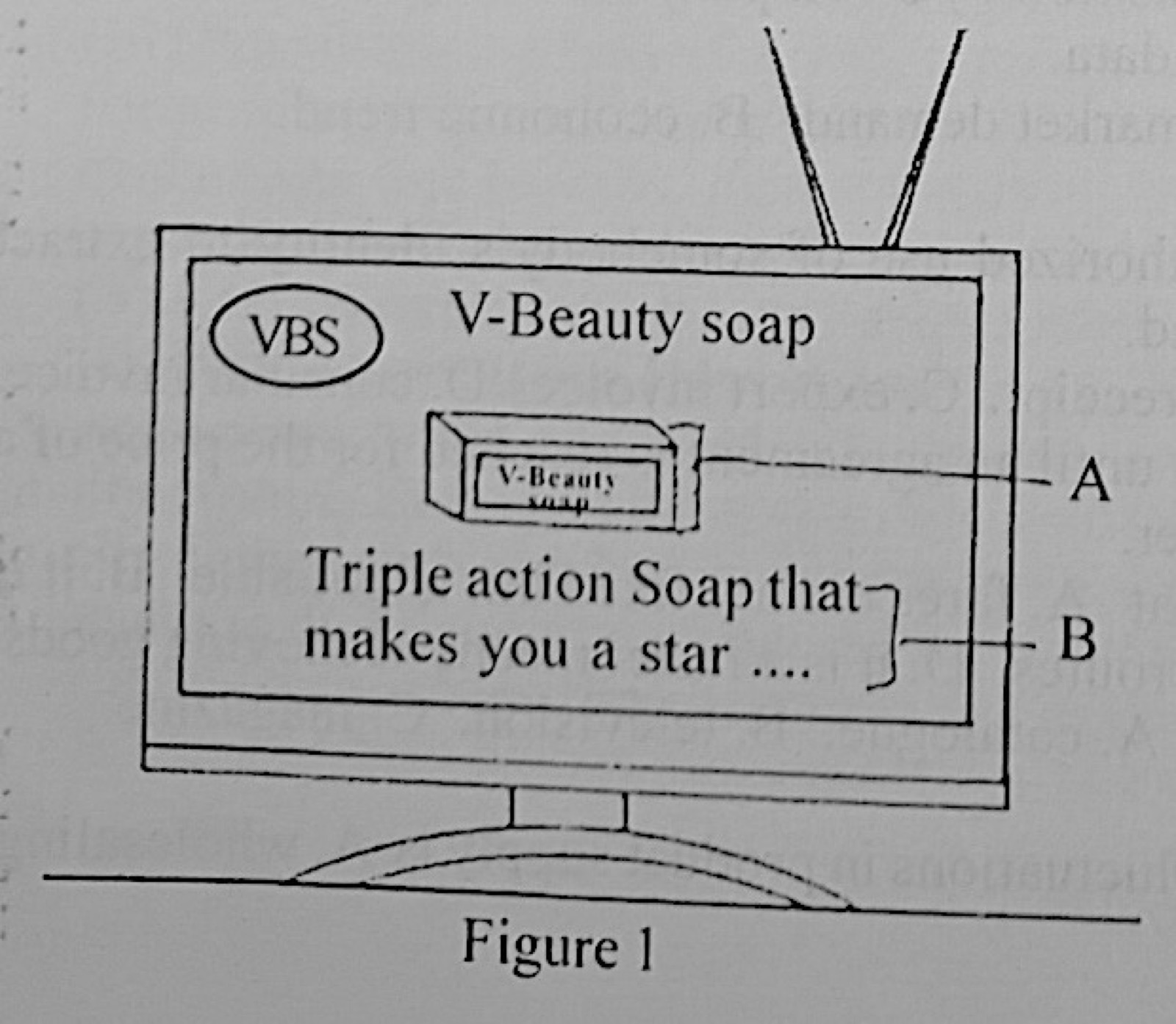
Use the advert in Figure 1 below to answer the following questions. (a) List six items that would be found on the package of the product labelled A. (b) State three functions of the part labelled B. (c) State four advantages of using this medium to advertise the product.
Show the model answer
Model answer
(a) Any six: brand name (V-Beauty); manufacturer's name and address; ingredients; weight/size; directions for use; manufacturing and expiry dates; NAFDAC/regulatory number; batch number; price; logo/trademark; barcode. (b) B is the slogan. Any three: makes the product easy to remember; communicates the product's main benefit; attracts attention and persuades buyers; distinguishes the brand from competitors; builds brand image. (c) The medium is television. Any four: combines sight, sound and movement; can demonstrate the soap in use; reaches a large audience; reaches people who cannot read; attractive and memorable; prestige.
Explanation
A is the soap pack, B is the slogan, and the medium is television.
(a) Outline four differences between organizational buying behaviour and consumer buying behaviour. (b) List and explain three influencing factors in organizational buying behaviour.
Show the model answer
Model answer
(a) Any four: organisations buy to produce or resell, consumers for personal use; organisational buyers are few and large, consumers many and small; organisational buying is done by trained professionals/committees, consumer buying by individuals; organisational purchases are large in volume and value; organisational demand is derived and fairly inelastic; organisational buying follows formal procedures (tenders, contracts); buyer-seller relationships are closer and longer-term; consumer buying is more emotional/impulsive. (b) Any three, explained: environmental factors (economy, technology, government policy, competition); organisational factors (objectives, policies, procedures, structure); interpersonal factors (authority, status, persuasiveness of members of the buying committee); individual factors (age, education, job position, personality of the buyers).
Explanation
Give each point as a full sentence, with an example where possible.