Question 1
MarketsThe need for an item backed by the ability to pay by a consumer is
- A.demand
- B.want
- C.exchange
- D.utility
Show the answer and explanation
Answer: A (demand)
Explanation
Demand is a want or need backed by the ability to pay.
43 questions. Try each one, then open the answer to check yourself and read the explanation.
The need for an item backed by the ability to pay by a consumer is
Answer: A (demand)
Demand is a want or need backed by the ability to pay.
An orientation that holds that a company's decision should include consumer satisfaction and community development is
Answer: A (societal marketing concept)
The societal marketing concept adds the welfare of society to customer satisfaction and profit.
The concept applied by XYZ Ltd that uses aggressive promotional efforts to attract customers to buy its brand of cosmetics is
Answer: C (selling concept)
The selling concept relies on aggressive selling and promotion to make people buy.
The process of bringing products to the attention of prospective customers is
Answer: B (promotion)
Promotion communicates with customers to make them aware of products.
The factors that influence the performance of marketing activities of a firm is marketing.
Answer: D (environment)
The marketing environment is all the internal and external forces that affect a firm's marketing activities.
Which of the following factors would influence a company's decision to change its production process?
Answer: A (Technological factor)
New technology gives firms new ways of producing, leading them to change their production process.
The set of variables a confectionery company uses to execute its marketing strategy is marketing.
Answer: A (mix)
The marketing mix (4Ps) is the set of controllable variables used to carry out a marketing strategy.
Iron ore is classified as
Answer: D (primary product)
Iron ore is taken straight from nature without processing, so it is a primary product.
Which of the following items is an example of primary product?
Answer: A (Cotton)
Cotton is a raw farm product; the others are made from it.
A product that is bought frequently on impulse at lower prices is
Answer: C (convenience goods)
Convenience goods are cheap items bought often and with little thought, sometimes on impulse.
Use the following information to answer questions 11 and 12.
OJ Ltd is a bakery that produces bread and confectioneries while Ernest Super Market buys its products.
OJ Ltd is an example of
Answer: B (an industrial market)
A bakery buys flour and other inputs to make products, so it is part of the industrial market; Ernest Super Market, which buys to resell, is the reseller.
Use the following information to answer questions 11 and 12.
OJ Ltd is a bakery that produces bread and confectioneries while Ernest Super Market buys its products.
Ernest Super Market is classified as
Answer: A (a retailer)
A supermarket sells goods in small quantities to final consumers: it is a retailer.
The last stage in the buying decision process is the
Answer: C (post-purchase behavior)
The buying process ends with post-purchase behaviour, when the buyer feels satisfied or not.
The systematic process of obtaining and analyzing data to provide information for marketing decision making is
Answer: A (marketing research)
This is the definition of marketing research.
A source of primary data for marketing research is
Answer: B (customer's feedback)
Feedback collected directly from customers is first-hand (primary) data; reports already kept are secondary.
Which of the following factors is not a price determinant?
Answer: D (Consumer's culture)
Cost, competitors' prices and demand directly affect price; culture does not.
Which pricing strategy is adopted by a company that sells its product for N200 when the prevailing market price for same product is N150?
Answer: A (Skimming pricing)
Charging more than the market price is skimming; penetration pricing would be below N150.
Which of the following pricing strategies is used by wholesalers of industrial goods?
Answer: A (Cost-plus pricing)
Wholesalers commonly add a fixed mark-up to their cost: cost-plus pricing.
Use the following information to answer questions 20 and 21.
ABC Foods has recently expanded its production capacity and is searching for a medium for advertising its products at a lower cost.
Which of the following advertising media would be suitable for the company?
Answer: C (Radio)
Radio reaches a wide audience at a much lower cost than television.
Use the following information to answer questions 20 and 21.
ABC Foods has recently expanded its production capacity and is searching for a medium for advertising its products at a lower cost.
A benefit that the company would derive from advertising the product is
Answer: B (increase in market share)
Advertising raises sales, increasing the firm's share of the market.
Sales promotion is important because it enables a business to
Answer: C (stimulate demand for its products)
Sales promotion offers short-term incentives that stimulate demand.
A form of sales promotion that rewards customers for consistently purchasing a company's product is
Answer: A (loyalty scheme)
Loyalty schemes reward customers for repeated purchases.
A person who carries out point-of sales promotion is
Answer: D (a merchandiser)
A merchandiser handles promotion at the point of sale.
Which of the following institutions is not a marketing intermediary?
Answer: C (Financial firms)
Financial firms help with finance but do not handle the goods; they are facilitators.
Use the following information to answer questions 26 and 27.
BIK Ltd has developed a new health application for the public.
Which of the following means would be used by the company to make the service available to the target market?
Answer: B (internet)
A health app is delivered online, through the internet.
Use the following information to answer questions 26 and 27.
BIK Ltd has developed a new health application for the public.
Which of the following illustrations would be used to distribute the application?
Answer: A (Producer→Consumer)
An app is downloaded directly from the developer by the user, a direct channel.
Air transport is preferred to other modes because it is
Answer: A (faster in transporting goods for long distance.)
Air transport is the fastest over long distances.
An activity performed in a warehouse is
Answer: B (sorting and labelling)
Warehouses store goods and also sort, grade and label them.
A specialized facility used for the storage of fruits and vegetables is
Answer: A (refrigerator)
Fruits and vegetables spoil quickly and are kept in cold storage (refrigeration).
Use the following information to answer questions 32 to 34.
The yam sellers in Alesinloye trading area in Kano formed an organization
The type of organization formed by the yam sellers is a
Answer: C (market union)
Traders selling the same product in a market form a market union.
Use the following information to answer questions 32 to 34.
The yam sellers in Alesinloye trading area in Kano formed an organization
Which of the following functions would be performed by the organization?
Answer: D (Disseminating information to members)
A market union passes useful market information to its members.
Use the following information to answer questions 32 to 34.
The yam sellers in Alesinloye trading area in Kano formed an organization
Which of the following reasons would have informed the formation of the association? To
Answer: C (protect the interest of members)
Market unions are formed mainly to protect their members' interests.
Use the following information to answer questions 35 and 36.
Muyi sets up a poultry business at the outskirts of Oshogbo upon retirement from the civil service.
Muyi is regarded as
Answer: D (an entrepreneur)
Muyi started his own business and bears its risk, so he is an entrepreneur.
A source of financing option available to a provision store owner is
Answer: D (personal savings)
A small sole trader cannot issue shares or debentures; personal savings are available.
A delivery note that accompanies goods to the buyer shows
Answer: C (quantity of goods bought)
A delivery note lists the goods and quantities delivered, not prices.
Use the information below to answer questions 39 and 40.
The inscription V-Cough on the product is an example of a
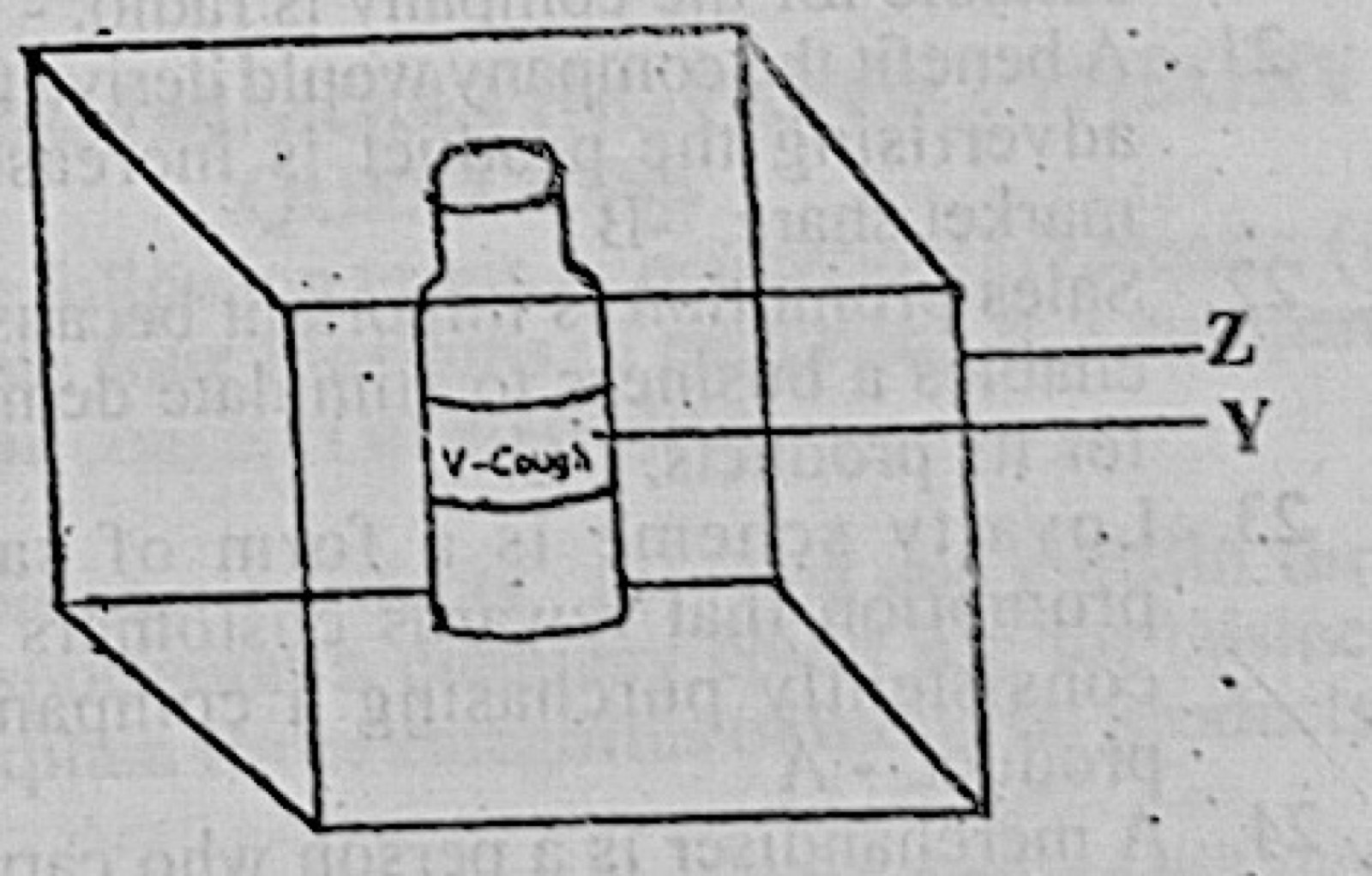
Answer: B (brand name)
V-Cough is the name used to identify the product: its brand name.
Use the information below to answer questions 39 and 40.
The part represented by the letter Z is the
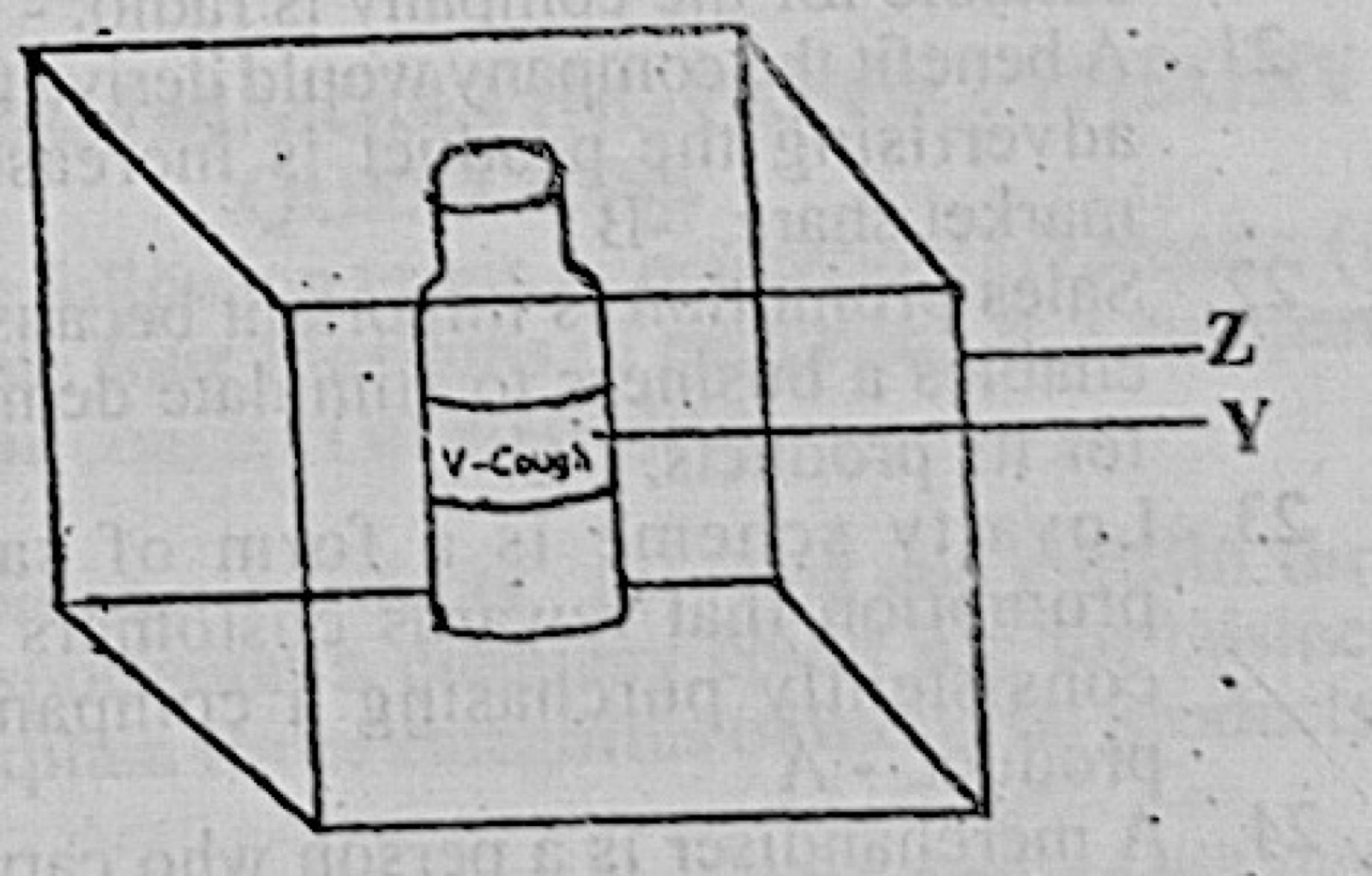
Answer: B (package)
Z points to the bottle that holds the medicine, which is its package; Y points to the label.
(a) State five functions of a wholesaler.
(b) Outline five factors that would influence the choice of a distribution channel by a producer.
(a) Any five: buys in bulk and sells in small lots to retailers (breaking bulk); stores goods; finances producers by prompt payment; gives credit to retailers; bears risks; transports goods to retailers; gives market information to producers and advice to retailers; grades and packs goods; promotes products.
(b) Any five: nature of the product (perishable, bulky, technical); size and location of the market; producer's financial resources; degree of control desired; unit value of the product; availability of suitable middlemen; channels used by competitors; government policies; size of orders.
Give five separate points in each part.
Mr Oke, the head of the purchasing committee in BIQ Ltd bought a television set for his family.
(a) Explain the first four steps Mr Oke took in buying the television.
(b) List and explain four factors that would influence the committee's buying behaviour.
(a) Need recognition: he realised the family needed a television.
Information search: he gathered information on brands, sizes and prices from adverts, shops and friends.
Evaluation of alternatives: he compared brands on price, quality, size and features.
Purchase decision: he chose the brand that suited his family and budget and bought it.
(b) Any four, explained: environmental factors (economy, inflation, interest rates, government policy, technology); organisational factors (objectives, policies, procedures, structure); interpersonal factors (authority, status and influence of committee members); individual factors (age, education, personality, experience of members); supplier factors (price, quality, reliability, credit terms).
In (a) apply each step to Mr Oke; (b) is about the company committee, not his family.
JK Ltd, a Nigerian company decides to expand its operations to the South African Market.
(a) State four reasons that would have necessitated the company's decision.
(b) List and explain four entry modes the company could use to enter the South African market.
(a) Any four: saturated or small home market; to reach a larger market and increase sales; to make more profit; to use excess production capacity; to spread risk across countries; favourable trade agreements (e.g. AfCFTA); to gain foreign exchange; to enjoy economies of scale; to meet demand found in South Africa.
(b) Any four, explained: exporting (direct or through agents); licensing; franchising; joint venture with a South African firm; direct investment (own subsidiary/factory); contract manufacturing; strategic alliance; e-commerce.
Give each point as a full sentence, with an example where possible.
(a) List two components each of the 4p's of marketing.
(b) List and explain four external factors affecting the marketing environment.
(a) Product: quality, design, features, brand name, packaging, size, warranty (any two).
Price: list price, discounts, allowances, credit terms, payment period (any two).
Place: channels, outlets/locations, transport, warehousing, inventory, coverage (any two).
Promotion: advertising, sales promotion, personal selling, publicity/public relations, direct marketing (any two).
(b) Any four, explained: political-legal (laws, government policy); economic (income, inflation, interest rates); social-cultural (values, beliefs, lifestyles); technological (new inventions); demographic (population size, age, sex); competitive (rivals' actions); natural/physical (climate, resources); suppliers, intermediaries and customers (micro-environment).
Give each point as a full sentence, with an example where possible.
Jo-Bo, a young graduate established a retail outlet in his neighbourhood instead of seeking for a paid employment.
(a) State five activities Jo-Bo would carry out to ensure continuous patronage by customers.
(b) State five benefits Jo-Bo would derive from his decision.
(a) Any five: stock a wide variety of quality goods; keep prices fair/competitive; treat customers politely; give credit to trusted customers; offer home delivery; display goods attractively; keep the shop clean; give gifts/discounts to loyal customers; keep regular opening hours; advertise and use social media.
(b) Any five: he is his own boss; he earns profit; independence in decision making; he can employ others; he develops business skills; self-satisfaction; flexible working hours; he can grow the business; he avoids unemployment.
Give each point as a full sentence, with an example where possible.
(a) State five factors that a manufacturer would consider before setting prices for his products.
(b) Explain five advantages of television over electronic billboard as a medium of advertising.
(a) Any five: cost of production; level of demand; competitors' prices; pricing objectives (profit, market share); government regulations and taxes; nature of the product; stage in the product life cycle; customers' ability to pay; cost of distribution and promotion.
(b) Any five, explained: TV reaches a much larger, nationwide audience while a billboard is seen only by people passing one place; TV combines sound, sight and movement; TV can demonstrate how the product works; TV messages are longer and can explain more; TV reaches viewers inside their homes, including those who do not travel; TV programmes let firms target audiences by time and programme; TV carries more prestige.
Give each point as a full sentence, with an example where possible.