Which of the following supports the view that there was commerce in Nigeria many years ago?
A.Communities were interdependent
B.The economy was subsistent
C.Specialization was minimal
D.Cowries were used as money
E.Horses were used as means of transportation
Show the answer and explanation
Answer: A (Communities were interdependent)
Explanation
Communities depending on one another for goods means they exchanged goods, which is commerce; a subsistence economy with little specialisation means little trade.
Which of the following is not an obligation of a common carrier?
A.Carrying goods securely and safely
B.Liability for losses and damages
C.Delivery of goods at appropriate places
D.Insuring goods in transit
E.Passing through agreed routes
Show the answer and explanation
Answer: D (Insuring goods in transit)
Explanation
A common carrier must carry goods safely, by the agreed route, deliver them and be liable for loss; insuring the goods is the owner's choice, not the carrier's duty.
Which of the following is not a means of effecting payments through a current account?
A.Cheques
B.Standing orders
C.Giro system
D.Credit transfer
E.Credit Card
Show the answer and explanation
Answer: C (Giro system)
Explanation
Cheques, standing orders, credit transfers and card payments are drawn on a current account; the giro system (the post office giro) works outside the current account.
The process whereby a firm buys over the assets and liabilities of another firm is known as
A.amalgamation
B.cartel
C.factoring
D.holding
E.combine
Show the answer and explanation
Answer: A (amalgamation)
Explanation
Taking over another firm's assets and liabilities so that the two become one business is amalgamation (merger/absorption); a holding company only buys controlling shares.
Use the following information to answer Questions 76-78: A company had an authorized share capital of N30,000. It offered applicants N20,000 share capital out of which the company collected N15,000. What was the issued capital?
A.N5,000
B.N10,000
C.N15,000
D.N20,000
E.N35,000
Show the answer and explanation
Answer: D (N20,000)
Explanation
Issued capital is the part of authorised capital offered to the public: N20,000.
Use the following information to answer Questions 76-78: A company had an authorized share capital of N30,000. It offered applicants N20,000 share capital out of which the company collected N15,000. What was the paid-up capital?
A.N35,000
B.N30,000
C.N20,000
D.N15,000
E.N5,000
Show the answer and explanation
Answer: D (N15,000)
Explanation
Paid-up capital is the money actually received from shareholders: N15,000.
Use the following information to answer Questions 76-78: A company had an authorized share capital of N30,000. It offered applicants N20,000 share capital out of which the company collected N15,000. What was the unissued capital?
Which of the following are true of small shops? I. They exist to serve a local market II. They provide personal services to customers III. There is not much opportunity for expansion IV. There is no need to employ paid assistants
A.I, II and III only
B.II, III and IV only
C.III and IV only
D.I, II and IV only
E.II and III only
Show the answer and explanation
Answer: A (I, II and III only)
Explanation
Small shops serve the neighbourhood, give personal service and have little room to grow; many do employ paid assistants, so IV is not always true.
Marketing is about bringing about exchange: giving something of value (goods or services) to get something of value (money) in return, to satisfy both sides.
Commerce 2 (answer five questions) (a) What is Commerce? (b) State and explain the importance of any five ancillary services to trade
Show the model answer
Model answer
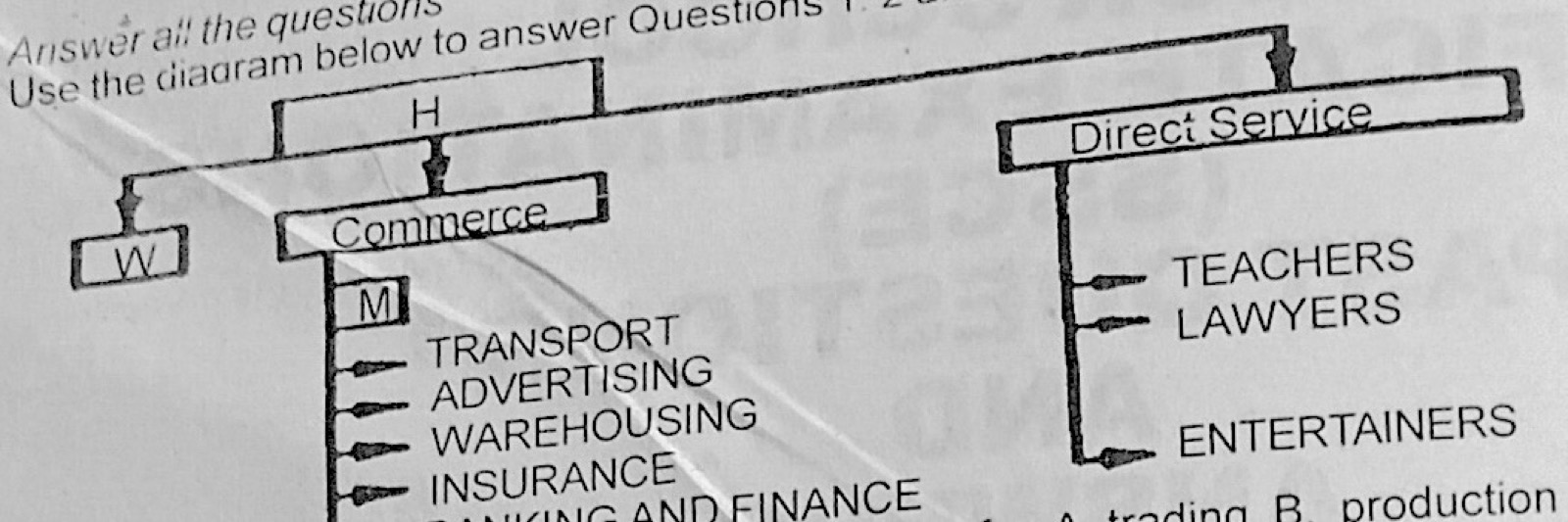
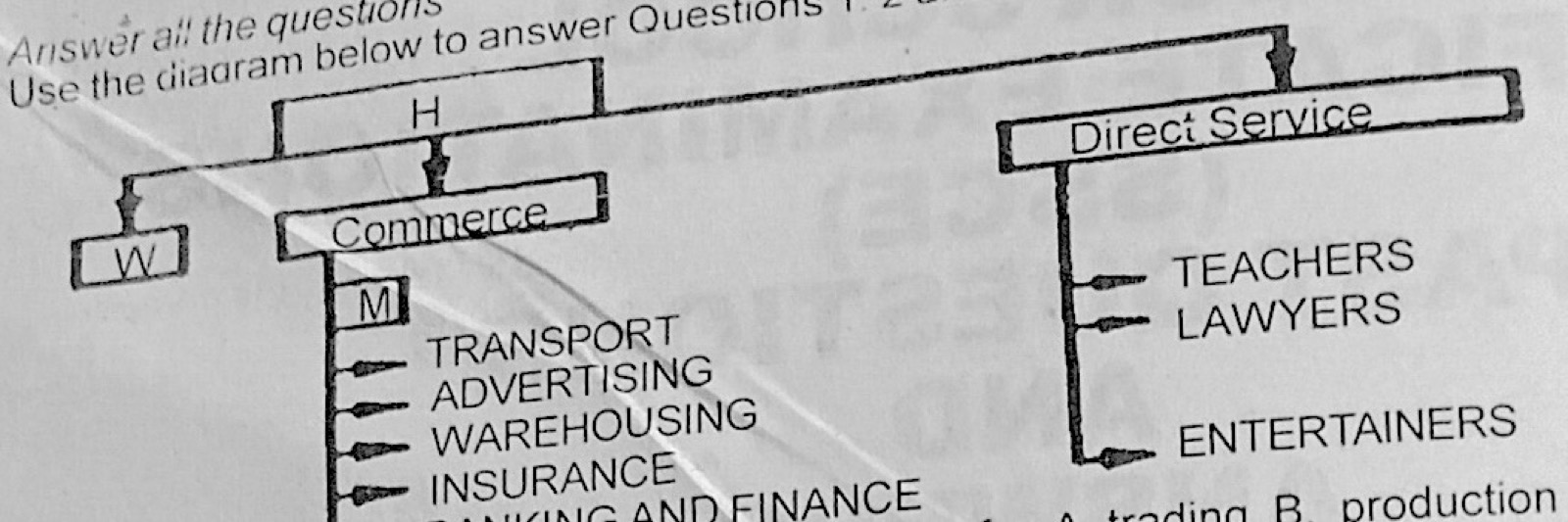
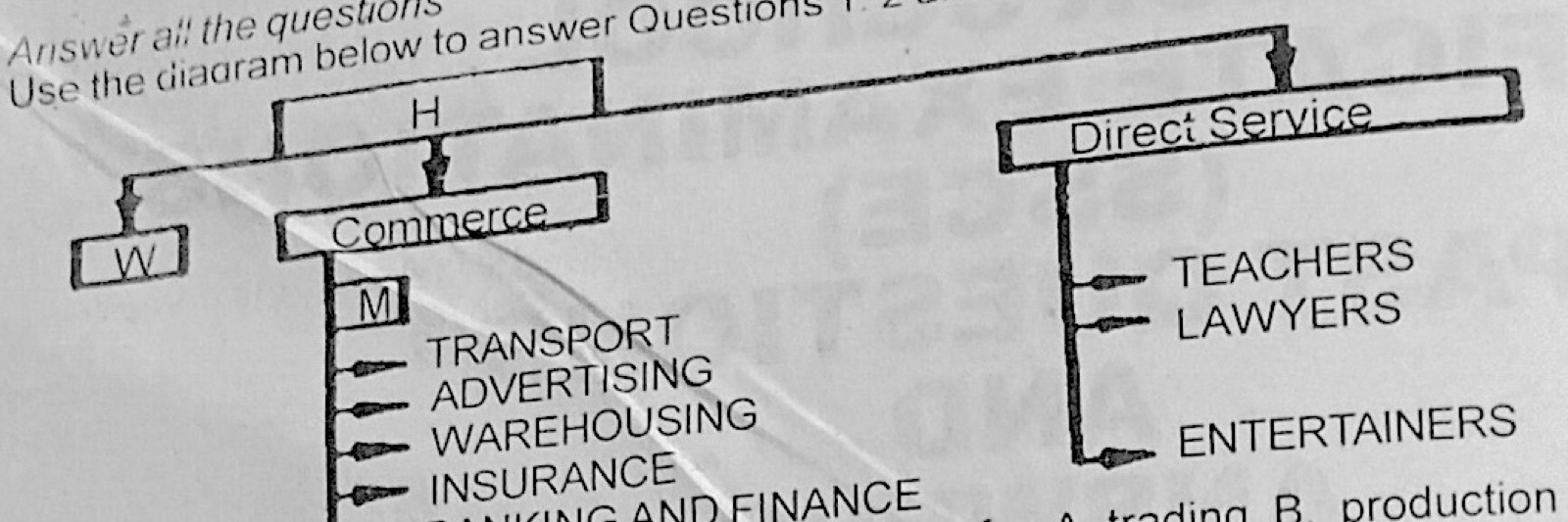
(a) Commerce is all the activities involved in buying and selling goods and services (trade) and the services that help trade (aids to trade) to get goods from producers to consumers. (b) Any five, each named and explained: Transport – moves goods from where they are produced to where they are needed (place utility). Warehousing – stores goods until they are needed, so production can run ahead of demand (time utility) and prices stay steady. Insurance – covers traders against risks such as fire, theft and accidents, so they can trade with confidence. Banking/finance – provides loans, overdrafts and safe means of payment such as cheques. Advertising – informs buyers about goods and persuades them to buy, increasing sales. Communication – lets buyers and sellers exchange information quickly (telephone, post, internet).
Explanation
Define commerce in one clear sentence, then explain how each aid removes a hindrance to trade.
Commerce 2 (answer five questions) (a) Messrs Ola and Musa are both merchants. Ola trades on cash basis only while Musa allows credit. Give four reasons each why Ola insists on cash payment and Musa allows credit sales (b) Distinguish between cash discount and trade discount
Show the model answer
Model answer
(a) Ola (cash only), any four: avoids bad debts; keeps his capital free for buying new stock (no money tied up in debtors); avoids the cost of collecting debts and going to court; less book-keeping; small capital cannot finance credit. Musa (credit), any four: to attract more customers and increase sales; to meet competition from rivals who give credit; to clear stock quickly, especially perishable or slow-moving goods; to keep the loyalty of regular customers; he can charge higher prices on credit; he has enough capital to wait for payment. (b) Trade discount is a reduction from the list price given by one trader to another (e.g. manufacturer to retailer) to allow for profit or for bulk buying; it is deducted on the invoice and not entered in the books. Cash discount is a reduction allowed to a buyer for paying promptly or within a stated period; it is given at the time of payment and recorded in the cash book.
Explanation
Give four separate reasons on each side, then contrast the two discounts by purpose and timing.
Commerce 2 (answer five questions) (a) Explain the meaning of working capital and state its importance (b) Outline any seven factors which might affect the rate of turnover.
Show the model answer
Model answer
(a) Working capital is current assets minus current liabilities: the funds available to run the business day by day. Importance: pays for stock, wages and other running costs; shows whether the business can pay its short-term debts (liquidity); allows the firm to take advantage of cash discounts and bulk buying; prevents the business from stopping for lack of funds. (b) Any seven: price of the goods; nature of the goods (perishable/fast-moving or durable); amount of capital to buy stock; advertising and sales promotion; credit facilities offered; location of the business; competition; season/fashion and changes in taste; efficiency and attitude of sales staff; income of customers; the range of goods stocked; transport and communication facilities.
Explanation
Give the formula for working capital, then list seven distinct factors briefly.
Commerce 2 (answer five questions) (a) What is a Bonded Warehouse? (b) State four ways in which a bonded warehouse may be useful in international trade
Show the model answer
Model answer
(a) A bonded warehouse is a warehouse, approved and supervised by the customs authority, where imported goods on which duty has not been paid are kept until the duty is paid or the goods are re-exported. (b) Any four: the importer pays duty only when he takes goods out, in instalments, so his capital is not tied up; goods meant for re-export (entrepot trade) can be re-exported without paying duty; goods can be blended, packed, sorted or graded while in bond; buyers can inspect samples there; goods are kept safe under customs watch; government revenue is protected.
Explanation
Stress that duty is unpaid while goods are in bond.
Commerce 2 (answer five questions) (a) Give any five advantages of advertising (b) What are five distinctive merits of television as a medium of advertising?
Show the model answer
Model answer
(a) Any five: informs consumers about new products; increases sales and turnover; makes large-scale production possible and so lowers unit cost; creates employment; helps consumers make choices; educates people on how to use products; builds goodwill and brand loyalty; brings revenue to the media. (b) Any five: combines sight, sound and movement, so it attracts attention; can demonstrate how a product is used; reaches a very large audience at once, including people who cannot read; adverts can be repeated often; prestige – it gives the product a good image; it reaches people at home when they are relaxed.
Explanation
In (b) give merits special to television, not general advantages of advertising.
Commerce 2 (answer five questions) Distinguish between the following (a) Broker and jobber (b) Gross profit and net profit (c) Fixed capital and liquid capital (d) Factors and del credere agents (e) F.O.B and C. I. F
Show the model answer
Model answer
(a) A broker buys and sells shares on behalf of the public and earns commission; a jobber dealt in shares on his own account with brokers only and earned a profit (the jobber's turn). (b) Gross profit = sales − cost of goods sold; net profit = gross profit − expenses (rent, wages, etc.). (c) Fixed capital is assets used over a long period without changing form (buildings, machines); liquid capital is cash or assets easily turned into cash (cash, bank balance, debtors). (d) A factor is an agent who has possession of the goods, sells them in his own name and may fix the price; a del credere agent sells for a principal and, for an extra commission, guarantees payment by the buyers he introduces. (e) F.O.B. (free on board): the price covers all costs until the goods are loaded on the ship; the buyer pays freight and insurance. C.I.F.: the price covers cost of goods, insurance and freight to the port of destination.
Explanation
Give both sides of each pair so the difference is clear.
Commerce 2 (answer five questions) (a) What is consumerism? (b) Give three reasons why consumers need protection (c) State any five measures taken by government or associations to protect consumers in Nigeria
Show the model answer
Model answer
(a) Consumerism is the organised movement by consumers, government and groups to protect consumers' rights and interests against unfair practices of producers and sellers. (b) Any three: to prevent sale of fake, adulterated or harmful goods; to stop overcharging and short measures/weights; to stop false and misleading advertisement; to stop hoarding and artificial scarcity; consumers are often ignorant of product quality. (c) Any five: laws such as the Weights and Measures Act, Food and Drugs Act, Hire Purchase Act and Price Control Act; agencies such as Standards Organisation of Nigeria (SON), NAFDAC and the Consumer Protection Council; price control boards; consumers' associations educating and representing consumers; trade associations' codes of conduct; Advertising Practitioners Council (APCON) controlling adverts; courts giving redress.
Commerce 2 (answer five questions) (a) What is meant by the term insurable risk? (b) Explain any four circumstances when an insured may not be indemnified
Show the model answer
Model answer
(a) An insurable risk is a risk whose chance of loss can be calculated from past statistics, so that an insurer can fix a premium for it (e.g. fire, theft, accident). Losses from speculative risks such as trade losses are not insurable. (b) Any four, explained: the insured failed to disclose material facts (breach of utmost good faith); the insured has no insurable interest in the property; the loss was not proximately caused by the risk insured against; the loss was deliberately caused by the insured, or is fraudulent; the policy had lapsed or premium was not paid; the loss is excluded by an exemption clause; the insured tries to profit from the loss (indemnity/contribution limit the claim to the actual loss).
Commerce 2 (answer five questions) (a) List five types of business units in Nigeria (b) Give five main differences between a retail co-operative society and a public limited liability company
Show the model answer
Model answer
(a) Sole proprietorship; partnership; private limited liability company; public limited liability company; co-operative society; public corporation (any five). (b) Any five: aim – co-operative serves members' welfare (cheap goods), company aims at profit; control – co-operative: one member one vote; company: votes according to number of shares; surplus – co-operative shares surplus by patronage (purchases), company pays dividend according to shares held; membership – co-operative open to people with a common interest, shares not sold on the stock exchange, company shares sold to the public on the stock exchange; registration – co-operative registered under Co-operative Societies law, company incorporated under Companies Act; management – committee elected from members vs board of directors; size of capital – company usually much larger.
Explanation
Present (b) point by point, comparing the two on the same feature.
Commerce 2 (answer five questions) Describe any five advantages of the Stock Exchange Market
Show the model answer
Model answer
Any five, described: provides a market for buying and selling existing securities, so investors can turn shares into cash (liquidity); helps companies and government raise long-term capital; encourages saving and investment; prices quoted show the value of shares and the health of companies and the economy; protects investors through strict rules for listing and dealing; helps government borrow by selling stocks and bonds; attracts foreign investment.
Explanation
Five clear advantages, each with a sentence of explanation.