48 questions. Try each one, then open the answer to check yourself and read the explanation.
Question 1
Friction
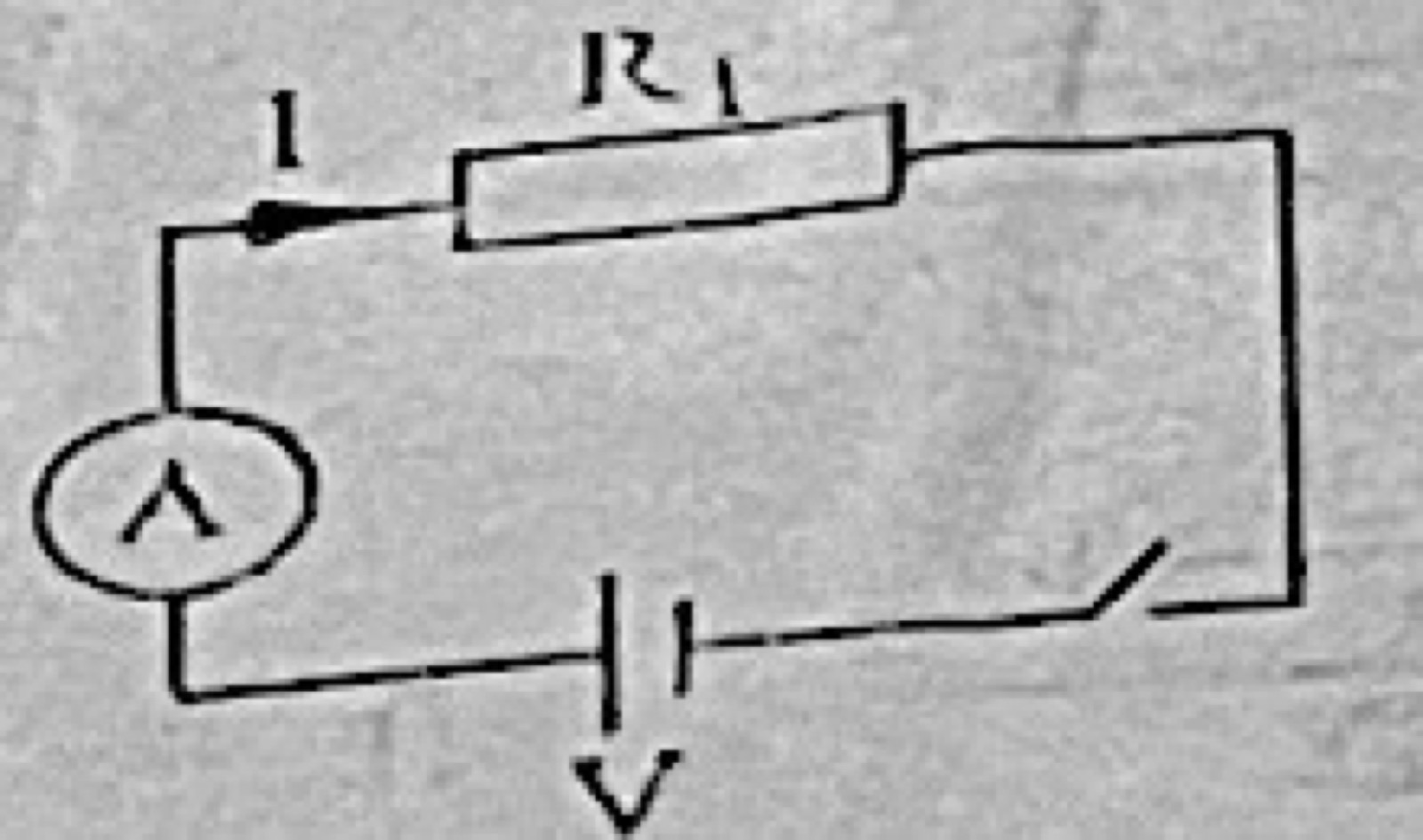
A bead travelling on a straight wire is brought to rest at 0.2m by friction. If the mass of the bead is 0.01kg and the coefficient of friction between the bead and the wire is 0.1, determine the work done by the friction. [g = 10ms−2]
On top of a spiral spring of force constant 500Nm−1 is placed a mass of 5 × 10⁻³ kg. If the spring is compressed downwards by a length of 0.02m and then released, calculate the height to which the mass is projected. [g = 10ms−2]
A.8m
B.4m
C.2m
D.1m
Show the answer and explanation
Answer: C (2m)
Explanation
Energy stored = ½ke2 = ½ × 500 × 0.022 = 0.1 J. This becomes mgh, so h = 0.1 ÷ (5 × 10−3 × 10) = 2 m.
A test tube of radius 1.0cm is loaded to 8.8g. If it is placed upright in water, find the depth to which it would sink. [g = 10ms−2, density of water = 1000kgm−3]
A.2.8cm
B.5.2cm
C.25.5cm
D.28.0cm
Show the answer and explanation
Answer: A (2.8cm)
Explanation
It floats when it displaces 8.8 g of water, i.e. 8.8 cm3. πr2h = 8.8 with r = 1 cm gives h ≈ 2.8 cm.
A hose of cross-sectional area 0.5m2 is used to discharge water from a water tanker at a velocity of 60ms−1 in 20s into a container. If the container is filled completely, the volume of the container is
A.240m3
B.600m3
C.2400m3
D.6000m3
Show the answer and explanation
Answer: B (600m3)
Explanation
Volume = area × speed × time = 0.5 × 60 × 20 = 600 m3.
A piece of stone attached to one end of a string is whirled round in a horizontal circle and the string suddenly cuts. The stone will fly off in a direction
A.perpendicular to the circular path
B.parallel to the circular path
C.tangential to the circular path
D.towards the centre of the circle.
Show the answer and explanation
Answer: C (tangential to the circular path)
Explanation
Once the string breaks there is no centripetal force, so the stone moves straight on along the tangent at that point.
A 90cm uniform lever has a load of 30N suspended at 15cm from one of its ends. If the fulcrum is at the centre of gravity, the force that must be applied at its other end to keep it in horizontal equilibrium is
A.15N
B.20N
C.30N
D.60N
Show the answer and explanation
Answer: B (20N)
Explanation
Fulcrum at 45 cm. Moments: 30 × (45 − 15) = F × 45, so F = 900/45 = 20 N.
T°C: 0, 5, 10, 15, 20, 40, 60 S.V.P (mmHg): 4.58, 6.51, 8.94, 12.67, 17.50, 55.10, 149.00 The table above shows the saturation vapour pressure against temperature in a certain town. If the vapour pressure in this town at 20°C is 10mmHg, what is the relative humidity?
A.170.0%
B.57.0%
C.17.5%
D.10.0%
Show the answer and explanation
Answer: B (57.0%)
Explanation
RH = actual vapour pressure ÷ SVP at that temperature × 100 = 10 ÷ 17.5 × 100 ≈ 57%.
A tuning fork of frequency 340Hz is vibrated just above a cylindrical tube of height 1.2m. If water is slowly poured into the tube, at what maximum height will resonance occur? [speed of sound in air = 340ms−1]
A.0.95 m
B.0.60m
C.0.50m
D.0.45m
Show the answer and explanation
Answer: A (0.95 m)
Explanation
λ = 340/340 = 1 m. The shortest resonating air column is λ/4 = 0.25 m, so the water can rise to 1.2 − 0.25 = 0.95 m.
An open pipe closed at one end produces its first fundamental note. If the velocity of sound in air is v and l the length of the pipe, the frequency of the note is
A.2v/l
B.v/5l
C.v/4l
D.v/2l
Show the answer and explanation
Answer: C (v/4l)
Explanation
For a pipe closed at one end the fundamental has λ = 4l, so f = v/(4l).
Given that Young's modulus for aluminium is 7.0 × 10¹⁰Nm−2 and density is 2.7 × 10³kgm−3, find the speed of the sound produced if a solid bar is struck at one end with a hammer.
A.5.1 × 103ms−1
B.4.2 × 103ms−1
C.3.6 × 103ms−1
D.2.8 × 103ms−1
Show the answer and explanation
Answer: A (5.1 × 10³ms−1)
Explanation
v = √(E/ρ) = √(7.0 × 10¹⁰ ÷ 2.7 × 10³) ≈ 5.1 × 10³ m s−1.
On a fairly cool rainy day when the temperature is 20°C, the length of a steel railroad track is 20m. What will be its length on a hot dry day when the temperature is 40°C? [coefficient of linear expansion of steel = 11 × 10−6 K−1]
A.20.013m
B.20.009m
C.20.004m
D.20.002m
Show the answer and explanation
Answer: C (20.004m)
Explanation
Increase = αLΔθ = 11 × 10−6 × 20 × 20 = 0.0044 m, so the length is about 20.004 m.
If an object is placed between two parallel plane mirrors with their reflecting surfaces facing each other, how many images of the object will be formed?
A.Infinite
B.Eight
C.Four
D.Two
Show the answer and explanation
Answer: A (Infinite)
Explanation
For parallel mirrors the angle between them is 0°, so n = 360/0 − 1 is infinite: the reflections go on forever.
A 2000W electric heater is used to heat a metal object of mass 5kg initially at 10°C. If a temperature rise of 30°C is obtained after 10min, the heat capacity of the material is
If 1.2 × 10⁶J of heat energy is given off in 1 sec. from a vessel maintained at a temperature gradient of 30Km−1, the surface area of the vessel is [thermal conductivity of the vessel = 400Wm−1K−1]
A.1.0 × 102m2
B.9.0 × 102m2
C.1.0 × 103m2
D.9.0 × 104m2
Show the answer and explanation
Answer: A (1.0 × 10²m2)
Explanation
Q/t = kA × (temperature gradient), so A = 1.2 × 10⁶ ÷ (400 × 30) = 100 m2.
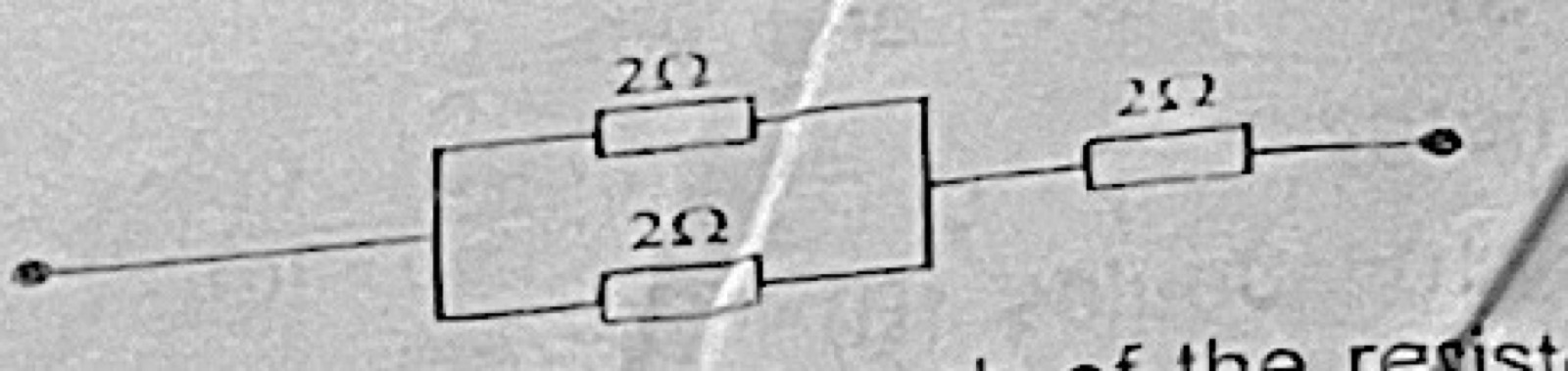
In the diagram above, if each of the resistors can dissipate a maximum of 18W without becoming excessively heated, what is the maximum power that circuit can dissipate?
A.27W
B.18W
C.9W
D.5W
Show the answer and explanation
Answer: A (27W)
Explanation
The series 2 Ω resistor carries the full current: 18 = I2 × 2 gives I = 3 A. Total resistance = 2 + 1 = 3 Ω, so P = I2R = 9 × 3 = 27 W.
The operation of an optical fibre is based on the principle of
A.dispersion of light
B.interference of light
C.refraction of light
D.polarization of light.
Show the answer and explanation
Answer: C (refraction of light)
Explanation
Optical fibres work by total internal reflection, which happens when light inside the glass meets the boundary at more than the critical angle; of the choices only refraction of light is related.
A ray of light is incident on an equilateral triangular glass prism of refractive index 3/2. Calculate the angle through which the ray is minimally deviated in the prism.
A.30.0°
B.37.2°
C.42.0°
D.48.6°
Show the answer and explanation
Answer: B (37.2°)
Explanation
n = sin((A + D)/2) ÷ sin(A/2). With A = 60° and n = 1.5: sin((60 + D)/2) = 0.75, so (60 + D)/2 = 48.6° and D ≈ 37.2°.
A wire of 5Ω resistance is drawn out so that its new length is two times the original length. If the resistivity of the wire remains the same and the cross-sectional area is halved, the new resistance is
A.40Ω
B.20Ω
C.10Ω
D.5Ω
Show the answer and explanation
Answer: B (20Ω)
Explanation
R = ρL/A. Doubling L and halving A each double R, so R = 5 × 2 × 2 = 20 Ω.
An electron of charge 1.6 × 10⁻¹⁹C is accelerated between two metal plates. If the kinetic energy of the electron is 4.8 × 10⁻¹⁷J, the potential difference between the plates is
A.30V
B.40V
C.300V
D.400V
Show the answer and explanation
Answer: C (300V)
Explanation
eV = KE, so V = 4.8 × 10⁻¹⁷ ÷ 1.6 × 10−19 = 300 V.
I. It retains its magnetism much longer than steel. II. It is more easily magnetized than steel. III. It is more easily demagnetized than steel. IV. It produces a stronger magnet than steel. Which combination of the above makes iron preferable to steel in the making of electromagnets?
A.I and II only
B.II and III only
C.I, III and IV only
D.II, III and IV only.
Show the answer and explanation
Answer: B (II and III only)
Explanation
An electromagnet must switch on and off, so its core must magnetise and demagnetise easily: soft iron does both, unlike steel.
In the calibration of an ammeter using Faraday's laws of electrolysis, the ammeter reading is kept constant at 1.20A. If 0.990g of copper is deposited in 40 minutes, the correction to be applied to the ammeter is [e.c.e. of copper = 3.3 × 10⁻⁴gC−1]
A.0.03A
B.0.04A
C.0.05A
D.0.06A
Show the answer and explanation
Answer: C (0.05A)
Explanation
m = zIt: 0.990 = 3.3 × 10⁻⁴ × I × 2400, so the true current I = 1.25 A. Correction = 1.25 − 1.20 = +0.05 A.
A circuit has an area of 0.4m2 and consists of 50 loops of wire. If the loops are twisted and allowed to rotate at a constant angular velocity of 10 rad s−1 in a uniform magnetic field of 0.4T, the amplitude of the induced voltage is
If the uncertainty in the measurement of the position of a particle is 5 × 10⁻¹⁰m, the uncertainty in the momentum of the particle is [h = 6.6 × 10⁻³⁴Js]
A.1.32 × 10−44Ns
B.3.30 × 10−44Ns
C.1.32 × 10−24Ns
D.3.30 × 10−24Ns
Show the answer and explanation
Answer: C (1.32 × 10⁻²⁴Ns)
Explanation
Using Δx × Δp ≈ h: Δp = 6.6 × 10⁻³⁴ ÷ 5 × 10−10 = 1.32 × 10⁻²⁴ N s.
The maximum kinetic energy of the photoelectrons emitted from a metal surface is 0.34eV. If the work function of the metal surface is 1.83eV, find the stopping potential.
A.2.17V
B.1.49V
C.1.09V
D.0.34V
Show the answer and explanation
Answer: D (0.34V)
Explanation
The stopping potential must cancel the maximum kinetic energy: eVs = 0.34 eV, so Vs = 0.34 V. The work function is not needed.
An electron makes a transition from a certain energy level EK to the ground state E0. If the frequency of emission is 8.0 × 10¹⁴ Hz, the energy emitted is [h = 6.6 × 10⁻³⁴Js]
A.8.25 × 10−19J
B.5.28 × 10−19J
C.5.28 × 1019J
D.8.25 × 1019J
Show the answer and explanation
Answer: B (5.28 × 10⁻¹⁹J)
Explanation
E = hf = 6.6 × 10−34 × 8.0 × 1014 = 5.28 × 10⁻¹⁹ J.
When a nucleus is formed by bringing protons and neutrons together, the actual mass of the formed nucleus is less than the sum of the masses of the constituent protons and neutrons. The energy equivalent of this mass difference is the
A.lost energy
B.work function
C.building energy
D.stability energy
Show the answer and explanation
Answer: C (building energy)
Explanation
The missing mass (mass defect) corresponds to the binding energy that holds the nucleus together.