JAMB Physics 1999 past questions and answers

48 questions. Try each one, then open the answer to check yourself and read the explanation.

Question 2

Newton's Laws and Momentum

A lead bullet of mass 0.05 kg is fired with a velocity of 200 m s−1 into a lead block of mass 0.95 kg. Given that the lead block can move freely, the final kinetic energy after impact is

  1. A.50 J
  2. B.100 J
  3. C.150 J
  4. D.200 J
Show the answer and explanation

Answer: A (50 J)

Explanation

Momentum is conserved: 0.05 × 200 = (0.05 + 0.95)v, so v = 10 m s−1. Final KE = ½ × 1 × 102 = 50 J.

Open this question

Question 3

Work, Energy and Power

A ball of mass 0.1 kg is thrown vertically upwards with a speed of 10 m s−1 from the top of a tower 10 m high. Neglecting air resistance, its total energy just before hitting the ground is [g = 10 m s−2]

  1. A.5 J
  2. B.10 J
  3. C.15 J
  4. D.20 J
Show the answer and explanation

Answer: C (15 J)

Explanation

Total energy is conserved, so it equals the starting energy: KE ½ × 0.1 × 102 = 5 J plus PE 0.1 × 10 × 10 = 10 J, giving 15 J.

Open this question

Question 4

Equilibrium of Forces

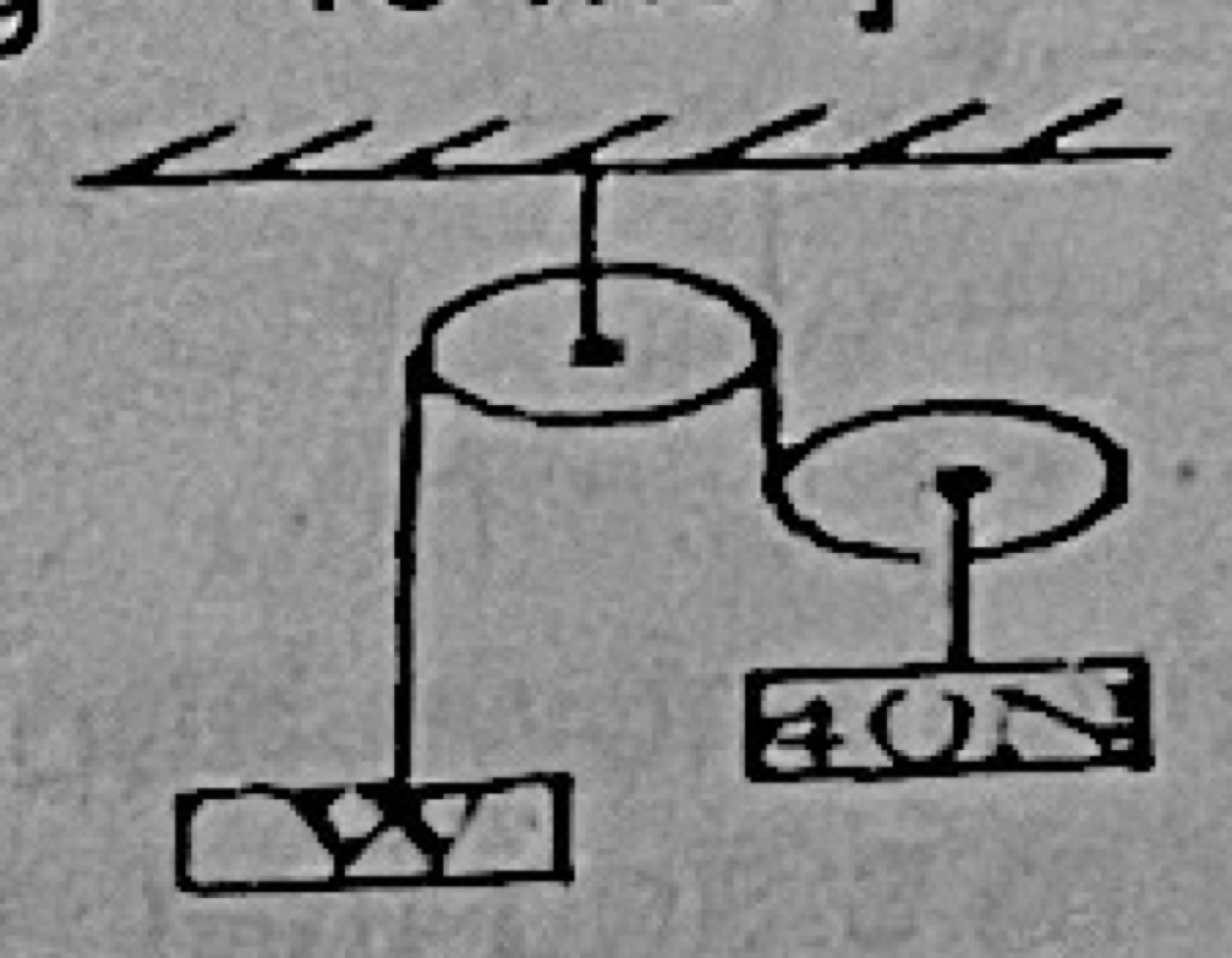
The figure above represents a frictionless pulley system in which a weight W is in equilibrium with a weight of 40 N. Find the value of W.

Diagram for this question
  1. A.13.3 N
  2. B.20.0 N
  3. C.40.0 N
  4. D.80.0 N
Show the answer and explanation

Answer: C (40.0 N)

Explanation

The same rope passes over a frictionless pulley, so the tension is the same on both sides. W balances the 40 N weight, so W = 40 N.

Open this question

Question 5

Equilibrium of Forces

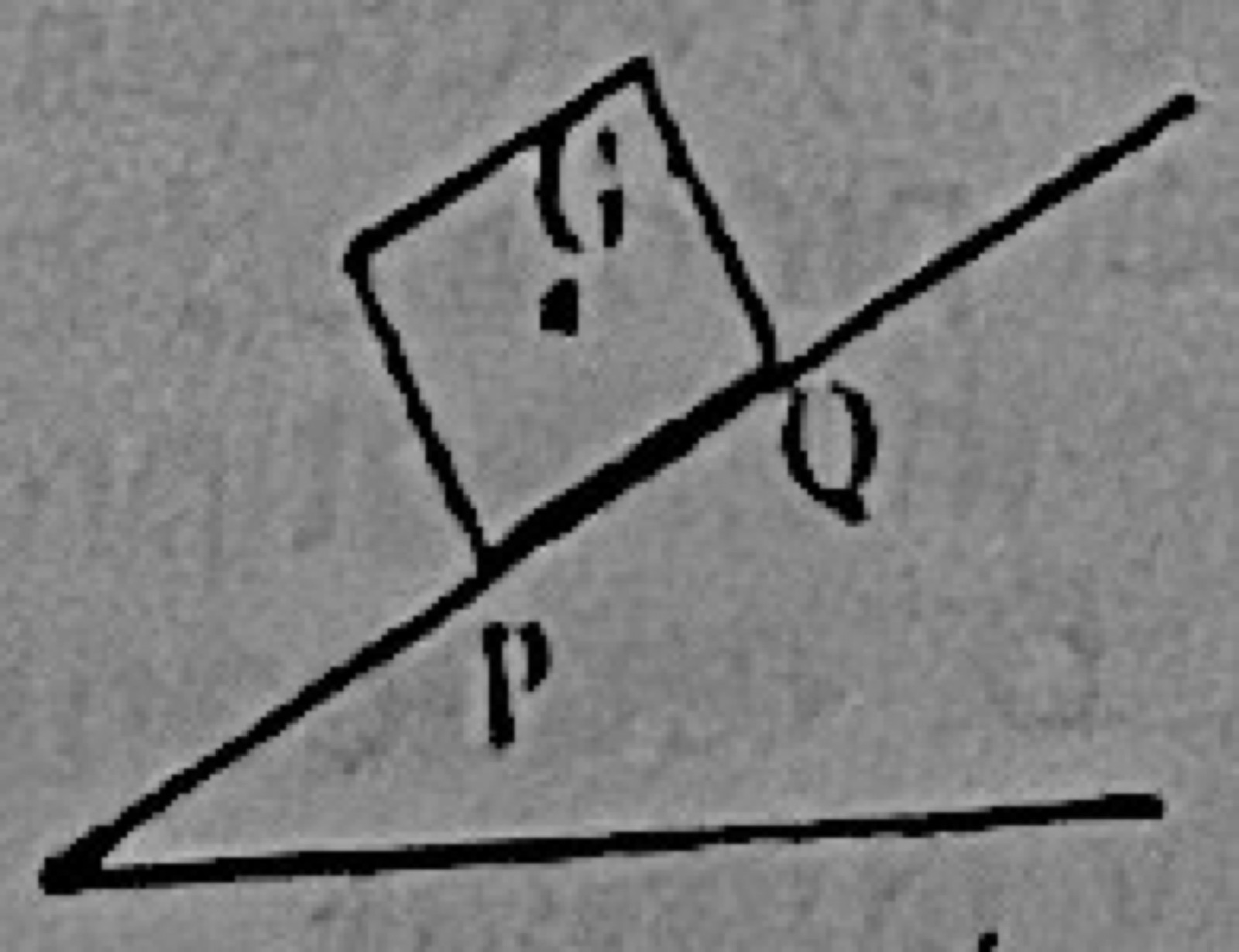
The diagram above shows a solid figure with base PQ and centre of gravity G on an inclined plane. Which of the following statements is correct?

Diagram for this question
  1. A.The solid will fall over if the vertical line through G lies outside the base
  2. B.The solid will fall over if the vertical line through G lies inside the base
  3. C.The solid will not fall over if the vertical line through G lies outside the base.
  4. D.The solid can never fall over.
Show the answer and explanation

Answer: A (The solid will fall over if the vertical line through G lies outside the base)

Explanation

A body topples when the vertical line through its centre of gravity falls outside its base, because its weight then gives a turning moment about the edge.

Open this question

Question 6

Newton's Laws and Momentum

Two bodies have masses in the ratio 3 : 1. They experience forces which impart to them accelerations in the ratio 2 : 9 respectively. Find the ratio of the forces the masses experience.

  1. A.1:4
  2. B.2:1
  3. C.2:3
  4. D.2:5
Show the answer and explanation

Answer: C (2:3)

Explanation

F = ma, so F1/F2 = (3 × 2)/(1 × 9) = 6/9 = 2/3.

Open this question

Question 7

Motion

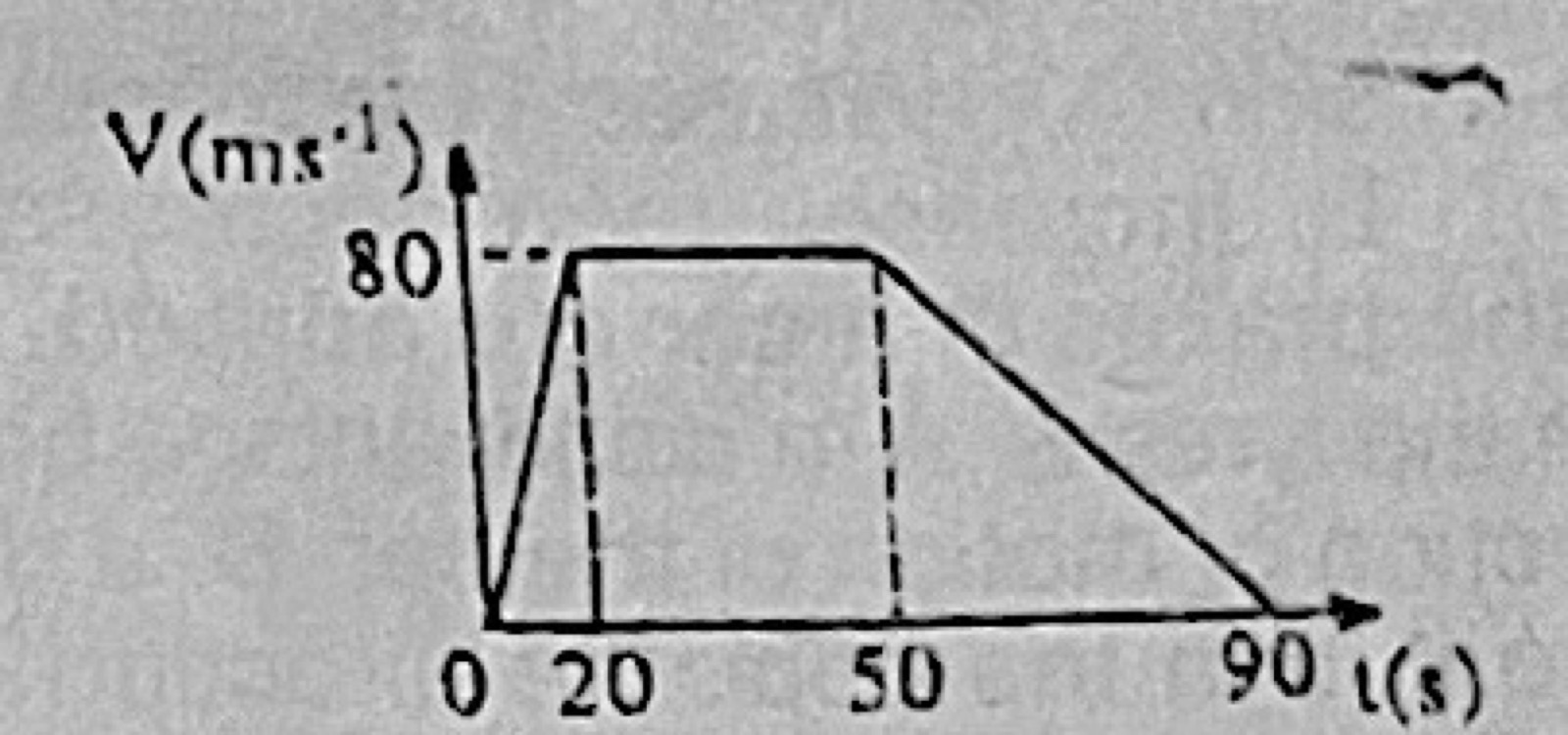
The diagram above shows the velocity time graph of a vehicle. Its acceleration and retardation respectively are

Diagram for this question
  1. A.8.0 m s−2, 4.0 m s−2
  2. B.4.0 m s−2, 8.0 m s−2
  3. C.4.0 m s−2, 2.0 m s−2
  4. D.2.0 m s−2, 4.0 m s−2
Show the answer and explanation

Answer: C (4.0 m s−2, 2.0 m s−2)

Explanation

Acceleration = 80/20 = 4.0 m s−2 (0 to 20 s). Retardation = 80/(90 − 50) = 2.0 m s−2.

Open this question

Question 8

Motion

A particle of mass 10−2 kg is fixed to the tip of a fan blade which rotates with angular velocity of 100 rad s−1. If the radius of the blade is 0.2 m, the centripetal force is

  1. A.2 N
  2. B.20 N
  3. C.200 N
  4. D.400 N
Show the answer and explanation

Answer: B (20 N)

Explanation

F = mω2r = 10−2 × 1002 × 0.2 = 20 N.

Open this question

Question 9

Measurement and Units

The inner diameter of a small test tube can be measured accurately using a

  1. A.micrometer screw guage
  2. B.pair of dividers
  3. C.metre rule
  4. D.pair of vernier calipers.
Show the answer and explanation

Answer: D (pair of vernier calipers.)

Explanation

Vernier calipers have inside jaws for internal diameters and read to 0.01 cm; a micrometer screw gauge cannot reach inside a tube.

Open this question

Question 10

Gas Laws

A gas at a volume Vo in a container at pressure Po is compressed to one fifth of its volume. What will be its pressure if it maintains its original temperature T?

  1. A.Po/5
  2. B.⅘ Po
  3. C.Po
  4. D.5 Po
Show the answer and explanation

Answer: D (5 Po)

Explanation

At constant temperature PV is constant (Boyle's law). If the volume becomes Vo/5, the pressure becomes 5Po.

Open this question

Question 11

Quantity of Heat

A piece of substance of specific heat capacity 450 J kg−1 K−1 falls through a vertical distance of 20 m from rest. Calculate the rise in temperature of the substance on hitting the ground when all its energies are converted into heat

  1. A.2/9 °C
  2. B.4/9 °C
  3. C.5/4 °C
  4. D.9/2 °C
Show the answer and explanation

Answer: B (4/9 °C)

Explanation

mgh = mcθ, so θ = gh/c = (10 × 20)/450 = 4/9 °C (taking g = 10 m s−2).

Open this question

Question 12

Pressure

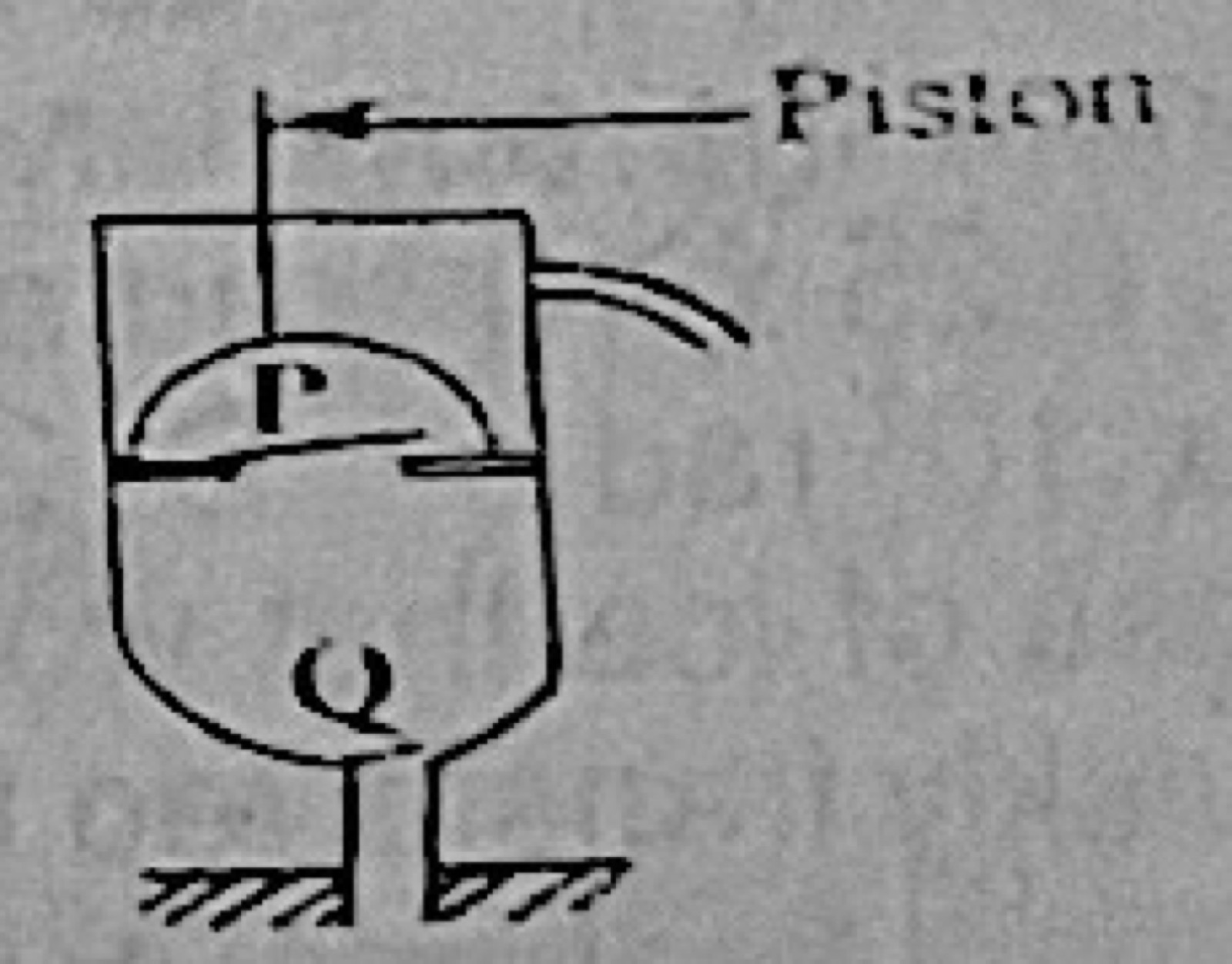
The diagram above shows a lift pump with valves at P and Q. During a downward stroke of the piston

Diagram for this question
  1. A.both valves are open
  2. B.P is open while Q is closed
  3. C.P is closed while Q is open
  4. D.both valves are closed.
Show the answer and explanation

Answer: B (P is open while Q is closed)

Explanation

On the downstroke the water below the piston is pushed up: it closes the bottom valve Q and opens the piston valve P so the water passes above the piston.

Open this question

Question 13

Gas Laws

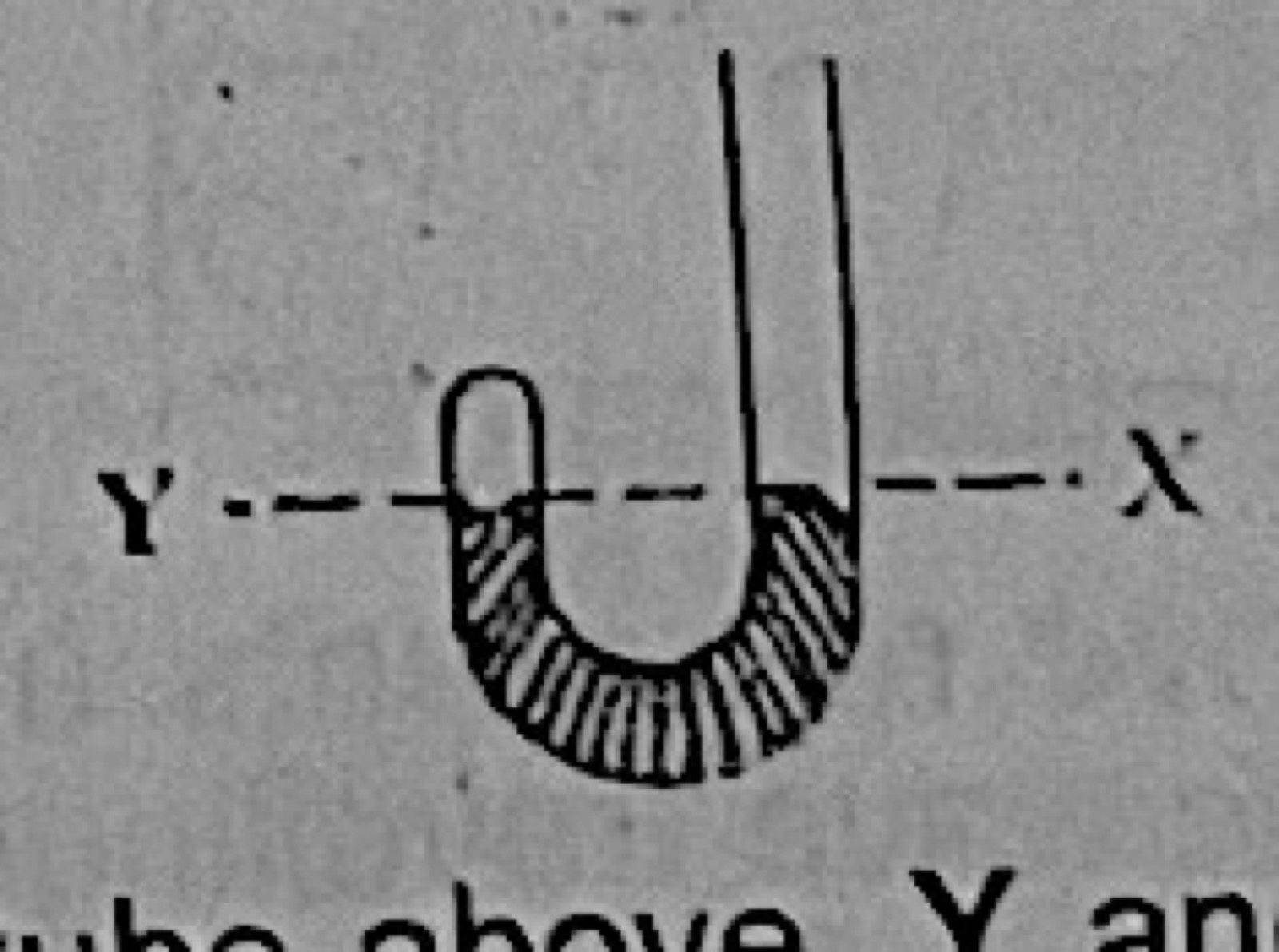
In the J-tube above, Y and X are on the same horizontal level and 30 cm3 of air is trapped above Y when the atmospheric pressure is 75 cm Hg. Calculate the volume of air trapped above Y when 15 cm Hg is now poured into the limb above X.

Diagram for this question
  1. A.15 cm3
  2. B.25 cm3
  3. C.35 cm3
  4. D.45 cm3
Show the answer and explanation

Answer: B (25 cm3)

Explanation

The trapped air's pressure rises from 75 to 75 + 15 = 90 cm Hg. By Boyle's law 75 × 30 = 90 × V, so V = 25 cm3.

Open this question

Question 14

Elasticity

If the stress on a wire is 107 N m−2 and the wire is stretched from its original length of 10.00 cm to 10.05 cm. The Young's modulus of the wire is

  1. A.5.0 × 104 N m−2
  2. B.5.0 × 105 N m−2
  3. C.2.0 × 108 N m−2
  4. D.2.0 × 109 N m−2
Show the answer and explanation

Answer: D (2.0 × 10⁹ N m−2)

Explanation

Strain = 0.05/10.00 = 0.005. Young's modulus = stress/strain = 107/0.005 = 2.0 × 10⁹ N m−2.

Open this question

Question 15

Density and Upthrust

A solid weighs 10.0 N in air, 6.0 N when fully immersed in water and 7.0 N when fully immersed in a certain liquid X. Calculate the relative density of the liquid.

  1. A.5/3
  2. B.4/3
  3. C.3/4
  4. D.7/10
Show the answer and explanation

Answer: C (3/4)

Explanation

Relative density = loss of weight in liquid ÷ loss of weight in water = (10 − 7)/(10 − 6) = 3/4.

Open this question

Question 16

Change of State and Vapours

I. A liquid boils when its saturated vapour pressure is equal to the external pressure
II. Dissolved substances in pure water lead to increase in the boiling point
III. When the external pressure is increased, the boiling point increases
IV. Dissolved substances in pure water decrease the boiling point.
Which combination of the above are peculiarities of the boiling point of a liquid?

  1. A.I, II and III
  2. B.I, II, III and IV
  3. C.I, II and IV
  4. D.II, III and IV.
Show the answer and explanation

Answer: A (I, II and III)

Explanation

Statements I, II and III are true. IV is false: dissolved substances raise the boiling point, they do not lower it.

Open this question

Question 17

Structure of Matter and Kinetic Theory

When the temperature of a liquid is increased, its surface tension

  1. A.decreases
  2. B.increases
  3. C.remains constant
  4. D.increases then decreases.
Show the answer and explanation

Answer: A (decreases)

Explanation

Heating weakens the attraction between liquid molecules, so surface tension falls as temperature rises.

Open this question

Question 18

Friction

When the brakes in a car are applied, the frictional force on the tyres is

  1. A.a disadvantage because it is in the direction of motion of the car
  2. B.a disadvantage because it is in the opposite direction of motion of the car
  3. C.an advantage because it is in the direction of motion of the car
  4. D.an advantage because it is in the opposite direction of motion of the car.
Show the answer and explanation

Answer: D (an advantage because it is in the opposite direction of motion of the car.)

Explanation

Friction acts opposite to the car's motion, and that is what slows the car down, so here it is useful.

Open this question

Question 20

Light and Reflection

A man stands 4 m in front of a plane mirror. If the mirror is moved 1 m towards the man, the distance between him and his new image is

  1. A.3 m
  2. B.5 m
  3. C.6 m
  4. D.10 m
Show the answer and explanation

Answer: C (6 m)

Explanation

The man is now 3 m from the mirror, and his image is 3 m behind it, so they are 3 + 3 = 6 m apart.

Open this question

Question 21

Sound

If a sound wave goes from a cold-air region to a hot-air region, its wavelength will

  1. A.increase
  2. B.decrease
  3. C.decrease then increase
  4. D.remain constant.
Show the answer and explanation

Answer: A (increase)

Explanation

Sound travels faster in hot air while the frequency stays the same, so λ = v/f increases.

Open this question

Question 22

Light and Reflection

The inside portion of part of a hollow metal sphere of diameter 20 cm is polished. The portion will therefore form a

  1. A.concave mirror of focal length 5 cm
  2. B.concave mirror of focal length 10 cm
  3. C.convex mirror of focal length 5 cm
  4. D.convex mirror of focal length 20 cm.
Show the answer and explanation

Answer: A (concave mirror of focal length 5 cm)

Explanation

A polished inside surface curves inwards, so it is a concave mirror. Its radius of curvature is 10 cm, so f = r/2 = 5 cm.

Open this question

Question 23

Waves

The equation of a wave travelling along the positive x-direction is given by y = 0.25 × 10⁻³ sin (500 t − 0.025x). Determine the angular frequency of the wave motion.

  1. A.0.25 × 10−3 rad s−1
  2. B.0.25 × 10−1 rad s−1
  3. C.5.00 × 102 rad s−1
  4. D.2.50 × 103 rad s−1
Show the answer and explanation

Answer: C (5.00 × 10² rad s−1)

Explanation

Compare with y = A sin(ωt − kx): the coefficient of t is ω = 500 = 5.00 × 10² rad s−1.

Open this question

Question 24

Change of State and Vapours

Calculate the mass of ice that would melt when 2 kg of copper is quickly transferred from boiling water to a block of ice without heat loss [Specific heat capacity of copper = 400 J kg−1 K−1; Latent heat of fusion of ice = 3.3 × 10⁵ J kg−1]

  1. A.8/33 kg
  2. B.33/80 kg
  3. C.80/33 kg
  4. D.33/8 kg
Show the answer and explanation

Answer: A (8/33 kg)

Explanation

Heat given by copper cooling from 100 °C to 0 °C = 2 × 400 × 100 = 80 000 J. Mass melted = 80 000/(3.3 × 105) = 8/33 kg.

Open this question

Question 25

Waves

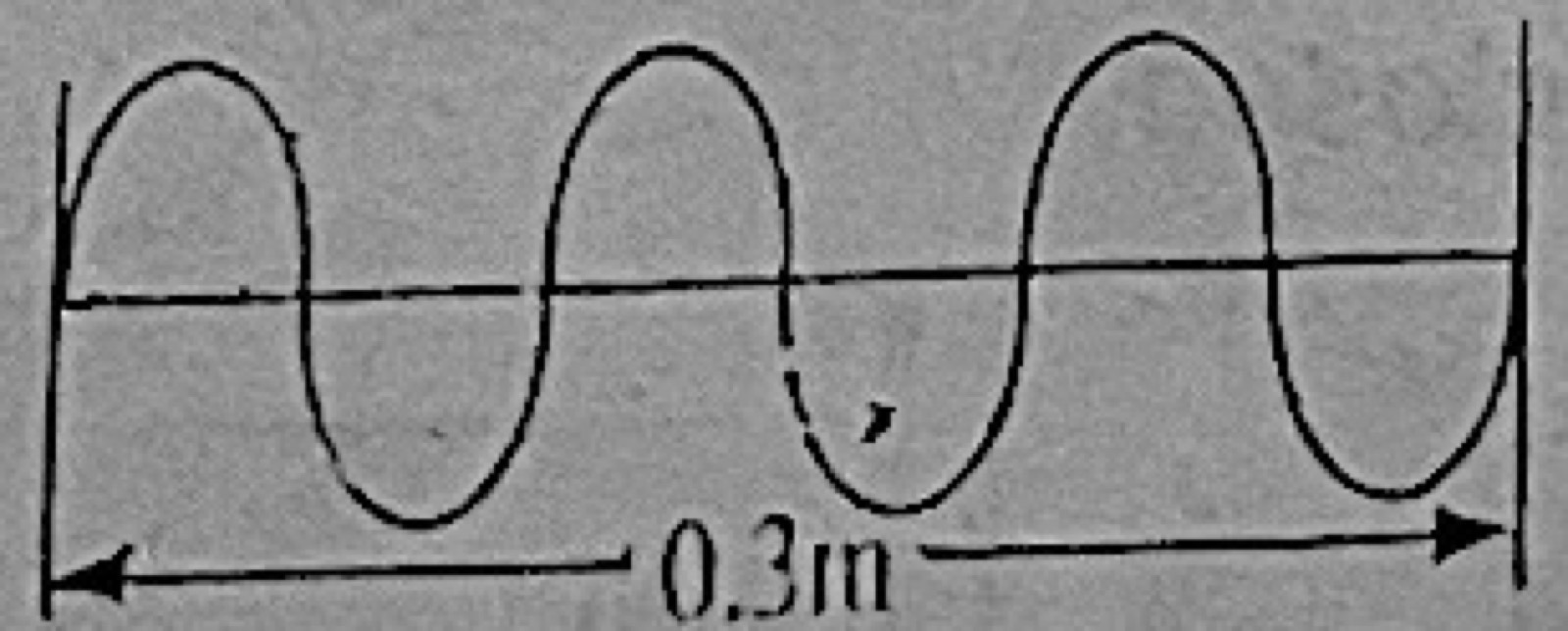
The diagram above represents a transverse electromagnetic wave travelling with speed 3.0 × 10⁸ m s−1. What is the frequency of the wave?

Diagram for this question
  1. A.3.0 × 107 Hz
  2. B.9.0 × 107 Hz
  3. C.1.0 × 109 Hz
  4. D.3.0 × 109 Hz
Show the answer and explanation

Answer: D (3.0 × 10⁹ Hz)

Explanation

Three complete waves fit in 0.3 m, so λ = 0.1 m. f = v/λ = 3.0 × 10⁸/0.1 = 3.0 × 10⁹ Hz.

Open this question

Question 26

Heat Transfer

The temperature gradient across a copper rod of thickness 0.02 m, maintained at two temperature junctions of 20 °C and 80 °C respectively is

  1. A.3.0 × 102 K m−1
  2. B.3.0 × 103 K m−1
  3. C.5.0 × 103 K m−1
  4. D.3.0 × 104 K m−1
Show the answer and explanation

Answer: B (3.0 × 10³ K m−1)

Explanation

Temperature gradient = temperature difference ÷ thickness = (80 − 20)/0.02 = 3000 = 3.0 × 10³ K m−1.

Open this question

Question 27

Electromagnetic Spectrum

Which of the following electromagnetic waves is least energetic?

  1. A.Infra-red rays
  2. B.X-rays
  3. C.Ultra-violet rays.
  4. D.Gamma rays.
Show the answer and explanation

Answer: A (Infra-red rays)

Explanation

Photon energy rises with frequency. Of these, infra-red has the lowest frequency, so it is the least energetic; gamma rays are the most energetic.

Open this question

Question 28

Magnetism

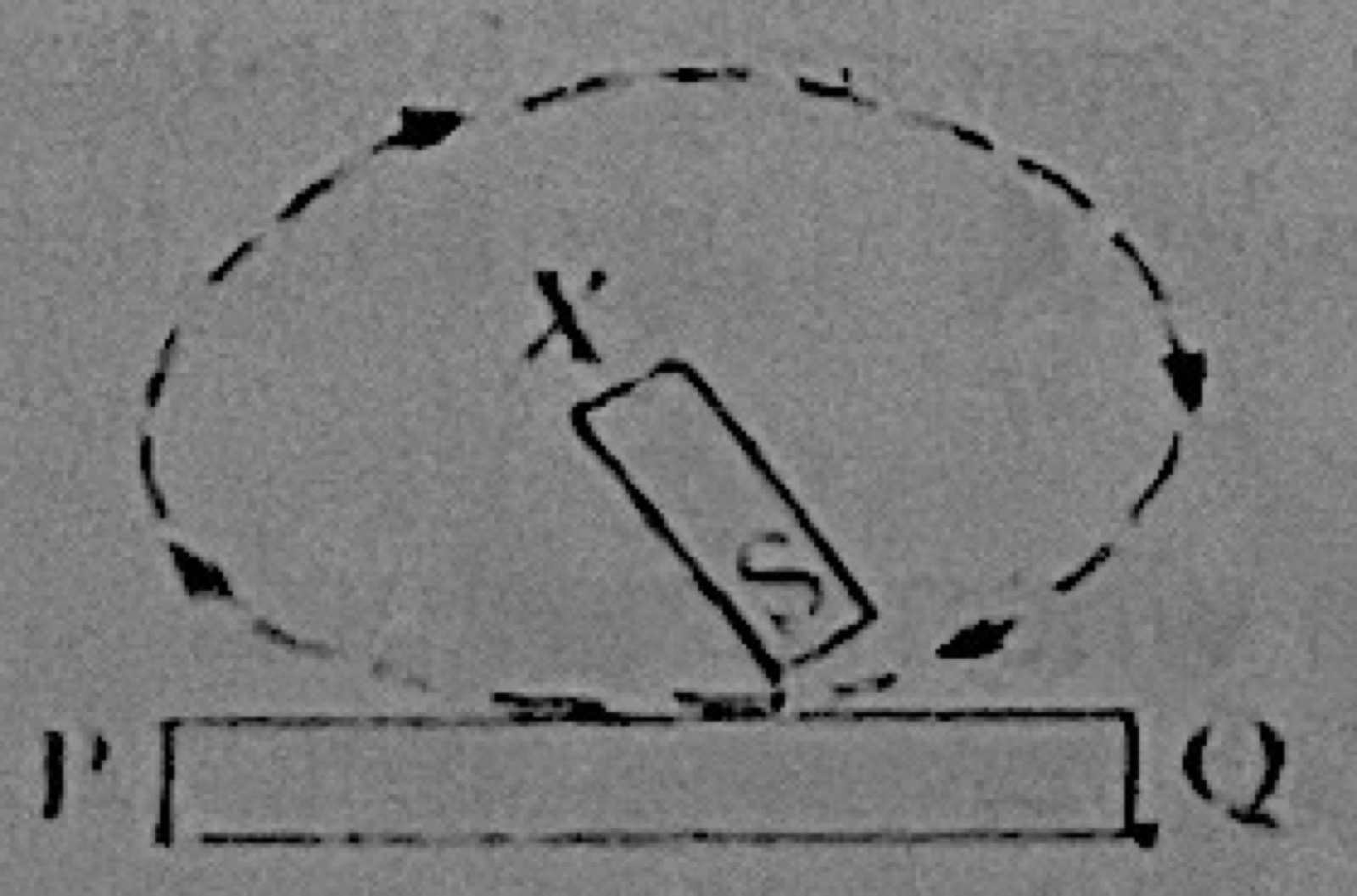
The diagram above shows a magnet X with its South pole moved along a soft-iron bar PQ in the direction shown. After some time, the poles at P and Q respectively are

Diagram for this question
  1. A.North-North
  2. B.North-South
  3. C.South-North
  4. D.South-South.
Show the answer and explanation

Answer: B (North-South)

Explanation

In single-touch stroking the end where each stroke finishes gets the opposite pole to the stroking pole. The S pole is stroked from Q to P, so P becomes North and Q South.

Open this question

Question 29

Current Electricity

Four cells each of e.m.f. 1.5 V and internal resistance of 4 Ω are connected in parallel. What is the effective e.m.f. and internal resistance of the combination?

  1. A.6.0 V, 16 Ω
  2. B.6.0 V, 1 Ω
  3. C.1.5 V, 4 Ω
  4. D.1.5 V, 1 Ω.
Show the answer and explanation

Answer: D (1.5 V, 1 Ω.)

Explanation

Identical cells in parallel keep the e.m.f. of one cell (1.5 V), and their internal resistances combine as 4/4 = 1 Ω.

Open this question

Question 30

Current Electricity

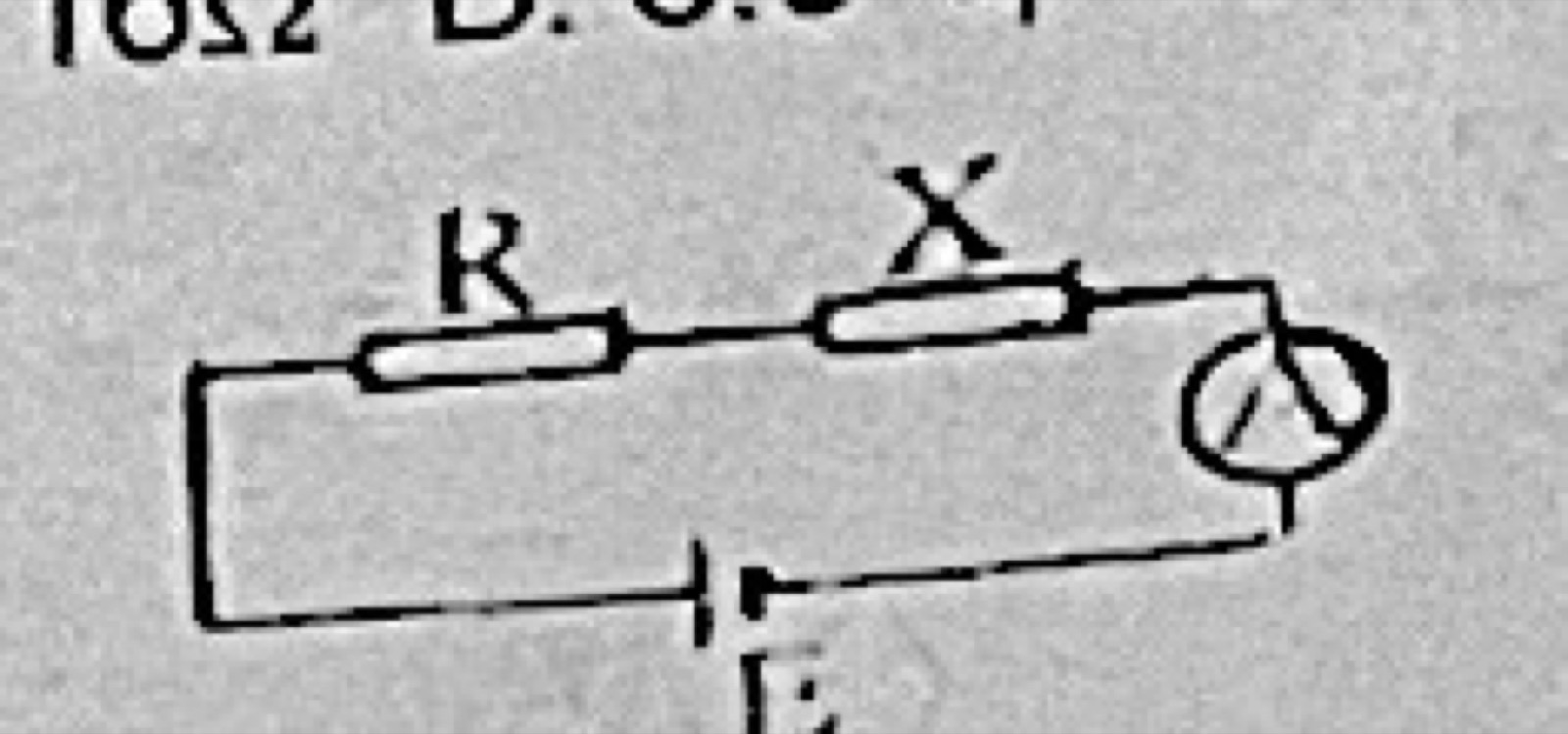
In the circuit above, the ammeter reads a current of 5.0 A when R = 8 Ω and reads 7.0 A when R = 5 Ω. The value of the unknown resistance X is

Diagram for this question
  1. A.10.0 Ω
  2. B.7.5 Ω
  3. C.5.0 Ω
  4. D.2.5 Ω
Show the answer and explanation

Answer: D (2.5 Ω)

Explanation

E = I(R + X) in both cases: 5(8 + X) = 7(5 + X), so 40 + 5X = 35 + 7X and X = 2.5 Ω.

Open this question

Question 31

Lenses and Optical Instruments

An astronomical telescope is said to be in normal adjustment when the

  1. A.eye is accomodated
  2. B.focal length of objective lens is longer than that of eye piece
  3. C.final image is at the near point of eye
  4. D.final image is at infinity.
Show the answer and explanation

Answer: D (final image is at infinity.)

Explanation

In normal adjustment the final image is formed at infinity, so the eye views it relaxed.

Open this question

Question 32

Magnetism

Steel is more suitable for permanent magnet than iron because the former

  1. A.is easily demagnetized by shaking vigorously
  2. B.is an alloy of many metals
  3. C.is easily magnetized by alternating current through one cycle
  4. D.retains magnetism more than iron.
Show the answer and explanation

Answer: D (retains magnetism more than iron.)

Explanation

Steel is harder to magnetise but keeps its magnetism much longer than soft iron, which is what a permanent magnet needs.

Open this question

Question 33

Refraction of Light

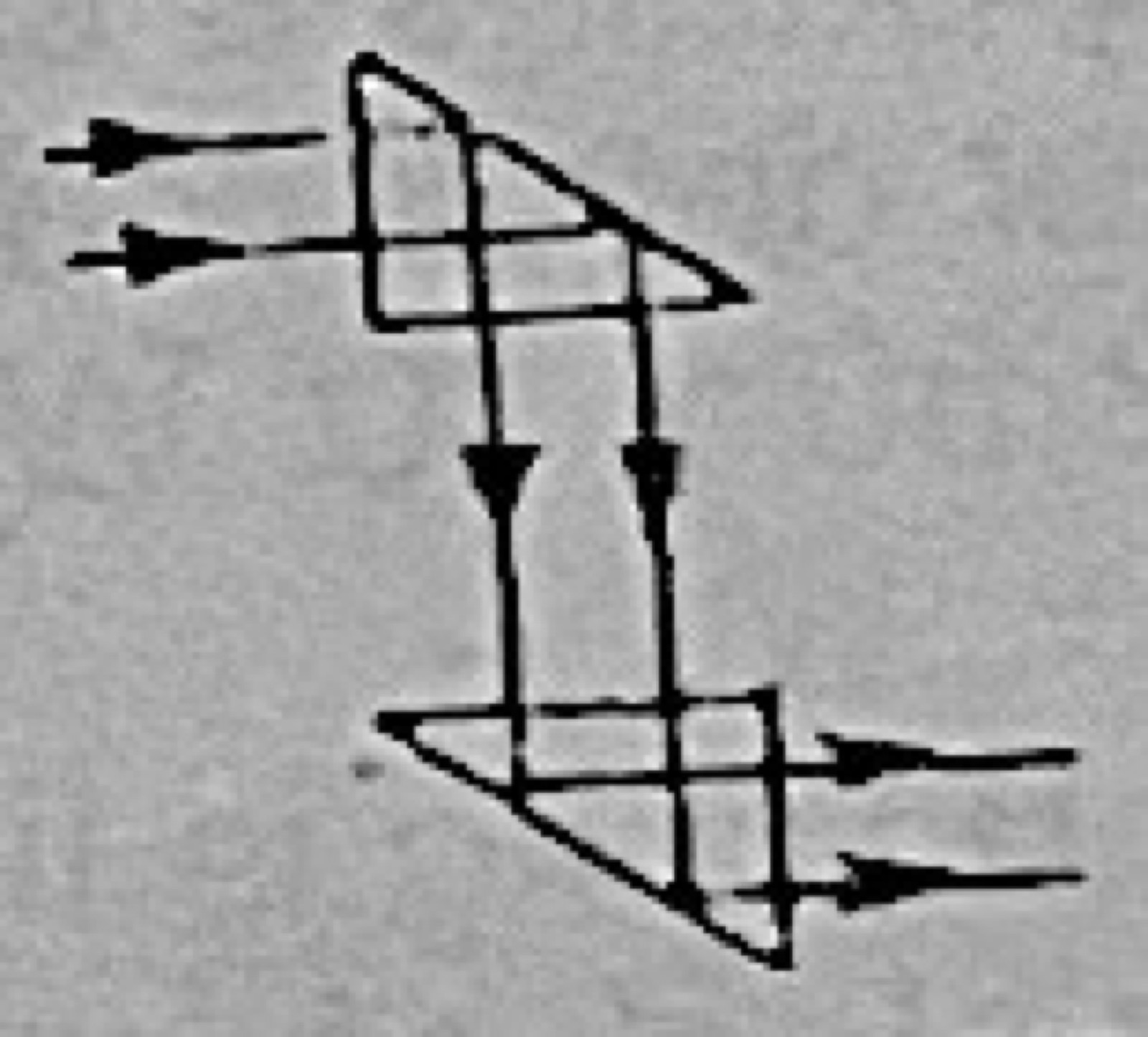
The diagram above shows the prism arrangement in a

Diagram for this question
  1. A.binocular
  2. B.spectrometer
  3. C.periscope
  4. D.projector.
Show the answer and explanation

Answer: C (periscope)

Explanation

Two right-angled prisms each turn the light through 90° by total internal reflection, so light entering at the top leaves lower down in the same direction: a periscope.

Open this question

Question 34

Refraction of Light

The velocities of light in air and glass are 3.0 × 10⁸ m s−1 and 2.0 × 10⁸ m s−1 respectively. If the angle of refraction is 30°, the sine of the angle of incidence is

  1. A.0.33
  2. B.0.50
  3. C.0.67
  4. D.0.75
Show the answer and explanation

Answer: D (0.75)

Explanation

sin i/sin r = speed in air ÷ speed in glass = 1.5, so sin i = 1.5 × sin 30° = 1.5 × 0.5 = 0.75.

Open this question

Question 35

Alternating Current Circuits

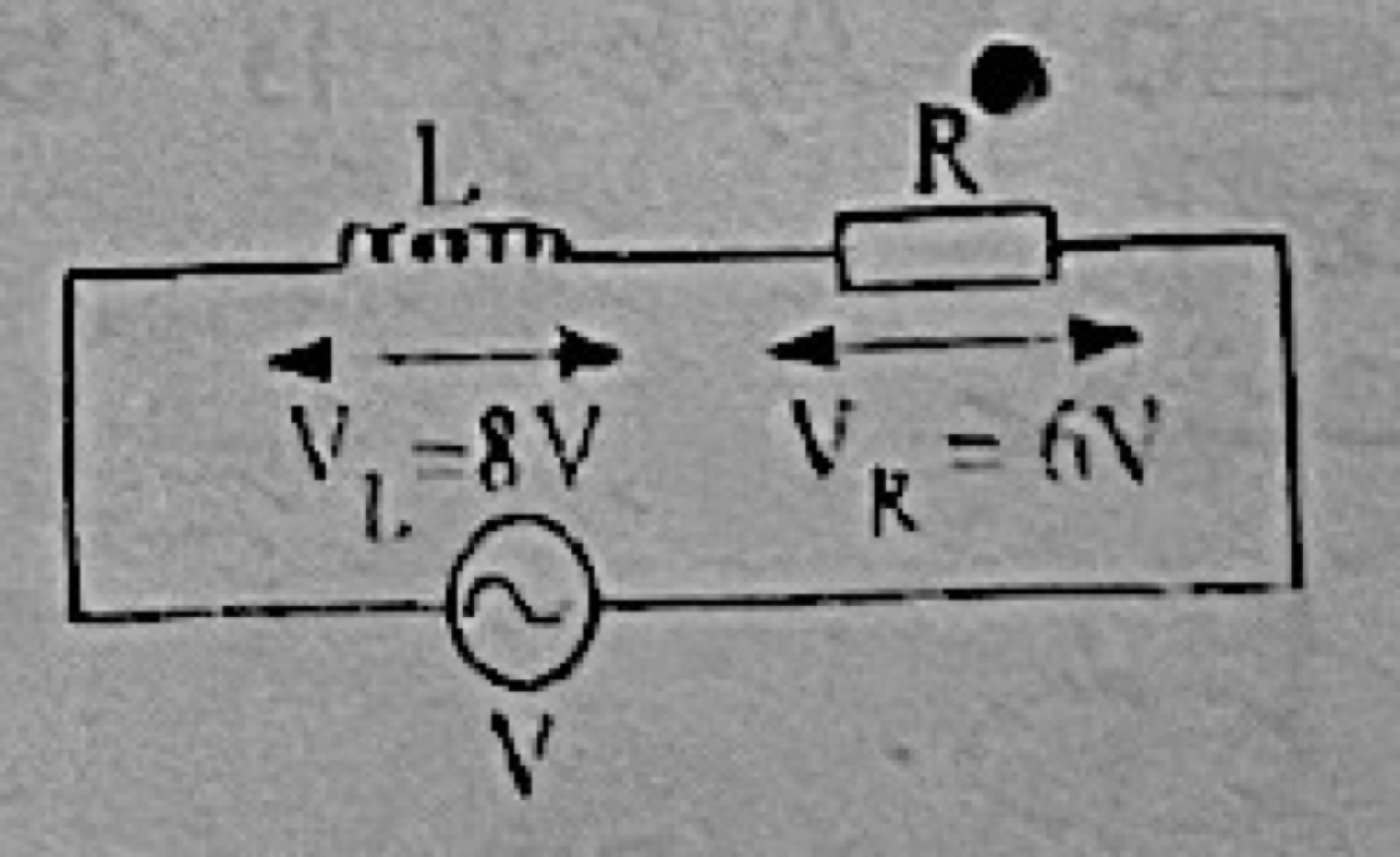
In the series a.c circuit shown above, the p.d across the inductor is 8 V r.m.s. and that across the resistor is 6 V r.m.s. The effective voltage is

Diagram for this question
  1. A.2 V
  2. B.10 V
  3. C.14 V
  4. D.48 V
Show the answer and explanation

Answer: B (10 V)

Explanation

The inductor and resistor voltages are 90° out of phase, so V = √(82 + 62) = 10 V.

Open this question

Question 36

Electromagnetic Induction

The core of an efficient transformer should consist of laminated pieces of metal in order to

  1. A.increase the heat produced by increasing the eddy current
  2. B.increase the heat produced by reducing the eddy current
  3. C.reduce the heat produced by increasing the eddy current
  4. D.reduce the heat produced by reducing the eddy current.
Show the answer and explanation

Answer: D (reduce the heat produced by reducing the eddy current.)

Explanation

Insulated laminations break up the paths of eddy currents, so less current flows in the core and less energy is wasted as heat.

Open this question

Question 37

Electromagnetic Induction

In Fleming's right-hand rule, the thumb, the forefinger and the middle finger if held mutually at right angles represent respectively, the

  1. A.motion, the field and the induced current
  2. B.induced current, the motion and the field
  3. C.field, the induced current and the motion
  4. D.induced current, the field and the motion.
Show the answer and explanation

Answer: A (motion, the field and the induced current)

Explanation

In the right-hand (dynamo) rule: thuMb = Motion, First finger = Field, seCond finger = induced Current.

Open this question

Question 38

Capacitors

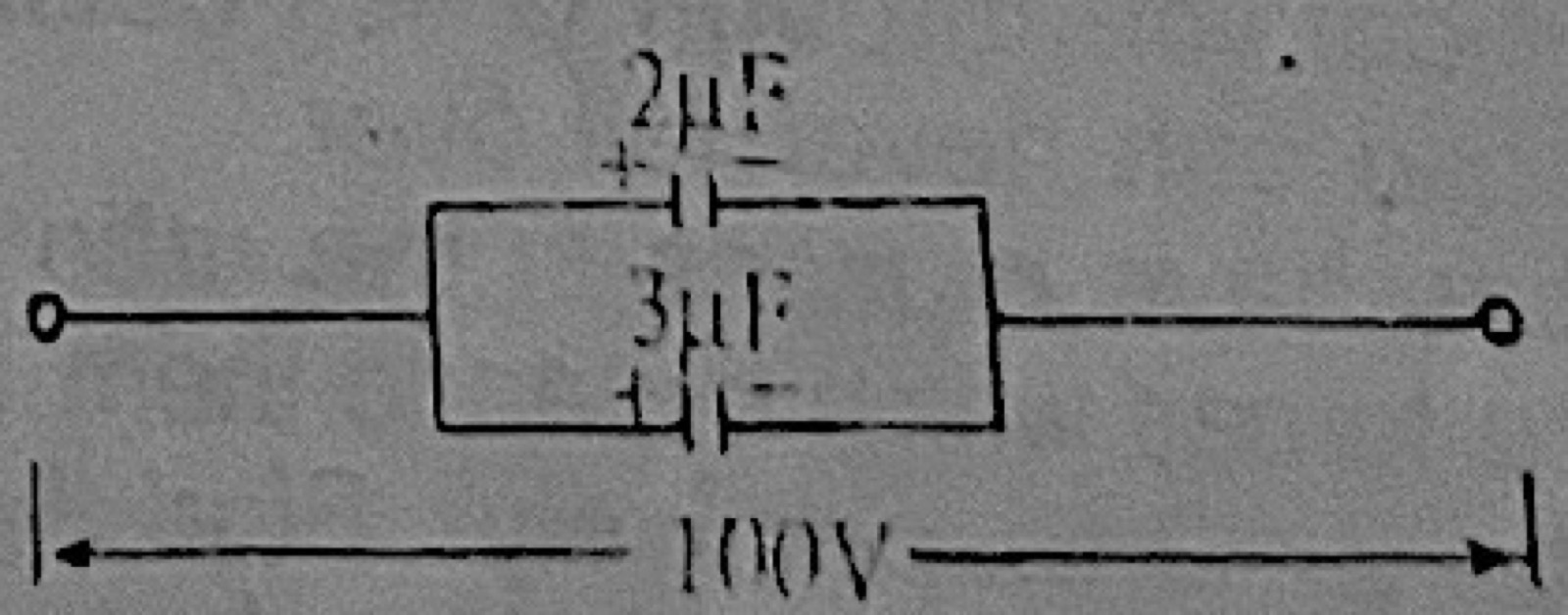
In the circuit above, the potential across each capacitor is 100 V. The total energy stored in the two capacitors is

Diagram for this question
  1. A.3.0 × 104 J
  2. B.3.0 × 102 J
  3. C.2.5 × 10−2 J
  4. D.6.0 × 10−3 J.
Show the answer and explanation

Answer: C (2.5 × 10⁻² J)

Explanation

The 2 μF and 3 μF capacitors are in parallel: C = 5 μF. Energy = ½CV2 = ½ × 5 × 10−6 × 1002 = 2.5 × 10⁻² J.

Open this question

Question 39

Alternating Current Circuits

At what frequency would a 10 H inductor have a reactance of 2000 Ω?

  1. A.π/200 Hz
  2. B.π/100 Hz
  3. C.100/π Hz
  4. D.100π Hz
Show the answer and explanation

Answer: C (100/π Hz)

Explanation

XL = 2πfL, so f = 2000/(2π × 10) = 100/π Hz.

Open this question

Question 40

Electrical Energy and Power

A 3000-W electric cooker is to be used on a 200 V mains circuit. Which of the fuses below can be used safely with the cooker?

  1. A.2 A
  2. B.5 A
  3. C.10 A
  4. D.20 A
Show the answer and explanation

Answer: D (20 A)

Explanation

The cooker draws I = P/V = 3000/200 = 15 A. The fuse must be rated just above this, so only the 20 A fuse will not blow in normal use.

Open this question

Question 41

Current Electricity

A galvanometer has a resistance of 5 Ω. By using a shunt wire of resistance 0.05 Ω, the galvanometer could be converted to an ammeter capable of reading 2 A. What is the current through the galvanometer?

  1. A.2 mA
  2. B.10 mA
  3. C.20 mA
  4. D.25 mA
Show the answer and explanation

Answer: C (20 mA)

Explanation

The galvanometer and shunt share the same p.d.: I × 5 = 0.05 × (2 − I), so I = 0.1/5.05 ≈ 0.020 A = 20 mA.

Open this question

Question 42

Electrical Energy and Power

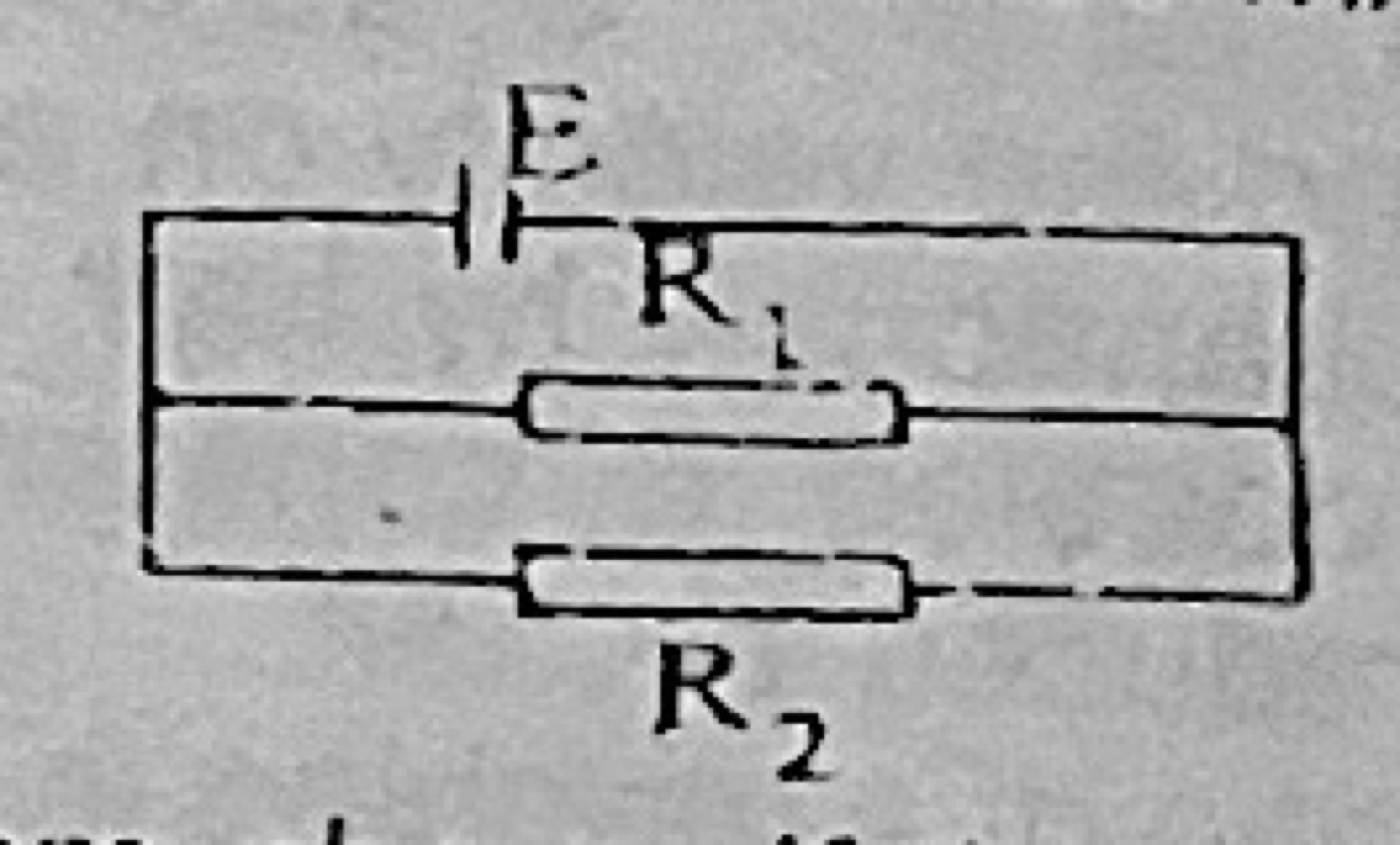
In the diagram above, if the internal resistance of the cell is zero, the ratio of the powers P1 and P2 dissipated by R1 and R2 respectively, is

Diagram for this question
  1. A.R2/R1
  2. B.R1/R2
  3. C.(R1 + R2)/R1
  4. D.(R1 + R2)/R2
Show the answer and explanation

Answer: A (R2/R1)

Explanation

R1 and R2 are in parallel across the cell, so both have the same voltage V. P = V2/R, so P1/P2 = R2/R1.

Open this question

Question 43

Modern Physics

If Δx is the uncertainty in the measurement of the position of a particle along the x-axis and ΔPx is the uncertainty in the measurement of the linear momentum along the x-axis, then the uncertainty principle relation is given as

  1. A.Δx ΔPx ≥ h
  2. B.Δx ΔPx = 0
  3. C.Δx ΔPx < h
  4. D.Δx ΔPx = ∞
Show the answer and explanation

Answer: A (Δx ΔPx ≥ h)

Explanation

Heisenberg's uncertainty principle says the product of the uncertainties in position and momentum cannot be smaller than about Planck's constant.

Open this question

Question 44

Radioactivity and Nuclear Physics

2311Na + Proton → pqX + alpha particle. What are the values of p and q respectively in the equation above?

  1. A.10 and 20
  2. B.12 and 24
  3. C.20 and 10
  4. D.24 and 12
Show the answer and explanation

Answer: C (20 and 10)

Explanation

Mass numbers balance: 23 + 1 = p + 4, so p = 20. Atomic numbers balance: 11 + 1 = q + 2, so q = 10.

Open this question

Question 45

Electronics

A semi-conductor diode is used in rectifying alternating current into direct current mainly because it

  1. A.allows current to flow in either direction
  2. B.is non-linear
  3. C.offers a high input resistance
  4. D.allows current to flow only in one direction.
Show the answer and explanation

Answer: D (allows current to flow only in one direction.)

Explanation

A diode conducts in one direction only, so it blocks the reverse half of each a.c. cycle.

Open this question

Question 46

Electronics

In semi-conductors, the carriers of current at room temperature are

  1. A.electrons only
  2. B.electrons and holes
  3. C.holes only
  4. D.electrons and ions.
Show the answer and explanation

Answer: B (electrons and holes)

Explanation

In a semiconductor, current is carried by free electrons and by holes (missing electrons) moving the other way.

Open this question

Question 47

Modern Physics

What is the speed of a particle of mass 10−27 kg whose wavelength is 10−8 m? [h = 6.63 × 10⁻³⁴ J s]

  1. A.6.63 m s−1
  2. B.66.30 m s−1
  3. C.663.00 m s−1
  4. D.6630.00 m s−1
Show the answer and explanation

Answer: B (66.30 m s−1)

Explanation

de Broglie: λ = h/(mv), so v = h/(mλ) = 6.63 × 10⁻³⁴/(10−27 × 10−8) = 66.3 m s−1.

Open this question

Question 48

Alternating Current Circuits

In a series R-L-C circuit at resonance, the voltages across the resistor and the inductor are 30 V and 40 V respectively. What is the voltage across the capacitor?

  1. A.30 V
  2. B.40 V
  3. C.50 V
  4. D.70 V
Show the answer and explanation

Answer: B (40 V)

Explanation

At resonance XL = XC, and the same current flows through both, so VC = VL = 40 V.

Open this question

Question 49

Radioactivity and Nuclear Physics

Gamma rays are produced when

  1. A.high velocity electrons are abruptly stopped in metals
  2. B.energy changes occur within the nucleus of atoms
  3. C.energy changes occur within the electronic structure of atoms
  4. D.electrons are deflected in very strong magnetic fields.
Show the answer and explanation

Answer: B (energy changes occur within the nucleus of atoms)

Explanation

Gamma rays come from the nucleus when it drops from an excited energy state; stopping fast electrons produces X-rays instead.

Open this question

Question 50

Modern Physics

In the Rutherford scattering experiment, a beam of alpha particles was fired at a thin gold film with some of the particles being considerably deflected. This shows that

  1. A.a gold nucleus contains protons, neutrons and electrons uniformly distributed in a tiny volume
  2. B.the gold nucleus is positively charged and is concentrated in a tiny volume
  3. C.the gold nucleus emitted alpha particles
  4. D.the gold nucleus is concentrated in a tiny volume and contains alpha particles
Show the answer and explanation

Answer: B (the gold nucleus is positively charged and is concentrated in a tiny volume)

Explanation

Only a few alpha particles were strongly repelled, which shows the positive charge and most of the mass are packed into a very small nucleus.
Open this question