JAMB Physics 1984 past questions and answers

47 questions. Try each one, then open the answer to check yourself and read the explanation.

Question 1

Motion

The distance travelled by a particle starting from rest is plotted against the square of the time elapsed from the commencement of motion. The resulting graph is linear, the slope of this graph is a measure of

  1. A.initial displacement
  2. B.initial velocity
  3. C.acceleration
  4. D.half the acceleration
  5. E.half the initial velocity
Show the answer and explanation

Answer: D (half the acceleration)

Explanation

From rest, s = ½at², so a graph of s against t² is a straight line with slope ½a: half the acceleration.

Open this question

Question 2

Equilibrium of Forces

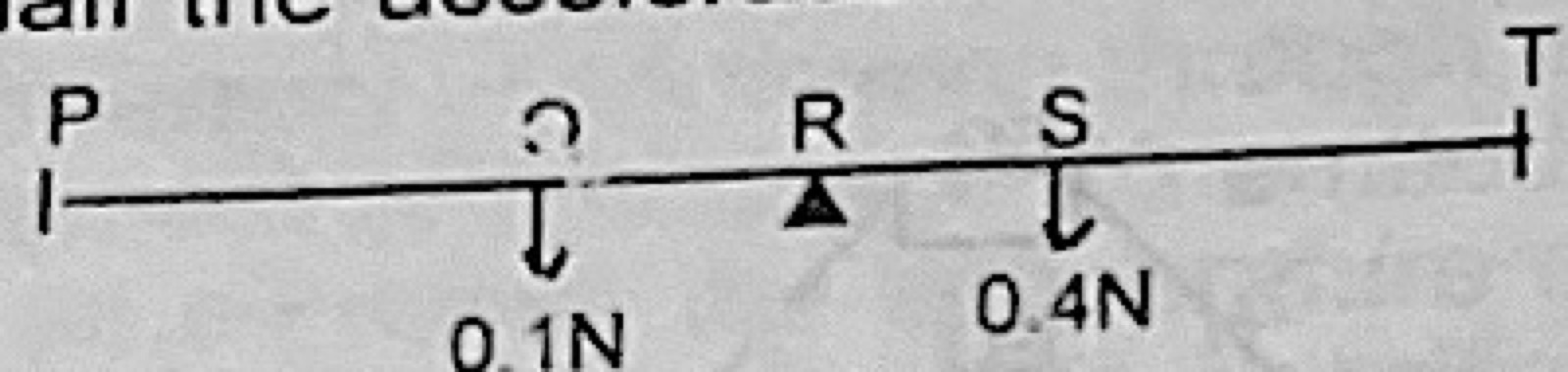
In Fig. 1, PT is a uniform metre rule pivoted at R, the 70 cm mark. Two forces 0.1 N and 0.4 N are applied at Q, the 60 cm mark and S, the 85 cm mark. If the metre rule is kept in equilibrium by the forces and its weight, then the weight of the metre rule is

Diagram for this question
  1. A.0.25 N
  2. B.0.30 N
  3. C.0.35 N
  4. D.0.50 N
  5. E.0.56 N
Show the answer and explanation

Answer: A (0.25 N)

Explanation

The weight acts at the 50 cm mark, 20 cm from the pivot. Moments about R: W × 20 + 0.1 × 10 = 0.4 × 15, so 20W = 5 and W = 0.25 N.

Open this question

Question 3

Measurement and Units

For which of the underlisted quantities is the derived unit ML2T−2 correct? I. Moment of a force II. Work III. Acceleration

  1. A.I only
  2. B.II only
  3. C.III only
  4. D.I and II
  5. E.II and III.
Show the answer and explanation

Answer: D (I and II)

Explanation

Moment and work are both force × distance: (MLT−2) × L = ML2T−2. Acceleration is LT−2.

Open this question

Question 4

Density and Upthrust

What volume of alcohol with a density of 8.4 × 10² kg m−3 will have the same mass as 4.2 m3 of petrol whose density is 7.2 × 10² kg m−3?

  1. A.1.4 m3
  2. B.3.6 m3
  3. C.4.9 m3
  4. D.5.0 m3
  5. E.5.8 m3.
Show the answer and explanation

Answer: B (3.6 m3)

Explanation

Mass of petrol = 4.2 × 720 = 3024 kg. Volume of alcohol = 3024 ÷ 840 = 3.6 m3.

Open this question

Question 5

Lenses and Optical Instruments

For correcting long sight defects in the human eye we require a

  1. A.converging lens
  2. B.diverging lens
  3. C.microscope
  4. D.periscope
  5. E.plain glass sheet.
Show the answer and explanation

Answer: A (converging lens)

Explanation

A long-sighted eye focuses near objects behind the retina; a converging lens adds the extra bending needed.

Open this question

Question 6

Light and Reflection

For a concave mirror to form a real diminished image, the object must be placed

  1. A.behind the mirror
  2. B.between the mirror and its focus
  3. C.between the focus and the centre of curvature
  4. D.at the centre of curvature
  5. E.at a distance greater than the radius of curvature.
Show the answer and explanation

Answer: E (at a distance greater than the radius of curvature.)

Explanation

A concave mirror gives a real, smaller image only when the object is beyond the centre of curvature.

Open this question

Question 7

Current Electricity

The unit of quantity of electricity is called

  1. A.the ampere
  2. B.the volt
  3. C.the coulomb
  4. D.the ammeter
  5. E.electromotive force
Show the answer and explanation

Answer: C (the coulomb)

Explanation

Quantity of electricity is charge, measured in coulombs (1 C = 1 A × 1 s).

Open this question

Question 8

Current Electricity

The resistance of a wire depends on

  1. A.the length of the wire
  2. B.the diameter of the wire
  3. C.the temperature of the wire
  4. D.the resistivity of the wire
  5. E.all of the above.
Show the answer and explanation

Answer: E (all of the above.)

Explanation

R = ρL/A, so resistance depends on length, cross-section (diameter) and resistivity, and resistivity changes with temperature.

Open this question

Question 9

Current Electricity

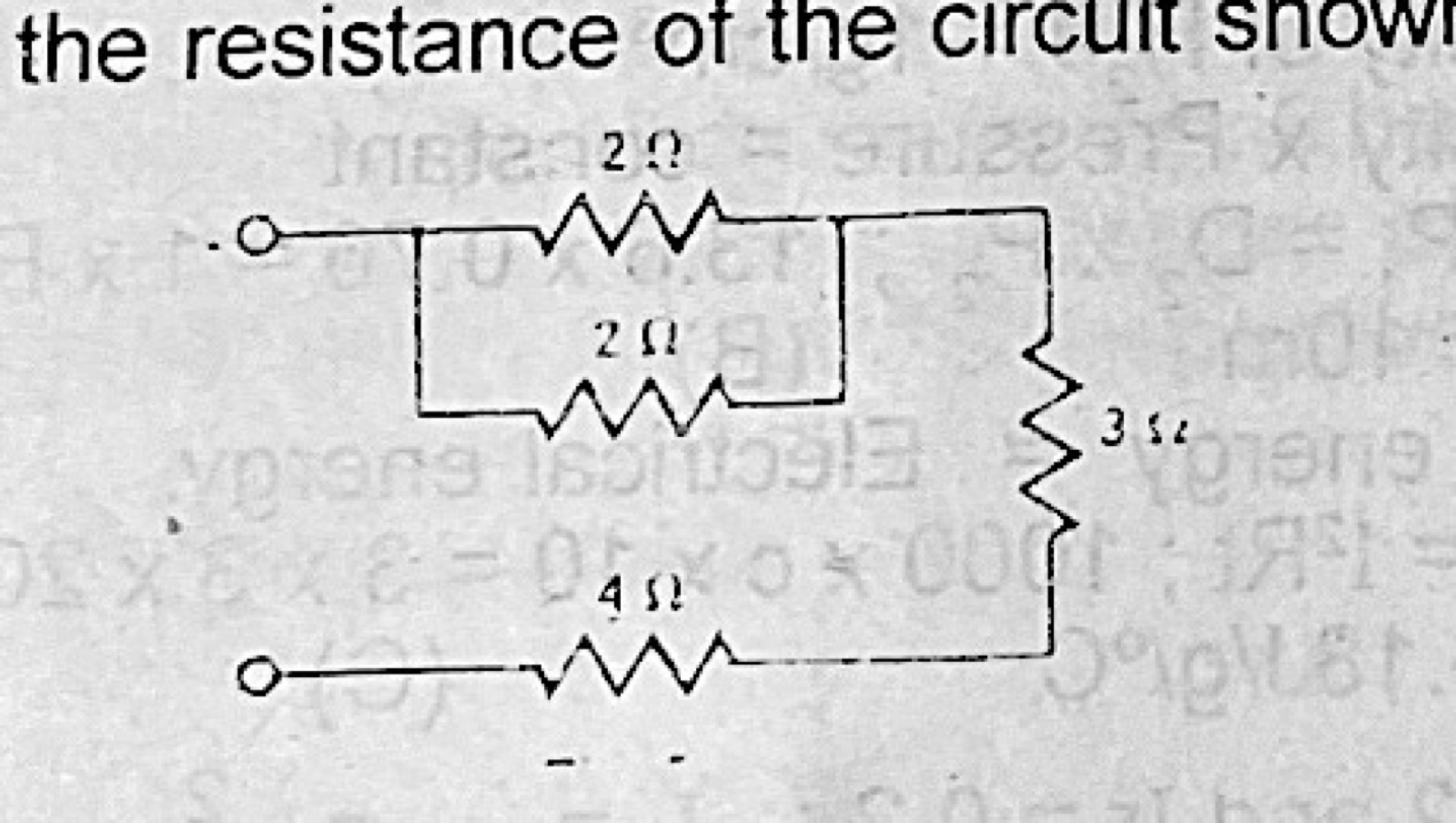
What is the resistance of the circuit shown in Fig. 2

Diagram for this question
  1. A.4 Ω
  2. B.11 Ω
  3. C.19/5 Ω
  4. D.17/4 Ω
  5. E.8 Ω
Show the answer and explanation

Answer: E (8 Ω)

Explanation

The two 2 Ω resistors in parallel give 1 Ω; adding 3 Ω and 4 Ω in series gives 1 + 3 + 4 = 8 Ω.

Open this question

Question 10

Current Electricity

Two cells, each of e.m.f 1.5 V and an internal resistance 2 Ω are connected in parallel. Calculate the current flowing when the cells are connected to a 1 Ω resistor

  1. A.0.75 A
  2. B.1.5 A
  3. C.0.5 A
  4. D.1.0 A
  5. E.0.6 A
Show the answer and explanation

Answer: A (0.75 A)

Explanation

Identical cells in parallel give e.m.f. 1.5 V and internal resistance 2 × 2/(2 + 2) = 1 Ω. I = 1.5/(1 + 1) = 0.75 A.

Open this question

Question 11

Current Electricity

Which of the following components is NOT contained in a dry cell?

  1. A.carbon rod
  2. B.paste of magnesium dioxide
  3. C.paste of ammonium chloride
  4. D.zinc case
  5. E.copper rod.
Show the answer and explanation

Answer: E (copper rod.)

Explanation

A dry (Leclanché) cell has a zinc case, a carbon rod, manganese dioxide and an ammonium chloride paste. There is no copper rod.

Open this question

Question 12

Electromagnetic Induction

Which of the following can be described as high tension transmission?

  1. A.High resistance and low voltage
  2. B.Low current and high voltage
  3. C.High current and low voltage
  4. D.High voltage and zero current
  5. E.High current and low resistance.
Show the answer and explanation

Answer: B (Low current and high voltage)

Explanation

High-tension transmission means sending power at very high voltage and therefore low current, to cut I²R losses.

Open this question

Question 14

Sound

When vibration occurs in an air column, the distance between a node and an antinode is equal to

  1. A.one-quarter of the wave length
  2. B.one-half of the wave length
  3. C.the wave length
  4. D.twice the wave length
  5. E.four-times the wave length.
Show the answer and explanation

Answer: A (one-quarter of the wave length)

Explanation

Nodes are half a wavelength apart and an antinode sits midway between them, so node to antinode is λ/4.

Open this question

Question 15

Sound

Which of the following statements is (are) NOT correct? I. Pressure changes do not affect the speed of sound in air. II. The velocity of sound increases with temperature III. The quality of a note depends only on its frequency.

  1. A.I only
  2. B.II only
  3. C.III only
  4. D.I and III
  5. E.II and III.
Show the answer and explanation

Answer: C (III only)

Explanation

At constant temperature pressure does not change the speed of sound, and the speed rises with temperature. Quality depends on the overtones present, not only the frequency, so III is wrong.

Open this question

Question 16

Sound

Of two identical tuning forks with natural frequency 256 Hz, one is loaded so that 4 beats per second are heard when they are sounded together. What is the frequency of the loaded tuning fork?

  1. A.260 Hz
  2. B.252 Hz
  3. C.248 Hz
  4. D.264 Hz
  5. E.258 Hz.
Show the answer and explanation

Answer: B (252 Hz)

Explanation

Loading a fork (adding mass to its prongs) lowers its frequency. A beat frequency of 4 Hz then means 256 − 4 = 252 Hz.

Open this question

Question 17

Change of State and Vapours

Dewpoint is the temperature at which water vapour

  1. A.turns into steam
  2. B.solidifies in the atmosphere into ice pellets
  3. C.first condenses into liquid form
  4. D.is just sufficient to cause cooling
  5. E.has a relative humidity of fifty per cent.
Show the answer and explanation

Answer: C (first condenses into liquid form)

Explanation

At the dew point the air becomes saturated, so cooling it any further makes the water vapour start to condense into liquid drops (dew).

Open this question

Question 18

Temperature and Thermometers

The lower and upper fixed points marked on a mercury-in-glass thermometer are 210 mm apart. The end of the mercury column in the tube is 49 mm above the lower fixed point in a room. What is the temperature of the room in degrees Celsius?

  1. A.55.3°C
  2. B.23.3°C
  3. C.49.0°C
  4. D.16.1°C
  5. E.76.7°C
Show the answer and explanation

Answer: B (23.3°C)

Explanation

The 100 degrees span 210 mm, so 49 mm above the ice point is (49/210) × 100 ≈ 23.3°C.

Open this question

Question 19

Change of State and Vapours

If a solid changes directly into a gas when heat is applied the process is called

  1. A.vaporization
  2. B.evaporation
  3. C.sublimation
  4. D.ionization
  5. E.conversion
Show the answer and explanation

Answer: C (sublimation)

Explanation

Changing straight from solid to gas without melting is sublimation (e.g. iodine, camphor).

Open this question

Question 20

Simple Machines

A plane inclined at an angle of 30° to the horizontal has an efficiency of 60%. The force parallel to the plane required to push a load of 120 N uniformly up the plane is

  1. A.60 N
  2. B.100 N
  3. C.120 N
  4. D.200 N
  5. E.240 N
Show the answer and explanation

Answer: B (100 N)

Explanation

VR = 1/sin 30° = 2. MA = efficiency × VR = 0.6 × 2 = 1.2. Effort = 120 ÷ 1.2 = 100 N.

Open this question

Question 21

Newton's Laws and Momentum

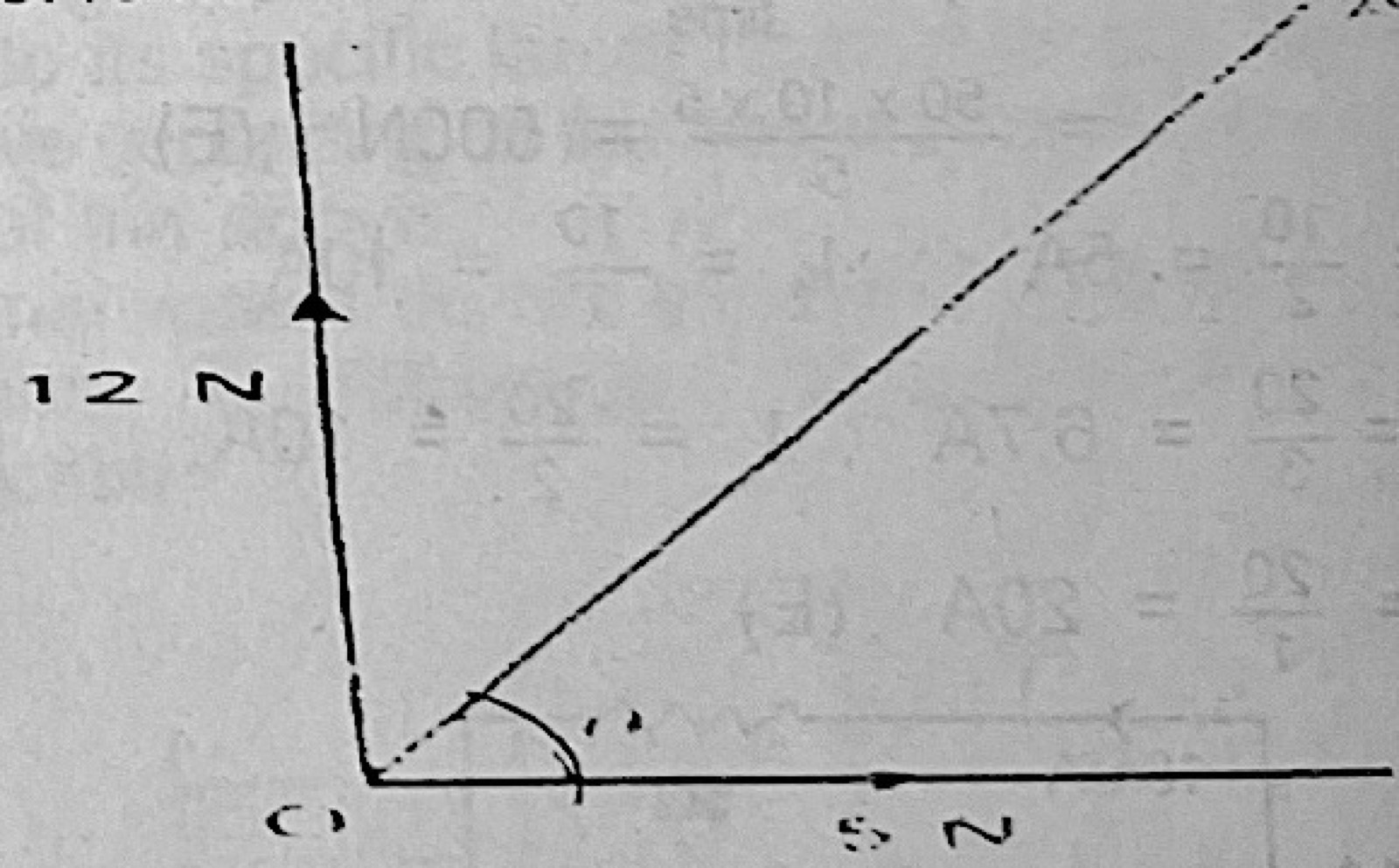
A body of mass 5 kg initially at rest is acted upon by two mutually perpendicular forces 12 N and 5 N as shown in Fig. 3. If the particle moves in the direction QA, calculate the magnitude of the acceleration.

Diagram for this question
  1. A.0.40 m s−2
  2. B.1.40 m s−2
  3. C.0.26 m s−2
  4. D.2.60 m s−2
  5. E.3.40 m s−2
Show the answer and explanation

Answer: D (2.60 m s−2)

Explanation

Resultant force = √(12² + 5²) = 13 N. a = F/m = 13/5 = 2.6 m s−2.

Open this question

Question 22

Work, Energy and Power

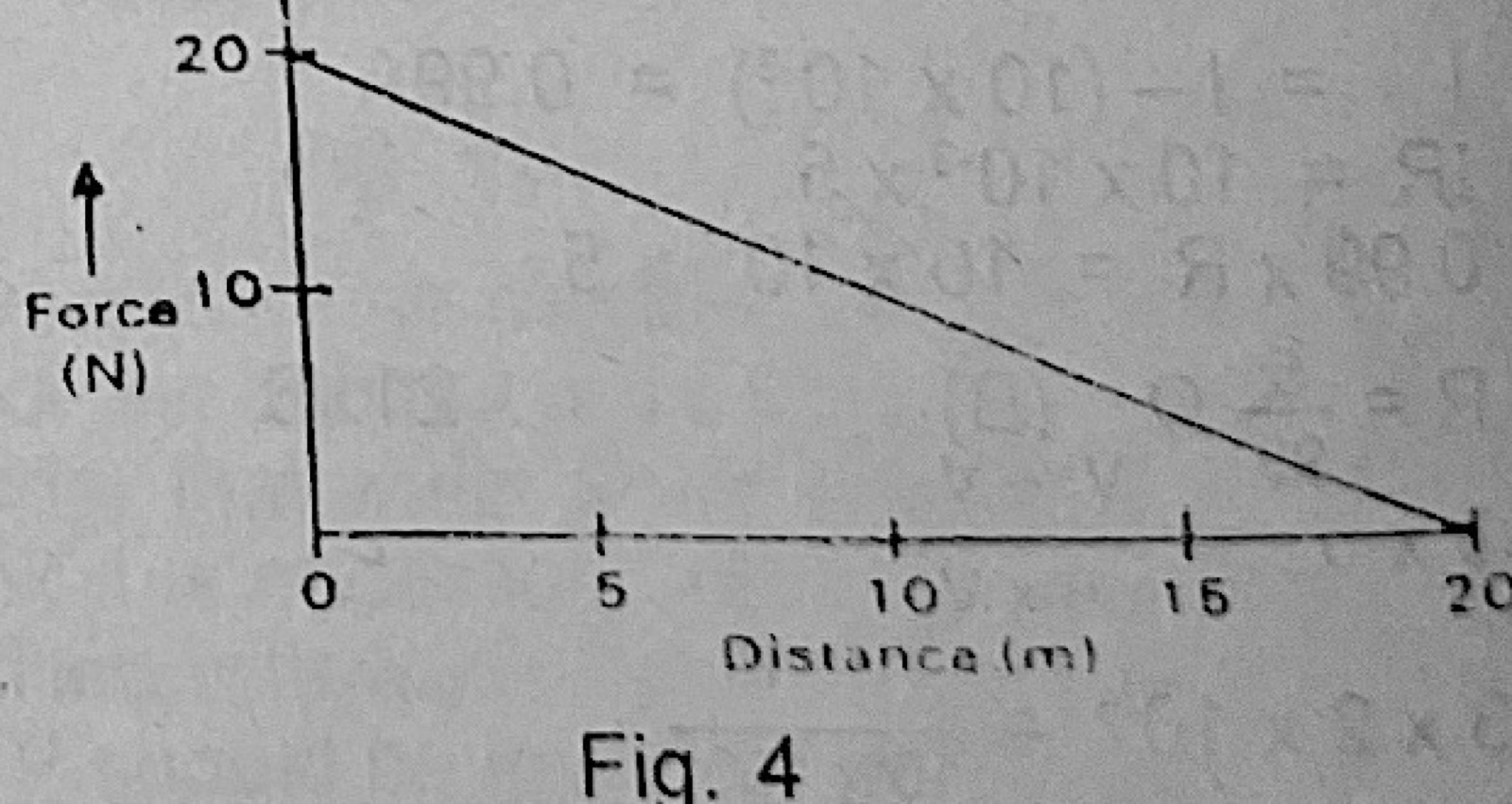
A force varying linearly with the distance acts on a body as shown in Fig. 4. The work done on the body by the force during the first 10 metres of motion is

Diagram for this question
  1. A.100 J
  2. B.150 J
  3. C.200 J
  4. D.300 J
  5. E.600 J
Show the answer and explanation

Answer: B (150 J)

Explanation

Work = area under the force–distance graph. The force falls from 20 N at 0 m to 10 N at 10 m, so the area is ½ × (20 + 10) × 10 = 150 J.

Open this question

Question 23

Simple Harmonic Motion

A simple pendulum, 0.6 m long, has a period of 1.5 s. What is the period of a similar pendulum 0.4 m long in the same location?

  1. A.1.5√(2/3) s
  2. B.1.5√(3/2) s
  3. C.2.25 s
  4. D.1.00 s
  5. E.2.00 s
Show the answer and explanation

Answer: A (1.5√(2/3) s)

Explanation

T is proportional to √L, so T₂ = 1.5 × √(0.4/0.6) = 1.5√(2/3) s.

Open this question

Question 24

Structure of Matter and Kinetic Theory

A small steel needle is carefully floated on water in a beaker. When a few drops of kerosine are introduced into the water the needle sinks. Which of the following statements correctly explain(s) the observation? I. There is tension on the water surface II. Kerosine reduces the density of water so that the needle becomes denser than water III. Kerosine reduces the surface tension of water.

  1. A.I only
  2. B.II only
  3. C.III only
  4. D.I and II
  5. E.I and III.
Show the answer and explanation

Answer: E (I and III.)

Explanation

The needle is held up by the surface tension of the water surface. Kerosine lowers the surface tension, so the surface film can no longer support it.

Open this question

Question 25

Modern Physics

Which of the following statements describes an atom accurately? I. Atoms of all elements are identical II. An atom contains a nucleus and number of electrons III. Due to the electrons in the atom an atom is negatively charged. IV. Electrons in the atom move in circular orbits round the nucleus.

  1. A.I and II
  2. B.II and III
  3. C.III and IV
  4. D.II and IV
  5. E.I, II and III.
Show the answer and explanation

Answer: D (II and IV)

Explanation

An atom has a nucleus with electrons around it, which in the simple (Bohr) model move in circular orbits. Atoms of different elements differ, and a whole atom is neutral.

Open this question

Question 26

Motion

A particle moves in a circular orbit of radius 0.02 m. If the speed of the particle is 0.88 m s−1, calculate its frequency in cycles per second.

  1. A.2.0
  2. B.7.0
  3. C.8.8
  4. D.14.0
  5. E.17.6
Show the answer and explanation

Answer: B (7.0)

Explanation

ω = v/r = 0.88/0.02 = 44 rad s−1. f = ω/2π = 44/(2 × 3.142) ≈ 7.0 Hz.

Open this question

Question 27

Quantity of Heat

Heat is supplied uniformly at the rate of 100 W to 1.0 × 10⁻² kg of a liquid for 20 seconds. If the temperature of the liquid rises by 5°C, then the specific heat capacity of the liquid is

  1. A.2.0 × 102 J kg−1 K−1
  2. B.2.0 × 102 J kg−1
  3. C.4.0 × 104 J kg−1 K−1
  4. D.4.0 × 104 J kg−1
  5. E.8.4 × 103 J kg−1 K−1.
Show the answer and explanation

Answer: C (4.0 × 10⁴ J kg−1 K−1)

Explanation

Heat = 100 × 20 = 2000 J. c = 2000/(0.01 × 5) = 4.0 × 10⁴ J kg−1 K−1.

Open this question

Question 28

Gas Laws

A given mass of an ideal gas occupies a volume V at a temperature T and under a pressure P. If the pressure is increased to 2P and the temperature reduced to ½T, then the percentage change in the volume of the gas is

  1. A.0%
  2. B.25%
  3. C.75%
  4. D.300%
  5. E.400%
Show the answer and explanation

Answer: C (75%)

Explanation

V ∝ T/P, so the new volume is V × ½ × ½ = V/4. The volume falls by ¾ of its value, a 75% change.

Open this question

Question 29

Temperature and Thermometers

Which of the following properties of matter CANNOT be utilized for temperature measurement? The

  1. A.length of a liquid column
  2. B.volume of a gas at constant pressure
  3. C.pressure of a gas at constant volume
  4. D.resistance of a metallic wire
  5. E.current produced in a photoelectric effect.
Show the answer and explanation

Answer: E (current produced in a photoelectric effect.)

Explanation

Liquid length, gas volume, gas pressure and wire resistance all change steadily with temperature and are used in thermometers. Photoelectric current depends on light, not temperature.

Open this question

Question 31

Lenses and Optical Instruments

Which of the following statements about the compound microscope and astronomical telescope is (are) correct? I. The final image of a compound microscope is located at infinity. II. The final image of the astronomical telescope is always erect. III. The objective lens of a compound microscope has a very short focal length.

  1. A.I only
  2. B.II only
  3. C.III only
  4. D.I and III
  5. E.II and III.
Show the answer and explanation

Answer: C (III only)

Explanation

A compound microscope's objective has a very short focal length and its final image is usually at the near point. An astronomical telescope gives an inverted image.

Open this question

Question 32

Refraction of Light

A coin is placed at the bottom of a cube of glass t cm thick. If the refractive index of the glass is μ, how high does the coin appear to be raised to an observer looking perpendicularly into the glass?

  1. A.1/(t − μ)
  2. B.t(μ − 1)/μ
  3. C.t(1 + 1/μ)
  4. D.−
  5. E.μt.
Show the answer and explanation

Answer: B (t(μ − 1)/μ)

Explanation

Apparent depth = t/μ, so the coin seems raised by t − t/μ = t(μ − 1)/μ.

Open this question

Question 33

Electromagnetic Induction

The electromotive force obtained from a simple dynamo may be increased by

  1. A.increasing the cross-sectional area of the coil
  2. B.winding the coil on a soft-iron armature so as to decrease the magnetic flux through the coil
  3. C.increasing the speed of rotation
  4. D.making the field magnet longer
  5. E.using low-resistance copper coils.
Show the answer and explanation

Answer: C (increasing the speed of rotation)

Explanation

The induced e.m.f. depends on how fast the flux linkage changes, so spinning the coil faster gives a bigger e.m.f.

Open this question

Question 35

Capacitors

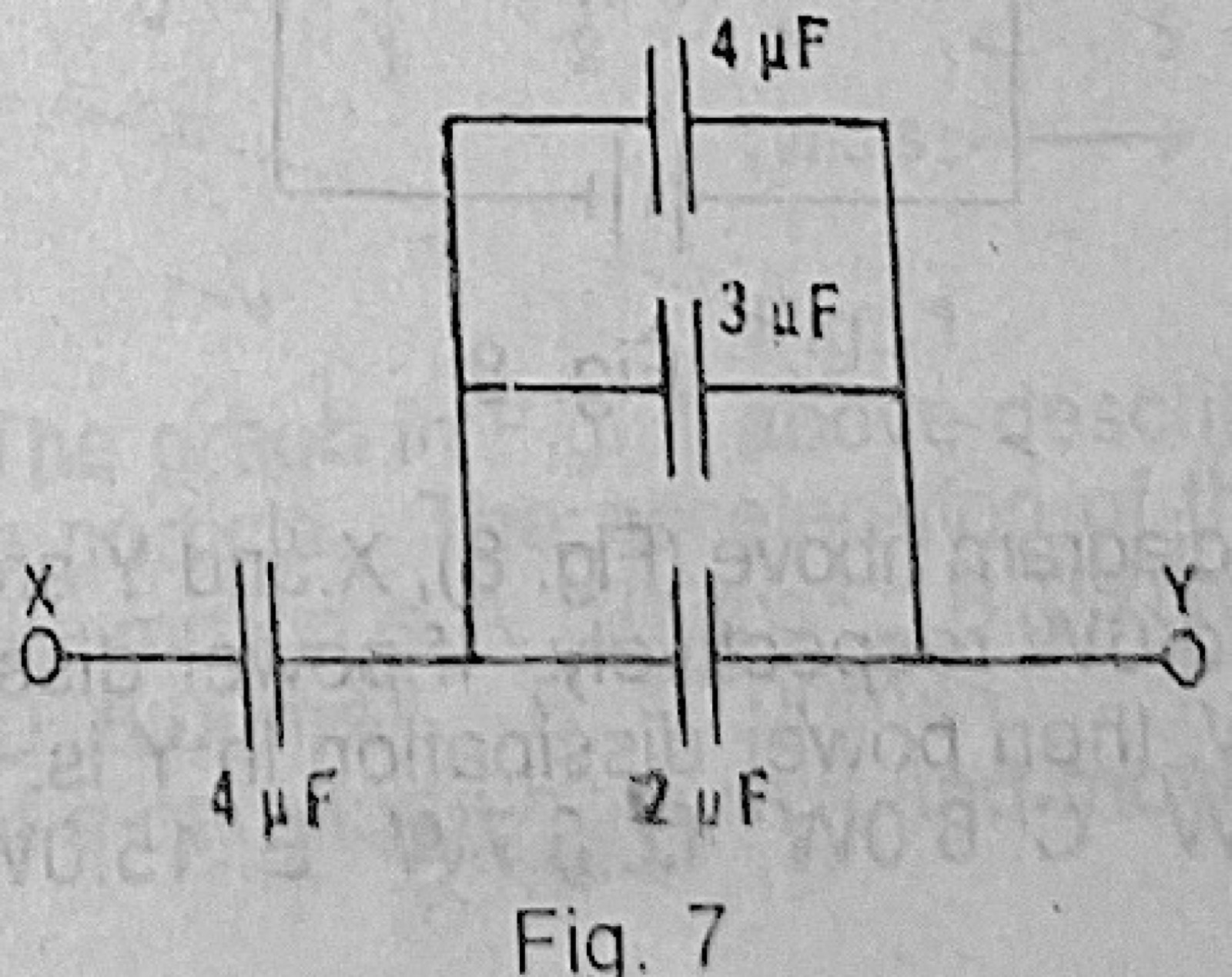
In the circuit shown in Fig. 7, calculate the effective capacitance between X and Y.

Diagram for this question
  1. A.¾ μF
  2. B.2 10/13 μF
  3. C.12 μF
  4. D.4 12/13 μF
  5. E.13 μF.
Show the answer and explanation

Answer: B (2 10/13 μF)

Explanation

The 4 μF, 3 μF and 2 μF in parallel add to 9 μF. In series with the other 4 μF: C = (4 × 9)/(4 + 9) = 36/13 = 2 10/13 μF.

Open this question

Question 36

Newton's Laws and Momentum

A gun of mass 2.0 kg fires a bullet of mass 1.6 × 10⁻² kg due East. If the bullet leaves the nozzle of the gun with a velocity of 150 m s−1, what is the recoil velocity of the gun?

  1. A.150 m s−1 due West
  2. B.1.2 × 10−4 m s−1 due West
  3. C.1.2 m s−1 due West
  4. D.1.2 m s−1 due East
  5. E.150 m s−1 due East
Show the answer and explanation

Answer: C (1.2 m s−1 due West)

Explanation

Momentum is conserved: 2.0v = 1.6 × 10−2 × 150 = 2.4, so v = 1.2 m s−1, in the opposite direction (West).

Open this question

Question 37

Pressure

Normal atmospheric pressure at sea-level is 105 N m−2 and the acceleration due to gravity is approximately 10 m s−2. If the atmosphere has a uniform density of 1 kg m−3, its height is

  1. A.100 m
  2. B.1000 m
  3. C.10000 m
  4. D.100 000 m
  5. E.1000 000 m
Show the answer and explanation

Answer: C (10000 m)

Explanation

p = hρg, so h = 105/(1 × 10) = 104 m = 10 000 m.

Open this question

Question 38

Newton's Laws and Momentum

Which of the following is a correct explanation of the inertia of a body?

  1. A.Ability to overcome the earth's gravity
  2. B.Reluctance to stop moving
  3. C.Readiness to start moving
  4. D.Reluctance to start moving and its readiness to stop moving once it has begun to move
  5. E.Reluctance to start moving its reluctance to stop moving once it has begun to move.
Show the answer and explanation

Answer: E (Reluctance to start moving its reluctance to stop moving once it has begun to move.)

Explanation

Inertia is a body's tendency to keep its state: it resists being started and, once moving, resists being stopped.

Open this question

Question 39

Work, Energy and Power

If a water pump at Kainji Dam is capable of lifting 1000 kg of water through a vertical height of 10 m in 10 s, the power of the pump is (g = 10 m s−2)

  1. A.1.0 kW
  2. B.10.0 kW
  3. C.12.5 kW
  4. D.15.0 kW
  5. E.20.0 kW
Show the answer and explanation

Answer: B (10.0 kW)

Explanation

Power = mgh/t = 1000 × 10 × 10/10 = 10 000 W = 10 kW.

Open this question

Question 40

Dispersion of Light and Colours

What is the apparent colour of a RED SHIRT when viewed in PURE green light?

  1. A.Red
  2. B.Green
  3. C.Yellow
  4. D.Black
  5. E.Blue
Show the answer and explanation

Answer: D (Black)

Explanation

A red shirt reflects only red light. Under pure green light there is no red to reflect, so it absorbs everything and looks black.

Open this question

Question 41

Dispersion of Light and Colours

The spectrum of white light consists of coloured lights arranged in the following order

  1. A.blue, red, green, yellow, indigo, violet, orange
  2. B.red, orange, yellow, green, blue, indigo, violet
  3. C.red, orange, yellow, indigo, green, blue, violet
  4. D.indigo, green, blue, violet, yellow, red, orange
  5. E.yellow, blue, green violet, orange, indigo, red.
Show the answer and explanation

Answer: B (red, orange, yellow, green, blue, indigo, violet)

Explanation

The order is ROYGBIV: red, orange, yellow, green, blue, indigo, violet.

Open this question

Question 42

Conduction through Liquids and Gases

Cathode rays are

  1. A.high-energy electromagnetic waves
  2. B.protons
  3. C.streams of electrons
  4. D.neutrons
  5. E.radio waves.
Show the answer and explanation

Answer: C (streams of electrons)

Explanation

Cathode rays are streams of fast-moving electrons given off by the cathode of a discharge tube.

Open this question

Question 43

Work, Energy and Power

A device that converts sound energy into electrical energy is

  1. A.the horn of a motor car
  2. B.an A.C. generator
  3. C.a microphone
  4. D.the telephone ear-piece
  5. E.a loudspeaker.
Show the answer and explanation

Answer: C (a microphone)

Explanation

A microphone turns sound vibrations into electrical signals. A loudspeaker or ear-piece does the reverse.

Open this question

Question 44

Radioactivity and Nuclear Physics

Which of the following I. β-particles II. protons III. neutrons IV. α-particles. may be found in light nuclei?

  1. A.I and II
  2. B.I and III
  3. C.II and IV
  4. D.II and III
  5. E.I, II and III.
Show the answer and explanation

Answer: D (II and III)

Explanation

Nuclei are made of protons and neutrons. Beta particles are created at the moment of decay, not stored in the nucleus.

Open this question

Question 45

Electromagnetic Spectrum

Radio waves have a velocity of 3 × 10⁸ m s−1. A radio station sends out a broadcast on a frequency of 800 kHz. The wavelength of the broadcast is

  1. A.375.0 m
  2. B.267.0 m
  3. C.240.0 m
  4. D.37.5 m
  5. E.26.7 m
Show the answer and explanation

Answer: A (375.0 m)

Explanation

λ = v/f = 3 × 10⁸ ÷ (800 × 103) = 375 m.

Open this question

Question 46

Electrical Energy and Power

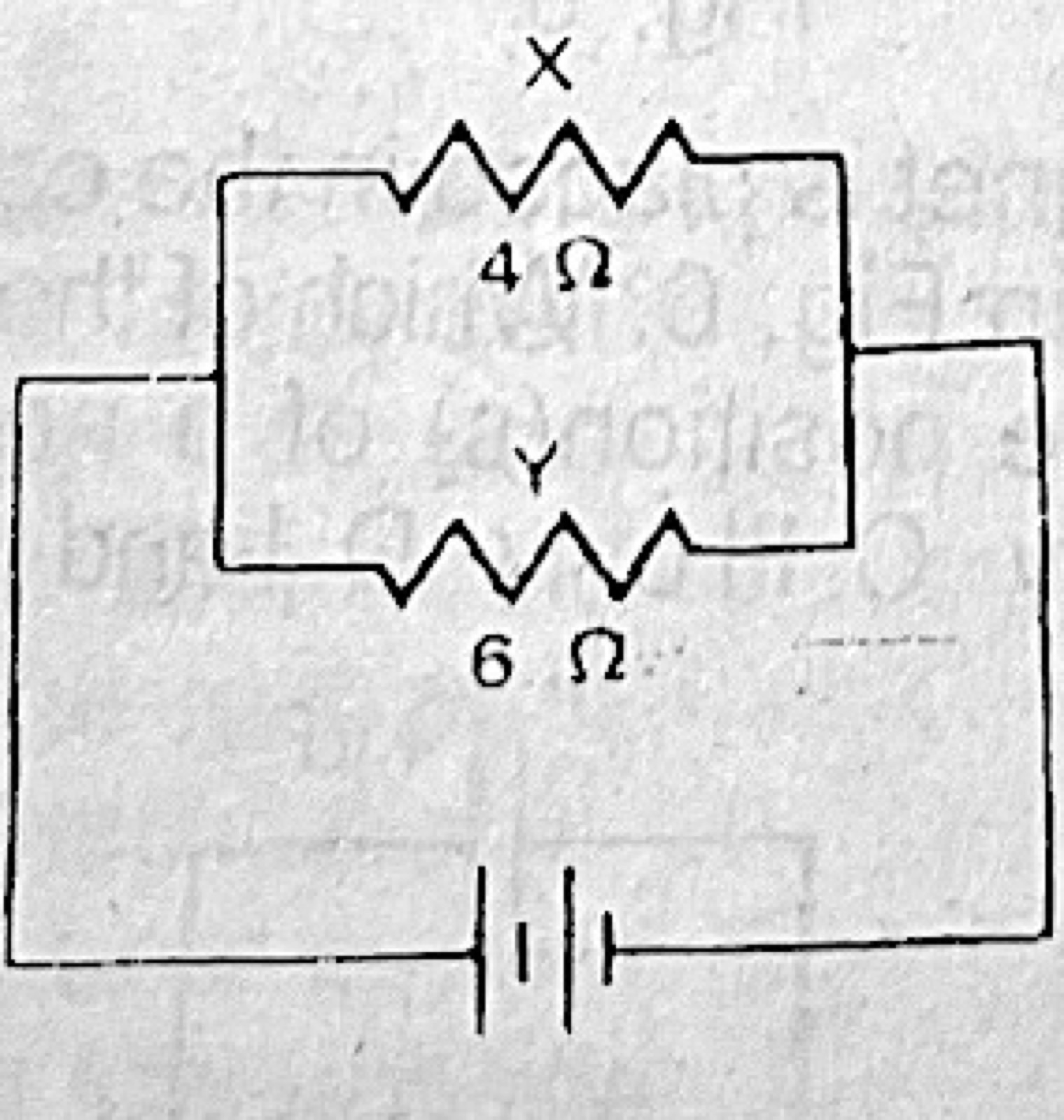
In the diagram above (Fig. 8), X and Y are resistance 4 Ω and 6 Ω respectively. If power dissipation in X is 10 W, then power dissipation in Y is

Diagram for this question
  1. A.2.4 W
  2. B.4.0 W
  3. C.6.0 W
  4. D.6.7 W
  5. E.15.0 W
Show the answer and explanation

Answer: D (6.7 W)

Explanation

X and Y are in parallel, so they have the same voltage and P = V²/R. PY = 10 × 4/6 ≈ 6.7 W.

Open this question

Question 47

Electrical Energy and Power

What is the cost of running five 50 W lamps and four 100 W lamps for 10 hours if electrical energy costs 2 kobo per kWh?

  1. A.N0.65
  2. B.N0.13
  3. C.N3.90
  4. D.N39.00
  5. E.N234.00.
Show the answer and explanation

Answer: B (N0.13)

Explanation

Power = 250 + 400 = 650 W = 0.65 kW. Energy = 0.65 × 10 = 6.5 kWh. Cost = 6.5 × 2 = 13 kobo = N0.13.

Open this question

Question 48

Modern Physics

Which of the following statements is (are) NOT true about the emission of photoelectrons from metallic surfaces? I. All metallic surfaces emit the same number of photoelectrons in a given light II. Most metallic surfaces emit the same number of photoelectrons in visible and infrared light. III. A metallic surface emits photoelectrons only if the frequency of the incident light is higher than its own characteristic threshold frequency

  1. A.I only
  2. B.II only
  3. C.I and II
  4. D.II and III
  5. E.III only
Show the answer and explanation

Answer: C (I and II)

Explanation

III is the threshold-frequency rule and is true. Different metals emit differently (I false), and most metals emit no photoelectrons at all in visible or infrared light (II false).

Open this question

Question 49

Current Electricity

A galvanometer of resistance 5.0 Ω has full-scale deflection for a current of 100 mA. How would its range be extended to 1.0 A? By placing a resistance of

  1. A.5/9 Ω in parallel
  2. B.9/5 Ω in series
  3. C.45 Ω in parallel
  4. D.45 Ω in series
  5. E.9/5 Ω in parallel
Show the answer and explanation

Answer: A (5/9 Ω in parallel)

Explanation

The shunt in parallel carries 0.9 A while the meter carries 0.1 A at the same p.d.: 0.9R = 0.1 × 5, so R = 5/9 Ω.

Open this question

Question 50

Electromagnetic Induction

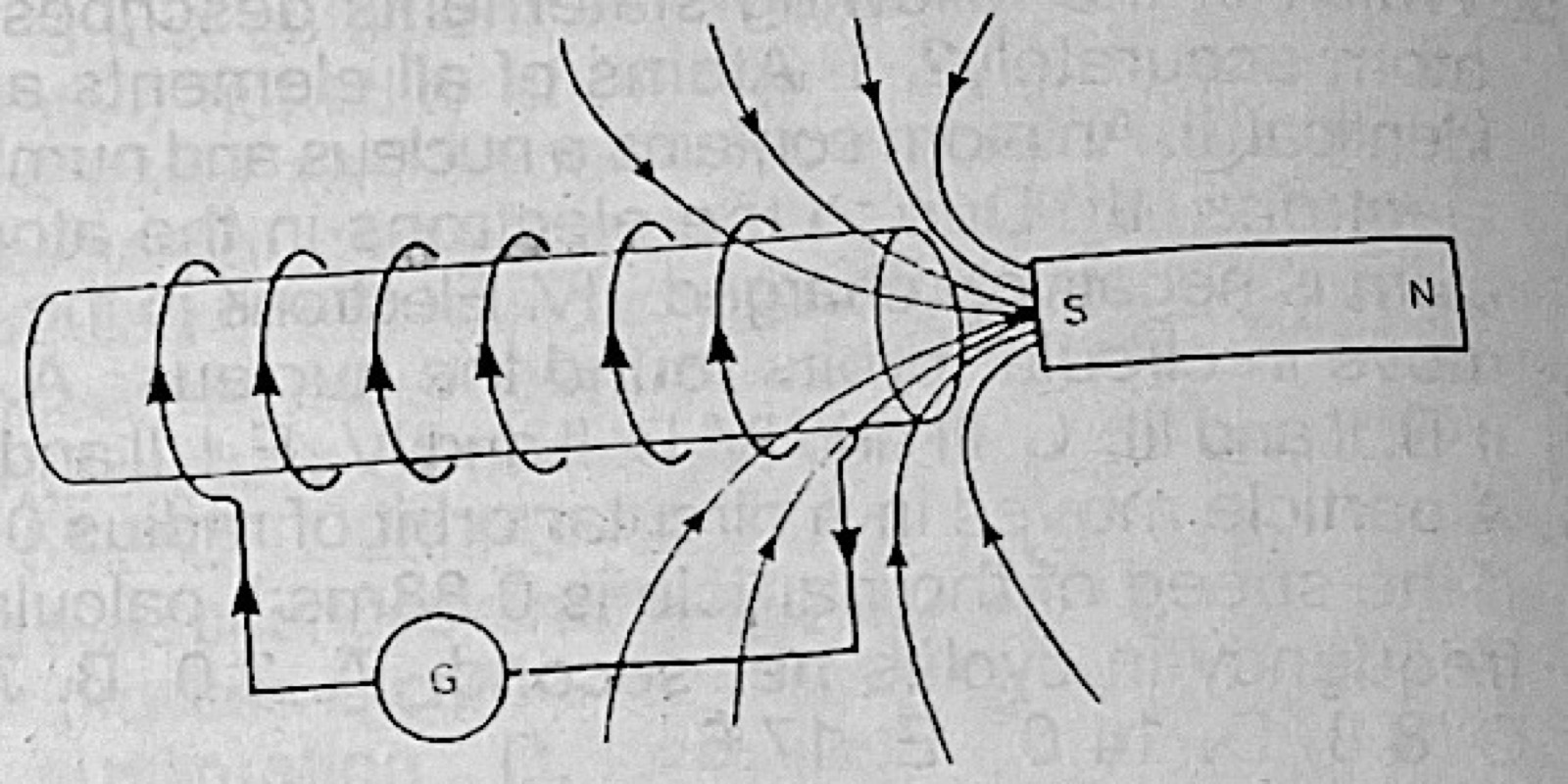
Fig. 9 above represents an insulated cylindrical coil of copper wire wound round a paper tube. The ends of the coil are connected to a sensitive galvanometer. When a magnet was plunged into the coil it was observed that the galvanometer needle gave a deflection. Which of the following correctly describes this experiment?

Diagram for this question
  1. A.The effect illustrated is induced electromotive force
  2. B.The strength of the current produced is inversely proportional to the speed with which the magnet is plunged into the coil.
  3. C.The direction of the current is always such as to enhance the change producing it
  4. D.The galvanometer gave a permanent deflection
  5. E.On removing the magnet from the coil the galvanometer deflected in the same direction.
Show the answer and explanation

Answer: A (The effect illustrated is induced electromotive force)

Explanation

Moving a magnet into a coil changes the flux through it and induces an e.m.f.: electromagnetic induction. The current opposes the change and reverses when the magnet is removed.
Open this question