JAMB Mathematics 1984 past questions and answers

49 questions. Try each one, then open the answer to check yourself and read the explanation.

Question 1

Fractions, Decimals and Approximation

Simplify ((2/3 − 1/5) − 1/3 of 2/5)/(3 − 1/1½)

  1. A.1/7
  2. B.7
  3. C.1/3
  4. D.3
  5. E.1/5
Show the answer and explanation

Answer: A (1/7)

Explanation

Top: 2/3 − 1/5 = 7/15, and 1/3 of 2/5 = 2/15, so the top is 5/15 = 1/3. Bottom: 3 − 2/3 = 7/3. Then 1/3 ÷ 7/3 = 1/7.

Open this question

Question 2

Number Bases

If 263 + 441 = 714, what number base has been used?

  1. A.12
  2. B.11
  3. C.10
  4. D.9
  5. E.8.
Show the answer and explanation

Answer: D (9)

Explanation

Units: 3 + 1 = 4. Next column: 6 + 4 = 10 is written as 1 carry 1, so 10 = base + 1 and the base is 9. Check: 2 + 4 + 1 = 7.

Open this question

Question 3

Fractions, Decimals and Approximation

0.0001432/1 940 000 = K × 10n where 1 ≤ K < 10 and n is a whole number. The values of K and n are

  1. A.7.381 and −11
  2. B.2.34 and 10
  3. C.3.871 and 2
  4. D.7.831 and −11
  5. E.5.41 and −2.
Show the answer and explanation

Answer: A (7.381 and −11)

Explanation

1.432 × 10⁻⁴ ÷ 1.94 × 10⁶ = 0.7381 × 10⁻¹⁰ = 7.381 × 10⁻¹¹.

Open this question

Question 4

Commercial Arithmetic

P sold his bicycle to Q at a profit of 10%. Q sold it to R for ₦209 at a loss of 5%. How much did the bicycle cost P?

  1. A.₦200
  2. B.₦196
  3. C.₦180
  4. D.₦205
  5. E.₦150.
Show the answer and explanation

Answer: A (₦200)

Explanation

Q paid 209 ÷ 0.95 = ₦220. That was 110% of P's cost, so P paid 220 ÷ 1.1 = ₦200.

Open this question

Question 5

Quadratic Equations

If the price of oranges was raised by ½k per orange, the number of oranges a customer can buy for ₦2.40 will be less by 16. What is the present price of an orange?

  1. A.2½k
  2. B.3½k
  3. C.5½k
  4. D.20k
  5. E.21½k.
Show the answer and explanation

Answer: A (2½k)

Explanation

With price x kobo: 240/x − 240/(x + ½) = 16. This simplifies to 2x² + x − 15 = 0, i.e. (2x − 5)(x + 3) = 0, so x = 2½k.

Open this question

Question 6

Commercial Arithmetic

A man invested a total of ₦50,000 in two companies. If these companies pay dividend of 6% and 8% respectively, how much did he invest at 8% if the total yield is ₦3,700?

  1. A.₦15,000
  2. B.₦29,600
  3. C.₦21,400
  4. D.₦27,800
  5. E.₦35,000.
Show the answer and explanation

Answer: E (₦35,000.)

Explanation

If all ₦50,000 earned 6% the yield would be ₦3,000. The extra ₦700 comes from 2% on the 8% part, so that part is 700 ÷ 0.02 = ₦35,000.

Open this question

Question 7

Measures of Central Tendency

Thirty boys and x girls sat for a test. The mean of the boys' scores and that of the girls were respectively 6 and 8. Find x if the total score was 468.

  1. A.38
  2. B.24
  3. C.36
  4. D.22
  5. E.41.
Show the answer and explanation

Answer: C (36)

Explanation

The boys scored 30 × 6 = 180 in total, so the girls scored 468 − 180 = 288. 288 ÷ 8 = 36 girls.

Open this question

Question 8

Data Presentation

The cost of production of an article is made up as follows: Labour ₦70, Power ₦15, Materials ₦30, Miscellaneous ₦5. Find the angle of the sector representing labour in a pie chart.

  1. A.210°
  2. B.105°
  3. C.175°
  4. D.150°
  5. E.90°.
Show the answer and explanation

Answer: A (210°)

Explanation

The total cost is ₦120. Labour's angle = 70/120 × 360° = 210°.

Open this question

Question 9

Probability

Bola chooses at random a number between 1 and 300. What is the probability that the number is divisible by 4?

  1. A.1/3
  2. B.1/4
  3. C.1/5
  4. D.4/300
  5. E.1/300
Show the answer and explanation

Answer: B (1/4)

Explanation

Every fourth number is divisible by 4 (4, 8, …, 300), which is 75 numbers out of 300, so the probability is ¼.

Open this question

Question 10

Logarithms

Find, without using logarithm tables, the value of (log327 − log¼64)/log3(1/81)

  1. A.7/4
  2. B.−7/4
  3. C.−3/2
  4. D.7/3
  5. E.−1/4
Show the answer and explanation

Answer: C (−3/2)

Explanation

log₃27 = 3, log_¼ 64 = −3 (since (¼)⁻³ = 64) and log₃(1/81) = −4. So (3 + 3)/(−4) = −3/2.

Open this question

Question 11

Coordinate Geometry

A variable point P(x,y) traces a graph in a two dimensional plane. (0,−3) is one position of P. If x increases by 1 unit, y increases by 4 units the equation of the graph is

  1. A.−3 = (y + 4)/(x + 1)
  2. B.4y = −3 + x
  3. C.y/x = −3/4
  4. D.y + 3 = 4x
  5. E.4y = x + 3.
Show the answer and explanation

Answer: D (y + 3 = 4x)

Explanation

The gradient is 4 and the line passes through (0, −3), so y = 4x − 3, i.e. y + 3 = 4x.

Open this question

Question 12

Number Bases

A trader in a country where their currency 'MONT' (M) is in base five bought 103(5) oranges at M14(5) each, what will be his gain? If he sells them at M24 each

  1. A.M103(5)
  2. B.M1030(5)
  3. C.M102(5)
  4. D.M2002(5)
  5. E.M3032(5)
Show the answer and explanation

Answer: B (M1030(5))

Explanation

In base ten: 103₅ = 28 oranges, 14₅ = 9 and 24₅ = 14, so the gain is 28 × 5 = 140. In base five 140 = 1030₅.

Open this question

Question 13

Surds

Rationalize (5√7 − 7√5)/(√7 − √5)

  1. A.−2√35
  2. B.4√7 − 6√5
  3. C.−√35
  4. D.4√7 − 8√5
  5. E.√35.
Show the answer and explanation

Answer: C (−√35)

Explanation

Multiply top and bottom by √7 + √5. The bottom becomes 2 and the top 35 + 5√35 − 7√35 − 35 = −2√35, so the result is −√35.

Open this question

Question 14

Indices

Simplify (3n − 3n−1)/(33 × 3n − 27 × 3n−1)

  1. A.1
  2. B.0
  3. C.1/27
  4. D.3n − 3n−1
  5. E.2/27
Show the answer and explanation

Answer: C (1/27)

Explanation

27 × 3ⁿ − 27 × 3ⁿ⁻¹ = 27(3ⁿ − 3ⁿ⁻¹). Cancelling (3ⁿ − 3ⁿ⁻¹) leaves 1/27.

Open this question

Question 15

Variation

P varies directly as the square of q and inversely as r. If p = 36 when q = 3 and r = 4, find p when q = 5 and r = 2

  1. A.72
  2. B.100
  3. C.90
  4. D.200
  5. E.125.
Show the answer and explanation

Answer: D (200)

Explanation

p = kq²/r. 36 = 9k/4 gives k = 16. Then p = 16 × 25/2 = 200.

Open this question

Question 16

Algebraic Expressions

Factorize 6x2 − 14x − 12

  1. A.2(x + 3)(3x − 2)
  2. B.6(x − 2)(x + 1)
  3. C.2(x − 3)(3x + 2)
  4. D.6(x + 2)(x − 1)
  5. E.(3x − 4)(2x + 3).
Show the answer and explanation

Answer: C (2(x − 3)(3x + 2))

Explanation

Take out 2: 2(3x² − 7x − 6) = 2(3x + 2)(x − 3).

Open this question

Question 17

Graphs of Functions

A straight line y = mx meets the curve y = x2 − 12x + 40 in two distinct points. If one of them is (5,5) find the other.

  1. A.(5,6)
  2. B.(8,8)
  3. C.(8,5)
  4. D.(7,7)
  5. E.(7,5).
Show the answer and explanation

Answer: B ((8,8))

Explanation

(5,5) on y = mx gives m = 1. Then x = x² − 12x + 40, i.e. x² − 13x + 40 = 0, so x = 5 or 8. The other point is (8,8).

Open this question

Question 18

Graphs of Functions

The table below is drawn for a graph y = x3 − 3x + 1
x: −3, −2, −1, 0, 1, 2, 3
y: 1, −1, 3, 1, −1, 3, 1
From x = −2 to x = 1, the graph crosses the x-axis in the range(s)

  1. A.−1 < x < 0 and 0 < x < 1
  2. B.−2 < x < −1 and 0 < x < 1
  3. C.−2 < x < −1 and −1 < x < 0
  4. D.0 < x < 1
  5. E.1 < x < 2.
Show the answer and explanation

Answer: B (−2 < x < −1 and 0 < x < 1)

Explanation

y changes sign between x = −2 (−1) and x = −1 (3), and between x = 0 (1) and x = 1 (−1). So the graph crosses the x-axis in −2 < x < −1 and 0 < x < 1.

Open this question

Question 19

Inequalities

In a racing competition Musa covered a distance of 5x km in the first hour and (x + 10)km in the next hour. He was second to Ngozi who covered a total distance of 118km in the two hours. Which of the following inequalities is correct?

  1. A.0 < −x < 15
  2. B.−3 ≤ x < 3
  3. C.15 < x < 18
  4. D.0 ≤ x < 15
  5. E.0 ≤ x < 18.
Show the answer and explanation

Answer: E (0 ≤ x < 18.)

Explanation

Musa covered less than Ngozi: 5x + x + 10 < 118, so 6x < 108 and x < 18. Distances cannot be negative, so 0 ≤ x < 18.

Open this question

Question 20

Linear and Simultaneous Equations

If 2x + 3y = 1 and x − 2y = 11, find (x + y)

  1. A.5
  2. B.−3
  3. C.8
  4. D.2
  5. E.−2.
Show the answer and explanation

Answer: D (2)

Explanation

From the second equation x = 11 + 2y. Then 22 + 4y + 3y = 1, so y = −3 and x = 5. x + y = 2.

Open this question

Question 21

Quadratic Equations

Tunde and Shola can do a piece of work in 18 days. Tunde can do it alone in x days, whilst Shola takes 15 days longer to do it alone. Which of the following equations is satisfied by x?

  1. A.x2 − 5x − 18 = 0
  2. B.x2 − 20x + 360 = 0
  3. C.x2 − 21x − 270 = 0
  4. D.2x2 + 42x − 190 = 0
  5. E.3x2 − 31x + 150 = 0.
Show the answer and explanation

Answer: C (x2 − 21x − 270 = 0)

Explanation

In one day they do 1/x + 1/(x + 15) = 1/18 of the work. Multiplying out: 18(2x + 15) = x(x + 15), which gives x² − 21x − 270 = 0.

Open this question

Question 23

Quadratic Equations

The quadratic equation whose roots are 1 − √13 and 1 + √13 is

  1. A.x2 + (1 − √13)x + 1 + √13 = 0
  2. B.x2 + (1 + √13)x + 1 − √13 = 0
  3. C.x2 + 2x + 12 = 0
  4. D.x2 − 2x + 12 = 0
  5. E.x2 − 2x − 12 = 0.
Show the answer and explanation

Answer: E (x2 − 2x − 12 = 0.)

Explanation

The roots add to 2 and multiply to 1 − 13 = −12, so the equation is x² − 2x − 12 = 0.

Open this question

Question 24

Algebraic Expressions

Find a factor which is common to all three binomial expressions 4a2 − 9b2, 8a3 + 27b3, (4a + 6b)2

  1. A.4a + 6b
  2. B.4a − 6b
  3. C.2a + 3b
  4. D.2a − 3b
  5. E.None.
Show the answer and explanation

Answer: C (2a + 3b)

Explanation

4a² − 9b² = (2a − 3b)(2a + 3b), 8a³ + 27b³ = (2a + 3b)(4a² − 6ab + 9b²) and (4a + 6b)² = 4(2a + 3b)². All contain 2a + 3b.

Open this question

Question 25

Mensuration of Solids

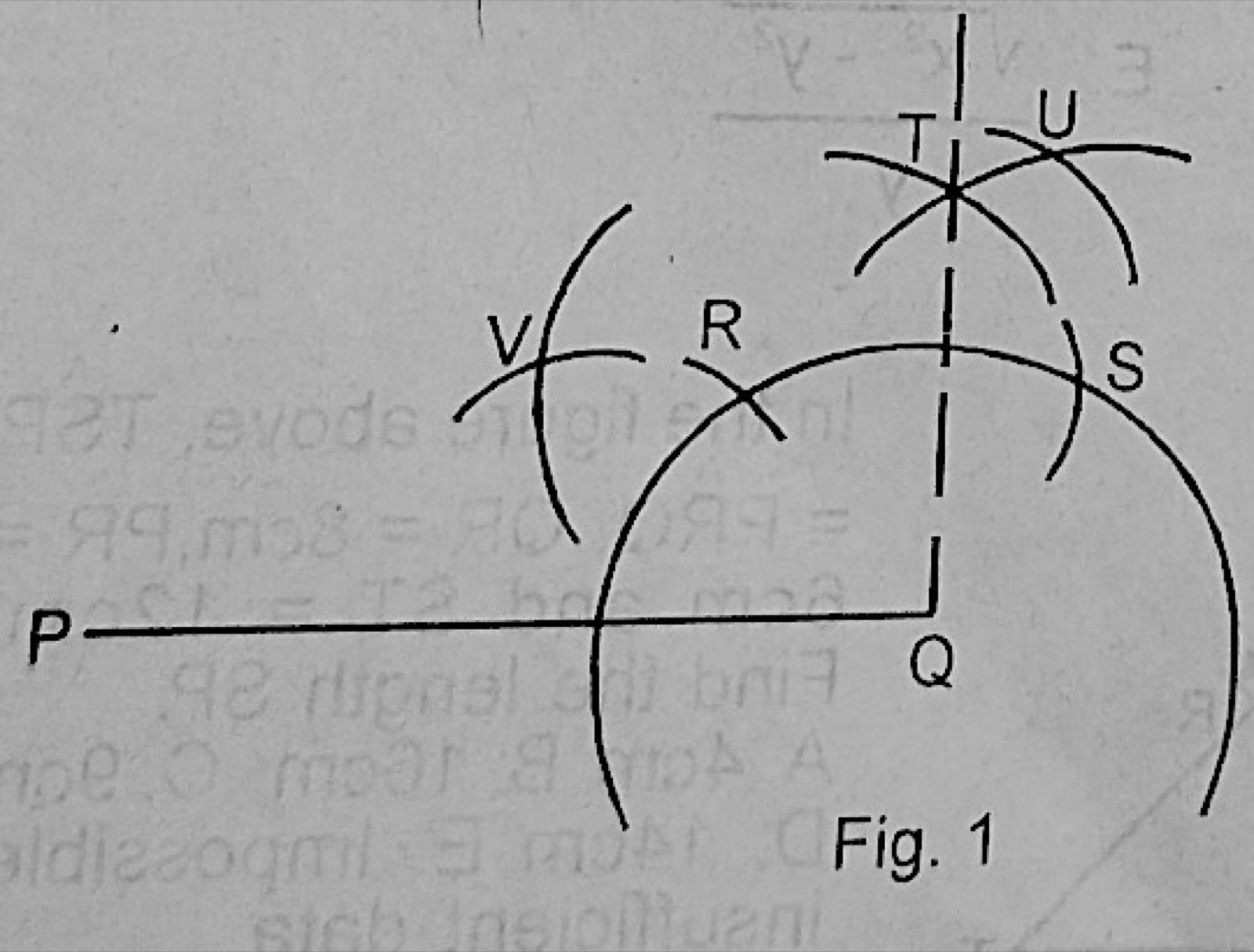
What is the volume of the regular three dimensional figure drawn above?

Diagram for this question
  1. A.160cm3
  2. B.48cm3
  3. C.96cm3
  4. D.120cm3
  5. E.40cm3.
Show the answer and explanation

Answer: B (48cm3)

Explanation

The end is a right-angled triangle with hypotenuse 5cm and side 4cm, so its other side is 3cm and its area is ½ × 3 × 4 = 6cm². Volume = 6 × 8 = 48cm³.

Open this question

Question 26

Polynomials

If (x − 2) and (x + 1) are factors of the expression x3 + px2 + qx + 1, what is the sum of p and q?

  1. A.0
  2. B.−3
  3. C.3
  4. D.−17/3
  5. E.−2/3
Show the answer and explanation

Answer: B (−3)

Explanation

x = 2: 8 + 4p + 2q + 1 = 0. x = −1: −1 + p − q + 1 = 0, so p = q. Then 6p = −9, p = q = −3/2 and p + q = −3.

Open this question

Question 27

Mensuration of Solids

A cone is formed by bending a sector of a circle having an angle of 210°. Find the radius of the base of the cone if the diameter of the circle is 12cm.

  1. A.7.00cm
  2. B.1.75cm
  3. C.√21cm
  4. D.3.50cm
  5. E.2√21cm
Show the answer and explanation

Answer: D (3.50cm)

Explanation

The arc becomes the base circumference: 2πr = 210/360 × 2π × 6, so r = 210/360 × 6 = 3.5cm.

Open this question

Question 28

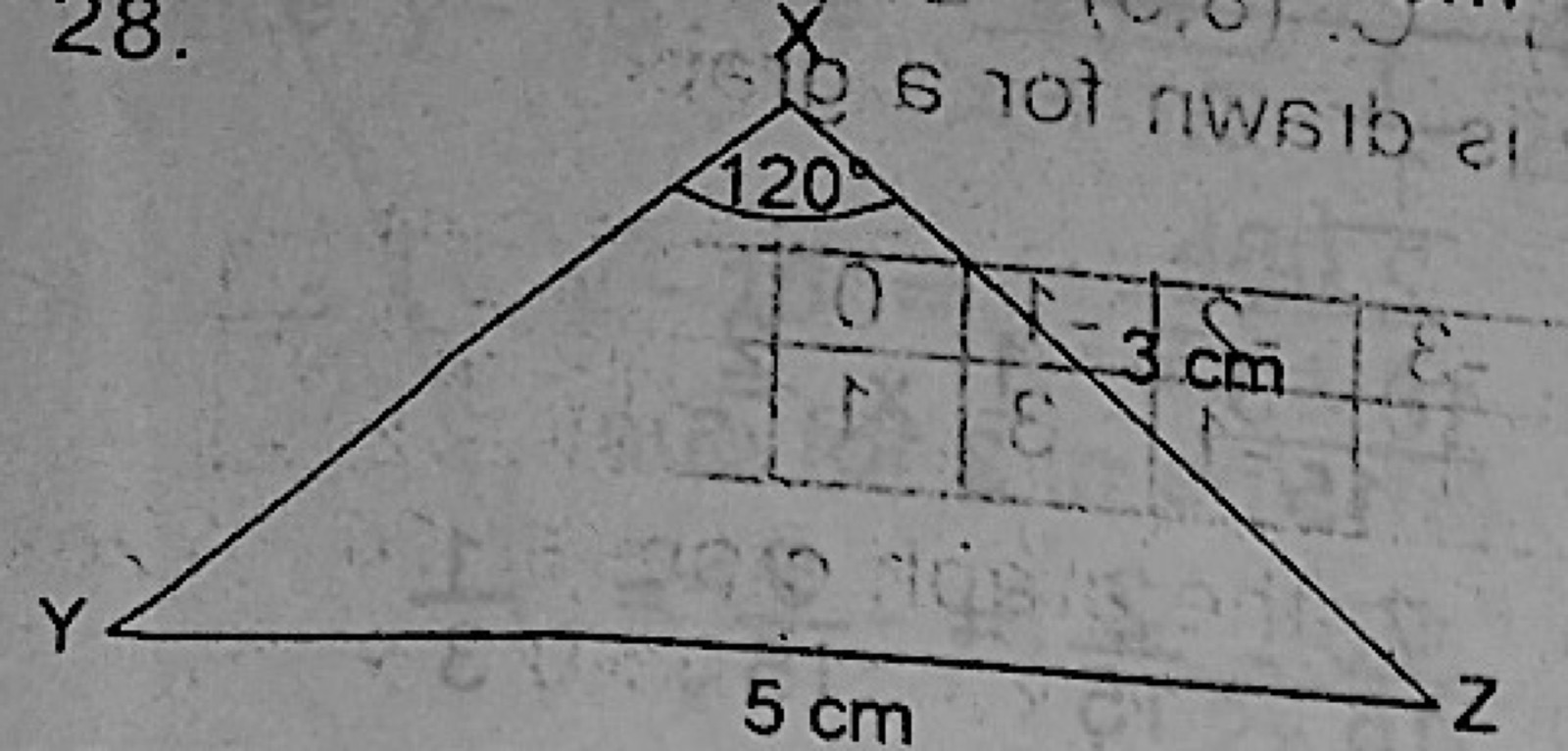
Trigonometry

Using ΔXYZ in the figure above find XYZ.

Diagram for this question
  1. A.29°
  2. B.31°20'
  3. C.31°
  4. D.31°18'
  5. E.59°.
Show the answer and explanation

Answer: D (31°18')

Explanation

By the sine rule, sin Y/3 = sin 120°/5, so sin Y = 3 × 0.866/5 ≈ 0.5196 and Y ≈ 31°18'.

Open this question

Question 29

Trigonometry

The sides of a triangle are (x + 4)cm, x cm and (x − 4)cm respectively. If the cosine of the largest angle is 1/5, find the value of x.

  1. A.24cm
  2. B.20cm
  3. C.28cm
  4. D.88/7cm
  5. E.0cm
Show the answer and explanation

Answer: A (24cm)

Explanation

The largest angle faces x + 4. Cosine rule: (x + 4)² = x² + (x − 4)² − 2x(x − 4)/5. Multiplying by 5 and simplifying gives 3x² − 72x = 0, so x = 24.

Open this question

Question 30

Algebraic Expressions

If a = 2x/(1 − x) and b = (1 + x)/(1 − x) then a2 − b2 in the simplest form is

  1. A.(3x + 1)/(x − 1)
  2. B.(3x2 + 1)/(x(x − 1)2)
  3. C.(3x2 + 1)/(1 − x)2
  4. D.(5x2 − 1)/(1 − x)2
  5. E.(5x2 − 2x − 1)/(1 − x)2
Show the answer and explanation

Answer: A ((3x + 1)/(x − 1))

Explanation

a² − b² = (4x² − (1 + x)²)/(1 − x)² = (3x² − 2x − 1)/(1 − x)² = (3x + 1)(x − 1)/(x − 1)² = (3x + 1)/(x − 1).

Open this question

Question 31

Algebraic Expressions

Simplify (1 + (x − 1)/(1/(x + 1)))(x + 2)

  1. A.(x2 − 1)(x + 2)
  2. B.x2(x + 2)/(x + 1)
  3. C.x2(x + 2)
  4. D.2x(x + 2)
  5. E.2x(x + 2)/(x + 1)
Show the answer and explanation

Answer: C (x2(x + 2))

Explanation

Dividing by 1/(x + 1) multiplies by (x + 1): 1 + (x − 1)(x + 1) = 1 + x² − 1 = x². So the expression is x²(x + 2).

Open this question

Question 32

Angles and Polygons

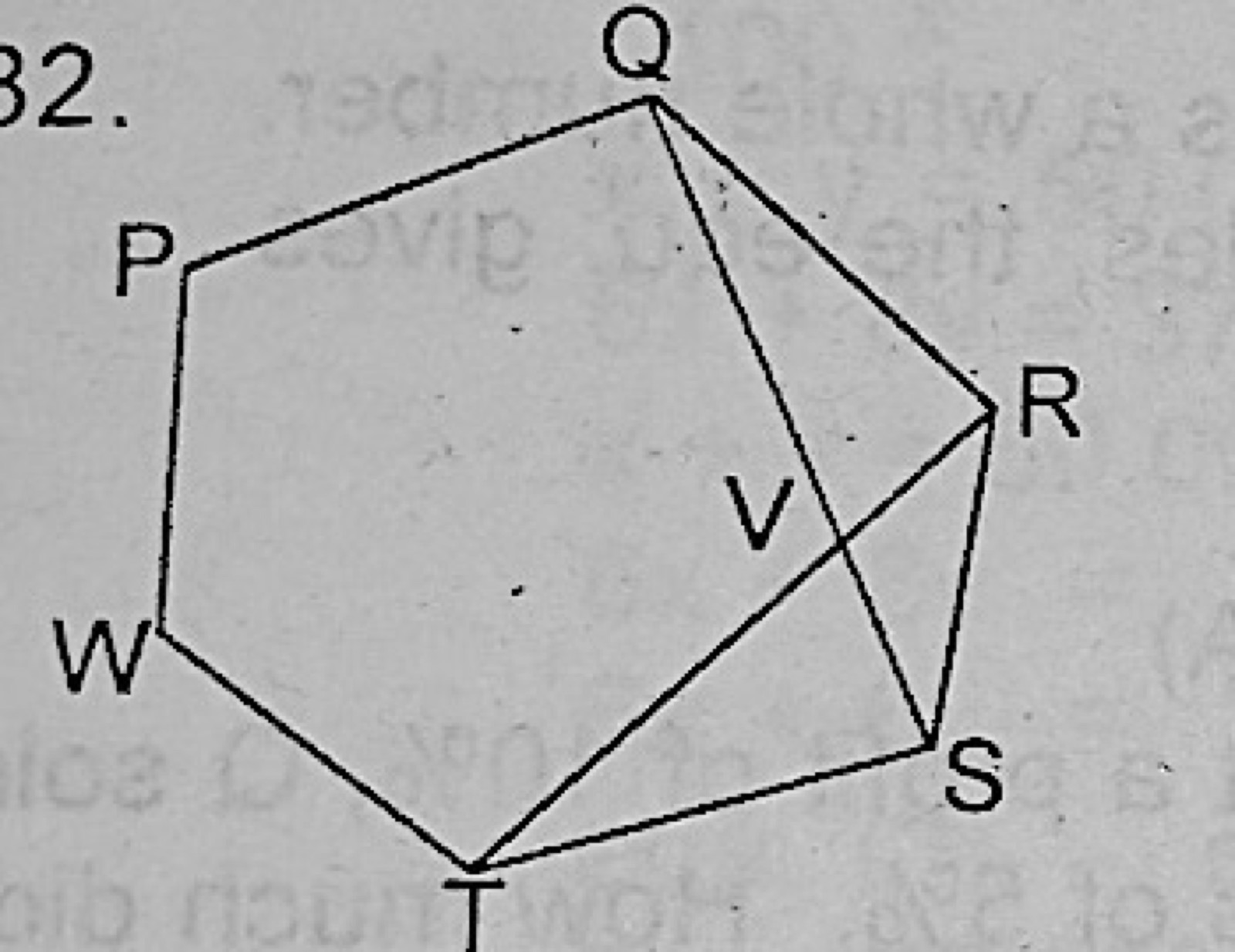
In the figure above PQRSTW is a regular hexagon. QS intersects RT at V. Calculate TVS.

Diagram for this question
  1. A.60°
  2. B.90°
  3. C.120°
  4. D.30°
  5. E.80°.
Show the answer and explanation

Answer: A (60°)

Explanation

Each interior angle is 120°. Triangles QRS and RST are isosceles, so <RSQ = <SRT = 30°. Then <RVS = 120° and <TVS = 180° − 120° = 60°.

Open this question

Question 33

Inequalities

Find all integral values of x which satisfy the inequalities −3 < 2 − 5x < 12

  1. A.−2, −1
  2. B.−2, 2
  3. C.−1, 0
  4. D.0, 1
  5. E.1, 2.
Show the answer and explanation

Answer: C (−1, 0)

Explanation

Subtract 2: −5 < −5x < 10. Divide by −5 and reverse the signs: −2 < x < 1. The integers are −1 and 0.

Open this question

Question 34

Mensuration of Plane Shapes

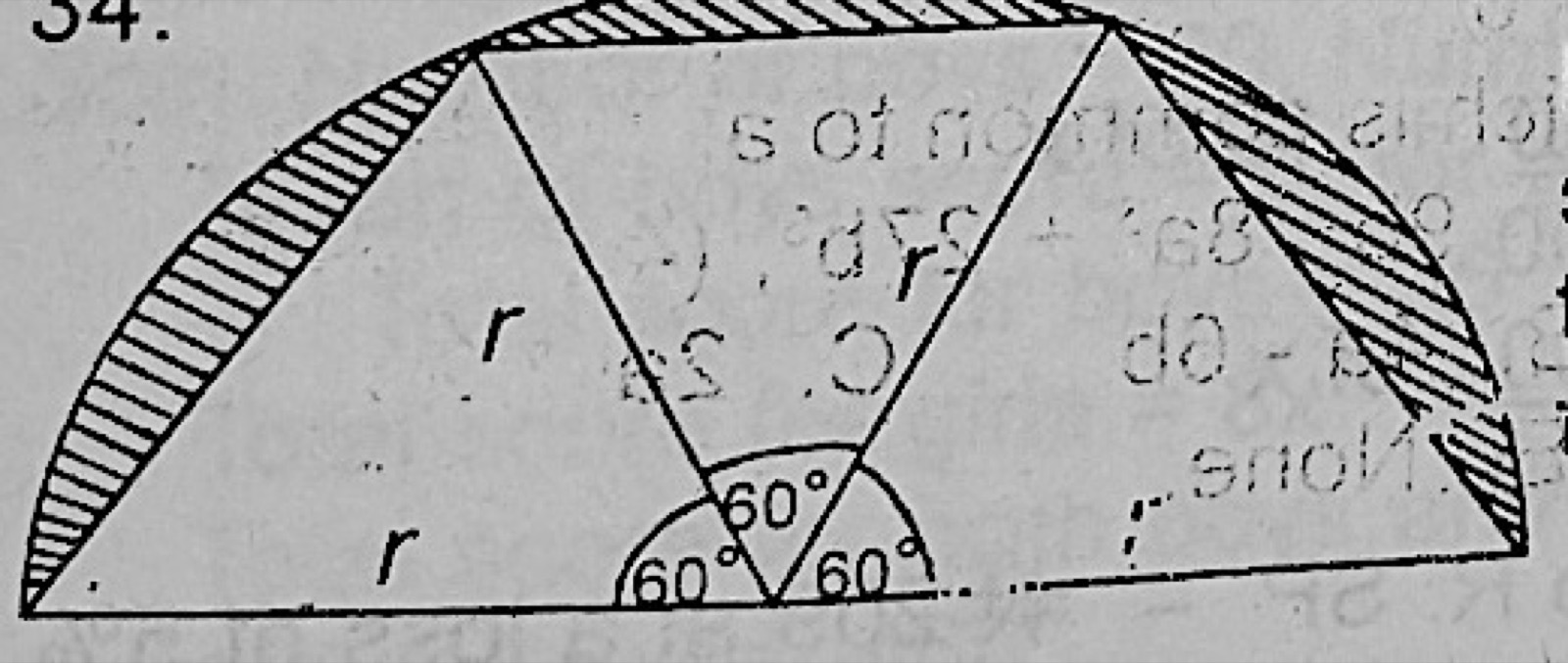
Find the area of the shaded portion of the semi-circular figure above.

Diagram for this question
  1. A.r2/4 (4π − 3√3)
  2. B.r2/4 (2π − 3√3)
  3. C.½r2π
  4. D.⅛r2√3
  5. E.r2/8 (4π + 3√3)
Show the answer and explanation

Answer: B (r2/4 (2π − 3√3))

Explanation

The semicircle is three 60° sectors, each minus an equilateral triangle. Each segment is πr²/6 − (√3/4)r², so three of them give r²/4(2π − 3√3).

Open this question

Question 35

Circle Theorems

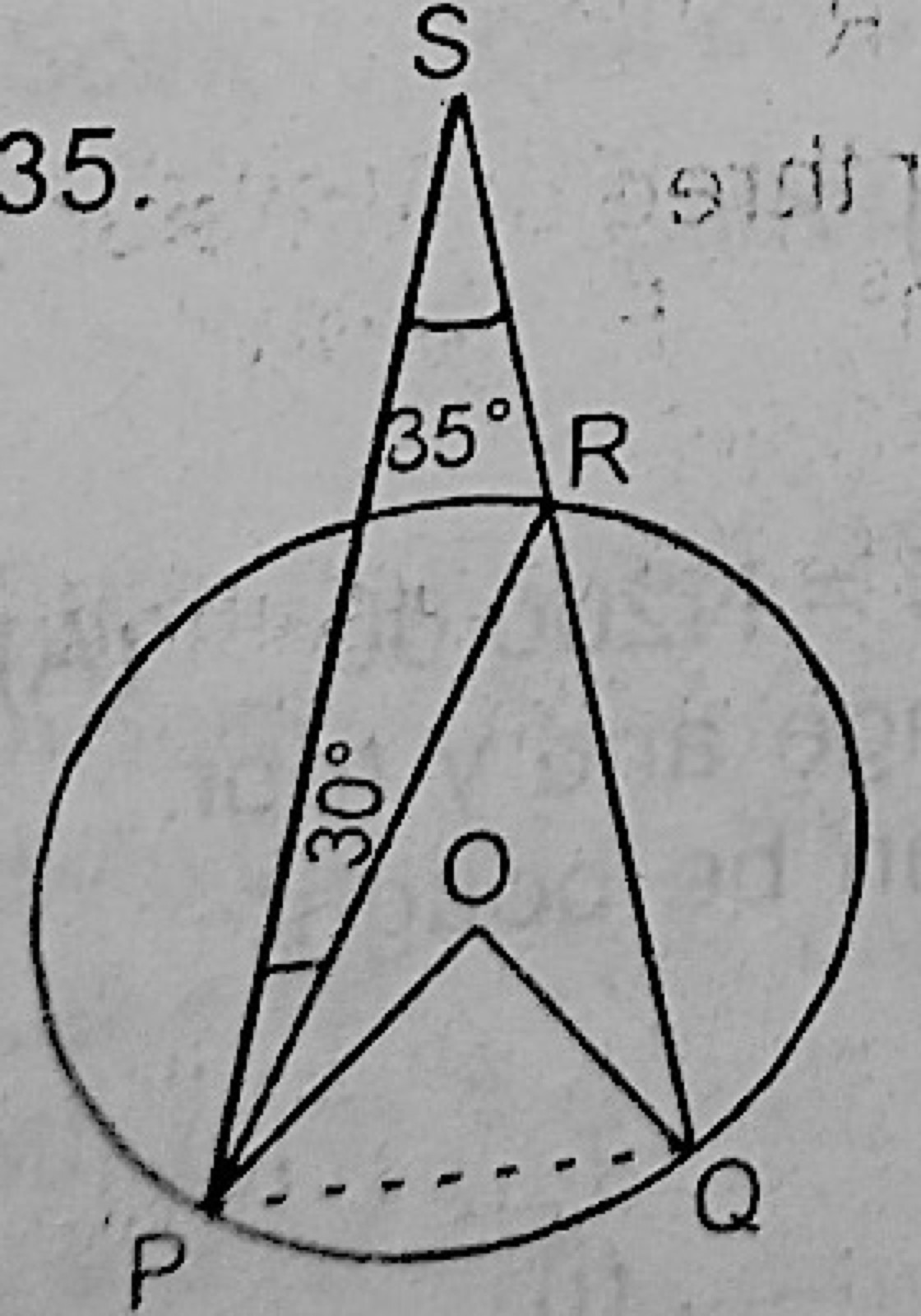
In the figure above, QRS is a line, PSQ = 35°, SPR = 30° and O is the centre of the circle. Find OQP.

Diagram for this question
  1. A.35°
  2. B.30°
  3. C.130°
  4. D.25°
  5. E.65°.
Show the answer and explanation

Answer: D (25°)

Explanation

<PRQ is an exterior angle of triangle PRS: 35° + 30° = 65°. The angle at the centre <POQ = 130°, and triangle OPQ is isosceles, so <OQP = (180° − 130°)/2 = 25°.

Open this question

Question 36

Algebraic Expressions

If pq + 1 = q2 and t = 1/p − 1/pq express t in terms of q.

  1. A.1/(p − q)
  2. B.1/(q − 1)
  3. C.1/(q + 1)
  4. D.1 + q
  5. E.1/(1 − q)
Show the answer and explanation

Answer: C (1/(q + 1))

Explanation

t = (q − 1)/pq, and pq = q² − 1. So t = (q − 1)/((q − 1)(q + 1)) = 1/(q + 1).

Open this question

Question 37

Data Presentation

The cumulative frequency function of the data below is given by the equation y = cf(x). What is cf(5)?
Scores (n): 3, 4, 5, 6, 8
Frequency (f): 30, 32, 30, 35, 20

  1. A.30
  2. B.35
  3. C.55
  4. D.62
  5. E.92.
Show the answer and explanation

Answer: E (92.)

Explanation

cf(5) counts all scores up to 5: 30 + 32 + 30 = 92.

Open this question

Question 38

Triangles and Quadrilaterals

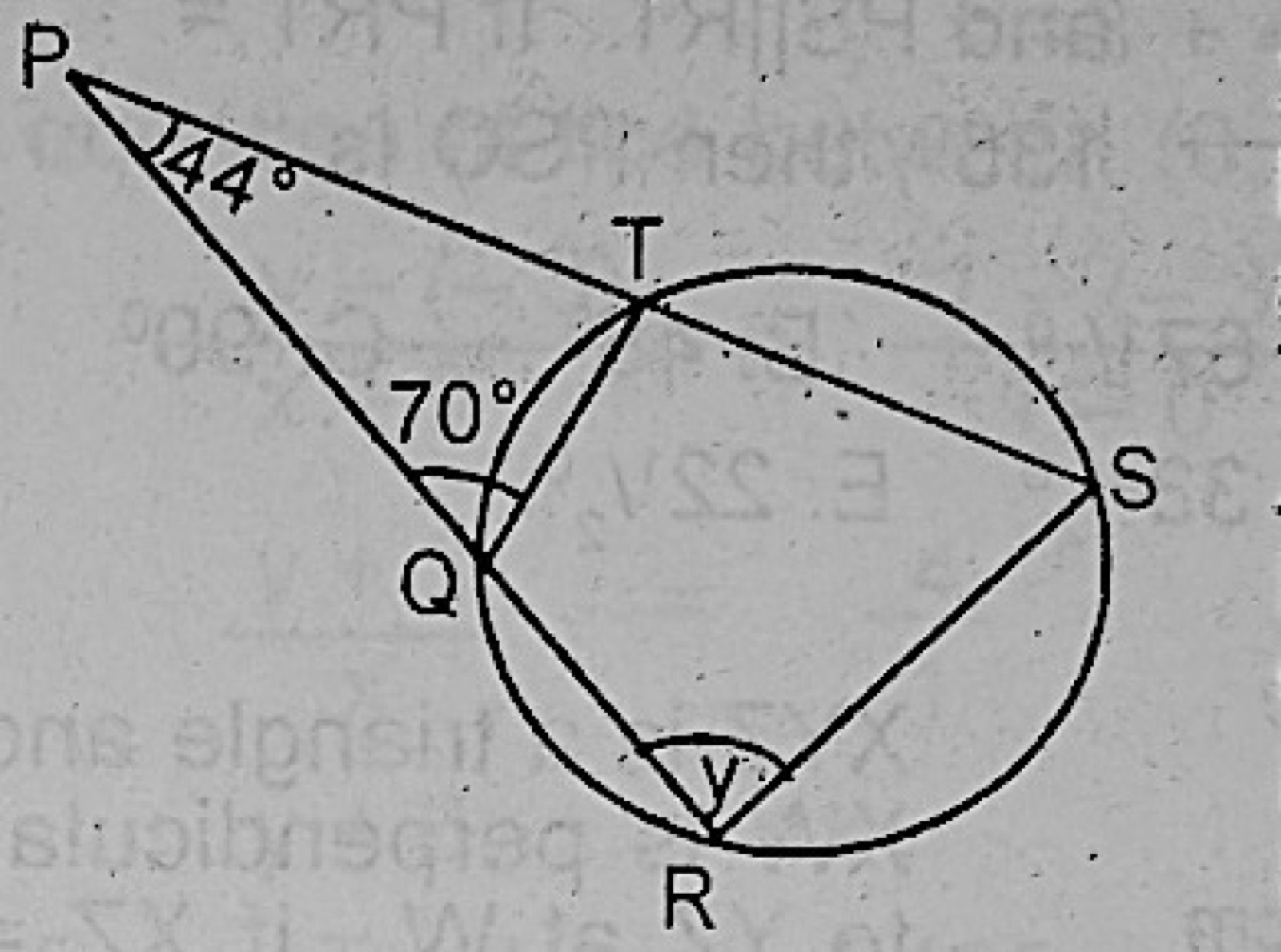
In the figure below, determine the angle marked y

Diagram for this question
  1. A.66°
  2. B.110°
  3. C.26°
  4. D.70°
  5. E.44°.
Show the answer and explanation

Answer: A (66°)

Explanation

QTSR is cyclic, so the exterior angle <PQT = 70° equals the opposite interior angle <TSR. In triangle PRS, y = 180° − 44° − 70° = 66°.

Open this question

Question 39

Mensuration of Solids

A right circular cone has a base radius r cm and a vertical angle 2y°. The height of the cone is

  1. A.r tan y° cm
  2. B.r sin y° cm
  3. C.r cot y° cm
  4. D.r cos y° cm
  5. E.r cosec y° cm.
Show the answer and explanation

Answer: C (r cot y° cm)

Explanation

Half the vertical angle is y, and tan y = r/h. So h = r/tan y = r cot y.

Open this question

Question 40

Probability

Two fair dice are rolled. What is the probability that both show up the same number of points?

  1. A.1/36
  2. B.7/36
  3. C.1/2
  4. D.1/3
  5. E.1/6
Show the answer and explanation

Answer: E (1/6)

Explanation

Of the 36 equally likely outcomes, 6 are doubles (1-1, …, 6-6). 6/36 = 1/6.

Open this question

Question 41

Quadratic Equations

The larger value of y for which (y − 1)2 = 4y − 7 is

  1. A.2
  2. B.4
  3. C.6
  4. D.7
  5. E.8.
Show the answer and explanation

Answer: B (4)

Explanation

y² − 2y + 1 = 4y − 7 gives y² − 6y + 8 = 0, so (y − 2)(y − 4) = 0. The larger value is 4.

Open this question

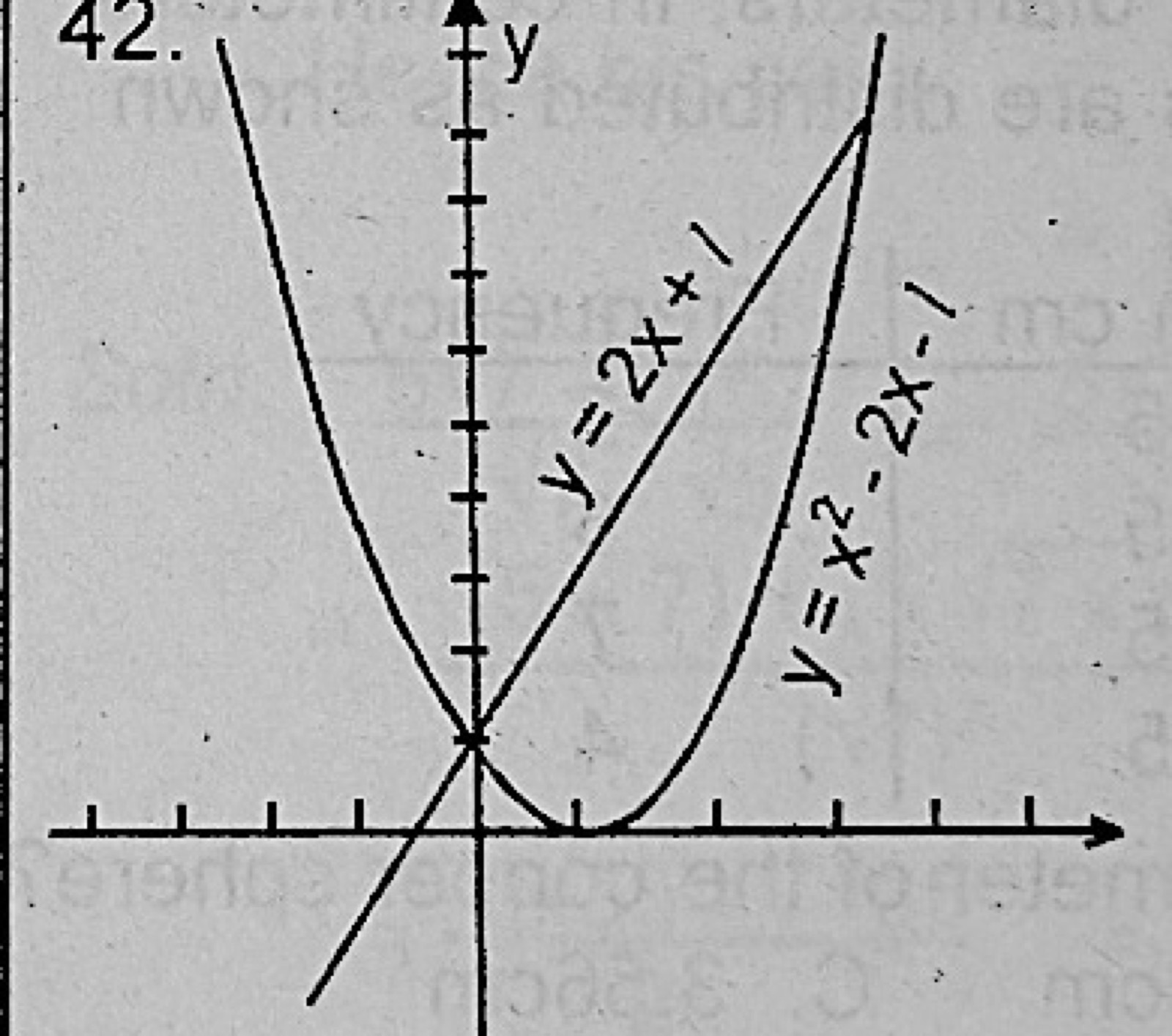
Question 42

Graphs of Functions

Find the x co-ordinates of the points of intersection of the two equations in the graph above.

Diagram for this question
  1. A.1, 1
  2. B.0, −4
  3. C.4, 9
  4. D.0, 0
  5. E.0, 4.
Show the answer and explanation

Answer: E (0, 4.)

Explanation

Set 2x + 1 = x² − 2x + 1: x² − 4x = 0, so x = 0 or 4.

Open this question

Question 43

Trigonometry

If sin θ = x/y and 0° < θ < 90° then find 1/tan θ

  1. A.x/√(y2 − x2)
  2. B.y/x
  3. C.√(y2 − x2)/x
  4. D.√(y2 + x2)/√(y2 + x2)
  5. E.√(x2 − y2)/y
Show the answer and explanation

Answer: C (√(y2 − x2)/x)

Explanation

With opposite side x and hypotenuse y, the adjacent side is √(y² − x²). 1/tan θ = adjacent/opposite = √(y² − x²)/x.

Open this question

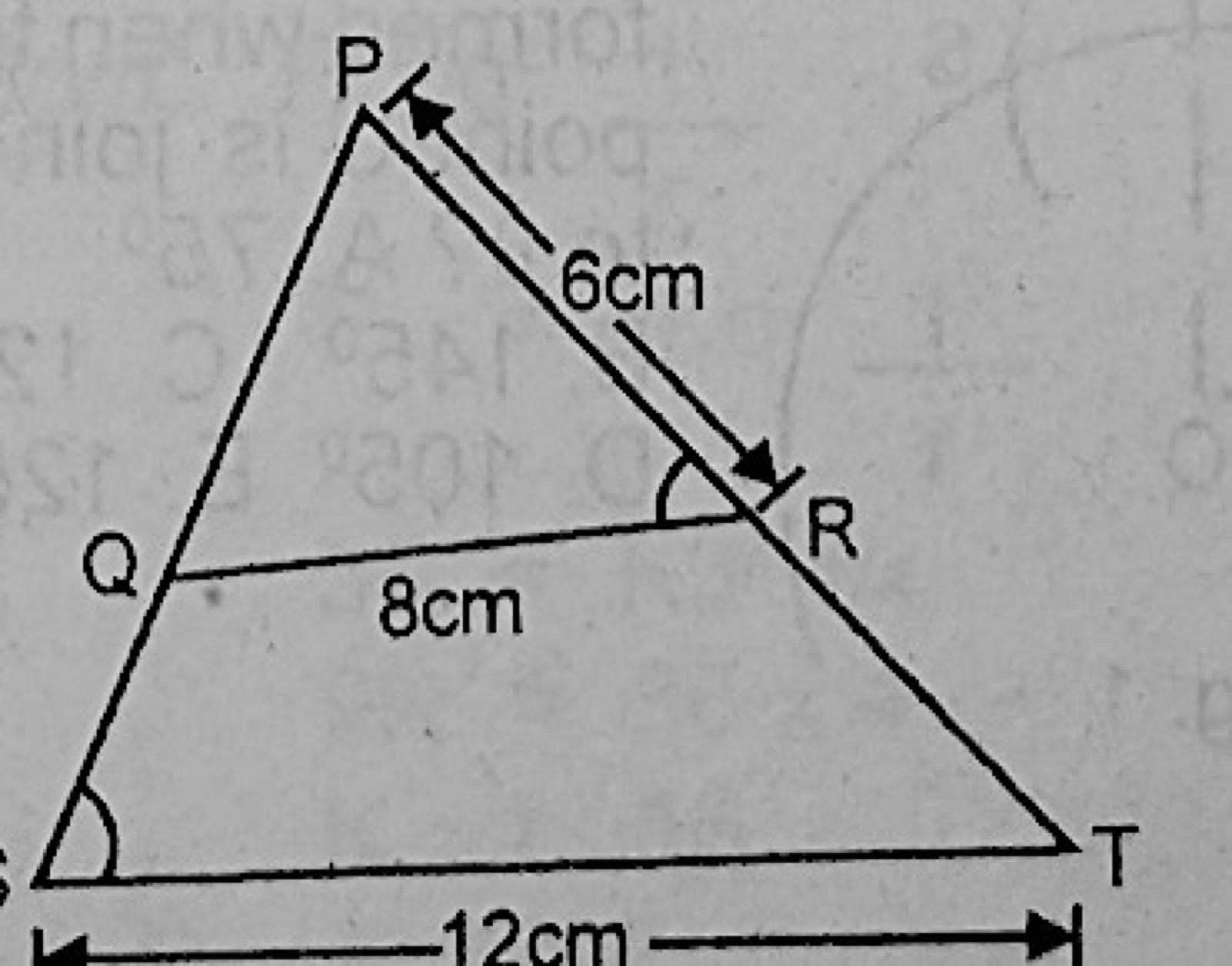
Question 44

Triangles and Quadrilaterals

In the figure above, TSP = PRQ, QR = 8cm, PR = 6cm and ST = 12cm. Find the length SP.

Diagram for this question
  1. A.4cm
  2. B.16cm
  3. C.9cm
  4. D.14cm
  5. E.Impossible, insufficient data.
Show the answer and explanation

Answer: C (9cm)

Explanation

Triangles PRQ and PST share angle P and have <PRQ = <PST, so they are similar: PR/PS = QR/TS. 6/PS = 8/12 gives PS = 9cm.

Open this question

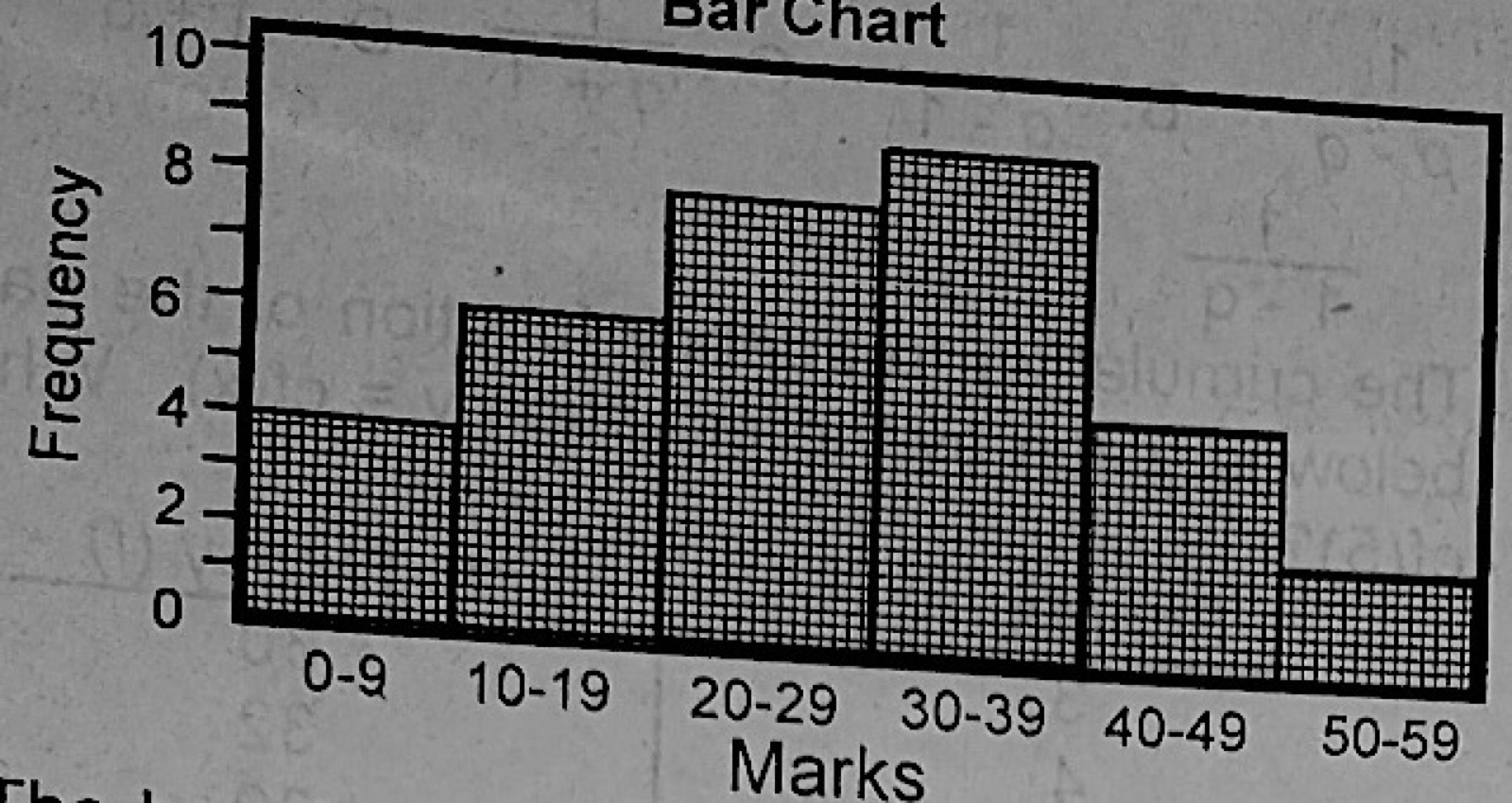
Question 45

Data Presentation

The bar chart above shows the mark distribution in a class test. Find the number of students in the class.

Diagram for this question
  1. A.9
  2. B.2
  3. C.60
  4. D.30
  5. E.34
Show the answer and explanation

Answer: E (34)

Explanation

The number of students is the sum of the bar heights (frequencies) for all the mark groups.

Open this question

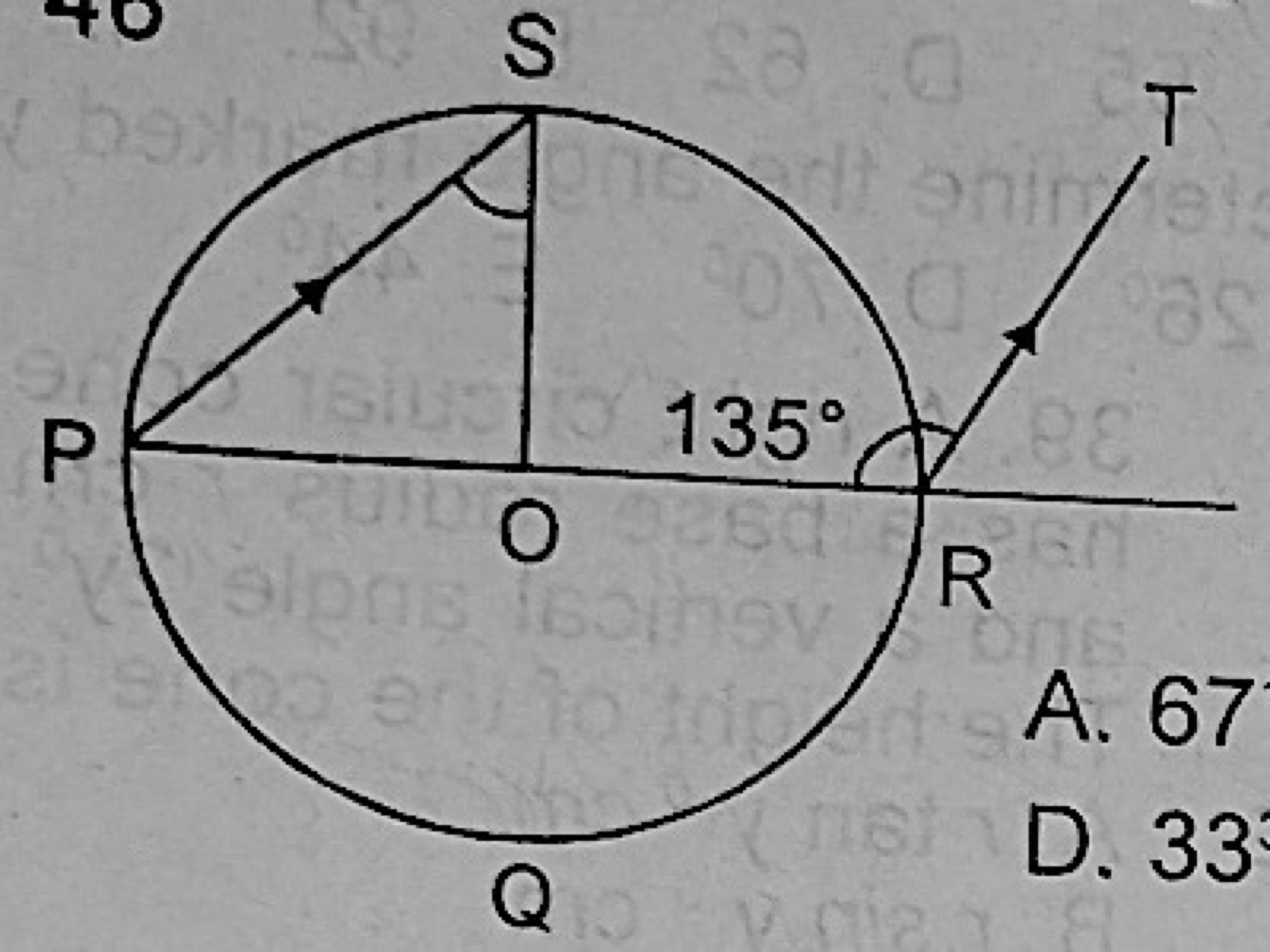
Question 46

Circle Theorems

In the figure above, O is the centre of circle PQRS and PS∥RT. If PRT = 135°, then PSO is

Diagram for this question
  1. A.67½°
  2. B.45°
  3. C.90°
  4. D.33¾°
  5. E.22½°.
Show the answer and explanation

Answer: B (45°)

Explanation

PS ∥ RT, so <SPR = 180° − 135° = 45° (co-interior angles). OP = OS, so <PSO = <SPO = 45°.

Open this question

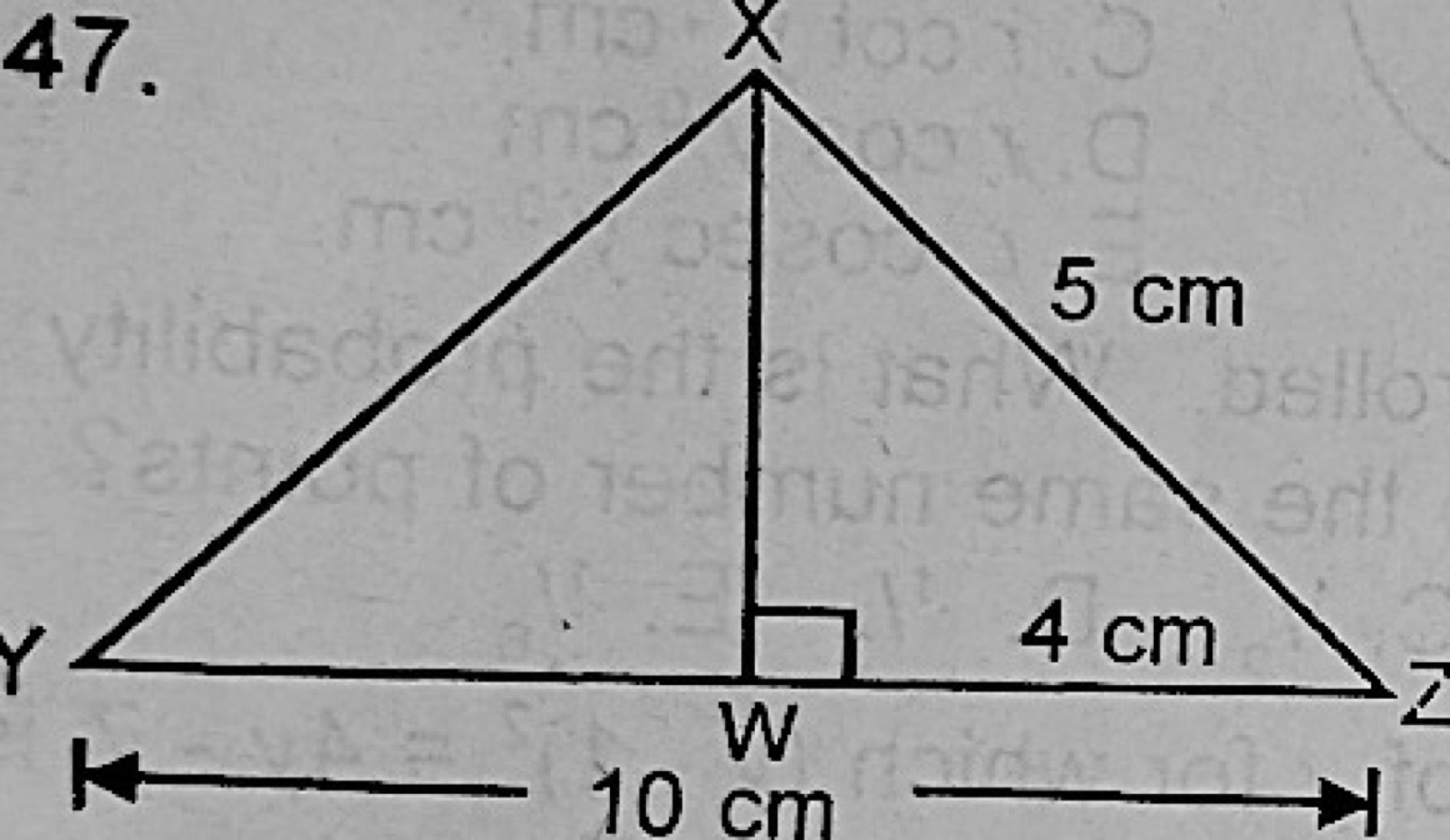
Question 47

Triangles and Quadrilaterals

XYZ is a triangle and XW is perpendicular to YZ at W. If XZ = 5cm and WZ = 4cm, calculate XY.

Diagram for this question
  1. A.5√3cm
  2. B.3√5cm
  3. C.3√3cm
  4. D.5cm
  5. E.6cm.
Show the answer and explanation

Answer: B (3√5cm)

Explanation

XW = √(5² − 4²) = 3cm and YW = 10 − 4 = 6cm. XY = √(6² + 3²) = √45 = 3√5cm.

Open this question

Question 48

Data Presentation

Measurements of the diameters, in centimeters, of 20 copper spheres are distributed as shown below:
Class boundary in cm: 3.35 − 3.45, 3.45 − 3.55, 3.55 − 3.65, 3.65 − 3.75
Frequency: 3, 6, 7, 4
What is the mean diameter of the copper sphere?

  1. A.3.40cm
  2. B.3.58cm
  3. C.3.56cm
  4. D.3.62cm
  5. E.3.63cm.
Show the answer and explanation

Answer: C (3.56cm)

Explanation

Use the class mid-points 3.4, 3.5, 3.6, 3.7: Σfx = 10.2 + 21.0 + 25.2 + 14.8 = 71.2, and 71.2 ÷ 20 = 3.56cm.

Open this question

Question 49

Constructions

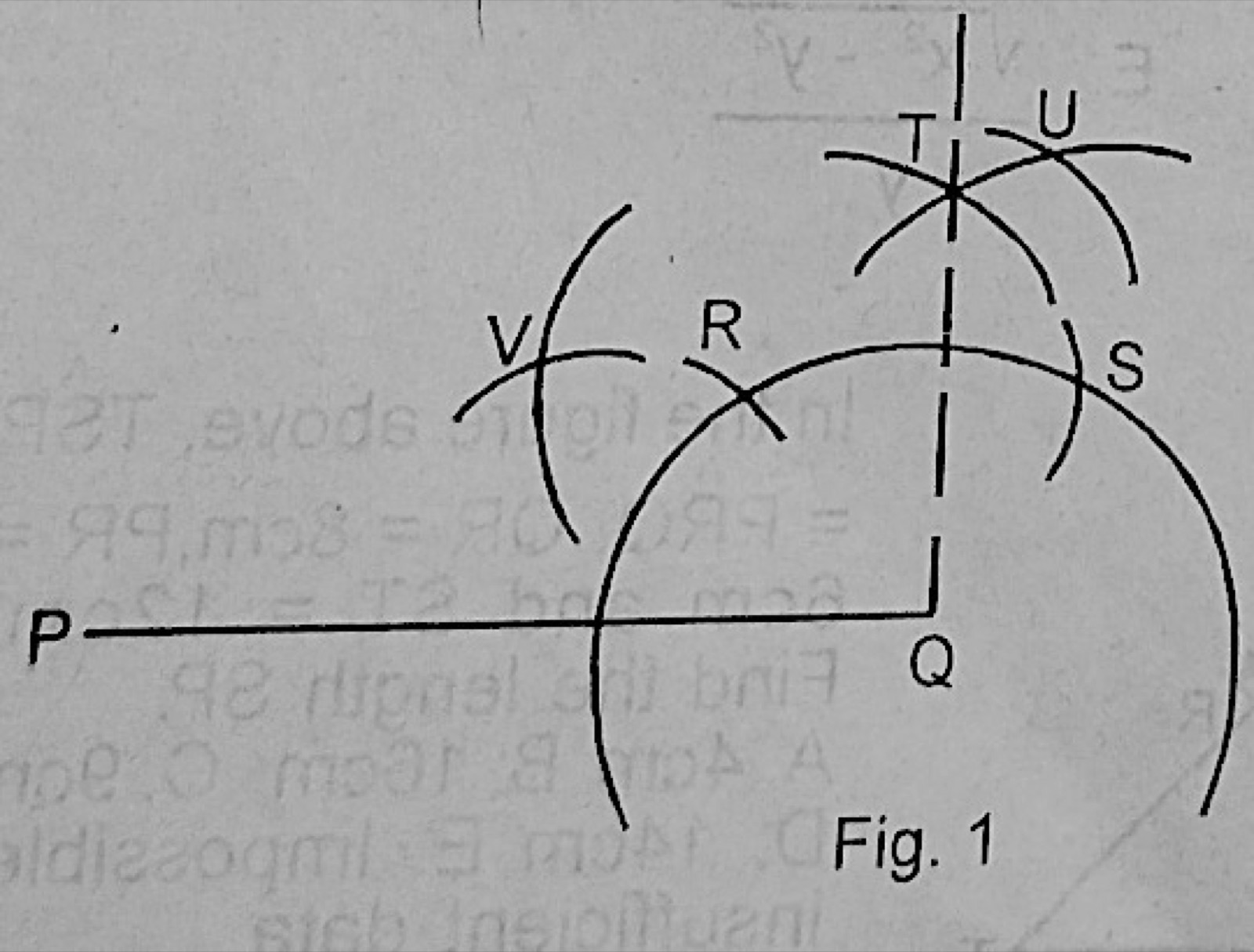
Use the construction (Fig. 1) to answer this question. What is the obtuse angle formed when the point U is joined to Q?

Diagram for this question
  1. A.75°
  2. B.145°
  3. C.120°
  4. D.105°
  5. E.125°.
Show the answer and explanation

Answer: D (105°)

Explanation

QT is the perpendicular to PQ at Q (90°). The arcs through T and S bisect a further angle, putting QU 15° beyond QT, so the obtuse angle PQU is 90° + 15° = 105°.
Open this question

Question 50

Constructions

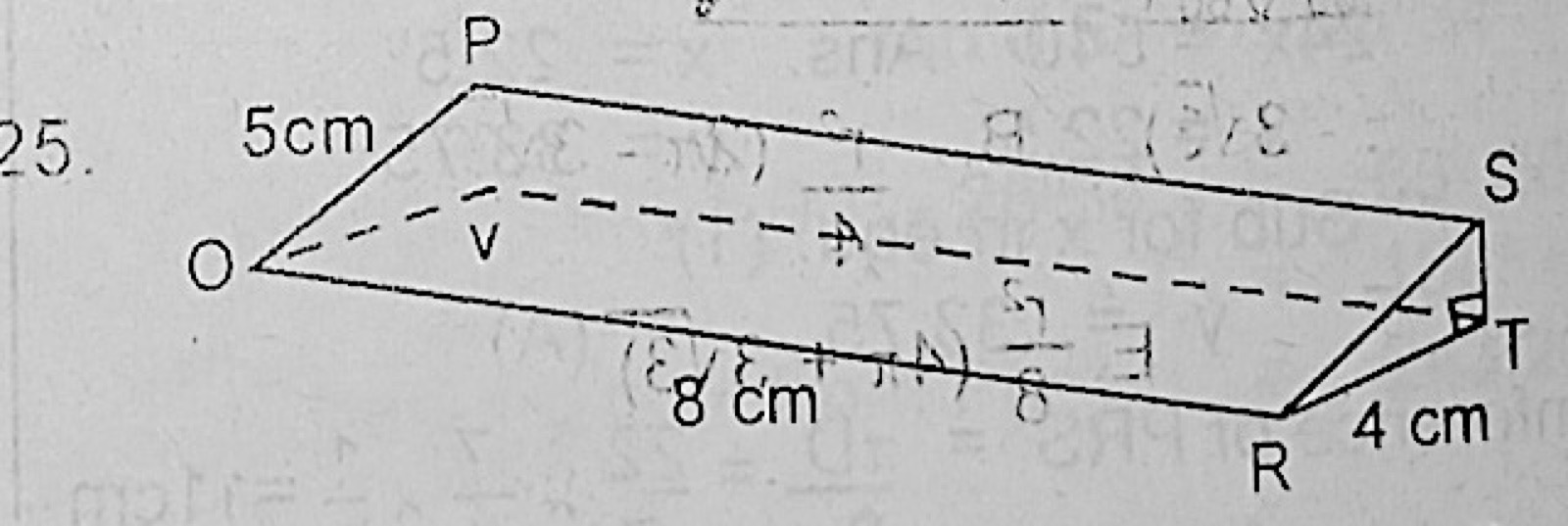
Use the construction (Fig. 1) to answer this question. What is the acute angle formed when the point V is joined to Q?

Diagram for this question
  1. A.60°
  2. B.30°
  3. C.45°
  4. D.90°
  5. E.15°.
Show the answer and explanation

Answer: B (30°)

Explanation

The arcs at V mark a bisected angle on the P side of the perpendicular, so the line QV makes 30° with QP.

Open this question