Question 1
Fractions, Decimals and ApproximationExpress (0.0425 ÷ 2.5) as a fraction
- A.17/10,000
- B.17/1,000
- C.17/250
- D.17/100
- E.17/10
Show the answer and explanation
Answer: B (17/1,000)
Explanation
0.0425 ÷ 2.5 = 0.017, and 0.017 = 17/1000.
57 questions. Try each one, then open the answer to check yourself and read the explanation.
Express (0.0425 ÷ 2.5) as a fraction
Answer: B (17/1,000)
0.0425 ÷ 2.5 = 0.017, and 0.017 = 17/1000.
What is log10 (6.95 × 10⁻³)?
Answer: C (3̄.8420)
log 6.95 = 0.8420 and the power 10−3 gives characteristic −3, so the log is 3̄.8420.
If P = {3, 5, 6} and Q = {4, 5, 6} then P∩Q equals
Answer: D ({5, 6})
P∩Q holds the elements in both sets: 5 and 6.
A and B are two sets. The number of elements in A∪B is 49, the number in A is 22 and number in B is 34. How many elements are in A∩B?
Answer: E (7)
n(A∩B) = n(A) + n(B) − n(A∪B) = 22 + 34 − 49 = 7.
A student found the approximate value of 0.02548 correct to two places of decimal instead of two significant figures. Find the percentage error.
Answer: E (20%)
To 2 d.p. the student got 0.03; the correct 2 s.f. value is 0.025. Error = 0.005, and 0.005/0.025 × 100% = 20%.
Simplify log39 + log315 − log35
Answer: C (3)
Combine the logs: log3(9 × 15 ÷ 5) = log327 = 3.
Solve the equation: 2/3 (x + 5) = 1/4(5x − 3)
Answer: E (7)
Multiply both sides by 12: 8(x + 5) = 3(5x − 3), so 8x + 40 = 15x − 9, giving 7x = 49 and x = 7.
Solve the equations: 4x − y = 11, 5x + 2y = 4
Answer: D (x = 2, y = −3)
Double the first equation (8x − 2y = 22) and add the second: 13x = 26, so x = 2; then y = 4(2) − 11 = −3.
Make q the subject of the relation t = √(pq/r − r2q)
Answer: A (q = rt2/(p − r3))
Square: t2 = pq/r − r2q. Multiply by r: rt2 = q(p − r3), so q = rt2/(p − r3).
One of the roots of the equation 6x2 = 5 − 7x is
Answer: C (1/2)
6x2 + 7x − 5 = 0 factorises as (2x − 1)(3x + 5) = 0, so x = 1/2 or x = −5/3.
P varies inversely as the square of W. When W = 4, P = 9. Find the value of P when W = 9
Answer: D (16/9)
P = k/W2; 9 = k/16 gives k = 144. When W = 9, P = 144/81 = 16/9.
In the triangle XYZ, XM is the altitude from X to YZ. XY = 13cm, XZ = 15cm and YM = 5cm. Find the length of YZ
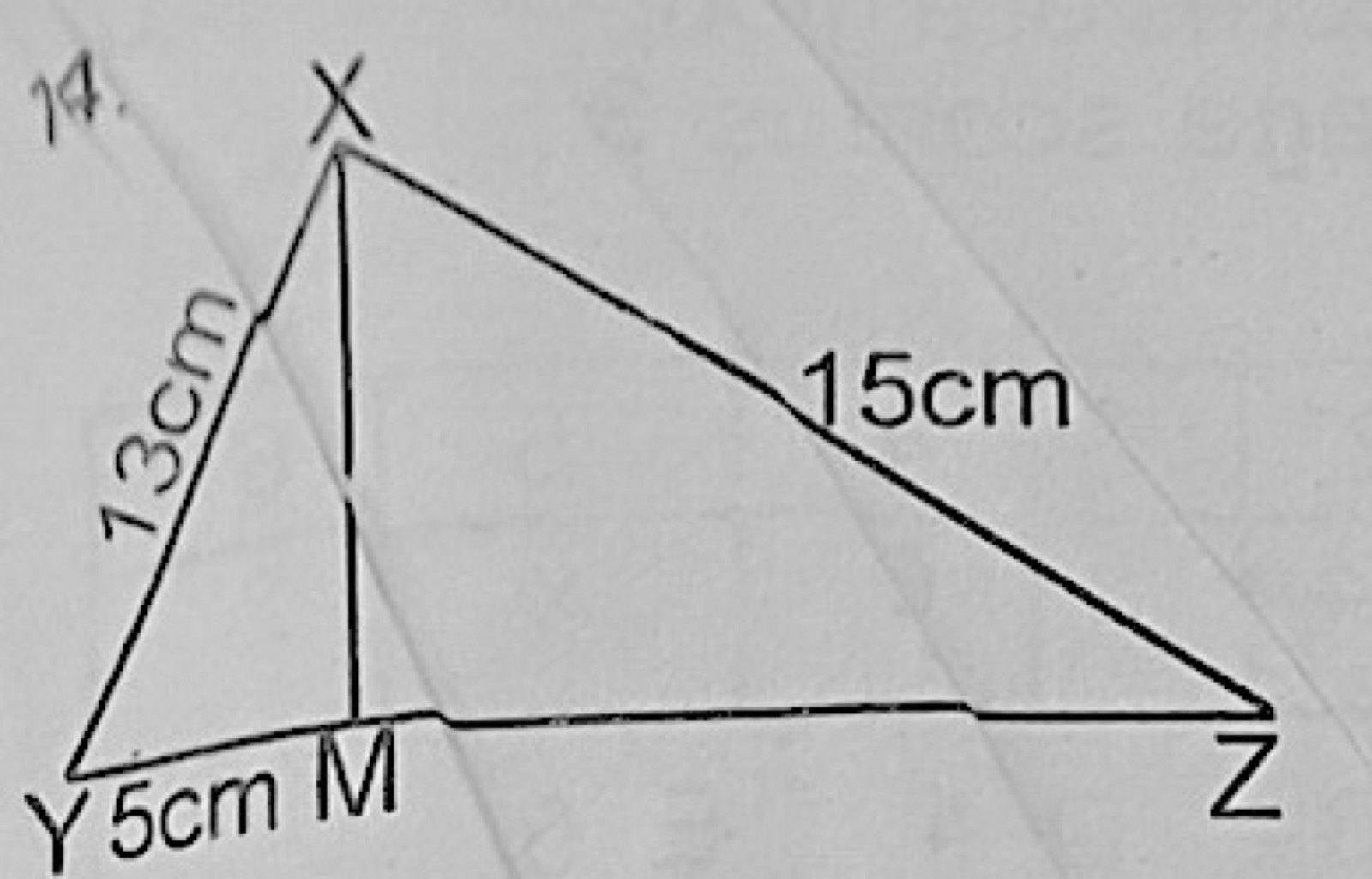
Answer: C (14cm)
XM = √(132 − 52) = 12 cm, so MZ = √(152 − 122) = 9 cm. YZ = 5 + 9 = 14 cm.
Two points P and Q are on longitude 67°W. Their latitudes differ by 90°. Calculate their distance apart in terms of π. (Take radius of the earth = 6400km).
Answer: C (3200πkm)
On the same longitude the points lie on a great circle: distance = 90/360 × 2π × 6400 = 3200π km.
The length of the two parallel sides of trapezium are 6cm and 10cm and the perpendicular distance between them is 5cm. Find the area of the trapezium.
Answer: B (40cm2)
Area = ½ × (6 + 10) × 5 = 40 cm2.
Calculate the total surface area of a solid cone of slant height 15cm and base radius 8cm in terms of π.
Answer: C (184πcm2)
Total surface area = πr2 + πrl = π × 8 × (8 + 15) = 184π cm2.
The cross-section of a prism is a right-angled triangle 3cm by 4cm by 5cm. The height of the prism is 8cm. Calculate its volume
Answer: A (48cm3)
The right angle is between the 3 cm and 4 cm sides, so the cross-section is ½ × 3 × 4 = 6 cm2. Volume = 6 × 8 = 48 cm3.
Find the radius of a circle in which an arc of length 44cm subtends angle 200° at the centre of the circle. {Take π = 22/7}
Answer: B (12.6cm)
Arc = θ/360 × 2πr, so 44 = 200/360 × 2 × 22/7 × r, giving r = 12.6 cm.
The diagram below is a triangle XYZ whose area is 23.5cm2. XY = 10cm and YZ = 8cm, calculate θ, correct to the nearest degree.
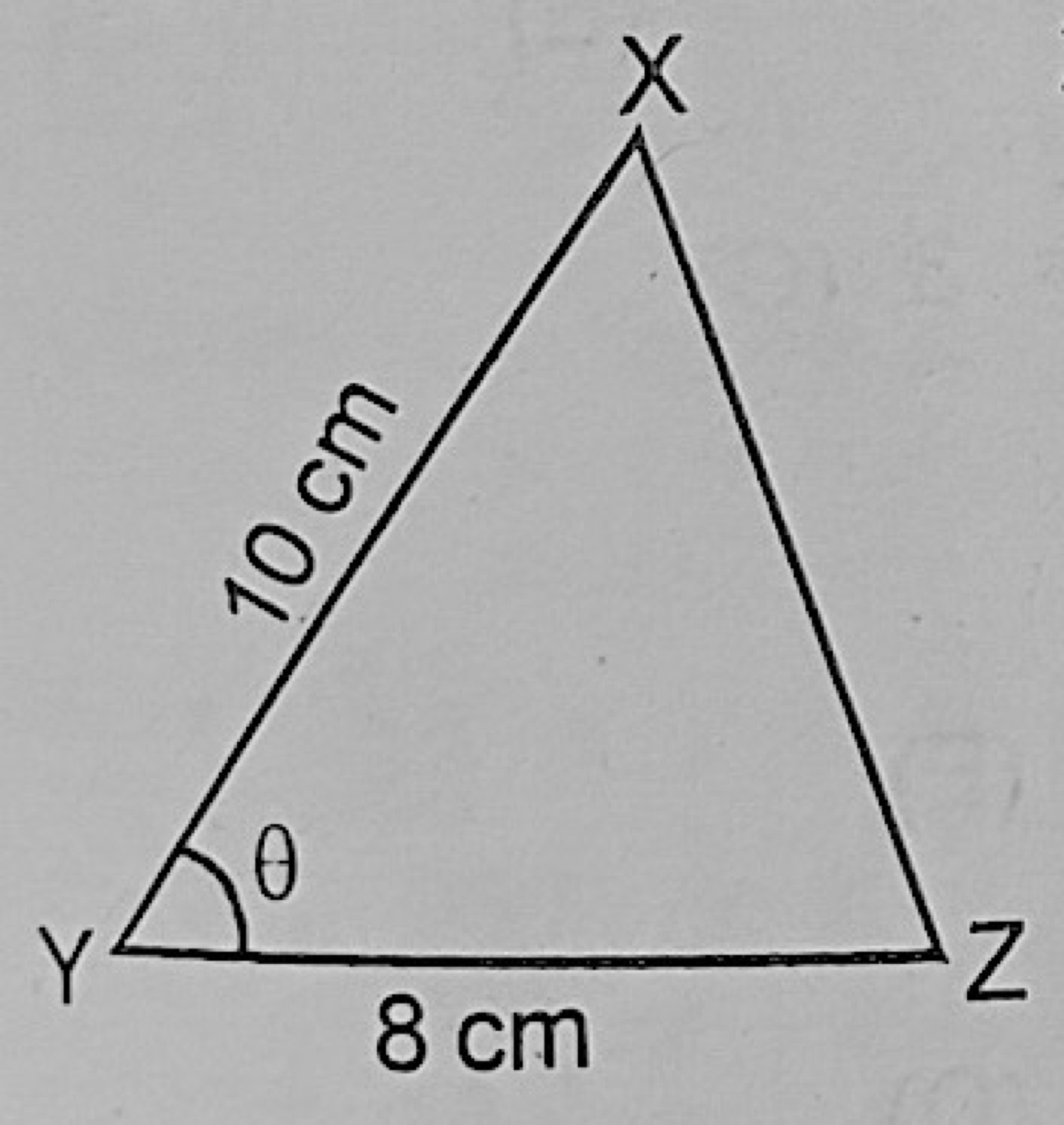
Answer: C (36°)
Area = ½ × 10 × 8 × sin θ = 23.5, so sin θ = 0.5875 and θ ≈ 36°.
Which of the following is not necessarily sufficient for the construction of a triangle?
Answer: D (Two sides and an angle)
Two sides with an angle that is not between them can give two different triangles (the ambiguous case), so it does not always fix one triangle.
In the diagram, EF//QR, PE = 2cm, EQ = 4cm and FR = 6cm. Find x.
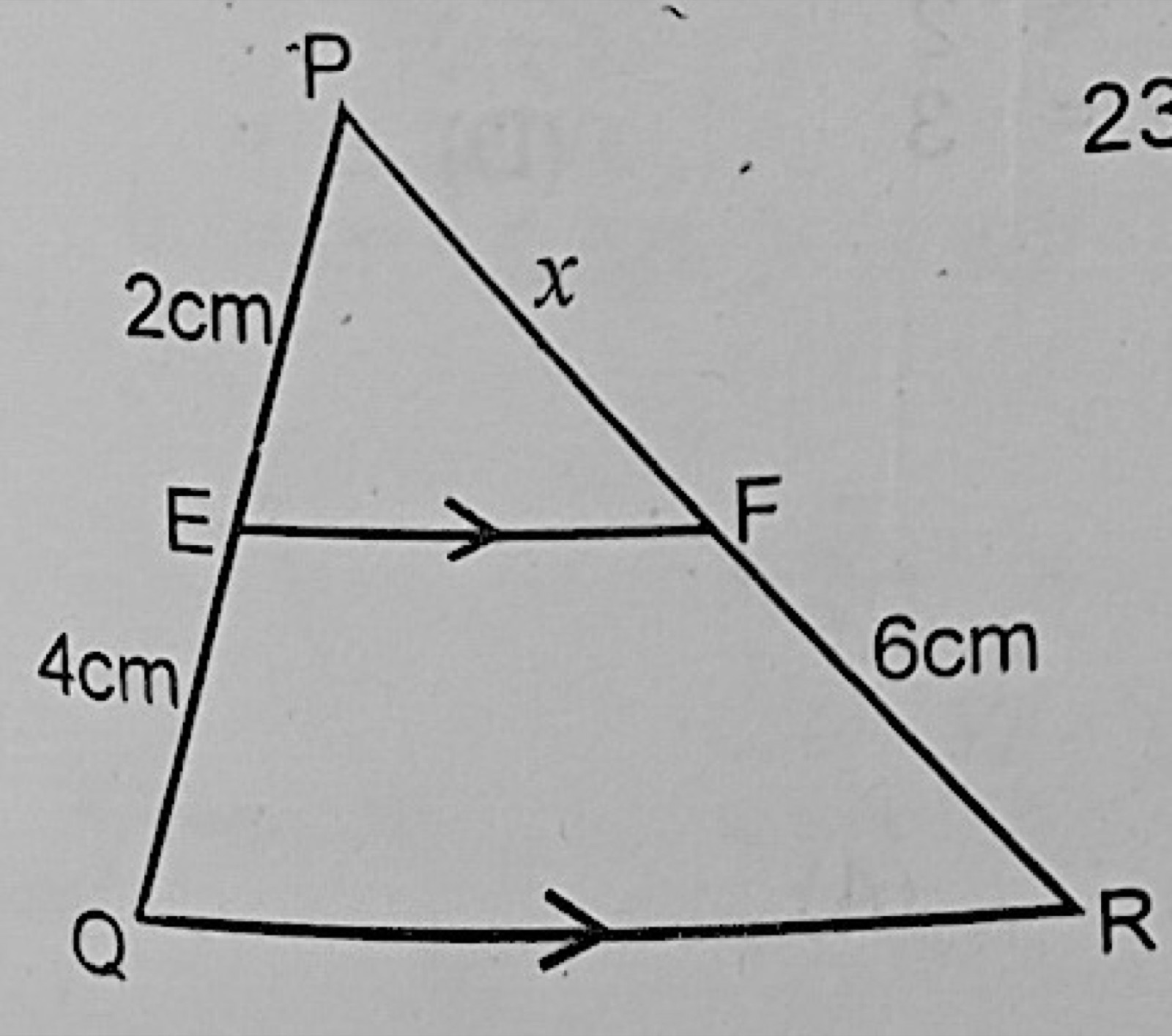
Answer: B (3cm)
A line parallel to one side divides the other sides in the same ratio: PE/EQ = PF/FR, so 2/4 = x/6 and x = 3 cm.
Which of the following statements is/are true when two straight lines intersect?
I. Adjacent angles are equal
II. Vertically opposite angles are equal
III. Adjacent angles are supplementary
Answer: D (II and III only)
Vertically opposite angles are always equal and adjacent angles on a straight line add to 180°; adjacent angles are equal only when the lines are perpendicular.
PQRS and GHRS are parallelograms on the same base SR and between the same parallel straight line PH and SR. Which of the following is true?
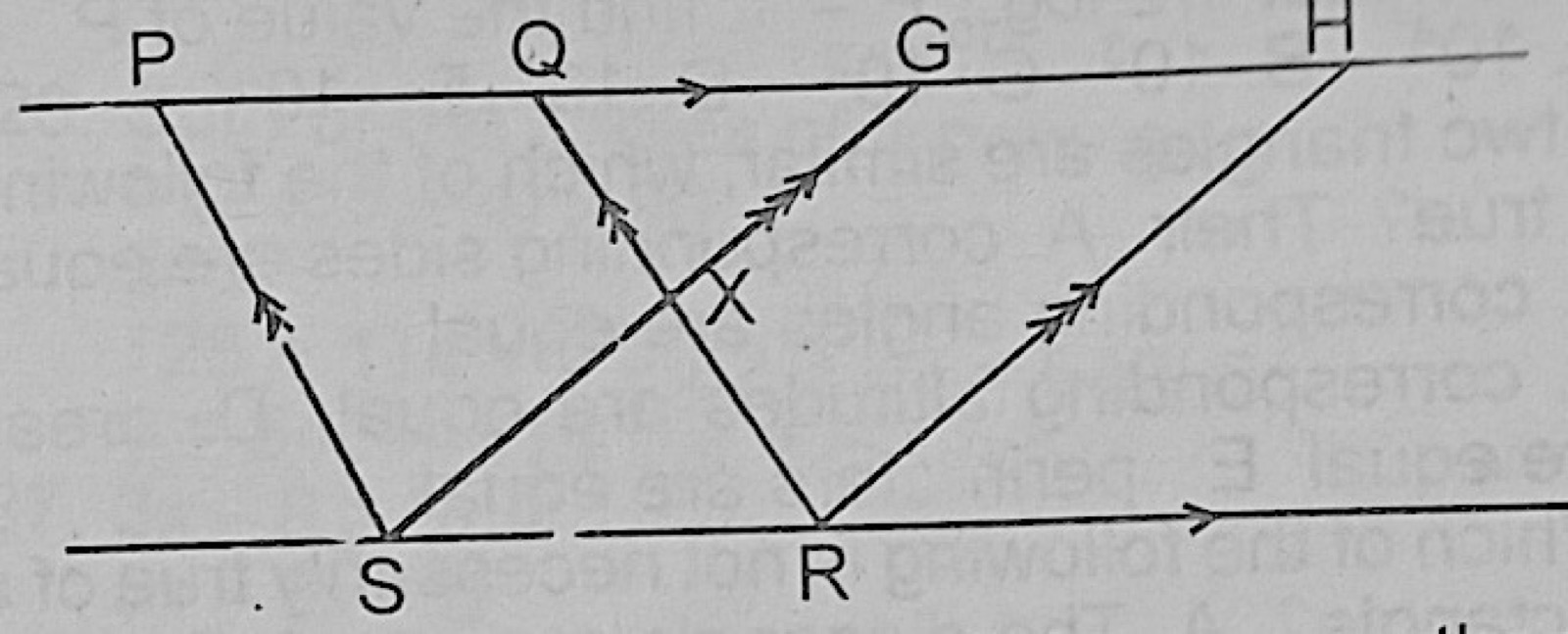
Answer: E (Parallelogram PQRS = Parallelogram GHRS.)
Parallelograms on the same base and between the same parallels have equal areas.
From the diagram below, which of the following is true?
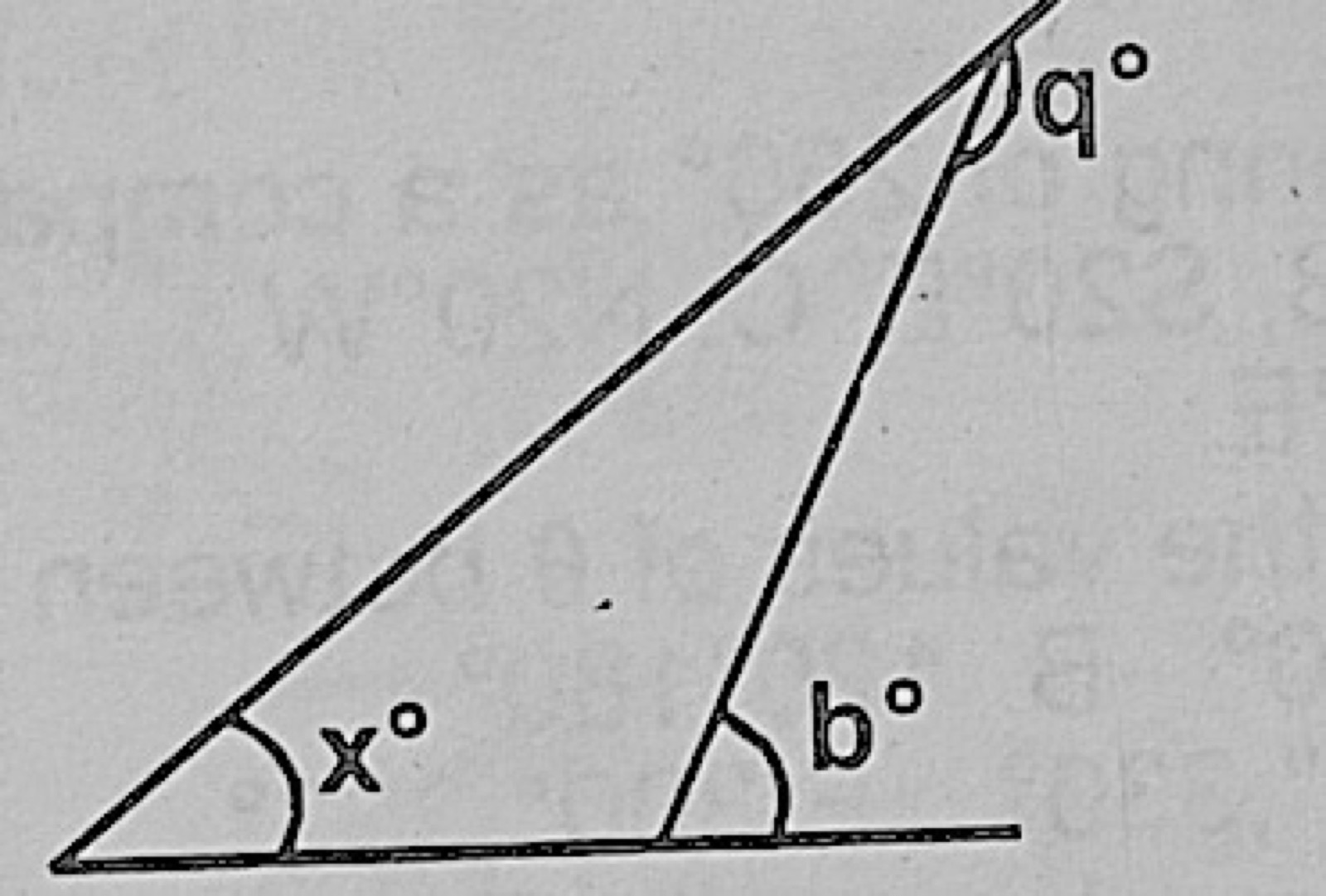
Answer: D (a + b = x + 180)
The top interior angle is 180 − a. The exterior angle b equals the sum of the two opposite interior angles: b = x + (180 − a), so a + b = x + 180.
The interior angles of a pentagon are 126°, 114°, y, 92° and 83°. Find the value of y.
Answer: E (125°.)
Angles of a pentagon add to (5 − 2) × 180° = 540°. y = 540 − (126 + 114 + 92 + 83) = 125°.
Solve the inequality 3x − 8 ≥ 5x
Answer: C (x ≤ −4)
3x − 5x ≥ 8 gives −2x ≥ 8. Dividing by −2 reverses the sign: x ≤ −4.
Divide 3̄.6721 by 4
Answer: B (1̄.4180)
Write 3̄.6721 as 4̄ + 1.6721. Dividing by 4 gives 1̄ + 0.4180 = 1̄.4180.
The eleventh term of an A.P. is 25 and its first term is −3. Find its common difference.
Answer: E (2 4/5.)
T11 = a + 10d, so −3 + 10d = 25, 10d = 28, d = 2 4/5.
Find the common ratio in the G.P: log 3, log 9, log 81……….
Answer: B (2)
log 9 = 2 log 3 and log 81 = 4 log 3, so each term is twice the one before: r = 2.
Find the value of t for which 64/27 = (3/4)t−1
Answer: B (−2)
64/27 = (4/3)3 = (3/4)−3, so t − 1 = −3 and t = −2.
O is the centre of the circle PQRS. PR and QS intersect at T. POR is a diameter, ∠PQT = 42° and ∠QTR = 64°. Find ∠QRT
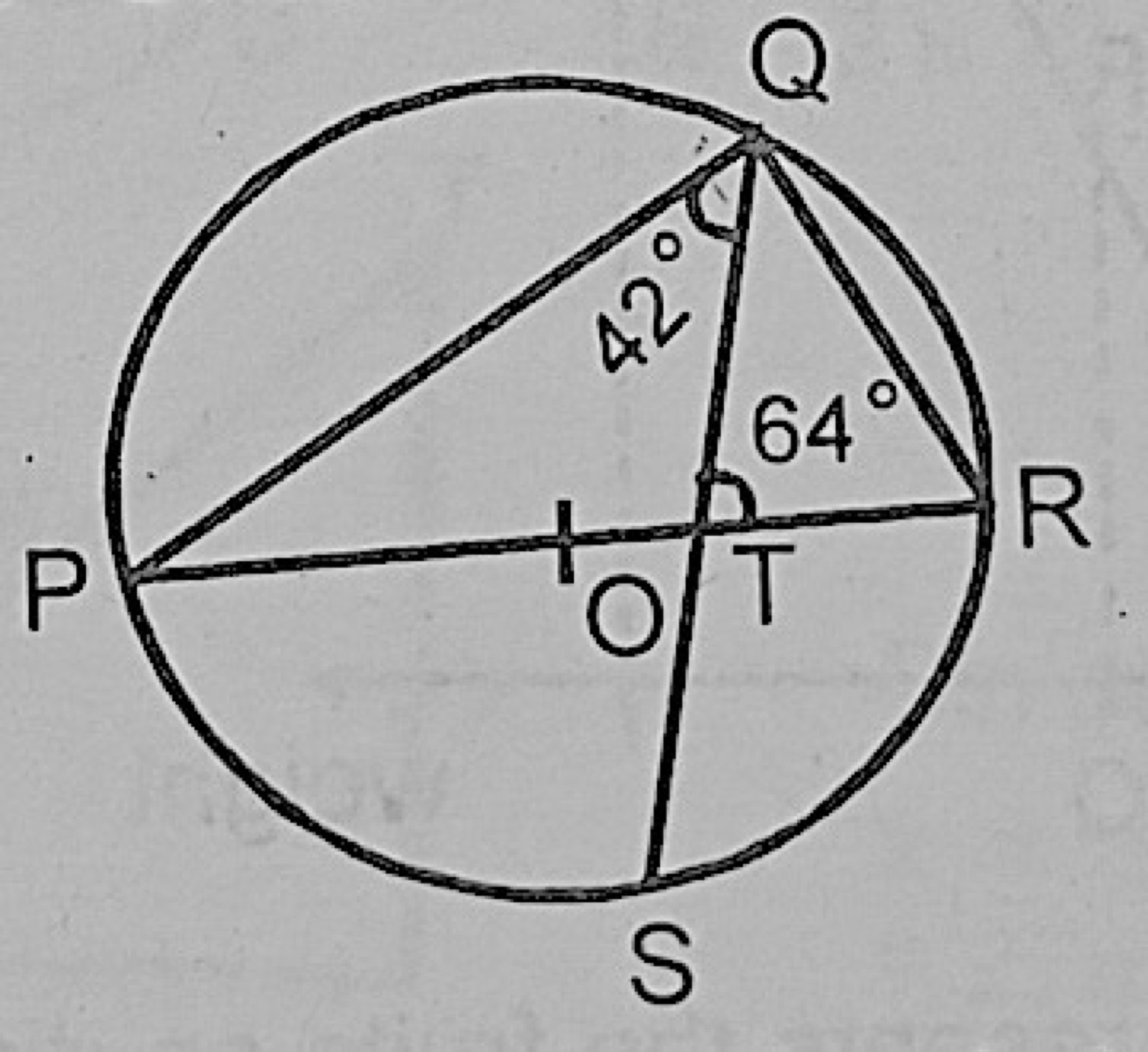
Answer: A (68°)
PR is a diameter, so ∠PQR = 90° and ∠TQR = 90 − 42 = 48°. In triangle QTR, ∠QRT = 180 − 64 − 48 = 68°.
TR is the tangent to the circle PQR with centre O. Find the size of ∠PRT
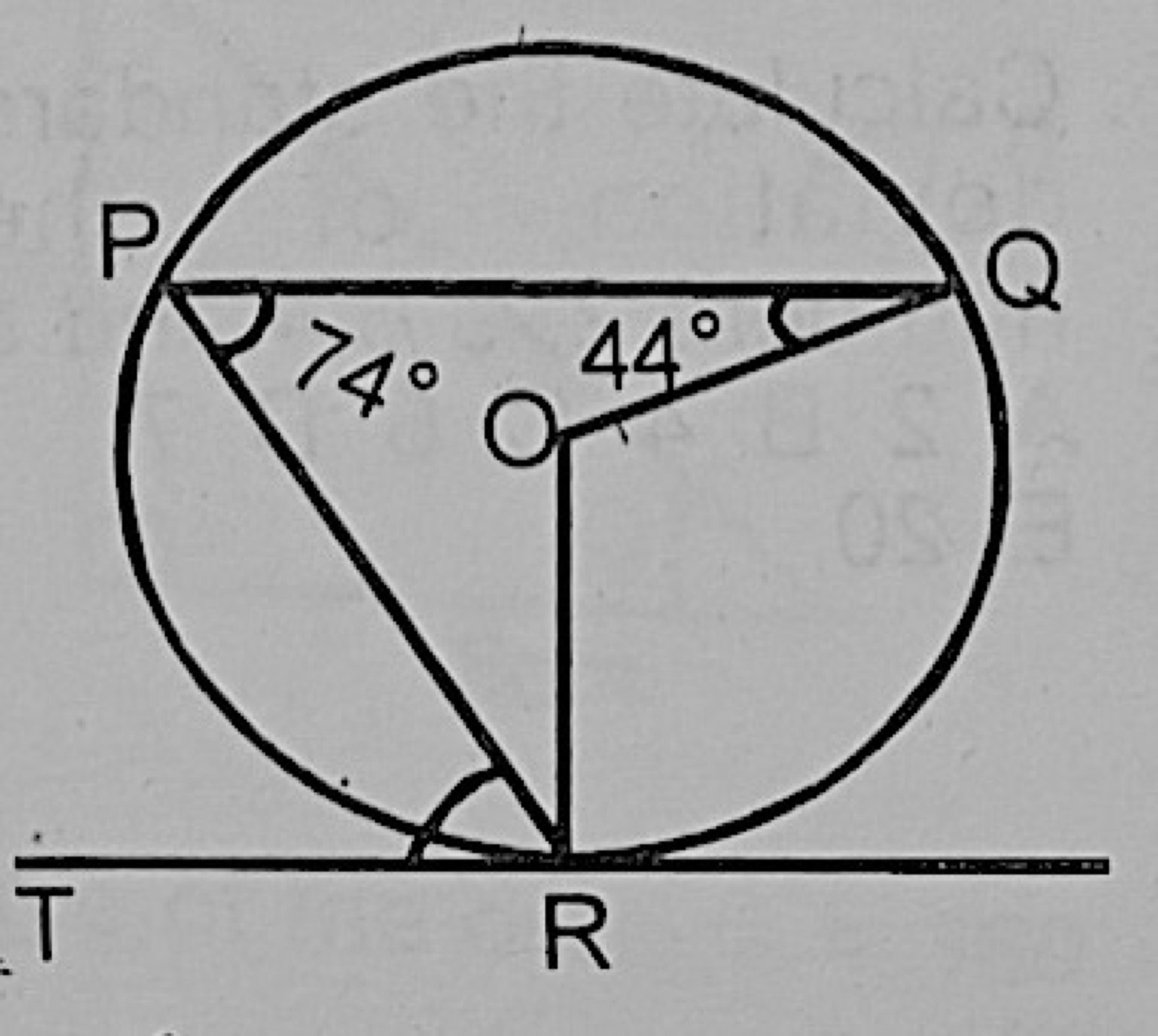
Answer: C (60°)
∠QOR = 2 × 74° = 148°, so in isosceles triangle OQR ∠OQR = 16°. ∠PQR = 44 + 16 = 60°, and the tangent–chord angle ∠PRT equals ∠PQR in the alternate segment: 60°.
Two angles of a triangle are 41° and 49°. Which of the following is true? It is
Answer: D (a right-angled triangle)
The third angle is 180 − 41 − 49 = 90°, and the other two angles differ, so it is right-angled but not isosceles.
Given that 1/2 log10 P = 1, find the value of P
Answer: C (102)
log10 P = 2, so P = 102.
If two triangles are similar, which of the following is true? Their
Answer: B (corresponding angles are equal)
Similar triangles have the same shape: their corresponding angles are equal, while their sides are only in the same ratio.
Which of the following is not necessarily true of a rectangle?
Answer: C (The diagonals are perpendicular)
A rectangle's diagonals cross at right angles only when it is a square.
A chord is 5cm from the centre of a circle of diameter 26cm. Find the length of the chord
Answer: C (24cm)
Radius = 13 cm. Half the chord = √(132 − 52) = 12 cm, so the chord is 24 cm.
The angle of elevation of a point T on a tower from a point U on the horizontal ground is 30°. If TU = 54m, how high is T above the horizontal ground?
Answer: E (27m.)
TU is the slanting line of sight, so height = 54 × sin 30° = 27 m.
Express the true bearing of 250° as a compass bearing
Answer: D (S70°W)
250° lies between south (180°) and west (270°); it is 70° west of south: S70°W.
Cos 65° has the same value as
Answer: E (Cos 295°)
Cosine is positive in the fourth quadrant and cos(360° − θ) = cos θ, so cos 295° = cos 65°.
Two sides of a triangle are perpendicular. If the two sides are 8cm and 6cm, calculate correct to the nearest degree, the smallest angle of the triangle.
Answer: C (37°)
The smallest angle is opposite the 6 cm side: tan θ = 6/8 = 0.75, so θ ≈ 36.9° ≈ 37°.
The graph is the cumulative frequency curve for the weight distribution of 100 workers in a factory. Which of the points P, Q, R, S and T indicates the median weight?
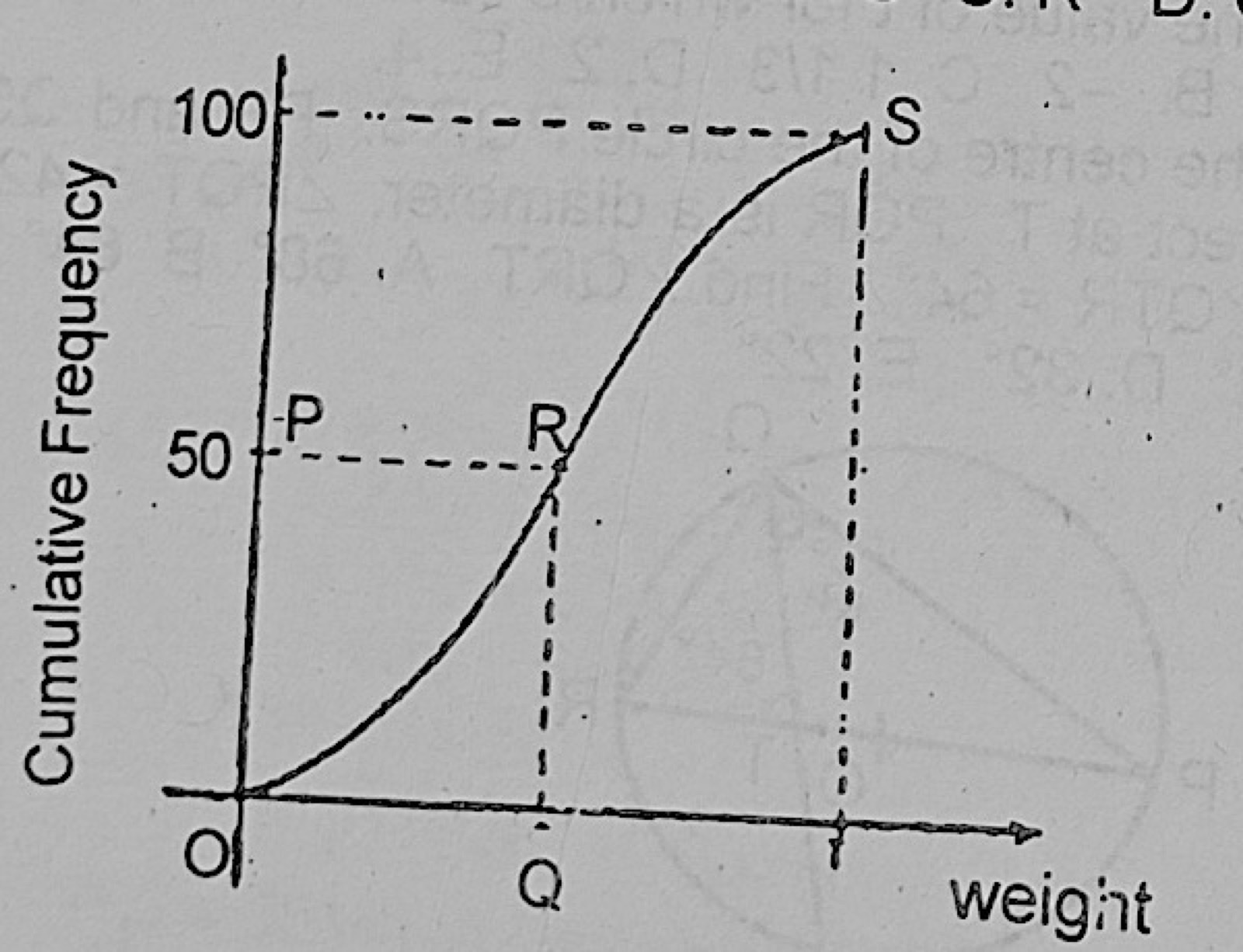
Answer: D (Q)
The median is the weight at half the total frequency (50). Go across from 50 to the curve at R and down to the weight axis at Q.
Calculate the standard deviation of the numbers 2, 5, 6, 4 and 8
Answer: A (2)
Mean = 25/5 = 5. Squared deviations: 9, 0, 1, 1, 9, total 20. Variance = 20/5 = 4, so the standard deviation is 2.
What is the probability of having an odd number in a single throw of a fair die with the faces numbered 1,2,3,4,5 and 6?
Answer: C (1/2)
Three of the six faces (1, 3, 5) are odd: 3/6 = 1/2.
A bag contains red, black and green identical balls. A ball is picked and replaced. The table shows the result of 100 trials. Find the experimental probability of picking a green ball.
Colour of ball: Red, Black, Green
No. of occurrences: 54, 30, 16
Answer: E (4/25.)
Green came up 16 times in 100 trials: 16/100 = 4/25.
A bag contains 3 white, 6 red 5 blue identical balls. A ball is picked at random from the bag. What is the probability that it is either white or blue?
Answer: B (4/7)
There are 14 balls, 3 + 5 = 8 of them white or blue: 8/14 = 4/7.
(a) Copy and complete the binary multiplication table
× | 10 | 11 | 100 | 101
10 | 100 | – | 1000 | –
11 | 110 | – | 1100 | –
100 | – | – | 10000 | 10100
(b) Convert 11.011two to a number in base ten
(c) Simplify (9.6 × 10¹⁸)/(0.24 × 105) and express your answer in the form P × 10m where 1 < P < 10 and m is an integer.
(a) Missing entries: 10 × 11 = 110; 10 × 101 = 1010; 11 × 11 = 1001; 11 × 101 = 1111; 100 × 10 = 1000; 100 × 11 = 1100.
(b) 11.011two = 1×2 + 1×1 + 0×½ + 1×¼ + 1×⅛ = 2 + 1 + 0.25 + 0.125 = 3.375.
(c) 9.6/0.24 = 40, so the value is 40 × 1018−5 = 40 × 1013 = 4 × 10¹⁴.
Check each binary product by converting to base ten (e.g. 3 × 3 = 9 = 1001two).
(a) The 6th term of an A.P. is 35 and the 13th term is 77. Find the 20th term.
(b) The Venn diagram represents three subsets P, Q and R of the universal set U. Copy the Venn diagram. Shade and indicate the regions represented by: (i) P∩Q'∩R (ii) P'∩Q∩R'.
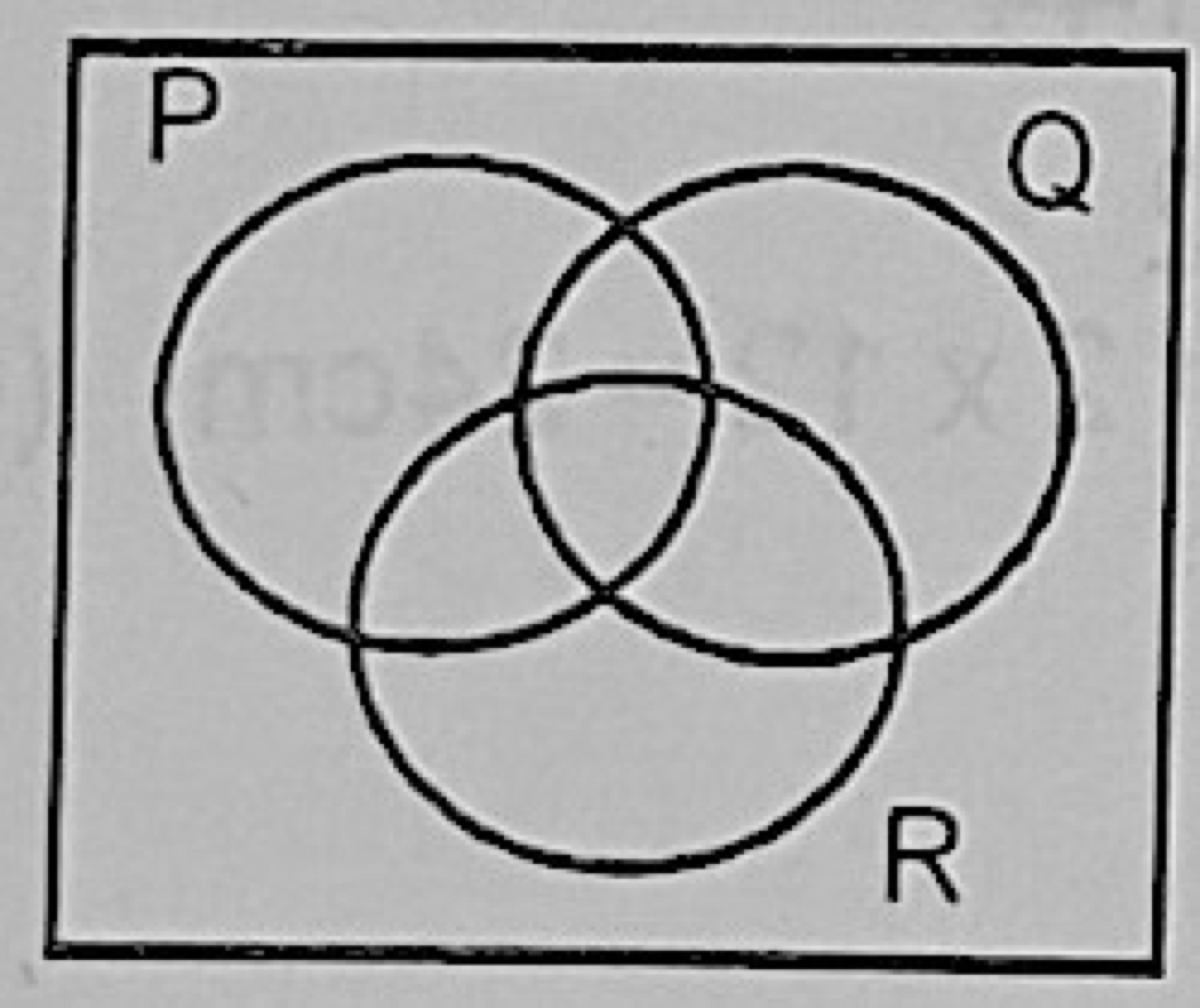
(a) a + 5d = 35 and a + 12d = 77. Subtract: 7d = 42, d = 6; a = 35 − 30 = 5.
T20 = a + 19d = 5 + 114 = 119.
(b)(i) P∩Q'∩R: the part common to P and R that lies outside Q.
(ii) P'∩Q∩R': the part of Q that is outside both P and R (Q only).
Find d first by subtracting the two term equations.
(a) Given that sin x = 5/13, 0° ≤ x ≤ 90°, find (cos x − 2 sin x)/(2 tan x)
(b) The diagram represents the vertical cross-section of a mountain with height NQ standing on a horizontal ground PRN. If the angles of elevation of the top Q of the mountain from P and R are 30° and 70° respectively and PR = 500m, calculate, correct to 3 significant figures: (i) |QP|; (ii) the height of the mountain.
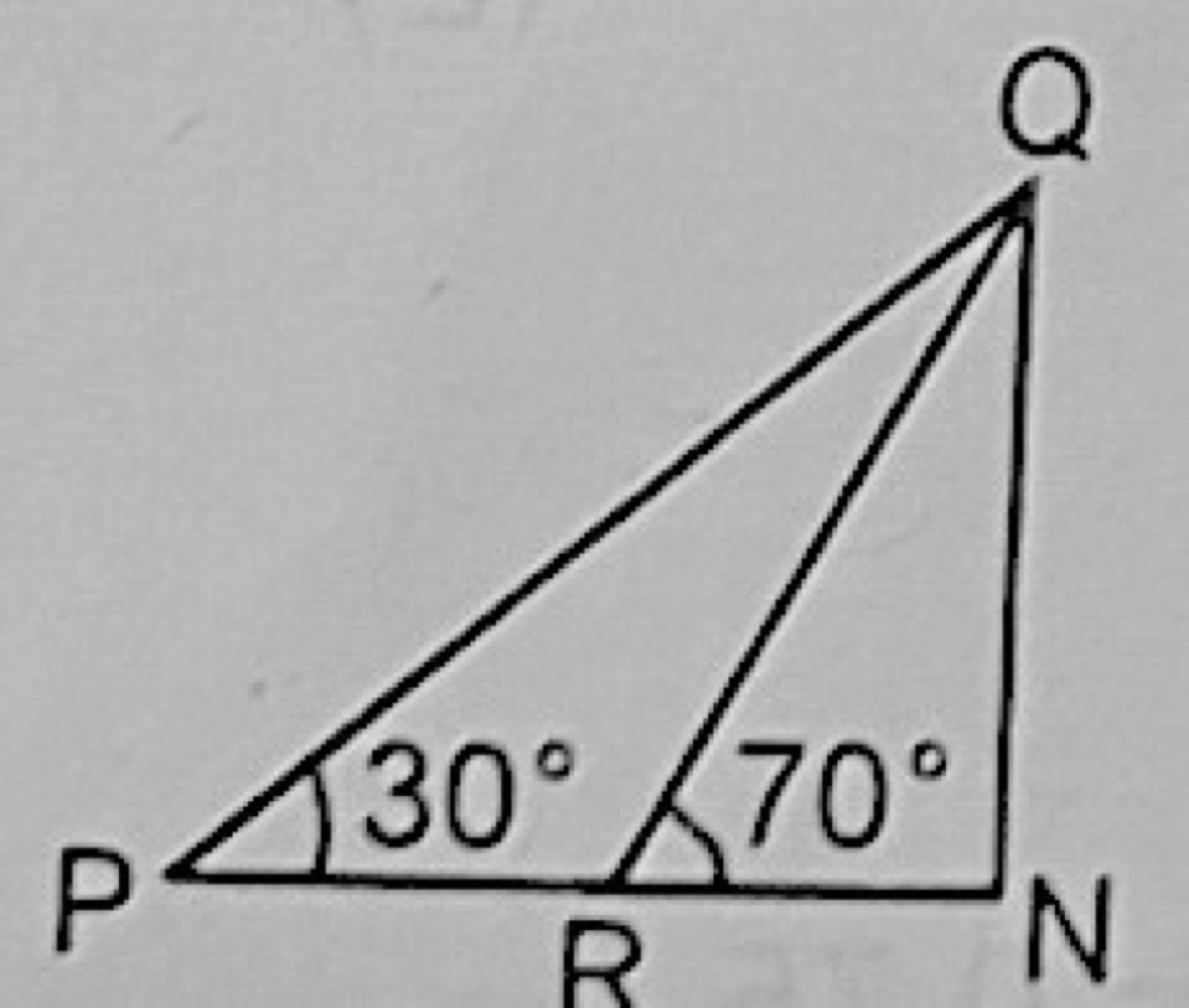
(a) Opposite = 5, hypotenuse = 13, so adjacent = 12: cos x = 12/13, tan x = 5/12.
(cos x − 2 sin x)/(2 tan x) = (12/13 − 10/13) ÷ (10/12) = 2/13 × 12/10 = 12/65.
(b) In triangle PQR, ∠PRQ = 110°, so ∠PQR = 180 − 30 − 110 = 40°.
(i) Sine rule: QP/sin 110° = 500/sin 40°, QP = 500 × 0.9397/0.6428 ≈ 731 m.
(ii) Height NQ = QP sin 30° = 730.9 × 0.5 ≈ 365 m.
Use the exterior angle at R to find the angle at Q, then the sine rule.
The table below shows how a company's sales manager spent his 1995 annual salary.
Food – 30%
Rent – 18%
Car maintenance – 25%
Savings – 12%
Taxes – 5%
Others – 10%
(a) Represent this information on a pie chart
(b) Find his savings at the end of the year if his annual salary was N60,000.00
(a) Angle = percentage × 3.6°: Food 108°, Rent 64.8°, Car maintenance 90°, Savings 43.2°, Taxes 18°, Others 36° (total 360°). Draw the sectors with a protractor and label each.
(b) Savings = 12% of N60,000 = N7,200.00.
Each 1% of the whole is 3.6° of the circle.
(a) Given that (5y − x)/(8y + 3x) = 1/5, find the value of x/y to two decimal places.
(b) If 3 is a root of the quadratic equation x2 + bx − 15 = 0, determine the value of b. Find the other root.
(a) 5(5y − x) = 8y + 3x, so 25y − 5x = 8y + 3x, 17y = 8x and x/y = 17/8 = 2.125 ≈ 2.13.
(b) 32 + 3b − 15 = 0, so 3b = 6 and b = 2.
x2 + 2x − 15 = (x − 3)(x + 5) = 0, so the other root is −5.
Cross-multiply, then collect the x and y terms on opposite sides.
(a) Use logarithm tables to evaluate (15.05 × √0.00695)/(6.95 × 102), correct to 3 significant figures.
(b) The first 5 students to arrive in a school on a Monday morning were 2 boys and 3 girls. Of these, two were chosen at random for an assignment. Find the probability that: (i) both were boys; (ii) the two were of different sexes.
(a) log 15.05 = 1.1775; log 0.00695 = 3̄.8420, half of it = 2̄.9210 (write 4̄ + 1.8420, divide by 2); log 695 = 2.8420.
Numerator: 1.1775 + 2̄.9210 = 0.0985. Subtract 2.8420: 3̄.2565.
Antilog = 0.001806 ≈ 0.00181.
(b) Two are chosen without replacement.
(i) P(both boys) = 2/5 × 1/4 = 1/10.
(ii) P(different sexes) = 2/5 × 3/4 + 3/5 × 2/4 = 6/20 + 6/20 = 3/5.
Two different students are chosen, so the second pick is from 4, not 5.
(a) Using a ruler and a pair of compasses only, construct ΔABC in which |AB| = 7cm, |BC| = 5cm and ∠ABC = 75°. Measure AC.
(b) In (a) above, locate by construction, a point D such that CD is parallel to AB and D is equidistant from points A and C. Measure ∠BAD.
(a) Draw BC = 5 cm. At B construct 75° (60° plus half of the 30° between 60° and 90°). Mark A on this arm with BA = 7 cm and join AC.
AC ≈ 7.5 cm (by calculation √(49 + 25 − 70 cos 75°) ≈ 7.48 cm).
(b) Through C construct a line parallel to AB (copy ∠ABC at C, or use parallelogram construction). Construct the perpendicular bisector of AC; D is where it meets the parallel line.
∠BAD ≈ 80° (accept 79°–81°).
D must lie on two loci at once: the line through C parallel to AB and the perpendicular bisector of AC.
(a) Solve the simultaneous equations:
log10x + log10y = 4
log10x + 2 log10y = 3
(b) The time t taken to buy fuel at a petrol station varies directly as the number of vehicles V on queue and jointly varies inversely as the number of pumps P available in the station. In a station with 5 pumps, it took 10 minutes to fuel 20 vehicles. Find (i) the relationship between t, P and V; (ii) the time it will take to fuel 50 vehicles in the station with 2 pumps; (iii) the number of pumps required to fuel 40 vehicles in 20 minutes.
(a) Subtract the first equation from the second: log10y = −1, so y = 1/10.
Then log10x = 4 − (−1) = 5, so x = 100,000.
(b)(i) t = kV/P. 10 = k × 20/5 gives k = 5/2, so t = 5V/(2P).
(ii) t = 5 × 50/(2 × 2) = 62.5 minutes (1 hr 2½ min).
(iii) 20 = 5 × 40/(2P), so P = 200/40 = 5 pumps.
Treat log x and log y as the unknowns and eliminate one of them.
The solid above is a cylinder surmounted by a hemispherical bowl. Calculate its: (a) total surface area; (b) Volume. (Take π = 22/7).

From the diagram the radius is 7 cm and the cylinder is 10 cm high.
(a) Curved surface of cylinder = 2πrh = 2 × 22/7 × 7 × 10 = 440 cm2.
Hemisphere = 2πr2 = 308 cm2. Base = πr2 = 154 cm2.
Total = 440 + 308 + 154 = 902 cm2.
(b) Volume = ⅔πr3 + πr2h = 718⅔ + 1540 = 2258⅔ ≈ 2258.7 cm3.
Add the separate surfaces that are on the outside: cylinder wall, hemisphere and flat base.
Above is the graph of the quadratic function y = ax2 + bx + c where a, b and c are constants. Using the graph, find: (a)(i) The scales on both axis; (ii) The equation of the line of symmetry of the curve; (iii) The roots of the quadratic equation ax2 + bx + c = 0. (b) Use the coordinates of points D, E and G to find the values of the constants a, b, and c and hence write down the quadratic function illustrated in the graph. (c) Find the greatest value of y within the range −3 ≤ x ≤ 5.
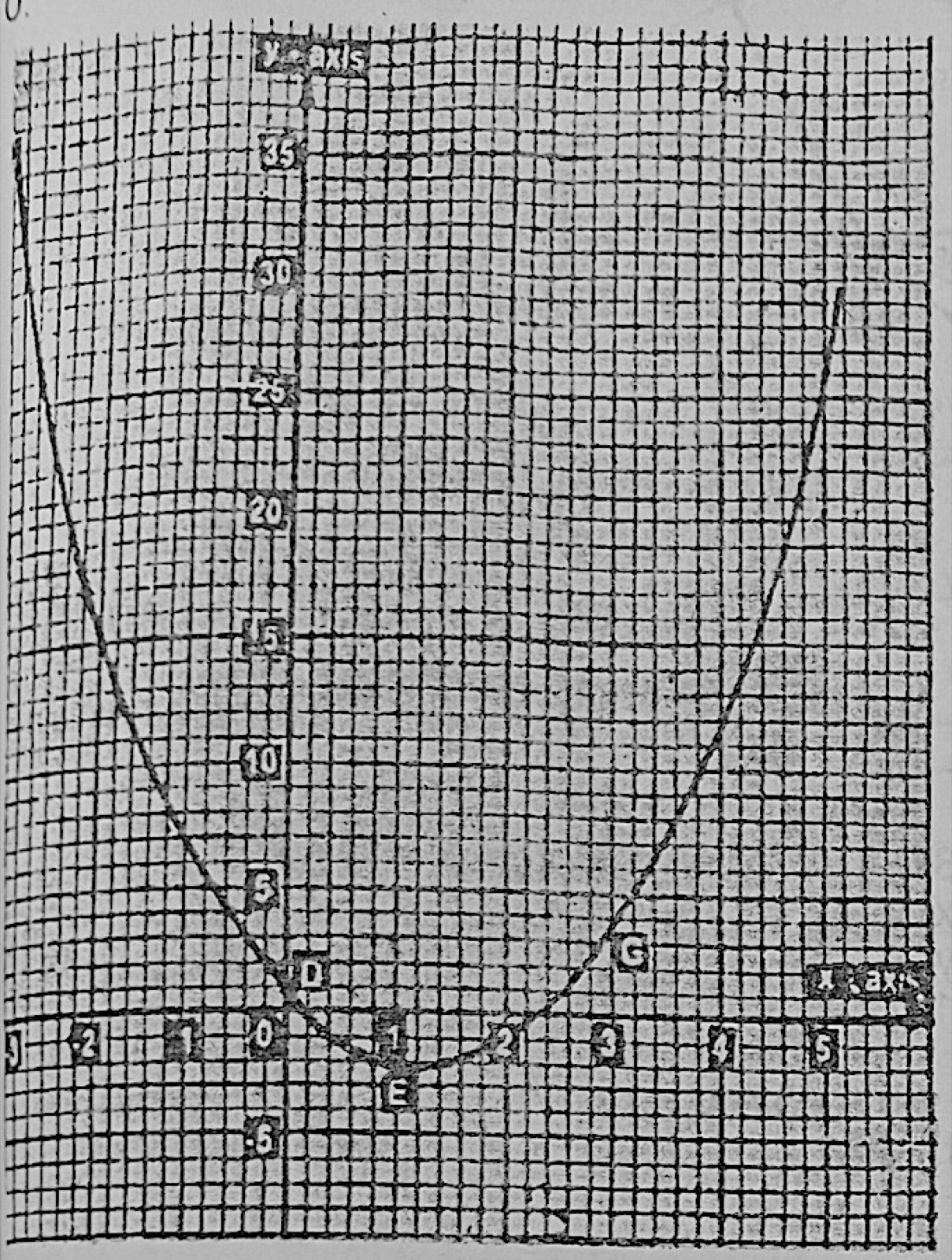
(a)(i) Read the scales from the grid: about 2 cm to 1 unit on the x-axis and 2 cm to 5 units on the y-axis.
(ii) The curve is lowest at about x = 1.25, so the line of symmetry is x = 1.25 (accept 1.2–1.3).
(iii) The curve cuts the x-axis at about x = 0.2 and x = 2.3.
(b) From the graph D = (0, 1), E = (1, −2), G = (3, 4).
D: c = 1. E: a + b + 1 = −2, so a + b = −3. G: 9a + 3b + 1 = 4, so 3a + b = 1.
Subtract: 2a = 4, a = 2, b = −5. y = 2x2 − 5x + 1.
(c) In −3 ≤ x ≤ 5 the greatest value is at x = −3: y = 18 + 15 + 1 = 34.
Substitute each point into y = ax² + bx + c to get three equations.
(a) PQRST is a circle with centre C. PCS is a straight line, RS//QT, |QR| = |RS| and ∠QTS = 56°. Find (i) ∠SQT (ii) ∠PQT
(b) In the diagram, points B and C are on a horizontal plane and |BC| = 30cm. A and D are points vertically above B and C respectively. |DC| = 40cm and |AB| = 26cm. Calculate the angles of depression of: (i) B from D; (ii) A from D: correct to the nearest degree.
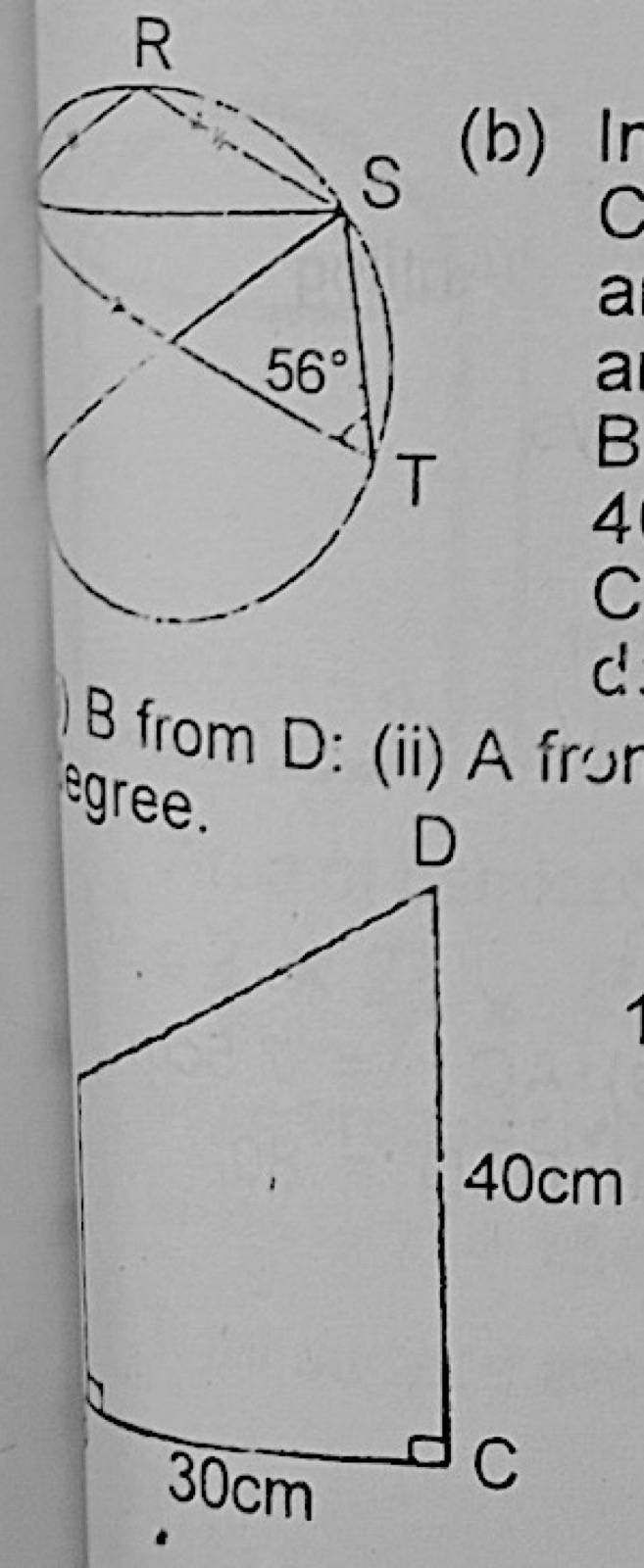
(a)(i) ∠QPS = ∠QTS = 56° (same segment). PQRS is cyclic, so ∠QRS = 180 − 56 = 124°.
Triangle QRS is isosceles (QR = RS), so ∠RSQ = (180 − 124)/2 = 28°.
RS ∥ QT, so ∠SQT = ∠RSQ = 28° (alternate angles).
(ii) PS is a diameter, so ∠PQS = 90°. ∠PQT = 90 − 28 = 62°.
(b)(i) The angle of depression of B from D equals ∠DBC: tan = 40/30, angle ≈ 53.1° ≈ 53°.
(ii) A is 40 − 26 = 14 cm below D over a horizontal 30 cm: tan = 14/30, angle ≈ 25.0° ≈ 25°.
An angle of depression is measured down from the horizontal at the observer.
The table below shows the mark distribution of candidates in an aptitude test for selection into the public service.
Mark (in %): 44–46, 47–49, 50–52, 53–55, 56–58, 59–61, 62–64, 65–67, 68–70, 71–73
Frequency: 2, 5, 11, 20, 26, 42, 46, 36, 9, 3
(a) Make a cumulative frequency for the distribution.
(b) Draw the cumulative frequency curve.
(c) From your graph estimate the median mark.
(d) The cut-off mark was 63%. What percentage of the candidates was selected?
(a) Upper class boundaries 46.5, 49.5, 52.5, 55.5, 58.5, 61.5, 64.5, 67.5, 70.5, 73.5 with cumulative frequencies 2, 7, 18, 38, 64, 106, 152, 188, 197, 200.
(b) Plot cumulative frequency against upper class boundary (start at (43.5, 0)) and join with a smooth S-shaped curve.
(c) Median at the 100th candidate: 58.5 + (100 − 64)/42 × 3 ≈ 61% (from the graph about 61).
(d) Candidates below 62.5: about 106 + 46/3 ≈ 121, so about 79 scored 63 or more: 79/200 × 100 ≈ 39% (accept 36–40% read from the graph).
Always plot cumulative frequency against the upper class boundary, not the class mark.