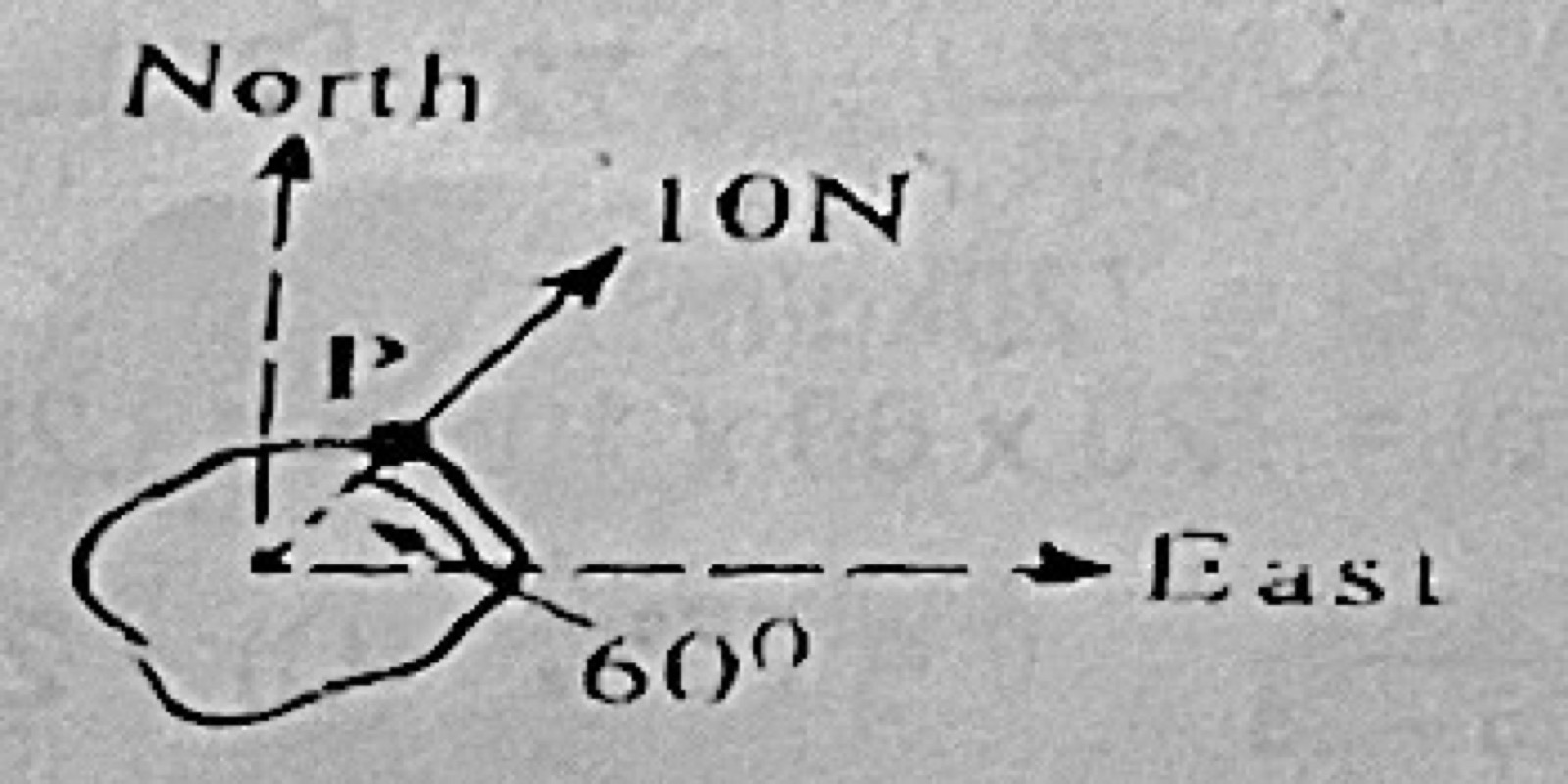
A body on the ground is acted on by a force of 10 N at a point P as shown in the diagram above. What force is needed to stop the body from moving eastward?
A.5 N in the direction of East
B.5 N in the direction of West
C.5√3 N in the direction of West
D.10 N in the Southwest direction
Show the answer and explanation
Answer: B (5 N in the direction of West)
Explanation
The 10 N force makes 60° with East, so its eastward component is 10 cos 60° = 5 N. A 5 N force towards the West cancels it.
In free fall, a body of mass 1 kg drops from a height of 125 m from rest in 5 s. How long will it take another body of mass 2 kg to fall from rest from the same height? [g = 10 m s−2]
A.5 s
B.10 s
C.12 s
D.15 s
Show the answer and explanation
Answer: A (5 s)
Explanation
In free fall every body has the same acceleration g whatever its mass, so it also takes 5 s.
A ball of mass 0.15 kg is kicked against a rigid vertical wall with a horizontal velocity of 50 m s−1. If it rebounced with a horizontal velocity of 30 m s−1, calculate the impulse of the ball on the wall.
A.3.0 N s
B.4.5 N s
C.7.5 N s
D.12.0 N s
Show the answer and explanation
Answer: D (12.0 N s)
Explanation
The velocity reverses, so the change is 50 − (−30) = 80 m s−1. Impulse = 0.15 × 80 = 12.0 N s.
The force of attraction between two point masses is 10−4 N when the distance between them is 0.18 m. If the distance is reduced to 0.06 m, calculate the force.
A.1.1 × 10−5 N
B.3.3 × 10−5 N
C.3.0 × 10−4 N
D.9.0 × 10−4 N
Show the answer and explanation
Answer: D (9.0 × 10⁻⁴ N)
Explanation
F ∝ 1/r2. The distance is divided by 3, so the force is multiplied by 9: 9.0 × 10⁻⁴ N.
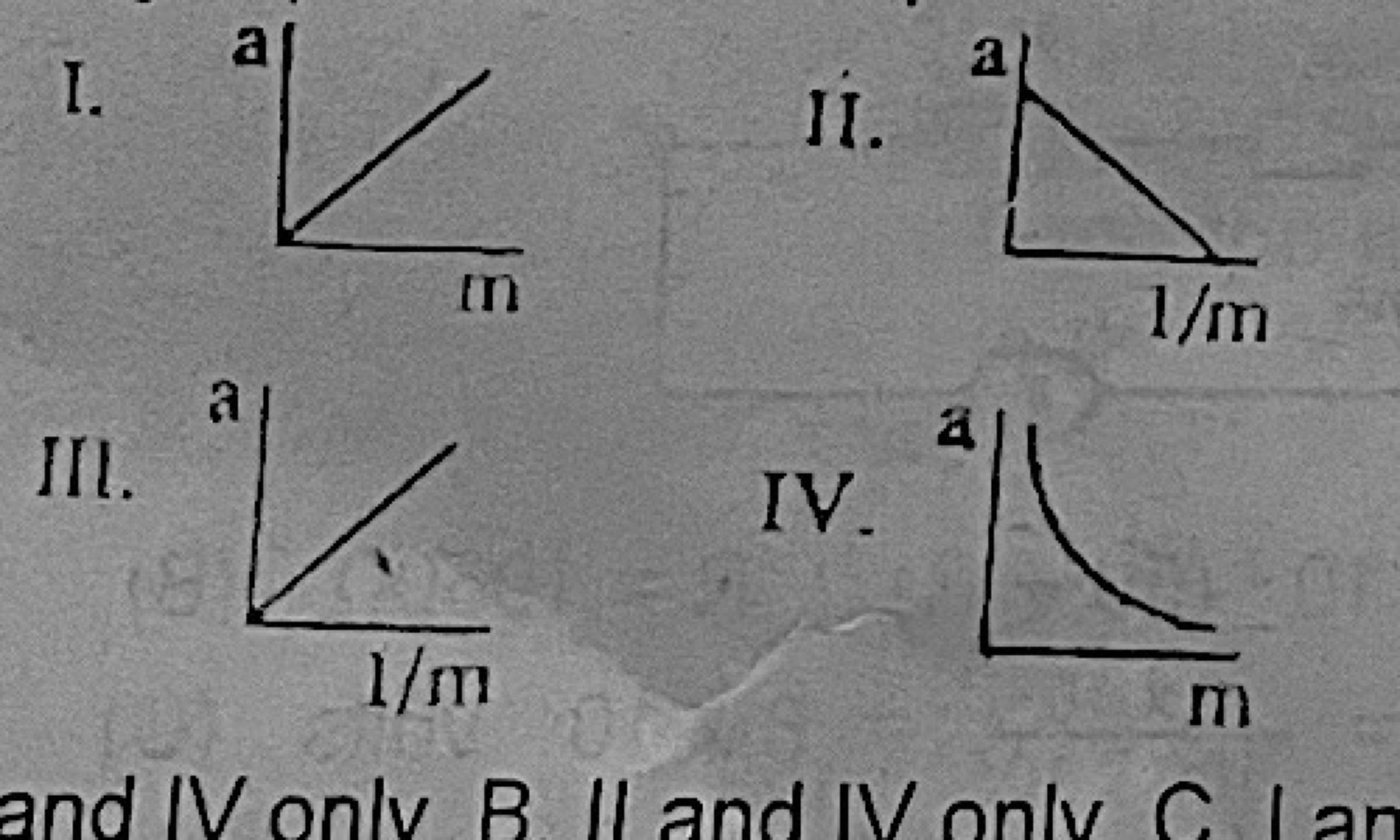
In an experiment, a constant force is applied to several masses (m) and the corresponding accelerations (a) are measured. Which of the following graphs correctly represents the experiment?
A.III and IV only
B.II and IV only
C.I and III only
D.I and II only
Show the answer and explanation
Answer: A (III and IV only)
Explanation
With F constant, a = F/m. So a against 1/m is a straight line through the origin (III), and a against m is a curve falling as m grows (IV).
A uniform metre rule weighing 0.5 N is to be pivoted on a knife-edge at the 30 cm-mark. Where will a force of 2 N be placed from the pivot to balance the metre rule?
A.95 cm
B.25 cm
C.20 cm
D.5 cm
Show the answer and explanation
Answer: D (5 cm)
Explanation
The weight acts at the 50 cm mark, 20 cm from the pivot: moment = 0.5 × 20 = 10 N cm. The 2 N force must be 10 ÷ 2 = 5 cm from the pivot on the other side.
A bullet fired at a wooden block of thickness 0.15 m manages to penetrate the block. If the mass of the bullet is 0.025 kg and the average resisting force of the wood is 7.5 × 10³ N, calculate the speed of the bullet just before it hits the wooden block.
A.450 m s−1
B.400 m s−1
C.300 m s−1
D.250 m s−1
Show the answer and explanation
Answer: C (300 m s−1)
Explanation
The bullet's kinetic energy is used up against the wood: ½ × 0.025 × v2 = 7.5 × 103 × 0.15 = 1125 J, so v2 = 90 000 and v = 300 m s−1.
B.the viscous force of the air and the upthrust completely counteract its weight
C.it expands as a result of reduced external pressure
D.the viscous force of the air is equal to the sum of the weight and upthrust
Show the answer and explanation
Answer: B (the viscous force of the air and the upthrust completely counteract its weight)
Explanation
At terminal velocity there is no resultant force: the upward forces (air resistance and upthrust) exactly balance the weight, so the speed stays constant.
In a wheel and axle mechanism, the diameters of the wheel and axle are 40 cm and 8 cm respectively. Given that the machine is 80% efficient, what effort is required to lift a load of 100 N?
A.20 N
B.25 N
C.50 N
D.80 N
Show the answer and explanation
Answer: B (25 N)
Explanation
Velocity ratio = 40/8 = 5. Mechanical advantage = 0.8 × 5 = 4. Effort = load ÷ MA = 100 ÷ 4 = 25 N.
Which of these statements are correct for the pressures in liquids? I. Pressure in a liquid at a point acts equally in all directions II. Pressure increases with depth III. Pressure at a depth depends on the shape of the container IV. Pressure at the same depth in different liquids are proportional to the densities of the liquids.
A.I, II and III only
B.I, II and IV only
C.I, III and IV only
D.II, III and IV only
Show the answer and explanation
Answer: B (I, II and IV only)
Explanation
Liquid pressure p = hρg acts equally in all directions, grows with depth h and is proportional to density ρ. It does not depend on the container's shape, so III is false.
The atmospheric pressure due to water is 1.3 × 10⁶ N m−2. What is the total pressure at the bottom of an ocean 10 m deep? [Density of water = 1000 kg m−3, g = 10 m s−2]
A.1.3 × 107 N m−2
B.1.4 × 106 N m−2
C.1.4 × 105 N m−2
D.1.0 × 105 N m−2
Show the answer and explanation
Answer: B (1.4 × 10⁶ N m−2)
Explanation
Water pressure at 10 m = hρg = 10 × 1000 × 10 = 1.0 × 10⁵ N m−2. Adding the given surface pressure: 1.3 × 10⁶ + 0.1 × 106 = 1.4 × 10⁶ N m−2.
A solid of weight 0.600 N is totally immersed in oil and water respectively. If the upthrust in oil is 0.210 N and the relative density of oil is 0.875 find the upthrust in water.
A.0.600 N
B.0.360 N
C.0.240 N
D.0.180 N
Show the answer and explanation
Answer: C (0.240 N)
Explanation
Relative density = upthrust in oil ÷ upthrust in water, so upthrust in water = 0.210 ÷ 0.875 = 0.240 N.
A platinum resistance thermometer records 3.0 Ω at 0 °C and 8.0 Ω at 100 °C. If it records 6.0 Ω in a certain environment, the temperature of the medium is
A 500 W heater is used to heat 0.6 kg of water from 25 °C to 100 °C in t1 seconds. If another 1000 W heater is used to heat 0.2 kg of water from 10 °C to 100 °C in t2 seconds, find t1/t2.
A.50
B.5
C.5/4
D.1/5
Show the answer and explanation
Answer: B (5)
Explanation
t = mcΔθ/P. t1 = 0.6 × c × 75/500 = 0.09c and t2 = 0.2 × c × 90/1000 = 0.018c, so t1/t2 = 5.
How many grams of water at 17 °C must be added to 42 g of ice at 0 °C to melt the ice completely? [Specific latent heat of fusion of ice = 3.4 × 10⁵ J kg−1, Specific heat capacity of water = 4200 J kg−1 K−1]
A.200 g
B.300 g
C.320 g
D.400 g
Show the answer and explanation
Answer: A (200 g)
Explanation
Heat to melt the ice = 0.042 × 3.4 × 105 = 14 280 J. The water cools from 17 °C to 0 °C: m × 4200 × 17 = 14 280, so m = 0.2 kg = 200 g.
In a resonance tube experiment, if the fundamental frequency of the vibrating air column is 280 Hz, the frequency of the third overtone is
A.70 Hz
B.840 Hz
C.1120 Hz
D.1960 Hz
Show the answer and explanation
Answer: D (1960 Hz)
Explanation
A resonance tube is closed at one end, so only odd harmonics occur: 280, 840, 1400, 1960 Hz. The third overtone is the 7th harmonic, 7 × 280 = 1960 Hz.
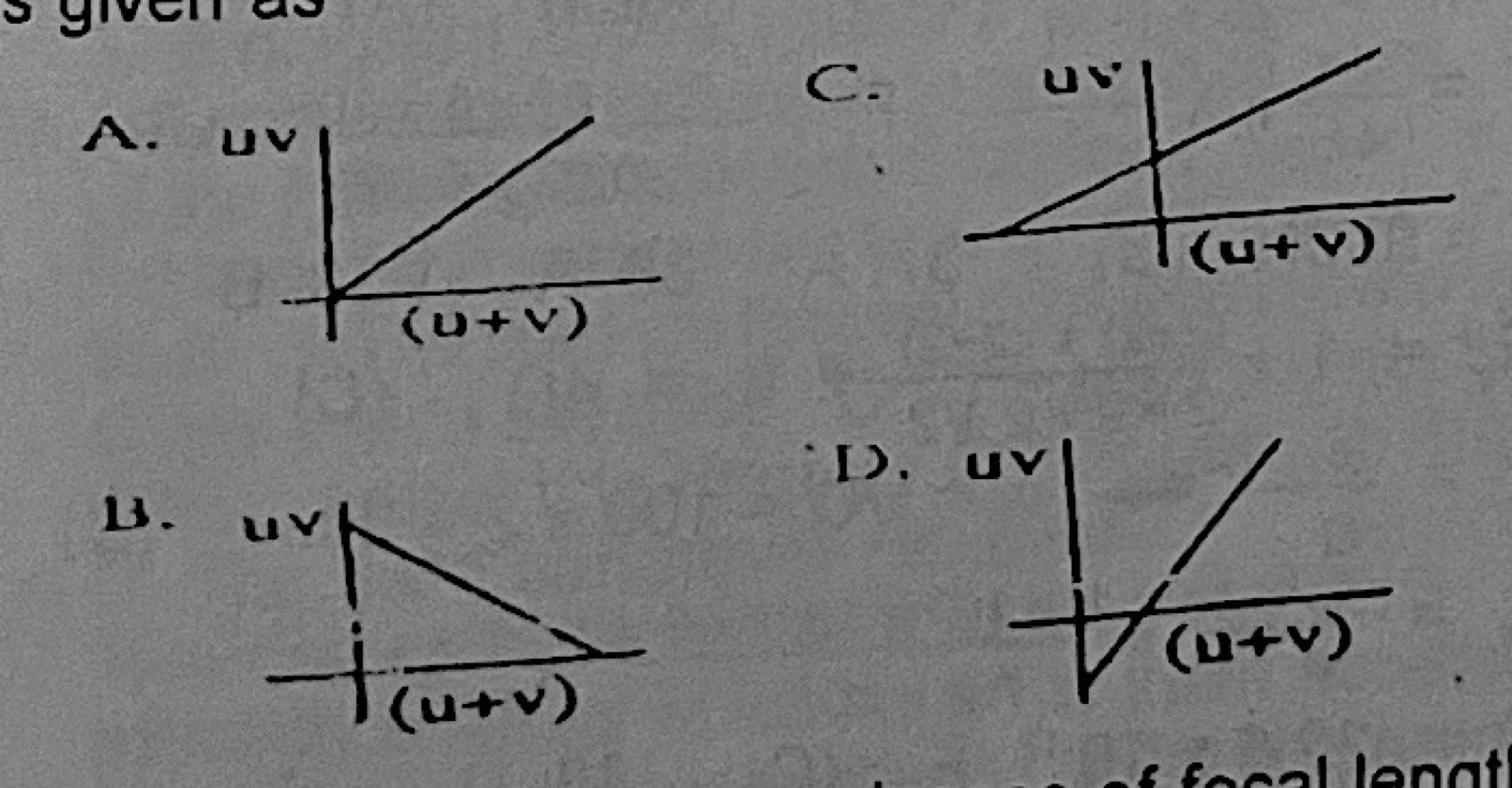
The correct shape of the graph of uv against (u + v) for an object distance u and image distance v in an experiment to find the focal length of a convex lens is given as
A.Graph A
B.Graph B
C.Graph C
D.Graph D
Show the answer and explanation
Answer: A (Graph A)
Explanation
From 1/f = 1/u + 1/v, uv = f(u + v). So uv against (u + v) is a straight line through the origin with slope f, which is graph A.
A man wears convex lens glasses of focal length 30 cm in order to correct his eye defect. Instead of the optimum 25 cm, his least distance of distinct vision is
A.14 cm
B.28 cm
C.75 cm
D.150 cm
Show the answer and explanation
Answer: D (150 cm)
Explanation
The lens must form a virtual image of an object at 25 cm at his near point: 1/30 = 1/25 − 1/v gives 1/v = 1/150, so his near point is 150 cm.
Which of the following are true about infra-red radiation? I. It is invisible II. It is called heat ray III. Its frequency is higher than that of blue light. IV. It travels as a transverse wave.
A.I, II, III and IV
B.I, II and IV only
C.I, III and IV only
D.II, III and IV only
Show the answer and explanation
Answer: B (I, II and IV only)
Explanation
Infra-red is invisible, is known as heat radiation and, like all electromagnetic waves, is transverse. Its frequency is lower than that of visible light, so III is false.
A parallel plate capacitor has a common plate area of 5 × 10⁻⁸ m2 and plate separation of 2 × 10⁻³ m. Assuming free space, what is the capacitance? [ε0 = 9.0 × 10⁻¹² C2 N−1 m−2]
A.2.25 × 10−17 F
B.4.50 × 10−17 F
C.2.25 × 10−16 F
D.4.50 × 10−16 F
Show the answer and explanation
Answer: C (2.25 × 10⁻¹⁶ F)
Explanation
C = ε0A/d = 9.0 × 10−12 × 5 × 10−8 ÷ (2 × 10⁻³) = 2.25 × 10⁻¹⁶ F.
Electricity is supplied to a school along a cable of total resistance 0.5 Ω with the maximum current drawn from the mains as 100 A. The maximum energy dissipated as heat for 1 hr is
A transformer which can produce 8 V from a 240 V a.c. supply, has an efficiency of 80%. If the current in the secondary coil is 15 A, calculate the current in the primary coil.
A.0.625 A
B.1.600 A
C.2.500 A
D.6.250 A
Show the answer and explanation
Answer: A (0.625 A)
Explanation
Output power = 8 × 15 = 120 W. Input power = 120 ÷ 0.8 = 150 W, so the primary current = 150 ÷ 240 = 0.625 A.
The electrochemical equivalent of a metal is 1.3 × 10⁻⁷ kg C−1. The mass of the metal which 2.0 × 10⁴ C of electricity will deposit from a suitable electrolyte is
A.6.5 × 10−2 kg
B.2.6 × 10−2 kg
C.6.5 × 10−3 kg
D.2.6 × 10−3 kg
Show the answer and explanation
Answer: D (2.6 × 10⁻³ kg)
Explanation
Faraday's first law: m = zQ = 1.3 × 10−7 × 2.0 × 104 = 2.6 × 10⁻³ kg.
A radioactive substance has a half-life of 80 days. If the initial number of atoms in the sample is 6.00 × 10¹⁰, how many atoms would remain at the end of 320 days?
A.3.75 × 109
B.7.50 × 109
C.3.00 × 1010
D.5.63 × 1010
Show the answer and explanation
Answer: A (3.75 × 10⁹)
Explanation
320 days is 4 half-lives, so (½)4 = 1/16 remains: 6.00 × 10¹⁰ ÷ 16 = 3.75 × 10⁹.
In a nuclear fusion experiment, the loss of mass amounts to 1.0 × 10⁻⁶ kg. The amount of energy obtained from the fusion is [Speed of light = 3.0 × 10⁸ m s−1]
A.3.0 × 10−4 J
B.3.0 × 10−1 J
C.9.0 × 104 J
D.9.0 × 1010 J
Show the answer and explanation
Answer: D (9.0 × 10¹⁰ J)
Explanation
E = mc2 = 1.0 × 10−6 × (3.0 × 108)2 = 9.0 × 10¹⁰ J.