Question 1
Measurement and UnitsWhich of the following is the dimension of pressure?
- A.ML−1T−2
- B.MLT−2
- C.ML2T−3
- D.ML−3
Show the answer and explanation
Answer: A (ML−1T−2)
Explanation
Pressure = force/area = (MLT−2)/L2 = ML−1T−2.
49 questions. Try each one, then open the answer to check yourself and read the explanation.
Which of the following is the dimension of pressure?
Answer: A (ML−1T−2)
Pressure = force/area = (MLT−2)/L2 = ML−1T−2.
The length of a displaced pendulum bob which passes its lowest point twice every second is [g = 10 m s−2]
Answer: A (0.25 m)
Passing the lowest point twice each second means one full swing takes 1 s, so T = 1 s. From T = 2π√(L/g), L = gT2/(4π2) = 10/39.5 ≈ 0.25 m.
In the diagram above, P, Q and R are vectors. Which of the following options gives the correct relationship between the vectors?
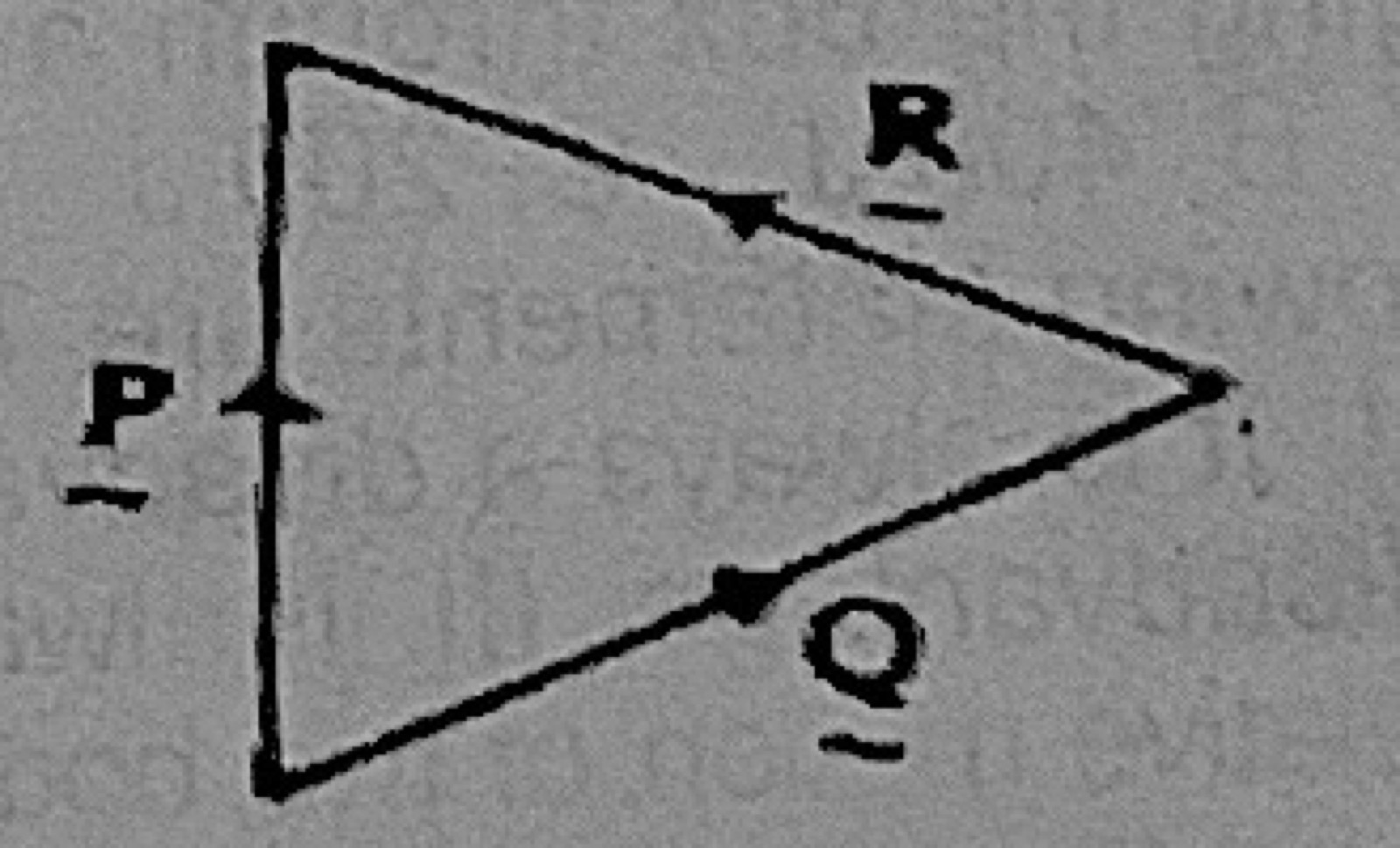
Answer: D (P + Q + R = 0)
The three arrows follow one another head to tail round the triangle and end where they started, so their sum is zero: P + Q + R = 0.
The value of T in the figure above is
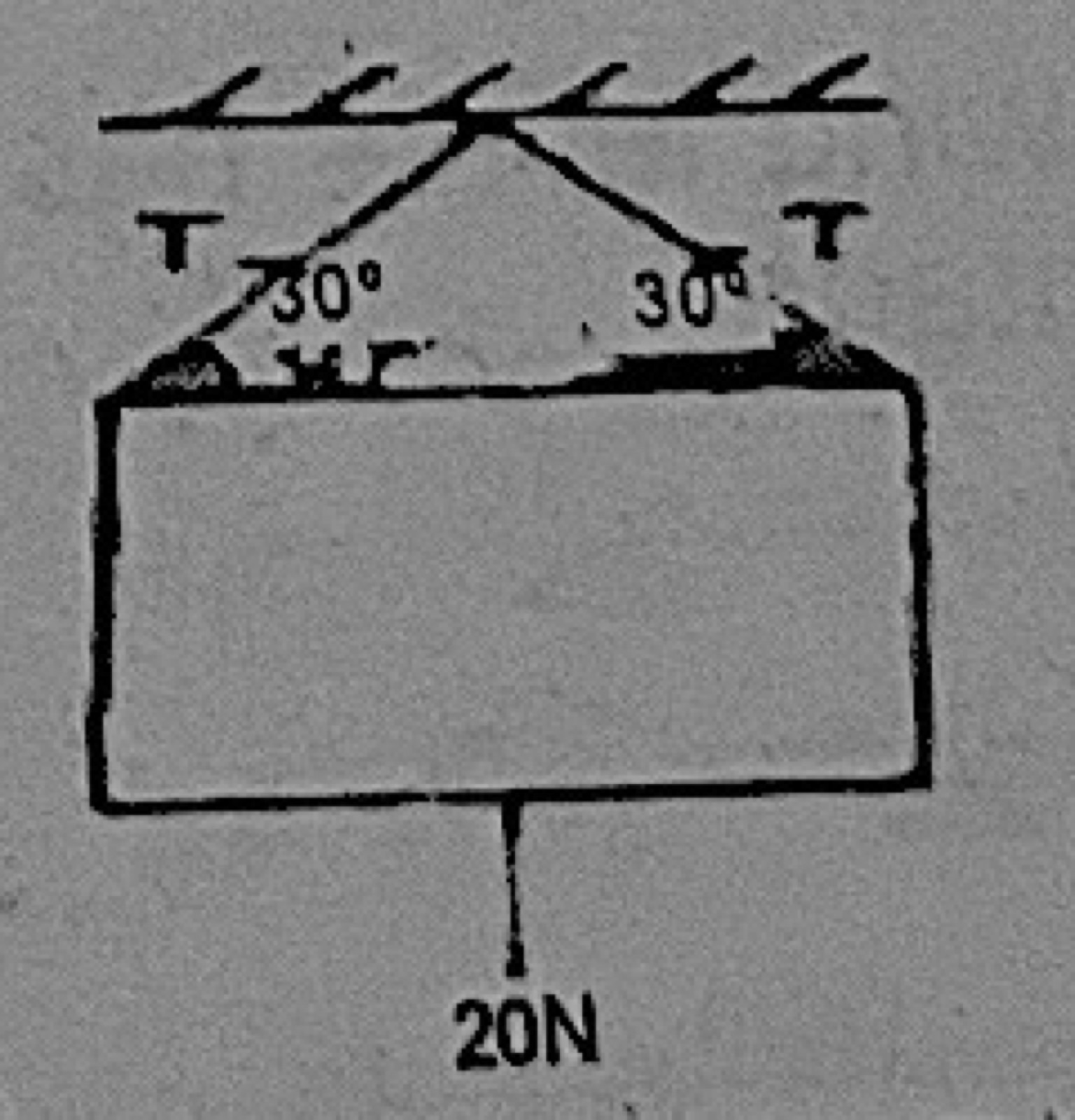
Answer: C (20.0 N)
Each string makes 30° with the horizontal, so each pulls up with T sin 30°. Two strings support the 20 N weight: 2T × 0.5 = 20 N, so T = 20 N.
When a ball rolls on a smooth level ground, the motion of its centre is
Answer: A (translational)
A rolling ball spins about its centre, but the centre itself just moves forward in a straight line. Straight-line movement of a point is translational motion.
The velocity-time graph of a body moving in a straight line and decelerating uniformly to rest is represented by
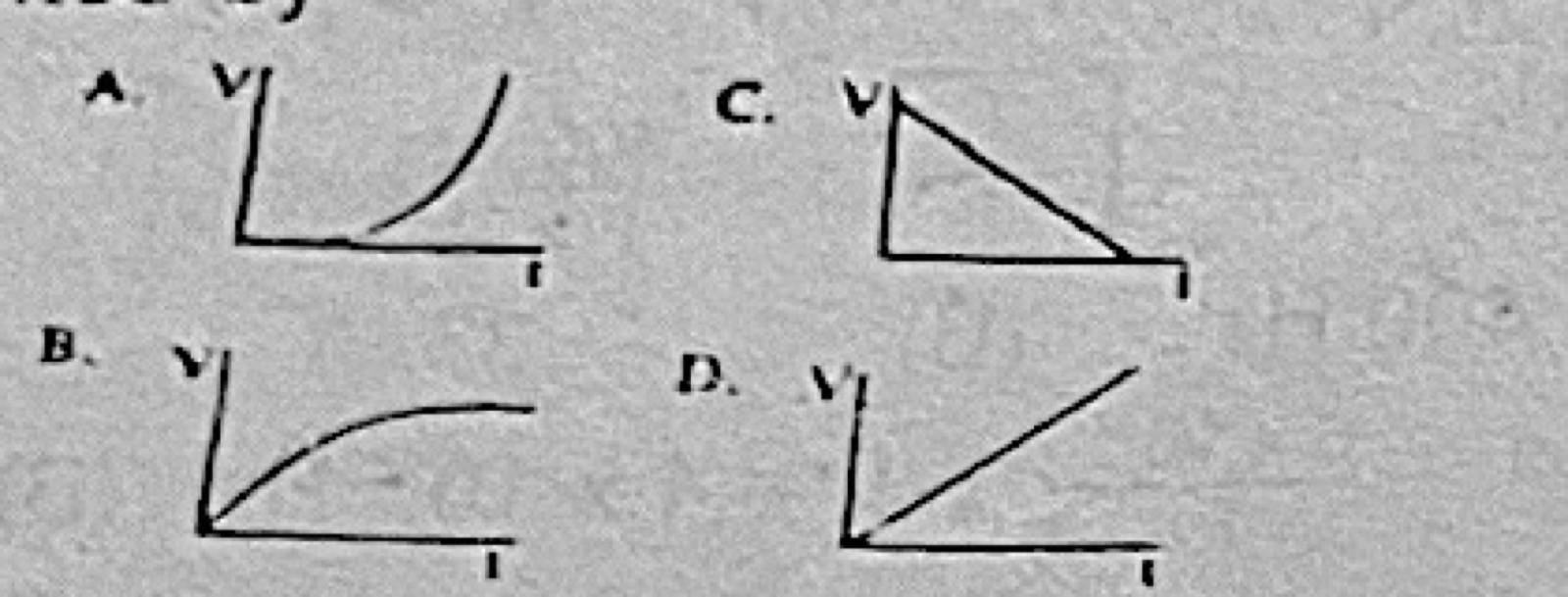
Answer: C (Graph C)
Uniform deceleration to rest is a straight line sloping down from the starting velocity to zero velocity, which is graph C.
The acceleration of the system shown above is
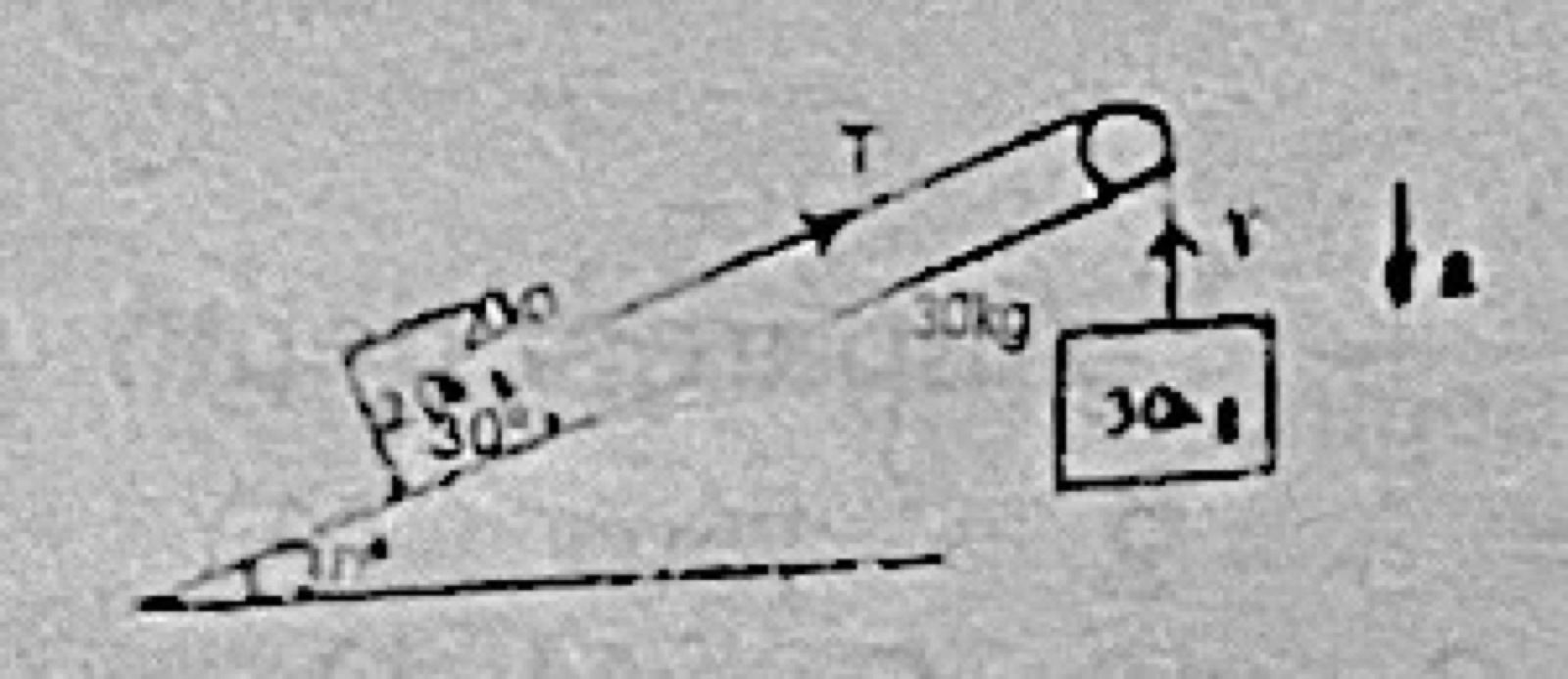
Answer: B (4 m s−2)
Taking the plane as smooth and g = 10 m s−2: the hanging 30 kg pulls with 300 N, and the 20 kg block on the 30° slope pulls back with 20 × 10 × sin 30° = 100 N. a = (300 − 100)/(30 + 20) = 4 m s−2.
What is the acceleration due to gravity 'g' on the moon, if g is 10 m s−2 on the earth?
Answer: C (1.67 m s−2)
Gravity on the moon is about one-sixth of that on earth: 10/6 ≈ 1.67 m s−2.
A body is projected from the earth's surface with the intention of letting it escape from the earth's gravitational field. What is the minimum escape velocity of the body? [Earth's radius = 6.4 × 10³ km, g = 10 m s−2]
Answer: D (11 km s−1)
Escape velocity v = √(2gR) = √(2 × 10 × 6.4 × 106) ≈ 1.13 × 10⁴ m s−1, about 11 km s−1.
A uniform rod PQ of length 1 m and mass 2 kg is pivoted at the end P. If a load of 14 N is placed at the centre of the rod, find the force that should be applied vertically upwards at Q to maintain the rod in equilibrium horizontally. [g = 10 m s−2]
Answer: C (17 N)
The rod's weight (20 N) and the 14 N load both act at the centre, 0.5 m from P. Moments about P: F × 1 = 34 × 0.5, so F = 17 N.
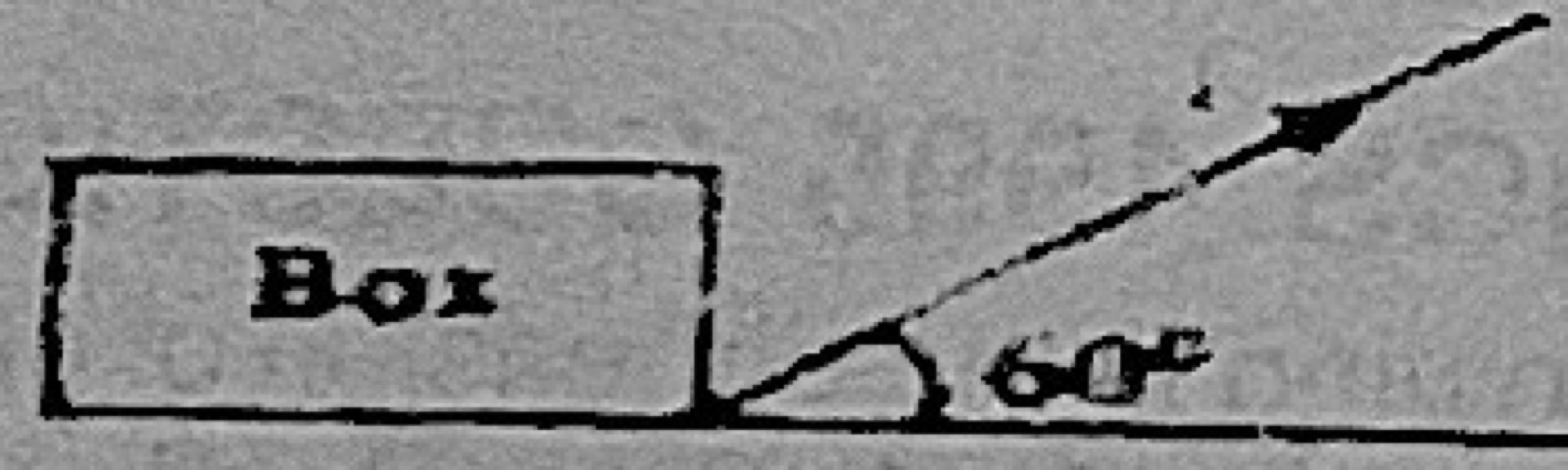
A box of mass 40 kg is being dragged along the floor by a rope inclined at 60° to the horizontal. The frictional force between the box and the floor is 100 N and the tension on the rope is 300 N. How much work is done in dragging the box through a distance of 4 m?
Answer: C (200 J)
The forward pull is 300 cos 60° = 150 N. Taking away friction leaves a net force of 50 N, and 50 N × 4 m = 200 J.
Which of the following statements are TRUE about frictional force?
I. It is always a disadvantage
II. It is sometimes a disadvantage
III. It always exists where there is a relative motion of two bodies that are in contact
IV. It is sometimes very useful.
Answer: D (II and IV only)
Friction causes wear and wastes energy (a disadvantage sometimes) but also lets us walk, brake and grip (useful sometimes). So II and IV are true.
The energy contained in a wire when it is extended by 0.02 m by a force of 500 N is
Answer: A (5 J)
Energy stored in a stretched wire = ½ × force × extension = ½ × 500 × 0.02 = 5 J.
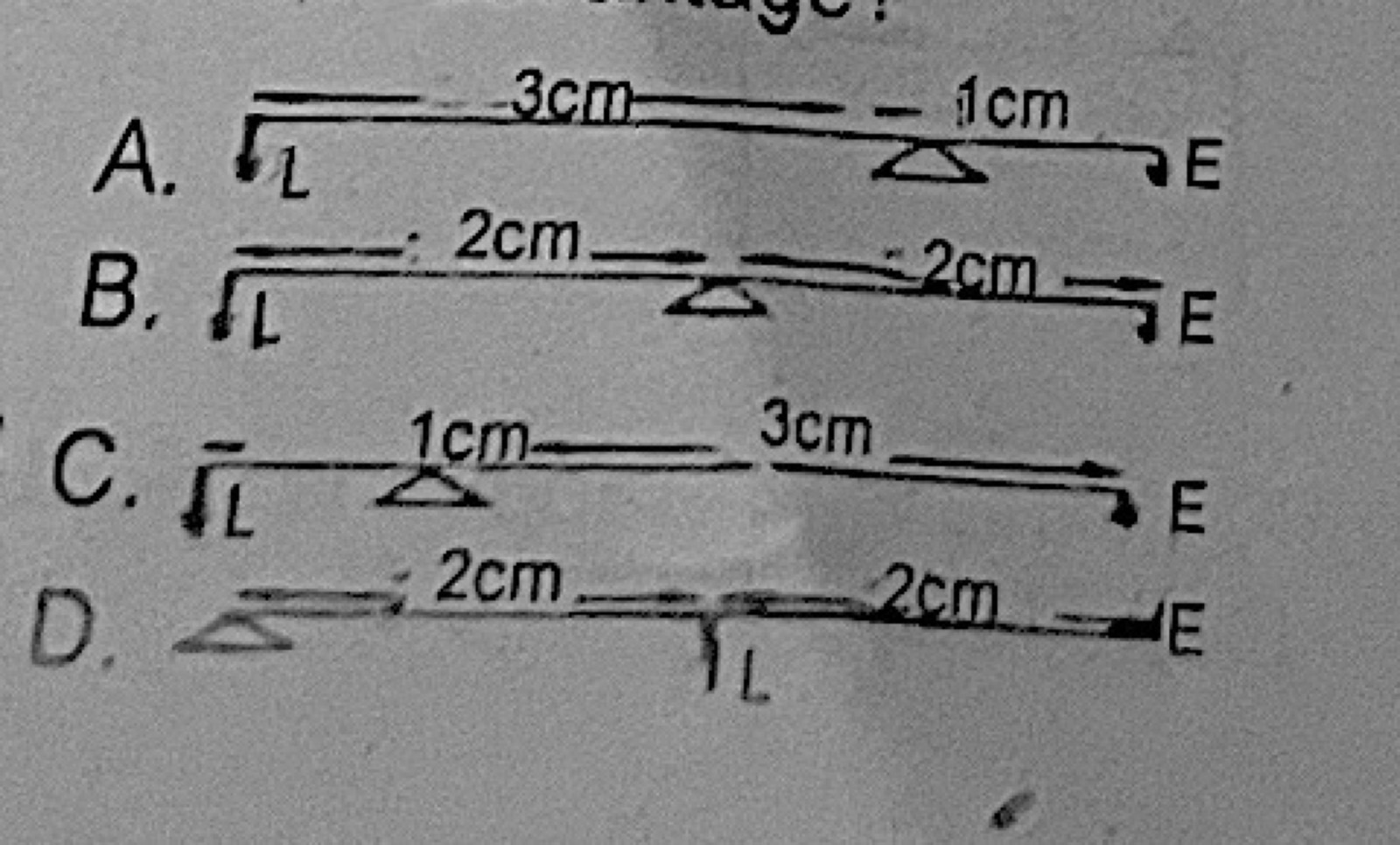
Which of the following levers has the greatest mechanical advantage?
Answer: C (Lever C)
Mechanical advantage = effort arm ÷ load arm. A: 1/3, B: 2/2 = 1, C: 3/1 = 3, D: 4/2 = 2. Lever C has the largest value.
A hydraulic press has a large circular piston of radius 0.8 m and a circular plunger of radius 0.2 m. A force of 500 N is exerted by the plunger. Find the force exerted on the piston.
Answer: A (8000 N)
Pressure is the same on both: F/(π × 0.82) = 500/(π × 0.22). So F = 500 × 16 = 8000 N.
The volume of an air bubble increases from the bottom to the top of a lake at constant temperature because
Answer: B (pressure increases with depth)
Pressure is greatest at the bottom and falls as the bubble rises. By Boyle's law, lower pressure at constant temperature means larger volume.
Temperature is a measure of the
Answer: B (mean kinetic energy of the molecules of the object)
By kinetic theory, temperature measures the average (mean) kinetic energy of the molecules of a body.
A rectangular metal block of volume 10−6 m3 at 273 K is heated to 573 K. If its coefficient of linear expansion is 1.2 × 10⁻⁵ K−1, the percentage change of its volume is
Answer: B (1.1%)
Cubic expansivity = 3 × 1.2 × 10−5 = 3.6 × 10⁻⁵ K−1. Fractional change = 3.6 × 10−5 × 300 = 0.0108, about 1.1%.
A piece of wood floats inside water at room temperature with a fraction of it above the liquid surface. As the temperature of the water is raised, the part of the wood above the liquid will
Answer: A (decrease because the density of water decreases with temperature)
Above 4 °C water becomes less dense as it warms, so the wood must displace more water to get the same upthrust. It sinks a little deeper, leaving less above the surface.
The equation PxVyTz = constant is Charles' law when
Answer: B (x = 0, y = 1, z = −1)
Charles' law (pressure constant) says V/T = constant, i.e. P0V1T−1 = constant.
An electric kettle with negligible heat capacity is rated at 2000 W. If 2.0 kg of water is put in it, how long will it take the temperature of water to rise from 20 °C to 100 °C? [Specific heat capacity of water = 4200 J kg−1 K−1]
Answer: B (336 s)
Heat needed = mcΔθ = 2 × 4200 × 80 = 672 000 J. Time = 672 000 ÷ 2000 = 336 s.
A temperature scale has a lower fixed point of 40 mm and an upper fixed point of 200 mm. What is the reading on this scale when a thermometer reads 60 °C?
Answer: D (136.0 mm)
60 °C is 60% of the way from 0 °C to 100 °C. The scale spans 160 mm, so the reading is 40 + 0.6 × 160 = 136 mm.
A quantity of ice at −10 °C is heated until the temperature of the heating vessel is 90 °C. Which of the following constants is NOT required to determine the quantity of heat supplied to the vessel?
Answer: D (Specific latent heat of vaporization)
The ice warms to 0 °C, melts, and the water warms to 90 °C. It never boils, so the latent heat of vaporization is not needed.
Which of the following statements give the TRUE differences between evaporation and boiling?
I. Evaporation occurs at all temperatures while boiling occurs at a fixed temperature for a given pressure
II. Evaporation is a surface phenomenon while boiling is an interior phenomenon
III. Evaporation is affected by surface area while boiling is not
Answer: D (I, II and III)
All three are true: evaporation happens at any temperature, only at the surface, and faster with a larger surface; boiling happens at one temperature (for a given pressure) throughout the liquid.
A well-lagged bar of length 100 cm has its ends maintained at 100 °C and 40 °C respectively. What is the temperature at a point 60 cm from the hotter end?
Answer: C (64 °C)
In a lagged bar the temperature falls evenly: 60 °C over 100 cm, i.e. 0.6 °C per cm. 60 cm from the hot end it is 100 − 36 = 64 °C.
Which of the following is the exclusive property of a transverse wave?
Answer: D (Polarization)
Only transverse waves can be polarized. All waves diffract and refract, and compressions belong to longitudinal waves.
The wavelength of signals from a radio transmitter is 1500 m and the frequency is 200 kHz. What is the wavelength for a transmitter operating at 1000 kHz?
Answer: B (300 m)
Speed is the same: λ1f1 = λ2f2. 1500 × 200 = λ × 1000, so λ = 300 m.
The difference between sound waves and light waves is that sound waves
Answer: B (require a medium to travel while light waves do not)
Sound is a mechanical wave and needs a medium; light is electromagnetic and can travel through a vacuum.
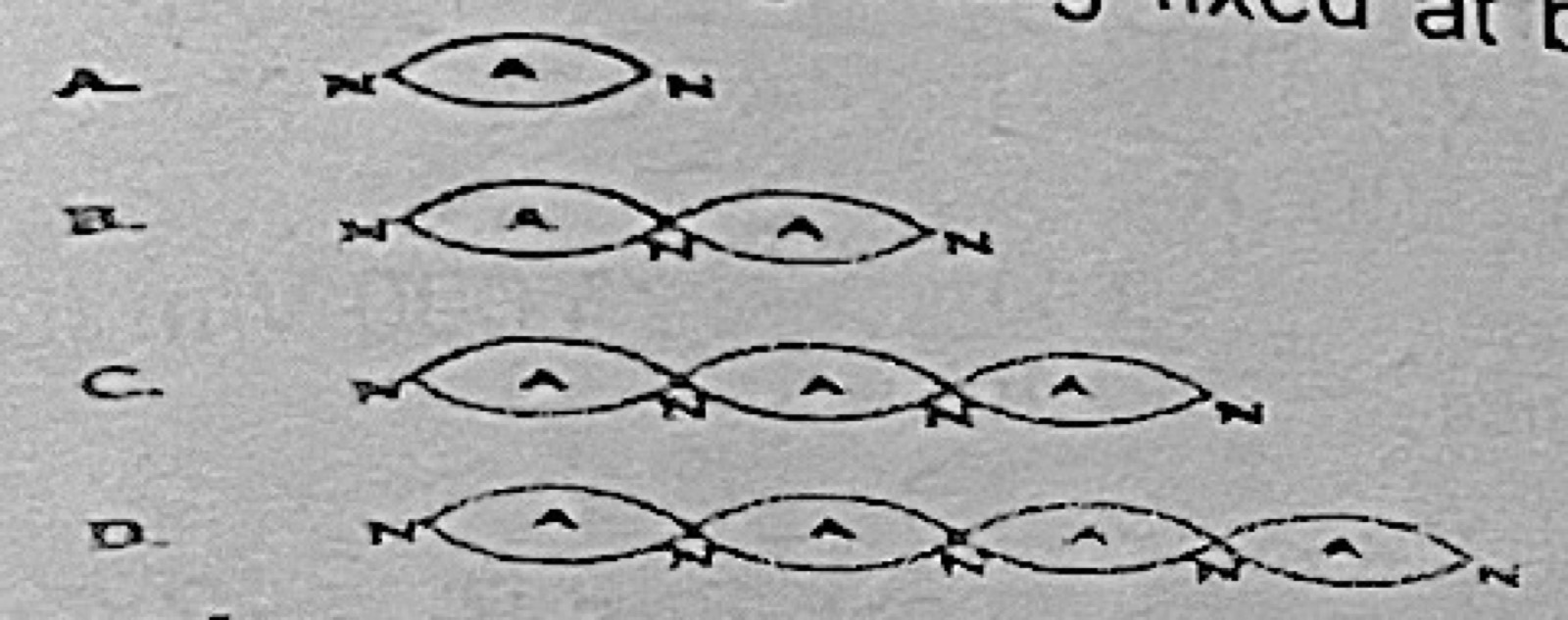
Which of the diagrams below represents the second overtone of a vibrating string fixed at both ends?
Answer: C (Diagram C)
The fundamental has one loop, the first overtone two loops and the second overtone three loops. Diagram C shows three loops.
The pitch of an acoustic device can be increased by
Answer: A (increasing the frequency)
Pitch depends on frequency: a higher frequency gives a higher pitch. Amplitude, loudness and intensity do not change pitch.
Total eclipse of the sun occurs when the
Answer: C (moon is between the sun and the earth)
In a solar eclipse the moon passes between the sun and the earth and casts its shadow on the earth.
What is the approximate critical angle for total internal reflection for diamond if the refractive index of diamond is 2.42?
Answer: D (24°)
sin C = 1/n = 1/2.42 = 0.413, so C ≈ 24°.
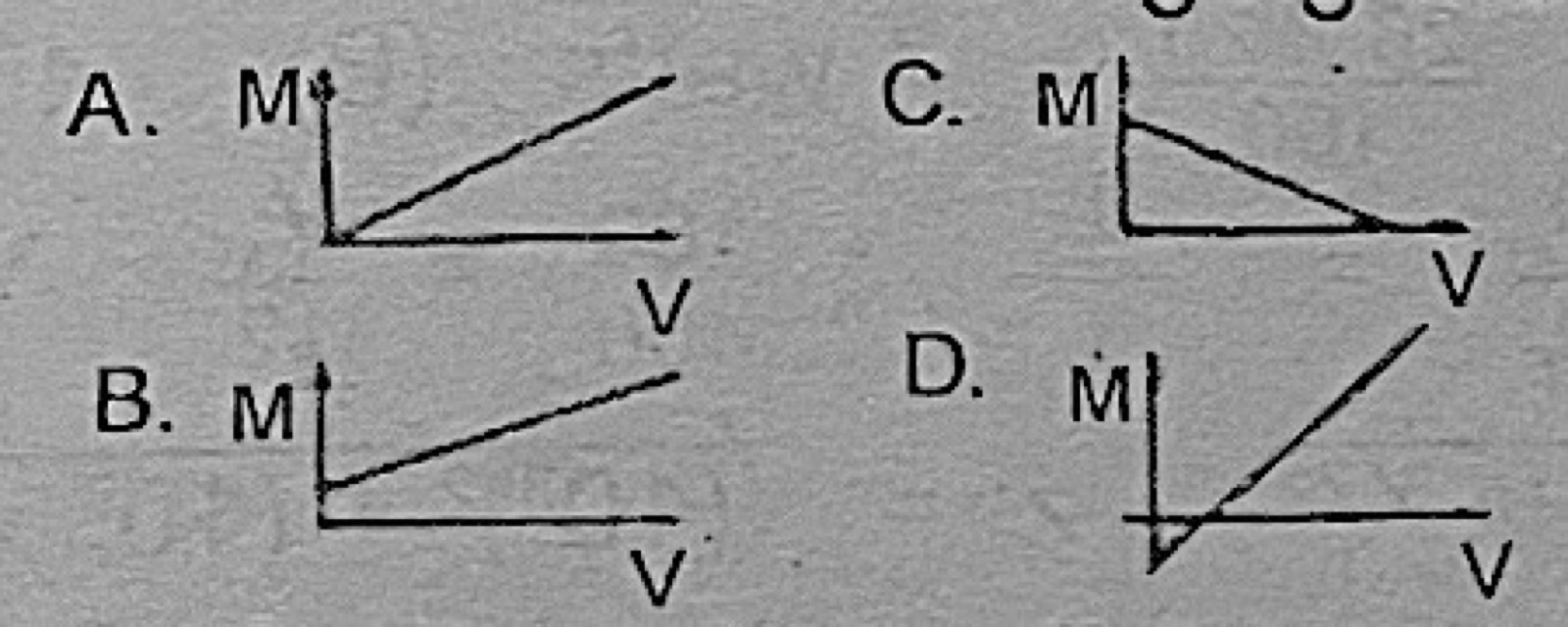
Which of the graphs represents the relationship between m and v for a converging mirror?
Answer: D (Graph D)
For a mirror m = v/f − 1, a straight line of slope 1/f that cuts the m-axis at −1 and the v-axis at v = f. Graph D shows this.
A real object is placed at a distance u cm in front of a curved mirror of focal length f cm. If the image is upright and magnified, then the mirror is
Answer: D (concave and u = f/2)
A convex mirror always gives a diminished image. A concave mirror gives an upright, magnified (virtual) image only when the object is inside the focal length, e.g. u = f/2.
Which of the following pairs of colours gives the widest separation in the spectrum of white light?
Answer: A (Red and violet)
Red and violet are at opposite ends of the spectrum (ROYGBIV), so they are separated the most.
Two parallel plates at a distance of 8.0 × 10⁻³ m apart are maintained at a p.d. of 600 volts with the negative plate earthed. What is the electric field strength?
Answer: D (75000.0 V m−1)
E = V/d = 600 ÷ (8.0 × 10⁻³) = 75 000 V m−1.
At different locations on the earth's surface, the earth's magnetic field is
Answer: C (different in both magnitude and direction)
The earth's field is strongest near the poles and weakest near the equator, and its direction (dip and declination) also changes from place to place.
If a resistance is halved in value and the potential difference across it is tripled, then the ratio of the new current to the old is
Answer: D (6 : 1)
I = V/R. The new current is (3V)/(R/2) = 6V/R, six times the old, so the ratio is 6 : 1.
A 12 V battery has an internal resistance of 0.5 Ω. If a cable of 1.0 Ω resistance is connected across the two terminals of the battery, the current drawn from the battery is
Answer: B (8.0 A)
I = E/(R + r) = 12 ÷ (1.0 + 0.5) = 8.0 A.
The diagram above shows two similar bulbs X and Y connected to a suitable power supply with F as an appropriate fuse rating. If the filament of X breaks, then the
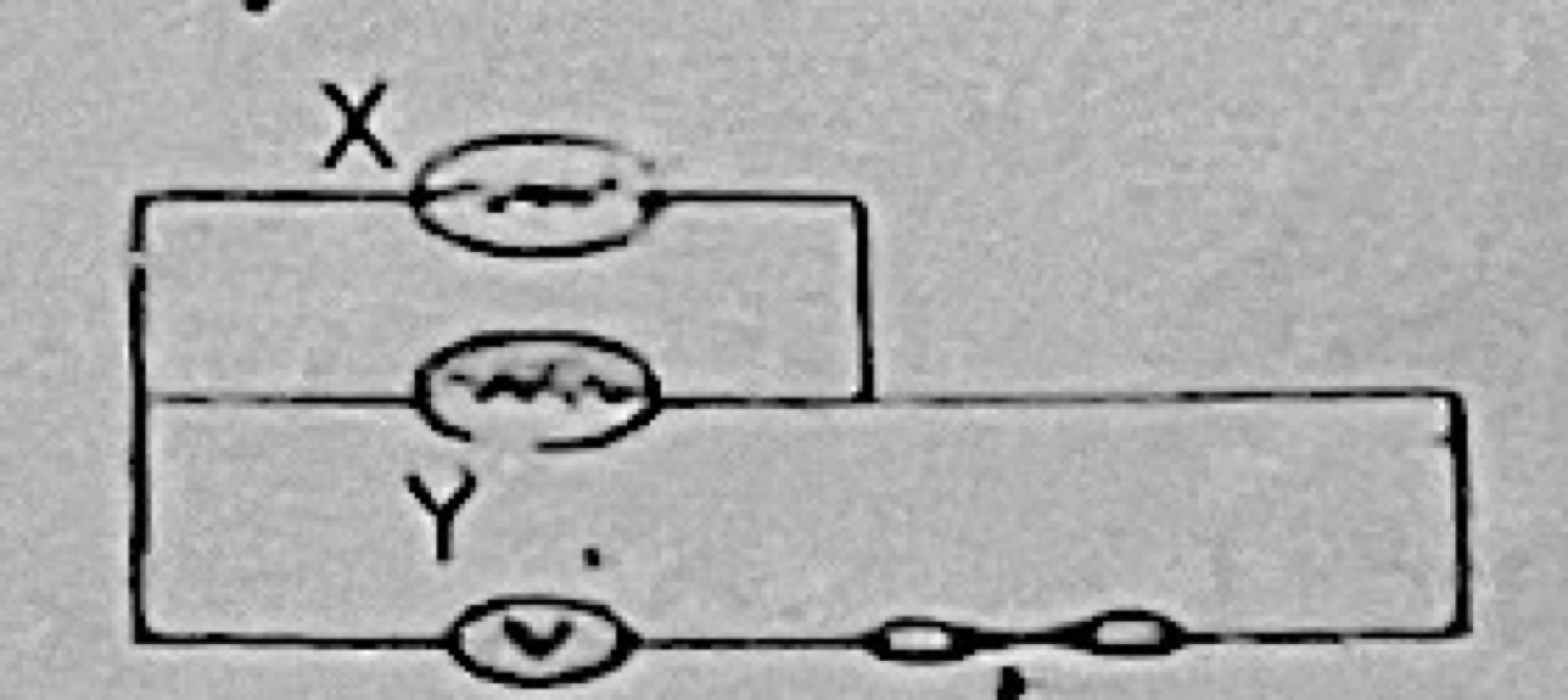
Answer: B (brightness of Y will remain constant)
X and Y are connected in parallel, so each has the full supply voltage across it. If X's filament breaks, Y still gets the same voltage and current, so its brightness remains constant.
The purpose of a dielectric material in a parallel plate capacitor is to
Answer: A (increase its capacitance)
A dielectric has a permittivity greater than air, so C = εA/d becomes larger.
The resultant capacitance in the figure above is
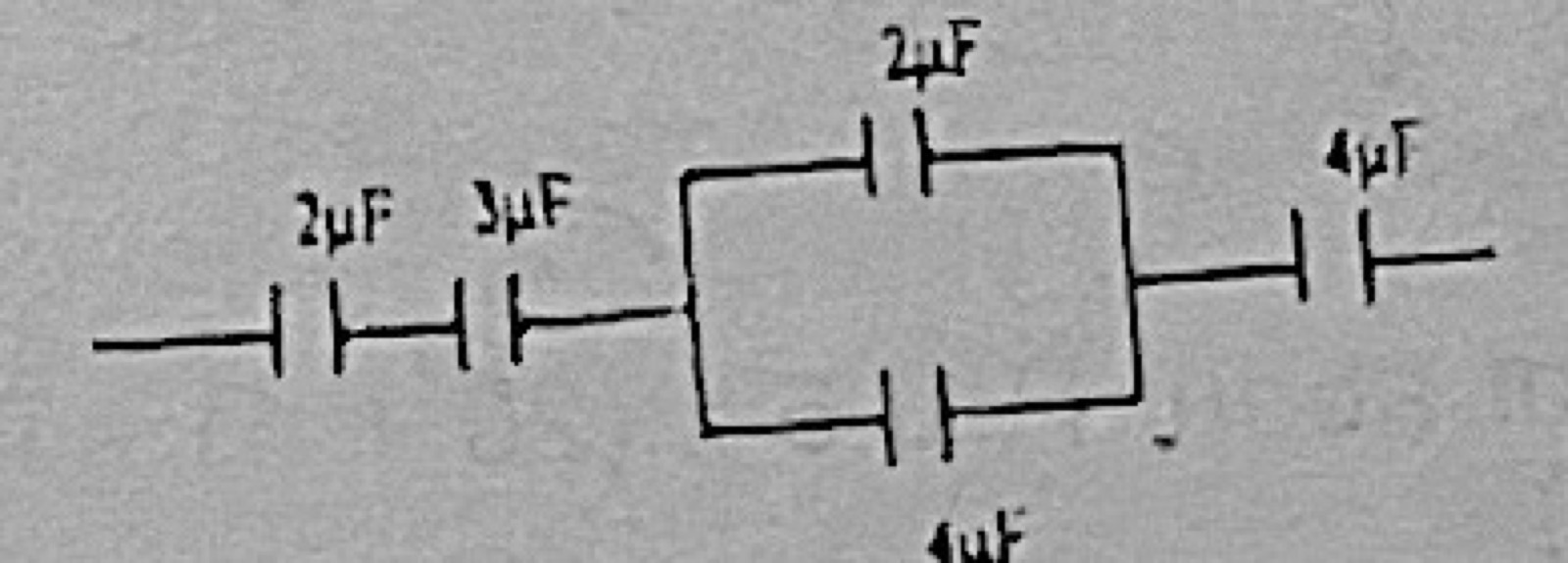
Answer: D (0.8 μF)
The 2 μF and 4 μF in parallel make 6 μF. This is in series with 2 μF, 3 μF and 4 μF: 1/C = 1/2 + 1/3 + 1/6 + 1/4 = 15/12, so C = 0.8 μF.
An electric current of 2 amperes flows in a heating coil of resistance 50 ohms for 3 minutes 20 seconds. Determine the heat produced.
Answer: D (40.0 kJ)
H = I2Rt = 22 × 50 × 200 = 40 000 J = 40.0 kJ.
If the maximum voltage across a 100-ohm resistor is 20 V, then the maximum power it can dissipate is
Answer: B (4.00 W)
P = V2/R = 202/100 = 4.00 W.
Which of the following is required to convert a milliammeter to an ammeter?
Answer: C (A low resistance in parallel)
A low resistance (shunt) in parallel carries most of the current, so the meter can measure larger currents.
The primary winding of a transformer has 400 turns and its secondary has 100 turns. If a source of e.m.f. of 12 V is applied to the primary, the secondary e.m.f. will be
Answer: A (3 V)
Vs/Vp = Ns/Np, so Vs = 12 × 100/400 = 3 V.
An alternating source is connected in series to a capacitor of capacitive reactance of 103√3 Ω and a resistor of resistance 103 Ω. The impedance of the circuit is
Answer: B (2000 Ω)
Z = √(R2 + X2) = √(106 + 3 × 10⁶) = √(4 × 10⁶) = 2000 Ω.
The half-life of a radioactive element is 9 days. What fraction of atoms has decayed in 36 days?
Answer: D (15/16)
36 days is 4 half-lives, so (½)4 = 1/16 remains. The fraction decayed is 1 − 1/16 = 15/16.
A light of energy 5 eV falls on a metal and the electrons with a maximum kinetic energy of 2 eV are ejected. The work function of the metal is
Answer: C (3.0 eV)
Photon energy = work function + maximum kinetic energy, so work function = 5 − 2 = 3.0 eV.