The external and internal diameters of a tube are measured as (32 ± 2)mm and (21 ± 1)mm respectively. Determine the percentage error in the thickness of the tube.
A.27%
B.14%
C.9%
D.3%
Show the answer and explanation
Answer: A (27%)
Explanation
Thickness = (32 − 21)/2 = 5.5 mm. The errors add: (2 + 1)/2 = 1.5 mm. Percentage error = 1.5/5.5 × 100 ≈ 27%.
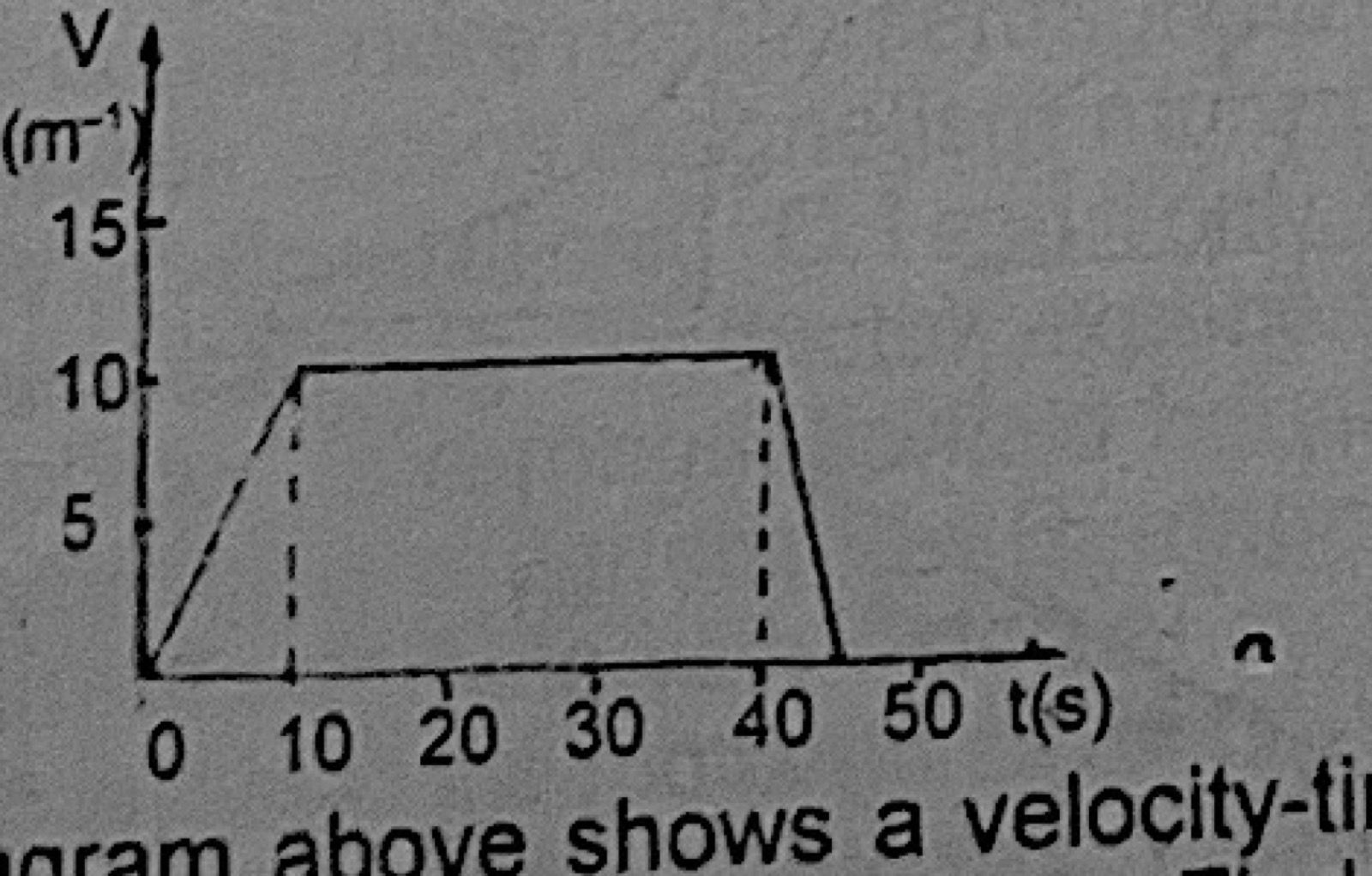
The diagram above shows a velocity-time graph representing the motion of a car. Find the total distance covered during the acceleration and retardation periods of the motion.
A.75m
B.150m
C.300m
D.375m
Show the answer and explanation
Answer: A (75m)
Explanation
Distance = area under the graph. Acceleration (0–10 s): ½ × 10 × 10 = 50 m. Retardation (40–45 s): ½ × 5 × 10 = 25 m. Total = 75 m.
An aeroplane lands on a runway at a speed of 180 km h−1 and is brought to a stop uniformly in 30 seconds. What distance does it cover on the runway before coming to rest?
A.360m
B.540m
C.750m
D.957m
Show the answer and explanation
Answer: C (750m)
Explanation
180 km h−1 = 50 m s−1. With uniform slowing, average speed = 25 m s−1, so distance = 25 × 30 = 750 m.
The force experienced by an object of mass 60.0kg in the moon's gravitational field is 1.002 × 10² N. What is the intensity of the gravitational field?
A.0.60 N kg−1
B.1.67 N kg−1
C.6.12 × 102 N kg−1
D.9.81 m s−2
Show the answer and explanation
Answer: B (1.67 N kg−1)
Explanation
Field intensity = force per unit mass = 100.2 ÷ 60.0 = 1.67 N kg−1.
Which of the following correctly describes the energy changes in the generation of light by a hydroelectric power station?
A.Electrical → mechanical → potential → light
B.Potential → mechanical → electrical → light
C.Mechanical → sound → electrical → light
D.Kinetic → mechanical → electrical → light
Show the answer and explanation
Answer: B (Potential → mechanical → electrical → light)
Explanation
Water stored behind the dam has potential energy; falling, it turns the turbines (mechanical), the generators produce electrical energy, and lamps turn it into light.
A weightless vessel of dimensions 4m × 3m × 2m is filled with a liquid of density 1000 kg m−3 and sealed. What is the maximum pressure this container can exert on a flat surface? [g = 10 m s−2]
A.9 × 104 N m−2
B.4 × 104 N m−2
C.3 × 104 N m−2
D.2 × 104 N m−2
Show the answer and explanation
Answer: B (4 × 10⁴ N m−2)
Explanation
Pressure is greatest when the vessel stands on its smallest face (3 m × 2 m), so the liquid is 4 m deep: p = hρg = 4 × 1000 × 10 = 4 × 10⁴ N m−2.
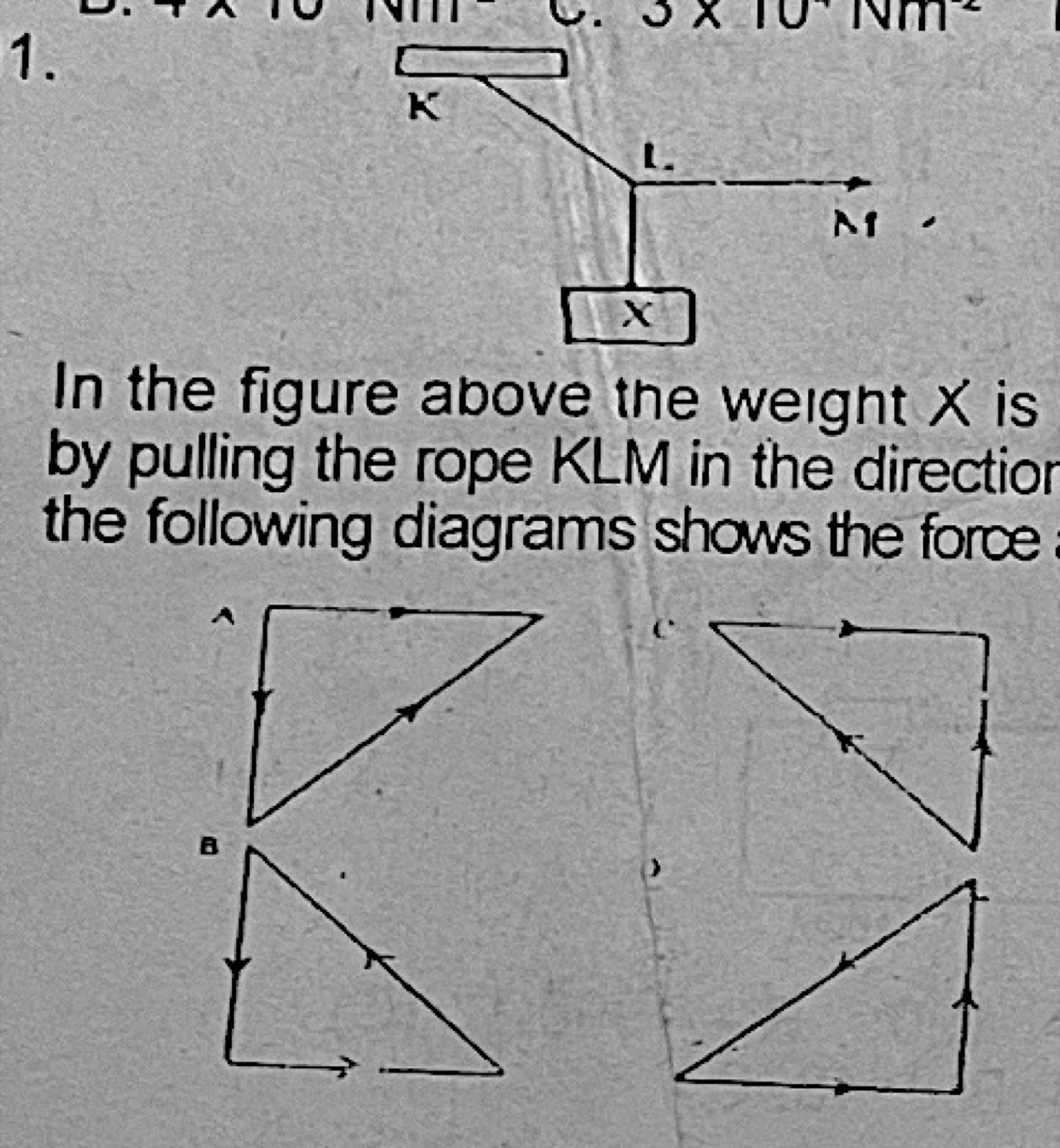
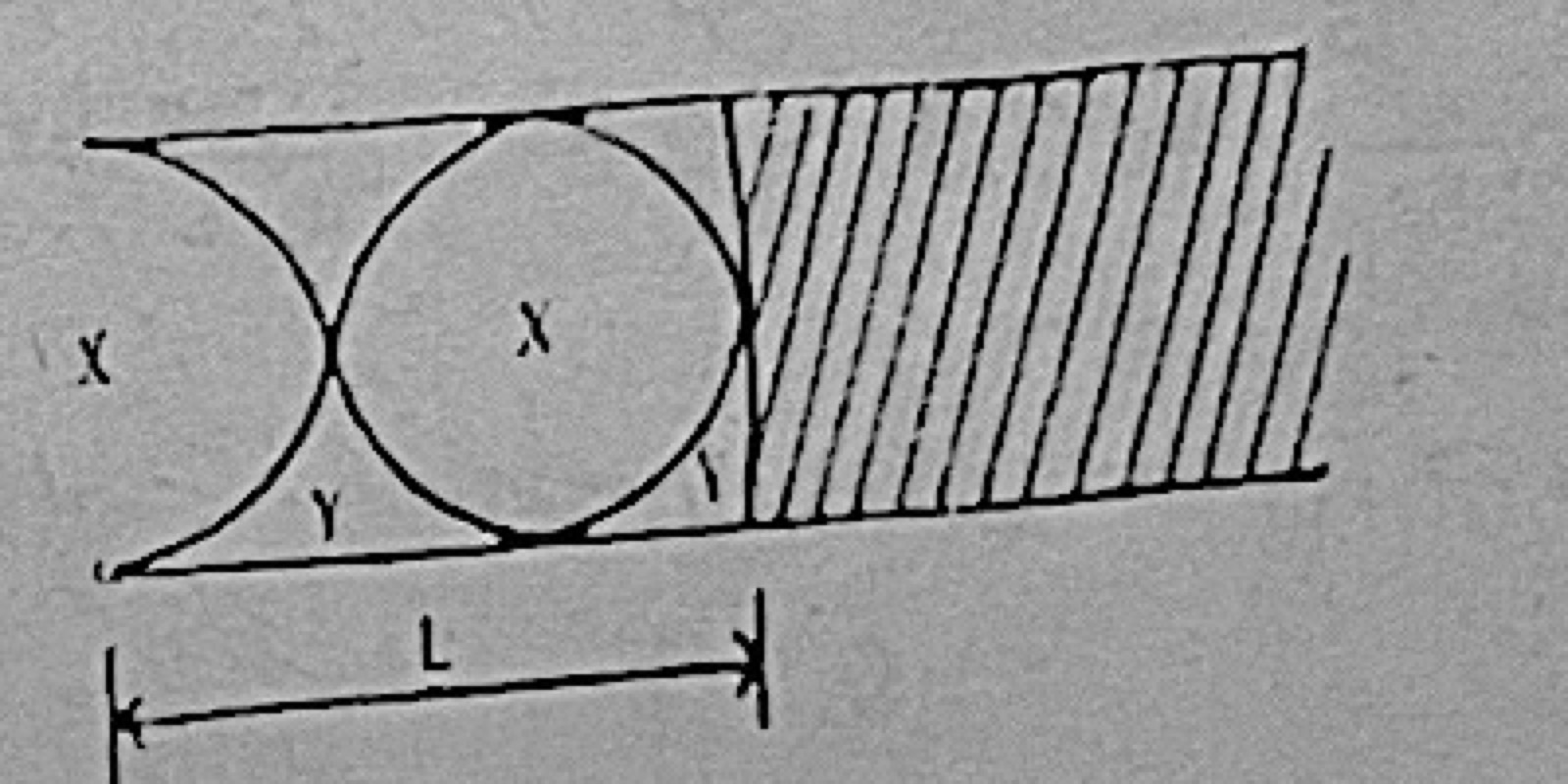
In the figure above the weight X is held in position by pulling the rope KLM in the direction LM. Which of the following diagrams shows the force acting at point L?
A.Diagram A
B.Diagram B
C.Diagram C
D.Diagram D
Show the answer and explanation
Answer: B (Diagram B)
Explanation
Three forces act at L: the weight (down), the pull along LM (horizontal) and the tension along LK (up and to the left). Drawn head to tail they close a triangle with a vertical side, a horizontal side and a slanting side, as in diagram B.
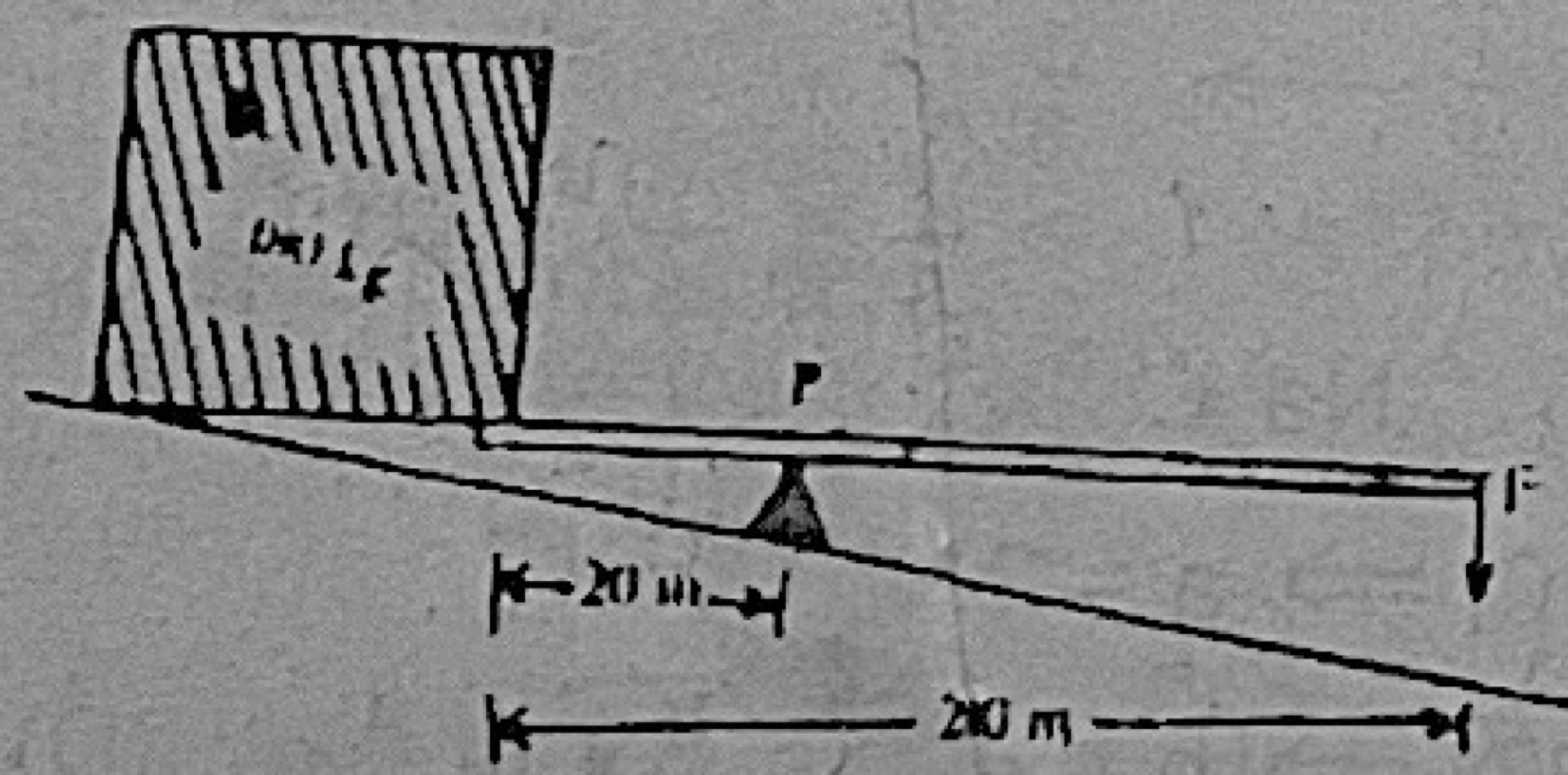
In the diagram above, a lever of length 200m is used to lift a load of mass 180kg. The pivot at P is 20m from the load. What minimum force, F, must be applied at the end of the lever? [g = 10 m s−2]
A.9 N
B.18 N
C.20 N
D.200 N
Show the answer and explanation
Answer: D (200 N)
Explanation
Take moments about P: 180 × 10 × 20 = F × 180 (the effort is 200 − 20 = 180 m from P), so F = 200 N.
An object of mass 400g and density 600 kg m−3 is suspended with a string so that half of it is immersed in paraffin of density 900 kg m−3. The tension in the string is
A.1.0 N
B.3.0 N
C.4.0 N
D.5.0 N
Show the answer and explanation
Answer: A (1.0 N)
Explanation
Volume = 0.4/600 m3; half of it displaces 900 × 0.4/1200 = 0.3 kg of paraffin, so upthrust = 3 N. Weight = 4 N, so tension = 4 − 3 = 1.0 N (g = 10 m s−2).
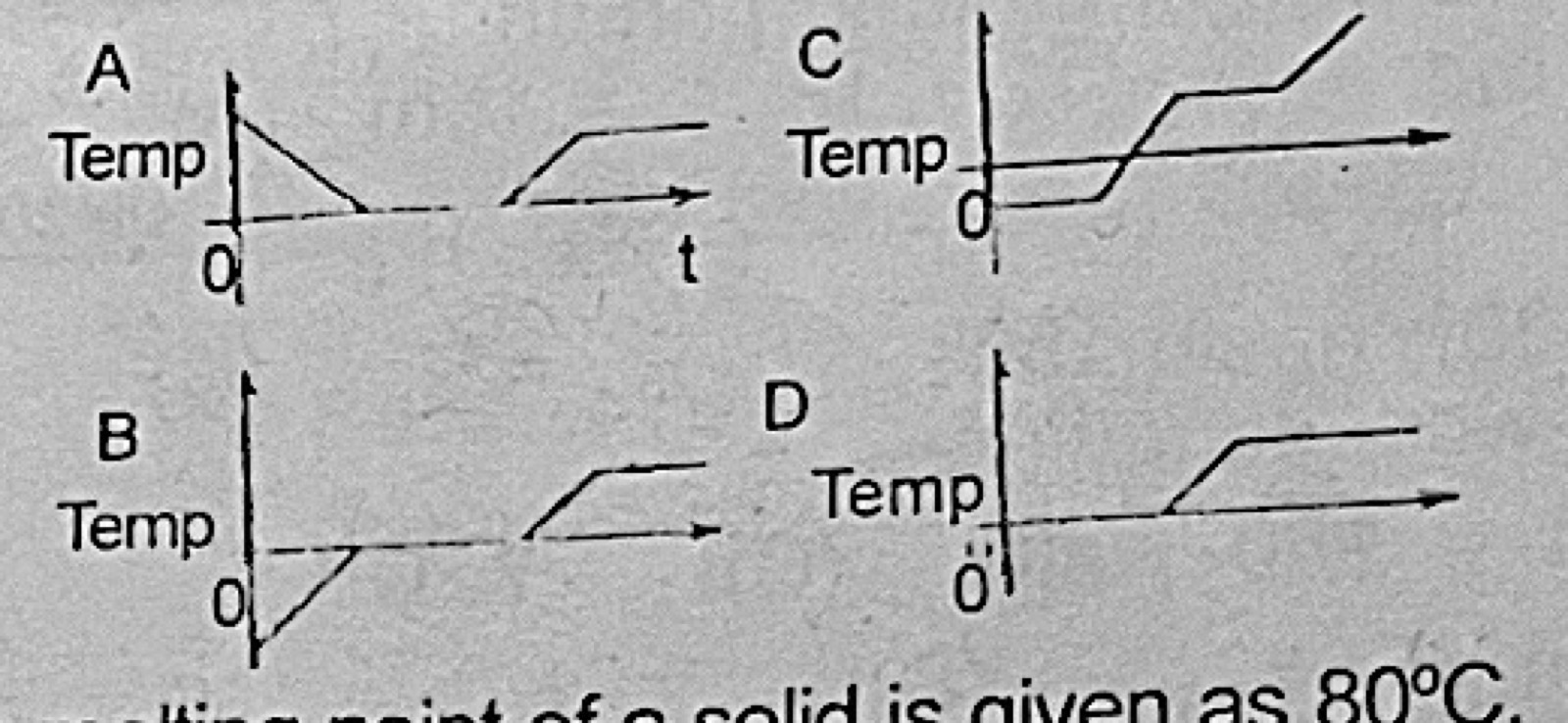
A block of ice at 0°C is put in an open vessel and heated uniformly until half the water boils off. Which of the following graphs best illustrates the change in temperature during the process?
A.Graph A
B.Graph B
C.Graph C
D.Graph D
Show the answer and explanation
Answer: D (Graph D)
Explanation
The temperature stays at 0°C while the ice melts, rises steadily as the water warms, then stays at 100°C while the water boils; graph D shows flat, rising, flat.
The melting point of a solid is given as 80°C. If 105 J of heat energy is required at this temperature to melt 10g of the solid, the specific latent heat of fusion of the solid is
Radio waves emitted from an antenna are picked up by a radar after reflection from an aircraft in 4 × 10⁻³ s. How far is the aircraft from the antenna? [c = 3 × 10⁸ m s−1]
A.6.0 × 102 km
B.1.2 × 103 km
C.3.0 × 103 km
D.6.0 × 105 km.
Show the answer and explanation
Answer: A (6.0 × 10² km)
Explanation
The waves go there and back, so distance = c × t/2 = 3 × 108 × 2 × 10−3 = 6.0 × 10⁵ m = 6.0 × 10² km.
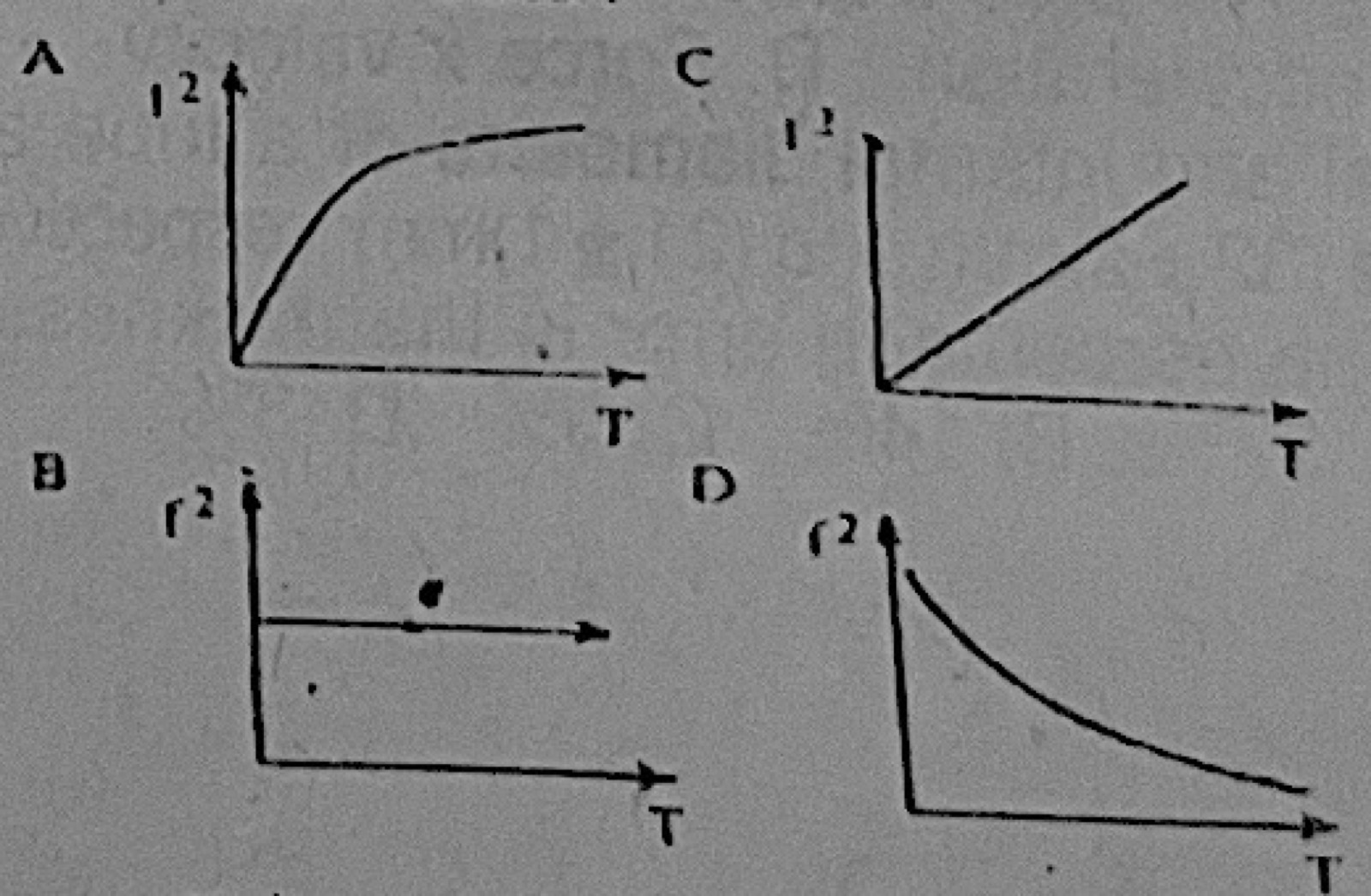
The fundamental frequency of vibration (f) of a wire is measured as a function of the tension (T) in the wire. Which of the following curves adequately represents the data?
A.Graph A
B.Graph B
C.Graph C
D.Graph D
Show the answer and explanation
Answer: C (Graph C)
Explanation
f ∝ √T, so f2 ∝ T: a graph of f2 against T is a straight line through the origin, as in graph C.
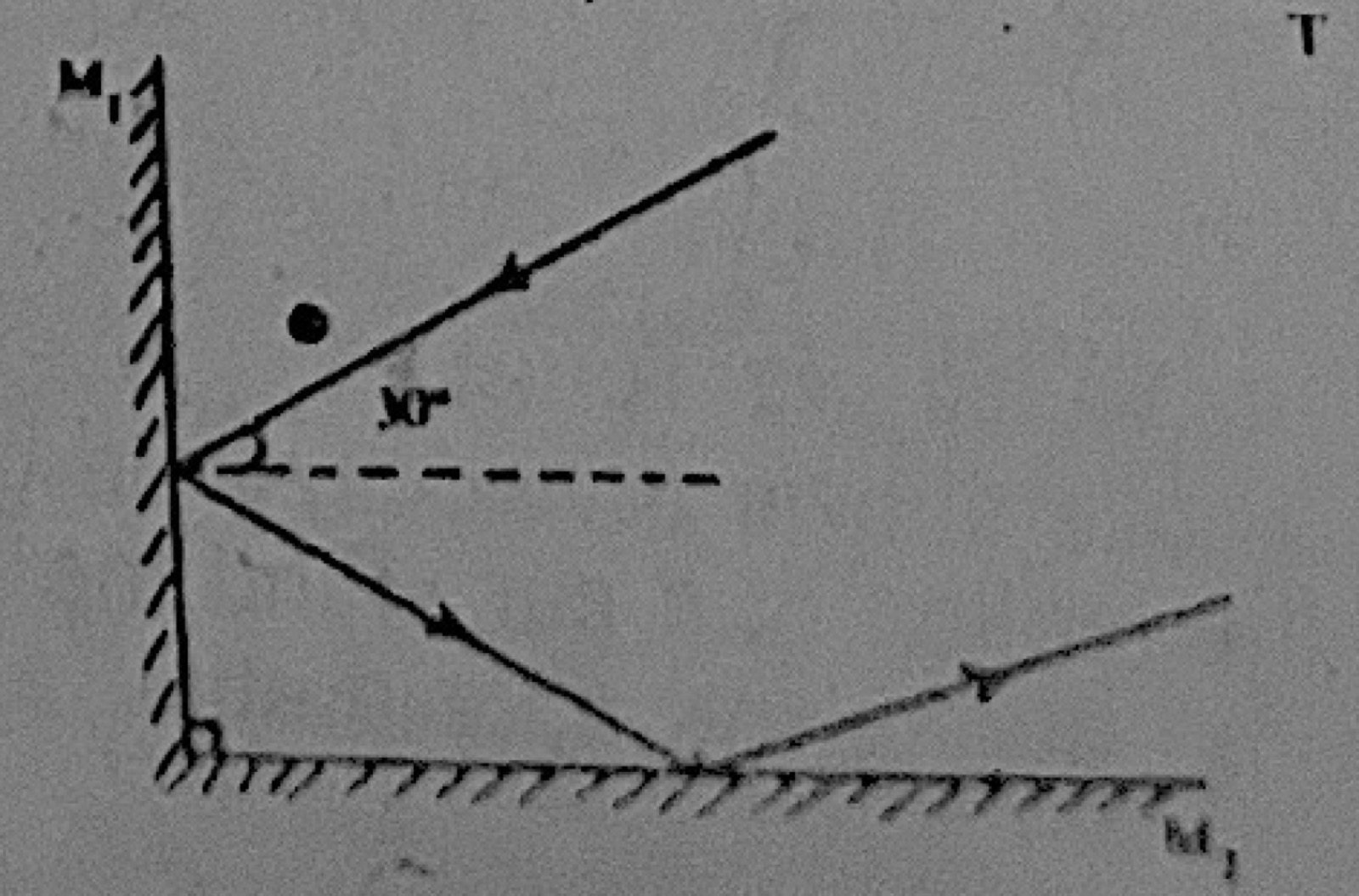
Two mirrors, M1, M2 are inclined at right angles as shown above. Calculate the angle of reflection of the ray of light at mirror M2.
A.30°
B.45°
C.60°
D.90°
Show the answer and explanation
Answer: C (60°)
Explanation
At M1 the ray meets the normal at 30° and leaves 30° below the horizontal. It then strikes the horizontal mirror M2 at 30° to its surface, i.e. 60° to its normal, so the angle of reflection is 60°.
Which of the following expressions gives the linear magnification produced by a concave mirror of radius of curvature r, if u and v are the object and image distances respectively?
A.v/r − 1
B.2v/r − 1
C.u/r − 1
D.2u/r − 1
Show the answer and explanation
Answer: B (2v/r − 1)
Explanation
m = v/u and 1/u = 1/f − 1/v, so m = v/f − 1. With f = r/2 this gives m = 2v/r − 1.
If the focal length of a camera lens is 20cm, the distance from the film at which the lens must be set to produce a sharp image of an object 100cm away is
A.17cm
B.20cm
C.25cm
D.100cm
Show the answer and explanation
Answer: C (25cm)
Explanation
1/v = 1/f − 1/u = 1/20 − 1/100 = 4/100, so v = 25 cm.
Which of the following may be used to explain a mirage? I. Layers of air near the road surface have varying refractive indices in hot weather II. Road surfaces sometimes become good reflectors in hot weather. III. Light from the sky can be reflected upwards after coming close to the road surface.
A.II only
B.II and III only
C.I and III only
D.I, II and III
Show the answer and explanation
Answer: C (I and III only)
Explanation
Hot air near the road has a lower refractive index, so light from the sky bends and is totally internally reflected upwards, looking like water. The road itself does not become a mirror.
Which of the following correctly explain(s) why a green leaf appears green in bright daylight? I. It absorbs only the green component of sunlight. II. It absorbs all colours in sunlight except green III. It reflects only the green component of sunlight.
A.I only
B.II only
C.I and III only
D.II and III only
Show the answer and explanation
Answer: D (II and III only)
Explanation
A green leaf absorbs the other colours of white light and reflects only green, which is what reaches our eyes.
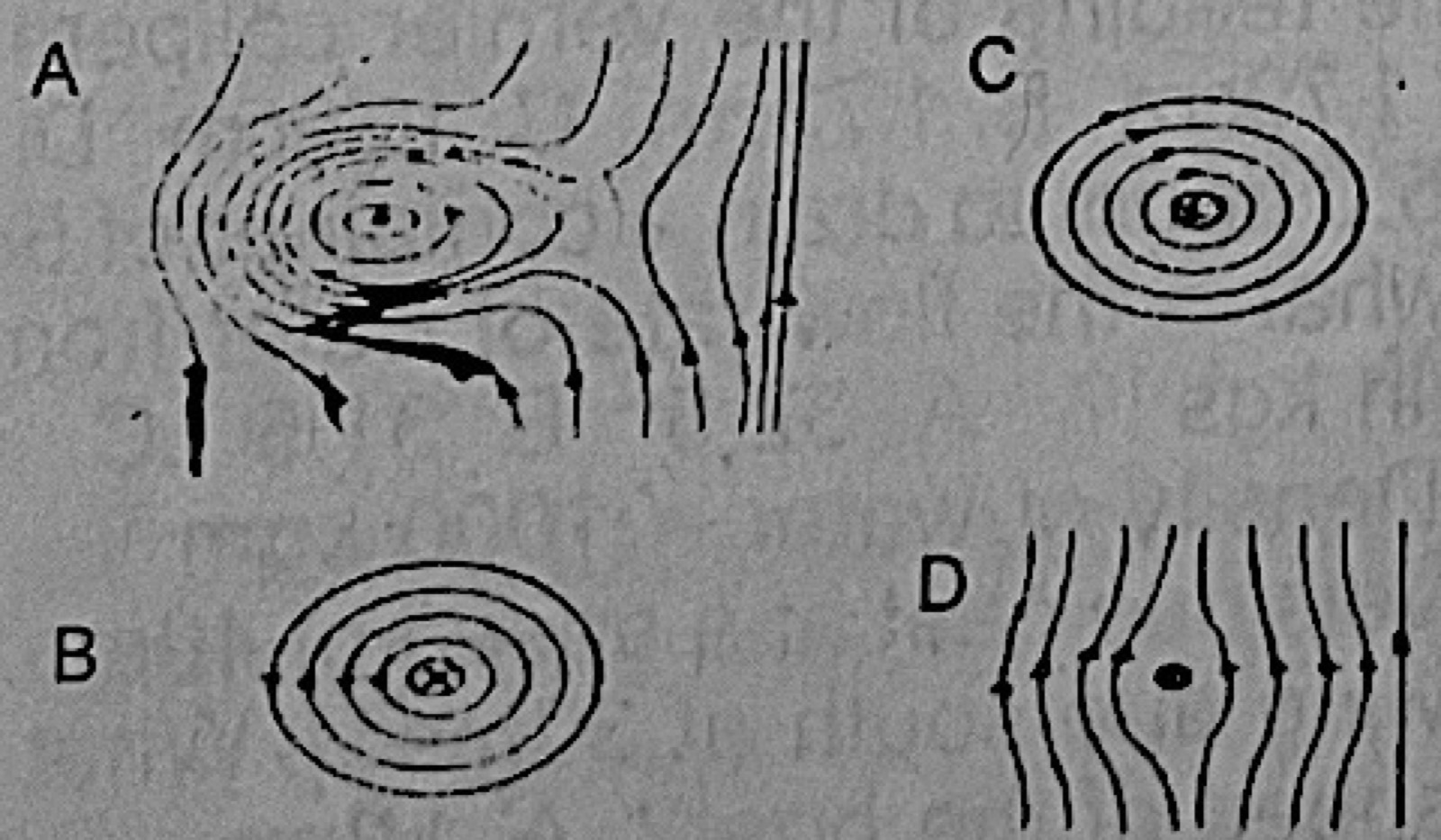
A horizontal component of the earth's magnetic field and the magnetic field of a straight wire X carries current into the plane of a paper. Which of the following figures correctly illustrates the resultant magnetic field pattern in the horizontal plane?
A.Figure A
B.Figure B
C.Figure C
D.Figure D
Show the answer and explanation
Answer: A (Figure A)
Explanation
The circular field of the wire adds to the earth's straight field on one side and cancels it on the other, giving distorted loops near the wire and a neutral point on one side, as in figure A.
Which of the following correctly explain(s) why soft iron is preferred to steel in electromagnets? I. Soft iron is more readily magnetized than steel II. Soft iron is more readily demagnetized than steel III. Soft iron retains magnetism more than steel.
A.I only
B.II and III only
C.I and II only
D.I, II and III.
Show the answer and explanation
Answer: C (I and II only)
Explanation
Soft iron magnetises strongly when the current flows and loses its magnetism when it stops, so the electromagnet can be switched on and off. Steel keeps its magnetism.
The terminal voltage of a battery is 4.0 V when supplying a current of 2.0A, and 2.0V when supplying a current of 3.0A. The internal resistance of the battery is
A.0.5Ω
B.1.0Ω
C.2.0Ω
D.4.0Ω
Show the answer and explanation
Answer: C (2.0Ω)
Explanation
E = V + Ir: E = 4 + 2r and E = 2 + 3r. Subtracting gives r = 2.0 Ω.
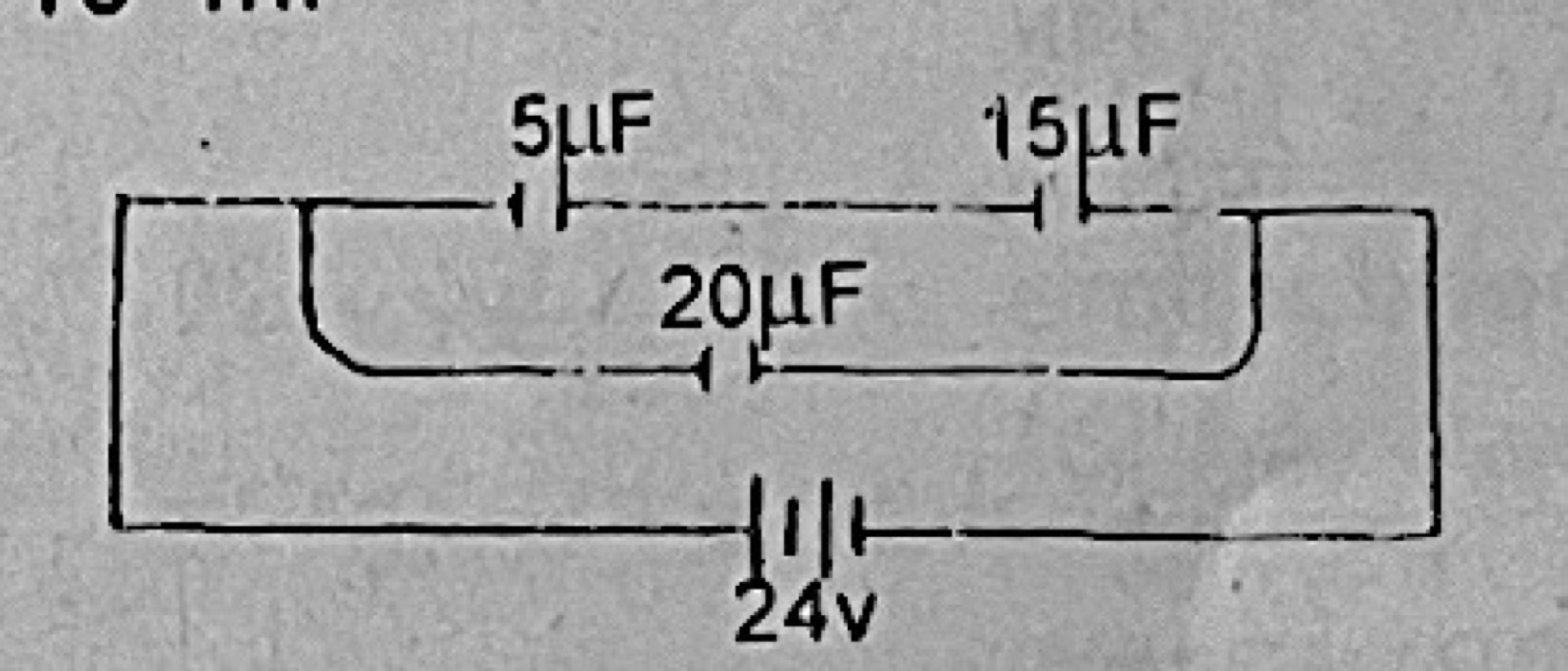
In the network shown above, determine the potential difference across the 5μF capacitor.
A.3 V
B.6 V
C.12 V
D.18 V
Show the answer and explanation
Answer: D (18 V)
Explanation
The 5 μF and 15 μF are in series across 24 V (the 20 μF is in parallel and does not affect them). Series C = 5 × 15/20 = 3.75 μF, Q = 3.75 × 24 = 90 μC, so V = 90/5 = 18 V.
Which of the following statements correctly describe(s) cathode rays? I. They consist of tiny particles carrying negative electric charges II. They are deflected in a magnetic field but not in an electric field. III. They consist of fast moving neutrons and deflected in an electric field.
A.I only
B.III only
C.I and II only
D.II and III only.
Show the answer and explanation
Answer: A (I only)
Explanation
Cathode rays are streams of fast electrons (negative particles); they are deflected by both electric and magnetic fields, and they are not neutrons.