50 questions. Try each one, then open the answer to check yourself and read the explanation.
Question 1
Density and Upthrust
The density of 400 cm3 of palm oil was 0.9 g cm−3 before frying. If the density of the oil was 0.6 g cm−3 after frying, assuming no loss of oil due to spilling, its new volume was
A.360 cm3
B.600 cm3
C.240 cm3
D.800 cm3
E.450 cm3.
Show the answer and explanation
Answer: B (600 cm3)
Explanation
The mass does not change: 0.9 × 400 = 360 g. New volume = mass ÷ new density = 360 ÷ 0.6 = 600 cm3.
Two closed vessels contain equal volumes of boiling water and are identical except that one is blackened on the outside while the other is polished. Which of the following is correct?
A.The polished vessel will cool faster because a polished surface is a good radiator
B.The polished vessel will cool faster because it will absorb less heat from the room
C.The black vessel will cool faster because it is a better conductor of heat
D.The polished vessel will cool faster because it reflects heat better
E.The black vessel will cool faster because a black surface radiates heat faster than a polished one.
Show the answer and explanation
Answer: E (The black vessel will cool faster because a black surface radiates heat faster than a polished one.)
Explanation
Dull black surfaces are good emitters of radiant heat, while polished surfaces are poor emitters. So the blackened vessel loses heat faster.
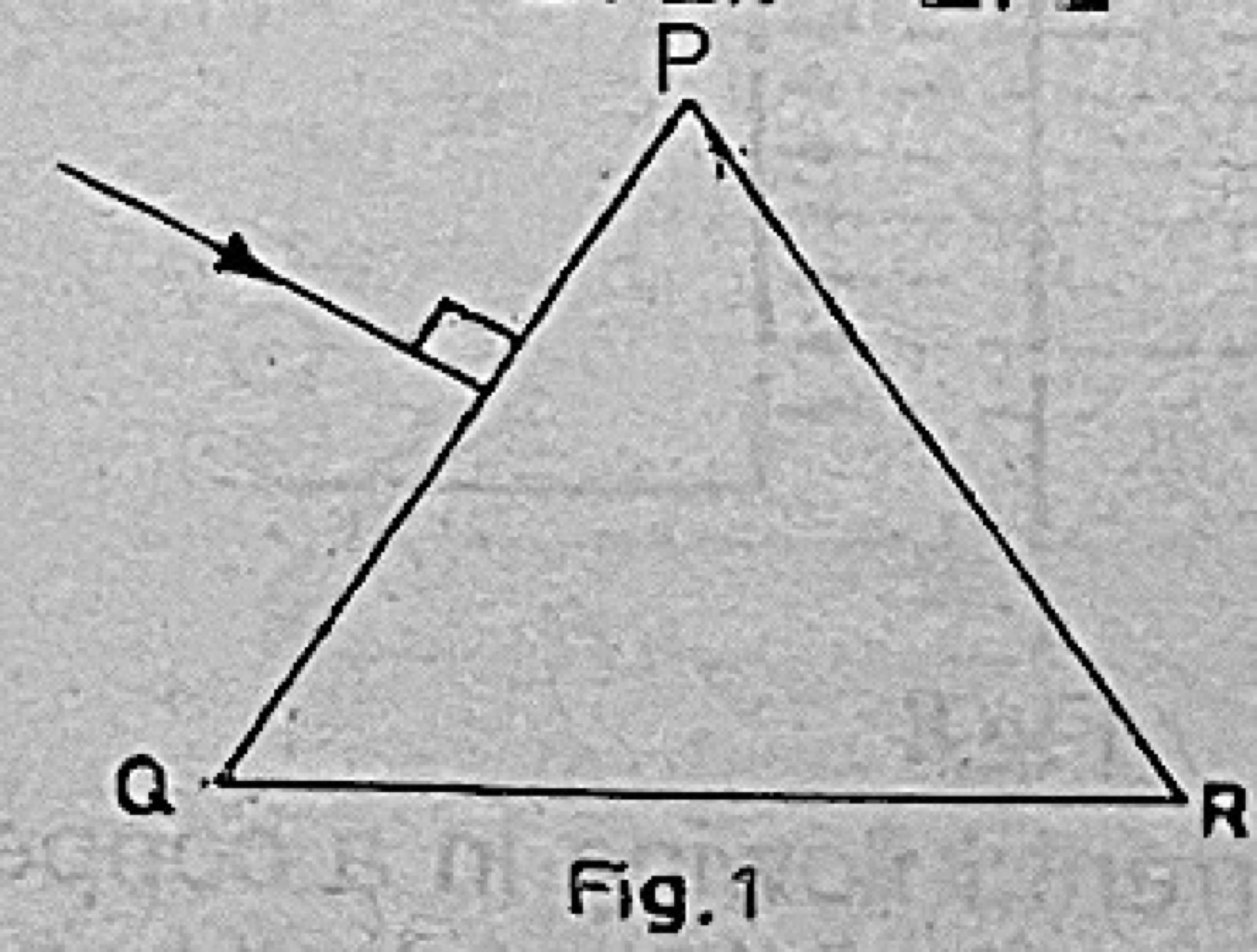
PQR is an equilateral glass prism of refractive index 1.5. Light incident normally on face PQ as shown in Fig. 1 will
A.undergo total internal reflection at face PR and then emerge normal to the face QR
B.emerge on face PR
C.undergo total internal reflection at face PR and emerge deflected away from the normal on face QR
D.undergo two successive total internal reflections and emerge at face PQ
E.be completely reflected back along its path.
Show the answer and explanation
Answer: A (undergo total internal reflection at face PR and then emerge normal to the face QR)
Explanation
The ray enters PQ without bending and meets PR at 60°, which is more than the critical angle (about 42° for n = 1.5), so it is totally reflected. In an equilateral prism the reflected ray then meets QR along the normal and leaves without bending.
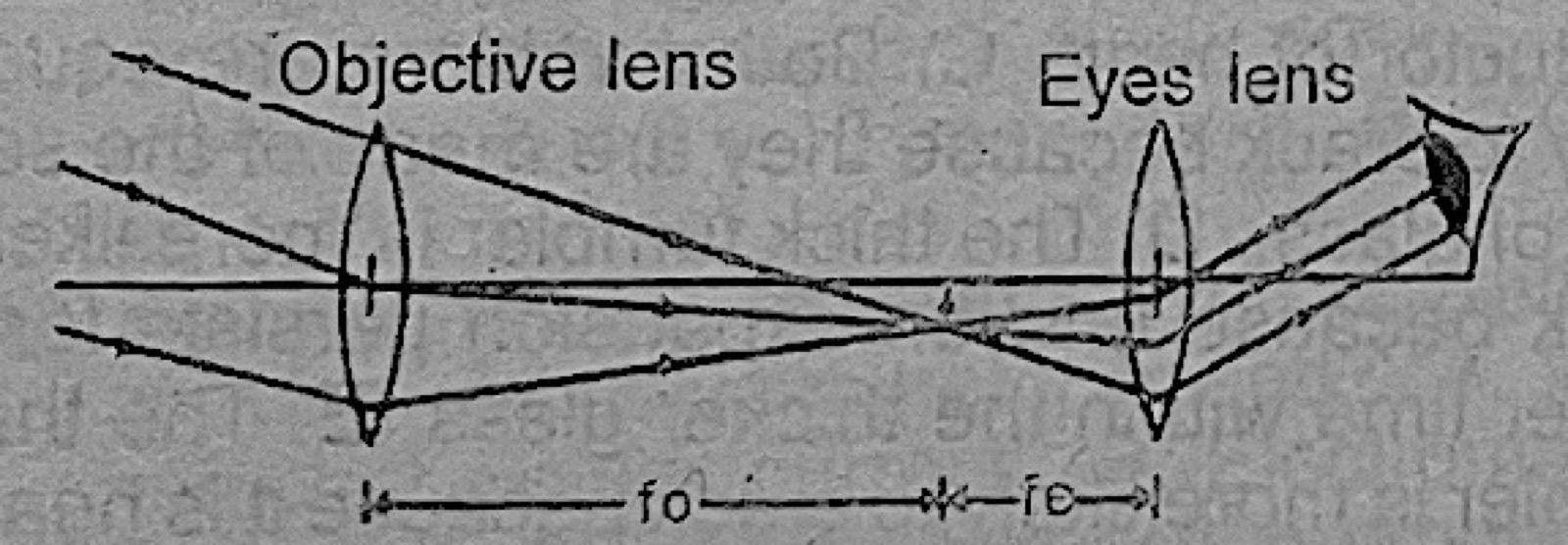
The diagram in Fig. 2 shows the lens arrangement in
A.a compound microscope
B.an astronomical telescope
C.a binocular
D.a periscope
E.a projection lantern.
Show the answer and explanation
Answer: B (an astronomical telescope)
Explanation
Two converging lenses separated by fo + fe, with parallel rays from a distant object entering the objective, is the arrangement of an astronomical telescope in normal adjustment.
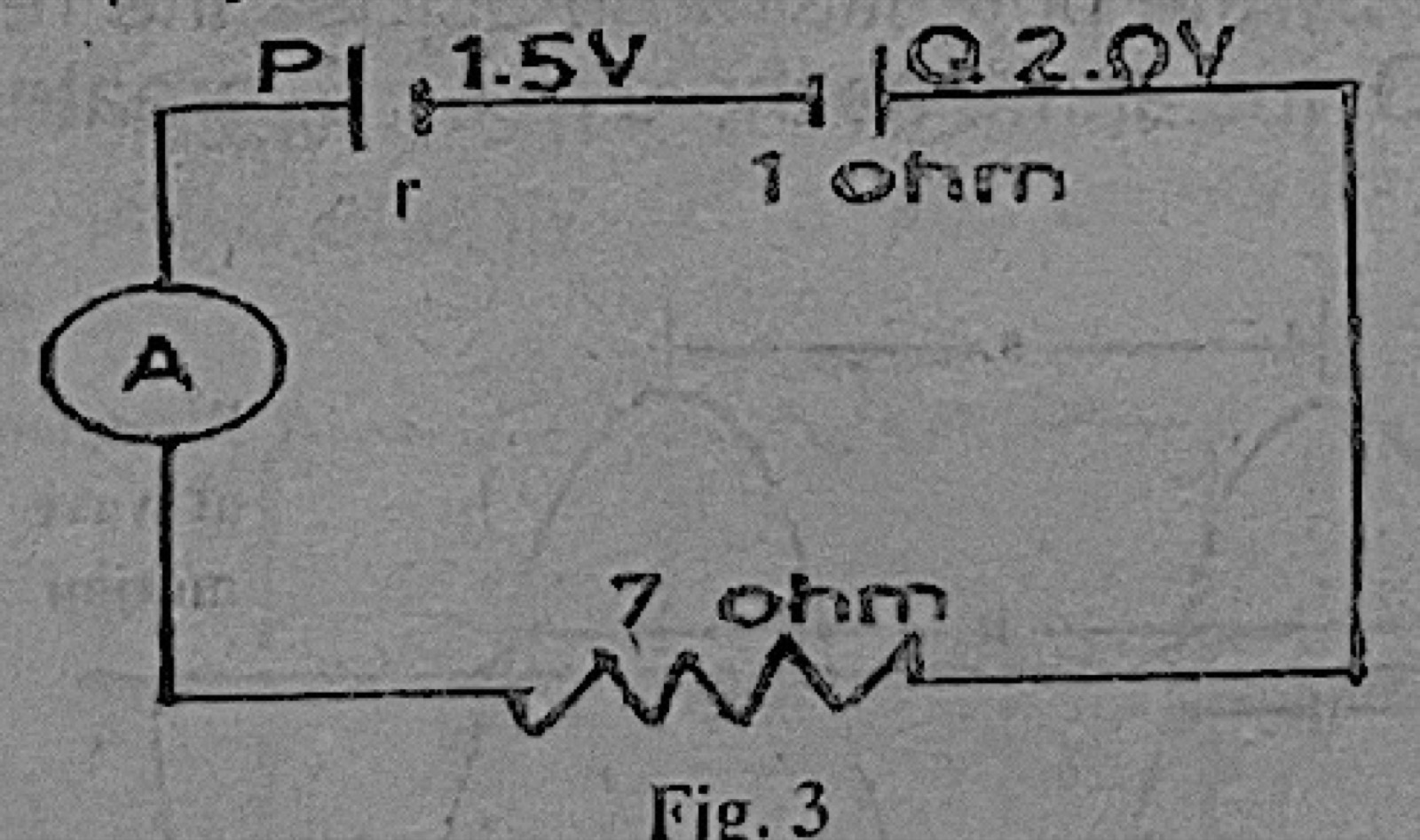
In the given circuit of Fig. 3 the cell P has an e.m.f. 1.5 V and an unknown internal resistance r while the cell Q has an e.m.f. 2.0 V and an internal resistance 1 ohm. If the ammeter reads 50 mA, then r is equal to
A.0.5 ohm
B.0.62 ohm
C.1.0 ohm
D.2.0 ohms
E.3.0 ohms.
Show the answer and explanation
Answer: D (2.0 ohms)
Explanation
The cells oppose each other, so the net e.m.f. is 2.0 − 1.5 = 0.5 V. Then 0.5 = 0.05 × (7 + 1 + r), so 7 + 1 + r = 10 and r = 2 Ω.
The heights of the mercury thread in a mercury-in-glass thermometer when in melting ice and then in steam are 3 cm and 18 cm respectively. At a temperature of 60°C the height would be
A.7.5 cm
B.9 cm
C.10.8 cm
D.12 cm
E.12.6 cm
Show the answer and explanation
Answer: D (12 cm)
Explanation
The 100 degrees span 18 − 3 = 15 cm. At 60°C the thread is 60% of the way up: 3 + 0.6 × 15 = 12 cm.
Which of the following statements is incorrect? The sensitivity of a galvanometer which incorporates an optical lever arrangement may be increased by providing:
A.a larger number of turns in the coil
B.a thinner suspension with a small torsional control
C.a special alloy permanent magnet which gives a high magnetic flux
D.all of the above
E.a light source with a greater intensity.
Show the answer and explanation
Answer: E (a light source with a greater intensity.)
Explanation
More turns, a weaker (thinner) suspension and a stronger magnet all give a bigger deflection per unit current, so A to C are correct. A brighter lamp only makes the spot easier to see; it does not change the deflection, so E is the incorrect statement.
A landlord has eight 40 W electric light bulbs, four 60 W bulbs and two 100 W bulbs in his house. If he has all the points on for five hours daily and if N.E.P.A. charges 5k per unit, his bill for 30 days is
A.N5.70
B.N7.23
C.N3.65
D.N8.05
E.N4.50
Show the answer and explanation
Answer: A (N5.70)
Explanation
Total power = 320 + 240 + 200 = 760 W = 0.76 kW. Energy = 0.76 × 5 × 30 = 114 kWh. Cost = 114 × 5k = 570k = N5.70.
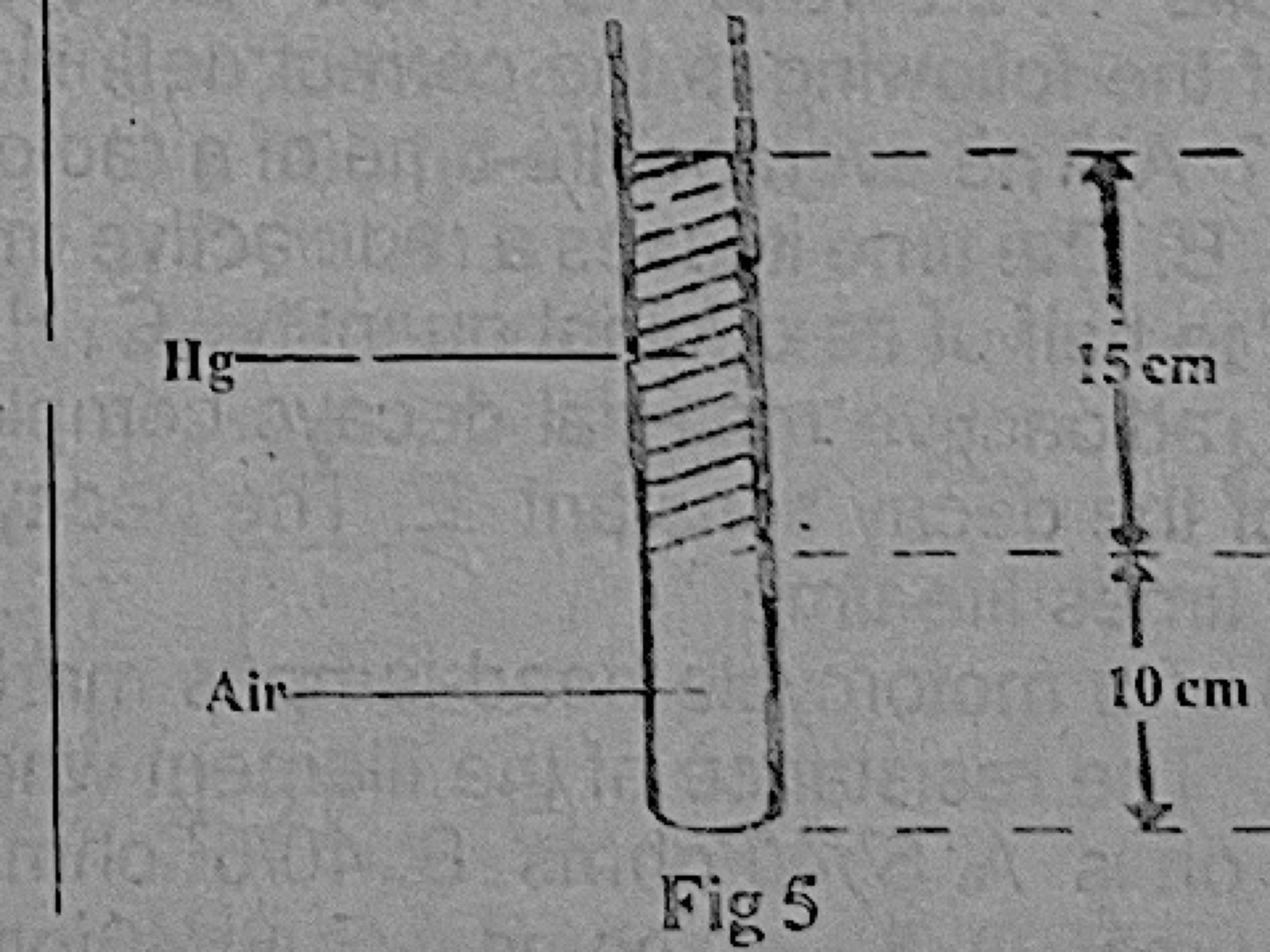
An air column 10 cm in length is trapped into the sealed end of a capillary tube by a 15 cm column of mercury with the tube held vertically as shown in Fig. 5. On inverting the tube, the air column becomes 15 cm long. The atmospheric pressure during the experiment is
A.90 cm
B.76 cm
C.75 cm
D.60 cm
E.50 cm
Show the answer and explanation
Answer: C (75 cm)
Explanation
With the open end up the air is at (H + 15) cmHg; inverted it is at (H − 15). Boyle's law: (H + 15) × 10 = (H − 15) × 15, so 5H = 375 and H = 75 cmHg.
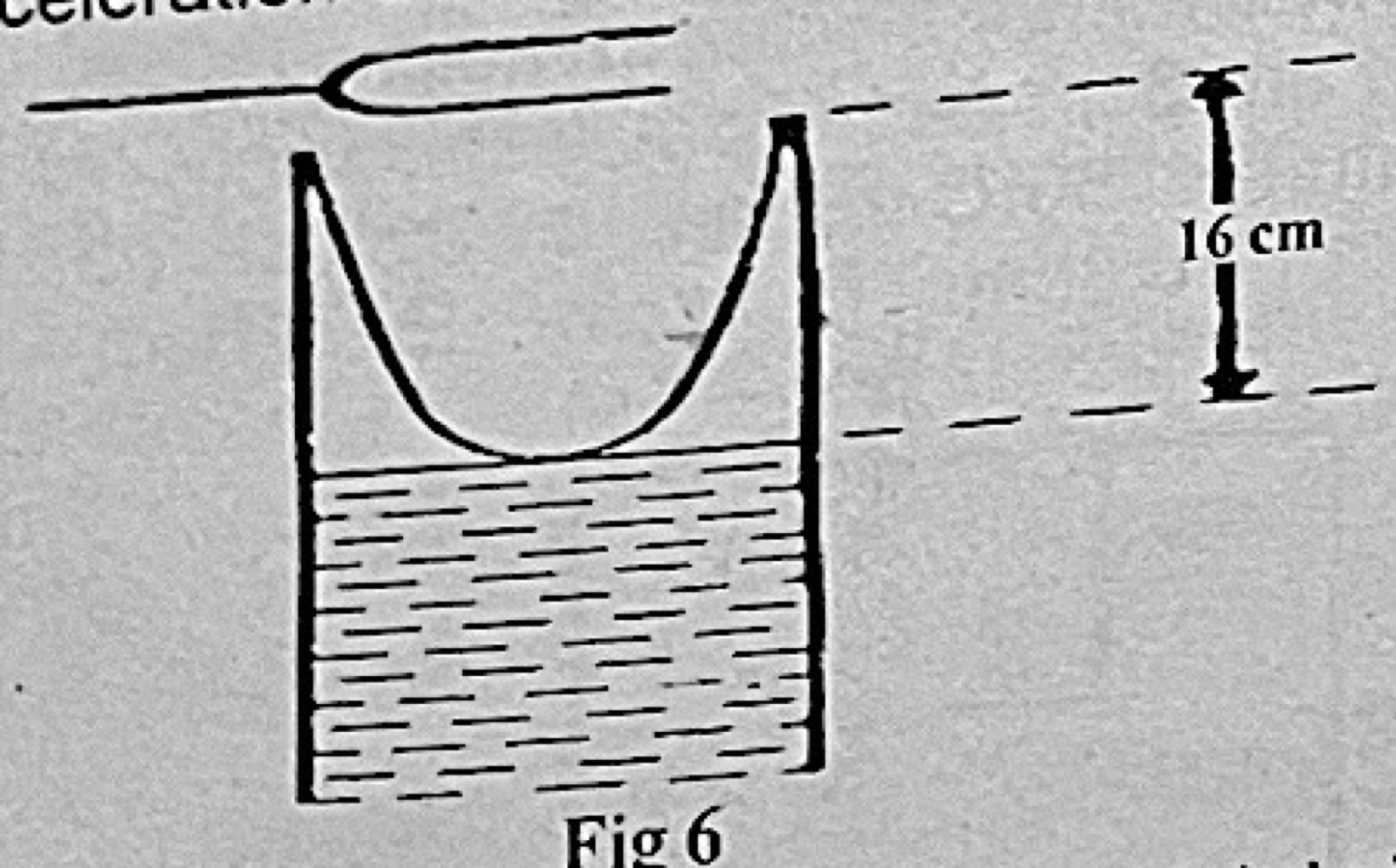
In a resonance tube experiment which is illustrated in Fig. 6, the velocity of sound in air is 327.68 m/s, the frequency of the tuning fork used is therefore
A.128 Hz
B.256 Hz
C.512 Hz
D.768 Hz
E.1024 Hz
Show the answer and explanation
Answer: C (512 Hz)
Explanation
At the first resonance the 16 cm air column is a quarter wavelength, so λ = 64 cm = 0.64 m. f = v/λ = 327.68/0.64 = 512 Hz.
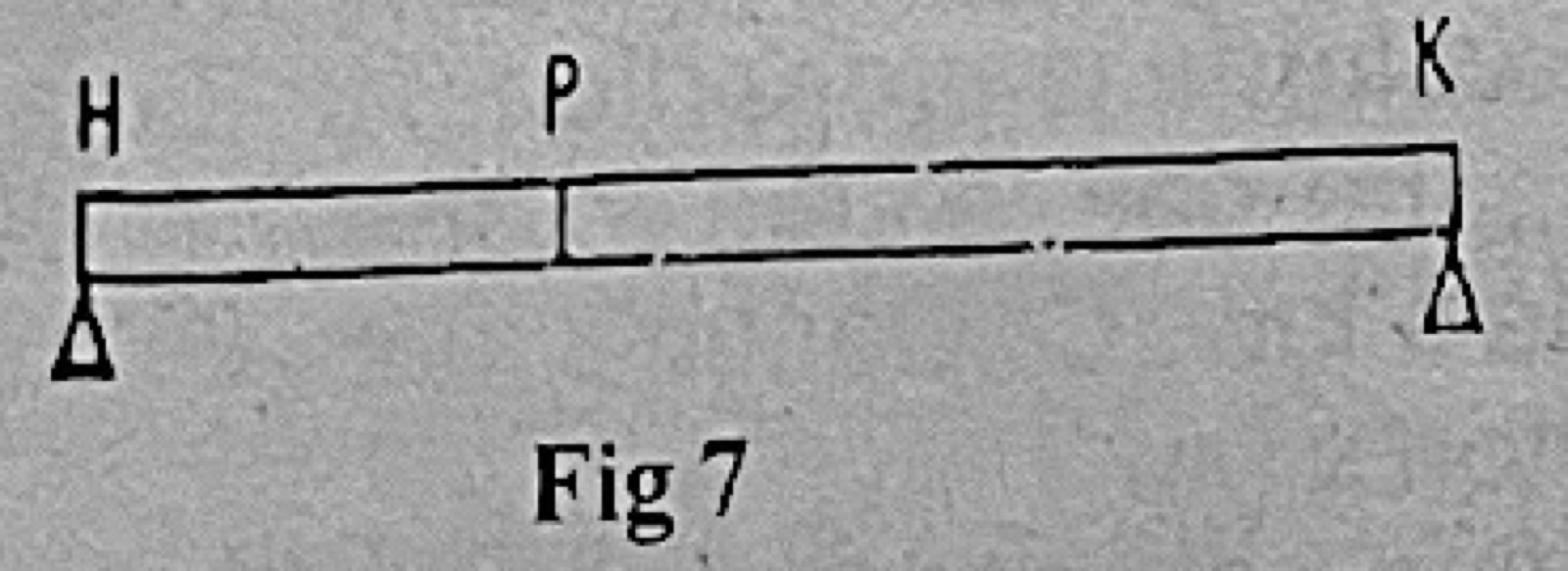
A uniform beam HK of length 10 m and weighing 200 N is supported at both ends as shown in Fig. 7. A man weighing 1000 N stands at a point P on the beam. If the reactions at H and K are respectively 800 N and 400 N, then the distance HP is
A.4 m
B.3⅓ m
C.3 m
D.6⅔ m
E.7 m
Show the answer and explanation
Answer: C (3 m)
Explanation
Take moments about H: 1000 × HP + 200 × 5 = 400 × 10. So 1000 × HP = 3000 and HP = 3 m.
Which of the following statements is correct? The magnetized state of an iron bar can be destroyed completely by
A.heating the bar to a high temperature
B.breaking the bar
C.connecting opposite poles with a small piece of iron
D.placing the bar inside a strong magnetic field
E.none of the above.
Show the answer and explanation
Answer: A (heating the bar to a high temperature)
Explanation
Strong heating makes the atoms vibrate violently and throws the magnetic domains out of line, destroying the magnetism. Breaking the bar just makes smaller magnets.
An electric cell has an internal resistance of 2 ohms. A current of 0.5 A is found to flow when a resistor of 5 ohms resistance is connected across it. What is the electromotive force of the cell?
In an electrolysis experiment, a cathode of mass 5 g is found to weigh 5.01 g after a current of 5 A flows for 50 seconds. What is the electrochemical equivalent of the deposited substance?
A.0.00004 g/C
B.0.00002 g/C
C.0.02500 g/C
D.0.05000 g/C
E.0.00001 g/C.
Show the answer and explanation
Answer: A (0.00004 g/C)
Explanation
Mass deposited m = zIt. Here m = 0.01 g and It = 5 × 50 = 250 C, so z = 0.01/250 = 0.00004 g/C.
Which of the following statements about radioactivity are true? (i) Alpha particle is positively charged (ii) Beta particle is negatively charged (iii) Gamma ray is neutral (iv) Beta particle has the same mass as helium atom (v) Gamma ray is charged.
A.i, ii, iii, iv only
B.iv and v only
C.i, ii and iii only
D.i, ii and v only
E.All
Show the answer and explanation
Answer: C (i, ii and iii only)
Explanation
Alpha particles are positive, beta particles (electrons) are negative and gamma rays have no charge. A beta particle is far lighter than a helium atom, and gamma rays are not charged.
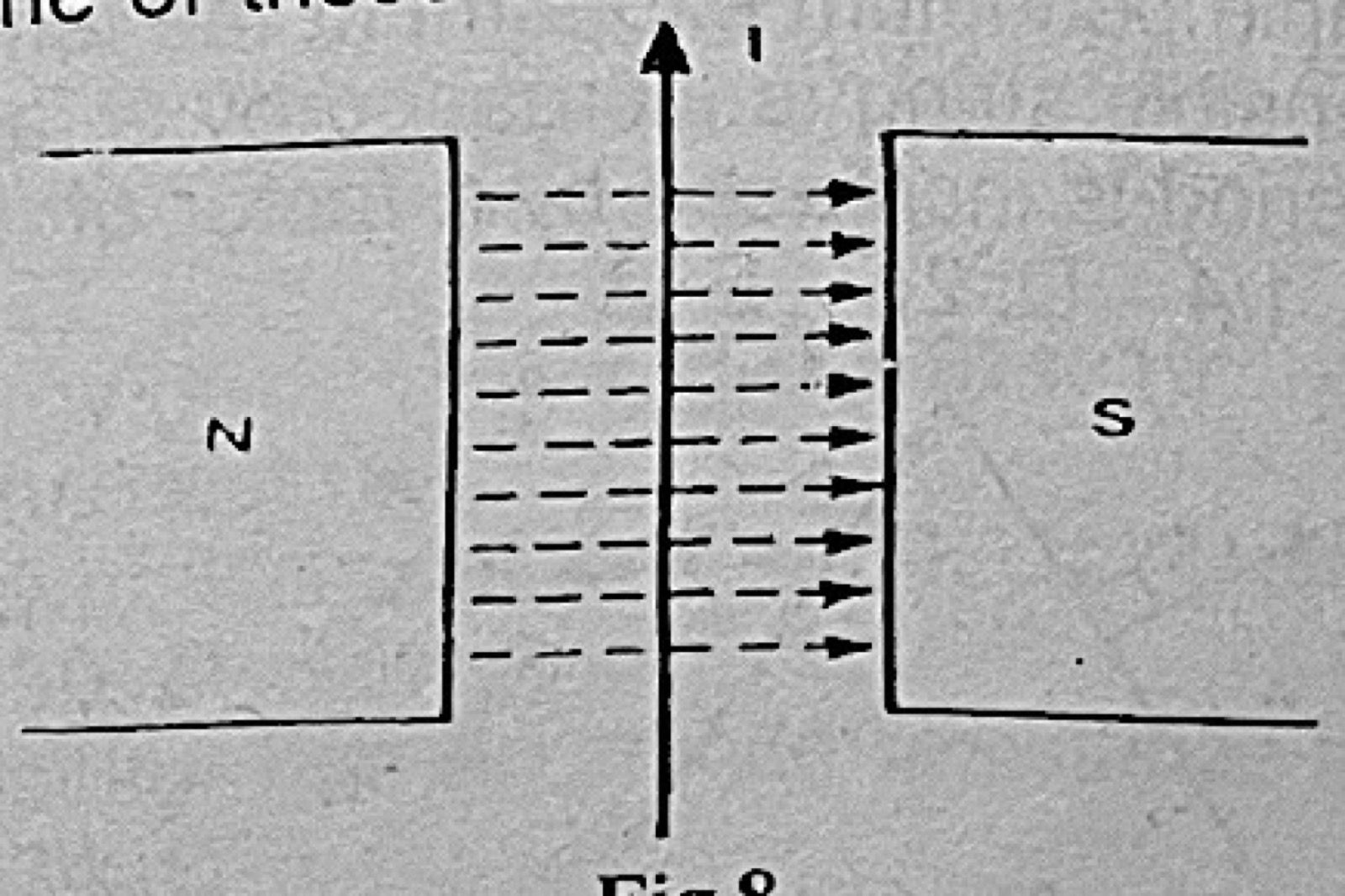
Fig. 8 shows a current I flowing in a copper wire situated in the magnetic field existing between the pole-pieces of a horse-shoe magnet. Which of the following statements is correct?
A.The wire will experience a force in the direction into the paper.
B.The wire will experience a force in the direction out of the paper
C.The wire will vibrate in the direction into and out of the paper
D.The wire will move in the direction of the field, i.e. towards the S-pole
E.The wire will not move because it is made of copper which is non-magnetic.
Show the answer and explanation
Answer: A (The wire will experience a force in the direction into the paper.)
Explanation
The field runs from N to S (left to right) and the current runs up the page. By Fleming's left-hand rule the force is perpendicular to both, into the paper.
Consider a thick glass tumbler and a thin glass tumbler which are made of the same kind of glass. Some hot liquid is poured into them. Which of the following statements is correct?
A.The thick tumbler is less likely to crack because it is stronger
B.The thick tumbler is less likely to crack because it insulates the heat better, glass being a poor conductor of heat.
C.Both tumblers are equally likely to crack because they are made of the same kind of glass.
D.The thick tumbler is more likely to crack because uneven expansion persists for a longer time within the thicker glass
E.The thick tumbler is more likely to crack because it is heavier.
Show the answer and explanation
Answer: D (The thick tumbler is more likely to crack because uneven expansion persists for a longer time within the thicker glass)
Explanation
Glass conducts heat poorly, so in thick glass the inside surface expands while the outside stays cool. This uneven expansion sets up strains that crack it; thin glass warms through quickly and evenly.
A capacitor and a resistor are connected in series with each other and in series with an accumulator of negligible internal resistance. The potential difference across the terminals of the capacitor is
A.twice the e.m.f. of the accumulator
B.less than the e.m.f. by the potential drop across the resistor
C.zero
D.the same as the e.m.f.
E.greater than the e.m.f.
Show the answer and explanation
Answer: D (the same as the e.m.f.)
Explanation
Once the capacitor is fully charged no current flows, so there is no p.d. across the resistor and the capacitor's p.d. equals the e.m.f.
An air bubble rises from the bottom to the top of a water dam which is 40 m deep. The volume of the bubble just below the surface is 2.5 cm3. Find its volume at the bottom of the dam, if atmospheric pressure is equivalent to 10 m of water.
A.10.0 cm3
B.2.0 cm3
C.1.6 cm3
D.0.625 cm3
E.0.5 cm3
Show the answer and explanation
Answer: E (0.5 cm3)
Explanation
Pressure at the surface = 10 m of water; at the bottom = 10 + 40 = 50 m. Boyle's law: 10 × 2.5 = 50 × V, so V = 0.5 cm3.
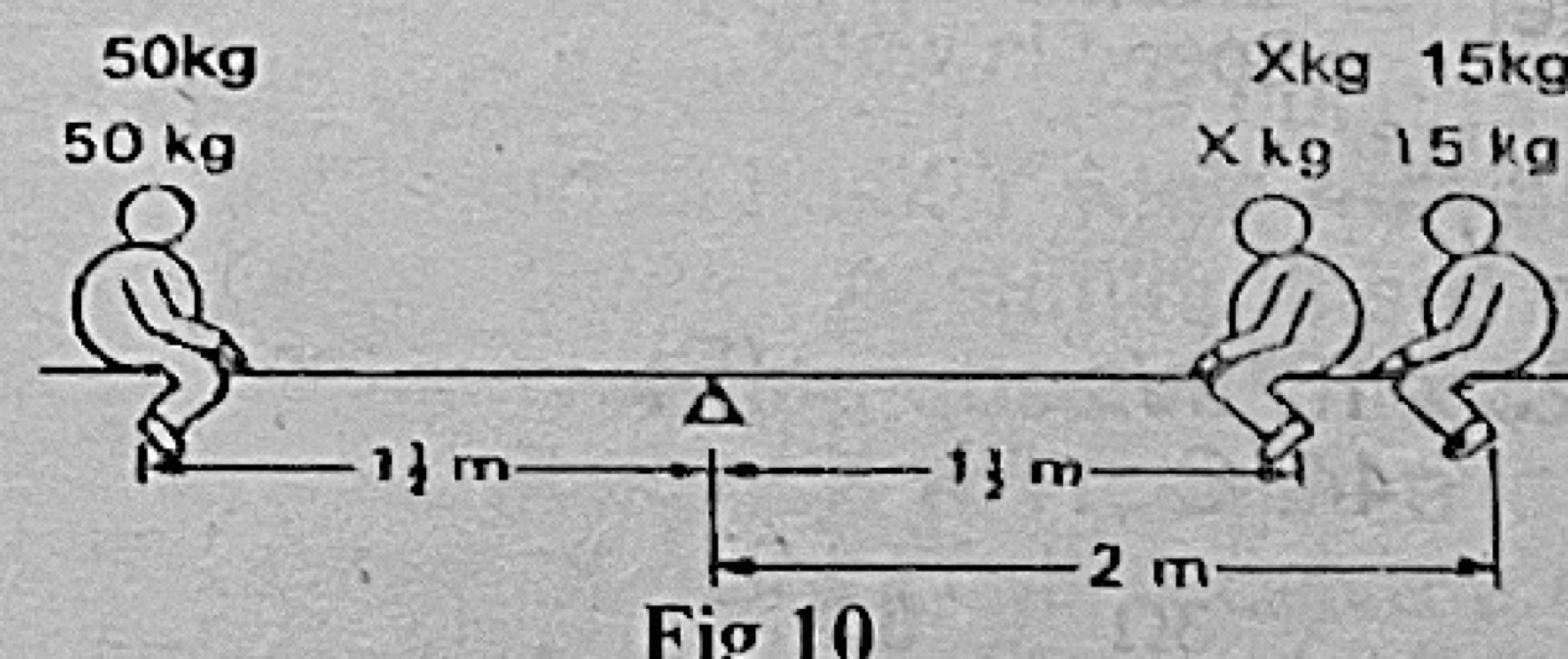
Fig. 10 shows a see-saw which is exactly in balance. The weights of the people sitting on it are 50 kg, X kg and 15 kg as shown. They sit at distances of 1½ m, 1½ m and 2 m from the pivot respectively. The value of X is
A.30
B.35
C.70
D.26¼
E.impossible to find.
Show the answer and explanation
Answer: A (30)
Explanation
Clockwise and anticlockwise moments are equal: 50 × 1.5 = X × 1.5 + 15 × 2, so 75 = 1.5X + 30 and X = 30.
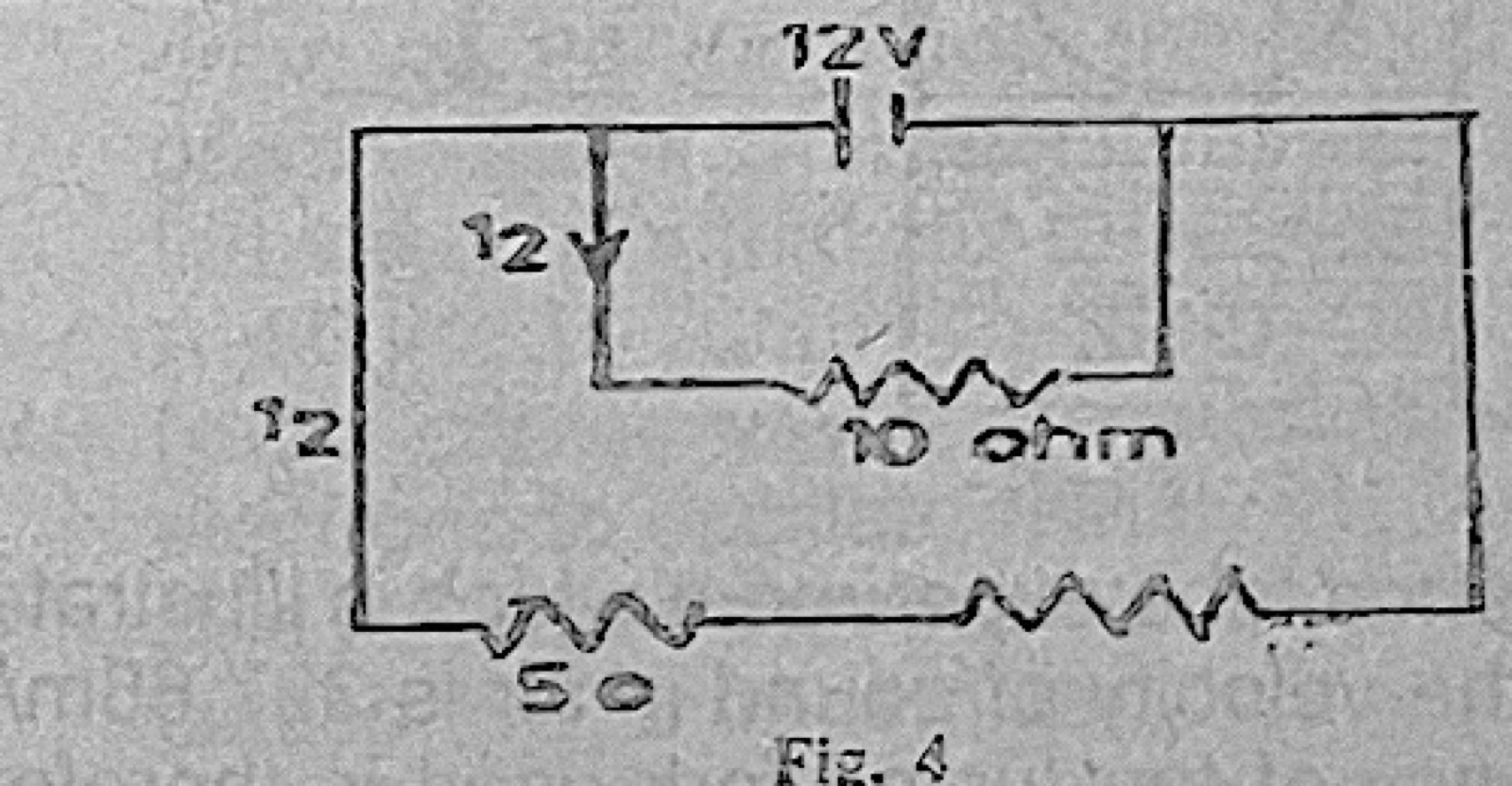
All the heat generated in a 5 ohm resistor by 2 A flowing for 30 seconds is used to evaporate 5 g of a liquid at its boiling point. Which of the following is the correct value of the specific latent heat of the liquid?
The speed of light in air is 3 × 10⁸ m s−1. If the refractive index of light from air-to-water is 4/3, then which of the following is the correct value of the speed of light in water?
A.4 × 108 m s−1
B.2.25 × 108 m s−1
C.4/9 × 10−8 m s−1
D.2.25 × 108 m s−2
E.4.33 × 108 m s−1.
Show the answer and explanation
Answer: B (2.25 × 10⁸ m s−1)
Explanation
Refractive index = speed in air ÷ speed in water, so speed in water = 3 × 10⁸ ÷ (4/3) = 2.25 × 10⁸ m s−1. Option D has the wrong unit.
A body is released from rest and allowed to fall freely from a given height under gravity. The kinetic energy at its half-way point is
A.a little above half of its initial energy
B.a little below half of its initial energy
C.a half of its initial energy
D.a little above its initial energy
E.a little below its initial energy.
Show the answer and explanation
Answer: C (a half of its initial energy)
Explanation
In free fall the potential energy lost turns into kinetic energy. Halfway down it has lost half its initial (potential) energy, so its KE is half the initial energy.
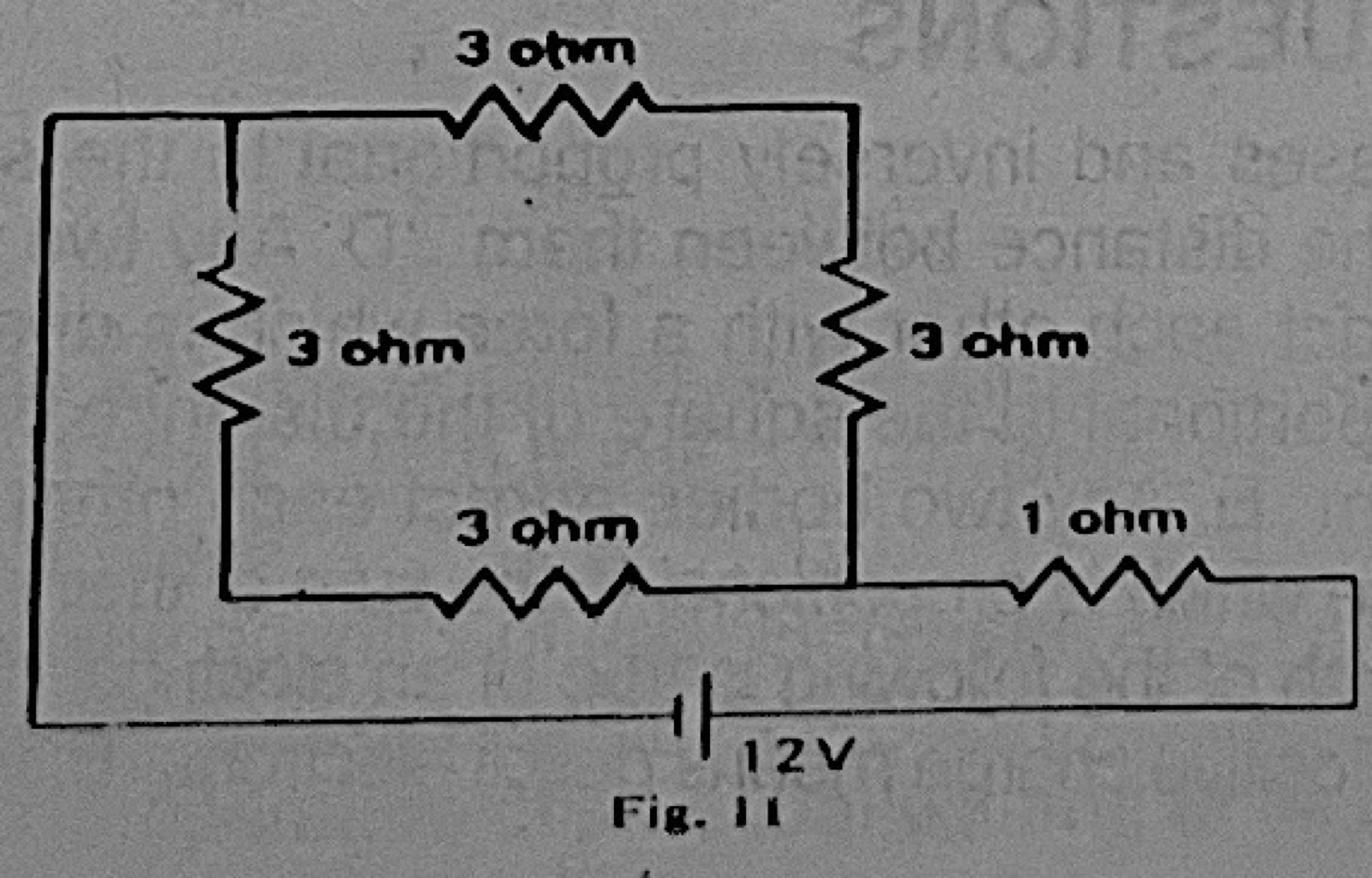
An electrical circuit of Fig. 11 is connected up as shown; which of the following is the correct value of the current through the 1 ohm resistance?
A.12/13 A
B.13/12 A
C.1/3 A
D.3 A
E.12/7 A
Show the answer and explanation
Answer: D (3 A)
Explanation
There are two 6 Ω paths (3 Ω + 3 Ω each) in parallel, giving 3 Ω, in series with the 1 Ω resistor: total 4 Ω. All the current passes through the 1 Ω resistor: I = 12/4 = 3 A.
A weight of 1000 grams hangs from a lever 20 cm to the right of the fulcrum. At the left is a 500-gram weight 20 cm from the fulcrum, and a 200-gram weight x cm away from the fulcrum. What is the value of x that will make the lever balanced?
A.50 cm
B.20 cm
C.10 cm
D.30 cm
E.70 cm.
Show the answer and explanation
Answer: A (50 cm)
Explanation
Moments about the fulcrum: 500 × 20 + 200 × x = 1000 × 20, so 200x = 10 000 and x = 50 cm.
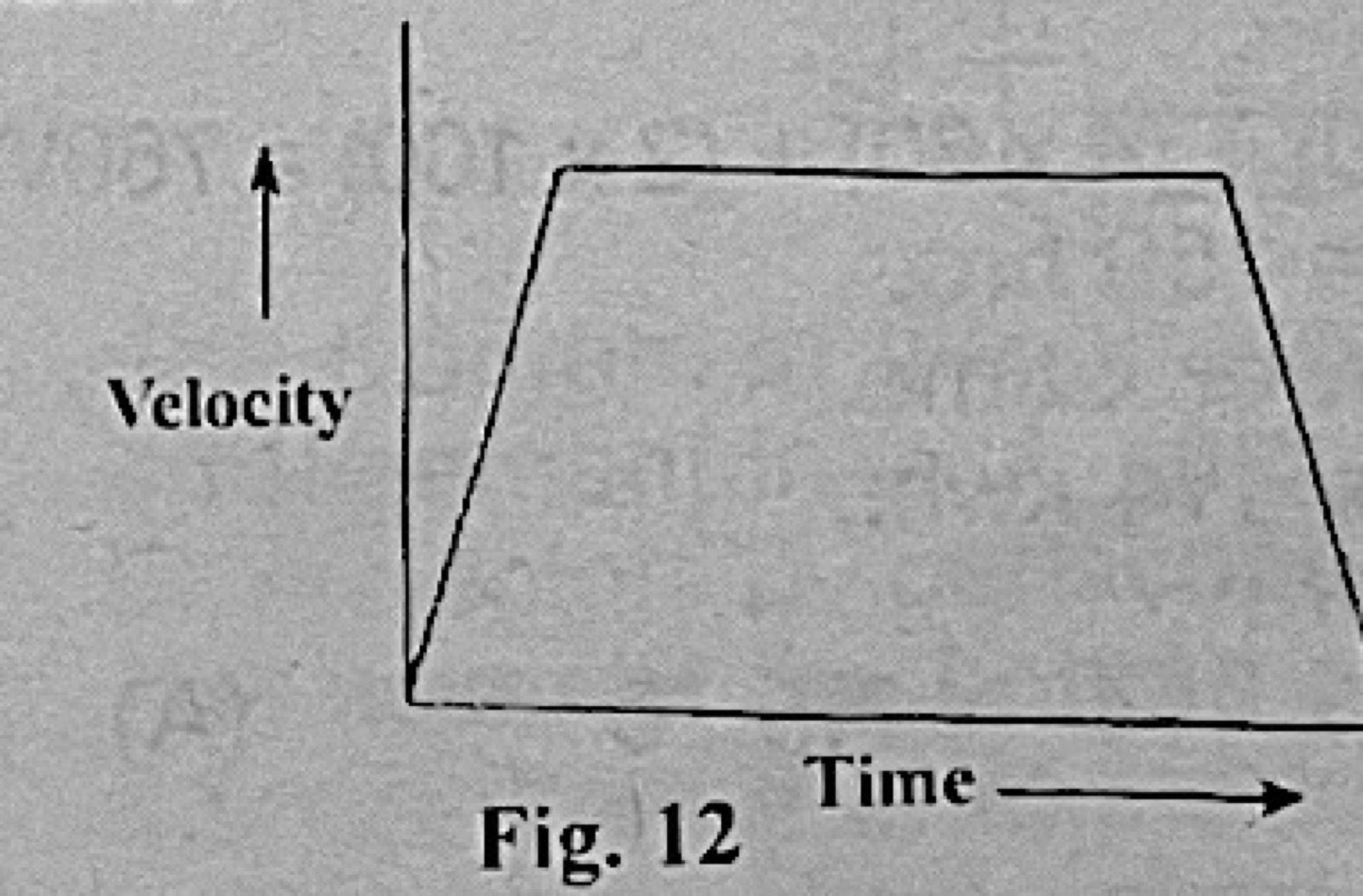
Fig. 12 shows the velocity-time graph of a car which starts from rest and is accelerated uniformly at the rate of 3 m sec−2 for 5 seconds. It attains a velocity which is maintained for 1 minute. The car is then brought to rest by a uniform retardation after another 3 seconds. Calculate the total distance covered.
A.900 metres
B.1920 metres
C.1020 metres
D.960 metres
E.860 metres.
Show the answer and explanation
Answer: D (960 metres)
Explanation
Top speed = 3 × 5 = 15 m s−1. Distance = area under the graph = ½ × 5 × 15 + 15 × 60 + ½ × 3 × 15 = 37.5 + 900 + 22.5 = 960 m.
Which of the following statements is correct? Silvered walls of a vacuum flask are used to prevent
A.heat loss due to conduction
B.vacuum loss
C.heat entry into the inner flask due to convection
D.heat loss due to radiation
E.heat loss due to convection
Show the answer and explanation
Answer: D (heat loss due to radiation)
Explanation
Shiny silvered surfaces are poor emitters and good reflectors of radiant heat, so they cut down heat transfer by radiation. The vacuum deals with conduction and convection.