Home › Past questions › JAMB › Mathematics › 1993 48 questions. Try each one, then open the answer to check yourself and read the explanation.
Sign up free to answer these questions on a CBT screen with a timer, then see your score and every answer explained.
Start practising free
Question 1 Number Bases Change 7110 to base 8
A. 1078 B. 1068 C. 718 D. 178 Show the answer and explanation Answer: A (1078 )
Explanation 71 ÷ 8 = 8 remainder 7, and 8 ÷ 8 = 1 remainder 0, and 1 ÷ 8 = 0 remainder 1. Reading the remainders upwards gives 1078 .
Open this question
Question 2 Fractions, Decimals and Approximation Evaluate 3524/0.05 correct to 3 significant figures.
A. 705 B. 70 000 C. 70 480 D. 70 500 Show the answer and explanation Answer: D (70 500 )
Explanation 3524 ÷ 0.05 = 3524 × 20 = 70 480. To 3 significant figures this is 70 500.
Open this question
Question 3 Indices If 9(x − ½) = 3x2 , find the value of x.
A. ½ B. 1 C. 2 D. 3 Show the answer and explanation Answer: B (1 )
Explanation Write 9 as 32 : 32x − 1 = 3x² , so x² − 2x + 1 = 0, i.e. (x − 1)² = 0 and x = 1.
Open this question
Question 4 Indices Solve for y in the equationy × 5(2y − 2) × 4(y − 1) = 1
A. ¾ B. ⅔ C. 1 D. 5/4 Show the answer and explanation Answer: B (⅔ )
Explanation Write everything in powers of 2 and 5: 2y ·5y × 52y−2 × 22y−2 = 103y−2 . This equals 1 = 100 , so 3y − 2 = 0 and y = ⅔.
Open this question
Question 6 Logarithms If 2 log3 y + log3 x2 = 4, then y is
A. (4 − log3 x2 )/2 B. 4/log3 x2 C. 2/x D. 9/x Show the answer and explanation Answer: D (9/x )
Explanation 2 log3 y + log3 x² = log3 (x²y²) = 4, so x²y² = 34 = 81. Then xy = 9 and y = 9/x.
Open this question
Question 7 Logarithms Solve without using tables log5 (62.5) − log5 (½)
A. 3 B. 4 C. 5 D. 8 Show the answer and explanation Answer: A (3 )
Explanation Subtracting logs means dividing: 62.5 ÷ ½ = 125 = 53 , so the value is log5 125 = 3.
Open this question
Question 8 Commercial Arithmetic If N225.00 yields N27.00 in x year simple interest at the rate of 4% per annum, find x.
A. 3 B. 4 C. 12 D. 27 Show the answer and explanation Answer: A (3 )
Explanation Simple interest = PRT/100, so 27 = 225 × 4 × x/100 = 9x, giving x = 3 years.
Open this question
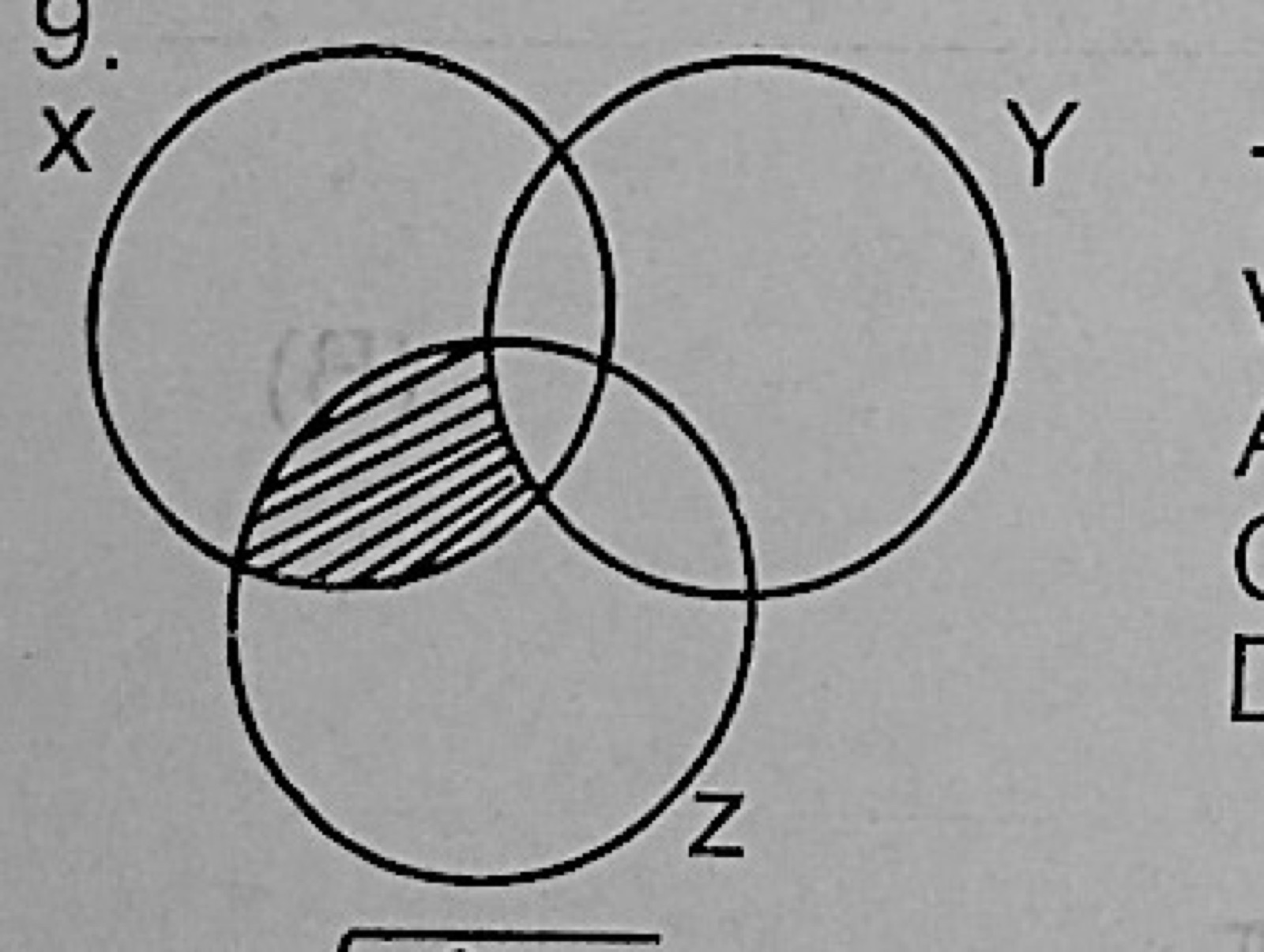
Question 9 Sets The shaded portion in the Venn diagram above is
A. X ∩ Z B. X′ ∩ Y ∩ Z C. X ∩ Y′ ∩ Z D. X ∩ Y ∩ Z′ Show the answer and explanation Answer: C (X ∩ Y′ ∩ Z )
Explanation The shaded part lies inside both X and Z but outside Y, which is X ∩ Y′ ∩ Z.
Open this question
Question 10 Surds If √(x2 + 9) = x + 1, solve for x.
A. 5 B. 4 C. 3 D. 1 Show the answer and explanation Answer: B (4 )
Explanation Square both sides: x² + 9 = x² + 2x + 1, so 2x = 8 and x = 4 (check: √25 = 5 = 4 + 1).
Open this question
Question 11 Algebraic Expressions Make x the subject of the relation
A. (p + q)/(a(p + q)) B. (p − q)/(a(p + q)) C. (p − q)/(apq) D. pq/(a(p − q)) Show the answer and explanation Answer: B ((p − q)/(a(p + q)) )
Explanation Cross-multiply: q + aqx = p − apx. Collect x terms: ax(p + q) = p − q, so x = (p − q)/(a(p + q)).
Open this question
Question 12 Algebraic Expressions Which of the following is a factor of 15 + 7x − 2x2 ?
A. x − 3 B. x + 3 C. x − 5 D. x + 5 Show the answer and explanation Answer: C (x − 5 )
Explanation 15 + 7x − 2x² = −(2x² − 7x − 15) = −(2x + 3)(x − 5), so x − 5 is a factor (x = 5 gives 15 + 35 − 50 = 0).
Open this question
Question 13 Algebraic Expressions Evaluate (x + 1/x + 1)2 − (x − 1/x − 1)2
A. 4x2 B. (2/x + 2)2 C. 4 D. 4(1 + x) Show the answer and explanation Answer: D (4(1 + x) )
Explanation Use a² − b² = (a + b)(a − b). Here a + b = 2x and a − b = 2/x + 2, so the product is 2x(2/x + 2) = 4 + 4x = 4(1 + x).
Open this question
Question 14 Linear and Simultaneous Equations Solve the following simultaneous equations for x2 + y − 5 = 0
A. −2, 4 B. 2, 4 C. −1, 8 D. 1, −8 Show the answer and explanation Answer: D (1, −8 )
Explanation From the second equation y = 7x − 3. Substituting: x² + 7x − 8 = 0, i.e. (x + 8)(x − 1) = 0, so x = 1 or −8.
Open this question
Question 15 Quadratic Equations Solve the following equation (3x − 2)(5x − 4) = (3x − 2)2
A. −⅔, 1 B. 1 C. ⅔, 1 D. ⅔, ⅘ Show the answer and explanation Answer: C (⅔, 1 )
Explanation Bring everything to one side: (3x − 2)[(5x − 4) − (3x − 2)] = (3x − 2)(2x − 2) = 0. So x = ⅔ or x = 1. Don't divide by (3x − 2), or you lose a root.
Open this question
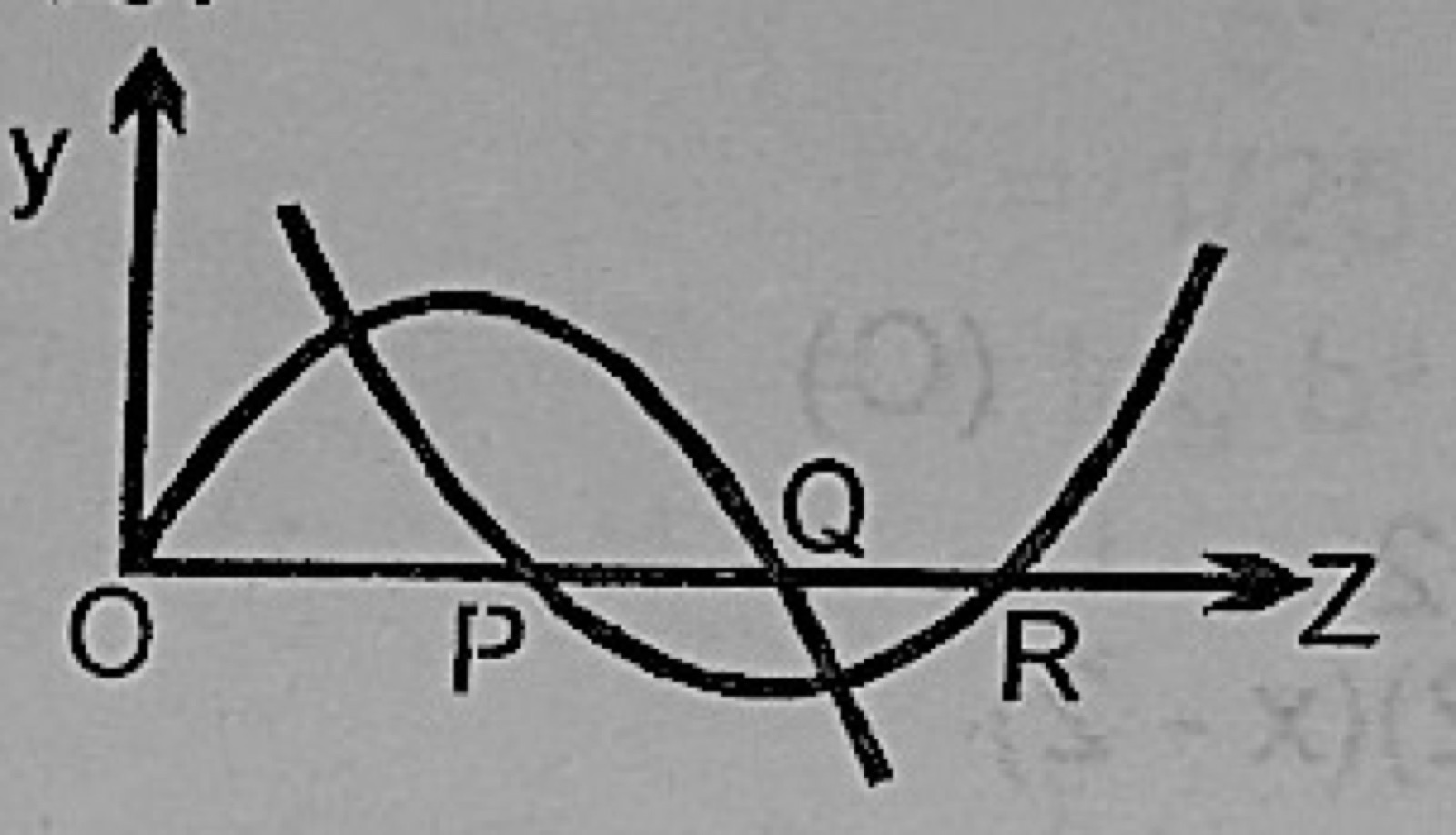
Question 16 Graphs of Functions The figure above represents the graphs of y = x(2 − x) and y = (x − 1)(x − 3). What are the x coordinates of P, Q and R respectively?
A. 1, 3, 2 B. 0, 0, 0 C. 0, 2, 3 D. 1, 2, 3 Show the answer and explanation Answer: D (1, 2, 3 )
Explanation P, Q and R are where the curves cut the x-axis. y = (x − 1)(x − 3) cuts it at 1 and 3; y = x(2 − x) cuts it at 0 and 2. From the figure P = 1, Q = 2 and R = 3.
Open this question
Question 17 Algebraic Expressions If the function f is defined by2 + 7x − 5, find f(−1).
A. −10 B. −8 C. 4 D. 10 Show the answer and explanation Answer: B (−8 )
Explanation x + 2 = −1 when x = −3. Then f(−1) = 2(9) + 7(−3) − 5 = 18 − 21 − 5 = −8.
Open this question
Question 18 Polynomials Divide the expression x3 + 7x2 + x + 7 by 1 + x2
A. x3 + 7x2 + 7 B. x3 − 7x + 7 C. x − 7 D. x + 7 Show the answer and explanation Answer: D (x + 7 )
Explanation Group the terms: x³ + 7x² + x + 7 = x²(x + 7) + (x + 7) = (x² + 1)(x + 7). Dividing by 1 + x² leaves x + 7.
Open this question
Question 20 Inequalities Solve the inequality y2 − 3y > 18
A. −3 < y < 6 B. y < −3 or y > 6 C. y > −3 or y > 6 D. y < −3 or y < 6 Show the answer and explanation Answer: B (y < −3 or y > 6 )
Explanation y² − 3y − 18 = (y − 6)(y + 3) > 0. A product of two factors is positive when both have the same sign, so y < −3 or y > 6.
Open this question
Question 21 Inequalities If x is negative, what is the range of value of x within which (x + 1)/3 > 1/(x + 3)
A. 3 < x < 4 B. −4 < x < −3 C. −2 < x < −1 D. −3 < x < 0 Show the answer and explanation Answer: B (−4 < x < −3 )
Explanation (x + 1)/3 − 1/(x + 3) = x(x + 4)/(3(x + 3)) > 0. Checking signs between the critical values −4, −3 and 0, the only negative interval that works is −4 < x < −3.
Open this question
Question 22 Commercial Arithmetic A man's initial salary is N540.00 a month and increases after each period of six months by N36.00 a month. Find his salary in the eighth month of the third year.
A. N828.00 B. N756.00 C. N720.00 D. N684.00 Show the answer and explanation Answer: C (N720.00 )
Explanation The eighth month of the third year is month 32. Rises come at months 7, 13, 19, 25 and 31, which is 5 rises, so the salary is 540 + 5 × 36 = N720.00.
Open this question
Question 23 Progressions If k + 1, 2k − 1, 3k + 1 are three consecutive terms of geometric progression, find the possible values of the common ratio.
A. 0, 8 B. 1, 5/3 C. 2, 3 D. 1, 1 Show the answer and explanation Answer: B (1, 5/3 )
Explanation For a GP, (2k − 1)² = (k + 1)(3k + 1), which gives k² − 8k = 0, so k = 0 or 8. k = 0 gives 1, −1, 1 (ratio −1) and k = 8 gives 9, 15, 25 (ratio 5/3).
Open this question
Question 24 Binary Operations A binary operation * is defined on a set of real numbers by x * y = xy for all real values of x and y. If x * 2 = x, find the possible values of x
A. 0, 1 B. 1, 2 C. 2, 2 D. 0, 2 Show the answer and explanation Answer: A (0, 1 )
Explanation x * 2 = x² so x² = x, i.e. x(x − 1) = 0, giving x = 0 or 1.
Open this question
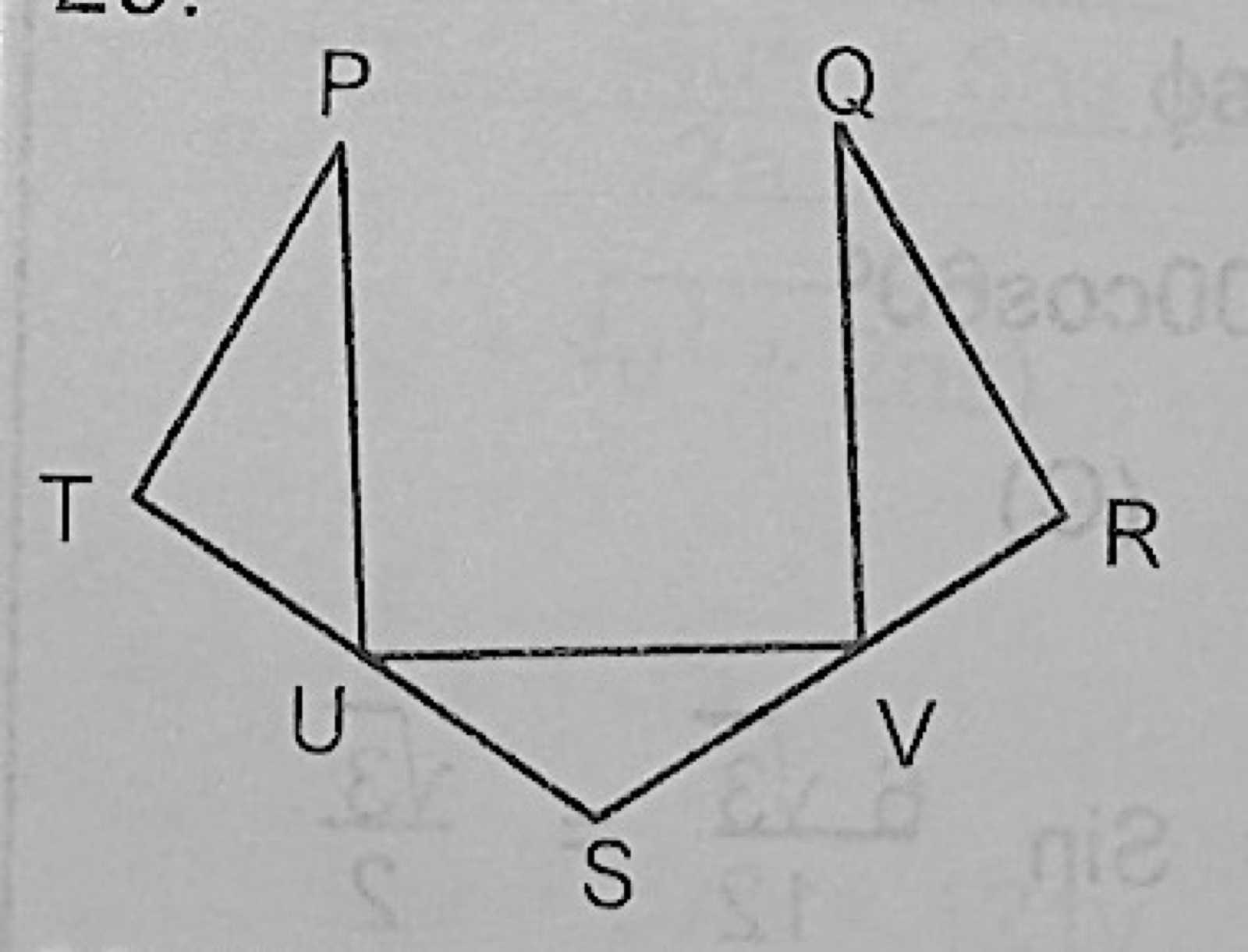
Question 25 Angles and Polygons PQRST is a regular pentagon and PQVU is a rectangle with U and V lying on TS and SR respectively as shown in the diagram above. Calculate TUP.
A. 18° B. 54° C. 90° D. 108° Show the answer and explanation Answer: B (54° )
Explanation Each angle of a regular pentagon is 108°. At P, angle TPU = 108° − 90° = 18°. In triangle TUP, angle TUP = 180° − 108° − 18° = 54°.
Open this question
Question 26 Angles and Polygons A regular polygon has 150° as the size of each interior angle. How many sides has the polygon?
A. 12 B. 10 C. 9 D. 8 Show the answer and explanation Answer: A (12 )
Explanation Each exterior angle is 180° − 150° = 30°, and the exterior angles add up to 360°, so there are 360 ÷ 30 = 12 sides.
Open this question
Question 27 Mensuration of Plane Shapes Calculate the length in cm of the arc of a circle of diameter 8cm which subtends an angle of 22° at the centre of the circle.
A. 2π B. π C. ⅔π D. π/2 Show the answer and explanation Answer: D (π/2 )
Explanation Arc length = (θ/360) × 2πr with r = 4cm. With 22½° this is (22.5/360) × 8π = π/2 cm; with 22° it is about 0.49π, which is still nearest to π/2.
Open this question
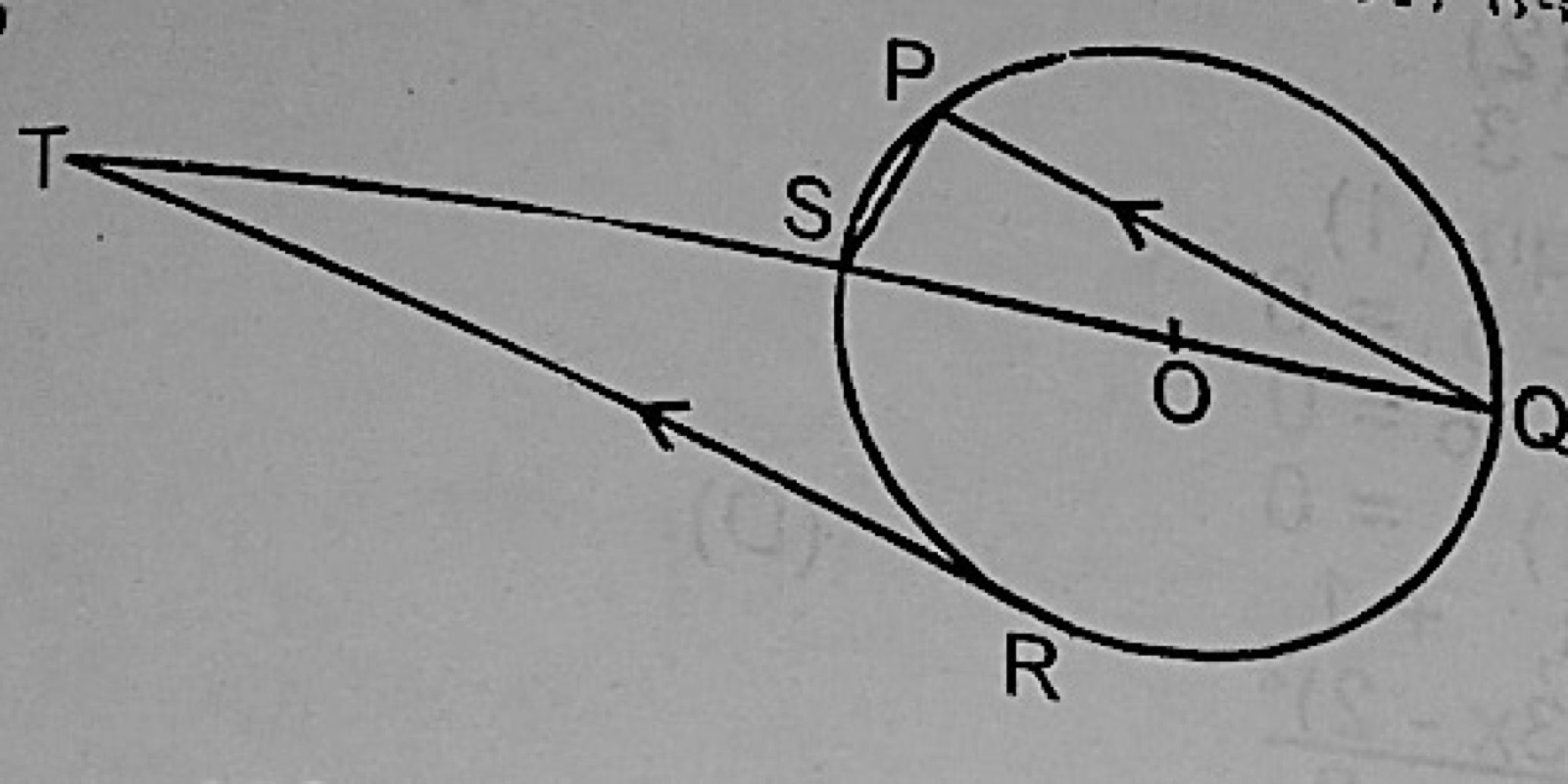
Question 28 Circle Theorems In the diagram above, PQRS is circle with O as centre and PQ‖RT. If RTS = 32°, find PSQ
A. 32° B. 45° C. 58° D. 90° Show the answer and explanation Answer: C (58° )
Explanation PQ is parallel to RT, so angle PQS = angle RTS = 32° (alternate angles). SQ is a diameter, so angle SPQ = 90°. Then angle PSQ = 180° − 90° − 32° = 58°.
Open this question
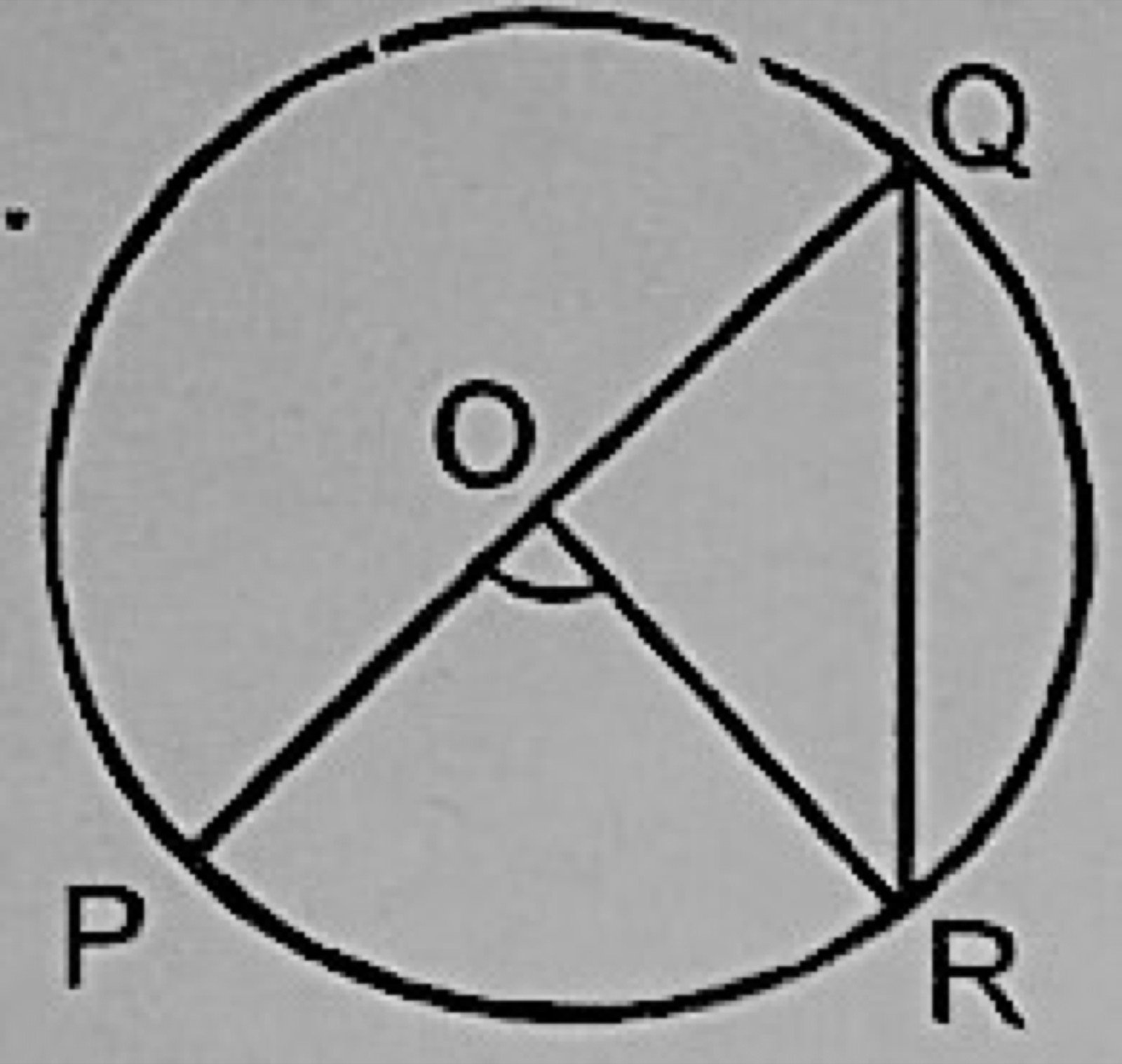
Question 29 Circle Theorems In the diagram above, O is the centre of the circle and POQ a diameter. If PÔR = 96°, find the value of OR̂Q
A. 84° B. 48° C. 45° D. 42° Show the answer and explanation Answer: B (48° )
Explanation Angle QOR = 180° − 96° = 84°. Triangle OQR is isosceles (OQ = OR are radii), so angle ORQ = (180° − 84°) ÷ 2 = 48°.
Open this question
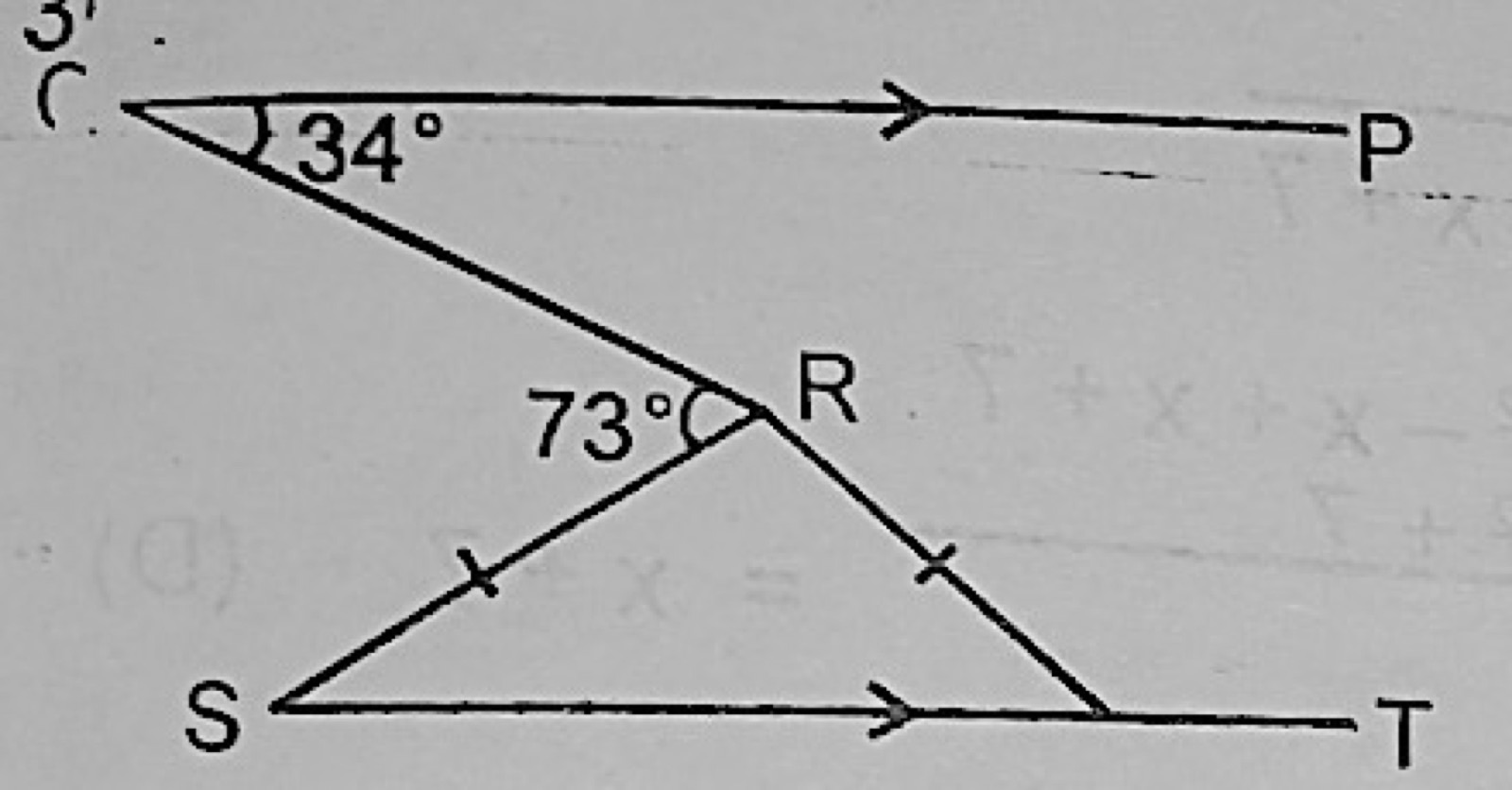
Question 30 Triangles and Quadrilaterals In the diagram above, PQ‖ST, PQR = 34°, QRS = 73° and RS = RT. Find SR̂T.
A. 68° B. 102° C. 90° D. 35° Show the answer and explanation Answer: B (102° )
Explanation Draw a line through R parallel to PQ. It splits the 73° at R into 34° (alternate to PQR) and 39°, so angle RST = 39°. RS = RT makes angle RTS = 39° too, so SRT = 180° − 78° = 102°.
Open this question
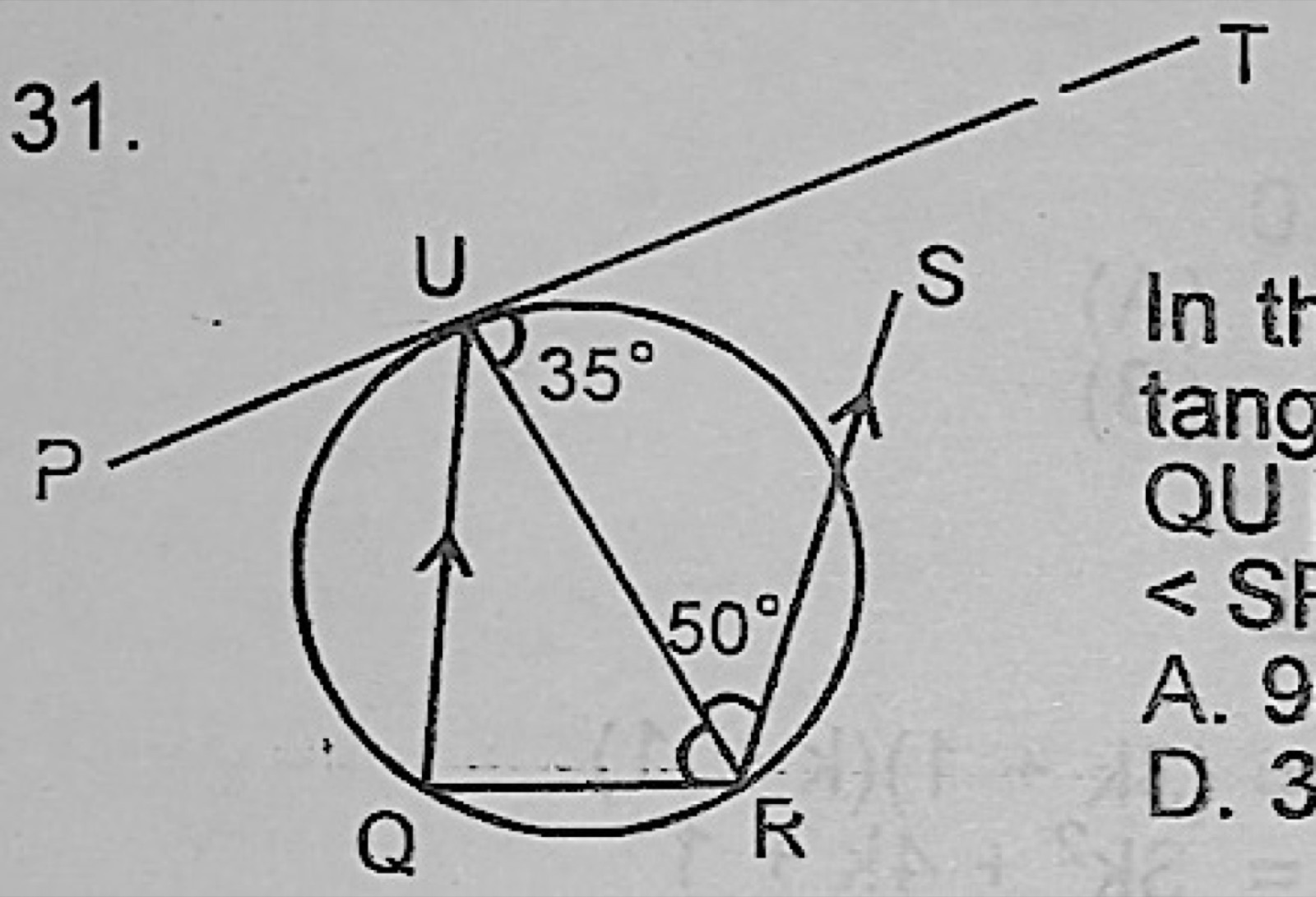
Question 31 Circle Theorems In the figure above, PT is a tangent to the circle at U and QU ‖ RS. If ∠TUR = 35° and ∠SRU = 50°, find ∠x.
A. 95° B. 85° C. 50° D. 35° Show the answer and explanation Answer: A (95° )
Explanation By the alternate segment theorem, angle UQR = angle TUR = 35°. Since QU ‖ RS, angle QUR = angle URS = 50° (alternate angles). In triangle QUR, x = 180° − 35° − 50° = 95°.
Open this question
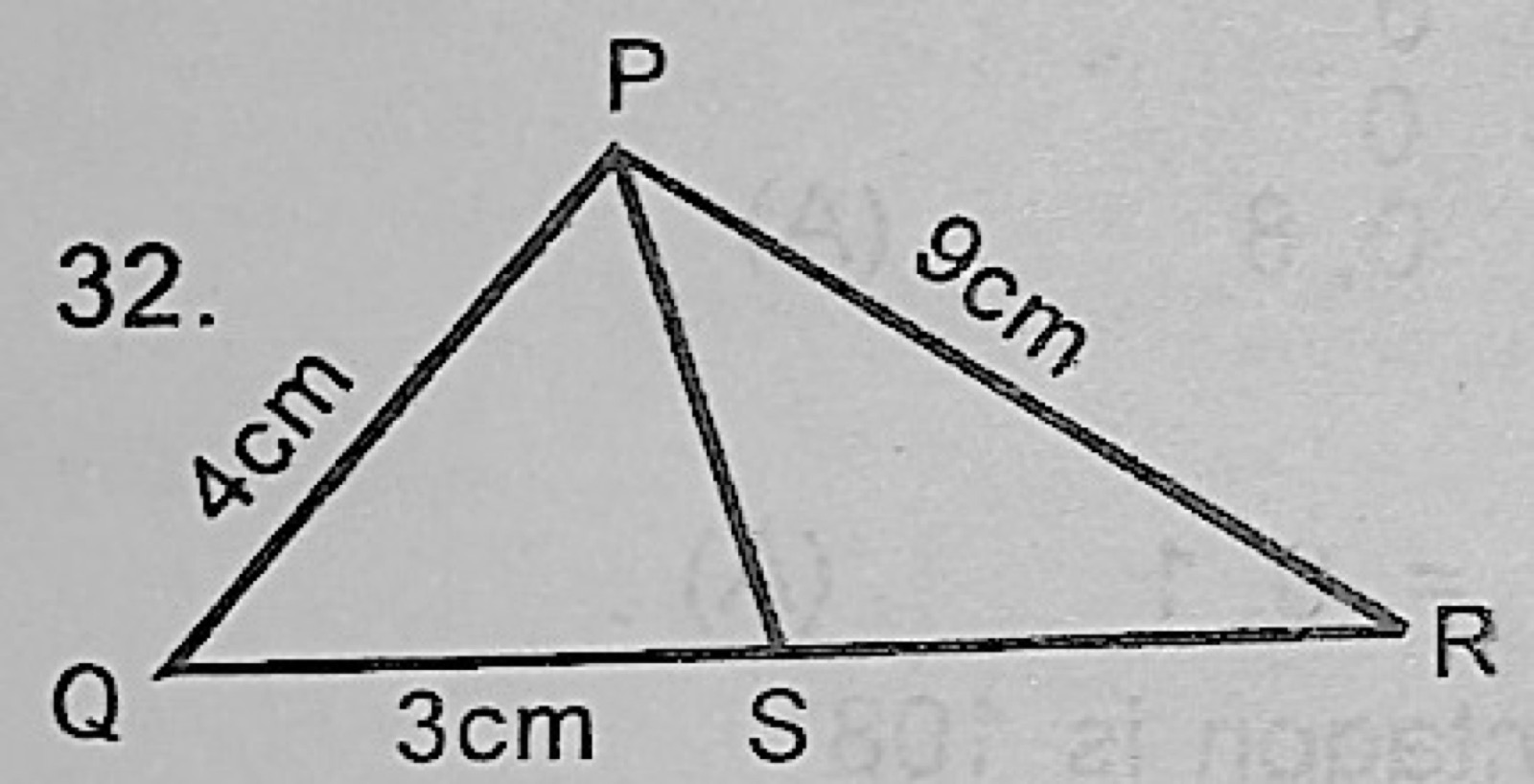
Question 32 Triangles and Quadrilaterals In the diagram above, ∠QPS = ∠SPR, PR = 9cm, PQ = 4cm and QS = 3cm. Find SR.
A. 6¾cm B. 3¾cm C. 4⅜cm D. 2⅔cm Show the answer and explanation Answer: A (6¾cm )
Explanation PS bisects angle P, so it divides QR in the ratio of the other two sides: QS/SR = PQ/PR. So 3/SR = 4/9 and SR = 27/4 = 6¾cm.
Open this question
Question 33 Triangles and Quadrilaterals The three sides of an isosceles triangle are of length x + 3, 2x + 3, 2x − 3 respectively. Calculate x.
A. 0 B. 1 C. 3 D. 6 Show the answer and explanation Answer: D (6 )
Explanation Two sides must be equal. x + 3 = 2x − 3 gives x = 6 (sides 9, 15, 9, a real triangle). x + 3 = 2x + 3 gives x = 0, which makes a side negative, so x = 6.
Open this question
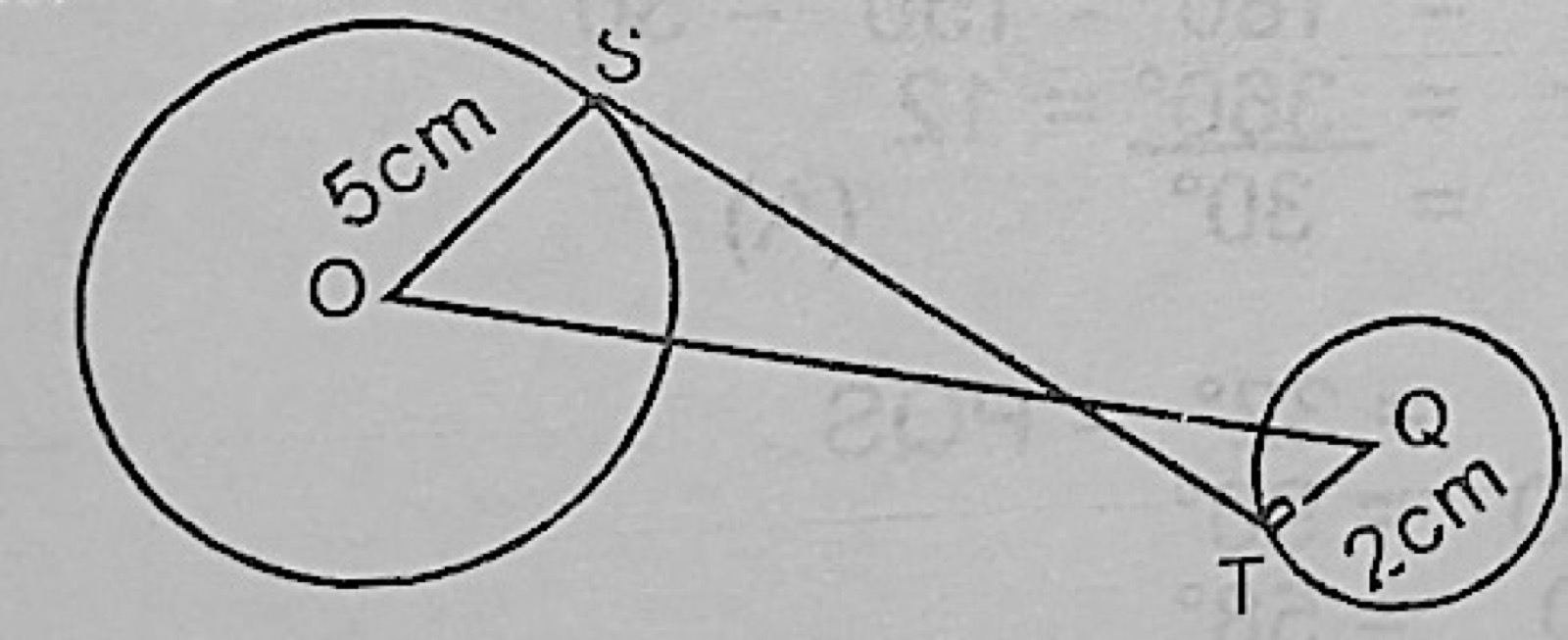
Question 34 Circle Theorems In the figure above, the line segment ST is tangent to the two circle at S and T, O and Q are the centres of the circles with OS = 5cm, QT = 2cm and OQ = 14cm. Find ST.
A. 7√3cm B. 12cm C. √87cm D. 7cm Show the answer and explanation Answer: A (7√3cm )
Explanation The tangent crosses the line of centres, so make a right triangle with hypotenuse OQ = 14 and one side 5 + 2 = 7. Then ST = √(196 − 49) = √147 = 7√3cm.
Open this question
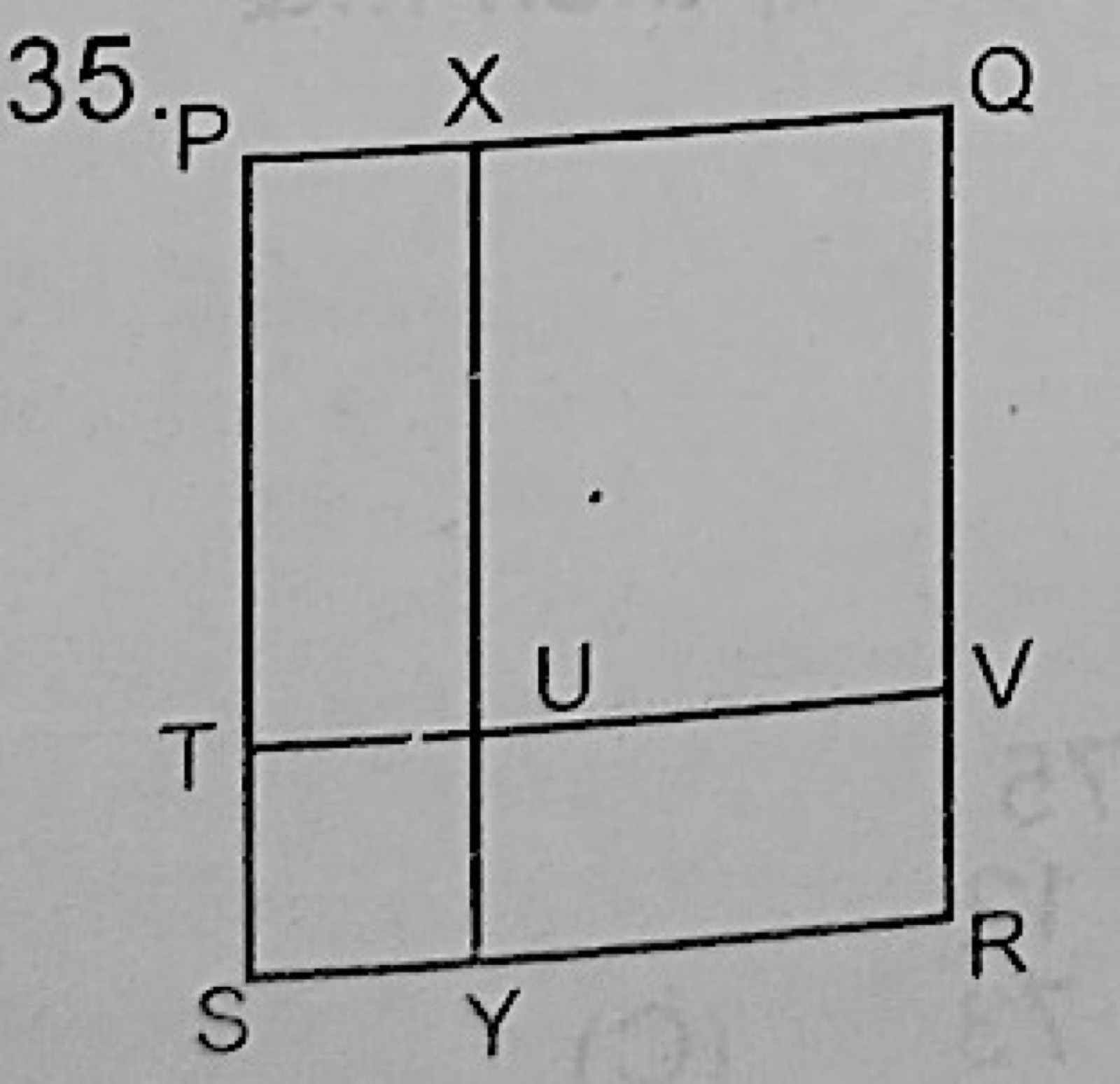
Question 35 Mensuration of Plane Shapes In the figure above, the area of the square PQRS is 100cm2 . If the ratio of the area of the square TUYS to the area of the square XQVU is 1 : 16, find YR.
A. 6cm B. 7cm C. 8cm D. 9cm Show the answer and explanation Answer: C (8cm )
Explanation The big square has side 10cm. Areas 1 : 16 mean sides 1 : 4, so the small squares have sides a and 4a with a + 4a = 10, giving a = 2. YR = 10 − 2 = 8cm.
Open this question
Question 36 Mensuration of Solids Find the radius of a sphere whose surface area is 154cm2 , (π = 22/7)
A. 7.00cm B. 3.50cm C. 3.00cm D. 1.75cm Show the answer and explanation Answer: B (3.50cm )
Explanation 4πr² = 154, so r² = 154 × 7 ÷ 88 = 12.25 and r = 3.5cm.
Open this question
Question 37 Mensuration of Plane Shapes Find the area of the sector of a circle with radius 3m, if the angle of the sector is 60°
A. 4.0m2 B. 4.1m2 C. 4.7m2 D. 5.0m2 Show the answer and explanation Answer: C (4.7m2 )
Explanation Sector area = (60/360) × π × 3² = 1.5π ≈ 4.7m².
Open this question
Question 38 Latitude and Longitude The angle between latitudes 30°S and 13°N is
A. 17° B. 33° C. 43° D. 53° Show the answer and explanation Answer: C (43° )
Explanation The latitudes are on opposite sides of the equator, so add them: 30° + 13° = 43°.
Open this question
Question 39 Trigonometry If sin θ = cos θ, find θ between 0° and 360°
A. 45°, 225° B. 135°, 315° C. 45°, 315° D. 135°, 225° Show the answer and explanation Answer: A (45°, 225° )
Explanation Dividing by cos θ gives tan θ = 1. Tan is positive in the first and third quadrants, so θ = 45° or 180° + 45° = 225°.
Open this question
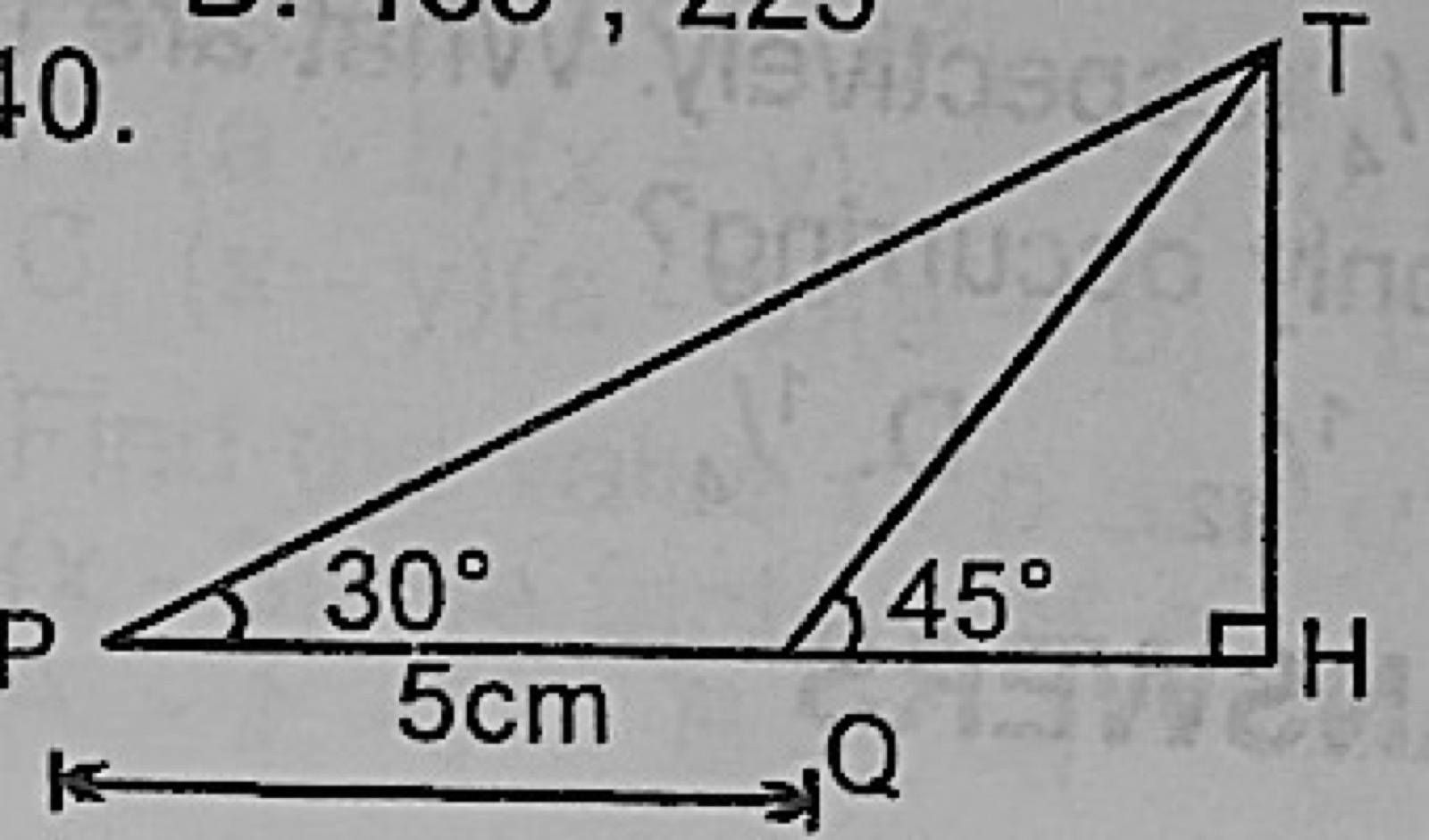
Question 40 Trigonometry From the figure above, calculate TH in centimetres
A. 5/(√3 + 1) B. 5/(√3 − 1) C. 5/√3 D. √3/5 Show the answer and explanation Answer: B (5/(√3 − 1) )
Explanation Let TH = h. The 45° angle at Q makes QH = h, so PH = 5 + h. Then tan 30° = h/(5 + h), i.e. 5 + h = h√3, so h = 5/(√3 − 1).
Open this question
Question 41 Trigonometry If two angles of a triangle are 30° each and the longest side is 10cm, calculate the length of each of the other sides.
A. 5cm B. 4cm C. 3√3cm D. 10√3/3 cm Show the answer and explanation Answer: D (10√3/3 cm )
Explanation The third angle is 120°, opposite the 10cm side. By the sine rule, each other side = 10 sin 30°/sin 120° = 5 ÷ (√3/2) = 10/√3 = 10√3/3 cm.
Open this question
Question 42 Data Presentation Quantities in the proportions 1, 4, 6, 7 are to be represented in a pie chart. Calculate the angle of the sector with proportion 7.
A. 20° B. 80° C. 120° D. 140° Show the answer and explanation Answer: D (140° )
Explanation The proportions add up to 18, so the angle is 7/18 × 360° = 140°.
Open this question
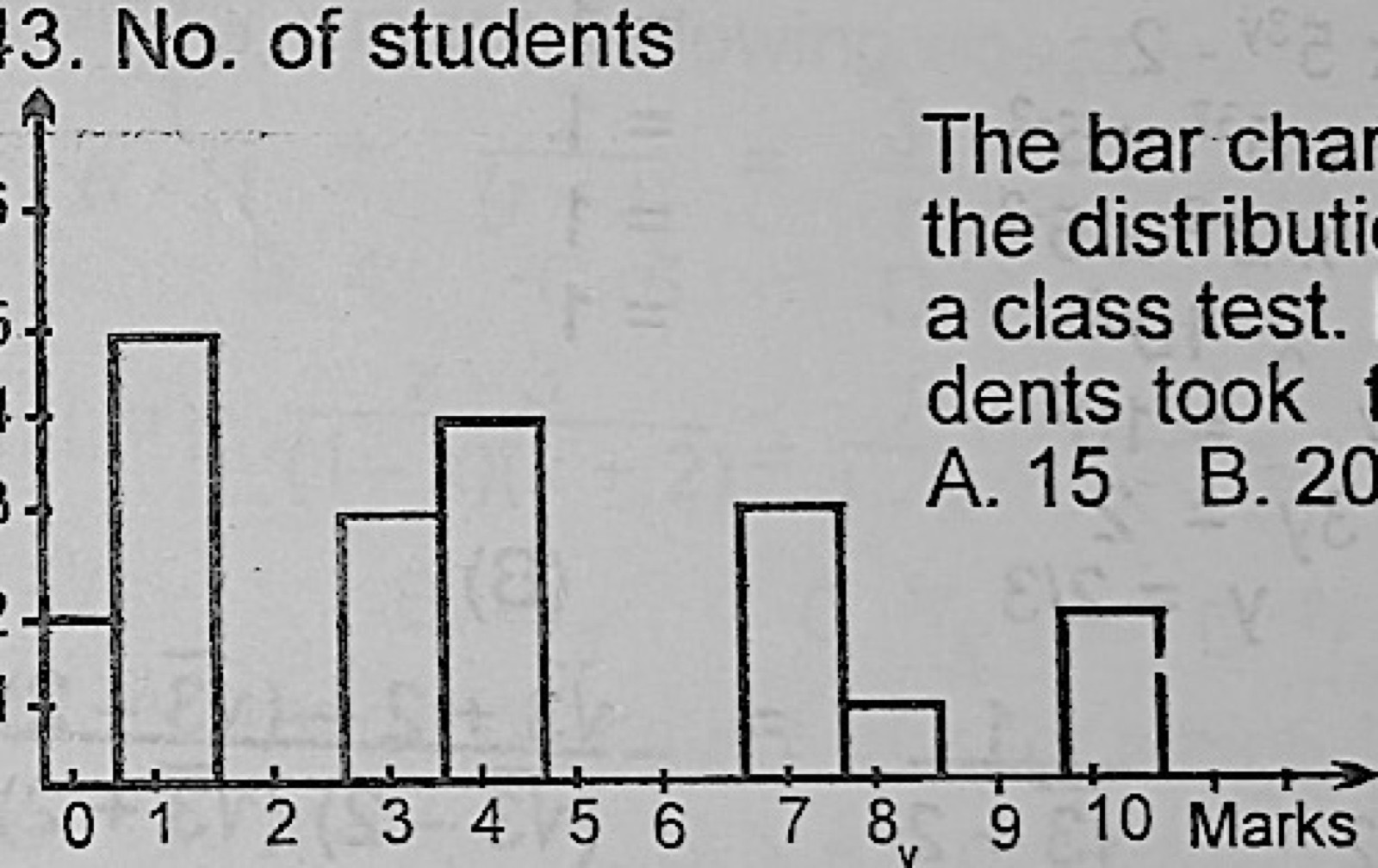
Question 43 Data Presentation The bar chart above shows the distribution of marks in a class test. How many students took the test?
A. 15 B. 20 C. 25 D. 50 Show the answer and explanation Answer: B (20 )
Explanation Add the heights of the bars: 2 + 5 + 3 + 4 + 3 + 1 + 2 = 20 students.
Open this question
Question 44 Measures of Central Tendency The following marks were obtained by twenty students in an examination.
A. 6 B. 10 C. 13 D. 14 Show the answer and explanation Answer: D (14 )
Explanation "At least 50" includes 50. Counting 53, 70, 84, 59, 90, 78, 60, 81, 73, 50, 67, 68, 64 and 52 gives 14 students.
Open this question
Question 45 Measures of Central Tendency Weight (g): 0-10, 10-20, 20-30, 30-40, 40-50
A. 13.2g B. 15.0g C. 16.8g D. 17.5g Show the answer and explanation Answer: C (16.8g )
Explanation The modal class is 10–20 (27 coconuts). Mode = L + d₁/(d₁ + d₂) × c = 10 + (27 − 10)/((27 − 10) + (27 − 19)) × 10 = 10 + 17/25 × 10 = 16.8g.
Open this question
Question 46 Measures of Central Tendency The mean of the ages of ten secondary school pupils is 16 but when the age of their teacher is added to it, the mean becomes 19. Find the age of the teacher.
A. 27 B. 35 C. 38 D. 49 Show the answer and explanation Answer: D (49 )
Explanation The ten pupils total 10 × 16 = 160 years. With the teacher, 11 people total 11 × 19 = 209 years, so the teacher is 209 − 160 = 49.
Open this question
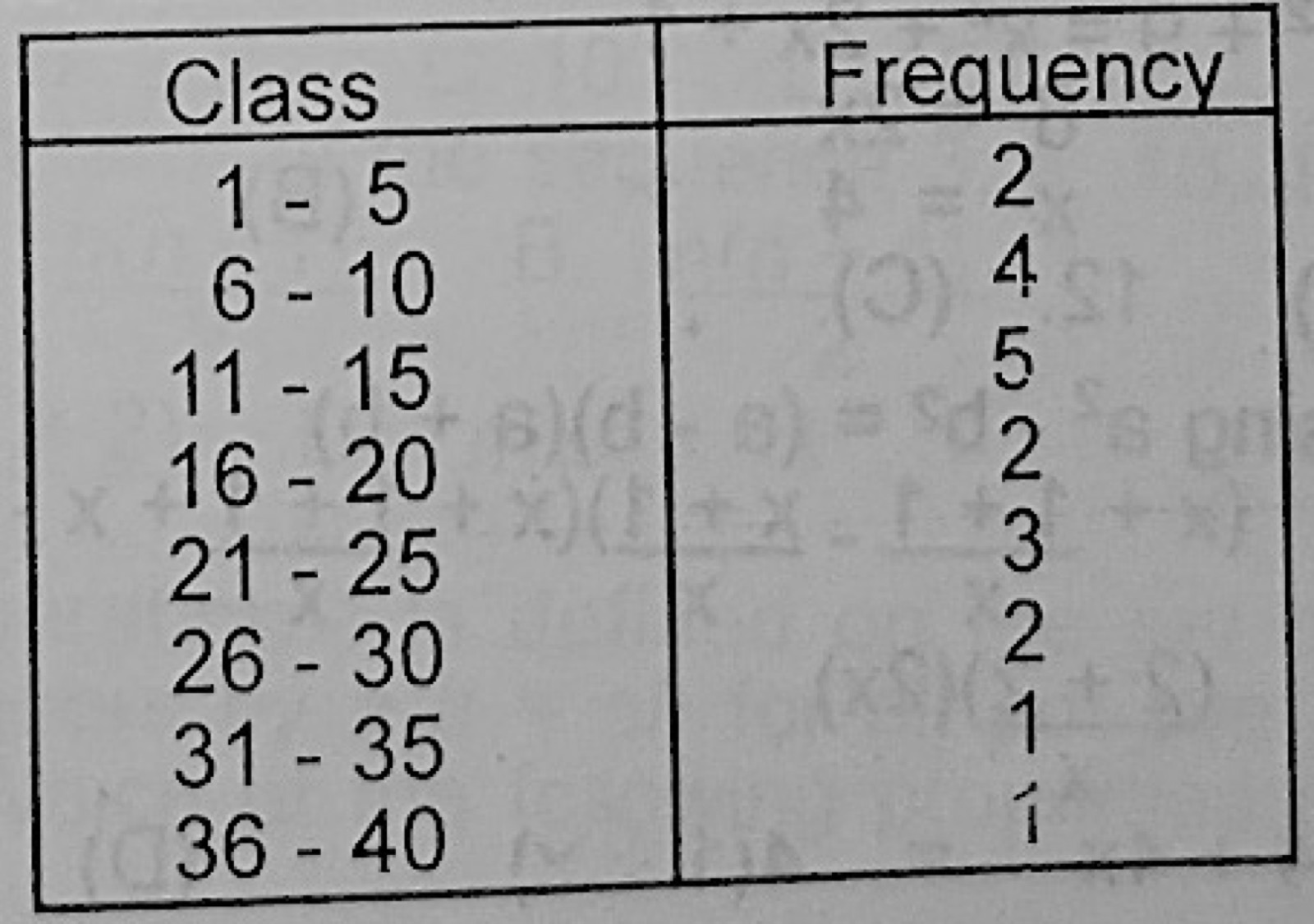
Question 47 Measures of Central Tendency Find the median of the observation in the table above
A. 11.5 B. 12.5 C. 14.0 D. 14.5 Show the answer and explanation Answer: D (14.5 )
Explanation There are 20 observations, so the median is the 10th. Cumulative frequencies are 2, 6, 11, … so it is in class 11–15. Median = 10.5 + (10 − 6)/5 × 5 = 14.5.
Open this question
Question 48 Probability A number is selected at random between 20 and 30 both numbers inclusive. Find the probability that number is a prime.
A. 2/11 B. 5/11 C. 6/11 D. 8/11 Show the answer and explanation Answer: A (2/11 )
Explanation There are 11 numbers from 20 to 30, and only 23 and 29 are prime, so the probability is 2/11.
Open this question
Question 49 Measures of Dispersion Calculate the standard deviation of the following data 7, 8, 9, 10, 11, 12, 13
A. 2 B. 4 C. 10 D. 11 Show the answer and explanation Answer: A (2 )
Explanation The mean is 10. The squared deviations are 9, 4, 1, 0, 1, 4, 9, total 28. Variance = 28/7 = 4, so the standard deviation is 2.
Open this question
Question 50 Probability The chances of three independent events X, Y, Z occurring are ½, ⅔, ¼ respectively. What are the chances of Y and Z only occurring?
A. ⅛ B. 1/24 C. 1/12 D. ¼ Show the answer and explanation Answer: C (1/12 )
Explanation Y and Z happen but X does not: (1 − ½) × ⅔ × ¼ = 1/12.
Open this question Sign up free for every JAMB Mathematics year, practice by topic and timed mocks.
Start practising free