Home › Past questions › JAMB › Chemistry › 2009 45 questions. Try each one, then open the answer to check yourself and read the explanation.
Sign up free to answer these questions on a CBT screen with a timer, then see your score and every answer explained.
Start practising free
Question 1 Separation of Mixtures A mixture of sugar and sulphur can be separated by
A. dissolution in water, evaporation and filtration B. filtration, evaporation and dissolution in water C. dissolution in water, filtration and evaporation D. evaporation, dissolution in water and filtration Show the answer and explanation Answer: C (dissolution in water, filtration and evaporation )
Explanation Sugar dissolves in water but sulphur does not. Dissolve, filter off the sulphur, then evaporate the filtrate to recover the sugar.
Open this question
Question 3 Mole Concept and Stoichiometry The percentage of water of crystallization in ZnSO4 .7H2 O is [Zn = 65, S = 32, O = 16, H = 1]
A. 33% B. 44% C. 55% D. 87% Show the answer and explanation Answer: B (44% )
Explanation Molar mass = 65 + 32 + 64 + 7(18) = 287. Water = 126, so 126/287 × 100 ≈ 44%.
Open this question
Question 4 Mole Concept and Stoichiometry 0.0075 mole of calcium trioxocarbonate(IV) is added to 0.015 mole of a solution of hydrochloric acid. The volume of gas evolved at s.t.p. is [Molar volume of a gas at s.t.p. = 22.4 dm3 ]
A. 224 cm3 B. 168 cm3 C. 112 cm3 D. 100 cm3 Show the answer and explanation Answer: B (168 cm3 )
Explanation CaCO3 + 2HCl → CaCl2 + H2 O + CO2 . 0.0075 mol CaCO3 uses exactly 0.015 mol HCl and gives 0.0075 mol CO2 = 0.0075 × 22 400 = 168 cm3 .
Open this question
Question 6 Gas Laws The basic assumption in the kinetic theory of gases that the collisions of the gaseous molecules are perfectly elastic implies that the
A. forces of attraction and repulsion are in equilibrium B. gaseous molecules can occupy any available space C. gaseous molecules will continue their motion indefinitely D. gases can be compressed Show the answer and explanation Answer: C (gaseous molecules will continue their motion indefinitely )
Explanation In a perfectly elastic collision no kinetic energy is lost, so the molecules never slow down and keep moving.
Open this question
Question 7 Atomic Structure If an atom is represented as 23 11 X, which of the following deductions is correct?
A. It contains 12 protons B. It forms a covalent chloride C. Its atomic number is 23 D. It is an alkali metal Show the answer and explanation Answer: D (It is an alkali metal )
Explanation Atomic number 11 is sodium (2,8,1), a group 1 alkali metal. It has 11 protons and 12 neutrons.
Open this question
Question 8 Atomic Structure If the relative molecular mass of an element is not a whole number, it can be deduced that the element is
A. naturally radioactive B. abundant in nature C. a transition metal D. an isotopic mixture Show the answer and explanation Answer: D (an isotopic mixture )
Explanation A fractional relative atomic mass is the average of the masses of its isotopes weighted by their abundance.
Open this question
Question 9 Atomic Structure Cathode rays cause an object placed behind a perforated anode to cast a shadow on the screen. This observation shows that the rays
A. are positively charged B. are negatively charged C. have mass D. travel in straight lines Show the answer and explanation Answer: D (travel in straight lines )
Explanation A sharp shadow forms only if the rays travel in straight lines past the object.
Open this question
Question 10 Atomic Structure Which quantum number divides shells into orbitals?
A. Principal B. Azimuthal C. Magnetic D. Spin Show the answer and explanation Answer: B (Azimuthal )
Explanation The azimuthal (subsidiary) quantum number splits each main shell into s, p, d and f sub-levels (orbital types).
Open this question
Question 11 Chemical Bonding The type of bonding in [Cu(NH3 )4 ]2+ is
A. coordinate B. electrovalent C. metallic D. covalent Show the answer and explanation Answer: A (coordinate )
Explanation Each NH3 donates its lone pair to the Cu2+ ion, forming dative (coordinate) bonds.
Open this question
Question 12 Air The mixture of gases used in a photographer's flash tube is
A. argon and krypton B. krypton and xenon C. helium and argon D. argon and xenon Show the answer and explanation Answer: B (krypton and xenon )
Explanation Photographic flash tubes are filled with the heavier noble gases krypton and xenon, which give an intense white flash.
Open this question
Question 13 Water When sodium trioxocarbonate (IV) decahydrate loses its water of crystallization to the atmosphere, the process is
A. deliquescence B. efflorescence C. hygroscopic D. effervescence Show the answer and explanation Answer: B (efflorescence )
Explanation Losing water of crystallization to the air is called efflorescence.
Open this question
Question 14 Hydrogen, Oxygen and Oxides Water can be obtained as the only product during the
A. combustion of hydrocarbons B. neutralization of an acid by a base C. combustion of hydrogen D. electrolysis of brine Show the answer and explanation Answer: C (combustion of hydrogen )
Explanation 2H2 + O2 → 2H2 O gives water alone; hydrocarbons also give CO2 and neutralization also gives a salt.
Open this question
Question 15 Solubility and Solutions If 10.5g of lead (II) trioxonitrate (V) is dissolved in 20cm3 of distilled water at 180 C, the solubility of the solute in mol dm−3 is [Pb = 207, N = 14, O = 16]
A. 1.60 B. 5.25 C. 16.00 D. 525.00 Show the answer and explanation Answer: A (1.60 )
Explanation Pb(NO3 )2 = 331 g/mol, so 10.5 g = 0.0317 mol. In 1000 cm3 : 0.0317 × 1000/20 ≈ 1.60 mol dm−3 .
Open this question
Question 16 Solubility and Solutions For a given solute, the concentration of its saturated solution in different solvents are
A. the same at the same temperature B. different at the same temperature C. the same at different temperatures D. constant Show the answer and explanation Answer: B (different at the same temperature )
Explanation Solubility depends on the solvent, so a solute's saturated concentration differs from one solvent to another even at the same temperature.
Open this question
Question 18 Electrolysis The acid used in electrolysis of water is dilute
A. HNO3 B. CH3 COOH C. H2 SO4 D. HCl Show the answer and explanation Answer: C (H2 SO4 )
Explanation Dilute H2 SO4 makes water conduct; its sulphate ions are not discharged, so only H2 and O2 are produced.
Open this question
Question 19 Mole Concept and Stoichiometry What volume of 1.5 M solution of KOH would contain 0.045 moles?
A. 67.50cm3 B. 30.00cm3 C. 6.75cm3 D. 3.00cm3 Show the answer and explanation Answer: B (30.00cm3 )
Explanation Volume = moles ÷ concentration = 0.045/1.5 = 0.030 dm3 = 30 cm3 .
Open this question
Question 20 Acids, Bases and Salts The salt formed from a reaction between citric acid and sodium hydroxide in solution will be
A. acidic B. basic C. complex D. neutral Show the answer and explanation Answer: B (basic )
Explanation A weak acid with a strong base gives a salt that hydrolyses to make the solution slightly alkaline.
Open this question
Question 21 Redox Reactions The colour change observed when testing for reducing agents using acidified potassium heptaoxodichromate (VI) solution is
A. yellow to purple B. orange to green C. green to orange D. purple to yellow Show the answer and explanation Answer: B (orange to green )
Explanation A reducing agent turns orange Cr2 O7 2− into green Cr3+ .
Open this question
Question 22 Redox Reactions The oxidation state of Cr in K2 Cr2 O7 is
A. +7 B. +6 C. +5 D. 4 Show the answer and explanation Answer: B (+6 )
Explanation 2(+1) + 2x + 7(−2) = 0, so 2x = 12 and x = +6.
Open this question
Question 23 Electrolysis Which of the following metals is purified commercially by eletrolysis?
A. Zn B. Fe C. Sn D. Cu Show the answer and explanation Answer: D (Cu )
Explanation Impure copper is made the anode and pure copper deposits on the cathode during electrolytic refining.
Open this question
Question 24 Electrolysis What current will deposit 3.25g of zinc in 2 hrs? [Zn = 65, F = 96500 mol−1 ]
A. 3.25A B. 2.00A C. 1.34A D. 0.67A Show the answer and explanation Answer: C (1.34A )
Explanation 3.25/65 = 0.05 mol Zn needs 2 × 0.05 = 0.1 F = 9650 C. I = 9650/7200 s ≈ 1.34 A.
Open this question
Question 25 Energy Changes C(s) + H2 O(g) → H2(g) + CO(g)
A. not feasible B. at equilibrium C. feasible D. exothermic Show the answer and explanation Answer: C (feasible )
Explanation A negative ΔG means the reaction is spontaneous (feasible) at that temperature.
Open this question
Question 26 Energy Changes Two equal bulbs, one containing ammonia and the other nitrogen, are opened mouth-to-mouth to each other at room temperature. The entropy in the mixture of gases is likely to
A. remain unchanged B. increase C. decrease D. change Show the answer and explanation Answer: B (increase )
Explanation The gases diffuse and mix, which increases disorder, so entropy increases.
Open this question
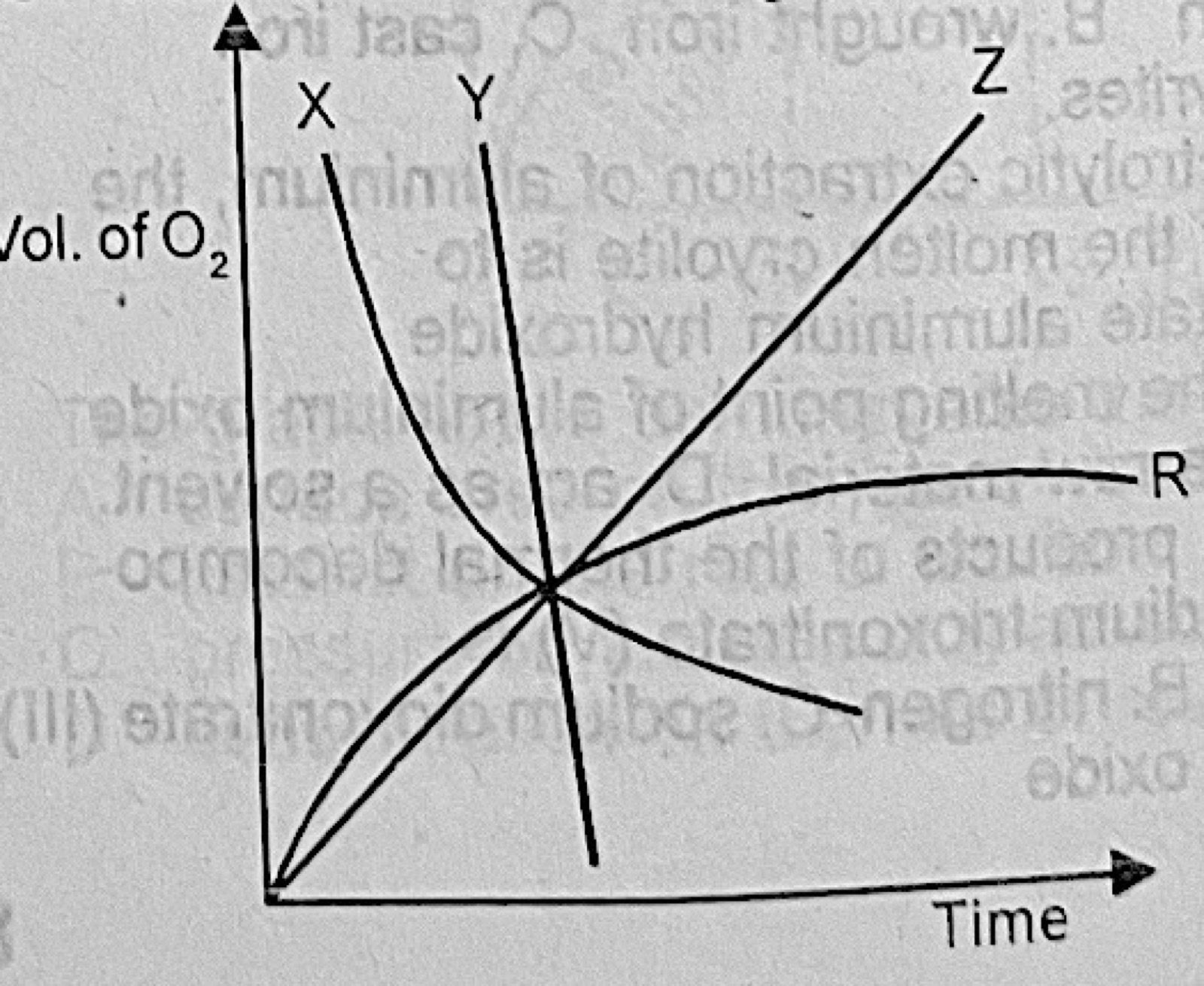
Question 27 Rates of Reaction In the diagram above, which of the curves represents the evolution of oxygen with time in the equation 2KClO3(s) → 2KCl(s) + 3O2(g) ?
A. X B. Y C. Z D. R Show the answer and explanation Answer: D (R )
Explanation The volume of oxygen starts at zero, rises quickly, then levels off when all the KClO3 has decomposed, which is curve R.
Open this question
Question 28 Rates of Reaction A catalyst increases the rate of a chemical reaction by providing a path that
A. raises the activation energy B. increases the temperature C. lowers the activation energy D. increases the concentration Show the answer and explanation Answer: C (lowers the activation energy )
Explanation A catalyst offers an alternative route with lower activation energy, so more collisions succeed.
Open this question
Question 29 Chemical Equilibrium CuO(s) + H2(g) ⇌ Cu(s) + H2 O(l)
A. The equilibrium is shifted to the left B. The equilibrium is shifted to the right C. There is no effect D. More H2(g) is produced Show the answer and explanation Answer: B (The equilibrium is shifted to the right )
Explanation As written, the only gas is H2 on the left. Increasing pressure favours the side with fewer gas molecules, which is the right.
Open this question
Question 30 Chemical Equilibrium The equilibrium of an endothermic reaction which proceeds with an increase in volume can be shifted in the reverse direction by
A. increasing the temperature and decreasing the pressure B. increasing the pressure and increasing the temperature C. decreasing the temperature and increasing the pressure D. decreasing the pressure and decreasing the temperature Show the answer and explanation Answer: C (decreasing the temperature and increasing the pressure )
Explanation Lowering temperature opposes an endothermic forward reaction, and raising pressure favours the side with smaller volume (the reactants).
Open this question
Question 31 Nitrogen and its Compounds The oxidation of ammonia in excess air produces
A. NO B. N2 O C. NO2 D. N2 O4 Show the answer and explanation Answer: A (NO )
Explanation Catalytic oxidation of ammonia gives nitrogen(II) oxide: 4NH3 + 5O2 → 4NO + 6H2 O.
Open this question
Question 32 Sulphur and its Compounds Hydrogen sulphide gas can act as
A. an oxidizing agent B. a dehydrating agent C. a bleaching agent D. a precipitating agent Show the answer and explanation Answer: D (a precipitating agent )
Explanation H2 S precipitates many metal ions as insoluble sulphides (it is used this way in qualitative analysis).
Open this question
Question 33 Petroleum and Coal The gasification of coke is used for the manufacture of
A. producer gas B. natural gas C. synthetic gas D. industrial gas Show the answer and explanation Answer: A (producer gas )
Explanation Passing air over red-hot coke converts it into producer gas (CO and N2 ).
Open this question
Question 34 Environmental Pollution The gas that is most useful in protecting humans against solar radiations is
A. chlorine B. ozone C. carbon(IV) oxide D. hydrogen sulphide Show the answer and explanation Answer: B (ozone )
Explanation The ozone layer absorbs most of the sun's harmful ultraviolet radiation.
Open this question
Question 35 Carbon and its Compounds Which of the allotrope of carbon is a constituent of a lead pencil?
A. Graphite B. Diamond C. Lampblack D. Soot Show the answer and explanation Answer: A (Graphite )
Explanation Pencil 'lead' is graphite mixed with clay; graphite is soft and leaves a mark.
Open this question
Question 36 Periodic Table Which of the following metals will show the highest metallic character?
A. Zinc B. Copper C. Barium D. Calcium Show the answer and explanation Answer: C (Barium )
Explanation Metallic character increases down a group, so barium (below calcium in group 2) loses electrons most easily.
Open this question
Question 37 Nitrogen and its Compounds Copper metal dissolves in concentrated trioxonitrate (V) acid with the resultant evolution of
A. CO2 B. SO2 C. NO2 D. CO Show the answer and explanation Answer: C (NO2 )
Explanation Cu + 4HNO3 (conc.) → Cu(NO3 )2 + 2NO2 + 2H2 O; brown NO2 is given off.
Open this question
Question 38 Metals and their Compounds The type of iron that is best suited for welding, making nails, chains and iron rods is
A. pig iron B. wrought iron C. cast iron D. iron pyrites Show the answer and explanation Answer: B (wrought iron )
Explanation Wrought iron is almost pure iron, so it is malleable and easy to weld and shape.
Open this question
Question 39 Metals and their Compounds In the electrolytic extraction of aluminium, the function of the molten cryolite is to
A. precipitate aluminium hydroxide B. lower the melting point of aluminium oxide C. act as a raw material D. act as a solvent Show the answer and explanation Answer: B (lower the melting point of aluminium oxide )
Explanation Alumina melts above 2000 °C; dissolving it in cryolite lowers the working temperature to about 950 °C, saving energy.
Open this question
Question 40 Nitrogen and its Compounds One of the products of the thermal decomposition of sodium trioxonitrate (V) is
A. sodium B. nitrogen C. sodium dioxonitrate (III) D. sodium oxide Show the answer and explanation Answer: C (sodium dioxonitrate (III) )
Explanation 2NaNO3 → 2NaNO2 + O2 ; group 1 nitrates give the nitrite (dioxonitrate(III)) and oxygen.
Open this question
Question 41 Petroleum and Coal A cracking process in petroleum refining can be represented by
A. heptane to heptene B. heptane to 3-methylhexane C. heptane to propene and butane D. heptane to 2,3,3-trimethybutane Show the answer and explanation Answer: C (heptane to propene and butane )
Explanation Cracking breaks a large molecule into smaller ones: C7 H16 → C3 H6 + C4 H10 .
Open this question
Question 43 Carbohydrates, Proteins and Amines Which of the following class of compounds can exist as dipolar ions in solution?
A. Alkanoic acids B. Fatty acids C. Dialkanoic acids D. Amino acids Show the answer and explanation Answer: D (Amino acids )
Explanation An amino acid has both −NH2 and −COOH groups, so it forms a zwitterion (+H3 N−CHR−COO− ).
Open this question
Question 44 Alkanols Lucas reagent is used to test for
A. alkanes B. alkanoic acids C. alkanols D. amines Show the answer and explanation Answer: C (alkanols )
Explanation Lucas reagent (ZnCl2 in conc. HCl) distinguishes primary, secondary and tertiary alkanols by how fast cloudiness appears.
Open this question
Question 45 Alkanols A compound commonly used for sterilization and preservation of specimens and food is
A. ethanol B. benzene C. ether D. ammonia Show the answer and explanation Answer: A (ethanol )
Explanation Ethanol kills microbes, so it is used as an antiseptic and to preserve biological specimens.
Open this question
Question 47 Hydrocarbons Which of the following hydrocarbons is mainly used as fuel?
A. Methylene B. Ethylene C. Methane D. Ethyne Show the answer and explanation Answer: C (Methane )
Explanation Methane is the main part of natural gas, used as a fuel for cooking and heating.
Open this question
Question 48 Hydrocarbons The molecular formula of a common organic laboratory anaesthetic is
A. CHCl3 B. CHI3 C. CCl4 D. CHF3 Show the answer and explanation Answer: A (CHCl3 )
Explanation Trichloromethane (chloroform), CHCl3 , was a common anaesthetic.
Open this question
Question 49 Hydrocarbons The simplest branched-chain hydrocarbon is
A. ethane B. ethene C. propane D. butane Show the answer and explanation Answer: D (butane )
Explanation A branch needs at least four carbons: 2-methylpropane is an isomer of butane.
Open this question
Question 50 Hydrocarbons Organic molecules that have the suffix-ene are unsaturated hydrocarbons that have
A. a single bond B. a double bond C. a triple bond D. an ionic bond Show the answer and explanation Answer: B (a double bond )
Explanation The ending -ene shows an alkene, which contains a C=C double bond.
Open this question Sign up free for every JAMB Chemistry year, practice by topic and timed mocks.
Start practising free