WAEC Commerce 1995 past questions and answers

106 questions. Try each one, then open the answer to check yourself and read the explanation.

Question 1

Introduction to Commerce

Which of the following is not a branch of Commerce?

  1. A.Insurance
  2. B.Warehousing
  3. C.Trade
  4. D.Transport
  5. E.Computerisation
Show the answer and explanation

Answer: E (Computerisation)

Explanation

Trade and the aids to trade (insurance, warehousing, transport, banking, advertising, communication) make up commerce; computerisation is not one of them.

Open this question

Question 2

Purchase and Sale of Goods

Which of the following is not a negotiable instrument?

  1. A.Share certificate
  2. B.Cheque
  3. C.Bill of Exchange
  4. D.Dividend warrant
  5. E.Debenture
Show the answer and explanation

Answer: A (Share certificate)

Explanation

Cheques, bills of exchange, dividend warrants and bearer debentures can be transferred by delivery or endorsement; a share certificate cannot – shares are transferred by a transfer form.

Open this question

Question 3

Occupation

Those involved in obtaining the gifts of nature from land and sea are engaged in

  1. A.Extractive occupation
  2. B.Manufacturing occupation
  3. C.Constructive occupation
  4. D.Commercial occupation
  5. E.Direct services
Show the answer and explanation

Answer: A (Extractive occupation)

Explanation

Extractive occupations (mining, fishing, farming, lumbering) take natural resources from land and sea.

Open this question

Question 4

Business Finance

When a company sells shares to existing shareholders at preferential rate, that is called

  1. A.Rights issue
  2. B.Bonus issue
  3. C.Private placing
  4. D.Sale by auction
  5. E.Issue by prospectus
Show the answer and explanation

Answer: A (Rights issue)

Explanation

A rights issue offers new shares to existing shareholders, usually below market price.

Open this question

Question 5

Business Units

Which of the following must be include in the Articles of Association?

  1. A.Voting rights of the shareholders
  2. B.The objects of the business
  3. C.The address of the registered office
  4. D.Statement that liability is limited
  5. E.List of types of shares
Show the answer and explanation

Answer: A (Voting rights of the shareholders)

Explanation

The Articles contain the internal rules, such as voting rights; the objects, registered office and limited liability are stated in the Memorandum.

Open this question

Question 6

Warehousing

Which of the following enables production to take place ahead of demand?

  1. A.Transporting
  2. B.Advertising
  3. C.Importing
  4. D.Warehousing
  5. E.Exporting
Show the answer and explanation

Answer: D (Warehousing)

Explanation

Goods produced before they are demanded are stored in warehouses until needed.

Open this question

Question 7

Business Finance

Called-up capital is the amount

  1. A.paid on allotment
  2. B.paid on first call
  3. C.paid on application
  4. D.demanded on shares issued
  5. E.paid-up on all shares
Show the answer and explanation

Answer: D (demanded on shares issued)

Explanation

Called-up capital is the part of issued capital that the company has asked shareholders to pay so far.

Open this question

Question 8

Business Finance

Which of the following is true about cumulative preference shares?

  1. A.Any unpaid dividend is carried forward
  2. B.The shareholders can obtain a capital refund
  3. C.They are entitled to further share in profit
  4. D.any unpaid dividend is forfeited
  5. E.The dividend declared is accumulated in a reserve account
Show the answer and explanation

Answer: A (Any unpaid dividend is carried forward)

Explanation

With cumulative preference shares, dividends missed in a bad year are carried forward and paid later.

Open this question

Question 9

Business Units

A public limited company has the rights and duties of an individual because it

  1. A.has a board of directors
  2. B.has a trading certificate
  3. C.has corporate status
  4. D.has a memorandum of association
  5. E.is so stated in articles of association
Show the answer and explanation

Answer: C (has corporate status)

Explanation

Incorporation gives the company a separate legal personality, so it can own property, sue and be sued like a person.

Open this question

Question 10

Business Combinations

When firms producing similar commodities join together, this is

  1. A.vertical merger
  2. B.holding company
  3. C.horizontal merger
  4. D.cartel
  5. E.lateral merger
Show the answer and explanation

Answer: C (horizontal merger)

Explanation

Firms at the same stage producing similar goods join in a horizontal merger.

Open this question

Question 11

Business Finance

The total indebtedness of a business is the same as its

  1. A.liabilities
  2. B.liquid capital
  3. C.solvency
  4. D.capital employed
  5. E.working capital
Show the answer and explanation

Answer: A (liabilities)

Explanation

Everything a business owes to outsiders is its liabilities.

Open this question

Question 12

Introduction to Commerce

All activities involved in the distribution and exchange of goods and services are referred to as

  1. A.Trade
  2. B.Market survey
  3. C.Advertising
  4. D.Commerce
  5. E.Sales promotion
Show the answer and explanation

Answer: D (Commerce)

Explanation

Commerce covers trade and all the aids to trade that distribute and exchange goods and services.

Open this question

Question 13

Production

Land as a factor of production comprises

  1. A.all resources provided by nature
  2. B.the earth surface only
  3. C.land surface and vegetation
  4. D.efforts to exploit the earth
  5. E.the oceans and rivers only
Show the answer and explanation

Answer: A (all resources provided by nature)

Explanation

In commerce and economics, land means all natural resources: soil, minerals, water, forests and so on.

Open this question

Question 14

Production

Goods are usually classified into

  1. A.saleable and non- saleable goods
  2. B.inferior and superior goods
  3. C.luxurious and essential goods
  4. D.producer and consumer goods
  5. E.home made and foreign made goods
Show the answer and explanation

Answer: D (producer and consumer goods)

Explanation

Goods are normally grouped as producer (capital) goods and consumer goods.

Open this question

Question 15

Wholesale Trade

Del-credere commission is an

  1. A.allowance paid to a supplier
  2. B.extra allowance paid for guaranteeing recovery of debts
  3. C.allowance paid to all commission agents
  4. D.allowance paid by the agent
  5. E.allowances to ensure delivery of goods by commission agent
Show the answer and explanation

Answer: B (extra allowance paid for guaranteeing recovery of debts)

Explanation

A del credere agent receives extra commission for guaranteeing that the buyers he finds will pay.

Open this question

Question 16

Foreign Trade

Which of the following is classified as invisible item in the balance of payments?

  1. A.Export of goods
  2. B.Import of machinery
  3. C.Gifts
  4. D.Sale of assets
  5. E.Salaries of expatriates
Show the answer and explanation

Answer: E (Salaries of expatriates)

Explanation

Salaries earned by expatriates are payments for services, which are invisible items.

Open this question

Question 17

Foreign Trade Documents

Which of the following is quoted when the buyer is responsible for the cost of loading the goods from the seller's warehouse up to his own warehouse?

  1. A.LOCO
  2. B.F.O.R
  3. C.F.A.S
  4. D.C.I.F
  5. E.C.F
Show the answer and explanation

Answer: A (LOCO)

Explanation

A loco price covers the goods only at the seller's premises; the buyer pays all costs of moving them.

Open this question

Question 18

Foreign Trade

A trade in which many countries exchange goods and services is called

  1. A.bilateral trade
  2. B.entrepot trade
  3. C.economic union
  4. D.multilateral trade
  5. E.counter trade
Show the answer and explanation

Answer: D (multilateral trade)

Explanation

Multilateral trade involves many countries trading with one another.

Open this question

Question 19

Foreign Trade Documents

Which of the following is used to ascertain the correct value of imports for purposes of assessing customs duty?

  1. A.Certificate of origin
  2. B.Open-indent
  3. C.Bill of Lading
  4. D.Ships manifest
  5. E.Bill of entry
Show the answer and explanation

Answer: E (Bill of entry)

Explanation

The importer fills a bill of entry describing the goods and their value, and customs uses it to work out the duty.

Open this question

Question 20

Foreign Trade

The best method of making payment to an overseas supplier is by

  1. A.bankdraft
  2. B.bill of exchange
  3. C.travellers cheque
  4. D.letter of credit
  5. E.certified cheque
Show the answer and explanation

Answer: D (letter of credit)

Explanation

A letter of credit gives the overseas supplier a bank's guarantee of payment.

Open this question

Question 21

Foreign Trade

A refund usually granted for goods imported and later re-exported is called

  1. A.commission
  2. B.discount
  3. C.customs drawback
  4. D.dock due
  5. E.demurrage
Show the answer and explanation

Answer: C (customs drawback)

Explanation

A customs drawback refunds import duty on goods that are re-exported.

Open this question

Question 22

Foreign Trade Documents

Which of the following is a declaration by the captain of a ship as to the cargo on board?

  1. A.Bill of lading
  2. B.Mate's receipt
  3. C.Ship's manifest
  4. D.Bill of sight
  5. E.Dock warrant
Show the answer and explanation

Answer: C (Ship's manifest)

Explanation

The ship's manifest is the captain's list of all the cargo the ship carries.

Open this question

Question 23

Foreign Trade

When the balance of trade is unfavourable which of the following conditions prevails?

  1. A.Exports exceed imports
  2. B.Imports exceed exports
  3. C.Customs duty is high
  4. D.Invisible exports exceed visible imports
  5. E.The value of money falls
Show the answer and explanation

Answer: B (Imports exceed exports)

Explanation

An unfavourable balance of trade means visible imports are worth more than visible exports.

Open this question

Question 24

Law of Contract

When a seller decides to sell his goods at a specific price for a specific period, he is making

  1. A.a sales promotion
  2. B.a bid
  3. C.an auction sale
  4. D.a firm offer
  5. E.an implied guarantee
Show the answer and explanation

Answer: D (a firm offer)

Explanation

A firm offer fixes the price for a stated period.

Open this question

Question 25

Purchase and Sale of Goods

A retailer who receives a trade discount of 33⅓% and a cash discount of 10% on goods worth N360 would pay

  1. A.N240
  2. B.N226
  3. C.N216
  4. D.N204
  5. E.N120
Show the answer and explanation

Answer: C (N216)

Explanation

Trade discount: 33⅓% of N360 = N120, leaving N240. Cash discount: 10% of N240 = N24, so he pays N216.

Open this question

Question 26

Purchase and Sale of Goods

Which of the following documents is used when goods are sent on approval?

  1. A.Catalogue
  2. B.Delivery note
  3. C.Receipt
  4. D.Advice note
  5. E.Pro forma invoice
Show the answer and explanation

Answer: E (Pro forma invoice)

Explanation

Goods sent on approval go with a pro forma invoice, which becomes a true invoice only if the buyer keeps them.

Open this question

Question 27

Foreign Trade

Terms of trade refers to

  1. A.agreement between two trading countries
  2. B.conditions attached to specific trade transactions
  3. C.the relationship between export and import prices
  4. D.the difference between the value of imports and exports
  5. E.all payments made to other countries and receipts from them.
Show the answer and explanation

Answer: C (the relationship between export and import prices)

Explanation

Terms of trade compare the prices of a country's exports with the prices of its imports.

Open this question

Question 28

Stock Exchange

Another name for shares, stocks and debentures traded in the stock exchange is

  1. A.collateral
  2. B.securities
  3. C.wares
  4. D.participating preference shares
  5. E.cumulative preference shares
Show the answer and explanation

Answer: B (securities)

Explanation

Shares, stocks and debentures are together called securities.

Open this question

Question 29

Stock Exchange

Which of the following belongs to the capital market?

  1. A.Commercial bank
  2. B.Savings bank
  3. C.Stock exchange
  4. D.Bureau de change
  5. E.Clearing house
Show the answer and explanation

Answer: C (Stock exchange)

Explanation

The stock exchange deals in long-term funds, so it is part of the capital market.

Open this question

Question 30

Insurance

Which of the following is not true of insurance?

  1. A.A large number of people face the same risk
  2. B.Possibility of making a profit out of an event
  3. C.Only a small number will actually suffer the loss in any one year
  4. D.A large number makes a small contribution to a common pool
  5. E.Possibility of assessing the frequency of occurrence of the event.
Show the answer and explanation

Answer: B (Possibility of making a profit out of an event)

Explanation

Insurance only restores the insured to his former position (indemnity); nobody may profit from a loss.

Open this question

Question 31

Insurance

Which of the following policies qualifies the holder to income tax relief?

  1. A.Accident insurance
  2. B.Public liability insurance
  3. C.Comprehensive insurance
  4. D.Endowment assurance
  5. E.Fidelity guarantee insurance
Show the answer and explanation

Answer: D (Endowment assurance)

Explanation

Premiums on life and endowment assurance attract income tax relief.

Open this question

Question 32

Banking

Which of the following is not a feature of good banking security? The

  1. A.asset must be easily converted into cash
  2. B.value of the asset must be easily ascertained
  3. C.ownership of the asset must not be in doubt
  4. D.value of the asset should be stable
  5. E.value of the asset must be less than the amount loaned
Show the answer and explanation

Answer: E (value of the asset must be less than the amount loaned)

Explanation

A good security must be worth more than the loan, not less, so the bank can recover its money.

Open this question

Question 33

Banking

Selling a bill at less than the face value for immediate cash before the due date is to

  1. A.retire the bill
  2. B.honour the bill
  3. C.discount the bill
  4. D.protest the bill
  5. E.withdraw the bill
Show the answer and explanation

Answer: C (discount the bill)

Explanation

Discounting a bill means selling it before maturity for less than its face value.

Open this question

Question 34

Insurance

Which of the following is a non- indemnity insurance?

  1. A.Marine
  2. B.Life
  3. C.Fire
  4. D.Bad debts
  5. E.Burglary
Show the answer and explanation

Answer: B (Life)

Explanation

A life cannot be valued in money, so life assurance pays an agreed sum rather than indemnity.

Open this question

Question 35

Stock Exchange

Which of the following regulates and controls the activities of the Nigerian Stock Exchange? The

  1. A.Central Bank
  2. B.Nigerian Association of Commercial Banks
  3. C.Securities and Exchange Commission (SEC)
  4. D.Nigerian Association of Chambers of Commerce
  5. E.Brokers and Jobbers
Show the answer and explanation

Answer: C (Securities and Exchange Commission (SEC))

Explanation

The Securities and Exchange Commission regulates the capital market, including the Stock Exchange.

Open this question

Question 36

Banking

A cheque drawn by a bank on itself is a

  1. A.credit transfer
  2. B.direct debt
  3. C.certified cheque
  4. D.bankdraft
  5. E.standing order
Show the answer and explanation

Answer: D (bankdraft)

Explanation

A bank draft is a cheque drawn by a bank on itself, so it is very unlikely to be dishonoured.

Open this question

Question 37

Co-operative Societies

Which of the following is formed primarily to promote savings and loans among the members?

  1. A.Consumer co-operative society
  2. B.producer co-operative society
  3. C.Co-operative wholesale society
  4. D.Retail co-operative society
  5. E.Co-operative thrift and credit society
Show the answer and explanation

Answer: E (Co-operative thrift and credit society)

Explanation

Thrift and credit societies collect members' savings and lend to members.

Open this question

Question 38

Banking

Mr. Ojo borrowed N54,000 from a Commercial Bank and deposited his life assurance certificate with the bank. The certificate deposited serves as

  1. A.a loan repayment
  2. B.a current asset
  3. C.an Interest charged
  4. D.a collateral security
  5. E.a part payment
Show the answer and explanation

Answer: D (a collateral security)

Explanation

A document deposited with a bank to back a loan is collateral security.

Open this question

Question 39

Insurance

When an insurance policy is declared void because of a false declaration the principle involved is

  1. A.indemnity
  2. B.insurable interest
  3. C.proximate cause
  4. D.utmost good faith
  5. E.subrogation
Show the answer and explanation

Answer: D (utmost good faith)

Explanation

Utmost good faith requires the insured to disclose all facts truthfully; a false declaration makes the policy void.

Open this question

Question 40

Banking

A mortgage bank is primarily concerned with financing the acquisition of

  1. A.motor vehicles
  2. B.research equipment
  3. C.computer machines
  4. D.dwelling houses
  5. E.factory site
Show the answer and explanation

Answer: D (dwelling houses)

Explanation

Mortgage banks give long-term loans for buying or building houses.

Open this question

Question 41

Insurance

An insurance policy which gives cover against claims made by employees who suffer injury at work is

  1. A.comprehensive insurance
  2. B.employers' liability insurance
  3. C.personal accident insurance
  4. D.consequential loss insurance
  5. E.fidelity guarantee insurance
Show the answer and explanation

Answer: B (employers' liability insurance)

Explanation

Employers' liability insurance covers claims by workers injured at work.

Open this question

Question 42

Business Calculations

What is the working capital of KO Ltd which has N3,500 in fixed assets, cash balance of N4,170, trade debtors N1,150 and sundry creditors of N1,800?

  1. A.N7,020.00
  2. B.N5,320.00
  3. C.N4,720.00
  4. D.N3,620.00
  5. E.N3,520.00
Show the answer and explanation

Answer: E (N3,520.00)

Explanation

Working capital = current assets − current liabilities = (N4,170 + N1,150) − N1,800 = N3,520. Fixed assets are left out.

Open this question

Question 43

Stock Exchange

The nominal value of share of a public limited company is 50k and the market value is 65k. The company's share is selling

  1. A.above per value
  2. B.at per value
  3. C.below per value
  4. D.ex dividend
  5. E.cum dividend
Show the answer and explanation

Answer: A (above per value)

Explanation

When the market price is more than the nominal (par) value, the share is selling above par (at a premium).

Open this question

Question 44

Business Calculations

Turnover of a business is the same as the

  1. A.profit of the business
  2. B.liabilities of the business
  3. C.assets of the business
  4. D.purchases of the business
  5. E.sales of the business
Show the answer and explanation

Answer: E (sales of the business)

Explanation

Turnover means the total sales of a business in a period.

Open this question

Question 45

Business Calculations

Opening stock plus purchases less closing stock gives

  1. A.the rate of turnover
  2. B.cost of goods sold
  3. C.working capital
  4. D.net profit
  5. E.gross profit
Show the answer and explanation

Answer: B (cost of goods sold)

Explanation

Opening stock + purchases − closing stock = cost of goods sold.

Open this question

Question 46

Business Finance

The part of the assets of a business that is available as cash or near cash is called

  1. A.Liquid capital
  2. B.working capital
  3. C.capital employed
  4. D.reserved capital
  5. E.equity
Show the answer and explanation

Answer: A (Liquid capital)

Explanation

Liquid capital is cash and assets that can quickly be turned into cash.

Open this question

Question 47

Business Finance

Which of the following is not a source of capital to a public limited company?

  1. A.Equipment leasing
  2. B.Debt factoring
  3. C.Debentures
  4. D.Trade credits
  5. E.Transporting
Show the answer and explanation

Answer: E (Transporting)

Explanation

Leasing, factoring, debentures and trade credit all provide funds; transporting is an aid to trade, not finance.

Open this question

Question 48

Transport

Which of the following enables goods to be available where they are needed?

  1. A.Advertising
  2. B.Communication
  3. C.Warehousing
  4. D.Sales promotion
  5. E.Transporting
Show the answer and explanation

Answer: E (Transporting)

Explanation

Transport moves goods to where they are needed (place utility).

Open this question

Question 49

Transport

The provision and administration of air traffic controls at Benin airport is the function of

  1. A.Okada Airline
  2. B.Nigeria Airways
  3. C.Concord Airline
  4. D.Nigeria Airports Authority
  5. E.Nigerian Air force
Show the answer and explanation

Answer: D (Nigeria Airports Authority)

Explanation

The Federal Airports Authority/Nigeria Airports Authority runs Nigeria's airports and their facilities.

Open this question

Question 50

Transport

Which of the following ensures regular transportation of gas and liquid products in all weather?

  1. A.Train
  2. B.Aeroplane
  3. C.Tanker
  4. D.Trailer
  5. E.Pipeline
Show the answer and explanation

Answer: E (Pipeline)

Explanation

Pipelines carry liquids and gas continuously and are not affected by weather.

Open this question

Question 51

Transport

Which of the following is a feature of ocean liners?

  1. A.They do not follow any definite route
  2. B.the rate charged depends on competition
  3. C.They are usually small ships that carry only cargo
  4. D.They belong to a particular shipping conference
  5. E.They stick to the coastal lines of a country
Show the answer and explanation

Answer: D (They belong to a particular shipping conference)

Explanation

Ocean liners run on fixed routes and timetables and are members of shipping conferences that agree their freight rates.

Open this question

Question 52

Transport

Which of the following is a contract of carriage?

  1. A.Advice Note
  2. B.Charter party
  3. C.Delivery note
  4. D.Consignment note
  5. E.Ship manifest
Show the answer and explanation

Answer: B (Charter party)

Explanation

A charter party is the contract for hiring a ship to carry goods.

Open this question

Question 54

Communication

Telephone, telegram and telex services in Nigeria are provided by

  1. A.NIPOST
  2. B.NRC
  3. C.DHL
  4. D.NAA
  5. E.NITEL
Show the answer and explanation

Answer: E (NITEL)

Explanation

NITEL (Nigerian Telecommunications Ltd) provided telephone, telegram and telex services.

Open this question

Question 55

Communication

The cost of sending a message by telephone is determined by the

  1. A.number of words contained in the message
  2. B.time of the day the message was sent
  3. C.type of person or organisation sending the message
  4. D.time taken to send the message
  5. E.urgency of the message delivered
Show the answer and explanation

Answer: D (time taken to send the message)

Explanation

Telephone calls are charged by duration (and distance), not by the number of words.

Open this question

Question 56

Warehousing

A receipt for goods deposited in a public warehouse is called a

  1. A.warranty
  2. B.dock warrant
  3. C.bond
  4. D.bill of sight
  5. E.letter of hypothecation
Show the answer and explanation

Answer: B (dock warrant)

Explanation

A dock (warehouse) warrant is the receipt and document of title for goods in a public warehouse.

Open this question

Question 57

Marketing

A firm that emphasizes the satisfaction of the consumers is applying the principle of

  1. A.consumerism
  2. B.selling concept
  3. C.marketing mix
  4. D.marketing concept
  5. E.salesmanship
Show the answer and explanation

Answer: D (marketing concept)

Explanation

The marketing concept puts satisfying the consumer at the centre of the firm's activities.

Open this question

Question 58

Marketing

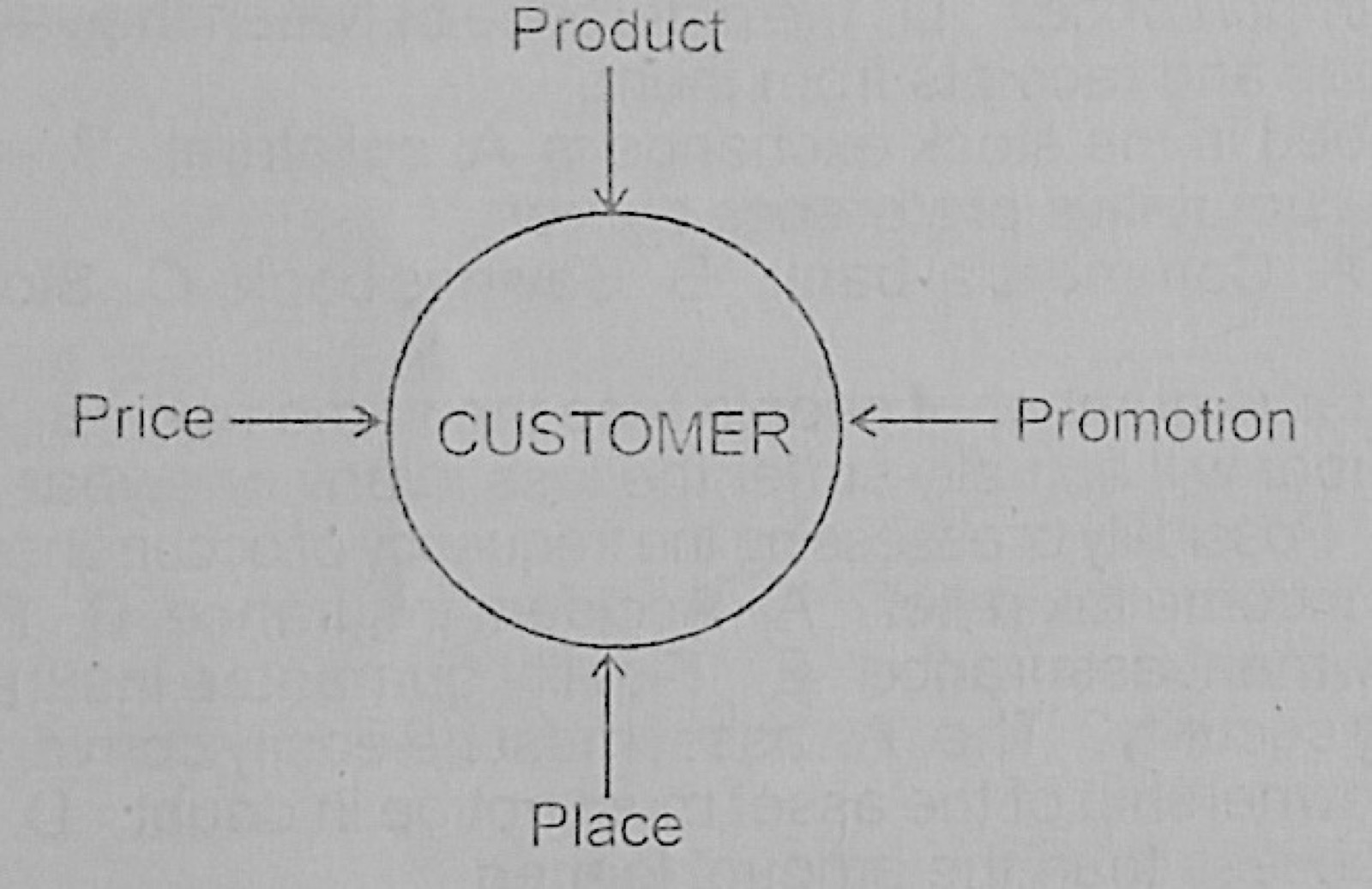
Use the diagram to answer the question.
The diagram above illustrates the marketing concept of

Diagram for this question
  1. A.pricing policy
  2. B.competitive promotion
  3. C.consumer sovereignty
  4. D.distribution channel
  5. E.product policy
Show the answer and explanation

Answer: C (consumer sovereignty)

Explanation

All four elements point at the customer in the centre, showing that the customer is king (consumer sovereignty).

Open this question

Question 59

Marketing

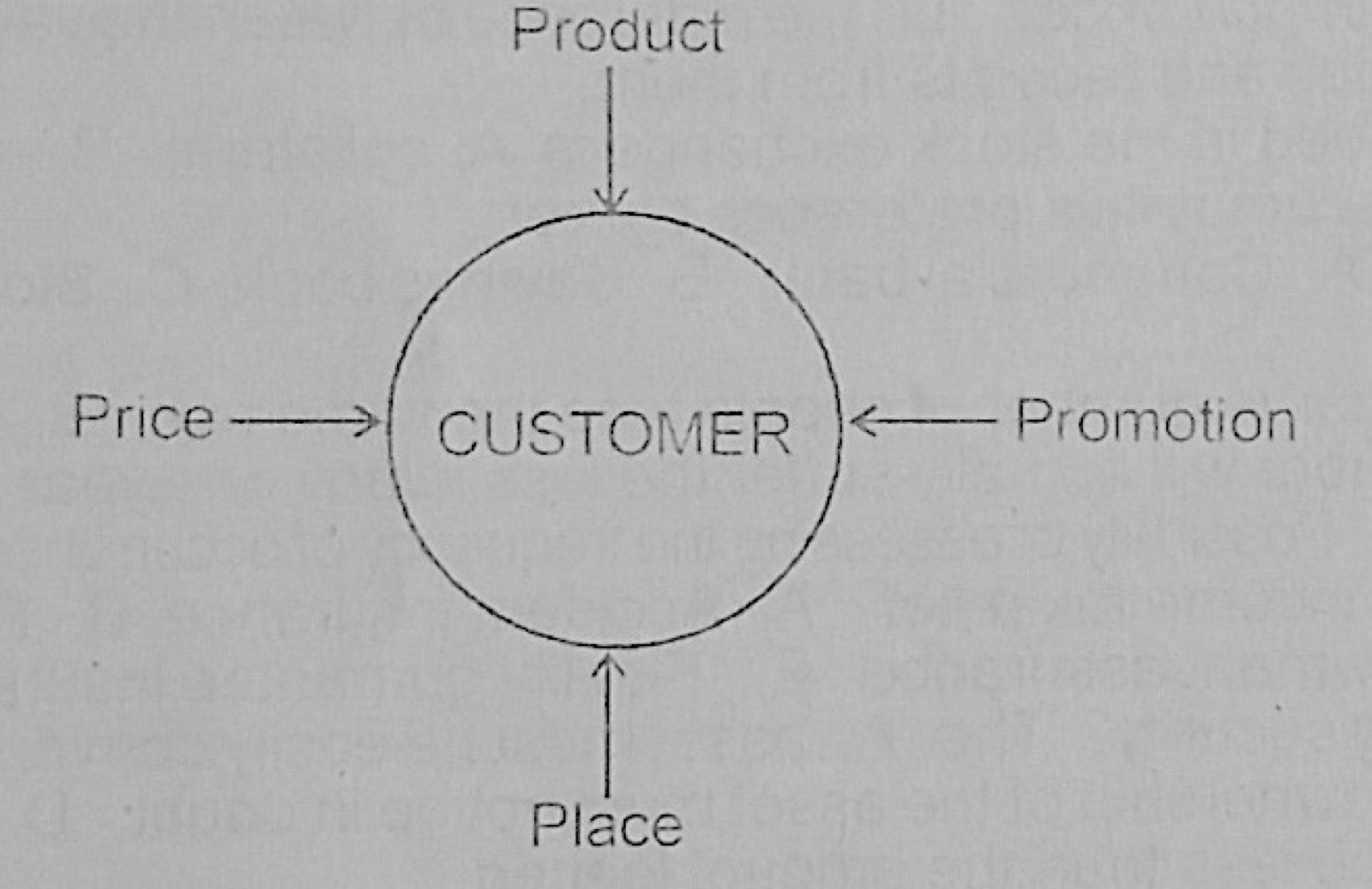
Use the diagram to answer the question.
The diagram contains the four elements of

Diagram for this question
  1. A.product mix
  2. B.promotion mix
  3. C.market segmentation
  4. D.marketing mix
  5. E.pricing policy
Show the answer and explanation

Answer: D (marketing mix)

Explanation

Product, price, place and promotion are the four Ps of the marketing mix.

Open this question

Question 61

Marketing

The use of name, symbol, letter or any combination of these by a company to distinguish its product is called

  1. A.product mix
  2. B.marketing mix
  3. C.slogan
  4. D.trade mark
  5. E.product differentiation
Show the answer and explanation

Answer: D (trade mark)

Explanation

A trade mark is a name or symbol that identifies a firm's product.

Open this question

Question 62

Marketing

The collection of information on the taste of consumers and the extent of demand for a product is called

  1. A.consumer orientation
  2. B.advertising
  3. C.market research
  4. D.marketing mix
  5. E.market segmentation
Show the answer and explanation

Answer: C (market research)

Explanation

Market research gathers information about consumers' tastes and demand.

Open this question

Question 63

Law of Contract

Mr. Orji contracted to sell 10 colour TV sets to Mr. Ede. Unknown to both of them the TV sets were stolen in transit. The contract may be terminated on the grounds of

  1. A.breach of contract
  2. B.performance
  3. C.bankruptcy
  4. D.frustration
  5. E.capacity
Show the answer and explanation

Answer: D (frustration)

Explanation

A contract is frustrated when an event beyond both parties' control makes it impossible to perform.

Open this question

Question 64

Purchase and Sale of Goods

In a hire purchase contract the customer becomes the legal owner of the goods by

  1. A.taking possession of goods
  2. B.paying the first instalment
  3. C.paying the last instalment
  4. D.paying monthly hire charges
  5. E.paying half the purchase price.
Show the answer and explanation

Answer: C (paying the last instalment)

Explanation

Under hire purchase, ownership passes only when the last instalment is paid.

Open this question

Question 65

Consumer Protection

Which of the following makes it an offence for a dealer to give misleading information about goods to consumers?

  1. A.Food and Drugs Act
  2. B.Restrictive Trade Practices Act
  3. C.Consumer Credit Act
  4. D.Trade Description Act
  5. E.Hire Purchase Act
Show the answer and explanation

Answer: D (Trade Description Act)

Explanation

The Trade Descriptions Act forbids false or misleading descriptions of goods.

Open this question

Question 66

Patents, Trademarks and Copyright

Which of the following gives an exclusive right to an inventor?

  1. A.Brand name
  2. B.Trade Mark
  3. C.Patent
  4. D.Copyright
  5. E.Label
Show the answer and explanation

Answer: C (Patent)

Explanation

A patent gives an inventor the sole right to make and sell his invention for some years.

Open this question

Question 67

Retail Trade

A modern trend in retailing which enables customers to purchase all the items needed in a shop is called

  1. A.automatic vending
  2. B.impulse buying
  3. C.one-stop shopping
  4. D.self service
  5. E.cash and carry
Show the answer and explanation

Answer: C (one-stop shopping)

Explanation

One-stop shopping lets customers buy all they need under one roof, as in supermarkets and hypermarkets.

Open this question

Question 68

Production

Who bears the greatest risks in a business? The

  1. A.employees
  2. B.preference shareholders
  3. C.entrepreneurs
  4. D.debenture holders
  5. E.trade creditors
Show the answer and explanation

Answer: C (entrepreneurs)

Explanation

The entrepreneur bears the risk of loss and takes whatever profit is left.

Open this question

Question 69

Business Finance

Dividend paid by public limited companies

  1. A.is based on patronage
  2. B.depends on the price of the shares
  3. C.is based on stock exchange rating
  4. D.depends on profit declared
  5. E.depends on rate of turnover
Show the answer and explanation

Answer: D (depends on profit declared)

Explanation

Dividends are paid out of the profit the company declares.

Open this question

Question 70

Banking

Commercial banks meet to exchange cheques drawn on one another and settle the differences between them at the

  1. A.money market
  2. B.stock exchange market
  3. C.discount house
  4. D.clearing house
  5. E.banking hall
Show the answer and explanation

Answer: D (clearing house)

Explanation

The clearing house is where banks exchange cheques and settle the net amounts they owe each other.

Open this question

Question 71

Business Calculations

Which of the following is likely to record a high rate of turnover?

  1. A.Furniture
  2. B.Gold and trinkets
  3. C.Motor vehicles
  4. D.Newspapers
  5. E.Carvings
Show the answer and explanation

Answer: D (Newspapers)

Explanation

Newspapers are cheap and bought daily, so stock is sold and replaced very quickly.

Open this question

Question 72

Foreign Trade

Restricting the quantity of goods which may be imported into a country is achieved through

  1. A.dumping
  2. B.tariffs
  3. C.terms of payment
  4. D.terms of trade
  5. E.quotas
Show the answer and explanation

Answer: E (quotas)

Explanation

A quota fixes the maximum quantity of a good that may be imported.

Open this question

Question 73

Banking

A cheque is cleared

  1. A.when it has been accepted by the drawer
  2. B.when the amount specified has been credited to the payee
  3. C.when it is deposited
  4. D.if the alterations are signed
  5. E.when it has been taken away for safe keeping
Show the answer and explanation

Answer: B (when the amount specified has been credited to the payee)

Explanation

A cheque is cleared when the money has passed from the drawer's account to the payee's account.

Open this question

Question 74

Retail Trade

A group of retailing shops with standard shop fronts and centralised buying is known as

  1. A.department stores
  2. B.unit shops
  3. C.mobile shops
  4. D.supermarket
  5. E.multiple stores
Show the answer and explanation

Answer: E (multiple stores)

Explanation

Multiple stores (chain stores) have identical shop fronts and buy centrally.

Open this question

Question 75

Law of Contract

Master Ojo is 14 years old. He entered into contract with Ade for the supply of 20 T- shirts. Ojo received the T- shirts but has refused to pay. Ade's lawyer said that the contract is void because it lacked one of the basic elements of a valid contract which is

  1. A.offer and acceptance
  2. B.consideration
  3. C.intention to create legal relations
  4. D.capacity
  5. E.legality
Show the answer and explanation

Answer: D (capacity)

Explanation

A 14-year-old is a minor and lacks the legal capacity to make most contracts.

Open this question

Question 76

Marketing

Goods sold under a distinctive trade mark are known as

  1. A.industrial goods
  2. B.commercial goods
  3. C.consumer goods
  4. D.branded goods
  5. E.speciality goods
Show the answer and explanation

Answer: D (branded goods)

Explanation

Goods given a distinctive name or mark are branded goods.

Open this question

Question 77

Consumer Protection

Actions by organized body of consumers to express dissatisfaction with the quality, price and quantity of goods available to them is called

  1. A.consumer behaviour
  2. B.consumer sovereignty
  3. C.consumerism
  4. D.consumer orientation
  5. E.consumer education
Show the answer and explanation

Answer: C (consumerism)

Explanation

Consumerism is the organised movement of consumers protesting about poor quality, high prices or short supply.

Open this question

Question 78

Consumer Protection

Any act that is aimed at making manufacturers meet some required standards is to

  1. A.prevent competition
  2. B.control price
  3. C.protect the consumer
  4. D.discourage dumping
  5. E.facilitate advertisement
Show the answer and explanation

Answer: C (protect the consumer)

Explanation

Laws on standards protect consumers from poor or dangerous goods.

Open this question

Question 79

Law of Contract

Which of the following makes for a valid contract?

  1. A.Discharge and performance
  2. B.Offer and acceptance
  3. C.Age and maturity
  4. D.Promise and capacity
  5. E.Consideration and frustration
Show the answer and explanation

Answer: B (Offer and acceptance)

Explanation

Offer and acceptance are basic elements of a valid contract.

Open this question

Question 80

Trade Associations

A voluntary association which consists of people who represent a cross section of business interests in a town is the

  1. A.chamber of commerce
  2. B.voluntary agency
  3. C.trade association
  4. D.business association
  5. E.trade union
Show the answer and explanation

Answer: A (chamber of commerce)

Explanation

A chamber of commerce brings together all kinds of businesses in a town or area.

Open this question

Question 81

Business Combinations

Which of the following is specifically formed to finance projects that are too large for a single firm to undertake?

  1. A.Trusts
  2. B.Merger
  3. C.Holding company
  4. D.Cartel
  5. E.Consortium
Show the answer and explanation

Answer: E (Consortium)

Explanation

A consortium is a temporary grouping of firms to undertake a project too big for one of them.

Open this question

Question 82

Trade Associations

A voluntary body formed by people in the same line of business for the purpose of protecting their interest is

  1. A.business association
  2. B.trade association
  3. C.trade union
  4. D.chamber of commerce
  5. E.trading partners
Show the answer and explanation

Answer: B (trade association)

Explanation

A trade association is made up of firms in the same trade.

Open this question

Question 83

Business Combinations

A holding company exercises control over its subsidiaries by

  1. A.changing the administration completely
  2. B.becoming the principal customer
  3. C.increasing the number of workers
  4. D.owning majority of the shares
  5. E.paying off the debts
Show the answer and explanation

Answer: D (owning majority of the shares)

Explanation

A holding company controls subsidiaries by owning more than half of their voting shares.

Open this question

Question 84

Business Combinations

An organisation that aims at restricting supply in order to keep up price is known as

  1. A.cartel
  2. B.price ring
  3. C.GATT
  4. D.ECOWAS
  5. E.Customs Union
Show the answer and explanation

Answer: A (cartel)

Explanation

A cartel restricts output to keep prices high.

Open this question

Question 85

Purchase and Sale of Goods

A document of title to goods which also serves as a contract between the seller and the shipping company is known as

  1. A.bill of lading
  2. B.bill of exchange
  3. C.ship's manifest
  4. D.bill of entry
  5. E.letter of hypothecation
Show the answer and explanation

Answer: A (bill of lading)

Explanation

A bill of lading is a receipt, a contract of carriage and a document of title.

Open this question

Question 86

Business Management

A diagram showing the formal lines of authority in any establishment is known as

  1. A.a map of the organisation
  2. B.span of control
  3. C.an organisation chart
  4. D.channel of distribution
  5. E.unity of command
Show the answer and explanation

Answer: C (an organisation chart)

Explanation

An organisation chart shows positions and the lines of authority between them.

Open this question

Question 87

Business Management

Which of the following is responsible for preparing the balance sheet of a public limited company?

  1. A.Public Relations Department
  2. B.Personnel Department
  3. C.Administration Department
  4. D.Research Department
  5. E.Finance Department
Show the answer and explanation

Answer: E (Finance Department)

Explanation

The finance (accounts) department prepares the final accounts and balance sheet.

Open this question

Question 88

Business Management

A structure of direct vertical relationship connecting the positions at each level in an organization is called

  1. A.staff organisation
  2. B.lateral organisation
  3. C.line organisation
  4. D.functional organisation
  5. E.line and staff organisation
Show the answer and explanation

Answer: C (line organisation)

Explanation

In line organisation, authority flows straight down from top to bottom.

Open this question

Question 89

Business Management

The process of transferring decision making to low levels of the organisation hierarchy is called

  1. A.span of control
  2. B.delegation of authority
  3. C.management of authority
  4. D.centralisation of authority
  5. E.unity of command
Show the answer and explanation

Answer: B (delegation of authority)

Explanation

Delegation passes authority to make decisions down to subordinates.

Open this question

Question 90

Business Management

The process by which the structure and allocation of jobs are determined is a management function of

  1. A.staffing
  2. B.motivating
  3. C.controlling
  4. D.organising
  5. E.directing
Show the answer and explanation

Answer: D (organising)

Explanation

Organising sets up the structure and assigns jobs and authority.

Open this question

Question 91

Business Management

The process of establishing objectives for the organisation and determining the best ways to achieve them is a management function of

  1. A.Communicating
  2. B.Organising
  3. C.Planning
  4. D.Controlling
  5. E.Motivating
Show the answer and explanation

Answer: C (Planning)

Explanation

Planning sets objectives and decides how to reach them.

Open this question

Question 92

Business Management

The number of subordinates that one person can supervise effectively in an organisation is referred to as

  1. A.unity of command
  2. B.chain of command
  3. C.organisation hierarchy
  4. D.delegation of authority
  5. E.Span of control
Show the answer and explanation

Answer: E (Span of control)

Explanation

Span of control is the number of subordinates one manager can supervise well.

Open this question

Question 93

Business Management

Measuring performance against the set objectives in an organisation is a management function that relates to

  1. A.staffing
  2. B.planning
  3. C.organising
  4. D.departmentalization
  5. E.controlling
Show the answer and explanation

Answer: E (controlling)

Explanation

Controlling compares actual performance with the plan and corrects differences.

Open this question

Question 94

Business Environment and Social Responsibility

When a company contributes to the welfare of the immediate community, it is performing a

  1. A.political responsibility
  2. B.economic responsibility
  3. C.social responsibility
  4. D.legal responsibility
  5. E.technological responsibility
Show the answer and explanation

Answer: C (social responsibility)

Explanation

Helping the community it operates in is a firm's social responsibility.

Open this question

Question 95

Foreign Trade

Which of the following is not related to imports?

  1. A.Customs duties
  2. B.Excise duties
  3. C.Certificate of origin
  4. D.Bill of Lading
  5. E.Ship's manifest
Show the answer and explanation

Answer: B (Excise duties)

Explanation

Excise duties are taxes on goods made at home, not on imports.

Open this question

Question 96

Stock Exchange

Which of the following is not true of the stock exchange?

  1. A.It is a commodity market
  2. B.It is a market for stock and shares
  3. C.It draws up rules to guide share dealing
  4. D.Government and companies raise funds through it
  5. E.Prices for shares are determined by it
Show the answer and explanation

Answer: A (It is a commodity market)

Explanation

The stock exchange deals in securities, not in commodities such as cocoa or metals.

Open this question

Question 98

Insurance

Life assurance premium is determined by the

  1. A.educational standard of the assured
  2. B.reputation of the assured
  3. C.number of the assured's children
  4. D.age of the assured
  5. E.sex of the assured
Show the answer and explanation

Answer: D (age of the assured)

Explanation

The older the person, the greater the risk of death, so age largely decides the premium.

Open this question

Question 99

Foreign Trade

Which of the following accurately describes the basis for international trade?

  1. A.terms of trade
  2. B.Absolute cost advantage
  3. C.Comparative cost advantage
  4. D.Division of labour
  5. E.Specialization
Show the answer and explanation

Answer: C (Comparative cost advantage)

Explanation

Countries trade because each specialises in what it produces at a comparatively lower cost.

Open this question

Theory question 101

Business Units

Commerce 2 (answer five questions)
(a) What is a Public Limited Company?
(b) State and explain any five features distinguishing a Public Limited Company from a Partnership.

Show the model answer
Model answer

(a) A public limited company is a business owned by shareholders (minimum of seven, now two, with no upper limit), registered under the Companies Act, with limited liability, whose shares are offered to the public and freely transferable on the stock exchange; it is a legal person separate from its owners.
(b) Any five, explained by contrast: legal personality – PLC is separate from its members and can sue and be sued, a partnership is not; liability – shareholders' liability is limited to their shares, partners (except limited partners) have unlimited liability; capital – PLC raises large capital from the public through shares and debentures, partners contribute their own capital; membership – no maximum for a PLC, a partnership has 2 to 20 members; transfer of ownership – shares freely transferable, a partner cannot transfer his share without others' consent; continuity – PLC has perpetual succession, a partnership may end on death, bankruptcy or withdrawal of a partner; management – PLC run by a board of directors elected by shareholders, partners manage the firm themselves; formation – PLC registers Memorandum and Articles and gets a certificate of incorporation and trading certificate, a partnership needs only a deed or agreement; publicity – PLC must publish audited accounts, a partnership's accounts are private.

Explanation

In (b) every point should say what the PLC does and what the partnership does.

Open this question

Theory question 102

Wholesale Trade

Commerce 2 (answer five questions)
(a) State any five channels of distribution for consumer goods.
(b) Explain five factors to be considered before choosing a particular channel.

Show the model answer
Model answer

(a) Any five: producer → wholesaler → retailer → consumer; producer → retailer → consumer; producer → consumer (direct, e.g. own shops, mail order, door-to-door); producer → agent → wholesaler → retailer → consumer; producer → agent → retailer → consumer; producer → wholesaler → consumer; producer → agent → consumer.
(b) Any five, explained: nature of the product – perishable, bulky, technical or expensive goods use short channels; number and location of customers – many scattered buyers need wholesalers and retailers, few concentrated buyers can be served directly; size of orders – large orders favour direct sales; financial strength of the producer – a rich producer can run his own outlets and salesmen; cost of each channel and the margins of middlemen; producer's wish to control price, quality and after-sales service; availability and efficiency of middlemen; competitors' channels and government regulations.

Explanation

List channels as chains of arrows; in (b) say how each factor makes the channel longer or shorter.

Open this question

Theory question 103

Business Finance

Commerce 2 (answer five questions)
(a) What is Capital?
(b) Explain five types of Capital.

Show the model answer
Model answer

(a) Capital is the money and other assets (wealth) that the owner(s) put into a business to start and run it; in accounts, capital = assets − liabilities.
(b) Any five, explained: authorised (nominal/registered) capital – the maximum share capital a company may issue, stated in its Memorandum; issued capital – the part of authorised capital actually offered to and taken up by shareholders; called-up capital – the part of issued capital the company has asked shareholders to pay; paid-up capital – the part of called-up capital actually paid; capital owned – assets less liabilities, the owner's net worth; capital employed – capital owned plus long-term liabilities, or fixed assets plus working capital; working capital – current assets less current liabilities, used for day-to-day running; liquid capital – cash and assets quickly turned into cash; fixed capital – money tied up in fixed assets such as buildings and machinery; borrowed capital – loans, debentures and overdrafts.

Explanation

Define each type briefly; formulas earn credit for capital employed and working capital.

Open this question

Theory question 104

Government and Business

Commerce 2 (answer five questions)
(a) Mention and explain the four business resources.
(b) Explain four ways by which government regulates business.

Show the model answer
Model answer

(a) Four resources (factors of production): land/natural resources – sites, raw materials, minerals, water; labour – human effort, physical and mental, used in production; capital – money and man-made aids such as machines, buildings, vehicles; entrepreneur/management – the person who organises the other resources, takes decisions and bears the risk. (Accept also money, materials, machines and men/manpower as the four Ms.)
(b) Any four, explained: legislation – laws on registration of businesses, companies (CAMA), contracts, sale of goods, hire purchase; consumer protection laws and agencies – standards (SON), food and drugs (NAFDAC), price control, weights and measures; licensing and registration – permits and licences before trading; taxation and tariffs – company tax, excise and customs duties, import bans and quotas; monetary policy through the Central Bank – interest rates, credit control; indigenisation, nationalisation and privatisation policies; labour laws – minimum wage, safety at work, trade union rules; environmental and zoning laws on where firms may locate.

Explanation

Name each resource and say what it contributes; in (b) give the means and its effect on business.

Open this question

Theory question 105

Transport

Commerce 2 (answer five questions)
(a) Describe five factors that determine the choice of means of transportation for goods.
(b) Explain five factors that have contributed to the growth of commerce.

Show the model answer
Model answer

(a) Any five, described: cost/freight charges compared with the value of the goods; nature of the goods – perishable goods need speed, fragile goods safety, bulky goods water/rail, liquids pipeline; speed/urgency of delivery; distance and destination – air or sea for long distances, road for short; safety and security of the goods; availability and regularity of the means; flexibility – road can give door-to-door service; terrain and the facilities available (roads, rail lines, ports).
(b) Any five, explained: specialisation and division of labour, creating surpluses for exchange; development of money as a medium of exchange; improved transport; improved communication (post, telephone, internet); growth of banking and credit facilities; development of insurance, which reduces risks; warehousing; advertising and mass media; large-scale production (industrial revolution); government policies, peace and stability, and growth of international trade and economic groupings; growth of population and income.

Explanation

In (a) relate each factor to the kind of goods; in (b) show how each factor increased trade.

Open this question

Theory question 106

Foreign Trade Documents

Commerce 2 (answer five questions)
(a) List five documents used in foreign trade.
(b) Explain five conditions under which an agency may be terminated.

Show the model answer
Model answer

(a) Any five: indent (order); letter of credit; bill of lading; consular invoice; certificate of origin; bill of entry; shipping note; export licence/import licence; mate's receipt; ship's manifest; marine insurance policy/certificate; bill of exchange; dock warrant; pro forma invoice; Form M.
(b) Any five, explained: by agreement of principal and agent; completion of the task (performance) for which the agent was appointed; expiry of the agreed period; revocation by the principal or renunciation by the agent (with notice); death of either party; insanity of either party; bankruptcy of the principal (or of the agent); destruction of the subject matter; the business becoming illegal (frustration); breach of duty by the agent.

Explanation

(a) only needs names; (b) needs a sentence on each condition.

Open this question

Theory question 107

Advertising

Commerce 2 (answer five questions)
(a) Explain five roles of advertising.
(b) Give three advantages and two disadvantages of using television as a medium of advertising.

Show the model answer
Model answer

(a) Any five, explained: informs consumers about new products, prices, uses and where to buy them; persuades people to buy and increases sales; creates and maintains demand, which allows mass production and lower unit cost; helps a firm meet competition and keep customers loyal (brand loyalty); educates consumers on how to use products; builds the image/goodwill of the firm; reminds customers of existing products; creates employment in the media and advertising agencies; provides revenue for the mass media.
(b) Advantages (any three): combines sight, sound, colour and movement, so it is very attractive; reaches a large audience at once, including illiterates; products can be demonstrated; high impact and easily remembered; can target audiences by programme and time.
Disadvantages (any two): very expensive to produce and air; message is short and quickly forgotten; reaches only people with sets and electricity; viewers may switch channels during adverts; cannot be kept for later reference.

Explanation

Explain each role; keep advantages and disadvantages of television separate.

Open this question

Theory question 108

Communication

Commerce 2 (answer five questions)
(a) Explain five services which NIPOST renders to the public.
(b) Give five advantages of using courier service.

Show the model answer
Model answer

(a) Any five, explained: collection and delivery of letters (ordinary, registered, express/EMS); parcel post; postal orders and money orders for sending money; private mail bags and post office boxes; poste restante – keeping mail for travellers to collect; sale of stamps and stationery, philatelic services; savings services (post office savings); speed post/express mail service; business reply and franking services; payment of pensions and collection of some bills and fees; agency services such as sale of licences.
(b) Any five: speed – fast delivery, often next day; door-to-door delivery and pick-up; safety and security of items, with tracking; proof of delivery (signature); delivery both within the country and abroad; handles documents and parcels of various sizes; reliability; some offer insurance cover for items.

Explanation

Name each NIPOST service and say what it does for the public.

Open this question

Theory question 109

Marketing

Commerce 2 (answer five questions)
(a) Describe five reasons why a manufacturer may brand his products.
(b) Outline five services rendered by the wholesaler to the manufacturer.

Show the model answer
Model answer

(a) Any five, described: to distinguish his product from competitors'; to make advertising easier and more effective; to build brand loyalty and repeat buying; to make it possible to charge a higher or stable price; to give assurance of quality and standard; to protect the product from imitation (with a registered trade mark); to make the product easy to identify and order; to introduce new products under a known name.
(b) Any five: buys in bulk, saving the manufacturer the cost of many small orders; gives market information about consumers' tastes and complaints; stores (warehouses) goods, relieving the manufacturer of storage costs; bears risks of price change, damage and theft; may finance the manufacturer by paying promptly or in advance; distributes goods to retailers over a wide area; helps advertise and promote the products; may pack, grade and label goods; enables continuous production by placing regular orders.

Explanation

Five points in each part, with a short explanation for (a).

Open this question

Theory question 110

Government and Business

Commerce 2 (answer five questions)
(a) Differentiate between Indigenisation and Nationalisation.
(b) Give five advantages and three disadvantages of Indigenisation.

Show the model answer
Model answer

(a) Indigenisation is a policy that transfers ownership and control of businesses from foreigners to citizens (individual Nigerians and government), e.g. the Nigerian Enterprises Promotion Decrees of 1972 and 1977. Nationalisation is the government taking over ownership and control of privately owned businesses (local or foreign), making them public enterprises. Differences: who acquires ownership (citizens/private persons vs the State); aim (economic independence and local participation vs public control of strategic industries); compensation and scope.
(b) Advantages (any five): increases Nigerians' participation and control of the economy; reduces foreign domination and repatriation of profits; develops local entrepreneurs and managerial skills; creates employment and promotion for citizens; keeps profits in the country; encourages use of local raw materials and technology; promotes economic independence and national pride.
Disadvantages (any three): discourages foreign investment and capital inflow; shortage of local capital, skills and technology; fronting – Nigerians used as fronts for foreigners; shares concentrated in the hands of a few rich people; possible fall in efficiency and quality; may lead to loss of foreign expertise and technology.
Explanation

In (a) show who takes over in each case.

Open this question