JAMB Physics 2006 past questions and answers

45 questions. Try each one, then open the answer to check yourself and read the explanation.

Question 1

Electronics

When the base current of a common-emitter transistor is kept at zero, it operates in the

  1. A.active-on region.
  2. B.breakdown region.
  3. C.saturation region.
  4. D.cut-off region.
Show the answer and explanation

Answer: D (cut-off region.)

Explanation

A transistor conducts only when a base current flows. With the base current at zero the collector current is (almost) zero, so the transistor is in the cut-off region (switched off).

Open this question

Question 2

Radioactivity and Nuclear Physics

One of the properties of gamma rays is that they are

  1. A.negatively charged
  2. B.massive
  3. C.neutral
  4. D.positively charged
Show the answer and explanation

Answer: C (neutral)

Explanation

Gamma rays are electromagnetic waves (photons). They carry no charge and have no rest mass, so they are not deflected by electric or magnetic fields.

Open this question

Question 3

Electronics

The theory of electronic conduction in solids, which satisfactorily explains the properties of conductors, insulators and semiconductors, is

  1. A.particle theory.
  2. B.band theory.
  3. C.group theory.
  4. D.string theory.
Show the answer and explanation

Answer: B (band theory.)

Explanation

Band theory explains conduction by the gap between the valence band and the conduction band: no gap in conductors, a small gap in semiconductors and a large gap in insulators.

Open this question

Question 5

Electronics

A certain manufacturer wishes to make an n-type semi-conductor. Which materials would he select for dopping?

  1. A.Arsenic and antimony
  2. B.Aluminium and indium
  3. C.Boron and antimony
  4. D.Helium and boron
Show the answer and explanation

Answer: A (Arsenic and antimony)

Explanation

n-type material is made by adding pentavalent (group V) atoms, which give a spare electron. Arsenic and antimony both have five valence electrons.

Open this question

Question 7

Radioactivity and Nuclear Physics

I. The number of neutrons released exceeds the number that caused the fission.
II. There is loss of mass.
III. Energy is produced
IV. Smaller nuclei merge to form larger nuclei.
Which of the statements above are correct about nuclear fission?

  1. A.I, II and IV only
  2. B.I, II and III only
  3. C.I, III and IV only
  4. D.II, III and IV only
Show the answer and explanation

Answer: B (I, II and III only)

Explanation

In fission a heavy nucleus splits, releasing more neutrons than it absorbed, with a loss of mass that appears as energy. Small nuclei joining together (IV) is fusion, so only I, II and III are correct.

Open this question

Question 8

Modern Physics

The energy associated with the emitted photon when a mercury atom changes from one state to another is 3.3 eV. Calculate the frequency of the photon. [e = 1.6 × 10⁻¹⁹ C; h = 6.6 × 10⁻³⁴ Js]

  1. A.8.0 × 1014 Hz
  2. B.3.1 × 1052 Hz
  3. C.1.3 × 10−15 Hz
  4. D.3.2 × 10−53 Hz
Show the answer and explanation

Answer: A (8.0 × 10¹⁴ Hz)

Explanation

E = 3.3 × 1.6 × 10−19 = 5.28 × 10⁻¹⁹ J. f = E/h = 5.28 × 10⁻¹⁹ ÷ 6.6 × 10−34 = 8.0 × 10¹⁴ Hz.

Open this question

Question 9

Electronics

A p-n junction diode is used as

  1. A.a rectifier in a d.c. circuit.
  2. B.an amplifier in an a.c.circuit.
  3. C.a rectifier in an a.c circuit.
  4. D.an amplifier in a d.c. circuit.
Show the answer and explanation

Answer: C (a rectifier in an a.c circuit.)

Explanation

A diode lets current flow in one direction only, so it is used to rectify (change a.c. to d.c.) in an a.c. circuit. It cannot amplify.

Open this question

Question 10

Electronics

The battery connection that permits current to flow across a p-n junction is called

  1. A.amplification.
  2. B.rectification.
  3. C.forward biased.
  4. D.reverse biased.
Show the answer and explanation

Answer: C (forward biased.)

Explanation

When the p-side is connected to the positive terminal (forward bias), the depletion layer narrows and current flows across the junction.

Open this question

Question 11

Modern Physics

The process through which free electrons leave the surface of hot metals is known as

  1. A.thermionic emission.
  2. B.photo emission.
  3. C.photon emission.
  4. D.electron emission.
Show the answer and explanation

Answer: A (thermionic emission.)

Explanation

Heating a metal gives its free electrons enough energy to escape from the surface; this is thermionic emission.

Open this question

Question 12

Equilibrium of Forces

A mirror of weight 75 N is hung by a cord from a hook on the wall. If the cord makes an angle of 30° with the horizontal, the tension in the cord is

  1. A.150 N.
  2. B.100 N .
  3. C.1500 N.
  4. D.250 N.
Show the answer and explanation

Answer: A (150 N.)

Explanation

The vertical part of the tension holds up the weight: T sin 30° = 75 N, so T = 75 ÷ 0.5 = 150 N.

Open this question

Question 13

Motion

The motion of smoke particles from a chimney is typical of

  1. A.oscillatory motion.
  2. B.rotational motion.
  3. C.circular motion.
  4. D.random motion.
Show the answer and explanation

Answer: D (random motion.)

Explanation

Smoke particles are knocked about irregularly by air molecules, so they move in no fixed direction: random motion.

Open this question

Question 14

Scalars and Vectors

The component of vector X along the direction of vector Y is zero when

  1. A.X is at an angle of 45° to Y.
  2. B.X and Y are in opposite directions to each other.
  3. C.X and Y are parallel to each other.
  4. D.X is perpendicular to Y.
Show the answer and explanation

Answer: D (X is perpendicular to Y.)

Explanation

The component of X along Y is X cos θ. This is zero when cos θ = 0, that is θ = 90°, so X must be perpendicular to Y.

Open this question

Question 15

Simple Machines

I. Work done by load is always less than the work done by effort
II. All machines are made of levers, pulleys, screws and gear wheels.
III. A fishing rod is a machine
IV. Effort is always larger than load.
Which of the statements above about machines are true?

  1. A.III and IV
  2. B.I and II
  3. C.I and III
  4. D.II and III
Show the answer and explanation

Answer: C (I and III)

Explanation

Friction makes useful work output less than work input (I true), and a fishing rod is a lever, so it is a machine (III true). Not all machines are levers, pulleys, screws or gears, and many machines lift a load bigger than the effort.

Open this question

Question 16

Work, Energy and Power

An engine of a car of power 80 kW moves on a rough road with a velocity of 32 ms−1. The force required to bring it to rest is

  1. A.2.50 × 105 N.
  2. B.2.50 × 103 N.
  3. C.2.56 × 106 N.
  4. D.2.80 × 103 N.
Show the answer and explanation

Answer: B (2.50 × 10³ N.)

Explanation

Power = force × velocity, so F = P/v = 80 000 ÷ 32 = 2500 N = 2.50 × 10³ N.

Open this question

Question 17

Gravitational Field

If the radius of the earth is 6.4 × 10⁶m, the escape velocity of a satellite from the earth is [g = 10ms−2]

  1. A.8.00 × 103ms−1.
  2. B.9.00 × 103ms−1.
  3. C.1.13 × 104ms−1.
  4. D.1.27 × 104ms−1.
Show the answer and explanation

Answer: C (1.13 × 10⁴ms−1.)

Explanation

Escape velocity v = √(2gR) = √(2 × 10 × 6.4 × 106) = √(1.28 × 10⁸) ≈ 1.13 × 10⁴ m s−1.

Open this question

Question 19

Motion

A shooter wants to fire a bullet in such a way that its horizontal range is equal to three times its maximum height. At what angle should he fire the bullet to achieve this?

  1. A.53°
  2. B.68°
  3. C.30°
  4. D.45°
Show the answer and explanation

Answer: A (53°)

Explanation

R = 2u2sin θ cos θ/g and H = u2sin2θ/2g. Setting R = 3H gives 2 cos θ = 1.5 sin θ, so tan θ = 4/3 and θ ≈ 53°.

Open this question

Question 20

Measurement and Units

The correct unit of energy density is

  1. A.kg m−3s−2.
  2. B.kg m−1s−2.
  3. C.kg m2s−2.
  4. D.kg m2s−2.
Show the answer and explanation

Answer: B (kg m−1s−2.)

Explanation

Energy density is energy per unit volume: J m−3 = (kg m2 s−2) ÷ m3 = kg m−1 s−2.

Open this question

Question 21

Electrostatics

The production and type of charge of a body can only be accounted for by the

  1. A.equilibrium in protons and neutrons.
  2. B.deficiency or surplus of electrons.
  3. C.deficiency or surplus of protons.
  4. D.deficiency or surplus of neutrons.
Show the answer and explanation

Answer: B (deficiency or surplus of electrons.)

Explanation

Only electrons move when bodies are charged. A body with extra electrons is negative; one that has lost electrons is positive.

Open this question

Question 22

Current Electricity

The electrolyte in the Nickel-iron (Nife) accumulator is

  1. A.ammonium chloride solution.
  2. B.dilute tetraoxosulphate(VI) acid.
  3. C.copper tetraoxosulphate(VI) solution.
  4. D.potassium hydroxide solution.
Show the answer and explanation

Answer: D (potassium hydroxide solution.)

Explanation

The NiFe (alkaline) accumulator uses potassium hydroxide solution as its electrolyte; the lead-acid accumulator uses dilute sulphuric acid.

Open this question

Question 23

Electromagnetic Induction

The main purpose of the transformer in an a.c. radio set is to

  1. A.increase power to the radio.
  2. B.convert energy from a.c. to d.c.
  3. C.step down the voltage.
  4. D.step up the voltage.
Show the answer and explanation

Answer: C (step down the voltage.)

Explanation

A radio works on a low voltage, so its transformer steps the mains voltage down. A transformer cannot increase power or change a.c. to d.c.

Open this question

Question 24

Alternating Current Circuits

When an a.c. voltage is applied to a capacitor, no power is consumed because the current

  1. A.and voltage are 180° out of phase.
  2. B.and voltage are in phase.
  3. C.lags behind the voltage by 90°.
  4. D.leads the voltage by 90°.
Show the answer and explanation

Answer: D (leads the voltage by 90°.)

Explanation

In a pure capacitor the current leads the voltage by 90°, so the average power (VI cos 90°) is zero: energy stored in one quarter-cycle is returned in the next.

Open this question

Question 25

Electrical Energy and Power

An electric heater with a p.d. of 240 V connected across its terminals has a total resistance of 960 Ω. Find the power rating of the heater.

  1. A.4.00 W.
  2. B.0.25 W.
  3. C.60.00 W.
  4. D.38.40 W.
Show the answer and explanation

Answer: C (60.00 W.)

Explanation

P = V2/R = 2402 ÷ 960 = 57 600 ÷ 960 = 60 W.

Open this question

Question 26

Current Electricity

An ammeter of resistance 5 Ω has a full-scale deflection when a current of 50 mA flows in it. The value of the resistor required to adapt it to measure a current of 5 A is

  1. A.19.80 Ω
  2. B.5.00 Ω
  3. C.0.05 Ω
  4. D.0.25 Ω
Show the answer and explanation

Answer: C (0.05 Ω)

Explanation

A shunt in parallel must carry 5 − 0.05 = 4.95 A with the same p.d. as the meter: 0.05 × 5 = 4.95 × S, so S ≈ 0.05 Ω.

Open this question

Question 27

Alternating Current Circuits

When a certain a.c. supply is connected to a lamp, it lights with the same brightness as it does with a 12 V d.c. battery. The r.m.s. value of the a.c. supply is

  1. A.8.5 V.
  2. B.17.0 V.
  3. C.3.5 V.
  4. D.12.0 V.
Show the answer and explanation

Answer: D (12.0 V.)

Explanation

The r.m.s. value of an a.c. is the d.c. value that gives the same heating effect. Same brightness as 12 V d.c. means the r.m.s. voltage is 12 V.

Open this question

Question 29

Capacitors

If the capacitance of a capacitor is C = εA/d, which of the following parameters is varied when a variable capacitor is used for tuning radio sets?

  1. A.Area and distance
  2. B.Constant (ε) only.
  3. C.Constant (ε) and area.
  4. D.Distance only.
Show the answer and explanation

Answer: A (Area and distance)

Explanation

In a tuning capacitor, turning the knob moves one set of plates between the other, changing the overlapping area of the plates (and so the capacitance); the dielectric (air) stays the same.

Open this question

Question 30

Magnetism

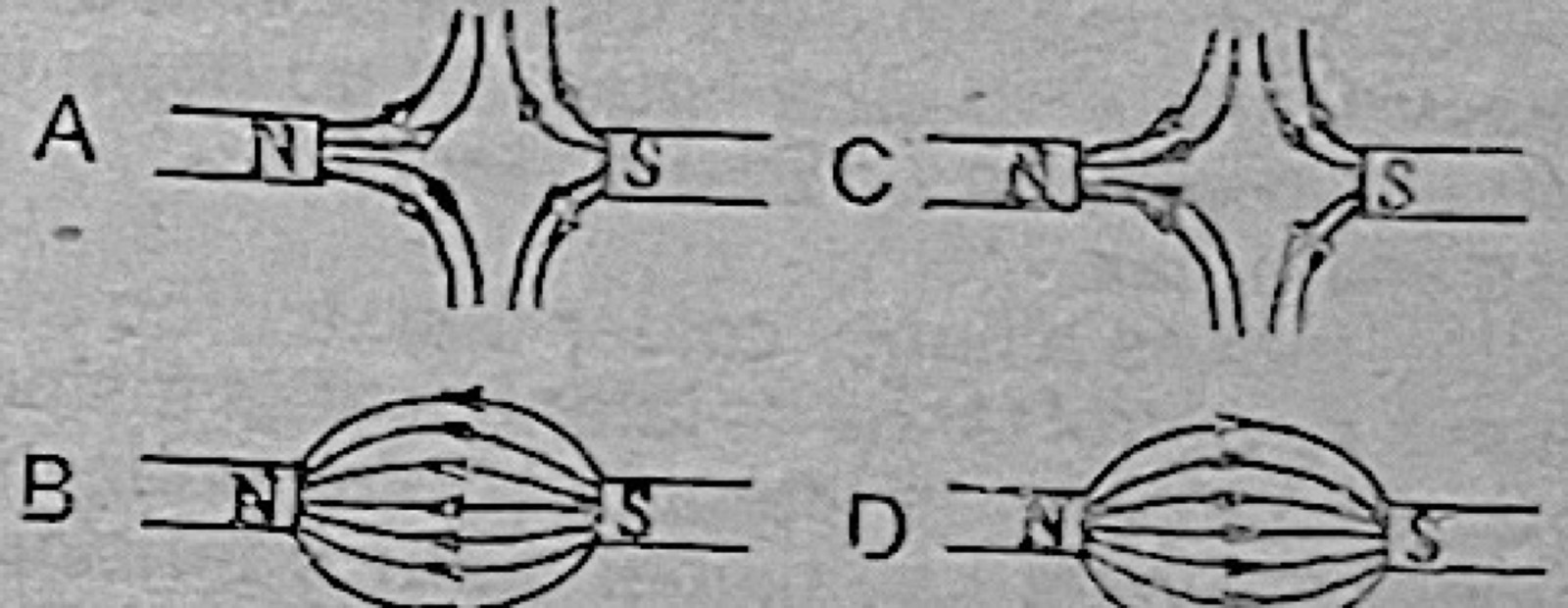
Which of the following diagrams represents the magnetic field of two isolated unlike poles?

Diagram for this question
  1. A.A
  2. B.B
  3. C.C
  4. D.D
Show the answer and explanation

Answer: D (D)

Explanation

Unlike poles attract, so field lines run straight across from N to S, and the arrows point from the N pole towards the S pole. Only D shows this.

Open this question

Question 31

Current Electricity

A cell of internal resistance r is connected to an external resistor R. The condition for maximum power transfer is

  1. A.R < r
  2. B.R = 2r.
  3. C.R = r.
  4. D.R > r.
Show the answer and explanation

Answer: C (R = r.)

Explanation

The maximum power is delivered to the external resistor when its resistance equals the internal resistance of the cell: R = r.

Open this question

Question 32

Capacitors

The capacitance of a parallel-plate capacitor when in air is 3 μf and in the presence of a dielectric material 6 μf. The dielectric constant is

  1. A.3.
  2. B.18.
  3. C.2.
  4. D.9.
Show the answer and explanation

Answer: C (2.)

Explanation

Dielectric constant = capacitance with dielectric ÷ capacitance in air = 6 ÷ 3 = 2.

Open this question

Question 33

Lenses and Optical Instruments

A person can focus objects when they lie beyond 75cm from his eyes. The focal length of the lens required to reduce his least distance of distinct vision to 25 cm is

  1. A.25.00 cm.
  2. B.37.50 cm.
  3. C.75.00 cm.
  4. D.18.75 cm.
Show the answer and explanation

Answer: B (37.50 cm.)

Explanation

This long-sighted person needs a converging lens that makes an object at u = 25 cm appear at 75 cm (virtual image, v = −75 cm). 1/f = 1/25 − 1/75 = 2/75, so f = 37.5 cm.

Open this question

Question 34

Waves

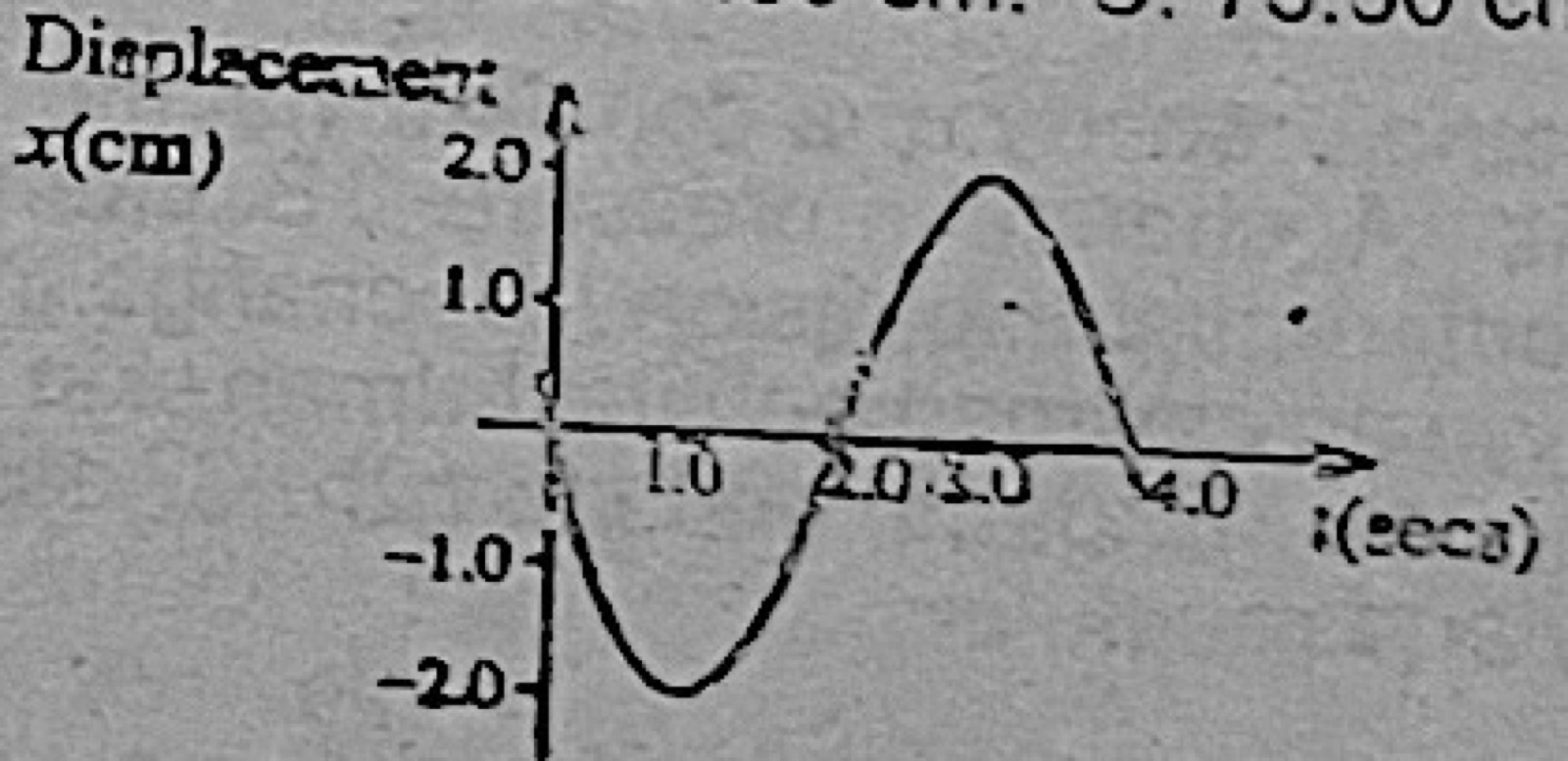
The frequency of the wave in the diagram above is

Diagram for this question
  1. A.1.05 Hz.
  2. B.0.17 Hz.
  3. C.1.57 Hz.
  4. D.0.25 Hz.
Show the answer and explanation

Answer: D (0.25 Hz.)

Explanation

The graph completes one full cycle between t = 0 and t = 4.0 s, so the period T = 4 s and f = 1/T = 0.25 Hz.

Open this question

Question 35

Light and Reflection

An object placed 10 cm from a concave mirror of focal length 5cm would have its image

  1. A.at infinity.
  2. B.10cm from the focus.
  3. C.at the centre of curvature.
  4. D.at the radius of curvature.
Show the answer and explanation

Answer: C (at the centre of curvature.)

Explanation

The radius of curvature is 2f = 10 cm, so the object is at the centre of curvature. 1/v = 1/5 − 1/10 = 1/10 gives v = 10 cm: the image is also at the centre of curvature.

Open this question

Question 36

Waves

A progressive wave equation is represented by y = a sin (150 πt − πx/4). If the phase difference of a progressive wave is 45°, the value of x in the equation is

  1. A.3cm.
  2. B.4cm.
  3. C.2 cm.
  4. D.1 cm.
Show the answer and explanation

Answer: D (1 cm.)

Explanation

The phase term is πx/4. A phase difference of 45° = π/4 rad, so πx/4 = π/4 and x = 1 cm.

Open this question

Question 37

Light and Reflection

Non-luminous objects can be seen because they

  1. A.are polished.
  2. B.are near.
  3. C.reflect light.
  4. D.emit light.
Show the answer and explanation

Answer: C (reflect light.)

Explanation

Non-luminous objects do not give out their own light; we see them because they reflect light from a source into our eyes.

Open this question

Question 38

Refraction of Light

A submarine is observed to rise from a real depth of 80 m to 60 m in water. Calculate the change in apparent depth. [Refractive index of water = 4/3]

  1. A.60m.
  2. B.15m.
  3. C.80m.
  4. D.45m.
Show the answer and explanation

Answer: B (15m.)

Explanation

Apparent depth = real depth ÷ n. 80 ÷ (4/3) = 60 m and 60 ÷ (4/3) = 45 m, so the apparent depth changes by 60 − 45 = 15 m.

Open this question

Question 39

Sound

The wavelength of the first overtone of a note in a closed pipe of length 33cm is

  1. A.44cm.
  2. B.33cm.
  3. C.22cm.
  4. D.17cm.
Show the answer and explanation

Answer: A (44cm.)

Explanation

In a closed pipe the first overtone has L = 3λ/4, so λ = 4L/3 = 4 × 33 ÷ 3 = 44 cm.

Open this question

Question 40

Elasticity

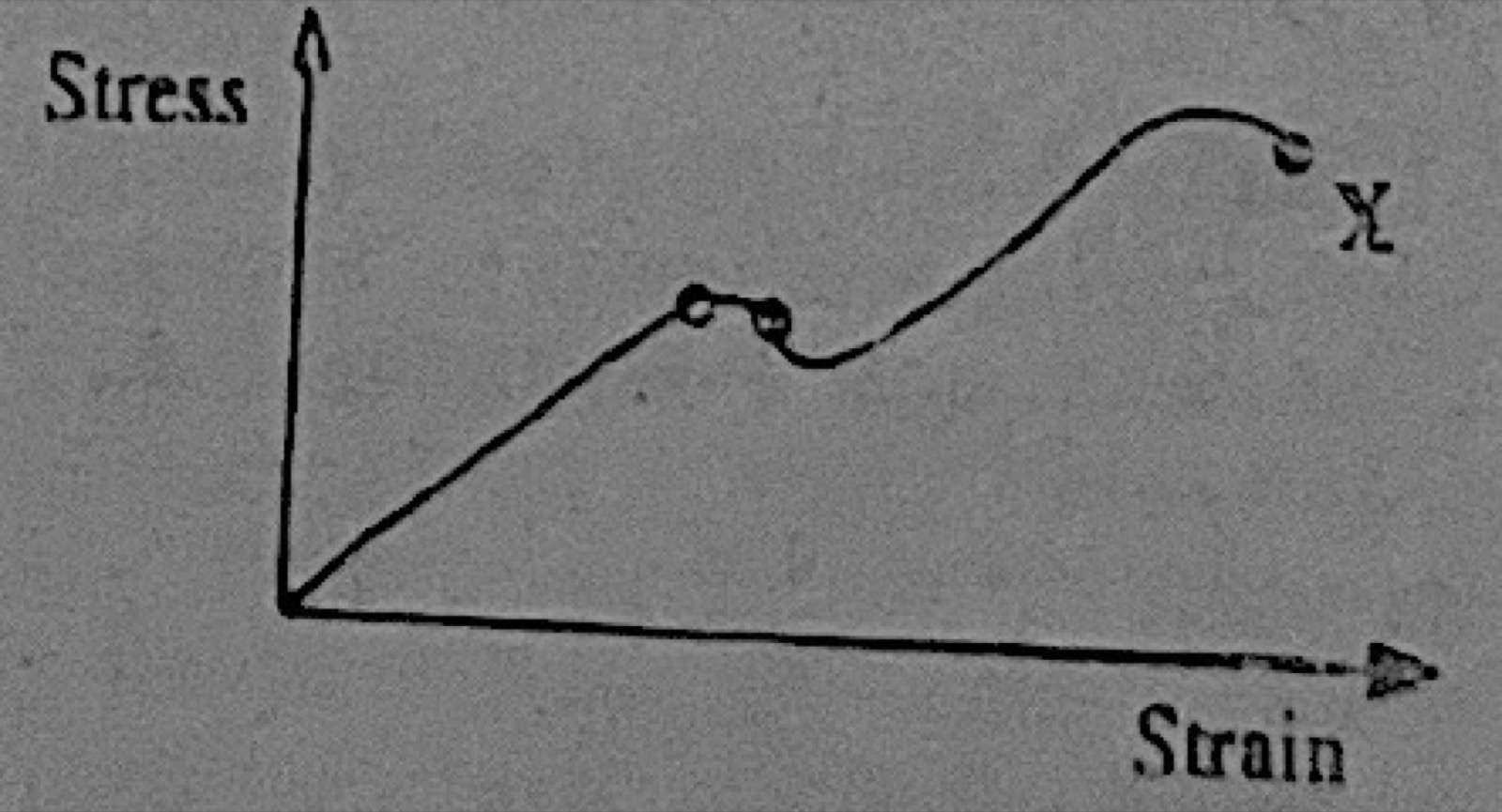
The diagram above represents the stress-strain graph for a typical metal rod. What does X represent?

Diagram for this question
  1. A.Yield point
  2. B.Breaking point
  3. C.Elastic limit
  4. D.Proportional limit
Show the answer and explanation

Answer: B (Breaking point)

Explanation

The straight part ends at the proportional/elastic limit and the small dip is the yield point. The curve stops at X, where the rod breaks, so X is the breaking point.

Open this question

Question 41

Density and Upthrust

If the relative density of gold is 19.2, the volume of 2.4 kg of gold is [Density of water = 103 kgm−3]

  1. A.1.92 × 10−4 m3
  2. B.4.61 × 10−3 m3.
  3. C.8.00 × 10−3 m3 .
  4. D.1.25 × 10−4 m3.
Show the answer and explanation

Answer: D (1.25 × 10⁻⁴ m3.)

Explanation

Density of gold = 19.2 × 1000 = 19 200 kg m−3. Volume = mass ÷ density = 2.4 ÷ 19 200 = 1.25 × 10⁻⁴ m3.

Open this question

Question 42

Heat Transfer

The thermos flask is designed to

  1. A.prevent heat gain by conduction, convection and radiation.
  2. B.prevent heat loss by conduction, convection and radiation.
  3. C.prevent heat loss or gain by conduction, convection and radiation.
  4. D.store hot tea or water.
Show the answer and explanation

Answer: C (prevent heat loss or gain by conduction, convection and radiation.)

Explanation

The vacuum, silvered walls and stopper cut down heat transfer in both directions, so a flask keeps hot things hot and cold things cold.

Open this question

Question 43

Quantity of Heat

An immersion heater rated 2.0 A, 240 V is used to boil water from temperature 52°C to 100°C. If the mass of the water is 2.5 kg, determine the time taken to boil the water. [Specific heat capacity of water = 4.2 × 10³ Jkg−1 K−1]

  1. A.1.05 × 104s.
  2. B.1.05 × 105s.
  3. C.1.05 × 103s.
  4. D.1.05 × 102s.
Show the answer and explanation

Answer: C (1.05 × 10³s.)

Explanation

Heat needed = mcΔθ = 2.5 × 4200 × 48 = 504 000 J. Power = IV = 2 × 240 = 480 W, so t = 504 000 ÷ 480 = 1050 s = 1.05 × 10³ s.

Open this question

Question 44

Temperature and Thermometers

What is likely to happen if the glass of a thermometer expands more upon heating than the liquid inside?

  1. A.The glass will shrink
  2. B.The liquid will go down in the stem
  3. C.The liquid will rise up in the stem
  4. D.The glass will break
Show the answer and explanation

Answer: B (The liquid will go down in the stem)

Explanation

If the bore of the glass grows faster than the liquid's volume, the liquid fills less of the tube, so its level falls in the stem.

Open this question

Question 45

Change of State and Vapours

A drop of petrol makes a finger colder than a drop of water would because

  1. A.petrol takes its latent heat of fusion from the finger.
  2. B.petrol takes its latent heat of vaporization from the finger.
  3. C.water has higher surface tension than petrol.
  4. D.water is more viscous than petrol.
Show the answer and explanation

Answer: B (petrol takes its latent heat of vaporization from the finger.)

Explanation

Petrol evaporates much faster than water, and the latent heat it needs to evaporate is taken from the finger, which cools it.

Open this question

Question 46

Density and Upthrust

A uniform solid cube material 10 cm on each side of mass 700 g is submerged in water. Which of the following best describes the behaviour of the cube in water?

  1. A.The cube will rest at an equilibrium position in water
  2. B.The cube will melt after a period of time
  3. C.The cube will sink in water
  4. D.The cube will float
Show the answer and explanation

Answer: D (The cube will float)

Explanation

Volume = 10 × 10 × 10 = 1000 cm3, so density = 700 ÷ 1000 = 0.7 g cm−3. This is less than water (1 g cm−3), so the cube rises and floats with 70% of it under water.

Open this question

Question 48

Temperature and Thermometers

The thermometric property of a constant volume thermometer is

  1. A.change in pressure.
  2. B.change in length.
  3. C.differential expansion.
  4. D.change involume.
Show the answer and explanation

Answer: A (change in pressure.)

Explanation

In a constant-volume gas thermometer the volume is kept fixed, and the gas pressure changes with temperature; pressure is the thermometric property.

Open this question

Question 49

Change of State and Vapours

At low humidity in an environment, the human skin is usually

  1. A.dry and smooth.
  2. B.damp and smooth.
  3. C.damp and rough.
  4. D.dry and rough.
Show the answer and explanation

Answer: D (dry and rough.)

Explanation

When the air is dry, moisture evaporates quickly from the skin, leaving it dry and rough (cracked lips and skin in harmattan).

Open this question

Question 50

Pressure

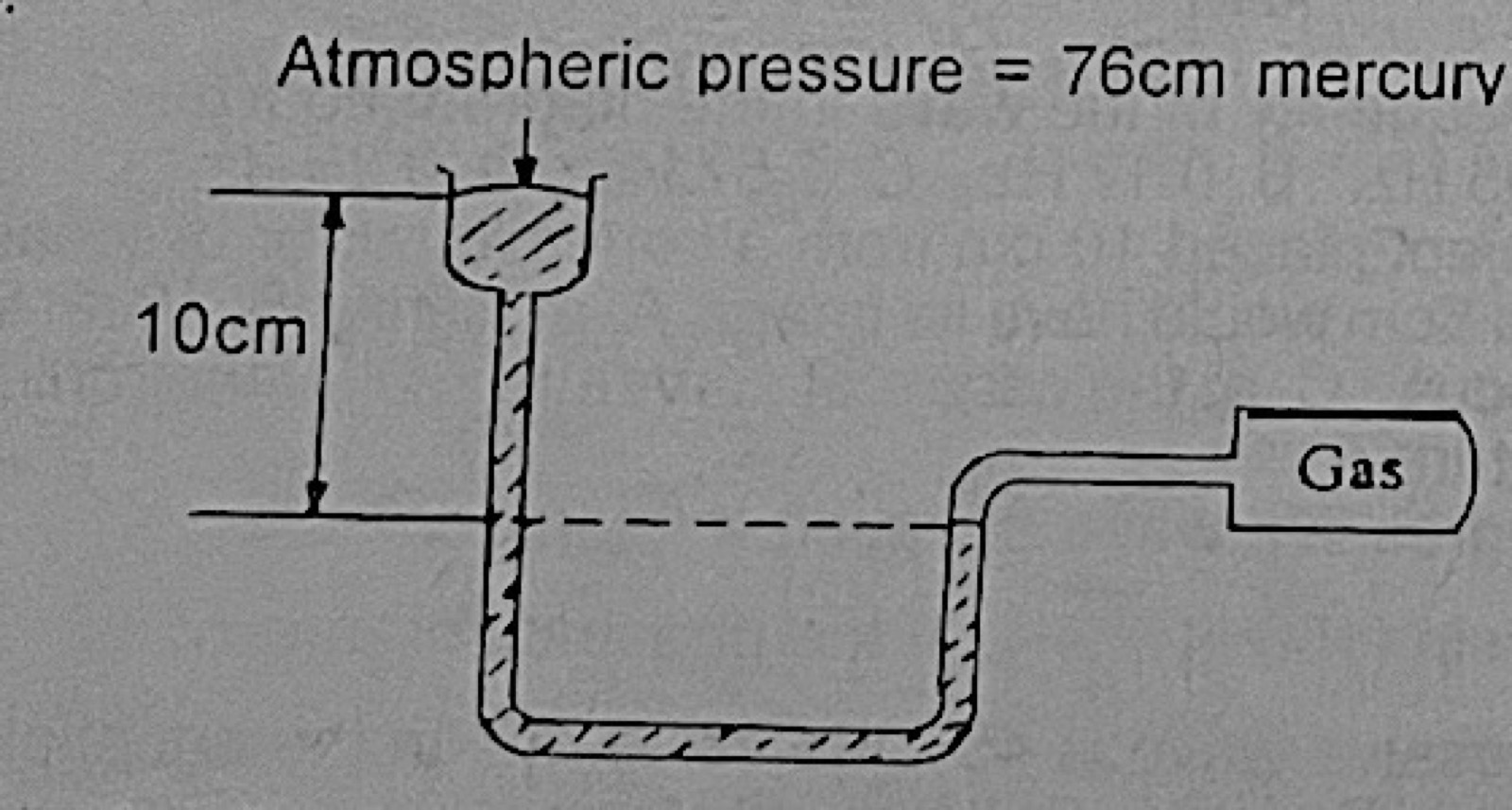
Atmospheric pressure = 76cm mercury
In the diagram above, the pressure of the gas is

Diagram for this question
  1. A.96cm of mercury.
  2. B.86 cm of mercury.
  3. C.66 cm of mercury.
  4. D.76 cm of mercury.
Show the answer and explanation

Answer: B (86 cm of mercury.)

Explanation

The mercury in the open limb stands 10 cm higher than on the gas side, so the gas pressure is atmospheric pressure plus 10 cm: 76 + 10 = 86 cm of mercury.
Open this question