The distance x m travelled by a particle in time t seconds is described by the equation x = 10 + 12t2. Find the average speed of the particle between the time interval t = 2 s and t = 5 s.
A.60 m s−1
B.72 m s−1
C.84 m s−1
D.108 m s−1
Show the answer and explanation
Answer: C (84 m s−1)
Explanation
At t = 2 s, x = 10 + 48 = 58 m; at t = 5 s, x = 10 + 300 = 310 m. Average speed = distance ÷ time = 252 ÷ 3 = 84 m s−1.
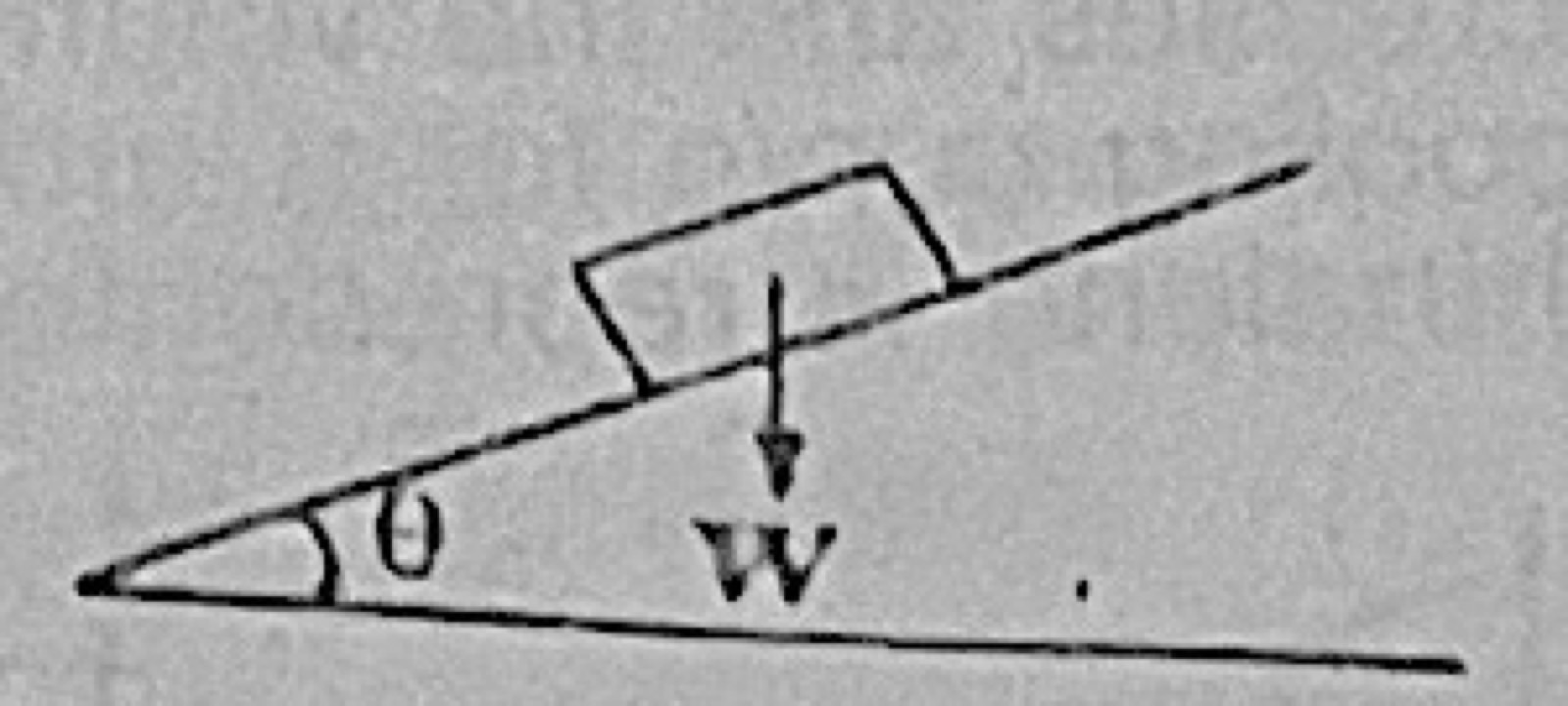
A 5 kg block is released from rest on a smooth plane inclined at an angle of 30° to the horizontal. What is the acceleration down the plane? [g = 10 m s−2]
A.5.0 m s−2
B.5.8 m s−2
C.8.7 m s−2
D.25.0 m s−2
Show the answer and explanation
Answer: A (5.0 m s−2)
Explanation
On a smooth slope only the component of weight along the slope acts, so a = g sin 30° = 10 × 0.5 = 5.0 m s−2.
An arrow of mass 0.1 kg moving with a horizontal velocity of 15 m s−1 is shot into a wooden block of mass 0.4 kg lying at rest on a smooth horizontal surface. Their common velocity after impact is
A.15.0 m s−1
B.7.5 m s−1
C.3.8 m s−1
D.3.0 m s−1
Show the answer and explanation
Answer: D (3.0 m s−1)
Explanation
Momentum is conserved: 0.1 × 15 = (0.1 + 0.4)v, so v = 1.5 ÷ 0.5 = 3.0 m s−1.
Two bodies X and Y are projected on the same horizontal plane, with the same initial speed but at angles 30° and 60° respectively to the horizontal. Neglecting air resistance, the ratio of the range of X to that of Y is
A.1 : 1
B.1 : 2
C.√3 : 1
D.1 : √3
Show the answer and explanation
Answer: A (1 : 1)
Explanation
Range R = u2 sin 2θ/g. sin 60° = sin 120°, so both ranges are equal: 1 : 1.
Which of the following with respect to a body performing simple harmonic motion are in phase?
A.Displacement and velocity of the body
B.Displacement and force on the body
C.Velocity and acceleration of the body
D.Force acting on the body and the acceleration
Show the answer and explanation
Answer: D (Force acting on the body and the acceleration)
Explanation
By F = ma, force and acceleration always point the same way, so they are in phase. Force is opposite to displacement, and velocity is 90° out of phase with both.
A body of mass 2 kg moving vertically upwards has its velocity increased uniformly from 10 m s−1 to 40 m s−1 in 4 s. Neglecting air resistance, calculate the upward vertical force acting on the body. [g = 10 m s−2]
A.15 N
B.20 N
C.35 N
D.45 N
Show the answer and explanation
Answer: C (35 N)
Explanation
a = (40 − 10)/4 = 7.5 m s−2. The force must hold up the weight and also accelerate it: F = m(g + a) = 2 × 17.5 = 35 N.
A planet has mass m1 and is at a distance r1 from the sun. A second planet has mass m2 = 10m1 and is at a distance of r2 = 2r1 from the sun. Determine the ratio of the gravitational forces experienced by the planets.
A.1 : 5
B.2 : 5
C.3 : 5
D.4 : 5
Show the answer and explanation
Answer: B (2 : 5)
Explanation
F ∝ m/r2. F2/F1 = 10/22 = 5/2, so F1 : F2 = 2 : 5.
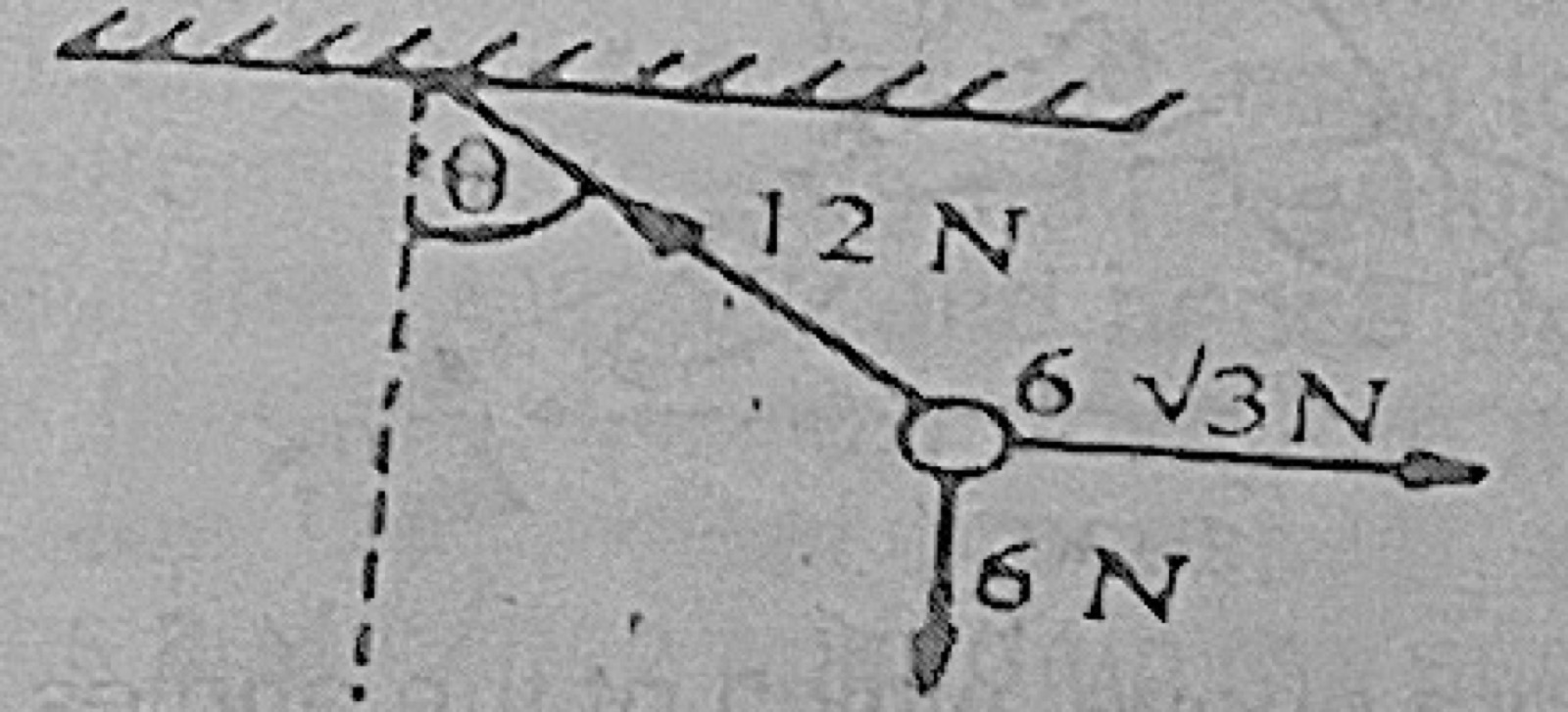
For what value of θ are the forces in the diagram above in equilibrium?
A.15°
B.30°
C.45°
D.60°
Show the answer and explanation
Answer: D (60°)
Explanation
The 12 N string must balance the 6 N downward force vertically: 12 cos θ = 6, so cos θ = 0.5 and θ = 60°. Check: 12 sin 60° = 6√3 N balances the horizontal force.
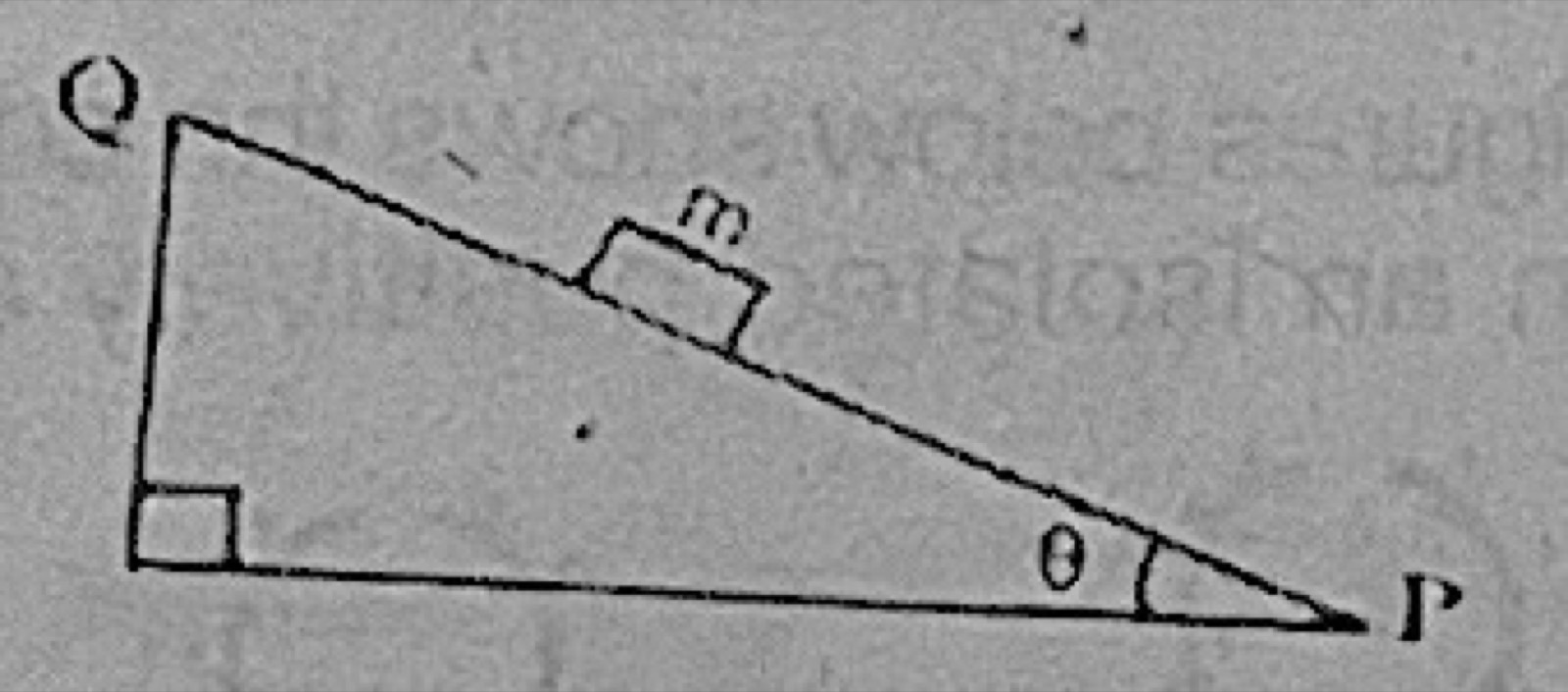
The figure above shows a block of mass m sliding down a rough inclined plane QP at angle θ. The forces acting on the block along the plane QP are
A.mg sin θ and the normal reaction
B.mg sin θ and the force of friction
C.mg cos θ and the normal reaction
D.mg cos θ and the force of friction
Show the answer and explanation
Answer: B (mg sin θ and the force of friction)
Explanation
Along the slope there is the component of weight mg sin θ pulling the block down and friction opposing its motion. The normal reaction and mg cos θ act at right angles to the slope.
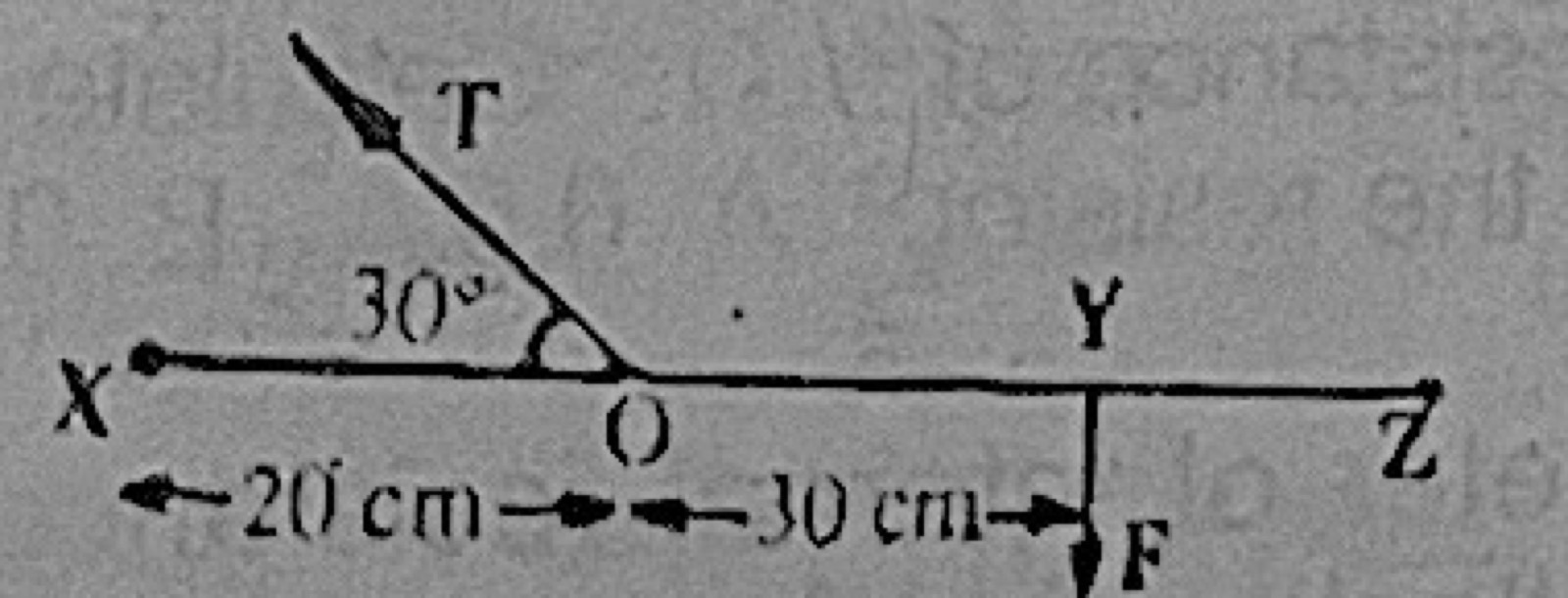
A uniform light beam XZ is hinged at X and kept in equilibrium by the forces T and F as shown in the diagram above. If XO = 20 cm and OY = 30 cm, express T in terms of F.
A.T = (2√3/3)F
B.T = 2F
C.T = (5√3/3)F
D.T = 5F
Show the answer and explanation
Answer: D (T = 5F)
Explanation
Take moments about X. T acts at O, 20 cm away, at 30° to the beam, so its moment is T sin 30° × 20 = 10T. F acts at Y, 50 cm away: 10T = 50F, so T = 5F.
An object of mass 100 g projected vertically upwards from the ground level has a velocity of 20 m s−1 at a height of 10 m. Calculate its initial kinetic energy at the ground level. [g = 10 m s−2, neglect air resistance]
A.10 J
B.20 J
C.30 J
D.50 J
Show the answer and explanation
Answer: C (30 J)
Explanation
Energy is conserved. At 10 m: KE = ½ × 0.1 × 202 = 20 J and PE = 0.1 × 10 × 10 = 10 J. The initial KE was 20 + 10 = 30 J.
An electric water pump rated 1.5 kW, lifts 200 kg of water through a vertical height of 6 metres in 10 seconds. What is the efficiency of the pump? [g = 10 m s−2, neglect air resistance]
A load of 20 N on a wire of cross-sectional area 8 × 10⁻⁷ m2, produces an extension of 10−4 m. Calculate Young's modulus for the material of the wire if its length is 3 m.
A cube of sides 0.1 m hangs freely from a string. What is the upthrust on the cube when totally immersed in water? [Density of water is 1000 kg m−3, g = 10 m s−2]
A.1000 N
B.700 N
C.110 N
D.10 N
Show the answer and explanation
Answer: D (10 N)
Explanation
Upthrust = weight of water displaced = 0.001 m3 × 1000 kg m−3 × 10 = 10 N.
A piece of wire gauze can be made to lie on water because
A.the wire gauze is less dense than water
B.the water molecules repel the wire gauze upwards
C.the water surface has the effect of an elastic thin skin
D.of the cohesive forces between the water and the wire gauze molecules
Show the answer and explanation
Answer: C (the water surface has the effect of an elastic thin skin)
Explanation
Surface tension makes the water surface behave like a stretched elastic skin, which can support a light gauze even though the metal is denser than water.
A liquid of mass 1.0 × 10³ kg fills a rectangular tank of length 2.5 m and width 2.0 m. If the tank is 4 m high, what is the pressure at the middle of the tank? [g = 10 m s−2]
A.1.0 × 104 N m−2
B.2.0 × 103 N m−2
C.1.5 × 103 N m−2
D.1.0 × 103 N m−2
Show the answer and explanation
Answer: D (1.0 × 10³ N m−2)
Explanation
Volume = 2.5 × 2.0 × 4 = 20 m3, so density = 1000/20 = 50 kg m−3. At the middle (2 m deep), p = hρg = 2 × 50 × 10 = 1.0 × 10³ N m−2.
Before starting a journey, the tyre pressure of a car was 3 × 10⁵ N m−2 at 27 °C. At the end of the journey, the pressure rose to 4 × 10⁵ N m−2. Calculate the temperature of the tyre after the journey assuming the volume is constant.
A.400 °C
B.300 °C
C.273 °C
D.127 °C
Show the answer and explanation
Answer: D (127 °C)
Explanation
At constant volume P/T is constant (T in kelvin): T2 = 300 × 4/3 = 400 K = 127 °C.
A mass of a liquid at 30 °C is mixed with a mass of the same liquid at 70 °C and the temperature of the mixture is 45 °C. Find the ratio of the mass of the cold liquid to the mass of the other liquid.
A.3 : 5
B.5 : 3
C.3 : 7
D.7 : 3
Show the answer and explanation
Answer: B (5 : 3)
Explanation
Heat gained = heat lost: mc × 15 = mh × 25, so mc : mh = 25 : 15 = 5 : 3.
A heating coil rated at 1000 W is used to boil off 0.5 kg of boiling water. The time taken to boil off the water is [Specific latent heat of vaporization of water = 2.3 × 10⁶ J kg−1]
A.1.15 × 109 s
B.1.15 × 107 s
C.1.15 × 105 s
D.1.15 × 103 s
Show the answer and explanation
Answer: D (1.15 × 10³ s)
Explanation
Heat needed = mL = 0.5 × 2.3 × 106 = 1.15 × 10⁶ J. Time = 1.15 × 10⁶ ÷ 1000 = 1.15 × 10³ s.
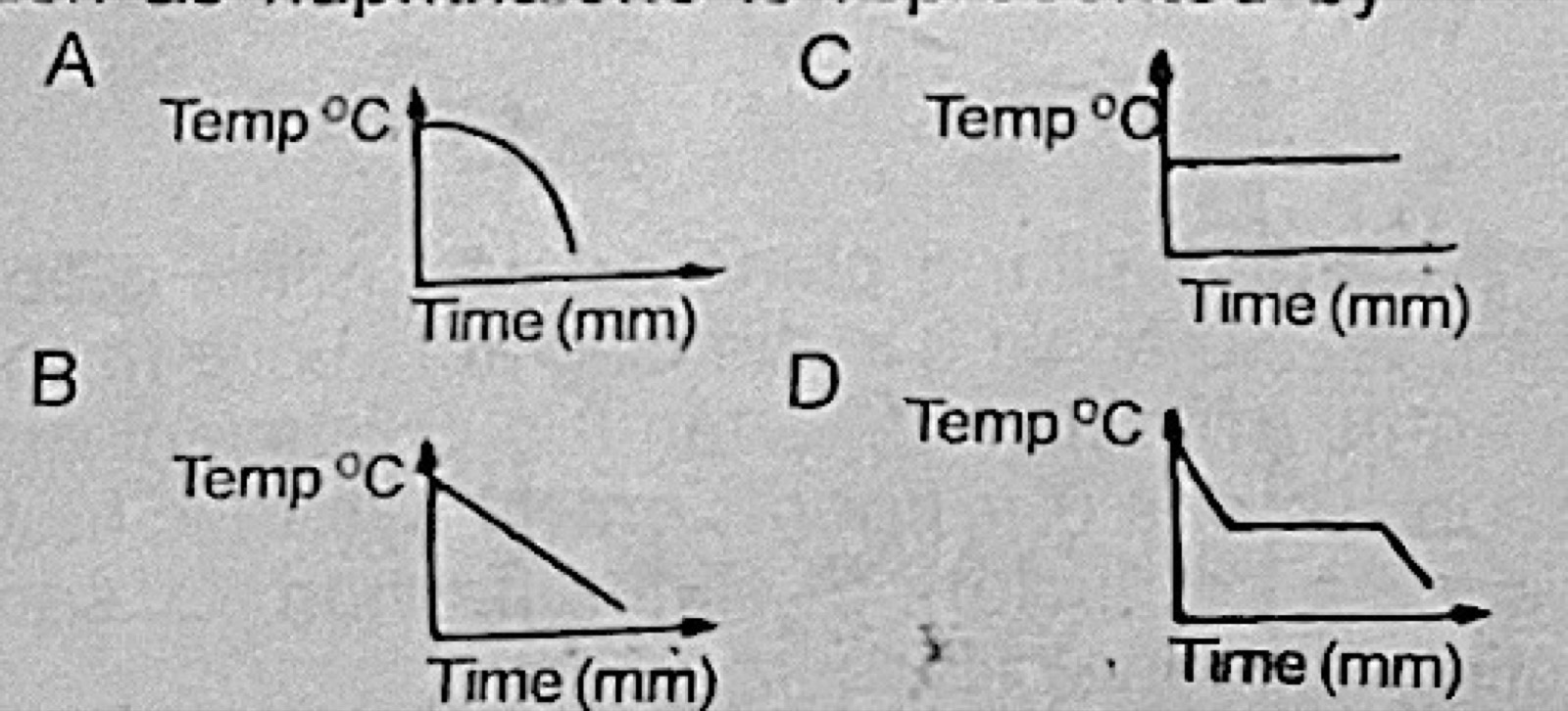
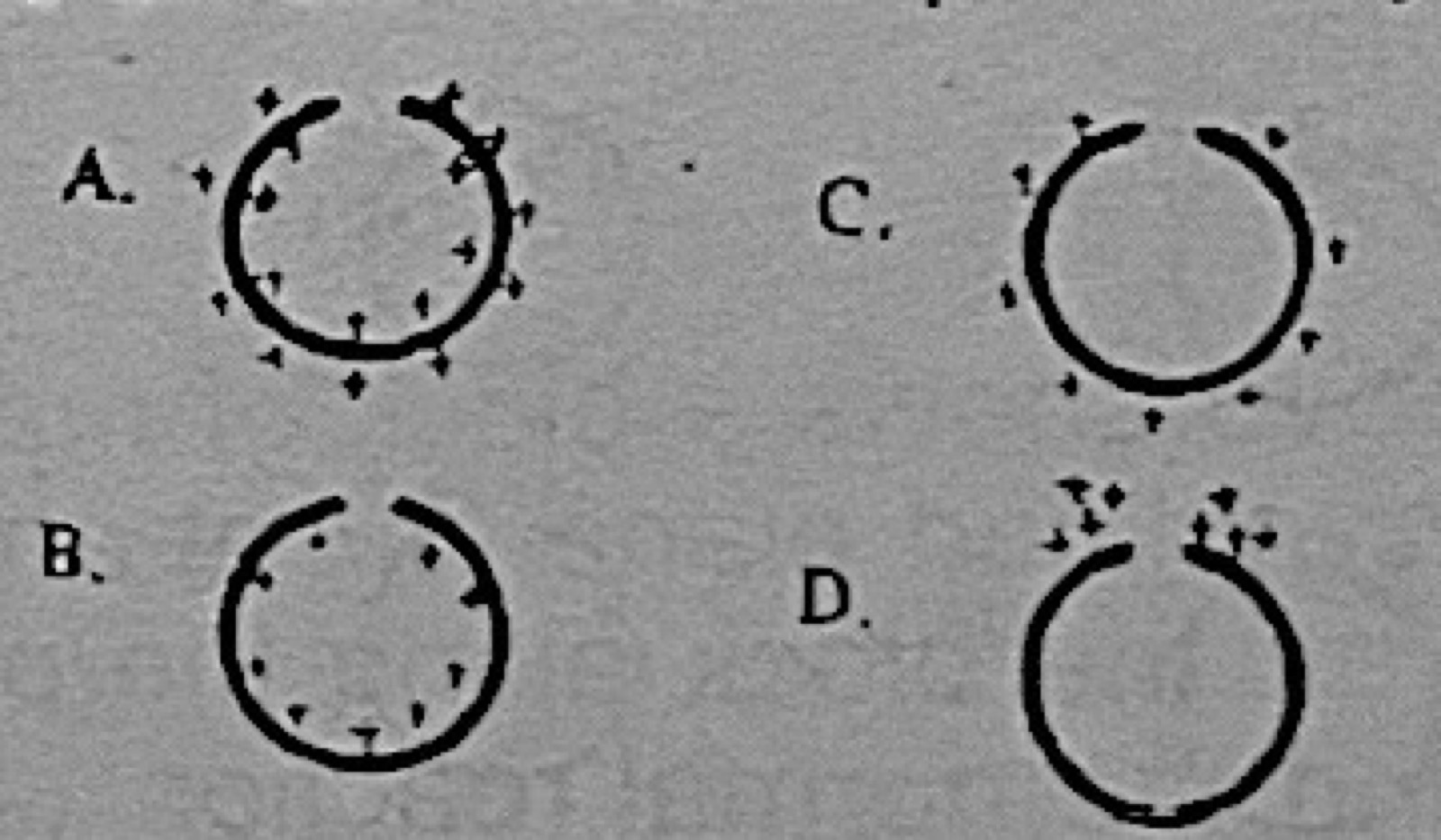
The correct cooling curve for a molten substance such as naphthalene is represented by
A.Graph A
B.Graph B
C.Graph C
D.Graph D
Show the answer and explanation
Answer: D (Graph D)
Explanation
The liquid cools, then the temperature stays constant while it solidifies (latent heat is given out), then the solid cools. Graph D shows the flat part.
What happens when a gas expands at constant temperature?
A.Its pressure decreases
B.The total momentum of its molecules remains constant
C.Its pressure decreases and the total momentum of its molecules remains constant
D.Its pressure decreases and the total kinetic energy of its molecules decreases
Show the answer and explanation
Answer: A (Its pressure decreases)
Explanation
By Boyle's law, PV is constant at fixed temperature, so a larger volume means a lower pressure. The temperature, and so the kinetic energy of the molecules, stays the same.
Under constant tension and constant mass per unit length, the note produced by a plucked string is 500 Hz when the length of the string is 0.90 m. At what length is the frequency 150 Hz?
A.3 m
B.4 m
C.5 m
D.6 m
Show the answer and explanation
Answer: A (3 m)
Explanation
Frequency is inversely proportional to length: f1L1 = f2L2. 500 × 0.90 = 150 × L, so L = 3 m.
The colours seen in thin films of oil on the road and in soap bubbles are due to
A.reflection
B.interference
C.diffraction
D.polarization
Show the answer and explanation
Answer: B (interference)
Explanation
Light reflected from the top and bottom of the thin film overlaps. Some colours add up and others cancel, depending on the film's thickness: this is interference.
If the load at the end of a sonometer wire is immersed in a bucket of water, the original fundamental frequency of the wire could be restored by
A.decreasing the length of the wire
B.increasing the length of the wire
C.increasing the mass per unit length of the wire
D.changing the temperature of the water
Show the answer and explanation
Answer: A (decreasing the length of the wire)
Explanation
In water the load feels an upthrust, so the tension and the frequency fall. Since f = (1/2L)√(T/m), making L smaller raises the frequency back to its original value.
Light of velocity 3.0 × 10⁸ m s−1 is incident on a material of refractive index n. If the velocity of light is reduced to 2.4 × 10⁸ m s−1 in the material, what is n?
A.2.33
B.2.25
C.1.33
D.1.25
Show the answer and explanation
Answer: D (1.25)
Explanation
n = speed in air ÷ speed in material = 3.0 × 10⁸ ÷ 2.4 × 108 = 1.25.
A patient with a sight defect has a least distance of distinct vision of 150 cm. For him to be able to read a material placed at a distance of 25 cm, what is the focal length of the glasses he should wear?
A.15.0 cm
B.17.6 cm
C.21.4 cm
D.30.0 cm
Show the answer and explanation
Answer: D (30.0 cm)
Explanation
The converging lens must make a virtual image of the page (u = 25 cm) at his near point, 150 cm away on the same side. 1/f = 1/25 − 1/150 = 5/150, so f = 30.0 cm.
The electromagnetic waves that are sensitive to temperature changes are
A.x-rays
B.gamma-rays
C.ultra-violet rays
D.infra-red rays
Show the answer and explanation
Answer: D (infra-red rays)
Explanation
Infra-red rays are heat radiation: they are given out by warm bodies and are detected by their heating effect, e.g. with a thermopile or blackened thermometer.
Three electric cells each of e.m.f. 1.5 V and internal resistance 1.0 Ω are connected in parallel across an external resistance of 2/3 Ω. Calculate the value of the current in the resistor.
A.0.5 A
B.0.9 A
C.1.5 A
D.4.5 A
Show the answer and explanation
Answer: C (1.5 A)
Explanation
Identical cells in parallel give e.m.f. 1.5 V and internal resistance 1/3 Ω. I = 1.5 ÷ (2/3 + 1/3) = 1.5 A.
A galvanometer of internal resistance 50 Ω has a full scale deflection for a current of 5 mA. What is the resistance required to convert it to a voltmeter with full scale deflection of 10 V?
A.1750 Ω
B.1950 Ω
C.2000 Ω
D.2500 Ω
Show the answer and explanation
Answer: B (1950 Ω)
Explanation
Total resistance = 10 ÷ 0.005 = 2000 Ω. Subtract the galvanometer's 50 Ω: a 1950 Ω resistor is needed in series.
If 8 × 10⁻² J of work is required to move 100 μC of charge from a point X to a point Y in an electrical circuit, the potential difference between X and Y is
A.4.0 × 102 V
B.4.0 × 104 V
C.8.0 × 102 V
D.8.0 × 104 V
Show the answer and explanation
Answer: C (8.0 × 10² V)
Explanation
V = W/Q = 8 × 10⁻² ÷ (100 × 10−6) = 800 V = 8.0 × 10² V.
In a metre bridge experiment, two resistors 2 Ω and 3 Ω occupy the left and right gaps respectively. Find the balance point from the left side of the bridge.
A.20 cm
B.40 cm
C.60 cm
D.80 cm
Show the answer and explanation
Answer: B (40 cm)
Explanation
At balance 2/3 = l/(100 − l), so 3l = 200 − 2l and l = 40 cm.
Two 50 μF parallel plate capacitors are connected in series. The combined capacitor is then connected across a 100-V battery. The charge on each plate of the capacitor is
A.5.00 × 10−3 C
B.2.50 × 10−3 C
C.1.25 × 10−3 C
D.1.00 × 10−2 C
Show the answer and explanation
Answer: B (2.50 × 10⁻³ C)
Explanation
Two equal capacitors in series give 50/2 = 25 μF. Q = CV = 25 × 10−6 × 100 = 2.50 × 10⁻³ C.
One of the features of the fission process is that
A.its products are not radioactive
B.it leads to chain reaction
C.neutrons are not released
D.the sum of the masses of the reactants equals the sum of the masses of the products
Show the answer and explanation
Answer: B (it leads to chain reaction)
Explanation
Each fission releases extra neutrons that can split more nuclei, so fission can lead to a chain reaction. Its products are radioactive and some mass is turned into energy.
The graphite rods surrounding the uranium fuel rods in a nuclear reactor, are used to
A.absorb the neutrons and hence halt the nuclear process
B.create the neutrons and hence slow up the nuclear process
C.slow down the neutrons and hence slow the nuclear process
D.speed up the neutrons and hence speed up the nuclear process
Show the answer and explanation
Answer: C (slow down the neutrons and hence slow the nuclear process)
Explanation
Graphite is a moderator: it slows down fast neutrons. Of the choices, only C says the graphite slows the neutrons; absorbing neutrons is the job of the control rods.