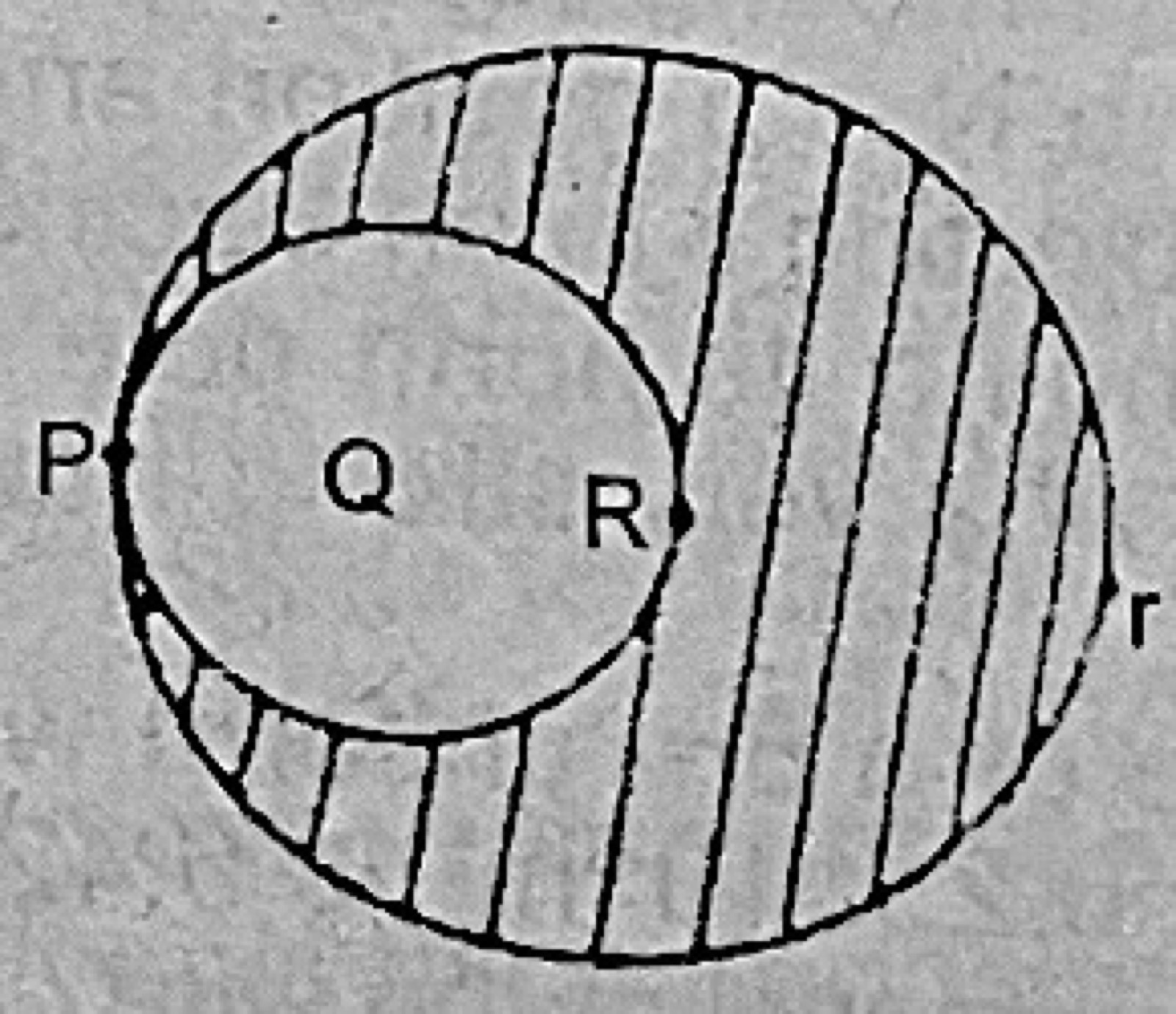
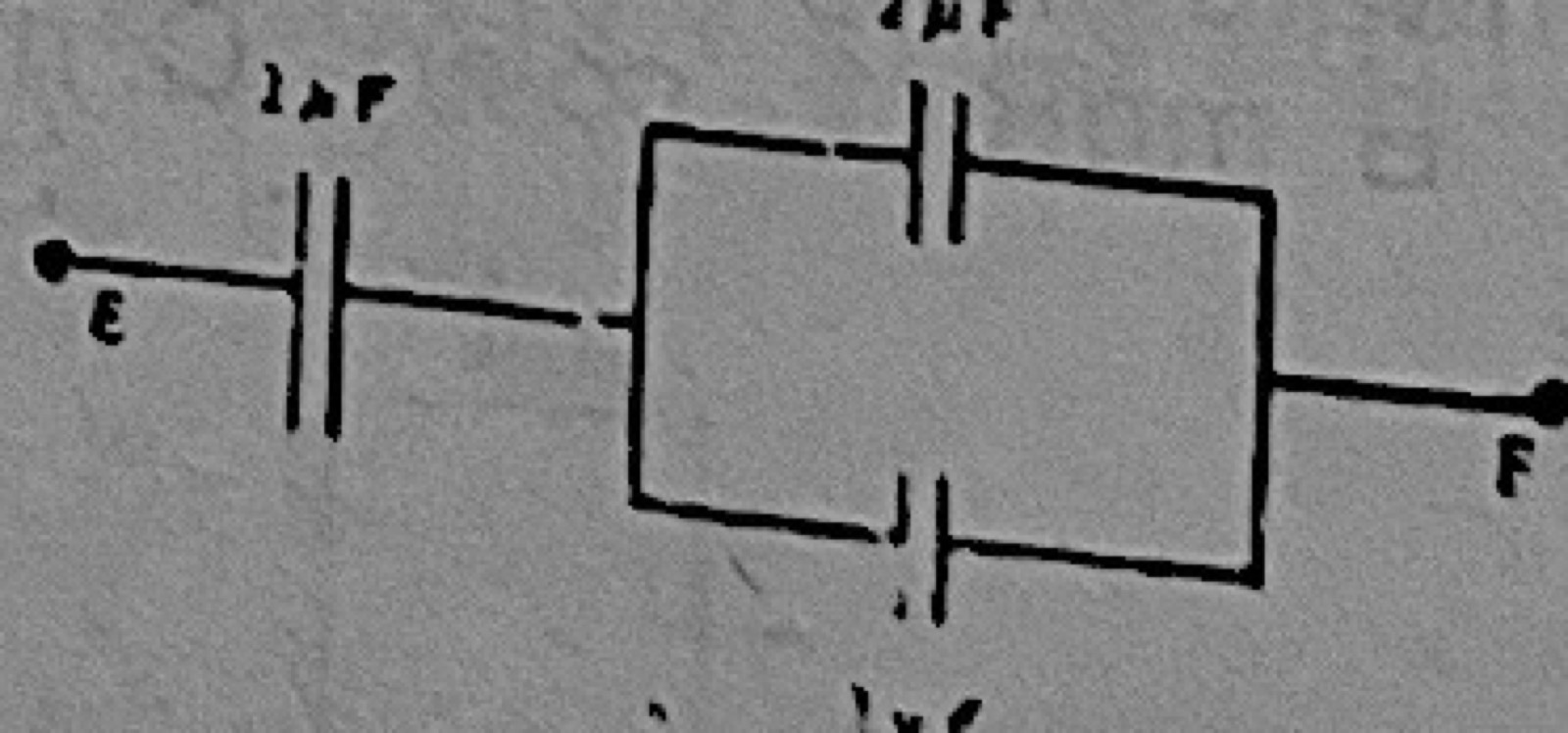
The figure above shows a uniform circular object, centre R and diameter PS. A circular section, centre Q and diameter PR is cut away from it. If PQRS is a straight line, where is the centre of gravity of the figure?
A.Q
B.R
C.A point between P and R.
D.A point between R and S
Show the answer and explanation
Answer: D (A point between R and S)
Explanation
Removing material on the P side of R shifts the centre of gravity of what is left away from the hole, to a point between R and S.
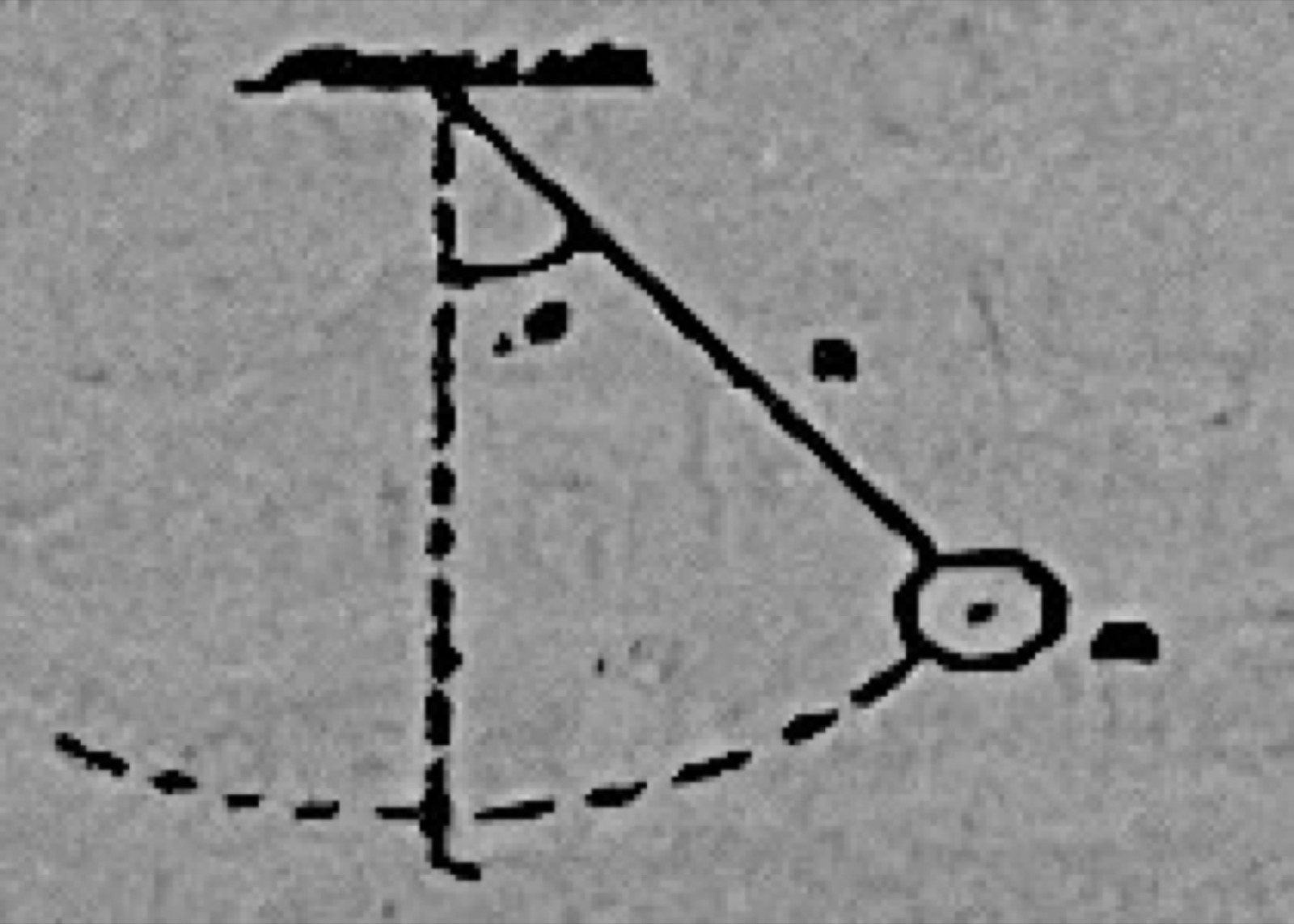
A simple pendulum of mass m moves along an arc of a circle radius R in a vertical plane as shown in the figure above. What is the work done by gravity in a downward swing through the angle θ to 0°?
A.mgR sin θ
B.mgR (1 − cos θ)
C.mgR
D.mgR (1 − sin θ)
Show the answer and explanation
Answer: B (mgR (1 − cos θ))
Explanation
At angle θ the bob is R(1 − cos θ) higher than at the bottom, so gravity does work mgR(1 − cos θ) as it swings down.
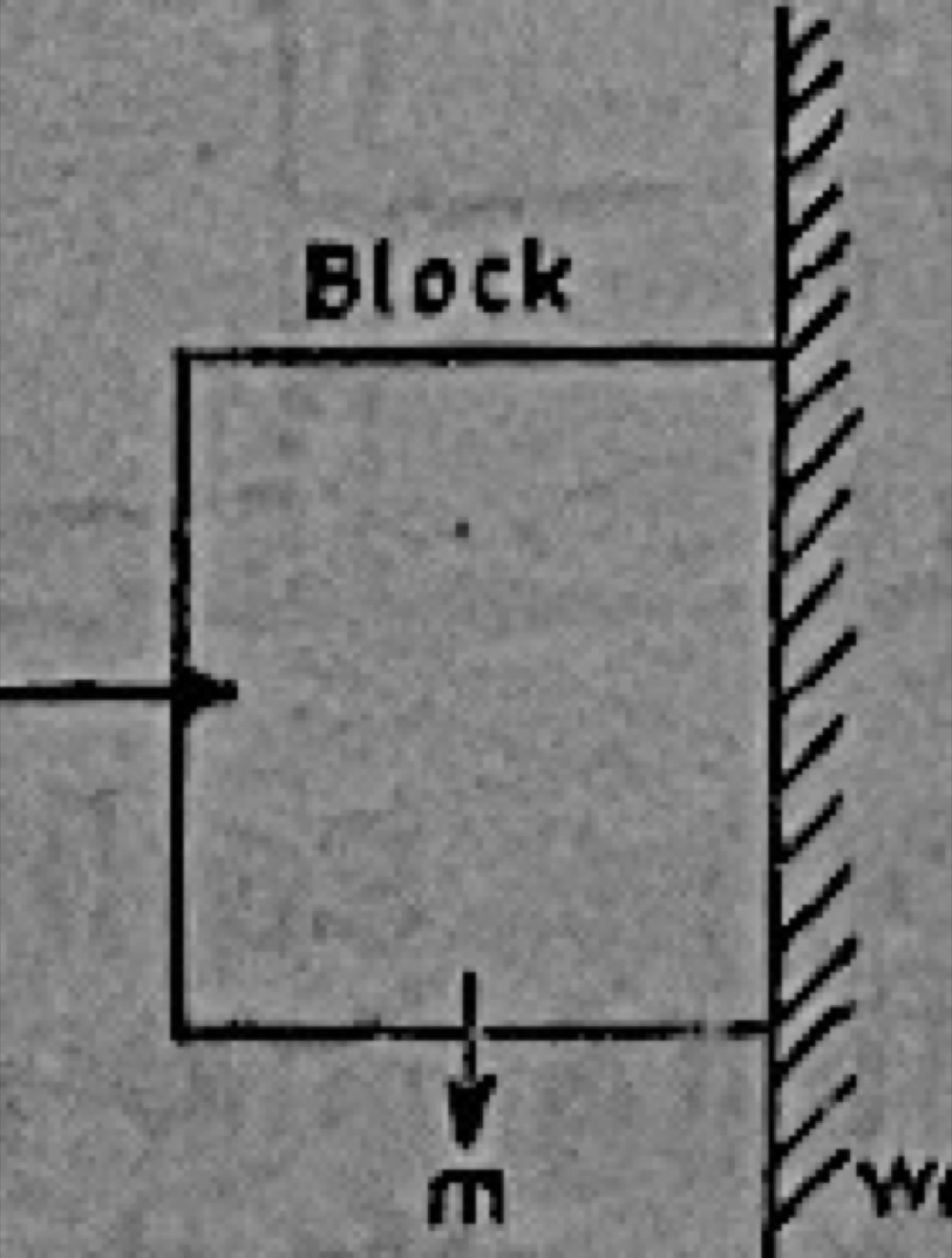
A block of mass m is held in equilibrium against a vertical wall by a horizontal force. If the coefficient of friction between the block and the wall is μ, the minimum value of the horizontal force is
A.μmg
B.(1 − μ)mg
C.(1 + μ)mg
D.mg/μ
Show the answer and explanation
Answer: D (mg/μ)
Explanation
The horizontal force F is the normal reaction, so the wall can give an upward friction of at most μF. This must hold up the weight: μF = mg, so F = mg/μ.
A block-and-tackle system is used to lift a load of 20 N through a vertical height of 10 m. If the efficiency of the system is 40%, how much work is done against friction?
A.80 J
B.120 J
C.300 J
D.500 J
Show the answer and explanation
Answer: C (300 J)
Explanation
Useful work = 20 × 10 = 200 J. Input = 200 ÷ 0.4 = 500 J. Work against friction = 500 − 200 = 300 J.
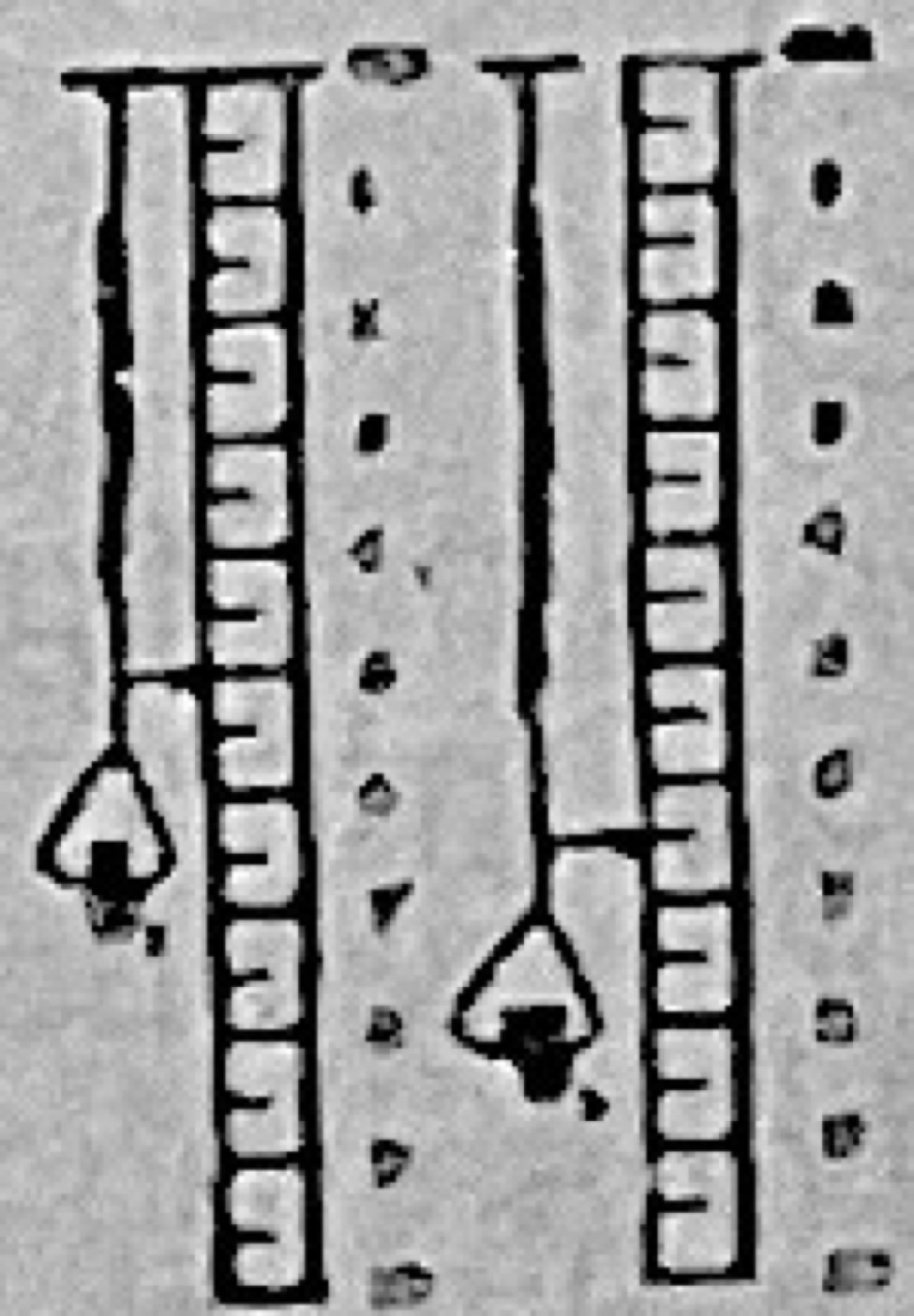
In the figure above W1 = 200 g and W2 = 450 g. Calculate the extension of the spring per unit load. [g = 10 m s−2]
A.6.0 × 10−5 m N−1
B.2.5 × 10−4 m N−1
C.6.0 × 10−3 m N−1
D.2.5 × 10−2 m N−1
Show the answer and explanation
Answer: C (6.0 × 10⁻³ m N−1)
Explanation
Extension per unit load = (6.5 − 5.0) cm ÷ (4.5 − 2.0) N = 0.015 m ÷ 2.5 N = 6.0 × 10⁻³ m N−1. (The pointer moves down 1.5 scale divisions when the load goes from 200 g to 450 g.)
An electric heater is used to melt a block of ice, mass 1.5 kg. If the heater is powered by a 12 V battery and a current of 20 A flows through the coil, calculate the time taken to melt the block of ice at 0°C. (Specific latent heat of fusion of ice = 336 × 103 J kg−1).
A.76.0 min
B.35.0 min
C.21.0 min
D.2.9 min
Show the answer and explanation
Answer: B (35.0 min)
Explanation
Heat needed = 1.5 × 336 000 = 504 000 J. Power = 12 × 20 = 240 W. t = 504 000/240 = 2100 s = 35 min.
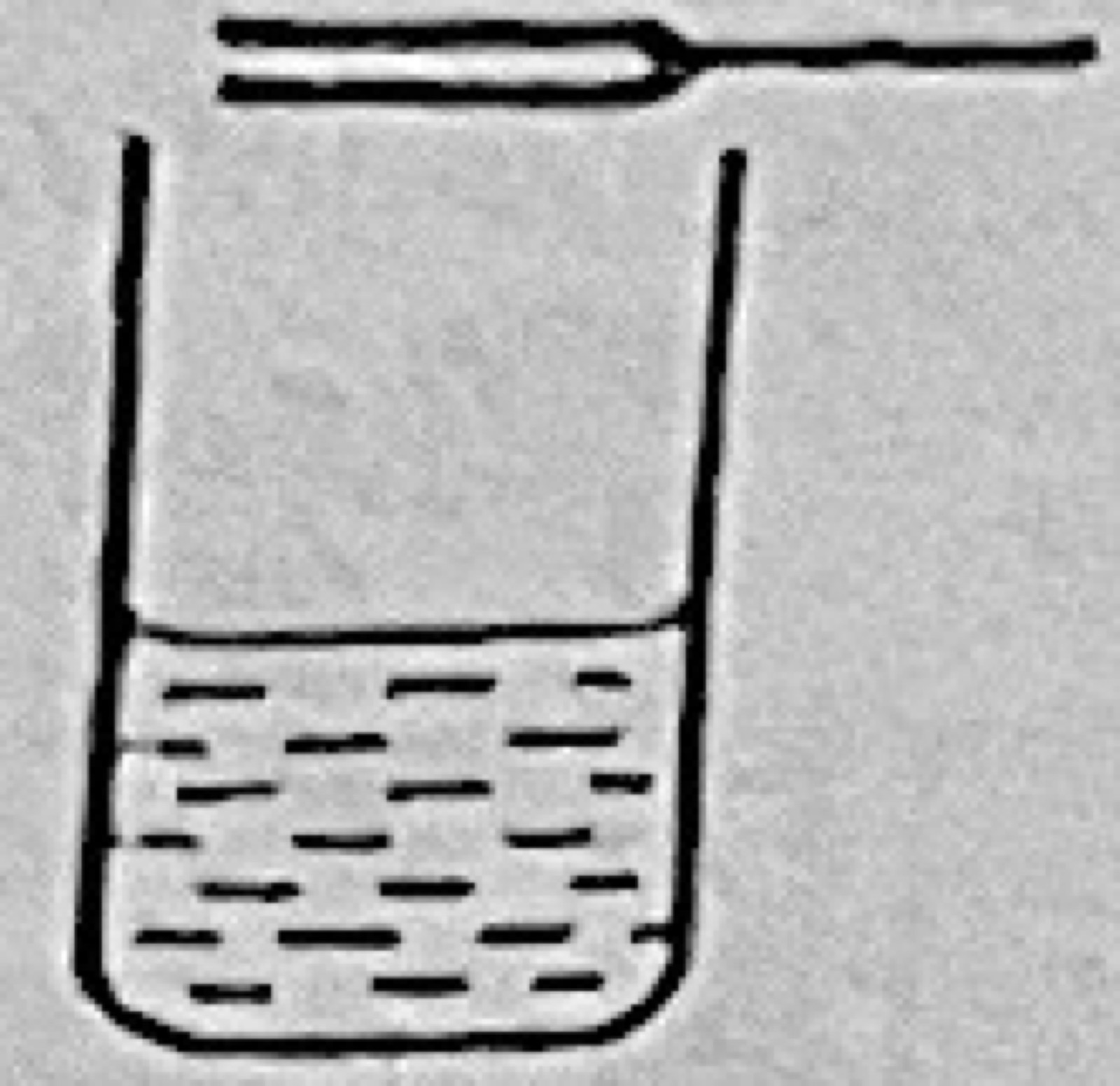
A vibrator of frequency 60 Hz is used in generating transverse stationary waves in a long thin wire. If the average distance between successive nodes on the wire is 45 cm, find the speed of the transverse waves in the wire.
A.27 m s−1
B.54 m s−1
C.90 m s−1
D.108 m s−1
Show the answer and explanation
Answer: B (54 m s−1)
Explanation
Successive nodes are half a wavelength apart, so λ = 90 cm = 0.9 m. v = fλ = 60 × 0.9 = 54 m s−1.
In a sound wave in air, the adjacent rarefactions and compressions are separated by a distance of 17 cm. If the velocity of the sound wave is 340 m s−1 determine the frequency.
A.10 Hz
B.20 Hz
C.1000 Hz
D.5780 Hz
Show the answer and explanation
Answer: C (1000 Hz)
Explanation
A compression and the next rarefaction are half a wavelength apart, so λ = 34 cm. f = v/λ = 340/0.34 = 1000 Hz.
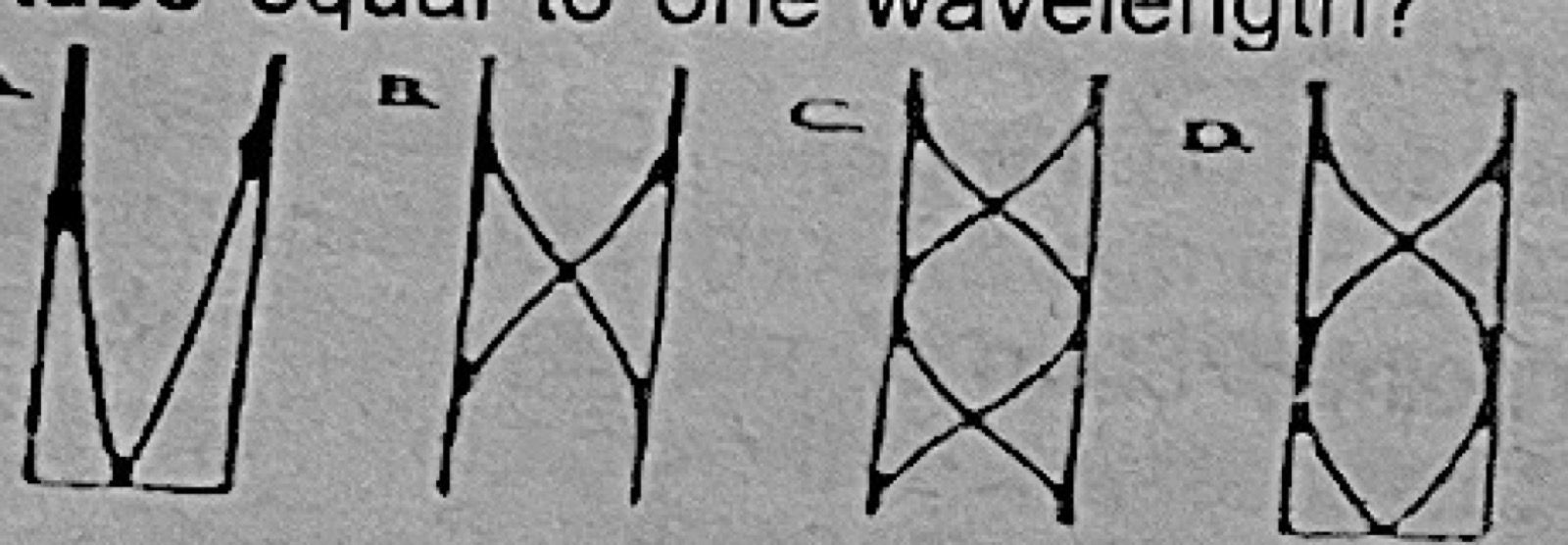
In which of the following diagrams is the length of the tube equal to one wavelength?
A.A
B.B
C.C
D.D
Show the answer and explanation
Answer: C (C)
Explanation
Each loop of a stationary-wave pattern (node to node) is half a wavelength, so the tube is one wavelength long when it holds two complete half-wave loops between antinodes at the open ends, as in C.
The magnification of the image of an object placed in front of a convex mirror is 1/3. If the radius of curvature of the mirror is 24 cm, what is the distance between the object and its image?
A.8 cm
B.16 cm
C.24 cm
D.32 cm
Show the answer and explanation
Answer: D (32 cm)
Explanation
f = 12 cm (virtual). With v = u/3 behind the mirror: 1/u − 3/u = −1/12, so u = 24 cm and v = 8 cm. The image is behind the mirror, so they are 24 + 8 = 32 cm apart.
A far sighted person cannot see objects that are less than 100 cm away. If this person wants to read a book at 25 cm, what type and focal length of lens does he need?
A.convex, 20 cm
B.concave, 20 cm
C.convex, 33 cm
D.concave, 33 cm
Show the answer and explanation
Answer: C (convex, 33 cm)
Explanation
The lens must form a virtual image at 100 cm of a book at 25 cm: 1/f = 1/25 − 1/100 = 3/100, so f ≈ 33 cm, converging (convex).
When a yellow card is observed through a blue glass, the card would appear
A.black
B.green
C.red
D.white
Show the answer and explanation
Answer: A (black)
Explanation
A yellow card reflects red, green and yellow light but no blue. Blue glass lets only blue through, so no light reaches the eye and the card looks black.
Two insulated charged spheres of different sizes and carrying opposite charges are connected together by a metallic conductor. Current will flow from one sphere to the other until both spheres
A.carry the same magnitude and sign of charge
B.are at the same potential
C.are at the same temperature
D.are of the same size.
Show the answer and explanation
Answer: B (are at the same potential)
Explanation
Charge flows from high to low potential and stops when the two spheres are at the same potential.
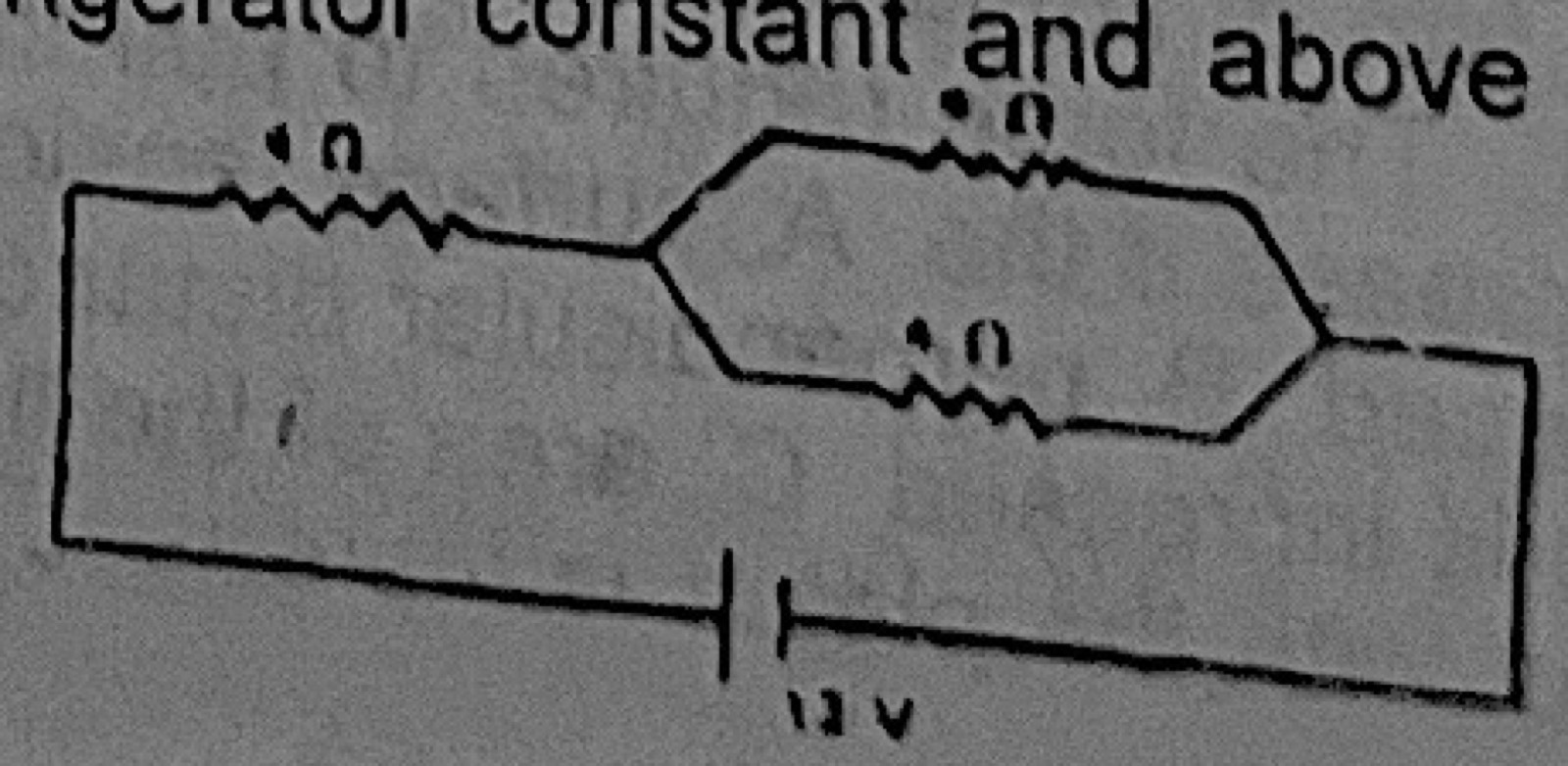
Three resistors, with substances 250 Ω, 500 Ω and 1 kΩ are connected in series. A 6 V battery is connected to either end of the combination. Calculate the potential difference between the ends of the 250 Ω resistor.
A.0.20 V
B.0.86 V
C.1.71 V
D.3.43 V.
Show the answer and explanation
Answer: B (0.86 V)
Explanation
Total = 1750 Ω, so I = 6/1750 A. V = 250 × 6/1750 ≈ 0.86 V.
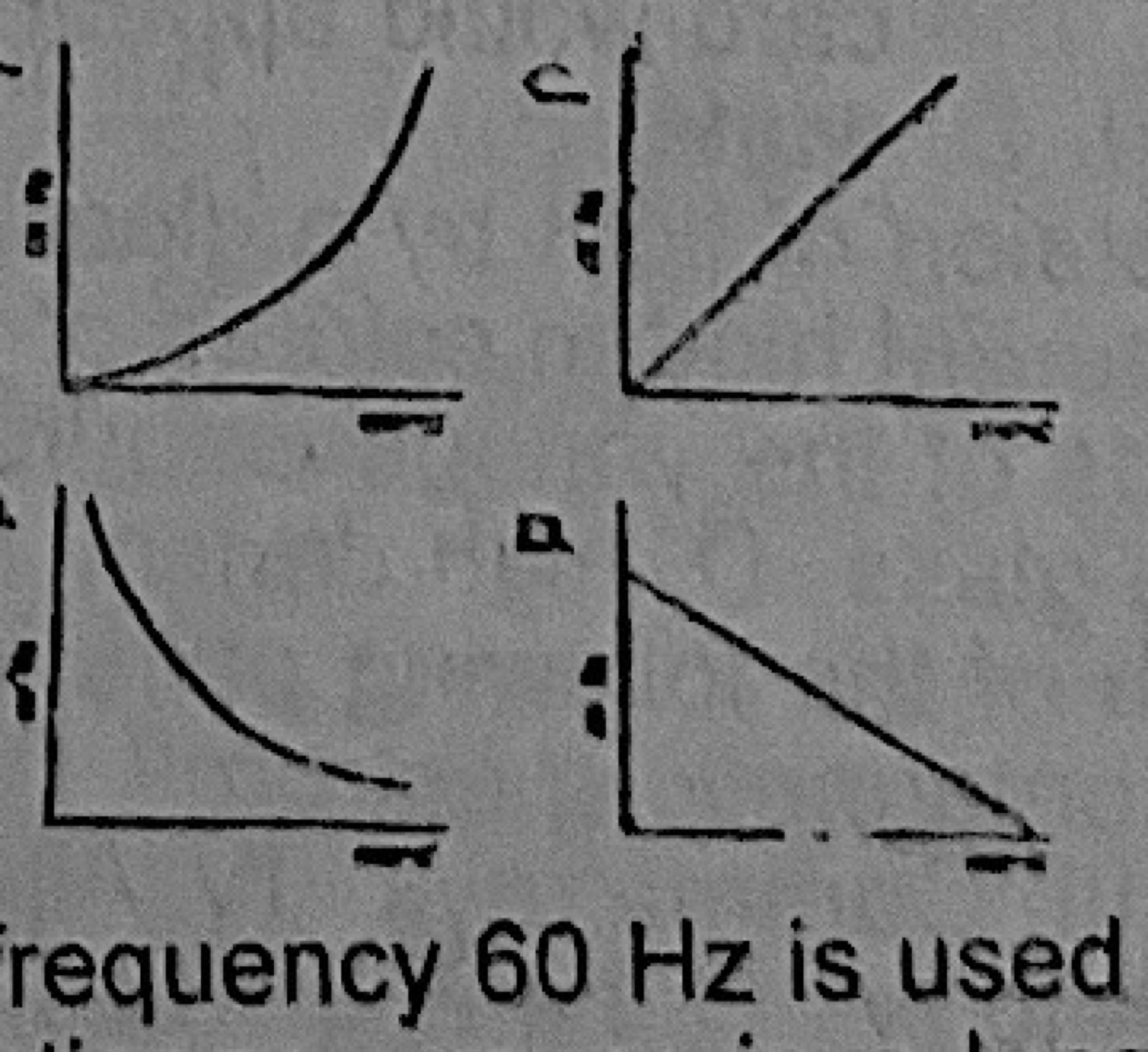
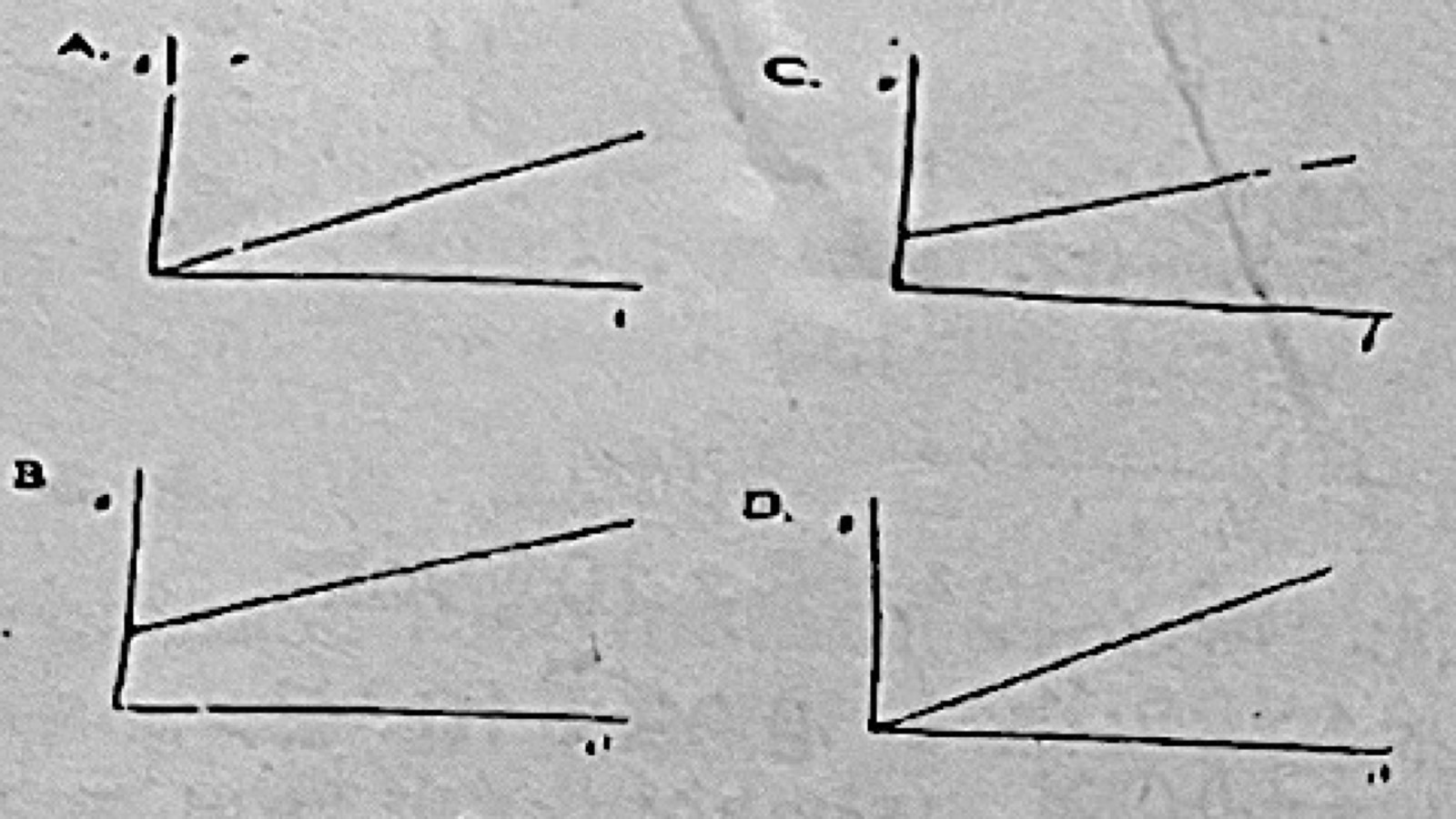
Which of the following correctly represents the relationship between the temperature rise θ and the current I in an experiment to illustrate the heating effect of electric current?
A.A
B.B
C.C
D.D
Show the answer and explanation
Answer: D (D)
Explanation
Heat produced = I²Rt, so the temperature rise is proportional to I². A graph of θ against I² is a straight line through the origin, as in D.
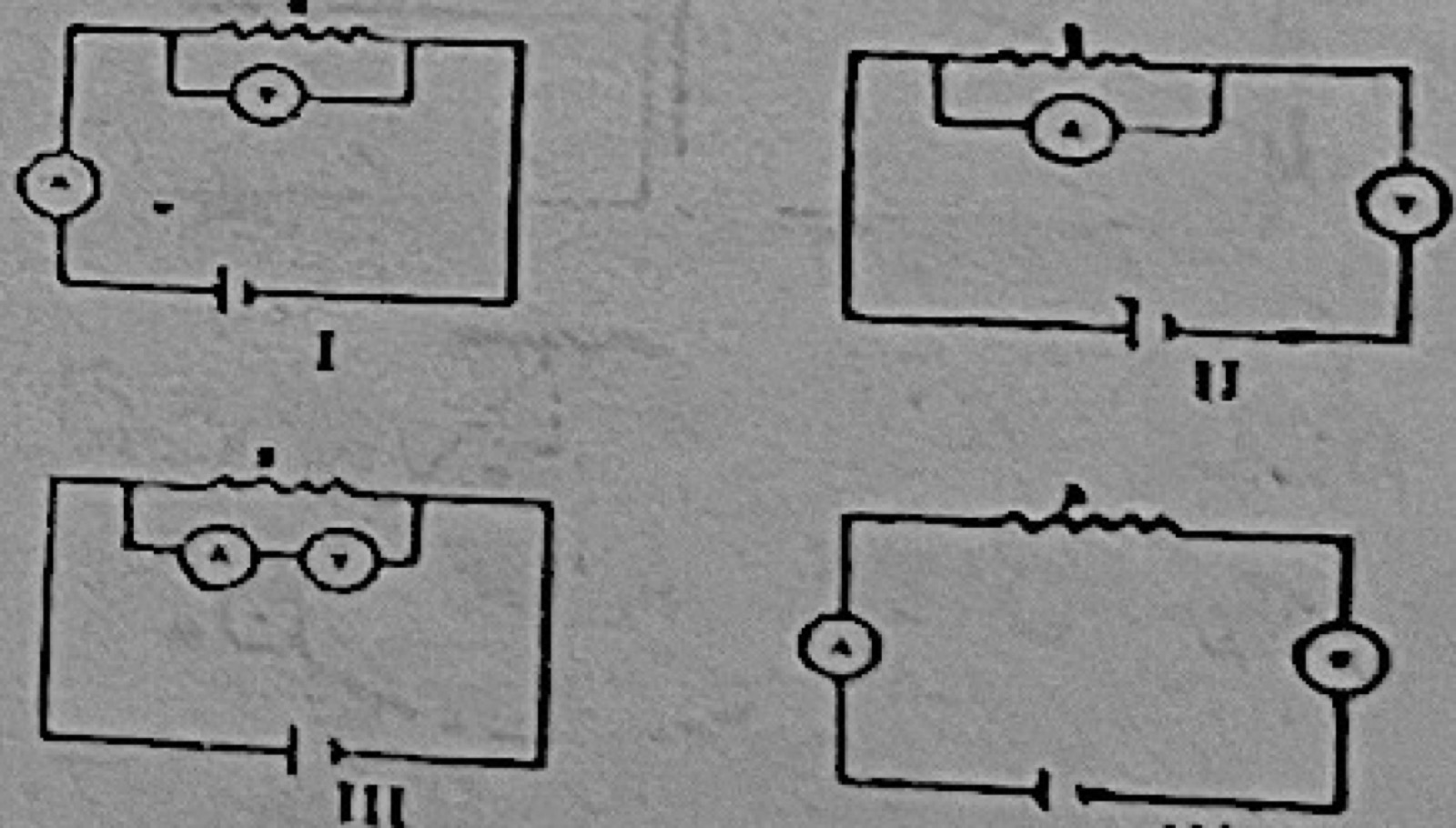
An ammeter of resistance 0.1 Ω has a full-scale deflection of 50 mA. Determine the resultant full-scale deflection of the meter when a shunt of 0.0111 Ω is connected across its terminals.
A.400 mA
B.450 mA
C.500 mA
D.550 mA
Show the answer and explanation
Answer: C (500 mA)
Explanation
At full scale the p.d. is 0.1 × 0.05 = 0.005 V. The shunt carries 0.005/0.0111 ≈ 0.45 A, so the total is 0.05 + 0.45 = 0.5 A = 500 mA.
The electrochemical equivalent of silver is 0.0012 g/C. If 36.0 g of silver is to be deposited by electrolysis on a surface by passing a steady current for 5.0 minutes, the current must be
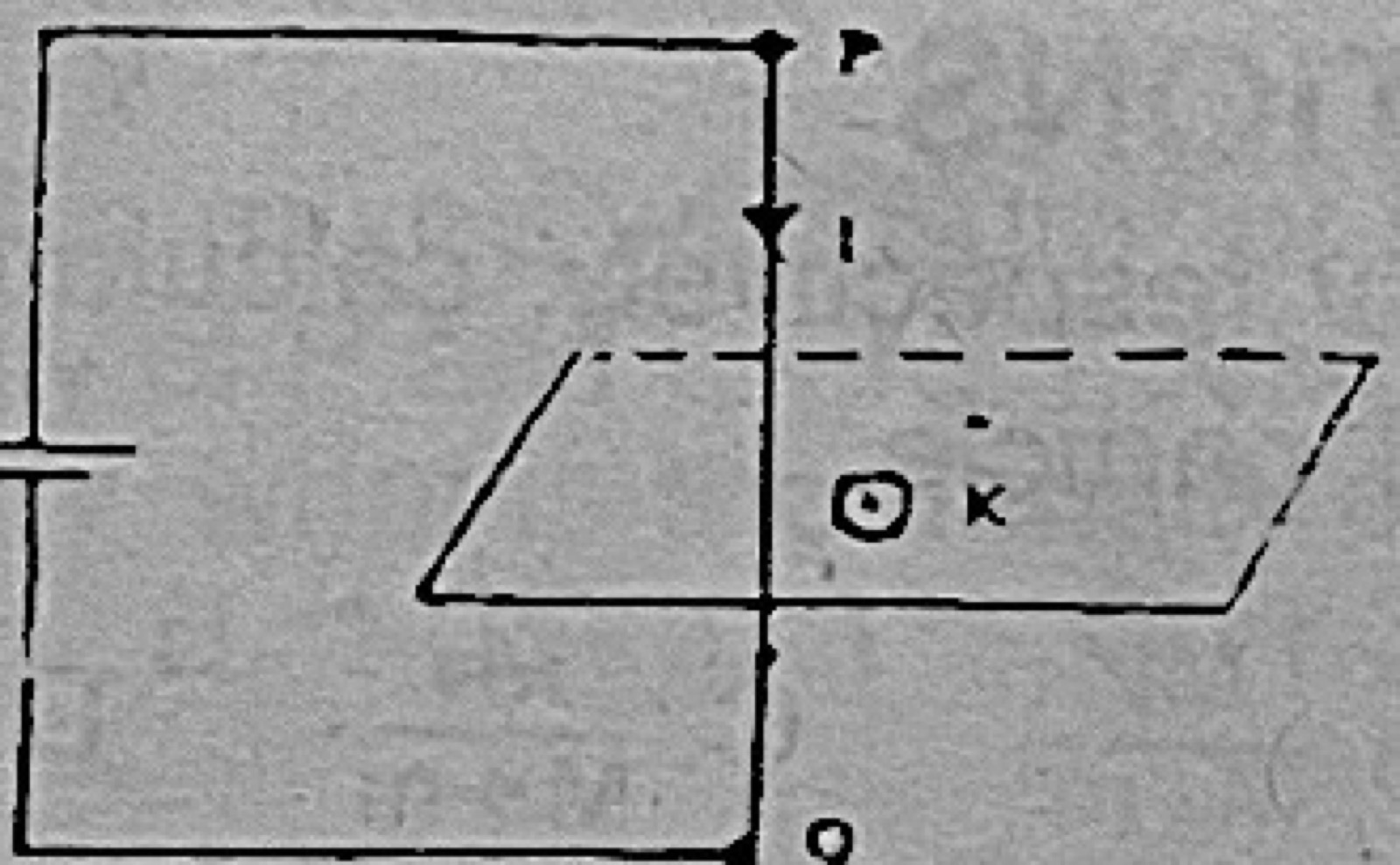
The figure above shows a conductor PQ carrying a current I in the direction shown. At a particular position near the conductor is a compass needle K. Neglecting the earth's magnetic field, the compass needle will
A.settle in any direction
B.settle in a fixed direction only if conductor PQ is a magnetic material
C.settle in a fixed direction whether conductor PQ is a magnetic material or not
D.be stationary
Show the answer and explanation
Answer: C (settle in a fixed direction whether conductor PQ is a magnetic material or not)
Explanation
Any current produces a magnetic field around it, whatever the wire is made of, so the needle settles along that field.
When a radiation strikes a metal surface, electrons may be ejected from the metal. The maximum kinetic energy which may be acquired by an ejected electron depends on the
A.intensity of the radiation
B.source of the radiation
C.wavelength of the radiation
D.detection device for the electron.
Show the answer and explanation
Answer: C (wavelength of the radiation)
Explanation
By Einstein's equation, maximum KE = hf − W = hc/λ − W, so it depends on the wavelength (frequency). Intensity only changes how many electrons come out.
Eight alpha decays and six beta decays are necessary before an atom of 23892U achieves stability. The final product in the chain has an atomic number of
A.70
B.78
C.82
D.90
Show the answer and explanation
Answer: C (82)
Explanation
Each alpha decay lowers the atomic number by 2 and each beta decay raises it by 1: 92 − 16 + 6 = 82.
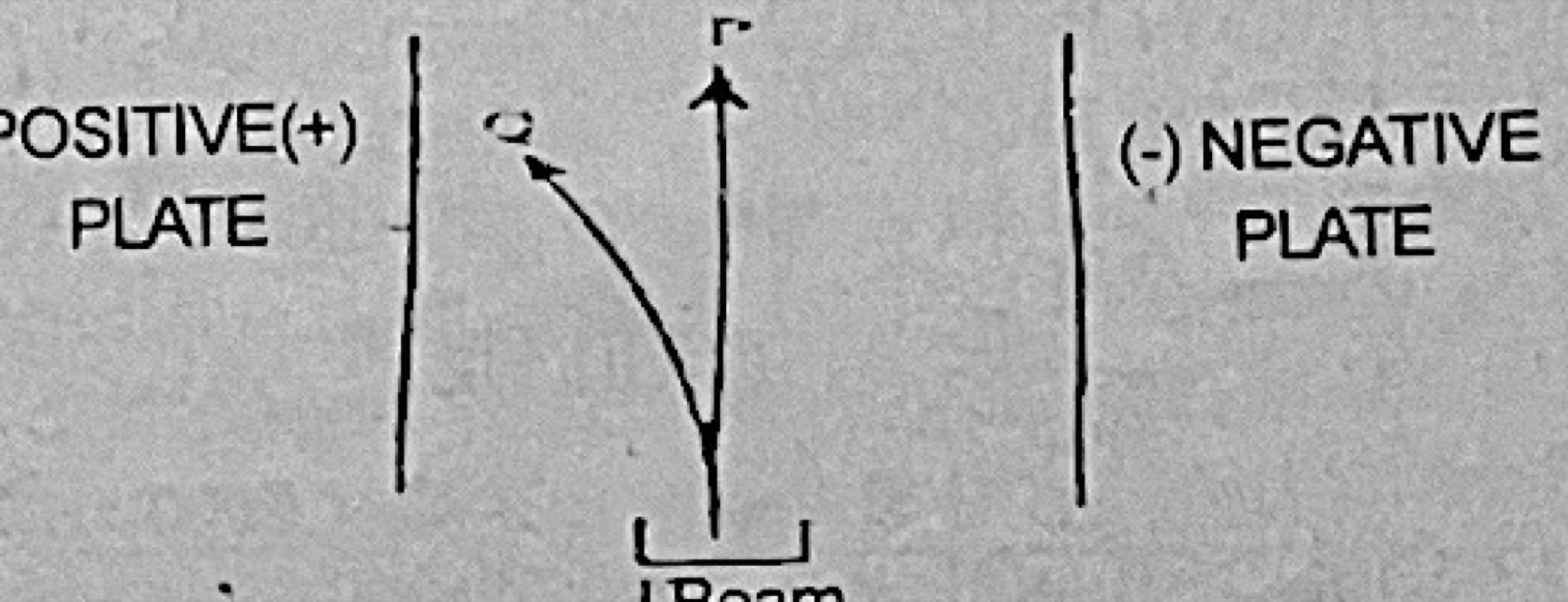
A beam of radiation is passed between a pair of charged plates as indicated in the diagram above. Beam P is undeflected while Q is deflected to the left. P and Q respectively could be I. γ-rays, β-rays II. x-rays, β-rays III. γ-rays, x-rays IV. x-rays, x-rays
A.I only
B.III only
C.I and II
D.III and IV
Show the answer and explanation
Answer: C (I and II)
Explanation
P is uncharged, so it could be γ-rays or X-rays. Q bends towards the positive plate, so it is negative: β-rays. Both I and II fit.