48 questions. Try each one, then open the answer to check yourself and read the explanation.
Question 1
Measurement and Units
Which of the following represents the correct precision if the length of a piece of wire is measured with a metre rule?
A.35 mm
B.35.0 mm
C.35.00 mm
D.35.01 mm
Show the answer and explanation
Answer: A (35 mm)
Explanation
A metre rule's smallest division is 1 mm, so it can only measure to the nearest millimetre: 35 mm. Writing 35.0 mm or 35.00 mm would claim a precision the rule does not have.
Two objects, one having three times the mass of the other, are dropped at the same time from a tall building. When they are above the ground, the two objects will have the same
A.momentum
B.kinetic energy
C.potential energy
D.acceleration
Show the answer and explanation
Answer: D (acceleration)
Explanation
All bodies falling freely have the same acceleration g, whatever their mass. Momentum and energies depend on mass.
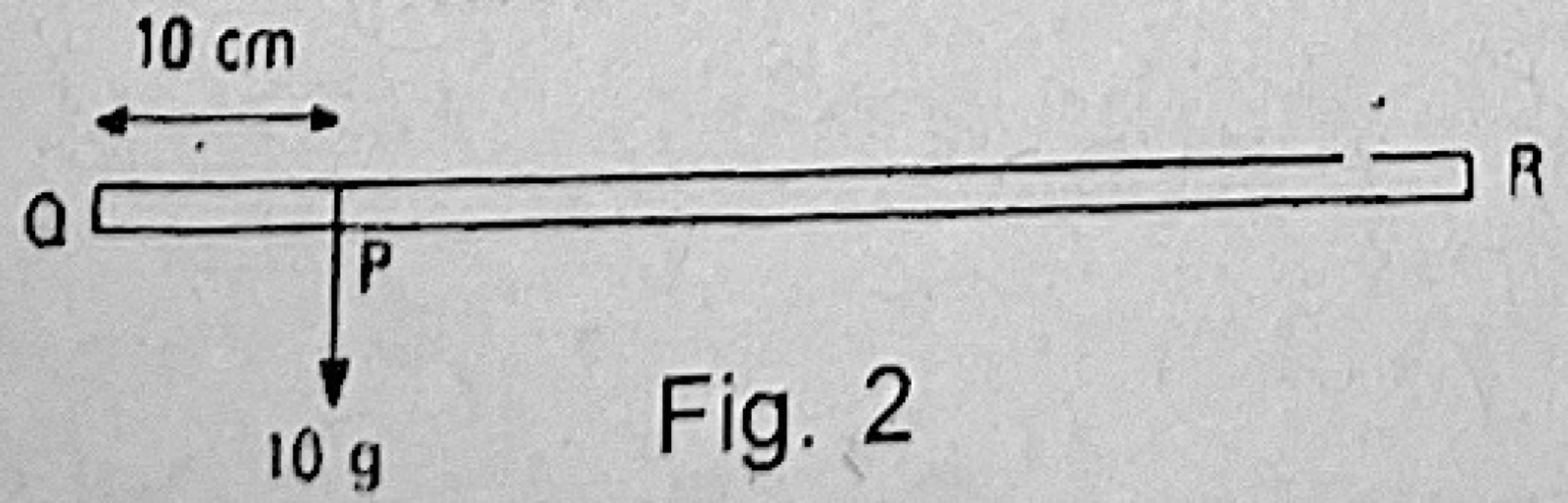
A uniform metre rule QR is balanced on a knife edge which is 55 cm from R. When a mass of 10 g is hung at P as shown in Fig. 2, the mass of the metre rule is
A.550 g
B.350 g
C.70 g
D.35 g
Show the answer and explanation
Answer: C (70 g)
Explanation
From R, P is at 90 cm, the pivot at 55 cm and the rule's centre of gravity at 50 cm. Moments: 10 × 35 = m × 5, so m = 70 g.
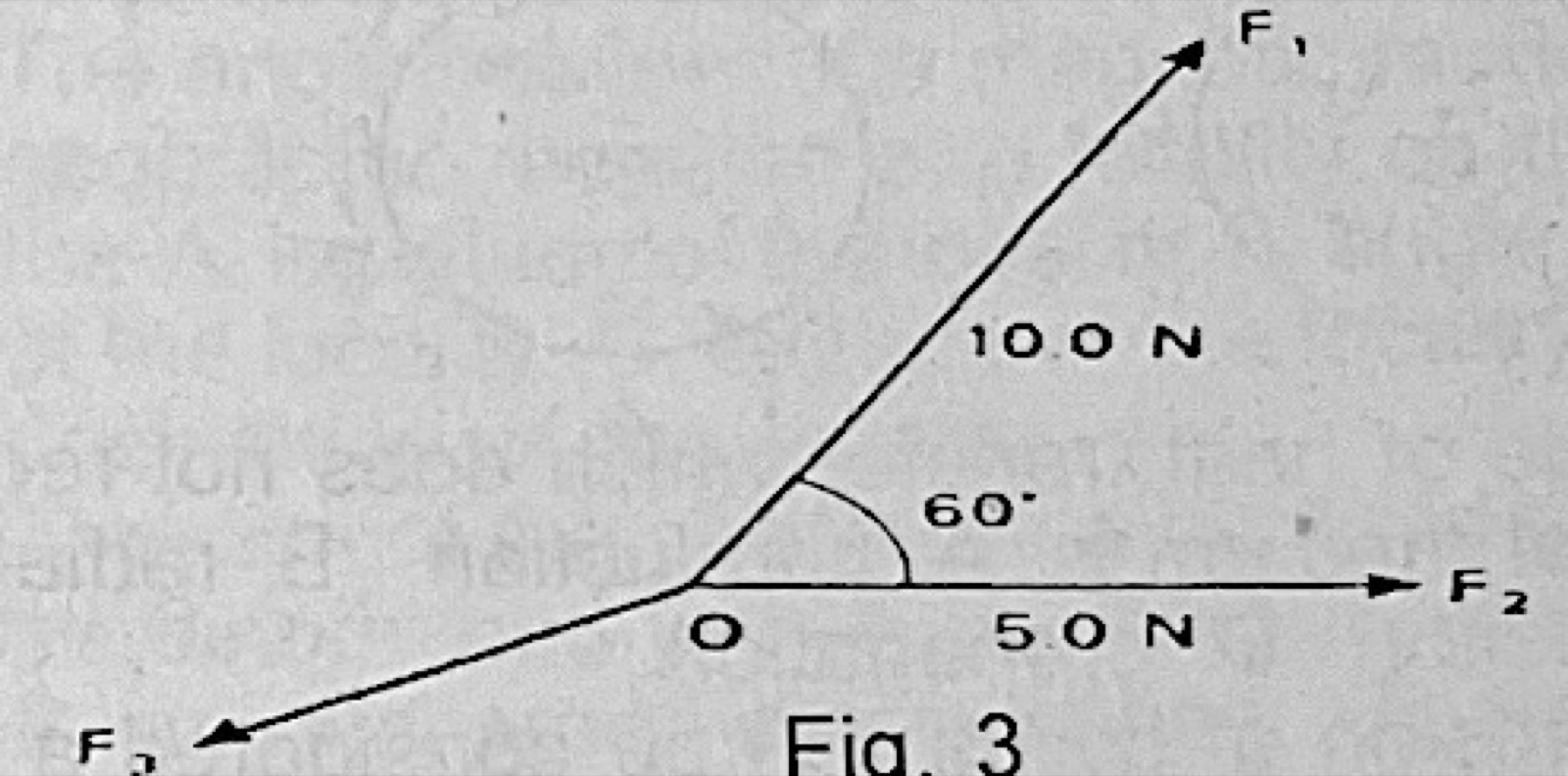
In Fig. 3, the three forces F1, F2, F3 acting at O are in equilibrium. If the magnitude of F1 is 10.0 N and the magnitude of F2 is 5.0 N, find the magnitude of F3.
A.26.4 N
B.15.0 N
C.13.2 N
D.10.0 N
Show the answer and explanation
Answer: C (13.2 N)
Explanation
F3 balances the resultant of F1 and F2, which are 60° apart: R² = 10² + 5² + 2 × 10 × 5 × cos 60° = 175, so R ≈ 13.2 N.
When a box of mass 45 kg is given an initial speed of 5 m s−1, it slides along a horizontal floor a distance of 3 m before coming to rest. What is the coefficient of the kinetic friction between the box and the floor? (g = 10 m s−2)
A.5/6
B.5/12
C.1/3
D.2/3.
Show the answer and explanation
Answer: B (5/12)
Explanation
Deceleration a = u²/2s = 25/6 m s−2. Friction μmg = ma, so μ = a/g = (25/6)/10 = 5/12.
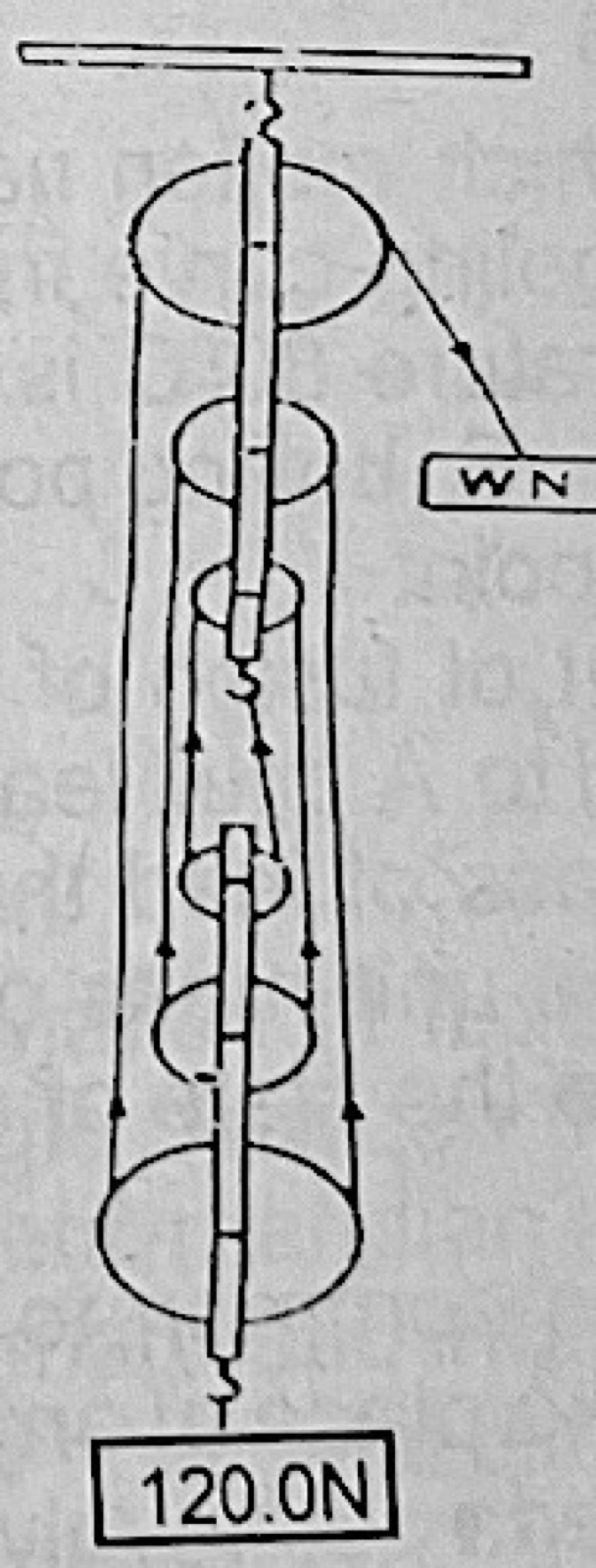
Figure 4 represents a block-and-tackle pulley system on which an effort of W Newtons supports a load of 120.0 N. If the efficiency of the machine is 40%, then the value of W is
A.28.0 N
B.48.0 N
C.50.0 N
D.288.0 N
Show the answer and explanation
Answer: C (50.0 N)
Explanation
The system has six supporting strands, so VR = 6. MA = 0.4 × 6 = 2.4, and W = 120 ÷ 2.4 = 50 N.
A constant force of magnitude F acts on an object of mass 0.04 kg initially at rest at a point O. If the speed of the object when it has moved 50 m from O is 500 m s−1, what is the value of F?
A.0.4 N
B.100.0 N
C.250.0 N
D.1000.0 N
Show the answer and explanation
Answer: B (100.0 N)
Explanation
a = v²/2s = 500²/100 = 2500 m s−2. F = ma = 0.04 × 2500 = 100 N.
A rectangular tank contains water to a depth of 2 m. If the base is 4 m × 3 m, calculate the force on the base (Density of water = 103 kg m−3, g = 10 m s−2)
A.2.4 × 105 N
B.2.4 × 104 N
C.2.0 × 104 N
D.1.7 × 103 N
Show the answer and explanation
Answer: A (2.4 × 10⁵ N)
Explanation
Pressure = hρg = 2 × 1000 × 10 = 2 × 10⁴ Pa. Force = pressure × area = 2 × 104 × 12 = 2.4 × 10⁵ N.
A 1000 kg elevator is descending vertically with an acceleration of 1.0 m s−2. If the acceleration due to gravity is 10.0 m s−2, the tension in the suspending cable is
A.1.0 N
B.10.0 N
C.9000.0 N
D.11 000.0 N
Show the answer and explanation
Answer: C (9000.0 N)
Explanation
Accelerating downwards, mg − T = ma, so T = m(g − a) = 1000 × 9 = 9000 N.
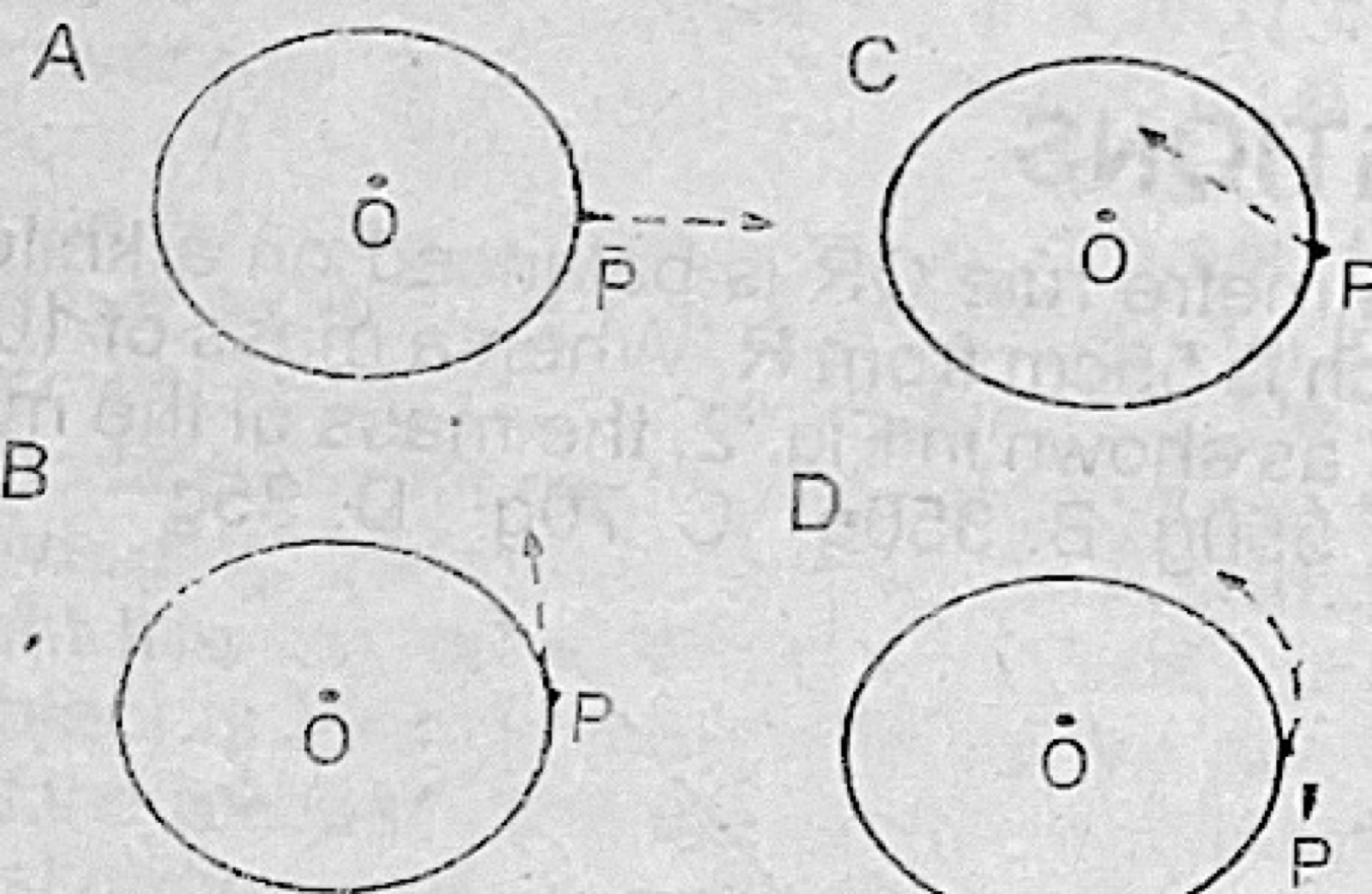
A ball attached to one end of a string moves anti-clockwise around a circle whose centre is O. If the string suddenly breaks when the ball is at the point P along which of the following paths will it move?
A.A
B.B
C.C
D.D
Show the answer and explanation
Answer: B (B)
Explanation
When the string breaks there is no centripetal force, so the ball flies off along the tangent in the direction it was moving; going anticlockwise at P, that is straight up the page, as in B.
The expansion of solids can be considered a disadvantage in the
A.balance wheel of a watch
B.fitting of wheels on rims
C.fire alarm
D.thermostat.
Show the answer and explanation
Answer: A (balance wheel of a watch)
Explanation
When a watch's balance wheel expands in heat its timing changes, which is a nuisance. Fitting tyres on wheels, fire alarms and thermostats all make use of expansion.
Which of the following is common to evaporation and boiling? They
A.take place at any temperature
B.are surface phenomena
C.involve change of state
D.take place at a definite pressure.
Show the answer and explanation
Answer: C (involve change of state)
Explanation
Both turn liquid into vapour, so both are changes of state. Evaporation happens at any temperature at the surface; boiling happens throughout at one temperature.
When two objects P and Q are supplied with the same quantity of heat, the temperature change in P is observed to be twice that of Q. The mass of P is half that of Q. The ratio of the specific heat capacity of P to Q is
A.1 : 4
B.4 : 1
C.1 : 1
D.2 : 1
Show the answer and explanation
Answer: C (1 : 1)
Explanation
Q = mcθ is the same for both: cP × (½m) × 2θ = cQ × m × θ, so cP = cQ and the ratio is 1 : 1.
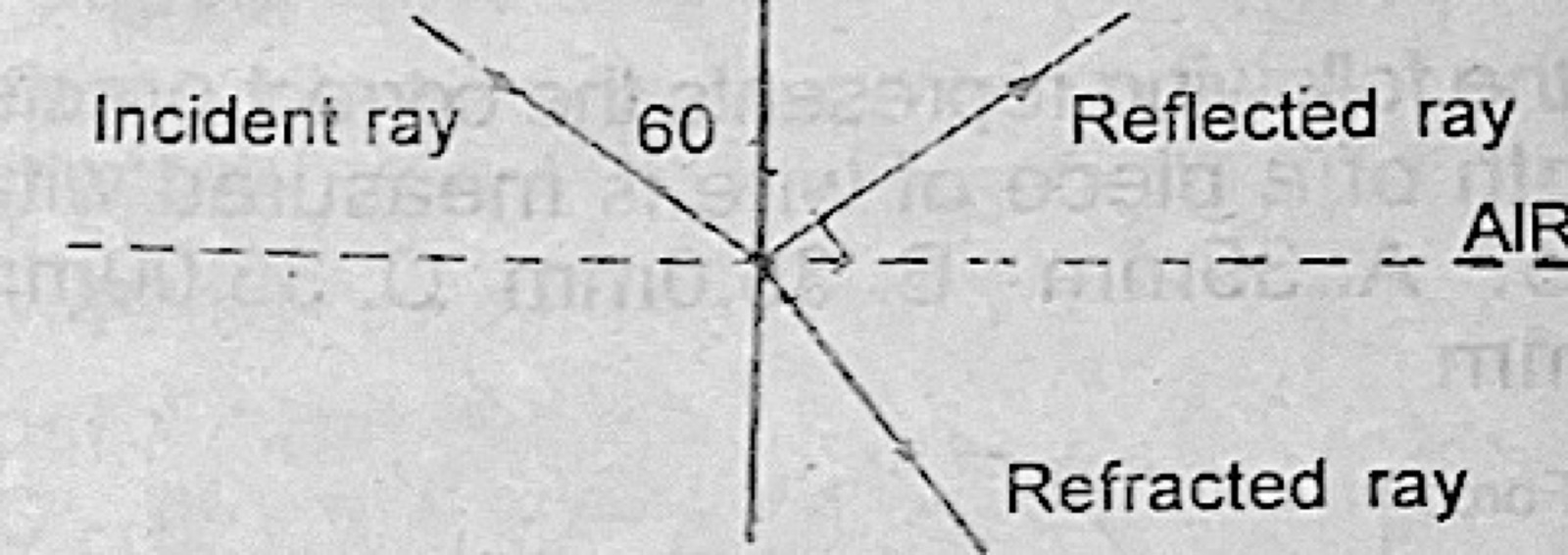
In Fig. 6, a ray of light in air strikes a glass plate at an angle of incidence of 60°. The reflected ray is observed to be perpendicular to the refracted ray. What is the refractive index of the glass?
A.1.73
B.1.50
C.0.87
D.0.57
Show the answer and explanation
Answer: A (1.73)
Explanation
Reflected ray is at 60° to the normal; for it to be at 90° to the refracted ray, the angle of refraction is 180° − 60° − 90° = 30°. n = sin 60°/sin 30° ≈ 1.73.
A lens of focal length 12.0 cm forms an upright image three times the size of a real object. The distance between the object and the image is
A.8.0 cm
B.16.0 cm
C.24.0 cm
D.32.0 cm
Show the answer and explanation
Answer: B (16.0 cm)
Explanation
An upright, magnified image from a converging lens is virtual and on the same side as the object, with v = −3u. 1/u − 1/(3u) = 1/12 gives u = 8 cm and the image 24 cm from the lens, so they are 24 − 8 = 16 cm apart.
A dentist obtains a linear magnification of 4 of a hole in a tooth by placing a concave mirror at a distance of 2.0 cm from the tooth. The radius of curvature of the mirror is
A.5.3 cm
B.3.2 cm
C.2.7 cm
D.1.6 cm
Show the answer and explanation
Answer: A (5.3 cm)
Explanation
The dentist sees an upright, virtual image, so v = −8 cm when u = 2 cm. 1/f = 1/2 − 1/8 = 3/8, f ≈ 2.67 cm and r = 2f ≈ 5.3 cm.
What is the effect of the increase in the size of the hole of a pin-hole camera on the image? It
A.gives a blurred image
B.corrects for chromatic aberration
C.magnifies the image
D.brings the image into a sharper focus.
Show the answer and explanation
Answer: A (gives a blurred image)
Explanation
A bigger hole lets light from each point of the object form a patch rather than a point, so the overlapping patches blur the image (though it is brighter).
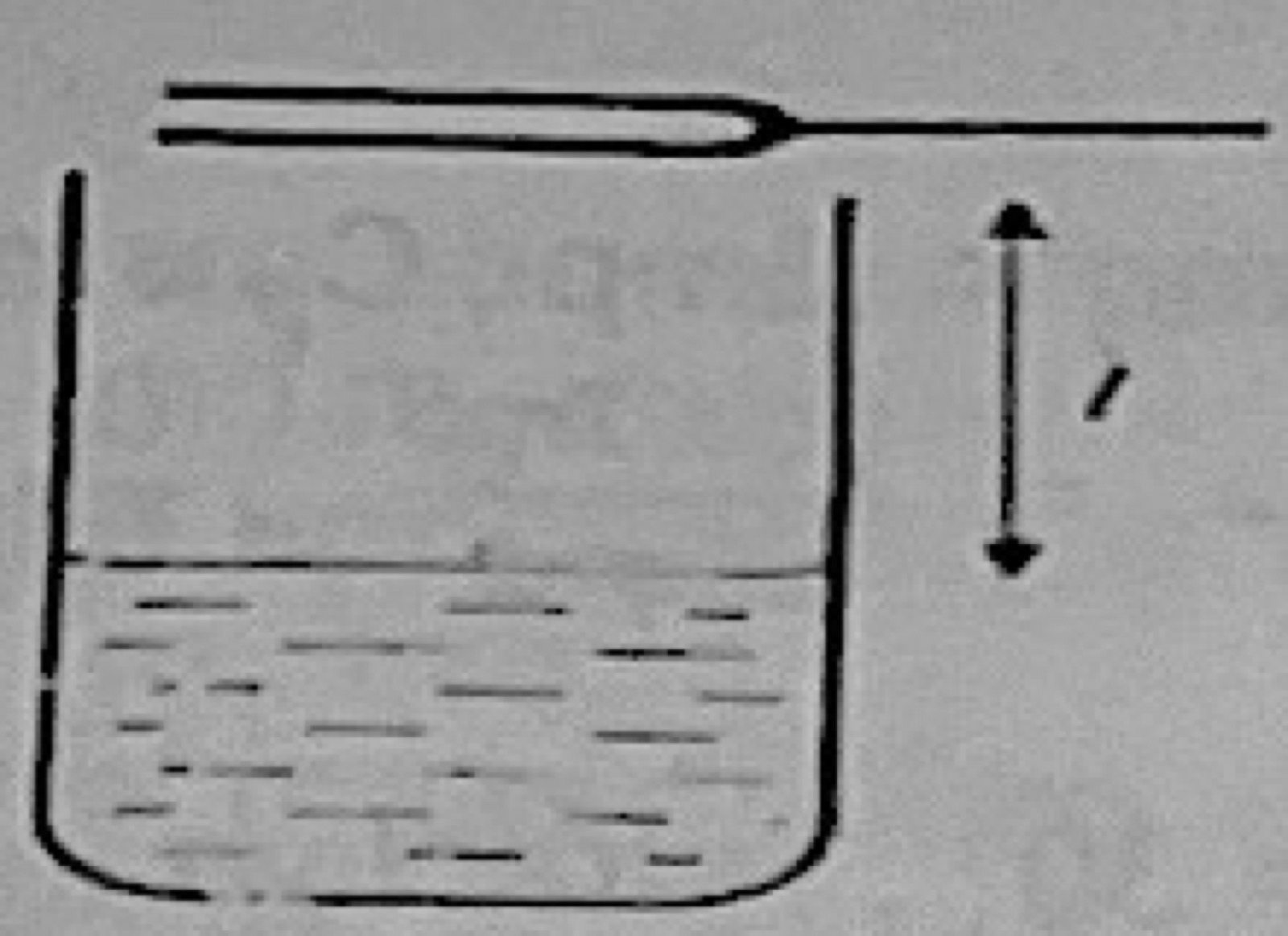
In Fig. 7, a resonance tube experiment is performed using one tuning fork. As the water level is lowered the first resonance is obtained when the length of the air column l = λ/4. The second resonance is obtained when l equals
A.λ/2
B.3λ/4
C.λ
D.3λ/2.
Show the answer and explanation
Answer: B (3λ/4)
Explanation
A tube closed at one end resonates at λ/4, 3λ/4, 5λ/4…, so the second resonance is at 3λ/4.
A man clapping his hands at regular intervals observes that the echo of a clap coincides with the next clap. If the reflecting cliff is 160 m away and the speed of sound is 320 m s−1, what is the frequency of the clapping?
A.1 Hz
B.2 Hz
C.4 Hz
D.8 Hz
Show the answer and explanation
Answer: A (1 Hz)
Explanation
The echo travels 320 m there and back in 320/320 = 1 s, so the claps are 1 s apart: 1 Hz.
A.Iron filings cling mainly round the ends of a bar magnet
B.The freely suspended bar magnet comes to rest in the geographic north-south direction.
C.Like poles attract
D.Lodestone is a non-magnetic oxide.
Show the answer and explanation
Answer: A (Iron filings cling mainly round the ends of a bar magnet)
Explanation
The magnetic force is strongest at the poles, near the ends of a bar magnet, so iron filings gather there. A suspended magnet points along the magnetic (not geographic) meridian.
The sign of the charge on a charged glass rod may be determined with
A.a charged electroscope
B.an uncharged electroscope
C.a galvanometer
D.an electrometer.
Show the answer and explanation
Answer: A (a charged electroscope)
Explanation
Bring the rod near an electroscope of known charge: if the leaves open further the charges are alike; an uncharged electroscope only shows that there is a charge.