JAMB Physics 1981 past questions and answers

48 questions. Try each one, then open the answer to check yourself and read the explanation.

Question 1

Temperature and Thermometers

The ice and steam points of a mercury-in-glass thermometer of centigrade scale and of uniform bore correspond respectively to 3 cm and 19 cm lengths of the mercury thread. When the length is 12 cm, the temperature is

  1. A.32°C
  2. B.48°C
  3. C.56°C
  4. D.65°C
  5. E.75°C
Show the answer and explanation

Answer: C (56°C)

Explanation

The 100 degrees span 19 − 3 = 16 cm. At 12 cm the thread is 9 cm above the ice point: θ = (9/16) × 100 ≈ 56°C.

Open this question

Question 2

Change of State and Vapours

A vapour is said to be saturated when

  1. A.more molecules return to the liquid than leave it
  2. B.a dynamic equilibrium exists between the liquid molecules and the vapour molecules at a given temperature
  3. C.the vapour pressure is atmospheric
  4. D.the temparature of the vapour varies
  5. E.all molecules are moving with the same speed.
Show the answer and explanation

Answer: B (a dynamic equilibrium exists between the liquid molecules and the vapour molecules at a given temperature)

Explanation

A saturated vapour is one in dynamic equilibrium with its liquid: molecules leave and return at the same rate.

Open this question

Question 3

Change of State and Vapours

The latent heat of fusion of a substance is the heat required to

  1. A.raise the temperature of unit mass of the substance by 1°C
  2. B.maintain unit mass of the substance at constant temperature
  3. C.change unit mass of substance from solid to liquid at constant temperature
  4. D.change unit mass of liquid to vapour at constant temperature
  5. E.raise the temperature of unit mass by 100°C.
Show the answer and explanation

Answer: C (change unit mass of substance from solid to liquid at constant temperature)

Explanation

Specific latent heat of fusion is the heat needed to melt unit mass of a solid without changing its temperature. Option D describes vaporisation.

Open this question

Question 4

Waves

The following types of waves are all transverse EXCEPT

  1. A.light waves
  2. B.radio waves
  3. C.sound waves
  4. D.surface waves on water
  5. E.x-rays.
Show the answer and explanation

Answer: C (sound waves)

Explanation

Sound waves in air are longitudinal: the particles vibrate along the direction the wave travels.

Open this question

Question 5

Pressure

The principle of the transmissibility of pressure in a fluid at rest in all directions is known as

  1. A.Archimedes Principle
  2. B.Flotation Principle
  3. C.Newton's Law
  4. D.Pascal's Law
  5. E.Boyle's Law
Show the answer and explanation

Answer: D (Pascal's Law)

Explanation

Pascal's principle states that pressure applied to an enclosed fluid is transmitted equally in all directions.

Open this question

Question 6

Gas Laws

When a fixed mass of an ideal gas expands at constant temperature, which property of the gas molecules increases?

  1. A.Average number per unit volume
  2. B.Average kinetic energy
  3. C.Average speed
  4. D.Average separation
  5. E.Average number of collisions per unit time.
Show the answer and explanation

Answer: D (Average separation)

Explanation

At constant temperature the molecules keep the same average kinetic energy and speed, but in a larger volume they are further apart, so their average separation increases (and collisions become less frequent).

Open this question

Question 7

Light and Reflection

Which of the following does NOT describe the image formed by a plane mirror?

  1. A.Erect
  2. B.Laterally inverted
  3. C.Same distance from mirror as object
  4. D.Magnified
  5. E.Virtual.
Show the answer and explanation

Answer: D (Magnified)

Explanation

A plane mirror image is the same size as the object, so it is not magnified.

Open this question

Question 8

Sound

If a source of sound is moving, a stationary listener will hear a sound of different frequency. This is called

  1. A.Doppler effect
  2. B.resonance
  3. C.ultra sound
  4. D.diffraction of sound
  5. E.rarefaction.
Show the answer and explanation

Answer: A (Doppler effect)

Explanation

The change in heard frequency caused by relative motion of source and listener is the Doppler effect.

Open this question

Question 9

Magnetism

Which of the following elements are real magnetic materials?

  1. A.Iron, steel and nickel
  2. B.Copper, steel and iron
  3. C.Lead, iron and brass
  4. D.Glass, lead and steel
  5. E.Stone, air and iron.
Show the answer and explanation

Answer: A (Iron, steel and nickel)

Explanation

Iron, steel (mostly iron) and nickel are ferromagnetic. Copper, lead, brass, glass, stone and air are not magnetic materials.

Open this question

Question 10

Simple Machines

An inclined plane of angle θ, acting as a simple machine, has a velocity ratio

  1. A.sin θ
  2. B.1/sin θ
  3. C.cos θ
  4. D.1/cos θ
  5. E.sin θ cos θ.
Show the answer and explanation

Answer: B (1/sin θ)

Explanation

Velocity ratio = distance moved along the slope ÷ height raised = L/(L sin θ) = 1/sin θ.

Open this question

Question 11

Heat Transfer

Heat may be transferred by conduction, convection and radiation. By which of these methods does heat travel through vacuum?

  1. A.Conduction only
  2. B.Convection only
  3. C.Radiation only
  4. D.All three methods
  5. E.None of these methods.
Show the answer and explanation

Answer: C (Radiation only)

Explanation

Conduction and convection need particles of matter. Only radiation (electromagnetic waves) crosses a vacuum.

Open this question

Question 12

Light and Reflection

Which of the following statements is applicable to a real image formed by a concave mirror? (i) It can be observed on a screen (ii) It is always inverted and in front of the mirror (iii) It only seems to exist (iv) It is formed by the actual converging of rays of light.

  1. A.(i), (ii) and (iii) only
  2. B.(i), (ii) and (iv) only
  3. C.(i) and (iii) only
  4. D.(i) and (ii) only
  5. E.All four statements.
Show the answer and explanation

Answer: B ((i), (ii) and (iv) only)

Explanation

A real image is formed where rays actually meet, in front of the mirror; it is inverted and can be caught on a screen. 'Only seems to exist' describes a virtual image.

Open this question

Question 13

Current Electricity

Which of the following is NOT an effect that can be produced by an electric current?

  1. A.Heat
  2. B.Light
  3. C.Sound
  4. D.Motion
  5. E.None of the above.
Show the answer and explanation

Answer: E (None of the above.)

Explanation

An electric current can produce heat (heater), light (lamp), sound (loudspeaker, bell) and motion (motor), so none of them is excluded.

Open this question

Question 14

Current Electricity

A cell of e.m.f. 2 V and internal resistance 1 Ω supplies a current of 0.5 amps to a resistance whose value is

  1. A.0.5 Ω
  2. B.1 Ω
  3. C.2 Ω
  4. D.2.5 Ω
  5. E.3 Ω
Show the answer and explanation

Answer: E (3 Ω)

Explanation

I = E/(R + r): 0.5 = 2/(R + 1), so R + 1 = 4 and R = 3 Ω.

Open this question

Question 15

Scalars and Vectors

An example of a scalar quantity is

  1. A.velocity
  2. B.weight
  3. C.electric charge
  4. D.acceleration due to gravity
  5. E.momentum.
Show the answer and explanation

Answer: C (electric charge)

Explanation

Electric charge has size but no direction. Velocity, weight, acceleration and momentum are vectors.

Open this question

Question 17

Refraction of Light

When a ray of light passes from water to glass, it is

  1. A.bent away from the normal
  2. B.bent towards the normal
  3. C.totally internally reflected
  4. D.absorbed by the glass
  5. E.broken into a pure spectrum.
Show the answer and explanation

Answer: B (bent towards the normal)

Explanation

Glass (n ≈ 1.5) is optically denser than water (n ≈ 1.33), so light slows down on entering glass and bends towards the normal.

Open this question

Question 18

Electrical Energy and Power

The resistance of a 240 V, 60 watt electric filament bulb is

  1. A.0.25 Ω
  2. B.480 Ω
  3. C.60 Ω
  4. D.240 Ω
  5. E.960 Ω
Show the answer and explanation

Answer: E (960 Ω)

Explanation

R = V²/P = 240²/60 = 57 600/60 = 960 Ω.

Open this question

Question 19

Friction

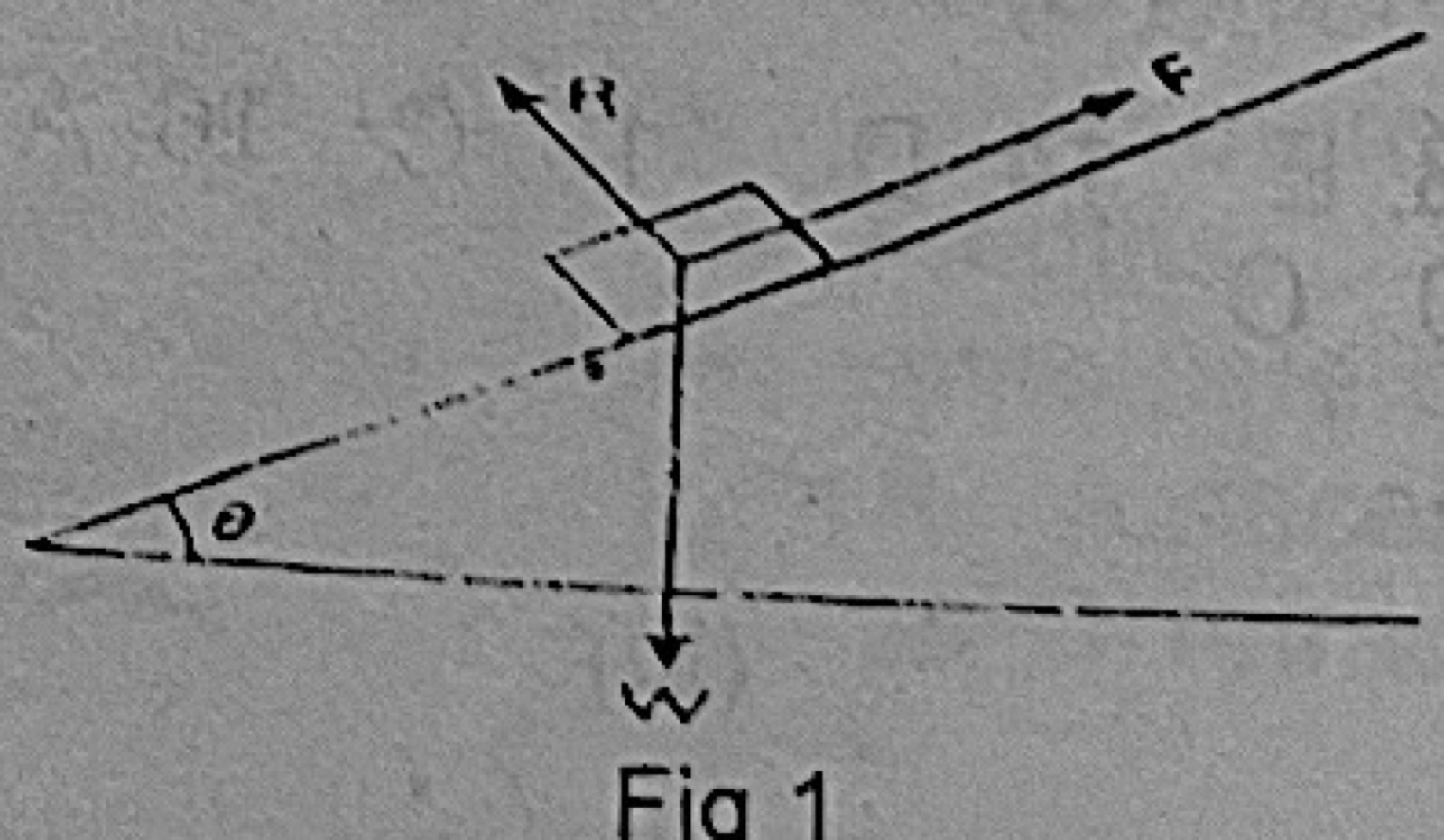
A body of mass 6 kg rests on an inclined plane. The normal reaction is R and the limiting frictional force is F as shown in the diagram (Fig. 1). If F is 30 N and g = 10 m s−2, then the angle of inclination θ is

Diagram for this question
  1. A.15°
  2. B.30°
  3. C.45°
  4. D.60°
  5. E.75°.
Show the answer and explanation

Answer: B (30°)

Explanation

At rest, friction balances the weight's component down the slope: F = mg sin θ, so 30 = 60 sin θ, sin θ = 0.5 and θ = 30°.

Open this question

Question 20

Heat Transfer

Two copper calorimeters O and P have identical dimensions but the outside of O is painted black while that of P is polished. The two are fitted with lids after equal volumes of boiling water have been added to them. They are then placed separately on a large metal table at a lower temperature. Several minutes later the temperature of

  1. A.both will be equal but lower
  2. B.P will be higher than that of O
  3. C.O will be higher than that of P
  4. D.O will be unchanged
  5. E.P will be unchanged.
Show the answer and explanation

Answer: B (P will be higher than that of O)

Explanation

The black surface of O radiates heat faster than the polished surface of P, so O cools faster and P stays hotter.

Open this question

Question 21

Current Electricity

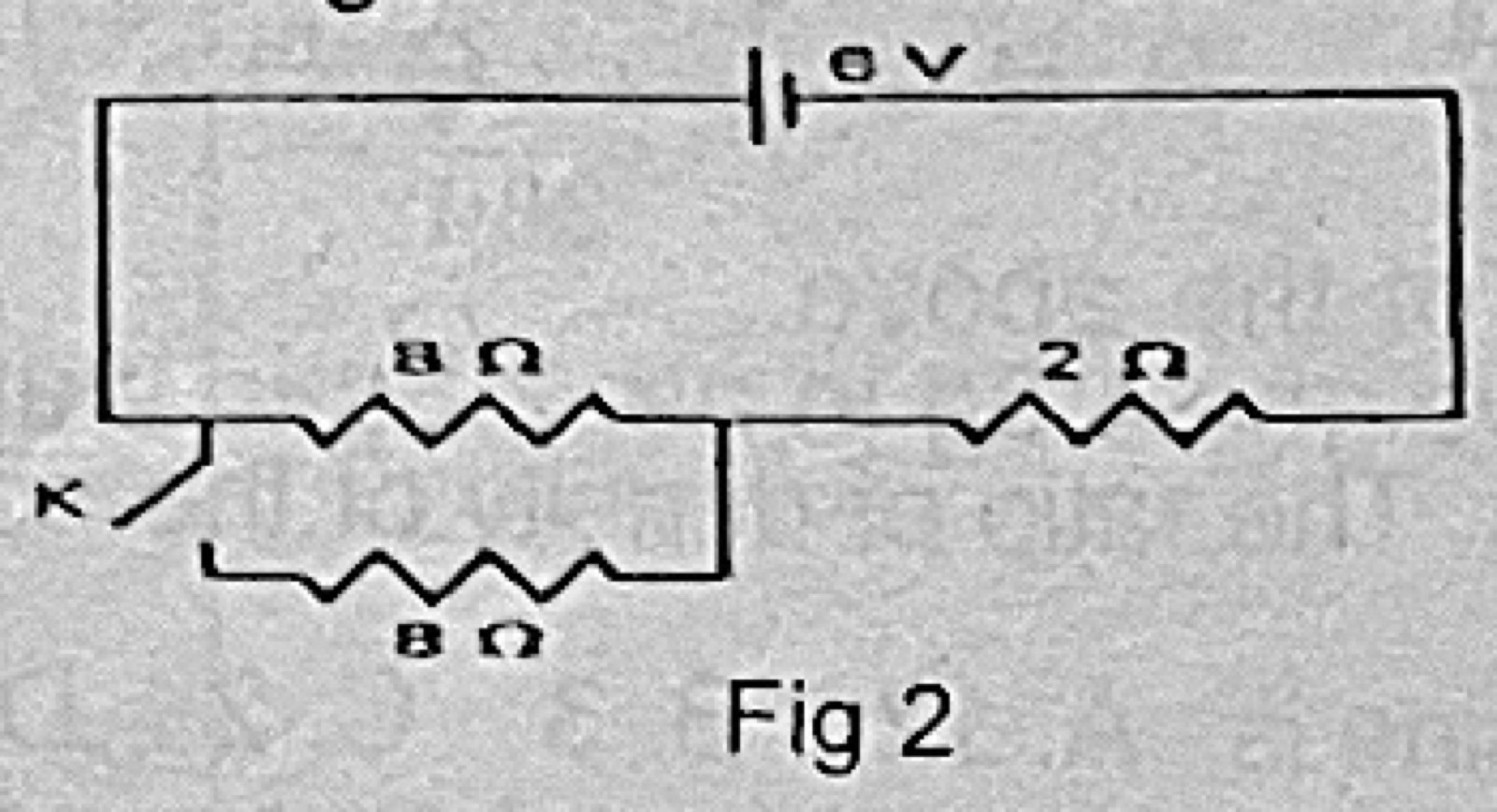
The effect of closing the key K in the circuit shown in Fig. 2 would be to

Diagram for this question
  1. A.increase the current by 0.6 A
  2. B.reduce the current by 0.6 A
  3. C.reduce the current by 0.4 A
  4. D.increase the current by 0.4 A
  5. E.keep the current unchanged.
Show the answer and explanation

Answer: D (increase the current by 0.4 A)

Explanation

With K open: R = 8 + 2 = 10 Ω, I = 6/10 = 0.6 A. With K closed the second 8 Ω goes in parallel (4 Ω), so R = 6 Ω and I = 1 A: an increase of 0.4 A.

Open this question

Question 22

Waves

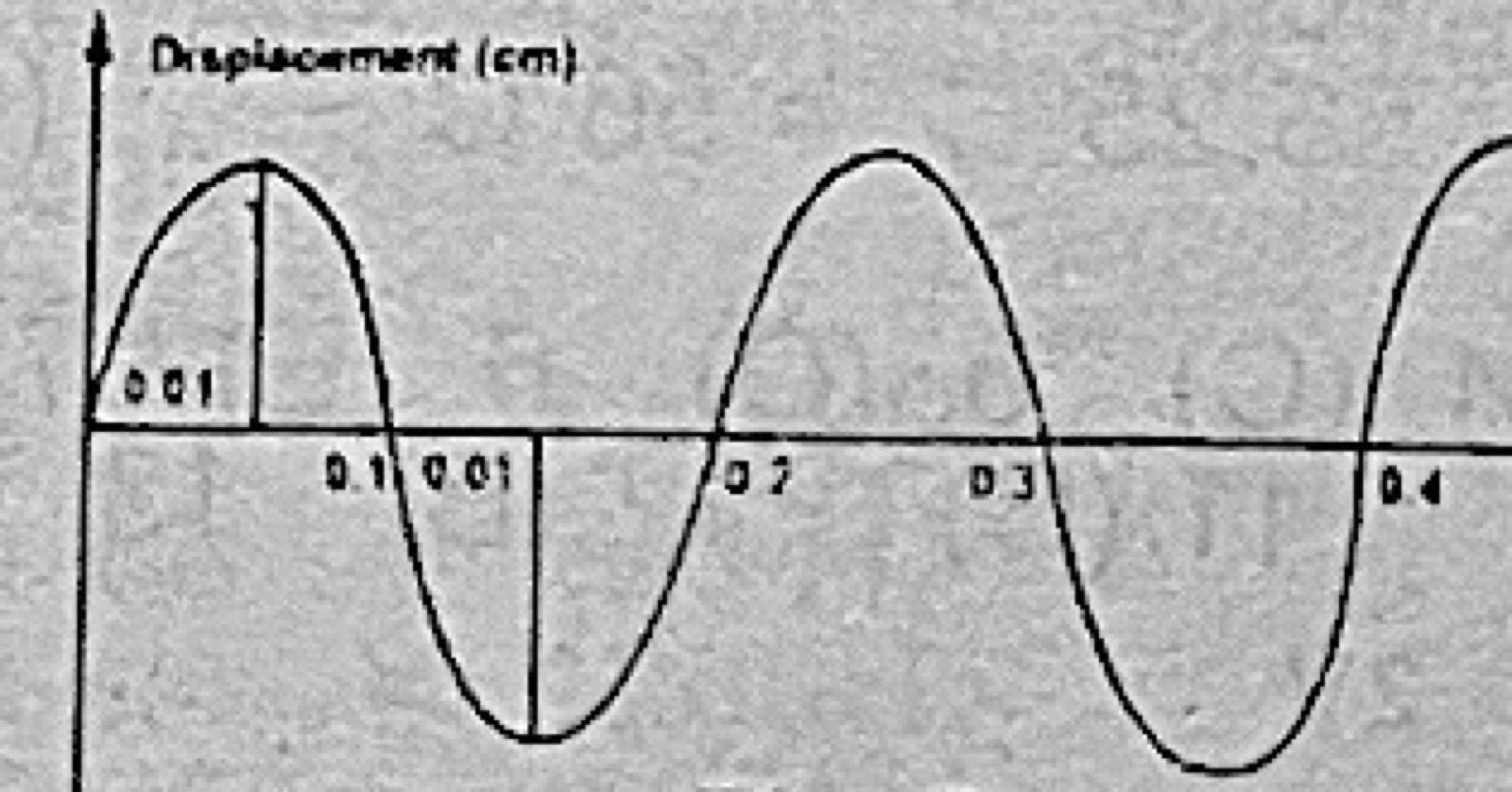
The wave motion shown (Fig. 3) has a frequency of

Diagram for this question
  1. A.0.1 Hz
  2. B.0.2 Hz
  3. C.5 Hz
  4. D.10 Hz
  5. E.100 Hz
Show the answer and explanation

Answer: C (5 Hz)

Explanation

From the graph one complete wave takes 0.2 s, so f = 1/T = 1/0.2 = 5 Hz.

Open this question

Question 23

Scalars and Vectors

An aircraft travelled from Calabar to Kano as follows: It flew first to Ilorin covering a distance of 300 km, 30° West of North, and then flew 400 km, 60° East of North to Kano. What is the resultant displacement?

  1. A.567 km
  2. B.410 km
  3. C.594 km
  4. D.500 km
  5. E.600 km
Show the answer and explanation

Answer: D (500 km)

Explanation

The two legs are 30° + 60° = 90° apart, so the resultant is √(300² + 400²) = 500 km.

Open this question

Question 24

Sound

All of the following frequencies are overtones of 320 Hz EXCEPT

  1. A.960 Hz
  2. B.640 Hz
  3. C.520 Hz
  4. D.1280 Hz
  5. E.1600 Hz
Show the answer and explanation

Answer: C (520 Hz)

Explanation

Overtones (harmonics) are whole-number multiples of 320 Hz: 640, 960, 1280, 1600 Hz. 520 Hz is not a multiple.

Open this question

Question 25

Motion

The driver in a motor car, of which the total mass is 800 kg and which is travelling at 20 m s−1, suddenly observes a stationary dog in his path 50 m ahead. If the car brakes can exert a force of 2000 N, what will most likely happen?

  1. A.The car will be able to stop immediately the driver notices the dog
  2. B.The car will stop 30 m after hitting the dog
  3. C.The car will stop 20 m in front of the dog
  4. D.The driver will quickly reverse the car
  5. E.The car will stop 5 m beyond the dog.
Show the answer and explanation

Answer: B (The car will stop 30 m after hitting the dog)

Explanation

Deceleration a = 2000/800 = 2.5 m s−2. Stopping distance = v²/2a = 400/5 = 80 m, which is 30 m beyond the dog 50 m ahead.

Open this question

Question 26

Refraction of Light

The absolute refractive indices of glass and water are 3/2 and 4/3 respectively. The refractive index at the interface when a ray travels from water to glass is

  1. A.1/2
  2. B.8/9
  3. C.9/8
  4. D.17/12
  5. E.2
Show the answer and explanation

Answer: C (9/8)

Explanation

wng = nglass/nwater = (3/2) ÷ (4/3) = 9/8.

Open this question

Question 27

Electrostatics

Which of the following statements is CORRECT?

  1. A.Charges generated on glass rubbed with silk are called negative
  2. B.Charges in various media can be carried by protons detached from their atoms.
  3. C.The magnitude of any charge is a multiple of the charge of an electron
  4. D.The intensity of an electric field is a scalar quantity
  5. E.If 500 joules of work are required to move a 2-coulomb charge between two points, the potential difference between the two points is 100 V.
Show the answer and explanation

Answer: C (The magnitude of any charge is a multiple of the charge of an electron)

Explanation

Charge comes in whole-number multiples of the electronic charge. Glass rubbed with silk becomes positive, field intensity is a vector, and 500 J ÷ 2 C = 250 V, not 100 V.

Open this question

Question 28

Friction

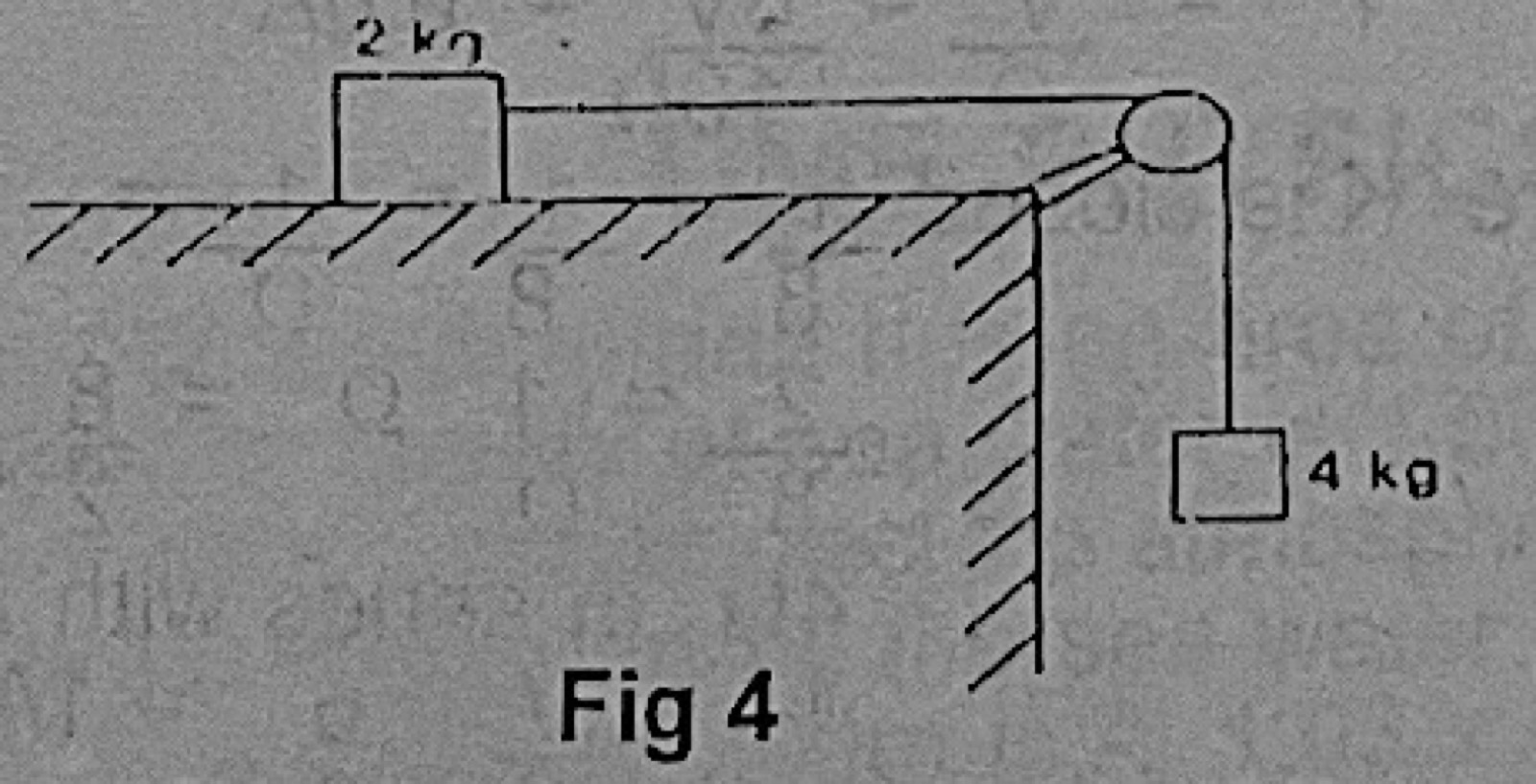
A mass of 2 kg on a surface (μ = ½) is connected to second mass of 4 kg over a frictionless pulley as shown in Fig. 4. If the acceleration due to gravity is 9.8 m s−2 then the masses will

Diagram for this question
  1. A.accelerate at 4.9 m s−2
  2. B.remain stationary
  3. C.accelerate at 9.8 m s−2
  4. D.accelerate at 19.6 m s−2
  5. E.Accelerate at 39.2 m s−2.
Show the answer and explanation

Answer: A (accelerate at 4.9 m s−2)

Explanation

Pulling force = 4 × 9.8 = 39.2 N; friction = ½ × 2 × 9.8 = 9.8 N. Net force 29.4 N on a total mass of 6 kg gives a = 4.9 m s−2.

Open this question

Question 29

Radioactivity and Nuclear Physics

Which type of radiation does NOT originate within the nucleus?

  1. A.Alpha
  2. B.Beta
  3. C.Gamma
  4. D.Neutron
  5. E.X-rays.
Show the answer and explanation

Answer: E (X-rays.)

Explanation

X-rays come from the electrons outside the nucleus (or from electrons being stopped). Alpha, beta, gamma radiation and neutrons come from the nucleus.

Open this question

Question 30

Current Electricity

The resistance of an open series circuit is

  1. A.zero
  2. B.half the normal resistance of the circuit
  3. C.double the normal resistance of the circuit
  4. D.one
  5. E.infinite
Show the answer and explanation

Answer: E (infinite)

Explanation

An open circuit has a gap, and no current can flow however large the voltage, so its resistance is effectively infinite.

Open this question

Question 31

Lenses and Optical Instruments

The lack of power of accommodation which is mainly due to the hardening of the eye lens and is usual with the onset of old age is called

  1. A.myopia
  2. B.hypermetropia
  3. C.presbyopia
  4. D.astigmatism
  5. E.eye ring.
Show the answer and explanation

Answer: C (presbyopia)

Explanation

Presbyopia is the loss of focusing (accommodation) power with age as the lens becomes stiff.

Open this question

Question 32

Lenses and Optical Instruments

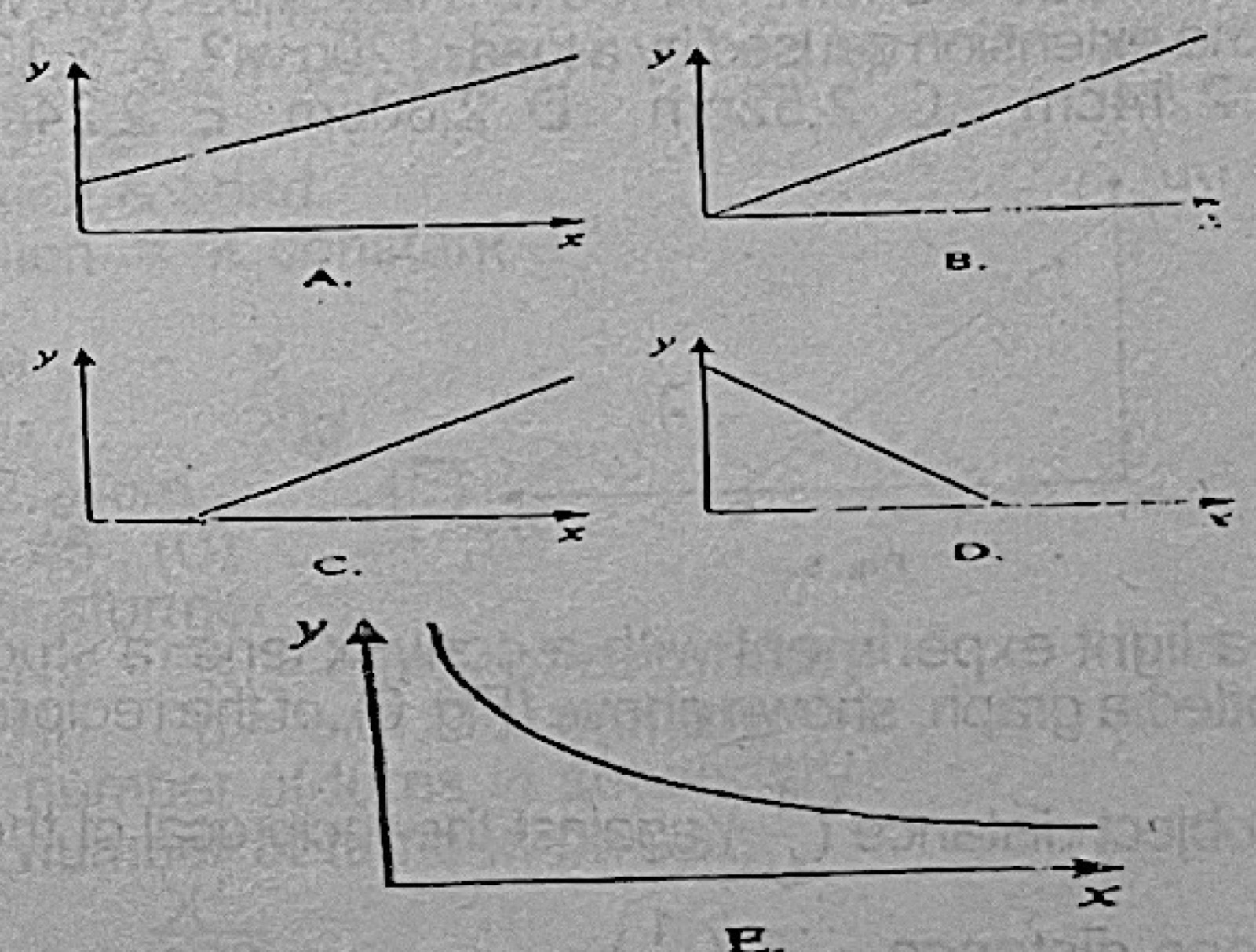
When a lamp is placed on the axis and at various distances U from a converging lens, real images are formed at various distances V from the lens. Which of the graphs below will be obtained by plotting the values of quantity y (y = 1/V) against another quantity x (x = 1/U)?

Diagram for this question
  1. A.A
  2. B.B
  3. C.C
  4. D.D
  5. E.E
Show the answer and explanation

Answer: D (D)

Explanation

From 1/V = 1/f − 1/U, the graph of 1/V against 1/U is a straight line with slope −1 that cuts both axes at 1/f, which is graph D.

Open this question

Question 33

Motion

A body falls freely under gravity (g = 9.8 m s−2) from a height of 40 m on to the top of a platform 0.8 m above the ground. Its velocity on reaching the platform is

  1. A.784 m s−1
  2. B.80 m s−1
  3. C.78.4 m s−1
  4. D.39.2 m s−1
  5. E.27.7 m s−1.
Show the answer and explanation

Answer: E (27.7 m s−1.)

Explanation

It falls 40 − 0.8 = 39.2 m. v² = 2gh = 2 × 9.8 × 39.2 = 768.3, so v ≈ 27.7 m s−1.

Open this question

Question 34

Electromagnetic Induction

Alternating current can induce voltage because it has a

  1. A.ripple value
  2. B.varying magnetic field
  3. C.weaker magnetic field than direct current
  4. D.stronger magnetic field than direct current
  5. E.high peak value
Show the answer and explanation

Answer: B (varying magnetic field)

Explanation

An e.m.f. is induced only when magnetic flux changes. An alternating current produces a constantly changing magnetic field.

Open this question

Question 35

Motion

Two particles X and Y starting from rest cover the same distance. The acceleration of X is twice that of Y. The ratio of the time taken by X to that taken by Y is

  1. A.1/2
  2. B.2
  3. C.1/√2
  4. D.√2
  5. E.4
Show the answer and explanation

Answer: C (1/√2)

Explanation

From s = ½at², t = √(2s/a), so t is proportional to 1/√a. Doubling a makes t smaller by √2: tX/tY = 1/√2.

Open this question

Question 36

Gas Laws

A balloon inflated with helium gas at ground level is released. As it rises through a constant temperature atmosphere,

  1. A.its pressure reduces but volume remains constant
  2. B.the product of pressure and volume remains constant
  3. C.both pressure and volume increase
  4. D.its pressure remains constant but the volume decreases
  5. E.both pressure and volume remain constant.
Show the answer and explanation

Answer: B (the product of pressure and volume remains constant)

Explanation

At constant temperature Boyle's law applies: as the outside pressure falls the balloon expands, but pV stays constant.

Open this question

Question 38

Sound

The quality (timbre) of sound depends on

  1. A.amplitude
  2. B.frequency
  3. C.harmonics
  4. D.velocity
  5. E.wavelength
Show the answer and explanation

Answer: C (harmonics)

Explanation

Quality depends on which overtones (harmonics) are present and how strong they are, which is why instruments playing the same note sound different.

Open this question

Question 39

Radioactivity and Nuclear Physics

The mass of a proton is approximately equal to that of

  1. A.an α-particle
  2. B.a β-particle
  3. C.a γ-ray
  4. D.an electron
  5. E.a neutron
Show the answer and explanation

Answer: E (a neutron)

Explanation

Protons and neutrons have almost the same mass (about 1 u). An electron or β-particle is about 1840 times lighter and an α-particle about four times heavier.

Open this question

Question 40

Lenses and Optical Instruments

An object placed on the principle axis of a convex lens of focal length 10 cm, produces a real image of double magnification. The image distance from the lens is

  1. A.30 cm
  2. B.25 cm
  3. C.20 cm
  4. D.15 cm
  5. E.10 cm
Show the answer and explanation

Answer: A (30 cm)

Explanation

v = 2u. Then 1/u + 1/(2u) = 1/10, so 3/(2u) = 1/10, u = 15 cm and v = 30 cm.

Open this question

Question 41

Equilibrium of Forces

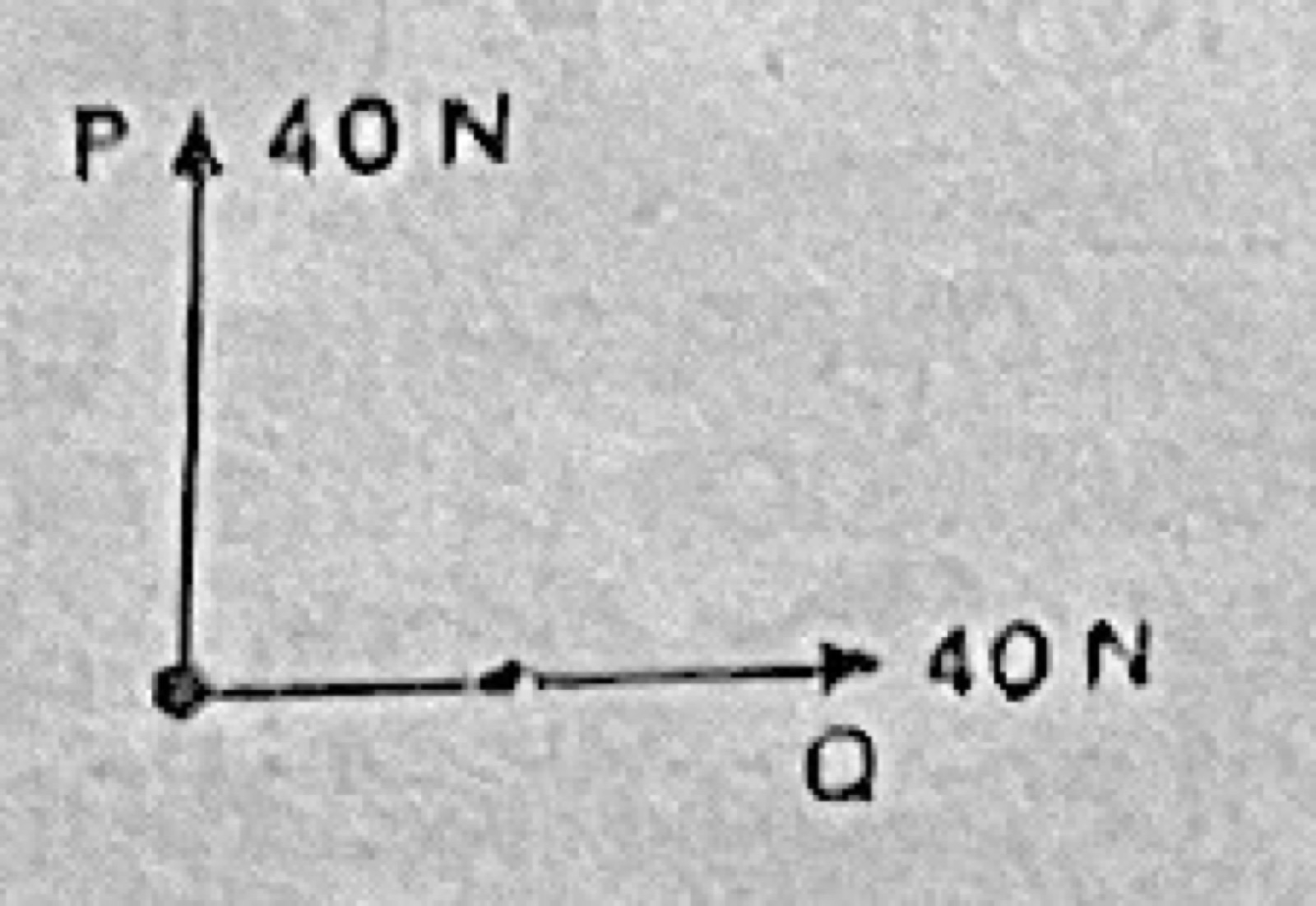
A particle is under the action of three forces in equilibrium. Two of the forces are as shown in Fig. 5. The third force is

Diagram for this question
  1. A.80 N along P
  2. B.160 N at 60° to P
  3. C.40√2 N at 45° to either P or Q
  4. D.0 N
  5. E.40√2 N at 30° to Q.
Show the answer and explanation

Answer: C (40√2 N at 45° to either P or Q)

Explanation

The two perpendicular 40 N forces have a resultant of √(40² + 40²) = 40√2 N at 45° between them. The third force must be equal and opposite to this, 40√2 N along the line at 45° to P and Q.

Open this question

Question 42

Temperature and Thermometers

A liquid-in-glass thermometer should quickly register temperature changes. This is achieved by choosing a liquid that

  1. A.is opaque
  2. B.has high density
  3. C.has regular expansion
  4. D.has a high thermal conductivity
  5. E.can wet glass
Show the answer and explanation

Answer: D (has a high thermal conductivity)

Explanation

A liquid with high thermal conductivity quickly takes up the temperature of its surroundings, so the thermometer responds fast.

Open this question

Question 43

Elasticity

The extension in a spring when 5 g wt was hung from it was 0.56 cm. If Hooke's law is obeyed, what is the extension caused by a load of 20 g wt?

  1. A.1.12 cm
  2. B.2.14 cm
  3. C.2.52 cm
  4. D.2.80 cm
  5. E.2.24 cm
Show the answer and explanation

Answer: E (2.24 cm)

Explanation

Extension is proportional to load: 0.56 × (20/5) = 2.24 cm.

Open this question

Question 44

Lenses and Optical Instruments

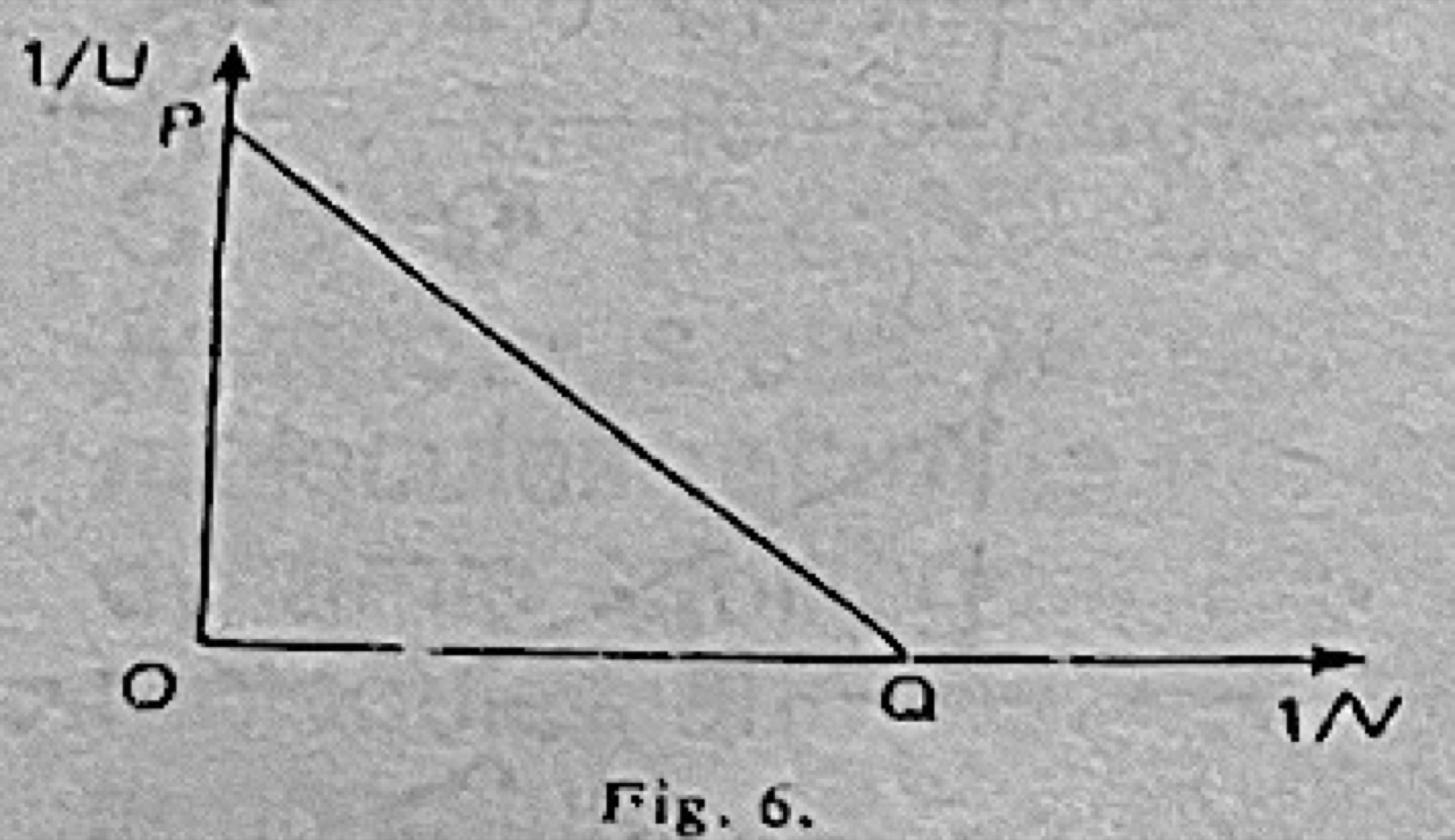
In a light experiment with a convex lens a student plotted a graph, shown above (Fig. 6), of the reciprocal of object distance (1/U) against the reciprocal of the image distance (1/V). The focal length of the lens is given by

Diagram for this question
  1. A.slope of the line PQ
  2. B.reciprocal of either OP or OQ
  3. C.length OP or OQ
  4. D.area under the graph
  5. E.ratio OP/OQ.
Show the answer and explanation

Answer: B (reciprocal of either OP or OQ)

Explanation

From 1/U + 1/V = 1/f, each intercept (OP and OQ) equals 1/f, so f is the reciprocal of either intercept.

Open this question

Question 45

Electromagnetic Induction

Which of the following is NOT directly associated with direct current (D.C.)?

  1. A.A dry cell
  2. B.A moving coil galvanometer
  3. C.A transformer
  4. D.A lead-acid accumulator
  5. E.A commutator
Show the answer and explanation

Answer: C (A transformer)

Explanation

A transformer works only with changing (alternating) current, because it relies on a changing magnetic flux.

Open this question

Question 46

Simple Harmonic Motion

The relationship between the period T and the length l of a simple pendulum is T = 2π(l/g)1/2. From experimental data of T and l, one can obtain the following graphs. (i) T vs. l (ii) T vs. l2 (iii) T2 vs. l (iv) T vs. √l (v) log T vs. log l. Which of the graphs are linear?

  1. A.All
  2. B.Only (i) and (ii)
  3. C.Only (iii) and (iv)
  4. D.(iii), (iv) and (v)
  5. E.None of them.
Show the answer and explanation

Answer: D ((iii), (iv) and (v))

Explanation

T ∝ √l, so T against √l and T² against l are straight lines, and log T = ½ log l + constant is also a straight line.

Open this question

Question 47

Electromagnetic Induction

A transformer has 300 turns of wire in the primary coil and 30 turns in the secondary coil. If the input voltage is 100 volts, the output voltage is

  1. A.5 volts
  2. B.10 volts
  3. C.15 volts
  4. D.20 volts
  5. E.25 volts
Show the answer and explanation

Answer: B (10 volts)

Explanation

Vs/Vp = Ns/Np, so Vs = 100 × 30/300 = 10 V.

Open this question

Question 48

Electromagnetic Induction

A closed coil of wire is placed near a magnet. The magnet lies along the axis of the coil. Under which of the following conditions would there be no current in the coil?

  1. A.When the coil is moved towards the stationary magnet
  2. B.When the coil is moved away from the stationary magnet
  3. C.When the coil is held stationary but the magnet is moved towards the coil
  4. D.When both the coil and the magnet are held stationary
  5. E.When the coil is held stationary but the magnet is moved away from the coil.
Show the answer and explanation

Answer: D (When both the coil and the magnet are held stationary)

Explanation

A current is induced only when the magnetic flux through the coil changes, which needs relative motion. With both still, nothing changes.
Open this question

Question 49

Electrical Energy and Power

If I is the current passing through a metallic resistor, and H is the rate of heat generated in the resistor at a constant temperature, then

  1. A.H ∝ 1/I
  2. B.H ∝ 1/I2
  3. C.H ∝ √I
  4. D.H ∝ I2
  5. E.none of the above.
Show the answer and explanation

Answer: D (H ∝ I2)

Explanation

The power (rate of heating) in a resistor is H = I²R, so at constant resistance H is proportional to I².

Open this question

Question 50

Density and Upthrust

A solid weighs 4.8 g in air, 2.8 g in water and 3.2 g in kerosine. The ratio of density of the solid to that of the kerosine is

  1. A.12
  2. B.3
  3. C.2
  4. D.3/2
  5. E.5/4
Show the answer and explanation

Answer: B (3)

Explanation

Relative density of solid = 4.8/(4.8 − 2.8) = 2.4. Relative density of kerosine = (4.8 − 3.2)/(4.8 − 2.8) = 0.8. Ratio = 2.4/0.8 = 3.

Open this question