JAMB Physics 1980 past questions and answers

45 questions. Try each one, then open the answer to check yourself and read the explanation.

Question 1

Gravitational Field

Which of the following statements is true of the law of universal gravitation?

  1. A.Any two bodies attract each other with a force which is proportional to the difference of their masses.
  2. B.Any two bodies attract each other with a force which is inversely proportional to the square of the distance between them
  3. C.Any two bodies attract each other with a force which is proportional to the product of their masses and inversely proportional to the square of the distance between them
  4. D.Any two bodies attract each other with a force which is directly proportional to the square of the distance between them
  5. E.Any two bodies attract each other with a force which is proportional to the sum of their masses.
Show the answer and explanation

Answer: C (Any two bodies attract each other with a force which is proportional to the product of their masses and inversely proportional to the square of the distance between them)

Explanation

Newton's law of gravitation: F = Gm1m2/r², proportional to the product of the masses and inversely proportional to the square of their separation. Option B states only half of the law.

Open this question

Question 2

Electrostatics

Which of the following is true of an electrical charge?

  1. A.Positive charge means deficit electrons
  2. B.Negative charge means excess of electrons
  3. C.Electric current means movement of electrons
  4. D.All of the above
  5. E.A and B only.
Show the answer and explanation

Answer: D (All of the above)

Explanation

A body is positive when it has lost electrons and negative when it has gained extra electrons; in metal wires an electric current is a flow of electrons.

Open this question

Question 3

Radioactivity and Nuclear Physics

Which of the following statements are true in the structure of atoms?

  1. A.The atoms of the different elements differ only in the number of protons and electrons
  2. B.The number of protons equals the number of electrons
  3. C.Atoms are constructed according to the plan of our solar system
  4. D.All of the above
  5. E.A and C only.
Show the answer and explanation

Answer: B (The number of protons equals the number of electrons)

Explanation

A neutral atom has as many electrons as protons. Atoms also differ in their numbers of neutrons, and electrons do not move in planet-like orbits, so A and C are not correct.

Open this question

Question 6

Magnetism

A magnet is similar to a bipolar charged system in that

  1. A.it consists of two opposite poles – the north and south poles
  2. B.the earth's magnetic field has a south pole near the geographic north pole and a north pole near the geographic south pole
  3. C.the force of attraction and repulsion between opposite and between like poles obeys a law identical in form to Coulomb's law for electrostatic charges
  4. D.A and B only
  5. E.A and C only
Show the answer and explanation

Answer: E (A and C only)

Explanation

Like a pair of opposite charges, a magnet has two opposite poles, and the force between poles follows an inverse-square law of the same form as Coulomb's law. B is true about the earth but is not a likeness to a charged system.

Open this question

Question 7

Temperature and Thermometers

In the study of Physics, temperature and heat are often confused with each other. Which of the following statements correctly defines these two elements?

  1. A.Temperature is a measure of the average kinetic energy of the molecules of a substance
  2. B.Heat is a measure of the total kinetic energy of the molecules in a system
  3. C.Different materials require different amounts of heat to cause a given change in temperature
  4. D.all of the above
  5. E.A and B only.
Show the answer and explanation

Answer: D (all of the above)

Explanation

Temperature measures the average kinetic energy of the molecules, heat relates to their total energy, and different materials have different specific heat capacities. All three are true.

Open this question

Question 8

Current Electricity

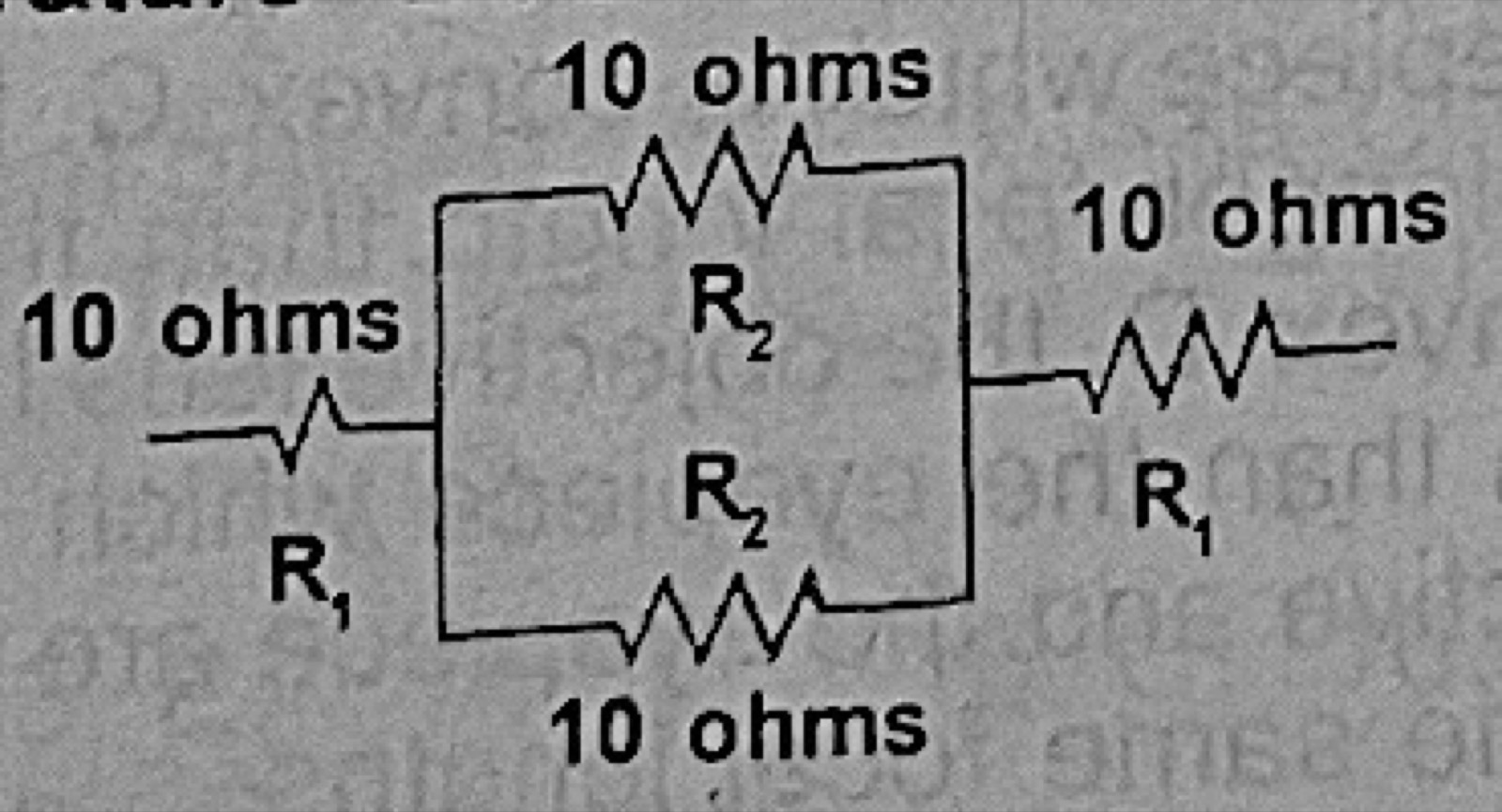
What is the total resistance in the above diagram?

Diagram for this question
  1. A.5 ohms
  2. B.15 ohms
  3. C.25 ohms
  4. D.35 ohms
  5. E.45 ohms.
Show the answer and explanation

Answer: C (25 ohms)

Explanation

The two 10 Ω resistors in parallel give 5 Ω. Adding the two 10 Ω resistors in series: 10 + 5 + 10 = 25 Ω.

Open this question

Question 9

Capacitors

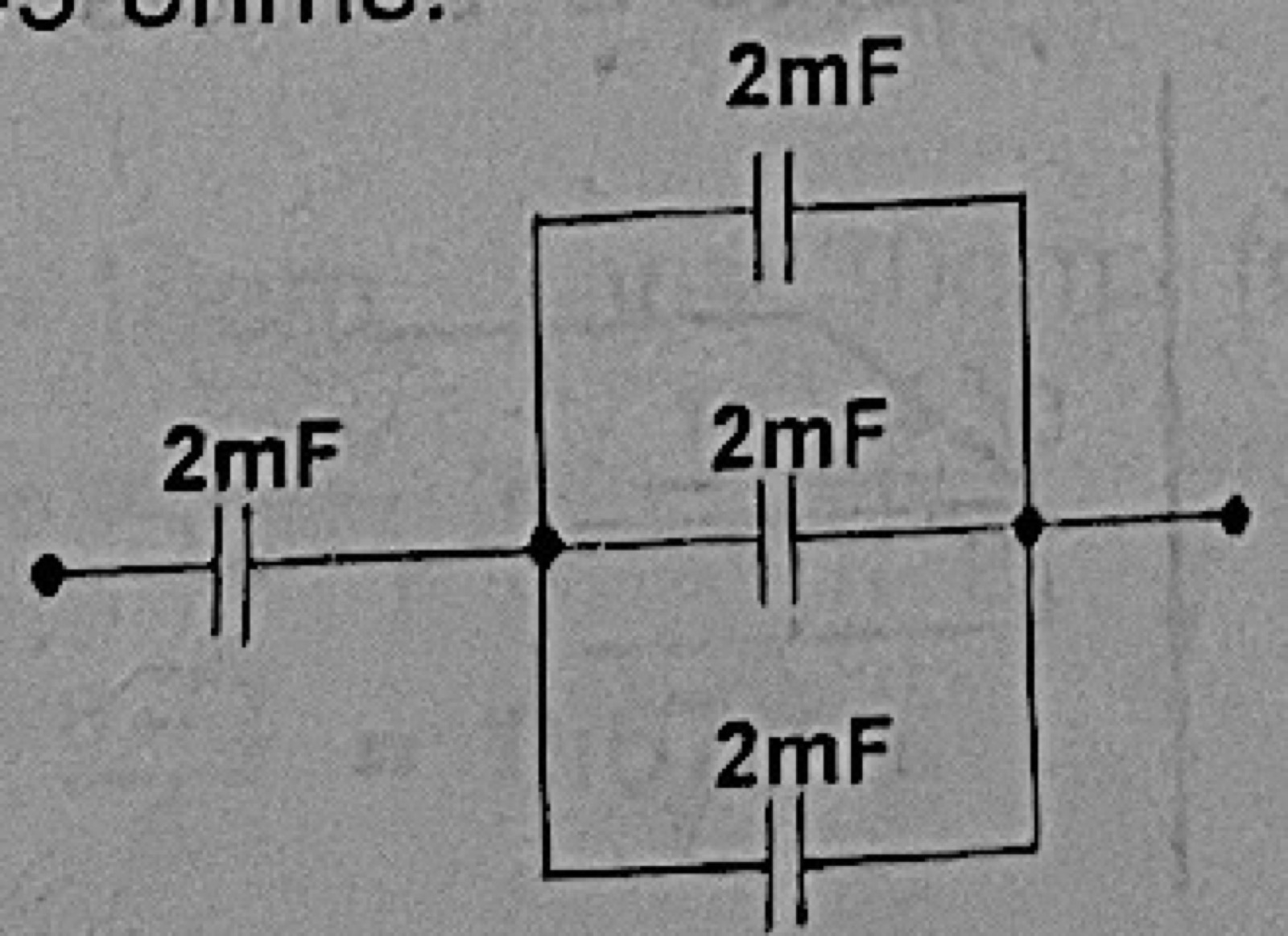
The total capacitance of the circuit above is

Diagram for this question
  1. A.0.25 mF
  2. B.0.50 mF
  3. C.0.75 mF
  4. D.1.25 mF
  5. E.1.50 mF
Show the answer and explanation

Answer: E (1.50 mF)

Explanation

The three 2 mF capacitors in parallel add to 6 mF. In series with 2 mF: C = (2 × 6)/(2 + 6) = 1.5 mF.

Open this question

Question 10

Quantity of Heat

A given quantity of heat increases the temperature of 150 grams of water from 9°C to 15°C and increases the temperature of an equal volume of oil weighing 100 grams from 9°C to 25°C. The ratio of the specific heat of oil to that of water is

  1. A.0.36
  2. B.0.46
  3. C.0.56
  4. D.0.76
  5. E.0.86
Show the answer and explanation

Answer: C (0.56)

Explanation

The same heat goes in: 150 × cw × 6 = 100 × co × 16. So co/cw = 900/1600 ≈ 0.56.

Open this question

Question 11

Scalars and Vectors

Which of the following physical quantities is NOT a vector?

  1. A.Velocity
  2. B.Work
  3. C.Force
  4. D.Electric field intensity
  5. E.Magnetic induction
Show the answer and explanation

Answer: B (Work)

Explanation

Work (energy) has size only and no direction, so it is a scalar. The others all have direction.

Open this question

Question 12

Motion

The motion of the moving skin of a talking drum can rightly be described as

  1. A.translational
  2. B.random
  3. C.rotational
  4. D.oscillatory
  5. E.transitory
Show the answer and explanation

Answer: D (oscillatory)

Explanation

The drum skin moves to and fro about its rest position, which is oscillatory (vibratory) motion.

Open this question

Question 13

Structure of Matter and Kinetic Theory

Which of the following does NOT cause a reduction of the surface tension of water?

  1. A.Soap solution
  2. B.Detergent
  3. C.Alcohol
  4. D.Camphor
  5. E.Grease
Show the answer and explanation

Answer: E (Grease)

Explanation

Soap, detergent, alcohol and camphor all lower the surface tension of water. Grease does not mix with water and does not lower it in this way.

Open this question

Question 14

Refraction of Light

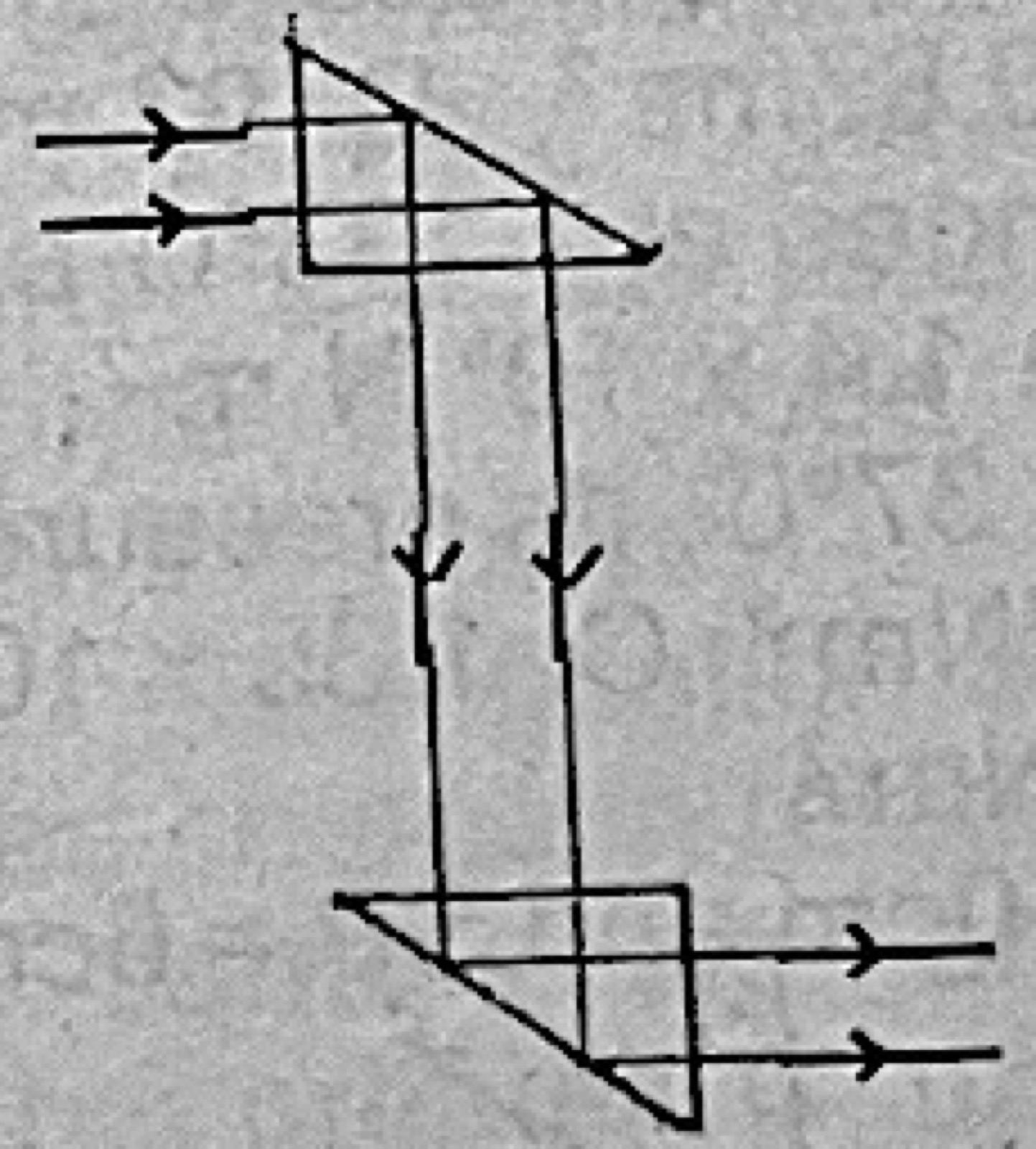
The diagram in the above figure shows the prism arrangement in a

Diagram for this question
  1. A.microscope
  2. B.stereoscope
  3. C.projector
  4. D.periscope
  5. E.gyroscope
Show the answer and explanation

Answer: D (periscope)

Explanation

Two right-angled prisms turn the light through 90° twice, so it comes out parallel to its original direction but at a different level: this is a prism periscope.

Open this question

Question 15

Quantity of Heat

The water at the bottom of a waterfall is slightly warmer than that at the top because part of the

  1. A.potential energy raises the water temperature
  2. B.water absorbs latent heat from the atmosphere
  3. C.kinetic energy is changed into internal energy
  4. D.dropping mass of water increases the heat capacity
  5. E.A and C above.
Show the answer and explanation

Answer: C (kinetic energy is changed into internal energy)

Explanation

As the water falls its potential energy becomes kinetic energy; when it strikes the bottom, part of that kinetic energy becomes internal (heat) energy, warming it slightly.

Open this question

Question 16

Change of State and Vapours

A pressure cooker saves both time and fuel in cooking because inside the cooker, the

  1. A.boiling point of water is raised
  2. B.pressure is constant
  3. C.heat is completely trapped
  4. D.temperature is evenly distributed
  5. E.volume of steam varies.
Show the answer and explanation

Answer: A (boiling point of water is raised)

Explanation

The higher pressure inside raises the boiling point of water above 100°C, so food cooks faster at the higher temperature.

Open this question

Question 17

Light and Reflection

Which of the following statements is NOT true of the image in a plane mirror? The image is

  1. A.the same size as the object
  2. B.laterally inverted
  3. C.virtual
  4. D.magnified
  5. E.the same distance behind the mirror as the object is in front.
Show the answer and explanation

Answer: D (magnified)

Explanation

A plane mirror image is the same size as the object, so it is never magnified.

Open this question

Question 18

Waves

Any line or section through an advancing wave in which all the particles are in the same phase is called the

  1. A.wave length
  2. B.wave crest
  3. C.wave trough
  4. D.wave amplitude
  5. E.wave front.
Show the answer and explanation

Answer: E (wave front.)

Explanation

A wavefront is a line or surface joining points of a wave that are in the same phase.

Open this question

Question 19

Magnetism

The name given to the characteristic behaviour of substances which set their length perpendicular to a strong magnetic field instead of in line with it is

  1. A.magnetization
  2. B.paramagnetism
  3. C.diamagnetism
  4. D.demagnetization
  5. E.ferromagnetism.
Show the answer and explanation

Answer: C (diamagnetism)

Explanation

Diamagnetic materials are weakly repelled by a magnetic field, so a rod of such material turns to lie across the field. Paramagnetic and ferromagnetic rods line up along it.

Open this question

Question 20

Electromagnetic Spectrum

Which of the following statements on the use of X-rays is incorrect? X-rays are used

  1. A.in hospitals to obtain photographs of tissues and bones in the body
  2. B.for the treatment of malignant growths like cancer cells
  3. C.in detecting fingerprints
  4. D.to reveal hidden flaws in metal castings and welded joints
  5. E.to detect alterations which have been made to works of art.
Show the answer and explanation

Answer: C (in detecting fingerprints)

Explanation

X-rays are used for medical images, cancer therapy, checking castings and examining paintings, but not for detecting fingerprints.

Open this question

Question 21

Capacitors

What is the relative permitivity of a capacitor if its capacitance with a medium as dielectric is 16 farads and its capacitance with vacuum as dielectric is 2 farads?

  1. A.−
  2. B.½
  3. C.2
  4. D.8
  5. E.32
Show the answer and explanation

Answer: D (8)

Explanation

Relative permittivity = capacitance with dielectric ÷ capacitance with vacuum = 16/2 = 8.

Open this question

Question 22

Lenses and Optical Instruments

If the magnification of a virtual image formed of an object 10 cm from a convex lens is 3, then the focal length of the lens is

  1. A.10 cm
  2. B.15 cm
  3. C.16 cm
  4. D.19 cm
  5. E.20 cm
Show the answer and explanation

Answer: B (15 cm)

Explanation

The virtual image is 3 × 10 = 30 cm away on the same side (v = −30 cm). 1/f = 1/10 − 1/30 = 2/30, so f = 15 cm.

Open this question

Question 23

Motion

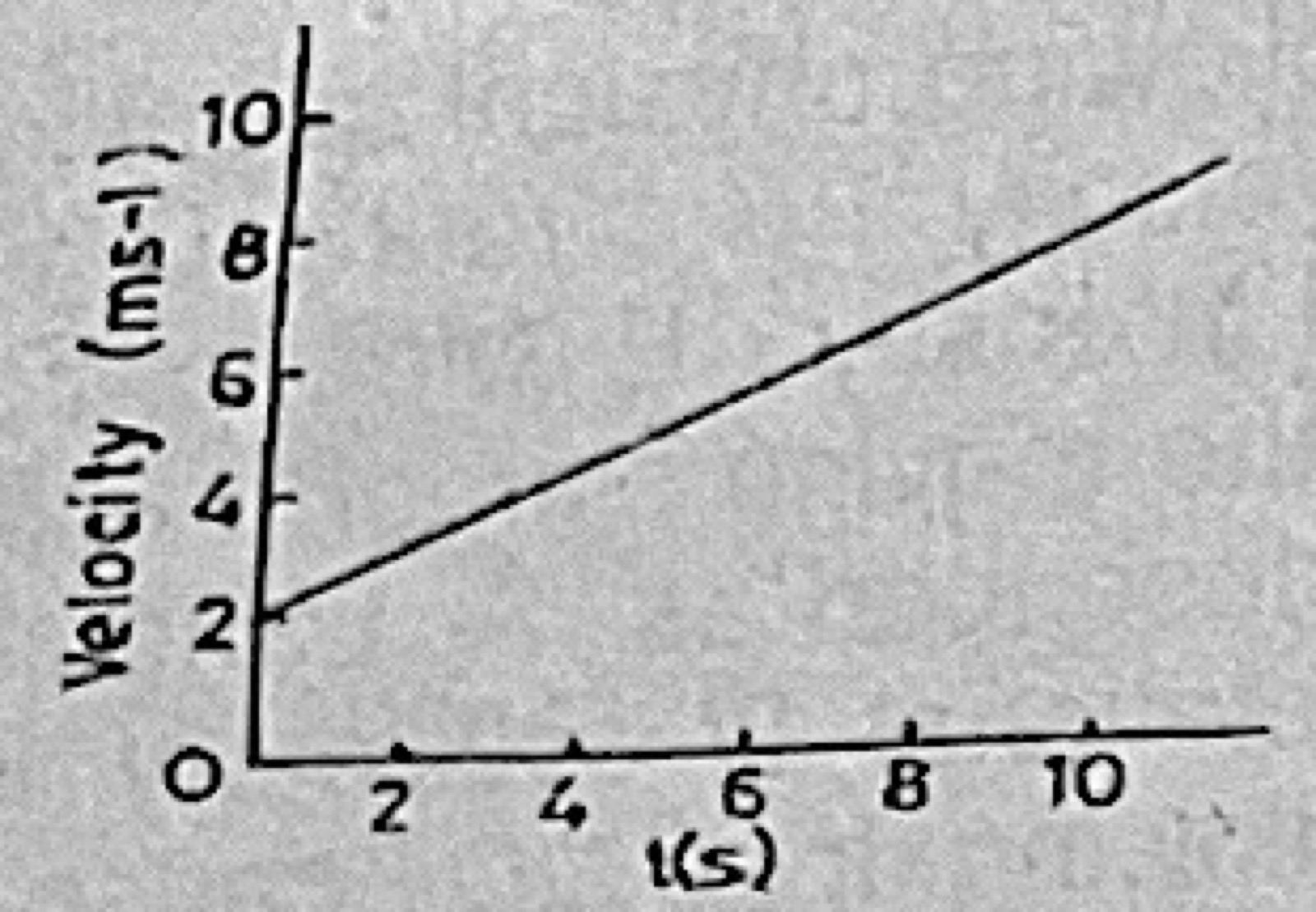
What is the acceleration of a particle whose motion is graphically displayed in the above figure?

Diagram for this question
  1. A.0.67 m s−2
  2. B.0.83 m s−2
  3. C.0.87 m s−2
  4. D.92 m s−2
  5. E.2.0 m s−2
Show the answer and explanation

Answer: A (0.67 m s−2)

Explanation

Acceleration is the slope of the velocity–time graph: the velocity rises from 2 to 6 m s−1 in 6 s, so a = 4/6 ≈ 0.67 m s−2.

Open this question

Question 25

Refraction of Light

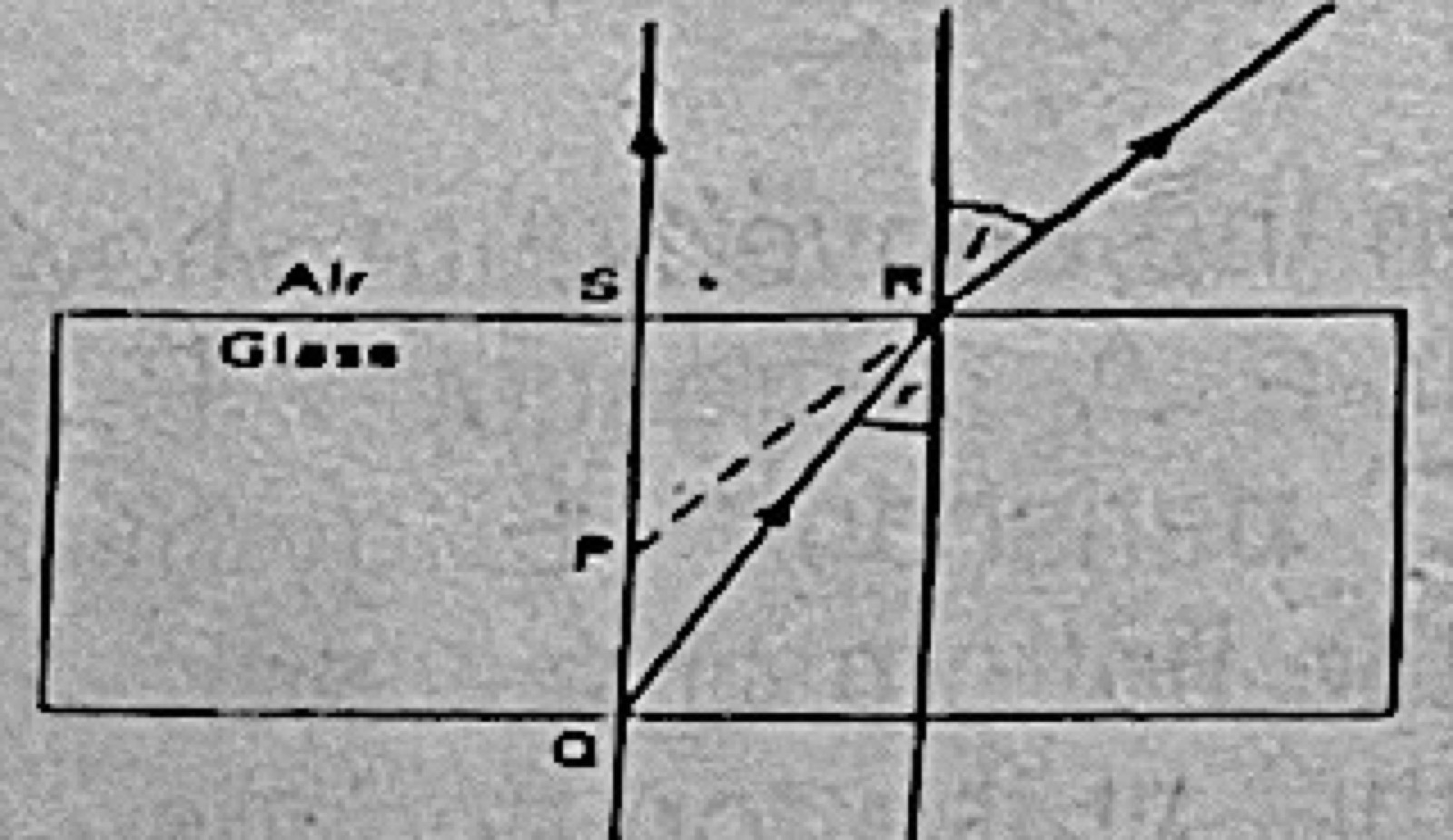
Given that SQ = 10 cm and SP = 6 cm, the refractive index of the block of glass shown in the above figure is

Diagram for this question
  1. A.0.30
  2. B.0.60
  3. C.1.67
  4. D.2.33
  5. E.2.36
Show the answer and explanation

Answer: C (1.67)

Explanation

Refractive index = real depth ÷ apparent depth = SQ/SP = 10/6 ≈ 1.67.

Open this question

Question 26

Electrical Energy and Power

A stand-by generator is connected to fifteen 40 W lamps and a musician's 600 W amplifying system. How much energy is used if the generator runs for 6 hours?

  1. A.3.84 kWh
  2. B.7.20 kWh
  3. C.8.40 kWh
  4. D.12.00 kWh
  5. E.14.56 kWh.
Show the answer and explanation

Answer: B (7.20 kWh)

Explanation

Total power = 15 × 40 + 600 = 1200 W = 1.2 kW. Energy = 1.2 × 6 = 7.2 kWh.

Open this question

Question 27

Scalars and Vectors

A tugboat is travelling from Asaba to Onitsha across the River Niger with a resultant velocity of 20 knots. If the river flows at 12 knots, the direction of motion of the boat relative to the direction of water flow is

  1. A.36.87°
  2. B.53.13°
  3. C.90°
  4. D.136.87°
  5. E.143.13°.
Show the answer and explanation

Answer: B (53.13°)

Explanation

The resultant (20 knots) is the hypotenuse, with the 12-knot river flow as the side next to the angle: cos θ = 12/20 = 0.6, so θ = 53.13°.

Open this question

Question 28

Current Electricity

A milliammeter of resistance 5 Ω and full scale deflection of 50 mA is to be used to measure a potential difference of 50 V. The resistance of the multiplier should be

  1. A.95 Ω
  2. B.110 Ω
  3. C.595 Ω
  4. D.995 Ω
  5. E.1005 Ω.
Show the answer and explanation

Answer: D (995 Ω)

Explanation

At full scale, 50 V must drive 0.05 A through the meter plus the multiplier: 50 = 0.05 × (5 + R), so 5 + R = 1000 and R = 995 Ω.

Open this question

Question 29

Density and Upthrust

An object of mass m and volume v is totally immersed in a liquid of density ρ. The tension of a string holding it is

  1. A.mg
  2. B.(m + ρv)g
  3. C.(m − ρv)g
  4. D.ρvg
  5. E.[m/(m − ρv)]g.
Show the answer and explanation

Answer: C ((m − ρv)g)

Explanation

The string holds the weight minus the upthrust: T = mg − ρvg = (m − ρv)g.

Open this question

Question 30

Density and Upthrust

The relative densities of zinc, brass, copper, gold and silver are respectively 7.1, 8.5, 8.9, 19.3, 10.5. A metal ornament which weighs 0.425 kg and can displace 50 × 10−6 m3 of water is made of

  1. A.zinc
  2. B.brass
  3. C.copper
  4. D.gold
  5. E.silver.
Show the answer and explanation

Answer: B (brass)

Explanation

Density = 0.425 ÷ (50 × 10−6) = 8500 kg m−3, a relative density of 8.5, which is brass.

Open this question

Question 31

Equilibrium of Forces

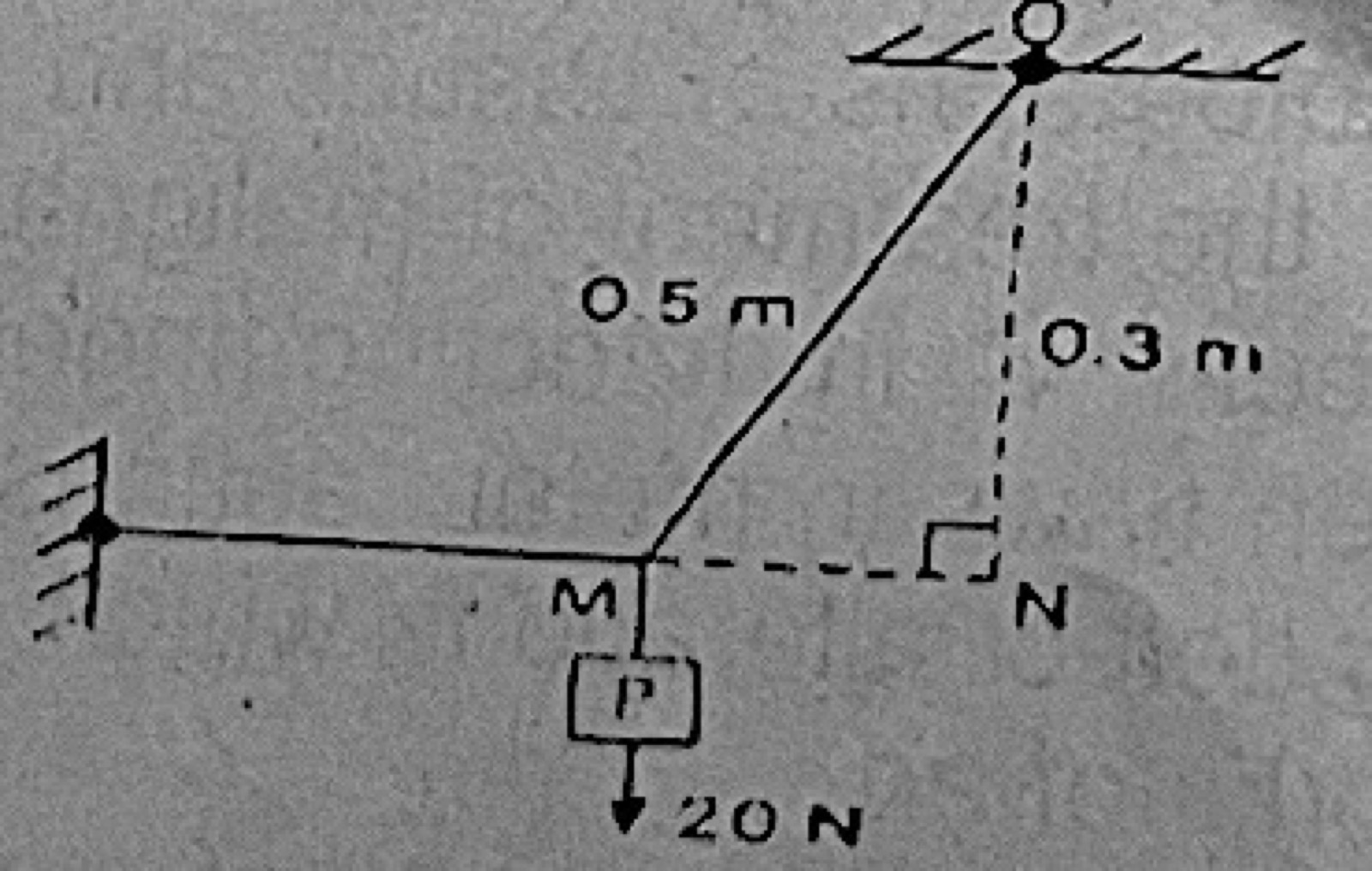
In the above diagram MN is perpendicular to ON and MP. What is the difference between the moment about N of the force of 20 newtons applied along MP and its moment about O?

Diagram for this question
  1. A.Zero
  2. B.0.2 N m
  3. C.0.4 N m
  4. D.0.8 N m
  5. E.0.6 N m
Show the answer and explanation

Answer: A (Zero)

Explanation

MN = √(0.5² − 0.3²) = 0.4 m. The vertical 20 N force at M is 0.4 m (horizontally) from both N and O, so both moments are 20 × 0.4 = 8 N m and the difference is zero.

Open this question

Question 32

Change of State and Vapours

Heat is supplied to a block of ice at 0° until half of it has melted. Which of the following statement is true?

  1. A.The temperature rises and the ice expands
  2. B.The temperature remains constant and the volume of ice decreases
  3. C.The ice gives out heat as it melts
  4. D.The mass remains constant and the temperature increases
  5. E.The mass decreases because some heat is lost to the atmosphere.
Show the answer and explanation

Answer: B (The temperature remains constant and the volume of ice decreases)

Explanation

While ice melts, the heat supplied is latent heat, so the temperature stays at 0°C, and since ice turns into denser water the volume decreases.

Open this question

Question 33

Gas Laws

If the volume of a fixed mass of a gas is kept constant, the pressure of the gas

  1. A.is inversely proportional to its centigrade temperature
  2. B.is inversely proportional to its absolute temperature
  3. C.is directly proportional to its centigrade temperature
  4. D.is directly proportional to its absolute temperature
  5. E.remains constant also.
Show the answer and explanation

Answer: D (is directly proportional to its absolute temperature)

Explanation

The pressure law: at constant volume, p ∝ T where T is the absolute (kelvin) temperature.

Open this question

Question 34

Sound

Which of the following statements about sound is NOT true?

  1. A.Sound is a longitudinal wave
  2. B.Sound can be reflected and refracted like light
  3. C.Sound travels through a vacuum
  4. D.Sound moves faster in a steel wire than in air
  5. E.Sound can only be produced by vibrating objects.
Show the answer and explanation

Answer: C (Sound travels through a vacuum)

Explanation

Sound needs a material medium, so it cannot travel through a vacuum.

Open this question

Question 35

Refraction of Light

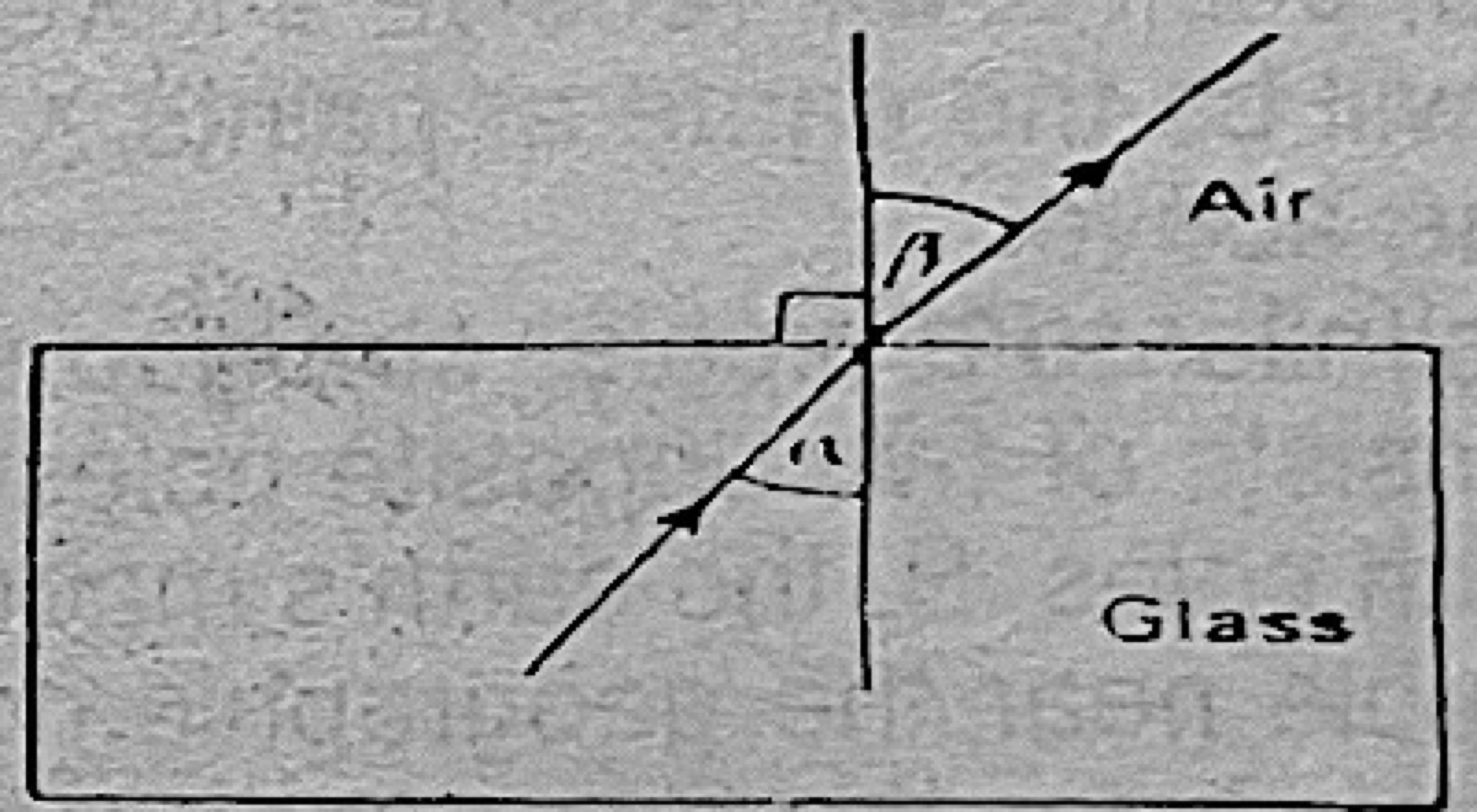
In the above diagram, a ray of light passes from glass into air. If the angle of incidence in glass is α and the angle of refraction in air is β, which of the following statements is true?

Diagram for this question
  1. A.α = β
  2. B.The refractive index of glass is sin θ/sin α
  3. C.The ray suffers total internal reflection if β is greater than the critical angle
  4. D.The ray will suffer total internal reflection if α is less than the critical angle
  5. E.The refractive index of glass is sin α/sin β
Show the answer and explanation

Answer: B (The refractive index of glass is sin θ/sin α)

Explanation

The refractive index of glass is sin(angle in air) ÷ sin(angle in glass) = sin β/sin α. Option E is upside down, and total internal reflection needs α greater than the critical angle.

Open this question

Question 36

Lenses and Optical Instruments

In a compound microscope

  1. A.there is only one lens
  2. B.the objective lens has a shorter focal length than the eyepiece which is convex
  3. C.the objective lens has a longer focal length than the eyepiece which is convex
  4. D.the objective lens has a shorter focal length than the eyepiece which is concave
  5. E.the objective and the eyepiece are both convex and have the same focal lengths.
Show the answer and explanation

Answer: B (the objective lens has a shorter focal length than the eyepiece which is convex)

Explanation

A compound microscope has two converging (convex) lenses, and the objective has the shorter focal length.

Open this question

Question 37

Dispersion of Light and Colours

In sunlight, a blue flower looks blue because we see the flower by the light it

  1. A.receives from our eye
  2. B.disperses
  3. C.absorbs
  4. D.refracts
  5. E.reflects
Show the answer and explanation

Answer: E (reflects)

Explanation

The flower absorbs the other colours of white light and reflects blue into our eyes.

Open this question

Question 38

Magnetism

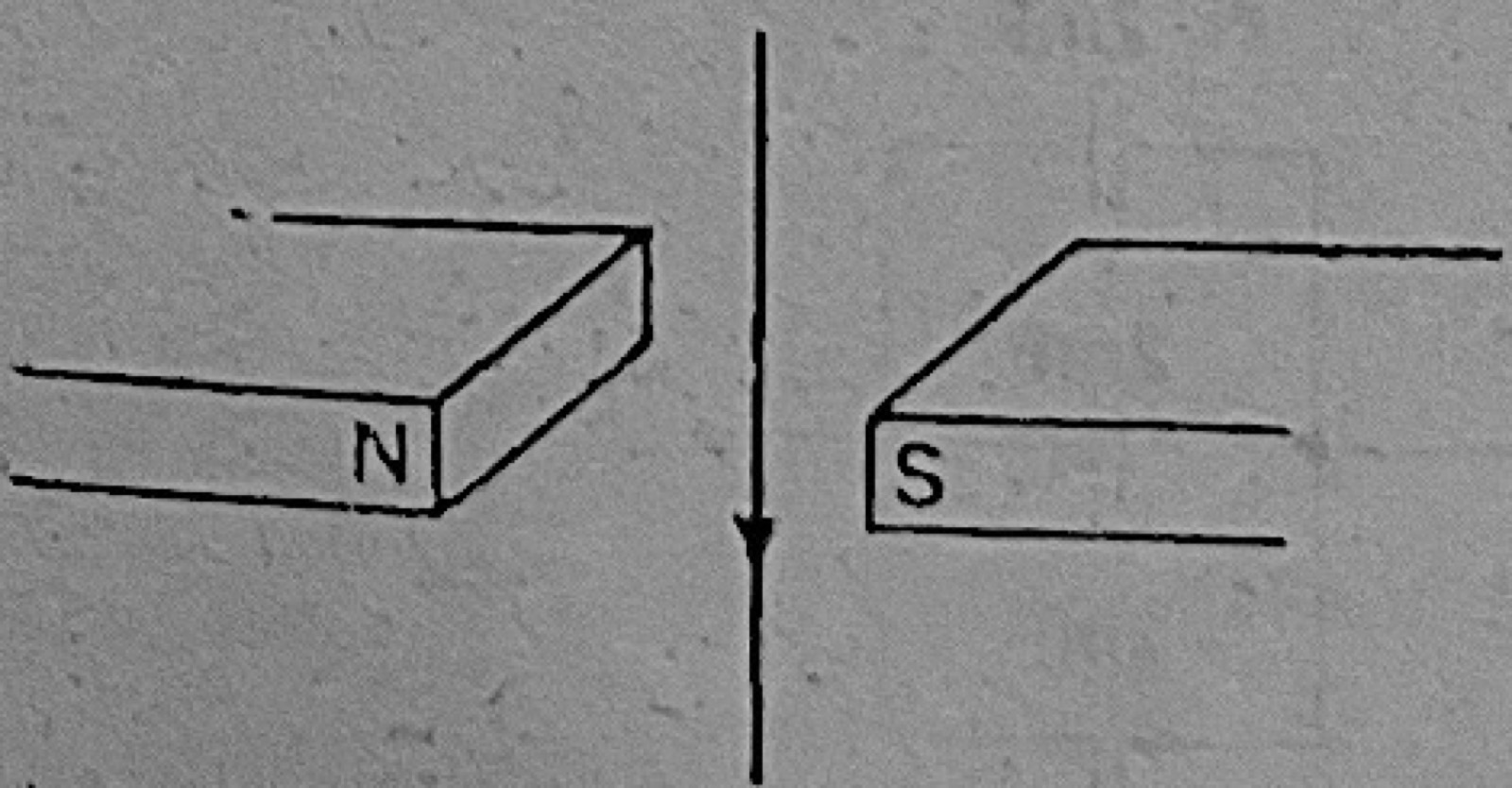
In the above diagram a straight vertical wire is placed between two opposite magnetic poles which are separated horizontally by a short distance. If a current is passed down the wire, in which direction will the wire move?

Diagram for this question
  1. A.Towards the observer
  2. B.Away from the observer
  3. C.Toward the North pole
  4. D.Towards the South pole
  5. E.Upwards
Show the answer and explanation

Answer: A (Towards the observer)

Explanation

The field runs from N (left) to S (right) and the current flows downwards. Fleming's left-hand rule gives a force out of the page, towards the observer.

Open this question

Question 39

Electromagnetic Induction

High Tension (H.T.) transmission means

  1. A.to transmit a given amount of power, the tension in the conducting wire must be high
  2. B.heat is not lost when current is passed through a conductor
  3. C.heat is gained when a given power is transmitted
  4. D.a big transformer is required to transmit power
  5. E.transmission of power at low current and high voltage.
Show the answer and explanation

Answer: E (transmission of power at low current and high voltage.)

Explanation

H.T. transmission sends power at a very high voltage so that the current is small, which reduces I²R heat losses in the cables.

Open this question

Question 40

Electromagnetic Induction

The best material for the core of the primary and secondary coils of an induction coil is

  1. A.copper, because it is a good conductor of electricity
  2. B.steel, because it becomes magnetic and retains its magnetism for a long time
  3. C.rubber, because it is a good insulator and the user is prevented from shock
  4. D.soft iron, because it becomes magnetic but easily loses its magnetism
  5. E.glass, because it is transparent.
Show the answer and explanation

Answer: D (soft iron, because it becomes magnetic but easily loses its magnetism)

Explanation

The core must magnetise and demagnetise quickly as the current is made and broken, which soft iron does.

Open this question

Question 41

Radioactivity and Nuclear Physics

Which of the following radiations cannot be deflected by a magnetic field?

  1. A.α
  2. B.β
  3. C.γ
  4. D.β and γ
  5. E.None of them
Show the answer and explanation

Answer: C (γ)

Explanation

Gamma rays carry no charge, so a magnetic field cannot deflect them. Alpha and beta particles are charged.

Open this question

Question 42

Electromagnetic Spectrum

Which of the following elements is the best absorber of X-rays?

  1. A.Hydrogen
  2. B.Oxygen
  3. C.Calcium
  4. D.Copper
  5. E.Lead
Show the answer and explanation

Answer: E (Lead)

Explanation

Dense elements with large atomic numbers absorb X-rays best, which is why lead is used as a shield.

Open this question

Question 43

Quantity of Heat

A calorimeter of thermal capacity 80 J contains 20 g of water at 25°C. Water at 100°C is added so that the final temperature of the set-up is 50°C. The amount of water added is (Heat capacity of water = 4.18 J/g/°C)

  1. A.20 g
  2. B.25 g
  3. C.45 g
  4. D.50 g
  5. E.100 g.
Show the answer and explanation

Answer: A (20 g)

Explanation

Heat lost by hot water = heat gained: m × 4.18 × 50 = 80 × 25 + 20 × 4.18 × 25 = 2000 + 2090. So 209m = 4090 and m ≈ 20 g.

Open this question

Question 45

Sound

A man stands one-third of the way between two walls and claps his hands. He hears two distinct echoes 1 s apart. If the speed of sound is 330 m s−1 the distance between the walls is

  1. A.33 m
  2. B.110 m
  3. C.220 m
  4. D.330 m
  5. E.495 m
Show the answer and explanation

Answer: E (495 m)

Explanation

If the walls are x apart, the echoes travel 2x/3 and 4x/3, a difference of 2x/3. Then 2x/3 = 330 × 1, so x = 495 m.

Open this question

Question 46

Current Electricity

A cell has an open circuit voltage V1 and a closed circuit voltage V2 when a current I is flowing through it. Therefore, the internal resistance of the cell is

  1. A.V2/I
  2. B.V1/I
  3. C.(V1 + V2)/I
  4. D.(V1 − V2)/I
  5. E.(V2 − V1)/I.
Show the answer and explanation

Answer: D ((V1 − V2)/I)

Explanation

The open-circuit voltage is the e.m.f., V1. With current flowing, V2 = V1 − Ir, so the 'lost volts' V1 − V2 = Ir and r = (V1 − V2)/I.

Open this question

Question 47

Current Electricity

According to Ohm's law, the ratio V/I is constant for

  1. A.an electrolyte
  2. B.a diode
  3. C.a transistor
  4. D.silver
  5. E.all of the above
Show the answer and explanation

Answer: D (silver)

Explanation

Metals such as silver obey Ohm's law at constant temperature. Diodes, transistors and many electrolytes do not have a constant V/I.

Open this question

Question 49

Radioactivity and Nuclear Physics

The activity of a radioactive substance depends on

  1. A.temperature and purity
  2. B.temperature and age
  3. C.purity and age
  4. D.age, purity and temperature
  5. E.none of the above.
Show the answer and explanation

Answer: C (purity and age)

Explanation

Activity depends on how many radioactive nuclei are present, which depends on how pure the sample is and how much has already decayed (its age). Temperature has no effect on radioactive decay.

Open this question

Question 50

Radioactivity and Nuclear Physics

Natural radioactivity consists of the emission of

  1. A.α-particles and β-rays
  2. B.α-particles and X-rays
  3. C.γ-rays and X-rays
  4. D.α-particles, β-rays and γ-rays
  5. E.α-particles, β-rays, γ-rays and X-rays.
Show the answer and explanation

Answer: D (α-particles, β-rays and γ-rays)

Explanation

Naturally radioactive nuclei emit alpha particles, beta particles and gamma rays. X-rays come from electron transitions or X-ray tubes, not from the nucleus.
Open this question