Home › Past questions › JAMB › Mathematics › 1989 50 questions. Try each one, then open the answer to check yourself and read the explanation.
Sign up free to answer these questions on a CBT screen with a timer, then see your score and every answer explained.
Start practising free
Question 1 Fractions, Decimals and Approximation Which of the following is in descending order?
A. 9/10, 4/5, 3/4, 17/10 B. 4/5, 9/10, 3/4, 17/20 C. 9/10, 17/20, 4/5, 3/4 D. 4/5, 9/10, 17/10, 3/4 Show the answer and explanation Answer: C (9/10, 17/20, 4/5, 3/4 )
Explanation As decimals, 9/10 = 0.9, 17/20 = 0.85, 4/5 = 0.8 and 3/4 = 0.75. Only option C goes from largest to smallest.
Open this question
Question 2 Fractions, Decimals and Approximation Evaluate 2700 000 × 0.03 ÷ 18 000
A. 4.5 × 100 B. 4.5 × 101 C. 4.5 × 10² D. 4.5 × 10³ Show the answer and explanation Answer: A (4.5 × 100 )
Explanation 2,700,000 × 0.03 = 81,000, and 81,000 ÷ 18,000 = 4.5 = 4.5 × 100 .
Open this question
Question 3 Fractions, Decimals and Approximation The prime factors of 2520 are
A. 2, 9, 5 B. 2, 9, 7 C. 2, 3, 5, 7 D. 2, 3, 7, 9 Show the answer and explanation Answer: C (2, 3, 5, 7 )
Explanation 2520 = 2³ × 3² × 5 × 7, so its prime factors are 2, 3, 5 and 7 (9 is not prime).
Open this question
Question 4 Number Bases If 12e = X7 , find X where e = 12
A. 20 B. 15 C. 14 D. 12 Show the answer and explanation Answer: A (20 )
Explanation 12 in base 12 is 1 × 12 + 2 = 14 in base 10. In base 7, 14 = 2 × 7 + 0, which is 207 .
Open this question
Question 5 Indices Simplify ∛((64r−6 )½ )
A. r/2 B. 2r C. 1/(2r) D. 2/r Show the answer and explanation Answer: D (2/r )
Explanation The square root then cube root is the 1/6 power: (64r−6 )1/6 = 2r−1 = 2/r.
Open this question
Question 6 Fractions, Decimals and Approximation What is the difference between 0.007685 correct to three significant figures and 0.007685 correct to four places of decimal?
A. 10−5 B. 7 × 10⁻⁴ C. 8 × 10⁻⁵ D. 10−6 Show the answer and explanation Answer: A (10−5 )
Explanation To 3 s.f. it is 0.00769; to 4 d.p. it is 0.0077. The difference is 0.0077 − 0.00769 = 0.00001 = 10−5 .
Open this question
Question 7 Ratio, Percentages and Rates If a : b = 5 : 8, x : y = 25 : 16, evaluate a/x : b/y
A. 125 : 128 B. 3 : 5 C. 3 : 4 D. 2 : 5 Show the answer and explanation Answer: D (2 : 5 )
Explanation (a/x) ÷ (b/y) = (a/b) × (y/x) = 5/8 × 16/25 = 2/5. So the ratio is 2 : 5.
Open this question
Question 8 Commercial Arithmetic Oke deposited N800.00 in the bank at the rate of 12½% simple interest. After some time the total amount was one and half times the principal. For how many years was the money left in the bank?
A. 2 B. 4 C. 5⅓ D. 8 Show the answer and explanation Answer: B (4 )
Explanation The amount is 1.5 × 800 = N1,200, so the interest is N400. Each year earns 12½% of 800 = N100, so it took 4 years.
Open this question
Question 9 Mensuration of Solids If the surface area of a sphere is increased by 44%, find the percentage increase in its diameter.
A. 44 B. 30 C. 22 D. 20 Show the answer and explanation Answer: D (20 )
Explanation Surface area is proportional to the diameter squared. The area is multiplied by 1.44, so the diameter is multiplied by √1.44 = 1.2, a 20% increase.
Open this question
Question 10 Surds Simplify 4 − 1/(2 − √3)
A. 2√3 B. 2 − √3 C. −2 + √3 D. 2 − √3 Show the answer and explanation Answer: D (2 − √3 )
Explanation Rationalise: 1/(2 − √3) = (2 + √3)/(4 − 3) = 2 + √3. Then 4 − (2 + √3) = 2 − √3.
Open this question
Question 11 Logarithms Find p in terms of q if log3 p + 3log3 q = 3.
A. (3/q)3 B. (q/3)1/3 C. (q/3)3 D. (3/q)1/3 Show the answer and explanation Answer: A ((3/q)3 )
Explanation log3 (pq³) = 3, so pq³ = 27. Then p = 27/q³ = (3/q)³.
Open this question
Question 12 Indices What are the values of y which satisfy the equation 9y − 4 × 3y + 3 = 0?
A. −1 and 0 B. −1 and 1 C. 1 and 3 D. 0 and 1. Show the answer and explanation Answer: D (0 and 1. )
Explanation Let x = 3y : x² − 4x + 3 = 0, so x = 1 or 3. Then 3y = 1 gives y = 0 and 3y = 3 gives y = 1.
Open this question
Question 13 Algebraic Expressions Make R the subject of the formula S = √((2R + T)/2RT)
A. R = T/(TS2 − 1) B. R = T/(2(TS2 − 1)) C. R = T/(TS2 + 1) D. R = T/(2(TS2 + 1)) Show the answer and explanation Answer: B (R = T/(2(TS2 − 1)) )
Explanation Square both sides: 2RTS² = 2R + T. Collect R: R(2S²T − 2) = T, so R = T/(2(TS² − 1)).
Open this question
Question 14 Algebraic Expressions Find the value of the expression (32/81)x3 − (64/27)x2 − (81/16)x−3 when x = −3/4
A. 10½ B. 10⅙ C. 3⅜ D. −13½. Show the answer and explanation Answer: A (10½ )
Explanation x³ = −27/64, x² = 9/16 and x−3 = −64/27. The terms are −1/6, −4/3 and +12, which add up to 10½.
Open this question
Question 15 Variation The cost of a dinner for a group of students is partly constant and partly varies directly as the number of students. If the cost is N74.00 when the number of students is 20, and N96.00 when the number is 30, find the cost when they are 15 students.
A. N68.50 B. N63.00 C. N60.00 D. N52.00 Show the answer and explanation Answer: B (N63.00 )
Explanation C = a + ks. From 74 = a + 20k and 96 = a + 30k, k = 2.2 and a = 30. For 15 students C = 30 + 2.2 × 15 = N63.
Open this question
Question 16 Algebraic Expressions If f(x) = 2x2 − 5x + 3, find f(x + 1)
A. 2x2 − x B. 2x2 − x + 10 C. 4x2 + 3x + 2 D. 4x2 + 3x + 12 Show the answer and explanation Answer: A (2x2 − x )
Explanation f(x + 1) = 2(x + 1)² − 5(x + 1) + 3 = 2x² + 4x + 2 − 5x − 5 + 3 = 2x² − x.
Open this question
Question 17 Indices Solve for a positive number x such that 2(x³ − x² − 2x) = 1
A. 4 B. 3 C. 2 D. 1 Show the answer and explanation Answer: C (2 )
Explanation 2 to a power equals 1 only when the power is 0: x³ − x² − 2x = x(x − 2)(x + 1) = 0. The positive solution is x = 2.
Open this question
Question 18 Algebraic Expressions Simplify (324 − 4x2 )/(2x + 18)
A. 2(x − 9) B. 2(9 + x) C. 81 − x2 D. −2(x − 9) Show the answer and explanation Answer: D (−2(x − 9) )
Explanation 324 − 4x² = (18 − 2x)(18 + 2x). Cancelling 2x + 18 leaves 18 − 2x = −2(x − 9).
Open this question
Question 19 Algebraic Expressions Factorize completely y3 − 4xy + xy3 − 4y
A. (y + xy)(y + 2)(y − 2) B. (y − xy)(y + 2)(y − 2) C. y(1 + x)(y + 2)(y − 2) D. y(1 − x)(y + 2)(y − 2) Show the answer and explanation Answer: C (y(1 + x)(y + 2)(y − 2) )
Explanation Group: y³(1 + x) − 4y(1 + x) = (1 + x)(y³ − 4y) = y(1 + x)(y + 2)(y − 2).
Open this question
Question 20 Algebraic Expressions If one factor of x3 − 8−1 is x − 2−1 the other factor is
A. x2 + 2−1 x − 4−1 B. x2 − 2−1 x − 4−1 C. x2 + 4−1 x + 2−1 D. x2 + 2−1 x + 4−1 Show the answer and explanation Answer: D (x2 + 2−1 x + 4−1 )
Explanation This is a difference of cubes: x³ − (½)³ = (x − ½)(x² + ½x + ¼).
Open this question
Question 21 Algebraic Expressions Factorize 4a2 − 12ab − c2 + 9b2
A. 4a(a − 3b) + (3b − c)2 B. (2a + 3b − c)(2a + 3b + c) C. (2a − 3b − c)(2a − 3b + c) D. 4a(a − 3b) + (3b + c)2 . Show the answer and explanation Answer: C ((2a − 3b − c)(2a − 3b + c) )
Explanation 4a² − 12ab + 9b² = (2a − 3b)², so the expression is (2a − 3b)² − c² = (2a − 3b − c)(2a − 3b + c).
Open this question
Question 22 Algebraic Expressions What are K and L respectively if ½(3y − 4x)2 = (8x2 + Kxy + Ly2 )?
A. −12, 9/2 B. −6, 9 C. 6, 9 D. 12, 9/2. Show the answer and explanation Answer: A (−12, 9/2 )
Explanation (3y − 4x)² = 9y² − 24xy + 16x². Half of it is 8x² − 12xy + (9/2)y², so K = −12 and L = 9/2.
Open this question
Question 23 Linear and Simultaneous Equations Solve the pair of equation for x and y respectively−1 − 3y−1 = 4−1 + y−1 = 1
A. −1, 2 B. 1, 2 C. 2, 1 D. 2, −1 Show the answer and explanation Answer: D (2, −1 )
Explanation Let u = 1/x, v = 1/y: 2u − 3v = 4 and 4u + v = 1. Then v = 1 − 4u, so 14u − 3 = 4 and u = ½, v = −1. So x = 2 and y = −1.
Open this question
Question 24 Quadratic Equations What value of Q will make the expression 4x2 + 5x + Q a complete square?
A. 25/16 B. 25/64 C. 5/8 D. 5/4 Show the answer and explanation Answer: A (25/16 )
Explanation (2x + a)² = 4x² + 4ax + a², so 4a = 5 and a = 5/4. Then Q = a² = 25/16.
Open this question
Question 25 Inequalities Find the range of values of r which satisfies the following inequality, where a, b and c are positive.
A. r > abc/(bc + ac + ab) B. r > abc C. r > 1/a + 1/b + 1/c D. r > 1/abc Show the answer and explanation Answer: A (r > abc/(bc + ac + ab) )
Explanation r(bc + ac + ab)/abc > 1. Since a, b, c are positive we can multiply out without changing the sign: r > abc/(bc + ac + ab).
Open this question
Question 26 Algebraic Expressions Express
A. −3/((x + 1)(2 − x)) B. 3/((x + 1)(2 − x)) C. −1/((x + 1)(x − 2)) D. 1/((x + 1)(x − 2)) Show the answer and explanation Answer: B (3/((x + 1)(2 − x)) )
Explanation The result is ((x − 2) − (x + 1))/((x + 1)(x − 2)) = −3/((x + 1)(x − 2)). Changing the sign of the factor (x − 2) gives 3/((x + 1)(2 − x)).
Open this question
Question 27 Algebraic Expressions Simplify−½ − (x + 1)½ )/(x + 1)½
A. 1/(x + 1) B. −1/(x + 1) C. 1/x D. −1/√(x + 1) Show the answer and explanation Answer: B (−1/(x + 1) )
Explanation Divide each term by (x + 1)½ : x/(x + 1) − 1 = (x − x − 1)/(x + 1) = −1/(x + 1).
Open this question
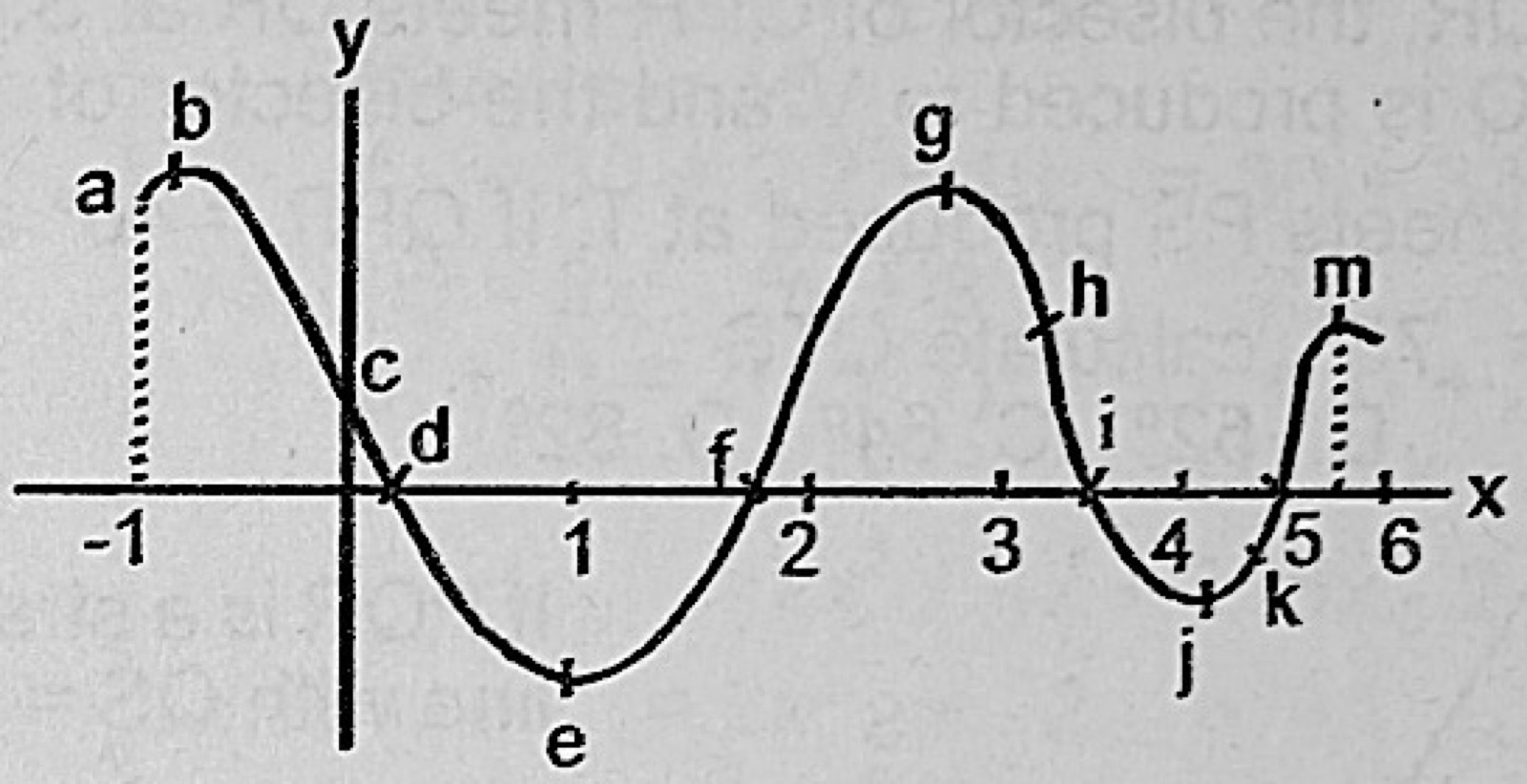
Question 28 Differentiation On the curve above, the points at which the gradient of the curve is equal to zero are
A. c, d, f, i, l B. b, e, g, j, m C. a, b, c, d, f, i, j, l D. c, d, f, h, i, l. Show the answer and explanation Answer: B (b, e, g, j, m )
Explanation The gradient is zero at the turning points, the tops and bottoms of the curve where the tangent is flat. These are b, e, g, j and m.
Open this question
Question 29 Progressions The sum of the first two terms of a geometric progression is x and the sum of the last two terms is y. If there are n terms in all, then the common ratio is
A. x/y B. y/x C. (x/y)1/(n−2) D. (y/x)1/(n−2) Show the answer and explanation Answer: D ((y/x)1/(n−2) )
Explanation x = a + ar and y = arn−2 + arn−1 = rn−2 (a + ar). So y/x = rn−2 and r = (y/x)1/(n−2) .
Open this question
Question 30 Progressions If −8, m, n, 19 are in arithmetic progression, find (m, n)
A. 1, 10 B. 2, 10 C. 3, 13 D. 4, 16 Show the answer and explanation Answer: A (1, 10 )
Explanation From −8 to 19 is three equal steps: 3d = 27, so d = 9. Then m = 1 and n = 10.
Open this question
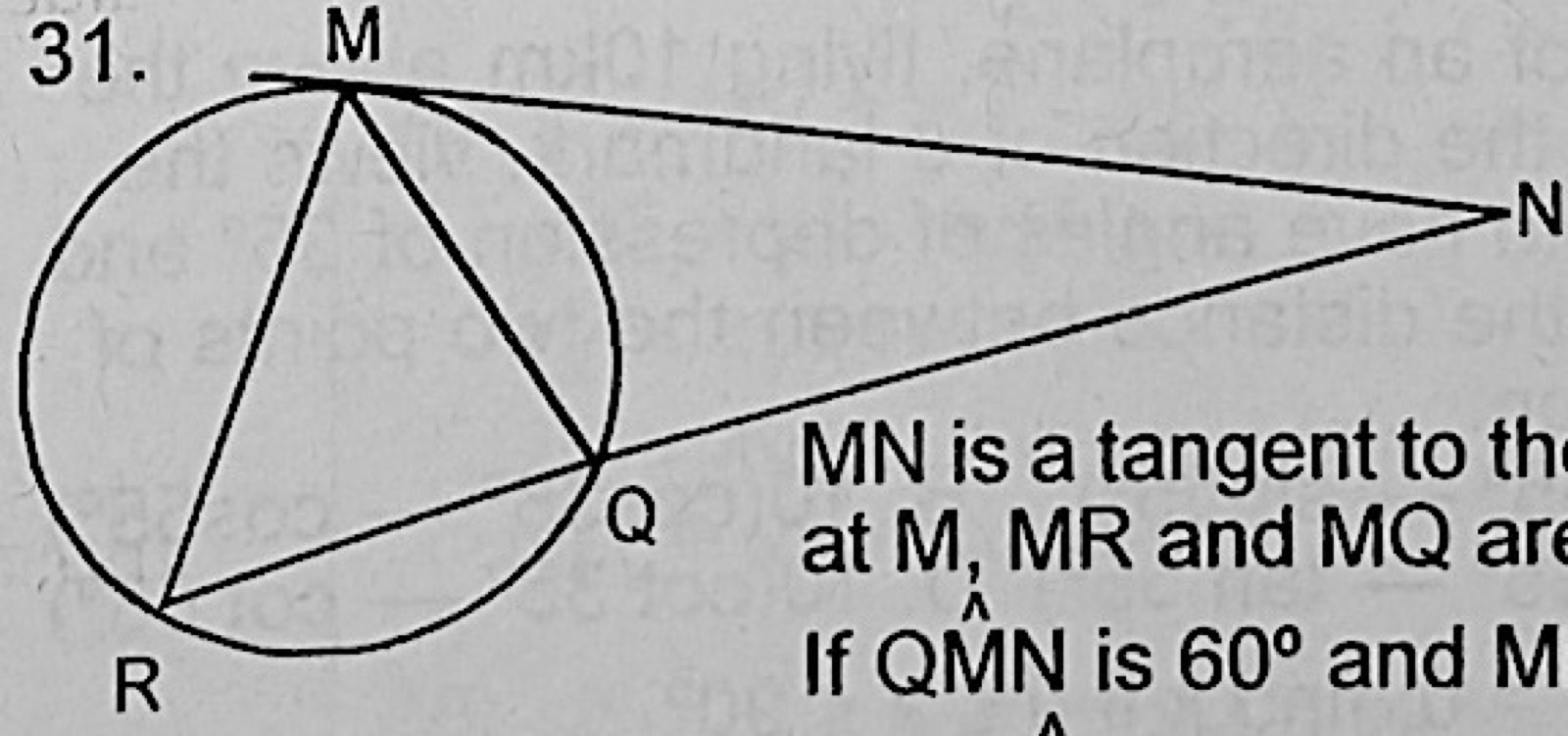
Question 31 Circle Theorems MN is a tangent to the given circle at M, MR and MQ are two chords. If QM̂N is 60° and MN̂Q is 40°, find RM̂Q
A. 120° B. 110° C. 60° D. 20°. Show the answer and explanation Answer: D (20°. )
Explanation By the alternate segment theorem angle MRQ = angle QMN = 60°. In triangle MQN, angle MQN = 180° − 60° − 40° = 80°, so angle MQR = 100°. In triangle MRQ, angle RMQ = 180° − 60° − 100° = 20°.
Open this question
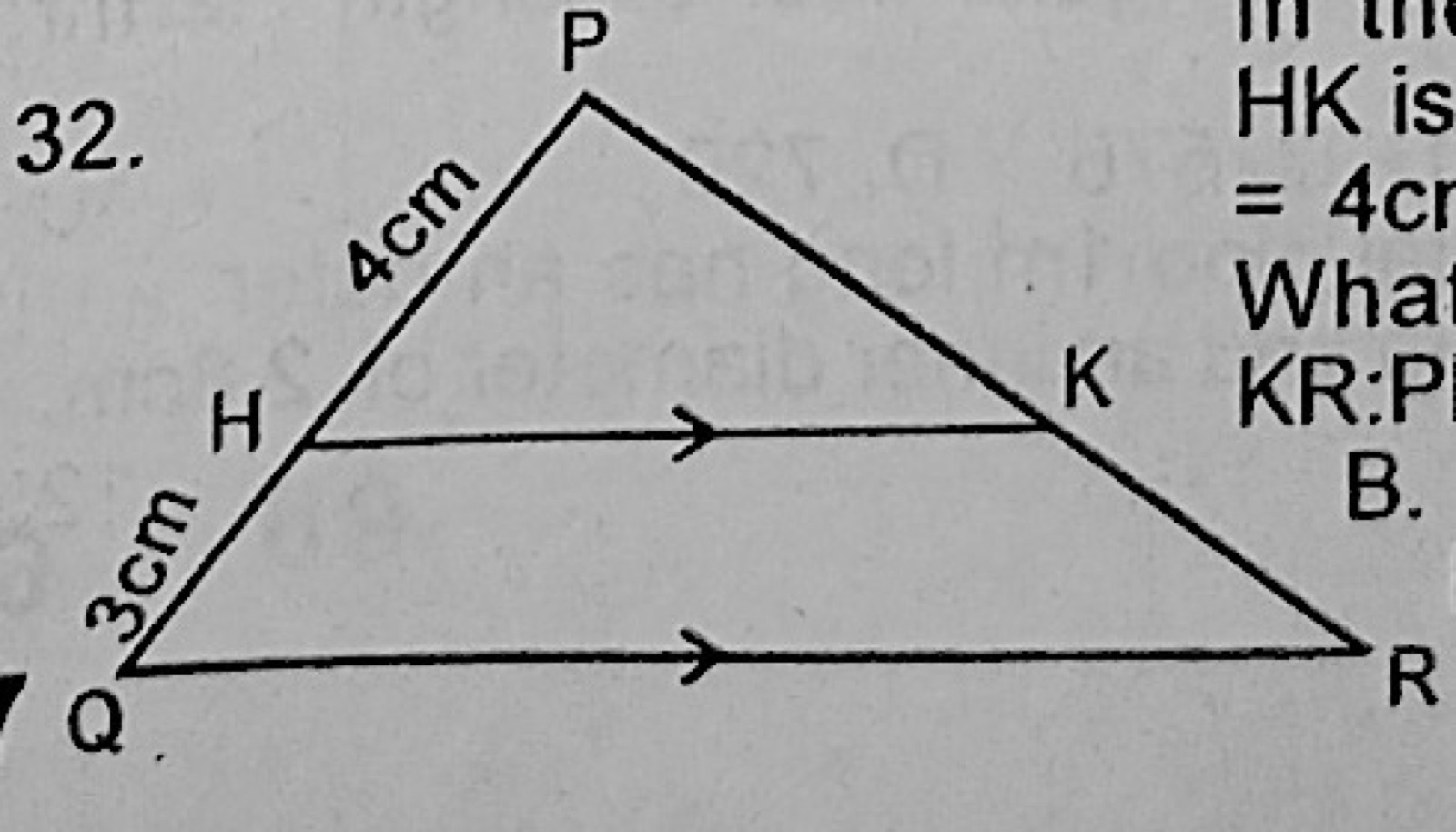
Question 32 Triangles and Quadrilaterals In the diagram above, HK is parallel to QR, PH = 4cm and HQ = 3cm. What is the ratio of KR:PR?
A. 7 : 3 B. 3 : 7 C. 3 : 4 D. 4 : 3. Show the answer and explanation Answer: B (3 : 7 )
Explanation A line parallel to one side divides the other two sides in the same ratio. So KR : PR = HQ : PQ = 3 : 7.
Open this question
Question 33 Angles and Polygons A regular polygon of (2k + 1) sides has 140° as the size of each interior angle. Find k.
A. 4 B. 4½ C. 8 D. 8½. Show the answer and explanation Answer: A (4 )
Explanation Each exterior angle is 180° − 140° = 40°, so there are 360 ÷ 40 = 9 sides. Then 2k + 1 = 9 and k = 4.
Open this question
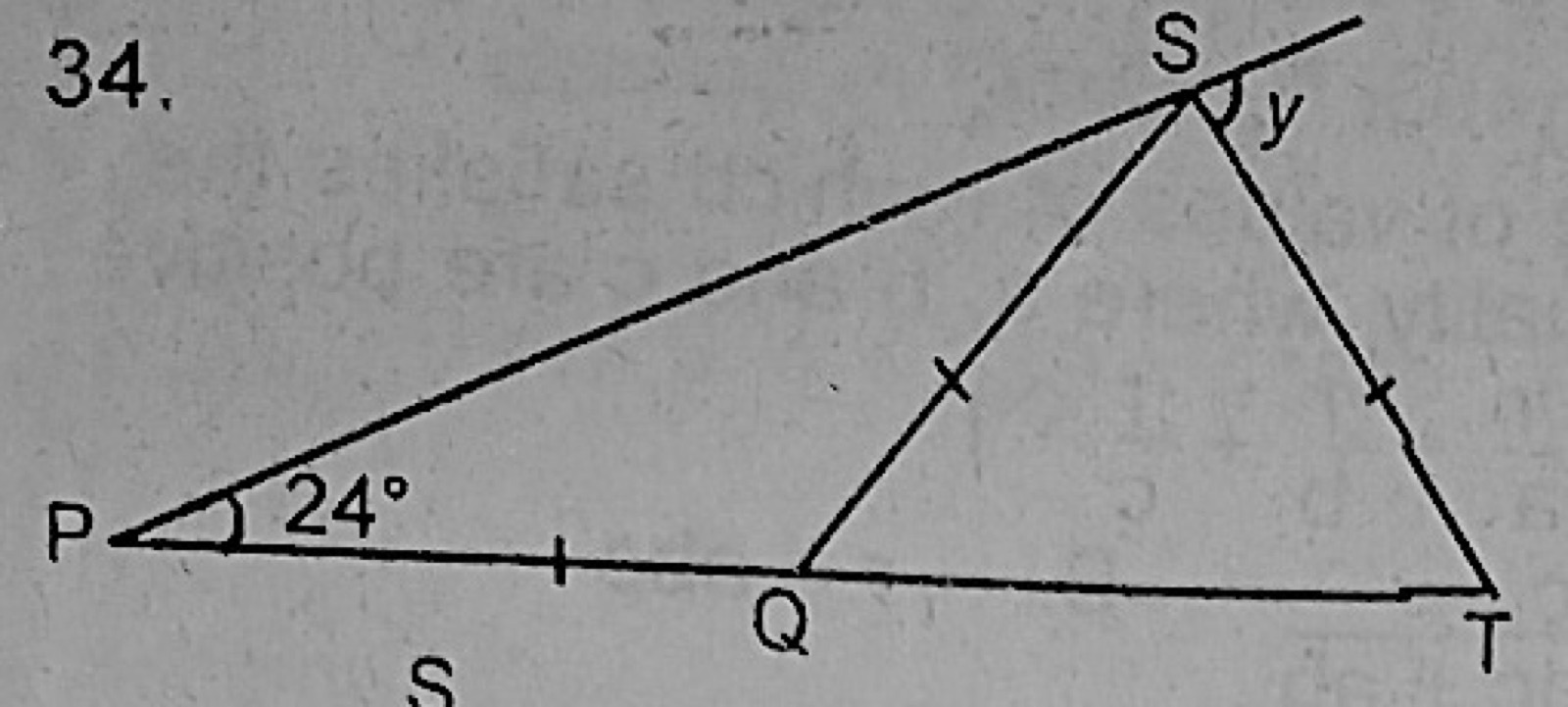
Question 34 Angles and Polygons If PST is a straight line and PQ = QS = SR in the above diagram, find y.
A. 24° B. 48° C. 72° D. 84° Show the answer and explanation Answer: C (72° )
Explanation PQ = QS gives angle QSP = 24°, and the exterior angle SQR = 24° + 24° = 48°. SQ = SR gives angle SRQ = 48°, so angle QSR = 84°. On the straight line at S, y = 180° − 24° − 84° = 72°.
Open this question
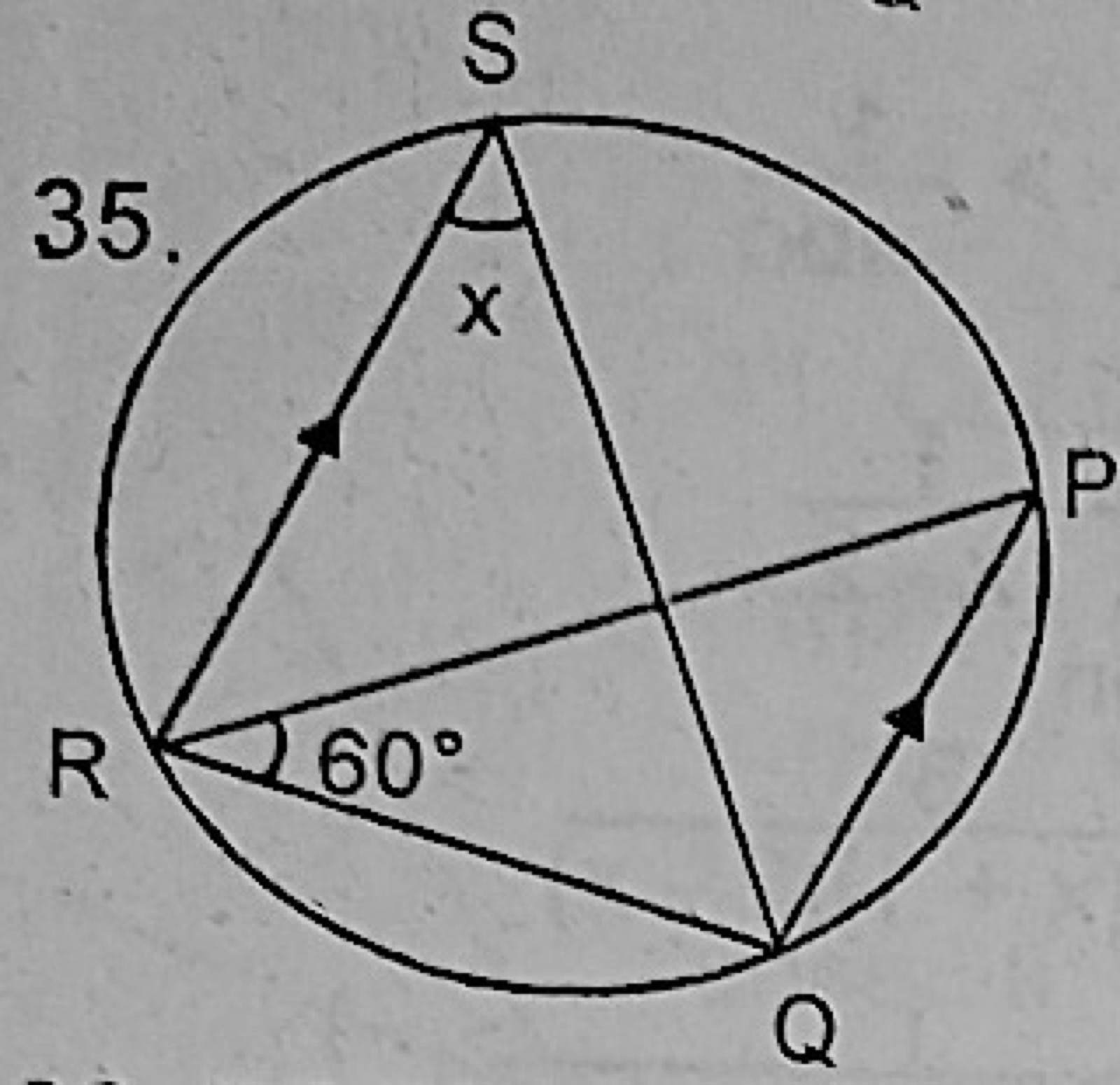
Question 35 Angles and Polygons In the above diagram PQ is parallel to RS and QS bisects PQ̂R. If PR̂Q is 60°, find x
A. 30° B. 40° C. 60° D. 120° Show the answer and explanation Answer: B (40° )
Explanation Angle PRQ = 60° means arc PQ = 120°. QS bisects angle PQR, so arcs PS and SR are equal, and the parallel chords make arc QR equal to arc PS. These three equal arcs share 240°, so each is 80°. x stands on arc QR, so x = 40°.
Open this question
Question 36 Triangles and Quadrilaterals PQRS is a rhombus. If PR2 + QS2 = kPQ2 , determine k.
A. 1 B. 2 C. 3 D. 4. Show the answer and explanation Answer: D (4. )
Explanation The diagonals of a rhombus bisect each other at right angles, so PQ² = (PR/2)² + (QS/2)². Multiplying by 4, PR² + QS² = 4PQ², so k = 4.
Open this question
Question 37 Triangles and Quadrilaterals In XYZ, Ŷ = Ẑ = 30° and XZ = 3cm. Find YZ.
A. √3/2 cm B. 3√3/2 cm C. 3√3cm D. 2√3cm Show the answer and explanation Answer: C (3√3cm )
Explanation Angle X = 120°. By the sine rule YZ/sin 120° = 3/sin 30°, so YZ = 3 × (√3/2) ÷ ½ = 3√3cm.
Open this question
Question 38 Triangles and Quadrilaterals In ΔPQR, the bisector of QP̂R meets QR at S. The line PQ is produced to V and the bisector of VQ̂S meets PS produced at T. If QP̂R = 46° and QŜT = 75°, calculate QT̂S
A. 41° B. 52° C. 64° D. 82° Show the answer and explanation Answer: A (41° )
Explanation Angle QPS = 23° and angle QSP = 180° − 75° = 105°, so the exterior angle VQS = 23° + 105° = 128° and angle TQS = 64°. In triangle QST, angle QTS = 180° − 75° − 64° = 41°.
Open this question
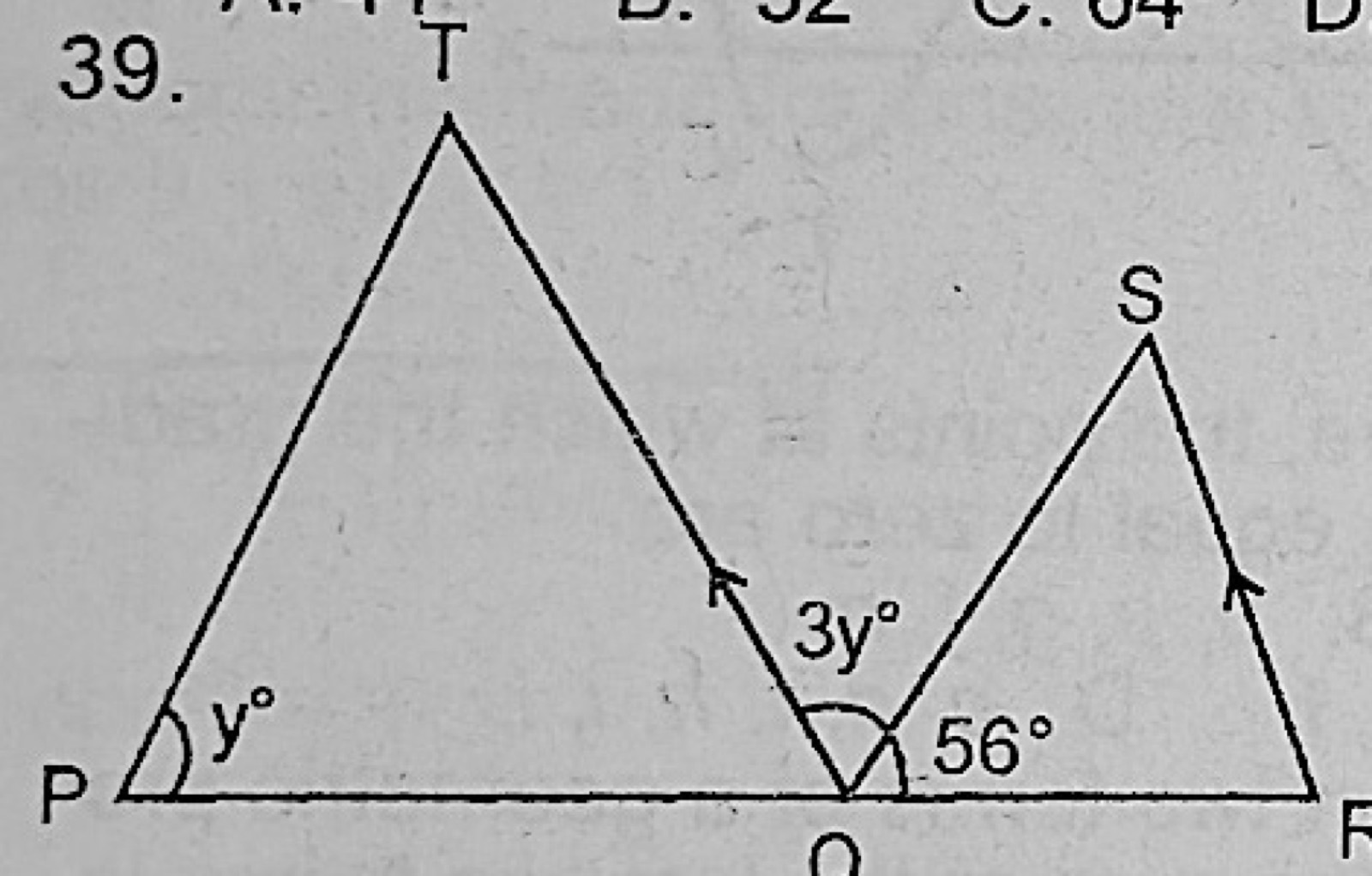
Question 39 Angles and Polygons If PQR is a straight line with QS = QR, calculate TP̂Q, if QT||SR and TQ̂S = 3y°
A. 62° B. 56° C. 20⅔° D. 18⅔° Show the answer and explanation Answer: C (20⅔° )
Explanation QS = QR, so angle QRS = (180° − 56°)/2 = 62°. QT is parallel to SR, so angle TQP = 62° (corresponding angles). On the straight line at Q, 62° + 3y + 56° = 180°, so y = 20⅔°, the angle TPQ.
Open this question
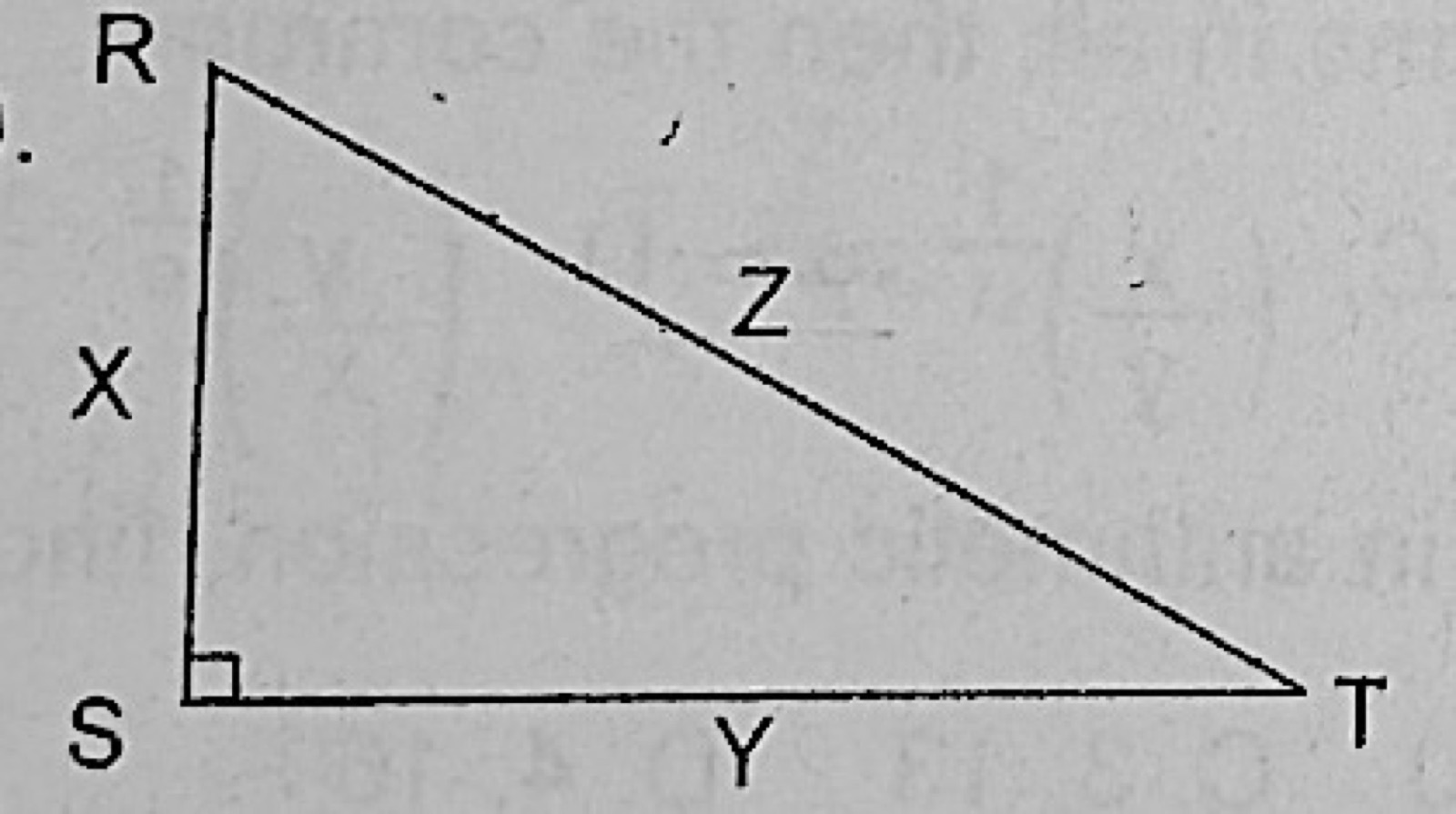
Question 40 Triangles and Quadrilaterals If x : y = 5 : 12 and z = 52cm, find the perimeter of the triangle
A. 68cm B. 84cm C. 100cm D. 120cm Show the answer and explanation Answer: D (120cm )
Explanation The triangle is right-angled with legs in ratio 5 : 12, so the sides are 5k, 12k, 13k. 13k = 52 gives k = 4, and the perimeter is 30k = 120cm.
Open this question
Question 41 Trigonometry The pilot of an aeroplane, flying 10km above the ground in the direction of a landmark, views the landmark to have angles of depression of 35° and 55°. Find the distance between the two points of observation.
A. 10(sin35° − sin55°) B. 10(cos35° − cos55°) C. 10(tan35° − tan 55°) D. 10(cot 35° − cot 55°) Show the answer and explanation Answer: D (10(cot 35° − cot 55°) )
Explanation At height 10km, the horizontal distance to the landmark is 10 cot θ for a depression angle θ. The two positions are 10 cot 35° and 10 cot 55° away, so the distance between them is 10(cot 35° − cot 55°).
Open this question
Question 42 Trigonometry 4 sin2 x − 3 = 0, find x if 0 ≤ x ≤ 90°
A. 30° B. 45° C. 60° D. 90° Show the answer and explanation Answer: C (60° )
Explanation sin²x = 3/4, so sin x = √3/2 (positive in this range). Then x = 60°.
Open this question
Question 43 Mensuration of Plane Shapes A square tile has side 30cm. How many of these tiles will cover a rectangular floor of length 7.2m and width 4.2m?
A. 336 B. 420 C. 576 D. 720 Show the answer and explanation Answer: A (336 )
Explanation The floor is 720cm by 420cm. That is 24 tiles along and 14 tiles across, so 24 × 14 = 336 tiles.
Open this question
Question 44 Mensuration of Solids A cylindrical metal pipe 1m long has an outer diameter of 7.2cm and an inner diameter of 2.8cm. Find the volume of metal used for the cylinder.
A. 440πcm3 B. 1,100πcm3 C. 4,400πcm3 D. 11,000πcm3 Show the answer and explanation Answer: B (1,100πcm3 )
Explanation Volume of metal = π/4 × (D² − d²) × length = π/4 × (51.84 − 7.84) × 100 = π/4 × 44 × 100 = 1,100π cm³.
Open this question
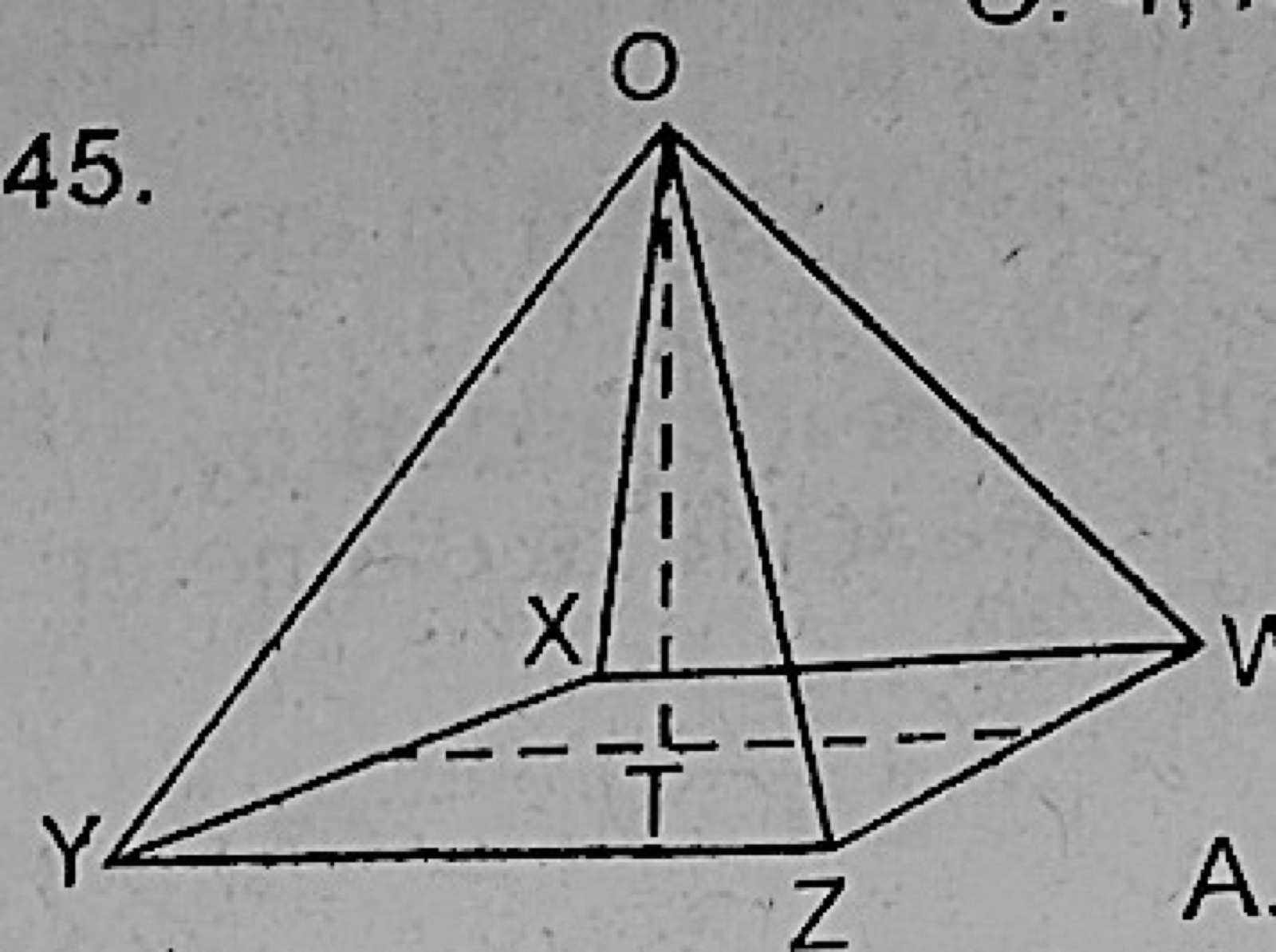
Question 45 Mensuration of Solids OXYZW is a pyramid with a square base such that OX = OY = OZ = OW = 5cm and XY = XW = YZ = WZ = 6cm. Find the height OT.
A. 2√5 B. 3 C. 4 D. √7 Show the answer and explanation Answer: D (√7 )
Explanation T is the centre of the base, half a diagonal from each corner: half of 6√2 = 3√2. OT² = 5² − (3√2)² = 25 − 18 = 7, so OT = √7cm.
Open this question
Question 46 Data Presentation In preparing rice cutlets, a cook used 75g of rice, 40g of margarine, 105g of meat and 20g of bread crumbs. Find the angle of the sector which represents meat in a pie chart.
A. 30° B. 60° C. 112.5° D. 157.5° Show the answer and explanation Answer: D (157.5° )
Explanation The total is 240g. Meat's angle = 105/240 × 360° = 157.5°.
Open this question
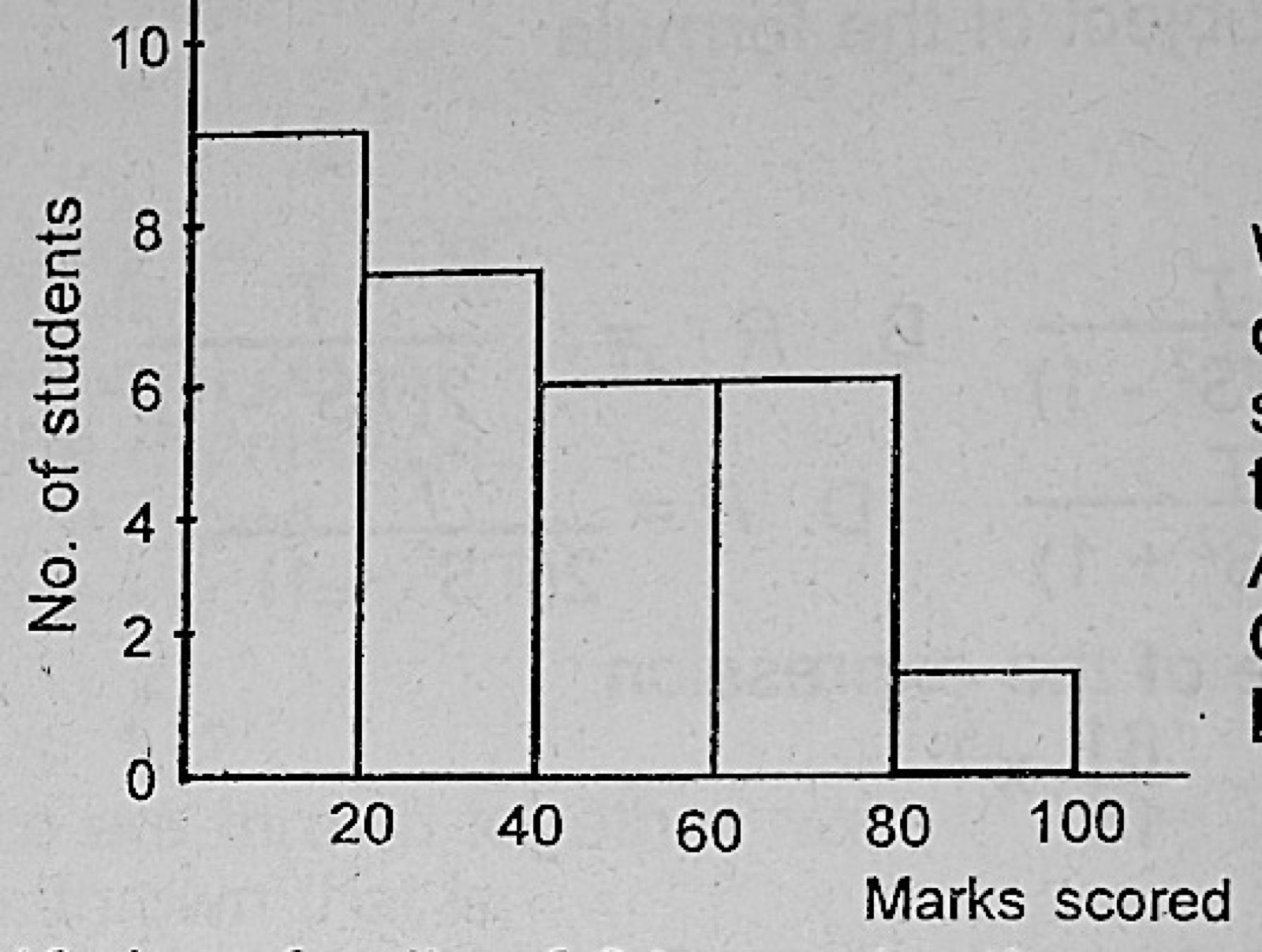
Question 47 Data Presentation In a class of 30 students, the marks scored in an examination are displayed in the following histogram: What percentage of the students scored more than 40%?
A. 14% B. 40% C. 46⅔% D. 53⅓% Show the answer and explanation Answer: C (46⅔% )
Explanation The bars above 40 marks show 6 + 6 + 2 = 14 students. 14/30 × 100 = 46⅔%.
Open this question
Question 48 Measures of Central Tendency In a family of 21 people, the average age is 14 years. if the age of the grandfather is not counted, the average age drops to 12 years. What is the age of the grandfather?
A. 35years B. 40 years C. 42 years D. 54 years Show the answer and explanation Answer: D (54 years )
Explanation Total age = 21 × 14 = 294. Without him, 20 × 12 = 240. The grandfather is 294 − 240 = 54 years old.
Open this question
Question 49 Measures of Central Tendency If n is the median and m is the mode of the following set of numbers, 2, 4,2.1, 1.6, 2.6, 2.6, 3.7, 2.1, 2.6, then (n, m) is
A. (2.6, 2.6) B. (2.5, 2.6) C. (2.6, 2.5) D. (2.5, 2.1) Show the answer and explanation Answer: A ((2.6, 2.6) )
Explanation In order the nine numbers are 1.6, 2, 2.1, 2.1, 2.6, 2.6, 2.6, 3.7, 4. The middle (5th) one is 2.6 and the most common is 2.6, so (n, m) = (2.6, 2.6).
Open this question
Question 50 Probability Two numbers are chosen at random from three numbers 1, 3, 6. Find the probability that the sum of the two is not odd.
A. 2/3 B. 1/2 C. 1/3 D. 1/6 Show the answer and explanation Answer: C (1/3 )
Explanation The possible pairs are 1 + 3 = 4, 1 + 6 = 7 and 3 + 6 = 9. Only one of the three sums is even, so the probability is 1/3.
Open this question Sign up free for every JAMB Mathematics year, practice by topic and timed mocks.
Start practising free