There are 30 students in a class. 15 study woodwork and 13 study metalwork, 6 study neither of the two subjects. How many students study woodwork but not metalwork?
A.5
B.9
C.11
D.13
Show the answer and explanation
Answer: C (11)
Explanation
30 − 6 = 24 study at least one subject, so 15 + 13 − 24 = 4 study both. Woodwork only = 15 − 4 = 11.
The radius and height of a solid cylinder are 8 cm and 14 cm respectively. Find, correct to two decimal places, the total surface area. [Take π = 22/7]
A.1,106.28 cm2
B.1,016.29 cm2
C.1,106.29 cm2
D.1,206.27 cm2
Show the answer and explanation
Answer: C (1,106.29 cm2)
Explanation
Total surface area = 2πr(r + h) = 2 × 22/7 × 8 × 22 = 7744/7 = 1106.2857…, which is 1,106.29 cm² to two decimal places.
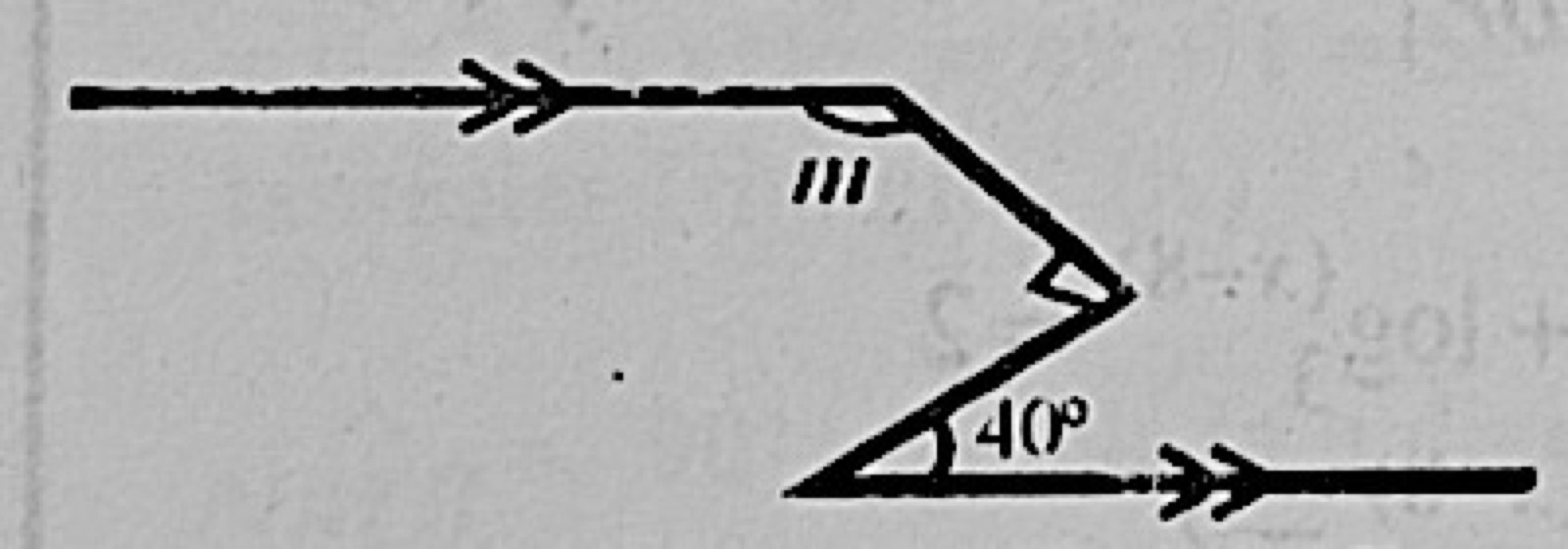
Draw a line through the right-angled corner parallel to the arrowed lines. The 40° angle is split off below, so the upper slanting line meets that parallel at 90° − 40° = 50°. Then m and 50° are co-interior angles, so m = 180° − 50° = 130°.
An empty cyclindrical tank is 140 cm in diameter. If 200 litres of water is poured into the tank, calculate, correct to the nearest centimetre, the height of water in the tank. [Take π = 22/7]
A.91 cm
B.57 cm
C.13 cm
D.7 cm
Show the answer and explanation
Answer: C (13 cm)
Explanation
200 litres = 200 000 cm³ and r = 70 cm. h = 200 000 ÷ (22/7 × 70 × 70) = 200 000 ÷ 15 400 ≈ 12.99, so about 13 cm.
Mrs. Kebeh stands at a distance of 110 m away from a building of vertical height 58 m. If Kebeh is 2 m tall, find the angle of elevation of the top of the building from her eye.
A.28°
B.27°
C.26°
D.20°
Show the answer and explanation
Answer: B (27°)
Explanation
Above her eye level the building rises 58 − 2 = 56 m. tan θ = 56/110 = 0.509, so θ ≈ 27°.
What is the name of a triangle with vertices (1, −3), (6, 2) and (0, 4)?
A.Isosceles triangle
B.Equilateral triangle
C.Right triangle
D.Scalene triangle
Show the answer and explanation
Answer: A (Isosceles triangle)
Explanation
The squared side lengths are 5² + 5² = 50, 6² + 2² = 40 and 1² + 7² = 50. Two sides are equal (√50) and 40 + 50 ≠ 50, so it is isosceles, not right-angled.
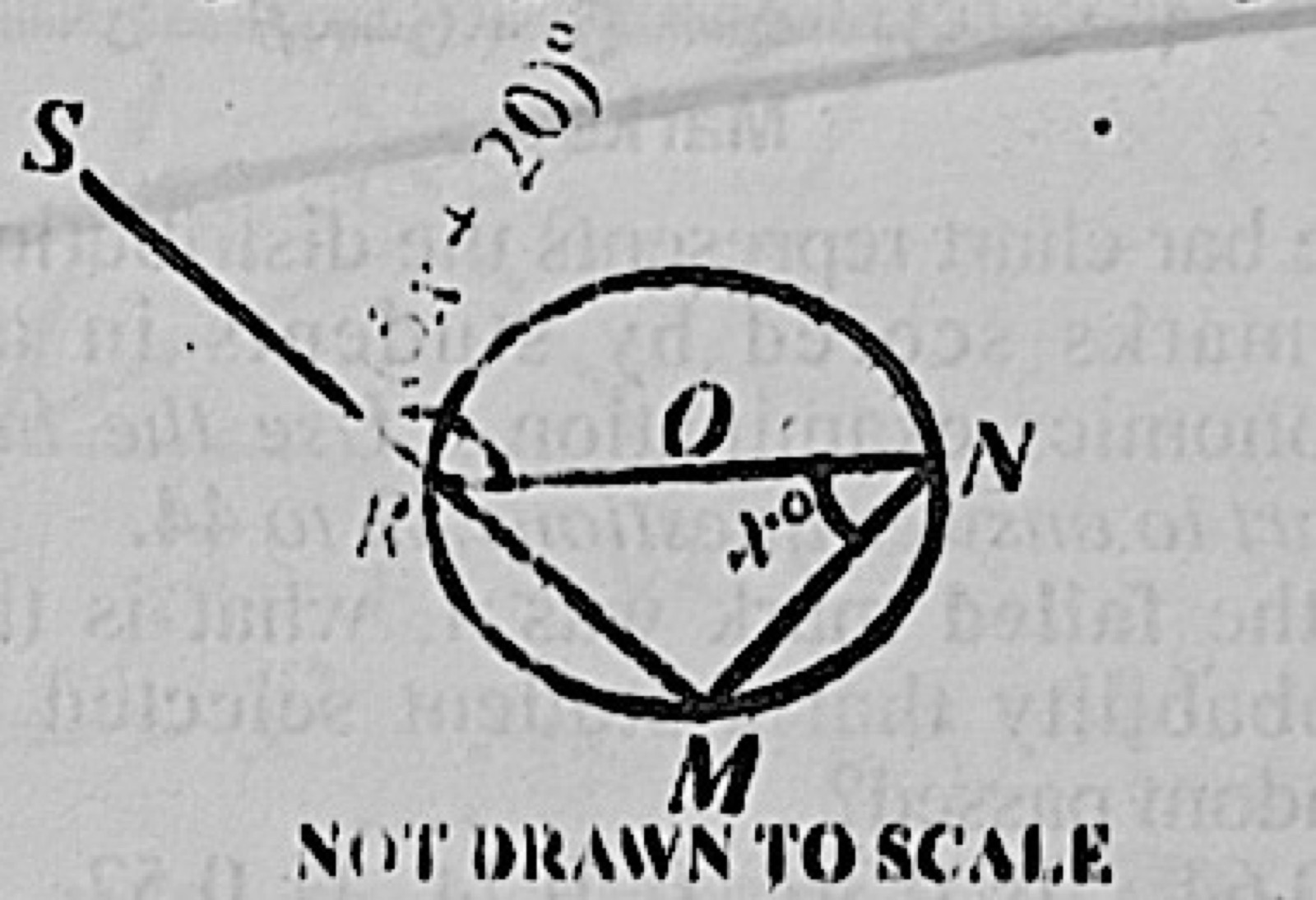
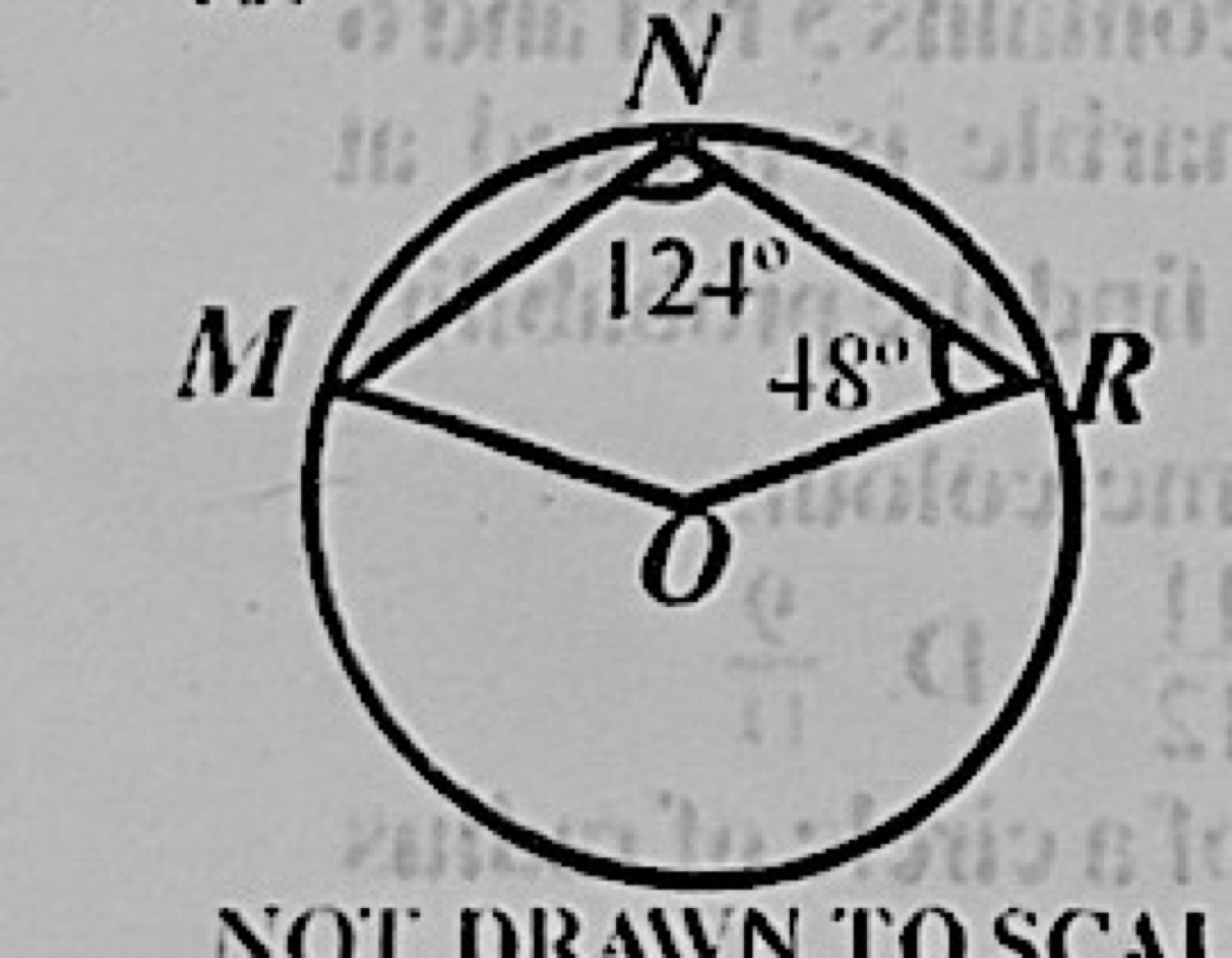
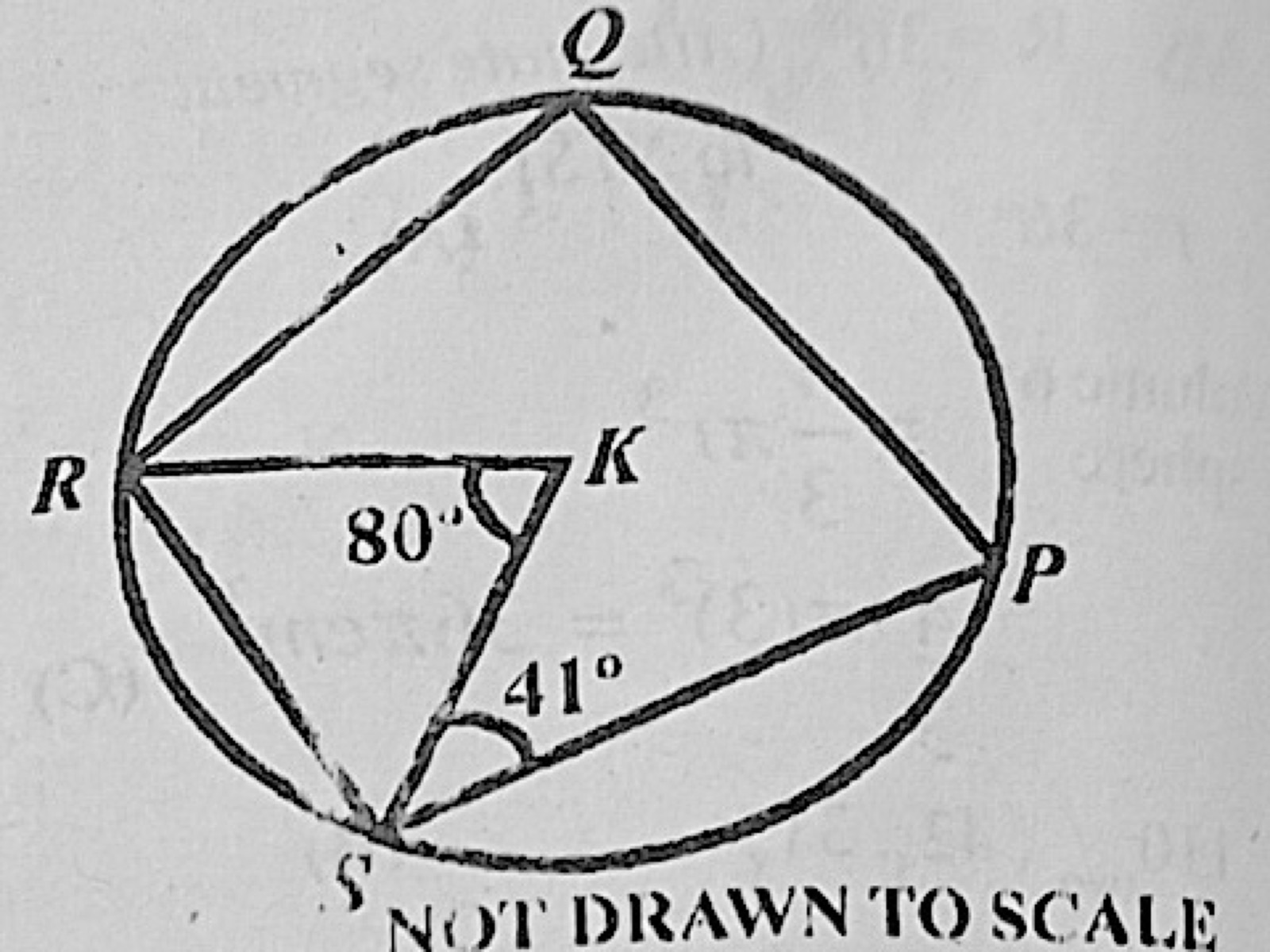
In the diagram, NR is a diameter, ∠MNR = x° and ∠SRN = (5x + 20)°. Find the value of 2x.
A.20°
B.35°
C.42°
D.90°
Show the answer and explanation
Answer: B (35°)
Explanation
∠NMR = 90° (angle in a semicircle), so ∠NRM = 90° − x. S, R and M lie on a straight line, so ∠SRN = 180° − (90° − x) = 90° + x. Then 5x + 20 = 90 + x gives x = 17.5 and 2x = 35°.
A bag contains 4 white marbles and 3 blue marbles. Another bag contains 5 red and 6 blue marbles. If a marble is picked at random from each bag, find the probability that they are of the same colour.
A.1/2
B.18/77
C.11/12
D.9/11
Show the answer and explanation
Answer: B (18/77)
Explanation
Only blue is in both bags, so P(both blue) = 3/7 × 6/11 = 18/77.
The angle of elevation of the top of a vertical building from a point Z on the ground is 50°. If the height of the building is 124 m, find the distance from Z to the foot of the building.
A student measured the height of a pole as 5.98 m which is less than the actual height. If the percentage error is 5%, find, correct to two decimal places, the actual height of the pole.
A.6.65 m
B.7.67 m
C.6.29 m
D.7.18 m
Show the answer and explanation
Answer: C (6.29 m)
Explanation
The measured value is 95% of the actual height: 0.95h = 5.98, so h = 6.2947… ≈ 6.29 m.
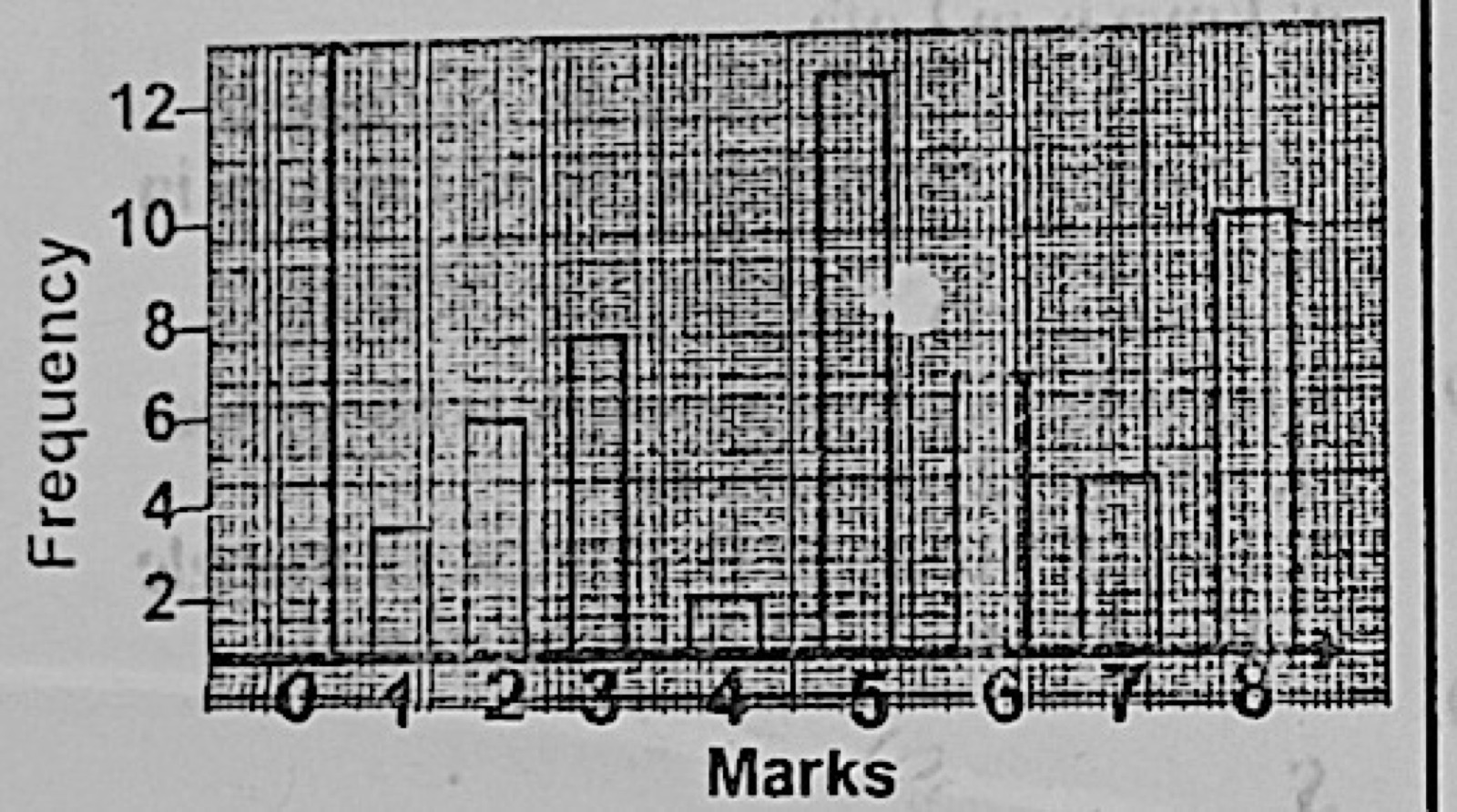
The bar chart represents the distribution of marks scored by students in an Economics examination. If the failed mark was 4, what is the probability that a student selected at random passed?
A.0.64
B.0.36
C.0.74
D.0.52
Show the answer and explanation
Answer: A (0.64)
Explanation
Students who passed scored 5 to 8 marks: 12 + 7 + 5 + 10 = 34 out of 53 students. 34/53 ≈ 0.64.
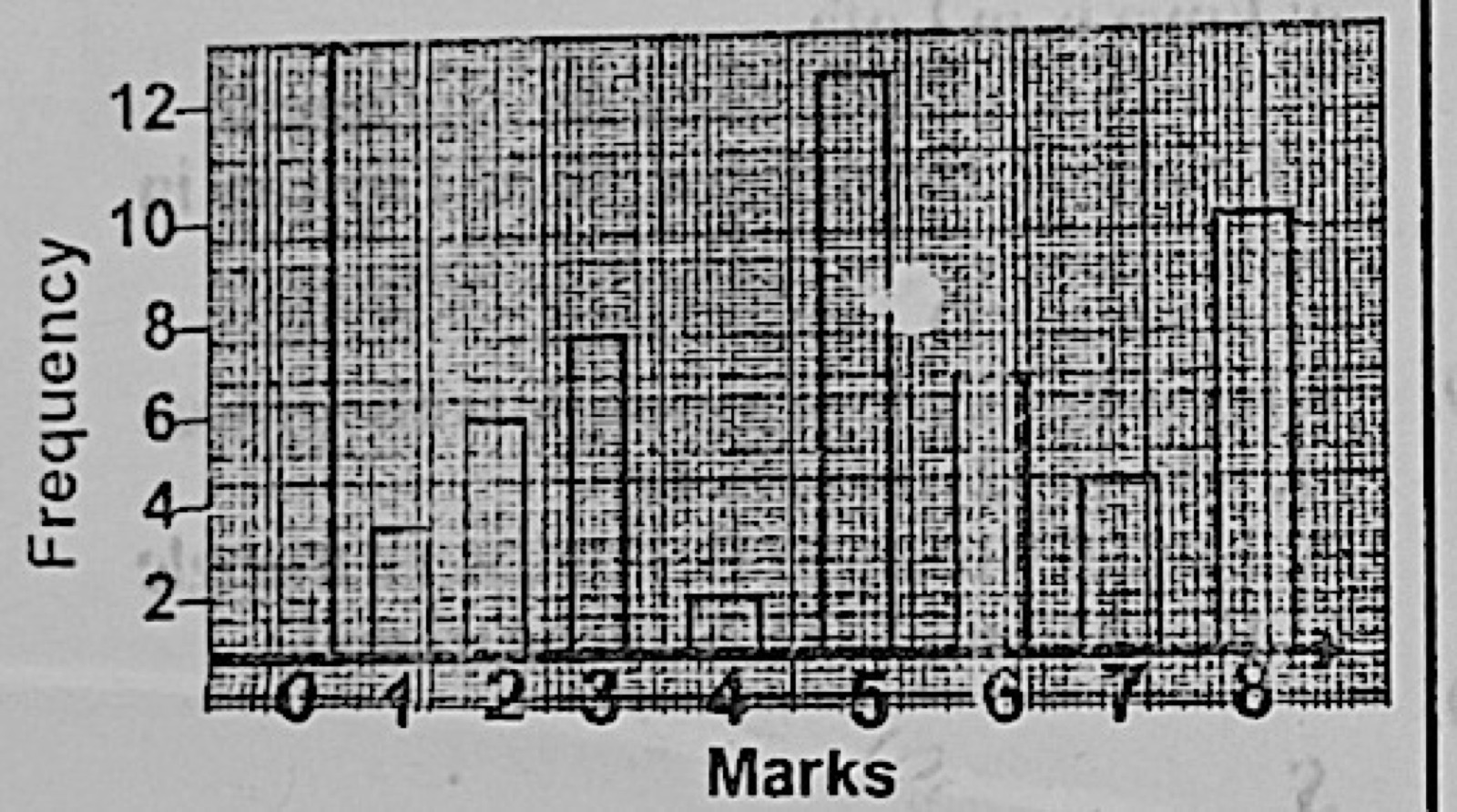
The bar chart represents the distribution of marks scored by students in an Economics examination. What percentage of the students scored at most 5 marks?
A.63.2%
B.58.5%
C.41.5%
D.38.3%
Show the answer and explanation
Answer: B (58.5%)
Explanation
At most 5 marks: 3 + 6 + 9 + 1 + 12 = 31 students out of 53. 31/53 × 100% ≈ 58.5%.
(a) A car travels a distance of 112 km at an average speed of 70 km/h. It then travels further for 60 km at an average speed of 50 km/h. Calculate, for the entire journey, the total time taken. (b) If x/y = 2 and y/z = 3, find the value of (x + y)/(y + z).
Show the model answer
Model answer
(a) Time for first part = 112 ÷ 70 = 1.6 h Time for second part = 60 ÷ 50 = 1.2 h Total time = 2.8 h = 2 hours 48 minutes (b) x = 2y and z = y/3 (x + y)/(y + z) = 3y ÷ (4y/3) = 9/4 = 2¼
Explanation
Time = distance ÷ speed for each part; then write x and z in terms of y.
In a football match, the tickets for children and adults were sold at D 3.00 and D 5.00 respectively. If 400 people attended the football match and D1,700.00 was collected in ticket sales: (a) how many tickets were sold to adults? (b) Mr. Sonko sold 250 tickets. If 175 of the tickets were for adults, how much sales did he make altogether?
Show the model answer
Model answer
(a) Let c = children's tickets, a = adults' tickets: c + a = 400 and 3c + 5a = 1700 3(400 − a) + 5a = 1700 ⇒ 2a = 500 ⇒ a = 250 adults' tickets (b) Children's tickets = 250 − 175 = 75 Sales = 175 × D5 + 75 × D3 = D875 + D225 = D1,100.00
Explanation
Form two simultaneous equations: one for people, one for money.
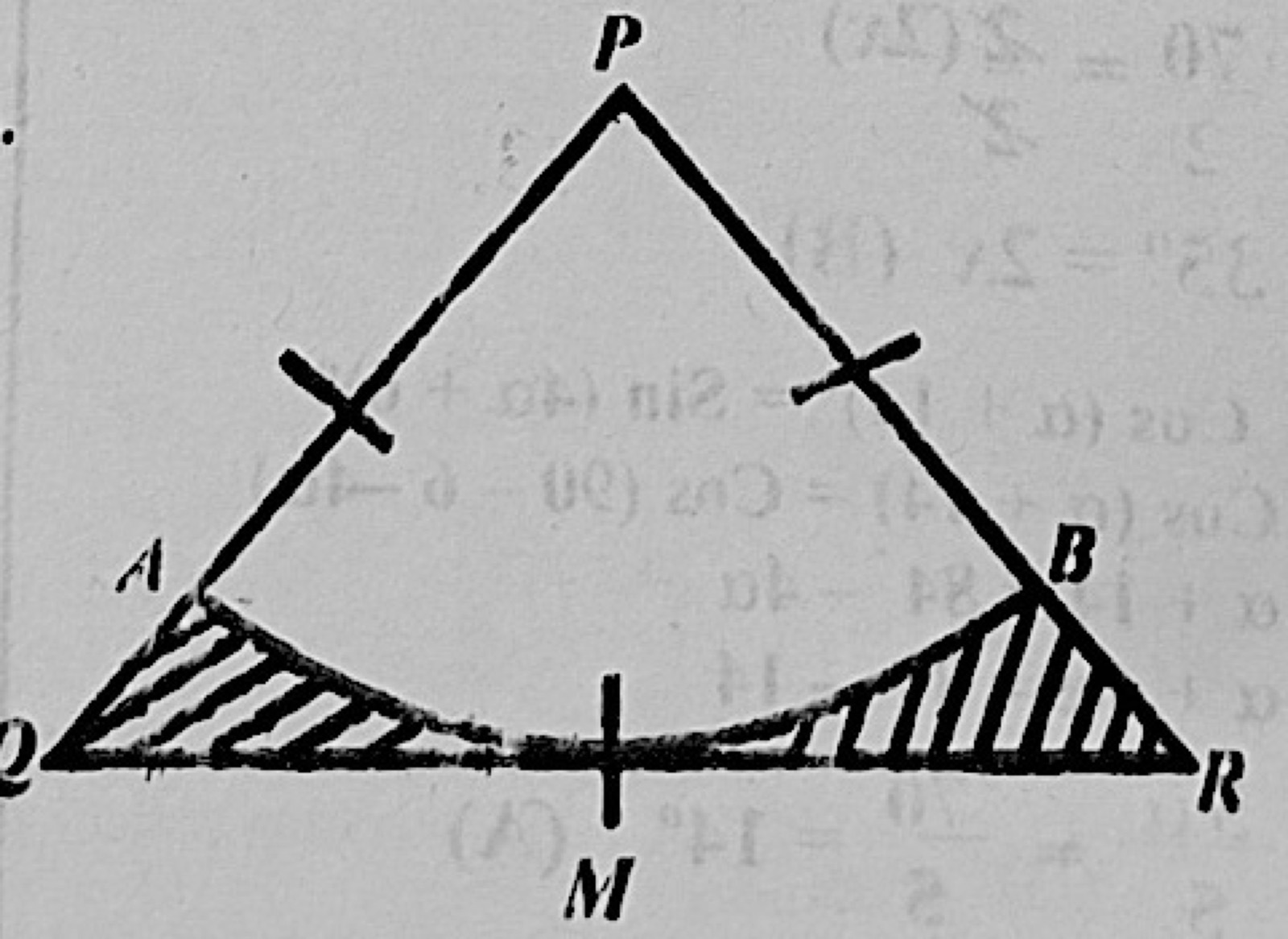
In the diagram, PQR is an equilateral triangle of side 18cm. M is the midpoint of QR. An arc of a circle with centre P touches QR at M and meets PQ at A and PR at B. Calculate, correct to two decimal places, the area of the shaded region. [Take π = 22/7]
Show the model answer
Model answer
Radius PM = height of triangle = 18 sin 60° = 9√3 ≈ 15.588 cm Area of triangle PQR = ½ × 18 × 18 × sin 60° = 81√3 ≈ 140.30 cm² Area of sector PAB (angle 60°) = 60/360 × 22/7 × 243 ≈ 127.29 cm² Shaded area = 140.30 − 127.29 ≈ 13.01 cm²
Explanation
The radius of the arc is the height PM of the triangle.
A boy stands at a point M on the same horizontal level as the foot, T, of a vertical building. He observes an object on the top, P of the building at an angle of elevation of 66°. He moves directly backwards to a new point C and observes the same object at an angle of elevation of 53°. If |MT| = 50 m: (a) illustrate the information in a diagram; (b) calculate, correct to one decimal place: (i) the height of the building; (ii) |MC|
Show the model answer
Model answer
(a) Vertical PT with right angle at T; C, M, T in a straight line with MT = 50 m; angle of elevation 66° at M and 53° at C (b)(i) PT = 50 tan 66° ≈ 112.3 m (ii) CT = 112.30 ÷ tan 53° ≈ 84.63 m, so |MC| = 84.63 − 50 ≈ 34.6 m
Explanation
C is further from the building than M, so the smaller angle is at C.
(a) M = {n: 2n − 3 ≤ 37}, where n is a counting number. (i) Write down all the elements in M. (ii) If a number is selected at random from M, what is the probability that it is a: (α) multiple of 3; (β) factor of 10. (b) A shopowner gave an end-of-year bonus to two of his attendants, Kontor and Gapson in the ratio of their ages. Kontor's age is one and half times that of Kontor who is 20 years old. If Kontor received Le 200,000.00: find: (i) the total amount shared; (ii) Gapson's share.
Show the model answer
Model answer
(a)(i) 2n ≤ 40 ⇒ n ≤ 20, so M = {1, 2, 3, …, 20} (ii)(α) Multiples of 3: 3, 6, 9, 12, 15, 18 ⇒ P = 6/20 = 3/10 (β) Factors of 10: 1, 2, 5, 10 ⇒ P = 4/20 = 1/5 (b) Gapson is 20, so Kontor is 1½ × 20 = 30; ratio Kontor : Gapson = 3 : 2 (i) 3/5 of total = Le 200,000 ⇒ total = Le 333,333.33 (= 1,000,000/3) (ii) Gapson's share = 2/5 of total = Le 133,333.33 (= 400,000/3)
Explanation
Read (b) as 'one and half times that of Gapson, who is 20 years old'.
(a) The sum of three numbers is 81. The second number is twice the first. Given that the third number is 6 more than the second, find the numbers. (b) Given the points P(3, 5) and Q(−5, 7) on the cartesian plane such that R(x, y) is the midpoint of PQ, find the equation of the line that passes through R and perpendicular to PQ.
Show the model answer
Model answer
(a) Let the numbers be x, 2x, 2x + 6: 5x + 6 = 81 ⇒ x = 15. The numbers are 15, 30 and 36 (b) R = ((3 − 5)/2, (5 + 7)/2) = (−1, 6) Gradient of PQ = (7 − 5)/(−5 − 3) = −¼, so the perpendicular gradient = 4 y − 6 = 4(x + 1) ⇒ y = 4x + 10
(a) Copy and complete the table of values for y = 2x2 − x − 4 for −3 ≤ x ≤ 3. x: −3, −2, −1, 0, 1, 2, 3 y: 17, __, __, −4, __, __, __ (b) Using a scale of 2 cm to 1 unit on the x-axis and 2 cm to 2 units on the y-axis, draw the graph of y = 2x2 − x − 4 for −3 ≤ x ≤ 3. (c) Use the graph to find the: (i) roots of the equation 2x2 − x − 4 = 0; (ii) values of x for which y increases as x increases. (iii) minimum point of y.
Show the model answer
Model answer
(a) y = 17, 6, −1, −4, −3, 2, 11 (b) Plot the points and join with a smooth U-shaped curve (c)(i) Where the curve crosses the x-axis: x ≈ −1.2 and x ≈ 1.7 (ii) y increases for x > 0.25 (about x > 0.2 from the graph) (iii) Minimum point ≈ (0.25, −4.1)
Explanation
The roots are where the curve cuts the x-axis; the lowest point is the minimum.
The table shows the height of teak trees harvested by a farmer. Height (m): 3, 4, 5, 6, 7, 8 Number of trees: 4, 6, 4, 5, 6, 2 (a) Find the median height. (b) Calculate, correct to one decimal place, the: (i) mean; (ii) standard deviation.
Show the model answer
Model answer
(a) Σf = 27, so the median is the 14th value. Cumulative frequencies 4, 10, 14, … ⇒ median height = 5 m (b)(i) Σfx = 12 + 24 + 20 + 30 + 42 + 16 = 144; mean = 144/27 ≈ 5.3 m (ii) Σfx² = 834; variance = 834/27 − (144/27)² ≈ 2.444; standard deviation ≈ 1.6 m
Explanation
Find the position (n + 1)/2 for the median; use the exact mean for the standard deviation.
In a town, Chief X resides 60 m away on a bearing of 057° from the palace P. While Chief Y resides on a bearing of 150° from the same palace P. The residence of X and Y are 180 m apart. (a) Illustrate the information in a diagram. (b) Find, correct to three significant figures, the: (i) bearing of X from Y; (ii) distance between P and Y.
Show the model answer
Model answer
(a) From P, PX = 60 m on 057° and PY on 150°; ∠XPY = 150° − 57° = 93°; XY = 180 m (b)(i) Sine rule: sin ∠PYX = 60 sin 93° ÷ 180 ≈ 0.3329 ⇒ ∠PYX ≈ 19.4°. Bearing of P from Y = 330°, so bearing of X from Y = 330° + 19.4° ≈ 349° (ii) ∠PXY = 180° − 93° − 19.4° = 67.6°; PY = 180 sin 67.6° ÷ sin 93° ≈ 167 m (166.6 m)
(a) Two regular polygons P and Q are such that the number of sides of P is twice the number of sides of Q. The difference between the exterior angle of Q and P is 45°. Find the number of sides of P. (b) The area of a semi-circle is 32π cm2. Find, in terms of π, the circumference of the semi-circle.
Show the model answer
Model answer
(a) Let Q have n sides, P 2n sides: 360/n − 360/(2n) = 45 ⇒ 180/n = 45 ⇒ n = 4, so P has 8 sides (b) ½πr² = 32π ⇒ r = 8 cm Curved part = πr = 8π cm; with the diameter, the perimeter = (8π + 16) cm
Explanation
A polygon with more sides has a smaller exterior angle.
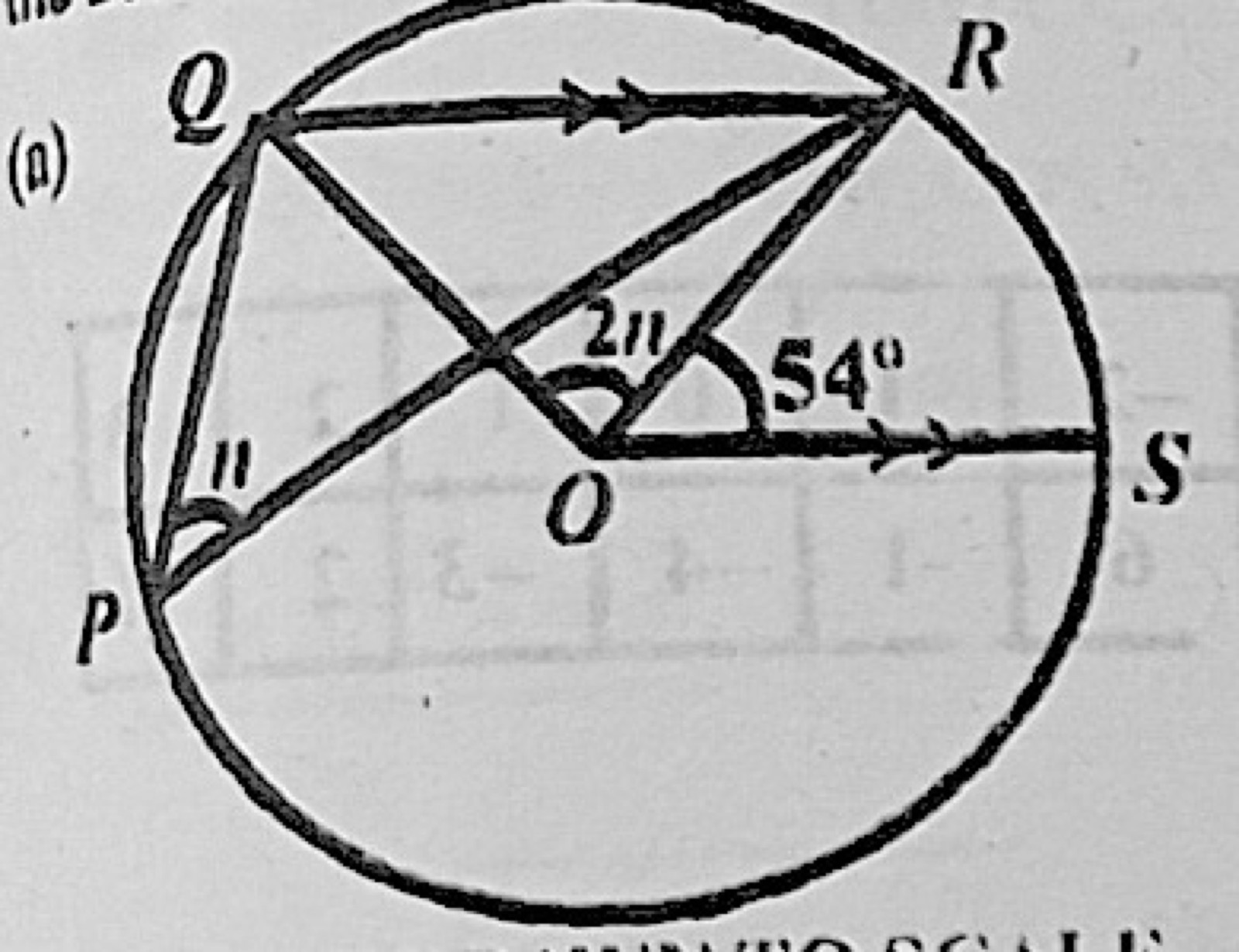
(a) In the diagram, P, Q, R and S are points on the circle with centre O. QR//OS, ∠QOR = 2m, ∠QPR = n and ∠SOR = 54°. Find the values of m and n. (b) The length of a rectangle is 4 cm more than the width. If the perimeter is 40 cm, find the area.
Show the model answer
Model answer
(a) ∠ORQ = ∠SOR = 54° (alternate angles, QR // OS) OQ = OR, so ∠OQR = 54° and ∠QOR = 180° − 108° = 72° ⇒ 2m = 72°, m = 36° n = ∠QPR = ½∠QOR = 36° (angle at centre is twice angle at circumference) (b) 2(w + w + 4) = 40 ⇒ w = 8 cm, length = 12 cm; area = 96 cm²
Explanation
Use alternate angles with the parallel lines, then the isosceles triangle OQR.
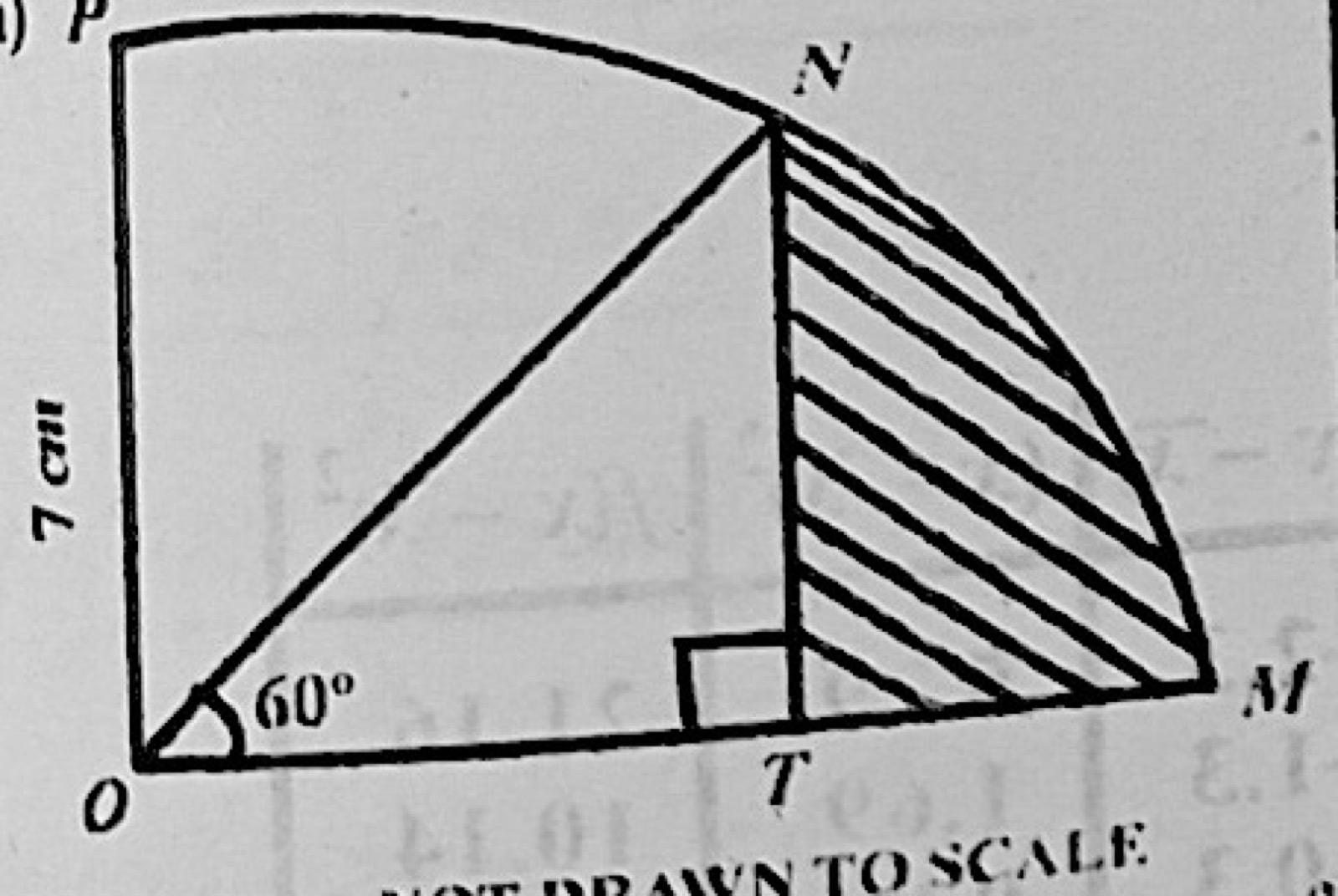
(a) In the daigram, the radius of the sector of circle centre O, is 7 cm and ∠MON is 60°. Find, correct to one decimal place, the area of the shaded portion. [Take π = 22/7] (b) The x and y intercepts of a straight line are −3/4 and 2/7 respectively. Find the equation of the line.
Show the model answer
Model answer
(a) Area of sector OMN = 60/360 × 22/7 × 7 × 7 = 77/3 ≈ 25.67 cm² OT = 7 cos 60° = 3.5 cm, NT = 7 sin 60° ≈ 6.062 cm; area of triangle ONT = ½ × 3.5 × 6.062 ≈ 10.61 cm² Shaded area = 25.67 − 10.61 ≈ 15.1 cm² (b) The line passes through (−3/4, 0) and (0, 2/7); gradient = (2/7)/(3/4) = 8/21 y = (8/21)x + 2/7, i.e. 21y = 8x + 6
Explanation
The shaded part is the sector minus the right-angled triangle ONT.