What is the number whose logarithm to base 10 is 3̄.4771?
A.3.0
B.0.3
C.0.03
D.0.003
E.0.0003
Show the answer and explanation
Answer: D (0.003)
Explanation
The mantissa 0.4771 is log 3, and the characteristic bar 3 (that is, −3) puts the first significant figure in the third decimal place, so the number is 0.003.
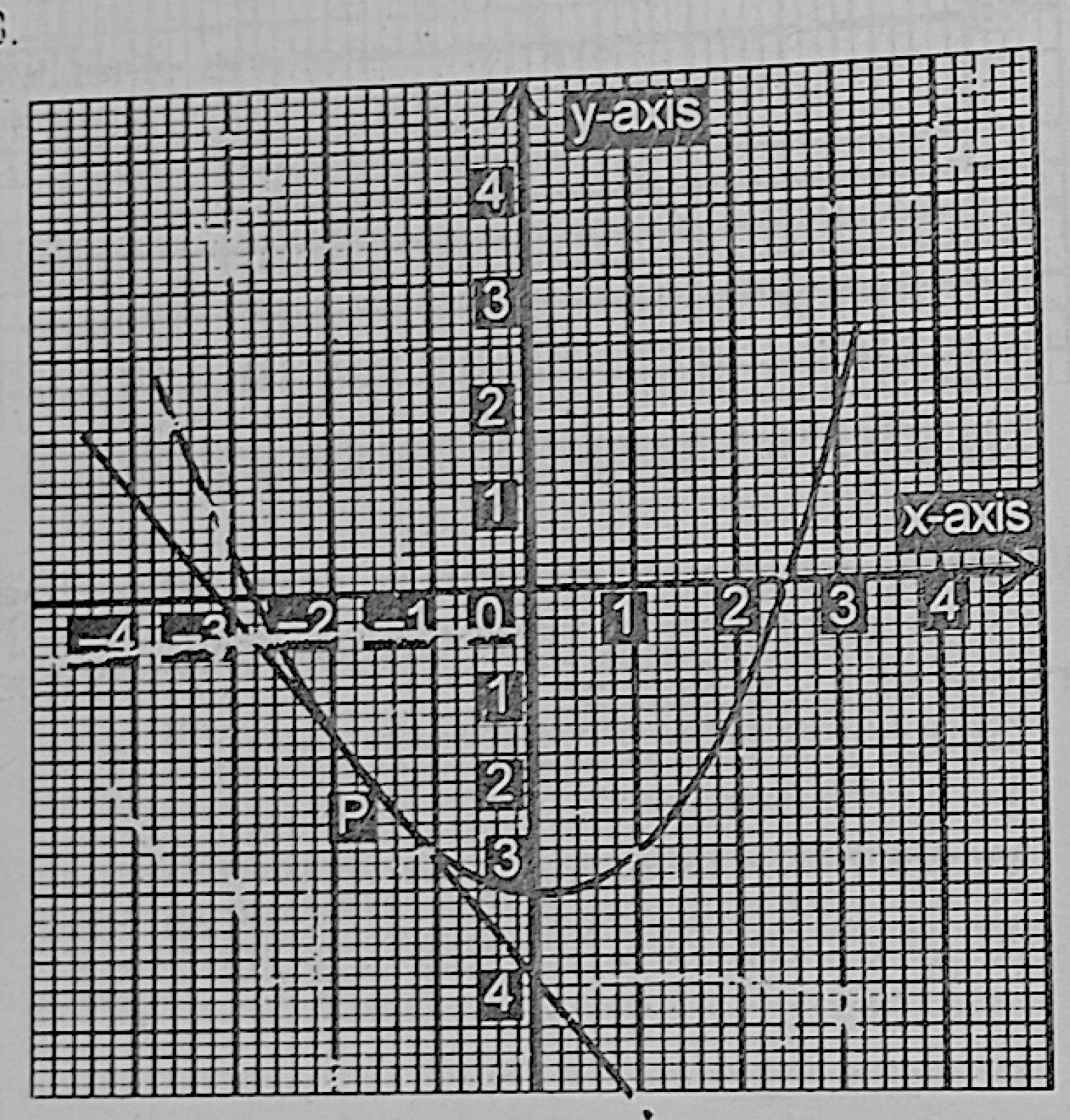
In the graph above, the gradient of the curve at the point P is
A.−1 1/3
B.−3/4
C.3/7
D.3/4
E.1 1/3
Show the answer and explanation
Answer: A (−1 1/3)
Explanation
The gradient at P is the gradient of the tangent drawn at P. The tangent passes through about (−3, 0) and (0, −4), so the gradient = (−4 − 0)/(0 − (−3)) = −4/3 = −1 1/3.
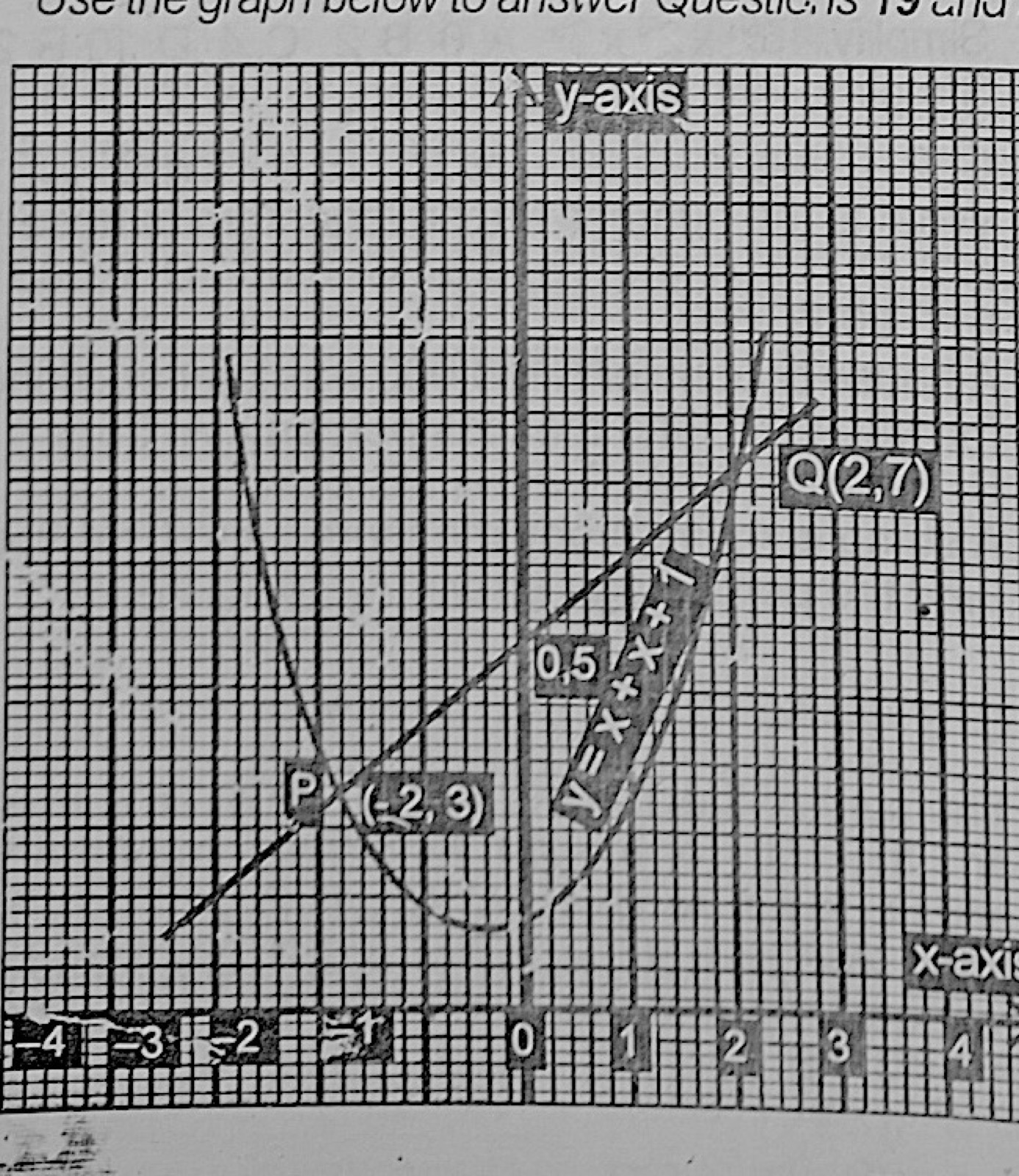
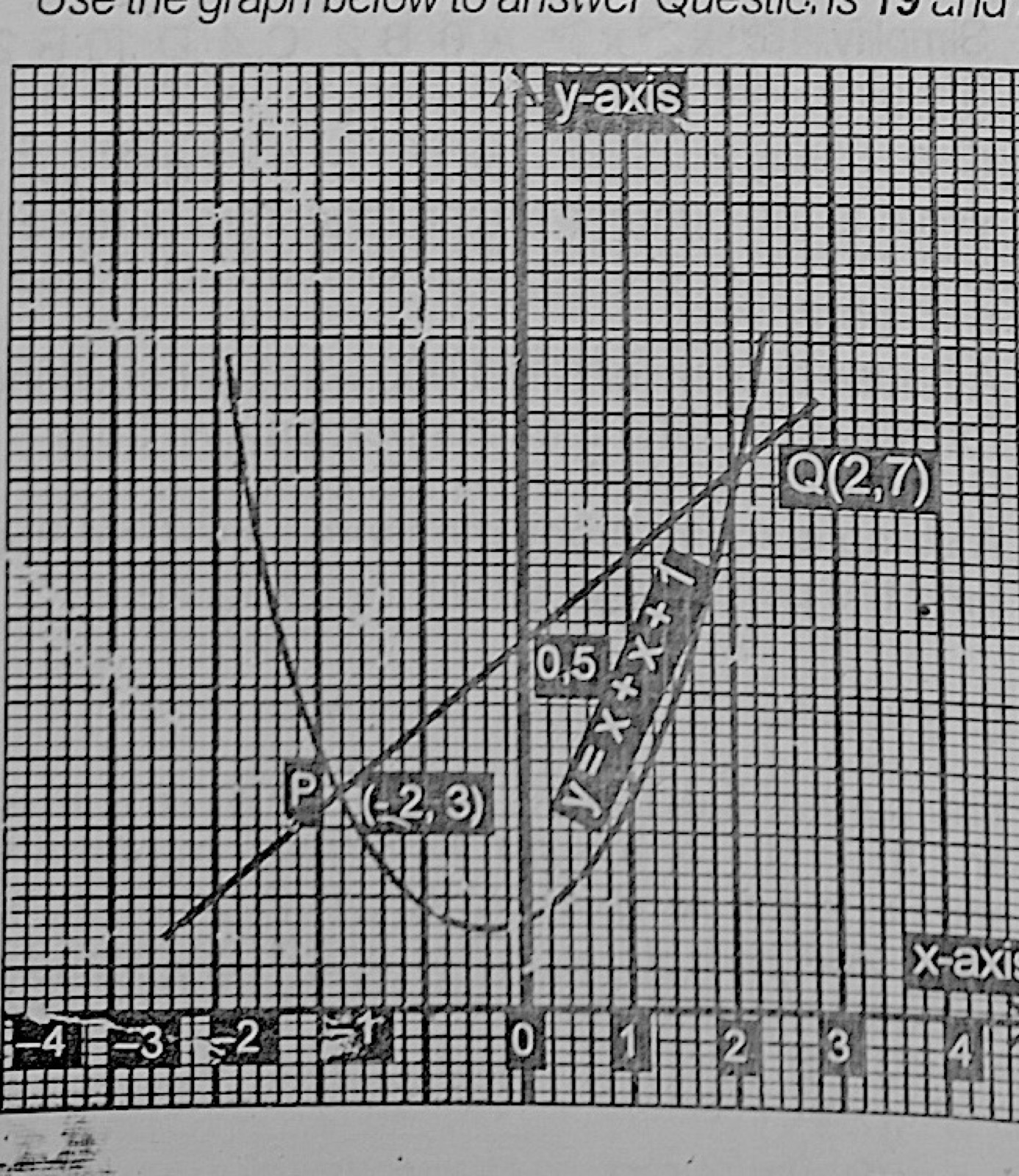
Use the graph to answer this question. Which of the following equations can be solved by the points of intersection P and Q of the curve and the line PQ?
A.x2 − 2 = 0
B.x2 − 4 = 0
C.x2 + 6 = 0
D.x2 − x − 2 = 0
E.x2 − x + 4 = 0
Show the answer and explanation
Answer: B (x2 − 4 = 0)
Explanation
The curve is y = x² + x + 1 and the line is y = x + 5. Where they meet, x² + x + 1 = x + 5, which simplifies to x² − 4 = 0.
Two ships on the equator are on longitudes 45°W and 45°E respectively. How far are they apart along the equator, correct to 2 significant figures? (Take the radius of earth = 6400km and π = 22/7)
A.15,000km
B.10,000km
C.6,400km
D.5,000km
E.3,200km
Show the answer and explanation
Answer: B (10,000km)
Explanation
The difference in longitude is 90°. Distance = 90/360 × 2 × 22/7 × 6400 ≈ 10 057 km ≈ 10,000 km (2 s.f.).
Calculate, correct to 2 significant figures, the length of the arc of a circle of radius 3.5cm which subtends an angle of 75° at the centre of the circle. (Take π = 22/7).
A.2.3cm
B.4.6cm
C.8cm
D.16cm
E.110cm
Show the answer and explanation
Answer: B (4.6cm)
Explanation
Arc = 75/360 × 2 × 22/7 × 3.5 = 75/360 × 22 ≈ 4.58 cm ≈ 4.6 cm.
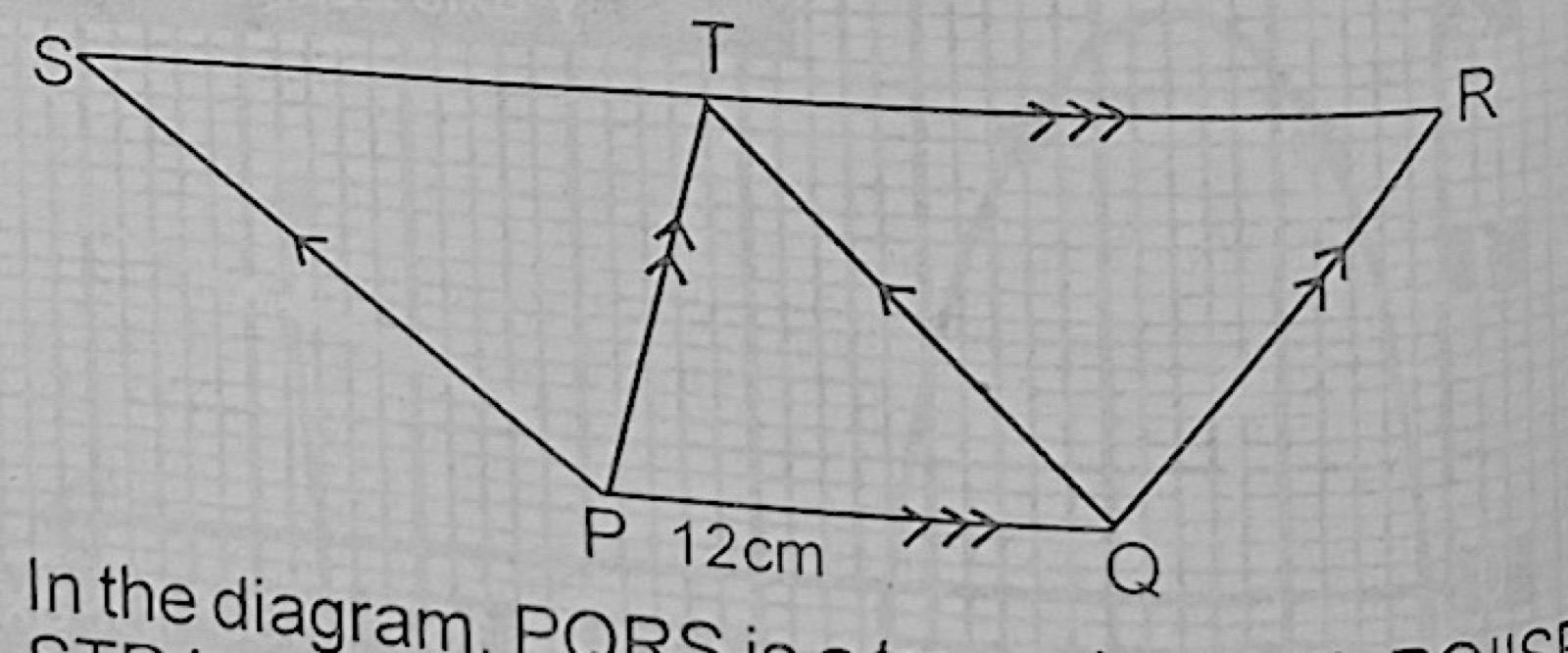
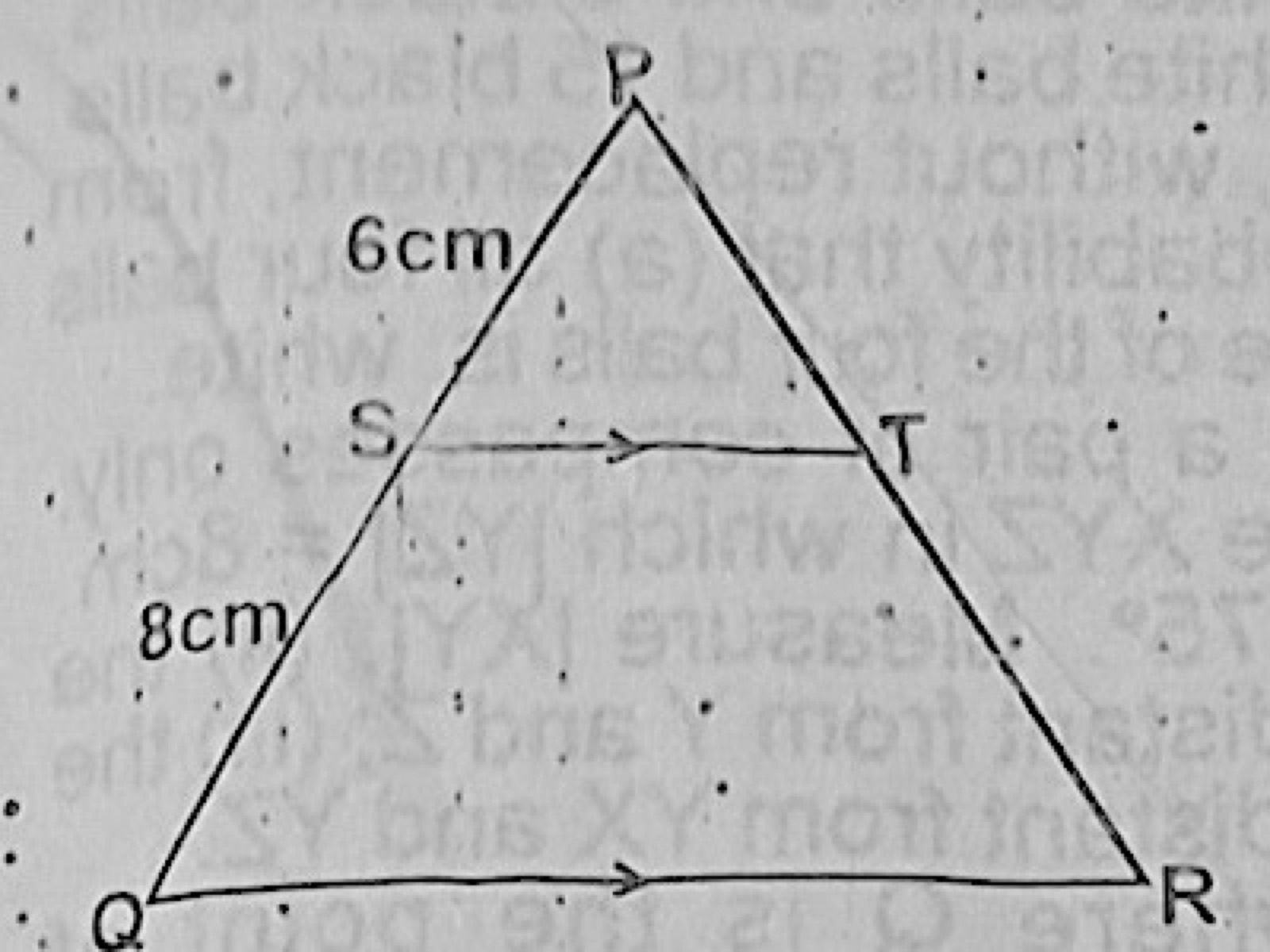
In the diagram, PQRS is a trapezium with PQ||SR. STR is a straight line, PS||QT, PT||QR. If |PQ| = 12cm and the height of the trapezium is 9cm, find its area.
A.96cm2
B.108cm2
C.135cm2
D.162cm2
E.216cm2
Show the answer and explanation
Answer: D (162cm2)
Explanation
PQTS and PQRT are parallelograms, so ST = TR = PQ = 12 cm and SR = 24 cm. Area = ½(12 + 24) × 9 = 162 cm².
A ladder 6m long leans against a vertical wall so that it makes an angle of 60° with the wall. Calculate the distance of the foot of the ladder from the wall.
A.3m
B.6m
C.2√3m
D.3√3m
E.6√3m
Show the answer and explanation
Answer: D (3√3m)
Explanation
The distance from the wall is opposite the 60° angle at the wall: 6 sin 60° = 6 × √3/2 = 3√3 m.
The table shows the masses to the nearest kilogram, of 40 students in a university. Mass(kg): 65, 66, 67, 68, 69, 70 No. of Students: 4, 5, 11, 8, 7, 5 The percentage of the students with mass less than 69kg is
A.56%
B.62.5%
C.68%
D.70%
E.87.5%
Show the answer and explanation
Answer: D (70%)
Explanation
Students under 69 kg: 4 + 5 + 11 + 8 = 28. 28/40 × 100% = 70%.
The mean heights of the three groups of students consisting of 20, 16 and 14 students are 1.67m, 1.50m and 1.40m respectively. Find the mean height of all the students.
A.1.52m
B.1.53m
C.1.54m
D.1.55m
E.1.56m
Show the answer and explanation
Answer: C (1.54m)
Explanation
Total height = 20 × 1.67 + 16 × 1.50 + 14 × 1.40 = 77 m for 50 students, so the mean = 77 ÷ 50 = 1.54 m.
Two cards are drawn one after the other with replacement from a well-shuffled ordinary pack of 52 cards containing four Aces. Find the probability that they are both Aces.
A.1/221
B.1/169
C.1/52
D.1/26
E.1/13
Show the answer and explanation
Answer: B (1/169)
Explanation
With replacement each draw has probability 4/52 = 1/13, so both Aces = 1/13 × 1/13 = 1/169.
The length of an exercise book is given as 20cm correct to the nearest centimetre. In which of the following ranges of possible measurements does the actual length lie?
A.19.5 − 20.5cm
B.19.1 − 20.9cm
C.19.9 − 20.1cm
D.19.95 − 20.05cm
E.19 − 21cm.
Show the answer and explanation
Answer: A (19.5 − 20.5cm)
Explanation
To the nearest centimetre, the length can be up to 0.5 cm either side of 20 cm: 19.5 cm to 20.5 cm.
(a) Evaluate, without using mathematical tables, 17.572 − 12.432. (b) Prove that angles in the same segment of a circle are equal.
Show the model answer
Model answer
(a) Difference of two squares: (17.57 − 12.43)(17.57 + 12.43) = 5.14 × 30 = 154.2 (b) Diagram: circle centre O, chord AB, points P and Q on the same arc; join OA and OB. Given: ∠APB and ∠AQB in the same segment. To prove: ∠APB = ∠AQB. ∠AOB = 2∠APB (angle at centre is twice angle at circumference) ∠AOB = 2∠AQB (same reason) So ∠APB = ∠AQB.
Explanation
For (b), the angle-at-the-centre theorem does all the work; state the reason for each step.
(a) A tower and a building stand on the same horizontal level. From the point P at the bottom of the building, the angle of elevation of the top T, of the tower is 65°. From the top Q of the building, the angle of elevation of the point T is 25°. If the building is 20m high, calculate the distance PT. (b) Hence or otherwise, calculate the height of the tower. (Give your answers correct to 3 significant figures.)
Show the model answer
Model answer
(a) In triangle PQT: ∠QPT = 90° − 65° = 25°, ∠PQT = 90° + 25° = 115°, so ∠PTQ = 40° Sine rule: PT/sin 115° = 20/sin 40° PT = 20 × 0.9063/0.6428 = 28.2 m (b) Height of tower = PT sin 65° = 28.2 × 0.9063 = 25.6 m
Explanation
Sketch the building PQ and tower first; the key is finding the angles of triangle PQT.
(a) Divide 11111111two by 101two (b) A sector of a circle 6cm has an angle of 105° at the centre. Calculate its (i) perimeter (ii) area (Take π = 22/7)
Show the model answer
Model answer
(a) 11111111two = 255 and 101two = 5; 255 ÷ 5 = 51 = 110011two (or by long division in base two) (b)(i) Arc = 105/360 × 2 × 22/7 × 6 = 11 cm; perimeter = 11 + 6 + 6 = 23 cm (ii) Area = 105/360 × 22/7 × 62 = 33 cm2
Explanation
The perimeter of a sector includes the two radii as well as the arc.
The table below gives the frequency distributions of marks obtained by some students in a scholarship examination. Scores (x): 15, 25, 35, 45, 55, 65, 75 Freq. (f): 1, 4, 12, 24, 18, 8, 3 (a) Calculate, correct to 3 significant figures, the mean mark. (b) Find the: (i) mode, (ii) range of the distribution.
A bag contains 12 white balls and 8 black balls, another contains 10 white balls and 15 black balls. If two balls are drawn, without replacement, from each bag, find the probability that (a) all four balls are black (b) exactly one of the four balls is white.
Show the model answer
Model answer
(a) Bag 1 both black: 8/20 × 7/19 = 14/95; Bag 2 both black: 15/25 × 14/24 = 7/20 P(all black) = 14/95 × 7/20 = 49/950 (b) P(exactly one white from bag 1) = 2 × 12/20 × 8/19 = 48/95; P(exactly one white from bag 2) = 2 × 10/25 × 15/24 = 1/2 P(exactly one white) = P(1 white from bag 1, both black from bag 2) + P(both black from bag 1, 1 white from bag 2) = 48/95 × 7/20 + 14/95 × 1/2 = 336/1900 + 140/1900 = 476/1900 = 119/475 (≈ 0.251)
Explanation
Treat each bag separately, then multiply; for 'exactly one' add the two ways it can happen.
(a) Using a ruler and a pair of compasses only, construct: (i) a traingle XYZ in which |YZ| = 8cm, XYZ = 60° and XZY = 75°. Measure |XY|; (ii) the locus l1 of points equidistant from Y and Z; (iii) the locus l2 of points equidistant from YX and YZ. (b) Measure QY where Q is the point of intersection of l1 and l2
Show the model answer
Model answer
(a)(i) Draw YZ = 8 cm; construct 60° at Y and 75° at Z (60° + bisected 30°, i.e. 60° + 15°); the arms meet at X. |XY| ≈ 10.9 cm (check: 8 sin 75°/sin 45° = 10.93) (ii) l1 is the perpendicular bisector of YZ. (iii) l2 is the bisector of angle XYZ. (b) Q lies on the bisector (30° to YZ) above the midpoint of YZ: QY ≈ 4.6 cm (4/cos 30° = 4.62)
Explanation
Leave all construction arcs visible; a locus equidistant from two lines is an angle bisector.
The table below gives the ages, to the nearest 5 years, of 50 people. Age in years: 10, 15, 20, 25, 30 No. of People: 8, 19, 10, 7, 6 (a) Construct a cumumlative frequency table for the distribution. (b) Draw a cumulative frequency curve (ogive). (c) From your ogive, find the: (i) median age: (ii) number of people who are at most 15 years of age. (iii) number of people who are between 20 and 25 years of age.
Show the model answer
Model answer
(a) Upper class boundaries 12.5, 17.5, 22.5, 27.5, 32.5 with cumulative frequencies 8, 27, 37, 44, 50 (b) Plot cumulative frequency against upper class boundary (start at (7.5, 0)) and join with a smooth S-shaped curve. (c)(i) Median at the 25th person: about 17 years (12.5 + 17/19 × 5 ≈ 17.0) (ii) At most 15 years (read at 17.5): 27 people (iii) Read the curve at 20 and 25 years (about 32 and 40): about 8 people
Explanation
Ages 'to the nearest 5 years' mean each class spans 2.5 years either side, so plot at upper class boundaries.
(a) Copy and complete the following table of values for y = 2x2 − 9x − 1. x: −1, 0, 1, 2, 3, 4, 5, 6 y: __, −1, −8, −11, __, __, __, 17 (b) Using a scale of 2cm to represent 1 unit on the x-axis and 2cm to represent 5 unit on the y-axis, draw the graph of y = 2x2 − 9x − 1 for −1 ≤ x ≤ 6. (c) Use your graph to find the: (i) roots of the equation 2x2 − 9x = 4, correct to one decimal place; (ii) gradient of the curve y = 2x2 − 9x − 1 at x = 3.
Show the model answer
Model answer
(a) x = −1: y = 10; x = 3: y = −10; x = 4: y = −5; x = 5: y = 4 (b) Plot the points with the given scales and join with a smooth U-shaped curve. (c)(i) 2x2 − 9x = 4 means 2x2 − 9x − 1 = 3: draw y = 3 and read x ≈ −0.4 and x ≈ 4.9 (ii) Draw the tangent at x = 3 and find rise ÷ run: gradient ≈ 3
Explanation
Rewrite the new equation so its left side matches the graph; the right side is the horizontal line to draw.
(a) The fourth term of an A.P. is 37 and the 6th term is 12 more than the fouth term. Find the first and seventh terms (b) If P = (1,2,3,4) and Q = (3,5,6), find: (i) P∩Q; (ii) P∪Q (iii) (P∩Q)∪Q; (iv) (P∪Q)∩P.
Show the model answer
Model answer
(a) a + 3d = 37 and (a + 5d) − (a + 3d) = 12, so 2d = 12, d = 6 a = 37 − 18 = 19 (first term); seventh term = 19 + 6 × 6 = 55 (b)(i) P∩Q = {3} (ii) P∪Q = {1, 2, 3, 4, 5, 6} (iii) (P∩Q)∪Q = {3, 5, 6} (iv) (P∪Q)∩P = {1, 2, 3, 4}
(a) Two points X(32°N, 47°W) and Y(32°N, 25°E), are on the earth's surface. If it takes an aeroplane 11 hours to fly from X to Y along the parallel of latitude, calculate its speed, correct to the nearest kilometre per hour (Take the radius of the earth = 6400km and π = 22/7). (b) Two observers P and Q, 15 metres apart observe a kite (K) in the same vertical plane and from the same side of the kite. The angles of elevation of the kite from P and Q 35° and 45° respectively. Find the height of the kite to the nearest metre.
Show the model answer
Model answer
(a) Difference in longitude = 47° + 25° = 72° Distance = 72/360 × 2 × 22/7 × 6400 × cos 32° ≈ 8045.7 × 0.8480 ≈ 6823 km Speed = 6823 ÷ 11 ≈ 620 km/h (b) Let height = h. From Q (45°), horizontal distance = h; from P, distance = h + 15 tan 35° = h/(h + 15): 0.7002(h + 15) = h 0.2998h = 10.50, h ≈ 35 m
Explanation
Along a parallel of latitude the radius is R cos(latitude).