Given the statements: p : the subject is difficult. q: I will do my best. Which of the following is equivalent to "Although the subject is difficult, I will do my best".
A.p ∨ q
B.~p ∨ q
C.p ∧ ~q
D.p ∧ q
Show the answer and explanation
Answer: D (p ∧ q)
Explanation
'Although … ,' joins two statements that are both true, so it means 'and': p ∧ q.
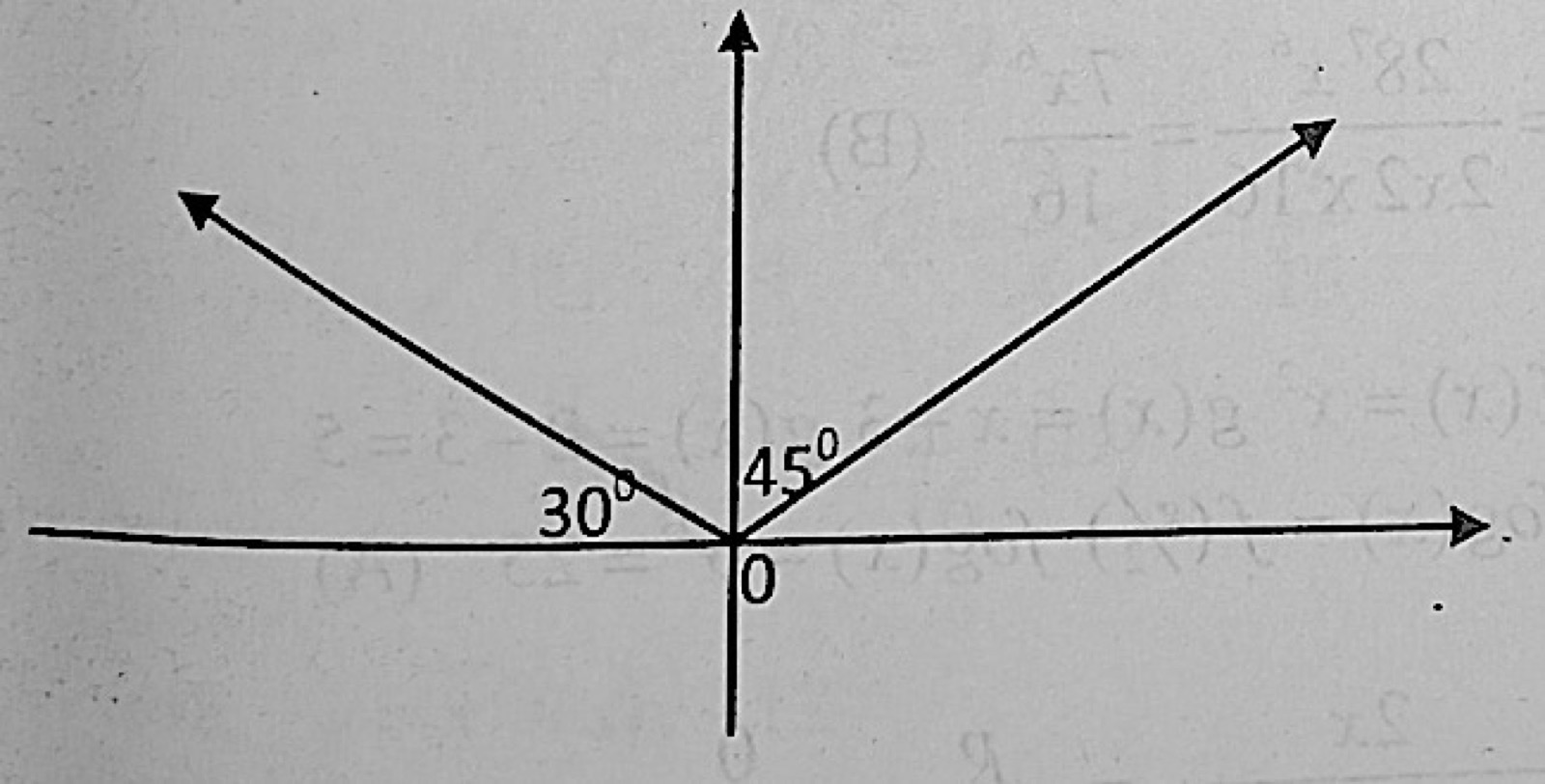
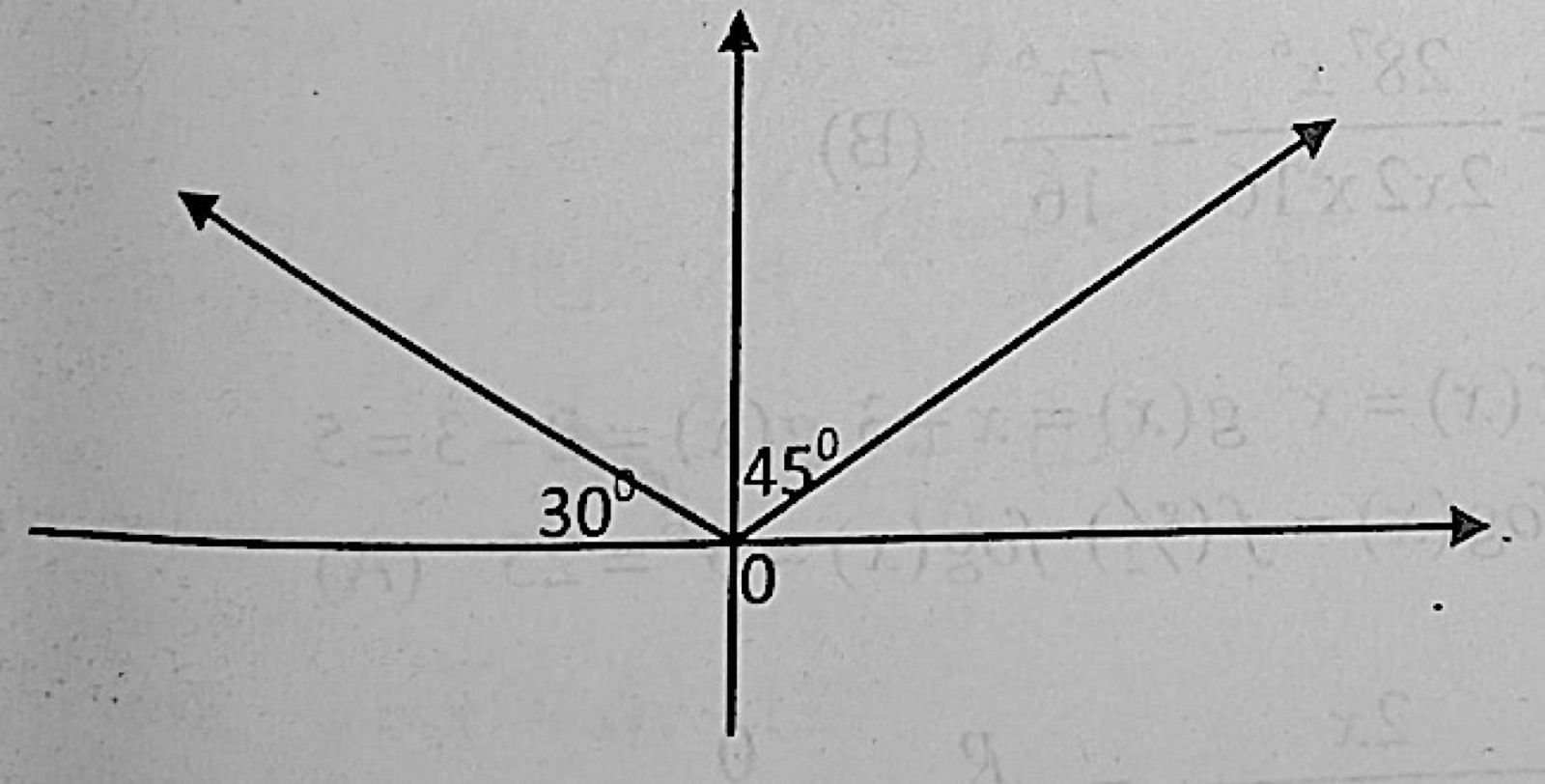
Forces of magnitude 8 N and 5 N act on a body as shown in the diagram. Calculate, correct to 2 decimal places, the angle that the resultant makes with the horizontal.
The table shows the distribution of marks scored by students in a test. Marks: 0, 1, 2, 3, 4, 5 No. of candidates: 6, 4, 8, 10, 9, 3 How many candidates scored above the median mark?
A.3
B.12
C.22
D.30
Show the answer and explanation
Answer: B (12)
Explanation
40 candidates; the 20th and 21st marks are both 3 (cumulative 6, 10, 18, 28), so the median is 3. Above it: 9 + 3 = 12.
The table shows the distribution of marks scored by students in a test. Marks: 0, 1, 2, 3, 4, 5 No. of candidates: 6, 4, 8, 10, 9, 3 Find the inter-quartile range of the distribution.
A.4
B.3
C.2
D.1
Show the answer and explanation
Answer: B (3)
Explanation
The lower quartile (10th mark) is 1 and the upper quartile (30th mark) is 4, so the inter-quartile range is 4 − 1 = 3.
A mass of 75 kg is placed on a lift. Find the force exerted by the floor of the lift on the mass when the lift is moving up with a constant velocity. [Take g = 9.8 ms−2]
A.750 N
B.745 N
C.735 N
D.98 N
Show the answer and explanation
Answer: C (735 N)
Explanation
Constant velocity means no acceleration, so R = mg = 75 × 9.8 = 735 N.
Each of the 90 students in a class speak at least Igbo and Hausa. If 56 students speak Igbo and 50 speak Hausa, find the probability that a student selected at random from the class speaks Igbo only.
A.28/45
B.4/9
C.8/45
D.1/9
Show the answer and explanation
Answer: B (4/9)
Explanation
Both languages: 56 + 50 − 90 = 16, so Igbo only = 40. P = 40/90 = 4/9.
A particle starts from rest and moves in a straight line such that its acceleration after t seconds is given by a = (3t − 2) ms−2. Find the other time when the velocity would be zero.
A.1/3 seconds
B.3/4 seconds
C.4/3 seconds
D.2 seconds
Show the answer and explanation
Answer: C (4/3 seconds)
Explanation
v = 3t²/2 − 2t (v = 0 at t = 0). v = 0 again when 3t/2 = 2, t = 4/3 s.
A particle starts from rest and moves in a straight line such that its acceleration after t seconds is given by a = (3t − 2) ms−2. Find the distance covered after 3 seconds
A.10 m
B.9 m
C.13/3 m
D.9/2 m
Show the answer and explanation
Answer: D (9/2 m)
Explanation
s = ∫v dt = t³/2 − t² (s = 0 at t = 0). At t = 3: 27/2 − 9 = 9/2 m from the start.
In calculating the mean of 8 numbers, a boy mistakenly used 17 instead of 25 as one of the numbers. If he obtained 20 as the mean, find the correct mean.
A.24
B.23
C.21
D.19
Show the answer and explanation
Answer: C (21)
Explanation
Wrong total 160; correct total 160 − 17 + 25 = 168, mean 168/8 = 21.
A 24 N force acts on a body such that it changes its velocity from 5 ms−1 to 9 ms−1 in 2 seconds. If the body is travelling in a straight line, calculate the distance covered during the period.
A binary operation Δ is defined on the set of real numbers, R, by a Δ b = a3 − b3. Without using calculator, find the value of (√3 + √2) Δ (√3 − √2), leaving the answer in surd form.
Points (2, 1) and (6, 7) are opposite verticals of a square which is inscribed in a circle. Find the: (a) centre of the circle; (b) equation of the circle.
Show the model answer
Model answer
The diagonal of the square is a diameter. (a) Centre = midpoint = (4, 4). (b) r² = (2 − 4)² + (1 − 4)² = 13. (x − 4)² + (y − 4)² = 13, i.e. x² + y² − 8x − 8y + 19 = 0.
Explanation
A square's diagonal is a diameter of its circumscribed circle.
A car moving with an initial velocity, u, travels in a straight line with a constant acceleration of 3 ms−2 until it attains a velocity of 33 ms−1 after 6 seconds. Calculate the distance travelled by the car.
Show the model answer
Model answer
u = v − at = 33 − 18 = 15 ms⁻¹. s = ½(u + v)t = ½(15 + 33)(6) = 144 m.
Five finalists in a beauty pageant were ranked by two judges X and Y as shown in the table. Finalist: Anne, Linda, Susan, Rose, Erica X: 1, 4, 3, 5, 2 Y: 3, 2, 4, 5, 1 Calculate the Spearman's rank correlation co-efficient.
There are 8 boys and 6 girls in a class. If two students are selected at random from the class, find the probability that they are of: (a) The same sex; (b) Different sexes.
Forces of magnitude 3N, 4 N and 2 N act along the vectors j, −i + j and i + j respectively. Calculate, correct to one decimal place, the magnitude of the resultant of the forces.
(a) The functions f: x → x2 + 1 and g: x → 5 − 3x are defined on the set of real numbers, R. (i) State the domain of f−1, the inverse of f. (ii) Find g−1(2). (b) Evaluate ∫02 (x + 3)/√(x2 + 6x + 9) dx
Show the model answer
Model answer
(a)(i) f⁻¹(x) = √(x − 1) (taking x ≥ 0 for f), so the domain of f⁻¹ is {x : x ≥ 1} (the range of f). (ii) g⁻¹(x) = (5 − x)/3, so g⁻¹(2) = 1. (b) √(x² + 6x + 9) = x + 3 for 0 ≤ x ≤ 2, so the integrand is 1 and the integral is 2.
(a) If (√5 + 4)/(3 − 2√5) − (2 + √5)/(4 − 2√5) = a + b√5, find the values of a and b. (b)(i) Evaluate: |2 −1 2 / 1 3 4 / 1 2 1| (rows separated by /). (ii) Using the result in 10(b)(i), find, correct to two decimal places the value of x in the system of equations: 2x − y + 2z + 5 = 0, x + 3y + 4z − 1 = 0, x + 2y + z + 2 = 0.
(a)(i) Write down the Binomial expansion of (1 + x)4. (ii) Use the result in 11(a)(i) to evaluate, correct to three decimal places (5/4)4. (b) The first, second and fifth terms of a linear sequence (A. P.) are three consecutive terms of an exponential sequence (G. P.). If the first term of the linear sequence is 7, find its common difference.
The table shows the distribution of heights of a group of people. Height (m): 0.4 − 0.5, 0.6 − 0.9, 1.0 − 1.2, 1.3 − 1.4, 1.5 − 1.7 No. of People: 2, 8, 12, 6, 6 (a) Draw a histogram to illustrate the distribution. (b) Using an assumed mean of 1.1 m, find, correct to one decimal place, the mean height of the group.
Show the model answer
Model answer
(a) Boundaries (widths): 0.35–0.55 (0.2), 0.55–0.95 (0.4), 0.95–1.25 (0.3), 1.25–1.45 (0.2), 1.45–1.75 (0.3). Unequal widths: plot frequency per 0.1 m – 1, 2, 4, 3, 2 – as touching bars. (b) Class marks 0.45, 0.75, 1.1, 1.35, 1.6; d = −0.65, −0.35, 0, 0.25, 0.5. Σfd = −1.3 − 2.8 + 0 + 1.5 + 3.0 = 0.4; Σf = 34. Mean = 1.1 + 0.4/34 ≈ 1.1 m.
Explanation
With unequal class widths, plot frequency densities.
(a) Edem and his wife were invited to a dinner by a family of 5. They all sat in such a way that Edem sat next to his wife. Find the number of ways of seating them in a row. (b) A bag contains 4 red and 5 black identical balls. If 5 balls are selected at random from the bag, one after the other with replacement, find the probability that: (i) a red ball was picked 3 times; (ii) a black ball was picked at most 2 times.
Show the model answer
Model answer
(a) 7 people; treat Edem and his wife as one unit: 6! × 2! = 1440. (b) P(red) = 4/9, P(black) = 5/9, n = 5. (i) ⁵C₃(4/9)³(5/9)² = 16 000/59 049 ≈ 0.271. (ii) Black 0, 1 or 2 times: [(4/9)⁵ + 5(5/9)(4/9)⁴ + 10(5/9)²(4/9)³] = (1024 + 6400 + 16 000)/59 049 = 23 424/59 049 ≈ 0.397.
Explanation
Glue the couple together, then let them swap places.
(a) Given that AB = (4, 5) and BC = (−3, 5) (column vectors), find the: (i) angle between the vectors AB and BC; (b) P, Q, R and M are points in the OXY plane. If PQ = 2i + 8j, PR = 11i − 12j and M divides QR internally in the ratio 3 : 7, find PM.
(a) A bucket full of water with a mass of 8 kg is pulled out of a well with a light inextensible rope. Find its acceleration when the tension in the rope is 150 N. [Take g = 10 ms−2] (b) A mass of 12 kg is acted upon by a force F, changing its speed from 15 ms−1 to 25 ms−1 after covering a distance of 50 m. Find the: (i) value of F; (ii) distance covered when its speed is 35 ms−1
Show the model answer
Model answer
(a) T − mg = ma: 150 − 80 = 8a, a = 8.75 ms⁻² upwards. (b)(i) 25² = 15² + 2a(50), so a = 4 ms⁻² and F = 12 × 4 = 48 N. (ii) 35² = 15² + 2(4)s, so s = 1000/8 = 125 m (from where its speed was 15 ms⁻¹).