WAEC Commerce 1999 past questions and answers

60 questions. Try each one, then open the answer to check yourself and read the explanation.

Question 1

Occupation

A shoe repairer is engaged in a

  1. A.service occupation
  2. B.manufacturing
  3. C.extractive occupation
  4. D.commercial occupation
Show the answer and explanation

Answer: A (service occupation)

Explanation

A shoe repairer renders a direct (personal) service to customers.

Open this question

Question 2

Production

The goods that are used for the production of other goods are known as

  1. A.commercial goods
  2. B.consumer goods
  3. C.capital goods
  4. D.non-durable goods
Show the answer and explanation

Answer: C (capital goods)

Explanation

Capital (producer) goods such as machines are used to make other goods.

Open this question

Question 3

Production

Which of the following brings about specialization?

  1. A.Recruitment of staff
  2. B.Division of labour
  3. C.Business resource
  4. D.Employer of labour
Show the answer and explanation

Answer: B (Division of labour)

Explanation

Division of labour splits work into tasks so each worker specialises.

Open this question

Question 4

Production

Which of the following refers to all the resources used in creating utilities?

  1. A.A Fixed capital
  2. B.Factors of production
  3. C.Entrepreneurship
  4. D.Labour
Show the answer and explanation

Answer: B (Factors of production)

Explanation

Land, labour, capital and entrepreneur together are the factors of production.

Open this question

Question 5

Introduction to Commerce

Which of the following enables people to consume a variety of goods and services?

  1. A.Labour
  2. B.Capital
  3. C.Land
  4. D.Exchange
Show the answer and explanation

Answer: D (Exchange)

Explanation

Through exchange people obtain goods they do not produce themselves.

Open this question

Question 6

Co-operative Societies

A business unit in which profits are shared on the basis of members' patronage is known as

  1. A.partnership
  2. B.public limited company
  3. C.co-operative society
  4. D.private limited company
Show the answer and explanation

Answer: C (co-operative society)

Explanation

Co-operatives share surplus according to how much each member bought (patronage).

Open this question

Question 7

Business Finance

A public limited company wishing to obtain more capital may have to

  1. A.apply for subvention
  2. B.buy treasury bills
  3. C.buy second-hand securities
  4. D.issue debentures
Show the answer and explanation

Answer: D (issue debentures)

Explanation

Issuing debentures (or more shares) raises long-term capital.

Open this question

Question 8

Warehousing

The safe-keeping of goods from the point of production to the time they are needed is

  1. A.standardizing
  2. B.warehousing
  3. C.hoarding
  4. D.stock controlling
Show the answer and explanation

Answer: B (warehousing)

Explanation

Warehousing stores goods until they are needed.

Open this question

Question 9

Business Units

The document which regulates the operations of a partnership is known as

  1. A.Deed
  2. B.Articles of association
  3. C.Prospectus
  4. D.Certificate of trading
Show the answer and explanation

Answer: A (Deed)

Explanation

The deed of partnership sets out how the partnership is run.

Open this question

Question 10

Business Finance

A company is said to be insolvent when

  1. A.it makes a loss in any one year
  2. B.its total liabilities exceed total assets
  3. C.the ordinary shareholders receive no dividend from the company
  4. D.the preference shareholders could not be paid by the company
Show the answer and explanation

Answer: B (its total liabilities exceed total assets)

Explanation

A business is insolvent when what it owes is more than what it owns.

Open this question

Question 11

Consumer Protection

Which of the following is formed in order to enforce the rights and powers of buyers in relation to sellers?

  1. A.Consortium
  2. B.Trade Association
  3. C.Consumer Association
  4. D.Holding Company
Show the answer and explanation

Answer: C (Consumer Association)

Explanation

Consumer associations protect the interests of buyers.

Open this question

Question 12

Business Calculations

A Public Limited Company whose nominal capital is made up of 400,000 ordinary shares of 50k each, decided to issue 50% of it to the public and realised only 50% of the amount due.
What is the company's registered capital?

  1. A.N50,000.00
  2. B.N80,000.00
  3. C.N200,000.00
  4. D.N400,000.00
Show the answer and explanation

Answer: C (N200,000.00)

Explanation

Registered (nominal) capital = 400,000 × 50k = N200,000.

Open this question

Question 13

Business Calculations

A Public Limited Company whose nominal capital is made up of 400,000 ordinary shares of 50k each, decided to issue 50% of it to the public and realised only 50% of the amount due.
What is the paid up capital?

  1. A.N50,000.00
  2. B.N100,000.00
  3. C.N150,000.00
  4. D.N200,000.00
Show the answer and explanation

Answer: A (N50,000.00)

Explanation

Issued: 200,000 shares × 50k = N100,000 due; only 50% was received, so paid-up capital = N50,000.

Open this question

Question 14

Business Calculations

A Public Limited Company whose nominal capital is made up of 400,000 ordinary shares of 50k each, decided to issue 50% of it to the public and realised only 50% of the amount due.
What is the called up-capital?

  1. A.N50,000.00
  2. B.N100,000.00
  3. C.N200,000.00
  4. D.N400,000.00
Show the answer and explanation

Answer: B (N100,000.00)

Explanation

The amount demanded on the 200,000 issued shares is 200,000 × 50k = N100,000.

Open this question

Question 15

Stock Exchange

Which of the following documents is used to advertise shares to the public?

  1. A.Letter of allotment
  2. B.Articles of association
  3. C.Memorandum of association
  4. D.Prospectus
Show the answer and explanation

Answer: D (Prospectus)

Explanation

A prospectus invites the public to buy a company's shares.

Open this question

Question 16

Business Units

A major advantage of the private company over a partnership is that the private company

  1. A.can sell shares
  2. B.has limited liability
  3. C.can publish its account
  4. D.is allowed to borrow from commercial banks
Show the answer and explanation

Answer: B (has limited liability)

Explanation

Shareholders of a private company have limited liability, while ordinary partners do not.

Open this question

Question 17

Foreign Trade Documents

Which of the following is a contract of carriage and a document of title?

  1. A.Indent
  2. B.Bill of lading
  3. C.Pro forma invoice
  4. D.Bill of exchange
Show the answer and explanation

Answer: B (Bill of lading)

Explanation

A bill of lading is both a contract of carriage and a document of title to the goods.

Open this question

Question 18

Retail Trade

Which of the following is not a feature of a Department Store?

  1. A.One-stop shopping
  2. B.Deals in one line of goods
  3. C.Use of trolleys
  4. D.Convenient location
Show the answer and explanation

Answer: B (Deals in one line of goods)

Explanation

A department store sells many lines of goods in separate departments.

Open this question

Question 19

Retail Trade

A major cost component of running a mail order firm is the

  1. A.printing of catalogues
  2. B.paying salesmen's salaries
  3. C.renting shops
  4. D.travelling expenses
Show the answer and explanation

Answer: A (printing of catalogues)

Explanation

Mail order firms sell through catalogues, which are costly to print and post; they need no shops or salesmen.

Open this question

Question 20

Purchase and Sale of Goods

A bill of exchange becomes negotiable when it is

  1. A.accepted
  2. B.protested
  3. C.dishonoured
  4. D.discounted
Show the answer and explanation

Answer: A (accepted)

Explanation

Once the drawee signs (accepts) the bill, it can be passed on to others.

Open this question

Question 21

Purchase and Sale of Goods

What is the purpose of a debit note? To

  1. A.reduce the credit in the buyer's account
  2. B.reduce the debit charged to an invoice
  3. C.compensate for damaged goods returned
  4. D.allow for a rebate
Show the answer and explanation

Answer: A (reduce the credit in the buyer's account)

Explanation

A debit note corrects an undercharge, so it adds to what the buyer owes; reducing debits, returns and rebates are done with a credit note.

Open this question

Question 22

Banking

Status enquiry is necessary when

  1. A.goods are ordered from a mail order firm
  2. B.money is withdrawn from fixed deposit account
  3. C.granting credit to a new customer
  4. D.goods are produced according to specification
Show the answer and explanation

Answer: C (granting credit to a new customer)

Explanation

Before giving credit to a new customer, a seller checks his ability to pay through a status enquiry.

Open this question

Question 23

Purchase and Sale of Goods

Trade discount is given to the buyer for

  1. A.prompt payment
  2. B.credit purchase
  3. C.cash purchase
  4. D.retailer's mark-up
Show the answer and explanation

Answer: D (retailer's mark-up)

Explanation

Trade discount gives the retailer his margin (mark-up); prompt payment earns cash discount.

Open this question

Question 24

Banking

Government can borrow money from the public through

  1. A.the issuing of treasury bills
  2. B.increasing taxation
  3. C.increasing the lending rate
  4. D.establishing more banks
Show the answer and explanation

Answer: A (the issuing of treasury bills)

Explanation

Treasury bills are short-term government borrowing.

Open this question

Question 25

Insurance

Insurance is necessary because of the need to

  1. A.pool resources together
  2. B.meet uncertainties in future
  3. C.make profit
  4. D.lend money to individuals
Show the answer and explanation

Answer: B (meet uncertainties in future)

Explanation

Insurance protects people against uncertain future losses.

Open this question

Question 26

Money

Notes and coins are legal tender because they are

  1. A.printed by the Central Bank
  2. B.backed by law
  3. C.backed by gold
  4. D.issued by all banks
Show the answer and explanation

Answer: B (backed by law)

Explanation

The law requires notes and coins to be accepted in settlement of debts.

Open this question

Question 27

Stock Exchange

If a company is described as "listed" it means

  1. A.its shares can be traded on the stock exchange
  2. B.it is about to be voluntarily liquidated
  3. C.it is duly registered by the registrar of companies
  4. D.it has been blacklisted
Show the answer and explanation

Answer: A (its shares can be traded on the stock exchange)

Explanation

A listed (quoted) company's shares are traded on the stock exchange.

Open this question

Question 28

Banking

The counterfoil of a cheque book enables the drawer to

  1. A.request for a new cheque book
  2. B.reconcile his books of accounts
  3. C.know who the debtors are
  4. D.obtain an overdraft from the bank
Show the answer and explanation

Answer: B (reconcile his books of accounts)

Explanation

Counterfoils record cheques issued, helping the drawer check his records against the bank statement.

Open this question

Question 29

Money

Which of the following qualities of money is generally undermined by inflation?

  1. A.Stability
  2. B.Scarcity
  3. C.Durability
  4. D.Portability
Show the answer and explanation

Answer: A (Stability)

Explanation

Inflation makes the value of money unstable.

Open this question

Question 30

Communication

One advantage of communication by telephone is that

  1. A.the conversation can be very short
  2. B.it is less expensive
  3. C.feedback is instantaneous
  4. D.the conversation is strictly private
Show the answer and explanation

Answer: C (feedback is instantaneous)

Explanation

On the telephone the other person replies at once.

Open this question

Question 31

Communication

Which of the following is the fastest means of sending a document from one place to another?

  1. A.Facsimile
  2. B.Courier service
  3. C.Express mail
  4. D.Registered mail
Show the answer and explanation

Answer: A (Facsimile)

Explanation

A facsimile machine transmits an exact copy of a document over the telephone line almost instantly.

Open this question

Question 32

Transport

Which of the following is a disadvantage of canal transport? It is

  1. A.narrow and cannot support big vessels
  2. B.not suitable for small ferriers
  3. C.often for short journey
  4. D.suitable for carrying only goods
Show the answer and explanation

Answer: A (narrow and cannot support big vessels)

Explanation

Canals are narrow and shallow, so big ships cannot use them.

Open this question

Question 33

Advertising

A manufacturer of machinery who wants to reduce cost of promotion can use

  1. A.samples
  2. B.public relations techniques
  3. C.showrooms
  4. D.catalogues
Show the answer and explanation

Answer: D (catalogues)

Explanation

Catalogues describe machines cheaply to many buyers; samples of machines are impossible and showrooms are expensive.

Open this question

Question 34

Wholesale Trade

Direct selling by a producer to a consumer is possible when the

  1. A.goods have to be made on demand
  2. B.manufacturer has good knowledge of the market
  3. C.customer buys in small quantities
  4. D.goods are fashionable
Show the answer and explanation

Answer: A (goods have to be made on demand)

Explanation

Goods made to a customer's order are sold directly to that customer.

Open this question

Question 35

Marketing

The task of grouping consumers according to their buying habits is known as market

  1. A.diversification
  2. B.development
  3. C.expansion
  4. D.segmentation
Show the answer and explanation

Answer: D (segmentation)

Explanation

Market segmentation divides consumers into groups with similar needs or habits.

Open this question

Question 36

Economic Integration

Which of the following is not an economic grouping?

  1. A.ECOWAS
  2. B.GATT
  3. C.ECOMOG
  4. D.EEC
Show the answer and explanation

Answer: C (ECOMOG)

Explanation

ECOMOG was ECOWAS's military monitoring group, a peace-keeping force, not an economic grouping.

Open this question

Question 37

Government and Business

Business losses in nationalized industries are borne by the

  1. A.Shareholders
  2. B.Debenture holders
  3. C.Board of directors
  4. D.Public
Show the answer and explanation

Answer: D (Public)

Explanation

Nationalised industries belong to the state, so losses fall on the public (taxpayers).

Open this question

Question 38

Retail Trade

Which of the following can be sold through a vending machine?

  1. A.cigarettes
  2. B.shirts
  3. C.hand bags
  4. D.Shoes
Show the answer and explanation

Answer: A (cigarettes)

Explanation

Vending machines sell small standard items such as cigarettes and drinks.

Open this question

Question 39

Wholesale Trade

Which of the following is the most suitable channel of distribution for technical goods?

  1. A.manufacturer-retailer-consumer
  2. B.manufacturer-wholesaler-retailer-consumer
  3. C.manufacturer-wholesaler-consumer
  4. D.manufacturer-consumer
Show the answer and explanation

Answer: D (manufacturer-consumer)

Explanation

Technical goods need expert advice, installation and after-sales service, best given directly by the manufacturer.

Open this question

Question 40

Foreign Trade Documents

Which of the following implies that the price quoted includes the cost of insurance and carriage?

  1. A.F.O.B
  2. B.F.A.S
  3. C.C.O.D
  4. D.C.I.F
Show the answer and explanation

Answer: D (C.I.F)

Explanation

C.I.F means cost, insurance and freight are all included.

Open this question

Question 41

Warehousing

Bonded warehouses are controlled by

  1. A.Export Promotion Council
  2. B.Ports Authority
  3. C.Customs and Excise Authority
  4. D.Clearing and forwarding agents
Show the answer and explanation

Answer: C (Customs and Excise Authority)

Explanation

Goods in bond have not paid duty, so customs controls them.

Open this question

Question 42

Purchase and Sale of Goods

A hire purchase transaction becomes a sale when the

  1. A.hirer accepts the hire purchase terms
  2. B.finance company agrees to pay
  3. C.hirer takes possession of goods
  4. D.hirer pays full cost of the goods
Show the answer and explanation

Answer: D (hirer pays full cost of the goods)

Explanation

Ownership passes when the hirer has paid the full price.

Open this question

Question 43

Warehousing

Which of the following serves as a receipt for goods kept in a bonded warehouse?

  1. A.Dock Warrant
  2. B.Bill of Sight
  3. C.Foul bill
  4. D.Dock due
Show the answer and explanation

Answer: A (Dock Warrant)

Explanation

A dock (warehouse) warrant is the receipt and document of title for warehoused goods.

Open this question

Question 44

Wholesale Trade

Which of the following have lien on goods in their possession until their commission is paid?

  1. A.Brokers
  2. B.Factors
  3. C.Auctioneers
  4. D.Wholesale merchants
Show the answer and explanation

Answer: B (Factors)

Explanation

Factors hold the principal's goods and may keep them until paid.

Open this question

Question 45

Marketing

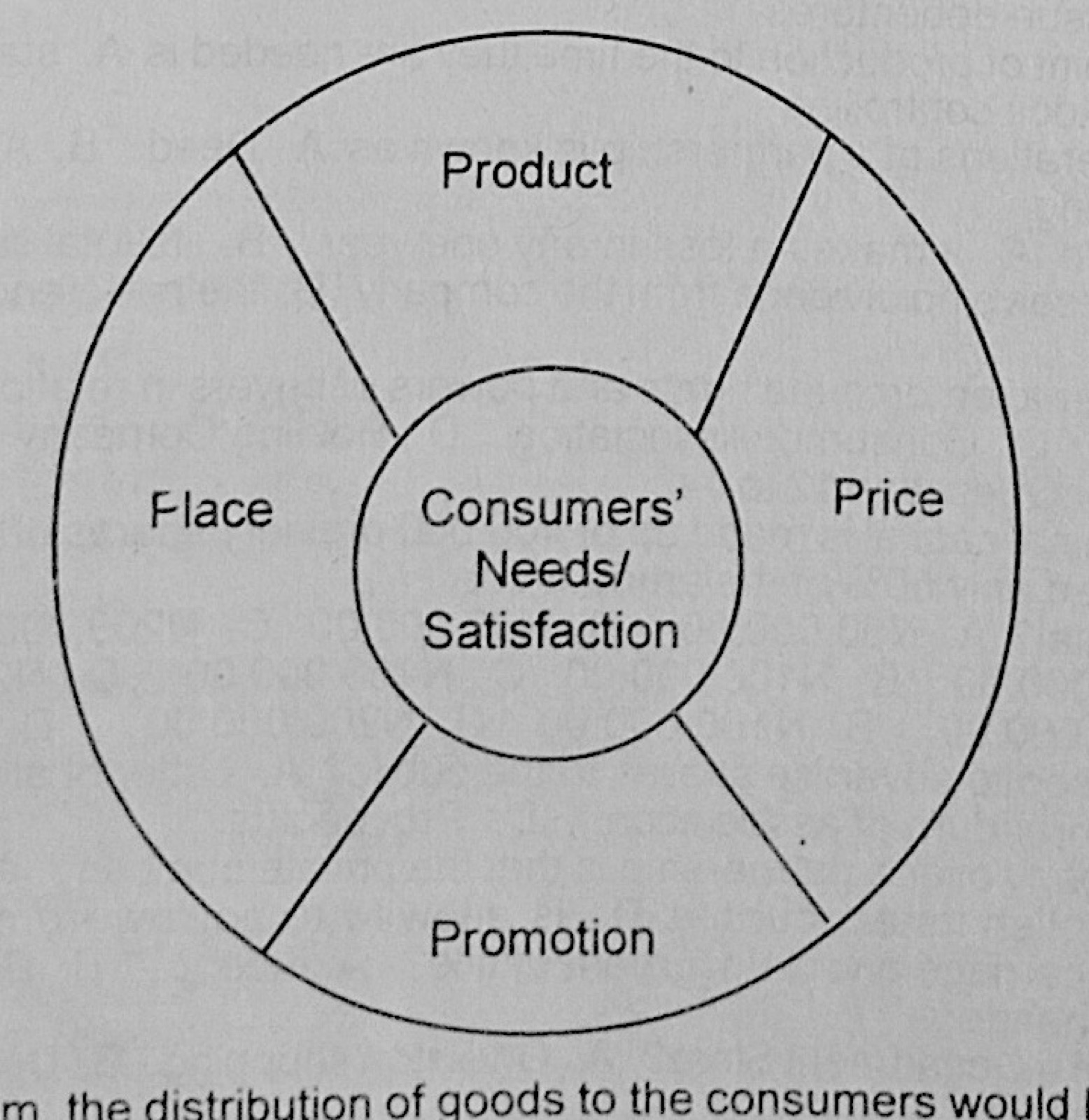
Use the diagram to answer the question.
From the diagram, the distribution of goods to the consumers would be considered under

Diagram for this question
  1. A.place
  2. B.price
  3. C.promotion
  4. D.product
Show the answer and explanation

Answer: A (place)

Explanation

Place covers distribution: getting goods to where consumers can buy them.

Open this question

Question 46

Marketing

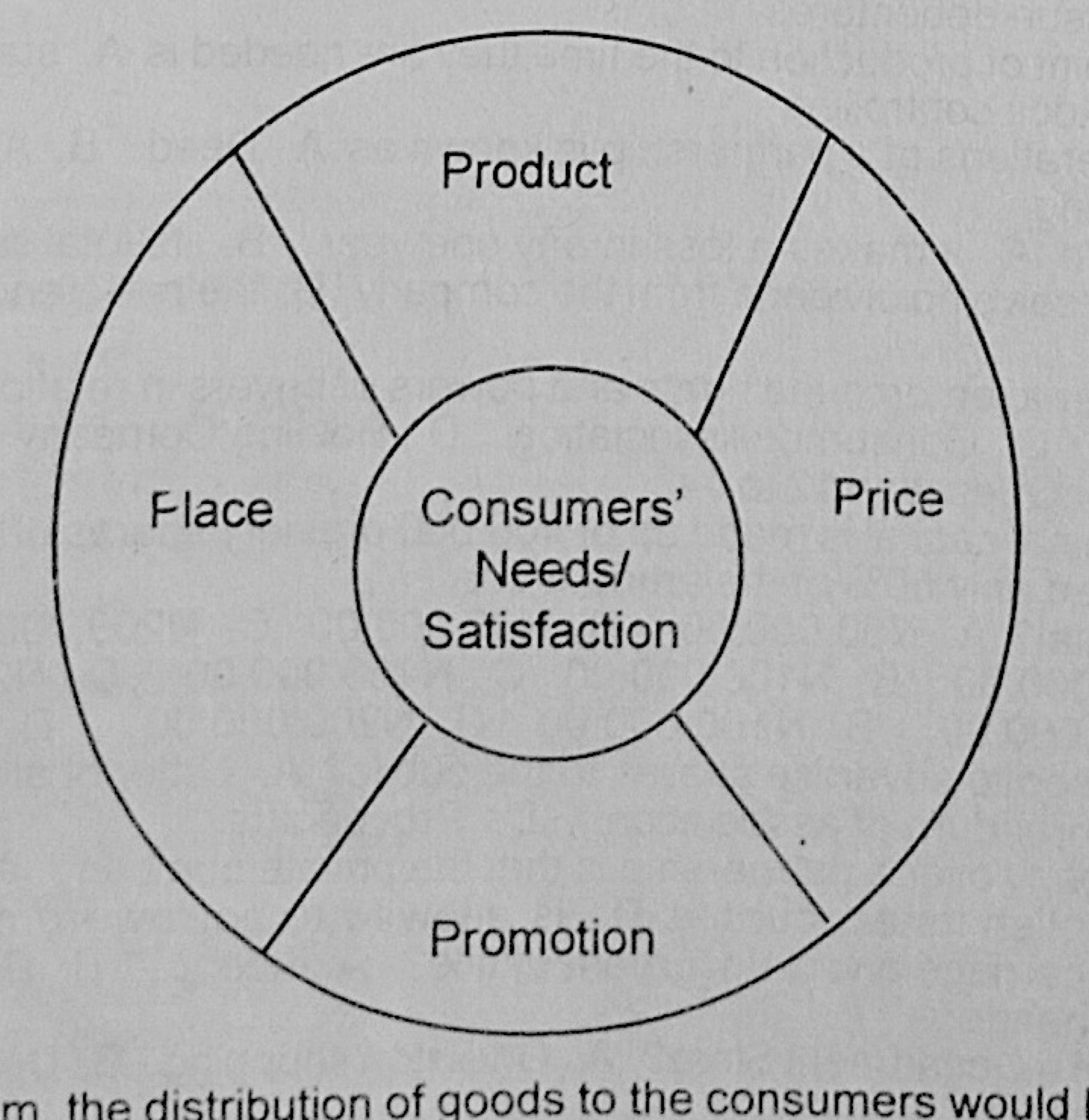
Use the diagram to answer the question.
The above diagram which shows consumers' needs as the focus of attention illustrates the meaning of

Diagram for this question
  1. A.market segmentation
  2. B.marketing concept
  3. C.market research
  4. D.sales orientation
Show the answer and explanation

Answer: B (marketing concept)

Explanation

Putting consumers' needs at the centre of all decisions is the marketing concept.

Open this question

Question 47

Advertising

A picture which indicates that success in life can only be achieved through the use of the product is an example of

  1. A.market research
  2. B.persuasive advertising
  3. C.mass selling
  4. D.informative advertising
Show the answer and explanation

Answer: B (persuasive advertising)

Explanation

Persuasive advertising appeals to emotions to make people want the product.

Open this question

Question 48

Purchase and Sale of Goods

A contract of sale of goods where ownership passes to the buyer on the payment of first instalment is,

  1. A.hire purchase
  2. B.cash with order
  3. C.deferred payment
  4. D.cash on delivery
Show the answer and explanation

Answer: C (deferred payment)

Explanation

Under deferred payment the buyer owns the goods from the first instalment.

Open this question

Question 49

Insurance

Mr. Ajai did not disclose that he stores drums of petrol when he took a fire insurance policy. Under which of the following principles will be insurance company reject his claims?

  1. A.Subrogation
  2. B.Utmost good faith
  3. C.Insurable interest
  4. D.Proximate cause
Show the answer and explanation

Answer: B (Utmost good faith)

Explanation

Hiding a material fact such as stored petrol breaks the duty of utmost good faith.

Open this question

Question 50

Purchase and Sale of Goods

A bill of exchange is retired when it is

  1. A.paid before maturity
  2. B.marked "accepted"
  3. C.discounted
  4. D.dishonoured
Show the answer and explanation

Answer: A (paid before maturity)

Explanation

A bill is retired when the acceptor pays it before the due date, usually for a rebate.

Open this question

Theory question 101

Business Finance

Commerce 2 (answer any five questions)
State and explain any five classes of shares a public limited company can issue.

Show the model answer
Model answer

Any five, explained: ordinary shares (equities) – owners of the company, vote at meetings, dividend varies with profit and is paid last, bear the greatest risk, repaid last on winding up; preference shares – fixed rate of dividend paid before ordinary shares, usually no voting rights, priority in repayment of capital; cumulative preference shares – unpaid dividends in a bad year are carried forward and paid later; non-cumulative preference shares – a missed dividend is lost; participating preference shares – fixed dividend plus a further share of profit after ordinary shareholders receive a stated amount; redeemable preference shares – can be bought back by the company at a fixed date or at its option; deferred/founders' shares – held by founders, receive dividend only after all other shareholders have been paid.

Explanation

Explain how each class differs in dividend, voting and risk.

Open this question

Theory question 102

Consumer Protection

Commerce 2 (answer any five questions)
(a) Explain five reasons why consumers need protection.
(b) State five government legislations aimed at consumer protection.

Show the model answer
Model answer

(a) Any five, explained: against fake, adulterated or harmful goods and expired drugs; against sub-standard goods; against short weights and measures; against excessive prices and hoarding; against false or misleading advertisements and labels; against unfair credit/hire purchase terms and repossession; because consumers are often ignorant of product details and have little bargaining power against big firms; against monopolies and restrictive practices; to provide means of redress.
(b) Any five: Sale of Goods Act; Hire Purchase Act; Trade Descriptions Act; Weights and Measures Act; Food and Drugs Act (NAFDAC Decree); Standards Organisation of Nigeria Act; Price Control Act; Consumer Protection Council Act; Counterfeit and Fake Drugs Act; Merchandise Marks Act.

Explanation

Explain each reason in (a); name five laws in (b).

Open this question

Theory question 103

Banking

Commerce 2 (answer any five questions)
(a) Describe to Kola a new recruit in your office, the steps he may take to open a current account.
(b) Outline four functions of the Central Bank.

Show the model answer
Model answer

(a) Steps: go to the bank of his choice and ask to open a current account; obtain and fill the account opening (application) form with his personal details; provide two acceptable referees (usually current account holders) who sign reference forms; submit passport photographs and means of identification (and proof of address/employer's letter); give specimen signatures on the signature card; pay in the minimum initial deposit; after references are confirmed the account is opened, and he receives a cheque book and paying-in slips.
(b) Any four: issues currency notes and coins; banker to the government; bankers' bank – keeps commercial banks' reserves and acts as lender of last resort; controls credit and the money supply (bank rate, open market operations, cash reserve ratio, special deposits); manages the national debt; keeps the country's foreign reserves and manages exchange rates; supervises and regulates banks; provides clearing facilities; advises government on monetary policy.

Explanation

Give the steps in order in (a).

Open this question

Theory question 104

Introduction to Commerce

Commerce 2 (answer any five questions)
(a) With the aid of a diagram illustrate six branches of trade and show six types of retail outlets.
(b) State eight features of hawking.

Show the model answer
Model answer

(a) Diagram: TRADE → Home trade and Foreign trade. Home trade → Wholesale and Retail. Foreign trade → Import, Export and Entrepot. (Six branches: home, foreign, wholesale, retail, import, export, entrepot.) Retail outlets shown under Retail (any six): hawkers/itinerant traders; market stalls; kiosks; unit/independent shops; mobile shops; department stores; supermarkets; chain/multiple stores; mail order; vending machines; co-operative retail shops.
(b) Any eight: little capital needed; no fixed shop – goes from place to place; carries goods on head, bicycle or cart; sells small quantities of cheap goods; deals in a few lines of goods, often fast-moving; personal contact with customers; prices often fixed by bargaining; no credit given/cash sales; no rent or rates paid; long and flexible hours; often owner-operated (sole trader); goods exposed to weather and damage; easy to start and stop.

Explanation

A clear labelled tree diagram is needed in (a).

Open this question

Theory question 105

Marketing

Commerce 2 (answer any five questions)
(a) Explain branding and give two suitable examples.
(b) In which five ways does branding affect the consumer?

Show the model answer
Model answer

(a) Branding is giving a product a distinctive name, symbol, design or mark so that it can be identified and distinguished from competitors' products. Examples (any two): Peak milk; Omo detergent; Coca-Cola; Indomie noodles; Golden Penny flour; Lux soap.
(b) Any five: easy identification of the product when buying; assurance of consistent quality and standard; may pay a higher price for the brand; protection against fake products (trademark); helps consumers build loyalty and make repeat purchases easily; informs consumers through brand advertising; makes comparison between products easier; may limit choice or lead to impulse/emotional buying.

Explanation

Real brand names are needed as examples.

Open this question

Theory question 106

Marketing

Commerce 2 (answer any five questions)
(a) Explain five reasons why a manufacturer may engage in personal selling.
(b) Explain five characteristics of Sole Proprietorship.

Show the model answer
Model answer

(a) Any five, explained: to explain and demonstrate technical or complex products; to get immediate feedback on customers' needs and complaints; to persuade customers and answer their objections on the spot; to build personal relationships and customer loyalty; to negotiate price and terms with large buyers; to introduce new products; to give after-sales advice and service; to reach buyers who are few in number (industrial buyers).
(b) Any five, explained: owned and controlled by one person; capital provided by the owner (savings, loans from family); unlimited liability – owner's private property can be taken to pay debts; owner takes all profit and bears all losses; quick decision making and flexibility; few legal formalities to start; personal contact with customers and staff; no separate legal entity – the business ends with the owner's death (lack of continuity); usually small in size.

Explanation

Each point needs a short explanation.

Open this question

Theory question 107

Communication

Commerce 2 (answer any five questions)
(a) Explain five reasons why communication is important in commerce.
(b) Explain five functions of Advertising.

Show the model answer
Model answer

(a) Any five, explained: links buyers and sellers – orders, enquiries and quotations can be sent quickly; speeds up business transactions and decision making; makes advertising possible through the mass media; enables control of branches and agents from head office; helps payment and banking (transfers, electronic banking); widens the market, including foreign trade; reduces the need to travel, saving time and cost; provides market information (prices, supplies); helps in emergencies and in coordinating transport.
(b) Any five, explained: informs consumers about products, prices and where to buy; persuades consumers to buy and increases sales; creates and maintains demand, aiding mass production and lower costs; introduces new products; reminds consumers of existing products and builds brand loyalty; meets competition; educates consumers on uses of products; builds the image of the firm; provides revenue for the media and employment.

Explanation

Five points each, with explanation.

Open this question

Theory question 108

Business Calculations

Commerce 2 (answer any five questions)
WAZOBIA Enterprises financial position as at 31st December, 1996 is as follows:
Fixtures N1,000.00
Stock 31st December N8,000.00
Debtors N5,000.00
Creditors N3,000.00
Cash at hand N7,000.00
Bank overdraft N1,200.00
Typewriter N4,500.00
Furniture N2,500.00
Capital N18,000.00
One year co-operative loan N4,100.00
Profit for the year N1,700.00
Calculate: (a) Capital owned (b) Working capital (c) Current liabilities (d) Fixed capital (e) Capital employed

Show the model answer
Model answer

Fixed assets: fixtures N1,000 + typewriter N4,500 + furniture N2,500 = N8,000.
Current assets: stock N8,000 + debtors N5,000 + cash N7,000 = N20,000.
Total assets = N28,000.
(a) Capital owned = capital + profit = N18,000 + N1,700 = N19,700 (check: total assets N28,000 − all liabilities N8,300 = N19,700).
(b) Working capital = current assets − current liabilities = N20,000 − N4,200 = N15,800.
(c) Current liabilities = creditors N3,000 + bank overdraft N1,200 = N4,200.
(d) Fixed capital = fixed assets = N8,000.
(e) Capital employed = fixed assets + working capital = N8,000 + N15,800 = N23,800 (= capital owned N19,700 + loan N4,100).

Explanation

Group the items into fixed assets, current assets, current liabilities and long-term liabilities first. The one-year loan is treated as a long-term liability.

Open this question

Theory question 109

Trade Associations

Commerce 2 (answer any five questions)
Outline two functions of each of the following:
(a) Trade Association
(b) Consumer Association
(c) Customs Authority
(d) Manufacturers' Association
(e) Chamber of Commerce

Show the model answer
Model answer

(a) Trade association (any two): protects members' interests and represents them before government; sets standards of quality and conduct; provides information and training; settles disputes among members.
(b) Consumer association (any two): protects consumers against exploitation, fake and sub-standard goods; educates consumers on their rights; tests and compares products; presses government for consumer laws; takes up consumers' complaints.
(c) Customs authority (any two): collects import and export duties and excise duties; prevents smuggling and seizes contraband; controls bonded warehouses; enforces import bans and quotas; compiles trade statistics.
(d) Manufacturers' Association (any two): represents manufacturers' interests to government (tariffs, taxes); promotes local manufacturing and use of local raw materials; organises trade fairs and exhibitions; provides information, research and training to members.
(e) Chamber of commerce (any two): promotes trade, commerce and industry in its area; represents business interests to government; organises trade fairs; provides commercial information and issues certificates of origin; settles trade disputes by arbitration.

Explanation

Two short points under each heading.

Open this question

Theory question 110

Law of Contract

Commerce 2 (answer any five questions)
(a) What is a contract?
(b) Explain six reasons for which a contract can be terminated.

Show the model answer
Model answer

(a) A contract is a legally binding (enforceable) agreement between two or more parties, made by offer and acceptance, with consideration, capacity, intention to create legal relations and a legal object.
(b) Any six, explained: performance – both parties do what they promised; agreement – the parties agree to end it or replace it; breach – one party fails to perform, so the other may end it and claim damages; frustration – an event beyond the parties' control makes performance impossible (e.g. destruction of the goods, death); lapse of time – the contract was for a fixed period which has expired; operation of law – death, bankruptcy or insanity of a party, or a change in the law making it illegal; rescission because of misrepresentation, fraud, mistake or duress; merger into a higher contract.

Explanation

Define with its elements; explain each way of ending a contract.
Open this question