WAEC Commerce 1996 past questions and answers

106 questions. Try each one, then open the answer to check yourself and read the explanation.

Question 1

Production

Which of the following is not the duty of an entrepreneur?

  1. A.Provision of initial capital
  2. B.Bearing of risks
  3. C.Organization of other factors of production
  4. D.Decision on what to produce
  5. E.Decision on the amount of tax to pay
Show the answer and explanation

Answer: E (Decision on the amount of tax to pay)

Explanation

The entrepreneur provides capital, bears risk, organises the other factors and decides what to produce; tax is fixed by government.

Open this question

Question 2

Foreign Trade

The difference between the total amount of money received by a country and the total amount paid to other countries within a given period is the

  1. A.trade gap
  2. B.balance of trade
  3. C.balance of payments
  4. D.current account balance
  5. E.terms of trade
Show the answer and explanation

Answer: C (balance of payments)

Explanation

The balance of payments compares all money received from and paid to other countries, for goods, services and capital.

Open this question

Question 3

Communication

Which of the following is used to transmit typed messages over long distances?

  1. A.Dictaphone
  2. B.Teleprinter
  3. C.Computer
  4. D.Telephone
  5. E.Radio
Show the answer and explanation

Answer: B (Teleprinter)

Explanation

A teleprinter (telex machine) sends typed messages that are printed at the other end.

Open this question

Question 4

Business Combinations

When a company buys up firms supplying it with raw materials, this is an example of

  1. A.horizontal integration
  2. B.a holding company
  3. C.backward integration
  4. D.consortium
  5. E.lateral merger
Show the answer and explanation

Answer: C (backward integration)

Explanation

Taking over firms at an earlier stage of production, such as raw material suppliers, is backward (vertical) integration.

Open this question

Question 5

Occupation

Industrial, commercial and direct services are branches of

  1. A.manufacturing
  2. B.occupation
  3. C.exchange
  4. D.distribution
  5. E.specialization
Show the answer and explanation

Answer: B (occupation)

Explanation

Occupations are grouped into industrial, commercial and services.

Open this question

Question 6

Banking

The primary purpose of credit cards is to

  1. A.obtain goods without paying cash on the spot
  2. B.obtain a loan from a bank
  3. C.obtain a loan from a trader
  4. D.persuade a businessman to cash a cheque
  5. E.provide a means of identifying the holder
Show the answer and explanation

Answer: A (obtain goods without paying cash on the spot)

Explanation

A credit card lets the holder buy goods and pay later without carrying cash.

Open this question

Question 7

Transport

Containers are suitable for transporting goods by

  1. A.sea only
  2. B.road only
  3. C.sea and rail only
  4. D.road and sea only
  5. E.road, sea and rail
Show the answer and explanation

Answer: E (road, sea and rail)

Explanation

Standard containers move easily between ships, lorries and trains.

Open this question

Question 9

Insurance

An insurance company shares its accepted risk with others in the form of

  1. A.reinsurance
  2. B.subrogation
  3. C.mutual insurance
  4. D.fidelity guarantee insurance
  5. E.contribution
Show the answer and explanation

Answer: A (reinsurance)

Explanation

Reinsurance passes part of a large risk to other insurers.

Open this question

Question 10

Business Management

Which of the following stresses the use of only specialists to head departments?

  1. A.Committee organisation structure
  2. B.Line organization structure
  3. C.line and staff organization structure
  4. D.Functional organization structure
  5. E.Centralization
Show the answer and explanation

Answer: D (Functional organization structure)

Explanation

In functional organisation each department is headed by a specialist in that function.

Open this question

Question 11

Government and Business

The process of involving local businessmen in the ownership and control of businesses that were formerly owned by foreigners is called

  1. A.nationalization
  2. B.industrialization
  3. C.indigenization
  4. D.commercialization
  5. E.privatization
Show the answer and explanation

Answer: C (indigenization)

Explanation

Indigenisation transfers ownership and control of foreign businesses to citizens.

Open this question

Question 13

Business Management

Which of these management functions involves checking performance against set standards?

  1. A.Controlling
  2. B.Coordinating
  3. C.Planning
  4. D.Directing
  5. E.Organizing
Show the answer and explanation

Answer: A (Controlling)

Explanation

Controlling measures actual performance against the standards set.

Open this question

Question 14

Foreign Trade Documents

The form given by the Customs Authority to enable an importer examine goods before the arrival of the bill of lading is known as

  1. A.entry for warehousing
  2. B.certificate of origin
  3. C.bill of sight
  4. D.bill of exchange
  5. E.dock warrant
Show the answer and explanation

Answer: C (bill of sight)

Explanation

A bill of sight lets the importer inspect goods when he lacks full details because the documents have not arrived.

Open this question

Question 15

Business Environment and Social Responsibility

An organization that builds access roads for the benefit of the community in which it is located has fulfilled its

  1. A.legal responsibility
  2. B.political responsibility
  3. C.social responsibility
  4. D.technological responsibility
  5. E.economic responsibility
Show the answer and explanation

Answer: C (social responsibility)

Explanation

Providing amenities for the host community is social responsibility.

Open this question

Question 16

Foreign Trade Documents

Which of the following is applicable to foreign trade only?

  1. A.Pro forma invoice
  2. B.Insurance policy
  3. C.Order
  4. D.Bill of exchange
  5. E.Consular invoice
Show the answer and explanation

Answer: E (Consular invoice)

Explanation

A consular invoice is certified by the importing country's consul and is used only in foreign trade.

Open this question

Question 17

Business Management

The department that deals with internal grievances and maintenance of discipline in an organization is the

  1. A.accounts
  2. B.maintenance
  3. C.personnel
  4. D.public relations
  5. E.production
Show the answer and explanation

Answer: C (personnel)

Explanation

The personnel department handles staff welfare, grievances and discipline.

Open this question

Question 18

Purchase and Sale of Goods

Another name for consignment note is

  1. A.quotation
  2. B.waybill
  3. C.debit note
  4. D.receipt
  5. E.credit note
Show the answer and explanation

Answer: B (waybill)

Explanation

A consignment note is also called a waybill.

Open this question

Question 19

Production

Specialization is possible as a result of

  1. A.good roads
  2. B.education
  3. C.demand for goods
  4. D.growth in population
  5. E.exchange
Show the answer and explanation

Answer: E (exchange)

Explanation

People can specialise only if they can exchange their surplus for what others produce.

Open this question

Question 20

Business Management

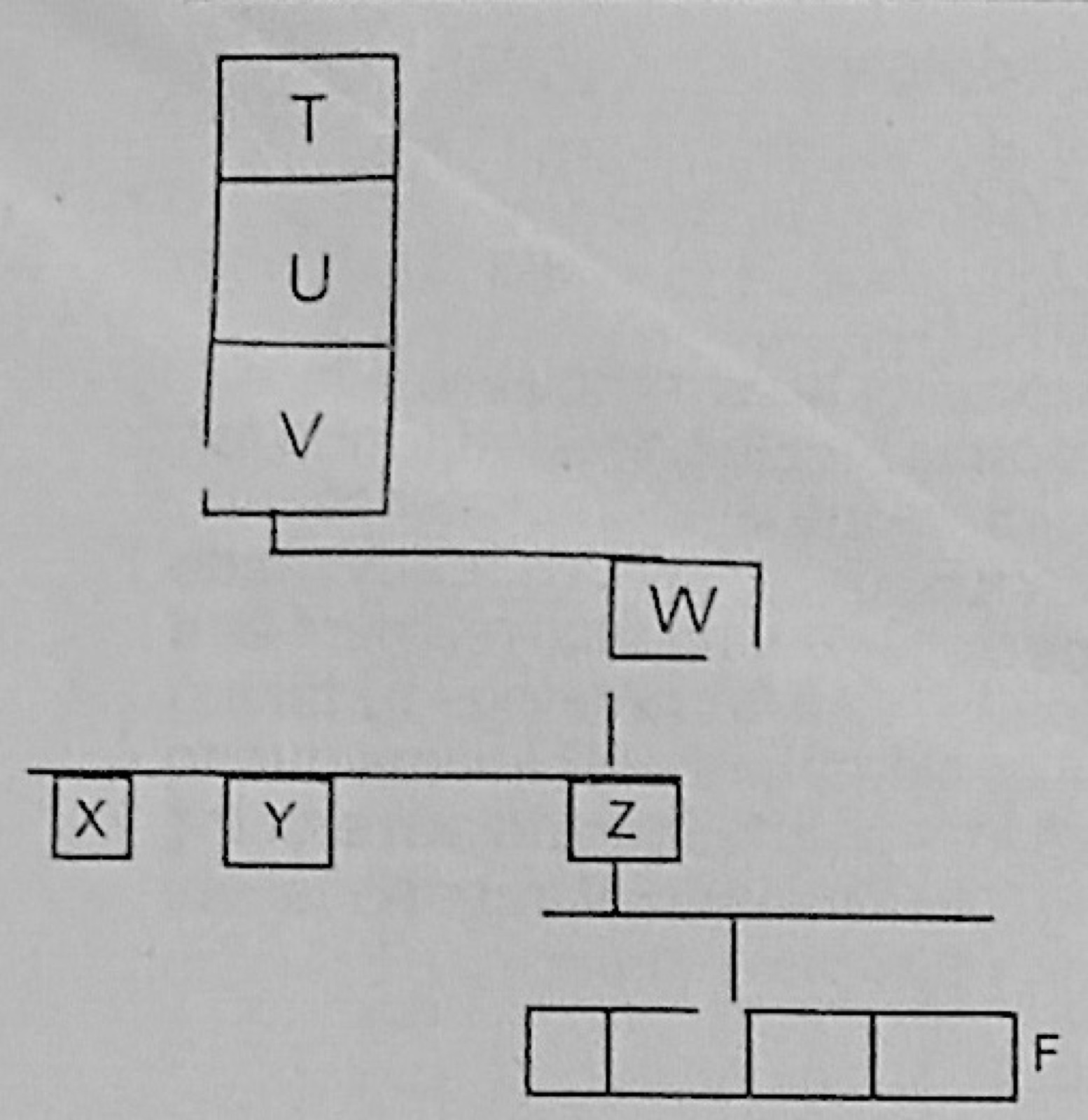
Use the organization chart of Oluwa Plc to answer the question.
In which of the boxes in the organization chart would you locate the shareholders of OLUWA PLC?

Diagram for this question
  1. A.F
  2. B.X
  3. C.V
  4. D.T
  5. E.W
Show the answer and explanation

Answer: D (T)

Explanation

Shareholders own the company, so they are at the very top, box T.

Open this question

Question 21

Business Management

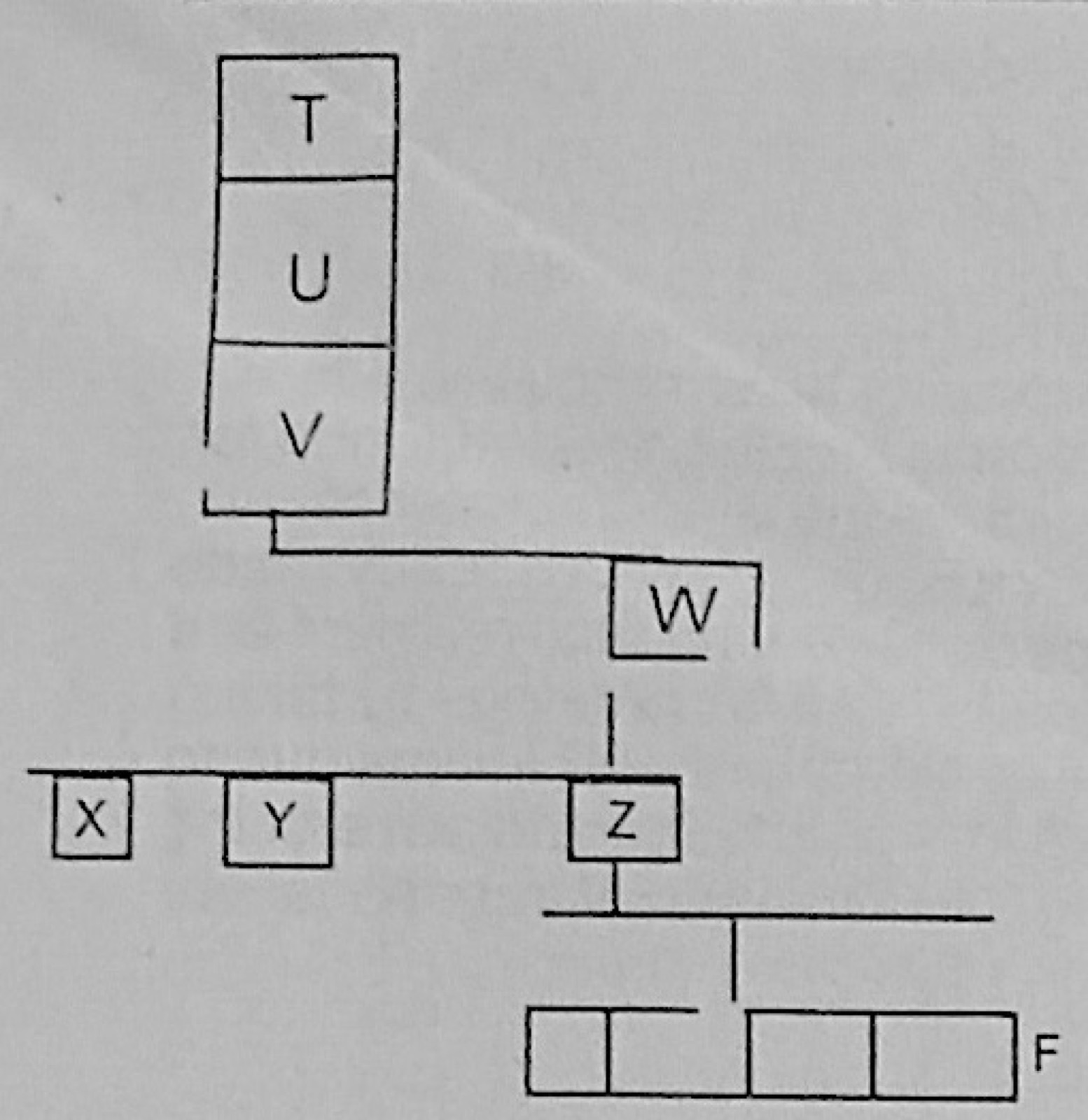
Use the organization chart of Oluwa Plc to answer the question.
The position of the Departmental Manager would be located in Box

Diagram for this question
  1. A.T
  2. B.F
  3. C.W
  4. D.X
  5. E.U
Show the answer and explanation

Answer: D (X)

Explanation

Departmental managers are on the level of X, Y and Z, below the chief executive and above the clerks.

Open this question

Question 22

Business Management

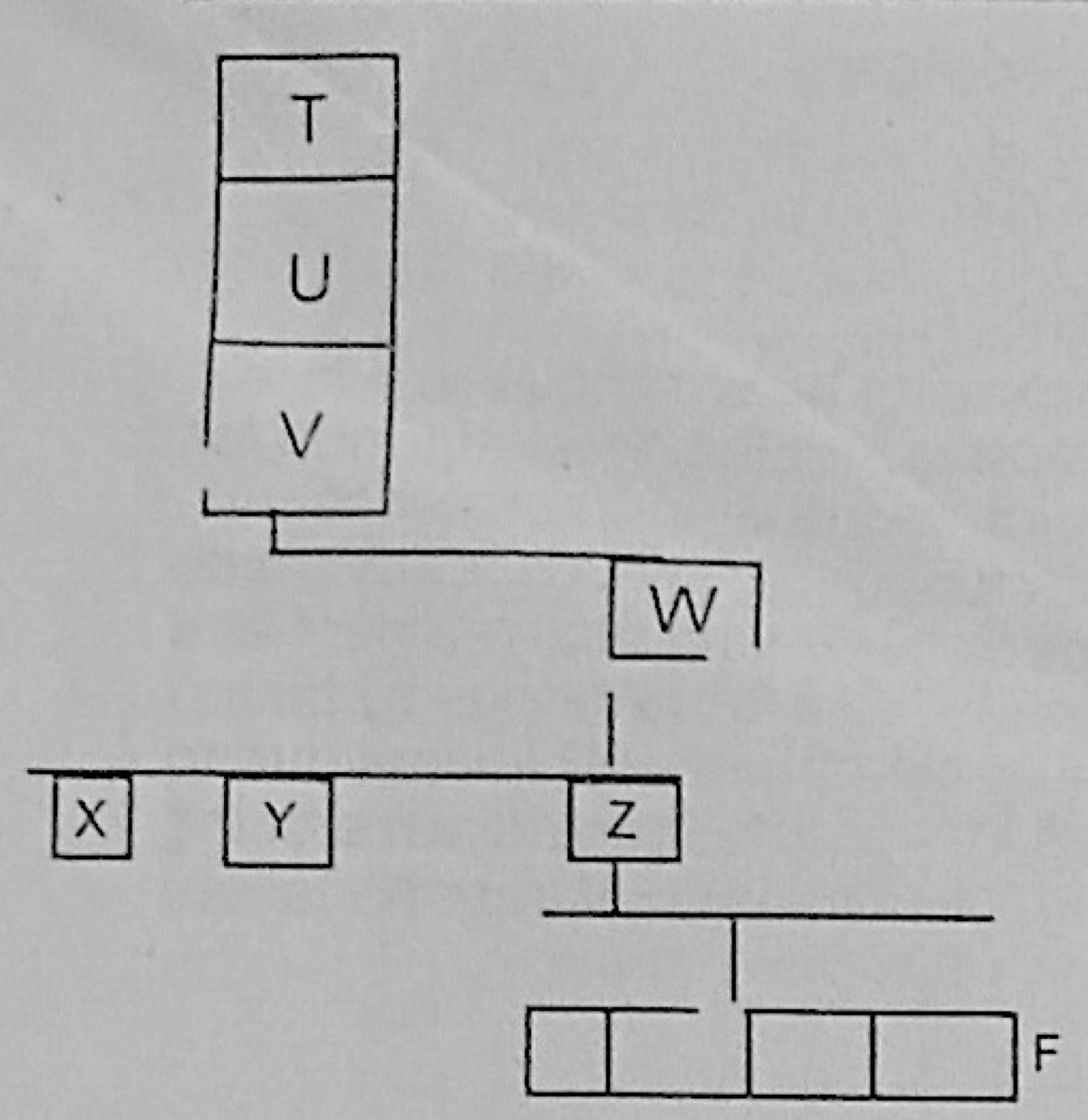
Use the organization chart of Oluwa Plc to answer the question.
The Board of Directors of Oluwa Plc would be in Box

Diagram for this question
  1. A.V
  2. B.W
  3. C.X
  4. D.T
  5. E.U
Show the answer and explanation

Answer: E (U)

Explanation

The board is elected by and sits just below the shareholders, box U.

Open this question

Question 23

Business Management

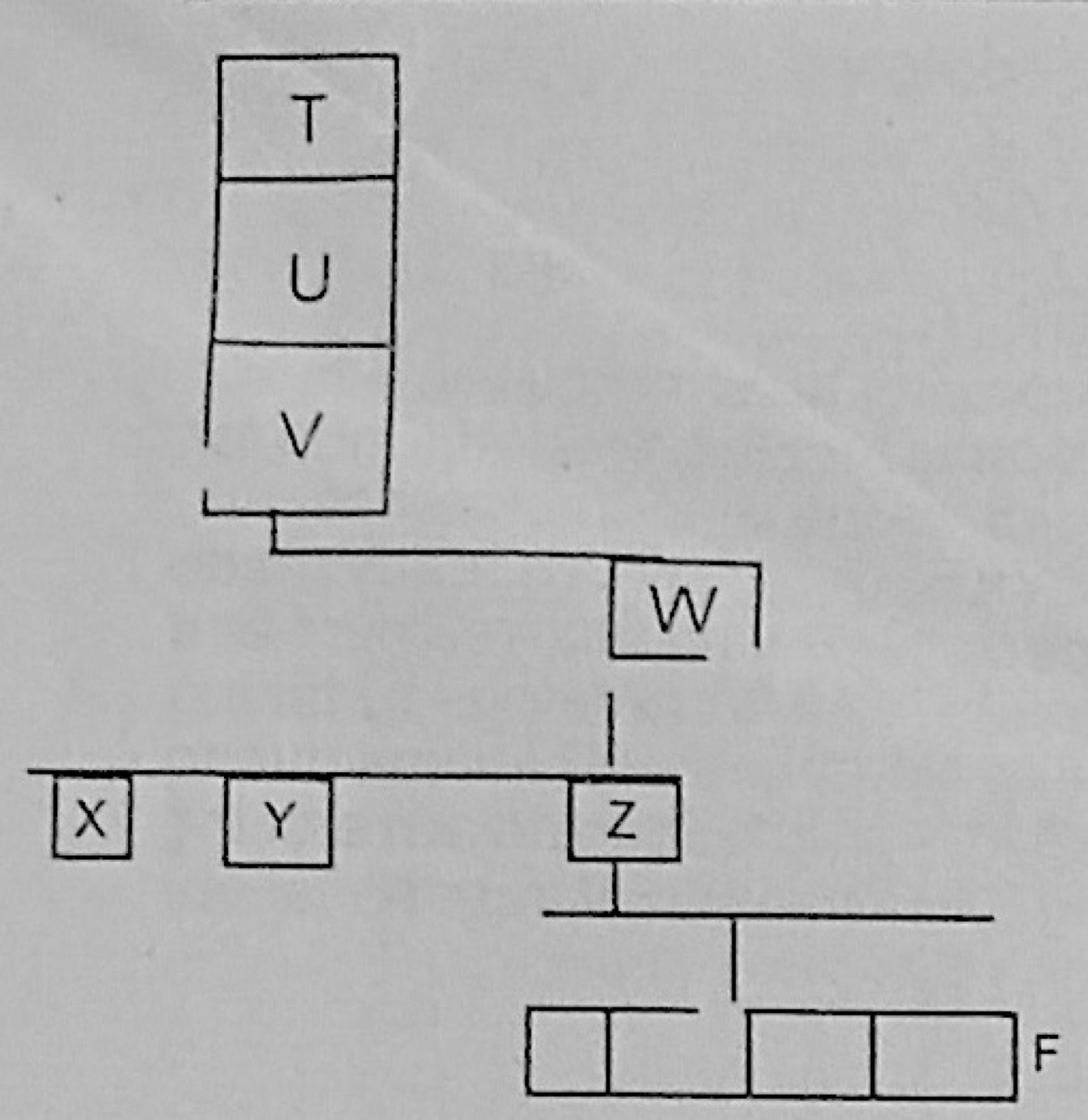
Use the organization chart of Oluwa Plc to answer the question.
The position of the Accounts Clerk would be located in Box

Diagram for this question
  1. A.F
  2. B.T
  3. C.V
  4. D.U
  5. E.X
Show the answer and explanation

Answer: A (F)

Explanation

Clerks are at the lowest level of the chart, the boxes marked F.

Open this question

Question 24

Business Management

Use the organization chart of Oluwa Plc to answer the question.
The Managing Director would be located in Box

Diagram for this question
  1. A.V
  2. B.T
  3. C.U
  4. D.W
  5. E.F
Show the answer and explanation

Answer: A (V)

Explanation

The managing director is below the board and above all other managers, box V.

Open this question

Question 25

Business Management

Use the organization chart of Oluwa Plc to answer the question.
Which of the following is represented by the chart?

  1. A.Committee organization
  2. B.Staff organization
  3. C.Line and staff organization
  4. D.Line organization
  5. E.Centralised organization
Show the answer and explanation

Answer: C (Line and staff organization)

Explanation

The key takes box W, set to one side of the chain from V, as a staff position, giving line and staff organization.

Open this question

Question 26

Purchase and Sale of Goods

Which of the following may serve as a delivery note?

  1. A.Debit note
  2. B.Credit note
  3. C.Invoice
  4. D.Advice note
  5. E.Statement of Account
Show the answer and explanation

Answer: D (Advice note)

Explanation

An advice note tells the buyer the goods are on the way and can be used to check them on delivery.

Open this question

Question 27

Insurance

Mr. Chidi insured his house against fire. The house was destroyed by flood. Which of the following principles prevented him from being compensated?

  1. A.Uberrimae fidei
  2. B.Subrogation
  3. C.Indemnity
  4. D.Proximate cause
  5. E.Insurable interest
Show the answer and explanation

Answer: D (Proximate cause)

Explanation

Proximate cause: the insurer pays only if the loss was mainly caused by the risk insured (fire), not flood.

Open this question

Question 28

Transport

The price charged for leasing a ship is known as

  1. A.way bill
  2. B.haulage
  3. C.clean bill
  4. D.freight
  5. E.demurrage
Show the answer and explanation

Answer: D (freight)

Explanation

Freight is the charge paid to the shipowner for the use of the ship or for carrying goods.

Open this question

Question 29

Warehousing

Goods in bonded warehouses are under the strict supervision of the

  1. A.Customs Authority
  2. B.Ports Authority
  3. C.Importer
  4. D.Clearing agent
  5. E.Exporter
Show the answer and explanation

Answer: A (Customs Authority)

Explanation

Goods in bond have not paid duty, so customs officers control them.

Open this question

Question 30

Stock Exchange

Which of the following regulates and controls the activities of the Nigerian Stock Exchange?

  1. A.The Nigerian Capital Market Association
  2. B.The Securities and Exchange Commission
  3. C.The Nigerian Deposit Insurance Commission
  4. D.The Nigerian Reinsurance Corporation
  5. E.The Central Bank of Nigeria.
Show the answer and explanation

Answer: B (The Securities and Exchange Commission)

Explanation

The Securities and Exchange Commission regulates the capital market.

Open this question

Question 31

Business Units

Which of the following is drawn up as a guide to the running of a Partnership?

  1. A.Deed of Agreement
  2. B.Partnership Act
  3. C.Memorandum of Association
  4. D.Prospectus
  5. E.Articles of Association
Show the answer and explanation

Answer: A (Deed of Agreement)

Explanation

Partners sign a deed of partnership (agreement) setting out how the firm will be run.

Open this question

Question 32

Business Units

The law governing the operations of companies and partnership in Nigeria is the

  1. A.Nigerian Companies Decree
  2. B.Nigerian Partnership Act
  3. C.Nigerian Enterprises Promotion Decree
  4. D.Companies and Allied Matters Decree
  5. E.Sale of Goods Act
Show the answer and explanation

Answer: D (Companies and Allied Matters Decree)

Explanation

The Companies and Allied Matters Decree (now Act) of 1990 governs companies and partnerships.

Open this question

Question 33

Insurance

Which of the following is a non-indemnity insurance?

  1. A.Personal Accident Insurance
  2. B.Burglary insurance
  3. C.Fire insurance
  4. D.Consequential loss insurance
  5. E.Third party insurance
Show the answer and explanation

Answer: A (Personal Accident Insurance)

Explanation

Injury to the body cannot be valued exactly, so personal accident policies pay agreed sums, not indemnity.

Open this question

Question 34

Business Units

The document issued to a newly formed public company to commence business is called the

  1. A.certificate of incorporation
  2. B.articles of association
  3. C.memorandum of association
  4. D.trading certificate
  5. E.insurance certificate
Show the answer and explanation

Answer: D (trading certificate)

Explanation

A public company needs a trading certificate before it can start business.

Open this question

Question 35

Retail Trade

Small scale retail attracts a lot of new entrepreneurs in West Africa because

  1. A.many people have had good training in retail trade
  2. B.it is easy to succeed with the business
  3. C.banks are always ready to lend to retailers
  4. D.only a small amount of capital is needed to start the business
  5. E.government exempts retailers from paying tax
Show the answer and explanation

Answer: D (only a small amount of capital is needed to start the business)

Explanation

Small-scale retailing needs little capital, so it is easy to enter.

Open this question

Question 36

Insurance

In marine insurance, the deliberate throwing of some goods into the sea to prevent the ship from sinking is an example of

  1. A.a constructive total loss
  2. B.a partial loss
  3. C.a general average loss
  4. D.a total loss
  5. E.an actual total loss
Show the answer and explanation

Answer: C (a general average loss)

Explanation

Goods sacrificed (jettisoned) to save the ship are a general average loss shared by all parties.

Open this question

Question 37

Government and Business

Tax levied on goods at each stage of their movement from production to the final consumer is known as

  1. A.customs drawback
  2. B.ad valorem duty
  3. C.specific tax
  4. D.value added tax
  5. E.tariff
Show the answer and explanation

Answer: D (value added tax)

Explanation

VAT is charged on the value added at each stage of production and distribution.

Open this question

Question 38

Trade Associations

An association of businessmen engaged in both commerce and industry is called

  1. A.trade association
  2. B.Trade union
  3. C.chamber of commerce
  4. D.trust
  5. E.cartel
Show the answer and explanation

Answer: C (chamber of commerce)

Explanation

A chamber of commerce brings together businessmen in trade and industry in an area.

Open this question

Question 39

Government and Business

When the government decides to run a statutory corporation as a profit-oriented enterprise, this is known as

  1. A.nationalization
  2. B.commercialization
  3. C.take-over bid
  4. D.privatization
  5. E.indigenization
Show the answer and explanation

Answer: B (commercialization)

Explanation

Commercialisation keeps government ownership but runs the corporation to make profit.

Open this question

Question 40

Introduction to Commerce

The primary aim of commerce is to

  1. A.produce goods and services
  2. B.warehouse goods
  3. C.advertise goods and services
  4. D.finance goods and services
  5. E.exchange goods and services
Show the answer and explanation

Answer: E (exchange goods and services)

Explanation

Commerce covers trade and its aids, whose purpose is the exchange and distribution of goods and services.

Open this question

Question 41

Business Finance

Which of the following has a fixed rate of dividend?

  1. A.Debenture
  2. B.Ordinary share
  3. C.Founder's share
  4. D.Preference share
  5. E.Equity
Show the answer and explanation

Answer: D (Preference share)

Explanation

Preference shares receive a fixed rate of dividend; debentures earn interest, not dividend.

Open this question

Question 42

Economic Integration

Which of the following is not a barrier to the smooth functioning of ECOWAS?

  1. A.Different currencies
  2. B.Different languages
  3. C.Adequate population
  4. D.Political crisis
  5. E.Fear of domination
Show the answer and explanation

Answer: C (Adequate population)

Explanation

An adequate population provides a market; it is not a barrier.

Open this question

Question 43

Stock Exchange

The capital market is a market

  1. A.for long term loans
  2. B.for new shares of public companies
  3. C.where money is deposited
  4. D.where foreign currencies are bought and sold
  5. E.for short term loans
Show the answer and explanation

Answer: A (for long term loans)

Explanation

The capital market deals in long-term funds.

Open this question

Question 44

Government and Business

Which of the following is primarily established to promote the growth of industry in Nigeria?

  1. A.NITEL
  2. B.UBA
  3. C.NIPOST
  4. D.NIDB
  5. E.UAC
Show the answer and explanation

Answer: D (NIDB)

Explanation

The Nigerian Industrial Development Bank was set up to finance industrial growth.

Open this question

Question 45

Transport

Another name for sea taxi is

  1. A.tramp
  2. B.liner
  3. C.special freighter
  4. D.voyage charter
  5. E.flying boat
Show the answer and explanation

Answer: A (tramp)

Explanation

Tramps go wherever there is cargo, with no fixed route, like taxis.

Open this question

Question 46

Transport

Contracts for the carriage of goods by sea are generally called

  1. A.charter by demise
  2. B.charter parties
  3. C.voyage charter
  4. D.time charter
  5. E.marine policy
Show the answer and explanation

Answer: B (charter parties)

Explanation

A charter party is the contract for hiring a ship; time and voyage charters are types of it.

Open this question

Question 47

Foreign Trade

A nation's earnings from tourism are classified as

  1. A.visible exports
  2. B.invisible exports
  3. C.visible imports
  4. D.invisible imports
  5. E.entrepot trade items
Show the answer and explanation

Answer: B (invisible exports)

Explanation

Earnings from services such as tourism are invisible exports.

Open this question

Question 48

Trade Associations

An Association of employees in an organization is called a

  1. A.trade union
  2. B.trade association
  3. C.consumer association
  4. D.credit union
  5. E.co-operative society
Show the answer and explanation

Answer: A (trade union)

Explanation

Workers form trade unions to protect their interests.

Open this question

Question 49

Insurance

A firm that accepts a portion of the risk involved in an insurance contract is

  1. A.a broker
  2. B.an actuary
  3. C.a speculator
  4. D.an underwriter
  5. E.an assessor
Show the answer and explanation

Answer: D (an underwriter)

Explanation

An underwriter accepts all or part of a risk in return for premium.

Open this question

Question 50

Law of Contract

Musa places his bicycle for sale at N800.00 and Dada had agreed to pay the amount. In this transaction, Musa is the

  1. A.offerer
  2. B.offeree
  3. C.buyer
  4. D.guarantor
  5. E.auctioneer
Show the answer and explanation

Answer: A (offerer)

Explanation

Musa makes the offer to sell, so he is the offerer; Dada, who accepts, is the offeree.

Open this question

Question 51

Purchase and Sale of Goods

When goods are sent through an independent carrier, the document used by the sender is

  1. A.a delivery note
  2. B.an advice note
  3. C.an invoice
  4. D.a consignment note
  5. E.a receipt
Show the answer and explanation

Answer: D (a consignment note)

Explanation

A consignment note goes with goods sent by an independent carrier.

Open this question

Question 52

Wholesale Trade

Which of the following may not be considered when choosing an appropriate channel of distribution for a new product?

  1. A.Nature of the product
  2. B.Identification of potential consumers
  3. C.Operating costs
  4. D.Existing local channel of distribution
  5. E.Provision of credit facilities to customers
Show the answer and explanation

Answer: E (Provision of credit facilities to customers)

Explanation

The product, customers, costs and existing channels decide the channel; credit to customers does not.

Open this question

Question 53

Foreign Trade

Which of the following may be used to restrict imports?
I. Bill of lading
II. Specific licences
III. Foreign exchange rationing
IV. Letters of credit
V. Customs duties and tariffs

  1. A.I, II and V only
  2. B.II, III and V only
  3. C.III, IV and V only
  4. D.I, II and IV only
  5. E.II, III and IV only
Show the answer and explanation

Answer: B (II, III and V only)

Explanation

Licences, foreign exchange rationing and duties all limit imports; bills of lading and letters of credit are ordinary trade documents.

Open this question

Question 54

Banking

Which of the following is not a reason for dishonouring a cheque?

  1. A.Insufficient funds
  2. B.Different amount in words and in figures
  3. C.Uninitiated alteration
  4. D.Wrong signature
  5. E.Special crossing
Show the answer and explanation

Answer: E (Special crossing)

Explanation

A special crossing only directs payment to a named bank; it is not a reason to refuse payment.

Open this question

Question 55

Business Units

Which of the following statements is not true of a private limited company?

  1. A.The minimum number of shareholders is two
  2. B.Its shares are freely transferable
  3. C.There is a limit to the number of shareholders
  4. D.It is a separate legal entity
  5. E.It is a registered business
Show the answer and explanation

Answer: B (Its shares are freely transferable)

Explanation

A private company restricts the transfer of its shares; free transfer belongs to public companies.

Open this question

Question 56

Co-operative Societies

A retail co-operative society aims at

  1. A.encouraging members to save money
  2. B.buying seeds and fertilizers
  3. C.Manufacturing goods as cheaply as possible
  4. D.lending money to members at low rate of interest
  5. E.cutting off the profits of middlemen
Show the answer and explanation

Answer: E (cutting off the profits of middlemen)

Explanation

Consumer (retail) co-operatives buy in bulk and sell to members, cutting out middlemen's profit.

Open this question

Question 57

Marketing

The value of a product expressed in monetary terms is known as

  1. A.utility
  2. B.price
  3. C.Premium
  4. D.commission
  5. E.interest
Show the answer and explanation

Answer: B (price)

Explanation

Price is value expressed in money.

Open this question

Question 58

Communication

Which of the following is not true of franking machines?

  1. A.Hired by companies and licensed by NIPOST
  2. B.Print postage impression on mails
  3. C.Can print company's logo on mails
  4. D.Advance payment must be made to NIPOST
  5. E.Postage stamp is used
Show the answer and explanation

Answer: E (Postage stamp is used)

Explanation

A franking machine prints the postage on the envelope, so no stamps are used.

Open this question

Question 59

Transport

Which of the following is suitable for transporting fish a long distance?

  1. A.Tramp
  2. B.Cargo liner
  3. C.Tanker
  4. D.Barge
  5. E.Refrigerated ship
Show the answer and explanation

Answer: E (Refrigerated ship)

Explanation

Fish is perishable and needs refrigeration on a long journey.

Open this question

Question 60

Law of Contract

Which of the following is not an element of a contract?

  1. A.Consideration
  2. B.Probability
  3. C.Legality
  4. D.Capacity
  5. E.Consensus
Show the answer and explanation

Answer: B (Probability)

Explanation

Consideration, legality, capacity and consensus (agreement) are elements of a contract; probability is not.

Open this question

Question 62

Business Units

A partner who does not play an active role in a business but contributes capital is a

  1. A.secret partner
  2. B.dormant partner
  3. C.nominal partner
  4. D.limited partner
  5. E.general partner
Show the answer and explanation

Answer: B (dormant partner)

Explanation

A dormant (sleeping) partner contributes capital but takes no part in running the firm.

Open this question

Question 63

Business Units

Which of the following is not included in the Memorandum of Association?

  1. A.Winding up procedure
  2. B.Objectives of the company
  3. C.Address of the registered office
  4. D.Amount of capital
  5. E.Conditions for amendment of the memorandum
Show the answer and explanation

Answer: A (Winding up procedure)

Explanation

The Memorandum states name, office, objects, liability and capital; winding up is covered by the Articles and the law.

Open this question

Question 64

Business Finance

Which of the following is not a source of capital?

  1. A.Personal savings
  2. B.Credit transfer
  3. C.Bank loan
  4. D.Credit purchase
  5. E.Debenture
Show the answer and explanation

Answer: B (Credit transfer)

Explanation

A credit transfer is just a way of paying money into accounts; it does not provide capital.

Open this question

Question 65

Transport

The contract between ship owners and hirers whereby the hirers take full control of the ship is called

  1. A.time charter
  2. B.charter by demise
  3. C.shipping conference
  4. D.voyage charter
  5. E.charter party
Show the answer and explanation

Answer: B (charter by demise)

Explanation

Under a charter by demise (bareboat charter) the hirer takes over the ship and its crew completely.

Open this question

Question 66

Consumer Protection

Which of the following does not aim at protecting the consumer?

  1. A.Sale of Goods Act
  2. B.Fair Trading Act
  3. C.Price Control Act
  4. D.Partnership Act
  5. E.Food and Drugs Act
Show the answer and explanation

Answer: D (Partnership Act)

Explanation

The Partnership Act governs partners' relations, not consumer protection.

Open this question

Question 67

Marketing

Which of the following activities makes the consumer its focus in decision making?

  1. A.Selling concept
  2. B.Marketing concept
  3. C.Product concept
  4. D.Production concept
  5. E.Market research
Show the answer and explanation

Answer: B (Marketing concept)

Explanation

The marketing concept starts from what consumers want.

Open this question

Question 68

Occupation

Which of the following is a direct service?

  1. A.Banking
  2. B.Teaching
  3. C.Advertising
  4. D.Fishing
  5. E.Warehousing
Show the answer and explanation

Answer: B (Teaching)

Explanation

Direct services are rendered personally to people, like teaching, nursing or law.

Open this question

Question 69

Foreign Trade

Which of the following is a disadvantage of foreign trade?

  1. A.Encourages dumping
  2. B.Makes available the products that a country cannot produce
  3. C.Widens the world market
  4. D.Encourages specialization
  5. E.Makes possible the transfer of technology
Show the answer and explanation

Answer: A (Encourages dumping)

Explanation

Foreign trade exposes a country to dumping of cheap goods that harm home industries.

Open this question

Question 70

Law of Contract

An agreement that is enforceable in law is called

  1. A.a contract
  2. B.an offer
  3. C.an acceptance
  4. D.a consideration
  5. E.an injunction
Show the answer and explanation

Answer: A (a contract)

Explanation

A contract is a legally enforceable agreement.

Open this question

Question 71

Foreign Trade Documents

A document signed by a customs officer of the exporting country to confirm the country of export of the goods is

  1. A.an export invoice
  2. B.a consular invoice
  3. C.a certificate of origin
  4. D.a letter of hypothecation
  5. E.a bill of lading
Show the answer and explanation

Answer: C (a certificate of origin)

Explanation

A certificate of origin states the country where the goods come from.

Open this question

Question 72

Purchase and Sale of Goods

For which of the following reasons would a seller not issue a credit note to a customer? If

  1. A.goods are undercharged
  2. B.goods are damaged
  3. C.bottles are returned
  4. D.goods are overcharged
  5. E.fewer goods are returned
Show the answer and explanation

Answer: A (goods are undercharged)

Explanation

Undercharging means the buyer owes more, so a debit note is sent, not a credit note.

Open this question

Question 73

Purchase and Sale of Goods

A statement of account is a

  1. A.summary of goods sold to a customer for a particular item
  2. B.note to inform the customer of an addition to his business transaction
  3. C.standard letter sent to customers who have not settled their bills
  4. D.statement of acceptance of credit facilities to a customer
  5. E.Summary of a customer's transactions over a given period
Show the answer and explanation

Answer: E (Summary of a customer's transactions over a given period)

Explanation

A statement of account summarises a customer's dealings and balance for a period, usually a month.

Open this question

Question 74

Business Management

Management is

  1. A.getting things done through other people
  2. B.the implementation of business decision
  3. C.the number of levels in an organisation
  4. D.made up of the general manager and the employees
  5. E.making goods available in places where they are needed
Show the answer and explanation

Answer: A (getting things done through other people)

Explanation

Management is achieving goals through the efforts of other people.

Open this question

Question 75

Insurance

The sum of money the assurer is prepared to pay the assured in total discharge of a contract before its maturity is

  1. A.dividend
  2. B.premium
  3. C.annuity
  4. D.surrender value
  5. E.interest
Show the answer and explanation

Answer: D (surrender value)

Explanation

The surrender value is paid when a life policy is cancelled before it matures.

Open this question

Question 76

Communication

Which of the following services is not rendered by NIPOST?

  1. A.Express delivery
  2. B.Recorded delivery
  3. C.Parcel post
  4. D.Telephone
  5. E.Cash delivery
Show the answer and explanation

Answer: D (Telephone)

Explanation

Telephone services were provided by NITEL, not by NIPOST.

Open this question

Question 77

Wholesale Trade

Which of the following functions may not be performed by a wholesaler?

  1. A.Transporting
  2. B.Warehousing
  3. C.Financing
  4. D.Branding
  5. E.Manufacturing
Show the answer and explanation

Answer: E (Manufacturing)

Explanation

Wholesalers buy, store, finance and may brand goods, but they do not manufacture them.

Open this question

Question 78

Law of Contract

The commercial term 'Caveat emptor' means, 'Let the

  1. A.buyer beware'
  2. B.seller beware'
  3. C.manufacturer beware'
  4. D.account be settled'
  5. E.endorser be careful'
Show the answer and explanation

Answer: A (buyer beware')

Explanation

Caveat emptor is Latin for 'let the buyer beware'.

Open this question

Question 79

Production

Which of the following is not a business resource?

  1. A.Wages
  2. B.Man
  3. C.Money
  4. D.Material
  5. E.Machine
Show the answer and explanation

Answer: A (Wages)

Explanation

Men, money, materials and machines are business resources; wages are a payment to labour.

Open this question

Question 80

Co-operative Societies

In which of the following business units are the owners mostly the customers?

  1. A.Co-operatives
  2. B.Partnerships
  3. C.Public corporations
  4. D.Limited liability companies
  5. E.Sole proprietorship
Show the answer and explanation

Answer: A (Co-operatives)

Explanation

Members of a consumer co-operative own it and also buy from it.

Open this question

Question 81

Business Finance

Which of the following is not a way of raising capital for business?

  1. A.Issuing of bonds
  2. B.Borrowing
  3. C.Savings
  4. D.Ploughing back profit
  5. E.Issuing dividend warrants
Show the answer and explanation

Answer: E (Issuing dividend warrants)

Explanation

Dividend warrants pay out profit to shareholders; they do not raise money.

Open this question

Question 82

Business Environment and Social Responsibility

In a business environment, which of the following variables can a businessman conveniently control?

  1. A.Product
  2. B.Politics
  3. C.Culture
  4. D.Economy
  5. E.The laws
Show the answer and explanation

Answer: A (Product)

Explanation

A firm decides its own product; politics, culture, the economy and laws are outside its control.

Open this question

Question 83

Foreign Trade

Which of the following is not a reason for imposing import duties? To

  1. A.improve balance of trade
  2. B.improve quality of goods for consumers
  3. C.obtain revenue
  4. D.protect infant industries
  5. E.prevent dumping
Show the answer and explanation

Answer: B (improve quality of goods for consumers)

Explanation

Import duties raise revenue, protect home industry, prevent dumping and correct the trade balance; they do not improve quality.

Open this question

Question 84

Marketing

The face to face contact between sellers and buyers with the aim of selling a product is known as

  1. A.personal selling
  2. B.customer coordination
  3. C.promotion
  4. D.advertising
  5. E.public relations
Show the answer and explanation

Answer: A (personal selling)

Explanation

Personal selling is selling face to face.

Open this question

Question 85

Advertising

Which of the following is the main tool of mass selling?

  1. A.public relations
  2. B.Personal selling
  3. C.Consumer research
  4. D.Customer orientation
  5. E.Advertising
Show the answer and explanation

Answer: E (Advertising)

Explanation

Advertising reaches very many people at once.

Open this question

Question 86

Retail Trade

The allowance given to a retailer to enable him make profit is known as

  1. A.interest
  2. B.commission
  3. C.trade discount
  4. D.cash discount
  5. E.dividend
Show the answer and explanation

Answer: C (trade discount)

Explanation

Trade discount is a reduction from the list price that gives the retailer his profit margin.

Open this question

Question 87

Retail Trade

One of the features of supermarkets is

  1. A.having similar shop fronts
  2. B.having many shops under one roof
  3. C.selling common household goods
  4. D.having central control from headquarters
  5. E.selling without shops
Show the answer and explanation

Answer: C (selling common household goods)

Explanation

Supermarkets sell mainly food and everyday household goods by self-service.

Open this question

Question 88

Business Combinations

A group of public limited companies that collectively own a joint venture is known as a

  1. A.holding company
  2. B.consortium
  3. C.cartel
  4. D.trust
  5. E.merger
Show the answer and explanation

Answer: B (consortium)

Explanation

Firms that come together to own and run a joint project form a consortium.

Open this question

Question 89

Introduction to Commerce

Which of the following clearly defines business?

  1. A.The process of planning, coordinating, organizing and controlling
  2. B.The act of achieving goals with the help of others
  3. C.The act of buying and selling
  4. D.Sole Proprietorship, Partnership and Public Limited Companies
  5. E.Any productive activity undertaken for profit motive
Show the answer and explanation

Answer: E (Any productive activity undertaken for profit motive)

Explanation

A business is any productive activity carried on to make profit.

Open this question

Question 90

Consumer Protection

Which of the following ensures that the quality of a product is maintained?

  1. A.Price Control Board
  2. B.Chamber of Commerce
  3. C.Food and Drugs Act
  4. D.Standards Organization of Nigeria
  5. E.Manufacturers' Association of Nigeria
Show the answer and explanation

Answer: D (Standards Organization of Nigeria)

Explanation

The Standards Organisation of Nigeria sets and enforces product quality standards.

Open this question

Question 91

Foreign Trade Documents

Which of the following would enable customs officers to correctly assess import duties on goods?

  1. A.Pro-forma invoice
  2. B.Bill of exchange
  3. C.Documentary credit
  4. D.Consular invoice
  5. E.Bill of lading
Show the answer and explanation

Answer: D (Consular invoice)

Explanation

A consular invoice certifies the value and details of the goods, so customs can work out the correct duty.

Open this question

Question 92

Insurance

An insurance policy which benefits one's family only in the event of one's death is known as

  1. A.a comprehensive insurance
  2. B.a whole-life insurance
  3. C.an endowment policy
  4. D.an annuity
  5. E.a third party insurance
Show the answer and explanation

Answer: B (a whole-life insurance)

Explanation

Whole-life assurance pays out only when the assured dies.

Open this question

Question 93

Business Units

One of the demerits of sole trading is

  1. A.quick decision taking
  2. B.flexibility in operation
  3. C.unlimited liability
  4. D.pride of ownership
  5. E.ease of commencement
Show the answer and explanation

Answer: C (unlimited liability)

Explanation

A sole trader can lose his private property to pay business debts.

Open this question

Question 94

Trade Associations

A group of people in the same line of business who come together for the interest of its members is called

  1. A.Chamber of Commerce
  2. B.trade association
  3. C.trade union
  4. D.consortium
  5. E.cartel
Show the answer and explanation

Answer: B (trade association)

Explanation

A trade association is formed by firms in the same line of business.

Open this question

Question 95

Foreign Trade Documents

A foreign order which instructs an agent to buy certain goods at a particular place is called

  1. A.letter of credit
  2. B.letter of attorney
  3. C.open indent
  4. D.closed indent
  5. E.bill of lading
Show the answer and explanation

Answer: D (closed indent)

Explanation

A closed (specific) indent names the supplier or place the goods must come from.

Open this question

Question 96

Stock Exchange

The shares of XYZ Plc are quoted at the stock exchange by a jobber at 85 K for k share. How much will Alabi, an investor who buys 500 shares pay?

  1. A.N675.00
  2. B.N425.00
  3. C.N250.00
  4. D.N175.00
  5. E.N75.00
Show the answer and explanation

Answer: B (N425.00)

Explanation

500 shares × 85k = 42,500k = N425.

Open this question

Question 98

Wholesale Trade

An agent who guarantees payments for goods sold is

  1. A.a factor
  2. B.a del credere agent
  3. C.a broker
  4. D.a partner
  5. E.an auctioneer
Show the answer and explanation

Answer: B (a del credere agent)

Explanation

A del credere agent guarantees that buyers will pay, for extra commission.

Open this question

Question 99

Foreign Trade

Dumping means selling goods abroad

  1. A.at a lower price than in the home market
  2. B.at a higher price than in the home market
  3. C.at the same price as in the home market
  4. D.on credit in the foreign market
  5. E.for ready cash in the foreign market.
Show the answer and explanation

Answer: A (at a lower price than in the home market)

Explanation

Dumping is selling abroad more cheaply than at home, often below cost.

Open this question

Question 100

Marketing

Which of the following are functions of marketing?

  1. A.Buying, financing, selling and transporting
  2. B.Sorting, grading, managing and storage
  3. C.Risk-bearing, storage, production and promotion
  4. D.Organizing, risk-bearing, transporting and storage
  5. E.Production, promotion, distribution and pricing
Show the answer and explanation

Answer: A (Buying, financing, selling and transporting)

Explanation

The functions of marketing include buying, selling, transporting, storage, financing, risk-bearing, grading and market information.

Open this question

Theory question 101

Retail Trade

Commerce 2 (answer any five questions)
(a) Give two examples of small-scale retail outlets and three examples of large-scale retail outlets.
(b) Explain five reasons for the survival of small-scale retailers.

Show the model answer
Model answer

(a) Small-scale (any two): hawkers/itinerant traders; market stall holders; kiosks; unit/independent shops; mobile shops; roadside traders. Large-scale (any three): department stores; supermarkets/hypermarkets; multiple (chain) stores; mail order businesses; co-operative retail societies; discount stores.
(b) Any five, explained: personal service and close relationship with customers; grant credit to known customers; open long and convenient hours; located near customers (in residential areas); sell in very small quantities that the poor can afford; little capital needed to start; low running costs/overheads; flexible – can adapt quickly to local demand; deliver goods to customers; some customers like bargaining; sell goods that large shops do not stock.

Explanation

Give named examples in (a); in (b) explain why each reason keeps small shops in business.

Open this question

Theory question 102

Transport

Commerce 2 (answer any five questions)
(a) State five reasons why road transport would be preferred to rail transport.
(b) Give five functions of the Nigerian Airports Authority.

Show the model answer
Model answer

(a) Any five: door-to-door delivery; flexible routes and time – no fixed timetable; faster over short distances; good for perishable and urgent goods; reaches places where there are no rail lines; many types of vehicles available; less handling, so less damage and pilferage; cheaper for small loads and short distances; easier to load and offload.
(b) Any five: builds, develops and maintains airports; provides air traffic control/navigation aids (at the time); provides passenger and cargo terminals and facilities; ensures safety and security at airports; provides fire-fighting and rescue services; collects airport charges and taxes; provides warehouses for cargo and car parks; regulates the use of airport facilities by airlines and others; trains staff.

Explanation

Short points are enough here; five each.

Open this question

Theory question 103

Insurance

Commerce 2 (answer any five questions)
Write short notes on each of the following:
(a) Marine insurance
(b) Accident insurance
(c) Group insurance
(d) Export Credit Guarantee insurance
(e) Fire insurance

Show the model answer
Model answer

(a) Marine insurance covers ships (hull), cargo and freight against perils of the sea such as sinking, storm, collision, fire and piracy; policies may be voyage, time, mixed, floating or fleet; it was the first form of insurance.
(b) Accident insurance covers losses from accidents other than fire and marine: personal accident, motor (third party, comprehensive), burglary/theft, employers' liability, public liability, fidelity guarantee, goods in transit, bad debts.
(c) Group insurance is one policy covering a group of people, e.g. all employees of a firm (group life or group personal accident); premiums are lower, the employer usually pays, and it improves staff welfare and loyalty.
(d) Export Credit Guarantee insurance protects exporters against non-payment by overseas buyers (because of insolvency, war, exchange control, etc.); it encourages exporters to sell on credit and makes it easier to obtain bank finance; usually provided by a government agency.
(e) Fire insurance covers buildings, stock and other property against loss or damage by fire, lightning and explosion; the insured is indemnified up to the sum insured, and it can be extended to consequential loss (loss of profit while the business is closed after a fire).

Explanation

About two or three facts for each note: what is covered and a key feature.

Open this question

Theory question 104

Co-operative Societies

Commerce 2 (answer any five questions)
(a) Give any five features which are common to both co-operative societies and private limited companies.
(b) Explain any five differences between co-operative societies and private limited companies.

Show the model answer
Model answer

(a) Any five: both are registered under the law; both are separate legal entities that can sue and be sued; members have limited liability; capital comes from members' shares; both have perpetual succession; both hold annual general meetings; both are managed by elected committees/boards; both share surplus/profit among members; both keep and audit accounts.
(b) Any five, explained by contrast: objective – service to members vs profit; voting – one member one vote vs votes according to shares held; distribution of surplus – according to purchases (patronage) vs according to shares held; membership – open and voluntary with no maximum vs 2 to 50 members; shares – not transferable, withdrawable at par vs transferable only with consent; registration – under the Co-operative Societies law vs Companies and Allied Matters Act; management – elected committee vs board of directors; interest on capital – limited fixed rate vs dividend that varies with profit.

Explanation

In (b) state each difference for both bodies.

Open this question

Theory question 105

Introduction to Commerce

Commerce 2 (answer any five questions)
State five aids to trade and explain how each facilitates trade.

Show the model answer
Model answer

Any five, each explained: transport – moves goods from producers to consumers, creating place utility and widening the market; communication – passes information between buyers and sellers, speeding up orders and payments; banking – provides safe keeping of money, means of payment (cheques, transfers) and loans/credit; insurance – protects traders against risks such as fire, theft and loss at sea, and encourages investment; warehousing – stores goods until needed, creating time utility and steadying prices; advertising – informs and persuades consumers, creating demand; also tourism and (for some books) middlemen/agents.

Explanation

Name the aid and say how it helps the flow of goods from producer to consumer.

Open this question

Theory question 106

Business Environment and Social Responsibility

Commerce 2 (answer any five questions)
Explain the social responsibilities of a business to the following:
(a) the community
(b) the employee
(c) the shareholders
(d) the government
(e) the consumers

Show the model answer
Model answer

(a) Community: provide amenities such as roads, water, scholarships and health centres; avoid pollution and protect the environment; employ local people; support community projects.
(b) Employees: fair wages and prompt payment; safe and healthy working conditions; training and promotion; welfare such as medical care, housing, pension; respect for workers' rights and unions.
(c) Shareholders: fair returns (dividends) on their investment; protect and grow their capital; honest accounts and information, annual general meetings; efficient management.
(d) Government: pay taxes and levies promptly; obey laws and regulations; support government policies and economic development; give correct returns and information.
(e) Consumers: goods of good quality and standard at fair prices; correct information/labelling; safe goods; regular supply; after-sales service; attend to complaints.

Explanation

Two or three responsibilities for each group.

Open this question

Theory question 107

Purchase and Sale of Goods

Commerce 2 (answer any five questions)
(a) Give three similarities and three differences between hire purchase and deferred payment.
(b) Explain four reasons why a trader would prefer the use of cheque to cash for large payments.

Show the model answer
Model answer

(a) Similarities (any three): both are forms of credit buying; buyer takes possession of the goods at once; payment is by instalments; usually a deposit is paid; both cost more than the cash price; both are used for durable goods.
Differences (any three): ownership – under hire purchase it passes only when the last instalment is paid, under deferred payment it passes at once; repossession – seller can repossess under HP on default but can only sue for the debt under deferred payment; the HP buyer cannot resell the goods before full payment, a deferred-payment buyer can; HP is governed by the Hire Purchase Act; HP buyer is a hirer, deferred-payment buyer is an owner/debtor; HP often involves a finance company.
(b) Any four, explained: safety – less risk of theft or loss than carrying cash; convenience – easy to carry and write any amount; serves as evidence/receipt of payment (the paid cheque); can be crossed or stopped for security; saves time counting cash; can be sent by post; payment can be made without the payer being present; encourages banking habits and keeps records.

Explanation

Keep similarities and differences clearly separate in (a).

Open this question

Theory question 108

Advertising

Commerce 2 (answer any five questions)
(a) What is public relations?
(b) State and explain five media of public relations.

Show the model answer
Model answer

(a) Public relations is the planned, continuous effort of an organisation to create and keep goodwill and mutual understanding between itself and the public (customers, community, government, staff).
(b) Any five, explained: press releases and press conferences; feature articles and documentaries in newspapers, radio and television; sponsorship of sports, educational and cultural events; donations, scholarships and community projects; open days/factory visits and exhibitions or trade fairs; house journals, newsletters and annual reports; seminars, lectures and workshops; public campaigns (e.g. on health or safety); company website/social media.

Explanation

Define PR as building goodwill; then explain each medium.

Open this question

Theory question 109

Business Management

Commerce 2 (answer any five questions)
(a) Give four uses of an Organization Chart.
(b) Explain three reasons why managers may refuse to delegate authority.
(c) State three advantages of delegation of authority.

Show the model answer
Model answer

(a) Any four: shows the structure of the organisation; shows lines of authority and responsibility (chain of command); shows the relationship between departments and positions; shows who reports to whom; helps new staff understand the organisation; shows span of control and helps in planning, staffing and spotting duplication or gaps; aids communication.
(b) Any three, explained: fear of losing power or control; lack of confidence in subordinates' ability; fear that subordinates will outshine them; belief that 'I can do it better myself'; lack of trained subordinates; fear of being blamed for subordinates' mistakes; poor communication or unclear objectives.
(c) Any three: reduces the manager's workload and allows him to concentrate on important matters; speeds up decision making; trains and develops subordinates for higher posts; motivates subordinates and raises morale; makes use of specialists' skills; ensures continuity when the manager is absent.

Explanation

Four, three and three points.

Open this question

Theory question 110

Purchase and Sale of Goods

Commerce 2 (answer any five questions)
Give two uses of each of the following documents in business transaction:
(i) Pro forma invoice
(ii) Advice note
(iii) Credit note
(iv) Statement of account
(v) Receipt

Show the model answer
Model answer

(i) Pro forma invoice: sent when the buyer must pay before goods are dispatched; sent with goods on approval or sale or return; used as a quotation; used by importers to obtain import licence/foreign exchange.
(ii) Advice note: tells the buyer that the goods have been sent and how; enables the buyer to check the goods on arrival and prepare to receive them.
(iii) Credit note: corrects an overcharge on an invoice; records goods or empties returned; reduces the amount the buyer owes; allowance for damaged goods.
(iv) Statement of account: summarises transactions with a customer over a period; shows the balance owed and reminds the buyer to pay; helps both parties check their records.
(v) Receipt: evidence of payment; used for records and accounting; can be used to claim refunds or exchange of goods; proof of ownership.

Explanation

Two uses for each document.

Open this question