The fundamental frequency of a plucked wire under a tension of 400 N is 250 Hz. When the frequency is changed to 500 Hz at constant length, the tension is
A.40 N.
B.160 N.
C.400 N.
D.1600 N.
Show the answer and explanation
Answer: D (1600 N.)
Explanation
For a stretched wire f ∝ √T. Doubling the frequency (250 Hz to 500 Hz) needs four times the tension: 4 × 400 N = 1600 N.
The production of pure spectrum could easily be achieved using a
A.triangular prism only.
B.triangular prism with two concave lenses.
C.triangular prism with two convex lenses.
D.glass prism with a pin.
Show the answer and explanation
Answer: C (triangular prism with two convex lenses.)
Explanation
A pure spectrum needs a parallel beam entering the prism (first convex lens) and the separated colours focused sharply on a screen (second convex lens).
During the nuclear reactions described by 23592W → 23593X → 23191Y, the particles emitted are respectively
A.β and β.
B.β and α.
C.α and β.
D.α and α.
Show the answer and explanation
Answer: B (β and α.)
Explanation
W → X: mass number unchanged, atomic number up by 1, so a β particle is emitted. X → Y: mass number down by 4 and atomic number down by 2, so an α particle is emitted.
The instrument that measures both a.c. and d.c. is
A.an inverter.
B.a current balance.
C.a moving coil ammeter.
D.a moving iron ammeter.
Show the answer and explanation
Answer: D (a moving iron ammeter.)
Explanation
In a moving-iron meter both irons are magnetised the same way whichever way the current flows, so it deflects for both a.c. and d.c. A moving-coil meter works for d.c. only.
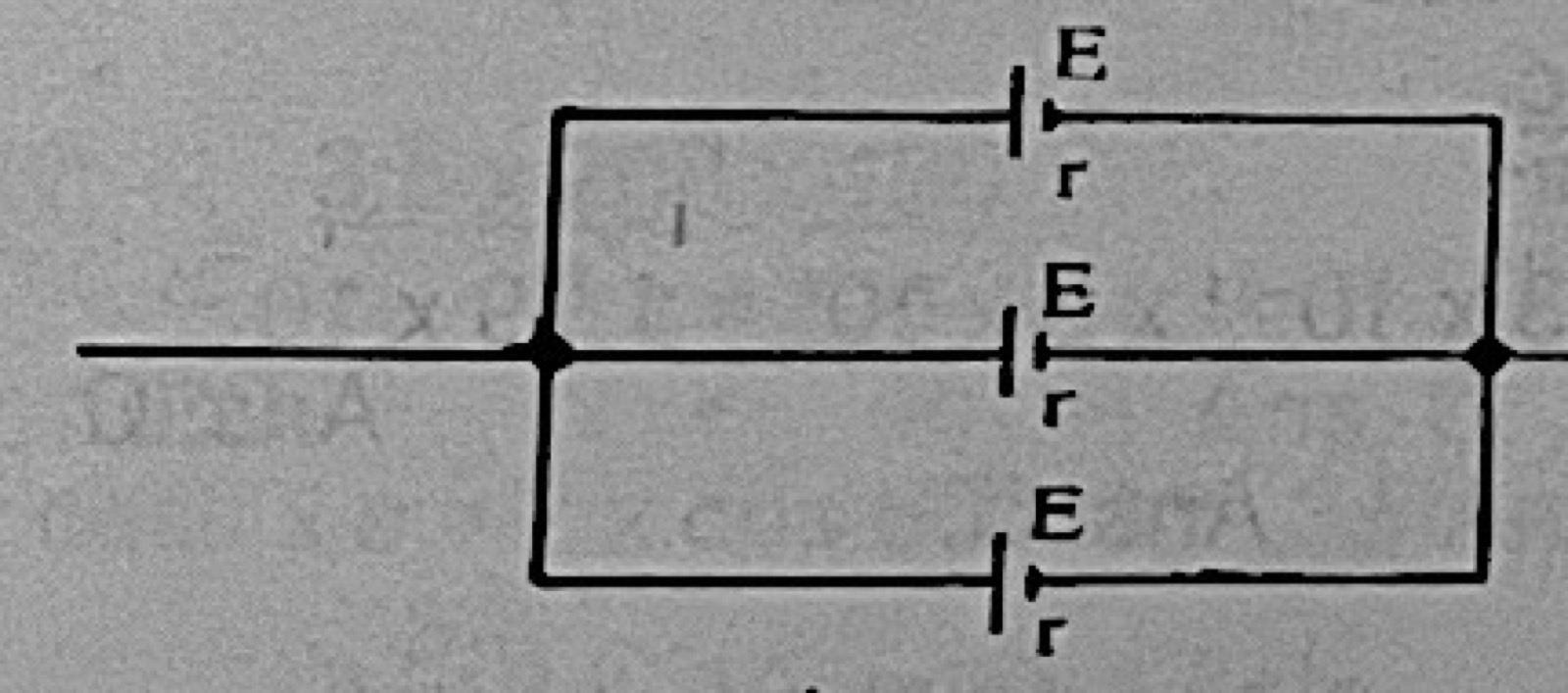
Three cells each of e.m.f. 1.5 V and internal resistance 2.5Ω are connected as shown in the diagram above. Find the net e.m.f. and the internal resistance.
A.4.5V, 7.50 Ω.
B.4.5V, 0.83 Ω.
C.1.5V, 7.50 Ω.
D.1.5V, 0.83 Ω.
Show the answer and explanation
Answer: D (1.5V, 0.83 Ω.)
Explanation
Identical cells in parallel give the e.m.f. of one cell, 1.5 V. Their internal resistances are in parallel: 2.5 ÷ 3 ≈ 0.83 Ω.
A 120 V, 60 W lamp is to be operated on 220 V a.c. supply mains. Calculate the value of non-inductive resistance that would be required to ensure that the lamp is run on correct value.
A.500Ω.
B.300Ω.
C.200Ω.
D.100Ω.
Show the answer and explanation
Answer: C (200Ω.)
Explanation
Lamp current I = P/V = 60 ÷ 120 = 0.5 A. The resistor in series must take the other 220 − 120 = 100 V, so R = 100 ÷ 0.5 = 200 Ω.
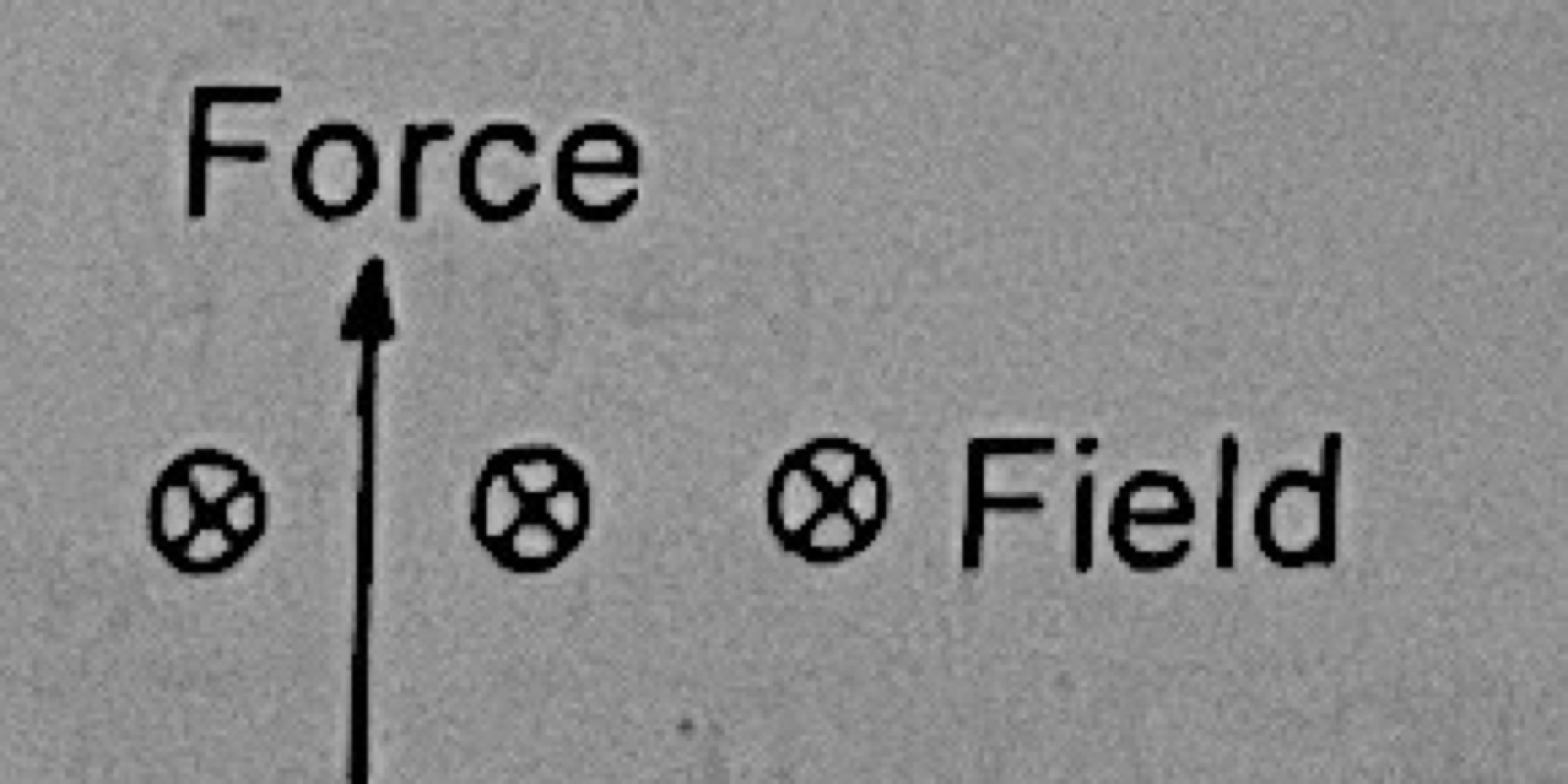
In the diagram above, if the magnetic field points into the paper and the force on a current-carrying conductor points upwards, what is the direction of the current?
A.Downwards
B.Right
C.Left
D.Upwards
Show the answer and explanation
Answer: B (Right)
Explanation
Fleming's left-hand rule: point the first finger into the paper (field) and the thumb up (force); the second finger then points to the right, which is the current direction.
The instantaneous value of the induced e.m.f. as a function of time is ε=ε0 sin ωt where ε0 is the peak value of the e.m.f. The instantaneous value of the e.m.f., one quarter of the period, is
A.ε0
B.ε0/2
C.ε0/4
D.0.
Show the answer and explanation
Answer: A (ε0)
Explanation
ω = 2π/T, so at t = T/4 the angle ωt = π/2. ε = ε0 sin 90° = ε0.
A charge 50 μC has an electric field strength of 360 NC−1 at a certain point. The electric field strength due to another charge 120 μC kept at the same distance apart and in the same medium is
A.18 NC−1
B.144 NC−1
C.150 NC−1
D.864 NC−1
Show the answer and explanation
Answer: D (864 NC−1)
Explanation
At the same distance, E = kq/r2 is proportional to q. E = 360 × 120/50 = 864 N C−1.
Two long parallel wires X and Y carry currents 3A and 5A respectively. If the force experienced per unit length by X is 5 × 10⁻⁵ N, the force per unit length experienced by wire Y is
A.5 × 10−4 N.
B.3 × 10−6 N.
C.3 × 10−5 N.
D.5 × 10−5 N.
Show the answer and explanation
Answer: D (5 × 10⁻⁵ N.)
Explanation
The force per unit length between two wires is μ0IXIY/2πr, the same expression for both wires (Newton's third law). So Y feels the same 5 × 10⁻⁵ N per metre.
The ratio of the coefficient of linear expansion of two metals α1/α2 is 3:4. If, when heated through the same temperature change, the ratio of the increase in lengths of the two metals, e1/e2 is 1:2, the ratio of the original lengths is l1/l2
A.2/3
B.8/3
C.3/8
D.3/2
Show the answer and explanation
Answer: A (2/3)
Explanation
Expansion e = αlΔθ with the same Δθ, so e1/e2 = (α1/α2)(l1/l2). 1/2 = (3/4)(l1/l2), so l1/l2 = 2/3.
I. Mass II. Density III. Temperature IV. Nature of substance. Which of the above affect diffusion?
A.I, II and IV only
B.II, III and IV only
C.I, II, III and IV.
D.I and II only.
Show the answer and explanation
Answer: C (I, II, III and IV.)
Explanation
Lighter, less dense molecules diffuse faster (Graham's law), molecules move faster at higher temperature, and diffusion is quicker in gases than in liquids. So mass, density, temperature and the nature of the substance all matter.
A string of length 4 m is extended by 0.02 m when a load of 0.4 kg is suspended at its end. What will be the length of the string when the applied force is 15 N? [g=10ms−2]
A.5.05 m
B.6.08 m
C.4.05 m
D.4.08 m
Show the answer and explanation
Answer: D (4.08 m)
Explanation
k = F/e = (0.4 × 10) ÷ 0.02 = 200 N m−1. A 15 N force stretches it 15 ÷ 200 = 0.075 m, so the length is 4 + 0.075 ≈ 4.08 m.
I. Use a liquid with a high melting point. II. Use a liquid of high volume expansivity. III. Use a capillary tube of large diameter. Which of the above best describes how the sensitivity of a liquid-in-glass thermometer can be enhanced?
A.II only
B.II and III only
C.I only
D.I and III only
Show the answer and explanation
Answer: A (II only)
Explanation
A thermometer is more sensitive when the liquid expands a lot per degree (high expansivity) and the bore is narrow. A wide tube or a high melting point does not help.
I. Increase the melting point of the liquid. II. Increase the boiling point of the liquid. III. Decrease the melting point of the liquid. IV. Decrease the boiling point of the liquid. Which of the statements above about the effects of increase in pressure in a liquid are correct?
A.II and III only
B.I and II only
C.III and IV only
D.I and III only
Show the answer and explanation
Answer: A (II and III only)
Explanation
Higher pressure makes a liquid boil at a higher temperature (pressure cooker). For water, higher pressure lowers the melting point (regelation). So II and III are correct.
A blacksmith heated a metal whose cubic expansivity is 6.3 × 10⁻⁶ K−1. The real expansivity is
A.6.3 × 10−6 K−1.
B.4.2 × 10−6 K−1.
C.2.1 × 10−6 K−1.
D.2.0 × 10−6 K−1.
Show the answer and explanation
Answer: A (6.3 × 10⁻⁶ K−1.)
Explanation
For a solid, the cubic expansivity is its real expansivity (the real/apparent distinction applies to liquids in containers), so the real expansivity is 6.3 × 10⁻⁶ K−1.
A reservoir 500 m deep is filled with a fluid of density 850 kgm−3. If the atmospheric pressure is 1.05 × 10⁵ Nm−2, the pressure at the bottom of the reservoir is [g=10ms−2]
2 kg of water is heated with a heating coil which draws 3.5 A from a 200 V mains for 2 minutes. What is the increase in temperature of the water? [Specific heat capacity of water = 4200 Jkg−1 K−1]
A boy drags a bag of rice along a smooth horizontal floor with a force of 2 N applied at an angle of 60° to the floor. The work done after a distance of 3 m is
A.6 J.
B.5 J.
C.4 J.
D.3 J.
Show the answer and explanation
Answer: D (3 J.)
Explanation
Only the horizontal component of the force does work: W = F cos 60° × s = 2 × 0.5 × 3 = 3 J.
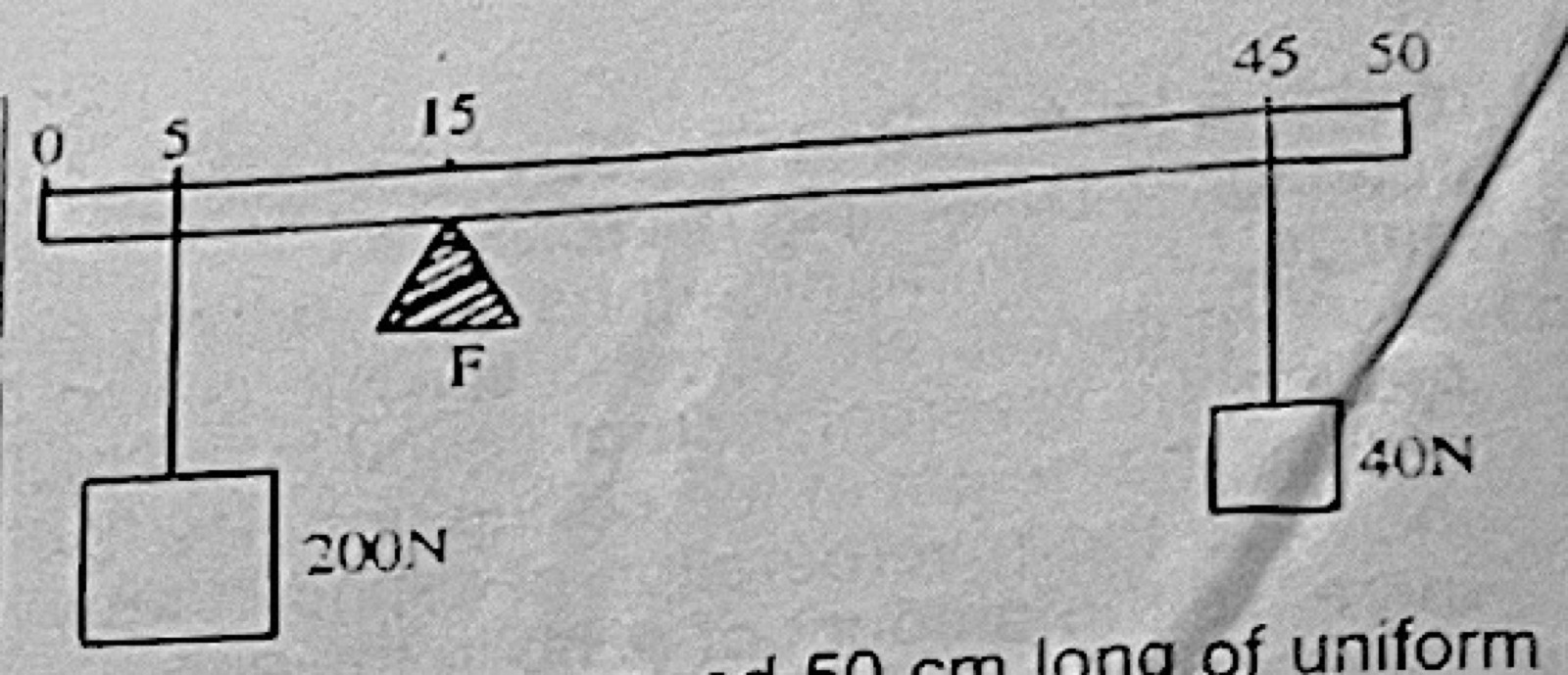
In the diagram above, a rod 50 cm long of uniform cross-section is suspended horizontally on a fulcrum, F, by the action of two forces. What is the weight of the rod?
A.120N
B.200 N
C.40 N
D.80 N.
Show the answer and explanation
Answer: D (80 N.)
Explanation
The rod's weight W acts at its middle (25 cm), 10 cm right of F. Moments about F: 200 × 10 = 40 × 30 + W × 10, so 2000 = 1200 + 10W and W = 80 N.
A particle of weight 120 N is placed on a plane inclined at an angle 30° to the horizontal. If the plane has an efficiency of 60%, what is the force required to push the weight uniformly up the plane?
A.210 N
B.175 N
C.100 N
D.50 N.
Show the answer and explanation
Answer: C (100 N)
Explanation
VR = 1/sin 30° = 2. MA = efficiency × VR = 0.6 × 2 = 1.2. Effort = load ÷ MA = 120 ÷ 1.2 = 100 N.
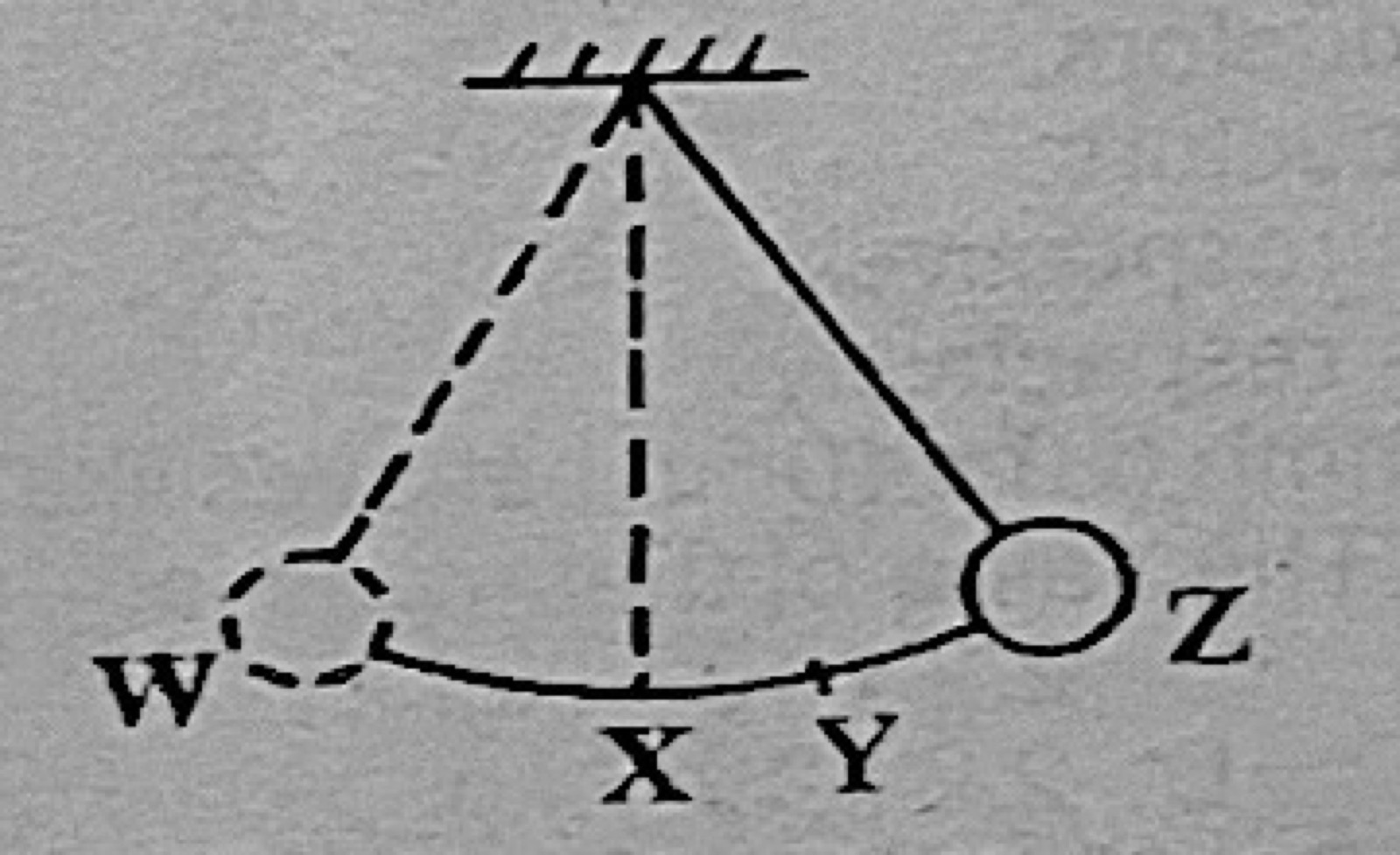
From the diagram above, the bob of the pendulum has the fastest speed at
A.W.
B.Z.
C.Y.
D.X.
Show the answer and explanation
Answer: D (X.)
Explanation
The bob moves fastest at the lowest point of its swing, X, where all its potential energy has become kinetic energy. It is momentarily at rest at W and Z.