Home › Past questions › JAMB › Physics › 2002 49 questions. Try each one, then open the answer to check yourself and read the explanation.
Sign up free to answer these questions on a CBT screen with a timer, then see your score and every answer explained.
Start practising free
Question 1 Newton's Laws and Momentum If the total force acting on a particle is zero, the linear momentum will
A. increase then decrease B. be constant C. increase D. decrease. Show the answer and explanation Answer: B (be constant )
Explanation Zero resultant force means no change in momentum (Newton's second law), so the momentum stays constant.
Open this question
Question 2 Friction The effect of a particle in a fluid attaining its terminal velocity is that the
A. weight is equal to the retarding force B. acceleration is maximum C. buoyancy force is more than the weight of the fluid displaced D. buoyancy force is equal to the viscous retarding force. Show the answer and explanation Answer: A (weight is equal to the retarding force )
Explanation At terminal velocity the forces balance: the weight equals the total upward (retarding) force, so the acceleration is zero.
Open this question
Question 3 Gravitational Field If the distance between two suspended masses 10kg each is tripled, the gravitational force of attraction between them is reduced by
A. one quarter B. one ninth C. one half D. one third. Show the answer and explanation Answer: B (one ninth )
Explanation F ∝ 1/d2 , so tripling d makes the force (1/3)2 = 1/9 of its old value.
Open this question
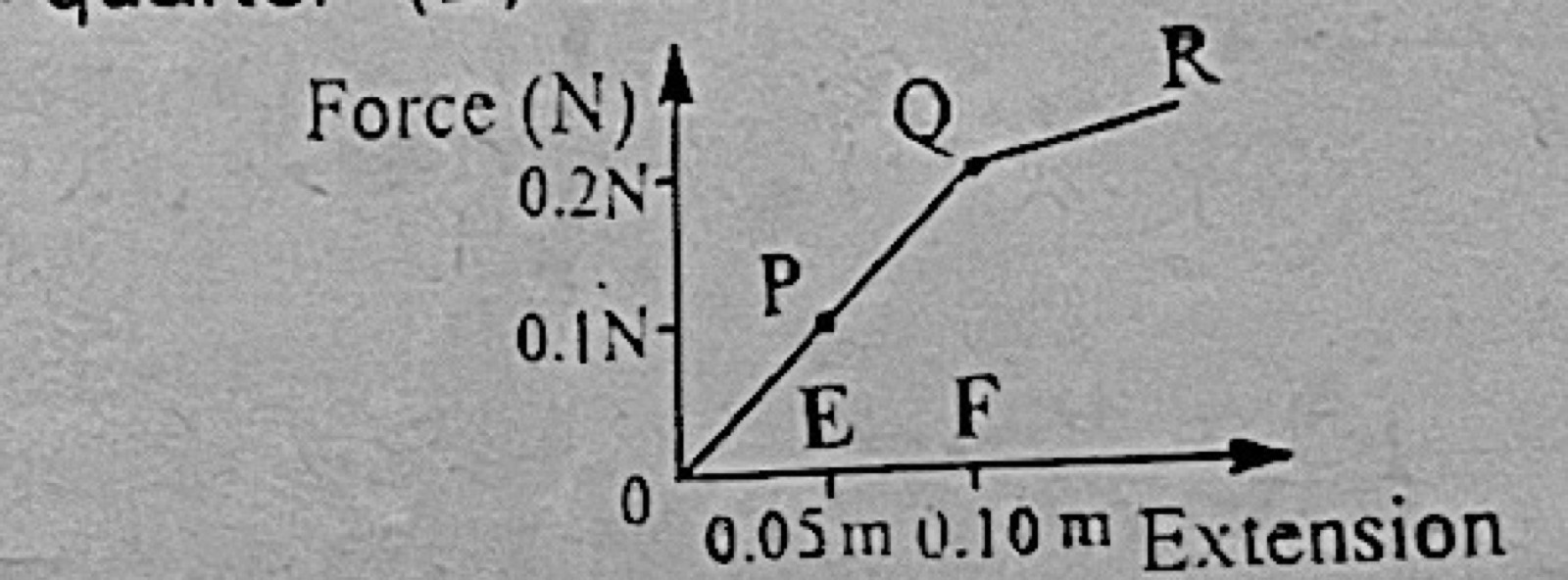
Question 4 Elasticity The diagram above shows the force-extension curve of a piece of wire. The energy stored when the wire is stretched from E to F is
A. 1.5 × 10⁻² J B. 7.5 × 10⁻¹ J C. 7.5 × 10⁻³ J D. 2.5 × 10⁻³ J Show the answer and explanation Answer: C (7.5 × 10⁻³ J )
Explanation Energy = area under the graph from E (0.05 m, 0.1 N) to F (0.10 m, 0.2 N) = ½(0.1 + 0.2) × 0.05 = 7.5 × 10⁻³ J.
Open this question
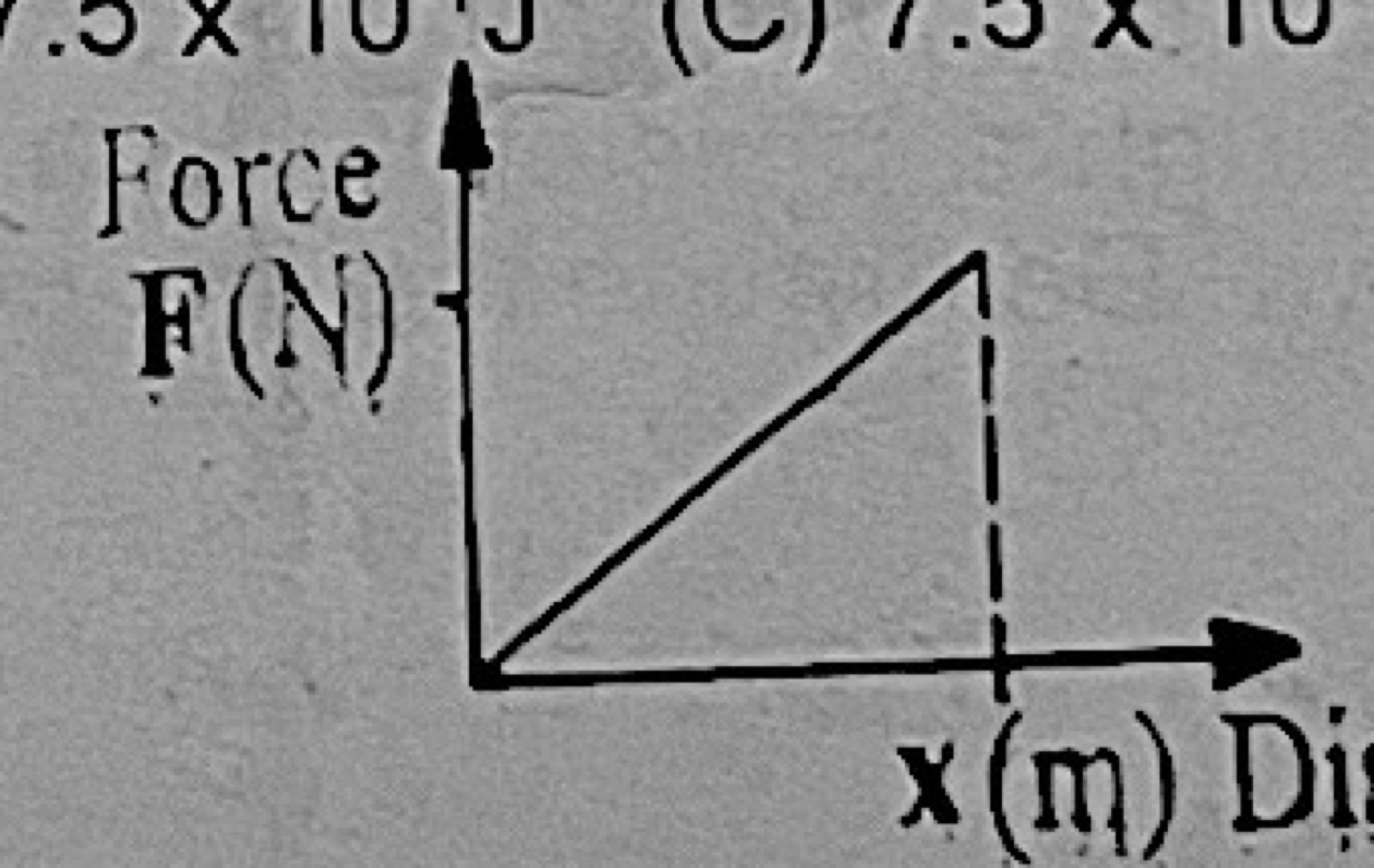
Question 5 Work, Energy and Power The diagram above shows the force (F) acting on an object through a distance (x). The work done on this object is expressed as
A. Fx2 J B. Fx J C. F/x J D. Fx/2 J Show the answer and explanation Answer: D (Fx/2 J )
Explanation Work done is the area under the force–distance graph, a triangle of base x and height F, so W = ½Fx = Fx/2.
Open this question
Question 6 Simple Machines A wheel and axle is used to raise a load of 500 N by the application of an effort of 250N. If the radii of the wheel and the axle are 0.4cm and 0.1 cm respectively, the efficiency of the machine is
A. 60% B. 50% C. 40% D. 20% Show the answer and explanation Answer: B (50% )
Explanation VR = 0.4/0.1 = 4 and MA = 500/250 = 2, so efficiency = 2/4 × 100% = 50%.
Open this question
Question 7 Scalars and Vectors Two forces each of 10N act on a body, one towards the north and the other towards the east. The magnitude and the direction of the resultant force are
A. 10√2 N, 45°E B. 10√2 N, 45°W C. 20N, 45°W D. 20N, 45°E Show the answer and explanation Answer: A (10√2 N, 45°E )
Explanation R = √(102 + 102 ) = 10√2 N, and tan θ = 10/10 gives 45° between north and east (N45°E).
Open this question
Question 8 Pressure The hydrostatic blood pressure difference between the head and feet of a boy standing straight is 1.65 × 10⁴ Nm−2 . Find the height of the boy. [Density of blood = 1.1 × 10³ kgm−3 , g = 10ms−2 ]
A. 0.6m B. 0.5m C. 2.0m D. 1.5m Show the answer and explanation Answer: D (1.5m )
Explanation h = P/(ρg) = 1.65 × 10⁴ ÷ (1.1 × 103 × 10) = 1.5 m.
Open this question
Question 9 Newton's Laws and Momentum A body weighing 80N stands in an elevator that is about to move. The force exerted by the floor on the body as the elevator moves upwards with an acceleration of 5ms−2 is [g = 10ms−2 ]
A. 160 N B. 120N C. 80N D. 40N Show the answer and explanation Answer: B (120N )
Explanation Mass = 80/10 = 8 kg. R = m(g + a) = 8 × (10 + 5) = 120 N.
Open this question
Question 10 Density and Upthrust A copper cube weighs 0.25N in air, 0.17N when completely immersed in paraffin oil and 0.15N when completely immersed in water. The ratio of upthrust in oil to upthrust in water is
A. 4:5 B. 3:5 C. 13:10 D. 7:10 Show the answer and explanation Answer: A (4:5 )
Explanation Upthrust in oil = 0.25 − 0.17 = 0.08 N; in water = 0.25 − 0.15 = 0.10 N; ratio 0.08 : 0.10 = 4 : 5.
Open this question
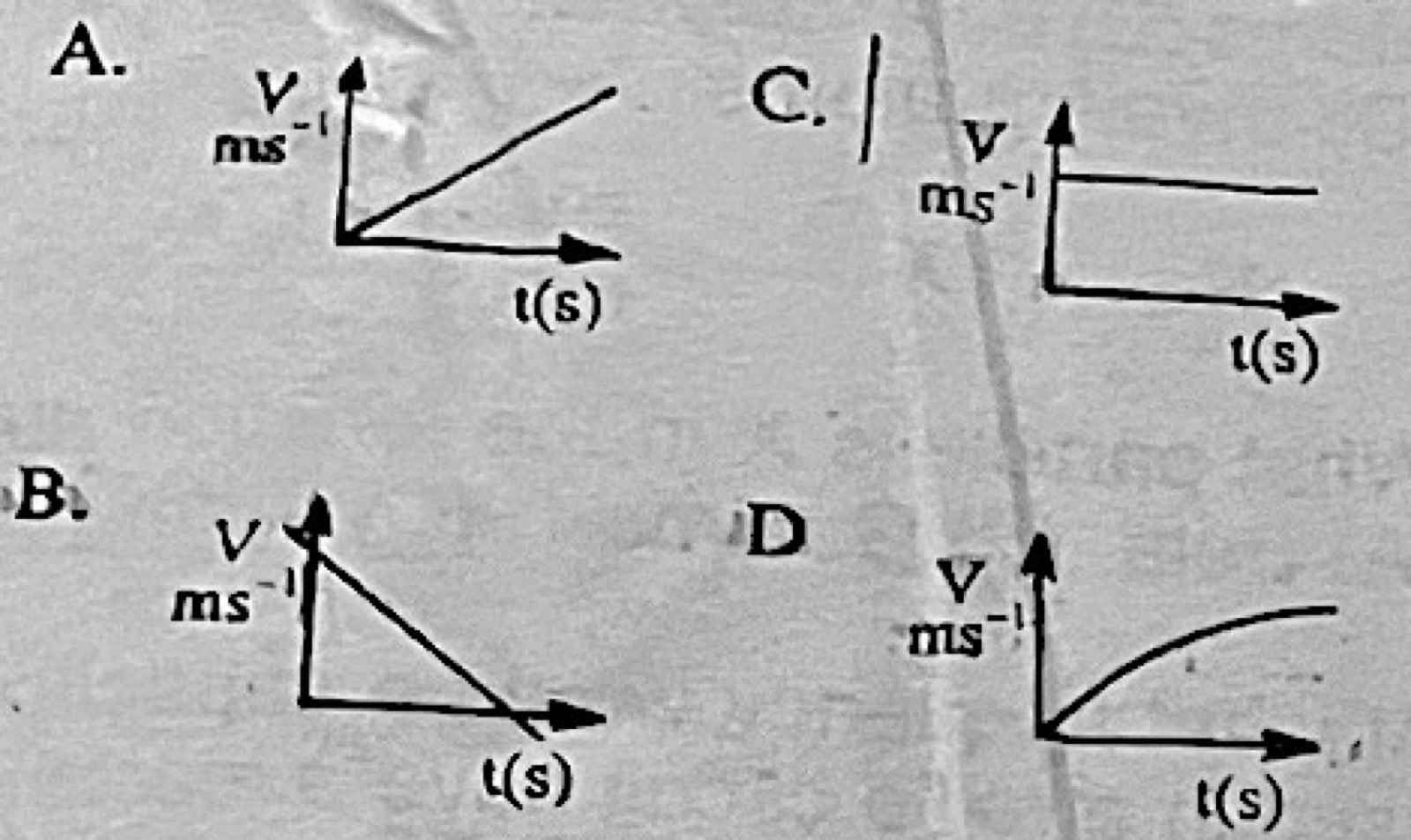
Question 11 Friction Which of the following is the correct shape of the velocity-time graph of a spherical steel ball dropped into a viscous fluid in a tall cylinder?
A. Graph A B. Graph B C. Graph C D. Graph D Show the answer and explanation Answer: D (Graph D )
Explanation The ball speeds up quickly at first, then the viscous drag grows until it reaches a steady terminal velocity, so the curve rises and levels off (graph D).
Open this question
Question 12 Motion A particle in circular motion performs 30 oscillations in 6 seconds. Its angular velocity is
A. 10π rad s−1 B. 5π rad s−1 C. 6 rad s−1 D. 5 rad s−1 Show the answer and explanation Answer: A (10π rad s−1 )
Explanation f = 30/6 = 5 Hz, so ω = 2πf = 10π rad s−1 .
Open this question
Question 13 Sound I. Temperature. II. Density of air molecules. III. Pressure. IV. Pitch.
A. I, II, III and IV. B. I, II and IV only. C. II and IV only. D. I and II only. Show the answer and explanation Answer: D (I and II only. )
Explanation The speed of sound in air depends on temperature and on the density of the air; pressure alone (at fixed temperature) and pitch do not change it.
Open this question
Question 14 Refraction of Light A coin placed below a rectangular glass block of thickness 9 cm and refractive index 1.5 is viewed vertically above the block. The apparent displacement of the coin is
A. 8cm B. 6 cm C. 5 cm D. 3cm Show the answer and explanation Answer: D (3cm )
Explanation Apparent depth = 9/1.5 = 6 cm, so the coin appears raised by 9 − 6 = 3 cm.
Open this question
Question 15 Sound The phenomenon that makes sound persist when its source has been removed is known as
A. rarefaction B. acoustic vibration C. reverberation D. echo. Show the answer and explanation Answer: C (reverberation )
Explanation Reverberation is the persistence of sound in a room after the source stops, caused by many overlapping reflections.
Open this question
Question 16 Refraction of Light A ray of light which strikes a glass slab from air at normal incidence passes through the slab
A. deviated and undisplaced at a lower speed B. undeviated and displaced at a faster speed C. undeviated and undisplaced at a lower speed D. deviated and displaced at a lower speed Show the answer and explanation Answer: C (undeviated and undisplaced at a lower speed )
Explanation At normal incidence the ray does not bend, so it goes straight through without deviation or sideways displacement; it travels more slowly in glass.
Open this question
Question 17 Waves The colours seen in soap bubbles are due to
A. interference B. dispersion C. diffraction D. refraction. Show the answer and explanation Answer: A (interference )
Explanation Light reflected from the front and back surfaces of the thin soap film interferes; different thicknesses reinforce different colours.
Open this question
Question 18 Gas Laws The pressure of 3 moles of an ideal gas at a temperature of 27°C having a volume of 10−3 m3 is [R = 8.3 J mol−1 K−1 ]
A. 2.49 × 10⁶ Nm−2 B. 7.47 × 10⁶ Nm−2 C. 2.49 × 10⁵ Nm−2 D. 7.47 × 10⁵ Nm−2 Show the answer and explanation Answer: B (7.47 × 10⁶ Nm−2 )
Explanation P = nRT/V = 3 × 8.3 × 300 ÷ 10−3 = 7.47 × 10⁶ N m−2 .
Open this question
Question 19 Light and Reflection To produce an enlarged and erect image with a concave mirror, the object must be positioned
A. between the principal focus and the centre of curvature B. at the principal focus C. between the principal focus and the pole D. beyond the centre of curvature. Show the answer and explanation Answer: C (between the principal focus and the pole )
Explanation Only an object inside the focal length of a concave mirror gives a virtual, erect, magnified image.
Open this question
Question 20 Change of State and Vapours Blowing air over a liquid aids evaporation by
A. increasing its temperature B. increasing its surface area C. decreasing its density D. decreasing its vapour pressure. Show the answer and explanation Answer: D (decreasing its vapour pressure. )
Explanation Moving air carries away the vapour above the liquid, lowering the vapour pressure there so more molecules can escape.
Open this question
Question 22 Lenses and Optical Instruments Which of the following eye defects can be corrected using a cylindrical lens?
A. Astigmatism B. Presbyopia. C. Chromatic aberration. D. Myopia. Show the answer and explanation Answer: A (Astigmatism )
Explanation Astigmatism comes from unequal curvature of the cornea in different directions; a cylindrical lens corrects curvature in one direction only.
Open this question
Question 23 Heat Transfer The radiator of a motor car is cooled by
A. radiation and conduction B. convection C. conduction D. radiation. Show the answer and explanation Answer: B (convection )
Explanation Air flowing through the radiator carries the heat away, which is cooling by (forced) convection.
Open this question
Question 24 Waves Vibrations in a stretched spring cannot be polarized because they are
A. transverse waves B. mechanical waves C. stationary waves D. longitudinal waves. Show the answer and explanation Answer: D (longitudinal waves. )
Explanation Only transverse waves can be polarized; vibrations along a stretched spring are longitudinal.
Open this question
Question 25 Quantity of Heat The time rate of loss of heat by a body is proportional to the
A. temperature of its surroundings B. temperature of the body C. difference in temperature between the body and its surroundings D. ratio of the temperature of the body to that of its surroundings. Show the answer and explanation Answer: C (difference in temperature between the body and its surroundings )
Explanation Newton's law of cooling: the rate of heat loss is proportional to the excess temperature of the body over its surroundings.
Open this question
Question 26 Waves The property that is propagated in a travelling wave is
A. amplitude B. energy C. wavelength D. frequency. Show the answer and explanation Answer: B (energy )
Explanation A travelling wave carries energy from one place to another without carrying the medium along.
Open this question
Question 27 Waves Which of the following is a characteristic of stationary waves?
A. The antinode is a point of minimum displacement. B. The distance between two successive nodes is one wavelength. C. They are formed by two identical waves travelling in opposite directions. D. They can be transverse or longitudinal. Show the answer and explanation Answer: C (They are formed by two identical waves travelling in opposite directions. )
Explanation A stationary wave forms when two identical waves travel in opposite directions and superpose. Antinodes have maximum displacement and nodes are half a wavelength apart.
Open this question
Question 28 Light and Reflection A concave mirror of radius of curvature 40cm forms a real image twice as large as the object. The object distance is
A. 30cm B. 40cm C. 60cm D. 10cm Show the answer and explanation Answer: A (30cm )
Explanation f = 20 cm and v = 2u. 1/u + 1/(2u) = 1/20 gives 3/(2u) = 1/20, so u = 30 cm.
Open this question
Question 29 Waves If tension is maintained on a stretched string of length 0.6m, such that its fundamental frequency of 220Hz is excited, determine the velocity of the transverse wave in the string.
A. 66ms−1 B. 132ms−1 C. 264ms−1 D. 528ms−1 Show the answer and explanation Answer: C (264ms−1 )
Explanation For the fundamental, λ = 2L = 1.2 m, so v = fλ = 220 × 1.2 = 264 m s−1 .
Open this question
Question 30 Capacitors The energy stored in a capacitor of capacitance 10μF carrying a charge of 100μC is
A. 4 × 10⁻³ J B. 5 × 10⁻⁴ J C. 5 × 10⁻¹ J D. 4 × 10⁻² J Show the answer and explanation Answer: B (5 × 10⁻⁴ J )
Explanation E = Q2 /(2C) = (100 × 10−6 )2 ÷ (2 × 10 × 10−6 ) = 5 × 10⁻⁴ J.
Open this question
Question 31 Electrical Energy and Power An electric iron is rated 1000W, 230V. What is the resistance of its element?
A. 57.6Ω B. 55.9Ω C. 52.9Ω D. 51.9Ω Show the answer and explanation Answer: C (52.9Ω )
Explanation R = V2 /P = 2302 /1000 = 52.9 Ω.
Open this question
Question 32 Current Electricity An electric cell with nominal voltage E has a resistance of 3Ω connected across it. If the voltage falls to 0.6E, the internal resistance of the cell is
A. 4Ω B. 3Ω C. 2Ω D. 1Ω Show the answer and explanation Answer: C (2Ω )
Explanation The 3 Ω resistor gets 0.6E and the internal resistance the remaining 0.4E. With the same current, r = 3 × 0.4/0.6 = 2 Ω.
Open this question
Question 33 Electromagnetic Spectrum The electromagnetic wave that can produce a heating effect on the environment is
A. gamma rays B. infrared rays C. x-rays D. ultraviolet rays Show the answer and explanation Answer: B (infrared rays )
Explanation Infrared radiation is the part of the spectrum we feel as heat; it warms whatever absorbs it.
Open this question
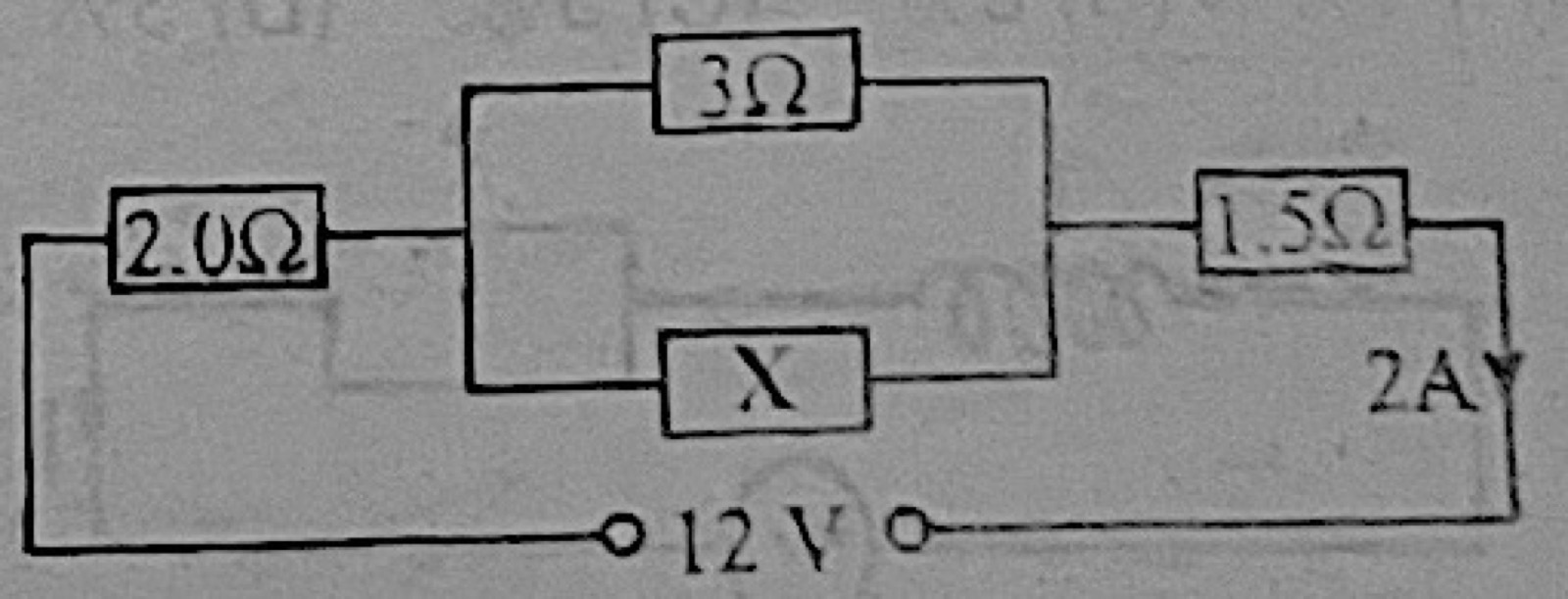
Question 34 Current Electricity From the diagram above, determine the value of the resistance X.
A. 9Ω B. 12Ω C. 15Ω D. 6Ω Show the answer and explanation Answer: C (15Ω )
Explanation Total resistance = 12 V ÷ 2 A = 6 Ω, so the parallel pair is 6 − 2 − 1.5 = 2.5 Ω. 3X/(3 + X) = 2.5 gives X = 15 Ω.
Open this question
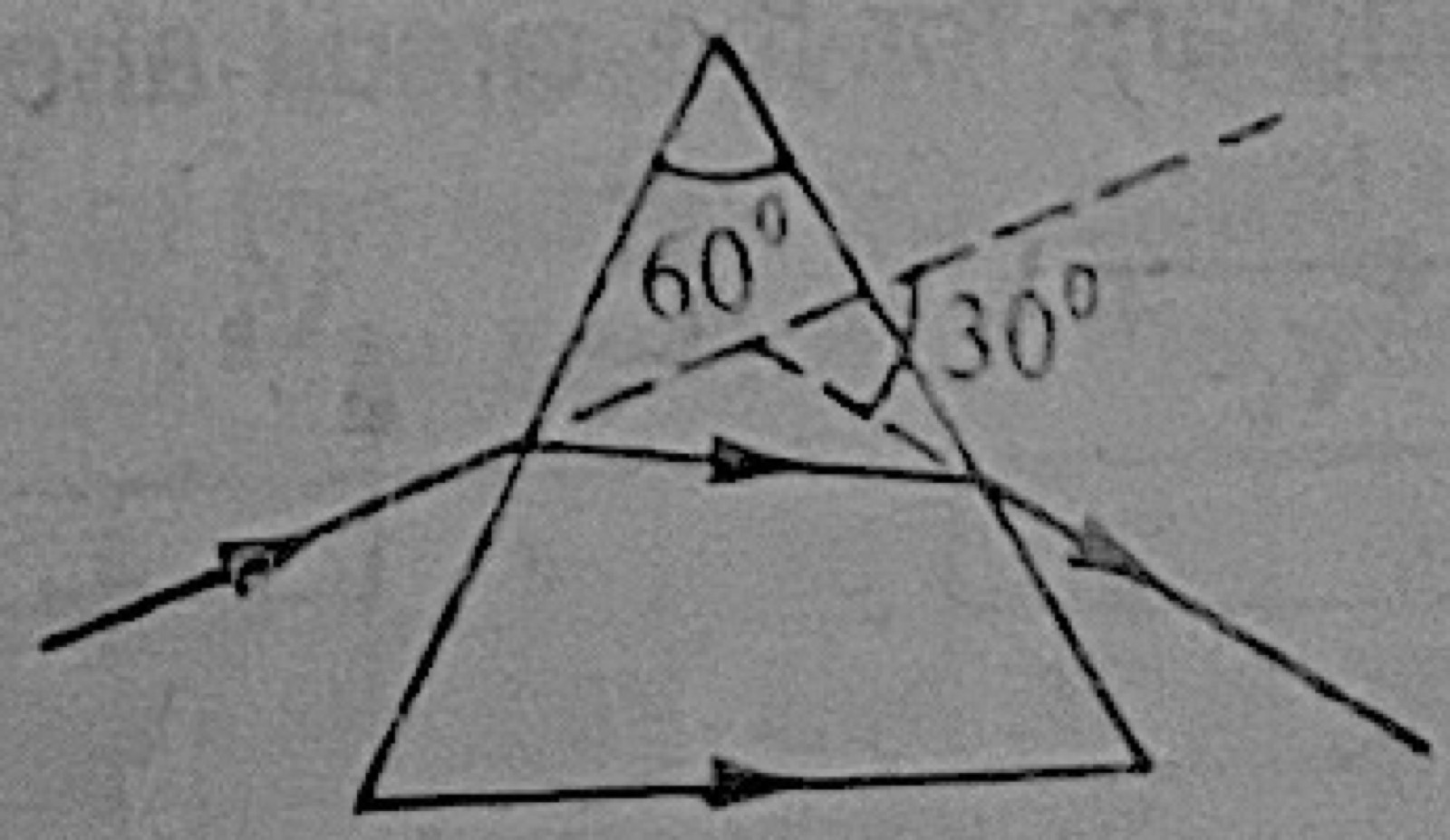
Question 35 Refraction of Light Calculate the refractive index of the material for the glass prism in the diagram above.
A. √2 B. 3/2 C. 2/3 D. 4/3 Show the answer and explanation Answer: A (√2 )
Explanation The ray passes through symmetrically (minimum deviation) with A = 60° and D = 30°: n = sin((60 + 30)/2) ÷ sin(60/2) = sin 45° ÷ sin 30° = √2.
Open this question
Question 36 Electrical Energy and Power When connected to a mains of 250V, the fuse rating in the plug of an electric device of 1kW is
A. 4A B. 2A C. 5A D. 3A Show the answer and explanation Answer: A (4A )
Explanation I = P/V = 1000 ÷ 250 = 4 A.
Open this question
Question 37 Lenses and Optical Instruments The eye controls the amount of light reaching the retina by adjusting the
A. retina B. optice nerve C. cornea D. iris. Show the answer and explanation Answer: D (iris. )
Explanation The iris changes the size of the pupil, letting in more or less light.
Open this question
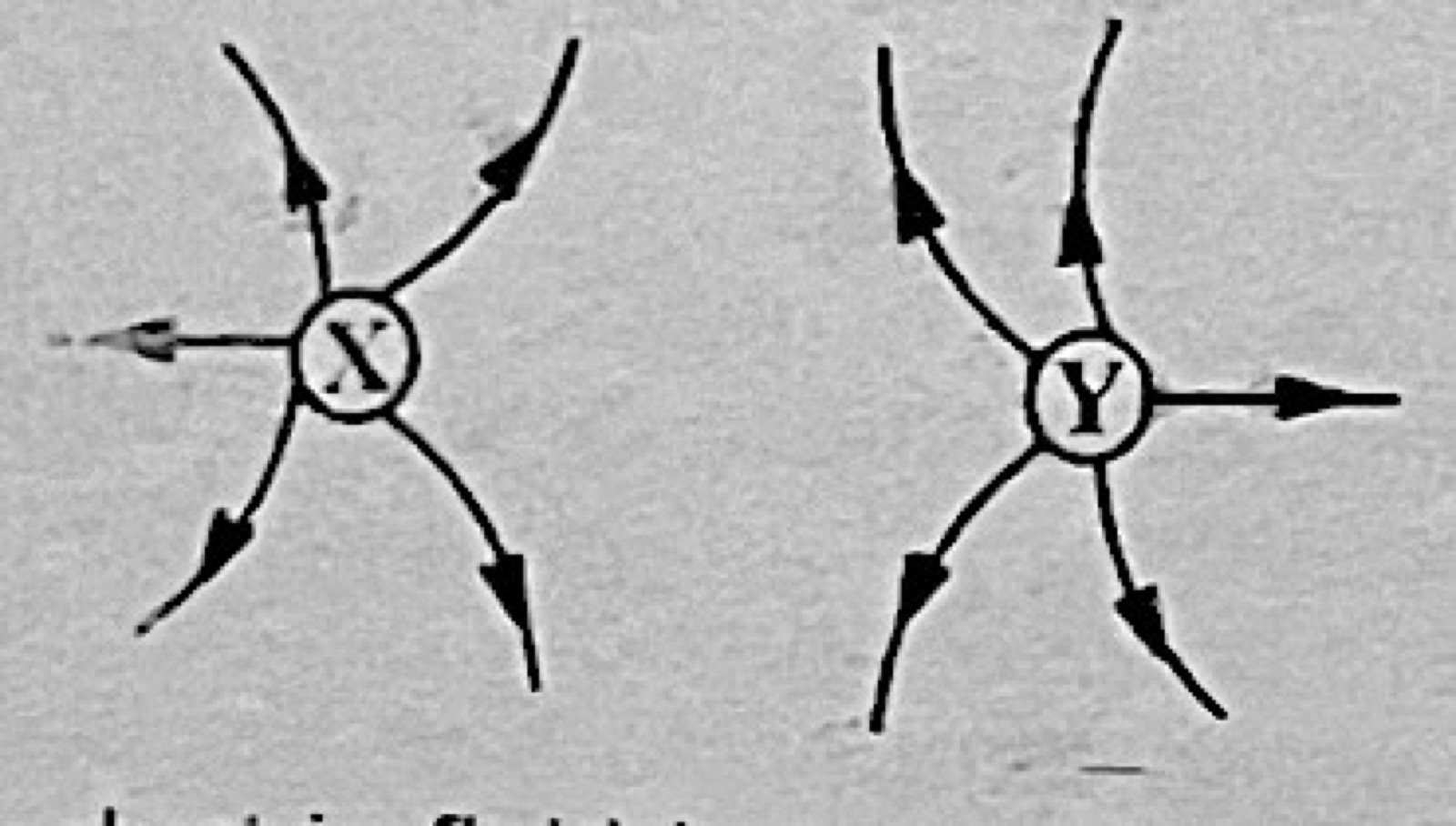
Question 38 Electrostatics The electric field between two-point charges is shown in the diagram above. What types of charges are at X and Y?
A. X is positive and Y is negative. B. X is negative and Y is positive. C. Both X and Y are positive. D. Both X and Y are negative. Show the answer and explanation Answer: C (Both X and Y are positive. )
Explanation Field lines point away from positive charges; here the lines leave both X and Y and bend away from each other, so both are positive.
Open this question
Question 39 Electronics A transistor is used in the amplification of signals because it
A. allows doping B. contains electron and hole carriers C. consumes a lot of power D. controls the flow of current. Show the answer and explanation Answer: D (controls the flow of current. )
Explanation A transistor amplifies because a small current at the base controls a much larger current through the collector and emitter, so a weak signal is reproduced as a strong one.
Open this question
Question 40 Conduction through Liquids and Gases A current of 0.5 A flowing for 3 h deposits 2g of a metal during electrolysis. The quantity of the same metal that would be deposited by a current of 1.5 A flowing in 1h is
A. 10g B. 18g C. 2g D. 6g Show the answer and explanation Answer: C (2g )
Explanation Mass deposited ∝ It. 0.5 × 3 = 1.5 × 1, so the same charge passes and the same 2 g is deposited.
Open this question
Question 41 Radioactivity and Nuclear Physics The particle that is responsible for nuclear fission in a nuclear reactor is
A. electron B. photon C. neutron D. proton. Show the answer and explanation Answer: C (neutron )
Explanation Slow neutrons are absorbed by uranium-235 nuclei and make them split, releasing more neutrons that keep the chain reaction going.
Open this question
Question 42 Current Electricity The carbon-granule microphone works on the principle of change in
A. voltage B. inductance C. resistance D. capacitance. Show the answer and explanation Answer: C (resistance )
Explanation Sound pressure squeezes the carbon granules, changing their resistance and so the current in the circuit.
Open this question
Question 43 Modern Physics The energy associated with the photon of a radio transmission at 3 × 10⁵ Hz is [h = 6.63 × 10⁻³⁴ Js]
A. 1.30 × 10⁻²⁹ J B. 2.00 × 10⁻²⁹ J C. 1.30 × 10⁻²⁸ J D. 2.00 × 10⁻²⁸ J Show the answer and explanation Answer: D (2.00 × 10⁻²⁸ J )
Explanation E = hf = 6.63 × 10−34 × 3 × 105 ≈ 2.0 × 10⁻²⁸ J.
Open this question
Question 44 Electromagnetic Induction From the generating station to each substation, power is transmitted at a very high voltage so as to reduce
A. eddy current loss B. hysteresis loss C. heating in the coils D. magnetic flux leakage. Show the answer and explanation Answer: C (heating in the coils )
Explanation At high voltage the current is small, so the I2 R heating loss in the conductors is small.
Open this question
Question 45 Radioactivity and Nuclear Physics The percentage of the original nuclei of a sample of a radioactive substance left after 5 half-lives is
A. 1% B. 8% C. 5% D. 3% Show the answer and explanation Answer: D (3% )
Explanation After 5 half-lives the fraction left is (½)5 = 1/32 ≈ 3.1%, which is about 3%.
Open this question
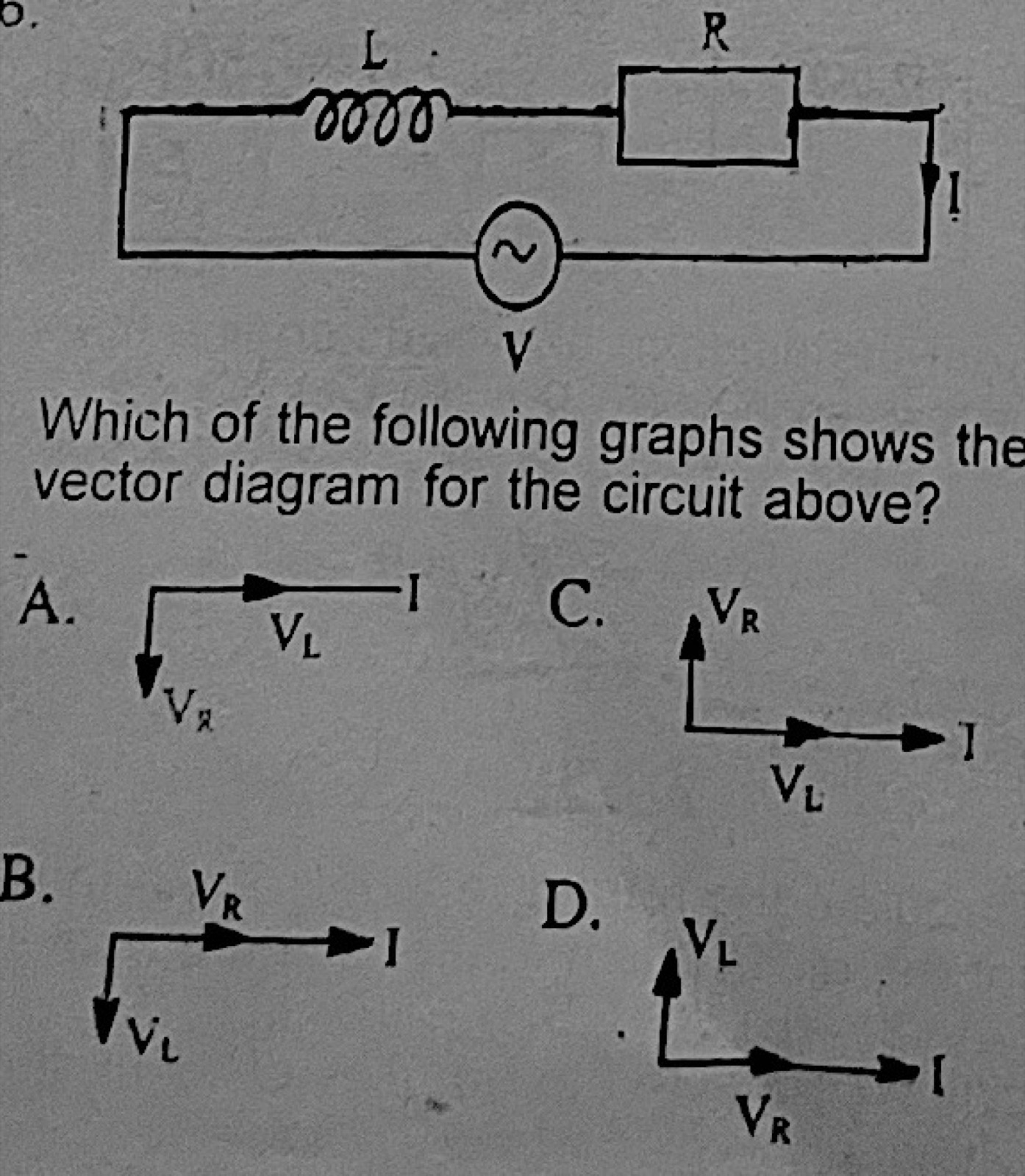
Question 46 Alternating Current Circuits Which of the following graphs shows the correct vector diagram for the circuit above?
A. Diagram A B. Diagram B C. Diagram C D. Diagram D Show the answer and explanation Answer: D (Diagram D )
Explanation In an inductor–resistor circuit VR is in phase with the current I, and VL leads I by 90°. Diagram D shows VR along I and VL at right angles, ahead of it.
Open this question
Question 47 Magnetism Which of the following statements is true of the properties of a moving coil galvanometer?
A. There are strong hair springs to give a large control couple. B. It has a small number of turns of coil. C. The coil has a small area. D. There is a strong permanent magnet to give high magnetic flux. Show the answer and explanation Answer: D (There is a strong permanent magnet to give high magnetic flux. )
Explanation A sensitive galvanometer needs a strong magnet, many turns, a large coil area and weak hair springs; only D is true.
Open this question
Question 48 Electronics Pure silicon can be converted to a p-type material by adding a controlled amount of
A. pentavalent atoms B. hexavalent atoms C. tetravalent atoms D. trivalent atoms Show the answer and explanation Answer: D (trivalent atoms )
Explanation Trivalent atoms (e.g. boron) have one electron too few for the bonds, which creates holes: p-type.
Open this question
Question 49 Radioactivity and Nuclear Physics 23 11 Na + X → 20 9 F + 4 2 He
A. Beta B. Gamma C. Alpha D. Neutron Show the answer and explanation Answer: D (Neutron )
Explanation Mass numbers: 23 + A = 20 + 4 gives A = 1. Atomic numbers: 11 + Z = 9 + 2 gives Z = 0. A particle with mass 1 and charge 0 is a neutron.
Open this question
Question 50 Alternating Current Circuits At what frequency would a capacitor of 2.5μF used in a radio circuit have a reactance of 250Ω?
A. 800/π Hz B. 200π Hz C. 2000π Hz D. π/800 Hz Show the answer and explanation Answer: A (800/π Hz )
Explanation XC = 1/(2πfC), so f = 1 ÷ (2π × 250 × 2.5 × 10−6 ) = 800/π Hz.
Open this question Sign up free for every JAMB Physics year, practice by topic and timed mocks.
Start practising free