JAMB Physics 2000 past questions and answers

47 questions. Try each one, then open the answer to check yourself and read the explanation.

Question 2

Equilibrium of Forces

A hand bag containing some load weighing 162 N is carried by two students each holding the handle of the bag next to him. If each handle is pulled 60° to the vertical, find the force on each student's arm.

  1. A.324 N
  2. B.162 N
  3. C.121 N
  4. D.81 N
Show the answer and explanation

Answer: B (162 N)

Explanation

Each pull T has a vertical part T cos 60° = T/2. The two together hold up the bag: 2 × T/2 = 162, so T = 162 N.

Open this question

Question 3

Friction

I. The frictional force is independent of the area of the surfaces in contact.
II. The frictional force depends on the nature of the surfaces in contact.
III. The frictional force depends on the speed of sliding.
IV. The frictional force is directly proportional to the normal reaction.
Which combination of the above is true of sliding friction?

  1. A.I, II and IV
  2. B.I, II and III
  3. C.I, III and IV
  4. D.II, III and IV
Show the answer and explanation

Answer: A (I, II and IV)

Explanation

The laws of sliding friction: it does not depend on contact area or (roughly) on speed, it depends on the surfaces, and it is proportional to the normal reaction. So I, II and IV.

Open this question

Question 4

Density and Upthrust

When a ship sails from salt water into fresh water, the fraction of its volume above the water surface will

  1. A.remain the same
  2. B.increase
  3. C.decrease
  4. D.increase then decrease.
Show the answer and explanation

Answer: C (decrease)

Explanation

Fresh water is less dense, so the ship must sink deeper to displace its own weight; less of it stays above the surface.

Open this question

Question 5

Simple Harmonic Motion

A simple pendulum has a period of 17.0 s. When the length is shortened by 1.5 m, its period is 8.5 s. Calculate the original length of the pendulum.

  1. A.1.5 m
  2. B.2.0 m
  3. C.3.0 m
  4. D.4.0 m
Show the answer and explanation

Answer: B (2.0 m)

Explanation

T ∝ √L, so (17/8.5)2 = L/(L − 1.5), i.e. 4 = L/(L − 1.5). Then 4L − 6 = L and L = 2.0 m.

Open this question

Question 6

Pressure

At a fixed point below a liquid surface, the pressure downward is P1 and the pressure upward is P2. It can be deduced that

  1. A.P1 = P2
  2. B.P1 > P2
  3. C.P1 < P2
  4. D.P1 ≥ P2
Show the answer and explanation

Answer: A (P1 = P2)

Explanation

Pressure at a point in a liquid acts equally in all directions, so the downward and upward pressures at the same point are equal.

Open this question

Question 7

Motion

I. Its velocity is constant
II. No work is done on the body.
III. It has constant acceleration directed away from the centre.
IV. The centripetal force is directed towards the centre.
Which combination of the above is true of a body moving with constant speed in a circular track?

  1. A.I and III
  2. B.I and IV
  3. C.II and III
  4. D.II and IV
Show the answer and explanation

Answer: D (II and IV)

Explanation

The direction keeps changing, so velocity is not constant (I false) and acceleration is towards the centre (III false). The force is towards the centre and at right angles to the motion, so it does no work (II, IV true).

Open this question

Question 8

Motion

The velocity v of a particle in a time t is given by the equation v = 10 + 2t2. Find the instantaneous acceleration after 5 seconds.

  1. A.10 m s−2
  2. B.15 m s−2
  3. C.20 m s−2
  4. D.60 m s−2
Show the answer and explanation

Answer: C (20 m s−2)

Explanation

a = dv/dt = 4t. At t = 5 s, a = 20 m s−2.

Open this question

Question 9

Work, Energy and Power

If the force and the velocity on a system are each reduced simultaneously by half, the power of the system is

  1. A.doubled
  2. B.constant
  3. C.reduced to a quarter
  4. D.reduced by half.
Show the answer and explanation

Answer: C (reduced to a quarter)

Explanation

Power = force × velocity, so halving both gives ½ × ½ = ¼ of the original power.

Open this question

Question 10

Simple Machines

The velocity ratio of a machine is 5 and its efficiency is 75%. What effort would be needed to lift a load of 150 N with the machine?

  1. A.50 N
  2. B.40 N
  3. C.30 N
  4. D.20 N
Show the answer and explanation

Answer: B (40 N)

Explanation

MA = efficiency × VR = 0.75 × 5 = 3.75. Effort = load ÷ MA = 150/3.75 = 40 N.

Open this question

Question 11

Newton's Laws and Momentum

A rope is being used to pull a mass of 10 kg vertically upward. Determine the tension in the rope if, starting from rest, the mass acquires a velocity of 4 m s−1 in 8 s. [g = 10 m s−2]

  1. A.105 N
  2. B.95 N
  3. C.50 N
  4. D.5 N
Show the answer and explanation

Answer: A (105 N)

Explanation

a = 4/8 = 0.5 m s−2 upwards. T − mg = ma, so T = 10 × 10 + 10 × 0.5 = 105 N.

Open this question

Question 13

Waves

I. Coherence II. Same frequency III. Same wavelength IV. Same intensity
Which of the conditions above are necessary to produce interference fringes?

  1. A.I, II and III
  2. B.I and III
  3. C.I, II and IV
  4. D.II and III
Show the answer and explanation

Answer: A (I, II and III)

Explanation

Interference needs coherent sources, which have the same frequency and wavelength; equal intensity is not required.

Open this question

Question 14

Light and Reflection

An engineer intends to deviate a light ray from its path by 120° through reflection from a plane mirror. Calculate the angle of incidence.

  1. A.20°
  2. B.30°
  3. C.40°
  4. D.60°
Show the answer and explanation

Answer: B (30°)

Explanation

Deviation by a plane mirror = 180° − 2i. So 180 − 2i = 120 and i = 30°.

Open this question

Question 15

Change of State and Vapours

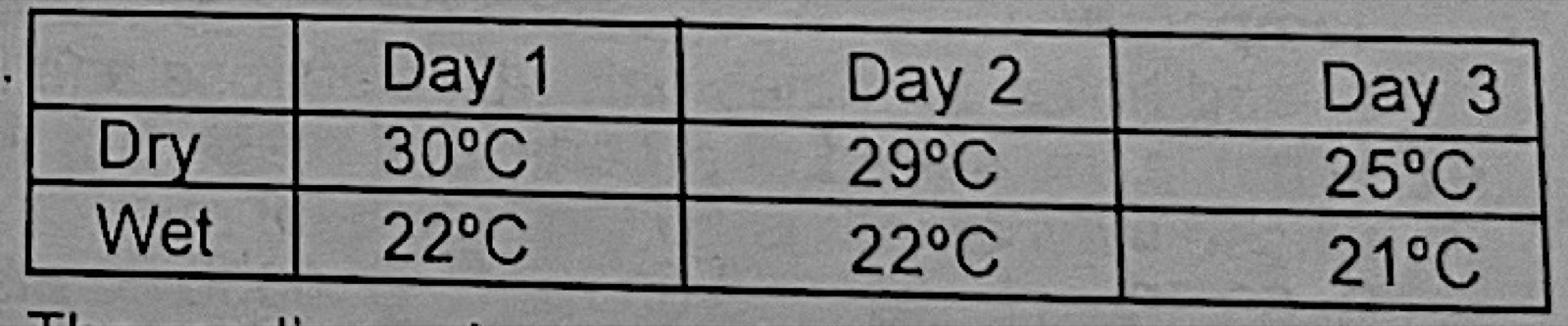
Dry bulb: Day 1 30 °C, Day 2 29 °C, Day 3 25 °C
Wet bulb: Day 1 22 °C, Day 2 22 °C, Day 3 21 °C
The readings above are for three consecutive days from a wet and dry bulb hygrometer. It can be concluded that the relative humidity for the three days

Diagram for this question
  1. A.increased steadily
  2. B.remained unchanged
  3. C.was least on Day 1
  4. D.decreased steadily
Show the answer and explanation

Answer: A (increased steadily)

Explanation

The difference between dry and wet readings fell from 8 °C to 7 °C to 4 °C. A smaller difference means less evaporation, so the air was getting more humid each day.

Open this question

Question 16

Refraction of Light

Total internal reflection occurs when light moves from

  1. A.air to water
  2. B.water to glass
  3. C.a dense medium to a less dense medium
  4. D.a less dense medium to a dense medium.
Show the answer and explanation

Answer: C (a dense medium to a less dense medium)

Explanation

Total internal reflection can only happen when light goes from an optically denser medium towards a less dense one, at more than the critical angle.

Open this question

Question 17

Waves

One end of a long wire is fixed while a vibrator is attached to the other end. When the vibrator is energized, the types of waves generated in the wire are

  1. A.stationary and transverse
  2. B.progressive and transverse
  3. C.stationary and longitudinal
  4. D.progressive and longitudinal
Show the answer and explanation

Answer: A (stationary and transverse)

Explanation

The vibrator shakes the wire sideways, making transverse waves; these reflect at the fixed end and combine with the incoming waves to form stationary waves.

Open this question

Question 18

Sound

A sonometer wire is vibrating at frequency fo. If the tension in the wire is doubled while the length and the mass per unit length are kept constant, the new frequency of vibration is

  1. A.fo/2
  2. B.2fo
  3. C.fo/√2
  4. D.fo√2
Show the answer and explanation

Answer: D (fo√2)

Explanation

f ∝ √T, so doubling the tension multiplies the frequency by √2: fo√2.

Open this question

Question 19

Refraction of Light

A boy observes a piece of stone at the bottom of a river 6.0 m deep. If he looks from the surface of the river, what is the apparent distance of the stone from him? [Refractive index of water = 4/3]

  1. A.4.5 m
  2. B.5.0 m
  3. C.5.5 m
  4. D.8.0 m
Show the answer and explanation

Answer: A (4.5 m)

Explanation

Apparent depth = real depth ÷ refractive index = 6.0 ÷ (4/3) = 4.5 m.

Open this question

Question 20

Quantity of Heat

A metal of mass 0.5 kg is heated to 100 °C and then transferred to a well-lagged calorimeter of heat capacity 80 J K−1 containing water of heat capacity 420 J K−1 at 15 °C. If the final steady temperature of the mixture is 25 °C, find the specific heat capacity of the metal.

  1. A.92 J kg−1 K−1
  2. B.133 J kg−1 K−1
  3. C.286 J kg−1 K−1
  4. D.877 J kg−1 K−1
Show the answer and explanation

Answer: B (133 J kg−1 K−1)

Explanation

Heat lost by metal = heat gained by calorimeter and water: 0.5 × c × 75 = (80 + 420) × 10 = 5000. So c = 5000/37.5 ≈ 133 J kg−1 K−1.

Open this question

Question 21

Temperature and Thermometers

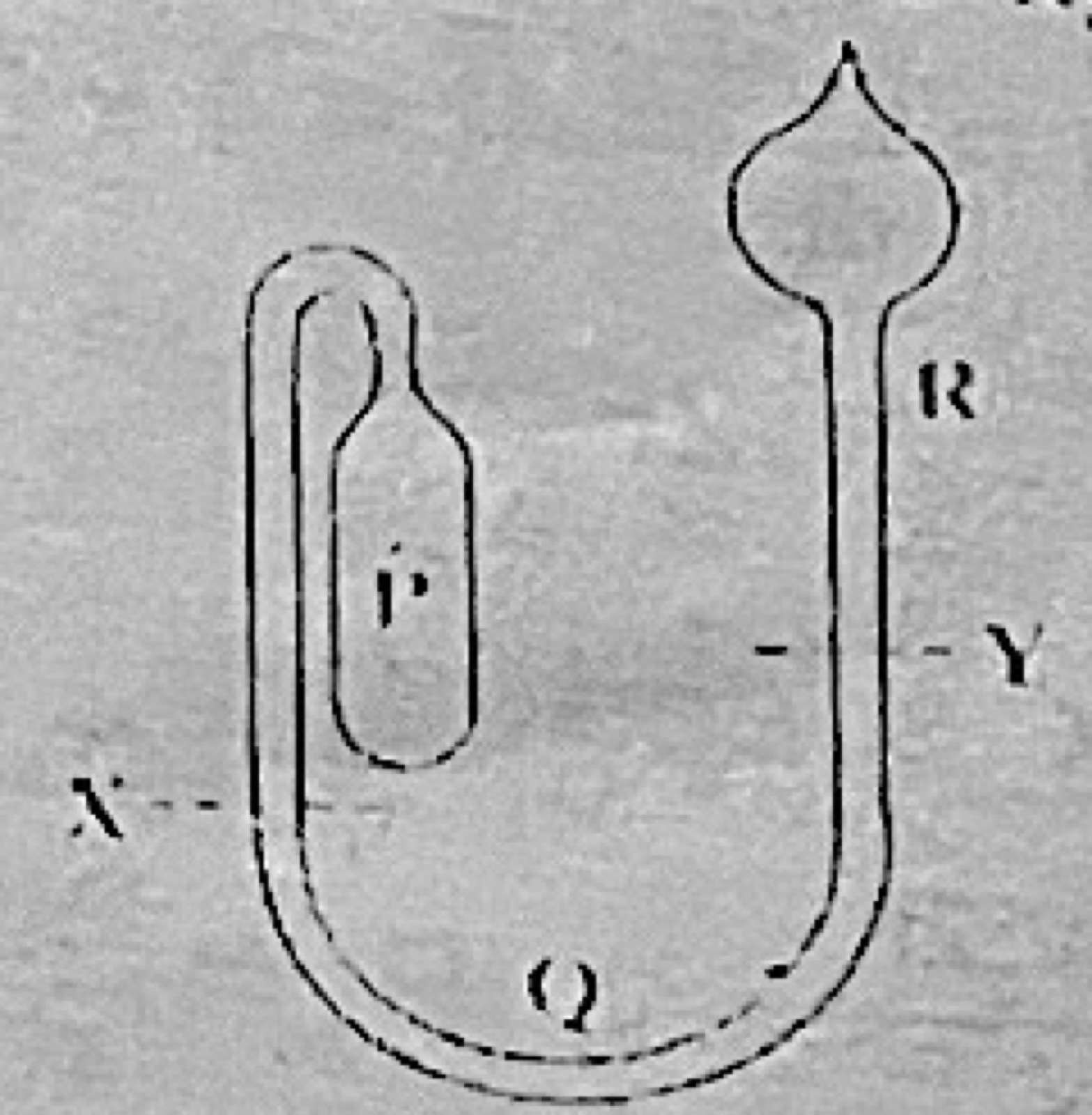
The diagram above shows a maximum and minimum thermometer divided into three portions P, Q and R. Which of the following is true about the respective contents of P, Q and R?

Diagram for this question
  1. A.Alcohol, mercury and alcohol
  2. B.Air, alcohol and mercury
  3. C.Mercury, alcohol and mercury
  4. D.Air, mercury and alcohol.
Show the answer and explanation

Answer: A (Alcohol, mercury and alcohol)

Explanation

In Six's maximum and minimum thermometer the bulb P is full of alcohol, the U-bend Q holds a thread of mercury, and above the mercury on the other side R is alcohol again.

Open this question

Question 22

Heat Transfer

The main reason for making the cover of a vacuum flask airtight is to prevent heat loss by

  1. A.conduction
  2. B.evaporation
  3. C.radiation
  4. D.convection
Show the answer and explanation

Answer: D (convection)

Explanation

The airtight stopper stops warm air (and vapour) from circulating out of the flask, so it cuts heat loss by convection; radiation is reduced by the silvered walls, not the cover.

Open this question

Question 23

Waves

A travelling wave moving from left to right has an amplitude of 0.15 m, a frequency of 550 Hz and a wavelength of 0.01 m. The equation describing the wave is

  1. A.y = 0.15 sin 200π (x − 5.5t)
  2. B.y = 0.15 sin π(0.01x − 5.5t)
  3. C.y = 0.15 sin 5.5π(x − 200t)
  4. D.y = 0.15 sin π(550x − 0.01t)
Show the answer and explanation

Answer: A (y = 0.15 sin 200π (x − 5.5t))

Explanation

k = 2π/λ = 2π/0.01 = 200π and ω = 2πf = 1100π = 200π × 5.5. So y = 0.15 sin(200πx − 1100πt) = 0.15 sin 200π(x − 5.5t).

Open this question

Question 24

Waves

A transverse wave is applied to a string whose mass per unit length is 3 × 10⁻² kg m−1. If the string is under a tension of 12 N, the speed of propagation of the wave is

  1. A.40 m s−1
  2. B.30 m s−1
  3. C.20 m s−1
  4. D.5 m s−1
Show the answer and explanation

Answer: C (20 m s−1)

Explanation

v = √(T/μ) = √(12/0.03) = √400 = 20 m s−1.

Open this question

Question 25

Thermal Expansion

A quantity of water at 0 °C is heated to about 30 °C. At each degree rise in temperature, its density will

  1. A.rise steadily
  2. B.rise then fall
  3. C.fall steadily
  4. D.fall then rise.
Show the answer and explanation

Answer: B (rise then fall)

Explanation

Water is densest at 4 °C, so its density rises from 0 °C to 4 °C and then falls as it is heated further.

Open this question

Question 26

Change of State and Vapours

A thin wire with heavy weights attached to boths ends is hung over a block of ice resting on two supports. If the wire cuts through the ice block while the block remains solid behind the wire, the process is called.

  1. A.fusion
  2. B.sublimation
  3. C.condensation
  4. D.regelation.
Show the answer and explanation

Answer: D (regelation.)

Explanation

Pressure under the wire lowers the melting point so the ice melts there; the water refreezes above the wire once the pressure is removed. This is regelation.

Open this question

Question 27

Current Electricity

A cell of internal resistance 0.01 Ω can be measured accurately using the

  1. A.Ohm-meter
  2. B.potentiometer
  3. C.electroscope
  4. D.metre bridge
Show the answer and explanation

Answer: B (potentiometer)

Explanation

A potentiometer draws no current at balance, so it can compare e.m.f. and terminal p.d. accurately enough to find a very small internal resistance.

Open this question

Question 28

Electrostatics

An electron of charge 1.6 × 10⁻¹⁹ C and mass 9.1 × 10⁻³¹ kg is accelerated between two metal plates with velocity of 4 × 10⁷ m s−1, the potential difference between the plates is

  1. A.4.55 × 101 V
  2. B.9.10 × 101 V
  3. C.4.55 × 102 V
  4. D.4.55 × 103 V
Show the answer and explanation

Answer: D (4.55 × 10³ V)

Explanation

eV = ½mv2, so V = 9.1 × 10−31 × (4 × 107)2 ÷ (2 × 1.6 × 10−19) = 4.55 × 10³ V.

Open this question

Question 29

Dispersion of Light and Colours

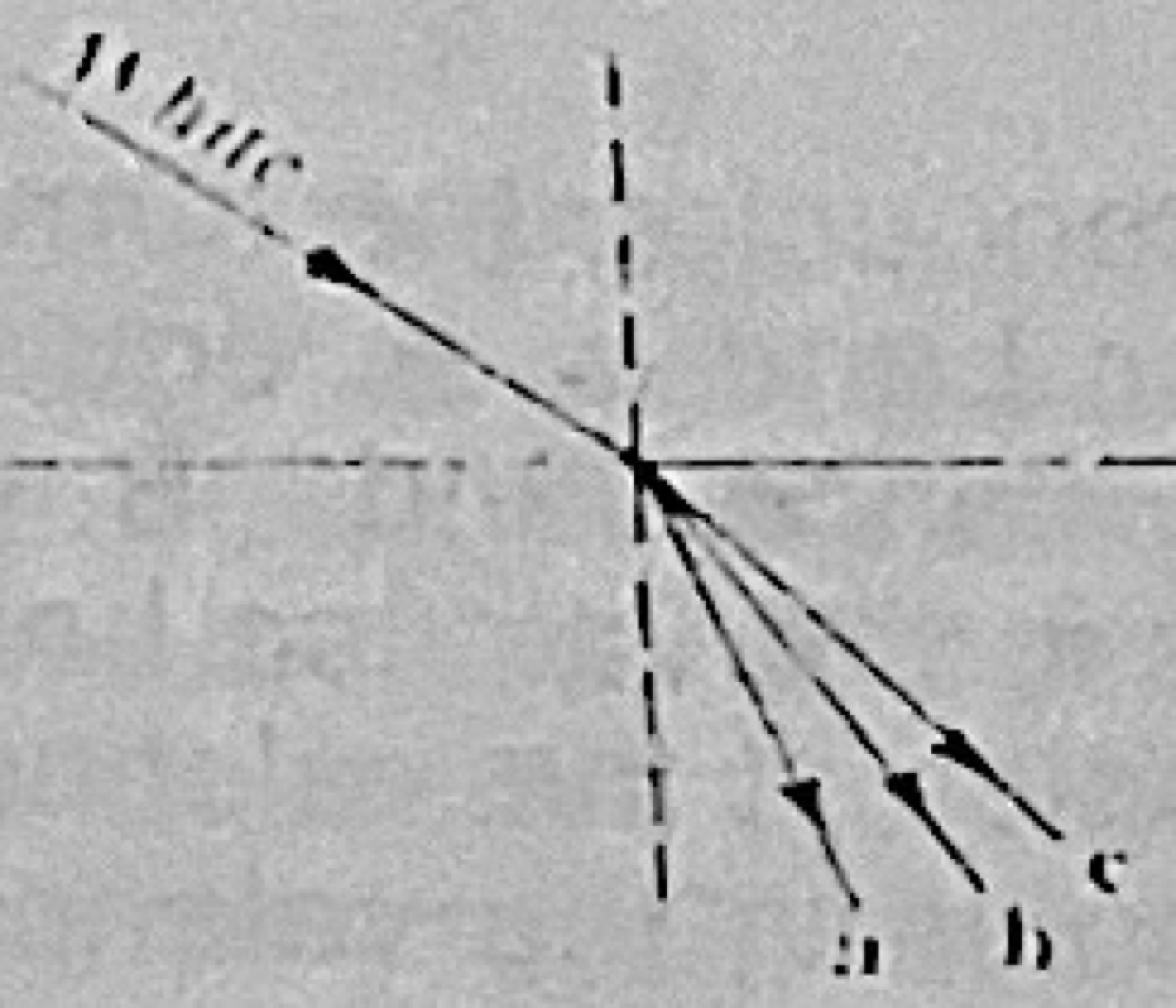
In the diagram above, a beam of white light travels from a rare to a dense medium. What colours of light do the rays a, b, and c respectively represent?

Diagram for this question
  1. A.Blue, yellow and red
  2. B.Green, red and blue
  3. C.Red, green and blue
  4. D.Yellow, blue and red.
Show the answer and explanation

Answer: A (Blue, yellow and red)

Explanation

Blue light slows down most in the denser medium, so it bends most towards the normal (ray a); red bends least (ray c). Yellow lies between them.

Open this question

Question 30

Capacitors

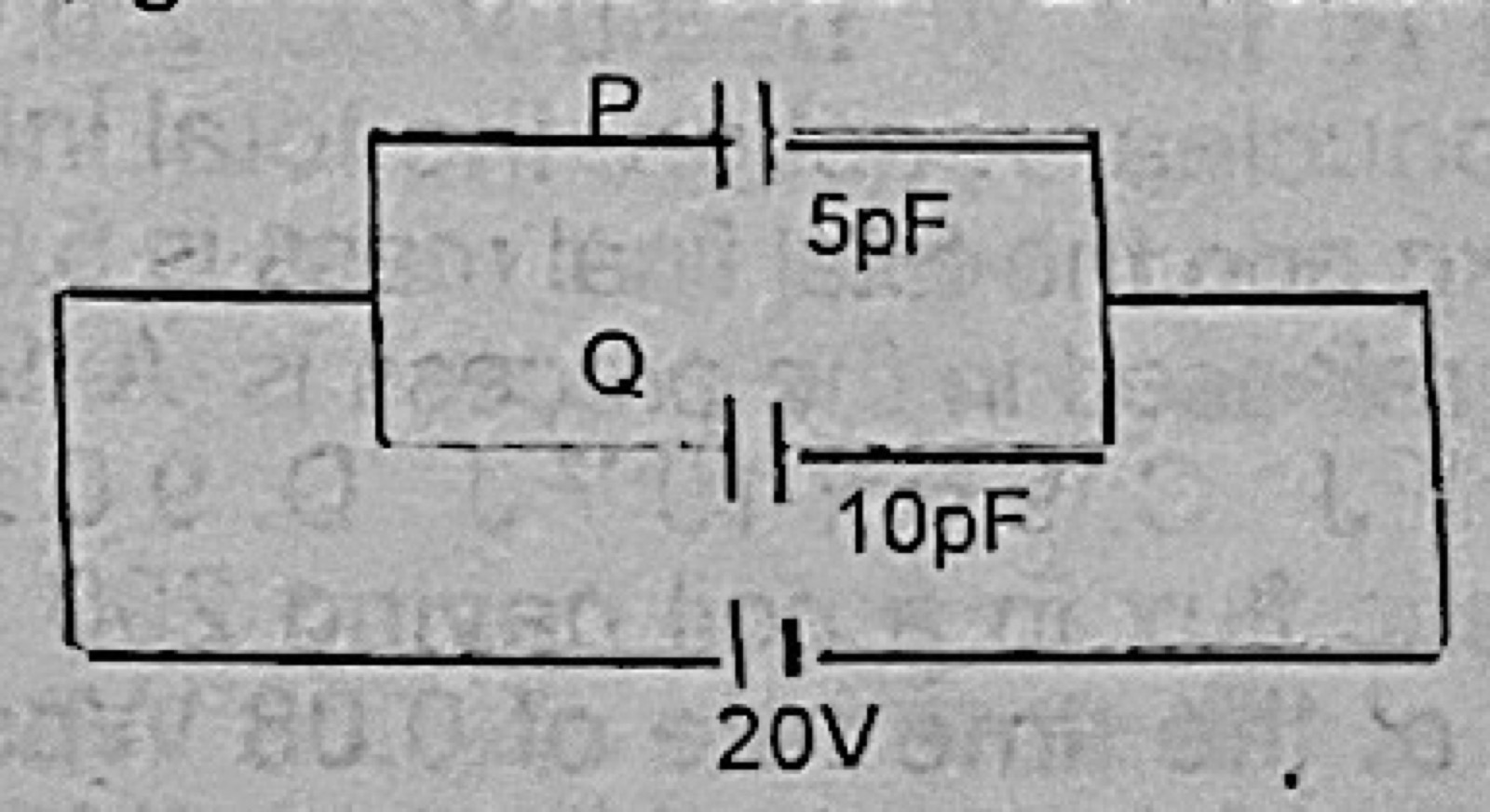
The diagram above shows two capacitors P and Q of capacitances 5 μF and 10 μF. Find the charges stored in P and Q respectively.

Diagram for this question
  1. A.200 μC and 100 μC
  2. B.100 μC and 200 μC
  3. C.4 μC and 2 μC
  4. D.2 μC and 4 μC.
Show the answer and explanation

Answer: B (100 μC and 200 μC)

Explanation

P and Q are in parallel across 20 V, so Q = CV: 5 μF × 20 V = 100 μC and 10 μF × 20 V = 200 μC.

Open this question

Question 31

Lenses and Optical Instruments

What optical instrument can best be constructed with converging lenses of focal lengths 50 cm and 5 cm?

  1. A.Compound microscope
  2. B.Terrestrial telescope
  3. C.Astronomical telescope
  4. D.Galileo's telescope
Show the answer and explanation

Answer: C (Astronomical telescope)

Explanation

An astronomical telescope uses two converging lenses: a long-focus objective (50 cm) and a short-focus eyepiece (5 cm). A Galilean telescope needs a diverging eyepiece.

Open this question

Question 32

Magnetism

If a charged ion goes through combined electric and magnetic fields, the resultant emergent velocity of the ion is

  1. A.E/B
  2. B.EB
  3. C.B/E
  4. D.E − B
Show the answer and explanation

Answer: A (E/B)

Explanation

The ion passes straight through when the electric and magnetic forces balance: qE = qvB, so v = E/B.

Open this question

Question 33

Current Electricity

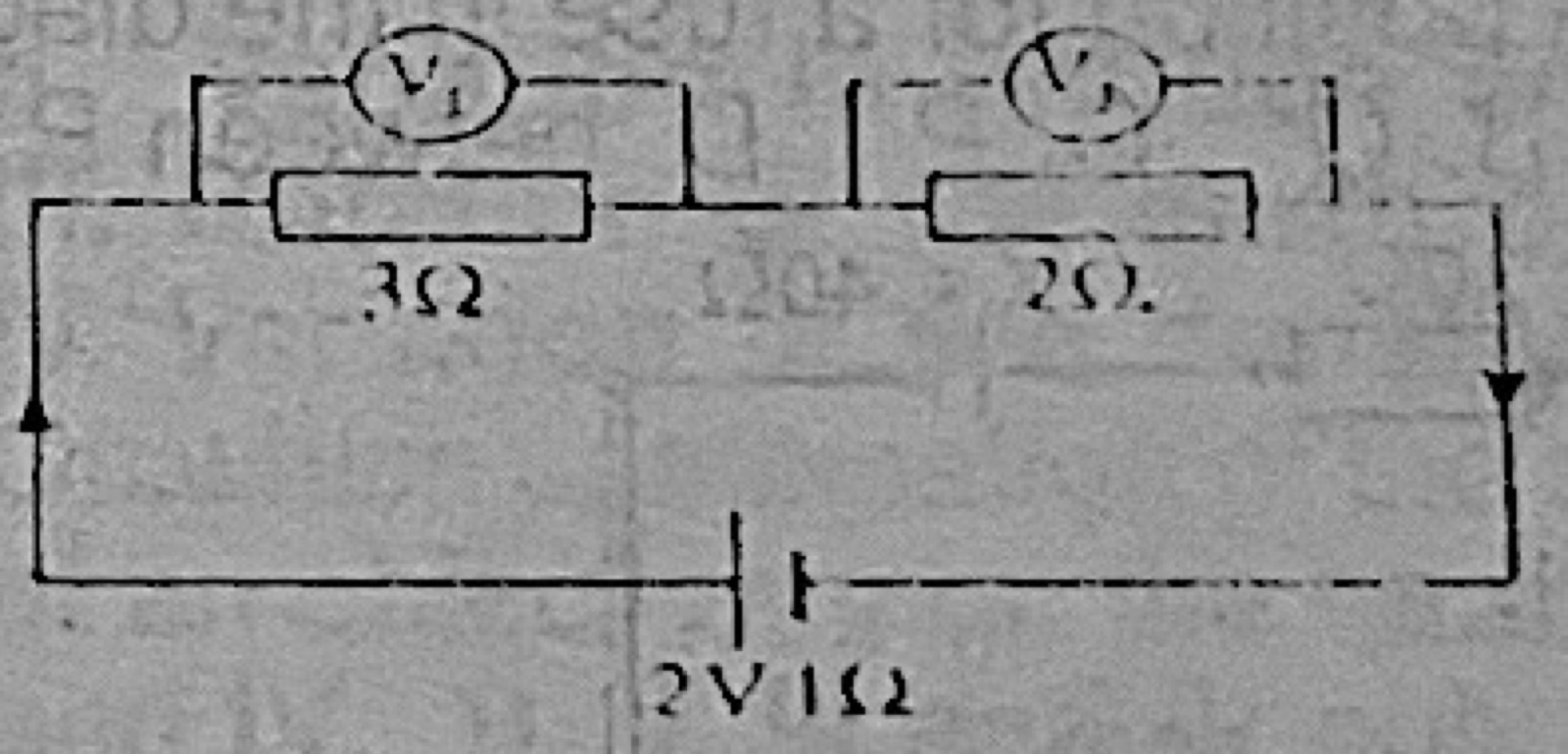
In the diagram above, the values of V1 and V2 are respectively

Diagram for this question
  1. A.1 V and ⅓ V
  2. B.⅓ V and 1 V
  3. C.⅓ V and ⅔ V
  4. D.1 V and ⅔ V
Show the answer and explanation

Answer: D (1 V and ⅔ V)

Explanation

Total resistance = 3 + 2 + 1 = 6 Ω, so I = 2/6 = ⅓ A. V1 = ⅓ × 3 = 1 V and V2 = ⅓ × 2 = ⅔ V.

Open this question

Question 34

Lenses and Optical Instruments

A projection lantern is used to give the image of a slide on a screen. If the image is 24 times as large as the slide and the screen is 72.0 m from the projecting lens, what is the position of the slide from the lens?

  1. A.4.0 m
  2. B.3.5 m
  3. C.3.0 m
  4. D.0.3 m
Show the answer and explanation

Answer: C (3.0 m)

Explanation

Magnification = v/u, so 24 = 72/u and u = 3.0 m.

Open this question

Question 35

Current Electricity

A radio is operated by eight cells each of e.m.f. 2.0 V connected in series. If two of the cells are wrongly connected, the net e.m.f. of the radio is

  1. A.16 V
  2. B.12 V
  3. C.10 V
  4. D.8 V
Show the answer and explanation

Answer: D (8 V)

Explanation

Six cells push one way (12 V) and the two reversed cells push the other way (4 V), so the net e.m.f. is 12 − 4 = 8 V.

Open this question

Question 36

Alternating Current Circuits

A 2 H inductor has negligible resistance and is connected to a 50/π Hz a.c supply. The reactance of the inductor is

  1. A.200 Ω
  2. B.50 Ω
  3. C.100/π Ω
  4. D.25/π Ω
Show the answer and explanation

Answer: A (200 Ω)

Explanation

XL = 2πfL = 2π × (50/π) × 2 = 200 Ω.

Open this question

Question 37

Radioactivity and Nuclear Physics

If the fraction of the atoms of a radioactive material left after 120 years is 1/64, what is the half-life of the material?

  1. A.2 years
  2. B.10 years
  3. C.20 years
  4. D.24 years
Show the answer and explanation

Answer: C (20 years)

Explanation

1/64 = (½)6, so 6 half-lives took 120 years. Half-life = 120/6 = 20 years.

Open this question

Question 38

Radioactivity and Nuclear Physics

A certain radioactive source emits radiations that were found to be deflected by both magnetic and electric fields. The radiations are

  1. A.x-rays
  2. B.beta rays
  3. C.gamma rays
  4. D.ultra-violet rays.
Show the answer and explanation

Answer: B (beta rays)

Explanation

Only charged particles are deflected by electric and magnetic fields. Beta rays are electrons; X-rays, gamma rays and UV are uncharged electromagnetic waves.

Open this question

Question 39

Electronics

In a pure semiconductor, the number of electrons in the conduction band is

  1. A.equal to the number of holes in the valence band
  2. B.greater than the number of holes in the valence band
  3. C.less than the number of holes in the valence band
  4. D.twice the number of holes in the valence band.
Show the answer and explanation

Answer: A (equal to the number of holes in the valence band)

Explanation

In a pure (intrinsic) semiconductor each electron that jumps to the conduction band leaves one hole behind, so the numbers are equal.

Open this question

Question 40

Current Electricity

A cell of internal resistance 1 Ω supplies current to an external resistor of 3 Ω. The efficiency of the cell is

  1. A.75%
  2. B.50%
  3. C.33%
  4. D.25%
Show the answer and explanation

Answer: A (75%)

Explanation

Efficiency = useful power/total power = R/(R + r) = 3/(3 + 1) = 75%.

Open this question

Question 41

Modern Physics

Light of energy 5 eV falls on a metal of work function 3 eV and electrons are liberated. The stopping potential is

  1. A.15.0 V
  2. B.8.0 V
  3. C.2.0 V
  4. D.1.7 V
Show the answer and explanation

Answer: C (2.0 V)

Explanation

Maximum KE of the electrons = 5 − 3 = 2 eV, so a stopping potential of 2.0 V is needed.

Open this question

Question 42

Radioactivity and Nuclear Physics

In a thermonuclear reaction, the total initial mass is 5.02 × 10⁻²⁷ kg and the total final mass is 5.01 × 10⁻²⁷ kg. The energy released in the process is

  1. A.9.0 × 10−10 J
  2. B.9.0 × 10−11 J
  3. C.9.0 × 10−12 J
  4. D.9.0 × 10−13 J
Show the answer and explanation

Answer: D (9.0 × 10⁻¹³ J)

Explanation

Mass lost = 0.01 × 10−27 = 10−29 kg. E = mc2 = 10−29 × (3 × 108)2 = 9.0 × 10⁻¹³ J.

Open this question

Question 43

Electromagnetic Induction

The magnetic flux in a coil having 200 turns changes at the time rate of 0.08 Wb s−1. The induced e.m.f. in the coil is

  1. A.1.6 V
  2. B.16.0 V
  3. C.25.0 V
  4. D.250.0 V
Show the answer and explanation

Answer: B (16.0 V)

Explanation

E = N × rate of change of flux = 200 × 0.08 = 16.0 V.

Open this question

Question 44

Modern Physics

If the frequency of an emitted x-rays is 1.6 × 10¹⁶ Hz, the accelerating potential is [e = 1.6 × 10⁻¹⁹ C, h = 6.63 × 10⁻³⁴ J s]

  1. A.6.6 V
  2. B.66.3 V
  3. C.663.0 V
  4. D.6630.0 V
Show the answer and explanation

Answer: B (66.3 V)

Explanation

eV = hf, so V = 6.63 × 10−34 × 1.6 × 1016 ÷ 1.6 × 10−19 = 66.3 V.

Open this question

Question 45

Electrical Energy and Power

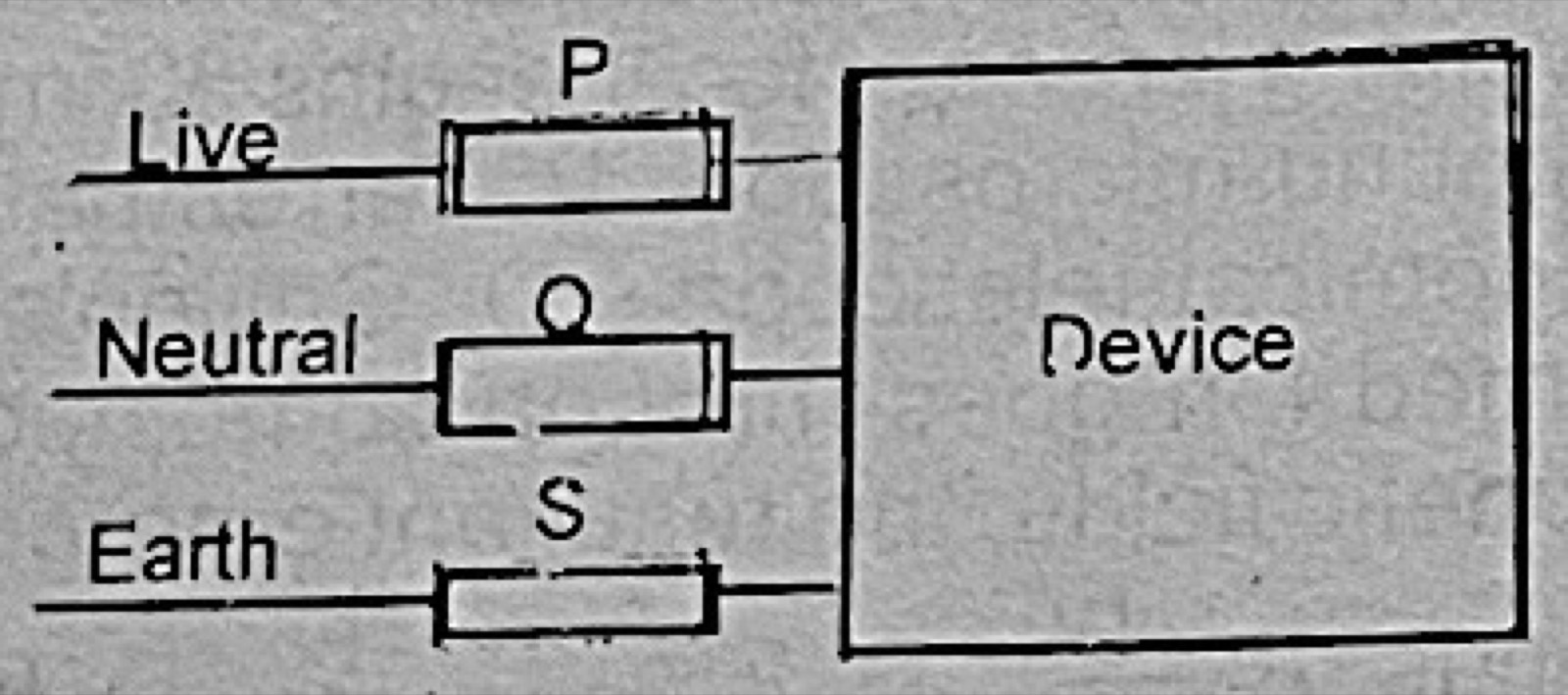
The correct position for a fuse in the diagram above is

Diagram for this question
  1. A.S
  2. B.Q
  3. C.P
  4. D.between P and Q
Show the answer and explanation

Answer: C (P)

Explanation

A fuse always goes in the live wire, so that when it blows the device is cut off from the high voltage. P is on the live wire.

Open this question

Question 46

Alternating Current Circuits

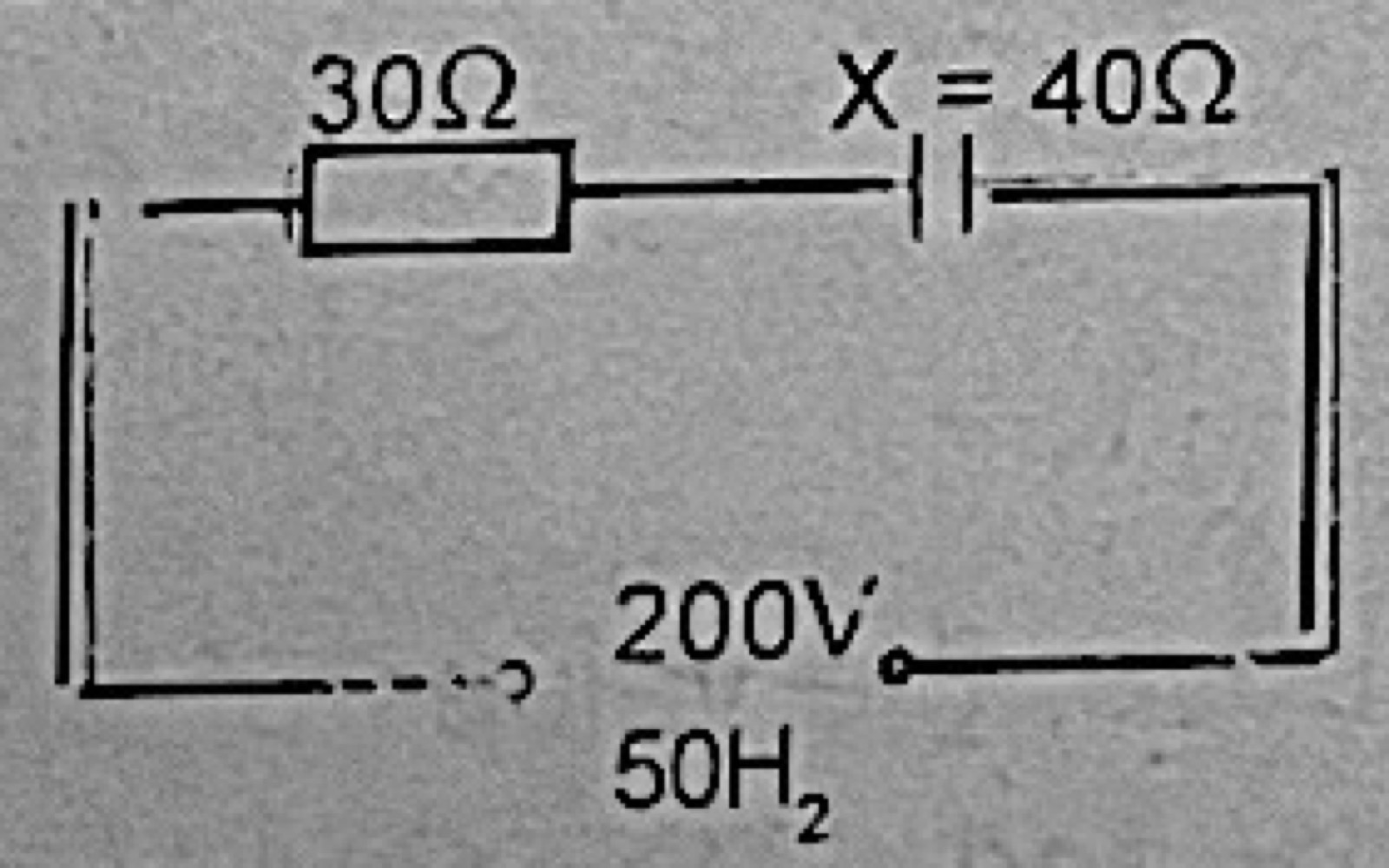
In the a.c circuit above, the current value is

Diagram for this question
  1. A.6.67 A
  2. B.4.00 A
  3. C.3.00 A
  4. D.0.58 A
Show the answer and explanation

Answer: B (4.00 A)

Explanation

Impedance Z = √(302 + 402) = 50 Ω, so I = V/Z = 200/50 = 4.00 A.

Open this question

Question 48

Conduction through Liquids and Gases

A gas would serve as an electrical conductor under

  1. A.reduced pressure and reduced potential
  2. B.reduced pressure and high current
  3. C.increased magnetic field
  4. D.exposure to visible light.
Show the answer and explanation

Answer: B (reduced pressure and high current)

Explanation

Gases conduct (as in a discharge tube) at low pressure with a high voltage driving a current through them; the other conditions do not ionise the gas.

Open this question

Question 49

Electromagnetic Induction

An electric generator with a power output of 3.0 kW at a voltage of 1.5 kV distributes power along cables of total resistance 20.0 Ω. The power loss in the cable is

  1. A.0.1 W
  2. B.10.0 W
  3. C.40.0 W
  4. D.80.0 W
Show the answer and explanation

Answer: D (80.0 W)

Explanation

I = P/V = 3000/1500 = 2 A. Power lost = I2R = 22 × 20 = 80.0 W.
Open this question

Question 50

Magnetism

A conductor of length 2 m carries a current of 0.8 A while kept in a magnetic field of magnetic flux density 0.5 T. The maximum force acting on it is

  1. A.8.0 N
  2. B.3.2 N
  3. C.0.8 N
  4. D.0.2 N
Show the answer and explanation

Answer: C (0.8 N)

Explanation

F = BIL sin θ is largest when θ = 90°: F = 0.5 × 0.8 × 2 = 0.8 N.

Open this question