A body of weight W N rests on a smooth plane inclined at an angle θ° to the horizontal. What is the resolved part of the weight in Newtons along the plane?
A.W sin θ
B.W cos θ
C.W sec θ
D.W tan θ.
Show the answer and explanation
Answer: A (W sin θ)
Explanation
The component of the weight along a slope of angle θ is W sin θ; the component at right angles to it is W cos θ.
A small metal ball is thrown vertically upwards from the top of a tower with an initial velocity of 20 m s−1. If the ball took a total of 6 s to reach ground level, determine the height of the tower [g = 10 m s−2]
A.60 m
B.80 m
C.100 m
D.120 m
Show the answer and explanation
Answer: A (60 m)
Explanation
Taking up as positive, displacement after 6 s = ut − ½gt² = 20 × 6 − 5 × 36 = −60 m. The ball ends 60 m below its start, so the tower is 60 m high.
A body of mass 100 g moving with a velocity of 10.0 m s−1 collides with a wall. If after the collision, it moves with a velocity of 2.0 m s−1 in the opposite direction, calculate the change in momentum.
A.0.8 N s
B.1.2 N s
C.12.0 N s
D.80.0 N s
Show the answer and explanation
Answer: B (1.2 N s)
Explanation
Initial momentum = 0.1 × 10 = 1.0 N s; final = 0.1 × (−2) = −0.2 N s. Change = −0.2 − 1.0 = −1.2 N s, a size of 1.2 N s.
A wheel and axle have radii 80 cm and 10 cm respectively. If the efficiency of the machine is 0.85, an applied force of 1200 N to the wheel will raise a load of
A.8.0 N
B.6.8 N
C.8160.0 N
D.9600.0 N
Show the answer and explanation
Answer: C (8160.0 N)
Explanation
VR = 80/10 = 8. MA = 0.85 × 8 = 6.8. Load = 6.8 × 1200 = 8160 N.
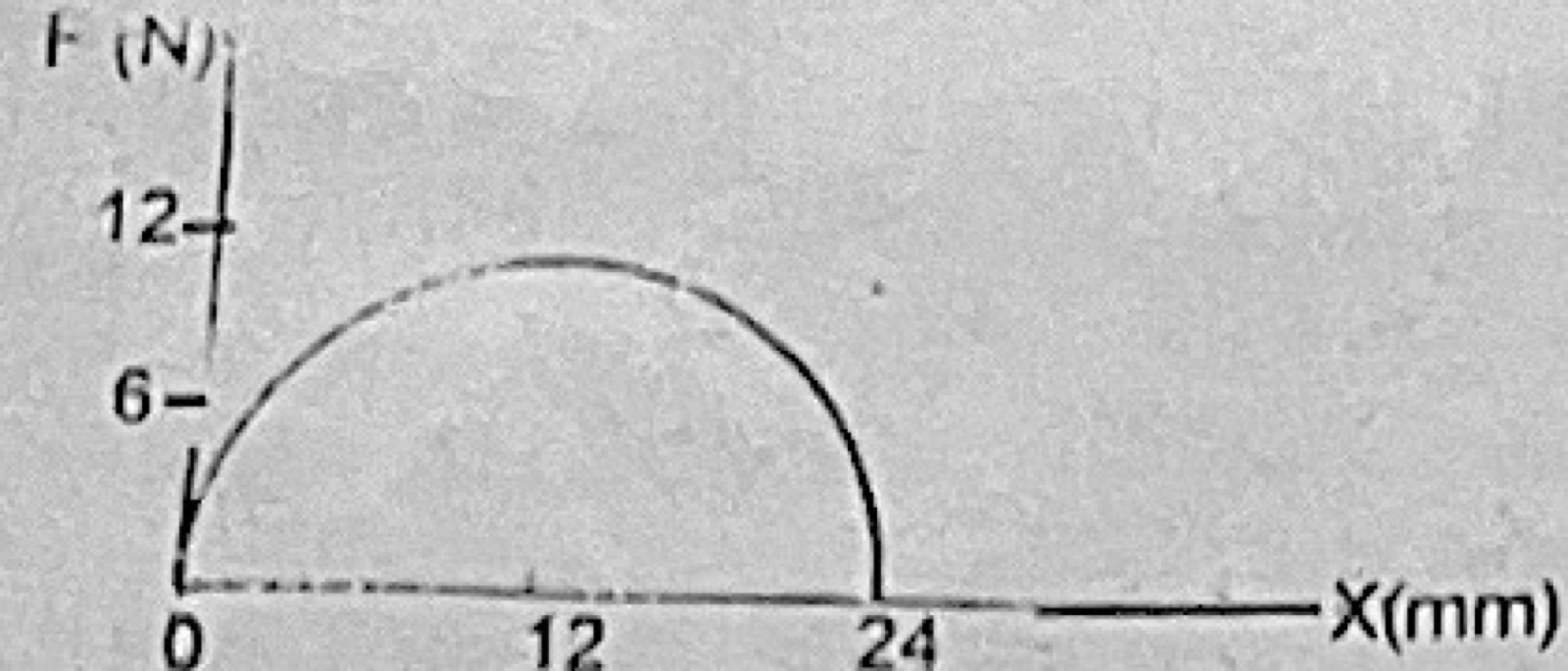
A body is under the action of a force F such that the force – displacement graph of the body is semicircular as shown above. The work done on the body by the force in moving through 24 metres is
A.36π J
B.72π J
C.144π J
D.288π J
Show the answer and explanation
Answer: B (72π J)
Explanation
Work = area under the graph = area of a semicircle of radius 12 = ½π × 12² = 72π J.
A 20 kg mass is to be pulled up a slope inclined at 30° to the horizontal. If the efficiency of the plane is 75%, the force required to pull the load up the plane is [g = 10 m s−2].
A.13.3 N
B.73.5 N
C.133.3 N
D.533.2 N
Show the answer and explanation
Answer: C (133.3 N)
Explanation
VR = 1/sin 30° = 2, so MA = 0.75 × 2 = 1.5. Effort = 200 ÷ 1.5 ≈ 133.3 N.
The spiral spring of a spring balance is 25.0 cm long when 5 N hangs on it and 30.0 cm long, when the weight is 10 N. What is the length of the spring if the weight is 3 N assuming Hooke's Law is obeyed?
A.15.0 cm
B.17.0 cm
C.20.0 cm
D.23.0 cm
Show the answer and explanation
Answer: D (23.0 cm)
Explanation
The extra 5 N adds 5 cm, so the spring stretches 1 cm per newton and its natural length is 25 − 5 = 20 cm. With 3 N it is 23 cm.
The mass of a stone is 15.0 g when completely immersed in water and 10.0 g when completely immersed in a liquid of relative density 2.0. The mass of the stone in air is
A.5.0 g
B.12.0 g
C.20.0 g
D.25.0 g.
Show the answer and explanation
Answer: C (20.0 g)
Explanation
Loss in the liquid is twice the loss in water: m − 10 = 2(m − 15), so m = 20 g.
In which of the following is surface tension important?
A.The floating of a ship in water
B.The floating of a dry needle in water
C.The floating of a balloon in air
D.The diffusion of sugar solution across a membrane.
Show the answer and explanation
Answer: B (The floating of a dry needle in water)
Explanation
A dry needle is denser than water but is held up by the stretched surface film of the water, which is surface tension. Ships and balloons float by upthrust.
A thermometer with an arbitrary scale, S, of equal divisions registers −30°S at the ice point and +90°S at the steam point. Calculate the Celcius temperature corresponding to 60°S.
What is the difference in the amount of heat given out by 4 kg of steam and 4 kg of water when both are cooled from 100°C to 80°C? [The specific latent heat of steam is 2,260,000 J kg−1, specific heat capacity of water is 4200 J kg−1 K−1]
A.4200 J
B.2,260,000 J
C.9,040,000 J
D.9,380,000 J
Show the answer and explanation
Answer: C (9,040,000 J)
Explanation
Both give out the same heat cooling from 100°C to 80°C as water; the steam gives out extra latent heat when it condenses: 4 × 2 260 000 = 9 040 000 J.
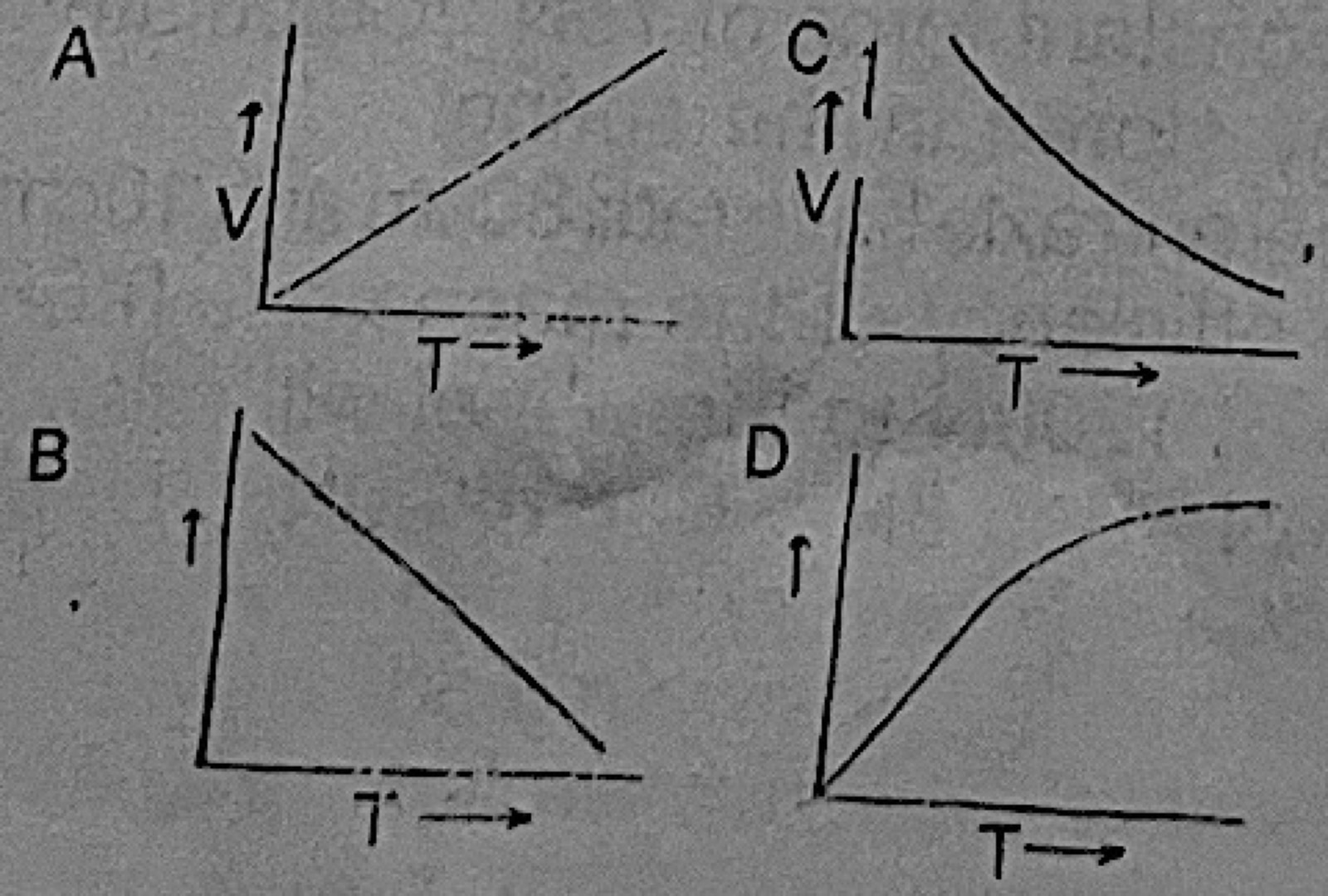
The graphs below show the variation of volume (V) against temperature (T) in Kelvin for a given mass of gas at constant pressure. Which of the graphs depicts the behaviour of an ideal gas?
A.A
B.B
C.C
D.D
Show the answer and explanation
Answer: A (A)
Explanation
Charles' law: at constant pressure V is proportional to the kelvin temperature, a straight line through the origin, as in A.
A boy timed 30 oscillations of a certain pendulum thrice and obtained 1 min. 10 s, 1 min. 12 s and 1 min. 7 s respectively. The mean period of oscillation of the pendulum is
A.0.14 s
B.0.43 s
C.2.32 s
D.6.97 s
Show the answer and explanation
Answer: C (2.32 s)
Explanation
Mean time for 30 oscillations = (70 + 72 + 67)/3 ≈ 69.7 s. Period = 69.7/30 ≈ 2.32 s.
C.erect and gets sharper as the hole becomes larger
D.inverted and formed by the light from each point travelling in a straight line.
Show the answer and explanation
Answer: D (inverted and formed by the light from each point travelling in a straight line.)
Explanation
Light from each point of the object travels in a straight line through the hole, so the top of the object is imaged at the bottom: the image is real and inverted.
When a plane mirror at which a ray is incident is rotated through an angle θ, the reflected ray will be rotated through
A.½θ
B.θ
C.2θ
D.3θ.
Show the answer and explanation
Answer: C (2θ)
Explanation
Turning the mirror by θ turns the normal by θ, which changes both the angle of incidence and of reflection by θ, so the reflected ray turns through 2θ.
A trough 12.0 cm deep is filled with water of refractive index 4/3. By how much would a coin at the bottom of the trough appear to be displaced when viewed vertically from above the water surface?
A.3.0 cm
B.6.0 cm
C.9.0 cm
D.16.0 cm
Show the answer and explanation
Answer: A (3.0 cm)
Explanation
Apparent depth = 12 ÷ (4/3) = 9 cm, so the coin seems raised by 12 − 9 = 3 cm.
A man hears his echo from a nearby hill 2 s after he shouted. If the frequency of his voice is 260 Hz and the wavelength is 1.29 m, how far away is the hill?
A.330.0 m
B.335.4 m
C.660.0 m
D.670.8 m
Show the answer and explanation
Answer: B (335.4 m)
Explanation
v = fλ = 260 × 1.29 = 335.4 m s−1. The sound takes 1 s each way, so the hill is 335.4 m away.
A moving coil galvanometer of 300 Ω resistance gives full scale deflection for 1.0 mA. The resistance, R, of the shunt that is required to convert the galvanometer into a 3.0 A ammeter is
A.899.70 Ω
B.10.00 Ω
C.0.10 Ω
D.0.01 Ω
Show the answer and explanation
Answer: C (0.10 Ω)
Explanation
The shunt carries 3 − 0.001 = 2.999 A at the meter's p.d. of 300 × 0.001 = 0.3 V. R = 0.3/2.999 ≈ 0.10 Ω.
The electrochemical equivalent of platinum is 5.0 × 10⁻⁷ kg C−1. To plate-out 1.0 kg of platinum, a current of 100 A must be passed through an appropriate vessel for
A.5.6 hours
B.56 hours
C.1.4 × 104 hours
D.2.0 × 104 hours.
Show the answer and explanation
Answer: A (5.6 hours)
Explanation
t = m/(zI) = 1.0/(5.0 × 10−7 × 100) = 20 000 s ≈ 5.6 hours.
Which of the following statements are TRUE of isotopes? I. Isotopes of an element have the same chemical properties because they have the same number of electrons II. Isotopes of elements are normally separated using physical properties III. Isotopes of an element have the same number of protons in their nuclei.
A.I and II only
B.I and III only
C.II and III only
D.I, II and III.
Show the answer and explanation
Answer: D (I, II and III.)
Explanation
Isotopes have the same number of protons and electrons, so they behave the same chemically; because of this they must be separated by physical methods that depend on their different masses (e.g. diffusion or a mass spectrometer). All three statements are true.