JAMB Physics 1990 past questions and answers

46 questions. Try each one, then open the answer to check yourself and read the explanation.

Question 2

Measurement and Units

Which of the following is a fundamental unit?

  1. A.Newton
  2. B.Watt
  3. C.Joule
  4. D.Second
Show the answer and explanation

Answer: D (Second)

Explanation

The second is an SI base unit. The newton, watt and joule are derived from base units.

Open this question

Question 3

Equilibrium of Forces

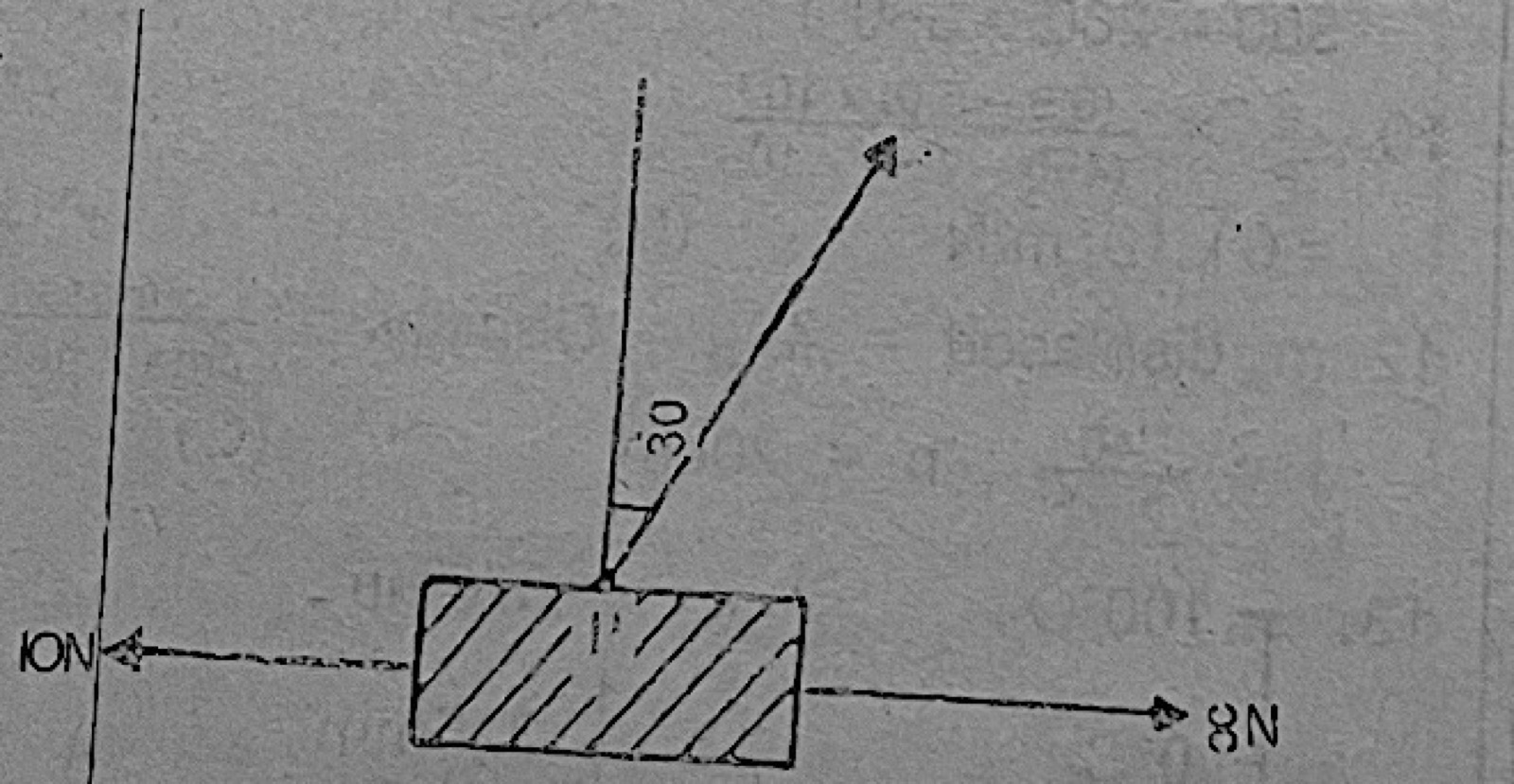
Two horizontal forces, 10 N and 8 N and another force F1 inclined at 30° to the vertical acting as shown in the diagram above, keep the body P in equilibrium. The weight of the body is

Diagram for this question
  1. A.2√3/3 N
  2. B.√3 N
  3. C.4√3/3 N
  4. D.2√3 N
Show the answer and explanation

Answer: D (2√3 N)

Explanation

Horizontally, F1 sin 30° must make up the 2 N difference, so F1 = 4 N. Vertically the weight equals F1 cos 30° = 4 × (√3/2) = 2√3 N.

Open this question

Question 4

Motion

A car moving with a speed of 90 km h−1 was brought uniformly to rest by the application of the brakes in 10 s. How far did the car travel after the brakes were applied?

  1. A.125 m
  2. B.150 m
  3. C.250 m
  4. D.15 km
Show the answer and explanation

Answer: A (125 m)

Explanation

90 km h−1 = 25 m s−1. Average speed while stopping uniformly = 12.5 m s−1, so the distance is 12.5 × 10 = 125 m.

Open this question

Question 5

Newton's Laws and Momentum

A particle of mass M which is at rest splits up into two. If the mass and velocity of one of the particles are m and v respectively, calculate the velocity of the second particle.

  1. A.mv/M
  2. B.Mv/(M − m)
  3. C.Mv/(M + m)
  4. D.mv/(M − m)
Show the answer and explanation

Answer: D (mv/(M − m))

Explanation

Total momentum stays zero, so the other piece, of mass M − m, has momentum mv the other way: V = mv/(M − m).

Open this question

Question 7

Equilibrium of Forces

Which of the following statements are correct about an object in equilibrium under parallel forces? I. The total clockwise moments of the forces about any point equals the total anticlockwise moments about the same point. II. The total forces in one direction equals the total forces in the opposite direction III. The resolved components along the x-axis equals the resolved components along the y-axis.

  1. A.I and II only
  2. B.I and III only
  3. C.II and III only
  4. D.I, II and III
Show the answer and explanation

Answer: A (I and II only)

Explanation

For equilibrium the moments balance about any point and the forces in opposite directions balance. There is no rule that x-components must equal y-components.

Open this question

Question 8

Equilibrium of Forces

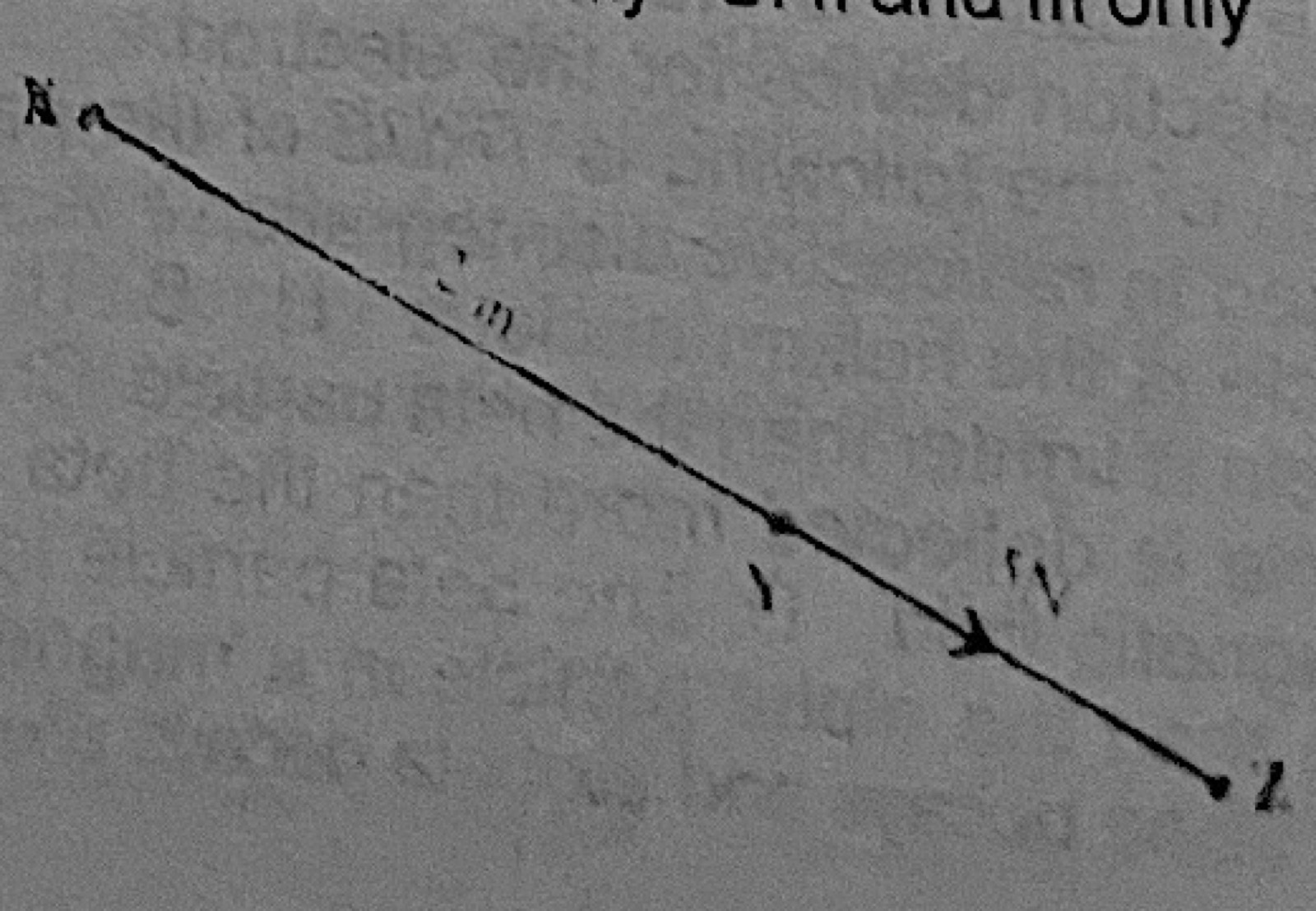
A force of 5 N acts at a point Y on a rod XYZ as shown in the diagram above. If XY is 2 m, what is the moment of the force about point X?

Diagram for this question
  1. A.0 N m
  2. B.3 N m
  3. C.7 N m
  4. D.10 N m
Show the answer and explanation

Answer: A (0 N m)

Explanation

The force acts along the rod itself, so its line of action passes through X. The perpendicular distance is zero and so is the moment.

Open this question

Question 9

Work, Energy and Power

To keep a vehicle moving at a constant speed v, requires power P, from the engine. The force provided by the engine is

  1. A.P/v
  2. B.½v
  3. C.Pv
  4. D.P/v2
Show the answer and explanation

Answer: A (P/v)

Explanation

Power = force × velocity, so F = P/v.

Open this question

Question 10

Work, Energy and Power

A stone of mass m kg is held h meters above the floor for 50 s. The work done in joules over this period is

  1. A.mh
  2. B.mgh
  3. C.mgh/50
  4. D.0
Show the answer and explanation

Answer: D (0)

Explanation

Work needs movement in the direction of the force. The stone does not move, so no work is done.

Open this question

Question 11

Friction

A body of mass 10 kg rests on a rough inclined plane whose angle of tilt θ is variable. θ is gradually increased until the body starts to slide down the plane at 30°. The coefficient of limiting friction between the body and the plane is

  1. A.0.30
  2. B.0.50
  3. C.0.58
  4. D.0.87
Show the answer and explanation

Answer: C (0.58)

Explanation

When the body just slides, μ = tan θ = tan 30° ≈ 0.58.

Open this question

Question 12

Simple Machines

An inclined plane which makes an angle of 30° with the horizontal has a velocity ratio of

  1. A.2
  2. B.1
  3. C.0.866
  4. D.0.50
Show the answer and explanation

Answer: A (2)

Explanation

VR = 1/sin θ = 1/sin 30° = 2.

Open this question

Question 13

Pressure

What is the length of the liquid column in a barometer tube that would support an atmospheric pressure of 102000 N m−2 if the density of the liquid is 2600 kg m−3? [g = 10 m s−2]

  1. A.0.75 m
  2. B.0.76 m
  3. C.3.92 m
  4. D.39.23 m
Show the answer and explanation

Answer: C (3.92 m)

Explanation

p = hρg, so h = 102 000/(2600 × 10) ≈ 3.92 m.

Open this question

Question 14

Density and Upthrust

40 m3 of liquid P is mixed with 60 m3 of another liquid Q. If the density of P and Q are 1.00 kg m−3 and 1.6 kg m−3 respectively, what is the density of the mixture?

  1. A.0.05 kg m−3
  2. B.1.25 kg m−3
  3. C.1.30 kg m−3
  4. D.1.36 kg m−3.
Show the answer and explanation

Answer: D (1.36 kg m−3.)

Explanation

Total mass = 40 × 1.00 + 60 × 1.6 = 136 kg in 100 m3, so the density is 1.36 kg m−3.

Open this question

Question 15

Temperature and Thermometers

The resistances of a platinum wire at the ice and steam points are 0.75 ohm and 1.05 ohm respectively. Determine the temperature at which the resistance of the wire is 0.90 ohm.

  1. A.43.0°C
  2. B.50.0°C
  3. C.69.9°C
  4. D.87.0°C
Show the answer and explanation

Answer: B (50.0°C)

Explanation

θ = (0.90 − 0.75)/(1.05 − 0.75) × 100 = 0.15/0.30 × 100 = 50°C.

Open this question

Question 16

Thermal Expansion

A bar of initial length l0 is heated through a temperature change Δt to a new length l. The linear expansivity, α, of the bar is

  1. A.(l − l0)/(lΔt)
  2. B.(l − l0)/(l0Δt)
  3. C.l0(1 + Δt)
  4. D.(l − l0)/(l(1 + Δt))
Show the answer and explanation

Answer: B ((l − l0)/(l0Δt))

Explanation

Linear expansivity = increase in length ÷ (original length × temperature change) = (l − l0)/(l0Δt).

Open this question

Question 17

Gas Laws

The pressure of a gas when cooled at constant volume will decrease because the molecules

  1. A.collide less frequently with the walls of the container
  2. B.have the same average kinetic energy
  3. C.break up into smaller molecules
  4. D.decrease in number
Show the answer and explanation

Answer: A (collide less frequently with the walls of the container)

Explanation

Cooling slows the molecules, so they hit the walls less often (and less hard), lowering the pressure.

Open this question

Question 18

Change of State and Vapours

1 kg of copper is transferred quickly from boiling water to a block of ice. Calculate the mass of ice melted, neglecting heat loss. [Specific heat capacity of copper − 400 J kg−1 K−1 and latent heat of fusion of ice − 333 × 103 J kg−1].

  1. A.60 g
  2. B.67 g
  3. C.120 g
  4. D.133 g
Show the answer and explanation

Answer: C (120 g)

Explanation

Heat given out by copper cooling from 100°C to 0°C = 1 × 400 × 100 = 40 000 J. Ice melted = 40 000/333 000 ≈ 0.12 kg = 120 g.

Open this question

Question 19

Change of State and Vapours

Which of the following conditions will make water boil at a temperature of 100°C when the atmospheric pressure is 750 mm Hg?

  1. A.Increase the external pressure
  2. B.Reduce the external pressure
  3. C.Heat more rapidly at the same pressure
  4. D.Reduce the external pressure by a quarter.
Show the answer and explanation

Answer: A (Increase the external pressure)

Explanation

Water boils at 100°C only at standard pressure, 760 mm Hg. At 750 mm Hg it boils below 100°C, so the pressure on it must be increased.

Open this question

Question 20

Heat Transfer

Which of the following statements are correct? I. Land and sea breezes are natural convection currents. II. Convection may occur in liquids or gases but not in solids. III. The vacuum in a thermos flask prevents heat loss due to convection only.

  1. A.I and II only
  2. B.II and III only
  3. C.I and III only
  4. D.I, II and III.
Show the answer and explanation

Answer: A (I and II only)

Explanation

Breezes are convection currents, and convection needs a fluid. The vacuum stops conduction as well as convection, so III is wrong.

Open this question

Question 21

Refraction of Light

A light wave of frequency 5 × 10¹⁴ Hz moves through water which has a refractive index of 4/3. Calculate the wavelength in water if the velocity of light in air is 3 × 10⁸ m s−1.

  1. A.4.5 × 10−7 m
  2. B.6.0 × 10−7 m
  3. C.1.7 × 106 m
  4. D.2.2 × 106 m
Show the answer and explanation

Answer: A (4.5 × 10⁻⁷ m)

Explanation

Speed in water = 3 × 10⁸ ÷ (4/3) = 2.25 × 10⁸ m s−1. λ = v/f = 2.25 × 10⁸/5 × 1014 = 4.5 × 10⁻⁷ m.

Open this question

Question 22

Waves

A wave disturbance travelling in air enters a medium in which its velocity is less than that in air. Which of the following statements is true about the wave in the medium?

  1. A.Both the frequency of the wave and the wavelength are decreased
  2. B.The frequency of the wave is decreased while the wavelength is increased
  3. C.The frequency of the wave is unaltered while the wavelength is decreased.
  4. D.The frequency of the wave is decreased while the wavelength is unaltered.
Show the answer and explanation

Answer: C (The frequency of the wave is unaltered while the wavelength is decreased.)

Explanation

The frequency is fixed by the source. With a lower speed, λ = v/f becomes shorter.

Open this question

Question 23

Light and Reflection

Shadows and eclipses result from the

  1. A.refraction of light
  2. B.rectilinear propagation of light
  3. C.defraction of light
  4. D.reflection of light.
Show the answer and explanation

Answer: B (rectilinear propagation of light)

Explanation

Shadows and eclipses form because light travels in straight lines and cannot bend round opaque objects.

Open this question

Question 24

Light and Reflection

An object which is 3 cm high is placed vertically 10 cm in front of a concave mirror. If this object produces an image 40 cm from the mirror, the height of the image is

  1. A.0.75 cm
  2. B.4.00 cm
  3. C.8.00 cm
  4. D.12.00 cm
Show the answer and explanation

Answer: D (12.00 cm)

Explanation

Magnification = v/u = 40/10 = 4, so the image is 4 × 3 = 12 cm high.

Open this question

Question 25

Light and Reflection

A boy looks at the image of an object in a plane mirror. He observes two images, a main bright one and the other faint. The observed images result from

  1. A.reflection only
  2. B.refraction only
  3. C.diffraction and interference
  4. D.reflection and refraction
Show the answer and explanation

Answer: D (reflection and refraction)

Explanation

A glass mirror has two reflecting surfaces. The faint image comes from the front glass surface; the bright one from the silvered back, which the light reaches only after being refracted into the glass.

Open this question

Question 26

Refraction of Light

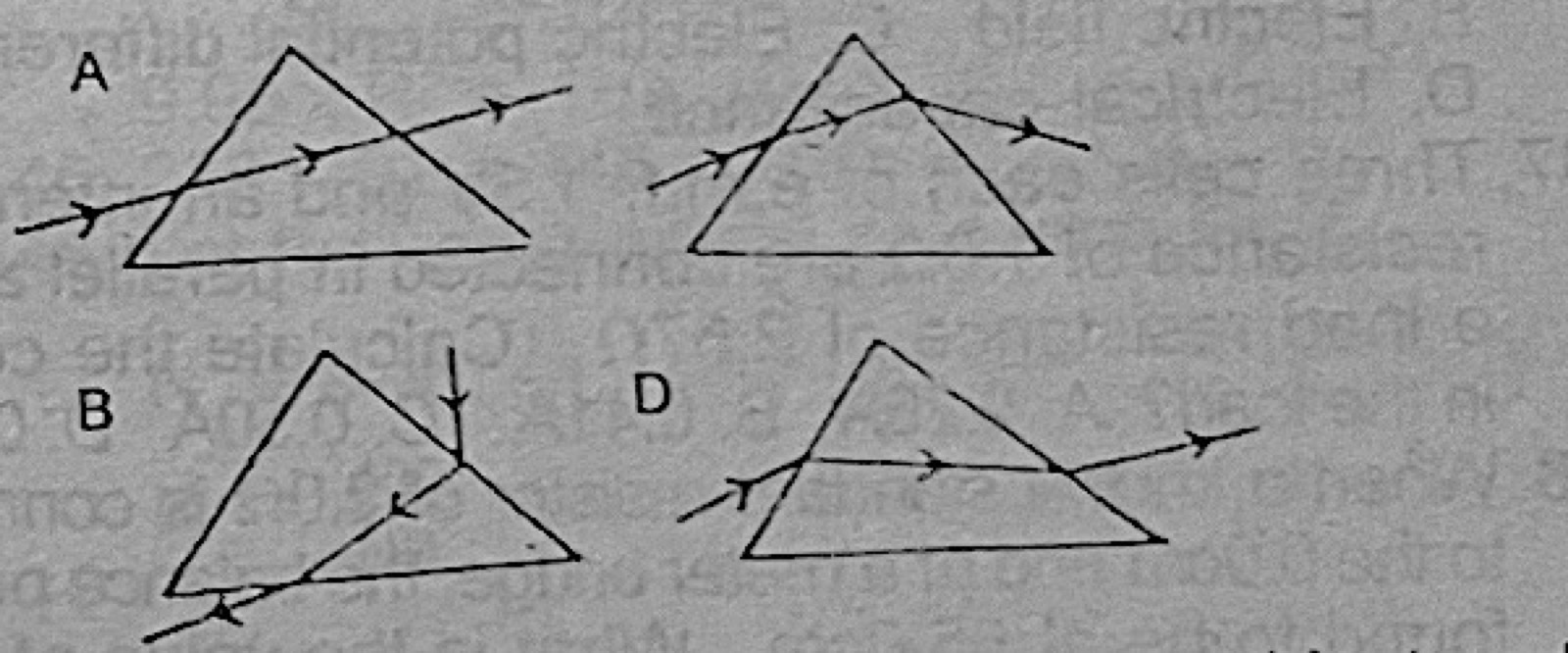
Which of the diagrams below correctly illustrates the path of a ray of light through a glass prism?

Diagram for this question
  1. A.A
  2. B.B
  3. C.C
  4. D.D
Show the answer and explanation

Answer: C (C)

Explanation

A ray passing through a prism is bent towards the base at both faces. Only the top-right diagram (C) shows the ray bending towards the base as it enters and again as it leaves.

Open this question

Question 27

Lenses and Optical Instruments

What must be the distance between an object and a converging lens of focal length 20 cm to produce an erect image two times the object height?

  1. A.20 cm
  2. B.15 cm
  3. C.10 cm
  4. D.5 cm
Show the answer and explanation

Answer: C (10 cm)

Explanation

An erect, magnified image is virtual, with v = −2u. 1/u − 1/(2u) = 1/20 gives 1/(2u) = 1/20, so u = 10 cm.

Open this question

Question 29

Lenses and Optical Instruments

For a short sighted person, light rays from a point on a very distant object is focused

  1. A.in front of the retina
  2. B.on the retina by a converging lens
  3. C.behind the retina by a diverging lens
  4. D.in front of the retina a distance 2F from the lens.
Show the answer and explanation

Answer: A (in front of the retina)

Explanation

A short-sighted eye is too strong (or too long), so parallel rays from far away meet in front of the retina.

Open this question

Question 30

Dispersion of Light and Colours

When light is incident on an object which is magenta in colour, which of the following colours would be absorbed?

  1. A.Red and blue
  2. B.Green only
  3. C.Red and green
  4. D.Red only
Show the answer and explanation

Answer: B (Green only)

Explanation

Magenta is red + blue, so a magenta object reflects red and blue and absorbs green.

Open this question

Question 31

Sound

In a resonance tube experiment, the effective length of the air column for the first resonance is 20 cm when set into vibration by a tuning fork of frequency 480 Hz. Neglecting end effect, the velocity of sound in air is

  1. A.96 m s−1
  2. B.255 m s−1
  3. C.340 m s−1
  4. D.384 m s−1
Show the answer and explanation

Answer: D (384 m s−1)

Explanation

First resonance: L = λ/4, so λ = 80 cm. v = fλ = 480 × 0.8 = 384 m s−1.

Open this question

Question 32

Sound

An organ pipe closed at one end is 80 cm long. Determine the frequency of the fundamental note assuming that the speed of sound in air is 340 m s−1.

  1. A.106 Hz
  2. B.213 Hz
  3. C.318 Hz
  4. D.425 Hz
Show the answer and explanation

Answer: A (106 Hz)

Explanation

For a closed pipe λ = 4L = 3.2 m, so f = 340/3.2 ≈ 106 Hz.

Open this question

Question 33

Sound

A sonometer wire of length 100 cm under a tension of 10 N, has a frequency of 250 Hz. Keeping the length of the wire constant, the tension is adjusted to produce a new frequency of 350 Hz. The new tension is

  1. A.5.1 N
  2. B.7.1 N
  3. C.14.0 N
  4. D.19.6 N
Show the answer and explanation

Answer: D (19.6 N)

Explanation

f ∝ √T, so T2 = 10 × (350/250)² = 10 × 1.96 = 19.6 N.

Open this question

Question 34

Magnetism

One of the properties of the earth's magnetic field is that the

  1. A.north pole lies in the northern hemisphere
  2. B.geographic and magnetic meridians coincide
  3. C.earth's magnetic flux is entirely horizontal at a place where the magnetic dip is zero
  4. D.earth's magnetic flux is entirely vertical at a place where the magnetic dip is zero.
Show the answer and explanation

Answer: C (earth's magnetic flux is entirely horizontal at a place where the magnetic dip is zero)

Explanation

Dip is the angle the field makes with the horizontal, so where the dip is zero (the magnetic equator) the field is entirely horizontal.

Open this question

Question 35

Electrostatics

Which of the following statements are true of an insulated charged body carrying a positive charge? I. It contains excess positive charges II. It creates an electric field III. It possesses potential energy IV. It carries electric current

  1. A.I and IV only
  2. B.I and II only
  3. C.I, II and III only
  4. D.I, II, III and IV.
Show the answer and explanation

Answer: C (I, II and III only)

Explanation

A positively charged body has more positive than negative charge, sets up an electric field and has electrical potential energy. Being insulated, its charge is at rest, so no current flows.

Open this question

Question 36

Electrostatics

Which of the following is a vector?

  1. A.Electric charge
  2. B.Electric field
  3. C.Electric potential difference
  4. D.Electrical capacitance.
Show the answer and explanation

Answer: B (Electric field)

Explanation

An electric field has both strength and direction. Charge, potential difference and capacitance are scalars.

Open this question

Question 37

Current Electricity

Three cells each of e.m.f. 1.5 V and an internal resistance of 1.0 Ω are connected in parallel across a load resistance of 2.67 Ω. Calculate the current in the load?

  1. A.0.26 A
  2. B.0.41 A
  3. C.0.50 A
  4. D.0.79 A
Show the answer and explanation

Answer: C (0.50 A)

Explanation

Identical cells in parallel give e.m.f. 1.5 V and internal resistance 1/3 Ω. I = 1.5/(2.67 + 0.33) = 0.5 A.

Open this question

Question 38

Current Electricity

When a known standard resistor of 2.0 Ω is connected to the 0.0 cm end of a meter bridge, the balance point is found to be at 55.0 cm. What is the value of the unknown resistor?

  1. A.1.10 Ω
  2. B.1.64 Ω
  3. C.2.44 Ω
  4. D.27.50 Ω
Show the answer and explanation

Answer: B (1.64 Ω)

Explanation

At balance R1/R2 = l1/l2: 2/R = 55/45, so R = 2 × 45/55 ≈ 1.64 Ω.

Open this question

Question 39

Current Electricity

The total energy required to send a unit positive charge round a complete electrical circuit is the

  1. A.kinetic energy
  2. B.potential difference
  3. C.electromotive force
  4. D.electrical energy.
Show the answer and explanation

Answer: C (electromotive force)

Explanation

The e.m.f. of a source is defined as the energy it gives to each coulomb of charge driven round the whole circuit (including inside the source). Potential difference refers to only part of the circuit.
Open this question

Question 40

Current Electricity

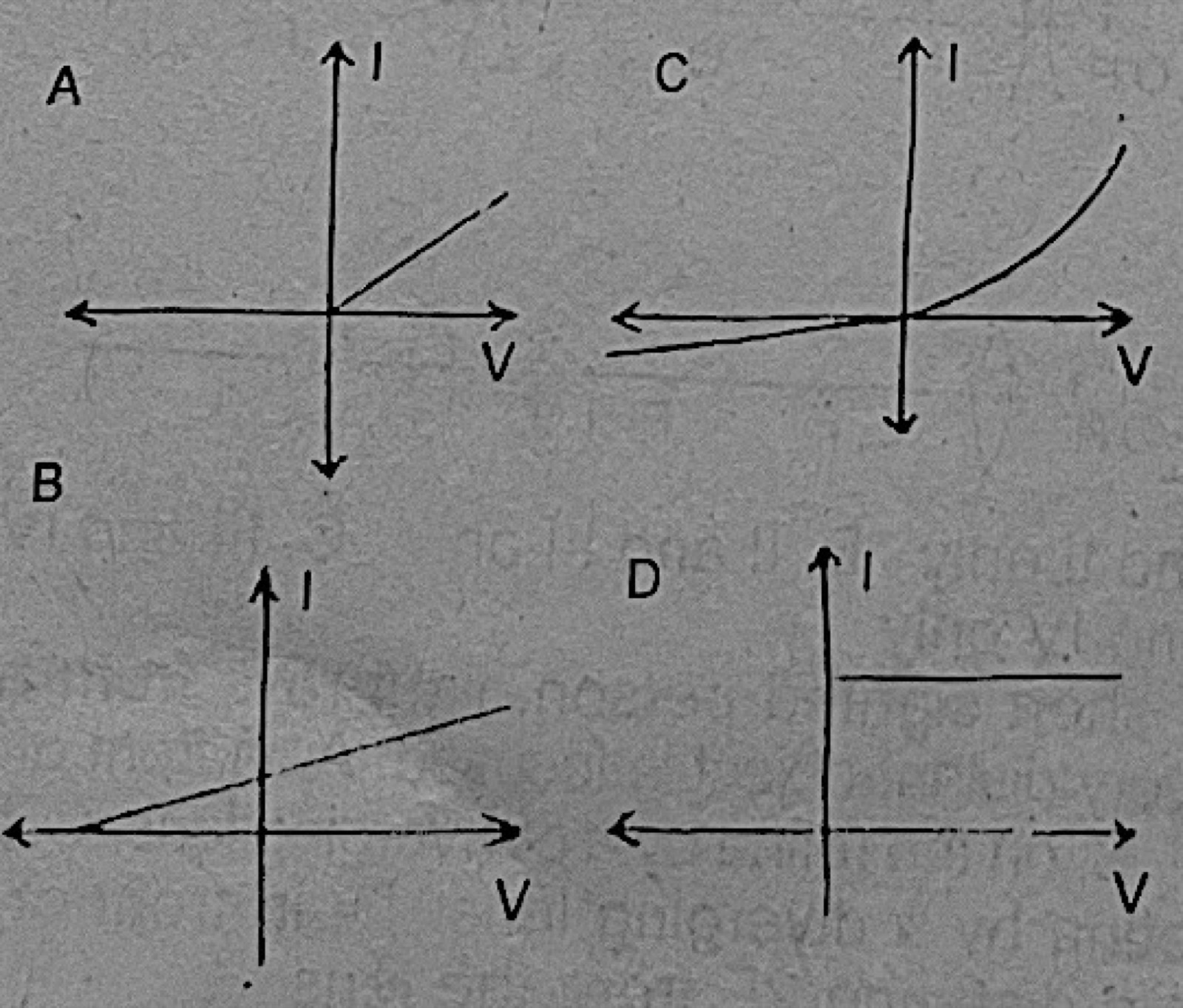
Which of the following graphs of current against voltage illustrates Ohm's law?

Diagram for this question
  1. A.A
  2. B.B
  3. C.C
  4. D.D
Show the answer and explanation

Answer: A (A)

Explanation

Ohm's law means I is directly proportional to V: a straight line through the origin, as in A.

Open this question

Question 41

Electrical Energy and Power

Which of the following is an essential physical property of the wires used for making fuses?

  1. A.Low density
  2. B.High thermal conductivity
  3. C.Low electrical resistivity
  4. D.Low melting point
Show the answer and explanation

Answer: D (Low melting point)

Explanation

A fuse wire must melt quickly when too much current heats it, so it needs a low melting point.

Open this question

Question 43

Electromagnetic Induction

Electrical power is transmitted at a high voltage rather than low voltage because the amount of energy loss is reduced due to

  1. A.heat dissipation
  2. B.production of eddy currents
  3. C.excessive current discharge
  4. D.excessive voltage discharge.
Show the answer and explanation

Answer: A (heat dissipation)

Explanation

At high voltage the current is small, so far less energy is lost as I²R heat in the cables.

Open this question

Question 44

Electrical Energy and Power

A lamp is rated 240 V, 60 W. The resistance of the filament is

  1. A.960 Ω
  2. B.16 Ω
  3. C.15 Ω
  4. D.4 Ω
Show the answer and explanation

Answer: A (960 Ω)

Explanation

R = V²/P = 240²/60 = 960 Ω.

Open this question

Question 45

Current Electricity

A 0 − 10 mA galvanometer with a coil resistance of 30 Ω can be converted to a 0 − 10 A ammeter by using

  1. A.0.03 Ω series resistor
  2. B.0.03 Ω shunt resistor
  3. C.9.99 Ω shunt resistor
  4. D.9.99 Ω series resistor.
Show the answer and explanation

Answer: B (0.03 Ω shunt resistor)

Explanation

The shunt carries 10 − 0.01 = 9.99 A at the same p.d. as the meter: 9.99R = 0.01 × 30, so R ≈ 0.03 Ω, connected in parallel.

Open this question

Question 46

Radioactivity and Nuclear Physics

The number of neutrons contained in the nucleus of 23892U is

  1. A.92
  2. B.146
  3. C.238
  4. D.330
Show the answer and explanation

Answer: B (146)

Explanation

Neutrons = mass number − atomic number = 238 − 92 = 146.

Open this question

Question 47

Electromagnetic Induction

What precaution should a manufacturer take to ensure that energy loss in a transformer is minimized?

  1. A.The winding of the transformer should be made of high resistance wires
  2. B.The core should be made of thin sheets of metal
  3. C.No magnetic material should be used to make the core
  4. D.The flux linking the primary with the secondary coils should be minimum.
Show the answer and explanation

Answer: B (The core should be made of thin sheets of metal)

Explanation

A core made of thin insulated (laminated) sheets cuts down eddy currents and the energy they waste.

Open this question

Question 48

Radioactivity and Nuclear Physics

A substance has a half life of 3 min. After 6 min, the count rate was observed to be 400. What was its count rate at zero time?

  1. A.200
  2. B.1200
  3. C.1600
  4. D.2400
Show the answer and explanation

Answer: C (1600)

Explanation

6 min is two half-lives, so the count rate has fallen to a quarter: original = 400 × 4 = 1600.

Open this question

Question 49

Electronics

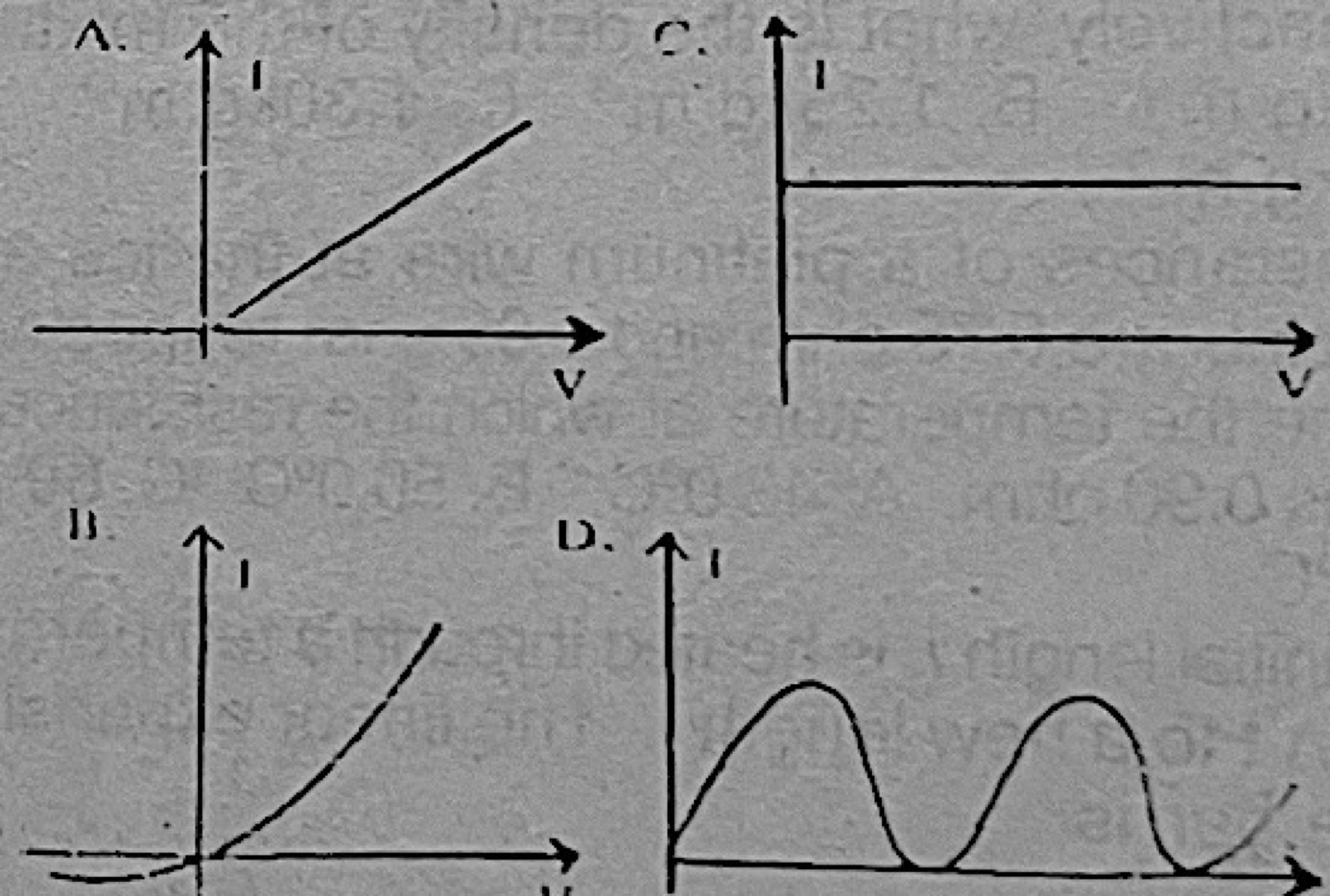
Which of the following graphs represents a voltage current characteristic curve for a diode?

Diagram for this question
  1. A.A
  2. B.B
  3. C.C
  4. D.D
Show the answer and explanation

Answer: B (B)

Explanation

A diode passes almost no current until the forward voltage is large enough, then the current rises steeply: a curve like B.

Open this question

Question 50

Modern Physics

The photocell works on the principle of the

  1. A.voltaic cell
  2. B.emission of electrons by incident radiation
  3. C.emission of protons by incident electrons
  4. D.photographic plate.
Show the answer and explanation

Answer: B (emission of electrons by incident radiation)

Explanation

In a photocell, light falling on a metal surface knocks out electrons (the photoelectric effect), which form a current.

Open this question