Question 1
Measurement and UnitsWhich of the following units is equivalent to kg m s−1?
- A.N s−1
- B.N m s
- C.N s
- D.J s−1
Show the answer and explanation
Answer: C (N s)
Explanation
1 N = 1 kg m s−2, so 1 N s = 1 kg m s−1 (the unit of momentum).
50 questions. Try each one, then open the answer to check yourself and read the explanation.
Which of the following units is equivalent to kg m s−1?
Answer: C (N s)
1 N = 1 kg m s−2, so 1 N s = 1 kg m s−1 (the unit of momentum).
A man walks 8 km north and then 5 km in a direction 60° east of north. Find the distance from his starting point.
Answer: A (11.36 km)
The angle between the two legs in the triangle is 180° − 60° = 120°. R² = 8² + 5² − 2 × 8 × 5 × cos 120° = 64 + 25 + 40 = 129, so R ≈ 11.36 km.
The velocity-time graph above describes the motion of a particle between two points P and Q. What is the distance between P and Q?
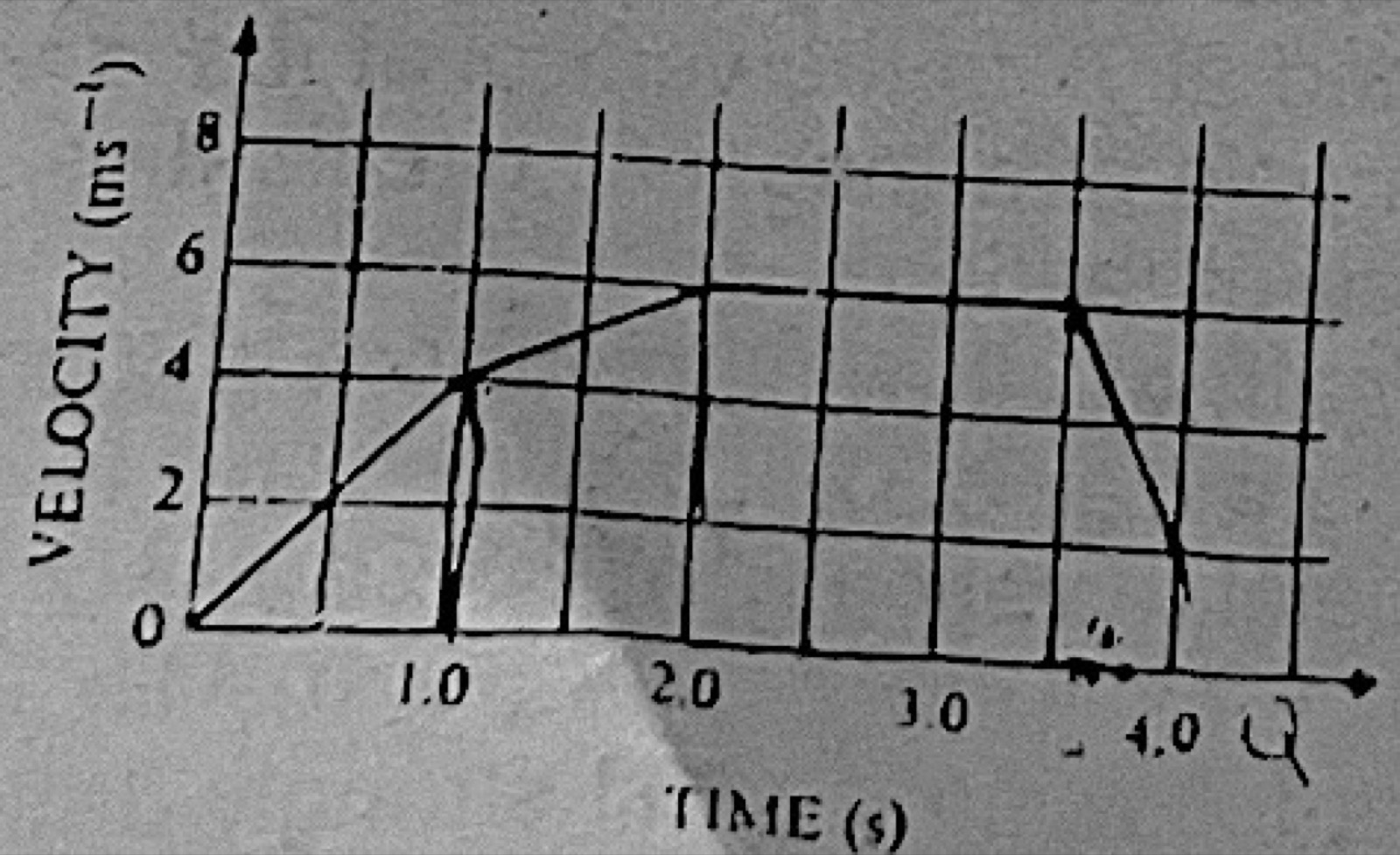
Answer: B (18.0 m)
Distance = area under the graph: ½ × 1 × 4 + ½(4 + 6) × 1 + 6 × 1.5 + ½(6 + 2) × 0.5 = 2 + 5 + 9 + 2 = 18 m.
A jet engine develops a thrust of 270 N when the velocity of the exhaust gases relative to the engine is 300 m s−1. What is the mass of the material ejected per second?
Answer: C (0.90 kg)
Thrust = mass ejected per second × exhaust speed, so mass per second = 270/300 = 0.9 kg.
Figure 1 above shows two connected bodies of masses m1 and m2 in equilibrium under gravity. The tension in the upper string is
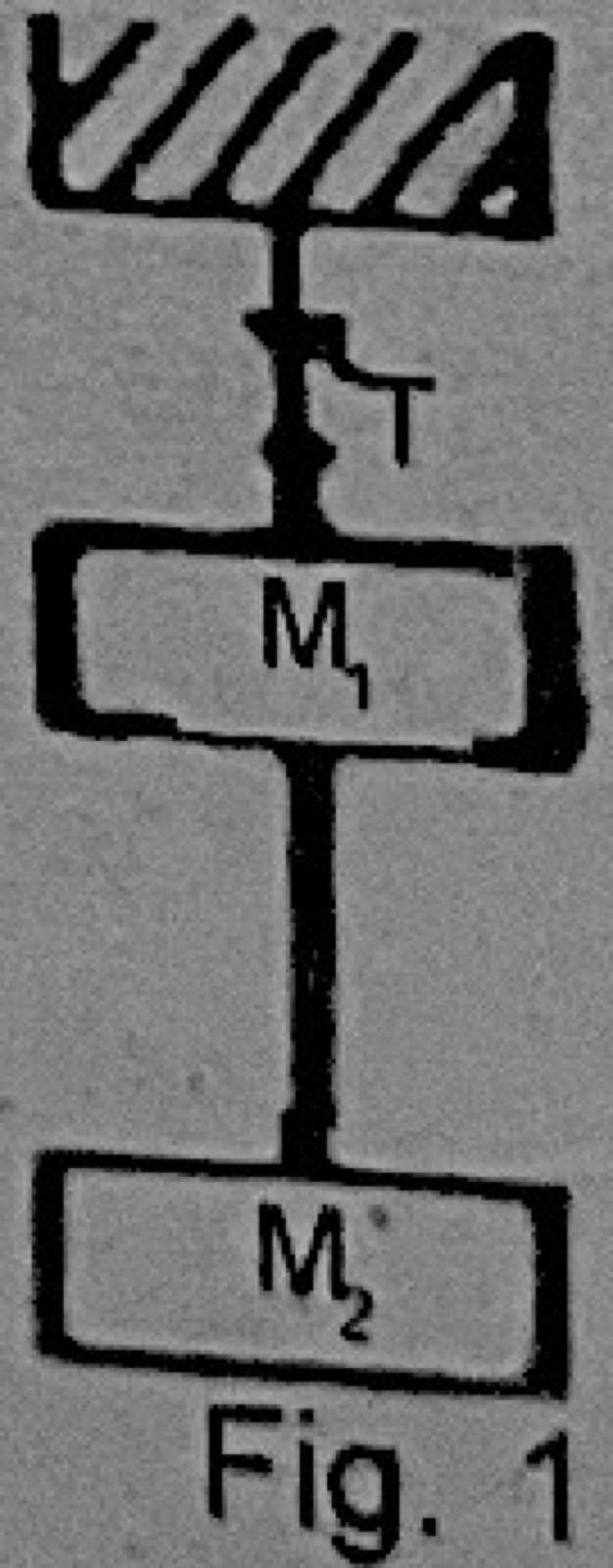
Answer: D ((m1 + m2)g.)
The upper string holds up both bodies, so its tension equals their total weight (m1 + m2)g.
An elevator of mass 4800 kg is supported by a cable which can safely withstand a maximum tension of 60 000 N. The maximum upward acceleration the elevator can have is [g = 10 m s−2]
Answer: A (2.5 m s−2)
T − mg = ma, so a = (60 000 − 48 000)/4800 = 2.5 m s−2.
A 50.0 kg block is dropped on a spring from a point 10 m above (Fig. 2). If the force constant of the spring is 4.0 × 10⁴ N m−1, find the maximum compression of the spring. [g = 10 m s−2]
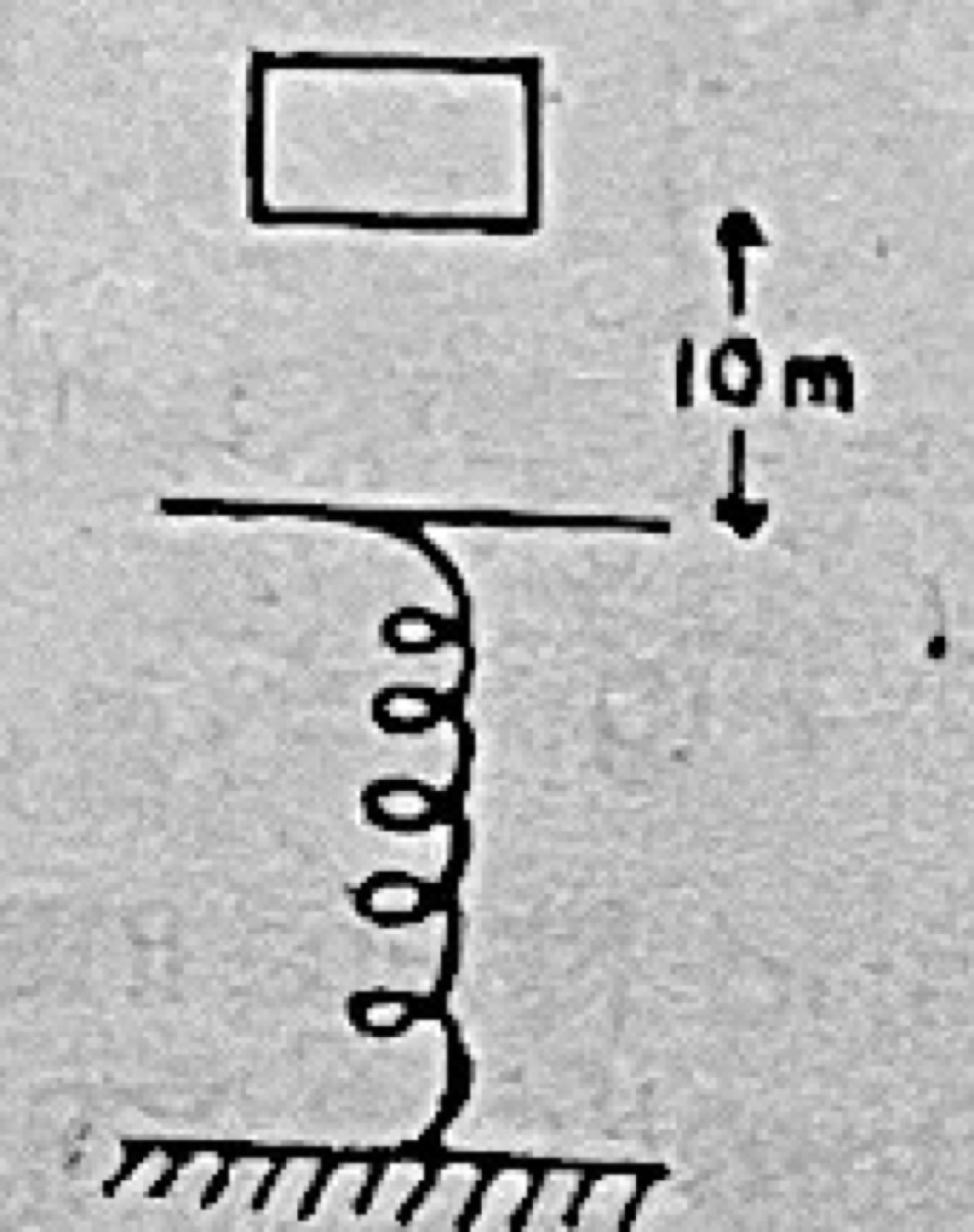
Answer: B (0.50 m)
The block's potential energy is stored in the spring: mgh = ½ke². 50 × 10 × 10 = ½ × 4 × 10⁴ × e², so e² = 0.25 and e = 0.5 m.
A constant force of 40 N acting on a body initially at rest gives an acceleration of 0.1 m s−2 for 4 s. Calculate the work done by the force
Answer: C (32 J)
Distance moved s = ½at² = ½ × 0.1 × 16 = 0.8 m. Work = 40 × 0.8 = 32 J.
A body rolls down a slope from a height of 100 m. Its velocity at the foot of the slope is 20 m s−1. What percentage of its initial potential energy is converted into kinetic energy? [g = 10 m s−2]
Answer: C (20%)
Per kilogram, PE = gh = 1000 J and KE = ½v² = 200 J. 200/1000 = 20%.
Figure 3 above represents the main sequence of energy conversion at Kainji Dam. The efficiency of the system is
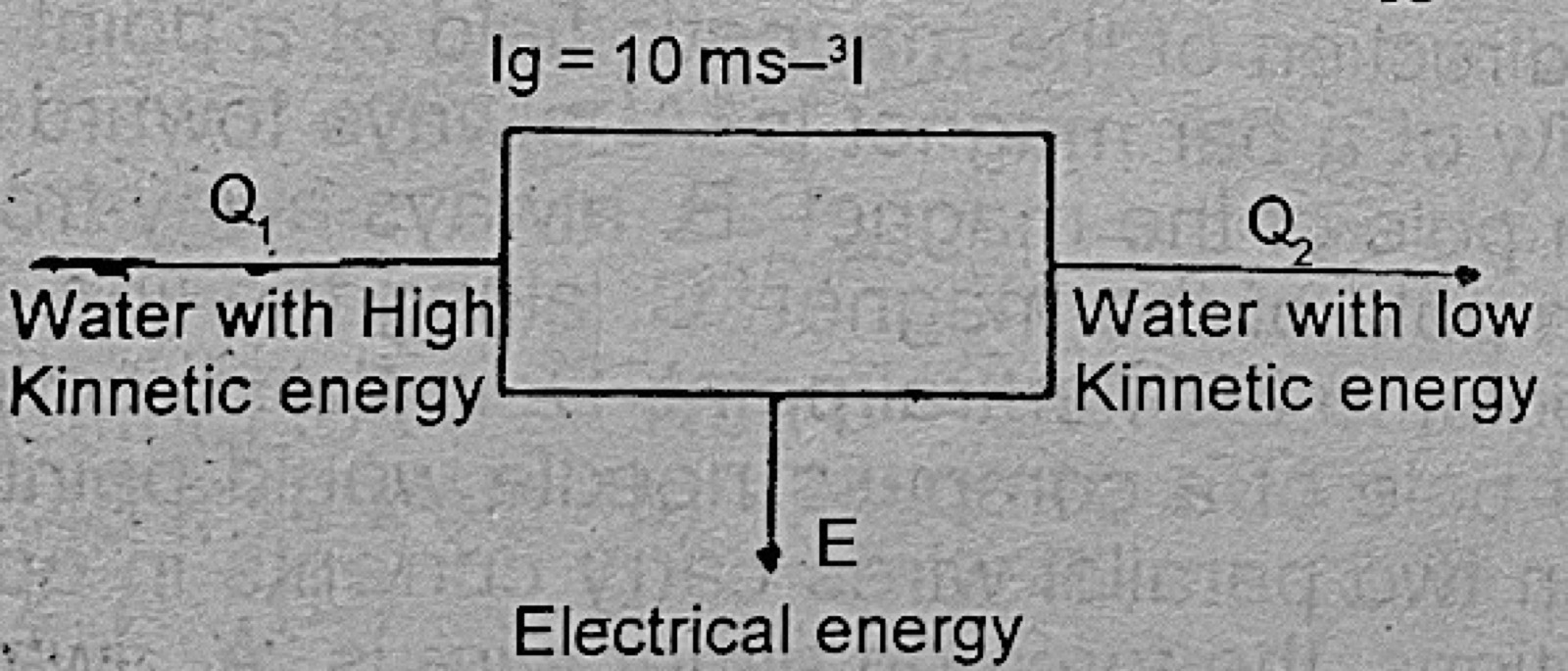
Answer: B (E/Q1)
Efficiency = useful output ÷ total input. The input is the kinetic energy Q1 brought in by the water and the useful output is the electrical energy E.
The coefficient of static friction between a 40 kg crate and concrete surface is 0.25. Find the magnitude of the minimum force needed to keep the crate stationary on the concrete base inclined at 45° to the horizontal. [g = 10 m s−2]
Answer: D (212 N)
Down the slope: mg sin 45° = 283 N. Friction can supply up to μmg cos 45° = 0.25 × 283 ≈ 71 N. The extra force needed is 283 − 71 ≈ 212 N.
If a beaker is filled with water it is observed that the surface of the water is not horizontal at the glass-water interface. This behaviour is due to
Answer: C (surface tension)
Water creeps up the glass to form a curved meniscus because of surface tension and adhesion between water and glass.
The mechanical advantage (MA) of an inclined plane depends on
Answer: D (the ratio of its length to its height.)
For an ideal inclined plane, MA = load/effort = length/height, so it depends on the ratio of length to height.
A load of 5 N gives an extension of 0.56 cm in a wire which obeys Hooke's law. What is the extension caused by a load of 20 N?
Answer: C (2.24 cm)
Extension is proportional to load: 0.56 × 20/5 = 2.24 cm.
A cube of side 10 cm and mass 0.5 kg floats in a liquid with only 1/5 of its height above the liquid surface. What is the relative density of the liquid?
Answer: C (0.625)
4/5 of the 1000 cm3 is under the liquid: 800 cm3 of liquid must weigh 500 g. Density = 500/800 = 0.625 g cm−3.
The distance between the fixed points of a centigrade thermometer is 20 cm. What is the temperature when the mercury level is 4.5 cm above the lower mark?
Answer: A (22.5°C)
θ = (4.5/20) × 100 = 22.5°C.
A metallic strip of iron and brass was heated. Which of the following diagrams accurately illustrates the shape of the strip after heating?
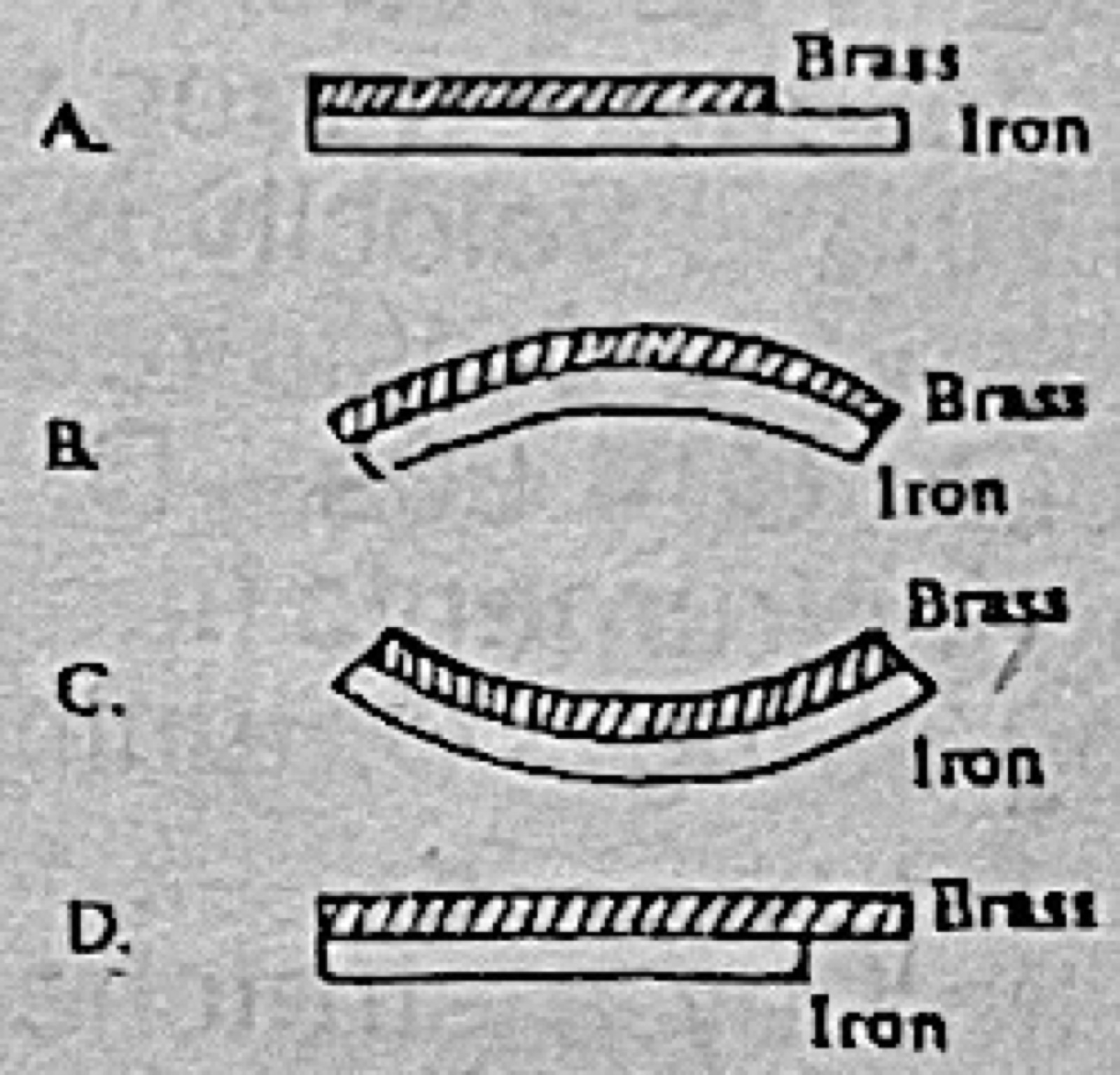
Answer: B (B)
Brass expands more than iron, so the strip bends with the brass on the outside (convex) side of the curve, as in B.
The length of a side of a metallic cube at 20°C is 5.0 cm. Given that the linear expansivity of the metal is 4.0 × 10⁻⁵ K−1, find the volume of the cube at 120°C.
Answer: A (126.50 cm3)
Cubic expansivity ≈ 3 × 4 × 10−5 = 1.2 × 10⁻⁴ K−1. V = 125 × (1 + 1.2 × 10−4 × 100) = 126.5 cm3.
As a result of air at the top of a barometer, the height of the mercury column is 73.5 cm when it should be 75.0 cm; the volume of the space above the mercury is 8.0 cm3. Calculate the correct barometric height when the barometer reads 74.0 cm and the volume of the space above the mercury is 6.0 cm3.
Answer: D (76.0 cm.)
The trapped air's pressure is first 75.0 − 73.5 = 1.5 cmHg. Boyle's law: 1.5 × 8 = p × 6, so p = 2 cmHg. True height = 74.0 + 2 = 76.0 cm.
A fixed quantity of gas is subjected to various pressures P and the corresponding volumes V measured at a constant temperature. Which of the following graphs best represent the results?
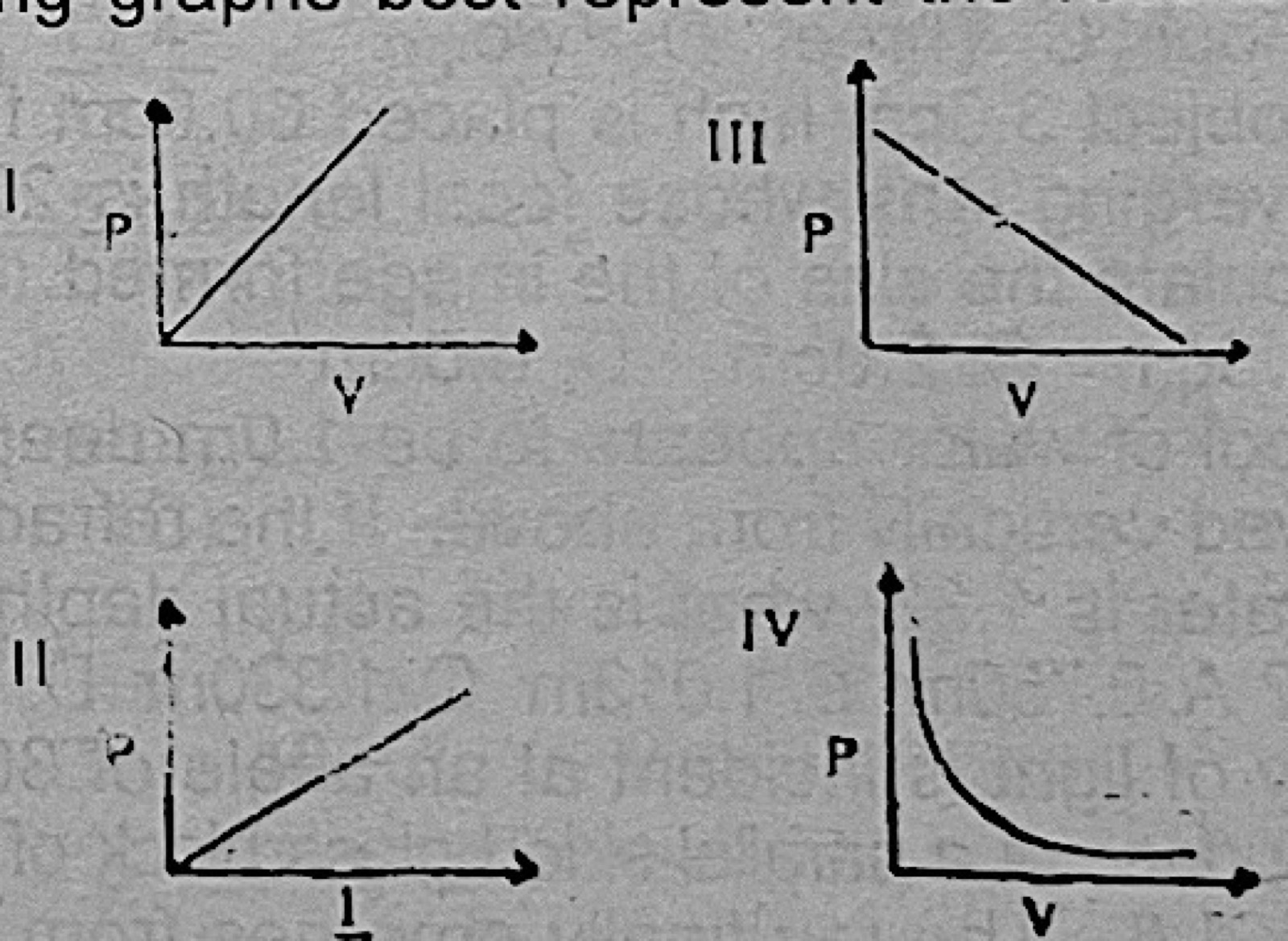
Answer: C (II, IV)
Boyle's law, pV = constant: p against 1/V is a straight line through the origin (II) and p against V is a curve that falls steeply then levels off (IV).
Hot water is added to three times its mass of water at 10°C and the resulting temperature is 20°C. What is the initial temperature of the hot water?
Answer: C (50°C)
Heat lost = heat gained: m(θ − 20) = 3m(20 − 10), so θ − 20 = 30 and θ = 50°C.
22,000 J of heat is required to raise the temperature of 1.5 kg of paraffin from 20°C to 30°C. Calculate the specific heat capacity of paraffin.
Answer: A (1466 J kg−1 °C−1)
c = Q/(mθ) = 22 000/(1.5 × 10) ≈ 1466 J kg−1 °C−1.
Calculate the amount of heat required to convert 2 kg of ice at −2°C to water at 0°C. (Specific heat capacity of ice = 2090 J kg−1 °C−1, specific latent heat of fusion of ice = 333 kJ kg−1).
Answer: D (674 360 J.)
Warming the ice: 2 × 2090 × 2 = 8360 J. Melting it: 2 × 333 000 = 666 000 J. Total = 674 360 J.
In which of the following are the substance arranged in descending order of their thermal conductivities?
Answer: A (copper, steel, glass)
Copper is an excellent conductor, steel a fair one and glass a poor one.
The vacuum in a thermos flask helps to reduce heat transfer by
Answer: B (convection and conduction)
Conduction and convection both need a material medium, so a vacuum stops them. Radiation is reduced by the silvered walls instead.
Which of the following phenomena explains the fact that a house whose roof is coated with white paint will be cooler in the hot season than one coated with black paint?
Answer: D (reflection)
A white roof reflects most of the sun's radiation, while a black roof absorbs it.
A wave has a frequency of 2 Hz and a wavelength of 30 cm. The velocity of the wave is
Answer: D (0.6 m s−1.)
v = fλ = 2 × 0.30 = 0.6 m s−1.
A boat at anchor is rocked by waves whose crests are 100 m apart and whose velocity is 25 m s−1. At what interval does the wave crests reach the boat?
Answer: C (4.00 s)
Crests arrive once every period: T = λ/v = 100/25 = 4 s.
Which of the following instruments has a pure tone?
Answer: C (tuning fork)
A tuning fork vibrates at a single frequency with almost no overtones, so it gives a pure tone.
The lowest note emitted by a stretched string has a frequency of 40 Hz. How many overtones are there between 40 Hz and 150 Hz?
Answer: B (2)
A stretched string gives all whole-number multiples of its fundamental: 80 Hz, 120 Hz, 160 Hz… Between 40 Hz and 150 Hz there are two overtones, 80 Hz and 120 Hz.
When the length l of a piece of wire under constant tension is varied, the relationship of the frequency of vibration f with l is
Answer: D (f ∝ 1/l)
f = (1/2l)√(T/μ), so at constant tension the frequency is inversely proportional to the length.
Which of the following statements supports the assumption that light travels in straight lines?
Answer: B (A source of light produces distinct shadows of opaque objects)
Sharp shadows form because light cannot bend round the edges of an opaque object; it travels in straight lines.
If an object is placed in front of two mirrors inclined at 90°, how many images will be formed?
Answer: C (Three)
n = 360°/90° − 1 = 3 images.
An object 3.0 cm high is placed 60.0 cm from a converging lens whose focal length is 20.0 cm. Calculate the size of the image formed.
Answer: B (1.5 cm)
1/v = 1/20 − 1/60 = 1/30, so v = 30 cm. Magnification = 30/60 = ½, so the image is 1.5 cm high.
A pool of water appears to be 1.0 m deep when viewed vertically from above. If the refractive index of water is 1.33, what is the actual depth of the pool?
Answer: C (1.330 m)
Real depth = refractive index × apparent depth = 1.33 × 1.0 = 1.33 m.
A ray of light is incident at an angle of 30° on one top surface of a parallel-sided glass block of refractive index 1.5. The ray finally emerges from the lower surface. What is the angular deviation of the emergent ray?
Answer: D (0°.)
With parallel faces the ray bends one way going in and back the same amount coming out, so it emerges parallel to its original direction: zero deviation (only a sideways shift).
Four lenses are being considered for use as a microscope objective. Which of the following focal lengths is most suitable?
Answer: B (+5 mm)
A microscope objective must be a converging lens (positive focal length) with a very short focal length, such as +5 mm.
If the angle of declination in a place is 10°E, calculate the true geographic bearing if the compass reads N40°E.
Answer: A (N50°E)
Magnetic north is 10° east of true north. The compass bearing is measured from magnetic north, so from true north the direction is 40° + 10° = N50°E.
In Fig. 4 above, a voltage V is applied across the terminals P and Q. The voltage across the 1 Ω resistor is
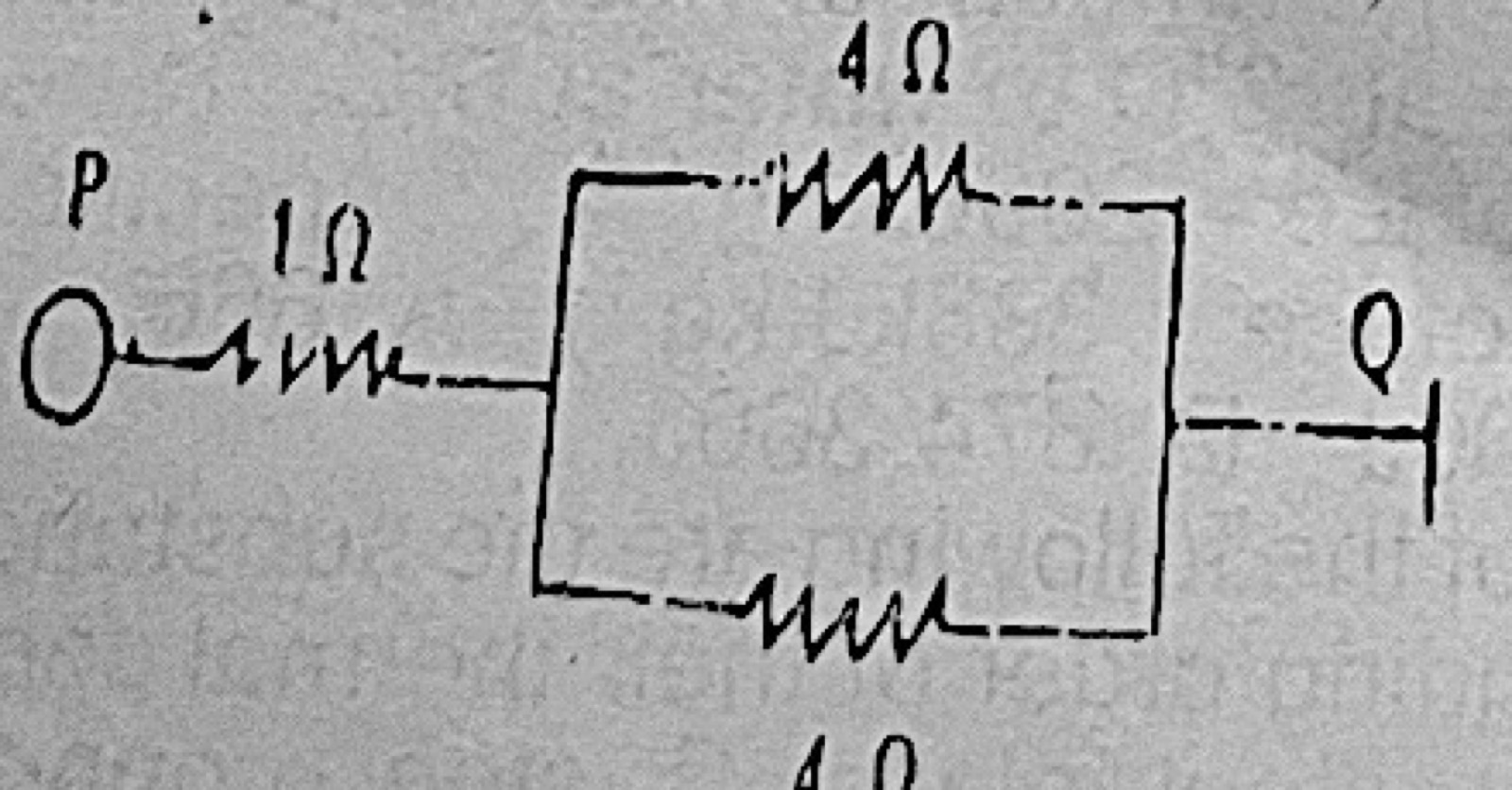
Answer: C (V/3)
The two 4 Ω in parallel give 2 Ω, so the total is 3 Ω. The 1 Ω resistor takes 1/3 of the voltage: V/3.
Two capacitances of 6 μF and 8 μF are connected in series. What additional capacitance must be connected in series with this combination to give a total of 3 μF?
Answer: C (24 μF)
In series 1/C adds: 1/3 = 1/6 + 1/8 + 1/C. So 1/C = 8/24 − 4/24 − 3/24 = 1/24 and C = 24 μF.
In Fig. 5 above, M and N are insulated metal spheres in contact. A negatively charged ebonite rod P is brought near M. When M and N are separated and the rod is taken away, which of the following statements is CORRECT?
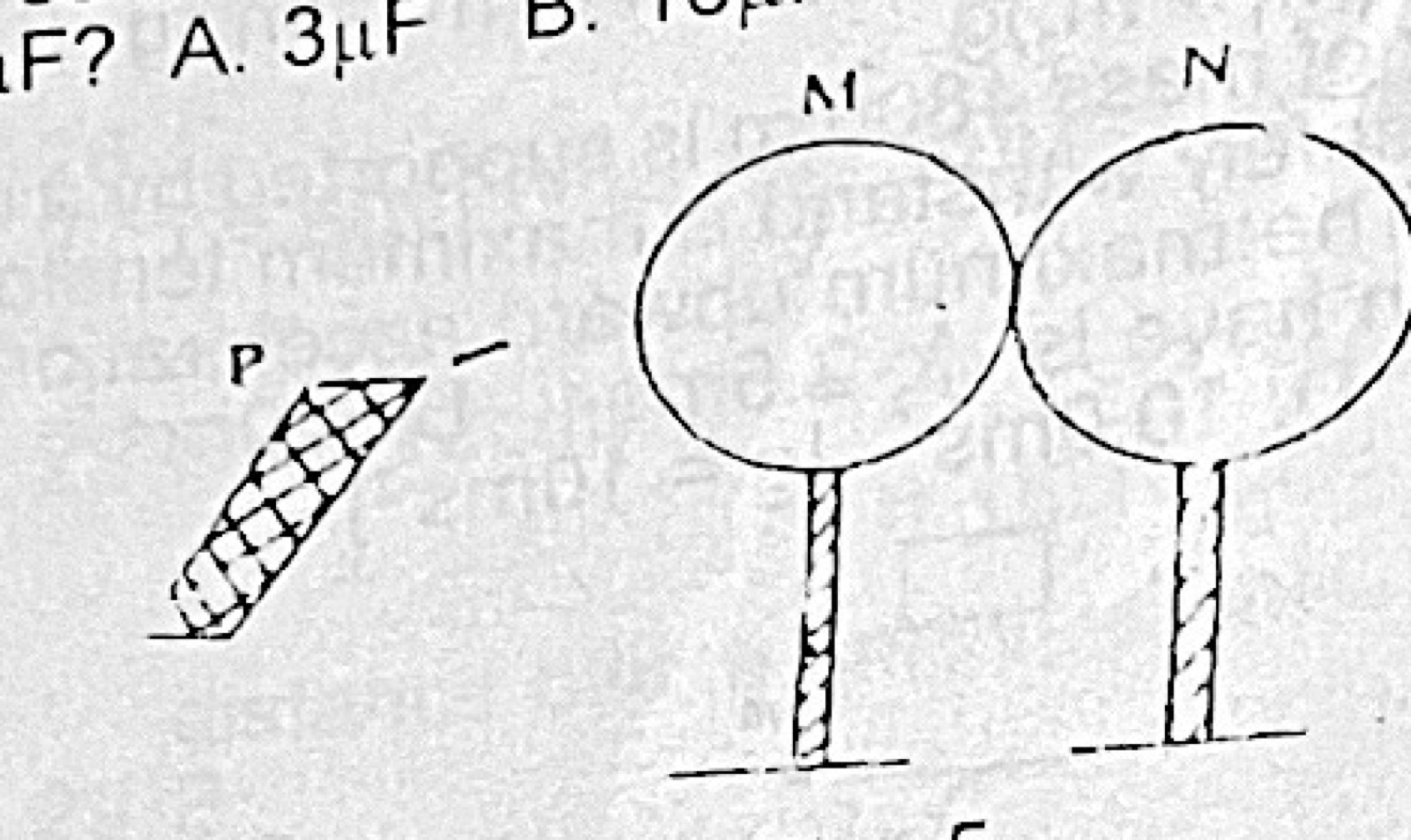
Answer: D (M has acquired positive charge and N negative charge.)
The negative rod repels electrons from M into N. Separating the spheres traps the charges: M (near the rod) is positive and N is negative.
When a transformer has more secondary windings than primary windings, it
Answer: A (has a smaller secondary current)
More secondary turns step the voltage up. Since power out cannot exceed power in, the secondary current is smaller.
A current of 0.5 A flows through a resistor when connected to a 40-V battery. How much energy is dissipated in 2 minutes?
Answer: C (2400 J)
Energy = IVt = 0.5 × 40 × 120 = 2400 J.
The direction of the magnetic field at a point in the vicinity of a bar magnet is
Answer: D (in the direction the north pole of a compass needle would point.)
The direction of a magnetic field at a point is defined as the direction in which a compass needle's north pole points there.
When two parallel wires carry currents in opposite directions, the force on either wire is
Answer: A (away from the other wire)
Parallel currents in opposite directions repel, so each wire is pushed away from the other.
A galvanometer of resistance 20 Ω is to be provided with a shunt such that 1/10 of the whole current in a circuit passes through the galvanometer. The resistance of the shunt is
Answer: B (2.22)
The shunt carries 9/10 of the current at the same p.d.: (1/10)I × 20 = (9/10)I × R, so R = 20/9 ≈ 2.22 Ω.
What type of reaction is represented by the following scheme? 21X + 21Y → 32Z + 10n + energy
Answer: A (Fusion reaction)
Two light nuclei join to form a heavier nucleus and release energy: nuclear fusion.
Which of the following statements is TRUE of photoelectric effect?
Answer: C (The energy of the emitted electron depends on the wavelength of the incident light)
The maximum energy of a photoelectron is hf − W = hc/λ − W, so it depends on the wavelength (frequency) of the light, not its intensity.
Isotopes are nuclei which have
Answer: C (the same atomic number but different number of neutrons)
Isotopes of an element have the same number of protons (atomic number) but different numbers of neutrons.
A radioactive sample initially contains N atoms. After three half-lives the number of atoms that have disintegrated is
Answer: D (7N/8)
After three half-lives N/8 atoms are left undecayed, so N − N/8 = 7N/8 have disintegrated.