Which of the following statements are true about the spring balance and the chemical balance? I. Both are used to measure the mass of an object II. Either of them may be used to measure the weight of an object. III. The spring balance works on the principle of Hooke's law while the chemical balance works on the principle of moments. IV. A change in gravity changes the readings of a spring balance but not that of a chemical balance
A.I and IV
B.II and III
C.III and IV
D.I, II and III
E.I and III.
Show the answer and explanation
Answer: C (III and IV)
Explanation
A spring balance measures weight using Hooke's law, so its reading changes with g. A chemical balance compares masses using moments, so its reading does not change with g.
Which of the following types of motion are oscillatory? I. A diving board when used by a diver II. The motion of the balance wheel of a wrist watch III. The motion of the turn-table of a record player IV. The motion of the centre of a ten kobo piece as it rolls down an inclined plane. V. The motion of the needle of a D.C. ammeter into which a low A.C. current is passed
A.I and II only
B.I, II and III
C.II, III and IV
D.I, II and V
E.III, IV and V
Show the answer and explanation
Answer: A (I and II only)
Explanation
A diving board and a watch balance wheel move to and fro about a fixed position. A turntable rotates and a rolling coin moves forward; neither repeats a to-and-fro motion.
If a car starts from rest and moves with a uniform acceleration of 10 m s−2 for ten seconds, the distance it covers in the last one second of its motion is
A.95 m
B.100 m
C.500 m
D.905 m
E.1000 m
Show the answer and explanation
Answer: A (95 m)
Explanation
Distance in 10 s = ½ × 10 × 10² = 500 m; in 9 s = ½ × 10 × 9² = 405 m. The last second covers 500 − 405 = 95 m.
A block of mass 2.0 kg resting on a smooth horizontal plane is acted upon simultaneously by two forces, 10 N due North and 10 N due East. The magnitude of the acceleration produced by the forces on the block is
A.0.10 m s−2
B.7.05 m s−2
C.10.00 m s−2
D.14.10 m s−2
E.20.00 m s−2
Show the answer and explanation
Answer: B (7.05 m s−2)
Explanation
Resultant = √(10² + 10²) ≈ 14.1 N. a = F/m = 14.1/2 ≈ 7.05 m s−2.
A metal block of mass 5 kg lies on a rough horizontal platform. If a horizontal force of 8 N applied to the block through its centre of mass just slides the block on the platform, then the coefficient of limiting friction between the block and the platform is
A.0.16
B.0.63
C.0.80
D.1.60
E.2.00
Show the answer and explanation
Answer: A (0.16)
Explanation
Limiting friction = μmg, so 8 = μ × 5 × 10 and μ = 0.16.
A 0.05 kg bullet travelling at 500 m s−1 horizontally strikes a thick vertical wall. It stops after penetrating through the wall a horizontal distance of 0.25 m. What is the magnitude of the average force the wall exerts on the bullet?
A.25 N
B.50 N
C.250 N
D.5000 N
E.25 000 N
Show the answer and explanation
Answer: E (25 000 N)
Explanation
The wall's force does work equal to the bullet's kinetic energy: F × 0.25 = ½ × 0.05 × 500² = 6250 J, so F = 25 000 N.
A force of 100 N stretches an elastic string to a total length of 20 cm. If an additional force of 100 N stretches the string 5 cm further, find the natural length of the string.
A.15 cm
B.12 cm
C.10 cm
D.8 cm
E.5 cm
Show the answer and explanation
Answer: A (15 cm)
Explanation
The extra 100 N gives an extra 5 cm, so the first 100 N also stretched it 5 cm. Natural length = 20 − 5 = 15 cm.
Two divers G and H are at depths 20 m and 40 m respectively below the water surface in a lake. The pressure on G is P1 while the pressure on H is P2. If the atmospheric pressure is equivalent to 10 m of water, then the value of P2/P1 is
A.0.50
B.0.60
C.1.67
D.2.00
E.3.00
Show the answer and explanation
Answer: C (1.67)
Explanation
Total pressure includes the atmosphere: P1 = 20 + 10 = 30 m of water and P2 = 40 + 10 = 50 m. P2/P1 = 50/30 ≈ 1.67.
The areas of the effort and load pistons of a hydraulic press are 0.5 m2 and 5 m2 respectively. If a force F1 of 100 N is applied on the effort piston, the force F2 on the load is
A.10 N
B.100 N
C.500 N
D.1000 N
E.5000 N
Show the answer and explanation
Answer: D (1000 N)
Explanation
The pressure is the same on both pistons: 100/0.5 = F2/5, so F2 = 1000 N.
A metal cube of volume 103 mm3 is lowered into a measuring cylinder containing water. If the internal cross-sectional area of the cylinder is 1.5 × 102 mm2, by how much does the water level rise in the cylinder?
A uniform cylindrical block of wood floats in water with one-third of its height above the water level. In a liquid of relative density 0.8, what fraction of its height will be above the liquid level?
A.1/6
B.1/5
C.1/3
D.4/5
E.5/6.
Show the answer and explanation
Answer: A (1/6)
Explanation
In water ⅔ is submerged, so the wood's relative density is ⅔. In the liquid the submerged fraction is (⅔)/0.8 = 5/6, leaving 1/6 above the surface.
A thin aluminium plate has a surface area of 1.500 m2 at 20°C. What will be its surface area when it is cooled to −20°C? (Take the linear expansivity of aluminium to be 2.5 × 10⁻⁵ K−1).
Two liquids, P at a temperature of 20°C and Q at a temperature of 80°C have specific heat capacities of 1.0 J kg−1 °C−1 and 1.5 J kg−1 °C−1 respectively. If equal masses of P and Q are mixed in a lagged calorimeter, then the equilibrium temperature is
A.44°C
B.50°C
C.56°C
D.60°C
E.70°C.
Show the answer and explanation
Answer: C (56°C)
Explanation
Heat lost by Q = heat gained by P: 1.5(80 − θ) = 1.0(θ − 20), so 120 − 1.5θ = θ − 20 and θ = 56°C.
A quantity of gas occupies a certain volume when the temperature is −73°C and the pressure is 1.5 atmospheres. If the pressure is increased to 4.5 atmospheres and the volume is halved at the same time, what will be the new temperature of the gas?
A.573°C
B.327°C
C.300°C
D.110°C
E.27°C
Show the answer and explanation
Answer: E (27°C)
Explanation
T2 = T1 × (p2V2)/(p1V1) = 200 K × (4.5 × ½)/1.5 = 300 K = 27°C.
In a gas experiment, the pressure of the gas is plotted against the reciprocal of the volume of the gas at a constant temperature. The unit of the slope of the resulting curve is
A.force
B.force/m
C.work
D.force/m3
E.energy/m2.
Show the answer and explanation
Answer: C (work)
Explanation
The slope is p ÷ (1/V) = pV, whose unit is N m−2 × m3 = N m, the unit of work (joule).
Two thermos flasks of volume Vx and Vy are filled with liquid water at an initial temperature of 0°C. After some time the temperature were found to be θx, θy respectively. Given that Vx/Vy = 2 and θx/θy = ½, the ratio of the heat flow into the flasks is
A.¼
B.½
C.4
D.1
E.2
Show the answer and explanation
Answer: D (1)
Explanation
Heat = mass × c × temperature rise, and mass is proportional to volume. The ratio is 2 × ½ = 1.
A.low specific heat capacity and low heat conductivity
B.low specific heat capacity and high heat conductivity
C.high specific heat capacity and low heat conductivity
D.high specific heat capacity and low heat conductivity
E.dull surface and low heat conductivity.
Show the answer and explanation
Answer: B (low specific heat capacity and high heat conductivity)
Explanation
A low specific heat capacity means the calorimeter takes little of the heat, and high conductivity lets its contents reach one steady temperature quickly.
Which of the following phenomena CANNOT be explained by the molecular theory of matter?
A.Expansion
B.Conduction
C.Convection
D.Radiation
E.Evaporation
Show the answer and explanation
Answer: D (Radiation)
Explanation
Expansion, conduction, convection and evaporation all involve the motion of molecules. Radiation is transfer by electromagnetic waves and needs no molecules, so molecular theory does not explain it.
In order to find the depth of the sea, a ship sends out a sound wave and receives an echo after one second. If the velocity of sound in water is 1500 m/s, what is the depth of the sea?
A.0.75 km
B.1.50 km
C.2.20 km
D.3.00 km
E.3.75 km
Show the answer and explanation
Answer: A (0.75 km)
Explanation
The sound takes 0.5 s each way, so depth = 1500 × 0.5 = 750 m = 0.75 km.
A convex mirror is used as a driving mirror because I. Its image is erect II. It has a large field of view III. It has a long focal length. Identify the CORRECT statement(s).
A.I and III only
B.I and II only
C.II and III only
D.I, II and III only
E.I only
Show the answer and explanation
Answer: B (I and II only)
Explanation
A convex mirror always gives an upright image and shows a wide field of view; a long focal length is not the reason.
Two rays of light from a point below the surface of water are equally inclined to the vertical and are inclined to each other at 60° in water. What is the angle between the rays when they emerge into air? (Take the refractive index of water to be 4/3)
A.41.8°
B.44.1°
C.60.0°
D.83.6°
E.120.0°
Show the answer and explanation
Answer: D (83.6°)
Explanation
Each ray meets the surface at 30°. sin r = (4/3) × sin 30° = 0.667, so r ≈ 41.8°. The emerging rays are 2 × 41.8° = 83.6° apart.
A charge of one coulomb liberates 0.0033 g of copper in an electrolytic process. How long will it take a current of 2 A to librate 1.98 g of copper in such a process?
A.5 minutes
B.30 minutes
C.50 minutes
D.60 minutes
E.120 minutes
Show the answer and explanation
Answer: A (5 minutes)
Explanation
Charge needed = 1.98/0.0033 = 600 C. t = Q/I = 600/2 = 300 s = 5 minutes.
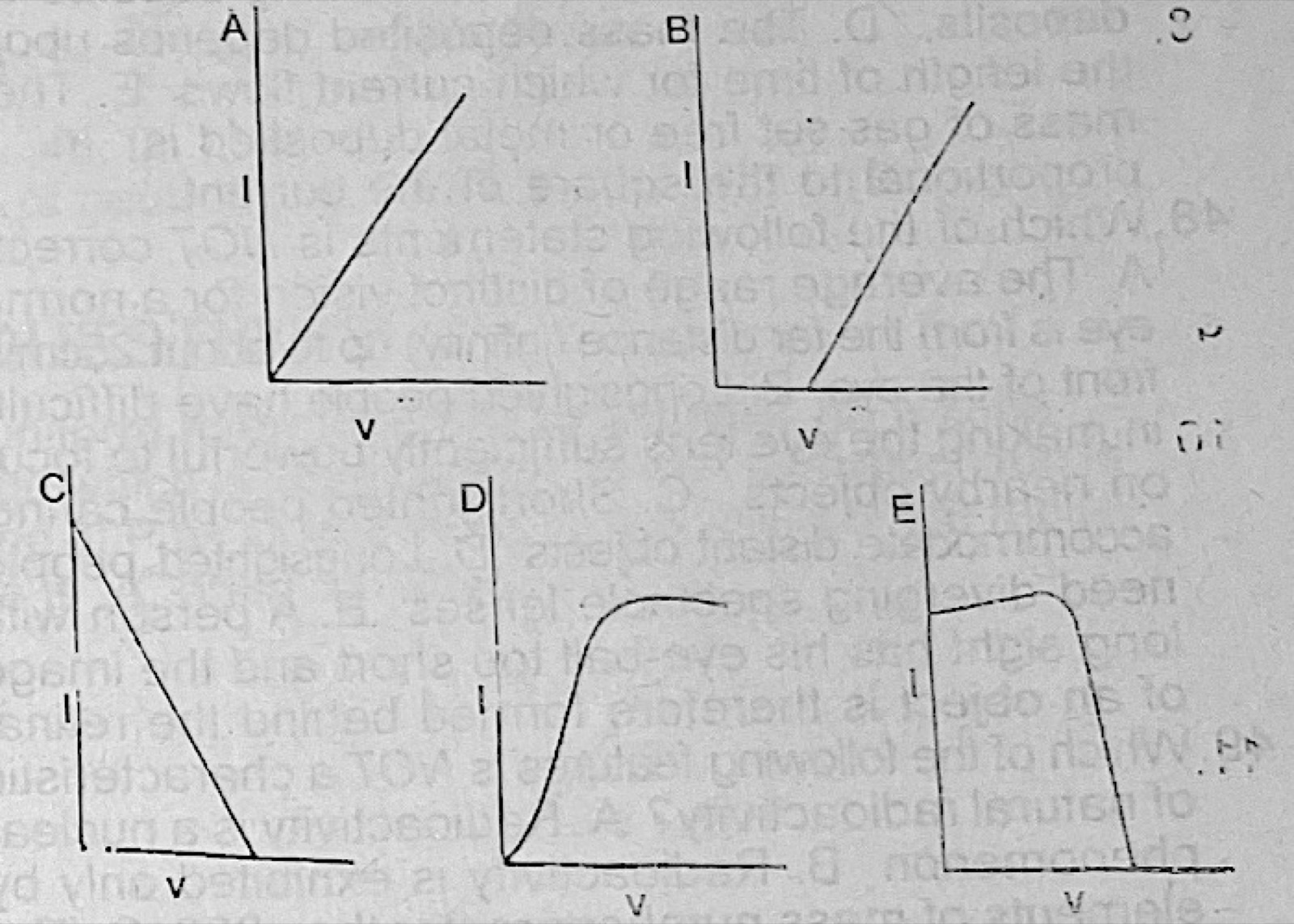
Which of the graphs A − E (Fig. 3) represents the current-voltage (I − V) relationship for a cell with internal resistance?
A.A
B.B
C.C
D.D
E.E
Show the answer and explanation
Answer: C (C)
Explanation
For a cell, V = E − Ir: the more current it supplies, the lower its terminal voltage. So I falls in a straight line as V rises, reaching zero when V equals the e.m.f., as in graph C.
An electric kettle, connected to a 240 V mains, produces 6.0 × 10⁵ J of heat energy to boil a quantity of water in 5 minutes. Find the resistance of the kettle.
A.14.4 Ω
B.28.8 Ω
C.144 Ω
D.288 Ω
E.2880 Ω
Show the answer and explanation
Answer: B (28.8 Ω)
Explanation
Power = 6.0 × 10⁵/300 = 2000 W. R = V²/P = 240²/2000 = 28.8 Ω.
On which of the following does the operation of a moving coil ammeter depend? I. Electromagnetic induction II. Force on a current-carrying conductor in a magnetic field. III. Magnetic effect of an electric current
A.I only
B.II only
C.III only
D.II and III
E.I, II and III.
Show the answer and explanation
Answer: B (II only)
Explanation
The current-carrying coil sits in a magnet's field and feels a turning force; that force turns the pointer.
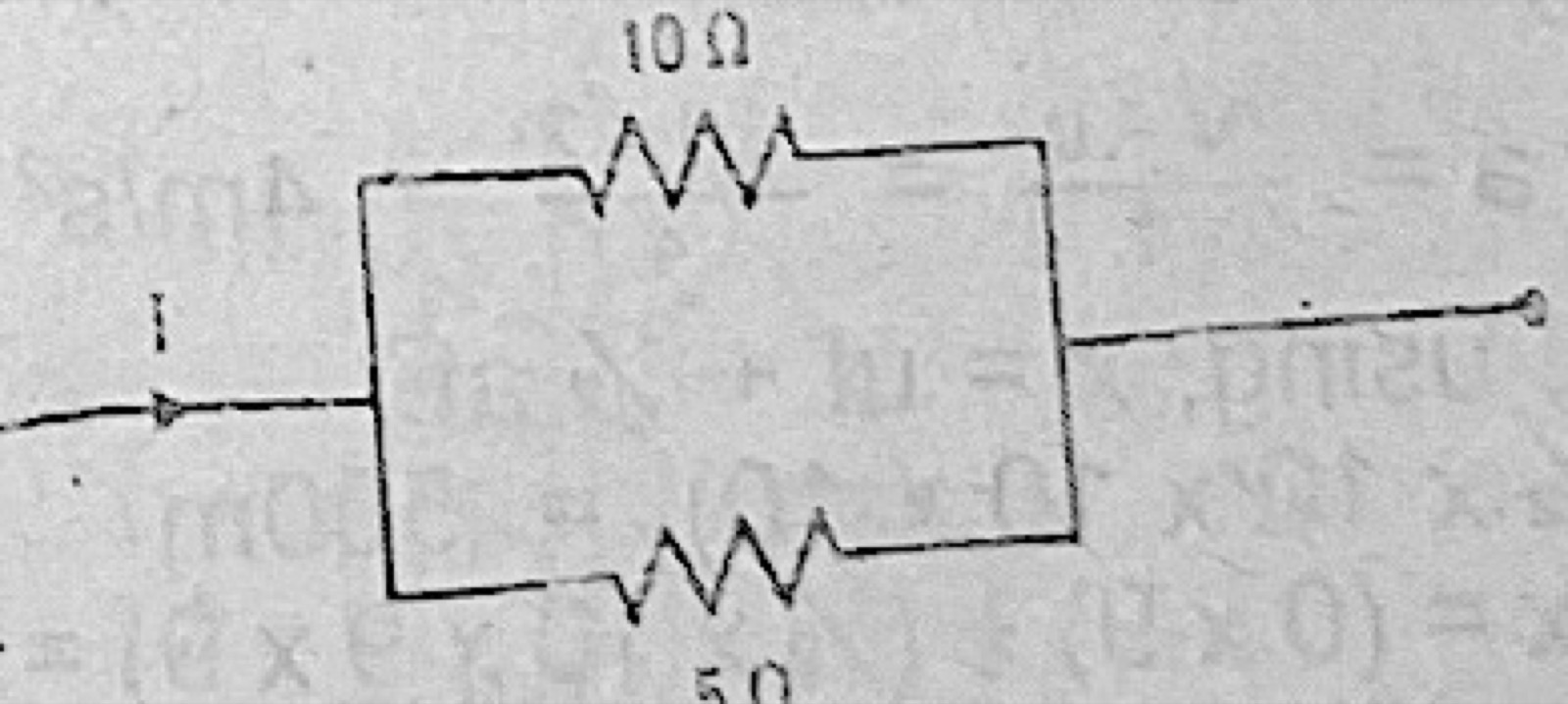
In Fig. 4, current (I) passes through the parallel combination. If the power dissipated in the 5 Ω resistor is 40 W, then the power dissipated in the 10 Ω resistor is
A.10 W
B.20 W
C.40 W
D.80 W
E.100 W
Show the answer and explanation
Answer: B (20 W)
Explanation
The resistors are in parallel, so they have the same voltage and P = V²/R. Doubling R halves the power: 40/2 = 20 W.
A transformer has a primary coil with 500 turns and a secondary coil with 2500 turns. When the voltage input to the primary coil is 120 V, the output is