Question 1
Number BasesFind the value of m if 13m + 24m = 41m.
- A.8
- B.6
- C.5
- D.2
Show the answer and explanation
Answer: B (6)
Explanation
(m + 3) + (2m + 4) = 4m + 1, so 3m + 7 = 4m + 1 and m = 6.
45 questions. Try each one, then open the answer to check yourself and read the explanation.
Find the value of m if 13m + 24m = 41m.
Answer: B (6)
(m + 3) + (2m + 4) = 4m + 1, so 3m + 7 = 4m + 1 and m = 6.
If 3214 is divided by 234 and leaves a remainder r, what is the value of r?
Answer: C (2)
3214 = 57 and 234 = 11 in base ten. 57 = 5 × 11 + 2, so r = 2.
Simplify 3½ − (2⅓ × 1¼) + 3/5
Answer: C (1 11/60)
2⅓ × 1¼ = 35/12. Then 7/2 − 35/12 + 3/5 = (210 − 175 + 36)/60 = 71/60 = 1 11/60.
A father decided to give 20% of his monthly income to his three children as their monthly allowance. The eldest child got 45% of the allowance and the youngest got 25%. How much was the father's monthly income if the second child got N3,000?
Answer: C (N50,000)
The second child got 100 − 45 − 25 = 30% of the allowance, so the allowance is N10,000. That is 20% of income, so income = N50,000.
If the interest on N150.00 for 2½ years is N4.50, find the interest on N250.00 for 6 months at the same rate.
Answer: A (N1.50)
Rate = 100 × 4.50/(150 × 2.5) = 1.2% a year. Interest = 250 × 1.2 × ½/100 = N1.50.
Evaluate (813/4 − 271/3)/(3 × 23).
Answer: B (1)
813/4 = 27 and 271/3 = 3, so the value is (27 − 3)/24 = 1.
If log102 = 0.3010 and log103 = 0.4771, evaluate log104.5
Answer: B (0.6532)
4.5 = 9/2, so log 4.5 = 2 log 3 − log 2 = 0.9542 − 0.3010 = 0.6532.
Simplify (√12 − √3)/(√12 + √3)
Answer: B (1/3)
√12 = 2√3, so the expression is (2√3 − √3)/(2√3 + √3) = √3/(3√3) = 1/3.
If U = {x/x is a positive integer less than 10} and P = {x/ x is a prime factor of 30}, find the complement of P.
Answer: C ({1, 4, 6, 7, 8, 9})
The prime factors of 30 are 2, 3 and 5. Removing them from {1, ..., 9} leaves {1, 4, 6, 7, 8, 9}.
The Venn diagram above shows a class of 40 students with the games they play. How many of the students play two games only?
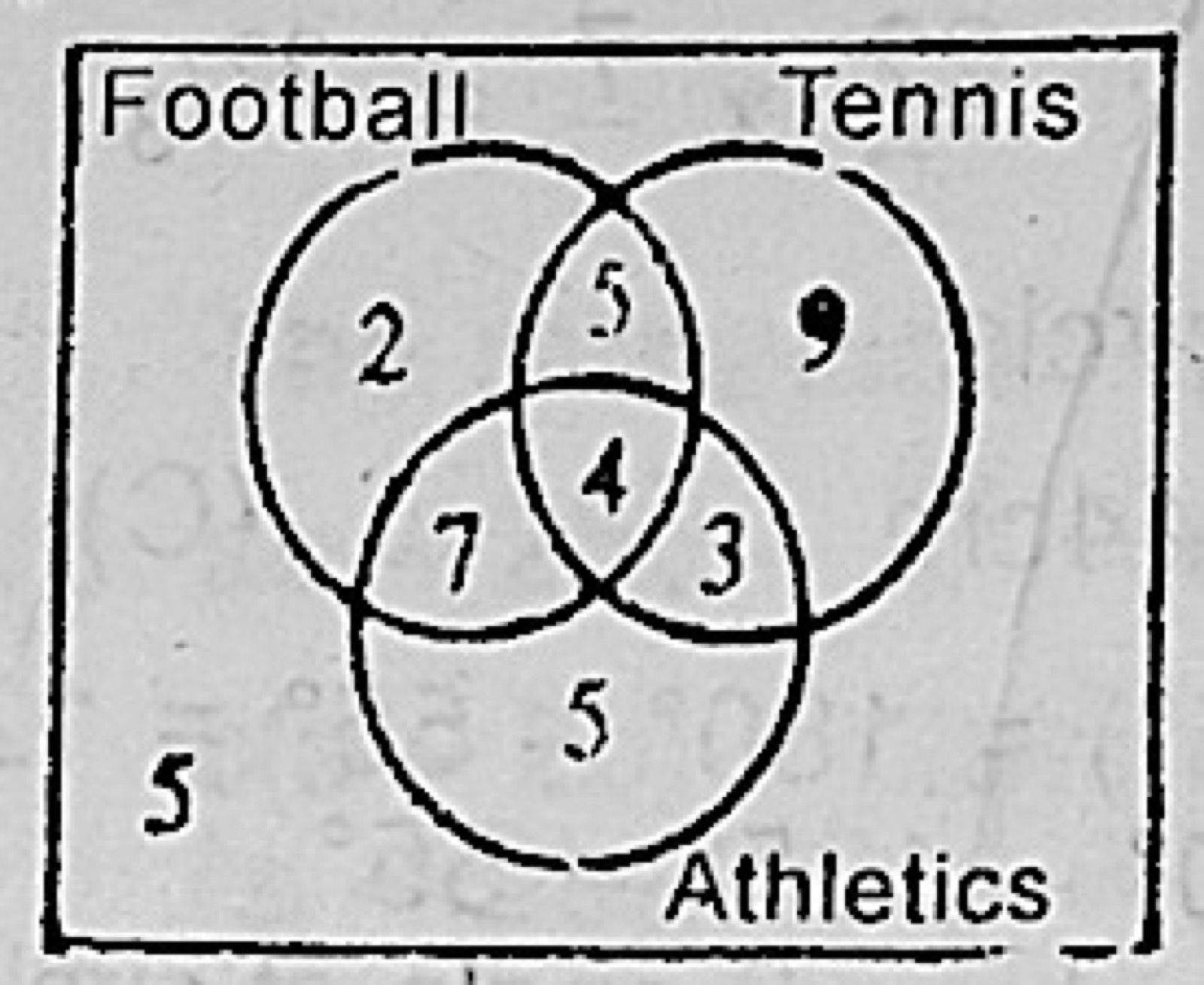
Answer: C (15)
The regions in exactly two circles hold 5, 7 and 3 students, so 5 + 7 + 3 = 15 play two games only.
If m = 3, p = −3, q = 7 and r = 5/2, evaluate m(p + q + r).
Answer: A (19.50)
p + q + r = −3 + 7 + 2.5 = 6.5, and 3 × 6.5 = 19.5.
Divide 6x2 − 13x + 5 by 2x − 1
Answer: B (3x − 5)
6x2 − 13x + 5 = (2x − 1)(3x − 5), so the quotient is 3x − 5.
A polynomial in x whose zeros are −2, −1 and 3 is
Answer: D (x3 − 7x − 6)
(x + 2)(x + 1)(x − 3) = (x2 + 3x + 2)(x − 3) = x3 − 7x − 6.
The time taken to do a piece of work is inversely proportional to the number of men employed. If it takes 30 men to do a piece of work in 6 days, how many men are required to do the work in 4 days?
Answer: C (45)
Men × days is constant: 30 × 6 = 180, so 180 ÷ 4 = 45 men.
The weight W kg of a metal bar varies jointly as its length L metres and the square of its diameter d metres. If W = 140 when d = 4⅔ and L = 54, find d in terms of W and L.
Answer: A (√(42W/5L))
W = kLd2: 140 = k × 54 × 196/9 = 1176k, so k = 5/42. Then d2 = W/(kL) = 42W/(5L).
Find the range of values of x for which 7x − 3 > 25 + 3x.
Answer: A (x > 7)
7x − 3x > 25 + 3, so 4x > 28 and x > 7.
The diagram above is the graph of the function f(x). Determine the range of values of x for which f(x) ≤ 0.
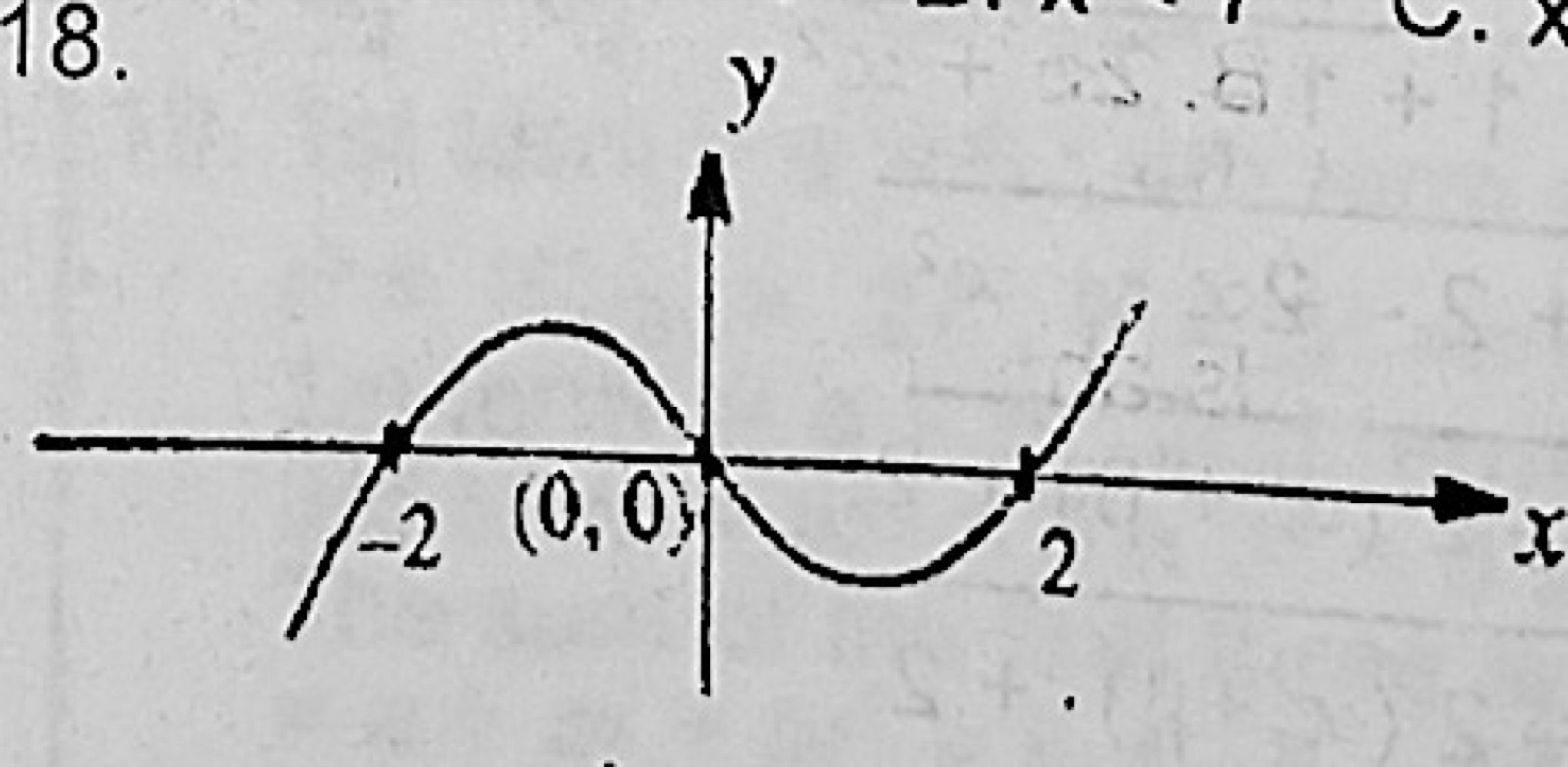
Answer: D (x ≤ −2, 0 ≤ x ≤ 2)
The curve is on or below the x-axis to the left of −2 and between 0 and 2, so f(x) ≤ 0 for x ≤ −2 and 0 ≤ x ≤ 2.
If the 7th term of an AP is twice the third term and the sum of the first four terms is 42, find the common difference.
Answer: B (3)
a + 6d = 2(a + 2d) gives a = 2d. Then 4a + 6d = 42 becomes 14d = 42, so d = 3.
Find the sum of the first 20 terms of the series 8, 12, 16, ......., 96.
Answer: D (920)
a = 8, d = 4: S20 = 20/2 × (16 + 19 × 4) = 10 × 92 = 920.
An operation * is defined on the set of real numbers by a * b = ab + 2(a + b + 1). Find the identity element.
Answer: C (−1)
a * e = a gives ae + 2a + 2e + 2 = a, so e(a + 2) = −(a + 2) and e = −1.
If M and N are two matrices defined by M = (1 3 2; 4 5 −1; −3 2 0) and N = (1 −2 3; 4 −1 5; 2 −3 −1), evaluate 2M − 3N. (Matrices written row by row.)
Answer: C ((−1 12 −5; −4 13 −17; −12 13 3))
2M = (2 6 4; 8 10 −2; −6 4 0) and 3N = (3 −6 9; 12 −3 15; 6 −9 −3). Subtracting entry by entry gives (−1 12 −5; −4 13 −17; −12 13 3).
If P = (1 3 2; 4 5 −1; −3 2 0), find the determinant of matrix P. (Matrix written row by row.)
Answer: B (57)
Expanding along the first row: 1(0 + 2) − 3(0 − 3) + 2(8 + 15) = 2 + 9 + 46 = 57.
In the diagram above, calculate the value of x.
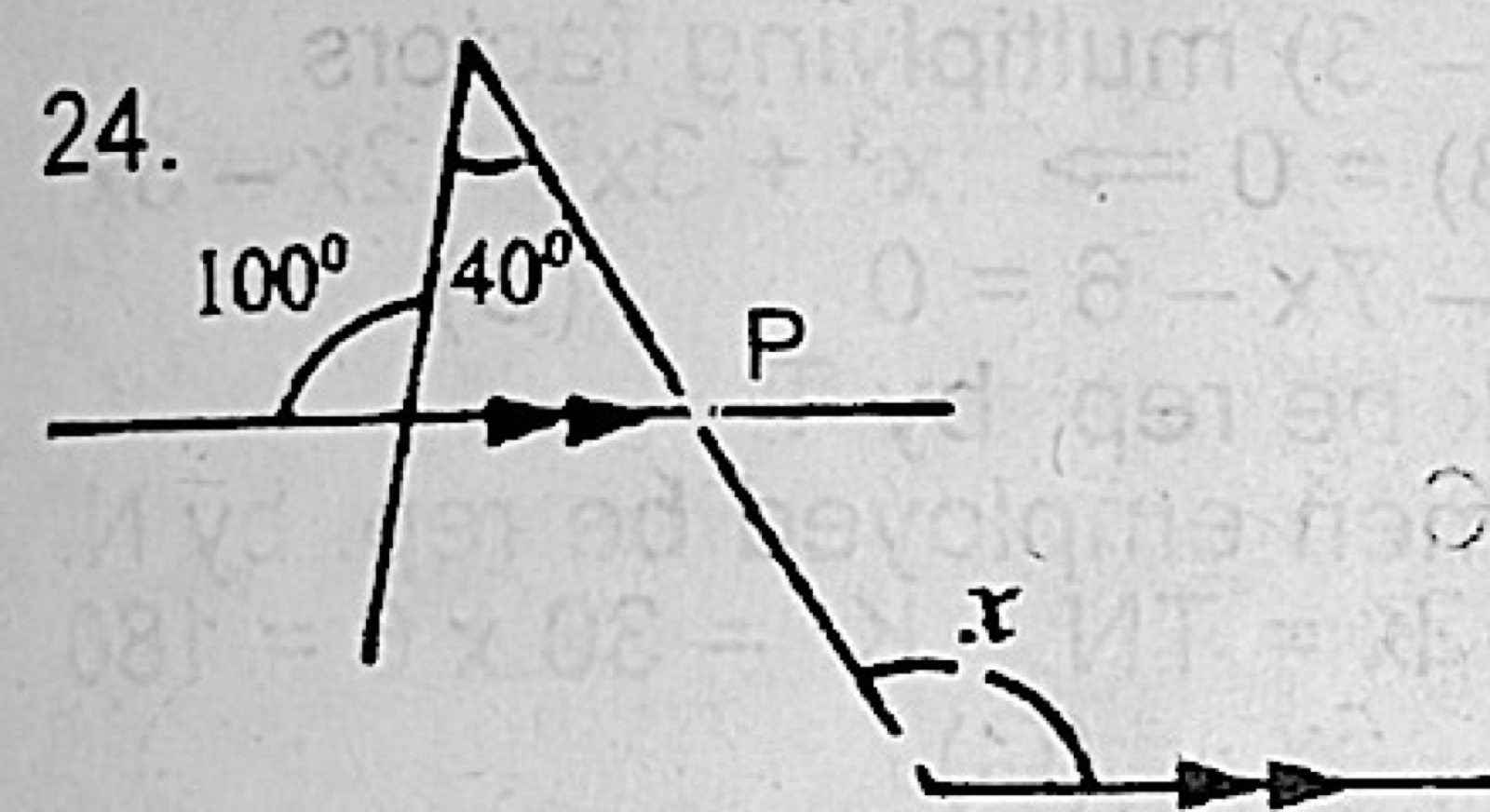
Answer: C (120°)
The triangle's angle at the left line is 180° − 100° = 80°, so its angle at P is 180° − 40° − 80° = 60°. Using the parallel lines, the angle between the slanting line and the lower line is 60°, so x = 180° − 60° = 120°.
Three straight lines EF, GH and LK intersect at O as shown above. If ∠KOF = 52° and ∠LOH = 85°, calculate the size of ∠EOG.

Answer: B (43°)
KOL is a straight line, so ∠FOH = 180° − 52° − 85° = 43°. ∠EOG is vertically opposite ∠FOH, so it is 43°.
The sum of the interior angles of a regular polygon is 1800°. Calculate the size of one exterior angle of the polygon.
Answer: A (30°)
(n − 2) × 180 = 1800 gives n = 12, so each exterior angle is 360° ÷ 12 = 30°.
In the diagram above, O is the centre of the circle, ∠UOT = 70° and ∠RST = 100°. Calculate ∠RUO.
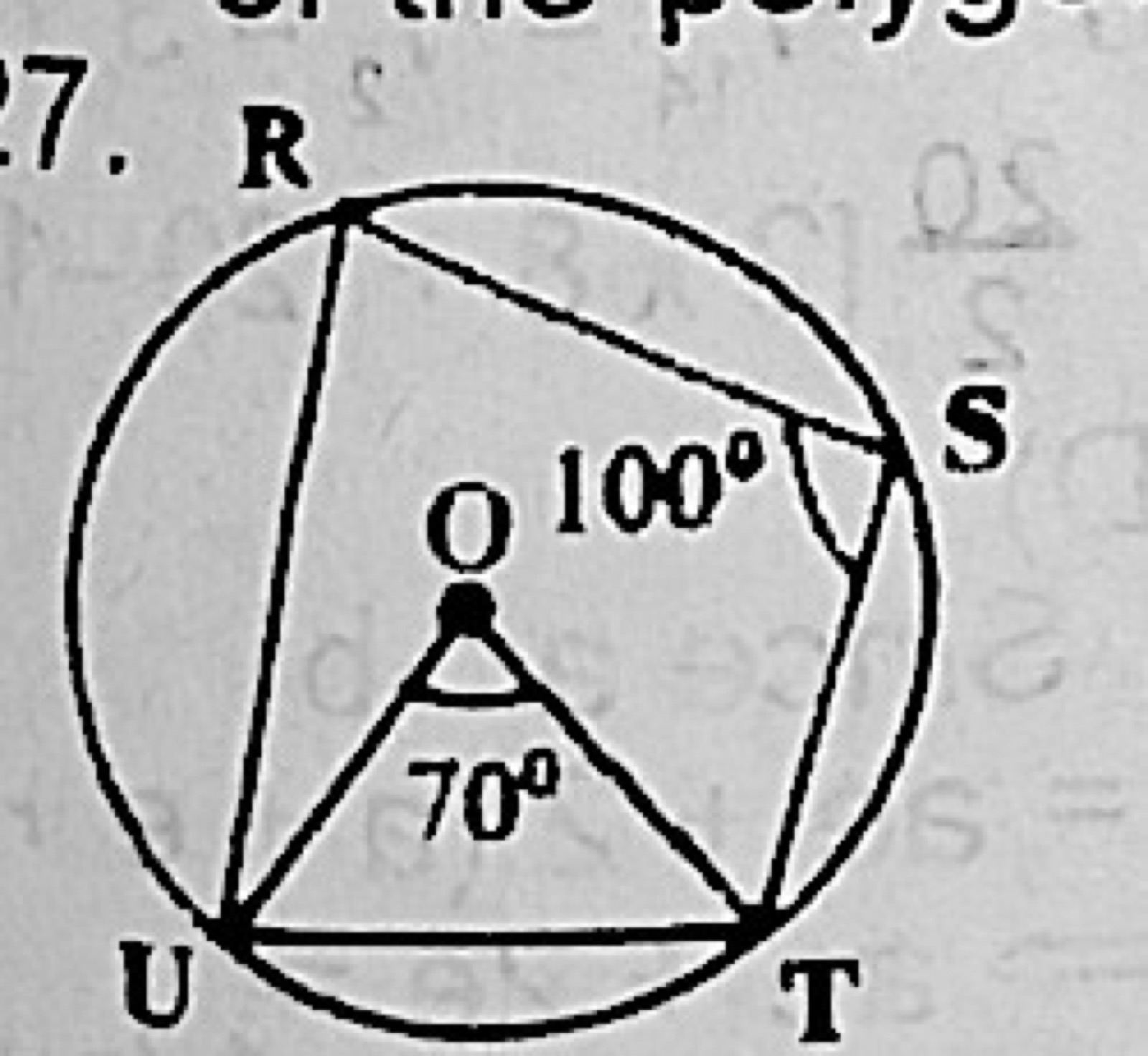
Answer: B (25°)
OU = OT, so ∠OUT = (180° − 70°)/2 = 55°. RSTU is cyclic, so ∠RUT = 180° − 100° = 80°. Then ∠RUO = 80° − 55° = 25°.
A chord of a circle subtends an angle of 60° at the centre of a circle of radius 14cm. Find the length of the chord.
Answer: B (14cm)
The two radii and the chord form a triangle with a 60° angle between equal sides, so it is equilateral and the chord is 14cm.
A sector of a circle has an area of 55 cm2. If the radius of the circle is 10 cm, calculate the angle of the sector. [π = 22/7]
Answer: B (63°)
θ/360 × 22/7 × 100 = 55, so θ = 55 × 360 × 7/2200 = 63°.
Find the curved surface area of a cone with circular base diameter 10 cm and height 12 cm.
Answer: B (65πcm2)
r = 5 and the slant height l = √(122 + 52) = 13. Curved surface = πrl = 65π cm2.
Two lines PQ and ST intersect at 75°. The locus of points equidistant from PQ and ST lies on the
Answer: C (bisector of the angles between lines PQ and ST)
Points equidistant from two intersecting lines lie on the bisectors of the angles between those lines.
Find the equation of the perpendicular at point (4, 3) to the line y + 2x = 5.
Answer: D (2y − x = 2)
The line has gradient −2, so the perpendicular has gradient ½: y − 3 = ½(x − 4), which gives 2y − x = 2.
Find the coordinates of the midpoint of the line joining (3, −4) and (−1, 10).
Answer: A ((1, 3))
Midpoint = ((3 − 1)/2, (−4 + 10)/2) = (1, 3).
If sin θ = −½ for 0 < θ < 360°, the value of θ is
Answer: C (210° and 330°)
Sine is negative in the third and fourth quadrants. With reference angle 30°, θ = 180° + 30° = 210° or 360° − 30° = 330°.
From the diagram above, find the bearing of R from S.
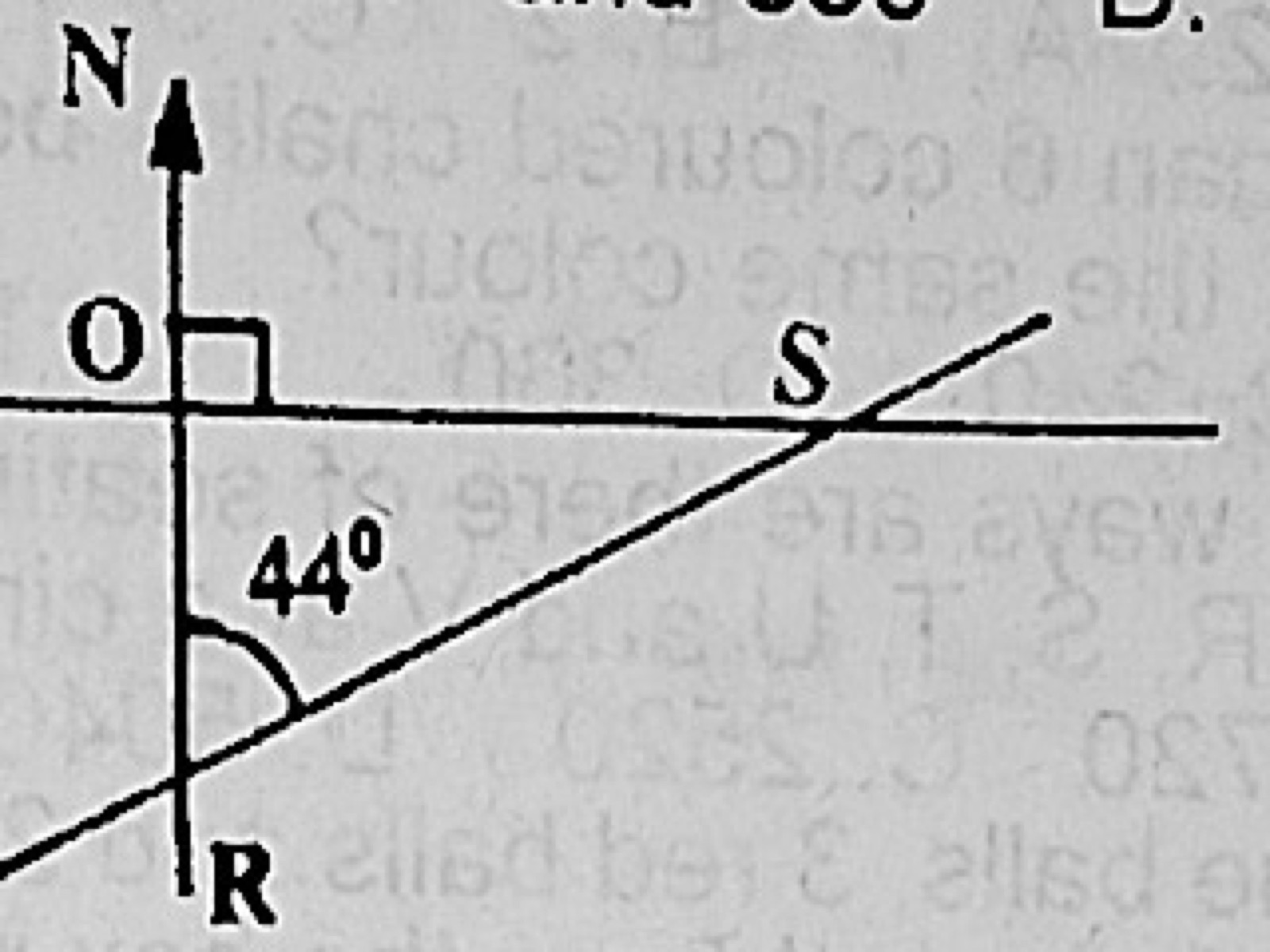
Answer: B (224°)
In the right-angled triangle ORS, ∠OSR = 90° − 44° = 46°. R lies 46° south of due west from S, so the bearing is 270° − 46° = 224°.
If y = (1 − 2x)3, find the value of dy/dx at x = −1.
Answer: D (−54)
dy/dx = 3(1 − 2x)2 × (−2) = −6(1 − 2x)2. At x = −1 this is −6 × 9 = −54.
Find the derivative of y = sin(2x3 + 3x − 4).
Answer: C ((6x2 + 3) cos(2x3 + 3x − 4))
By the chain rule, differentiate the sine to cosine and multiply by the derivative of the inside, 6x2 + 3.
The radius r of a circular disc is increasing at the rate of 0.5cm/sec. At what rate is the area of the disc increasing when its radius is 6cm?
Answer: C (6π cm2/sec.)
A = πr2, so dA/dt = 2πr × dr/dt = 2π × 6 × 0.5 = 6π cm2/sec.
Evaluate ∫0π/2 sin 2x dx.
Answer: A (1)
∫ sin 2x dx = −½ cos 2x. From 0 to π/2: −½(cos π − cos 0) = −½(−1 − 1) = 1.
Scores: 1, 2, 3, 4, 5, 6
No. of students: 1, 4, 5, 6, x, 2
The table above shows the scores of a group of students in a test. If the average score is 3.5, find the value of x.
Answer: B (2)
Σfx = 1 + 8 + 15 + 24 + 5x + 12 = 60 + 5x and Σf = 18 + x. (60 + 5x)/(18 + x) = 3.5 gives 1.5x = 3, so x = 2.
The modal height and range of heights 1.35, 1.25, 1.35, 1.40, 1.35, 1.45, 1.50, 1.35, 1.50 and 1.20 are m and r respectively. Find m + 2r.
Answer: C (1.95)
1.35 appears most often, so m = 1.35. r = 1.50 − 1.20 = 0.30. m + 2r = 1.95.
Find the value of t if the standard deviation of 2t, 3t, 4t, 5t and 6t is √2.
Answer: A (1)
The mean is 4t and the deviations are −2t, −t, 0, t, 2t. Variance = 10t2/5 = 2t2, so SD = t√2 = √2 and t = 1.
In how many ways can 6 coloured chalks be arranged if 2 are of the same colour?
Answer: D (360)
Arrange 6 items with 2 identical: 6!/2! = 720/2 = 360.
How many possible ways are there of seating seven people P, Q, R, S, T, U and V at a circular table?
Answer: B (720)
Around a circle, n people can be seated in (n − 1)! ways: 6! = 720.
A box contains 5 blue balls, 3 red balls and 2 white balls. Two balls are selected from the box with replacement. Find the probability of obtaining two blue or two red balls.
Answer: A (17/50)
P(two blue) = (5/10)2 = 1/4 and P(two red) = (3/10)2 = 9/100. Total = 25/100 + 9/100 = 34/100 = 17/50.
What is the probability that an integer x, (1 ≤ x ≤ 20) chosen at random is divisible by both 2 and 3?
Answer: C (3/20)
Numbers divisible by both 2 and 3 are multiples of 6: 6, 12 and 18. So the probability is 3/20.