JAMB Mathematics 1994 past questions and answers

48 questions. Try each one, then open the answer to check yourself and read the explanation.

Question 1

Fractions, Decimals and Approximation

Evaluate
1/3 ÷ [5/7(9/10 − 1 + 3/4)]

  1. A.28/39
  2. B.13/84
  3. C.39/28
  4. D.84/13
Show the answer and explanation

Answer: A (28/39)

Explanation

Inside the bracket: 9/10 − 1 + 3/4 = 13/20, and 5/7 × 13/20 = 13/28. Then 1/3 ÷ 13/28 = 1/3 × 28/13 = 28/39.

Open this question

Question 2

Fractions, Decimals and Approximation

Evaluate (0.36 × 5.4 × 0.63)/(4.2 × 9.0 × 2.4) correct to 2 significant figures.

  1. A.0.013
  2. B.0.014
  3. C.0.13
  4. D.0.14
Show the answer and explanation

Answer: B (0.014)

Explanation

The top is 1.22472 and the bottom is 90.72, giving 0.0135. Rounded to 2 significant figures this is 0.014.

Open this question

Question 3

Logarithms

Evaluate log5(0.04)/(log318 − log32)

  1. A.1
  2. B.−1
  3. C.⅔
  4. D.−⅔
Show the answer and explanation

Answer: B (−1)

Explanation

0.04 = 1/25 = 5−2, so the top is −2. The bottom is log3(18 ÷ 2) = log39 = 2. So the value is −2/2 = −1.

Open this question

Question 4

Indices

Without using table, solve the equation
8x−2 = 2/25

  1. A.4
  2. B.6
  3. C.8
  4. D.10
Show the answer and explanation

Answer: D (10)

Explanation

x−2 = 2/25 ÷ 8 = 1/100, so x² = 100 and x = 10.

Open this question

Question 5

Surds

Simplify √48 − 9/√3 + √75

  1. A.5√3
  2. B.6√3
  3. C.8√3
  4. D.18√3
Show the answer and explanation

Answer: B (6√3)

Explanation

√48 = 4√3, 9/√3 = 3√3 and √75 = 5√3. So 4√3 − 3√3 + 5√3 = 6√3.

Open this question

Question 7

Sets

In a science class of 42 students, each student offers at least one of Mathematics and Physics. If 22 students offer Physics and 28 students offer Mathematics, find how many students offer Physics only?

  1. A.6
  2. B.8
  3. C.12
  4. D.14
Show the answer and explanation

Answer: D (14)

Explanation

Students taking both = 22 + 28 − 42 = 8. Physics only = 22 − 8 = 14.

Open this question

Question 8

Sets

Given that for sets A and B, in a universal set E, A ⊆ B then A ∩ (A ∩ B)′ is

  1. A.A′
  2. B.∅
  3. C.B
  4. D.E
Show the answer and explanation

Answer: B (∅)

Explanation

If A ⊆ B then A ∩ B = A. So the expression is A ∩ A′, which has no elements: the empty set ∅.

Open this question

Question 9

Indices

Solve for x if 25x + 3(5x) = 4

  1. A.1 or −4
  2. B.0
  3. C.1
  4. D.−4 or 0
Show the answer and explanation

Answer: B (0)

Explanation

Let p = 5x, so p² + 3p − 4 = 0, i.e. (p + 4)(p − 1) = 0. 5x can't be −4, so 5x = 1 and x = 0.

Open this question

Question 10

Algebraic Expressions

Simplify ((2m − u)2 − (m − 2u)2)/(5m2 − 5u2)

  1. A.3/5
  2. B.2/5
  3. C.(2m − u)/(5m + u)
  4. D.(m − 2u)/(m + 5u)
Show the answer and explanation

Answer: A (3/5)

Explanation

The top is a difference of two squares: (3m − 3u)(m + u) = 3(m − u)(m + u). The bottom is 5(m − u)(m + u). Cancelling leaves 3/5.

Open this question

Question 11

Algebraic Expressions

Factorize a2x − b2y − b2x + a2y

  1. A.(a − b)(x + y)
  2. B.(y − x)(a − b)(a + b)
  3. C.(x − y)(a − b)(a + b)
  4. D.(x + y)(a − b)(a + b)
Show the answer and explanation

Answer: D ((x + y)(a − b)(a + b))

Explanation

Group as a²(x + y) − b²(x + y) = (x + y)(a² − b²) = (x + y)(a − b)(a + b).

Open this question

Question 12

Polynomials

Find the value of p and q such that (x − 1) and (x − 3) are factors of px3 + qx2 + 11x − 6.

  1. A.−1, −6
  2. B.1, −6
  3. C.1, 6
  4. D.6, −1
Show the answer and explanation

Answer: B (1, −6)

Explanation

Put x = 1: p + q + 5 = 0. Put x = 3: 27p + 9q + 27 = 0, i.e. 3p + q + 3 = 0. Subtracting gives 2p = 2, so p = 1 and q = −6.

Open this question

Question 13

Graphs of Functions

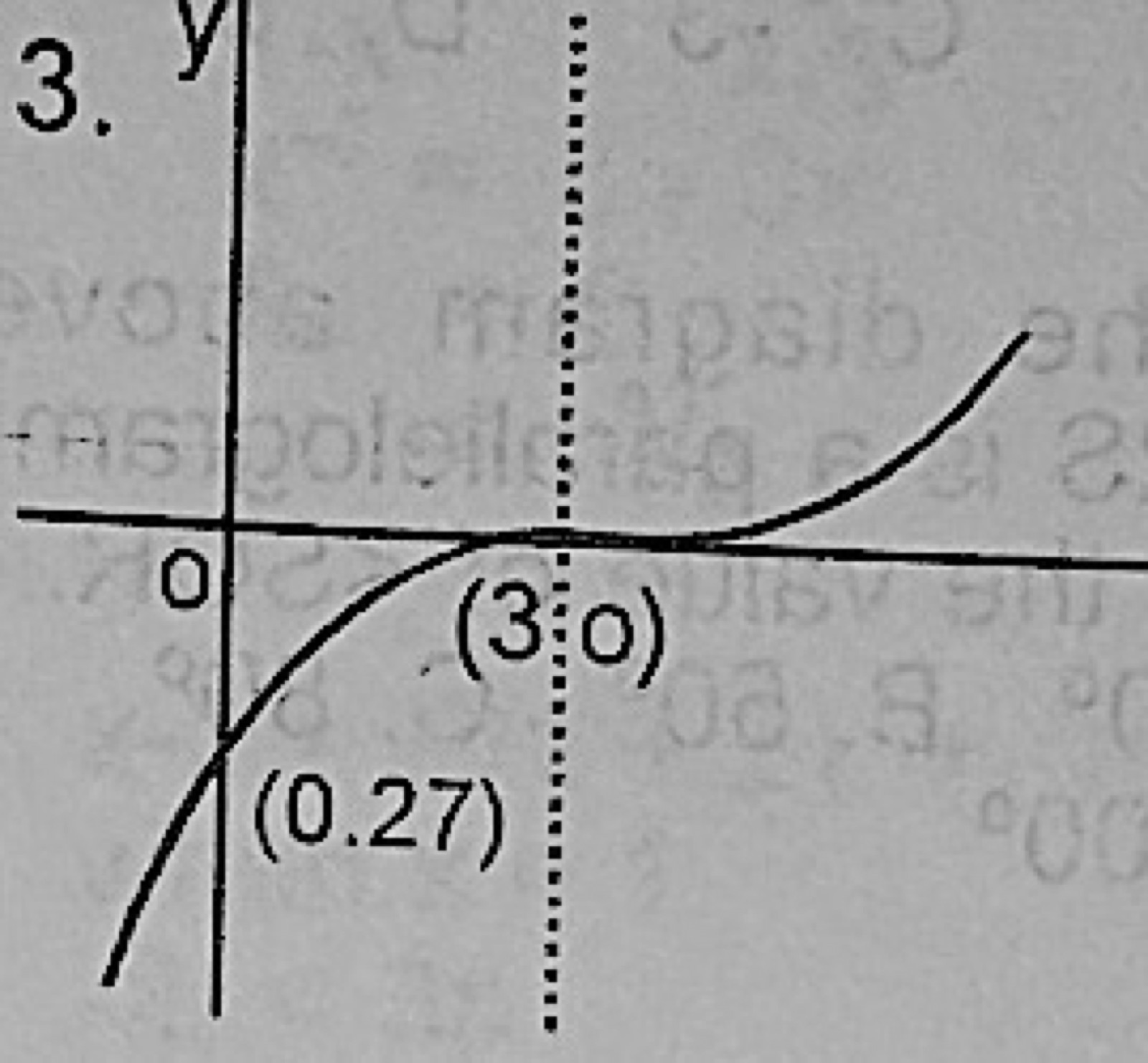
The equation of the graph above is

Diagram for this question
  1. A.y = (x − 3)3
  2. B.y = (x + 3)3
  3. C.y = x3 − 27
  4. D.y = −x3 + 27
Show the answer and explanation

Answer: A (y = (x − 3)3)

Explanation

The graph passes through (0, −27) and (3, 0), and its flat point (where it levels off) is at (3, 0). y = (x − 3)³ has exactly this: it is y = x³ shifted 3 units right.

Open this question

Question 14

Linear and Simultaneous Equations

If a = 1, b = 3, solve for x in the equation a/(a − x) = b/(x − b)

  1. A.4/3
  2. B.2/3
  3. C.3/2
  4. D.3/4
Show the answer and explanation

Answer: C (3/2)

Explanation

Substitute: 1/(1 − x) = 3/(x − 3). Cross-multiply: x − 3 = 3 − 3x, so 4x = 6 and x = 3/2.

Open this question

Question 15

Quadratic Equations

Solve for r in the following equation
1/(r − 1) + 2/(r + 1) = 3/r

  1. A.3
  2. B.4
  3. C.5
  4. D.6
Show the answer and explanation

Answer: A (3)

Explanation

Multiply through by r(r − 1)(r + 1): r(r + 1) + 2r(r − 1) = 3(r² − 1). This gives 3r² − r = 3r² − 3, so r = 3.

Open this question

Question 16

Polynomials

Find P if (x − 3)/((1 − x)(x + 2)) = P/(1 − x) + Q/(x + 2)

  1. A.−2/3
  2. B.−5/3
  3. C.5/3
  4. D.2/3
Show the answer and explanation

Answer: A (−2/3)

Explanation

Multiply out: x − 3 = P(x + 2) + Q(1 − x). Put x = 1 to remove Q: −2 = 3P, so P = −2/3.

Open this question

Question 17

Inequalities

Find the range of values of x for which 1/x > 2 is true.

  1. A.x < ½
  2. B.x < 0 or > ½
  3. C.0 < x < ½
  4. D.1 < x < 2
Show the answer and explanation

Answer: C (0 < x < ½)

Explanation

1/x can only be greater than 2 if x is positive. Then multiplying by x gives 1 > 2x, so x < ½. Together: 0 < x < ½.

Open this question

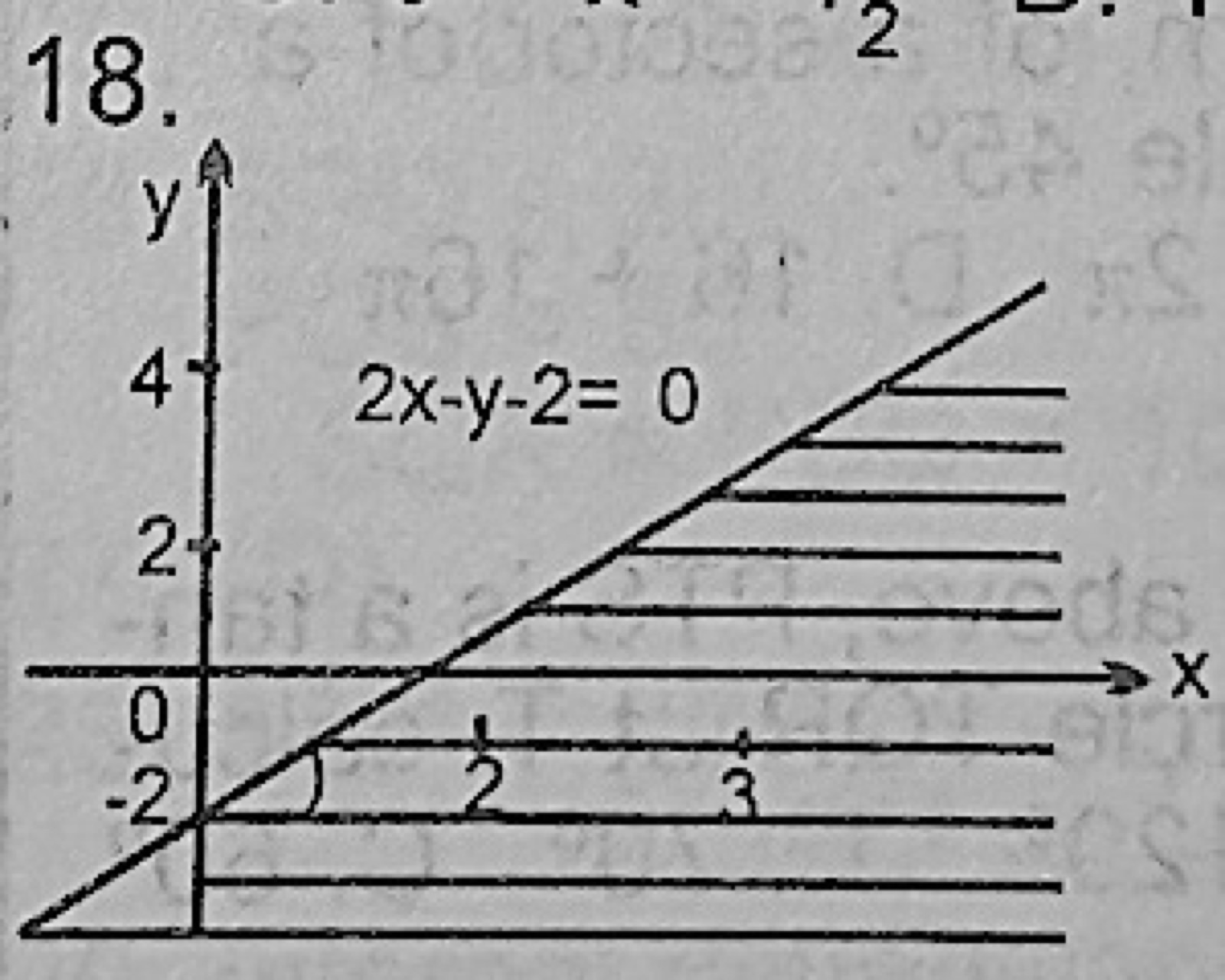
Question 18

Inequalities

Find the inequality which represents the shaded portion in the diagram above.

Diagram for this question
  1. A.2x − y − 2 ≤ 0
  2. B.2x − y − 2 ≥ 0
  3. C.2x − y − 2 < 0
  4. D.2x − y − 2 > 0
Show the answer and explanation

Answer: B (2x − y − 2 ≥ 0)

Explanation

Test a point in the shaded part, such as (3, 0): 2(3) − 0 − 2 = 4, which is positive. The boundary line is solid, so it is included: 2x − y − 2 ≥ 0.

Open this question

Question 19

Progressions

If the 6th term of an arithmetic progression is 11 and the first term is 1, find the common difference.

  1. A.12/5
  2. B.5/3
  3. C.−2
  4. D.2
Show the answer and explanation

Answer: D (2)

Explanation

The 6th term is a + 5d, so 1 + 5d = 11 and d = 2.

Open this question

Question 20

Logarithms

Find the value of r if log10r2 + log10r4 + log10r8 + log10r16 + log10r32 = 63

  1. A.10−1
  2. B.100
  3. C.10
  4. D.102
Show the answer and explanation

Answer: C (10)

Explanation

Adding logs multiplies the powers: the left side is (2 + 4 + 8 + 16 + 32) log r = 62 log r. So log r ≈ 1 and r ≈ 10 (exactly 10 if the sum also has a log10r term, making 63 log r = 63).

Open this question

Question 21

Progressions

Find the nth term of the sequence 3, 6, 10, 15, 21, ...

  1. A.n(n − 1)/2
  2. B.n(n + 1)/2
  3. C.(n + 1)(n + 2)/2
  4. D.n(2n + 1)
Show the answer and explanation

Answer: C ((n + 1)(n + 2)/2)

Explanation

Test n = 1 and n = 2: (n + 1)(n + 2)/2 gives 2×3/2 = 3 and 3×4/2 = 6, matching the sequence. The other formulas fail.

Open this question

Question 22

Binary Operations

A binary operation * is defined on the set of all positive integers by a*b = ab for all positive integers a, b. Which of the following properties does NOT hold.

  1. A.Closure
  2. B.Associativity
  3. C.Identity
  4. D.Inverse
Show the answer and explanation

Answer: D (Inverse)

Explanation

Products of positive integers are positive integers (closure), multiplication is associative, and 1 is the identity. But the inverse of 2 would be ½, which is not a positive integer.

Open this question

Question 23

Modular Arithmetic

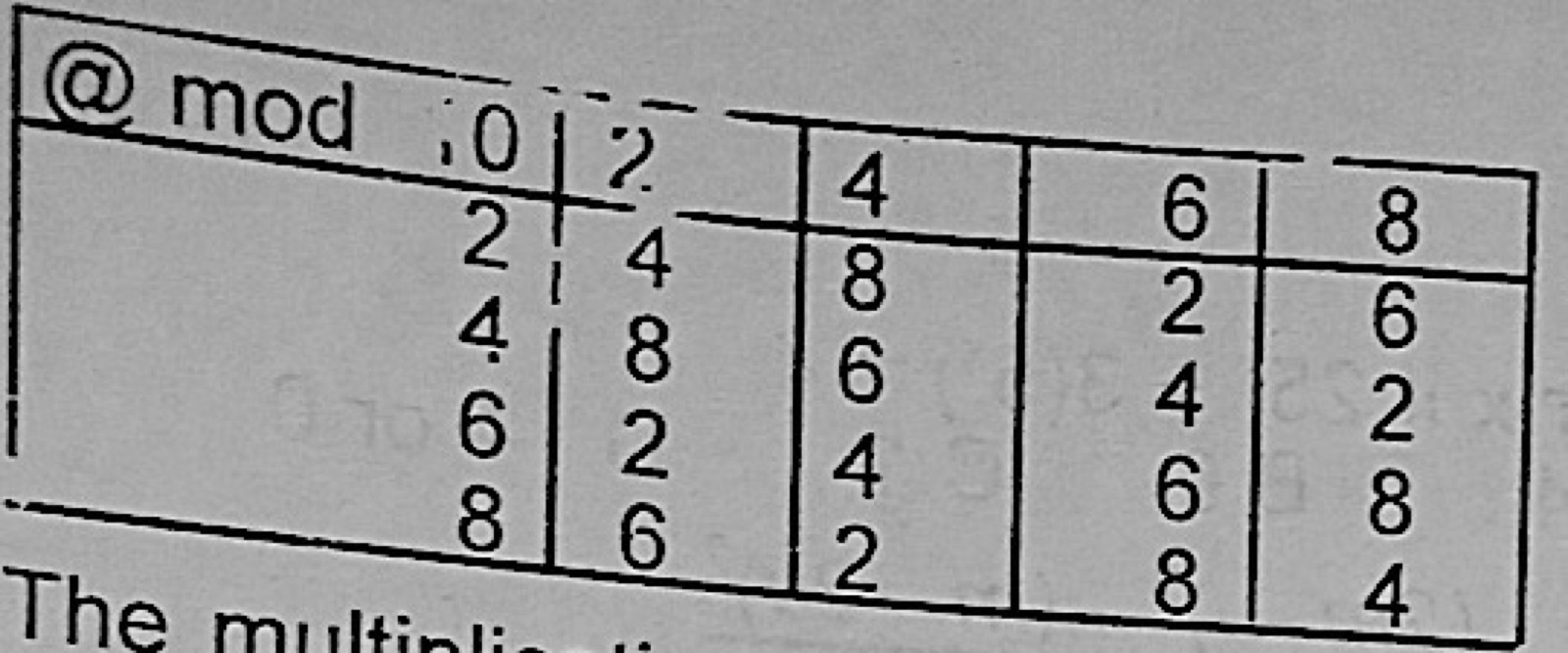
The multiplication table above has modulo 10 on the set S = {2, 4, 6, 8}, find the inverse of 2.

Diagram for this question
  1. A.2
  2. B.4
  3. C.6
  4. D.8
Show the answer and explanation

Answer: D (8)

Explanation

First find the identity: 6 leaves every element unchanged (e.g. 6 × 4 = 24 ≡ 4). The inverse of 2 is the element that gives 6 with it: 2 × 8 = 16 ≡ 6, so it is 8.

Open this question

Question 24

Matrices and Determinants

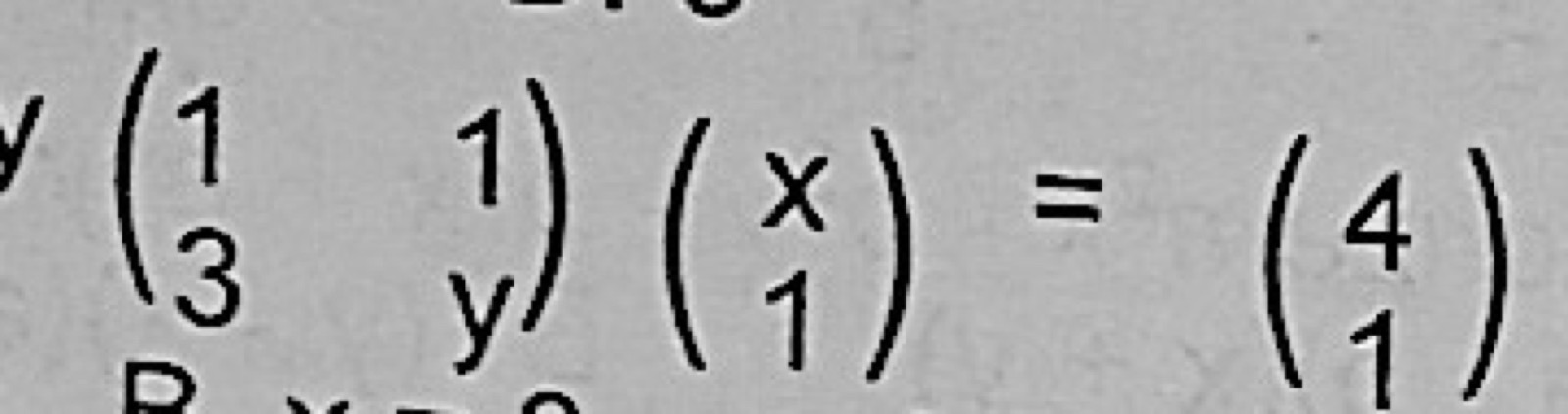
Solve for x and y in the matrix equation shown above: (1 1; 3 y)(x; 1) = (4; 1)

Diagram for this question
  1. A.x = −3, y = 8
  2. B.x = 8, y = 3
  3. C.x = 3, y = −8
  4. D.x = 8, y = −3
Show the answer and explanation

Answer: C (x = 3, y = −8)

Explanation

Multiplying out: x + 1 = 4 and 3x + y = 1. So x = 3, and then 9 + y = 1 gives y = −8.

Open this question

Question 25

Matrices and Determinants

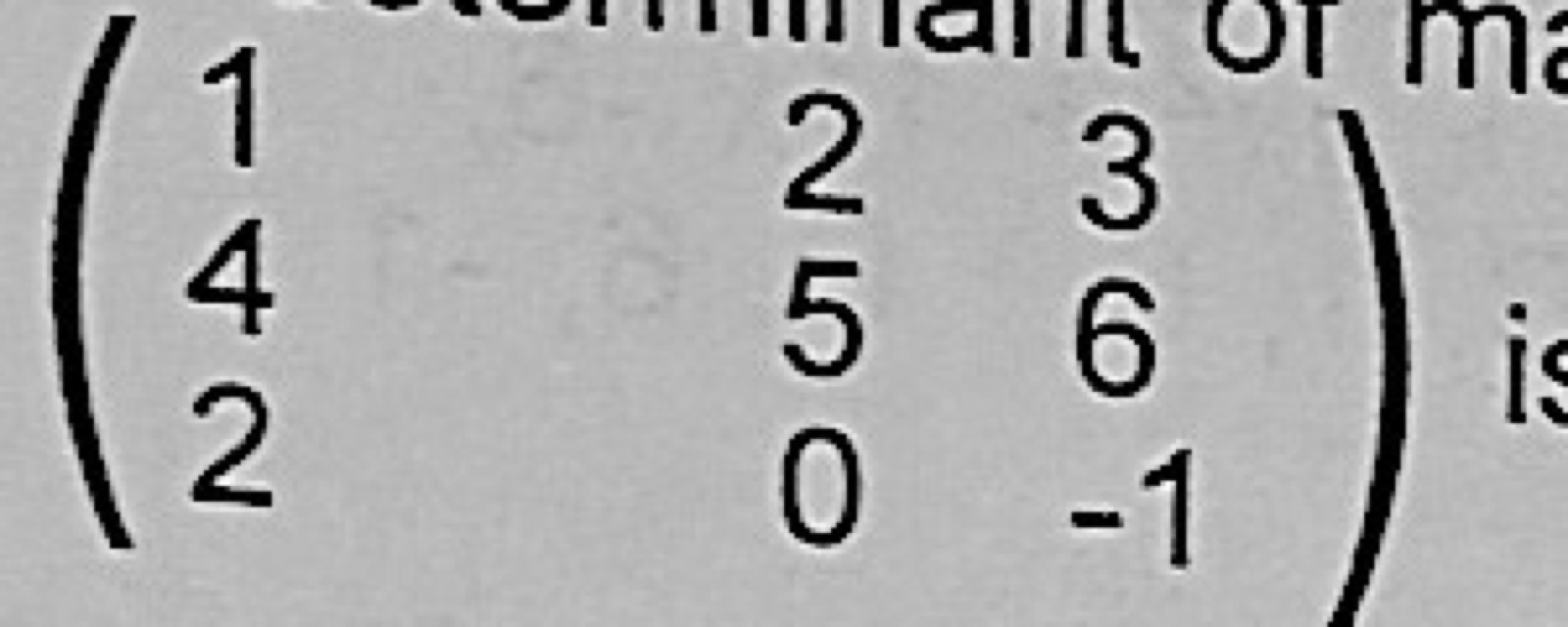
The determinant of matrix (1 2 3; 4 5 6; 2 0 −1) is

Diagram for this question
  1. A.−67
  2. B.−57
  3. C.−3
  4. D.3
Show the answer and explanation

Answer: C (−3)

Explanation

Expand along the first row: 1(5×(−1) − 6×0) − 2(4×(−1) − 6×2) + 3(4×0 − 5×2) = −5 + 32 − 30 = −3.

Open this question

Question 26

Angles and Polygons

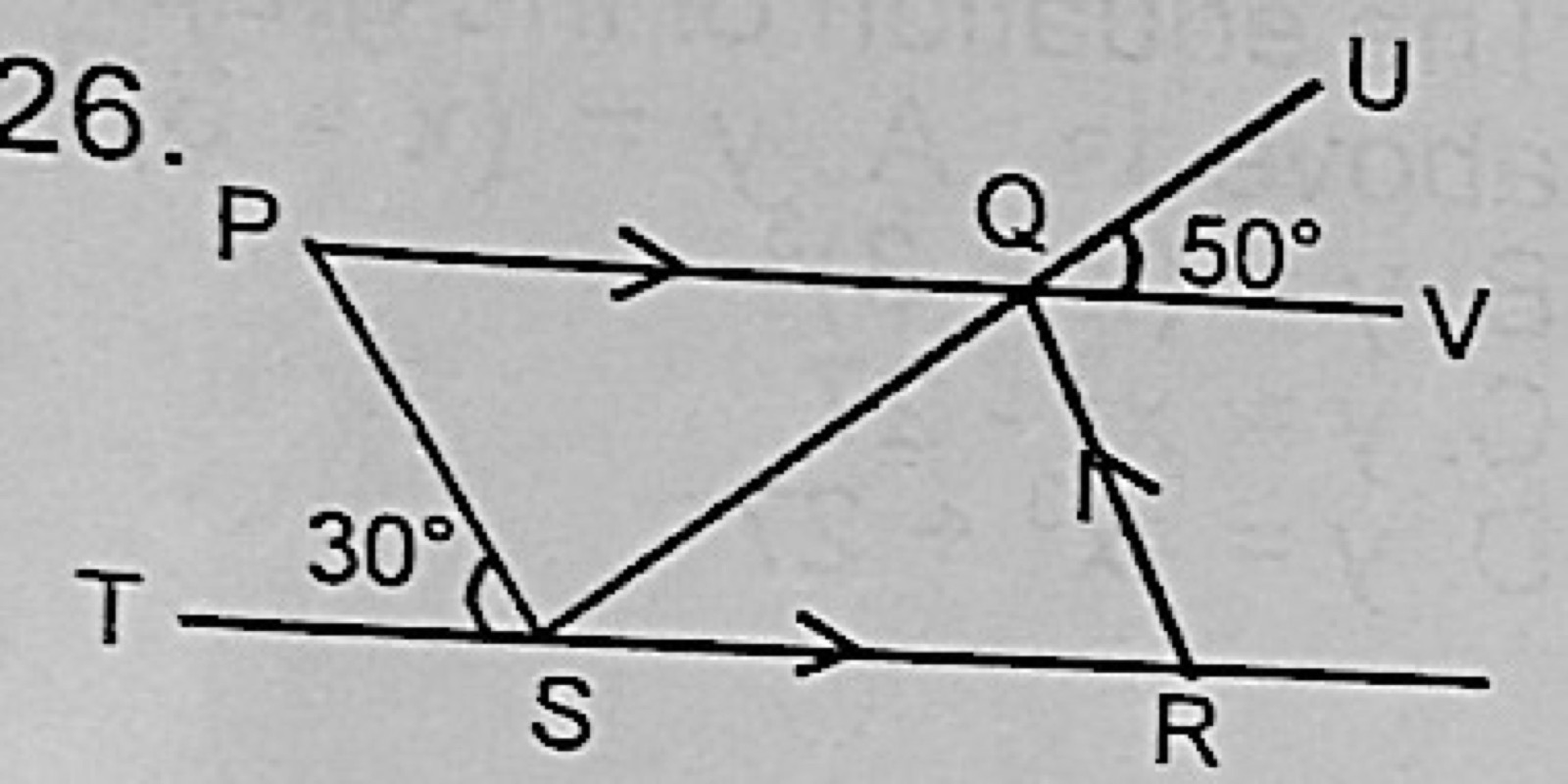
In the diagram above, PQRS is a parallelogram. Find the value of ∠SQR.

Diagram for this question
  1. A.30°
  2. B.50°
  3. C.80°
  4. D.100°
Show the answer and explanation

Answer: D (100°)

Explanation

Angle PQS = 50° (vertically opposite the 50°), and angle SPQ = 30° (alternate to the 30° at S, as PQ ‖ TR). So angle PSQ = 180° − 80° = 100°, and SQR = PSQ = 100° (alternate angles, PS ‖ QR).

Open this question

Question 27

Circle Theorems

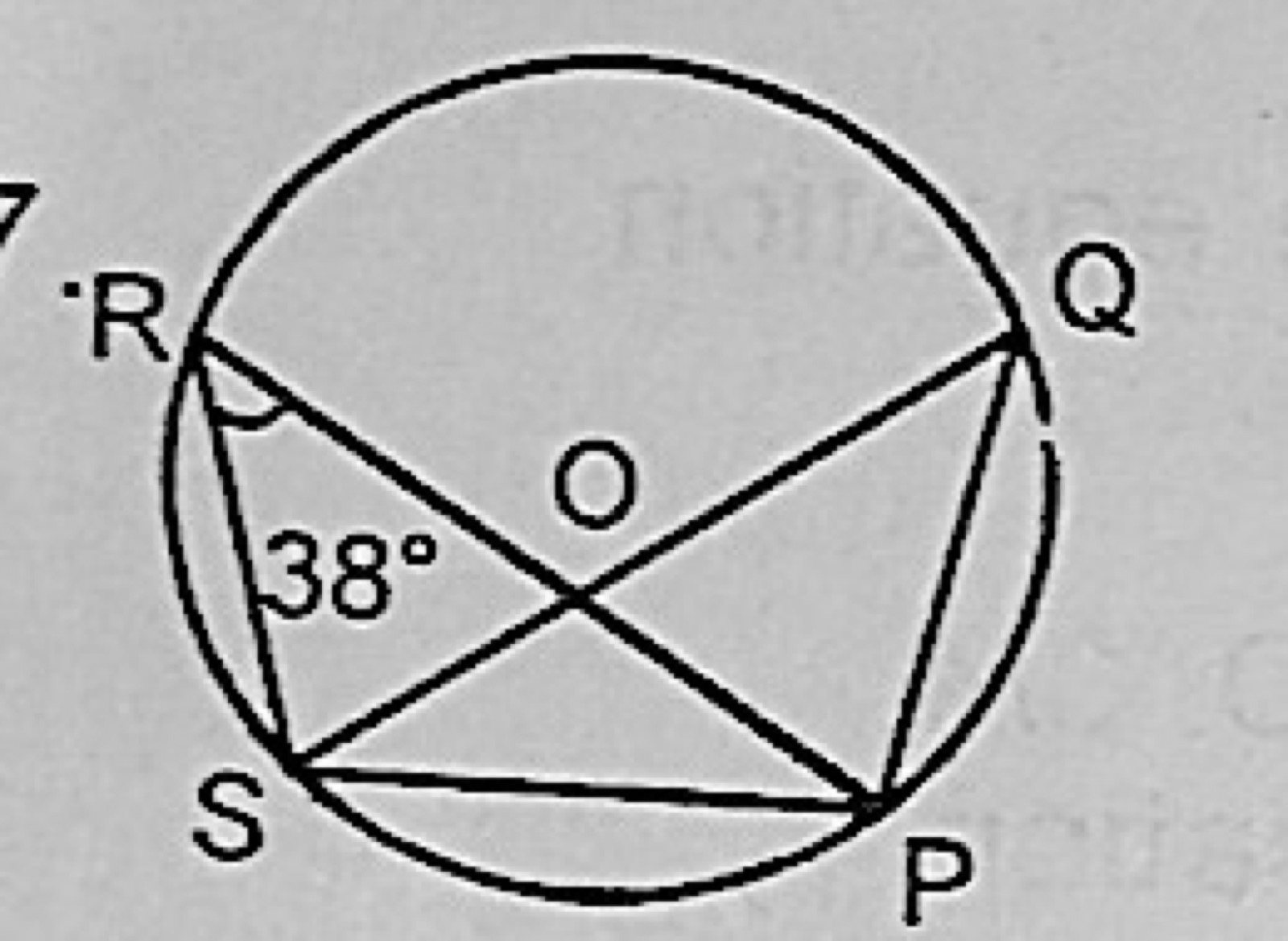
In the diagram above O is the centre of the circle. If SOQ is a diameter and ∠PRS is 38°, what is the value of ∠PSQ?

Diagram for this question
  1. A.148°
  2. B.104°
  3. C.80°
  4. D.52°
Show the answer and explanation

Answer: D (52°)

Explanation

Angle PQS = angle PRS = 38° (same segment). Angle SPQ = 90° (angle in a semicircle). So angle PSQ = 180° − 90° − 38° = 52°.

Open this question

Question 28

Triangles and Quadrilaterals

If three angles of a quadrilateral are (3y − x − z)°, 3x°, (2z − 2y − x)°, find the fourth angle in terms of x, y and z.

  1. A.(360 − x − y − z)°
  2. B.(360 + x + y − z)°
  3. C.(180 − x + y + z)°
  4. D.(180 + x + y + z)°
Show the answer and explanation

Answer: A ((360 − x − y − z)°)

Explanation

The three angles add up to (3y − x − z) + 3x + (2z − 2y − x) = x + y + z. The angles of a quadrilateral total 360°, so the fourth is (360 − x − y − z)°.

Open this question

Question 29

Mensuration of Solids

An open rectangular box is made of wood 2cm thick. If the internal dimensions of the box are 50cm long, 36cm wide and 20cm deep, the volume of wood in the box is

  1. A.11 520cm3
  2. B.36 000cm3
  3. C.38 200cm3
  4. D.47 520cm3
Show the answer and explanation

Answer: A (11 520cm3)

Explanation

Outside measurements: 54 × 40 × 22 (the open top adds no thickness) = 47 520cm³. Inside: 50 × 36 × 20 = 36 000cm³. Wood = 47 520 − 36 000 = 11 520cm³.

Open this question

Question 30

Mensuration of Plane Shapes

Calculate the perimeter, in cm, of a sector of a circle of radius 8cm and angle 45°.

  1. A.2π
  2. B.8 + 2π
  3. C.16 + 2π
  4. D.16 + 16π
Show the answer and explanation

Answer: C (16 + 2π)

Explanation

Arc length = 45/360 × 2π × 8 = 2π. The perimeter adds two radii: 2π + 16.

Open this question

Question 31

Circle Theorems

In the diagram above, PTS is a tangent to the circle TQR at T, calculate ∠RTS.

Diagram for this question
  1. A.120°
  2. B.70°
  3. C.60°
  4. D.40°
Show the answer and explanation

Answer: B (70°)

Explanation

In triangle QRT, angle RQT = 180° − 60° − 50° = 70°. By the alternate segment theorem, the angle between tangent TS and chord TR equals angle RQT, so RTS = 70°.

Open this question

Question 32

Triangles and Quadrilaterals

In the diagram above, find h

Diagram for this question
  1. A.12/7 cm
  2. B.12/7 √6cm
  3. C.7/12 cm
  4. D.½ √51cm
Show the answer and explanation

Answer: B (12/7 √6cm)

Explanation

Heron's formula: s = (6 + 5 + 7)/2 = 9 and area = √(9 × 3 × 4 × 2) = 6√6. Area = ½ × 7 × h, so h = 12√6/7 cm.

Open this question

Question 33

Mensuration of Solids

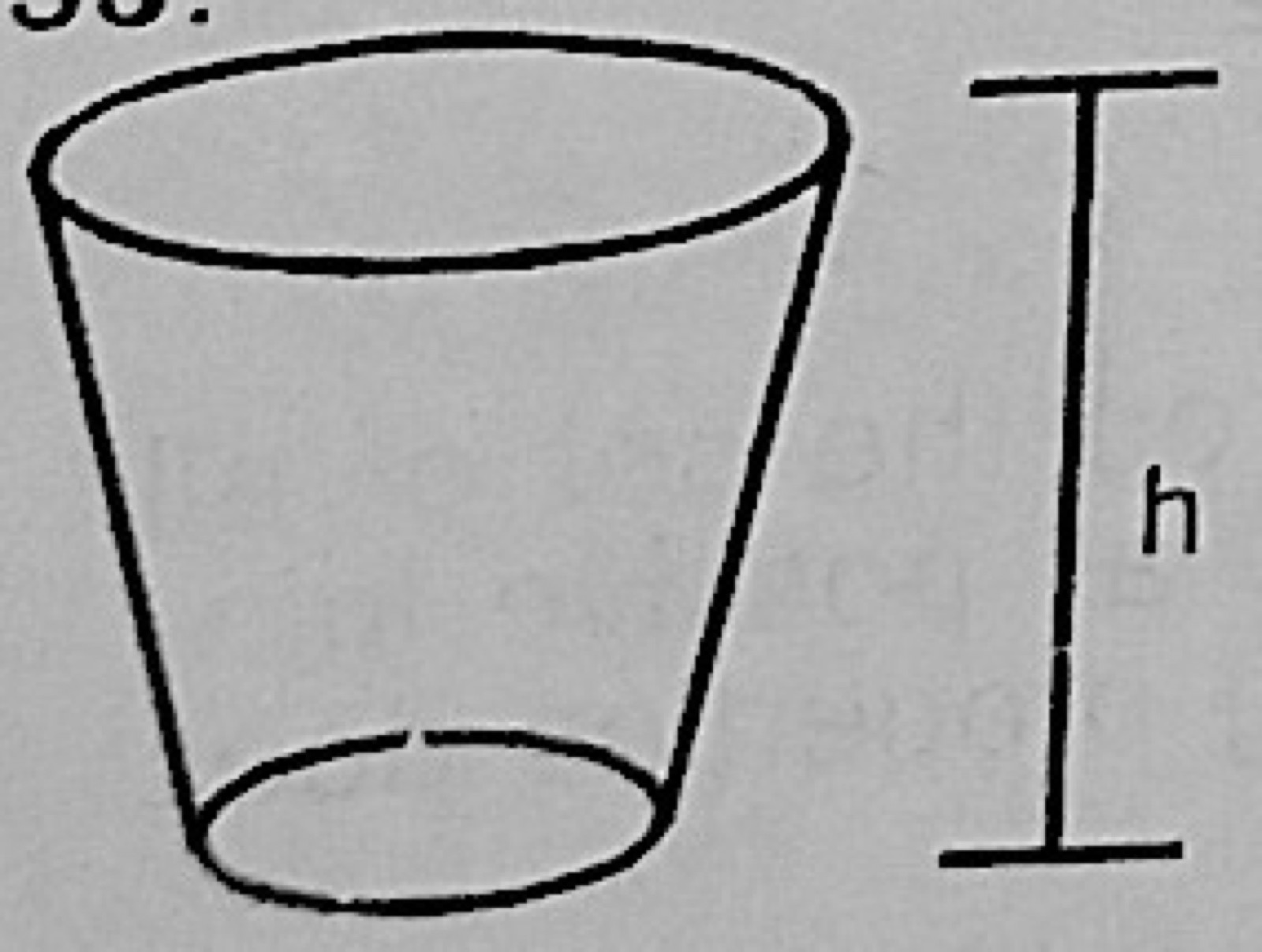
In the frustum of a cone shown above, the top diameter is twice the bottom diameter. If the height of the frustum is h centimeters, find the height of the cone.

Diagram for this question
  1. A.2h
  2. B.2πh
  3. C.πh
  4. D.πh/2
Show the answer and explanation

Answer: A (2h)

Explanation

The removed small cone has half the radius of the full cone, so by similar triangles it also has half the height. The frustum is the other half, so the full cone is 2h high.

Open this question

Question 34

Loci

What is the locus of a point P which moves on one side of a straight line XY, so that the angle XPY is always equal to 90°?

  1. A.The perpendicular bisector of XY
  2. B.A right-angled triangle
  3. C.A circle
  4. D.A semi-circle
Show the answer and explanation

Answer: D (A semi-circle)

Explanation

The angle in a semicircle is 90°, so every point P with angle XPY = 90° lies on the circle with diameter XY. Staying on one side of XY gives a semicircle.

Open this question

Question 35

Coordinate Geometry

If M(4, q) is the mid-point of the line joining L(p, −2) and N(q, p), find the values of p and q.

  1. A.p = 2, q = 4
  2. B.p = 3, q = 1
  3. C.p = 5, q = 3
  4. D.p = 6, q = 2
Show the answer and explanation

Answer: D (p = 6, q = 2)

Explanation

Midpoint: (p + q)/2 = 4 and (−2 + p)/2 = q. So p + q = 8 and p = 2q + 2, giving 3q + 2 = 8, q = 2 and p = 6.

Open this question

Question 37

Trigonometry

The angle of depression of a boat from the top of a cliff 10m high is 30°. How far is the boat from the foot of the cliff?

  1. A.5√3/3 m
  2. B.5√3m
  3. C.10√3
  4. D.10√3/3 m
Show the answer and explanation

Answer: C (10√3)

Explanation

The angle of elevation of the cliff top from the boat is also 30°. So tan 30° = 10/d and d = 10/tan 30° = 10√3 m.

Open this question

Question 38

Trigonometry

What is the value of sin (−690°)?

  1. A.√3/2
  2. B.−√3/2
  3. C.−½
  4. D.½
Show the answer and explanation

Answer: D (½)

Explanation

Adding 720° (two full turns) doesn't change sine: sin(−690°) = sin 30° = ½.

Open this question

Question 39

Differentiation

If y = 3t3 + 2t2 − 7t + 3, find dy/dt at t = −1

  1. A.−1
  2. B.1
  3. C.−2
  4. D.2
Show the answer and explanation

Answer: C (−2)

Explanation

dy/dt = 9t² + 4t − 7. At t = −1: 9 − 4 − 7 = −2.

Open this question

Question 40

Differentiation

Find the point (x, y) on the Euclidean plane where the curve y = 2x2 − 2x + 3 has 2 as gradient

  1. A.(1, 3)
  2. B.(2, 7)
  3. C.(0, 3)
  4. D.(3, 15)
Show the answer and explanation

Answer: A ((1, 3))

Explanation

dy/dx = 4x − 2 = 2 gives x = 1. Then y = 2 − 2 + 3 = 3, so the point is (1, 3).

Open this question

Question 41

Integration

Integrate (1 − x)/x3 with respect to x.

  1. A.(x − x2)/x4 + k
  2. B.4/x4 − 3/x3 + K
  3. C.1/x − 1/(2x2) + k
  4. D.1/(3x2) − 1/(2x) + k
Show the answer and explanation

Answer: C (1/x − 1/(2x2) + k)

Explanation

Split it: x−3 − x−2. Integrating gives x−2/(−2) − x−1/(−1) = −1/(2x²) + 1/x, plus a constant.

Open this question

Question 42

Integration

Evaluate ∫−11 (2x + 1)2 dx

  1. A.3⅔
  2. B.4
  3. C.4⅓
  4. D.4⅔
Show the answer and explanation

Answer: D (4⅔)

Explanation

Expand: 4x² + 4x + 1, which integrates to 4x³/3 + 2x² + x. At 1 this is 13/3; at −1 it is −1/3. The difference is 14/3 = 4⅔.

Open this question

Question 43

Data Presentation

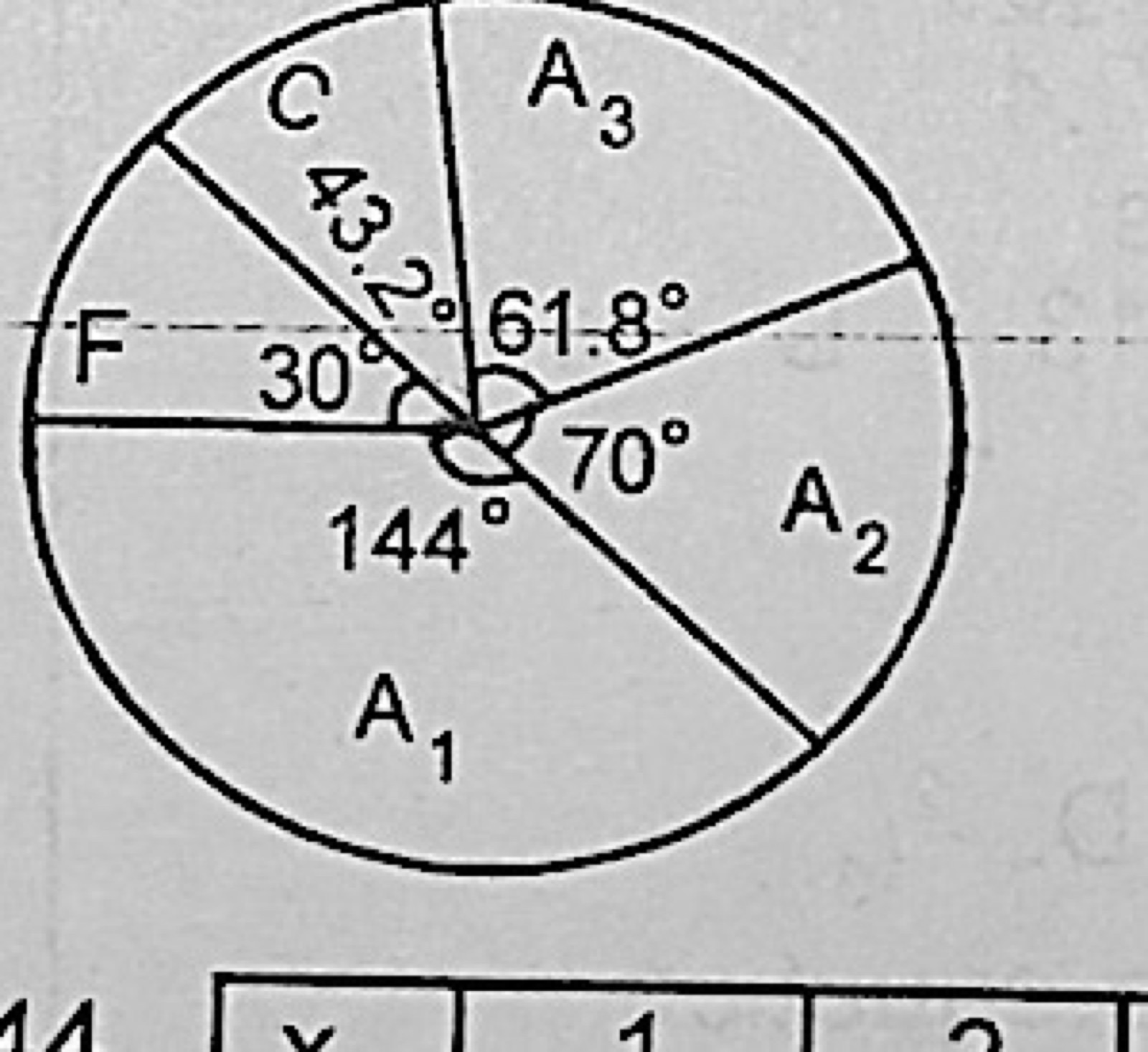
The grades A1, A2, A3, C4 and F earned by students in a particular course are shown in the pie chart above. What percentage of the students obtained a C4 grade?

Diagram for this question
  1. A.52.0
  2. B.43.2
  3. C.40.0
  4. D.12.0
Show the answer and explanation

Answer: D (12.0)

Explanation

The C4 sector is 43.2°. As a percentage of the whole circle: 43.2/360 × 100 = 12%.

Open this question

Question 44

Measures of Central Tendency

x: 1, 2, 3, 4, 5
f: y + 2, y − 1, 2y − 3, y + 4, 3y − 4
The table above shows the frequency distribution of data. If the mean is 43/14, find y?

  1. A.1
  2. B.2
  3. C.3
  4. D.4
Show the answer and explanation

Answer: B (2)

Explanation

Σf = 8y − 2 and Σfx = 28y − 13. Setting (28y − 13)/(8y − 2) = 43/14 and cross-multiplying gives 392y − 182 = 344y − 86, so 48y = 96 and y = 2.

Open this question

Question 45

Measures of Central Tendency

The mean of twelve positive numbers is 3. When another number is added, the mean becomes 5. Find the thirteenth number.

  1. A.29
  2. B.26
  3. C.25
  4. D.24
Show the answer and explanation

Answer: A (29)

Explanation

The twelve numbers total 36. Thirteen numbers with mean 5 total 65, so the new number is 65 − 36 = 29.

Open this question

Question 46

Measures of Dispersion

Find the mean deviation of the set of numbers 4, 5, 9

  1. A.0
  2. B.2
  3. C.5
  4. D.6
Show the answer and explanation

Answer: B (2)

Explanation

The mean is 6. The distances from the mean are 2, 1 and 3, whose average is 6/3 = 2.

Open this question

Question 47

Measures of Central Tendency

Class Interval: 1-5, 6-10, 11-15, 16-20, 21-25
Frequency: 6, 15, 20, 7, 2
Estimate the median of the frequency distribution above.

  1. A.10½
  2. B.11½
  3. C.12½
  4. D.13
Show the answer and explanation

Answer: B (11½)

Explanation

There are 50 values, so the median is the 25th. Cumulative frequencies are 6, 21, 41, … so it lies in 11–15. Median = 10.5 + (25 − 21)/20 × 5 = 11.5.

Open this question

Question 48

Measures of Dispersion

x: 1, 2, 3, 4, 5
f: 2, 1, 2, 1, 2
Find the variance of the frequency distribution above.

  1. A.3/2
  2. B.9/4
  3. C.5/2
  4. D.3
Show the answer and explanation

Answer: B (9/4)

Explanation

Σf = 8 and Σfx = 24, so the mean is 3. Σf(x − 3)² = 2(4) + 1(1) + 0 + 1(1) + 2(4) = 18. Variance = 18/8 = 9/4.

Open this question

Question 49

Probability

Age in years: 10, 11, 12
Number of pupils: 6, 27, 7
The table above shows the number of pupils in each group in a class. What is the probability that a pupil chosen at random is at least 11 years old?

  1. A.27/40
  2. B.17/20
  3. C.33/40
  4. D.3/20
Show the answer and explanation

Answer: B (17/20)

Explanation

There are 40 pupils, and 27 + 7 = 34 are 11 or older. Probability = 34/40 = 17/20.

Open this question

Question 50

Probability

In a survey, it was observed that 20 students read newspapers and 35 read novels. If 40 of the students read either newspapers or novels, what is the probability of the students who read both newspapers and novels?

  1. A.½
  2. B.⅔
  3. C.3/8
  4. D.3/11
Show the answer and explanation

Answer: C (3/8)

Explanation

Students reading both = 20 + 35 − 40 = 15. As a fraction of the 40 students: 15/40 = 3/8.
Open this question