JAMB Mathematics 1987 past questions and answers

50 questions. Try each one, then open the answer to check yourself and read the explanation.

Question 1

Number Bases

Convert 241 in base 5 to base 8

  1. A.718
  2. B.1078
  3. C.1768
  4. D.2418
Show the answer and explanation

Answer: B (1078)

Explanation

2415 = 2×25 + 4×5 + 1 = 71 in base 10. Dividing 71 by 8 gives 8 remainder 7, then 1 remainder 0, then 0 remainder 1, so it is 1078.

Open this question

Question 2

Fractions, Decimals and Approximation

Find the length of a rod which can be cut into exactly equal strips, each of either 40cm or 48cm in length

  1. A.120cm
  2. B.240cm
  3. C.360cm
  4. D.480cm
Show the answer and explanation

Answer: B (240cm)

Explanation

The rod must be a multiple of both 40 and 48. The smallest such length is the LCM of 40 and 48, which is 240cm.

Open this question

Question 3

Fractions, Decimals and Approximation

A rectangular lawn has an area of 1815 square yards. If its length is 50 metres, find its width in metres, given that 1 metre equals 1.1 yards.

  1. A.39.93
  2. B.35.00
  3. C.33.00
  4. D.30.00
Show the answer and explanation

Answer: D (30.00)

Explanation

1 m = 1.1 yd, so 1 m² = 1.1 × 1.1 = 1.21 sq yd. The area is 1815 ÷ 1.21 = 1500 m², so the width is 1500 ÷ 50 = 30 m.

Open this question

Question 4

Fractions, Decimals and Approximation

Reduce each number to 2 significant figures and then evaluate
(0.021741 × 1.2047)/0.023789

  1. A.0.8
  2. B.0.9
  3. C.1.1
  4. D.1.2
Show the answer and explanation

Answer: C (1.1)

Explanation

To 2 s.f. the numbers are 0.022, 1.2 and 0.024. Then 0.022 × 1.2 = 0.0264 and 0.0264 ÷ 0.024 = 1.1.

Open this question

Question 5

Ratio, Percentages and Rates

A train moves from P to Q at an average speed of 90km/h and immediately returns from Q to P through the same route at an average speed of 45km/h. Find the average speed for the entire journey.

  1. A.55.00km/h
  2. B.60.00km/h
  3. C.67.50km/h
  4. D.75.00km/h
Show the answer and explanation

Answer: B (60.00km/h)

Explanation

Let PQ = d. Time taken = d/90 + d/45 = 3d/90 = d/30. Average speed = total distance ÷ total time = 2d ÷ (d/30) = 60 km/h.

Open this question

Question 6

Mensuration of Plane Shapes

If the length of a square is increased by 20% while its width is decreased by 20% to form a rectangle, what is the ratio of the area of the rectangle to the area of the square?

  1. A.6:5
  2. B.25:24
  3. C.5:6
  4. D.24:25
Show the answer and explanation

Answer: D (24:25)

Explanation

If the side is 1, the rectangle is 1.2 by 0.8, with area 0.96. The ratio is 0.96 : 1 = 24 : 25.

Open this question

Question 7

Commercial Arithmetic

Two brothers invested a total sum of N5,000.00 on a farm project. The farm yield was sold for N15,000.00 at the end of the season. If the profit was shared in the ratio 2:3, what is the difference in the amount of profit received by the brothers?

  1. A.N2,000.00
  2. B.N4,000.00
  3. C.N6,000.00
  4. D.N10,000.00
Show the answer and explanation

Answer: A (N2,000.00)

Explanation

Profit = 15,000 − 5,000 = N10,000. The shares are 2/5 × 10,000 = N4,000 and 3/5 × 10,000 = N6,000, a difference of N2,000.

Open this question

Question 8

Measures of Central Tendency

Peter's weekly wages are N20.00 for the first 20 weeks and N36.00 for the next 24 weeks. Find his average weekly wage for the remaining 8 weeks of the year, if his average weekly wage for the whole year is N30.00.

  1. A.N37.00
  2. B.N35.00
  3. C.N30.00
  4. D.N25.00
Show the answer and explanation

Answer: A (N37.00)

Explanation

For 52 weeks he earns 52 × 30 = N1,560. The first 44 weeks give 400 + 864 = N1,264, leaving N296 for 8 weeks, which is N37 a week.

Open this question

Question 9

Commercial Arithmetic

A man invests a sum of money at 4% per annum simple interest. After 3 years the principal amounts to N7,000.00. Find the sum invested.

  1. A.N7,840.00
  2. B.N6,250.00
  3. C.N6,160.00
  4. D.N5,833.33
Show the answer and explanation

Answer: B (N6,250.00)

Explanation

Amount = P(1 + 3 × 0.04) = 1.12P. So 1.12P = 7,000 and P = N6,250.

Open this question

Question 10

Commercial Arithmetic

By selling 20 oranges for N1.35 a trader makes a profit of 8%. What is his percentage gain or loss if he sells the same 20 oranges for N1.10?

  1. A.8%
  2. B.10%
  3. C.12%
  4. D.15%
Show the answer and explanation

Answer: C (12%)

Explanation

N1.35 is 108% of the cost, so the cost is 1.35 ÷ 1.08 = N1.25. Selling for N1.10 is a loss of N0.15, and 0.15/1.25 × 100 = 12%.

Open this question

Question 11

Ratio, Percentages and Rates

Four boys and ten girls can cut a field in 5 hours. If the boys work at 5/4 hrs rate of which the girls work, how many boys will be needed to cut the field in 3 hours?

  1. A.180
  2. B.60
  3. C.25
  4. D.20
Show the answer and explanation

Answer: D (20)

Explanation

A boy does 5/4 of a girl's work, so 10 girls equal 8 boys and the team is 12 boys working 5 hours (60 boy-hours). To finish in 3 hours needs 60 ÷ 3 = 20 boys.

Open this question

Question 12

Indices

Evaluate without using tables
(0.008)−1/3 × (0.16)−3/2

  1. A.625/8
  2. B.8/625
  3. C.1/8
  4. D.8
Show the answer and explanation

Answer: A (625/8)

Explanation

0.008 = 1/125, so (0.008)−1/3 = 5. 0.16 = 4/25, so (0.16)−3/2 = (25/4)3/2 = 125/8. The product is 625/8.

Open this question

Question 13

Fractions, Decimals and Approximation

Instead of writing 35/6 as a decimal correct to 3 significant figures, a student wrote it correct to 3 places of decimals. Find his error in standard form.

  1. A.0.003
  2. B.3.0 × 10−3
  3. C.0.3 × 10−2
  4. D.0.3 × 10−3
Show the answer and explanation

Answer: B (3.0 × 10⁻³)

Explanation

35/6 = 5.8333…, which is 5.83 to 3 s.f. and 5.833 to 3 d.p. The error is 0.003, which in standard form is 3.0 × 10⁻³.

Open this question

Question 14

Logarithms

Simplify without using tables
(log26 − log23)/(log28 − 2log2½)

  1. A.1/5
  2. B.1/2
  3. C.−1/2
  4. D.log23/log27
Show the answer and explanation

Answer: A (1/5)

Explanation

The top is log2(6/3) = log22 = 1. The bottom is 3 − 2(−1) = 5. So the value is 1/5.

Open this question

Question 15

Surds

Simplify without using tables
(2√14 × 3√21)/(7√24 × 2√98)

  1. A.3√14/4
  2. B.3√2/4
  3. C.3√14/28
  4. D.3√2/28
Show the answer and explanation

Answer: D (3√2/28)

Explanation

Top: 6√294 = 6 × 7√6 = 42√6. Bottom: 7 × 2√6 × 2 × 7√2 = 196√12 = 392√3. So 42√6/(392√3) = 42√2/392 = 3√2/28.

Open this question

Question 16

Algebraic Expressions

If P = 2/3 (1 − r2)/n2, find n when r = √(1/3) and p = 1

  1. A.3/2
  2. B.3
  3. C.1/3
  4. D.2/3
Show the answer and explanation

Answer: D (2/3)

Explanation

With r² = 1/3: 1 = (2/3)(1 − 1/3)/n² = (2/3)(2/3)/n² = (4/9)/n². So n² = 4/9 and n = 2/3.

Open this question

Question 17

Algebraic Expressions

If a = u2 − 3v2 and b = 2uv + v2, evaluate (2a − b)(a − b2), when u = 1 and v = −1

  1. A.9
  2. B.15
  3. C.27
  4. D.33
Show the answer and explanation

Answer: A (9)

Explanation

a = 1 − 3 = −2 and b = −2 + 1 = −1. Then 2a − b = −3 and a − b² = −2 − 1 = −3, so the product is 9.

Open this question

Question 18

Algebraic Expressions

The formula Q = 1.5 + 0.5n, gives the cost Q (in naira) of feeding n people for a week. Find in kobo the extra cost of feeding one additional person.

  1. A.350k
  2. B.200k
  3. C.150k
  4. D.50k
Show the answer and explanation

Answer: D (50k)

Explanation

Increasing n by 1 increases Q by 0.5 naira, the coefficient of n. That is 50 kobo.

Open this question

Question 19

Variation

If P varies inversely as V and V varies directly as R2, find the relationship between P and R given that R = 7 when P = 2

  1. A.P = 98R2
  2. B.PR2 = 98
  3. C.P = 1/(98R2)
  4. D.P = R2/98
Show the answer and explanation

Answer: B (PR2 = 98)

Explanation

P = k/V and V = cR², so P = K/R². With R = 7 and P = 2, K = 2 × 49 = 98, giving PR² = 98.

Open this question

Question 20

Algebraic Expressions

Make y the subject of the formula Z = x2 + 1/y3

  1. A.y = 1/(Z − x2)3
  2. B.y = 1/(Z + x2)1/3
  3. C.y = 1/(Z − x2)1/3
  4. D.y = 1/(∛Z − ∛x2)
Show the answer and explanation

Answer: C (y = 1/(Z − x2)1/3)

Explanation

1/y³ = Z − x², so y³ = 1/(Z − x²). Taking cube roots, y = 1/(Z − x²)1/3.

Open this question

Question 21

Quadratic Equations

Find the values of m which make the following quadratic function a perfect square.
x2 + 2(m + 1)x + m + 3

  1. A.−1, 1
  2. B.−1, 2
  3. C.1, −2
  4. D.2, −2
Show the answer and explanation

Answer: C (1, −2)

Explanation

A perfect square needs (half the x-coefficient)² = constant: (m + 1)² = m + 3. This gives m² + m − 2 = 0, so (m + 2)(m − 1) = 0 and m = 1 or −2.

Open this question

Question 22

Indices

Factorize 62x + 1 + 7(6x) − 5

  1. A.{3(6x) − 5}{2(6x) + 1}
  2. B.{3(6x) + 5}{2(6x) − 1}
  3. C.{2(6x) − 5}{3(6x) + 1}
  4. D.{2(6x) + 5}{3(6x) − 1}
Show the answer and explanation

Answer: B ({3(6x) + 5}{2(6x) − 1})

Explanation

Let y = 6x; then 62x+1 = 6y². So the expression is 6y² + 7y − 5 = (3y + 5)(2y − 1).

Open this question

Question 23

Linear and Simultaneous Equations

Find two values of y which satisfy the simultaneous equations x + y = 5, x2 − 2y2 = 1

  1. A.12, −2
  2. B.−12, 12
  3. C.−12, 2
  4. D.2, −2
Show the answer and explanation

Answer: C (−12, 2)

Explanation

Put x = 5 − y into the second equation: (5 − y)² − 2y² = 1, which becomes y² + 10y − 24 = 0. So (y + 12)(y − 2) = 0 and y = −12 or 2.

Open this question

Question 24

Angles and Polygons

An (n − 2)2-sided figure has n diagonals. Find the number n of diagonals for a 25-sided figure.

  1. A.7
  2. B.8
  3. C.9
  4. D.10
Show the answer and explanation

Answer: A (7)

Explanation

Set (n − 2)² = 25, so n − 2 = 5 and n = 7.

Open this question

Question 25

Graphs of Functions

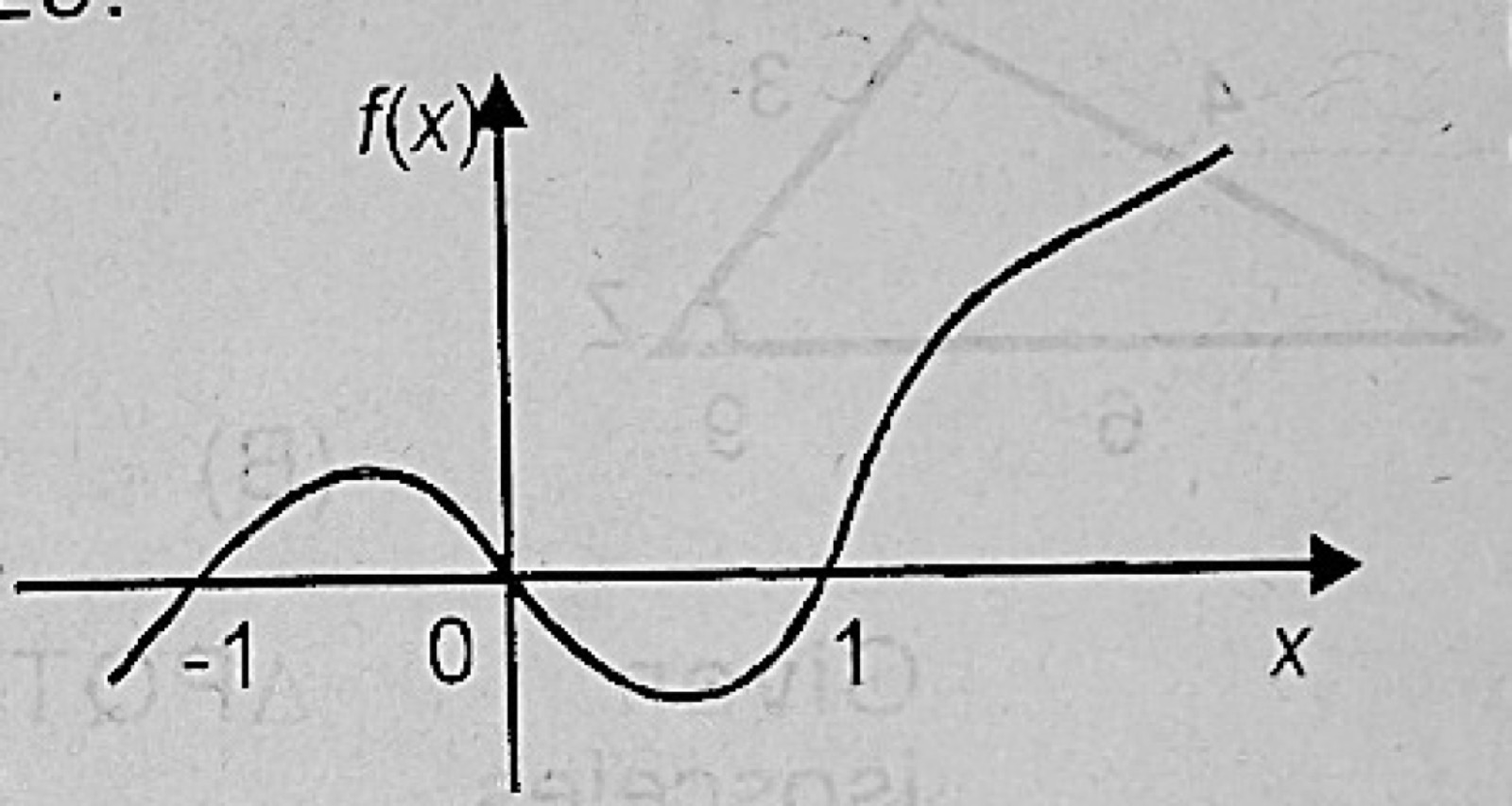
A cubic function f(x) is specified by the graph shown above. The values of the independent variable for which the function vanishes are

Diagram for this question
  1. A.−1, 0, 1
  2. B.−1 ≤ x ≤ 1
  3. C.x, −1
  4. D.x > 1
Show the answer and explanation

Answer: A (−1, 0, 1)

Explanation

"Vanishes" means f(x) = 0. The graph crosses the x-axis at x = −1, x = 0 and x = 1.

Open this question

Question 26

Inequalities

Solve the inequality x − 1 > 4(x + 2)

  1. A.x > −3
  2. B.x < −3
  3. C.2 < x < 3
  4. D.−3 < x < −2
Show the answer and explanation

Answer: B (x < −3)

Explanation

x − 1 > 4x + 8 gives −3x > 9. Dividing by −3 reverses the sign: x < −3.

Open this question

Question 27

Algebraic Expressions

Simplify
(x2 − y2)/(2x2 + xy − y2)

  1. A.(x + y)/(2x + y)
  2. B.(x + y)/(2x − y)
  3. C.(x − y)/(2x − y)
  4. D.(x − y)/(2x + y)
Show the answer and explanation

Answer: C ((x − y)/(2x − y))

Explanation

x² − y² = (x − y)(x + y) and 2x² + xy − y² = (2x − y)(x + y). Cancelling (x + y) leaves (x − y)/(2x − y).

Open this question

Question 28

Differentiation

The minimum value of y in the equation y = x2 − 6x + 8 is

  1. A.8
  2. B.3
  3. C.0
  4. D.−1
Show the answer and explanation

Answer: D (−1)

Explanation

dy/dx = 2x − 6 = 0 at x = 3. Then y = 9 − 18 + 8 = −1.

Open this question

Question 29

Progressions

Find the sum of the first 21 terms of the progression −10, −8, −6, …

  1. A.180
  2. B.190
  3. C.200
  4. D.210
Show the answer and explanation

Answer: D (210)

Explanation

a = −10, d = 2, n = 21. S = 21/2 × (2(−10) + 20 × 2) = 21/2 × 20 = 210.

Open this question

Question 30

Progressions

Find the eleventh term of the progression 4, 8, 16, …

  1. A.213
  2. B.212
  3. C.211
  4. D.210
Show the answer and explanation

Answer: B (212)

Explanation

This is a GP with a = 4 and r = 2. The 11th term is 4 × 210 = 22 × 210 = 212.

Open this question

Question 31

Circle Theorems

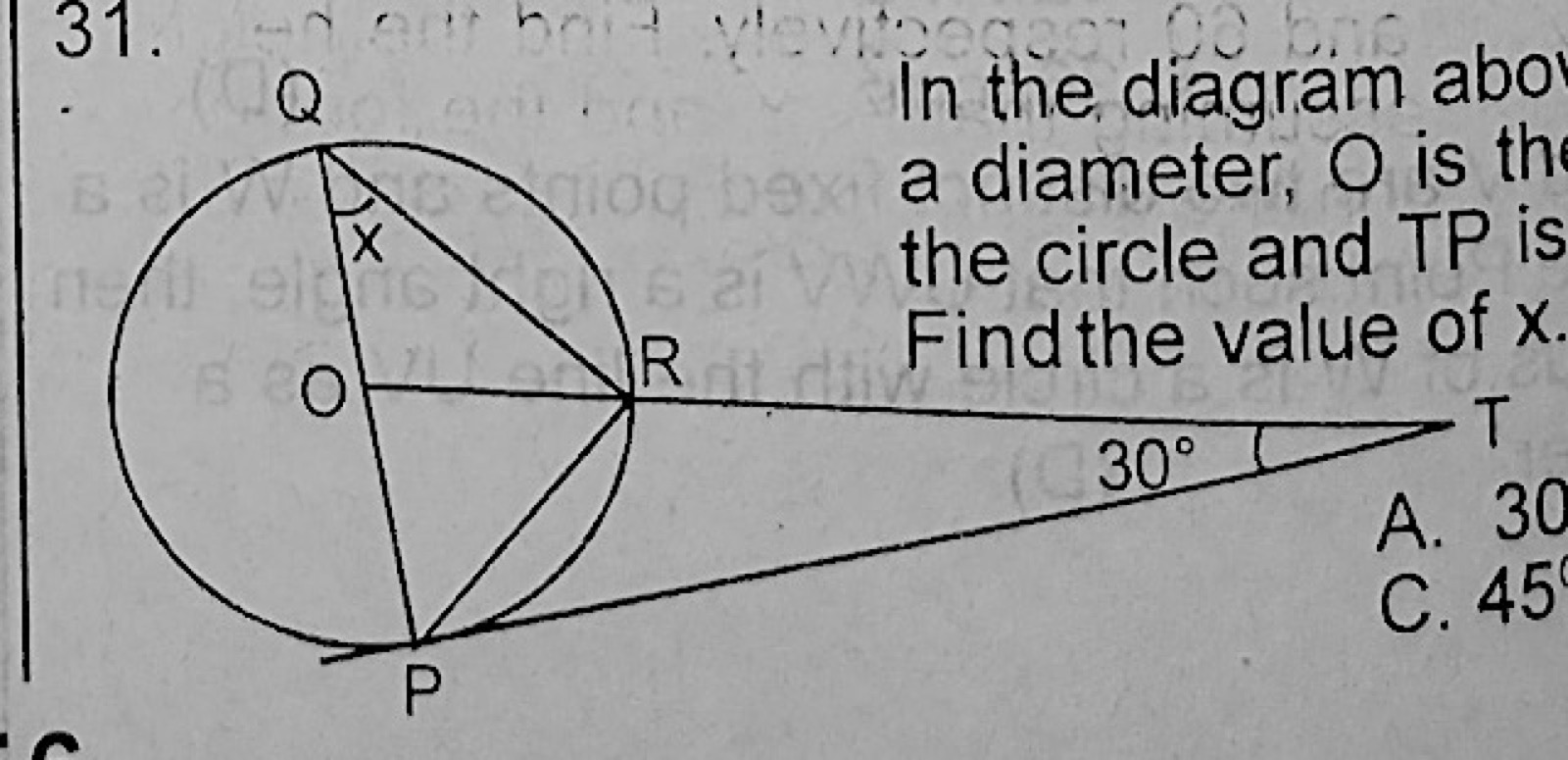
In the diagram above, POQ is a diameter, O is the centre of the circle and TP is a tangent. Find the value of x.

Diagram for this question
  1. A.30°
  2. B.40°
  3. C.45°
  4. D.50°
Show the answer and explanation

Answer: A (30°)

Explanation

OP is perpendicular to the tangent TP, so in triangle OPT angle POT = 180° − 90° − 30° = 60°. The angle x at Q stands on the same arc PR, so it is half of 60°, i.e. 30°.

Open this question

Question 32

Triangles and Quadrilaterals

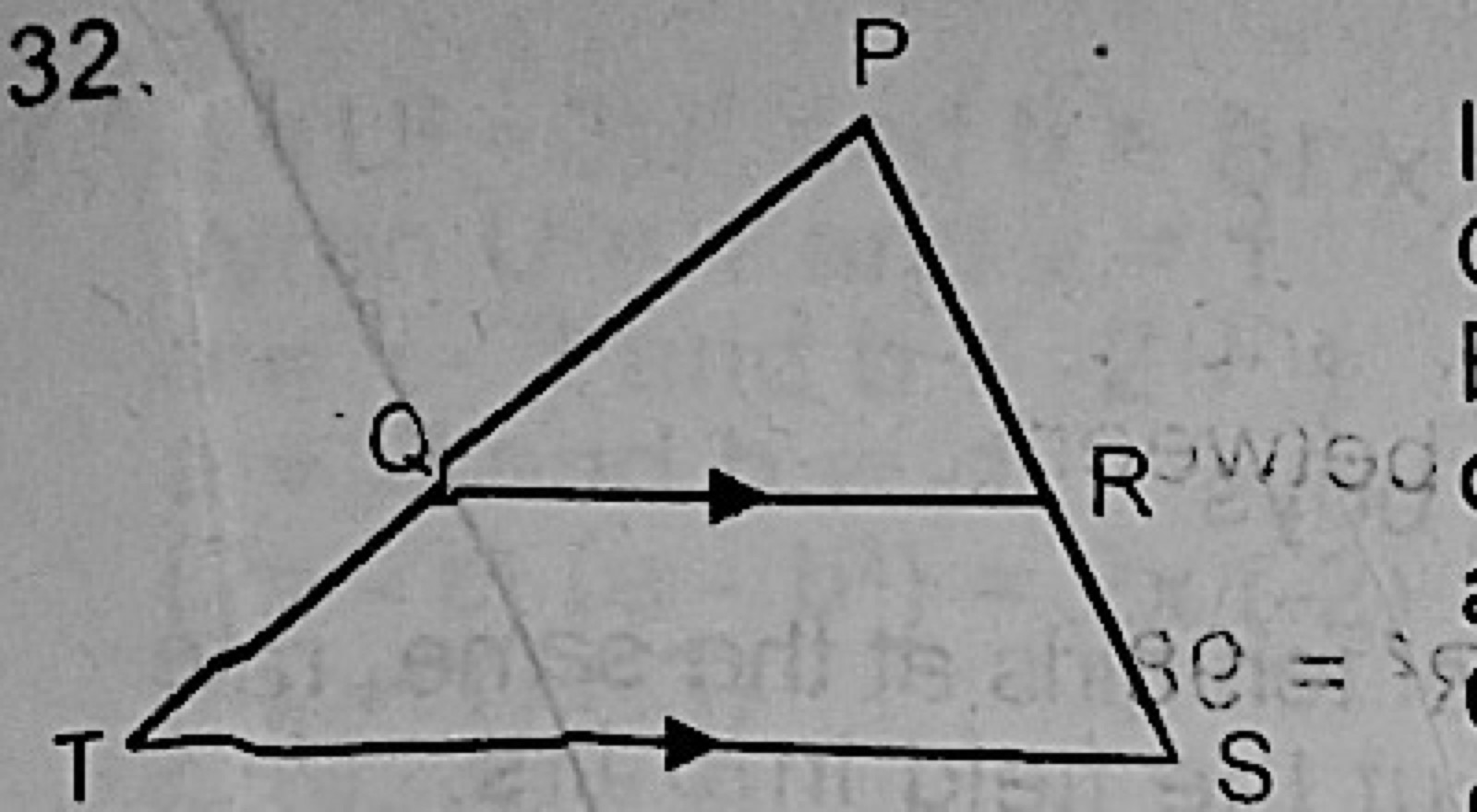
In the diagram above, QR||TS, QR:TS = 2:3. Find the ratio of the area of triangle PQR to the area of the trapezium QRST.

Diagram for this question
  1. A.4:9
  2. B.4:5
  3. C.1:3
  4. D.2:3
Show the answer and explanation

Answer: B (4:5)

Explanation

Triangles PQR and PTS are similar with sides in ratio 2:3, so their areas are in ratio 4:9. The trapezium is 9 − 4 = 5 parts, so the ratio is 4:5.

Open this question

Question 33

Angles and Polygons

Three angles of a nonagon are equal and the sum of six other angles is 1110°. Calculate the size of one of the equal angles.

  1. A.210°
  2. B.150°
  3. C.105°
  4. D.50°
Show the answer and explanation

Answer: D (50°)

Explanation

The angles of a nonagon add up to (9 − 2) × 180° = 1260°. The three equal angles share 1260° − 1110° = 150°, so each is 50°.

Open this question

Question 34

Triangles and Quadrilaterals

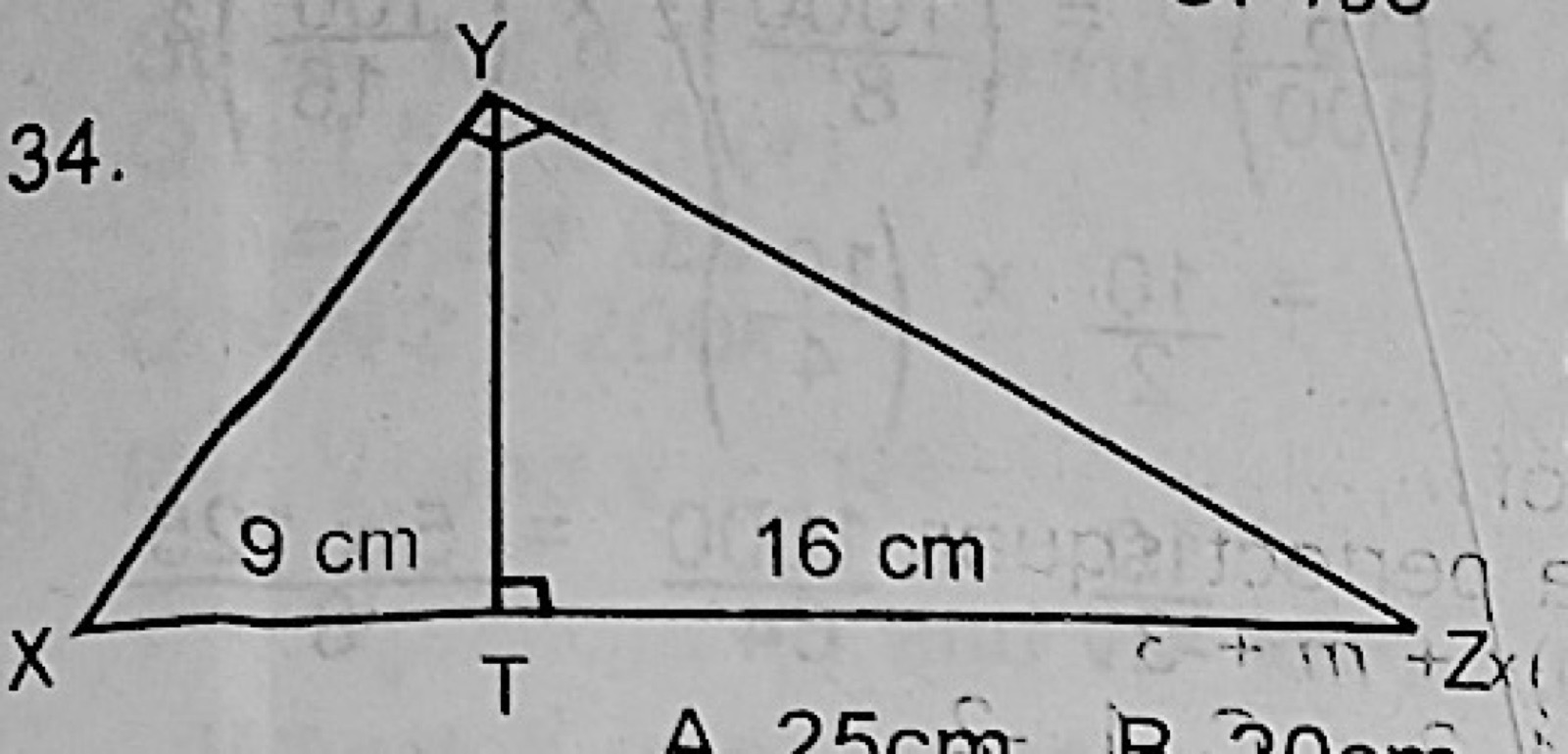
In the figure above, XŶZ = YT̂Z = 90°, XT = 9cm and TZ = 16cm. Find YZ

Diagram for this question
  1. A.25cm
  2. B.20cm
  3. C.16cm
  4. D.9cm
Show the answer and explanation

Answer: B (20cm)

Explanation

In a right-angled triangle with the altitude YT, YZ² = TZ × XZ. So YZ² = 16 × 25 = 400 and YZ = 20cm.

Open this question

Question 35

Circle Theorems

Two chords QR and NP of a circle intersect inside the circle at X. If RQ̂P = 37°, RQ̂N = 49° and QP̂N = 35° find PR̂Q.

  1. A.35°
  2. B.37°
  3. C.49°
  4. D.59°
Show the answer and explanation

Answer: D (59°)

Explanation

In triangle PQN, angle PQN = 37° + 49° = 86° and angle QPN = 35°, so angle QNP = 180° − 121° = 59°. Angle PRQ stands on the same arc PQ as angle PNQ, so it is also 59°.

Open this question

Question 36

Triangles and Quadrilaterals

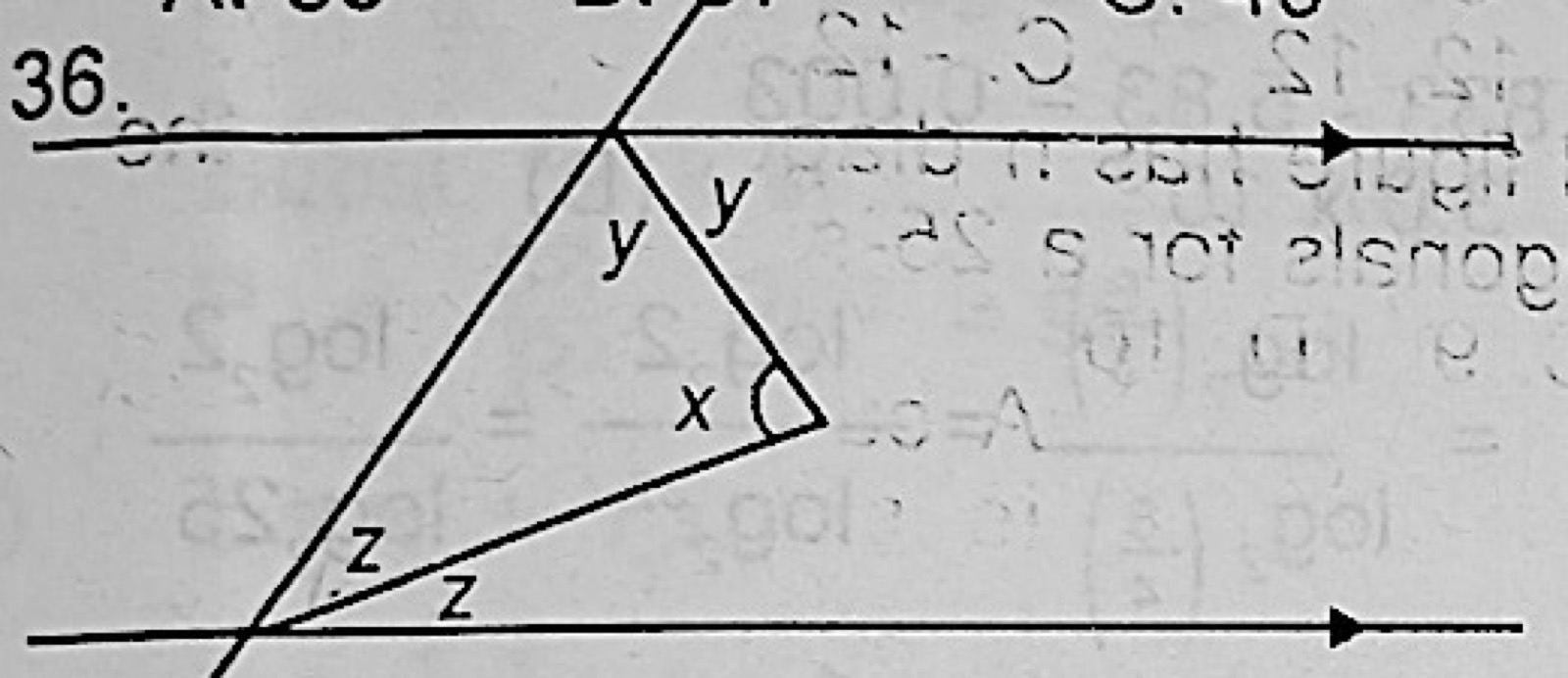
In the figure above, find the value of x.

Diagram for this question
  1. A.110°
  2. B.100°
  3. C.90°
  4. D.80°
Show the answer and explanation

Answer: C (90°)

Explanation

The two lines are parallel, so the co-interior angles 2y and 2z add to 180°, giving y + z = 90°. In the triangle containing x, x = 180° − (y + z) = 90°.

Open this question

Question 37

Mensuration of Plane Shapes

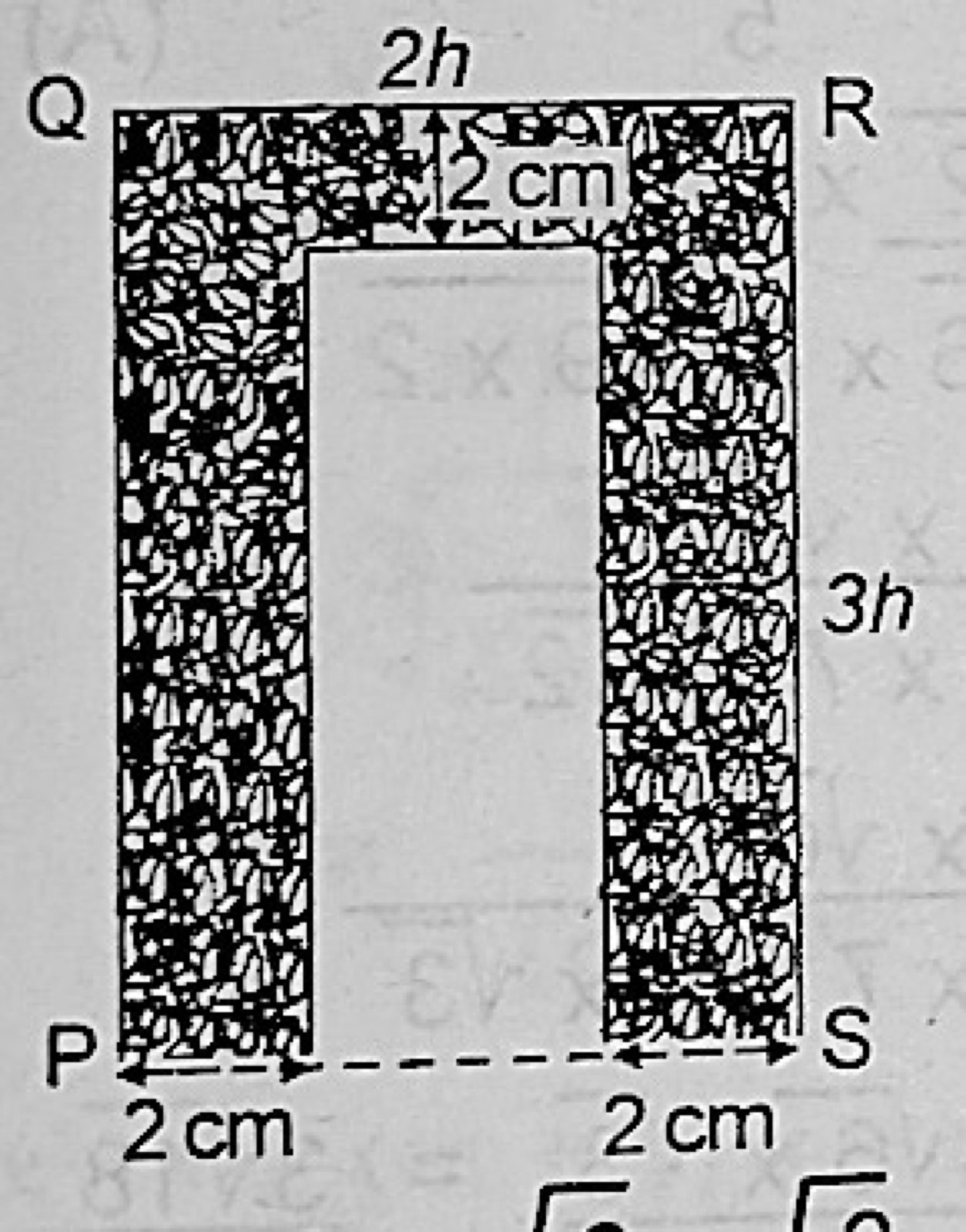
In the figure above, PQRS is a rectangle. If the shaded area is 72sq.cm, find h.

Diagram for this question
  1. A.12cm
  2. B.10cm
  3. C.8cm
  4. D.5cm
Show the answer and explanation

Answer: D (5cm)

Explanation

The rectangle is 2h by 3h and the unshaded part inside is (2h − 4) by (3h − 2). Shaded area = 6h² − (2h − 4)(3h − 2) = 16h − 8 = 72, so h = 5cm.

Open this question

Question 38

Trigonometry

The sine, cosine and tangent of 210° are respectively

  1. A.−1/2, −√3/2, √3/3
  2. B.1/2, √3/2, √3/3
  3. C.√3/2, √3/3, 1
  4. D.√3/2, 1/2, 1
Show the answer and explanation

Answer: A (−1/2, −√3/2, √3/3)

Explanation

210° is in the third quadrant with reference angle 30°, where sine and cosine are negative and tangent positive. So sin 210° = −1/2, cos 210° = −√3/2 and tan 210° = 1/√3 = √3/3.

Open this question

Question 39

Trigonometry

If tan θ = (m2 − n2)/2mn, find sec θ

  1. A.(m2 + n2)/(m2 − n2)
  2. B.(m2 + n2)/2mn
  3. C.mn/(2(m2 + n2))
  4. D.m2n2/(m2 − n2)
Show the answer and explanation

Answer: B ((m2 + n2)/2mn)

Explanation

Take a right triangle with opposite side m² − n² and adjacent side 2mn. The hypotenuse is √((m² − n²)² + 4m²n²) = m² + n², so sec θ = hypotenuse/adjacent = (m² + n²)/2mn.

Open this question

Question 40

Trigonometry

From two points X and Y, 8cm apart, and in line with a pole, the angle of elevation of the top of the pole are 30 and 60 respectively. Find the height of the pole, assuming that X, Y, and the foot of the pole are on the same horizontal plane and X and Y are on the same side of the pole.

  1. A.4m
  2. B.3√3/3 m
  3. C.4√3 m
  4. D.8√3m
Show the answer and explanation

Answer: C (4√3 m)

Explanation

Let Y be a from the foot. Then h = a tan 60° = a√3 and h = (8 + a) tan 30° = (8 + a)/√3. So 3a = 8 + a, a = 4 and h = 4√3.

Open this question

Question 41

Trigonometry

A room is 12m long, 9m wide and 8cm high. Find the cosine of the angle which a diagonal of the room makes with the floor of the room.

  1. A.15/17
  2. B.8/17
  3. C.8/15
  4. D.12/17
Show the answer and explanation

Answer: A (15/17)

Explanation

The floor diagonal is √(144 + 81) = 15m and the room diagonal is √(225 + 64) = 17m. The cosine of the angle with the floor is 15/17.

Open this question

Question 42

Latitude and Longitude

What is the circumference of radius of the earth?

  1. A.R cos θ
  2. B.2π R cos θ
  3. C.R sin θ
  4. D.2π R sin θ
Show the answer and explanation

Answer: B (2π R cos θ)

Explanation

The circle of latitude θ° has radius R cos θ, where R is the radius of the earth. Its circumference is 2πR cos θ.

Open this question

Question 43

Mensuration of Solids

The base of a pyramid is a square of side 8cm. If its vertex is directly above the centre, find the height, given that edge is 4√3cm

  1. A.6cm
  2. B.5cm
  3. C.4cm
  4. D.3cm
Show the answer and explanation

Answer: C (4cm)

Explanation

Half the diagonal of the base is 8√2/2 = 4√2. Height² = (4√3)² − (4√2)² = 48 − 32 = 16, so the height is 4cm.

Open this question

Question 44

Constructions

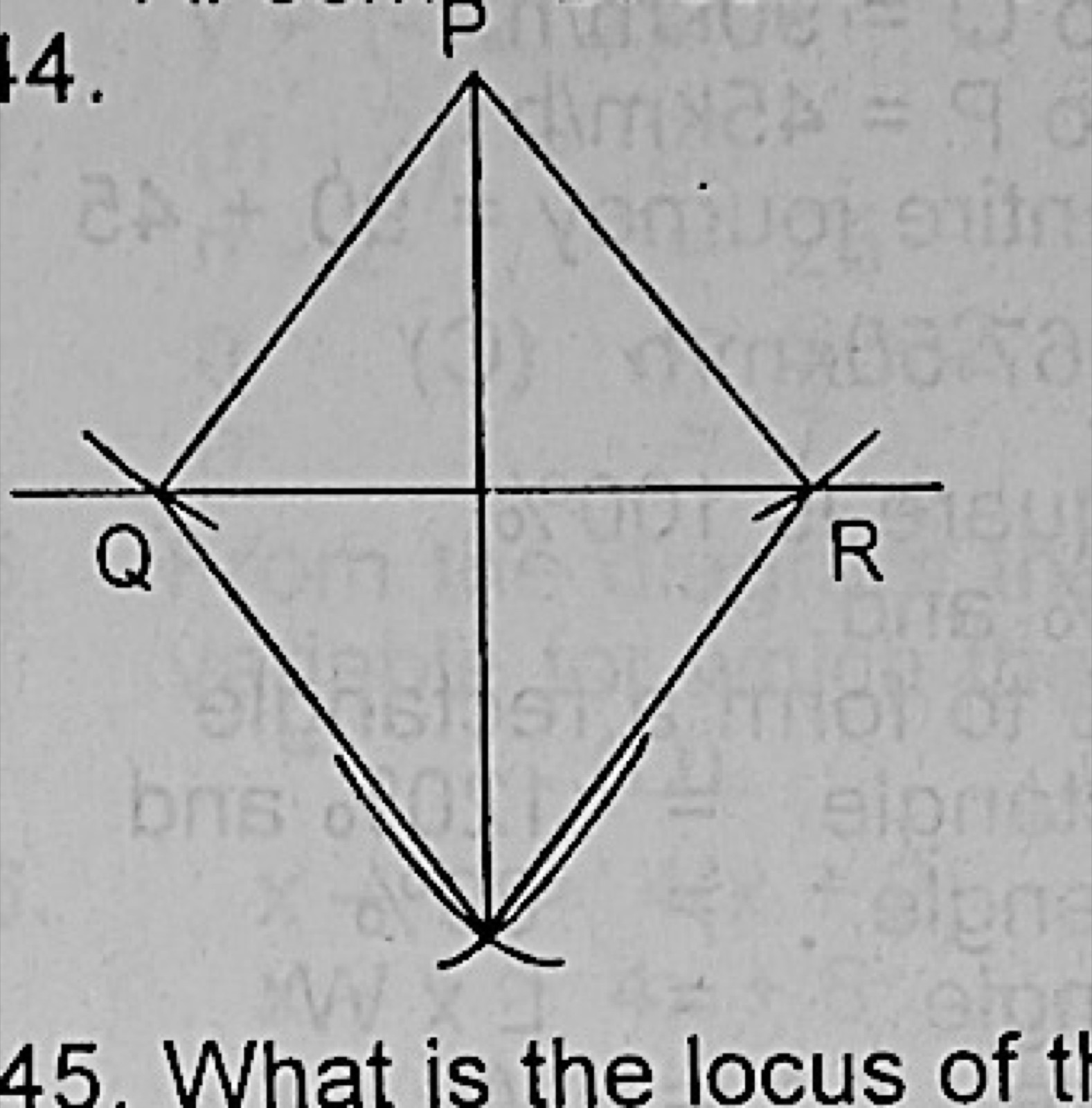
The figure above is an example of the construction of a

Diagram for this question
  1. A.perpendicular bisector of a given straight line
  2. B.perpendicular from a given point to a given line
  3. C.perpendicular to a line from a given point on that line.
  4. D.given angle.
Show the answer and explanation

Answer: B (perpendicular from a given point to a given line)

Explanation

An arc centred at the point P cuts the line at Q and R. Equal arcs from Q and R meet below the line, and joining P to that point gives the perpendicular from P to the line.

Open this question

Question 45

Loci

What is the locus of the mid-points of all chords of length 6cm within a circle of radius 5cm and with centre O?

  1. A.A circle of radius 4cm and with centre O
  2. B.The perpendicular bisectors of the chords
  3. C.A straight line passing through centre O
  4. D.A circle of radius 6cm and with centre O
Show the answer and explanation

Answer: A (A circle of radius 4cm and with centre O)

Explanation

The midpoint of each chord is √(5² − 3²) = 4cm from O. So all the midpoints lie on a circle of radius 4cm centred at O.

Open this question

Question 46

Data Presentation

Taking the period of daylight on a certain day to be from 5.30 a.m to 7.00 p.m, calculate the periods of daylight and of darkness on that day.

  1. A.187°30', 172°30'
  2. B.135°, 225°
  3. C.202°30', 157°30'
  4. D.195°, 165°
Show the answer and explanation

Answer: C (202°30', 157°30')

Explanation

Daylight lasts 13½ hours out of 24, so its angle is 13.5/24 × 360° = 202.5° = 202°30'. Darkness is 360° − 202°30' = 157°30'.

Open this question

Question 47

Measures of Central Tendency

The goals scored by 40 football teams from three league divisions are recorded below:
Number of goals: 0, 1, 2, 3, 4, 5, 6
Frequency: 4, 3, 15, 16, 1, 0, 1
What is the total number of goals scored by all the teams?

  1. A.21
  2. B.40
  3. C.91
  4. D.96
Show the answer and explanation

Answer: C (91)

Explanation

Total goals = Σfx = 0 + 3 + 30 + 48 + 4 + 0 + 6 = 91.

Open this question

Question 48

Measures of Central Tendency

The numbers 3, 2, 8, 5, 7, 12, 9 and 14 are the marks scored by a group of students in a class test. If P is the mean and Q the median, then P + Q is

  1. A.18
  2. B.17½
  3. C.16
  4. D.15
Show the answer and explanation

Answer: D (15)

Explanation

The total is 60, so the mean is 60/8 = 7.5. In order, 2, 3, 5, 7, 8, 9, 12, 14, the median is (7 + 8)/2 = 7.5. P + Q = 15.

Open this question

Question 49

Measures of Central Tendency

Below are the scores of a group of students in a Music test.
Scores: 1, 2, 3, 4, 5, 6, 7, 8, 9
No. of students: 3, 6, 10, 8, 6, 5, 2, 4, 12
If CF(x) is the number of students with scores less than or equal to x, find CF(6).

  1. A.40
  2. B.38
  3. C.33
  4. D.5
Show the answer and explanation

Answer: B (38)

Explanation

Add the frequencies for scores 1 to 6: 3 + 6 + 10 + 8 + 6 + 5 = 38.
Open this question

Question 50

Probability

Find the probability of selecting a figure which is a parallelogram from a square, a rectangle, a rhombus, a kite and a trapezium.

  1. A.3/5
  2. B.2/5
  3. C.4/5
  4. D.1/5
Show the answer and explanation

Answer: A (3/5)

Explanation

The square, rectangle and rhombus are parallelograms; the kite and trapezium are not. So the probability is 3/5.

Open this question