Home › Past questions › JAMB › Mathematics › 1981 45 questions. Try each one, then open the answer to check yourself and read the explanation.
Sign up free to answer these questions on a CBT screen with a timer, then see your score and every answer explained.
Start practising free
Question 1 Variation Suppose x varies inversely as y, y varies directly as the square of t and x = 1 when t = 3. Find x when t = 1 /3
A. 81 B. 27 C. 1 /9 D. 1 /27 E. 1 /81 Show the answer and explanation Answer: A (81 )
Explanation x ∝ 1/y and y ∝ t², so x = k/t². x = 1 at t = 3 gives k = 9. At t = ⅓, x = 9 ÷ (1/9) = 81.
Open this question
Question 2 Trigonometry If sine x equals cosine x, what is x in radians?
A. π /2 B. π /3 C. π /4 D. π /6 E. π /12 Show the answer and explanation Answer: C (π /4
Explanation sin x = cos x means tan x = 1, so x = 45° = π/4 radians.
Open this question
Question 3 Commercial Arithmetic The ratio of the price of a loaf of bread to the price of a packet of sugar in 1975 was r:t. In 1980 the price of a loaf went up by 25% and that of a packet of sugar by 10%. Their new ratio is now
A. 40r : 50t B. 44r : 50t C. 50r : 44t D. 55r : 44t E. 44r : 55t. Show the answer and explanation Answer: C (50r : 44t )
Explanation The new prices are 1.25r and 1.10t. 1.25r : 1.10t = 125r : 110t = 50r : 44t.
Open this question
Question 4 Linear and Simultaneous Equations Find a two-digit number such that three times the tens digit is 2 less than twice the units digit, and twice the number is 20 greater than the number obtained by reversing the digits.
A. 24 B. 42 C. 74 D. 47 E. 72 Show the answer and explanation Answer: D (47 )
Explanation With tens digit x and units digit y: 3x = 2y − 2 and 2(10x + y) = 10y + x + 20, i.e. 19x − 8y = 20. Solving gives x = 4, y = 7, so the number is 47.
Open this question
Question 5 Inequalities Find the value of x satisfying x/2 − 1/3 < 2x/5 + 1/6
A. x < 5 B. x > 7½ C. x < 7½ D. x < −5 E. x ≥ 5. Show the answer and explanation Answer: A (x < 5 )
Explanation Collect terms: x/2 − 2x/5 < 1/6 + 1/3, so x/10 < 1/2 and x < 5.
Open this question
Question 6 Trigonometry If sin x° = a/b, what is sin (90 − x)°?
A. a/b B. 1 − a/b C. √(b2 − a2 )/b D. √(a2 − b2 )/b E. √(b2 − a2 ) Show the answer and explanation Answer: C (√(b2 − a2 )/b )
Explanation sin(90 − x) = cos x. In a right triangle with opposite side a and hypotenuse b, the adjacent side is √(b² − a²), so cos x = √(b² − a²)/b.
Open this question
Question 7 Measures of Central Tendency 7 pupils of average age 12 years leave a class of 25 pupils of average age 14 years. If 6 new pupils of average age 11 years join the class, what is the average age of the pupils now in the class?
A. 13 years B. 12 years 7½ months C. 13 years 5 months D. 13 years 10 months E. 11 years. Show the answer and explanation Answer: D (13 years 10 months )
Explanation Total age = 25 × 14 − 7 × 12 + 6 × 11 = 350 − 84 + 66 = 332 years for 24 pupils. 332 ÷ 24 ≈ 13.83 years = 13 years 10 months.
Open this question
Question 8 Commercial Arithmetic A sum of money invested at 5% per annum simple interest amounts to $285.20 after 3 years. How long will it take the same sum to amount to $434.00 at 7½% per annum simple interest?
A. 7½ years B. 10 years C. 5 years D. 12 years E. 14 years. Show the answer and explanation Answer: B (10 years )
Explanation After 3 years at 5% the amount is 1.15P = 285.20, so P = $248. The interest needed is 434 − 248 = $186, and 248 × 7.5% = $18.60 a year, so it takes 186 ÷ 18.60 = 10 years.
Open this question
Question 9 Commercial Arithmetic By selling an article for ₦45.00 a man makes a profit of 8%. For how much should he have sold it in order to make a profit of 32%?
A. ₦180.00 B. ₦59.00 C. ₦63.00 D. ₦58.00 E. ₦55.00. Show the answer and explanation Answer: E (₦55.00. )
Explanation Cost price = 45 × 100/108. A 32% profit needs 132/100 of that: 45 × 132/108 = ₦55.00.
Open this question
Question 10 Circle Theorems An isosceles triangle of sides 13cm, 13cm, 10cm is inscribed in a circle. What is the radius of the circle?
A. 71 /24 cm B. 12cm C. 8cm D. 7cm E. 69 cm. Show the answer and explanation Answer: A (71 /24 cm )
Explanation The height to the 10cm side is √(13² − 5²) = 12cm, so the area is 60cm². The circumradius R = abc/(4 × area) = (13 × 13 × 10)/240 = 169/24 = 7 1/24cm.
Open this question
Question 11 Measures of Central Tendency A group of 14 children received the following scores in a reading test: 35, 35, 26, 26, 26, 29, 29, 29, 12, 25, 25, 25, 25, 17. What was the median score?
A. 29 B. 26 C. 24.4 D. 25 E. 23. Show the answer and explanation Answer: B (26 )
Explanation In order: 12, 17, 25, 25, 25, 25, 26, 26, 26, 29, 29, 29, 35, 35. The 7th and 8th scores are both 26, so the median is 26.
Open this question
Question 12 Fractions, Decimals and Approximation A micrometre is defined as one millionth of a millimetre. A length of 12,000 micrometres may be represented as
A. 0.00012m B. 0.0000012m C. 0.000012m D. 0.00000012m E. 0.000000012m. Show the answer and explanation Answer: C (0.000012m )
Explanation Using the question's definition, 12,000 micrometres = 12,000 ÷ 1,000,000 mm = 0.012mm, and 0.012mm ÷ 1000 = 0.000012m.
Open this question
Question 13 Angles and Polygons In one and a half hours, the minute hand of a clock rotates through an angle of
A. 90° B. 180° C. 640° D. 450° E. 540° Show the answer and explanation Answer: E (540° )
Explanation The minute hand turns 360° every hour, so in 1½ hours it turns 1.5 × 360° = 540°.
Open this question
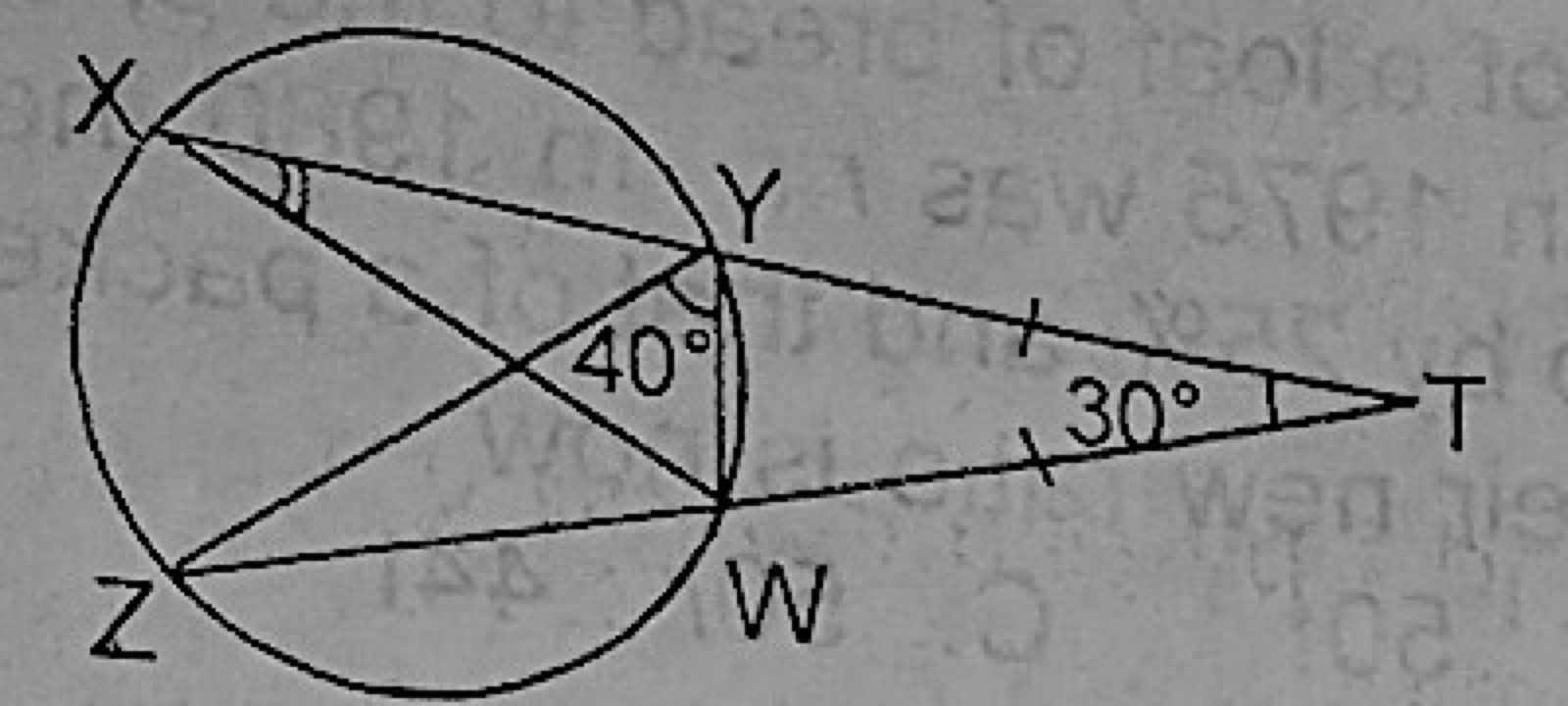
Question 15 Circle Theorems In the figure above, the chords XY and ZW are produced to meet at T such that YT = WT, ZYW = 40° and YTW = 30°. What is YXW?
A. 50° B. 75° C. 35° D. 115° E. 30°. Show the answer and explanation Answer: C (35° )
Explanation Triangle YTW is isosceles, so <TWY = 75°. The exterior angle of cyclic quadrilateral XYWZ at W equals the opposite interior angle: <YXZ = 75°. <WXZ = <WYZ = 40° (same segment), so <YXW = 75° − 40° = 35°.
Open this question
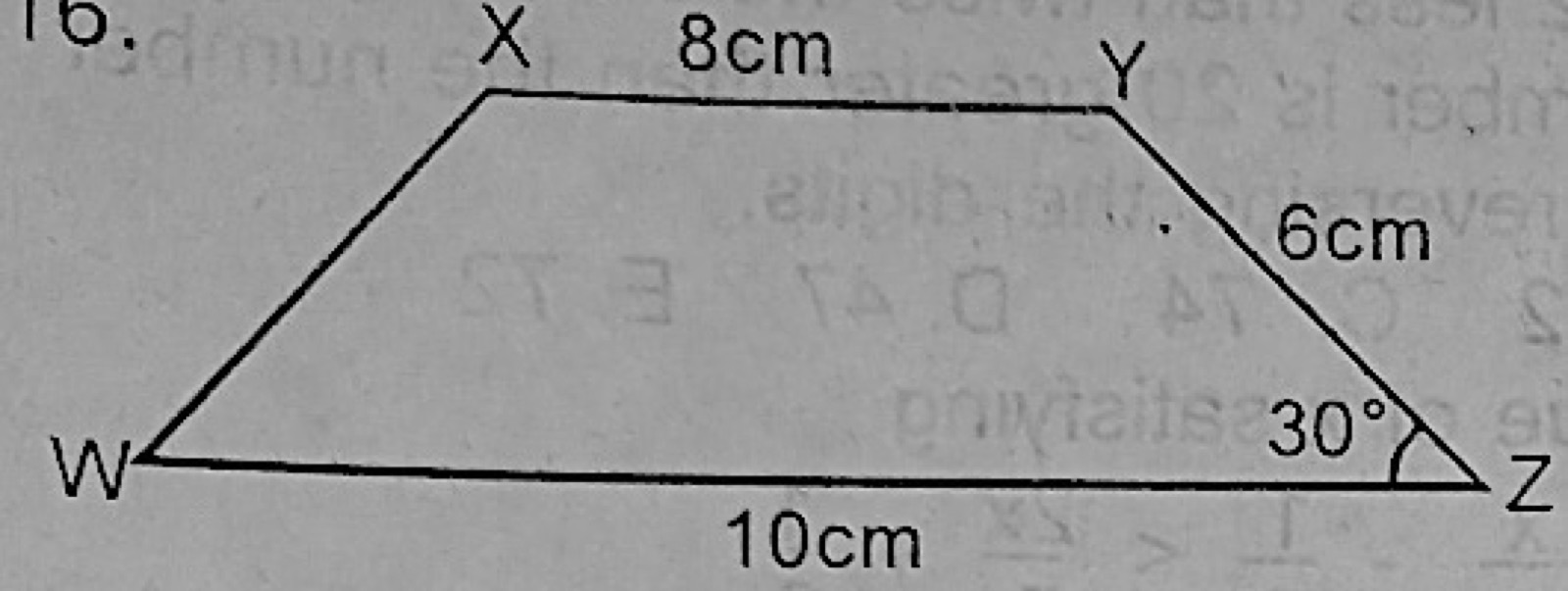
Question 16 Mensuration of Plane Shapes In the figure above, find the area of XYZW.
A. 60cm2 B. 54cm2 C. 27cm2 D. 54√2cm2 E. 27√2cm2 . Show the answer and explanation Answer: C (27cm2 )
Explanation XY ∥ WZ. The height is 6 sin 30° = 3cm, so the area of the trapezium is ½(8 + 10) × 3 = 27cm².
Open this question
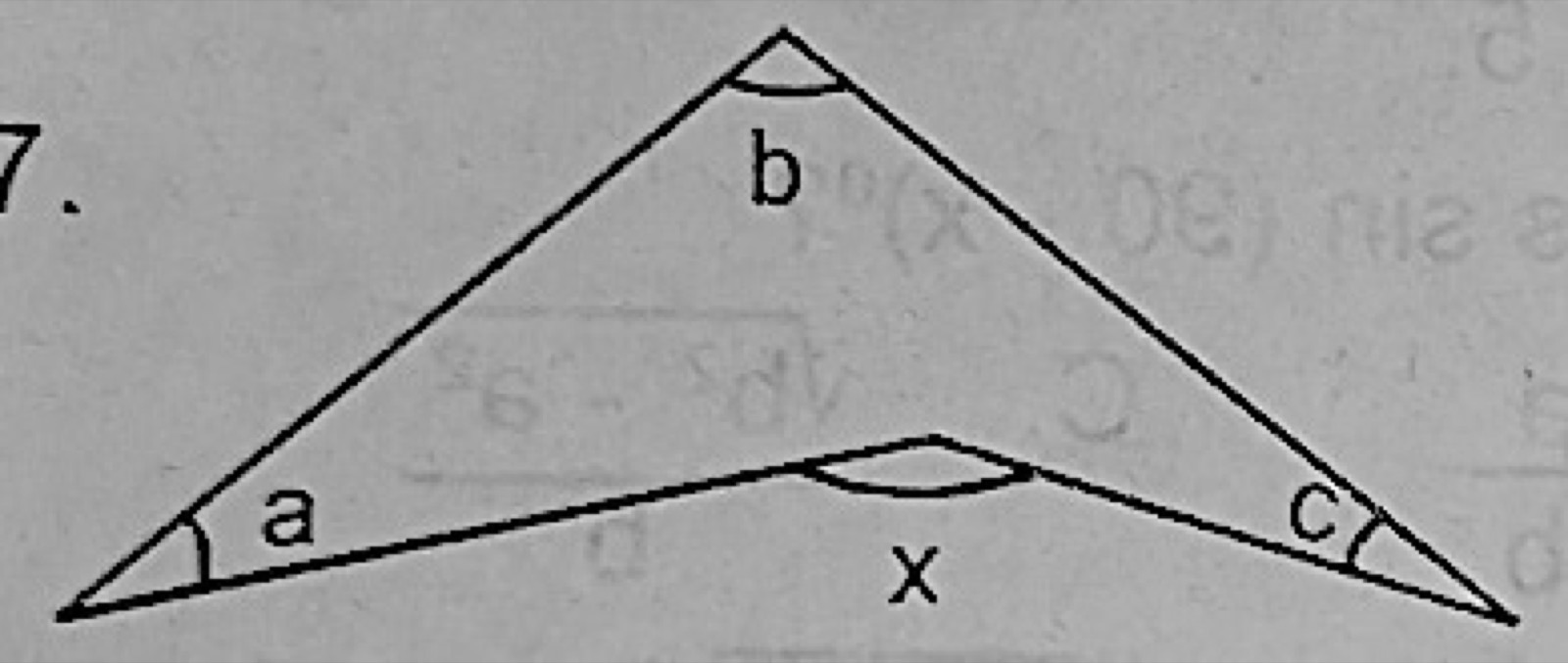
Question 17 Triangles and Quadrilaterals In the figure above, find x in terms of a, b and c.
A. a + b + c B. 180° − (a + b + c) C. a − b + c D. a + b E. a + c. Show the answer and explanation Answer: A (a + b + c )
Explanation Join the top vertex through the inner vertex. Each exterior angle of a triangle equals the sum of the two opposite interior angles, so the two parts of x add up to a + b + c.
Open this question
Question 18 Polynomials Factorize 3x3 + 4x2 − 13x + 6 completely, given that x − 1 is a factor.
A. (x − 1)(x − 3)(x + 2) B. (x − 1)(x + 3)(x − 2) C. (x − 1)(x + 3)(3x + 2) D. (x − 1)(x − 3)(3x + 2) E. (x − 1)(x + 3)(3x − 2). Show the answer and explanation Answer: E ((x − 1)(x + 3)(3x − 2). )
Explanation Dividing by x − 1 gives 3x² + 7x − 6, which factorises as (x + 3)(3x − 2).
Open this question
Question 19 Surds Simplify √2/(√3 − √2) − (√3 − √2)/(√3 + √2)
A. 2√2 − √3 B. 3(√6 − 1) C. √6 − 3 D. −1 /2 E. −√3/(2√2) Show the answer and explanation Answer: B (3(√6 − 1) )
Explanation √2/(√3 − √2) = √2(√3 + √2) = √6 + 2, and (√3 − √2)/(√3 + √2) = (√3 − √2)² = 5 − 2√6. The difference is 3√6 − 3 = 3(√6 − 1).
Open this question
Question 20 Quadratic Equations Solve 1/(x + 1) − 1/(x + 3) = 1/4
A. x = −1 or 3 B. x = 1 or 3 C. x = 1 or −5 D. x = −1 or 5 E. x = −1 or −3. Show the answer and explanation Answer: C (x = 1 or −5 )
Explanation The left side is 2/((x + 1)(x + 3)). Setting it equal to ¼ gives x² + 4x + 3 = 8, so x² + 4x − 5 = 0 and x = 1 or −5.
Open this question
Question 21 Triangles and Quadrilaterals In ΔXYZ, XY = 3cm, XZ = 5cm and YZ = 7cm. If the bisector of XYZ meets XZ at W, what is the length of XW?
A. 1.5cm B. 2.5cm C. 3cm D. 4cm E. None of the above. Show the answer and explanation Answer: A (1.5cm )
Explanation The angle bisector divides XZ in the ratio of the adjacent sides: XW : WZ = 3 : 7. So XW = 3/10 × 5 = 1.5cm.
Open this question
Question 23 Mensuration of Solids A cuboid has a diagonal of length 9cm and a square base of side 4cm. What is its height?
A. 9cm B. √65cm C. 4√2cm D. 7cm E. 6.5cm. Show the answer and explanation Answer: D (7cm )
Explanation The diagonal satisfies 9² = 4² + 4² + h², so h² = 81 − 32 = 49 and h = 7cm.
Open this question
Question 24 Logarithms Given that 10x = 0.2 and log10 2 = 0.3010, find x.
A. −1.3010 B. −0.6990 C. 0.6990 D. 1.3010 E. 0.02. Show the answer and explanation Answer: B (−0.6990 )
Explanation x = log₁₀ 0.2 = log₁₀ 2 − log₁₀ 10 = 0.3010 − 1 = −0.6990.
Open this question
Question 25 Linear and Simultaneous Equations Two cars X and Y start at the same point and travel towards a point P which is 150km away. If the average speed of Y is 60km per hour and X arrives at P 25 minutes earlier than Y. What is the average speed of X?
A. 513 /9 km per hour B. 72km per hour C. 37½km per hour D. 66km per hour E. 75km per hour. Show the answer and explanation Answer: B (72km per hour )
Explanation Y takes 150 ÷ 60 = 2½ hours, so X takes 2 hours 5 minutes = 125/60 hours. X's speed = 150 ÷ 125/60 = 72km per hour.
Open this question
Question 26 Indices Simplify (62n + 1 × 9n × 42n )/(18n × 2n × 122n )
A. 32n B. 3 × 22n−1 C. 2n D. 6 E. 1 Show the answer and explanation Answer: D (6 )
Explanation Count the powers. Of 2: top 2n + 1 + 4n = 6n + 1, bottom n + n + 4n = 6n. Of 3: top 2n + 1 + 2n = 4n + 1, bottom 2n + 2n = 4n. What is left is 2 × 3 = 6.
Open this question
Question 27 Fractions, Decimals and Approximation Evaluate correct to 4 decimal places 827.51 × 0.015.
A. 8.8415 B. 12.4127 C. 124.1265 D. 12.4120 E. 114.1265. Show the answer and explanation Answer: B (12.4127 )
Explanation 827.51 × 0.015 = 12.41265, which is 12.4127 to 4 decimal places.
Open this question
Question 28 Number Bases The number 25 when converted from the tens and units base to the binary base (base two) is one of the following
A. 10011 B. 111011 C. 111000 D. 11001 E. 110011. Show the answer and explanation Answer: D (11001 )
Explanation 25 = 16 + 8 + 1, so in base two it is 11001.
Open this question
Question 29 Fractions, Decimals and Approximation Evaluate (6.3 × 10⁵ )/(8.1 × 103 ) to 3 significant figures
A. 77.80 B. 778.0 C. 7.870 D. 8.770 E. 88.70. Show the answer and explanation Answer: A (77.80 )
Explanation 6.3 ÷ 8.1 = 0.7778 and 10⁵ ÷ 10³ = 100, giving 77.78, or 77.8 to three significant figures.
Open this question
Question 30 Measures of Central Tendency Marks scored by some children in an arithmetic test are 5,3,6,9,4,7,8,6,2,7,8,4,5,2,1,0,6,9,0,8. The arithmetic mean of the marks is
A. 6 B. 5 C. 7 D. 4 E. 8. Show the answer and explanation Answer: B (5 )
Explanation The 20 marks add up to 100, so the mean is 100 ÷ 20 = 5.
Open this question
Question 31 Measures of Central Tendency The weights of 30 new-born babies are given as follows: 6,9,5,7,6,7,5,8,9,5,7,5,8,7,8,7,5,6,5,7, 6,9,9,7,8,8,7,8,9,8. The mode is
A. 6 B. 5 C. 8 D. 7 E. 10. Show the answer and explanation Answer: D (7 )
Explanation Counting: 5 appears 6 times, 6 four times, 7 eight times, 8 seven times and 9 five times. 7 is the most frequent.
Open this question
Question 32 Mensuration of Plane Shapes What is the area between two concentric circles of diameters 26cm and 20cm?
A. 100π B. 169π C. 69π D. 9π E. 269π. Show the answer and explanation Answer: C (69π )
Explanation The radii are 13cm and 10cm, so the ring has area π(13² − 10²) = 69π cm².
Open this question
Question 33 Quadratic Equations The positive root of t in the following equation, 4t2 + 7t − 1 = 0, correct to 4 places of decimal is
A. 1.0622 B. 10.6225 C. 0.1328 D. 0.3218 E. 2.0132. Show the answer and explanation Answer: C (0.1328 )
Explanation t = (−7 + √(49 + 16))/8 = (−7 + 8.0623)/8 ≈ 0.1328.
Open this question
Question 34 Quadratic Equations The difference between the length and width of a rectangle is 6cm and the area is 135cm2 . What is the length?
A. 25cm B. 18cm C. 15cm D. 24cm E. 27cm. Show the answer and explanation Answer: C (15cm )
Explanation With width B, B(B + 6) = 135, so B² + 6B − 135 = 0 and B = 9. The length is 9 + 6 = 15cm.
Open this question
Question 35 Mensuration of Solids The area of a circular plate is one-sixteenth the surface area of a ball. If the area of the plate is given as Pcm2 , then the radius of the ball is
A. 2P/π B. 4P/√π C. √P/π D. 2√(P/π) E. 2P/3π Show the answer and explanation Answer: D (2√(P/π) )
Explanation P = (1/16) × 4πr² = πr²/4, so r² = 4P/π and r = 2√(P/π).
Open this question
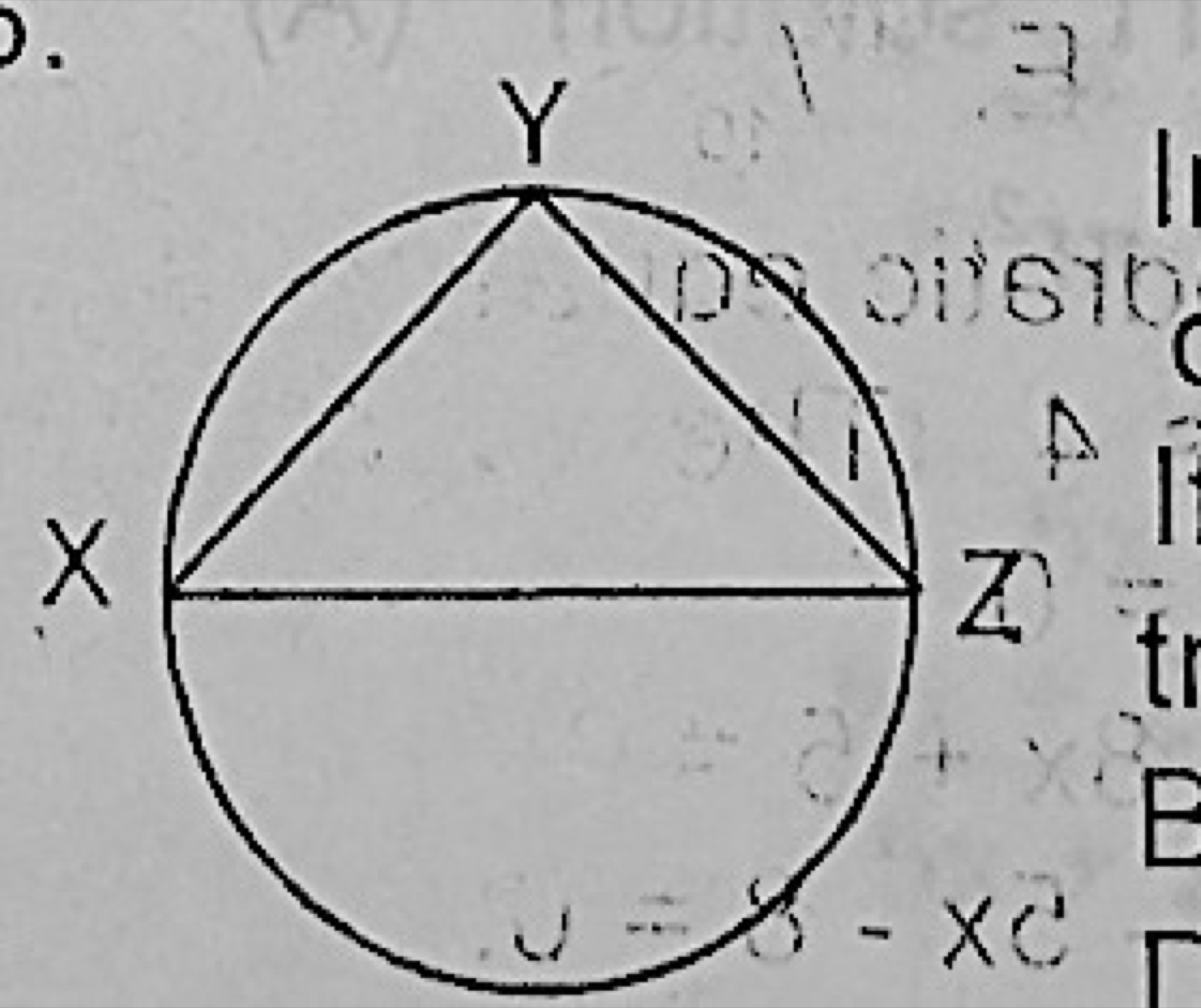
Question 36 Mensuration of Plane Shapes In the above diagram XZ is the diameter of a circle radius 5 /2 cm. If XY is 4cm then the area of the triangle XYZ is
A. 12cm2 B. 28½cm2 C. 16cm2 D. 10cm2 E. 6cm2 Show the answer and explanation Answer: E (6cm2 )
Explanation XZ = 5cm and the angle at Y is 90° (angle in a semicircle), so YZ = √(25 − 16) = 3cm. Area = ½ × 4 × 3 = 6cm².
Open this question
Question 37 Trigonometry Show that sin2 x/(1 + cos x) + sin2 x/(1 − cos x) is
A. sin x B. cos2 x C. sin2 x D. 1 E. 2. Show the answer and explanation Answer: E (2. )
Explanation Over the common denominator 1 − cos²x = sin²x, the top is sin²x(1 − cos x + 1 + cos x) = 2sin²x. So the sum is 2.
Open this question
Question 38 Progressions The first term of an Arithmetic Progression is 3 and the fifth term is 9. Find the number of terms in the progression if the sum of the terms is 81.
A. 12 B. 27 C. 9 D. 4 E. 36. Show the answer and explanation Answer: C (9 )
Explanation 3 + 4d = 9 gives d = 3/2. n/2 × (6 + (n − 1) × 3/2) = 81 simplifies to n² + 3n − 108 = 0, so n = 9.
Open this question
Question 41 Algebraic Expressions Multiply x2 + x + 1 by x2 − x + 1.
A. x4 + 3x2 + x + 1 B. x4 + x2 + 1 C. x4 + 4x2 − 6x + 1 D. x4 − 6x2 − 4x + 1 E. x4 − x3 − x2 + x + 1. Show the answer and explanation Answer: B (x4 + x2 + 1 )
Explanation Write it as ((x² + 1) + x)((x² + 1) − x) = (x² + 1)² − x² = x⁴ + x² + 1.
Open this question
Question 42 Ratio, Percentages and Rates A baking recipe calls for 2.5kg of sugar and 4.5kg of flour. With this recipe some cakes were baked using 24.5kg of a mixture of sugar and flour. How much sugar was used?
A. 12.25kg B. 6.75kg C. 8.75kg D. 15.75kg E. 8.25kg. Show the answer and explanation Answer: C (8.75kg )
Explanation Sugar is 2.5 out of every 7kg of mixture, so sugar used = 2.5/7 × 24.5 = 8.75kg.
Open this question
Question 43 Fractions, Decimals and Approximation The difference between 45 /7 and 21 /4 is greater than the sum of 1 /14 and 11 /2 by
A. 23 /28 B. 24 /28 C. 50 /56 D. 27 /28 E. 48 /56 .Show the answer and explanation Answer: C (50 /56
Explanation 4 5/7 − 2 1/4 = 69/28 and 1/14 + 1½ = 44/28. The difference is 25/28 = 50/56.
Open this question
Question 44 Angles and Polygons What is the size of an exterior angle of a regular pentagon?
A. 36° B. 60° C. 72° D. 120° E. 360° Show the answer and explanation Answer: C (72° )
Explanation The exterior angles of any polygon add to 360°, so each of the 5 equal ones is 360° ÷ 5 = 72°.
Open this question
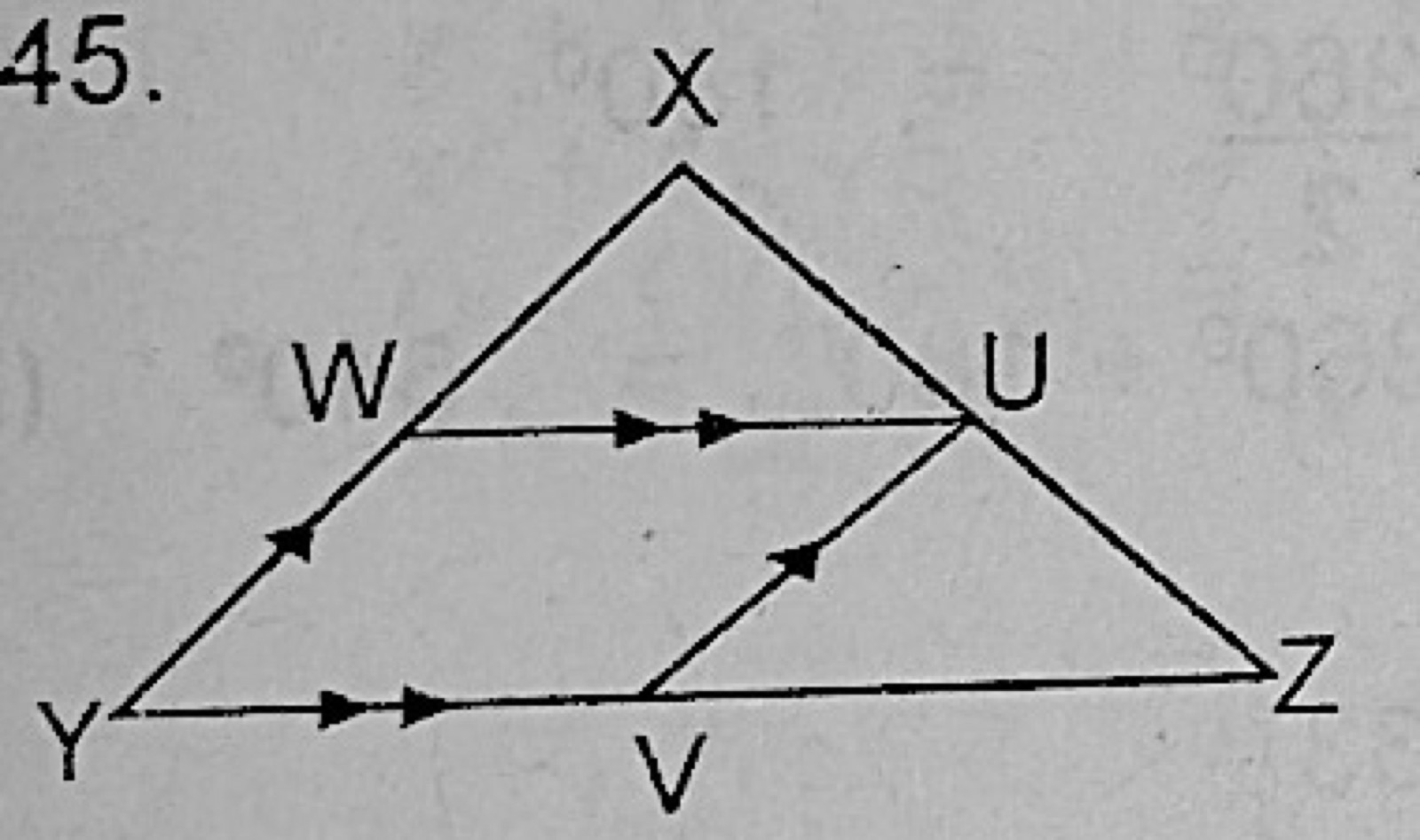
Question 45 Triangles and Quadrilaterals In the figure above WU∥YZ, WY∥VU: UZ = 12cm, VZ = 6cm, XU = 8cm. Determine the length of WU.
A. 1cm B. 3cm C. 6cm D. 2cm E. 4cm. Show the answer and explanation Answer: E (4cm. )
Explanation Triangles XWU and UVZ have parallel sides, so they are similar: WU/VZ = XU/UZ, i.e. WU/6 = 8/12, giving WU = 4cm.
Open this question
Question 46 Fractions, Decimals and Approximation Simplify 1 + 2/(3 − 4/(5 + 6 /7 ))
A. 177 /95 B. 3 /10 C. 233 /151 D. 7 /95 E. 17 /10 .Show the answer and explanation Answer: A (177 /95
Explanation Work from the bottom: 5 + 6/7 = 41/7, 4 ÷ 41/7 = 28/41, 3 − 28/41 = 95/41, 2 ÷ 95/41 = 82/95, and 1 + 82/95 = 177/95.
Open this question
Question 47 Quadratic Equations The sum of the root of a quadratic equation is 5 /2 and the product of its roots is 4. The quadratic equation is
A. 2x2 + 5x + 8 = 0 B. 2x2 − 5x + 8 = 0 C. 2x2 − 8x + 5 = 0 D. 2x2 + 8x − 5 = 0 E. 2x2 − 5x − 8 = 0. Show the answer and explanation Answer: B (2x2 − 5x + 8 = 0 )
Explanation x² − (sum)x + (product) = 0 gives x² − 5x/2 + 4 = 0, i.e. 2x² − 5x + 8 = 0.
Open this question
Question 48 Logarithms Solve the given equation (log3 x)2 − 6log3 x + 9 = 0.
A. 27 B. 9 C. 1 /27 D. 18 E. 81. Show the answer and explanation Answer: A (27 )
Explanation Put y = log₃x: y² − 6y + 9 = (y − 3)² = 0, so log₃x = 3 and x = 27.
Open this question
Question 49 Mensuration of Plane Shapes What is the length of an arc of a circle that subtends 2½ radians at the centre when the radius of the circle is 8cm?
A. 8cm B. 10cm C. 40cm D. 20cm E. 16cm. Show the answer and explanation Answer: D (20cm )
Explanation With the angle in radians, arc length = radius × angle = 8 × 2½ = 20cm.
Open this question Sign up free for every JAMB Mathematics year, practice by topic and timed mocks.
Start practising free