Home › Past questions › JAMB › Economics › 1995 48 questions. Try each one, then open the answer to check yourself and read the explanation.
Sign up free to answer these questions on a CBT screen with a timer, then see your score and every answer explained.
Start practising free
Question 1 Basic Concepts The ultimate objective of Economics is to
A. make effort to understand how the Economy works B. make the best use of scarce resources C. organize production at the lowest cost D. decide under what circumstances the government should intervene in the economy. Show the answer and explanation Answer: B (make the best use of scarce resources )
Explanation Economics exists because resources are scarce while wants are unlimited, so its final aim is to use those scarce resources in the best possible way.
Open this question
Question 3 Basic Concepts A student in Obu'pu Secondary School discovers that he simultaneously needs a biro, an exercise book, an eraser and a ruler, but that he can purchase only one of these items. What is the first thing he is expected to do?
A. Check how much money he has B. Find out which is the cheapest of the items C. Draw up a scale of preference D. Weigh the opportunity cost of each item against the others. Show the answer and explanation Answer: C (Draw up a scale of preference )
Explanation When wants compete for limited money, the first step is to rank them in order of importance in a scale of preference; he then buys the item at the top.
Open this question
Question 4 Economic Systems What to produce in any society is determined by the
A. expenditure of the people on different commodities B. competition among the different producers C. competition among the different consumers D. supply and demand in the factor markets. Show the answer and explanation Answer: A (expenditure of the people on different commodities )
Explanation Producers make what people are willing to spend their money on, so consumers' spending on different goods decides what is produced (consumer sovereignty).
Open this question
Question 5 Economic Systems The active intervention of the central authorities in the management of a country's economy rests upon the
A. failure of the market forces to produce satisfactory results B. superiority of the centrally planned economy over the private enterprise economy C. result-oriented nature of the private enterprise economy D. cost-minimization strategy of a mixed economy. Show the answer and explanation Answer: A (failure of the market forces to produce satisfactory results )
Explanation Government steps in when the price mechanism fails, for example by under-providing public goods, creating monopolies or causing unfair income distribution.
Open this question
Question 6 Population The problems of conducting census include
A. high rate of rural-urban migration B. poor geographical distribution of population C. high birth rate in the country D. poor town planning in urban areas. Show the answer and explanation Answer: D (poor town planning in urban areas. )
Explanation Census officials must locate and count every household; where towns are badly planned, with unnumbered houses and unnamed streets, people are missed or counted twice.
Open this question
Question 7 Population An ageing population is a population
A. with a high dependency ratio B. with many young people C. in which the number of old persons is increasing D. that is dominated by very old people. Show the answer and explanation Answer: C (in which the number of old persons is increasing )
Explanation A population is ageing when the number and share of old people in it keep rising over time.
Open this question
Question 8 Population The population of Ohaha L.G.A. was 480 000 in December 1980, out of which 60% were females. If within one year no births were recorded, but 5% of the males died, what will be the population of the L.G.A. in December 1981?
A. 96 000 B. 192 000 C. 288 000 D. 470 400. Show the answer and explanation Answer: D (470 400. )
Explanation Males = 40% of 480 000 = 192 000. Deaths = 5% of 192 000 = 9 600. Population = 480 000 − 9 600 = 470 400.
Open this question
Question 9 Labour Market What is meant by labour supply?
A. Number of people in working population B. Number of men and hours they work C. Number of hours during which the middle aged persons work D. Number of workforce multiplied by the hours they work. Show the answer and explanation Answer: A (Number of people in working population )
Explanation Labour supply refers to the number of people in the working population who are able and willing to work.
Open this question
Question 10 Theory of Production The advantages which firms obtain directly from expanding their operations are referred to as
A. internal economies of scale B. external economies of scale C. economies of localization D. economies of resource allocation. Show the answer and explanation Answer: A (internal economies of scale )
Explanation Internal economies of scale are cost savings a firm gets from its own growth, such as bulk buying or better machines.
Open this question
Question 11 Theory of Production The factor of production that has the highest degree of mobility is
A. land B. labour C. capital D. entrepreneurship. Show the answer and explanation Answer: B (labour )
Explanation Labour can move from place to place and from one job to another, so it is usually treated as the most mobile factor; land cannot move at all.
Open this question
Question 12 Labour Market Any payment to a factor of production in excess of what is necessary to keep that factor in its present employment is known as
A. real income B. profit C. economic rent D. real wage. Show the answer and explanation Answer: C (economic rent )
Explanation Economic rent is the surplus a factor earns above its transfer earnings, the minimum needed to keep it in its present use.
Open this question
Question 13 Theory of Production No. of workers | Total output (Units)
A. 23 and 20 B. 22 and 19 C. 14 and 19 D. 11 and 20. Show the answer and explanation Answer: B (22 and 19 )
Explanation Marginal product of the 2nd worker = 46 − 24 = 22. Average product with 5 workers = 95 ÷ 5 = 19.
Open this question
Question 14 Theory of Costs and Revenue Given that TC = TFC + TVC and TR = AR x Q, profit is equal to
A. (AR + Q) − TFC B. (TFC + TVC)/Q C. (AR x Q) − TC D. (TC x Q)/AR Show the answer and explanation Answer: C ((AR x Q) − TC )
Explanation Profit = total revenue − total cost, and total revenue = AR × Q, so profit = (AR × Q) − TC.
Open this question
Question 15 Theory of Costs and Revenue The opportunity cost of the use of productive resources which a producer owns and so does not pay for constitutes
A. a fixed cost B. an implicit cost C. a variable cost D. a prime cost. Show the answer and explanation Answer: B (an implicit cost )
Explanation Implicit costs are the earnings a producer gives up by using his own resources (such as his own building or time) instead of hiring them out.
Open this question
Question 16 Theory of Demand The effect of changes in the condition of demand on a demand schedule with the price constant is a
A. movement along the demand curve B. deflation of the demand curve C. hyperbola formation by the demand curve D. shift of the demand curve. Show the answer and explanation Answer: D (shift of the demand curve. )
Explanation A change in anything other than the good's own price (income, tastes, other prices) changes demand at every price, so the whole curve shifts.
Open this question
Question 17 Price Determination Which of the following statements is TRUE of the effect of changes in demand and supply on price?
A. A decrease in supply will lead to a fall in price and a fall in the quantity bought and sold B. An increase in demand will lead to a fall in price and in the quantity bought and sold C. A decrease in demand will lead to a rise in price and in the quantity bought and sold D. An increase in supply will lead to a fall in price and a rise in the quantity bought and sold. Show the answer and explanation Answer: D (An increase in supply will lead to a fall in price and a rise in the quantity bought and sold. )
Explanation When supply increases the supply curve shifts right, so the equilibrium price falls and a larger quantity is bought and sold.
Open this question
Question 18 Economic Systems In a free market economy, available resources are more efficiently allocated by complete reliance on
A. development planning B. strategic planning C. capital budgeting D. price system. Show the answer and explanation Answer: D (price system. )
Explanation A free market economy relies on the price system: prices signal what people want and guide resources to those uses.
Open this question
Question 19 Elasticity In order to maximize his profit, a businessman who faces a very elastic demand for his products is advised to
A. slightly increase the price of his products B. slightly reduce the price of his products C. leave his prices unchanged D. discriminate his prices. Show the answer and explanation Answer: B (slightly reduce the price of his products )
Explanation With elastic demand, a small price cut raises quantity sold by a bigger percentage, so total revenue rises.
Open this question
Question 20 Elasticity What is the elasticity of demand for commodity X, if at a price of ₦25 the quantity demanded is 80 and when the price is reduced to ₦20 the quantity demanded is 100?
A. 1.25 B. 1.45 C. 0.25 D. 0.15 Show the answer and explanation Answer: A (1.25 )
Explanation % change in quantity = 20/80 × 100 = 25%. % change in price = 5/25 × 100 = 20%. Elasticity = 25 ÷ 20 = 1.25.
Open this question
Question 21 Tools of Economic Analysis If y represents the income earned by workers in a factory, find the range of their income which satisfies the following inequality: 4Y − 300 > 500.
A. y > 300 B. y > 250 C. y > 200 D. y > 150. Show the answer and explanation Answer: C (y > 200 )
Explanation 4Y − 300 > 500 gives 4Y > 800, so Y > 200.
Open this question
Question 22 Market Structures Both in the short run and in the long run, a firm maximizes its profits when
A. MC = MR B. AC = MC C. AVC = AC D. MC = AVC. Show the answer and explanation Answer: A (MC = MR )
Explanation Profit is greatest at the output where the cost of one more unit (MC) equals the revenue it brings (MR); this rule holds in both periods.
Open this question
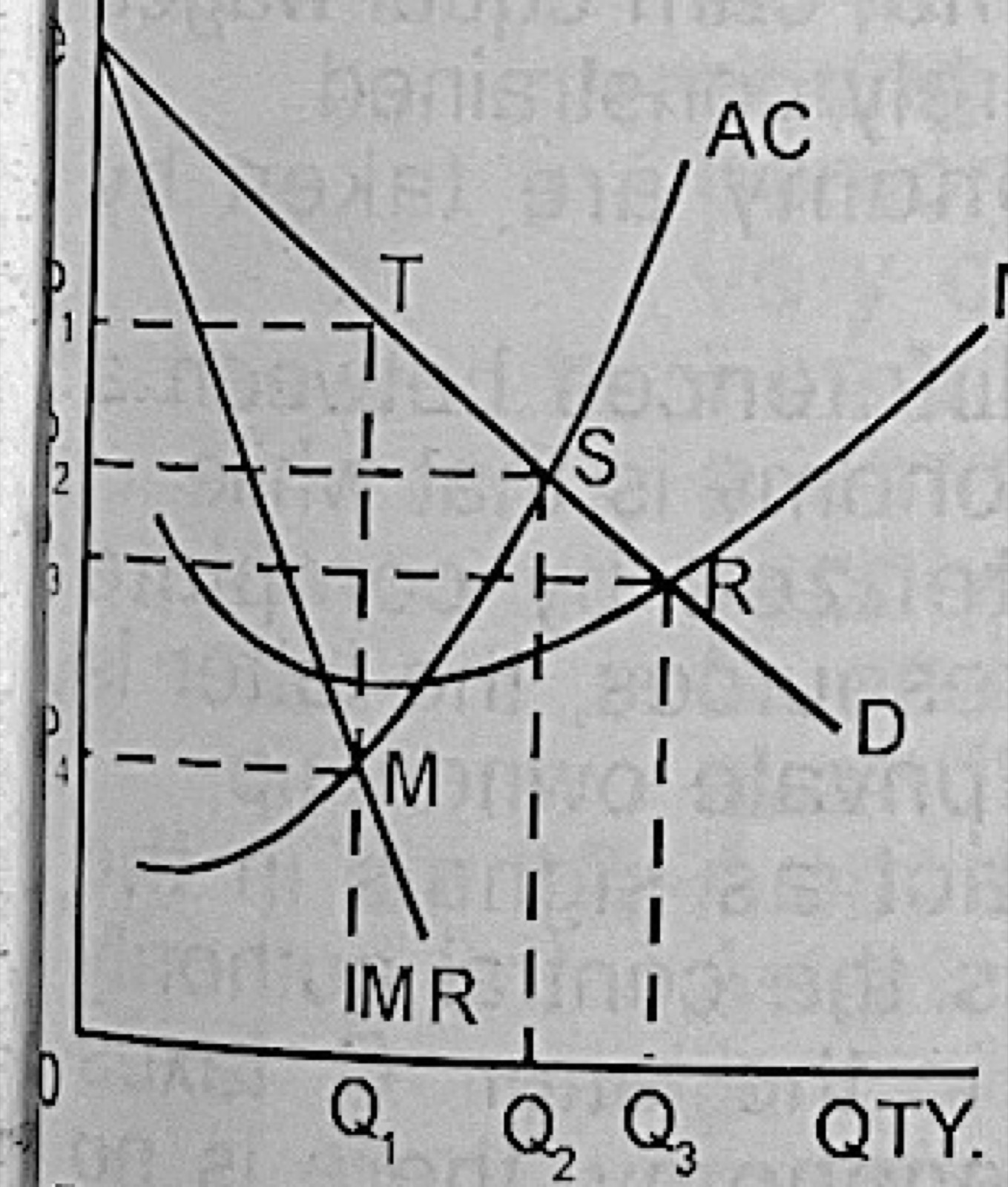
Question 23 Market Structures In the diagram above, the total revenue of the monopolist is given by the area
A. OQ1 MP4 B. P4 MTP1 C. OQ1 TP1 D. OQ2 SP2 . Show the answer and explanation Answer: C (OQ1 TP1 )
Explanation The monopolist produces Q1 , where MR = MC (point M), and charges the price read off the demand curve at T, which is P1 . Total revenue = price × quantity = area OQ1 TP1 .
Open this question
Question 24 Distributive Trade Stocking small quantities of a variety of goods is a function of the
A. manufacturer B. wholesaler C. retailer D. consumer. Show the answer and explanation Answer: C (retailer )
Explanation The retailer buys small amounts of many different goods so that consumers can find what they need in one shop.
Open this question
Question 25 Business Organisations In a joint stock company, preference shareholders are those who receive
A. high dividends when profits are high and little or nothing when profits are low B. a fixed rate of dividend and have the first claim on the net profits of the company C. the remaining profits after all other shareholders have been paid D. dividends quarterly when others receive annually. Show the answer and explanation Answer: B (a fixed rate of dividend and have the first claim on the net profits of the company )
Explanation Preference shares carry a fixed rate of dividend, paid before ordinary shareholders receive anything.
Open this question
Question 26 Business Organisations The major reason for the survival of small shops despite competition from large business enterprises is because of
A. the small capital outlay involved B. regularity and constant supply of commodities by them C. their local services and longer hours of operation D. their level of managerial competence. Show the answer and explanation Answer: C (their local services and longer hours of operation )
Explanation Small shops survive because they are close to customers, open long hours, give credit and personal service that big stores cannot match.
Open this question
Question 27 Business Organisations One of the major advantages of public enterprises is that
A. they are highly subsidized B. they are the largest employers of labour C. their operations are highly standardized D. they take prompt decisions and actions. Show the answer and explanation Answer: A (they are highly subsidized )
Explanation Public enterprises receive government subsidies, so they can supply essential services at prices people can afford.
Open this question
Question 28 Business Organisations When public enterprises become commercialized, it means that
A. the products of the enterprises are further subsidized B. they are expected to operate with the primary aim of making profits C. the government has decided to divest itself of such enterprises D. the staff of the enterprises will be laid off. Show the answer and explanation Answer: B (they are expected to operate with the primary aim of making profits )
Explanation Commercialization keeps the enterprise in government hands but requires it to run like a business and cover its costs or make profit.
Open this question
Question 29 Agriculture Which of the following statements are TRUE of agriculture in Nigeria?
A. I and II only B. I, II and III only C. I, III and IV only D. II and III only. Show the answer and explanation Answer: B (I, II and III only )
Explanation Agriculture feeds the population, employs most workers and supplies raw materials to industry; it does not supply heavy equipment.
Open this question
Question 30 Agriculture In recent times, agriculture in Nigeria tends to lose its vital labour force as a result of
A. lack of an effective agricultural policy B. employment opportunities in the oil sector C. rural-urban drift D. low prices of agricultural products. Show the answer and explanation Answer: C (rural-urban drift )
Explanation Young people leave the villages for towns in search of jobs and amenities, taking labour away from farms.
Open this question
Question 31 Agriculture The government can influence the prices of agricultural products by
A. fixing minimum prices when agricultural output is low B. fixing maximum prices in years of bumper harvests C. the use of buffer stock and stabilization funds D. paying all farmers producing identical crops a uniform amount of money. Show the answer and explanation Answer: C (the use of buffer stock and stabilization funds )
Explanation Under a buffer stock scheme, the government buys produce when harvests are big and sells it when they are poor, keeping prices steady.
Open this question
Question 32 Industrialisation The crucial factors which determine the location of petroleum refineries in Nigeria are availability of raw materials and
A. capital B. political consideration C. nearness to source of power D. labour. Show the answer and explanation Answer: B (political consideration )
Explanation Besides nearness to crude oil, the siting of Nigeria's refineries (for example Kaduna, far from the oil fields) was strongly influenced by political considerations.
Open this question
Question 33 Industrialisation Infant industries denote industries which
A. are introducing new products B. are too young to compete in the world market C. produce baby food and mother care products D. are allowed time enough to mature for recognition. Show the answer and explanation Answer: B (are too young to compete in the world market )
Explanation An infant industry is a newly established industry that cannot yet compete with older foreign firms, which is why it is often protected.
Open this question
Question 34 Theory of Production When compared with a labour-intensive industry, a capital-intensive industry employs more
A. workers than capital B. workers than machinery C. raw materials than capital D. machinery than workers. Show the answer and explanation Answer: D (machinery than workers. )
Explanation A capital-intensive industry uses a high proportion of machines relative to workers.
Open this question
Question 35 Natural Resources and Petroleum The major source of Nigeria's foreign exchange is the export of
A. skilled manpower B. palm kernel and cocoa C. crude oil D. groundnuts and cotton. Show the answer and explanation Answer: C (crude oil )
Explanation Since the 1970s crude oil has earned over 90% of Nigeria's export income.
Open this question
Question 36 Natural Resources and Petroleum The most important goal of OPEC is to
A. present a united front for the purpose of raising prices of crude oil B. bring unity among the petroleum exporting states C. ensure political stability among member states D. ensure that rules on quota production are strictly followed. Show the answer and explanation Answer: A (present a united front for the purpose of raising prices of crude oil )
Explanation OPEC was formed so that oil-exporting countries could act together and secure better, stable prices for their crude oil. Production quotas are a tool for reaching that goal, not the goal itself.
Open this question
Question 37 Financial Institutions The Central Bank's expansionary monetary policy is justified at a period
A. when the inflation rate is high and the economy is experiencing a boom B. of economic depression accompanied by low capacity utilization C. when trade unions are clamouring for higher wages D. when the price of crude petroleum is rising. Show the answer and explanation Answer: B (of economic depression accompanied by low capacity utilization )
Explanation Increasing money supply and lowering interest rates is meant to revive spending when the economy is depressed and factories are idle.
Open this question
Question 38 Money and Inflation The sharp increases in the prices of most goods and services during the last quarter of 1994 in Nigeria were mainly due to
A. ban on importation of foreign goods B. population upsurge C. the introduction of value-added tax D. increase in transport costs. Show the answer and explanation Answer: C (the introduction of value-added tax )
Explanation Value-added tax was introduced in Nigeria in 1994; as a tax on goods and services it pushed up their prices.
Open this question
Question 39 Money and Inflation The best method to curb inflation in Nigeria is to
A. reduce importation of commodities B. increase the general level of production C. reduce the volume of money supply D. set up price control boards. Show the answer and explanation Answer: B (increase the general level of production )
Explanation Nigeria's inflation is largely caused by shortage of goods, so raising domestic output is the lasting cure.
Open this question
Question 40 Financial Institutions A bank is said to be distressed when it
A. is unable to deal with the Central Bank B. has a low capital base C. has low level of deposits D. experiences serious liquidity crisis. Show the answer and explanation Answer: D (experiences serious liquidity crisis. )
Explanation A distressed bank cannot meet customers' withdrawals and other obligations because it has run short of liquid funds.
Open this question
Question 41 Financial Institutions One method through which the Central Bank can restrict the commercial banks' power of credit expansion is to
A. demand for increased special deposits B. decrease the cash ratio C. buy securities in the open market D. reduce the rate of interests at which banks borrow from it. Show the answer and explanation Answer: A (demand for increased special deposits )
Explanation Special deposits lock part of the banks' cash at the Central Bank, leaving less for lending. The other options expand credit.
Open this question
Question 42 Public Finance Which of the following is cheapest for the government in improving the welfare of its citizens?
A. Subsidy B. Income supplement C. Donation to specific projects D. Wages increase. Show the answer and explanation Answer: B (Income supplement )
Explanation An income supplement is paid only to those in need, so it costs less than subsidies or general wage increases that go to everyone.
Open this question
Question 43 Money and Inflation Which of the following is mostly used to determine the cost of living?
A. Marginal changes in prices B. Consumer price index C. Prices of imported and exported commodities D. Producer price index. Show the answer and explanation Answer: B (Consumer price index )
Explanation The consumer price index measures changes in the prices of the goods and services households normally buy.
Open this question
Question 45 Public Finance A government imposes an indirect tax on a good characterized by zero price elasticity of demand. The tax imposed is borne
A. totally by the consumer B. totally by the producer C. equally by both the consumer and the producer D. by the government. Show the answer and explanation Answer: A (totally by the consumer )
Explanation When demand is perfectly inelastic, buyers purchase the same quantity at any price, so the seller can pass the whole tax on to consumers.
Open this question
Question 46 National Income Ajanka, a medical student entitled to an annual allowance of ₦6,000, decides to leave the university to take up a job where he earns ₦7,000 per annum. By this singular act, the national-income level will
A. increase by ₦1,000 B. decrease by ₦7,000 C. increase by ₦7,000 D. increase by ₦13,000. Show the answer and explanation Answer: C (increase by ₦7,000 )
Explanation A student allowance is a transfer payment and is not counted in national income, but his ₦7,000 wage is payment for work, so national income rises by ₦7,000.
Open this question
Question 47 Population An increasing population might be of economic benefit to a country if
A. the female population is greater than the male population B. the dependency ratio is increasing as the total population increases C. a continuously higher proportion falls into the working class category D. the rural and urban proportion are balanced. Show the answer and explanation Answer: C (a continuously higher proportion falls into the working class category )
Explanation Population growth helps when more of the extra people are of working age, producing more output and supporting fewer dependants.
Open this question
Question 48 Economic Growth and Development The demands made on each other by the agricultural and industrial sectors as the economy grows are reflected in
A. backward and forward linkages B. horizontal and vertical linkages C. vertical linkages D. functional linkages. Show the answer and explanation Answer: A (backward and forward linkages )
Explanation Industry buys raw materials from agriculture (backward linkage) and sells inputs such as fertilizer and machines to it (forward linkage).
Open this question
Question 49 Balance of Payments and Exchange Rates Foreign exchange rate in a free market economy is determined by
A. the government B. the Central Bank C. demand and supply D. commercial banks. Show the answer and explanation Answer: C (demand and supply )
Explanation Under a free (floating) system the exchange rate is set by the demand for and supply of the currency.
Open this question
Question 50 International Economic Organisations The primary objective of all international economic organizations is to
A. ensure that third world countries get a better share of the world's resources B. promote international economic co-operation for the mutual benefit of all members C. enforce structural adjustment programmes on less developed countries D. encourage exports from the developed to the less developed countries. Show the answer and explanation Answer: B (promote international economic co-operation for the mutual benefit of all members )
Explanation Bodies such as the IMF, World Bank and ECOWAS exist to promote economic co-operation that benefits all their members.
Open this question Sign up free for every JAMB Economics year, practice by topic and timed mocks.
Start practising free