Bubbling of CO2 into Ca(OH)2(aq) a white precipitate is formed. In the presence of carbon dioxide (in excess) the white precipitate disappears. The reason for this is
A.calcium hydrogen carbonate is precipitated and then dissolve
B.calcium carbonate is formed which on reaction dissolves
C.concentration of the solution has occurred with the deposition of calcium hydroxide
D.calcium carbonate is formed which on reaction with further carbondioxide forms soluble calcium hydrogen carbonate
Show the answer and explanation
Answer: D (calcium carbonate is formed which on reaction with further carbondioxide forms soluble calcium hydrogen carbonate)
Explanation
CO2 first gives insoluble CaCO3 (milky); excess CO2 and water turn it into soluble Ca(HCO3)2, so the precipitate clears.
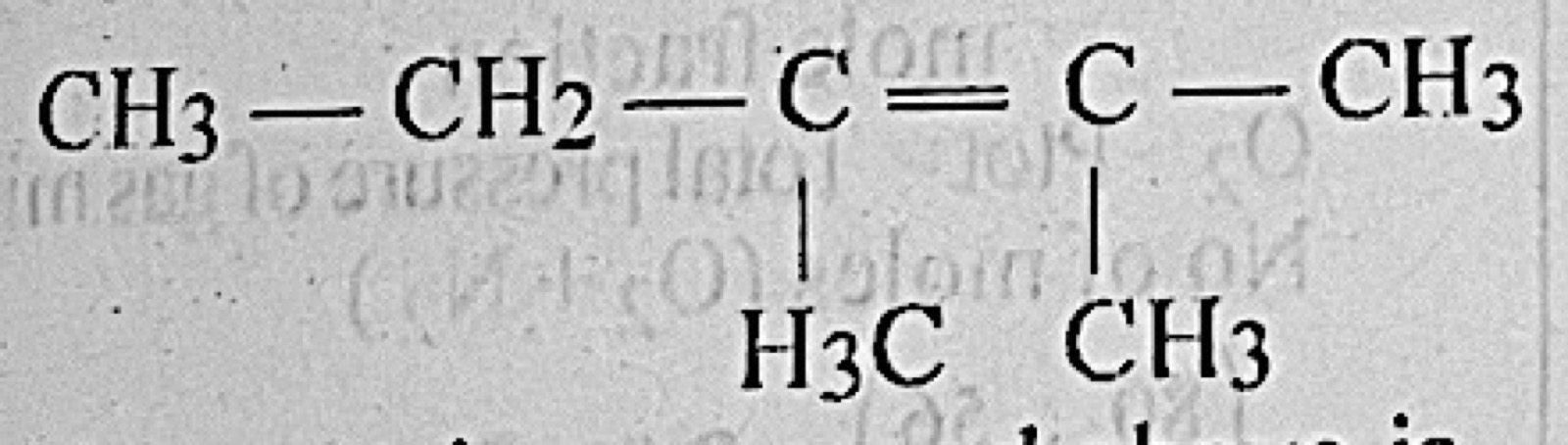
The longest chain has 5 carbons. Numbering from the end nearer the double bond puts the C=C at carbon 2 and the methyl groups on carbons 2 and 3: 2,3-dimethylpent-2-ene.
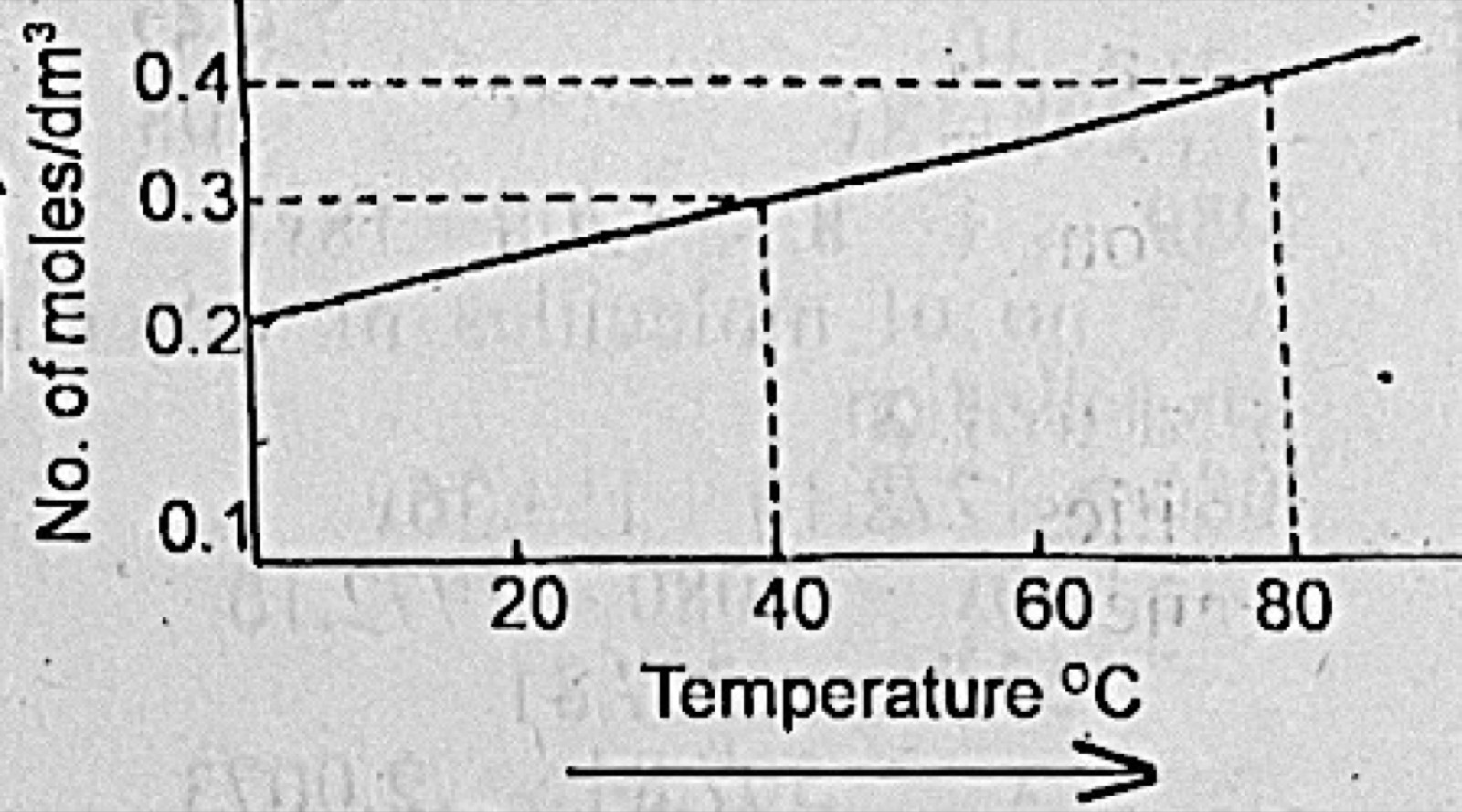
The solubility graph of a solid Y (molecular mass=160) as shown below. 1000cm3 of a saturated solution of Y at 80°C is cooled to 40°C. The weight of Y crystalized out would be
A.12g
B.16g
C.18g
D.14g
Show the answer and explanation
Answer: B (16g)
Explanation
From the graph, solubility is 0.4 mol/dm3 at 80 °C and 0.3 mol/dm3 at 40 °C. 0.1 mol crystallises: 0.1 × 160 = 16 g.
CuSO4(aq) is electrolyzed using platinum electrodes with a current of 0.193 amperes for 2 hours. How many grams of copper are deposited at the cathode? [Cu= 63.5 F=96500 coulombs]
A.0.500g
B.0.457g
C.0.914g
D.1.000g
Show the answer and explanation
Answer: B (0.457g)
Explanation
Q = It = 0.193 × 7200 = 1389.6 C. Cu2+ needs 2 × 96500 C per mole, so mass = 1389.6/193000 × 63.5 ≈ 0.457 g.
The total pressure of mixture of 80.0g of oxygen gas and 56.0g of nitrogen gas is 1.8 atm. Calculate the partial pressure of oxygen gas in the mixture [O=16, N=14]
A.1.0 atm
B.0.8 atm
C.1.4 atm
D.1.2 atm
Show the answer and explanation
Answer: A (1.0 atm)
Explanation
O2: 80/32 = 2.5 mol; N2: 56/28 = 2 mol. Mole fraction of O2 = 2.5/4.5, so p = 2.5/4.5 × 1.8 = 1.0 atm.
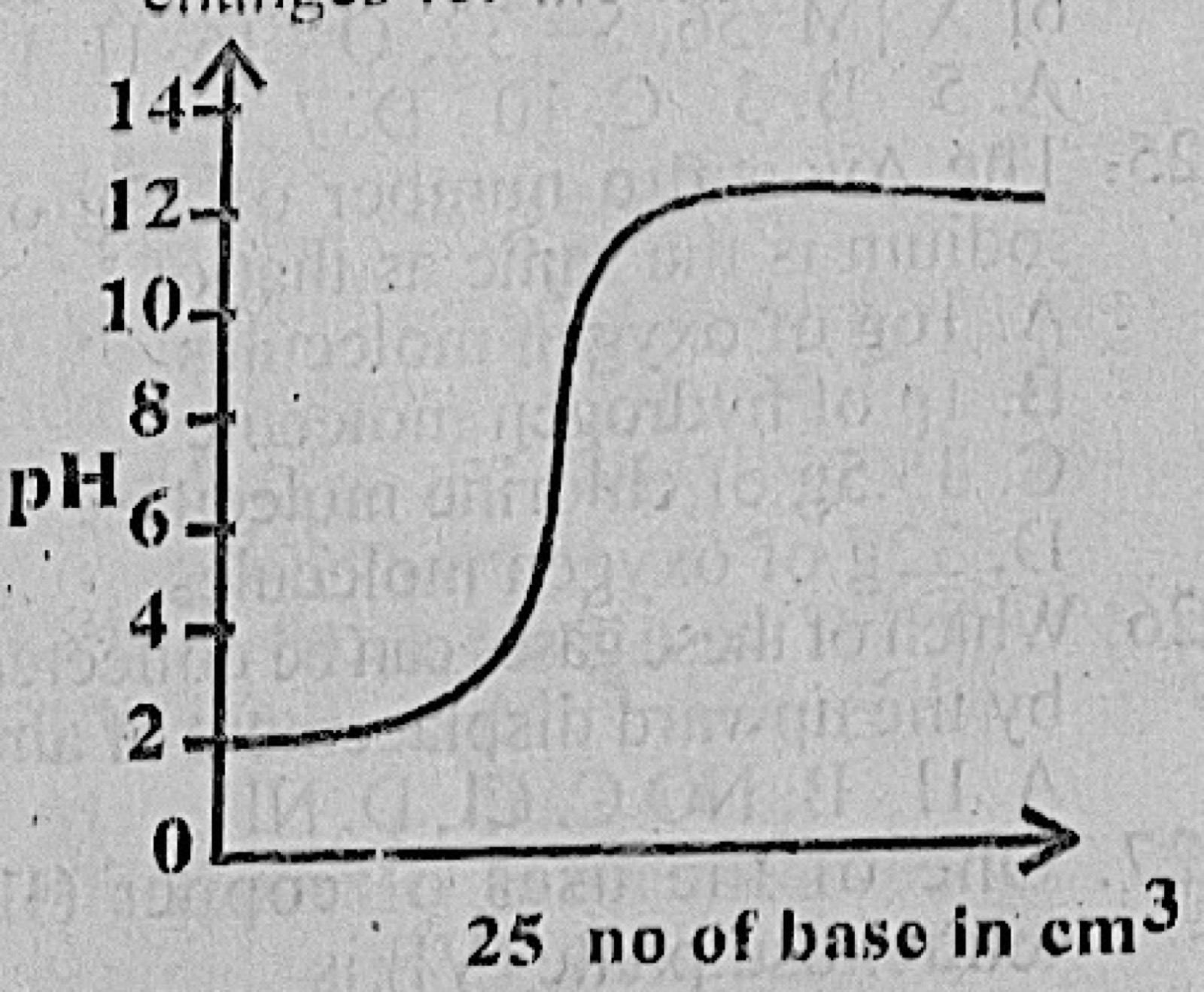
The graph below illustrates the pH changes for the titration of a
A.weak acid versus strong base
B.strong acid versus strong base
C.weak acid versus weak base
D.strong acid versus weak base
Show the answer and explanation
Answer: B (strong acid versus strong base)
Explanation
The pH starts low (about 2), ends high (about 12) and jumps steeply around 7 at the end point, which is typical of a strong acid against a strong base.