Home › Past questions › JAMB › Chemistry › 2007 46 questions. Try each one, then open the answer to check yourself and read the explanation.
Sign up free to answer these questions on a CBT screen with a timer, then see your score and every answer explained.
Start practising free
Question 1 Sulphur and its Compounds An element used in the production of matches is
A. nitrogen B. aluminium C. copper D. sulphur. Show the answer and explanation Answer: D (sulphur. )
Explanation Match heads contain sulphur (with an oxidising agent such as potassium chlorate), which catches fire easily when struck.
Open this question
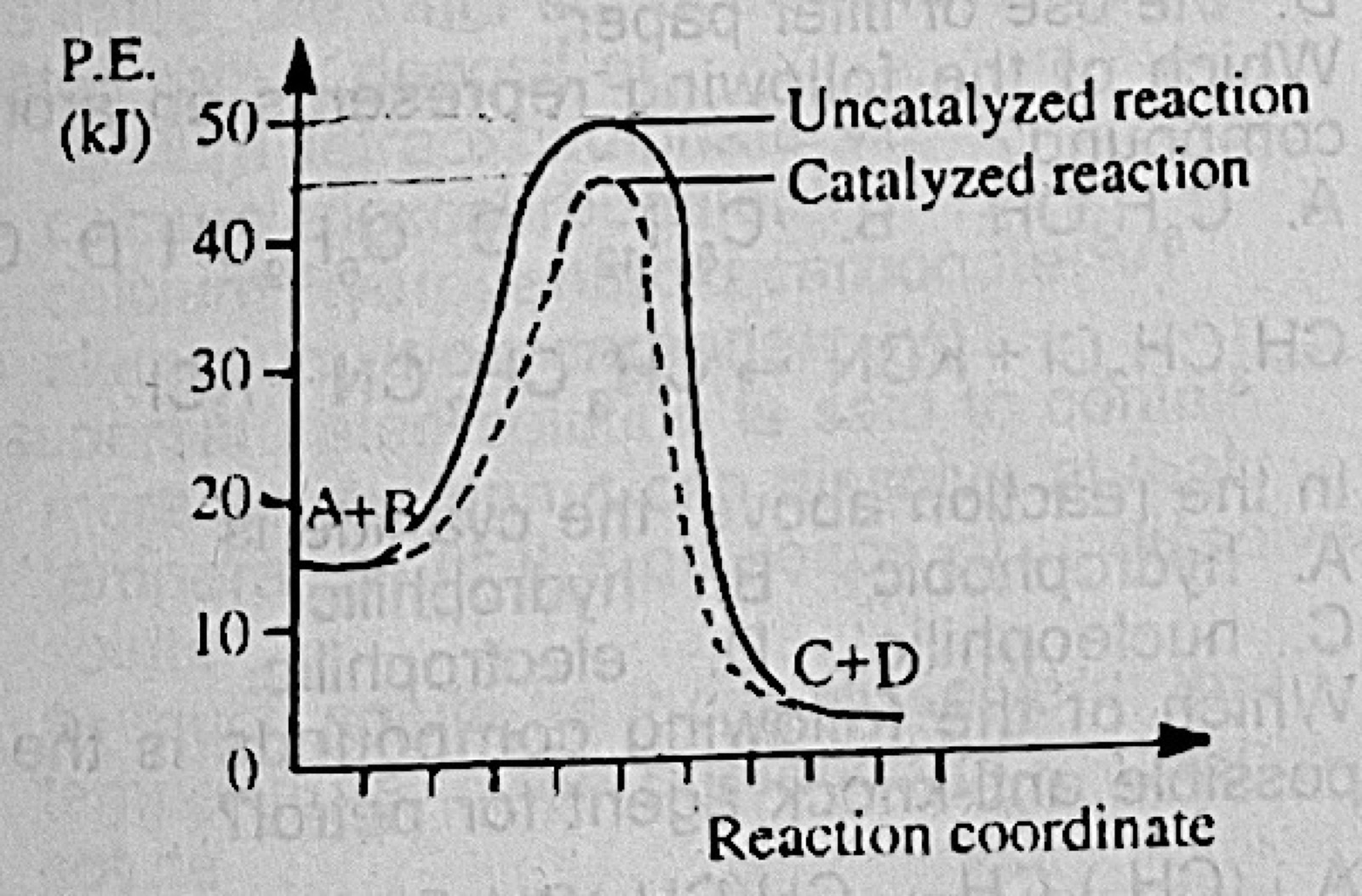
Question 2 Rates of Reaction In the diagram above, the respective activation energies for the catalyzed and uncatalyzed reactions in kJ are
A. 45 and 50 B. 50 and 45 C. 30 and 35 D. 40 and 45. Show the answer and explanation Answer: C (30 and 35 )
Explanation Activation energy = peak energy − energy of reactants. Reactants A + B are at 15 kJ; the catalysed peak is 45 kJ (45 − 15 = 30) and the uncatalysed peak is 50 kJ (50 − 15 = 35).
Open this question
Question 3 Carbon and its Compounds When calcium oxide is heated with carbon, the oxide will
A. be converted to the carbide B. be converted to the trioxocarbonate(IV) salt C. decompose to the metal D. melt, producing carbon(IV) oxide. Show the answer and explanation Answer: A (be converted to the carbide )
Explanation In an electric furnace CaO + 3C → CaC2 + CO; calcium carbide is formed (it is later used to make ethyne).
Open this question
Question 4 Qualitative Analysis A solution which on treatment with hydrochloric acid produces a colourless, odourless gas which turns lime water milky is most likely to be a
A. trioxonitrate(V) B. chloride C. trioxocarbonate(IV) D. hydroxide. Show the answer and explanation Answer: C (trioxocarbonate(IV) )
Explanation Acids react with trioxocarbonates(IV) (carbonates) to release CO2 , a colourless, odourless gas that turns lime water milky.
Open this question
Question 5 Metals and their Compounds The soft solder used for welding and plumbing is an alloy of
A. lead and tin B. iron and tin C. lead and zinc D. iron and zinc. Show the answer and explanation Answer: A (lead and tin )
Explanation Soft solder is mainly lead and tin; the alloy melts at a low temperature, which makes it good for joining metals.
Open this question
Question 6 Metals and their Compounds The reddish-brown rust on iron roofing sheets consists of
A. Fe3+ (H2 O)6 B. FeO.H2 O C. Fe2 O3 .3H2 O D. Fe3 O4 .2H2 O. Show the answer and explanation Answer: C (Fe2 O3 .3H2 O )
Explanation Rust is hydrated iron(III) oxide, Fe2 O3 .xH2 O, usually written Fe2 O3 .3H2 O.
Open this question
Question 7 Rates of Reaction Na2 S2 O3(aq) + 2HCl(aq) → 2NaCl(aq) + H2 O(l) + SO2(g) + S(s)
A. An increase in temperature and a decrease in the concentration of the reactants. B. A decrease in volume and an increase in the pressure of the reactants. C. A decrease in temperature and an increase in the concentration of the reactants. D. An increase in temperature and an increase in the concentration of the reactants. Show the answer and explanation Answer: D (An increase in temperature and an increase in the concentration of the reactants. )
Explanation Raising the temperature and the concentration both make collisions more frequent and more energetic, so together they give the greatest increase in rate. Pressure has little effect because the reactants are in solution.
Open this question
Question 8 Halogens The tincture of iodine means iodine dissolved in
A. ethanol B. bromine chloride C. chlorine water D. water. Show the answer and explanation Answer: A (ethanol )
Explanation A tincture is a solution in alcohol; tincture of iodine is iodine dissolved in ethanol, used as an antiseptic.
Open this question
Question 9 Chemical Equilibrium Cu2+ (aq) + 4NH3(g) ⇌ [Cu (NH3 )4 ]2+ (aq) 2+ (aq) as CuS(s) ?
A. NH3(g) concentration will decrease. B. More NH3(g) will be generated. C. The equilibrium will shift to the right. D. There will be no effect. Show the answer and explanation Answer: B (More NH3(g) will be generated. )
Explanation By Le Chatelier's principle, removing a reactant (Cu2+ ) makes the equilibrium shift to the left to replace it, so the complex breaks up and more NH3 is produced.
Open this question
Question 10 Metals and their Compounds Copper and silver metals are commonly used as coins because they are
A. easily reduced B. not easily reduced C. easily oxidized D. not easily oxidized. Show the answer and explanation Answer: D (not easily oxidized. )
Explanation Copper and silver are low in the activity series, so they do not easily react with air and water (are not easily oxidised) and coins stay intact.
Open this question
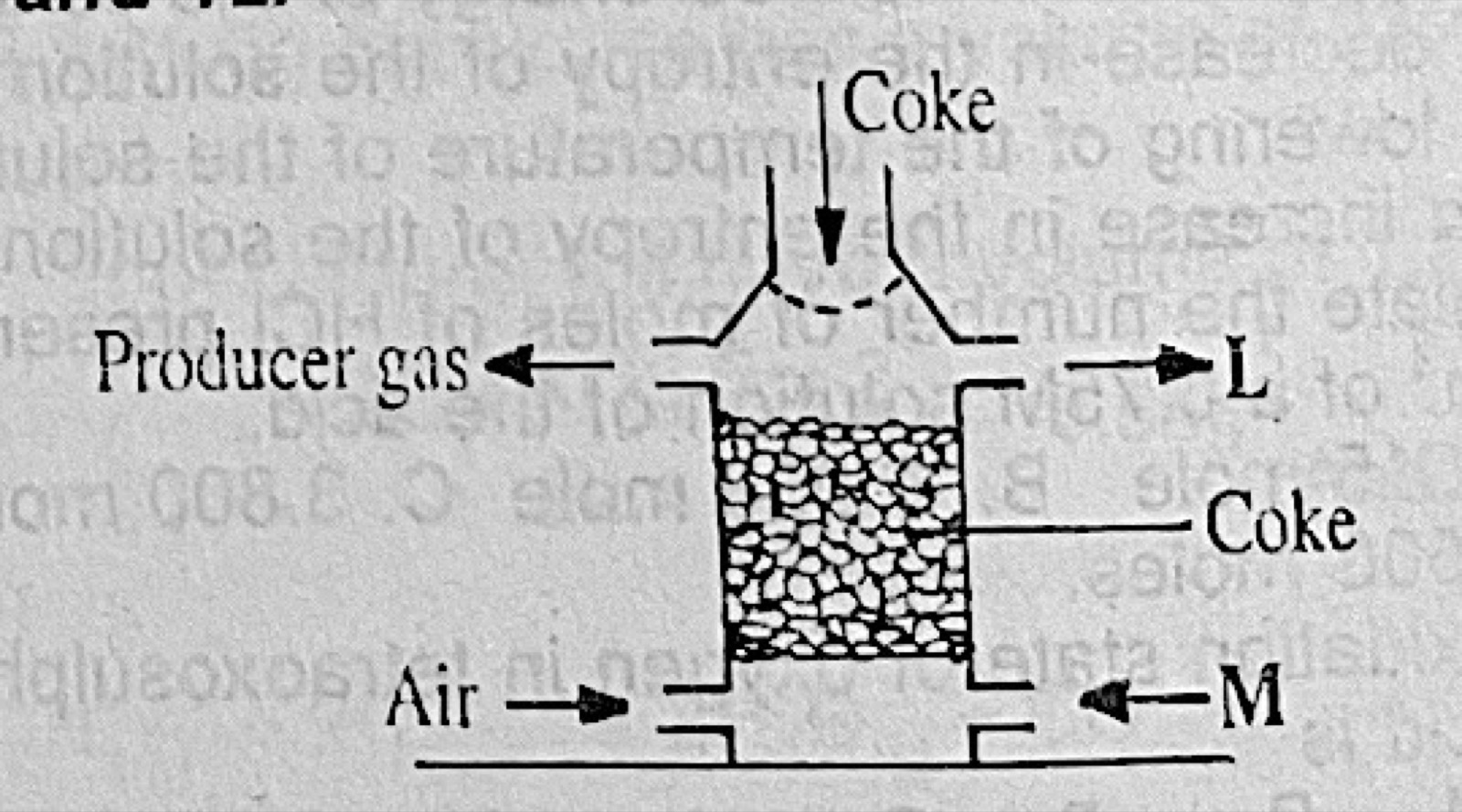
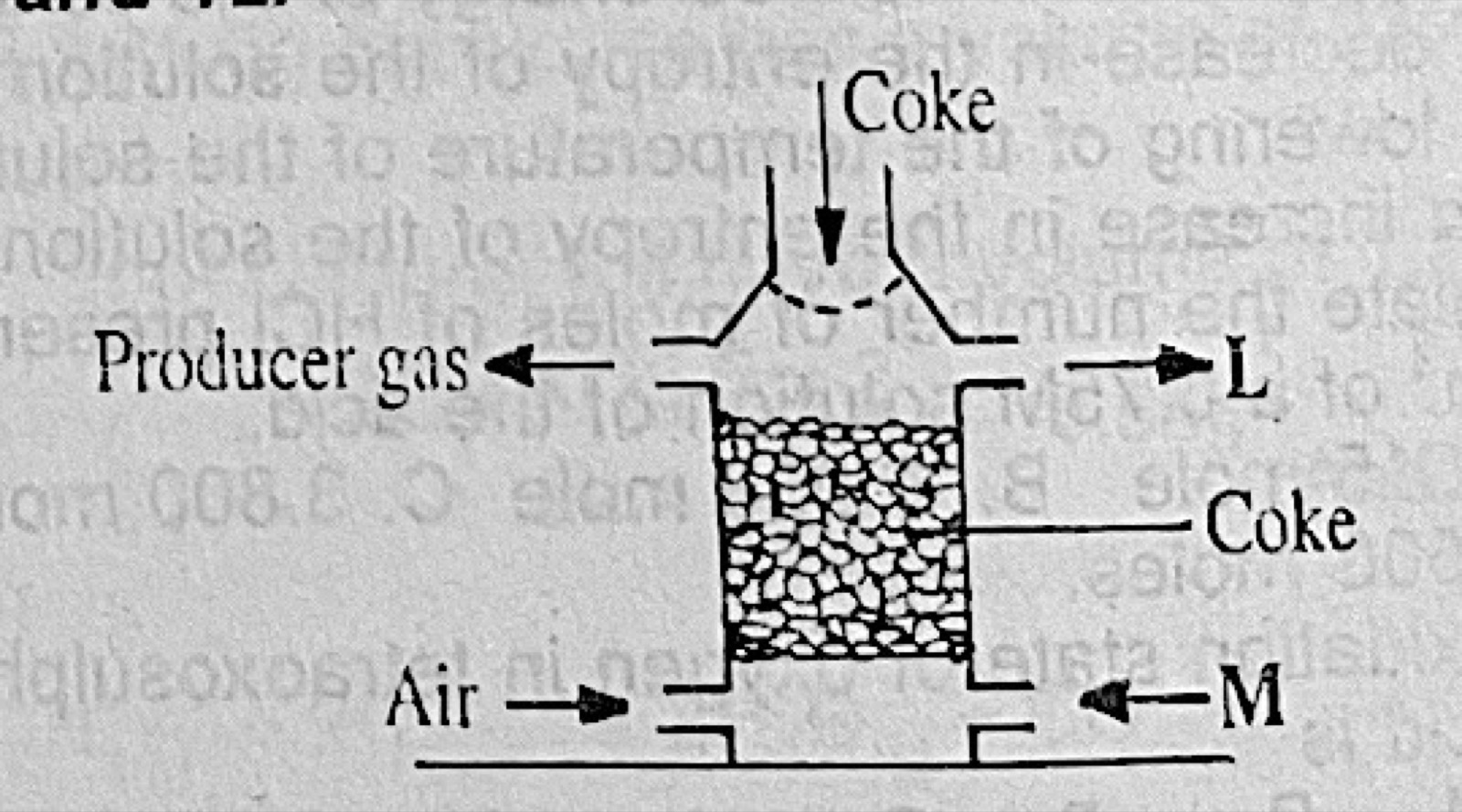
Question 11 Carbon and its Compounds Use the diagram below to answer questions 11 and 12.L is
A. water gas B. hydrogen C. nitrogen D. carbon(IV) oxide. Show the answer and explanation Answer: A (water gas )
Explanation When air is blown over hot coke, producer gas forms; when steam (M) is blown over hot coke, water gas (CO + H2 ) is formed and leaves as L.
Open this question
Question 12 Carbon and its Compounds Use the diagram below to answer questions 11 and 12.M is
A. carbon B. steam C. oxygen D. natural gas. Show the answer and explanation Answer: B (steam )
Explanation Steam passed over red-hot coke gives water gas: C + H2 O → CO + H2 . So M is steam.
Open this question
Question 13 Metals and their Compounds Which of the following sets of metals dissolves in dilute HCl?
A. Fe, Sn and Cu B. Mg, Fe and Cu C. Mg, Sn and Fe D. Cu, Mg and Sn. Show the answer and explanation Answer: C (Mg, Sn and Fe )
Explanation Metals above hydrogen in the activity series (Mg, Fe, Sn) displace hydrogen from dilute acid. Copper is below hydrogen, so any set with Cu is wrong.
Open this question
Question 15 Chemical Equilibrium H3 PO4(aq) + H2 O(l) ⇌ H2 PO4 − (aq) + H3 O+ (aq) ΔH = −13kJ at 298K
A. slow down the reverse reaction B. have no effect on the reaction C. favour the reverse reaction D. favour the forward reaction. Show the answer and explanation Answer: C (favour the reverse reaction )
Explanation The forward reaction is exothermic (ΔH negative), so heating favours the endothermic reverse reaction.
Open this question
Question 16 Electrolysis The reaction that takes place in a Daniell cell is
A. direct combination B. redox C. double decomposition D. neutralization. Show the answer and explanation Answer: B (redox )
Explanation In a Daniell cell zinc is oxidised (Zn → Zn2+ + 2e− ) while Cu2+ is reduced to copper, so the cell reaction is a redox reaction.
Open this question
Question 17 Redox Reactions What happens when zinc rod is immersed in copper(II) tetraoxosulphate(VI) solution?
A. The blue colour of the solution disappears. B. Electrons flow from copper to zinc. C. The zinc rod remains undissolved. D. The copper generates more copper ions. Show the answer and explanation Answer: A (The blue colour of the solution disappears. )
Explanation Zinc displaces copper: Zn + Cu2+ → Zn2+ + Cu. As the blue Cu2+ ions are used up the solution loses its blue colour.
Open this question
Question 18 Energy Changes C2 H4(g) + H2(g) → C2 H6(g) ΔH = −137kJ mol−1
A. exothermic B. spontaneous C. endothermic D. in equilibrium. Show the answer and explanation Answer: A (exothermic )
Explanation A negative ΔH means heat is given out, so the reaction is exothermic.
Open this question
Question 19 Electrolysis How long would it take to deposit 0.08g of copper from CuCl2 solution by passing a current of 0.5A? [Cu = 64, F = 96500 C mol−1 ]
A. 6 mins. B. 8 mins. C. 24 mins. D. 48 mins. Show the answer and explanation Answer: B (8 mins. )
Explanation Cu2+ + 2e− → Cu, so 64 g needs 2 × 96500 C. 0.08 g needs 0.08 × 193000/64 = 241.25 C. Time = 241.25 ÷ 0.5 = 482.5 s ≈ 8 minutes.
Open this question
Question 20 Acids, Bases and Salts Tartaric acid is used industrially to
A. make baking powder B. make fruit juices C. remove rust D. dry substances. Show the answer and explanation Answer: A (make baking powder )
Explanation Baking powder is a mixture of sodium hydrogencarbonate and tartaric acid; when wet, they react to give CO2 , which makes dough rise.
Open this question
Question 21 Acids, Bases and Salts The salt formed from a strong acid and a strong base is
A. complex B. neutral C. basic D. acidic. Show the answer and explanation Answer: B (neutral )
Explanation Neither ion of such a salt (e.g. NaCl) reacts with water, so its solution has pH 7: it is neutral.
Open this question
Question 22 Energy Changes Dissolving some pellets of NaOH in water would result in
A. a decrease in the free energy of the solution B. a decrease in the entropy of the solution C. a lowering of the temperature of the solution D. an increase in the entropy of the solution. Show the answer and explanation Answer: D (an increase in the entropy of the solution. )
Explanation When solid NaOH dissolves, its ordered lattice breaks up into ions spread through the water, so the disorder (entropy) increases. The process gives out heat, so the temperature rises.
Open this question
Question 23 Mole Concept and Stoichiometry Calculate the number of moles of HCl present in 20 cm3 of a 0.75M solution of the acid.
A. 0.015 mole B. 0.038 mole C. 3.800 moles D. 1.500 moles. Show the answer and explanation Answer: A (0.015 mole )
Explanation Moles = concentration × volume in dm3 = 0.75 × 20/1000 = 0.015 mol.
Open this question
Question 24 Redox Reactions The oxidation state of oxygen in tetraoxosulphate (VI) acid is
A. − 4 B. − 2 C. + 4 D. − 8. Show the answer and explanation Answer: B (− 2 )
Explanation Oxygen in H2 SO4 has its usual oxidation state of −2: 2(+1) + 6 + 4(−2) = 0.
Open this question
Question 25 Chemical Formulae and Equations MnO2(s) + x HCl(aq) → MnCl2(aq) + y H2 O(l) + z Cl2(g) x , y , and z respectively?
A. 2, 1, 2 B. 4, 1, 2 C. 4, 2, 1 D. 1, 2, 1. Show the answer and explanation Answer: C (4, 2, 1 )
Explanation Balancing: MnO2 + 4HCl → MnCl2 + 2H2 O + Cl2 . Two O atoms need 2H2 O, which needs 4H from 4HCl, and the 4 Cl give 2 in MnCl2 and 2 in Cl2 .
Open this question
Question 26 Mole Concept and Stoichiometry Calculate the mass of chlorine gas which occupies a volume of 1.12 dm3 at s.t.p. [Cl=35.5, Molar volume of gas at s.t.p. = 22.4 dm3 ]
A. 15.50 g B. 7.10 g C. 3.55 g D. 1.80 g. Show the answer and explanation Answer: C (3.55 g )
Explanation Moles of Cl2 = 1.12/22.4 = 0.05 mol. Mass = 0.05 × 71 = 3.55 g.
Open this question
Question 27 Atomic Structure Which experiment led to the measurement of the charge on an electron?
A. Mass spectrometric experiment. B. Oil-drop experiment. C. Scattering α - particles. D. Discharge-tube experiment. Show the answer and explanation Answer: B (Oil-drop experiment. )
Explanation Millikan's oil-drop experiment measured the charge on a single electron.
Open this question
Question 28 Gas Laws What is the volume of oxygen required to burn completely 45 cm3 of methane at s.t.p.?
A. 135.0 cm3 B. 180.0 cm3 C. 45.0 cm3 D. 90.0 cm3 Show the answer and explanation Answer: D (90.0 cm3 )
Explanation CH4 + 2O2 → CO2 + 2H2 O. By Gay-Lussac's law 1 volume of methane needs 2 volumes of oxygen: 2 × 45 = 90 cm3 .
Open this question
Question 29 Atomic Structure How many electrons are in the L shell of 31 15 P?
A. 5 B. 8 C. 18 D. 2. Show the answer and explanation Answer: B (8 )
Explanation Phosphorus has 15 electrons arranged 2, 8, 5. The L shell is the second shell, which holds 8.
Open this question
Question 30 Atomic Structure If the electron configuration of an element is 1s2 2s2 2p5 , how many unpaired electrons are there?
A. 2 B. 5 C. 1 D. 4. Show the answer and explanation Answer: C (1 )
Explanation Five electrons in the three 2p orbitals fill them as ↑↓, ↑↓, ↑, leaving one unpaired electron.
Open this question
Question 31 Gas Laws Which of the following decreases when a given mass of gas is compressed to half its initial volume?
A. Atomic radius of each particle. B. Average intermolecular distance. C. Frequency of collisions. D. Number of molecules present. Show the answer and explanation Answer: B (Average intermolecular distance. )
Explanation Compressing a gas pushes the same number of molecules closer together, so the average distance between them falls; collisions actually become more frequent.
Open this question
Question 32 Periodic Table The elements that belong to the third period of the periodic table are
A. Li, Be, Al and P B. Na, P, O and Cl C. B, C, N and O D. Na, Mg, S and Ar Show the answer and explanation Answer: D (Na, Mg, S and Ar )
Explanation Period 3 runs from Na to Ar (Na, Mg, Al, Si, P, S, Cl, Ar). Li, Be, B, C, N and O are in period 2.
Open this question
Question 33 Chemical Bonding A metal X forms two bromides with the formulae XBr2 and XBr3 . What type of bonding exists between X and bromine in the bromides?
A. Ionic bonding. B. Metallic bonding. C. Dative bonding. D. Covalent bonding. Show the answer and explanation Answer: A (Ionic bonding. )
Explanation X is a metal with variable valency (like iron); metals combine with halogens by transferring electrons, forming ionic (electrovalent) bonds.
Open this question
Question 34 Separation of Mixtures A mixture of petrol and water can be separated through
A. centrifugation B. distillation C. the use of a separating funnel D. the use of filter paper. Show the answer and explanation Answer: C (the use of a separating funnel )
Explanation Petrol and water do not mix and form two layers, so the lower water layer can be run off using a separating funnel.
Open this question
Question 35 Introduction to Organic Chemistry Which of the following represents an aromatic compound?
A. C6 H5 OH B. C6 H12 C. C6 H9 OH D. C6 H8 Show the answer and explanation Answer: A (C6 H5 OH )
Explanation C6 H5 OH is phenol, which contains a benzene ring (C6 H5 −), so it is aromatic.
Open this question
Question 36 Introduction to Organic Chemistry CH3 CH2 Cl + KCN → CH3 CH2 CN + KCl
A. hydrophobic B. hydrophilic C. nucleophilic D. electrophilic. Show the answer and explanation Answer: C (nucleophilic )
Explanation The CN− ion has a lone pair and attacks the partly positive carbon, replacing Cl− . A species that seeks a positive centre is a nucleophile.
Open this question
Question 38 Alkanols Which of the compounds is a tertiary alkanol?
A. CH3 — CH2 — CH(CH3 ) — CH2 — OH B. CH3 — CH(CH3 ) — CH2 — CH2 — OH C. CH3 — C(CH3 )(OH) — CH2 — CH3 D. CH3 — CH(OH) — CH3 Show the answer and explanation Answer: C (CH3 — C(CH3 )(OH) — CH2 — CH3 )
Explanation In a tertiary alkanol the carbon bearing −OH is joined to three other carbons. In C that carbon carries two CH3 groups and a CH2 CH3 group.
Open this question
Question 39 Hydrocarbons The hydrocarbon used in the production of styrene is
A. ethyne B. propyne C. ethane D. ethene. Show the answer and explanation Answer: D (ethene. )
Explanation Benzene and ethene react to form ethylbenzene, which is dehydrogenated to styrene (C6 H5 CH=CH2 ).
Open this question
Question 41 Petroleum and Coal The conversion of open chain alkanes into cycloalkanes and aromatic compounds is called
A. cracking B. reforming C. isomerization D. polymerization. Show the answer and explanation Answer: B (reforming )
Explanation Catalytic reforming turns straight-chain alkanes into ring compounds (cycloalkanes and aromatics) to improve petrol quality.
Open this question
Question 42 Hydrocarbons Which of the following alkanes has the highest boiling point?
A. Pentane. B. Ethane. C. Propane. D. Methane. Show the answer and explanation Answer: A (Pentane. )
Explanation Boiling point rises with molecular size because van der Waals forces get stronger; pentane is the largest of the four.
Open this question
Question 43 Fats, Oils and Soaps Certain useful waxes are composed mainly of
A. amino acids B. glycerols C. alkanols D. alkanoates. Show the answer and explanation Answer: D (alkanoates. )
Explanation Natural waxes are esters (alkanoates) formed from long-chain fatty acids and long-chain alcohols.
Open this question
Question 44 Alkanoic Acids and Esters The IUPAC nomenclature of the compound CH3 CH2 COOCH2 CH3 is
A. propyl ethanoate B. ethyl butanoate C. ethyl propanoate D. methyl butanoate. Show the answer and explanation Answer: C (ethyl propanoate )
Explanation The acid part CH3 CH2 COO− has 3 carbons (propanoate) and the alcohol part −CH2 CH3 is ethyl: ethyl propanoate.
Open this question
Question 45 Water When temporary hard water is boiled for some time in a kettle, the inner surface of the kettle becomes coated with a deposit of
A. calcium tetraoxosulphate(VI) B. calcium trioxocarbonate(IV) C. calcium hydrogentrioxocarbonate(IV) D. aluminium trioxocarbonate(IV). Show the answer and explanation Answer: B (calcium trioxocarbonate(IV) )
Explanation Boiling decomposes dissolved Ca(HCO3 )2 into insoluble CaCO3 , CO2 and water; the CaCO3 forms the fur in the kettle.
Open this question
Question 46 Solubility and Solutions A supersaturated solution is said to contain
A. more solute than it can dissolve at that temperature in the presence of undissolved solute B. as much solute as it can dissolve at that temperature in the presence of undissolved solute C. as much solute as it can dissolve at that temperature D. more solute than it can dissolve at that temperature. Show the answer and explanation Answer: D (more solute than it can dissolve at that temperature. )
Explanation A supersaturated solution holds more dissolved solute than a saturated solution at that temperature. It is unstable: a speck of undissolved solute makes the excess crystallise.
Open this question
Question 48 Water A good drying agent should be
A. deliquescent B. effervescent C. hygroscopic D. efflorescent. Show the answer and explanation Answer: C (hygroscopic )
Explanation A hygroscopic substance absorbs moisture from its surroundings without dissolving, so it can dry gases and other substances.
Open this question
Question 49 Environmental Pollution Smog usually occurs over cities which
A. burn a lot of fossil fuels B. have very few plants C. are surrounded by water D. are overpopulated. Show the answer and explanation Answer: A (burn a lot of fossil fuels )
Explanation Smog is smoke and fog mixed with pollutants (SO2 , nitrogen oxides, soot) released mainly by burning fossil fuels.
Open this question
Question 50 Mole Concept and Stoichiometry What weight of NaCl is needed to make 2.0 dm3 of a 1.5M solution? [Na = 23, Cl = 35.5]
A. 116 g B. 175 g C. 87 g D. 58 g. Show the answer and explanation Answer: B (175 g )
Explanation Moles = 1.5 × 2.0 = 3.0 mol. Mass = 3.0 × 58.5 = 175.5 g ≈ 175 g.
Open this question Sign up free for every JAMB Chemistry year, practice by topic and timed mocks.
Start practising free