JAMB Chemistry 1999 past questions and answers

46 questions. Try each one, then open the answer to check yourself and read the explanation.

Question 1

Mole Concept and Stoichiometry

200 cm3 each of 0.1 M solutions of lead (II) trioxonitrate (V) and hydrochloric acid were mixed. Assuming that lead (II) chloride is completely insoluble, calculate the mass of lead (II) chloride that will be precipitated. [Pb = 207, Cl = 35.5, N = 14, O = 16].

  1. A.2.78 g
  2. B.5.56 g
  3. C.8.34 g
  4. D.11.12 g
Show the answer and explanation

Answer: A (2.78 g)

Explanation

Each solution has 0.2 × 0.1 = 0.02 mol. Pb2+ + 2Cl− → PbCl2, so the 0.02 mol of Cl− makes only 0.01 mol of PbCl2. Mass = 0.01 × 278 = 2.78 g.

Open this question

Question 2

Mole Concept and Stoichiometry

56.00 cm3 of a gas at s.t.p weighed 0.11 g. What is the vapour density of the gas? [Molar volume of a gas at s.t.p = 22.4 dm3]

  1. A.11.00
  2. B.22.00
  3. C.33.00
  4. D.44.00
Show the answer and explanation

Answer: B (22.00)

Explanation

Molar mass = 0.11 × 22400/56 = 44 g mol−1. Vapour density = molar mass ÷ 2 = 22.

Open this question

Question 3

Gas Laws

Which of the following gases will diffuse fastest when passed through a porous plug? [H = 1, C = 12, N = 14, O = 16]

  1. A.Propane
  2. B.Oxygen
  3. C.Methane
  4. D.Ammonia
Show the answer and explanation

Answer: C (Methane)

Explanation

Lighter gases diffuse faster (Graham's law). Methane (16) is lighter than ammonia (17), oxygen (32) and propane (44).

Open this question

Question 4

Metals and their Compounds

Which of the following will have its mass increased when heated in air?

  1. A.Helium
  2. B.Magnesium
  3. C.Copper pyrites
  4. D.Glass
Show the answer and explanation

Answer: B (Magnesium)

Explanation

Magnesium burns in air and combines with oxygen to form magnesium oxide, so the product weighs more than the metal. Copper pyrites loses sulphur as SO2 and helium and glass do not react.

Open this question

Question 5

Gas Laws

What is the temperature of a given mass of a gas initially at 0°C and 9 atm, if the pressure is reduced to 3 atm at constant volume?

  1. A.91 K
  2. B.182 K
  3. C.273 K
  4. D.819 K
Show the answer and explanation

Answer: A (91 K)

Explanation

At constant volume P/T is constant: 9/273 = 3/T2, so T2 = 273 × 3/9 = 91 K.

Open this question

Question 6

Separation of Mixtures

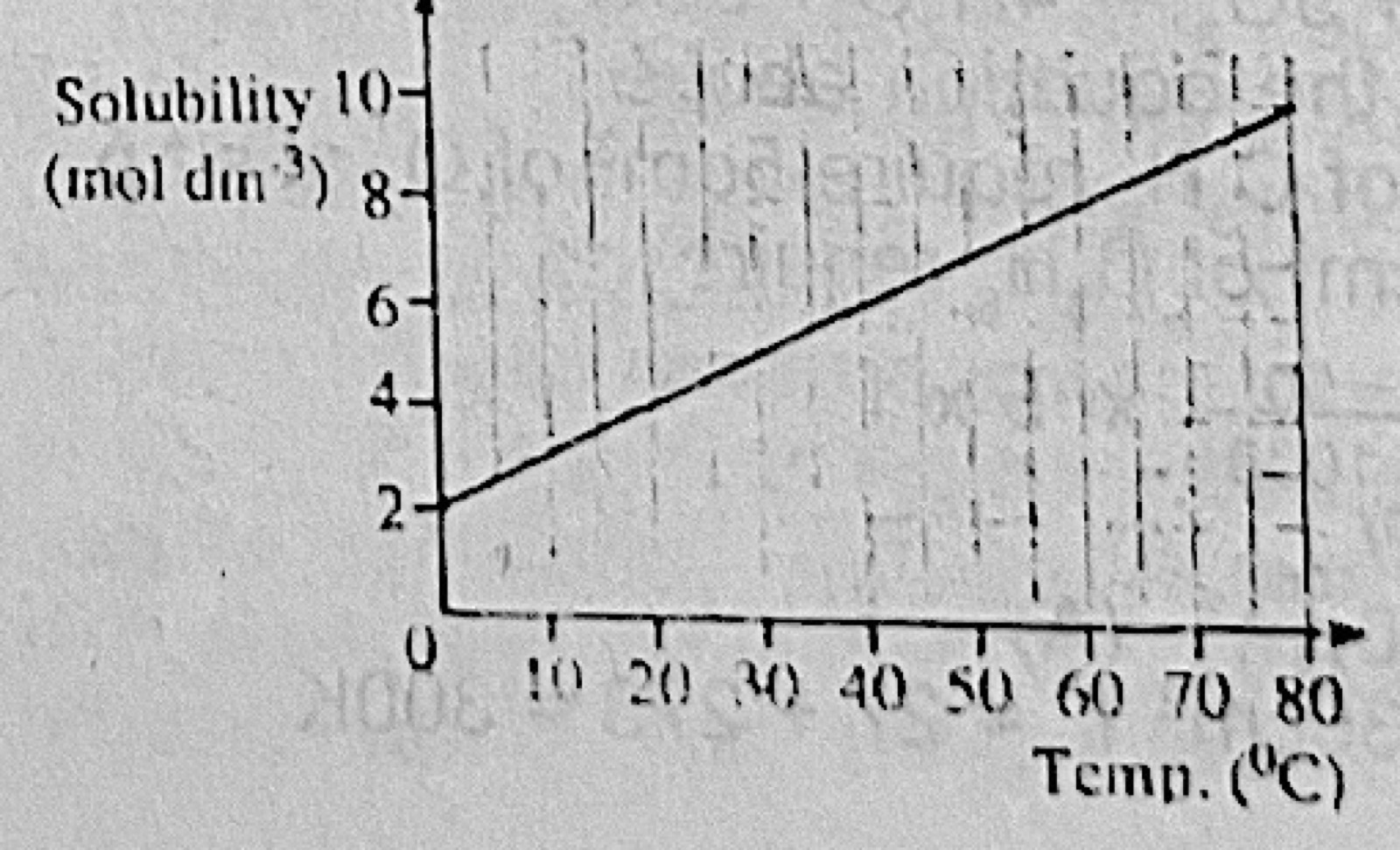
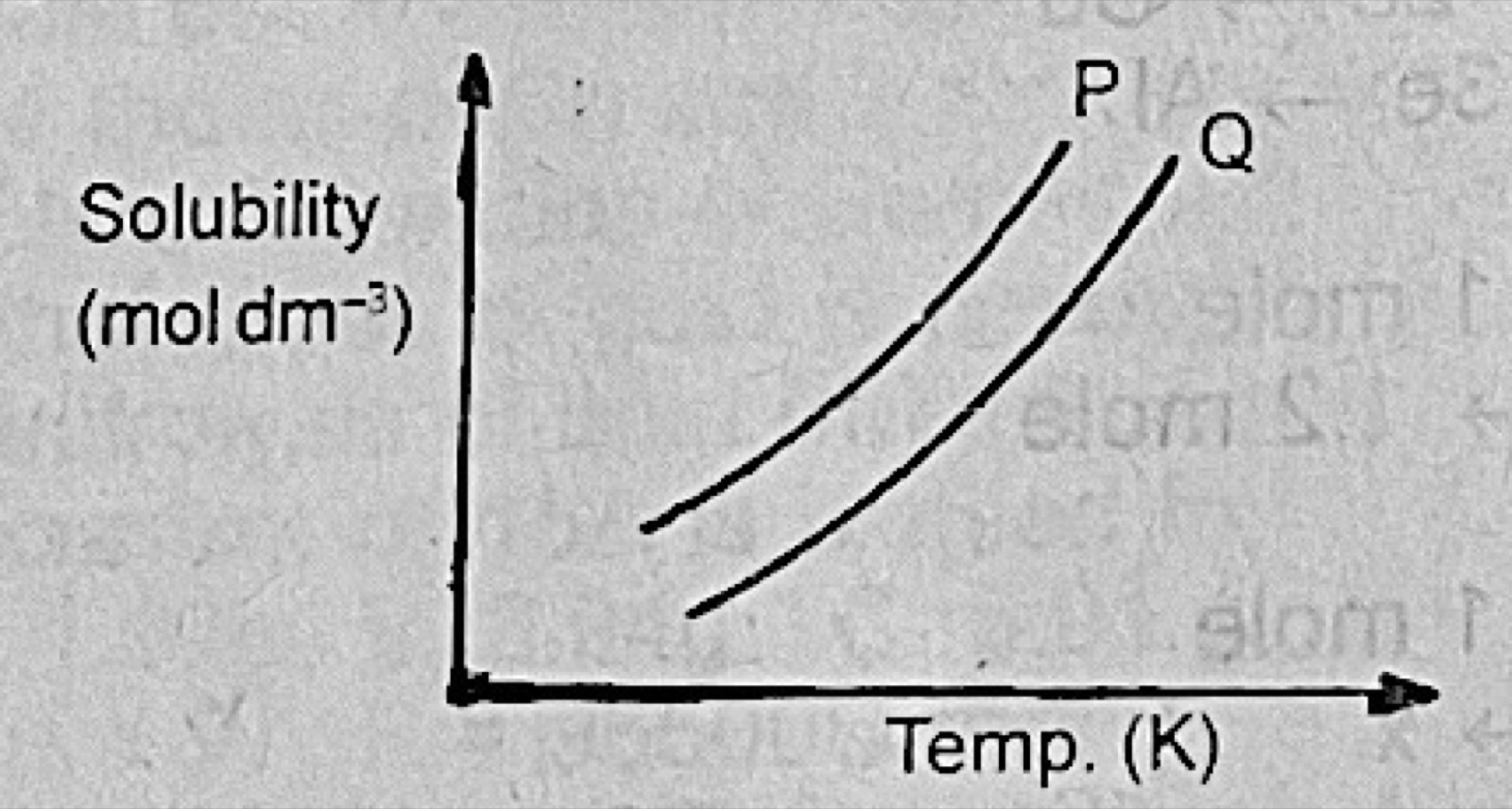
In the diagram above, the mixture of the two solids P and Q can be separated by

Diagram for this question
  1. A.distillation
  2. B.fractional distillation
  3. C.crystallization
  4. D.fractional crystallization
Show the answer and explanation

Answer: D (fractional crystallization)

Explanation

The graph shows two soluble solids whose solubilities differ and change with temperature. Such solids are separated by fractional crystallization: on cooling, the less soluble one crystallizes out first.

Open this question

Question 7

Mole Concept and Stoichiometry

Mg(s) + 2HCl(aq) → MgCl2(aq) + H2(g). From the equation above, the mass of magnesium required to react with 250 cm3 of 0.5 M HCl is [Mg = 24].

  1. A.0.3 g
  2. B.1.5 g
  3. C.2.4 g
  4. D.3.0 g
Show the answer and explanation

Answer: B (1.5 g)

Explanation

HCl = 0.25 × 0.5 = 0.125 mol. Mg needed = 0.125/2 = 0.0625 mol = 0.0625 × 24 = 1.5 g.

Open this question

Question 8

Chemical Formulae and Equations

A gaseous metallic chloride MClx consists of 20.22% of M by mass. The formula of the chloride is [M = 27, Cl = 35.5].

  1. A.MCl
  2. B.MCl2
  3. C.MCl3
  4. D.M2Cl6.
Show the answer and explanation

Answer: C (MCl3)

Explanation

Mole ratio M : Cl = 20.22/27 : 79.78/35.5 = 0.75 : 2.25 = 1 : 3, so the empirical formula is MCl3.

Open this question

Question 9

Kinetic Theory and States of Matter

In which of the following are water molecules in the most disorderly arrangement?

  1. A.Ice at −10°C
  2. B.Ice at 0°C
  3. C.Water at 100°C
  4. D.Steam at 100°C.
Show the answer and explanation

Answer: D (Steam at 100°C.)

Explanation

Gas molecules move freely and randomly, so steam is more disordered than liquid water or ice at any of these temperatures.

Open this question

Question 10

Periodic Table

In order to remove one electron from a 3s-orbital of gaseous sodium atom, about 496 kJ mol−1 of energy is required. This energy is referred to as

  1. A.electron affinity
  2. B.ionization energy
  3. C.activation energy
  4. D.electronegativity
Show the answer and explanation

Answer: B (ionization energy)

Explanation

The energy needed to remove an electron from a gaseous atom to form a positive ion is the (first) ionization energy.

Open this question

Question 11

Air

Nitrogen obtained from the liquefaction of air has a higher density than that obtained from nitrogen containing compounds because the former contains

  1. A.water vapour
  2. B.oxygen
  3. C.carbon (IV) oxide
  4. D.rare gases
Show the answer and explanation

Answer: D (rare gases)

Explanation

Nitrogen from air still contains about 1% of rare gases, mainly argon, which is heavier than nitrogen; this raises its density.

Open this question

Question 12

Water

The method that can be used to convert hard water to soft water is

  1. A.chlorination
  2. B.passage over activated charcoal
  3. C.the use of an ion-exchange resin
  4. D.aeration
Show the answer and explanation

Answer: C (the use of an ion-exchange resin)

Explanation

An ion-exchange resin swaps the Ca2+ and Mg2+ ions that cause hardness for Na+ ions, softening the water. Chlorination and charcoal treat germs and odours, not hardness.

Open this question

Question 13

Periodic Table

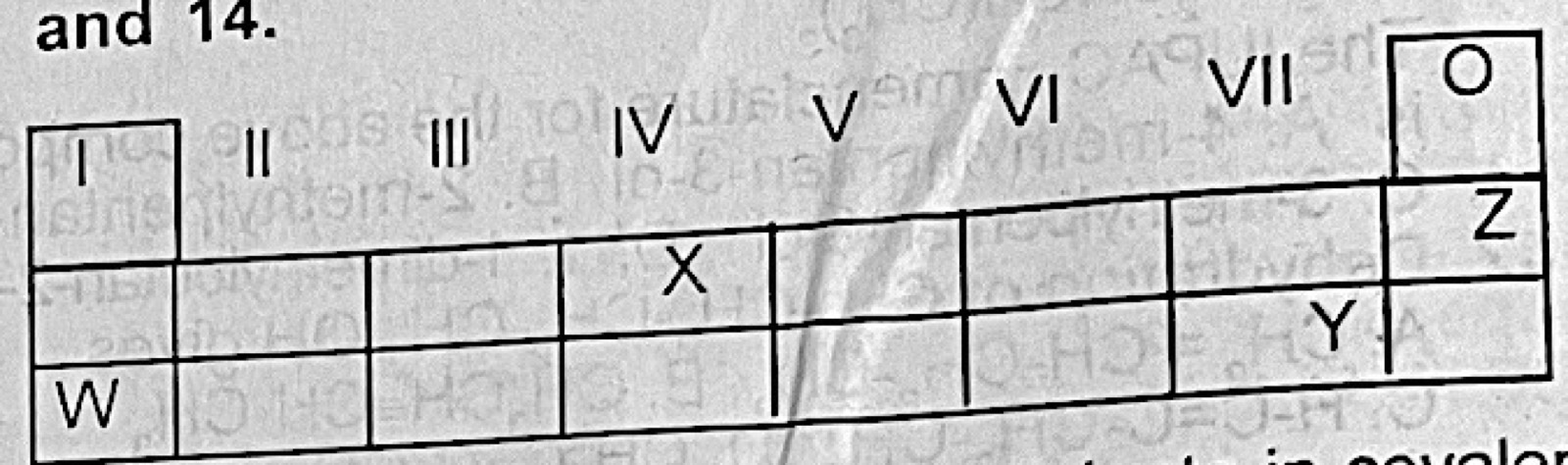
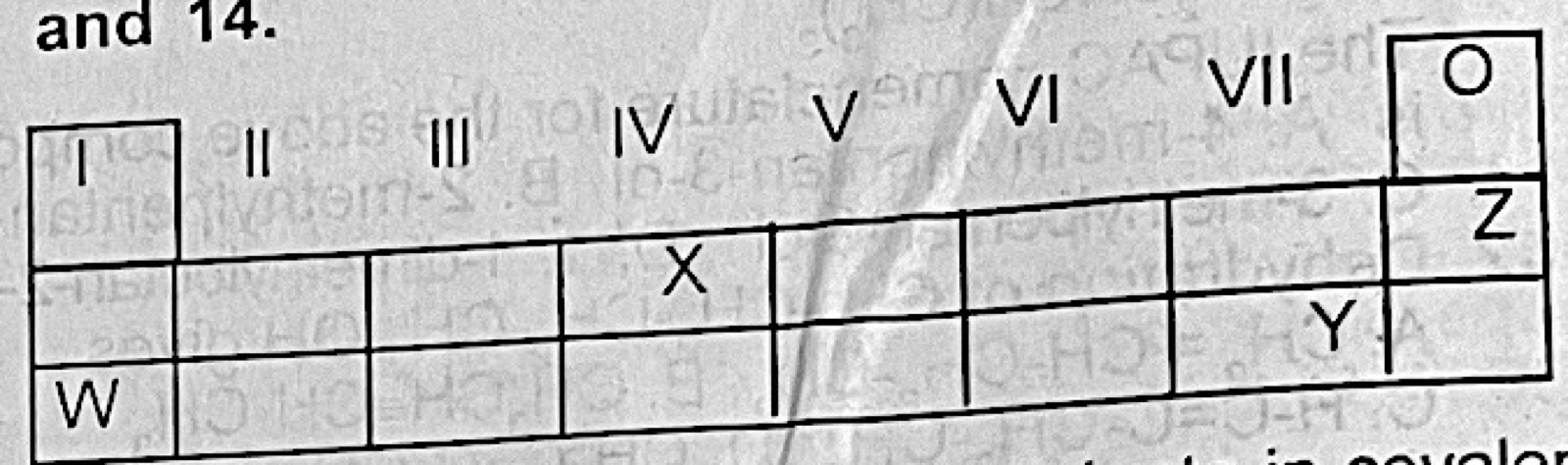
Use the table above (part of the periodic table) to answer this question. The element that is likely to participate in covalent rather than ionic bonding is

Diagram for this question
  1. A.Z
  2. B.Y
  3. C.X
  4. D.W
Show the answer and explanation

Answer: C (X)

Explanation

X is in Group IV; with four outer electrons it shares electrons rather than gaining or losing four, so it forms covalent bonds. W (Group I) and Y (Group VII) form ions and Z is a noble gas.

Open this question

Question 14

Periodic Table

Use the table above (part of the periodic table) to answer this question. The least reactive element is

Diagram for this question
  1. A.W
  2. B.X
  3. C.Y
  4. D.Z
Show the answer and explanation

Answer: D (Z)

Explanation

Z is in Group 0, the noble gases, which have full outer shells and are the least reactive elements.

Open this question

Question 15

Atomic Structure

1s22s22p63s23p63d74s2. An element with the electron configuration above is a

  1. A.non-metal
  2. B.metal
  3. C.transition element
  4. D.group two element
Show the answer and explanation

Answer: C (transition element)

Explanation

The element is filling its 3d sub-level (it is cobalt), which makes it a transition element.

Open this question

Question 16

Chemical Bonding

Given that electronegativity increases across a period and decreases down a group in the periodic table, in which of the following compounds will the molecules be held together by the strongest hydrogen bond?

  1. A.HF(g)
  2. B.NH3(g)
  3. C.CH4(g)
  4. D.HCl(g)
Show the answer and explanation

Answer: A (HF(g))

Explanation

Hydrogen bonds are strongest when H is joined to the most electronegative atom. Fluorine is the most electronegative element, so HF forms the strongest hydrogen bonds.

Open this question

Question 17

Volumetric Analysis

0.25 mole of hydrogen chloride was dissolved in distilled water and the volume made up to 0.50 dm3. If 15.00 cm3 of the solution requires 12.50 cm3 of aqueous sodium trioxocarbonate (IV) for neutralization, calculate the concentration of the alkaline solution

  1. A.0.30 mol dm−3
  2. B.0.40 mol dm−3
  3. C.0.50 mol dm−3
  4. D.0.60 mol dm−3.
Show the answer and explanation

Answer: A (0.30 mol dm−3)

Explanation

[HCl] = 0.25/0.50 = 0.50 mol dm−3, so 15.00 cm3 holds 0.0075 mol. Na2CO3 + 2HCl → 2NaCl + H2O + CO2, so Na2CO3 = 0.00375 mol in 0.0125 dm3 = 0.30 mol dm−3.

Open this question

Question 18

Redox Reactions

The correct order of increasing oxidation number of the transition metal ions for the compounds K2Cr2O7, V2O5 and KMnO4 is

  1. A.V2O5 < K2Cr2O7 < KMnO4
  2. B.K2Cr2O7 < KMnO4 < V2O5
  3. C.KMnO4 < K2Cr2O7 < V2O5
  4. D.KMnO4 < V2O5 < K2Cr2O7.
Show the answer and explanation

Answer: A (V2O5 < K2Cr2O7 < KMnO4)

Explanation

V in V2O5 is +5, Cr in K2Cr2O7 is +6 and Mn in KMnO4 is +7, so the order is V2O5 < K2Cr2O7 < KMnO4.

Open this question

Question 20

Redox Reactions

What is observed when aqueous solutions of each of tetraoxosulphate (VI) acid, potassium trioxoiodate (V) and potassium iodide are mixed together?

  1. A.A white precipitate is formed
  2. B.A green precipitate is formed
  3. C.The mixture remains colourless
  4. D.The mixture turns reddish brown.
Show the answer and explanation

Answer: D (The mixture turns reddish brown.)

Explanation

In acid, iodate(V) oxidizes iodide to iodine: IO3− + 5I− + 6H+ → 3I2 + 3H2O. The iodine colours the solution reddish brown.

Open this question

Question 21

Solubility and Solutions

From the diagram above, the mass of crystals deposited when 1 dm3 of a saturated solution of NaCl is cooled from 80°C to 60°C is [Na = 23, Cl = 35.5].

Diagram for this question
  1. A.117.00 g
  2. B.58.50 g
  3. C.11.70 g
  4. D.5.85 g
Show the answer and explanation

Answer: A (117.00 g)

Explanation

From the graph the solubility falls by about 2 mol dm−3 between 80°C and 60°C. So 2 mol of NaCl crystallizes from 1 dm3: 2 × 58.5 = 117 g.

Open this question

Question 22

Acids, Bases and Salts

The solution with the lowest pH value is

  1. A.5 ml of M/10 HCl
  2. B.10 ml of M/10 HCl
  3. C.15 ml of M/5 HCl
  4. D.20 ml of M/8 HCl.
Show the answer and explanation

Answer: C (15 ml of M/5 HCl)

Explanation

pH depends on the concentration of H+, not the volume. M/5 (0.2 M) is the most concentrated acid, so it has the lowest pH.

Open this question

Question 23

Solubility and Solutions

The solubility product of Cu(IO3)2 is 1.08 x 10⁻⁷. Assuming that neither ions react appreciably with water to form H+ and OH−, what is the solubility of this salt?

  1. A.2.7 x 10−8 mol dm−3
  2. B.9.0 x 10−8 mol dm−3
  3. C.3.0 x 10−3 mol dm−3
  4. D.9.0 x 10−3 mol dm−3.
Show the answer and explanation

Answer: C (3.0 x 10⁻³ mol dm−3)

Explanation

If the solubility is s, [Cu2+] = s and [IO3−] = 2s, so Ksp = 4s3 = 1.08 × 10⁻⁷. s3 = 2.7 × 10⁻⁸, s = 3.0 × 10⁻³ mol dm−3.

Open this question

Question 24

Energy Changes

The entropy and enthalpy of a system are a measure of

  1. A.degree of disorderliness and heat content respectively
  2. B.heat content and degree of disorderliness respectively
  3. C.heat content of a system only
  4. D.degree of disorderliness only.
Show the answer and explanation

Answer: A (degree of disorderliness and heat content respectively)

Explanation

Entropy measures how disordered a system is; enthalpy is its heat content.

Open this question

Question 25

Sulphur and its Compounds

2SO2(g) + O2(g) ⇌ 2SO3(g). In the chemical reaction above, the substance that will increase the rate of production of sulphur (VI) oxide is

  1. A.manganese (IV) oxide
  2. B.finely divided iron
  3. C.vanadium (V) oxide
  4. D.nickel
Show the answer and explanation

Answer: C (vanadium (V) oxide)

Explanation

In the Contact process, vanadium(V) oxide is the catalyst for oxidizing SO2 to SO3. Iron is used in the Haber process and nickel for hydrogenation.

Open this question

Question 26

Chemical Equilibrium

N2O4(g) ⇌ 2NO2(g). Increase in total pressure of the equilibrium reaction above will

  1. A.produce more of NO2(g) in the mixture
  2. B.convert all of N2O4(g) to NO2(g)
  3. C.have no effect on the concentrations of NO2(g) and N2O4(g)
  4. D.produce more of N2O4(g) in the mixture.
Show the answer and explanation

Answer: D (produce more of N2O4(g) in the mixture.)

Explanation

Raising the pressure favours the side with fewer gas molecules. The left side has 1 molecule against 2 on the right, so more N2O4 forms.

Open this question

Question 27

Electrolysis

What quantity of electricity will liberate 0.125 mole of oxygen molecules during the electrolysis of dilute sodium chloride solution? [F = 96 500 C mol−1].

  1. A.24 125 coulombs
  2. B.48 250 coulombs
  3. C.72 375 coulombs
  4. D.96 500 coulombs
Show the answer and explanation

Answer: B (48 250 coulombs)

Explanation

4OH− → O2 + 2H2O + 4e−: one mole of O2 needs 4 F. 0.125 × 4 × 96 500 = 48 250 C.

Open this question

Question 28

Rates of Reaction

X + Y → Z. The rate equation for the chemical reaction above is −Δ[X]/Δt = K[X]2[Y]. The overall order of the reaction is

  1. A.0
  2. B.1
  3. C.2
  4. D.3
Show the answer and explanation

Answer: D (3)

Explanation

The overall order is the sum of the powers in the rate equation: 2 + 1 = 3.

Open this question

Question 29

Electrolysis

When a current I was passed through an electrolyte solution for 40 minutes, a mass X g of a univalent metal was deposited at the cathode. What mass of the metal will be deposited when a current 2I is passed through the solution for 10 minutes?

  1. A.X/4 g
  2. B.X/2 g
  3. C.2X g
  4. D.4X g.
Show the answer and explanation

Answer: B (X/2 g)

Explanation

Mass deposited is proportional to charge = current × time. First: I × 40 = 40I. Second: 2I × 10 = 20I, which is half, so the mass is X/2 g.

Open this question

Question 30

Energy Changes

RS(aq) + HF(aq) → RF(s) + HS(aq) ΔH = −65.7 kJ mol−1. From the equation above, it can be deduced that

  1. A.the heat content of the reactants is lower than that of the products
  2. B.the heat content of the reactants is higher than that of the products
  3. C.the reaction is slow
  4. D.a large amount of heat is absorbed.
Show the answer and explanation

Answer: B (the heat content of the reactants is higher than that of the products)

Explanation

A negative ΔH means the reaction is exothermic: the reactants had more heat content than the products, and the difference is given out.

Open this question

Question 32

Qualitative Analysis

The gas that will form a white precipitate with acidified silver trioxonitrate (V) is

  1. A.NH3
  2. B.SO2
  3. C.CO2
  4. D.HCl
Show the answer and explanation

Answer: D (HCl)

Explanation

Hydrogen chloride dissolves to give Cl− ions, which form a white precipitate of silver chloride with silver trioxonitrate(V).

Open this question

Question 34

Sulphur and its Compounds

The salt that reacts with dilute hydrochloric acid to produce a pungent smelling gas which decolourizes acidified purple potassium tetraoxomanganate (VII) solution is

  1. A.Na2SO4
  2. B.Na2SO3
  3. C.Na2S
  4. D.Na2CO3.
Show the answer and explanation

Answer: B (Na2SO3)

Explanation

Sodium trioxosulphate(IV) reacts with dilute acid to give sulphur(IV) oxide, a choking gas that reduces purple KMnO4 to colourless Mn2+.

Open this question

Question 35

Nitrogen and its Compounds

A pair of compounds that can be used to generate a gas which has physiological effect on human beings is

  1. A.sodium trioxonitrate (V) and calcium chloride
  2. B.sodium dioxonitrate (III) and ammonium chloride
  3. C.sodium trioxonitrate (V) and ammonium chloride
  4. D.sodium dioxonitrate (III) and potassium chloride.
Show the answer and explanation

Answer: C (sodium trioxonitrate (V) and ammonium chloride)

Explanation

Heating sodium trioxonitrate(V) with ammonium chloride produces ammonium trioxonitrate(V), which decomposes to dinitrogen oxide (laughing gas), an anaesthetic. Option B gives nitrogen, which has no such effect.

Open this question

Question 36

Hydrogen, Oxygen and Oxides

Hydrogen is used in oxy-hydrogen flames for melting metals because it

  1. A.evolves a lot of heat when burnt
  2. B.combines explosively with oxygen
  3. C.is a very light gas
  4. D.is a rocket fuel.
Show the answer and explanation

Answer: A (evolves a lot of heat when burnt)

Explanation

Burning hydrogen in oxygen releases a great deal of heat, giving a flame hot enough to melt and weld metals.

Open this question

Question 37

Nitrogen and its Compounds

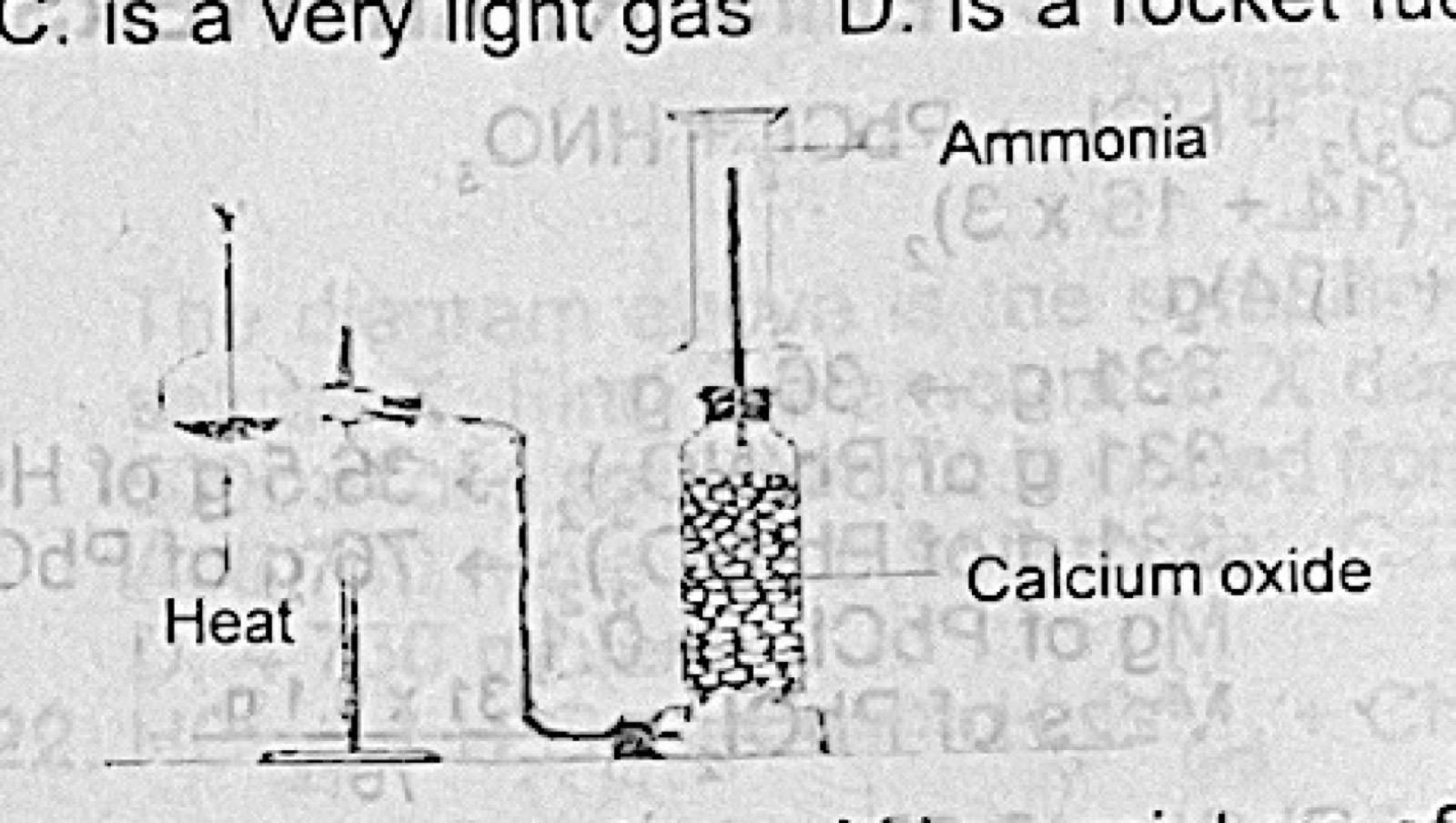
In the diagram above, Y is a mixture of

Diagram for this question
  1. A.calcium hydroxide and ammonium chloride
  2. B.calcium hydroxide and sodium chloride
  3. C.sodium chloride and ammonium trioxonitrate (V)
  4. D.sodium dioxonitrate (III) and ammonium chloride
Show the answer and explanation

Answer: A (calcium hydroxide and ammonium chloride)

Explanation

The diagram shows the laboratory preparation of ammonia, dried over calcium oxide. Ammonia is made by heating an ammonium salt with a base: calcium hydroxide and ammonium chloride.

Open this question

Question 38

Metals and their Compounds

What properties of duralumin make it more useful than its constituent metals?

  1. A.It is heavy with a high melting point
  2. B.It is malleable and has high density
  3. C.It is strong and light
  4. D.It is hard and ductile
Show the answer and explanation

Answer: C (It is strong and light)

Explanation

Duralumin (aluminium with copper, magnesium and manganese) is much stronger than pure aluminium but still light, so it is used for aircraft bodies.

Open this question

Question 39

Metals and their Compounds

The pair of metals in the reactivity series that are usually extracted by the electrolysis of their ores is

  1. A.magnesium and zinc
  2. B.magnesium and calcium
  3. C.copper and zinc
  4. D.lead and calcium.
Show the answer and explanation

Answer: B (magnesium and calcium)

Explanation

Very reactive metals near the top of the series, such as calcium and magnesium, cannot be reduced by carbon and are extracted by electrolysis of their molten compounds.

Open this question

Question 40

Metals and their Compounds

A metal that can be extracted from cassiterite is

  1. A.calcium
  2. B.magnesium
  3. C.tin
  4. D.copper
Show the answer and explanation

Answer: C (tin)

Explanation

Cassiterite is tin(IV) oxide, SnO2, the main ore of tin (mined around Jos in Nigeria).

Open this question

Question 41

Metals and their Compounds

Which of the following metals is passive to concentrated trioxonitrate (V) acid?

  1. A.Iron
  2. B.Tin
  3. C.Copper
  4. D.Zinc
Show the answer and explanation

Answer: A (Iron)

Explanation

Concentrated nitric acid forms a thin protective oxide layer on iron, so the iron stops reacting (it becomes passive).

Open this question

Question 42

Hydrocarbons

The hydrocarbon that burns in air with a sooty flame is

  1. A.C2H6
  2. B.C3H8
  3. C.C4H10
  4. D.C6H6
Show the answer and explanation

Answer: D (C6H6)

Explanation

Benzene has a very high proportion of carbon (C : H = 1 : 1), so it does not burn completely in air and gives a smoky, sooty flame.

Open this question

Question 43

Introduction to Organic Chemistry

2-methylprop-1-ene is an isomer of

  1. A.but-2-ene
  2. B.pent-1-ene
  3. C.2-methylbut-2-ene
  4. D.2-methylbut-1-ene
Show the answer and explanation

Answer: A (but-2-ene)

Explanation

Isomers have the same molecular formula. 2-methylprop-1-ene is C4H8, the same as but-2-ene; the other three are C5H10.

Open this question

Question 44

Alkanols

Which of the following is a solvent for perfumes?

  1. A.C5H12
  2. B.C4H6
  3. C.CH3COOH
  4. D.C2H5OH.
Show the answer and explanation

Answer: D (C2H5OH.)

Explanation

Ethanol dissolves the oils in perfumes, evaporates quickly and is safe on the skin, so it is the usual perfume solvent.

Open this question

Question 46

Hydrocarbons

How many grammes of bromine will saturate 5.2 g of but-1-ene-3-yne? [C = 12, H = 1, Br = 80].

  1. A.64.0 g
  2. B.48.0 g
  3. C.32.0 g
  4. D.16.0 g
Show the answer and explanation

Answer: B (48.0 g)

Explanation

But-1-ene-3-yne is CH2=CH–C≡CH, C4H4 (52 g mol−1), so 5.2 g = 0.1 mol. The double bond takes 1 Br2 and the triple bond 2, so 0.3 mol Br2 = 0.3 × 160 = 48 g.

Open this question

Question 47

Polymers

Polyvinyl chloride is used to produce

  1. A.bread
  2. B.pencils
  3. C.ink
  4. D.pipes
Show the answer and explanation

Answer: D (pipes)

Explanation

PVC is a tough, waterproof plastic widely used for water and drainage pipes.

Open this question

Question 48

Alkanals and Alkanones

An organic compound that does not undergo a reaction with both hydrogen cyanide and hydroxylamine can be an

  1. A.alkene
  2. B.alkanal
  3. C.alkanone
  4. D.alkanoic acid.
Show the answer and explanation

Answer: A (alkene)

Explanation

Hydrogen cyanide and hydroxylamine add to the C=O group of aldehydes (alkanals) and ketones (alkanones). An alkene has no carbonyl group, so it does not react with them.

Open this question

Question 49

Alkanoic Acids and Esters

When the two end alkyl groups of ethyl ethanoate are interchanged, the compound formed is known as

  1. A.methyl ethanoate
  2. B.ethyl propanoate
  3. C.methyl propanoate
  4. D.propyl ethanoate.
Show the answer and explanation

Answer: C (methyl propanoate)

Explanation

Ethyl ethanoate is CH3COOC2H5. Swapping the end groups gives C2H5COOCH3, methyl propanoate.

Open this question

Question 50

Hydrocarbons

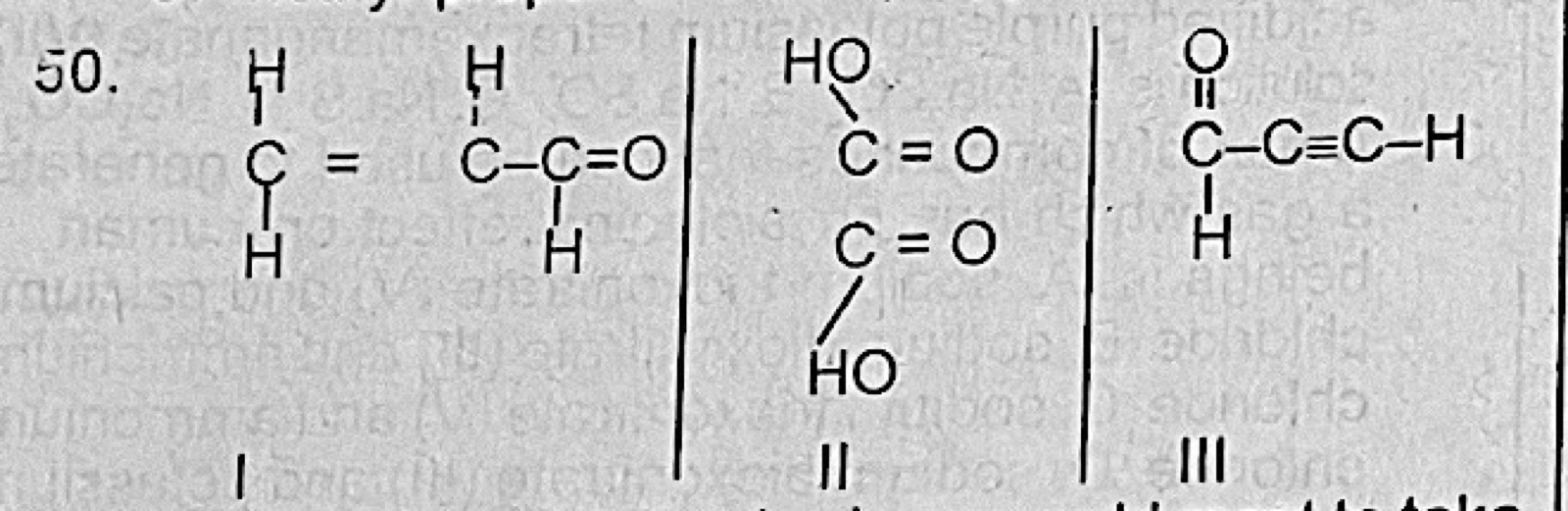
Which of the compounds above would react to take up two molecules of bromine during bromination?

Diagram for this question
  1. A.I only
  2. B.III only
  3. C.I and II only
  4. D.II and III only
Show the answer and explanation

Answer: B (III only)

Explanation

A triple bond can add two molecules of bromine. Only III (HC≡C–CHO) has a C≡C bond. I has at most one C=C bond (one Br2) and II (ethanedioic acid) has no carbon–carbon multiple bond.
Open this question