A pure solid has a sharp melting point, melting over a very narrow temperature range. Impurities lower the melting point and spread it over a wider range.
At the same temperature and pressure, 50 cm3 of nitrogen gas contains the same number of molecules as
A.25 cm3 of methane
B.40 cm3 of hydrogen
C.50 cm3 of ammonia
D.100 cm3 of chlorine
Show the answer and explanation
Answer: C (50 cm3 of ammonia)
Explanation
Avogadro's law: equal volumes of gases at the same temperature and pressure contain equal numbers of molecules. So 50 cm3 of any gas, such as ammonia, matches.
Nitrogen in NH3 has four electron pairs (three bonding, one lone pair) arranged tetrahedrally, which makes the molecule a pyramid. Of the options given, tetrahedral is the only one that fits.
Which of the following physical properties decreases down a group in the periodic table?
A.Atomic radius
B.Ionic radius
C.Electropositivity
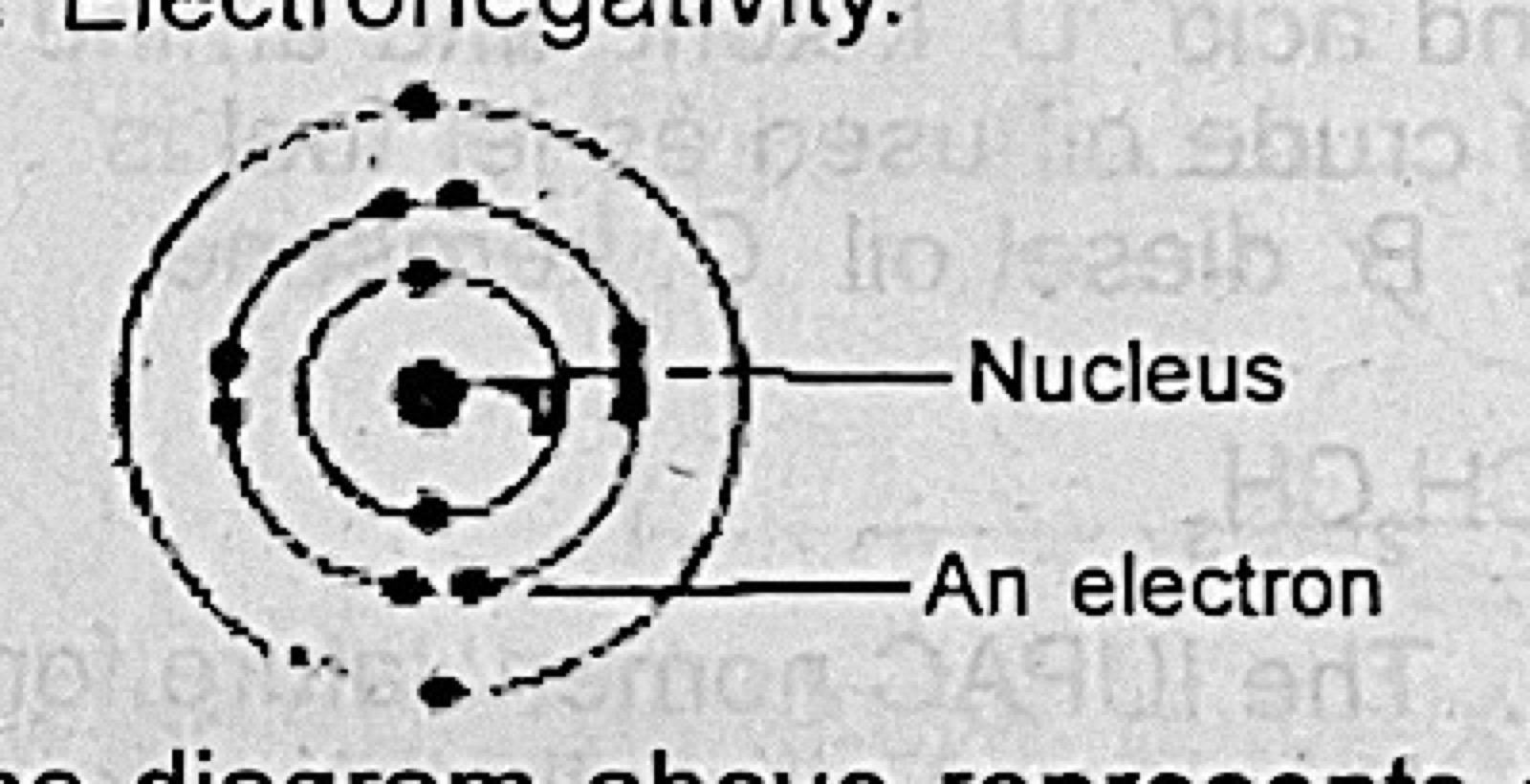
D.Electronegativity
Show the answer and explanation
Answer: D (Electronegativity)
Explanation
Going down a group, atoms get bigger and the outer electrons are further from the nucleus, so the atom attracts bonding electrons less: electronegativity decreases. The other three increase.
Elements X, Y and Z belong to groups I, V and VII respectively. Which of the following is TRUE about the bond types of XZ and YZ3?
A.Both are electrovalent
B.Both are covalent
C.XZ is electrovalent and YZ3 is covalent
D.XZ is covalent and YZ3 is electrovalent
Show the answer and explanation
Answer: C (XZ is electrovalent and YZ3 is covalent)
Explanation
A group I metal and a group VII non-metal transfer an electron to form an ionic (electrovalent) bond, as in NaCl. Two non-metals from groups V and VII share electrons, as in PCl3, giving covalent bonds.
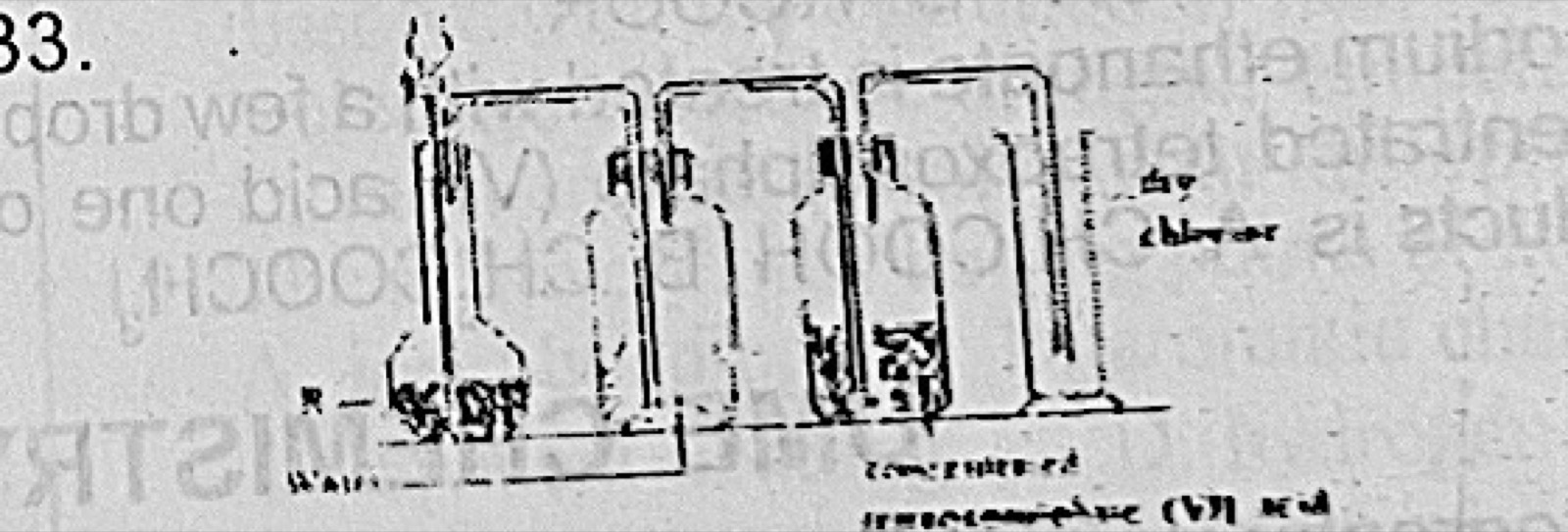
The set-up above would be useful for determining the amount of
A.oxygen in air
B.water vapour in air
C.CO2 in air
D.argon in air
Show the answer and explanation
Answer: B (water vapour in air)
Explanation
Anhydrous calcium chloride absorbs water. Weighing the U-tube before and after passing a known volume of air through it gives the mass of water vapour in the air.
A solid that absorbs water from the atmosphere and forms an aqueous solution is
A.hydrophilic
B.efflorescent
C.deliquescent
D.hygroscopic
Show the answer and explanation
Answer: C (deliquescent)
Explanation
A deliquescent solid (such as CaCl2 or NaOH) absorbs so much water from the air that it dissolves in it. A hygroscopic substance absorbs water but does not form a solution.
Calcium oxide is a metal oxide that reacts with acids to form a salt and water, so it is a base. CO2 is acidic, H3PO3 is an acid and CH3COOCH3 is an ester.
20 cm3 of a 2.0 M solution of ethanoic acid was added to excess of 0.05 M sodium hydroxide. The mass of the salt produced is [Na = 23, C = 12, O = 16, H = 1]
A.2.50 g
B.2.73 g
C.3.28 g
D.4.54 g
Show the answer and explanation
Answer: C (3.28 g)
Explanation
Moles of acid = 0.020 × 2.0 = 0.04 mol, giving 0.04 mol of CH3COONa (M = 82). Mass = 0.04 × 82 = 3.28 g.
What volume of oxygen measured at s.t.p would be liberated on electrolysis by 9650 coulombs of electricity? [Molar volume of gas = 22.4 dm3, F = 96,500 C mol-1]
A.22.4 dm3
B.11.2 dm3
C.1.12 dm3
D.0.560 dm3
Show the answer and explanation
Answer: D (0.560 dm3)
Explanation
9650 C is 0.1 F. Making one mole of O2 needs 4 F (4OH− → O2 + 2H2O + 4e−), so 0.1 F gives 0.025 mol = 0.025 × 22.4 = 0.560 dm3.
Which of the following is TRUE of Le Chatelier's Principle for an exothermic reaction?
A.Increase in temperature will cause an increase in the equilibrium constant
B.Increase in temperature will cause a decrease in the equilibrium constant
C.Addition of a catalyst will cause an increase in the equilibrium constant
D.Addition of a catalyst will cause a decrease in the equilibrium constant
Show the answer and explanation
Answer: B (Increase in temperature will cause a decrease in the equilibrium constant)
Explanation
For an exothermic reaction, heating favours the backward (endothermic) reaction, so less product forms and K gets smaller. A catalyst speeds up both directions equally and leaves K unchanged.
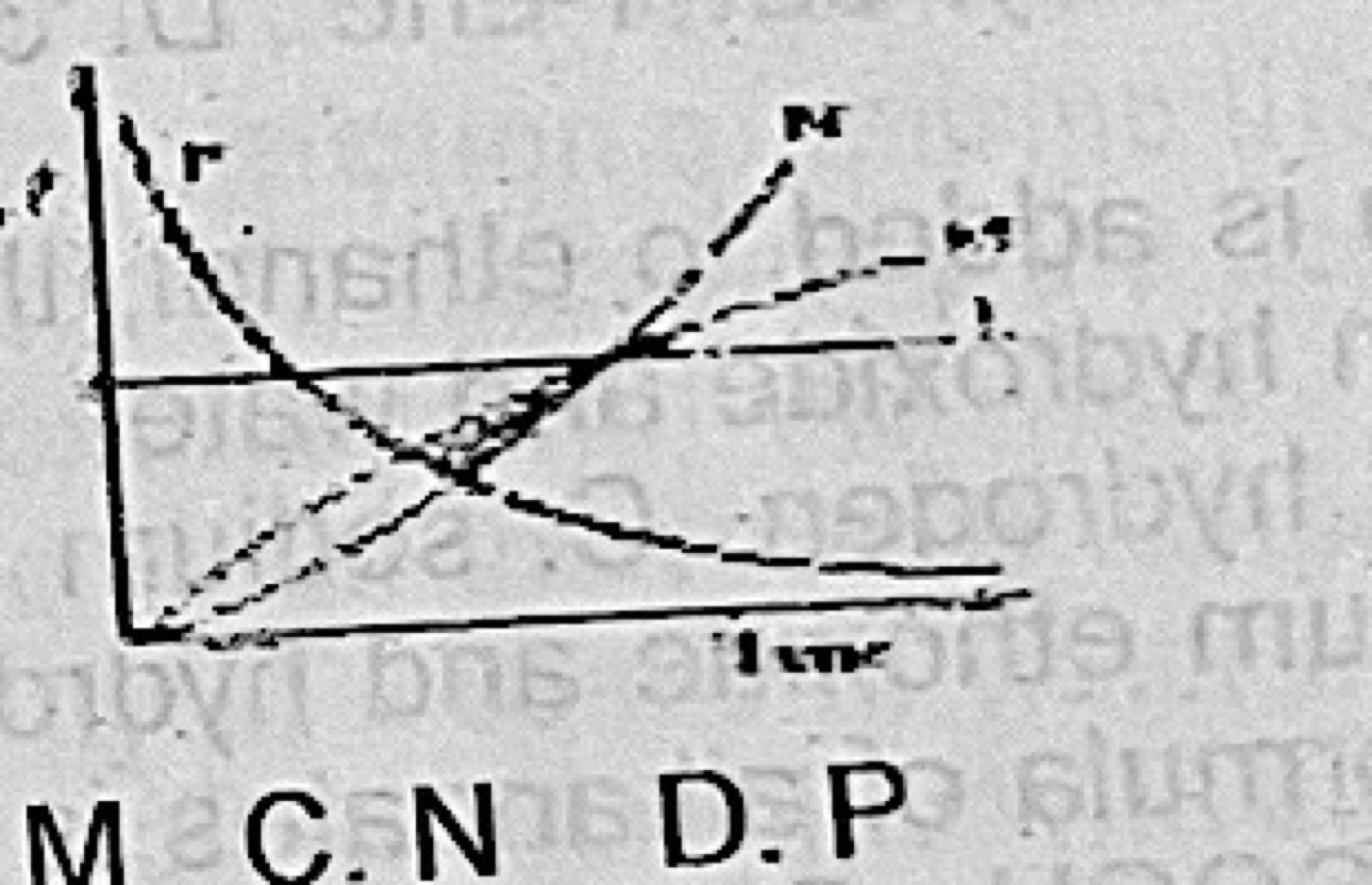
2HCl(aq) + CaCO3(s) → CaCl2(aq) + H2O(l) + CO2(g). From the reaction above, which of the following curves represents the consumption of calcium trioxocarbonate (IV) as dilute HCl is added to it?
A.L
B.M
C.N
D.P
Show the answer and explanation
Answer: D (P)
Explanation
As acid is added, the amount of CaCO3 left falls, quickly at first and then more slowly. Curve P is the only one that falls with time.
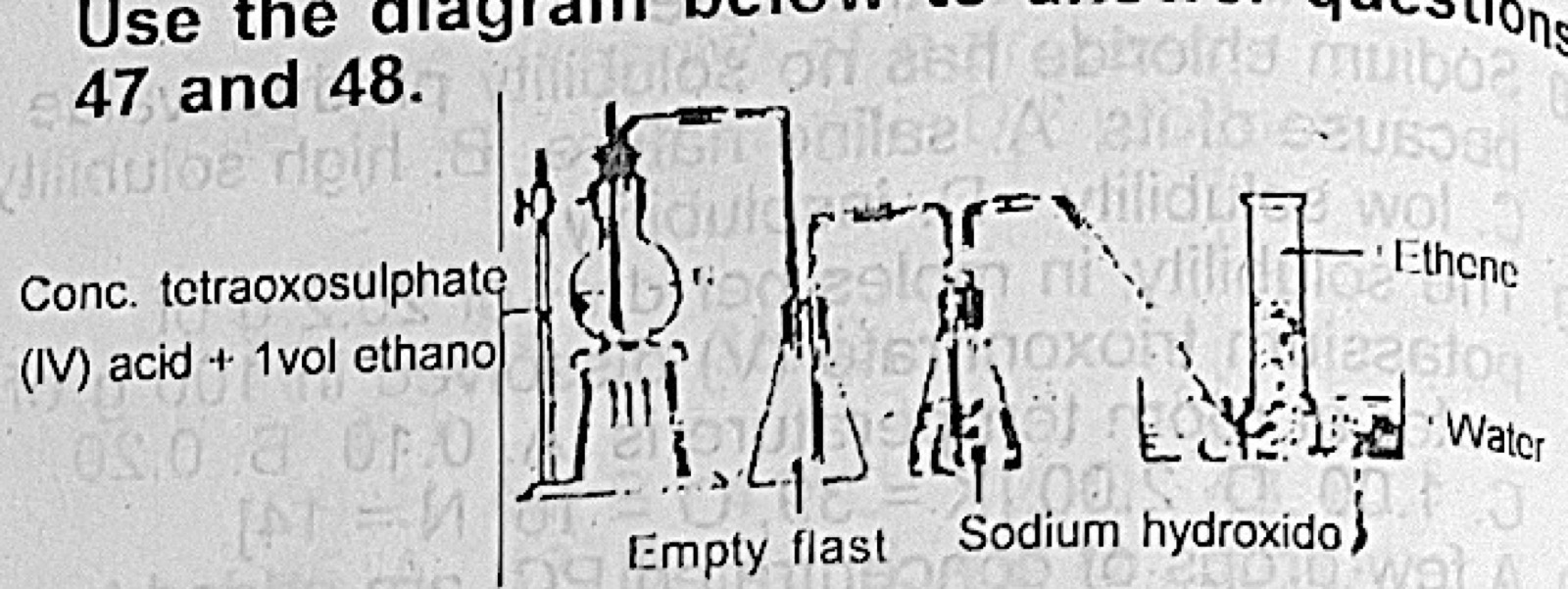
A.potassium tetraoxochlorate (VII) and concentrated H2SO4
B.potassium trioxochlorate (V) and concentrated H2SO4
C.potassium tetraoxomanganate (VII) and concentrated HCl
D.manganese (IV) oxide and concentrated HCl
Show the answer and explanation
Answer: D (manganese (IV) oxide and concentrated HCl)
Explanation
The set-up collects dry chlorine. In the laboratory, chlorine is made by heating manganese(IV) oxide with concentrated hydrochloric acid, which oxidizes the HCl to Cl2.
Clothes should be properly rinsed with water after bleaching because
A.the bleach decolourizes the clothes
B.chlorine reacts with fabrics during bleaching
C.the clothes are sterilized during bleaching
D.hydrogen chloride solution is produced during bleaching
Show the answer and explanation
Answer: D (hydrogen chloride solution is produced during bleaching)
Explanation
Chlorine bleaches by forming HOCl, which releases oxygen and leaves hydrochloric acid behind. The acid would weaken the fabric if it were not rinsed out.
SO3 is NOT directly dissolved in water in the preparation of H2SO4 by the contact process because
A.the reaction between SO3 and water is violently exothermic
B.acid is usually added to water and never water to acid
C.SO3 does not dissolve in water readily
D.SO3 is an acid gas
Show the answer and explanation
Answer: A (the reaction between SO3 and water is violently exothermic)
Explanation
SO3 reacts with water so violently that it forms a fine acid mist that is hard to condense. It is dissolved in concentrated H2SO4 instead to form oleum.
CH3—C(CH3)2—CH=CH2 The IUPAC name of the compound above is
A.2,2-dimethyl but-1-yne
B.2,2-dimethyl but-1-ene
C.3,3-dimethyl but-1-ene
D.3,3-dimethyl but-1-yne
Show the answer and explanation
Answer: C (3,3-dimethyl but-1-ene)
Explanation
The chain has 4 carbons with a C=C double bond, numbered from the double-bond end so it starts at carbon 1 (but-1-ene). Both methyl groups are then on carbon 3.