JAMB Chemistry 1991 past questions and answers

48 questions. Try each one, then open the answer to check yourself and read the explanation.

Question 1

Separation of Mixtures

Which of the following can be obtained by fractional distillation?

  1. A.Nitrogen from liquid air
  2. B.Sodium chloride from sea water
  3. C.Iodine from a solution of iodine in carbon tetrachloride
  4. D.Sulphur from a solution of sulphur in carbon disulphide.
Show the answer and explanation

Answer: A (Nitrogen from liquid air)

Explanation

Liquid air is a mixture of liquids with close boiling points (nitrogen −196°C, oxygen −183°C), which is exactly what fractional distillation separates.

Open this question

Question 2

Separation of Mixtures

Which of the following are mixtures? i. Petroleum ii. Rubber latex. iii. Vulcanizer's solution iv. Carbon (II) sulphide

  1. A.i, ii and iii
  2. B.i, ii and iv
  3. C.i and ii only
  4. D.i and iv.
Show the answer and explanation

Answer: A (i, ii and iii)

Explanation

Petroleum, rubber latex and vulcanizer's solution (rubber dissolved in a solvent) are all mixtures. A carbon sulphide is a compound with a fixed formula.

Open this question

Question 3

Mole Concept and Stoichiometry

An iron ore is known to contain 70.0% Fe2O3. The mass of iron metal which can be theoretically be obtained from 80 kg of the ore is [Fe = 56, O = 16].

  1. A.35.0 kg
  2. B.39.2kg
  3. C.70.0 kg
  4. D.78.4 kg
Show the answer and explanation

Answer: B (39.2kg)

Explanation

Mass of Fe2O3 = 70% of 80 kg = 56 kg. Iron is 112/160 of Fe2O3, so iron = 56 × 112/160 = 39.2 kg.

Open this question

Question 4

Chemical Formulae and Equations

In two separate experiments, 0.36 g and 0.71 g of chlorine combined with a metal X to give Y and Z respectively. An analysis showed that Y and Z contain 0.20 g and 0.40 g of X respectively. The data above represents the law of

  1. A.multiple proportion
  2. B.conservation of mass
  3. C.constant composition
  4. D.reciprocal proportion
Show the answer and explanation

Answer: C (constant composition)

Explanation

1 g of chlorine combines with about 0.56 g of X in both samples. The same ratio by mass each time shows the law of constant composition.

Open this question

Question 6

Gas Laws

A given quantity of a gas occupies a volume of 228 cm3 at a pressure of 750 mm Hg. What will be its volume at atmospheric pressure?

  1. A.220 cm3
  2. B.225 cm3
  3. C.230 cm3
  4. D.235 cm3
Show the answer and explanation

Answer: B (225 cm3)

Explanation

Boyle's law: P1V1 = P2V2, so V2 = 750 × 228 ÷ 760 = 225 cm3.

Open this question

Question 7

Mole Concept and Stoichiometry

Calculate the volume of carbon (IV) oxide measured at s.t.p, produced when 1 kg of potassium hydrogen trioxocarbonate (IV) is totally decomposed by heat. [G.M.V. at s.t.p = 22.4 dm3, K = 39, O = 16, C = 12, H = 1].

  1. A.28 dm3
  2. B.56 dm3
  3. C.112 dm3
  4. D.196 dm3
Show the answer and explanation

Answer: C (112 dm3)

Explanation

2KHCO3 → K2CO3 + H2O + CO2: 200 g gives 22.4 dm3 of CO2, so 1000 g gives 5 × 22.4 = 112 dm3.

Open this question

Question 8

Gas Laws

A sample of a gas exerts a pressure of 8.2 atm when confined in a 2.93 dm3 container at 20°C. The number of moles of gas in the sample is [R = 0.082 litre atm / deg mole].

  1. A.1.00
  2. B.2.00
  3. C.3.00
  4. D.4.00
Show the answer and explanation

Answer: A (1.00)

Explanation

n = PV/RT = (8.2 × 2.93) ÷ (0.082 × 293) = 1.00 mole.

Open this question

Question 9

Atomic Structure

Atoms of element X (with 2 electrons in the outer shell) combine with atoms of Y (with 7 electrons in the outer shell). Which of the following statements is FALSE? The compound formed

  1. A.has formula XY
  2. B.is likely to be ionic
  3. C.contains X2+ ions
  4. D.contains Y− ions.
Show the answer and explanation

Answer: A (has formula XY)

Explanation

X loses 2 electrons to form X2+ and each Y gains 1 to form Y−, so the formula is XY2, not XY.

Open this question

Question 10

Atomic Structure

The ions X− and Y+ are isoelectronic, each containing a total of 10 electrons. How many protons are in the nuclei of the neutral atoms of X and Y respectively?

  1. A.10 and 10
  2. B.9 and 9
  3. C.11 and 9
  4. D.9 and 11
Show the answer and explanation

Answer: D (9 and 11)

Explanation

X− has one more electron than protons, so X has 9 protons. Y+ has one fewer electron than protons, so Y has 11.

Open this question

Question 11

Atomic Structure

The electronic configuration of an element is 1s22s22p63s23p3. How many unpaired electrons are there in the element?

  1. A.5
  2. B.4
  3. C.3
  4. D.2.
Show the answer and explanation

Answer: C (3)

Explanation

The three 3p electrons go one into each of the three p orbitals (Hund's rule), so there are 3 unpaired electrons.

Open this question

Question 12

Chemical Bonding

Which of the following represents the type of bonding present in ammonium chloride molecule?

  1. A.Ionic only
  2. B.Covalent only
  3. C.Ionic and dative covalent
  4. D.Dative covalent only
Show the answer and explanation

Answer: C (Ionic and dative covalent)

Explanation

NH4+ forms when NH3 donates its lone pair to H+ (a dative bond), and NH4+ is held to Cl− by an ionic bond.

Open this question

Question 13

Periodic Table

Which of the following is arranged in order of increasing electronegativity?

  1. A.Chlorine, aluminium, magnesium, phosphorus, sodium.
  2. B.Sodium, magnesium, aluminium, phosphorus, chlorine
  3. C.Chlorine, phosphorous, aluminium, magnesium, sodium.
  4. D.Sodium, chlorine, phosphorus, magnesium, aluminium
Show the answer and explanation

Answer: B (Sodium, magnesium, aluminium, phosphorus, chlorine)

Explanation

Electronegativity increases across a period from left to right: Na < Mg < Al < P < Cl.

Open this question

Question 14

Air

A quantity of air was passed through a weighed amount of alkaline pyrogallol. An increase in the weight of the pyrogallol would result from the absorption of

  1. A.nitrogen
  2. B.neon
  3. C.argon
  4. D.oxygen
Show the answer and explanation

Answer: D (oxygen)

Explanation

Alkaline pyrogallol absorbs oxygen, which is why it is used to find the percentage of oxygen in air.

Open this question

Question 15

Atomic Structure

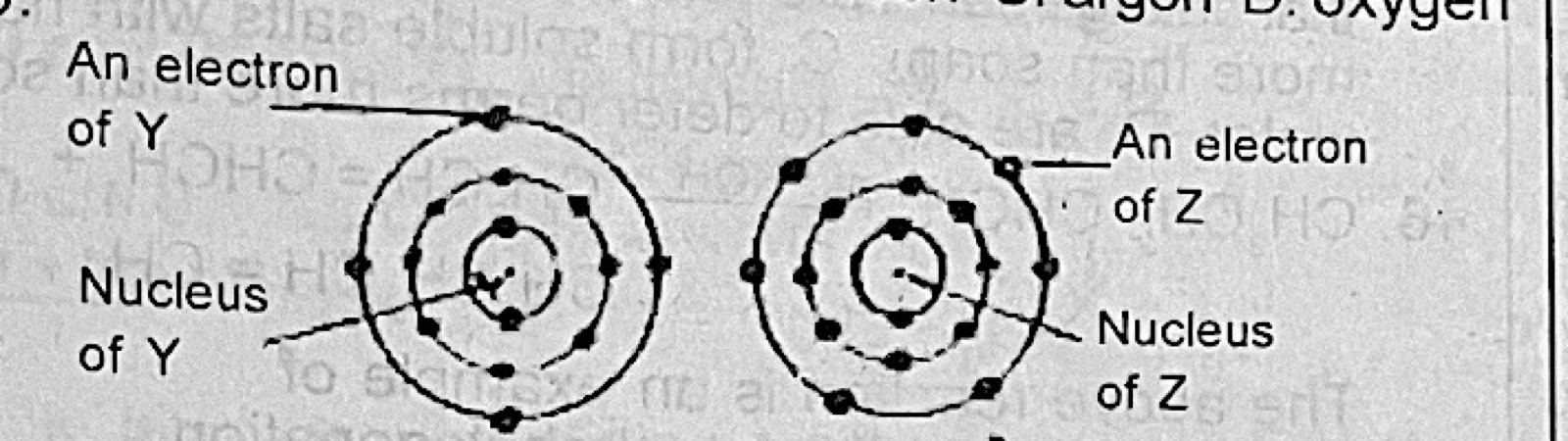
The electrons of two atoms Y and Z are arranged in shells as shown above. The bond formed between the atoms of Y and Z is

Diagram for this question
  1. A.ionic
  2. B.covalent
  3. C.dative
  4. D.metallic.
Show the answer and explanation

Answer: B (covalent)

Explanation

Y has 2,8,4 electrons (silicon) and Z has 2,8,7 (chlorine). Both are non-metals, so they share electrons in covalent bonds (as in SiCl4).

Open this question

Question 16

Environmental Pollution

Which of the following ions is a pollutant in drinking water even in trace amounts?

  1. A.Ca2+
  2. B.Hg2+
  3. C.Mg2+
  4. D.Fe2+
Show the answer and explanation

Answer: B (Hg2+)

Explanation

Mercury(II) ions are poisonous even in tiny amounts. Calcium, magnesium and small amounts of iron ions are harmless.

Open this question

Question 17

Solubility and Solutions

The solubility of copper (II) tetraoxosulphate (VI) is 75 g in 100 g of water at 100°C and 25 g in 100 g of water at 30°C. What mass of the salt would crystallize, if 50 g of copper (II) tetraoxosulphate (VI) solution saturated at 100°C were cooled to 30°C?

  1. A.57.5 g
  2. B.42.9 g
  3. C.28.6 g
  4. D.14.3 g
Show the answer and explanation

Answer: D (14.3 g)

Explanation

175 g of saturated solution at 100°C holds 75 g of salt, and 50 g of solution is 2/7 of that. Cooling 175 g of solution drops 50 g of salt, so 50 g drops 50 × 50/175 = 14.3 g.

Open this question

Question 18

Water

A sample of temporary hard water can be prepared in the laboratory by

  1. A.dissolving calcium chloride in distilled water
  2. B.saturating lime water with carbon (IV) oxide
  3. C.saturating distilled water with calcium hydroxide
  4. D.dissolving sodium hydrogen trioxocarbonate (IV) in some distilled water.
Show the answer and explanation

Answer: B (saturating lime water with carbon (IV) oxide)

Explanation

Excess CO2 in lime water forms calcium hydrogen trioxocarbonate(IV), Ca(HCO3)2, which causes temporary hardness. Calcium chloride gives permanent hardness.

Open this question

Question 19

Solubility and Solutions

A property of a colloidal dispersion which a solution does not have is

  1. A.the Tyndall effect
  2. B.homogeneity
  3. C.osmotic pressure
  4. D.surface polarity
Show the answer and explanation

Answer: A (the Tyndall effect)

Explanation

Colloid particles are big enough to scatter a beam of light (the Tyndall effect); the tiny particles in a true solution do not.

Open this question

Question 20

Halogens

50 cm3 of sulphur (IV) oxide, 800 cm3 of ammonia, 450 cm3 of hydrogen chloride, 1.0cm3 of carbon (IV) oxide will respectively saturate 1.0 cm3 of water at 15°C. Which of the following is suitable for demonstrating the fountain experiment?

  1. A.Sulphur (IV) oxide and hydrogen chloride.
  2. B.Carbon (IV) oxide and ammonia
  3. C.Ammonia and hydrogen chloride
  4. D.Carbon (IV) oxide and sulphur (IV) oxide.
Show the answer and explanation

Answer: C (Ammonia and hydrogen chloride)

Explanation

The fountain experiment needs a gas that dissolves very quickly and in large amounts. Ammonia (800 volumes) and hydrogen chloride (450 volumes) are the most soluble.

Open this question

Question 21

Electrolysis

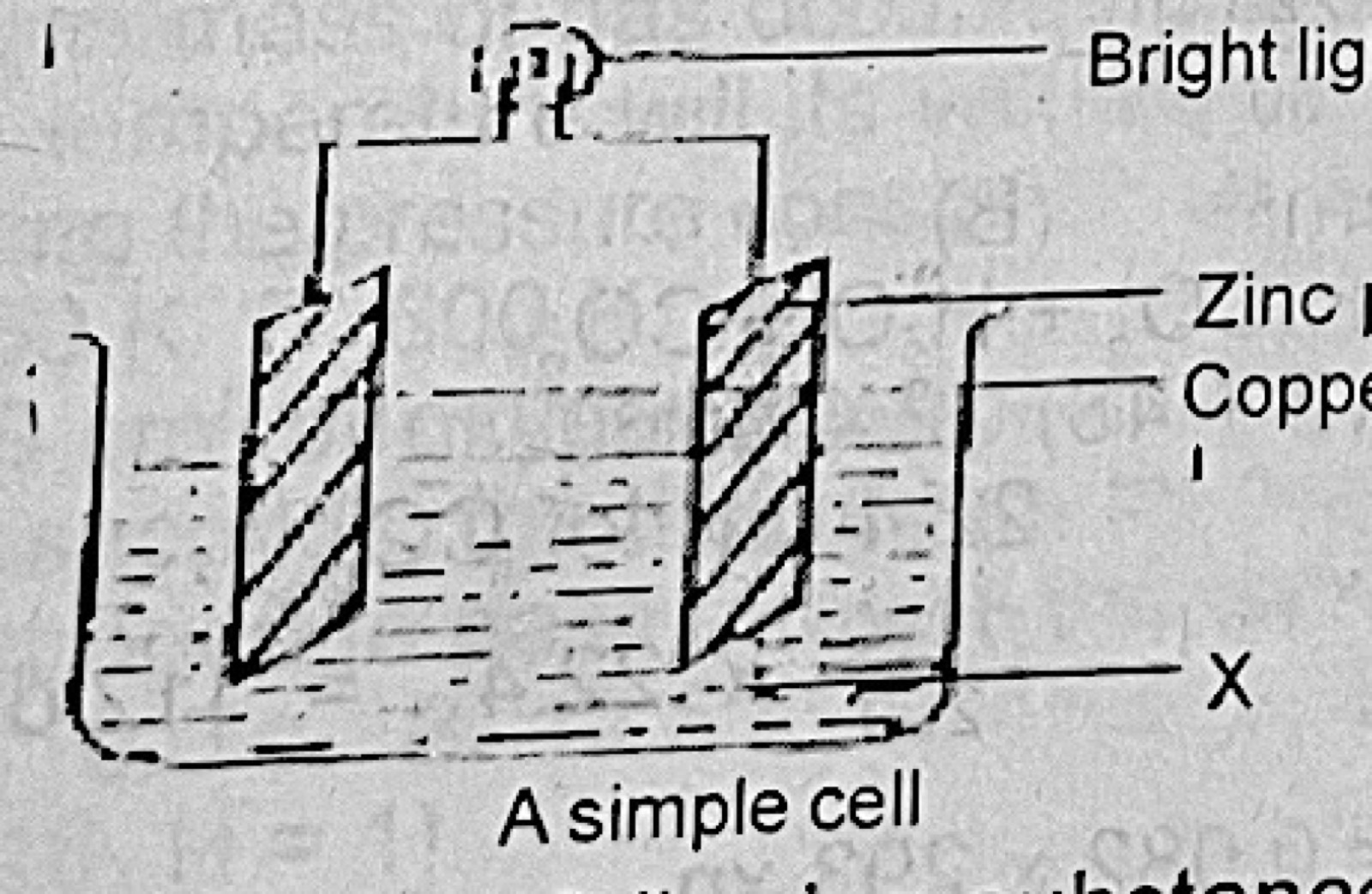
A simple cell (figure above): a zinc plate and a copper plate dip into substance X, connected to a bulb. Which of the following substances could be satisfactorily used as X in the above figure?

Diagram for this question
  1. A.Ammonia and potassium hydroxide
  2. B.Potassium hydroxide and sodium chloride.
  3. C.Ammonia and ethanoic acid
  4. D.Ethanoic acid and sodium chloride.
Show the answer and explanation

Answer: B (Potassium hydroxide and sodium chloride.)

Explanation

X must be an electrolyte that conducts well. Potassium hydroxide and sodium chloride are both strong electrolytes; ammonia and ethanoic acid are only weak electrolytes.

Open this question

Question 22

Mole Concept and Stoichiometry

What volume of CO2 at s.t.p would be obtained by reacting 10 cm3 of 0.1 M solution of anhydrous sodium trioxocarbonate (IV) with excess acid? [G.M.V at s.t.p = 22.4 dm3]

  1. A.2.240 cm3
  2. B.22.40 cm3
  3. C.224.0 cm3
  4. D.2240 cm3.
Show the answer and explanation

Answer: B (22.40 cm3)

Explanation

Moles of Na2CO3 = 0.1 × 10/1000 = 0.001, giving 0.001 mol of CO2. Volume = 0.001 × 22 400 cm3 = 22.4 cm3.

Open this question

Question 23

Electrolysis

If a current of 1.5 A is passed for 4.00 hours through a molten tin salt and 13.3 g of tin is deposited, what is the oxidation state of the metal in the salt? [Sn = 118.7, F = 96500 C mol−1].

  1. A.1
  2. B.2
  3. C.3
  4. D.4
Show the answer and explanation

Answer: B (2)

Explanation

Charge = 1.5 × 4 × 3600 = 21 600 C = 0.224 F. Moles of tin = 13.3 ÷ 118.7 = 0.112. Faradays per mole = 0.224 ÷ 0.112 = 2, so the tin is +2.

Open this question

Question 24

Acids, Bases and Salts

Which of the following equimolar solutions, Na2CO3, Na2SO4, FeCl3, NH4Cl and CH3COONa, have pH greater than 7?

  1. A.FeCl3 and NH4Cl
  2. B.Na2CO3, CH3COONa and Na2SO4
  3. C.Na2CO3 and CH3COONa
  4. D.FeCl3, CH3COONa and NH4Cl.
Show the answer and explanation

Answer: C (Na2CO3 and CH3COONa)

Explanation

Salts of a strong base and a weak acid (Na2CO3, CH3COONa) hydrolyse to give alkaline solutions. Na2SO4 is neutral; FeCl3 and NH4Cl are acidic.

Open this question

Question 25

Redox Reactions

MnO4− + 8H+ + ne → Mn2+ + 4H2O. Which is the value of n in the reaction above?

  1. A.2
  2. B.3
  3. C.4
  4. D.5
Show the answer and explanation

Answer: D (5)

Explanation

Manganese goes from +7 in MnO4− to +2, so it gains 5 electrons. Charges check: −1 + 8 − 5 = +2.

Open this question

Question 26

Redox Reactions

2H2S(g) + SO2(g) → 3S(s) + 2H2O(l). The above reaction is

  1. A.a redox reaction in which H2S is the oxidant and SO2 is the reductant
  2. B.a redox reaction in which SO2 is the oxidant and H2S is the reductant
  3. C.not a redox reaction because there is no oxidant in the reaction equation
  4. D.not a redox because there is no reductant in the reaction equation.
Show the answer and explanation

Answer: B (a redox reaction in which SO2 is the oxidant and H2S is the reductant)

Explanation

Sulphur in SO2 goes from +4 to 0 (reduced, so SO2 is the oxidant) and sulphur in H2S goes from −2 to 0 (oxidized, so H2S is the reductant).

Open this question

Question 27

Rates of Reaction

Manganese (IV) oxide is known to hasten the decomposition of hydrogen peroxide. Its main action is to

  1. A.increase the surface area of the reactants
  2. B.increase the concentration of the reactants
  3. C.lower the activation energy for the reaction
  4. D.lower the heat of reaction, ΔH, for the reaction
Show the answer and explanation

Answer: C (lower the activation energy for the reaction)

Explanation

MnO2 is a catalyst. A catalyst gives the reaction a route with lower activation energy; it does not change ΔH.

Open this question

Question 28

Energy Changes

1.1 g of CaCl2 dissolved in 50 cm3 of water caused a rise in temperature of 3.4°C. The heat of reaction, ΔH for CaCl2 in kJ per mole is [Ca = 40, Cl = 35.5, specific heat of water is 4.18 JK−1].

  1. A.−71.1
  2. B.−4.18
  3. C.+71.1
  4. D.+111.0
Show the answer and explanation

Answer: A (−71.1)

Explanation

Heat given out = 50 × 4.18 × 3.4 ≈ 711 J. Moles of CaCl2 = 1.1 ÷ 111 ≈ 0.01, so ΔH ≈ −0.711 ÷ 0.01 ≈ −71 kJ/mol. It is negative because the temperature rose.

Open this question

Question 29

Chemical Equilibrium

NO(g) + CO(g) ⇌ ½N2(g) + CO2(g) ΔH = −89.3 kJ. What conditions would favour maximum conversion of nitrogen (II) oxide and carbon (II) oxide in the reaction above?

  1. A.Low temperature and high pressure
  2. B.High temperature and low pressure
  3. C.High temperature and high pressure
  4. D.Low temperature and low pressure.
Show the answer and explanation

Answer: A (Low temperature and high pressure)

Explanation

The forward reaction is exothermic, so low temperature favours it. It goes from 2 moles of gas to 1.5 moles, so high pressure also pushes it forward.

Open this question

Question 30

Chemical Equilibrium

Which of the following equilibria is unaffected by a pressure change?

  1. A.2NaCl(s) ⇌ 2Na(l) + Cl2(g)
  2. B.H2(g) + I2(g) ⇌ 2HI(g)
  3. C.2O3(g) ⇌ 3O2(g)
  4. D.2NO2(g) ⇌ N2O4(g).
Show the answer and explanation

Answer: B (H2(g) + I2(g) ⇌ 2HI(g))

Explanation

In H2 + I2 ⇌ 2HI there are 2 moles of gas on each side, so changing the pressure does not shift the equilibrium.

Open this question

Question 31

Rates of Reaction

Initial concentration of NO in moles: 0.001, initial rate (moles / sec): 3.0 × 10⁻⁵
Initial concentration of NO in moles: 0.002, initial rate (moles / sec): 1.2 × 10⁻⁴
The data in the table above shows the rate of reaction of nitrogen (II) oxide with chlorine at 25°C. It can be concluded that doubling the initial concentration of NO increases the rate of reaction by a factor of

  1. A.two
  2. B.three
  3. C.four
  4. D.five
Show the answer and explanation

Answer: C (four)

Explanation

1.2 × 10⁻⁴ ÷ 3.0 × 10−5 = 4, so the rate becomes four times faster.

Open this question

Question 32

Nitrogen and its Compounds

Which of the following gases will rekindle a brightly glowing splint?

  1. A.NO2
  2. B.NO
  3. C.N2O
  4. D.Cl2.
Show the answer and explanation

Answer: C (N2O)

Explanation

Dinitrogen(I) oxide breaks down at the heat of the glowing splint, releasing oxygen that relights it.

Open this question

Question 33

Metals and their Compounds

Which of the following salts can be melted without decomposition?

  1. A.Na2CO3
  2. B.CaCO3
  3. C.MgCO3
  4. D.ZnCO3.
Show the answer and explanation

Answer: A (Na2CO3)

Explanation

Sodium trioxocarbonate(IV) is thermally stable and melts without breaking down. The carbonates of calcium, magnesium and zinc decompose to the oxide and CO2 on heating.

Open this question

Question 34

Hydrogen, Oxygen and Oxides

Oxygen gas can be prepared by heating

  1. A.ammonium trioxonitrate (V)
  2. B.ammonium trioxonitrate (III)
  3. C.potassium trioxonitrate (V)
  4. D.manganese (IV) oxide.
Show the answer and explanation

Answer: C (potassium trioxonitrate (V))

Explanation

Heating potassium nitrate gives oxygen: 2KNO3 → 2KNO2 + O2. Ammonium nitrate gives N2O and ammonium nitrite gives N2.

Open this question

Question 36

Metals and their Compounds

Addition of aqueous ammonia to a solution of Zn2+ gives a white precipitate which dissolves in an excess of ammonia because

  1. A.zinc is amphoteric
  2. B.zinc hydroxide is readily soluble
  3. C.zinc forms a complex which is readily soluble in excess ammonia
  4. D.ammonia solution is a strong base.
Show the answer and explanation

Answer: C (zinc forms a complex which is readily soluble in excess ammonia)

Explanation

Zn(OH)2 reacts with excess ammonia to form the soluble complex ion [Zn(NH3)4]2+.

Open this question

Question 37

Carbon and its Compounds

Which of the following, in clear solution, forms a white precipitate when carbon (IV) oxide is bubbled into it for a short time?

  1. A.KOH
  2. B.NaOH
  3. C.Ca(OH)2
  4. D.Al(OH)3.
Show the answer and explanation

Answer: C (Ca(OH)2)

Explanation

Lime water, Ca(OH)2, turns milky with CO2 because insoluble CaCO3 forms. Potassium and sodium carbonates are soluble.

Open this question

Question 38

Metals and their Compounds

Copper (II) tetraoxosulphate (VI) is widely used as a

  1. A.fertilizer
  2. B.fungicide
  3. C.disinfectant
  4. D.purifier
Show the answer and explanation

Answer: B (fungicide)

Explanation

Copper(II) sulphate kills fungi, so it is sprayed on crops as a fungicide, often as Bordeaux mixture with lime.

Open this question

Question 39

Metals and their Compounds

Which of the following metals can be prepared in samples by the thermal decomposition of their trioxonitrate (V) salts?

  1. A.Copper and mercury
  2. B.Silver and copper
  3. C.Mercury and silver
  4. D.Magnesium and mercury
Show the answer and explanation

Answer: C (Mercury and silver)

Explanation

Nitrates of metals low in the activity series, such as mercury and silver, decompose all the way to the metal. Copper and magnesium nitrates leave the oxide.

Open this question

Question 40

Introduction to Organic Chemistry

Which of the following compounds can exist as geometric isomers?

  1. A.2-methylbut-2-ene.
  2. B.But-2-ene
  3. C.But-1-ene
  4. D.CI—C—Br with I above and I below the carbon
Show the answer and explanation

Answer: B (But-2-ene)

Explanation

Geometric (cis–trans) isomers need two different groups on each carbon of the C=C. But-2-ene has CH3 and H on each carbon; the others have two identical groups on one carbon or no C=C.

Open this question

Question 41

Introduction to Organic Chemistry

How many structural isomers can be written for the alkyl bromide, C4H9Br?

  1. A.3
  2. B.4
  3. C.6
  4. D.8
Show the answer and explanation

Answer: B (4)

Explanation

The isomers are 1-bromobutane, 2-bromobutane, 1-bromo-2-methylpropane and 2-bromo-2-methylpropane: four.

Open this question

Question 42

Hydrocarbons

The final products of the reaction between methane and chlorine in the presence of ultraviolet light are hydrogen chloride and

  1. A.chloromethane
  2. B.tetrachloromethane
  3. C.trichloromethane
  4. D.dichloromethane
Show the answer and explanation

Answer: B (tetrachloromethane)

Explanation

Substitution continues until all four hydrogens are replaced, so the final organic product is tetrachloromethane, CCl4.

Open this question

Question 43

Hydrocarbons

How many grams of bromine will be required to completely react with 10 g of propyne? [C = 12, H = 1, Br = 80].

  1. A.20g
  2. B.40 g
  3. C.60 g
  4. D.80 g
Show the answer and explanation

Answer: D (80 g)

Explanation

C3H4 (40 g/mol) adds 2Br2 (320 g). 10 g of propyne is 0.25 mol, which needs 0.5 mol of Br2 = 80 g.

Open this question

Question 44

Alkanols

Ethene when passed into concentrated H2SO4 is rapidly absorbed. The product is diluted with water and then warmed to produce

  1. A.ethanol
  2. B.diethyl ether
  3. C.ethanal
  4. D.diethyl sulphate
Show the answer and explanation

Answer: A (ethanol)

Explanation

Ethene forms ethyl hydrogen sulphate with the acid. Warming this with water hydrolyses it to ethanol.

Open this question

Question 45

Fats, Oils and Soaps

One of the advantages of detergents over soap is that detergents

  1. A.are easier to manufacture
  2. B.foam more than soap
  3. C.form soluble salts with hard water
  4. D.are able to deter germs more than soap.
Show the answer and explanation

Answer: C (form soluble salts with hard water)

Explanation

Soap forms an insoluble scum with calcium and magnesium ions in hard water. Detergents form soluble salts, so they still lather in hard water.

Open this question

Question 46

Hydrocarbons

CH3CH2CHXCH3 (alc. KOH) → CH3CH = CHCH3 + CH3CH2CH = CH2
The above reaction is an example of

  1. A.dehydration
  2. B.dehydrohalogenation
  3. C.neutralization
  4. D.a fission reaction
Show the answer and explanation

Answer: B (dehydrohalogenation)

Explanation

Alcoholic KOH removes H and the halogen X from neighbouring carbons to form an alkene. Removing a hydrogen halide is dehydrohalogenation.

Open this question

Question 47

Alkanols

A certain liquid has a high boiling point. It is viscous, non-toxic, miscible with water being very hygroscopic. This liquid is most likely to be

  1. A.CH3CH2CH2OH
  2. B.CH3CHOHCH3
  3. C.CH3CH2CHOHCH3
  4. D.CH2OHCHOHCH2OH
Show the answer and explanation

Answer: D (CH2OHCHOHCH2OH)

Explanation

Glycerol (propane-1,2,3-triol) has three –OH groups, giving strong hydrogen bonding. That makes it viscous, high-boiling, hygroscopic and fully miscible with water.
Open this question

Question 48

Introduction to Organic Chemistry

The compound CH3—CH(CH2Cl)—CH3 is known as

  1. A.1-chloro-2-methylbutane
  2. B.1-chloro-2-methylpropane
  3. C.2-chloromethylpropane
  4. D.1-chloro-2, 2-dimethylethane
Show the answer and explanation

Answer: B (1-chloro-2-methylpropane)

Explanation

The longest chain is three carbons including the CH2Cl carbon. Cl is on C1 and a methyl group is on C2: 1-chloro-2-methylpropane.

Open this question

Question 49

Fats, Oils and Soaps

Which of the following statements is TRUE of the complete hydrolysis of a glycerine by sodium hydroxide?

  1. A.3 moles of NaOH are required for each mole of glyceride
  2. B.3 moles of glycerol are produced.
  3. C.Only one mole of soap is formed.
  4. D.Concentrated H2SO4 is essential for the completion of the reaction.
Show the answer and explanation

Answer: A (3 moles of NaOH are required for each mole of glyceride)

Explanation

A glyceride (fat) has three ester groups, so each mole needs 3 moles of NaOH, giving 1 mole of glycerol and 3 moles of soap.

Open this question

Question 50

Alkanoic Acids and Esters

Which of the following are the products of the reaction between CH3COOH and Cl2 in sunlight?

  1. A.ClCH2COOH + HCl
  2. B.CH3COCl + HOCl
  3. C.CH3COOCl + HCl
  4. D.CH3COCl + H2O.
Show the answer and explanation

Answer: A (ClCH2COOH + HCl)

Explanation

In sunlight chlorine substitutes a hydrogen on the CH3 group, giving chloroethanoic acid, ClCH2COOH, and HCl.

Open this question