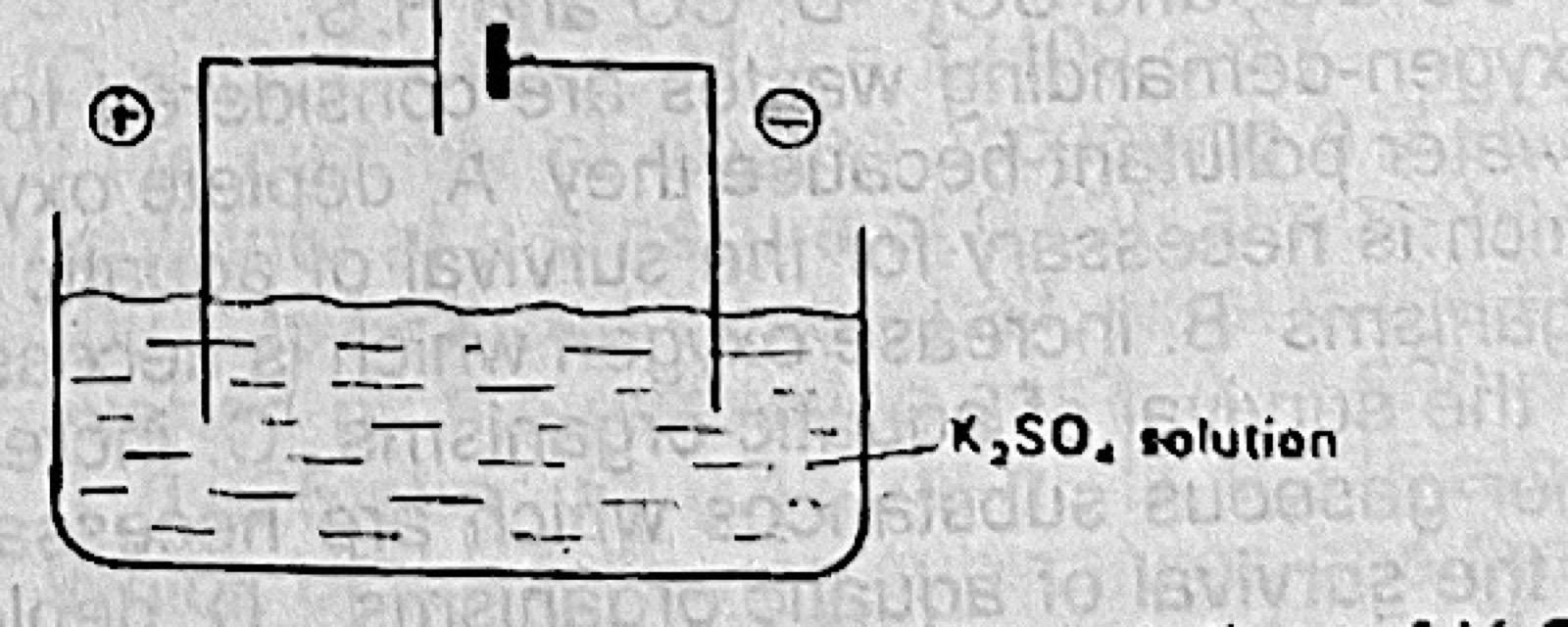
What mass of a divalent metal M (atomic mass = 40) would react with excess hydrochloric acid to liberate 224 cm3 of dry hydrogen gas measured at S.T.P? [G.M.V = 22.4 dm3]
A.8.0 g
B.4.0 g
C.0.8 g
D.0.4 g
Show the answer and explanation
Answer: D (0.4 g)
Explanation
M + 2HCl → MCl2 + H2, so 1 mol of M gives 1 mol of H2. 224 cm3 is 0.01 mol of H2, so 0.01 × 40 = 0.4 g of M is needed.
10 cm3 of hydrogen fluoride gas reacts with 5 cm3 of dinitrogen difluoride gas (N2F2) to form 10 cm3 of a single gas. Which of the following is the most likely equation of the reaction?
A.HF + N2F2 → N2HF3
B.2HF + N2F2 → 2NHF2
C.2HF + N2F2 → N2H2F4
D.HF + 2N2F2 → N4HF5.
Show the answer and explanation
Answer: B (2HF + N2F2 → 2NHF2)
Explanation
By Gay-Lussac's law the volumes 10 : 5 : 10 give the mole ratio 2 : 1 : 2. Only 2HF + N2F2 → 2NHF2 has this ratio and is balanced.
200 cm3 of oxygen diffuse through a porous plug in 50 seconds. How long will 80 cm3 of methane (CH4) take to diffuse through the same porous plug under the same conditions? [C = 12, O = 16, H = 1].
A.40 sec
B.20 sec
C.14 sec
D.7 sec.
Show the answer and explanation
Answer: C (14 sec)
Explanation
Oxygen's rate is 200/50 = 4 cm3/s. By Graham's law methane is √(32/16) = 1.414 times faster, about 5.66 cm3/s, so 80 cm3 takes 80/5.66 ≈ 14 s.
Which of the following groups of physical properties increases from left to right of the Periodic Table? 1 Ionization energy 2 Atomic radius 3 Electronegativity 4 Electron affinity
A.1 and 2
B.1, 2 and 3
C.3 and 4
D.1,2,3 and 4.
Show the answer and explanation
Answer: C (3 and 4)
Explanation
Across a period the nuclear charge rises, so electronegativity and electron affinity increase while atomic radius decreases. Every option except C includes atomic radius, which does not increase.
When 50 cm3 of a saturated solution of sugar (molar mass 342.0 g) at 40°C was evaporated to dryness, 34.2 g of dry solid was obtained. The solubility of sugar at 40°C is
A.10.0 moles dm−3
B.7.0 moles dm−3
C.3.5 moles dm−3
D.2.0 moles dm−3
Show the answer and explanation
Answer: D (2.0 moles dm−3)
Explanation
34.2 g is 0.1 mol of sugar in 50 cm3. In 1000 cm3 that is 0.1 × 20 = 2.0 mol, so the solubility is 2.0 mol dm−3.
20 cm3 of 0.1 molar NH4OH solution when neutralized with 20.05cm3 of 0.1 molar HCl liberated 102 joules of heat. Calculate the heat of neutralization of NH4OH
A.−51.0 KJ mol−1
B.+57.3 KJ mol−1
C.+57.0 kJ mol−1
D.+51.0 kJ mol−1.
Show the answer and explanation
Answer: A (−51.0 KJ mol−1)
Explanation
Moles of NH4OH = 0.020 × 0.1 = 0.002 mol. 102 J / 0.002 = 51000 J = 51.0 kJ per mole, and since heat was given out, ΔH = −51.0 kJ mol−1.
What is the consequence of increasing pressure on the equilibrium reaction ZnO(s) + H2(g) ⇌ Zn(s) + H2O(l)?
A.The equilibrium is driven to the left
B.The equilibrium is driven to the right
C.There is no effect
D.More ZnO(s) is produced.
Show the answer and explanation
Answer: B (The equilibrium is driven to the right)
Explanation
Increasing pressure favours the side with fewer gas molecules. There is one mole of gas (H2) on the left and none on the right, so the equilibrium moves to the right.
Which of the following contains an efflorescent, a deliquescent and a hygroscopic substance respectively?
A.Na2SO4, concentrated H2SO4, CaCl2
B.Na2CO3.H2O, FeSO4.7H2O, concentrated H2SO4
C.Na2CO3.10H2O, FeCl3, concentrated H2SO4
D.Concentrated H2SO4, FeSO4.7H2O, MgCl2.
Show the answer and explanation
Answer: C (Na2CO3.10H2O, FeCl3, concentrated H2SO4)
Explanation
Washing soda (Na2CO3.10H2O) loses water to the air (efflorescent), FeCl3 absorbs water until it dissolves (deliquescent), and concentrated H2SO4 absorbs water without dissolving into a solution of a solid (hygroscopic).
The tabulated results below were obtained by titrating 10.0 cm3 of water with soap. The titration was repeated with the same sample of water after boiling. Before boiling: Final (cm3) 25.0, Initial (cm3) 0.0 After boiling: Final (cm3) 20.0, Initial (cm3) 15.0 The ratio of permanent to temporary hardness is
A.1:5
B.1:4
C.4:1
D.5:1
Show the answer and explanation
Answer: B (1:4)
Explanation
Boiling removes only temporary hardness, so the 5.0 cm3 titre after boiling measures permanent hardness. Temporary hardness = 25.0 − 5.0 = 20.0, giving permanent : temporary = 5 : 20 = 1 : 4.
In the course of an experiment, two gases X and Y were produced. X turned wet lead ethanoate to black and Y bleached moist litmus paper. What are the element(s) in each of the gases X and Y respectively?
A.H and S;Cl
B.H and O;Cl
C.H and S;C and O
D.H and Cl;S and O.
Show the answer and explanation
Answer: A (H and S;Cl)
Explanation
X blackens lead ethanoate paper, so it is hydrogen sulphide (H and S). Y bleaches moist litmus, so it is chlorine (Cl).
Which of the following sulphides is insoluble in dilute HCl?
A.Na2S
B.ZnS
C.CuS
D.FeS
Show the answer and explanation
Answer: C (CuS)
Explanation
Copper (II) sulphide is so insoluble that dilute acid does not dissolve it (it is precipitated from acid solution in group analysis). Na2S, ZnS and FeS dissolve, giving H2S.
A substance Z reacts with NaOH to give salt and water only. When Z is treated with dilute HCl, a gas is evolved which gives a yellow suspension on passing into concentrated H2SO4. Substance Z is
A.NaHS
B.Na2SO3
C.Na2S
D.NaHSO3
Show the answer and explanation
Answer: A (NaHS)
Explanation
Z reacts with NaOH, so it is an acid salt. With HCl it gives H2S, which concentrated H2SO4 oxidises to yellow sulphur, so Z is NaHS.
Which of the following does NOT contain aluminium as a component?
A.Over-head cables
B.Duralumin
C.Container for caustic soda
D.Container for nitric acid
Show the answer and explanation
Answer: C (Container for caustic soda)
Explanation
Aluminium reacts with sodium hydroxide solution, so it cannot hold caustic soda. It is used for overhead cables, in the alloy duralumin and for nitric acid containers.
A white solid suspected to be lead trioxonitrate (V), zinc trioxocarbonate (IV) or calcium trioxocarbonate (IV) was heated strongly. Its residue which was yellow when hot and white when cold is
A.lead (II) oxide
B.calcium oxide
C.zinc oxide
D.lead nitrate
Show the answer and explanation
Answer: C (zinc oxide)
Explanation
Zinc oxide is the residue that is yellow when hot and white when cold. Lead (II) oxide is reddish-brown hot and yellow cold, and calcium oxide stays white.
Which of the following is NOT a correct test for the named organic compound in each case?
A.Butanoic acid solution gives effervescence with Na2CO3 solution
B.Glucose when reacted with Na2CrO4 at 0°C will show immediate discharge of colour
C.When but-2-ene is reacted with dilute solution of KMnO4 the purple colour of KMnO4 is discharged readily even at room temperature.
D.When butan-2-ol is boiled with butanoic acid with a drop of concentrated H2SO4 a sweet smelling liquid is produced.
Show the answer and explanation
Answer: B (Glucose when reacted with Na2CrO4 at 0°C will show immediate discharge of colour)
Explanation
Glucose is not tested this way: it does not instantly discharge the colour of a chromate at 0°C (it is tested with Fehling's or Benedict's solution). The other three are correct tests.
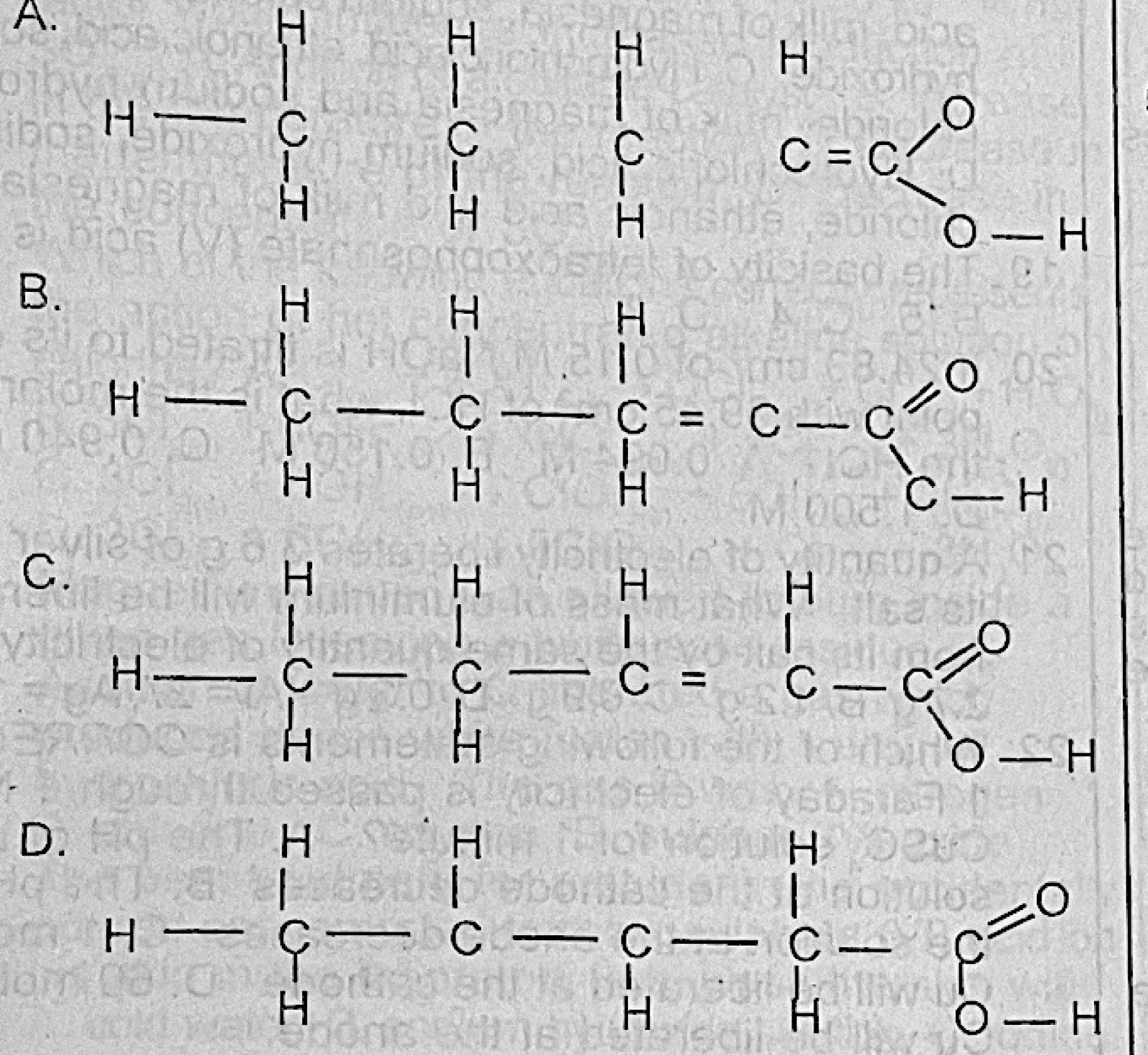
Which is the structural formula for pent-2-enoic acid?
A.Structure A
B.Structure B
C.Structure C
D.Structure D
Show the answer and explanation
Answer: C (Structure C)
Explanation
Pent-2-enoic acid is CH3CH2CH=CHCOOH: five carbons, a –COOH group, and a C=C between carbons 2 and 3 counting from the COOH carbon. Structure C shows this; B ends in a ketone group, not –COOH, and D has no double bond.