WAEC Mathematics 2015 past questions and answers

63 questions. Try each one, then open the answer to check yourself and read the explanation.

Question 1

Modular Arithmetic

If {x: 2 ≤ x ≤ 18; x ∈ integer} and 7 + x = 4(mod 9), find the highest value of x.

  1. A.2
  2. B.5
  3. C.15
  4. D.18
Show the answer and explanation

Answer: C (15)

Explanation

7 + x ≡ 4 (mod 9) gives x ≡ 6 (mod 9), so x = 6 or 15 in the range. The highest is 15.

Open this question

Question 2

Number Bases

The sum of 110112, 111112 and 100002 is 10m10n02. Find the values of m and n.

  1. A.m = 0, n = 0
  2. B.m = 1, n = 0
  3. C.m = 0, n = 1
  4. D.m = 1, n = 1
Show the answer and explanation

Answer: C (m = 0, n = 1)

Explanation

In base ten the sum is 27 + 31 + 16 = 74 = 10010102. Matching 10m10n0 gives m = 0 and n = 1.

Open this question

Question 3

Commercial Arithmetic

A trader bought an engine for $15,000.00 outside Nigeria. If the exchange rate is $0.075 to N1.00, how much did the engine cost in naira?

  1. A.N250,000.00
  2. B.N200,000.00
  3. C.N150,000.00
  4. D.N100,000.00
Show the answer and explanation

Answer: B (N200,000.00)

Explanation

Each naira buys $0.075, so the cost is 15 000 ÷ 0.075 = N200,000.

Open this question

Question 4

Indices

If (27x × 31−x)/92x = 1, find the value of x.

  1. A.1
  2. B.½
  3. C.−½
  4. D.−1
Show the answer and explanation

Answer: B (½)

Explanation

Write everything as powers of 3: 33x + 1 − x − 4x = 30, so 1 − 2x = 0 and x = ½.

Open this question

Question 5

Progressions

Find the 7th term of the sequence: 2, 5, 10, 17, 26……

  1. A.37
  2. B.48
  3. C.50
  4. D.63
Show the answer and explanation

Answer: C (50)

Explanation

The terms are n² + 1, so the 7th term is 49 + 1 = 50 (the differences 3, 5, 7, 9, 11, 13 also give 37 + 13 = 50).

Open this question

Question 6

Logarithms

Given that logx 64 = 3, evaluate x log28.

  1. A.6
  2. B.9
  3. C.12
  4. D.24
Show the answer and explanation

Answer: C (12)

Explanation

x³ = 64 so x = 4, and log28 = 3, so x log28 = 4 × 3 = 12.

Open this question

Question 7

Indices

If 2n = y, find 2(2+n/3)

  1. A.4y1/3
  2. B.4y−3
  3. C.2y1/3
  4. D.2y−3
Show the answer and explanation

Answer: A (4y1/3)

Explanation

22 + n/3 = 2² × (2n)1/3 = 4y1/3.

Open this question

Question 8

Algebraic Expressions

Factorize completely: 6ax − 12by − 9ay + 8bx.

  1. A.(2a − 3b)(4x + 3y)
  2. B.(3a + 4b)(2x − 3y)
  3. C.(3a − 4b)(2x + 3y)
  4. D.(2a + 3b)(4x − 3y)
Show the answer and explanation

Answer: B ((3a + 4b)(2x − 3y))

Explanation

Group as 6ax − 9ay + 8bx − 12by = 3a(2x − 3y) + 4b(2x − 3y) = (3a + 4b)(2x − 3y).

Open this question

Question 9

Quadratic Equations

Find the equation whose roots are ¾ and −4.

  1. A.4x2 − 13x + 12 = 0
  2. B.4x2 − 13x − 12 = 0
  3. C.4x2 + 13x − 12 = 0
  4. D.4x2 + 13x + 12 = 0
Show the answer and explanation

Answer: C (4x2 + 13x − 12 = 0)

Explanation

(4x − 3)(x + 4) = 0 expands to 4x² + 13x − 12 = 0.

Open this question

Question 10

Fractions, Decimals and Approximation

If m = 4, n = 9 and r = 16, evaluate m/n − 17/9 + n/r

  1. A.15/16
  2. B.11/16
  3. C.5/16
  4. D.−37/48
Show the answer and explanation

Answer: D (−37/48)

Explanation

4/9 − 16/9 + 9/16 = −4/3 + 9/16 = (−64 + 27)/48 = −37/48.

Open this question

Question 11

Quadratic Equations

Adding 42 to a given positive number gives the same result as squaring the number. Find the number.

  1. A.14
  2. B.13
  3. C.7
  4. D.6
Show the answer and explanation

Answer: C (7)

Explanation

x² = x + 42 gives (x − 7)(x + 6) = 0; the positive number is 7.

Open this question

Question 12

Graphs of Functions

Ada draws the graphs of y = x2 − x − 2 and y = 2x − 1 on the same axes. Which of these equations is she solving?

  1. A.x2 − x − 30 = 0
  2. B.x2 − 3x − 1 = 0
  3. C.x2 − 3x − 3 = 0
  4. D.x2 + 3x − 1 = 0
Show the answer and explanation

Answer: B (x2 − 3x − 1 = 0)

Explanation

Where the graphs meet, x² − x − 2 = 2x − 1, i.e. x² − 3x − 1 = 0.

Open this question

Question 13

Mensuration of Solids

The volume of a cone of height 3 cm is 38½ cm3. Find the radius of its base. [Take π = 22/7]

  1. A.3.0 cm
  2. B.3.5 cm
  3. C.4.0 cm
  4. D.4.5 cm
Show the answer and explanation

Answer: B (3.5 cm)

Explanation

⅓ × 22/7 × r² × 3 = 38.5 gives r² = 12.25, so r = 3.5 cm.

Open this question

Question 14

Mensuration of Plane Shapes

A sector of a circle with radius 6 cm subtends an angle of 60° at the centre. Calculate its perimeter in terms of π.

  1. A.2(π + 6) cm
  2. B.2(π + 3) cm
  3. C.2(π + 2) cm
  4. D.(π + 12) cm
Show the answer and explanation

Answer: A (2(π + 6) cm)

Explanation

Arc = 60/360 × 2π × 6 = 2π. Perimeter = 6 + 6 + 2π = 2(π + 6) cm.

Open this question

Question 15

Mensuration of Solids

The dimensions of a rectangular tank are 2 m by 7 m by 11 m. If its volume is equal to that of a cylindrical tank of height 4cm, calculate the base radius of the cylindrical tank. [Take π = 22/7]

  1. A.14 m
  2. B.7 m
  3. C.3½ m
  4. D.1¾ m
Show the answer and explanation

Answer: C (3½ m)

Explanation

Volume = 2 × 7 × 11 = 154 m³. 22/7 × r² × 4 = 154 gives r² = 12.25, so r = 3½ m (the height must be 4 m).

Open this question

Question 16

Circle Theorems

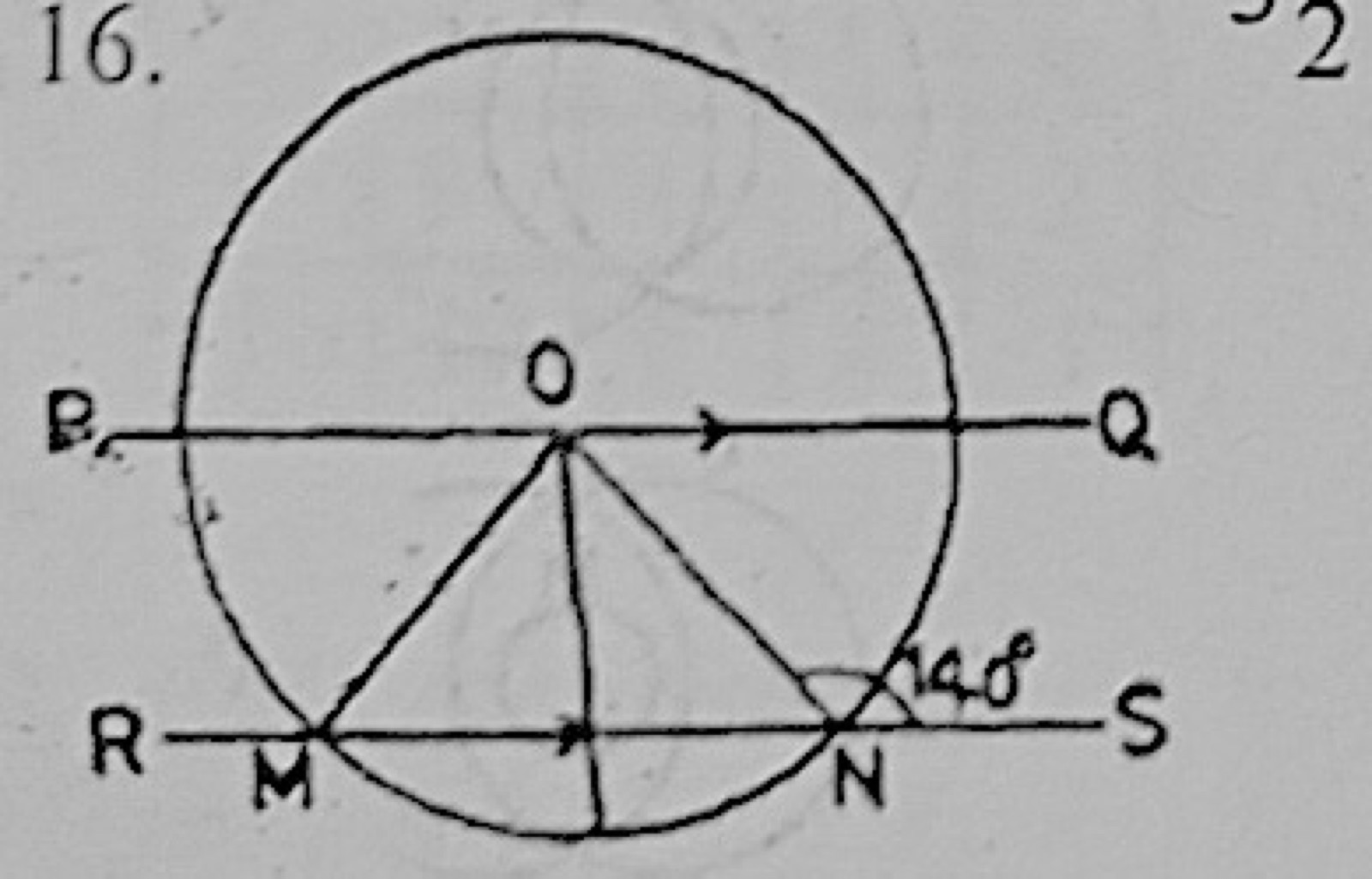
In the diagram, O is the centre of the circle. If PQ//RS and ∠ONS = 140°, find the size of ∠POM.

Diagram for this question
  1. A.40°
  2. B.50°
  3. C.60°
  4. D.80°
Show the answer and explanation

Answer: A (40°)

Explanation

∠ONM = 180° − 140° = 40°. OM = ON (radii), so ∠OMN = 40°, and ∠POM = ∠OMN = 40° (alternate angles, PQ//RS).

Open this question

Question 17

Circle Theorems

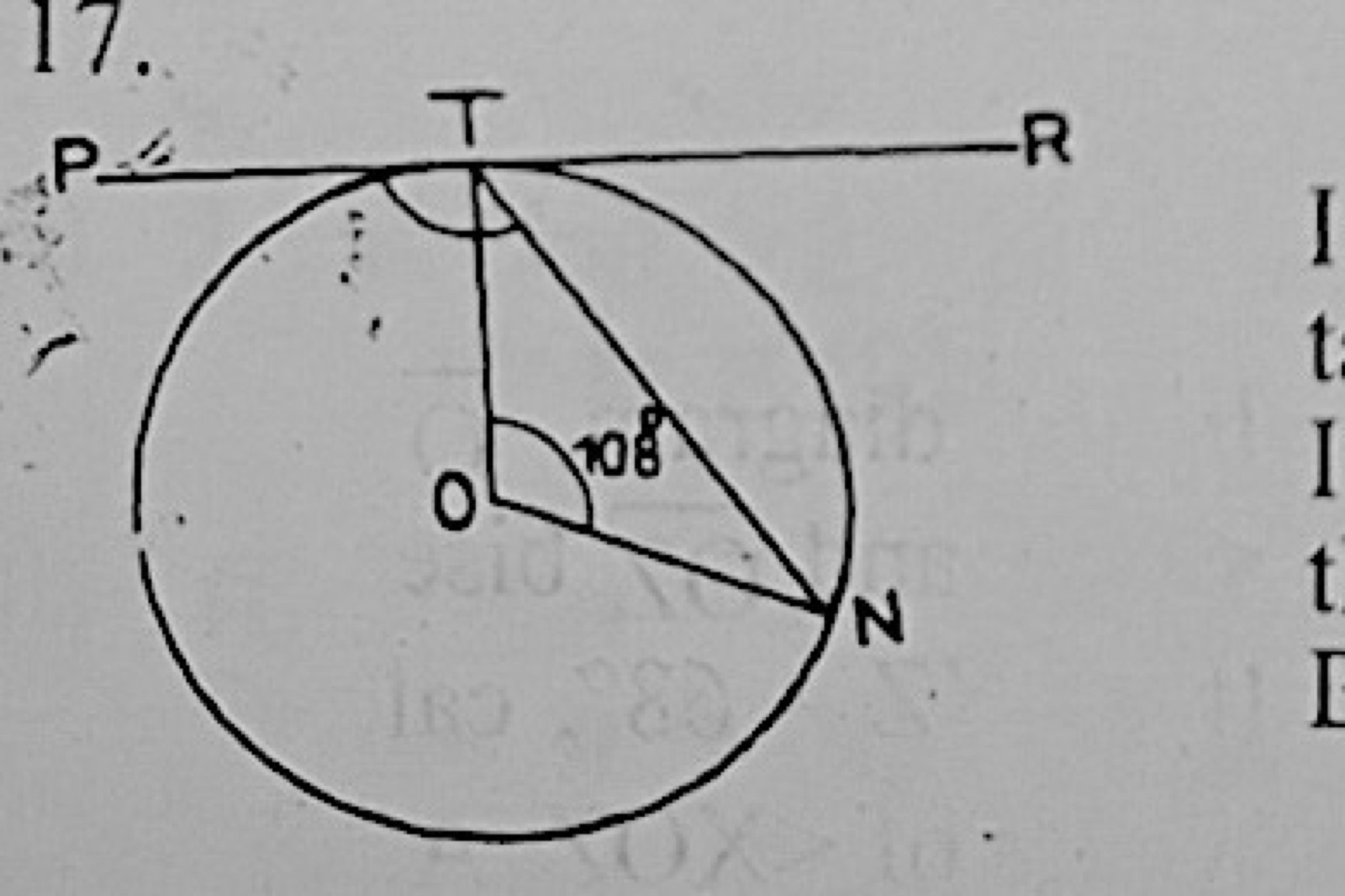
In the diagram, PTR is a tangent to the circle centre O. If angle TON = 108°, calculate the size of angle PTN.

Diagram for this question
  1. A.132°
  2. B.126°
  3. C.108°
  4. D.102°
Show the answer and explanation

Answer: B (126°)

Explanation

Triangle TON is isosceles, so ∠OTN = (180° − 108°)/2 = 36°. The radius OT meets the tangent at 90°, so ∠PTN = 90° + 36° = 126°.

Open this question

Question 18

Angles and Polygons

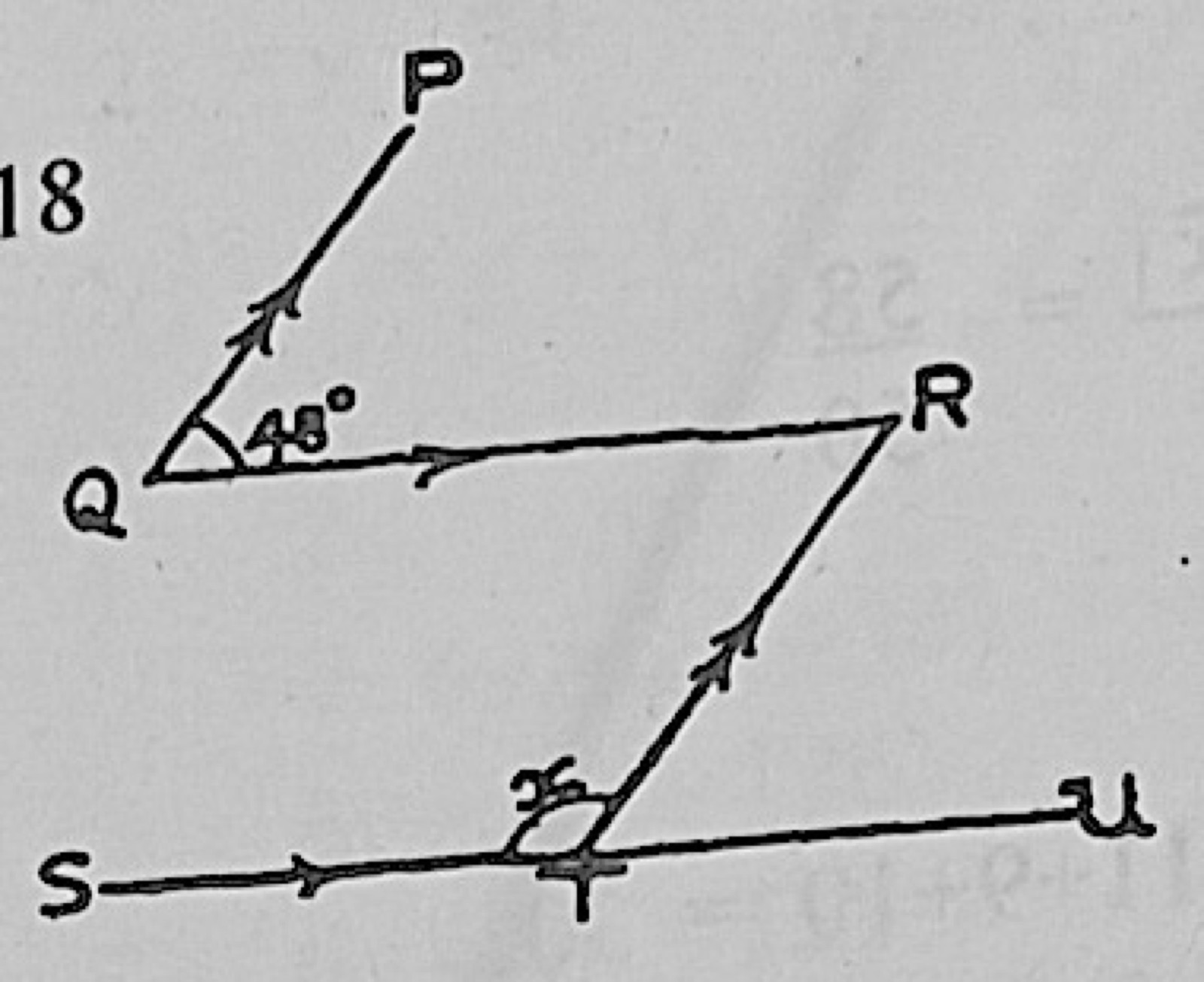
In the diagram, PQ//RT, QR//SU, ∠PQR = 48° and ∠RTS = x. Find the value of x.

Diagram for this question
  1. A.134°
  2. B.132°
  3. C.96°
  4. D.48°
Show the answer and explanation

Answer: B (132°)

Explanation

∠QRT = ∠PQR = 48° (alternate angles, PQ//RT). Since QR//SU, ∠RTS and ∠QRT are co-interior, so x = 180° − 48° = 132°.

Open this question

Question 19

Circle Theorems

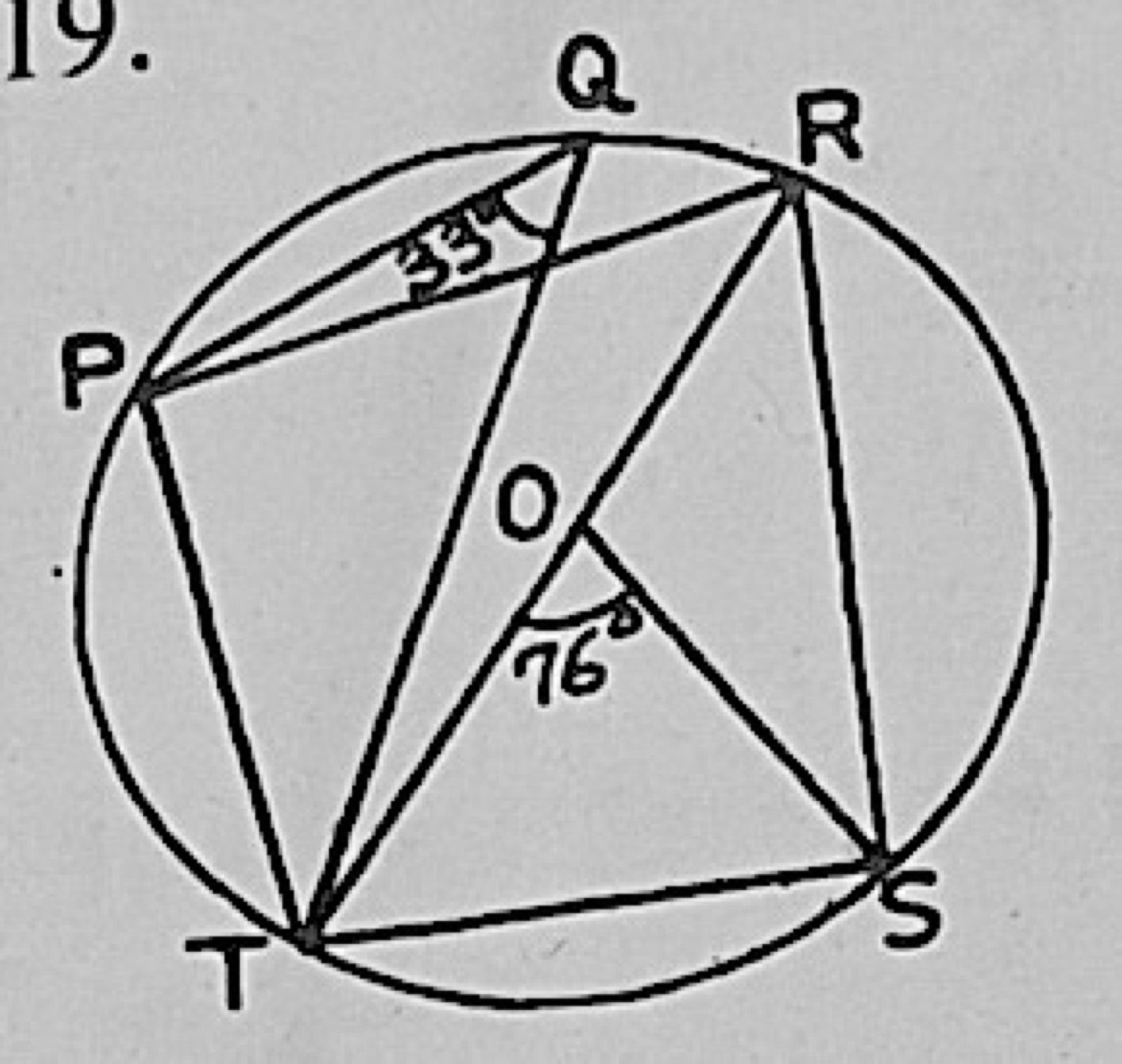
In the diagram, O is the centre of the circle, RT is a diameter, ∠PQT = 33° and ∠TOS = 76°. Calculate the value of angle PTR.

Diagram for this question
  1. A.73°
  2. B.67°
  3. C.57°
  4. D.37°
Show the answer and explanation

Answer: C (57°)

Explanation

∠TPR = 90° (angle in a semicircle) and ∠PRT = ∠PQT = 33° (same segment), so ∠PTR = 180° − 90° − 33° = 57°.

Open this question

Question 20

Circle Theorems

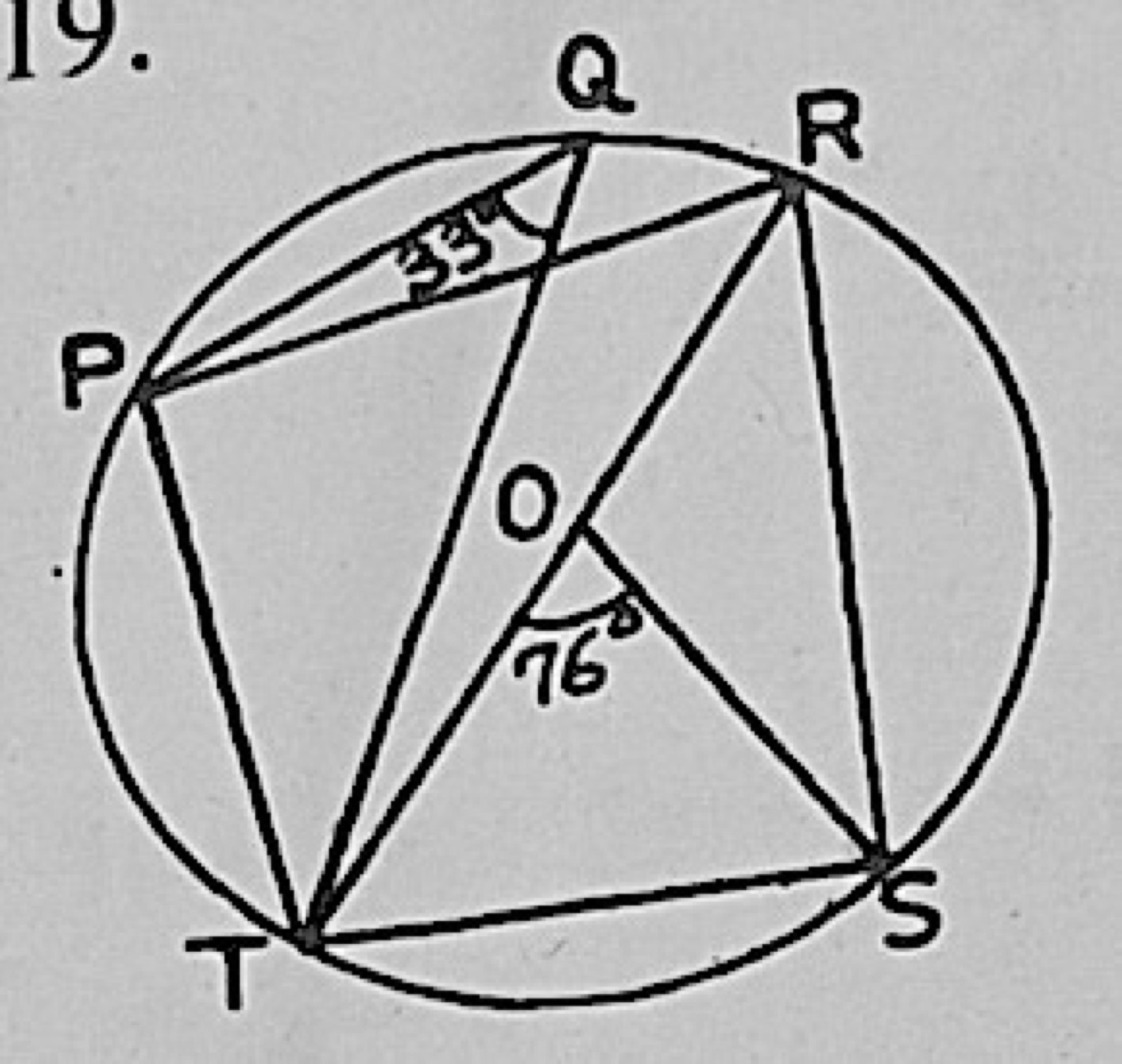
In the diagram, O is the centre of the circle, RT is a diameter, ∠PQT = 33° and ∠TOS = 76°. Find the size of angle PRS.

Diagram for this question
  1. A.76°
  2. B.71°
  3. C.38°
  4. D.33°
Show the answer and explanation

Answer: B (71°)

Explanation

∠PRT = ∠PQT = 33° (same segment) and ∠TRS = ½ × ∠TOS = 38° (angle at centre is twice angle at circumference), so ∠PRS = 33° + 38° = 71°.

Open this question

Question 21

Coordinate Geometry

The table shows some values for a linear graph.
x: 0, 1¼, 2, 4
y: 3, 5½, __, __
Find the gradient of the line.

  1. A.1
  2. B.2
  3. C.3
  4. D.4
Show the answer and explanation

Answer: B (2)

Explanation

Gradient = (5½ − 3)/(1¼ − 0) = 2½ ÷ 1¼ = 2.

Open this question

Question 22

Coordinate Geometry

The table shows some values for a linear graph.
x: 0, 1¼, 2, 4
y: 3, 5½, __, __
What is the value of y when x = 2?

  1. A.5
  2. B.7
  3. C.9
  4. D.11
Show the answer and explanation

Answer: B (7)

Explanation

The line has gradient 2 and y-intercept 3, so y = 2x + 3 and at x = 2, y = 7.

Open this question

Question 23

Trigonometry

Given that tan x = ⅔ where 0° ≤ x ≤ 90°, find the value of 2sin x.

  1. A.2√13/13
  2. B.3√13/13
  3. C.4√13/13
  4. D.6√13/13
Show the answer and explanation

Answer: C (4√13/13)

Explanation

Opposite 2, adjacent 3, hypotenuse √13. sin x = 2/√13, so 2 sin x = 4/√13 = 4√13/13.

Open this question

Question 24

Trigonometry

PQRS is a square. If X is the midpoint of PQ, calculate, correct to the nearest degree, ∠SXP.

  1. A.53°
  2. B.55°
  3. C.63°
  4. D.65°
Show the answer and explanation

Answer: C (63°)

Explanation

In right triangle SPX, PS = side and PX = half the side, so tan∠SXP = 2 and ∠SXP ≈ 63°.

Open this question

Question 25

Trigonometry

The angle of elevation of an aircraft from a point K on the horizontal ground is 30° if the aircraft is 800m above the ground, how far is it from K?

  1. A.400.00m
  2. B.692.82m
  3. C.923.76m
  4. D.1,600.00m
Show the answer and explanation

Answer: D (1,600.00m)

Explanation

sin 30° = 800/d, so d = 800 ÷ 0.5 = 1600 m.

Open this question

Question 26

Data Presentation

The population of students in a school is 810. If this is represented on a pie chart, calculate the sectoral angle for a class of 72 students.

  1. A.32°
  2. B.45°
  3. C.60°
  4. D.75°
Show the answer and explanation

Answer: A (32°)

Explanation

72/810 × 360° = 32°.

Open this question

Question 27

Measures of Dispersion

The scores of twenty students in a test are as follows: 44, 47, 48, 49, 50, 51, 52, 53, 53, 54, 58, 59, 60, 61, 63, 65, 67, 70, 73, 75. Find the third quartile.

  1. A.62
  2. B.63
  3. C.64
  4. D.65
Show the answer and explanation

Answer: B (63)

Explanation

The scores are already in order; the third quartile is the ¾ × 20 = 15th score, which is 63.

Open this question

Question 28

Measures of Central Tendency

The table shows the distribution of the scores of some students in a test.
Scores: 0 − 4, 5 − 9, 10 − 14
Frequency: 2, 1, 2
Calculate the mean score.

  1. A.5.6
  2. B.6.2
  3. C.6.6
  4. D.7.0
Show the answer and explanation

Answer: D (7.0)

Explanation

Class midpoints are 2, 7 and 12: mean = (2×2 + 1×7 + 2×12)/5 = 35/5 = 7.0.

Open this question

Question 29

Probability

The probabilities that Kebba, Ebou and Omar will hit a target are ⅔, ¾ and ⅘ respectively. Find the probability that only Kebba will hit the target.

  1. A.⅖
  2. B.7/60
  3. C.1/30
  4. D.1/60
Show the answer and explanation

Answer: C (1/30)

Explanation

Kebba hits and the other two miss: ⅔ × ¼ × ⅕ = 2/60 = 1/30.

Open this question

Question 30

Triangles and Quadrilaterals

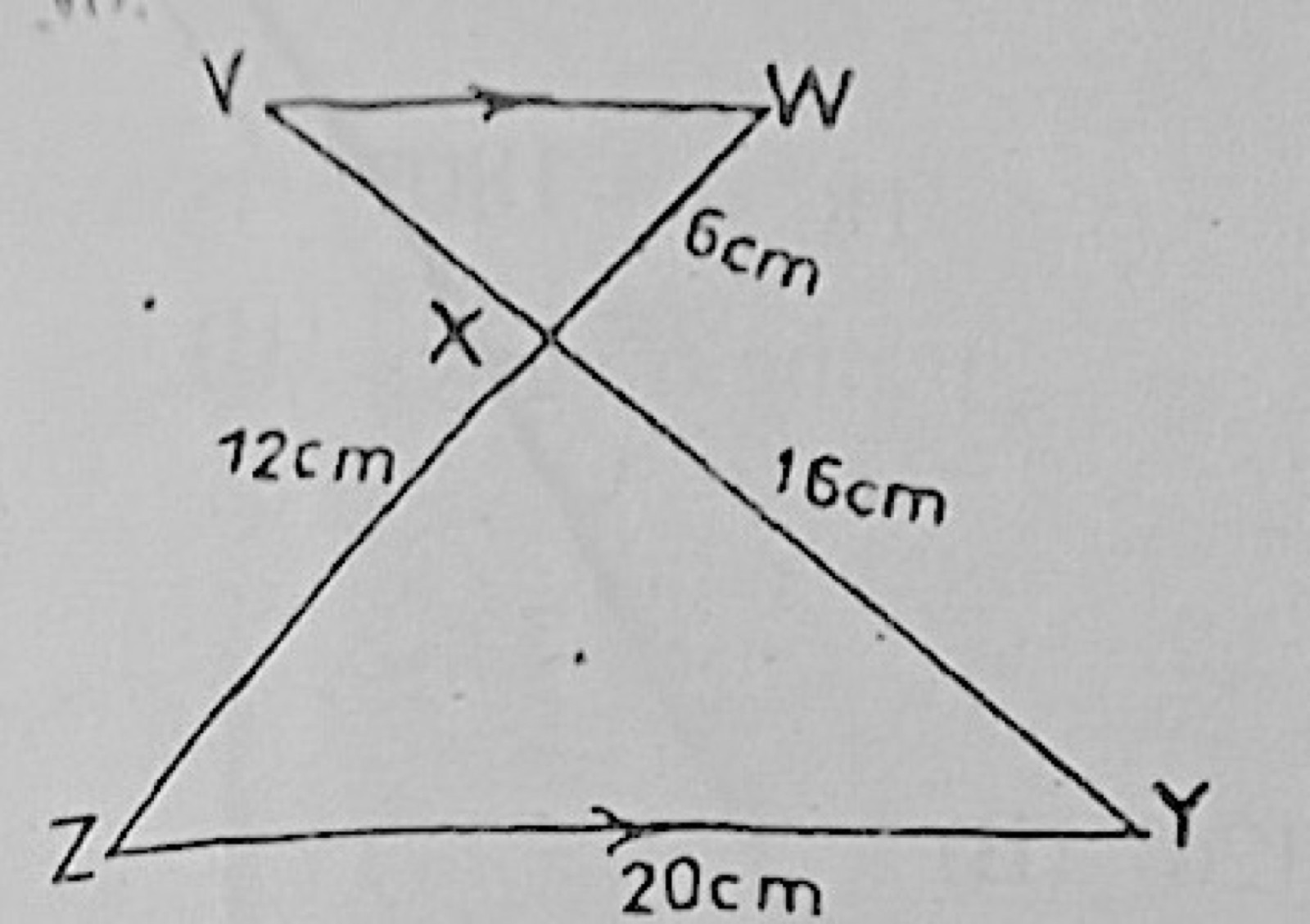
In the diagram, VW//YZ, |WX| = 6cm, |XY| = 16 cm, |YZ| = 20cm and |ZX| = 12cm. Calculate |VX|

Diagram for this question
  1. A.3cm
  2. B.4cm
  3. C.6cm
  4. D.8cm
Show the answer and explanation

Answer: D (8cm)

Explanation

Triangles XVW and XYZ are similar (VW//YZ), so VX/XY = WX/XZ: VX = 16 × 6/12 = 8 cm.

Open this question

Question 31

Linear and Simultaneous Equations

Tom will be 25 years old in n years' time. If he is 5 years younger than Bade, find Bade's present age.

  1. A.(30 − n) years
  2. B.(20 − n) years
  3. C.(25 − n) years
  4. D.(30 + n) years
Show the answer and explanation

Answer: A ((30 − n) years)

Explanation

Tom is now 25 − n, so Bade is 25 − n + 5 = (30 − n) years.

Open this question

Question 32

Surds

If (√2 + √3)/√3 is simplified as m + n√6, find the value of (m + n).

  1. A.⅓
  2. B.⅔
  3. C.1⅓
  4. D.1⅔
Show the answer and explanation

Answer: C (1⅓)

Explanation

Multiply top and bottom by √3: (√6 + 3)/3 = 1 + ⅓√6, so m + n = 1 + ⅓ = 1⅓.

Open this question

Question 33

Angles and Polygons

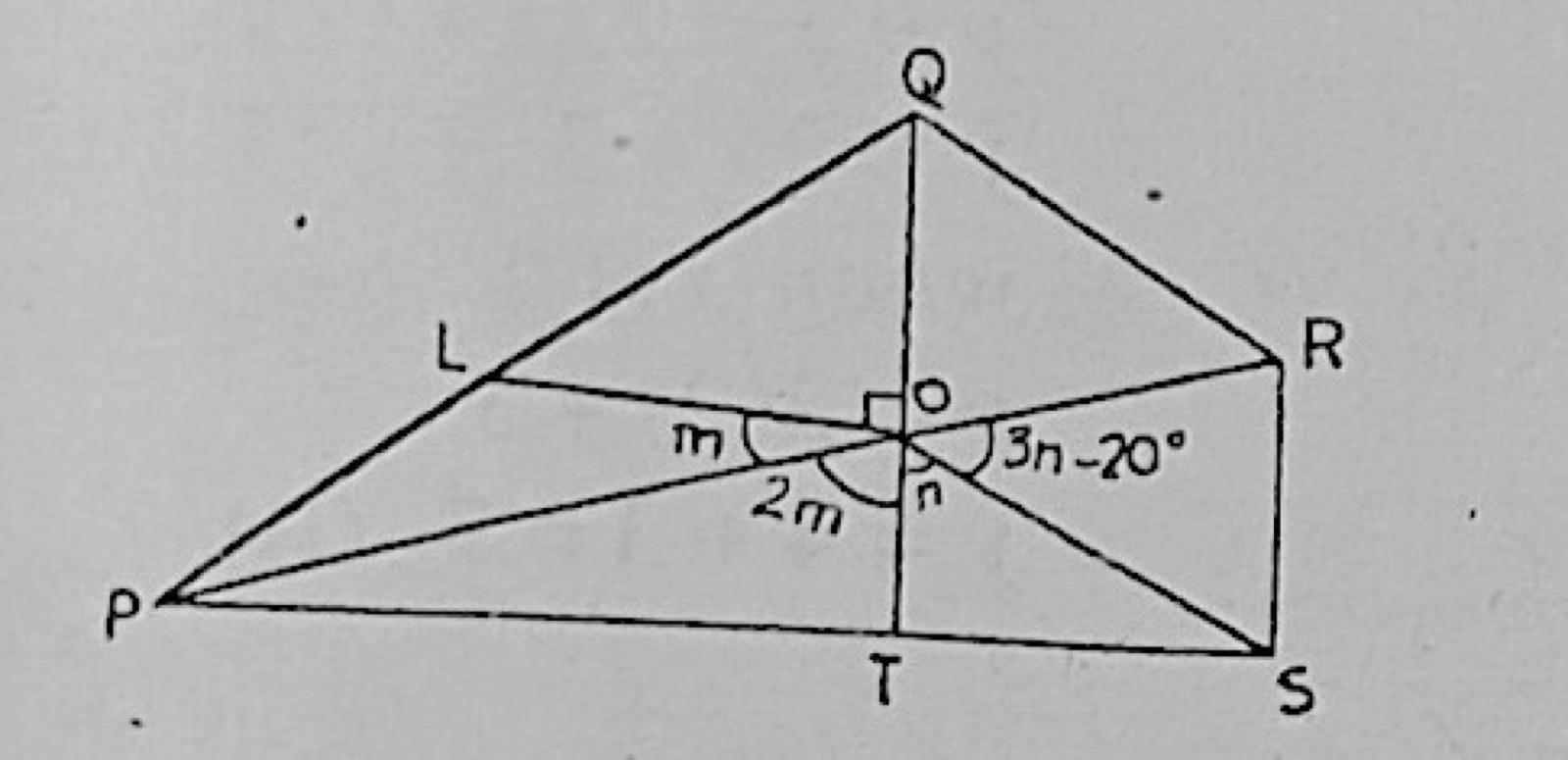
In the diagram, QT and PR are straight lines, ∠ROS = (3n − 20)°, ∠POT = 2m, ∠SOT = n, ∠POL = m and ∠QOL is a right angle. Find the value of n.

Diagram for this question
  1. A.35°
  2. B.40°
  3. C.55°
  4. D.60°
Show the answer and explanation

Answer: A (35°)

Explanation

On line QT: 90° + m + 2m = 180°, so m = 30°. On line PR: 2m + n + (3n − 20) = 180°, so 4n = 140° and n = 35°.

Open this question

Question 34

Algebraic Expressions

Make k the subject of the relation T = √((Tk − H)/(k − H))

  1. A.k = H(T2 − 1)/(T2 − T)
  2. B.k = HT/(T − 1)2
  3. C.k = H(T2 + 1)/T
  4. D.k = H(T − 1)/T
Show the answer and explanation

Answer: A (k = H(T2 − 1)/(T2 − T))

Explanation

Square: T²(k − H) = Tk − H, so k(T² − T) = T²H − H and k = H(T² − 1)/(T² − T).

Open this question

Question 35

Measures of Central Tendency

Which of the following is used to determine the mode of a grouped data

  1. A.Bar chart
  2. B.Frequency polygon
  3. C.Ogive
  4. D.Histogram
Show the answer and explanation

Answer: D (Histogram)

Explanation

The mode of grouped data is estimated from the tallest bar of a histogram (by drawing the crossing lines).

Open this question

Question 36

Mensuration of Plane Shapes

The area of a rhombus is 110 cm2. If the diagonals are 20 cm and (2x + 1) cm long, find the value of x.

  1. A.5.0
  2. B.4.0
  3. C.3.0
  4. D.2.5
Show the answer and explanation

Answer: A (5.0)

Explanation

Area = ½ × d₁ × d₂: ½ × 20 × (2x + 1) = 110, so 2x + 1 = 11 and x = 5.

Open this question

Question 37

Algebraic Expressions

Simplify: (3x − y)/xy − (2x + 3y)/2xy + ½

  1. A.(4x + 5y − xy)/2xy
  2. B.(5x − 4x + xy)/2xy
  3. C.(5x + 4x − xy)/2xy
  4. D.(4x − 5y + xy)/2xy
Show the answer and explanation

Answer: D ((4x − 5y + xy)/2xy)

Explanation

Over 2xy: (6x − 2y − 2x − 3y + xy)/2xy = (4x − 5y + xy)/2xy.

Open this question

Question 38

Inequalities

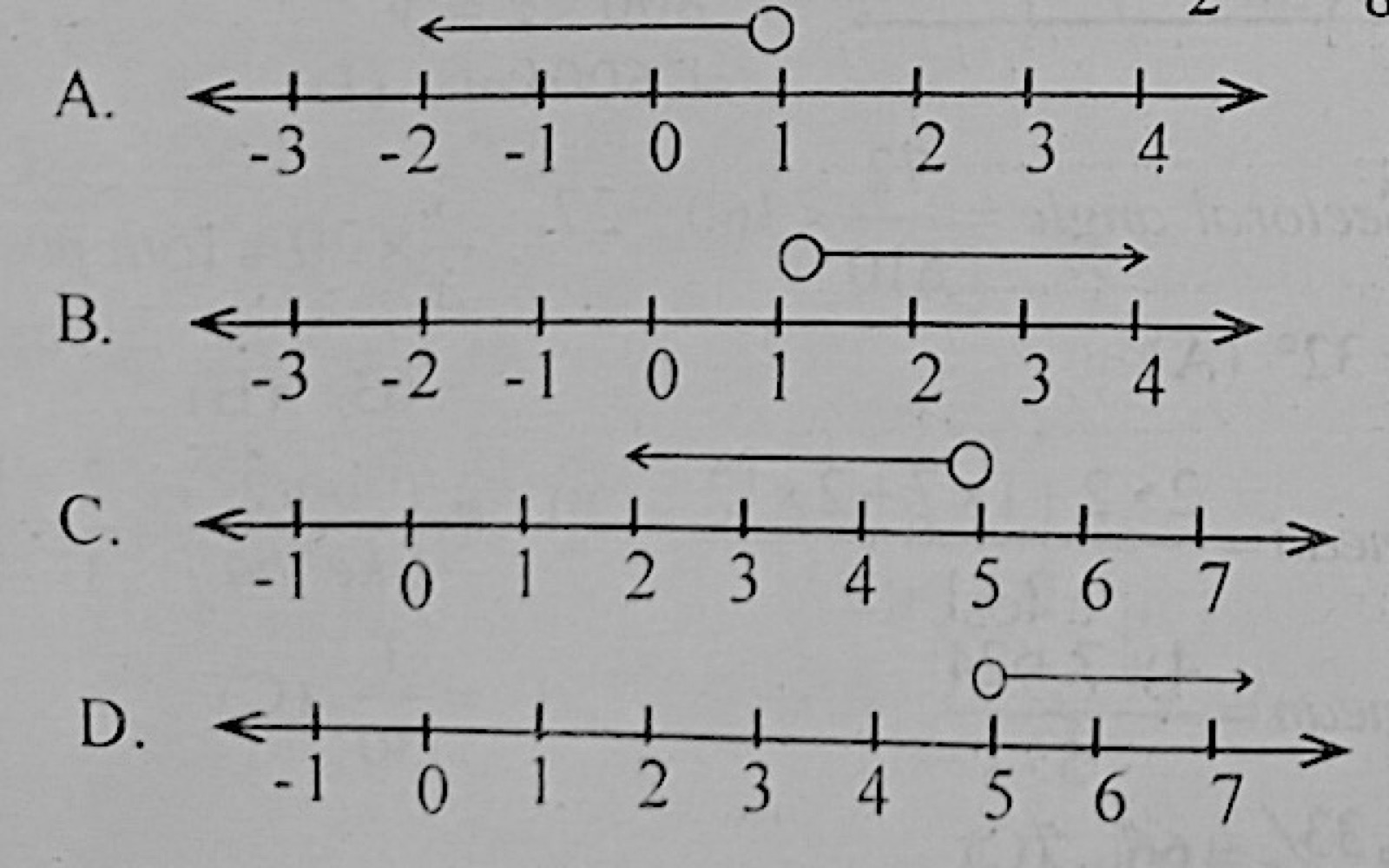
Illustrate graphically, the solution of y/2 + 1/8 > 5y/8.

Diagram for this question
  1. A.Number line −3 to 4: open circle at 1, arrow to the left
  2. B.Number line −3 to 4: open circle at 1, arrow to the right
  3. C.Number line −1 to 7: open circle at 5, arrow to the left
  4. D.Number line −1 to 7: open circle at 5, arrow to the right
Show the answer and explanation

Answer: A (Number line −3 to 4: open circle at 1, arrow to the left)

Explanation

Multiply by 8: 4y + 1 > 5y, so y < 1: an open circle at 1 with the arrow pointing left.

Open this question

Question 39

Fractions, Decimals and Approximation

A farmer uses ⅖ of his land to grow cassava, ⅓ of the remainder for yam and the rest for maize. Find the part of the land used for maize.

  1. A.2/15
  2. B.⅖
  3. C.⅔
  4. D.⅘
Show the answer and explanation

Answer: B (⅖)

Explanation

Remainder after cassava = ⅗; yam = ⅓ × ⅗ = ⅕; maize = 1 − ⅖ − ⅕ = ⅖.

Open this question

Question 40

Variation

The rate of consumption of petrol by a vehicle varies directly as the square of the distance covered. If 4 litres of petrol is consumed on a distance of 15 km, how far would the vehicle go on 9 litres of petrol?

  1. A.22½ km
  2. B.30 km
  3. C.33¾ km
  4. D.45 km
Show the answer and explanation

Answer: A (22½ km)

Explanation

R = kD²: 4 = k × 225. Then 9 = (4/225)D², so D² = 506.25 and D = 22½ km.

Open this question

Question 41

Commercial Arithmetic

A trader bought 100 oranges at 5 for N40.00 and sold them at 20 for N120.00. Find the profit or loss per cent.

  1. A.20% profit
  2. B.20 % loss
  3. C.25 % profit
  4. D.25 % loss
Show the answer and explanation

Answer: D (25 % loss)

Explanation

Cost per orange = N8, selling price = N6, so there is a loss of N2 on N8, i.e. 25% loss.

Open this question

Question 42

Sets

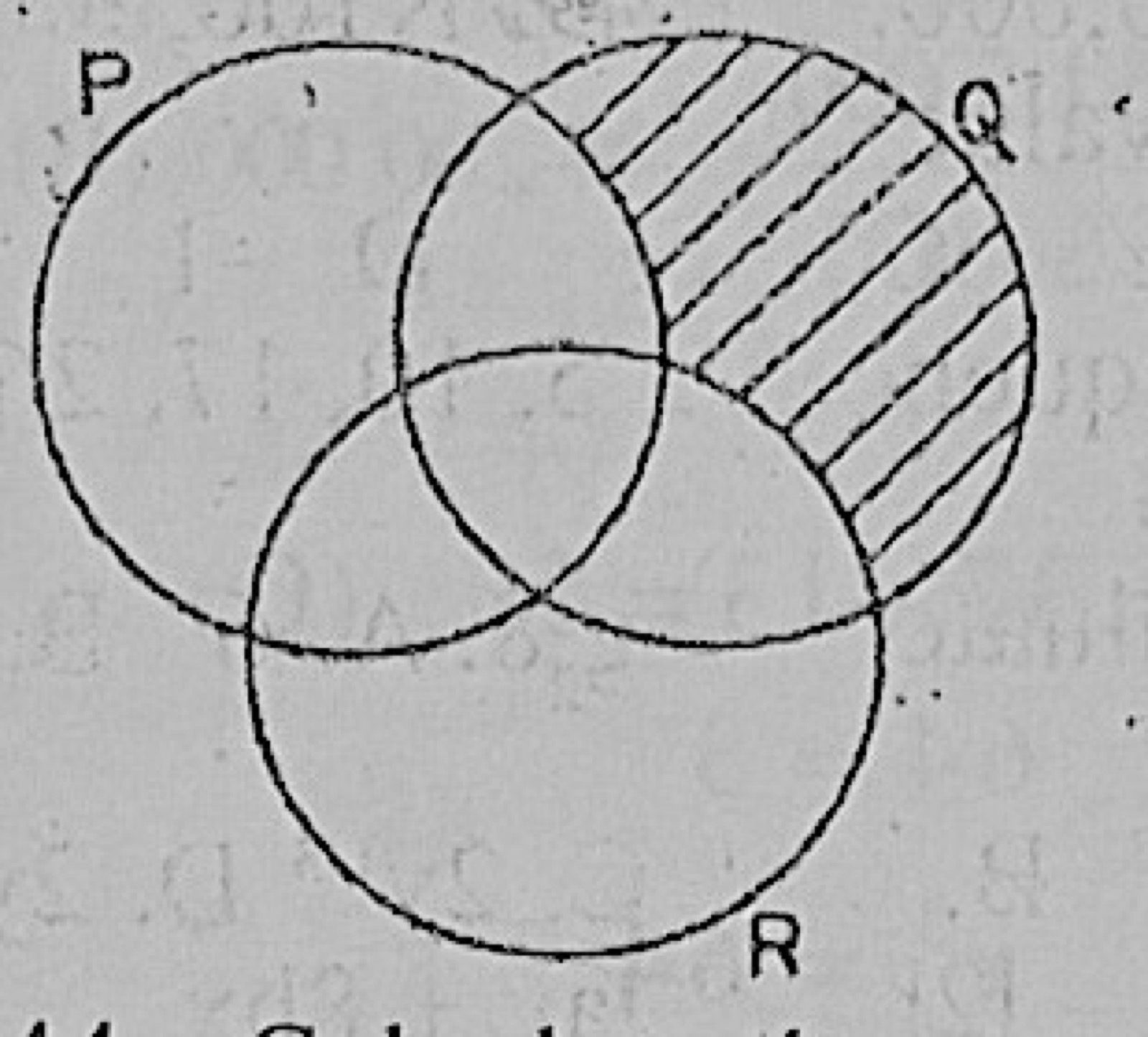
Describe the shaded portion in the diagram.

Diagram for this question
  1. A.P' ∩ Q ∩ R'
  2. B.(P ∩ R)' ∩ Q
  3. C.P' ∩ Q ∩ R
  4. D.(P ∪ Q)' ∩ R
Show the answer and explanation

Answer: A (P' ∩ Q ∩ R')

Explanation

The shaded part is inside Q but outside both P and R, i.e. P' ∩ Q ∩ R' = (P ∪ R)' ∩ Q.

Open this question

Question 43

Linear and Simultaneous Equations

Find the value of p if ¼p + 3q = 10 and 2p − ⅓q = 7.

  1. A.4
  2. B.3
  3. C.−3
  4. D.−4
Show the answer and explanation

Answer: A (4)

Explanation

From the second equation q = 6p − 21. Then ¼p + 18p − 63 = 10, so 73p/4 = 73 and p = 4.

Open this question

Question 44

Measures of Dispersion

Calculate the mean deviation of 5, 3, 0, 7, 2, 1.

  1. A.0.0
  2. B.2.0
  3. C.2.5
  4. D.3.0
Show the answer and explanation

Answer: B (2.0)

Explanation

Mean = 18/6 = 3. Deviations 2, 0, 3, 4, 1, 2 add to 12, so mean deviation = 12/6 = 2.0.

Open this question

Question 45

Mensuration of Plane Shapes

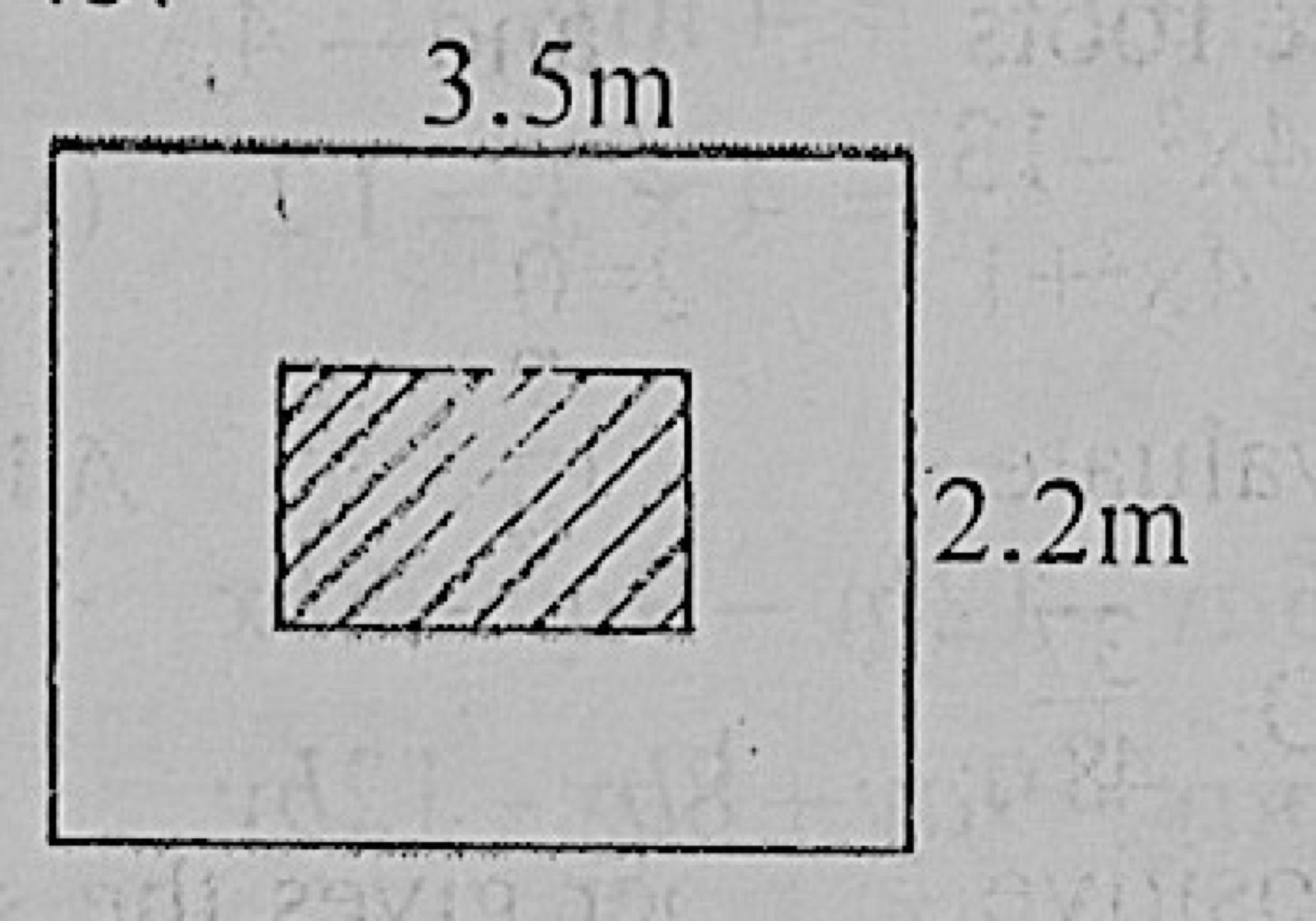
In the diagram, the shaded part is a carpet laid in a room with dimensions 3.5m by 2.2m leaving a margin of 0.5m round it. Find the area of the margin.

Diagram for this question
  1. A.4.7 m2
  2. B.4.9 m2
  3. C.5.7 m2
  4. D.5.9 m2
Show the answer and explanation

Answer: A (4.7 m2)

Explanation

The carpet measures (3.5 − 1) × (2.2 − 1) = 2.5 × 1.2 = 3.0 m². Margin = 3.5 × 2.2 − 3.0 = 7.7 − 3.0 = 4.7 m².

Open this question

Question 46

Angles and Polygons

Two angles of a pentagon are in the ratio 2:3. The others are 60° each. Calculate the smaller of the two angles.

  1. A.72°
  2. B.100°
  3. C.120°
  4. D.144°
Show the answer and explanation

Answer: D (144°)

Explanation

Angles of a pentagon add to 540°. 540° − 3 × 60° = 360°, shared 2:3 gives 144° and 216°; the smaller is 144°.

Open this question

Question 47

Probability

A letter is selected from the letters of the English alphabet. What is the probability that the letter selected is from the word MATHEMATICS?

  1. A.9/13
  2. B.11/26
  3. C.4/13
  4. D.1/26
Show the answer and explanation

Answer: C (4/13)

Explanation

MATHEMATICS uses 8 different letters (M, A, T, H, E, I, C, S), so the probability is 8/26 = 4/13.

Open this question

Question 48

Circle Theorems

In a circle radius r cm, a chord 16√3 cm long is 10 cm from the centre of the circle. Find, correct to the nearest cm, the value of r.

  1. A.22cm
  2. B.17cm
  3. C.16cm
  4. D.15cm
Show the answer and explanation

Answer: B (17cm)

Explanation

Half the chord is 8√3. r² = 10² + (8√3)² = 100 + 192 = 292, so r ≈ 17.1 ≈ 17 cm.

Open this question

Question 49

Logic

Consider the following statements:
X: Locally manufactured tyres are attractive.
Y: Many locally manufactured tyres do not last long.
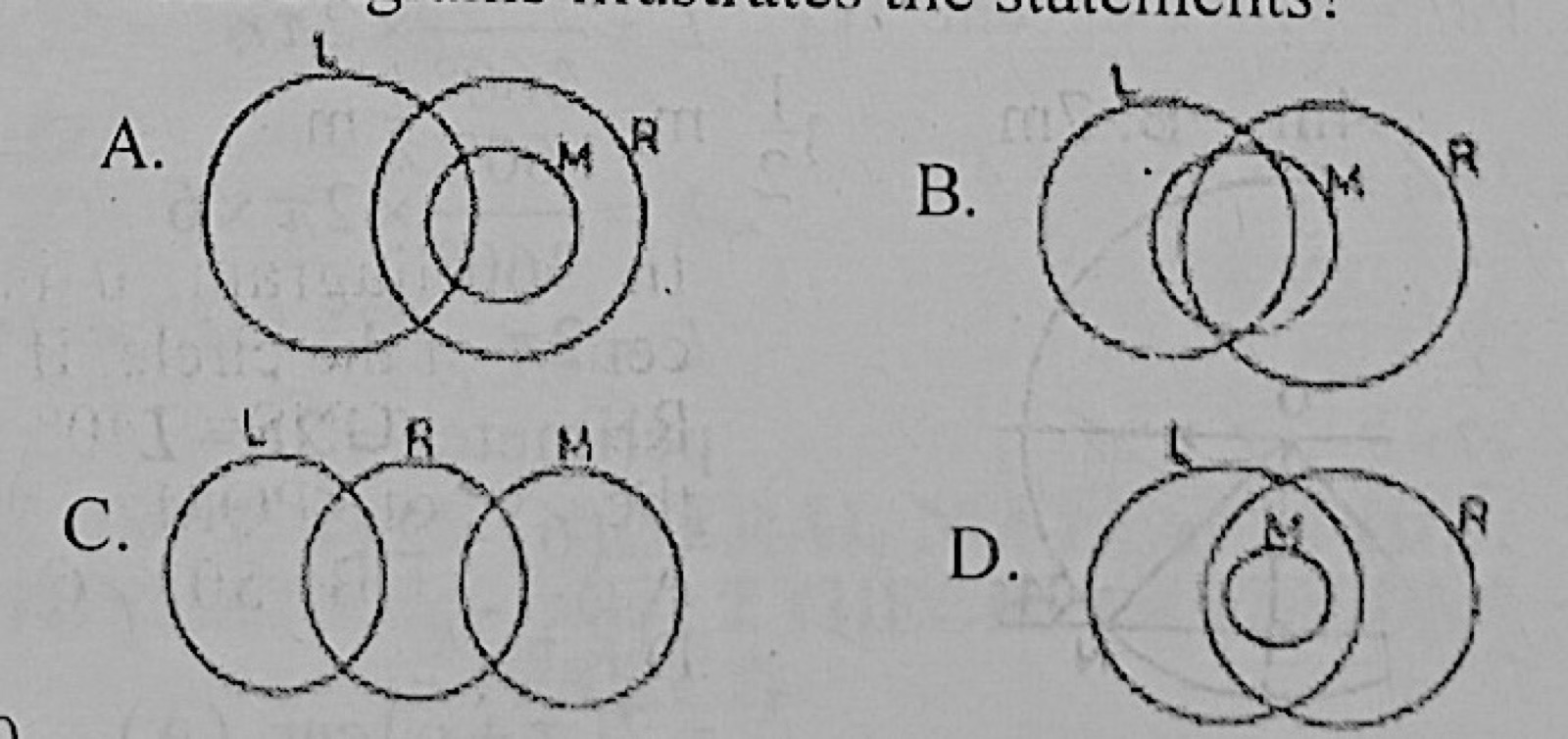
Denoting locally manufactured tyres by M, attractive tyres by R and long lasting tyres by L, which of these Venn diagrams illustrates the statements?

Diagram for this question
  1. A.Diagram A
  2. B.Diagram B
  3. C.Diagram C
  4. D.Diagram D
Show the answer and explanation

Answer: A (Diagram A)

Explanation

M must lie wholly inside R (all are attractive) and only partly inside L (many do not last long). Only diagram A shows M inside R and overlapping L.

Open this question

Question 50

Triangles and Quadrilaterals

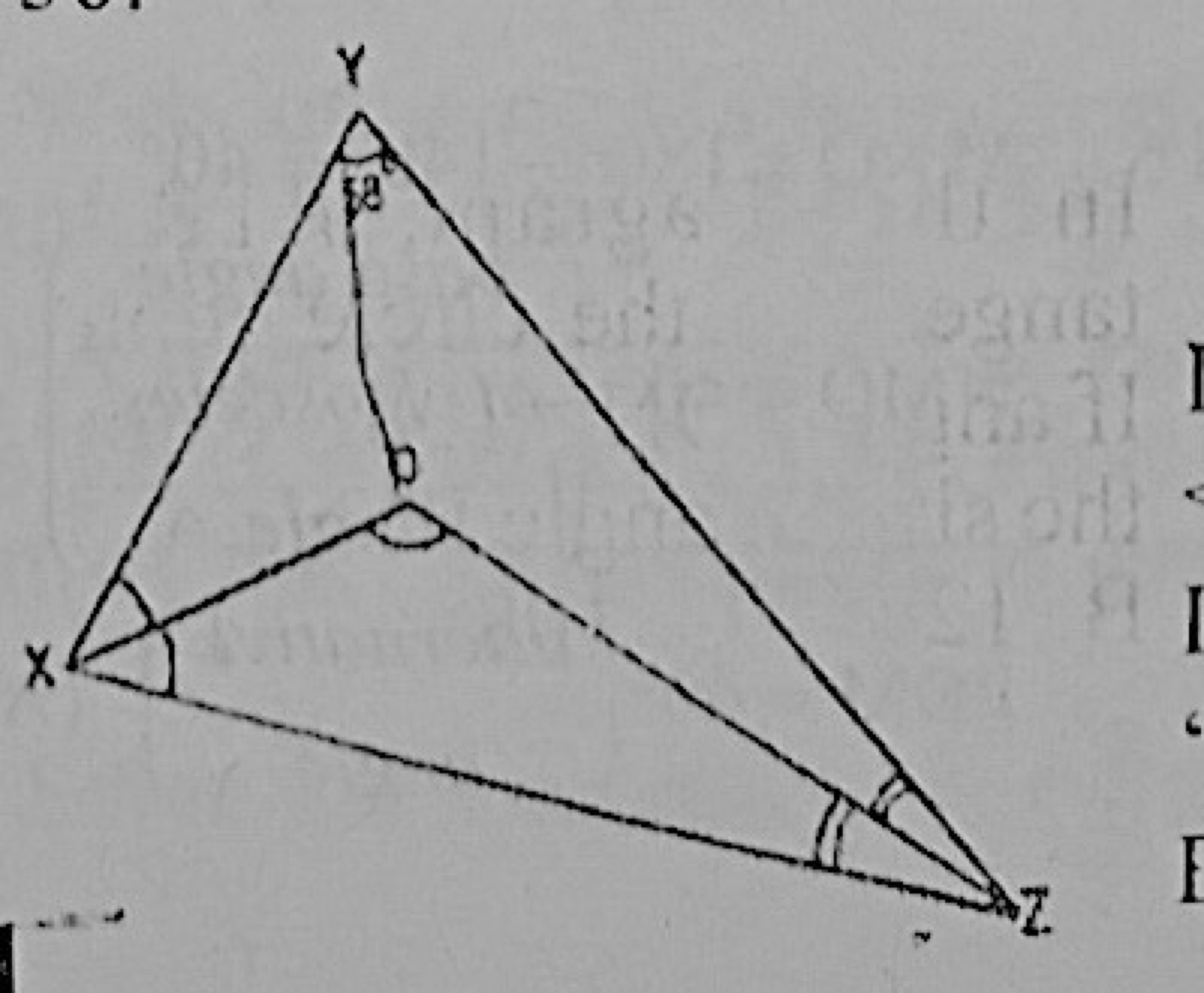
In the diagram, OX bisects ∠YXZ and OZ bisects ∠YZX. If ∠XYZ = 68°, calculate the value of ∠XOZ.

Diagram for this question
  1. A.68°
  2. B.72°
  3. C.112°
  4. D.124°
Show the answer and explanation

Answer: D (124°)

Explanation

∠YXZ + ∠YZX = 112°, so half of it is 56°. In triangle XOZ, ∠XOZ = 180° − 56° = 124°.

Open this question

Theory question 101

Fractions, Decimals and Approximation

(a) Without using Mathematical tables or calculators, simplify: 34/9 ÷ (5⅓ − 2¾) + 59/10
(b) A number is selected at random from each of the sets {2, 3, 4} and {1, 3, 5}. Find the probability that the sum of the two numbers is greater than 3 and less than 7.

Show the model answer
Model answer

(a) 5⅓ − 2¾ = 16/3 − 11/4 = 31/12
31/9 ÷ 31/12 = 31/9 × 12/31 = 4/3
4/3 + 59/10 = 40/30 + 177/30 = 217/30 = 77/30
(b) There are 3 × 3 = 9 equally likely pairs; sums: 3, 5, 7, 4, 6, 8, 5, 7, 9
Sums greater than 3 and less than 7: 5, 4, 6, 5 → 4 outcomes
Probability = 4/9

Explanation

Do the bracket first, then the division, then the addition.

Open this question

Theory question 102

Inequalities

(a) Solve the inequality: 4 + ¾(x + 2) ≤ ⅜x + 1.
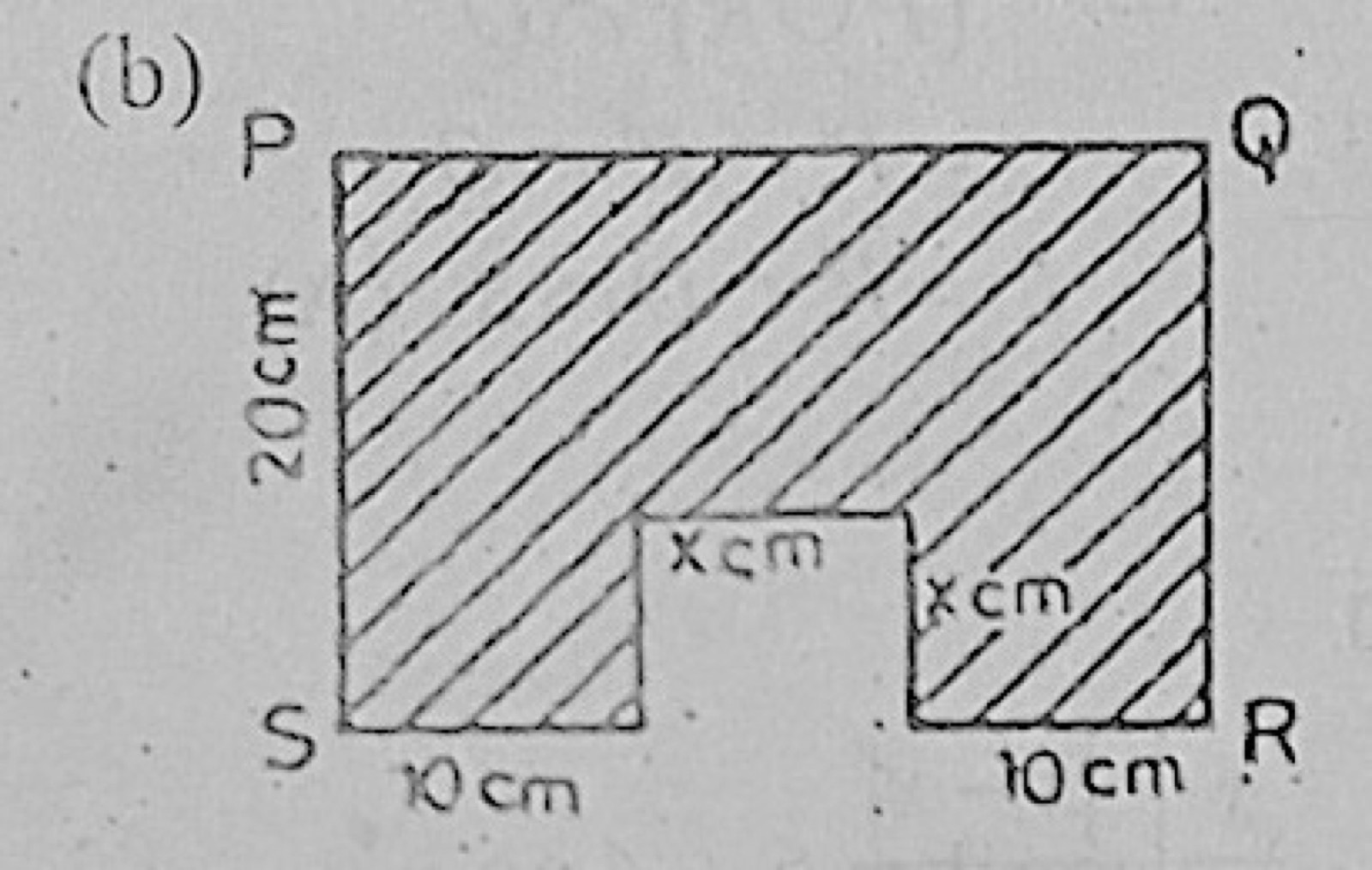
(b) The diagram shows a rectangle PQRS from which a square of side x cm has been cut. If the area of the shaded portion is 484 cm2, find the values of x.

Diagram for this question
Show the model answer
Model answer

(a) Multiply through by 8: 32 + 6(x + 2) ≤ 3x + 8
6x + 44 ≤ 3x + 8 → 3x ≤ −36 → x ≤ −12
(b) The rectangle is 20 cm high and (10 + x + 10) = (20 + x) cm long.
Shaded area = 20(20 + x) − x² = 484
400 + 20x − x² = 484 → x² − 20x + 84 = 0 → (x − 6)(x − 14) = 0
x = 6 cm or x = 14 cm

Explanation

In (b), the length of the rectangle includes the cut-out width x.

Open this question

Theory question 103

Angles and Polygons

(a) The ratio of the interior angle to the exterior angle of a regular polygon is 5 : 2. Find the number of sides of the polygon.
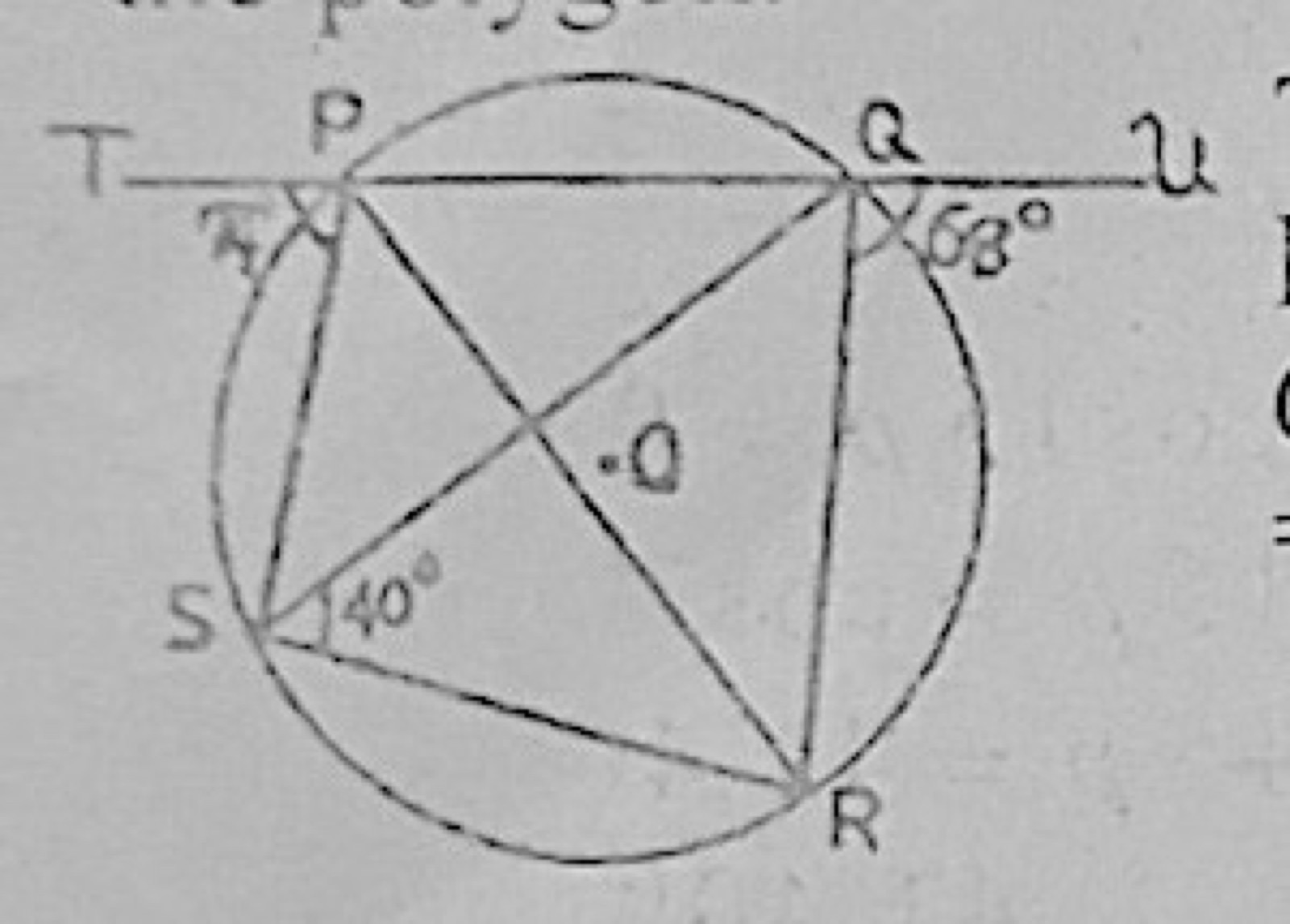
(b) The diagram shows a circle PQRS with centre O, ∠UQR = 68°, ∠TPS = 74° and ∠QSR = 40°. Calculate the value of ∠PRS.

Diagram for this question
Show the model answer
Model answer

(a) Interior + exterior = 180°, so exterior angle = 2/7 × 180° = 360/7°
Number of sides = 360° ÷ 360/7° = 7
(b) TPQU is a straight line: ∠PQR = 180° − 68° = 112° and ∠SPQ = 180° − 74° = 106°
∠PSR = 180° − 112° = 68° (opposite angles of cyclic quadrilateral PQRS)
∠QPR = ∠QSR = 40° (same segment), so ∠SPR = 106° − 40° = 66°
In triangle PRS: ∠PRS = 180° − 68° − 66° = 46°

Explanation

Use opposite angles of a cyclic quadrilateral and angles in the same segment.

Open this question

Theory question 104

Fractions, Decimals and Approximation

(a) By how much is the sum of 3⅔ and 2⅕ less than 7?
(b) The height, h m, of a dock above sea level is given by h = 6 + 4cos(15p)°, 0 < p < 6. Find: (i) the value of h when p = 4; (ii) correct to two significant figures, the value of p when h = 9m.

Show the model answer
Model answer

(a) 3⅔ + 2⅕ = 55/15 + 33/15 = 88/15 = 513/15
7 − 513/15 = 12/15
(b)(i) h = 6 + 4cos 60° = 6 + 4 × 0.5 = 8 m
(ii) 9 = 6 + 4cos(15p)° → cos(15p)° = 0.75 → 15p = 41.41° → p = 2.76 ≈ 2.8

Explanation

In (b)(ii), make cos(15p)° the subject before using inverse cosine.

Open this question

Theory question 105

Mensuration of Plane Shapes

A trapezium PQRS is such that PQ//RS and the perpendicular from P to RS is 40 cm. If |PQ| = 20cm, |SP| = 50 cm and |SR| = 60 cm, calculate, correct to 2 significant figures, the: (a) area of the trapezium; (b) ∠QRS.

Show the model answer
Model answer

(a) Area = ½(20 + 60) × 40 = 1600 cm² ≈ 1.6 × 10³ cm²
(b) Let the perpendicular from P meet SR at N: SN = √(50² − 40²) = 30 cm
The perpendicular from Q meets SR at M with SM = 30 + 20 = 50 cm, so MR = 60 − 50 = 10 cm
tan∠QRS = 40/10 = 4 → ∠QRS ≈ 76°

Explanation

Drop perpendiculars from P and Q to SR and use right-angled triangles.

Open this question

Theory question 106

Logic

(a) (i) Illustrate the following statement in a Venn diagram: All good Literature students in a school are in the General Arts class. (ii) Use the diagram to determine whether or not the following are valid conclusions from the given statement: I. Vivian is in the General Arts class therefore she is a good Literature student; II. Audu is not a good Literature student therefore he is not in the General Arts class; III. Kweku is not in the General Arts class therefore he is not a good Literature student.
(b) The cost (c) of producing n bricks is the sum of a fixed amount h, and a variable amount y, where y varies directly as n. If it costs GH¢ 950.00 to produce 600 bricks and GH¢ 1,030.00 to produce 1000 bricks, (i) find the relationship between c, h and n; (ii) calculate the cost of producing 500 bricks.

Show the model answer
Model answer

(a)(i) Universal set = students in the school; circle L (good Literature students) drawn wholly inside circle G (General Arts class).
(ii) I: not valid (Vivian may be in G but outside L). II: not valid (Audu may be in G but outside L). III: valid (outside G means outside L).
(b)(i) c = h + kn
950 = h + 600k and 1030 = h + 1000k → 400k = 80 → k = 0.2, h = 830
c = 830 + 0.2n (i.e. c = h + n/5 with h = 830)
(ii) c = 830 + 0.2 × 500 = GH¢ 930.00

Explanation

A conclusion is valid only if it must be true in the diagram.

Open this question

Theory question 107

Graphs of Functions

The table is for the relation y = px2 − 5x + q.
x: −3, −2, −1, 0, 1, 2, 3, 4, 5
y: 21, 6, __, −12, __, __, __, 0, 13
(a)(i) Use the table to find the values of p and q. (ii) Copy and complete the table.
(b) Using scales of 2 cm to 1 unit on the x-axis and 2 cm to 5 units on the y-axis, draw the graph of the relation for −3 ≤ x ≤ 5.
(c) Use the graph to find: (i) y when x = 1.8; (ii) x when y = −8.

Show the model answer
Model answer

(a)(i) At x = 0, y = −12, so q = −12. At x = 4: 16p − 20 − 12 = 0 → p = 2. So y = 2x² − 5x − 12.
(ii) x = −1: y = −5; x = 1: y = −15; x = 2: y = −14; x = 3: y = −9
(b) Plot the nine points with the given scales and join them with a smooth U-shaped curve (minimum near x = 1.25, y ≈ −15.1).
(c)(i) y ≈ −14.5 (exact −14.52)
(ii) x ≈ −0.6 or x ≈ 3.1 (roots of 2x² − 5x − 4 = 0)

Explanation

Find q first from the point where x = 0.

Open this question

Theory question 108

Constructions

(a) Using ruler and a pair of compasses only, construct a: (i) trapezium WXYZ such that |WX| = 8 cm, |XY| = 5.5 cm, |XZ| = 8.3 cm, ∠WXY = 60° and WX//ZY; (ii) rectangle PQYZ where P and Q are on WX.
(b) Measure: (i) |QX| (ii) ∠XWZ.

Show the model answer
Model answer

(a)(i) Draw WX = 8 cm; construct 60° at X and mark Y with XY = 5.5 cm; through Y construct a line parallel to WX; with centre X and radius 8.3 cm cut this line at Z; join WZ.
(ii) Drop perpendiculars from Z and Y to WX, meeting it at P and Q; PQYZ is the rectangle.
(b)(i) |QX| ≈ 2.8 cm (± 0.1) (ii) ∠XWZ ≈ 76° (± 1°)

Explanation

Keep construction arcs visible; measured answers within ± 0.1 cm and ± 1° are accepted.

Open this question

Theory question 109

Progressions

(a) The first term of an Arithmetic Progression (AP) is −8. If the ratio of the 7th term to the 9th term is 5 : 8, find the common difference of the AP.
(b) A trader bought 30 baskets of pawpaw and 100 baskets of mangoes for N2,450.00. She sold the pawpaw at a profit of 40% and the mangoes at a profit of 30%. If her profit on the entire transaction was N855.00, find the: (i) cost price of a basket of pawpaw; (ii) selling price of the 100 baskets of mangoes.

Show the model answer
Model answer

(a) (−8 + 6d)/(−8 + 8d) = 5/8 → −64 + 48d = −40 + 40d → 8d = 24 → d = 3
(b) Let a basket of pawpaw cost x and a basket of mangoes cost y.
30x + 100y = 2450 … (1)
Profit: 0.4(30x) + 0.3(100y) = 855 → 12x + 30y = 855 … (2)
Solving: x = N40.00, y = N12.50
(i) Cost price of a basket of pawpaw = N40.00
(ii) Selling price of 100 baskets of mangoes = 1.3 × 100 × 12.50 = N1,625.00

Explanation

Write one equation for the total cost and one for the total profit.

Open this question

Theory question 110

Trigonometry

(a) Without using Mathematical tables or calculators, simplify: (2 tan 60° + cos 30°)/sin 60°.
(b) From an aeroplane in the air and at a horizontal distance of 1050 m, the angle of depression of the top and base of a control tower at an instance are 36° and 41° respectively. Calculate, correct to the nearest metre, the: (i) height of the control tower; (ii) shortest distance between the aeroplane and the base of the control tower.

Show the model answer
Model answer

(a) tan 60° = √3, cos 30° = sin 60° = √3/2
(2√3 + √3/2) ÷ √3/2 = (5√3/2) × (2/√3) = 5
(b)(i) Height of plane above the base = 1050 tan 41° ≈ 912.8 m
Height of plane above the top = 1050 tan 36° ≈ 762.9 m
Height of tower ≈ 912.8 − 762.9 ≈ 150 m
(ii) Distance = 1050/cos 41° ≈ 1391 m

Explanation

The tower's height is the difference of two vertical distances from the plane.

Open this question

Theory question 111

Algebraic Expressions

(a) Make m the subject of the relation h = mt/(d(m + p))
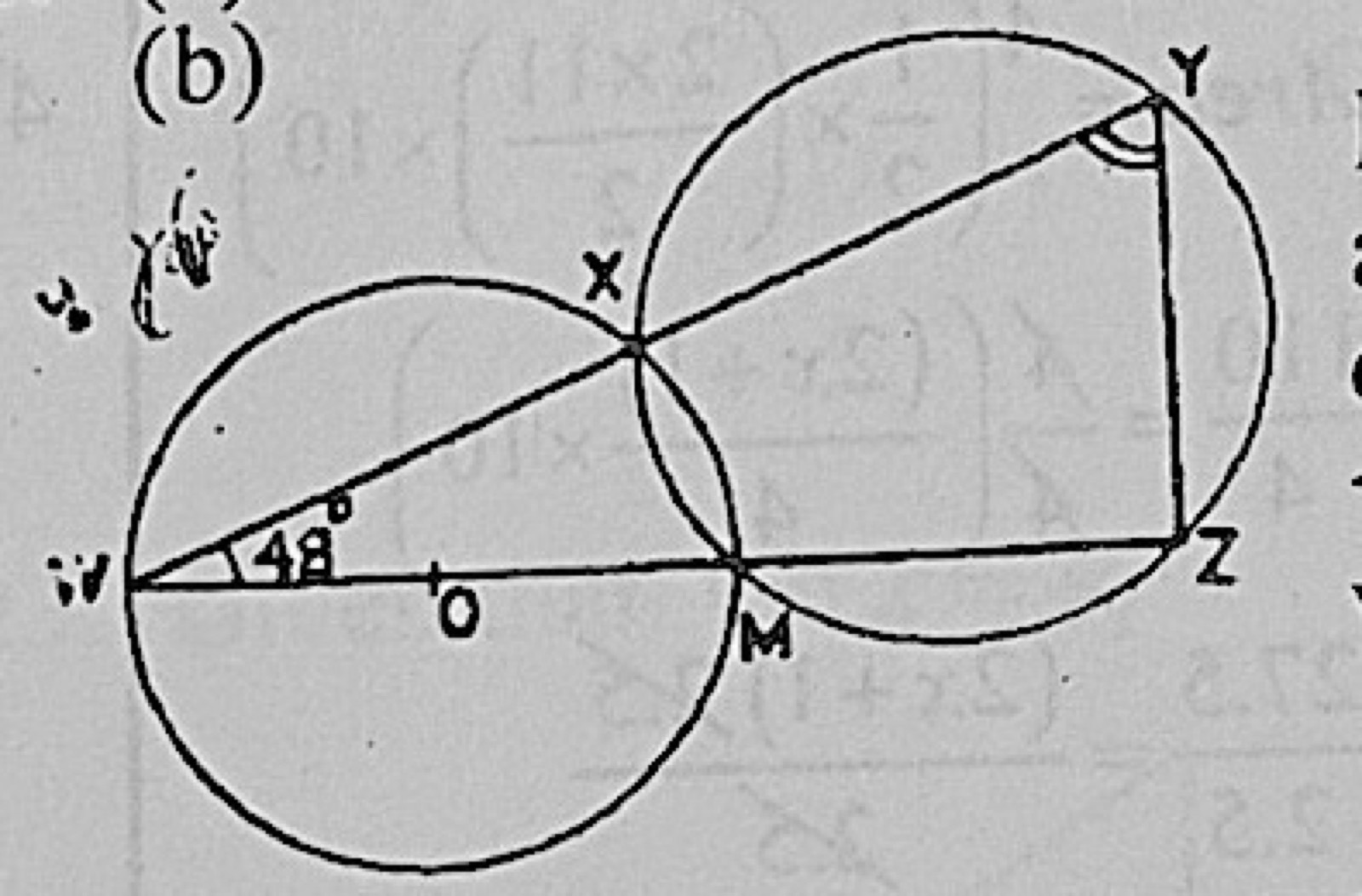
(b) In the diagram, WY and WZ are straight lines, O is the centre of circle WXM and ∠XWM = 48°. Calculate the value of ∠WYZ.
(c) An operation ⊗ is defined on the set X = {1, 3, 5, 6} by m ⊗ n = m + n + 2 (mod 7), where m, n ∈ X. (i) Draw a table for the operation. (ii) Using the table, find the truth set of: I. 3 ⊗ n = 3; II. n ⊗ n = 3.

Diagram for this question
Show the model answer
Model answer

(a) hd(m + p) = mt → hdm + hdp = mt → m(t − hd) = hdp → m = hdp/(t − hd)
(b) WM is a diameter, so ∠WXM = 90°; ∠XMW = 180° − 90° − 48° = 42°
∠XMZ = 180° − 42° = 138° (WMZ straight)
XYZM is cyclic, so ∠XYZ = 180° − 138° = 42°; ∠WYZ = 42°
(c)(i) Rows m = 1, 3, 5, 6; columns n = 1, 3, 5, 6:
1: 4, 6, 1, 2
3: 6, 1, 3, 4
5: 1, 3, 5, 6
6: 2, 4, 6, 0
(ii) I. 3 ⊗ n = 3 → n = 5: {5}
II. n ⊗ n = 3: the diagonal is 4, 1, 5, 0, so the truth set is { } (empty)

Explanation

In (b), use the angle in a semicircle and then opposite angles of a cyclic quadrilateral.

Open this question

Theory question 112

Mensuration of Solids

A water reservoir in the form of a cone mounted on a hemisphere is built such that the plane face of the hemisphere fits exactly to the base of the cone and the height of the cone is 6 times the radius of its base.
(a) Illustrate this information in a diagram.
(b) If the volume of the reservoir is 333⅓ π m3 calculate, correct to the nearest whole number, the: (i) volume of the hemisphere; (ii) total surface area of the reservoir. [Take π = 22/7]

Show the model answer
Model answer

(a) A cone of base radius r and height 6r standing on the flat face of a hemisphere of radius r.
(b) Volume = ⅔πr³ + ⅓πr²(6r) = (8/3)πr³ = (1000/3)π → r³ = 125 → r = 5 m
(i) Hemisphere = ⅔ × 22/7 × 125 ≈ 261.9 ≈ 262 m³
(ii) Slant height l = √(5² + 30²) = √925 ≈ 30.41 m
Curved surface of hemisphere = 2πr² = 2 × 22/7 × 25 ≈ 157.1 m²
Curved surface of cone = πrl = 22/7 × 5 × 30.41 ≈ 477.9 m²
Total surface area ≈ 635 m²

Explanation

Find r first from the total volume.

Open this question

Theory question 113

Data Presentation

The table shows the distribution of marks of candidates.
Marks %: 0−9, 10−19, 20−29, 30−39, 40−49, 50−59, 60−69, 70−79, 80−89, 90−99
Frequency: 7, 11, 17, 20, 29, 34, 30, 25, 21, 6
(a) Construct a cumulative frequency table for the distribution and draw a cumulative frequency curve.
(b) Use the curve to estimate, correct to one decimal place, the: (i) lowest mark for distinction if 5 % of the candidates passed with distinction; (ii) probability of selecting a candidate who scored at most 45%.

Show the model answer
Model answer

(a) Upper class boundaries 9.5, 19.5, …, 99.5; cumulative frequencies 7, 18, 35, 55, 84, 118, 148, 173, 194, 200. Plot cumulative frequency against upper class boundary and join with a smooth S-shaped curve.
(b)(i) 5% of 200 = 10, so read the mark at cumulative frequency 190: ≈ 79.5 + (17/21) × 10 ≈ 87.6
(ii) At 45 marks the cumulative frequency ≈ 71, so probability ≈ 71/200 ≈ 0.36 (accept readings from the curve)

Explanation

Plot against upper class boundaries, not class marks.
Open this question