Question 1
Ratio, Percentages and RatesIf x% of 240 equals 12, find x.
- A.x = 1
- B.x = 3
- C.x = 5
- D.x = 7
Show the answer and explanation
Answer: C (x = 5)
Explanation
x/100 × 240 = 12, so 2.4x = 12 and x = 5.
60 questions. Try each one, then open the answer to check yourself and read the explanation.
If x% of 240 equals 12, find x.
Answer: C (x = 5)
x/100 × 240 = 12, so 2.4x = 12 and x = 5.
Evaluate ((3.2)2 − (4.8)2)/(3.2 + 4.8)
Answer: B (−1.60)
Difference of two squares: (3.2 − 4.8)(3.2 + 4.8)/(3.2 + 4.8) = 3.2 − 4.8 = −1.60.
Find the product of 0.0409 and 0.0021 leaving your answer in the standard form.
Answer: B (8.6 × 10⁻⁵)
0.0409 × 0.0021 = 0.00008589 ≈ 8.6 × 10⁻⁵.
Simplify: √50 + 10/√2
Answer: B (10√2)
√50 = 5√2 and 10/√2 = 10√2/2 = 5√2, so the sum is 10√2.
P naira invested for 4 years at r % simple interest per annum yields 0.36 P naira interest. Find the value of r.
Answer: C (9)
I = PRT/100: P × r × 4/100 = 0.36P, so 4r = 36 and r = 9.
Convert 425 to a base three numeral.
Answer: C (2113)
425 = 4 × 5 + 2 = 22. 22 = 2 × 9 + 1 × 3 + 1, so it is 2113.
A trader bought 100 tubers of yam at 5 for N350.00. She sold them in sets of 4 for N290.00. Find her gain per cent.
Answer: A (3.6%)
Cost = 20 × N350 = N7,000. Sales = 25 × N290 = N7,250. Gain = N250, and 250/7000 × 100% ≈ 3.6%.
If p − 2g + 1 = g + 3p and p − 2 = 0, find g.
Answer: B (−1)
p = 2, so 2 − 2g + 1 = g + 6. Then −3 = 3g and g = −1.
Simplify: ∛(27x3y9)
Answer: C (3xy3)
Take the cube root of each factor: ∛27 = 3, ∛x3 = x, ∛y9 = y3.
Given that x = 2 and y = −1/4, evaluate (x2y − 2xy)/5
Answer: A (0)
x2y = 4 × (−1/4) = −1 and 2xy = 2 × 2 × (−1/4) = −1. So (−1 − (−1))/5 = 0.
If 4y is 9 greater than the sum of y and 3x, by how much is y greater than x?
Answer: A (3)
4y = y + 3x + 9, so 3y − 3x = 9 and y − x = 3.
If p = (3/5)√(q/r), express q in terms of p and r.
Answer: C ((25/9)p2r)
Square both sides: p2 = 9q/(25r), so q = 25p2r/9.
Simplify: (2x2 − 5x − 12)/(4x2 − 9)
Answer: D ((x − 4)/(2x − 3))
2x2 − 5x − 12 = (2x + 3)(x − 4) and 4x2 − 9 = (2x − 3)(2x + 3). Cancel (2x + 3) to get (x − 4)/(2x − 3).
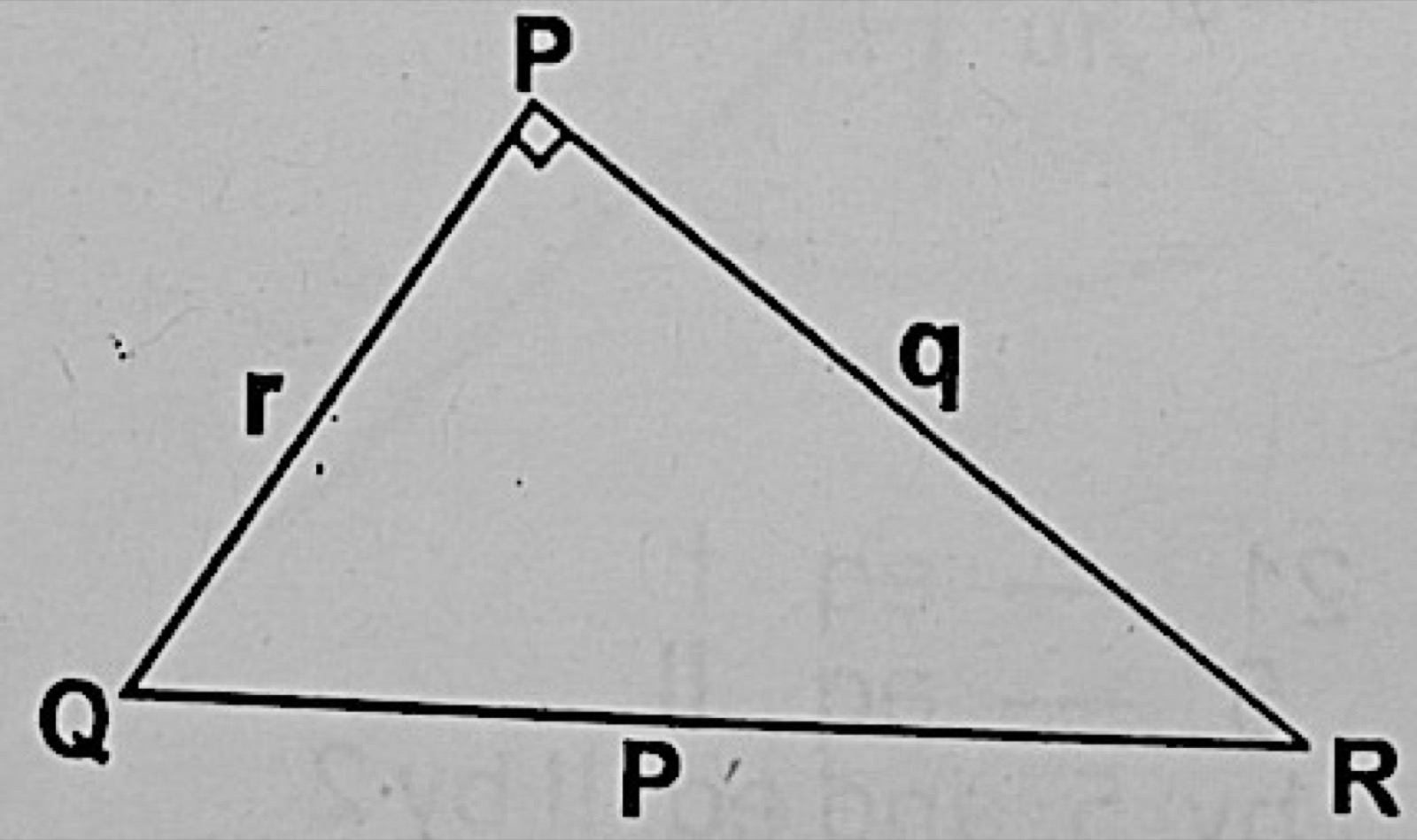
In the diagram, ∠QPR = 90°. If q2 = 25 − r2, find the value of p.
Answer: C (5)
By Pythagoras, p2 = q2 + r2 = 25, so p = 5.
POR is a sector of a circle centre O, radius 4 cm. If PÔR = 30°, find, correct to 3 significant figures, the area of sector POR. [Take π = 22/7]
Answer: A (4.19 cm2)
Area = 30/360 × 22/7 × 42 = 88/21 ≈ 4.19 cm2.
If the volume of a cube is 343 cm3, find the length of its side.
Answer: C (7 cm)
Side = ∛343 = 7 cm.
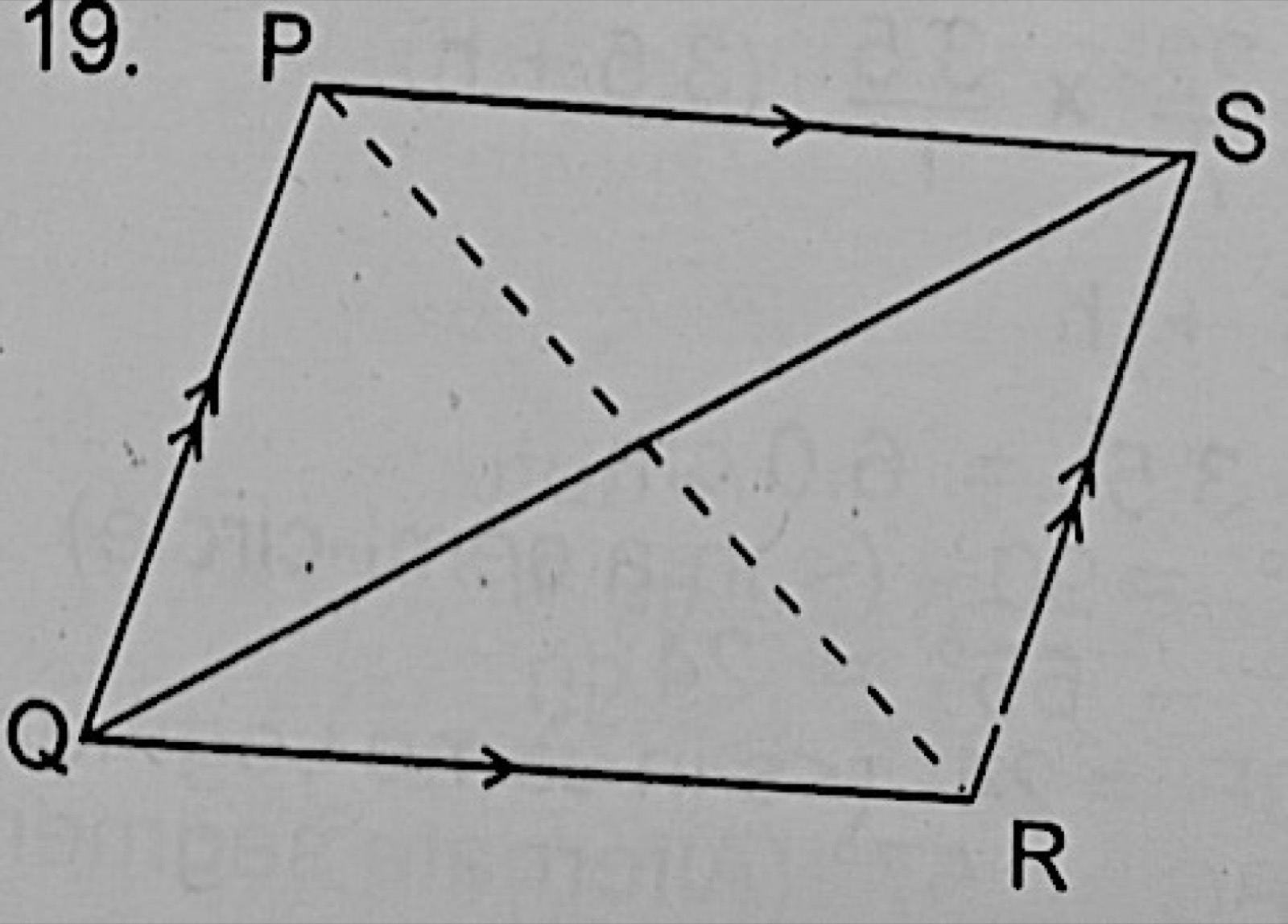
In the diagram, PQRS is a rhombus. |PR| = 10 cm and |QS| = 24 cm. Calculate the perimeter of the rhombus.
Answer: B (52 cm)
The diagonals bisect each other at right angles: side = √(52 + 122) = 13 cm. Perimeter = 4 × 13 = 52 cm.
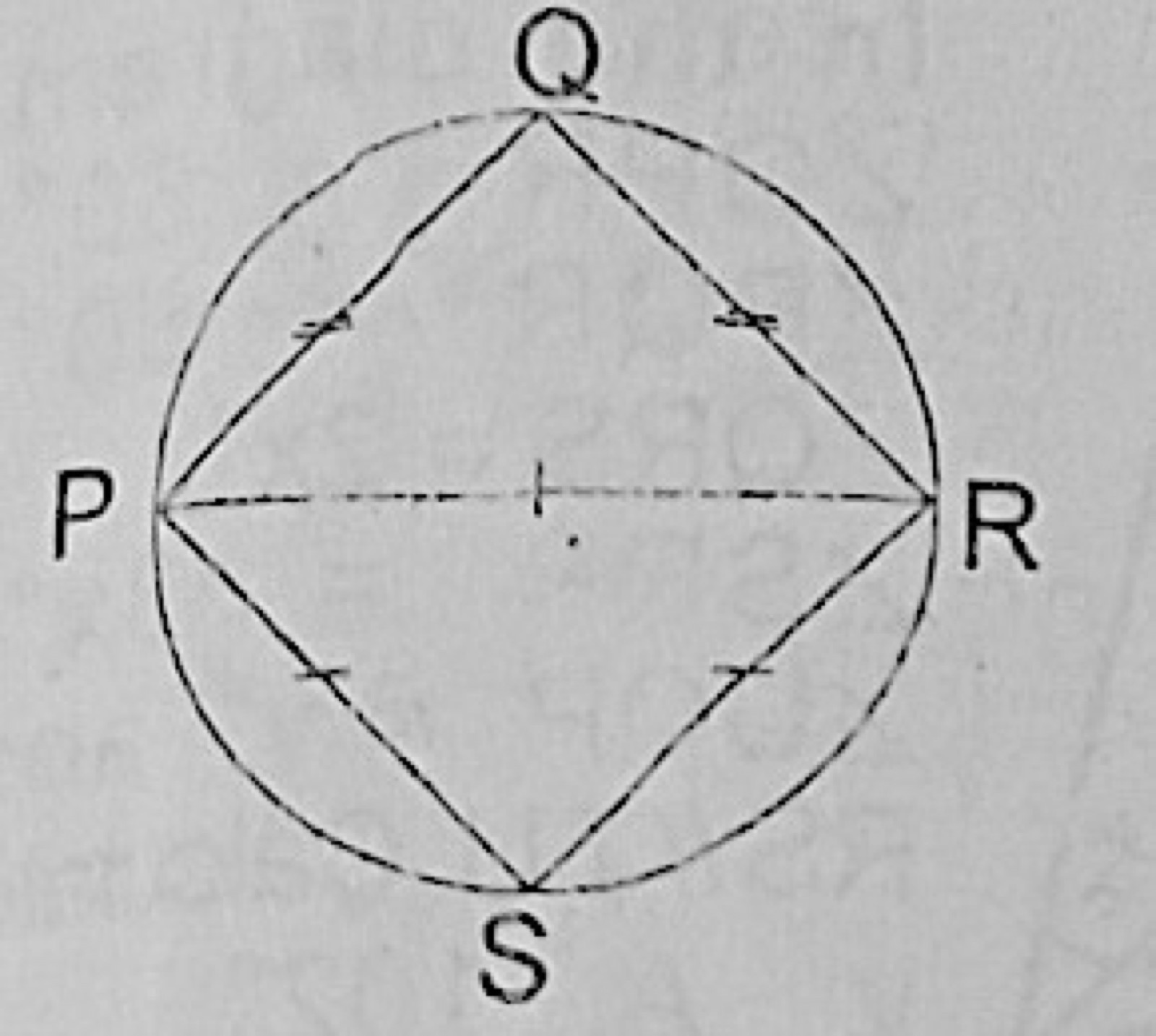
In the diagram, |PQ| = |QR| and |PR| = |RS| = |SP|. Calculate the size of ∠QRS.
Answer: C (90°)
ΔPRS is equilateral, so ∠PSR = ∠PRS = 60°. PQRS is cyclic, so ∠PQR = 180° − 60° = 120°, and the isosceles ΔPQR has ∠QRP = 30°. ∠QRS = 30° + 60° = 90°.
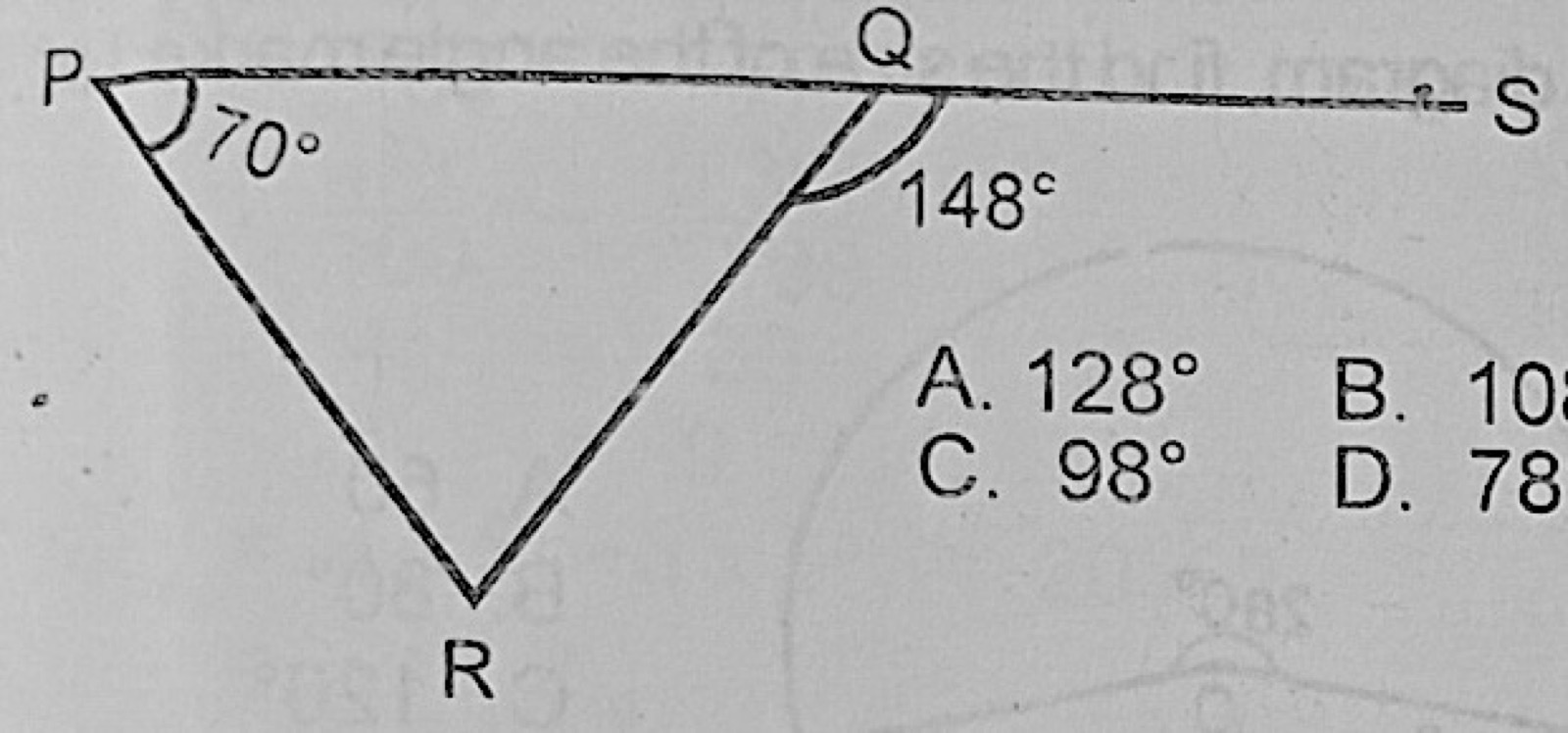
In the figure shown, PQS is a straight line. What is the value of ∠PRQ?
Answer: D (78°)
The exterior angle RQS (148°) equals the sum of the two opposite interior angles: 70° + ∠PRQ = 148°, so ∠PRQ = 78°.
In the diagram, PQ // RS, QU // PT and ∠PSR = 42°. Find angle x.
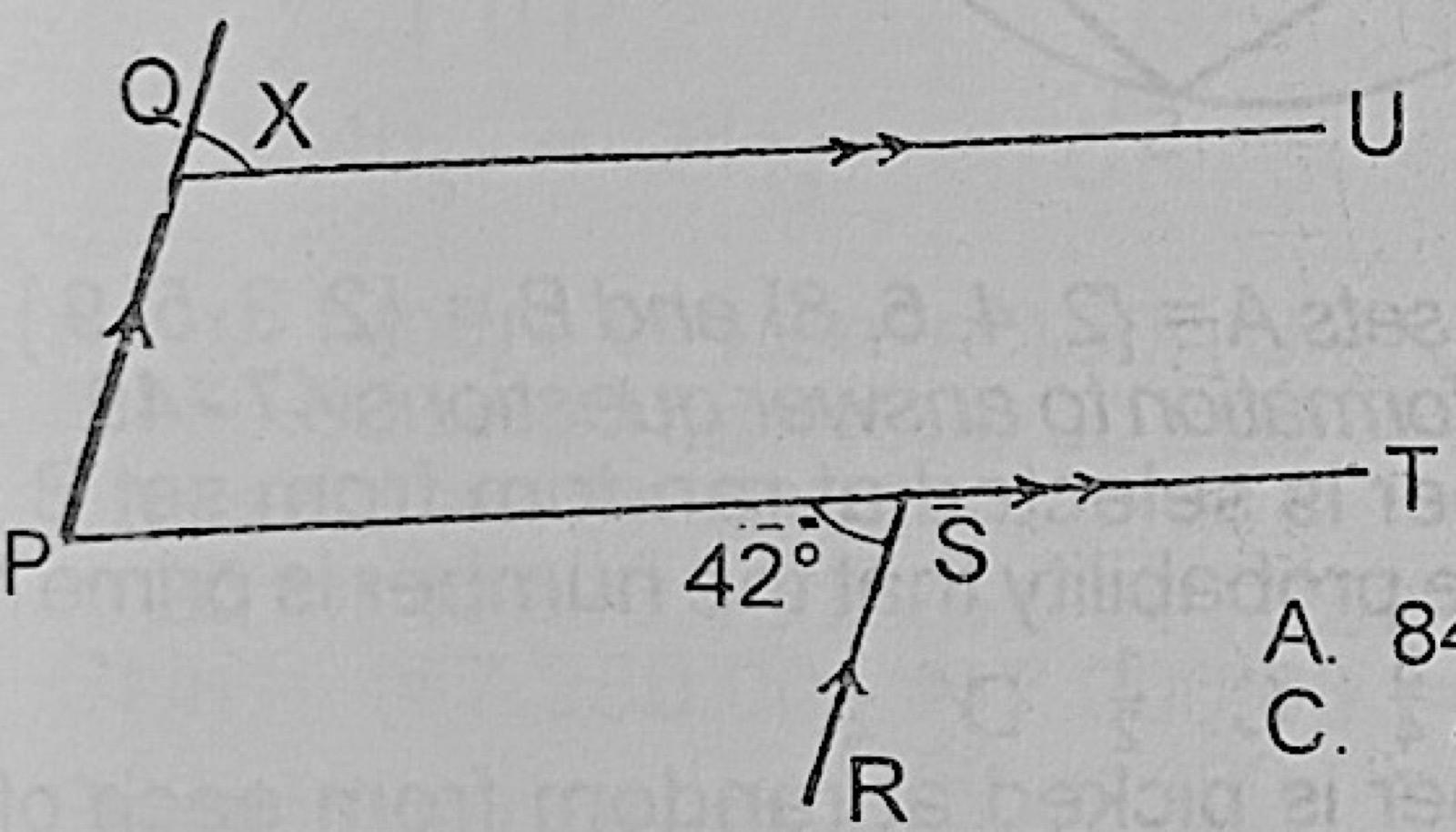
Answer: C (42°)
Because PQ ∥ RS, the angle PQ makes with PT equals 42° (corresponding angles). Because QU ∥ PT, x is the corresponding angle at Q, so x = 42°.
The angles of a quadrilateral are (x + 10)°, 2y°, 90° and (100 − y)°. Find y in terms of x.
Answer: C (y = 160 − x)
The angles add to 360°: x + 10 + 2y + 90 + 100 − y = 360, so x + y = 160 and y = 160 − x.
In the figure |PX| = |XQ|, PQ // YZ and XY // QR. What is the ratio of the area of XYZQ to the area of ΔYZR?
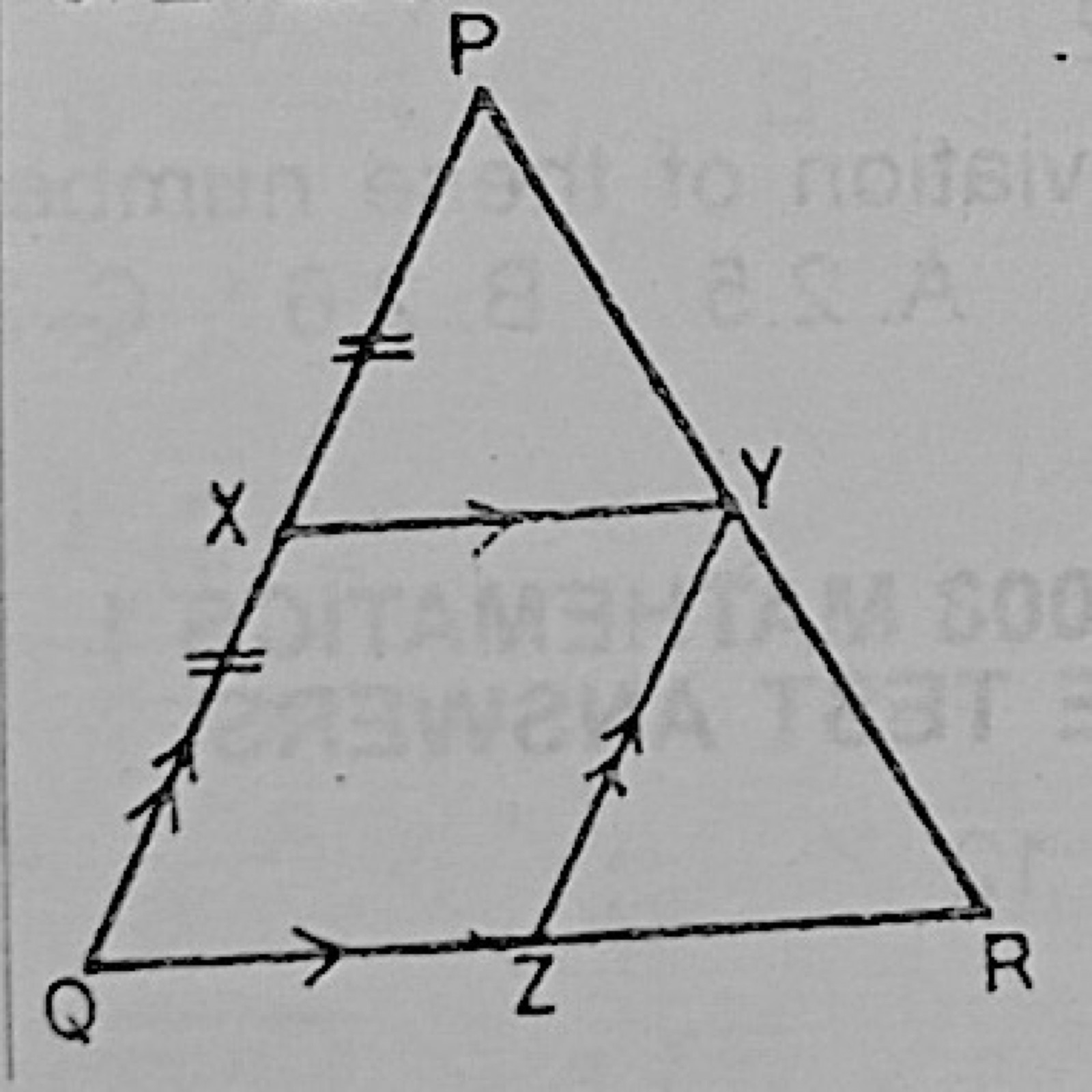
Answer: B (2:1)
X is the midpoint of PQ, so Y and Z are midpoints of PR and QR (midpoint theorem). The triangle splits into four equal triangles: XYZQ is two of them and YZR is one, so the ratio is 2 : 1.
In the diagram, O is the centre of the circle and PQRS is a cyclic quadrilateral. Find the value of x.
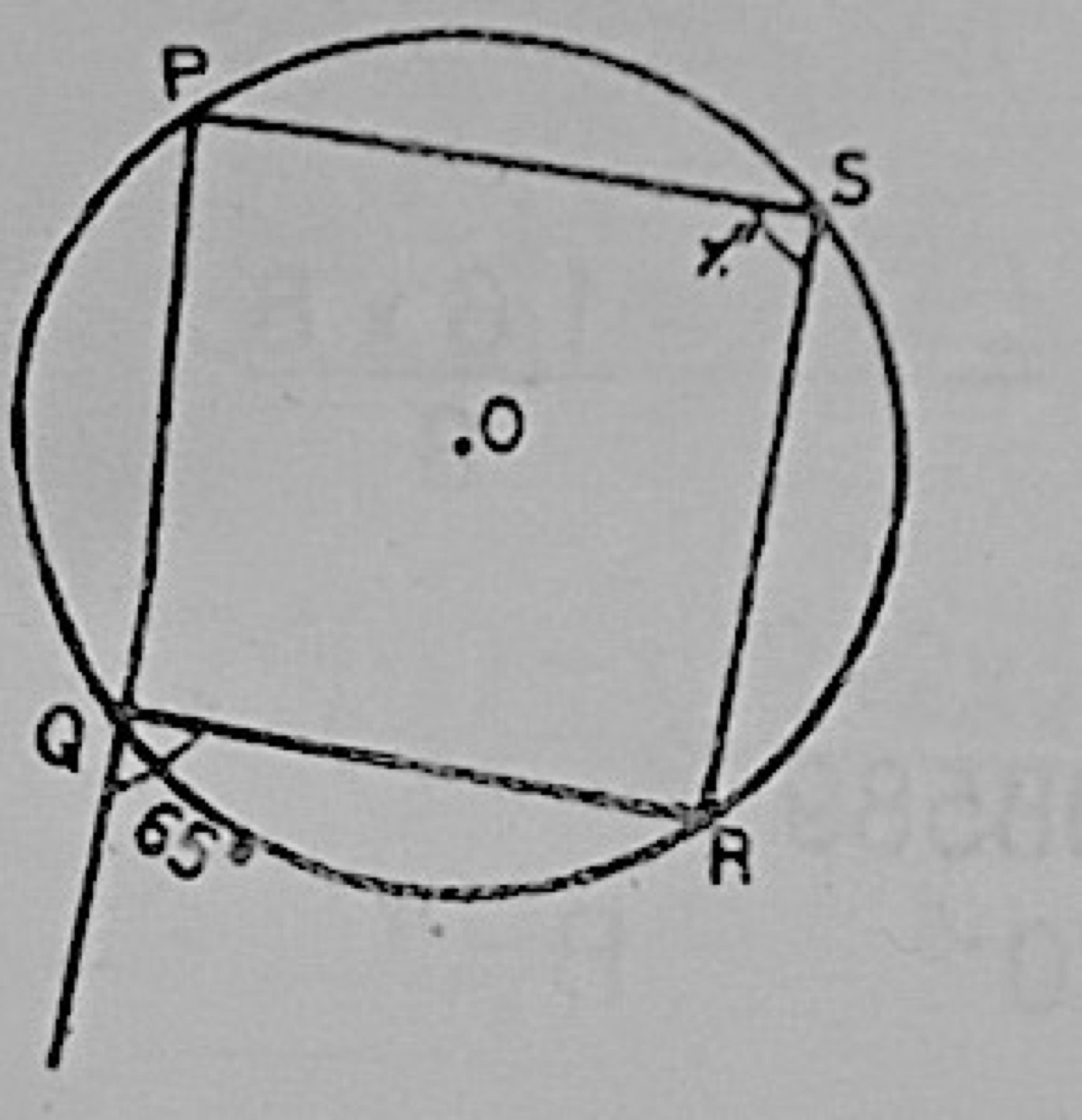
Answer: B (65°)
The 65° is an exterior angle at Q, so the interior ∠PQR = 180° − 65° = 115°. Opposite angles of a cyclic quadrilateral add to 180°, so x = 180° − 115° = 65°.
If x° is obtuse, which of the following is true?
Answer: D (90 < x < 180)
An obtuse angle is bigger than 90° but less than 180°.
If tan x = 1, evaluate sin x + cos x, leaving your answer in the surd form.
Answer: C (√2)
tan x = 1 gives x = 45°, so sin x + cos x = 1/√2 + 1/√2 = 2/√2 = √2.
If cos (x + 25)° = sin 45°, find the value of x.
Answer: A (20)
sin 45° = cos 45°, so x + 25 = 45 and x = 20.
If 2n = 128, find the value of (2n−1)(5n−2).
Answer: D (2(105))
27 = 128, so n = 7. Then 26 × 55 = 2 × (2 × 5)5 = 2(105).
If x ∝ (45 + ½y), which of the following is true?
Answer: C (x is partly constant and partly varies as y)
x = k(45 + ½y) = 45k + (k/2)y: a constant part plus a part that varies with y, i.e. partial variation.
Simplify: log√8/(log 4 − log 2)
Answer: C (3/2)
log√8 = log 23/2 = (3/2) log 2 and log 4 − log 2 = log 2, so the value is 3/2.
Every staff in an office owns either a Mercedes and/or a Toyota car. 20 own Mercedes, 15 own Toyota and 5 own both. How many staff are there in the office?
Answer: B (30)
n(M ∪ T) = 20 + 15 − 5 = 30.
A train travels 60 km in M minutes. If its average speed is 400 km per hour, find the value of M.
Answer: D (9)
Time = 60/400 h = 0.15 h = 0.15 × 60 = 9 minutes.
An arc of a circle, radius 14 cm, is 18.33 cm long. Calculate, correct to the nearest degree, the angle which the arc subtends at the centre of the circle. [Take π = 22/7]
Answer: D (75°)
θ/360 × 2 × 22/7 × 14 = 18.33, so θ = 18.33 × 360/88 ≈ 75°.
What is the length of an edge of a cube whose total surface area is X cm2 and whose volume is X/2 cm3?
Answer: A (3)
With edge a: 6a2 = X and a3 = X/2 = 3a2, so a = 3.
XY is a chord of circle centre O and radius 7 cm. The chord XY which is 8 cm long subtends an angle of 120° at the centre of the circle. Calculate the perimeter of the minor segment. [Take π = 22/7]
Answer: B (22.67 cm)
Minor arc = 120/360 × 2 × 22/7 × 7 = 14.67 cm. Perimeter of the segment = arc + chord = 14.67 + 8 = 22.67 cm.
If the perimeter of ΔPQR in the diagram is 24 cm, what is the area of ΔPRS?
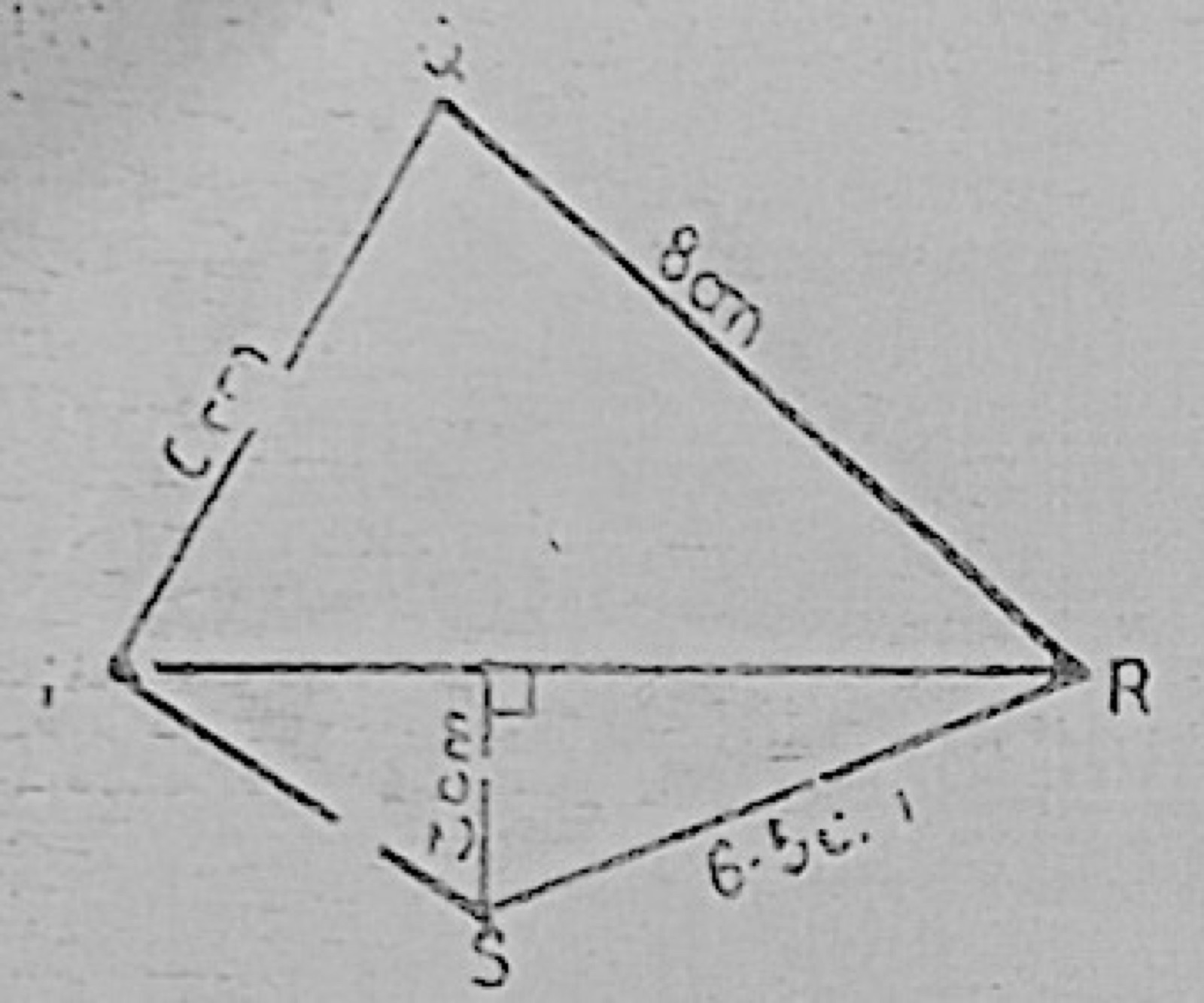
Answer: B (15.0 cm2)
|PR| = 24 − 6 − 8 = 10 cm. The height from S to PR is 3 cm, so area of ΔPRS = ½ × 10 × 3 = 15 cm2.
If p = ½ and 1/(p − 1) = 2/(p + x), find the value of x.
Answer: B (−1½)
1/(½ − 1) = −2, so 2/(½ + x) = −2, giving ½ + x = −1 and x = −1½.
Find the quadratic equation whose roots are c and −c.
Answer: B (x2 − c2 = 0)
(x − c)(x + c) = 0 gives x2 − c2 = 0.
Which of the number lines below best represents the inequality −3 ≤ x < 4?
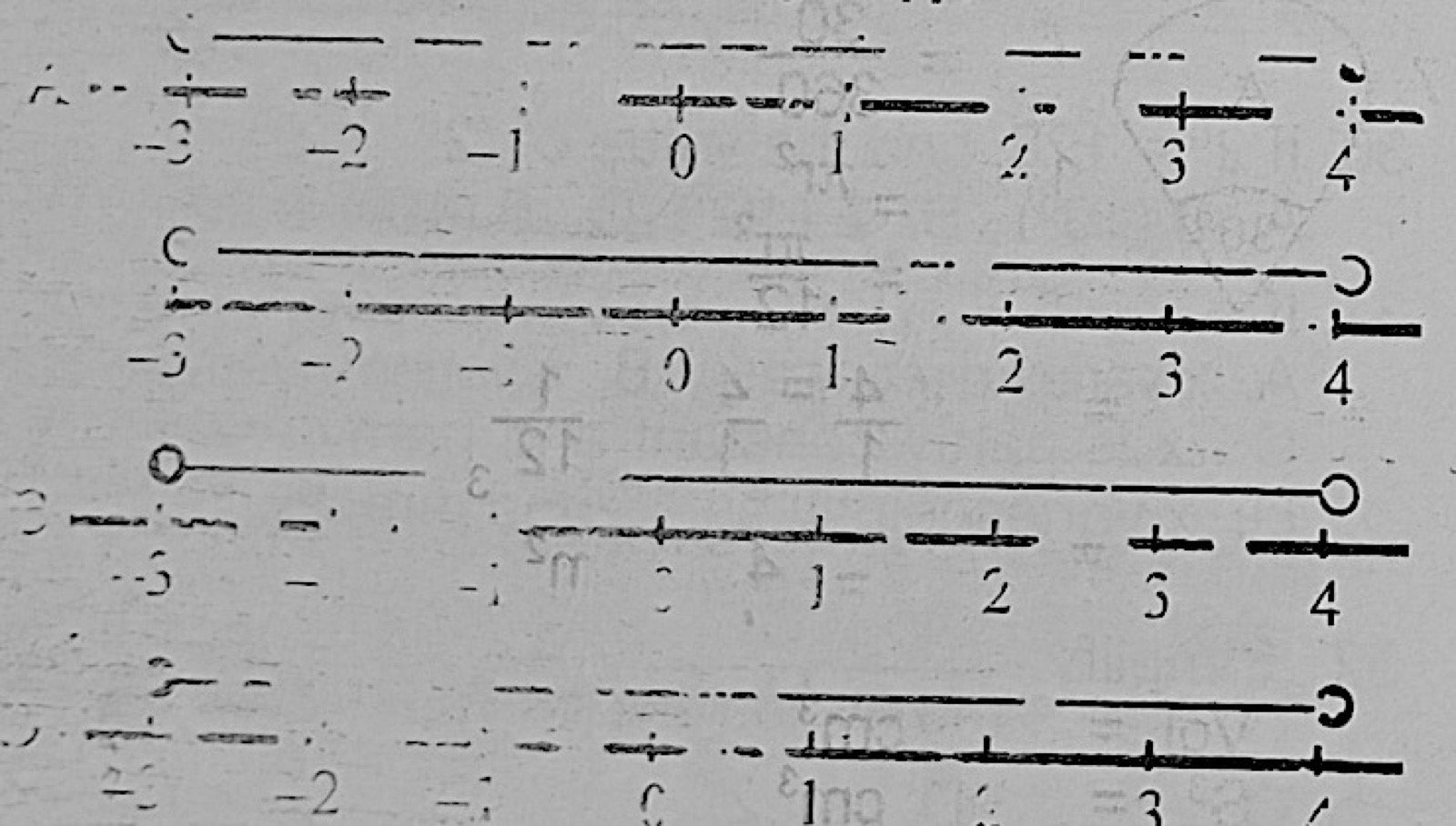
Answer: C (Diagram C)
−3 is included (filled dot at −3) and 4 is not (open circle at 4), with the line joining them.
In the diagram, PX is a tangent to the circle and RST is an equilateral triangle. Calculate ∠PTS.
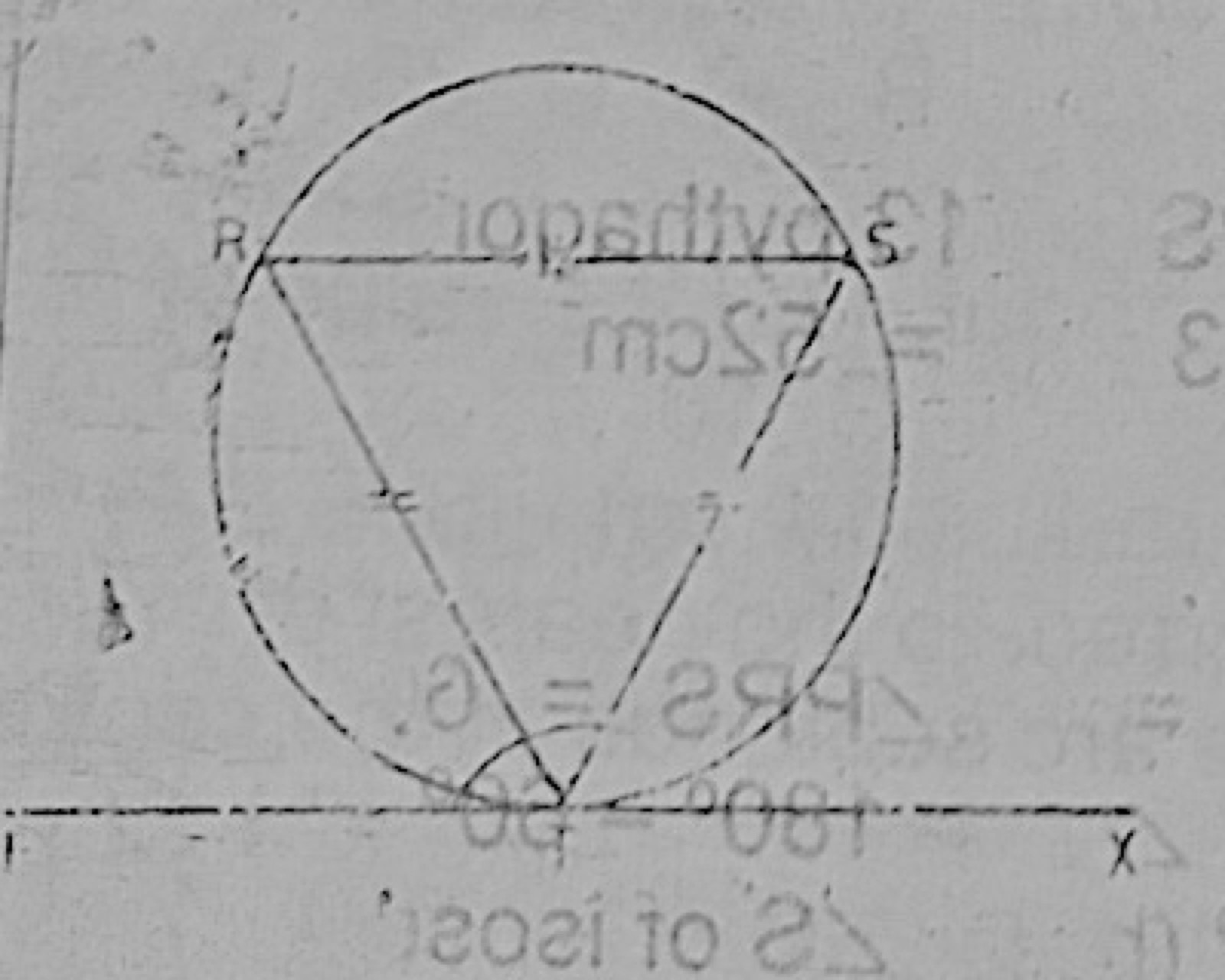
Answer: C (120°)
By the alternate segment theorem, ∠STX = ∠TRS = 60°. P, T, X lie on a straight line, so ∠PTS = 180° − 60° = 120°.
In the diagram, ∠QPR = 60°, ∠PQR = 50°, ∠QRS = 2x°, ∠SRP = 3x°, ∠UQP = y° and RS // TU. Calculate y.
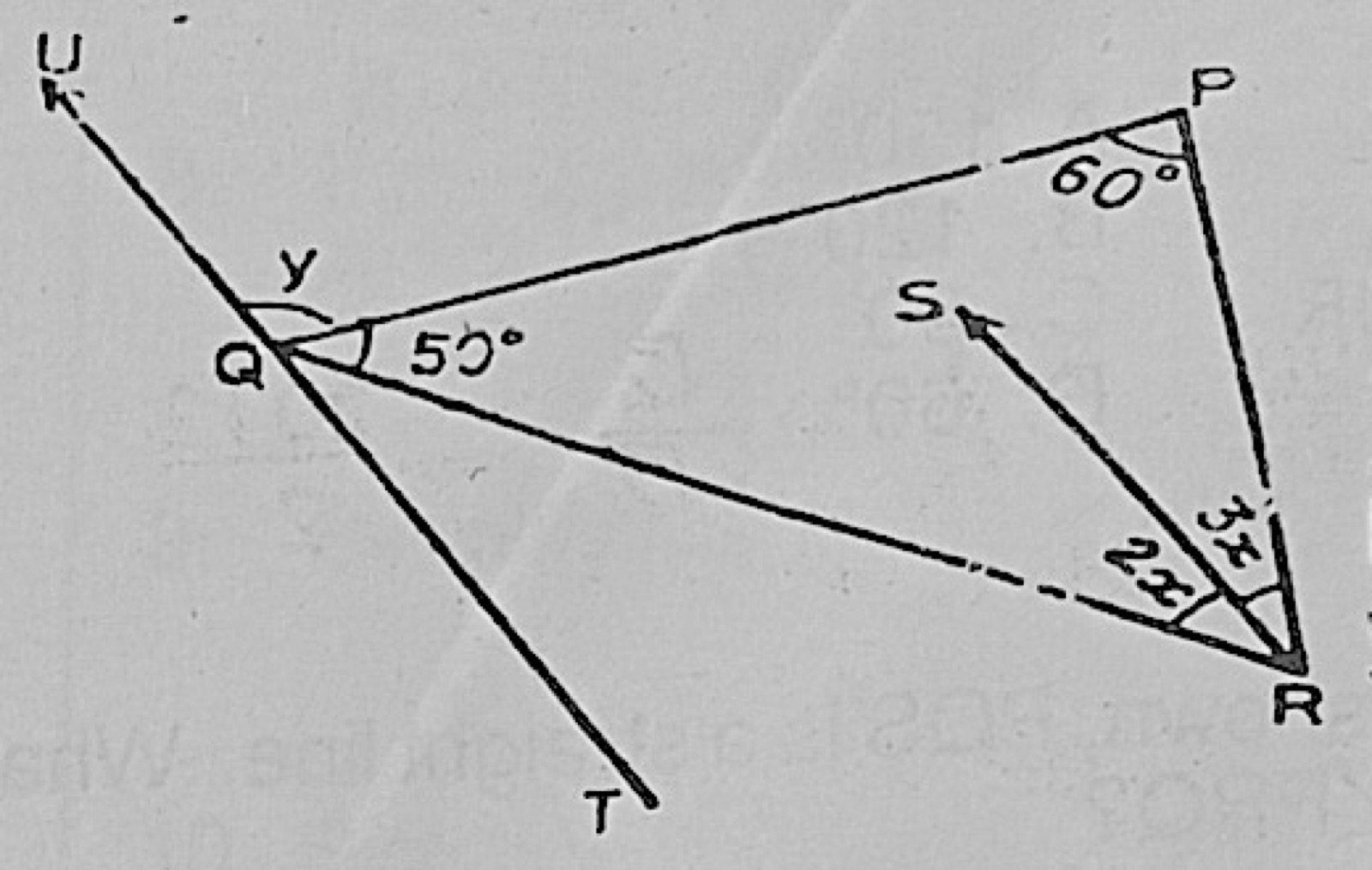
Answer: A (102°)
In ΔPQR, 5x = 180 − 60 − 50 = 70, so x = 14 and ∠QRS = 28°. RS ∥ TU gives ∠TQR = 28° (alternate). On the straight line UQT: y + 50 + 28 = 180, so y = 102°.
In the diagram, find the size of the angle marked a°.
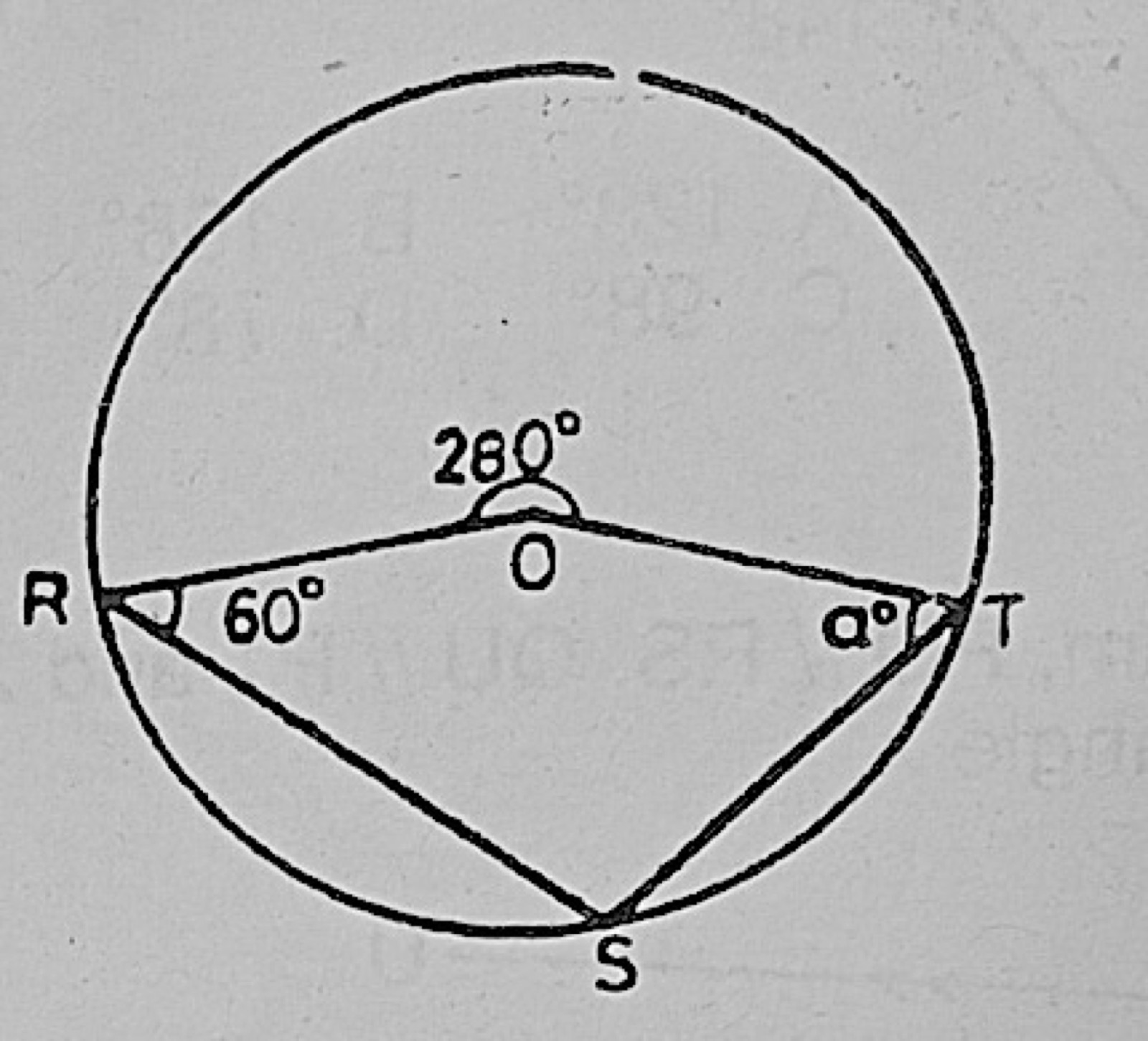
Answer: B (80°)
The reflex angle at O is 280°, so ∠ROT inside the shape is 80° and the angle at S on the circle is ½ × 280° = 140°. The four angles of RO TS add to 360°: 60 + 80 + 140 + a = 360, so a = 80°.
Given the sets A = {2, 4, 6, 8} and B = {2, 3, 5, 9}. If a number is selected at random from set B, what is the probability that the number is prime?
Answer: B (3/4)
2, 3 and 5 are prime; 9 is not. Probability = 3/4.
Given the sets A = {2, 4, 6, 8} and B = {2, 3, 5, 9}. If a number is picked at random from each of the two sets, what is the probability that their product is odd?
Answer: D (0)
Every number in A is even, and an even number times anything is even, so an odd product is impossible: probability 0.
Given the sets A = {2, 4, 6, 8} and B = {2, 3, 5, 9}. If a number is picked at random from each of the two sets, what is the probability that their difference is 6 or 7?
Answer: C (1/8)
There are 4 × 4 = 16 pairs. Difference 6: (8, 2); difference 7: (2, 9). So 2/16 = 1/8.
Find the mean deviation of these numbers: 10, 12, 14, 15, 17, 19.
Answer: A (2.5)
Mean = 87/6 = 14.5. Absolute deviations: 4.5, 2.5, 0.5, 0.5, 2.5, 4.5, total 15. Mean deviation = 15/6 = 2.5.
(a) Without using calculator or tables, find the value of log 3.6 given that log 2 = 0.3010, log 3 = 0.4771 and log 5 = 0.6990.
(b) If all numbers in the equation y/(y + 101) = 11/10010 are in base two, solve for y.
(a) 3.6 = 18/5 = (2 × 32)/5.
log 3.6 = log 2 + 2 log 3 − log 5 = 0.3010 + 0.9542 − 0.6990 = 0.5562.
(b) In base ten: 101two = 5, 11two = 3, 10010two = 18.
y/(y + 5) = 3/18 → 18y = 3y + 15 → 15y = 15 → y = 1.
Write 3.6 as a product and quotient of 2, 3 and 5.
(a) Solve the inequality (2/5)(x − 2) − (1/6)(x + 5) ≤ 0
(b) Given that P = (x2 − y2)/(x2 + xy), (i) express P in its simplest form; (ii) find the value of P if x = −4 and y = −6.
(a) Multiply by 30: 12(x − 2) − 5(x + 5) ≤ 0 → 7x − 49 ≤ 0 → x ≤ 7.
(b)(i) P = (x − y)(x + y)/[x(x + y)] = (x − y)/x.
(ii) P = (−4 − (−6))/(−4) = 2/(−4) = −½.
Clear the fractions with the LCM of 5 and 6.
The table below shows how a man spends his income in a month.
Food: ₦4500; House rent: ₦3000; Provisions: ₦2500; Electricity: ₦2000; Transportation: ₦5000; Others: ₦3000
(a) Represent the information on a pie chart.
(b) What percentage of his income is spent on transportation?
Total = ₦20,000. Angle = amount/20,000 × 360°.
(a) Food 81°, House rent 54°, Provisions 45°, Electricity 36°, Transportation 90°, Others 54° (total 360°). Draw and label the sectors.
(b) 5000/20,000 × 100% = 25%.
Each ₦1,000 is 18° of the pie.
(a) A pentagon is such that one of its exterior angles is 60°. Two others are (90 − m)° each while the remaining angles are (30 + 2m)° each. Find the value of m.
(b) In the diagram, PQR is a straight line, QR = √3 cm and SQ = 2 cm. Calculate, correct to one decimal place, ∠PQS.
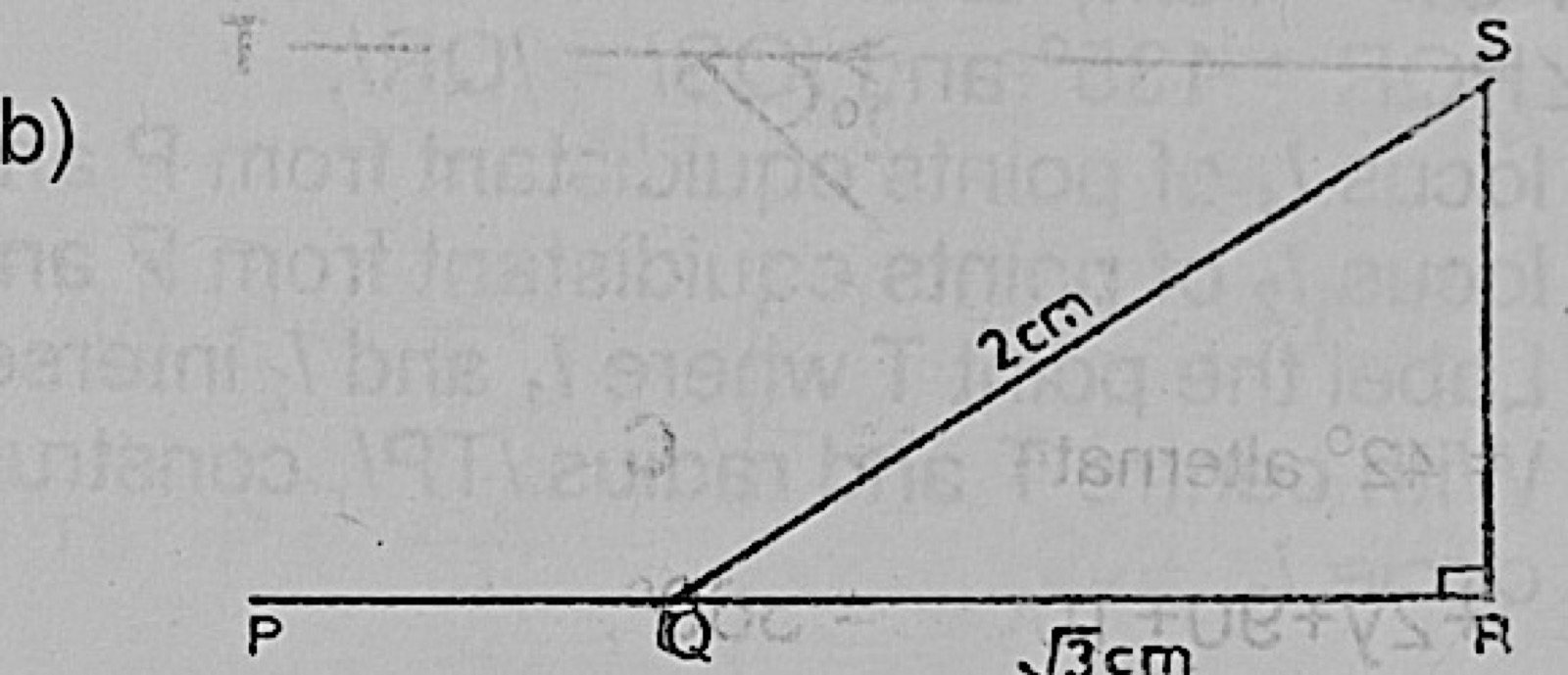
(a) Exterior angles add to 360°: 60 + 2(90 − m) + 2(30 + 2m) = 360 → 300 + 2m = 360 → m = 30.
(b) In right-angled ΔSQR (right angle at R): cos ∠SQR = √3/2, so ∠SQR = 30°.
∠PQS = 180° − 30° = 150.0°.
The exterior angles of any polygon add up to 360°.
(a) A rectangular field is l metres long and b metres wide. Its perimeter is 280 metres. If the length is two and a half times its breadth, find the values of l and b.
(b) The base of a pyramid is a 4.5 m by 2.5 m rectangle. The height of the pyramid is 4 m. Calculate its volume.
(a) 2(l + b) = 280 → l + b = 140, and l = 2.5b. So 3.5b = 140 → b = 40 m and l = 100 m.
(b) V = ⅓ × base area × height = ⅓ × 4.5 × 2.5 × 4 = 15 m3.
Substitute l = 2.5b into the perimeter equation.
(a) If 2x+y = 16 and 4x−y = 1/32, find the values of x and y.
(b) P, Q and R are related in such a way that P ∝ Q2/R. When P = 36, Q = 3 and R = 4. Calculate Q when P = 200 and R = 2.
(a) 2x+y = 24 → x + y = 4. 22(x−y) = 2−5 → x − y = −5/2.
Adding: 2x = 3/2 → x = ¾; y = 4 − ¾ = 3¼.
(b) P = kQ2/R: 36 = 9k/4 → k = 16.
200 = 16Q2/2 → Q2 = 25 → Q = 5 (or −5).
Write every number as a power of 2 and equate the indices.
(a) Solve, correct to two decimal places, the equation 4x2 = 11x + 21.
(b) A man invests £1500 for two years at compound interest. After one year, his money amounts to £1560. Find the: (i) rate of interest; (ii) interest for the second year.
(c) A car costs ₦300,000.00. It depreciates by 25% in the first year and 20% in the second year. Find its value after 2 years.
(a) 4x2 − 11x − 21 = 0. x = [11 ± √(121 + 336)]/8 = (11 ± √457)/8 = (11 ± 21.378)/8.
x ≈ 4.05 or x ≈ −1.30.
(b)(i) Interest in year 1 = £60; rate = 60/1500 × 100% = 4%.
(ii) Compound interest: second-year interest = 4% of £1560 = £62.40.
(c) After year 1: 300,000 × 0.75 = ₦225,000. After year 2: 225,000 × 0.80 = ₦180,000.00.
With compound interest the second year's interest is on the new amount, £1560.
The ages, in years, of 50 teachers in a school are given below:
21 37 49 27 49 42 26 33 46 40
50 29 23 24 29 31 36 22 27 38
30 28 42 39 34 23 21 32 41 46
46 31 33 29 28 43 47 40 34 44
26 38 34 49 45 27 25 33 39 40
(a) Form a frequency distribution of the data using the intervals: 21 − 25, 26 − 30, 31 − 35, etc.
(b) Draw the histogram of the distribution.
(c) Use your histogram to estimate the mode.
(d) Calculate the mean age.
(a) 21–25: 7; 26–30: 11; 31–35: 9; 36–40: 9; 41–45: 6; 46–50: 8 (total 50).
(b) Bars on class boundaries 20.5, 25.5, …, 50.5 with heights equal to the frequencies.
(c) Modal class 26–30. From the histogram (joining the corners of the tallest bar to the neighbouring bars): mode ≈ 25.5 + 5 × 4/(4 + 2) ≈ 28.8 years.
(d) Class marks 23, 28, 33, 38, 43, 48: Σfx = 161 + 308 + 297 + 342 + 258 + 384 = 1750. Mean = 1750/50 = 35 years.
Tally each age into its class first and check the frequencies add to 50.
(a) The triangle ABC has sides AB = 17 m, BC = 12 m and AC = 10 m. Calculate the: (i) largest angle of the triangle; (ii) area of the triangle.
(b) From a point T on a horizontal ground, the angle of elevation of the top R of a tower RS, 38 m high, is 63°. Calculate, correct to the nearest metre, the distance between T and S.
(a)(i) The largest angle is C, opposite AB. cos C = (122 + 102 − 172)/(2 × 12 × 10) = −45/240 = −0.1875, so C ≈ 100.8°.
(ii) Area = ½ × 12 × 10 × sin 100.8° ≈ 58.9 m2.
(b) tan 63° = 38/|TS|, so |TS| = 38/1.9626 ≈ 19.4 ≈ 19 m.
The largest angle is opposite the longest side; a negative cosine means it is obtuse.
(a) Using ruler and a pair of compasses only, construct: (i) a quadrilateral PQRS such that |PQ| = 7 cm, ∠QPS = 60°, |PS| = 6.5 cm, ∠PQR = 135° and |QS| = |QR|; (ii) locus l1 of points equidistant from P and Q; (iii) locus l2 of points equidistant from P and S.
(b)(i) Label the point T where l1 and l2 intersect. (ii) With centre T and radius |TP|, construct a circle l3.
(a)(i) Draw PQ = 7 cm; construct 60° at P and mark PS = 6.5 cm. Construct 135° at Q (90° + 45°). With centre Q and radius QS, cut the 135° arm at R. Join SR.
(ii) l1: perpendicular bisector of PQ. (iii) l2: perpendicular bisector of PS.
(b)(i) T is where l1 and l2 meet.
(ii) The circle centre T, radius TP, passes through P, Q and S (radius ≈ 3.9 cm).
T is equidistant from P, Q and S, so the circle passes through all three.
(a) In the diagram, AB//CD and BC//FE. CD̂E = 75° and DÊF = 26°. Find the angles marked x and y.
(b) The diagram shows a circle ABCD with centre O and radius 7 cm. The reflex angle AOC = 190° and angle DAO = 35°. Find: (i) ∠ABC; (ii) ∠ADC.
(c) Using the diagram in 11(b) above, calculate, correct to 3 significant figures, the length of: (i) arc ABC; (ii) the chord AD. [Take π = 3.142]
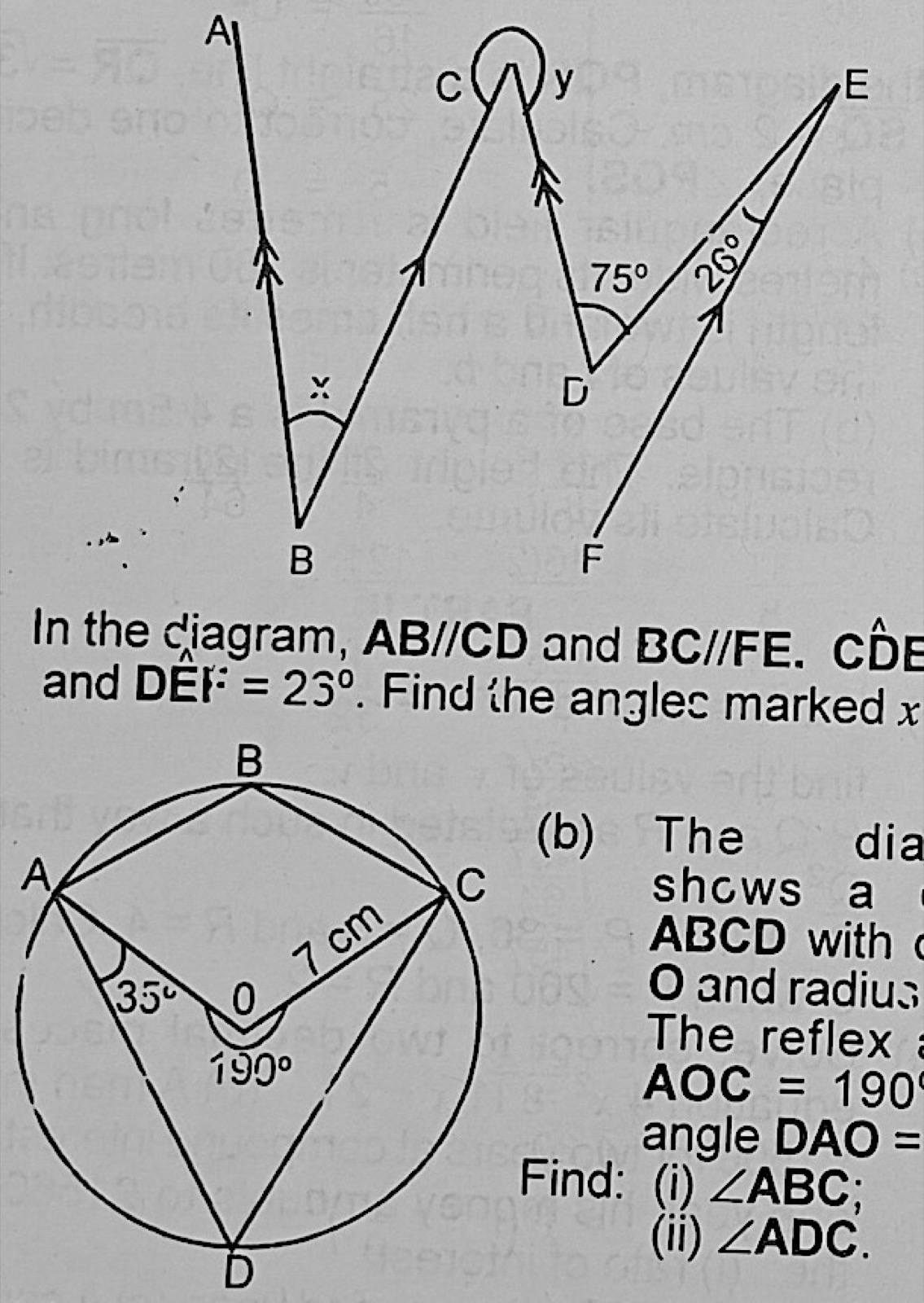
(a) Through D draw a line parallel to BC and FE. Its angle with DE = 26° (alternate), so its angle with DC = 75° − 26° = 49°. Hence ∠BCD = 49° (alternate) and x = ∠ABC = ∠BCD = 49° (AB ∥ CD).
y = 360° − 49° = 311°.
(b) ∠AOC (non-reflex) = 360° − 190° = 170°.
(i) ∠ABC = ½ × 190° = 95°. (ii) ∠ADC = ½ × 170° = 85°.
(c)(i) Arc ABC = 170/360 × 2 × 3.142 × 7 ≈ 20.8 cm.
(ii) ΔAOD is isosceles with ∠OAD = ∠ODA = 35°, so ∠AOD = 110°. AD = 2 × 7 × sin 55° ≈ 11.5 cm.
An angle at the circumference is half the angle at the centre on the same arc.
(a) Copy and complete the table of values for y = 3 sin x + 2 cos x for 0° ≤ x ≤ 360°.
x: 0°, 60°, 120°, 180°, 240°, 300°, 360°
y: 2.00, –, –, –, –, –, 2.00
(b) Using a scale of 2 cm to 60° on x-axis and 2 cm to 1 unit on y-axis, draw the graph of y = 3 sin x + 2 cos x for 0° ≤ x ≤ 360°.
(c) Use your graph to solve the equation: 3 sin x + 2 cos x = 1.5.
(d) Find the range of values of x for which 3 sin x + 2 cos x < −1.
(a) 0°: 2.00; 60°: 3.60; 120°: 1.60; 180°: −2.00; 240°: −3.60; 300°: −1.60; 360°: 2.00.
(b) Plot the points and join with a smooth curve.
(c) Where y = 1.5 meets the curve: x ≈ 122° and x ≈ 351°.
(d) The curve is below y = −1 for about 162° < x < 310°.
(Accept graph readings within a few degrees.)
For example at 60°: 3(0.866) + 2(0.5) = 3.60.
(a) If 3, x, y, 18 are in Arithmetic Progression (A.P), find the values of x and y.
(b)(i) The sum of the second and third terms of a geometric progression is six times the fourth term. Find the two possible values of the common ratio. (ii) If the second term is 8 and the common ratio is positive, find the first six terms.
(a) 18 = 3 + 3d → d = 5, so x = 8 and y = 13.
(b)(i) ar + ar2 = 6ar3 → 6r2 − r − 1 = 0 → (3r + 1)(2r − 1) = 0 → r = ½ or r = −⅓.
(ii) r = ½ and ar = 8, so a = 16. First six terms: 16, 8, 4, 2, 1, ½.
Divide the GP equation by ar (not zero) to get a quadratic in r.
(Questions 14 and 15 are for candidates in Ghana, Sierra Leone and The Gambia only.)
(a) The function f is defined as f: x → 3x2 − 5x. (i) Evaluate f(−2). (ii) Find the values of x for which f(x) = −7/4.
(b) A rhombus ABCD has A at (0, 2) and B at (5, 3). If the diagonals intersect at (0, 3), find the coordinates of C and D.
(a)(i) f(−2) = 3(4) + 10 = 22.
(ii) 3x2 − 5x = −7/4 → 12x2 − 20x + 7 = 0 → (6x − 7)(2x − 1) = 0 → x = 7/6 or x = ½.
(b) The diagonals bisect each other at M(0, 3). C = 2M − A = (0, 4); D = 2M − B = (−5, 3).
The point where the diagonals meet is the midpoint of AC and of BD.
(a) Using a scale of 2 cm to 2 units on both axes, draw two perpendicular axes OX and OY for the interval −8 ≤ x ≤ 8 and −10 ≤ y ≤ 10.
(b) Draw, clearly labelling all the vertices and coordinates, (i) triangle PQR with P(−3, 6), Q(−1, 1) and R(4, 2); (ii) ΔP1Q1R1, with P1(5, 6), Q1(3, 1) and R1(−2, 2); (iii) ΔP2Q2R2, the image of ΔPQR under a rotation through 180° about the origin where P → P2, Q → Q2 and R → R2; (iv) the point Q3, the image of Q under a translation by the vector (−4, 3).
(c) What single transformation maps ΔPQR onto ΔP1Q1R1?
(a), (b)(i), (ii) Axes to scale; plot and label PQR and P1Q1R1.
(iii) (x, y) → (−x, −y): P2(3, −6), Q2(1, −1), R2(−4, −2).
(iv) Q3 = (−1 − 4, 1 + 3) = (−5, 4).
(c) Each point keeps its y-coordinate and the midpoints of PP1, QQ1, RR1 all have x = 1: a reflection in the line x = 1.
Check the midpoint of each point and its image to find the mirror line.