WAEC Mathematics 2002 past questions and answers

55 questions. Try each one, then open the answer to check yourself and read the explanation.

Question 1

Triangles and Quadrilaterals

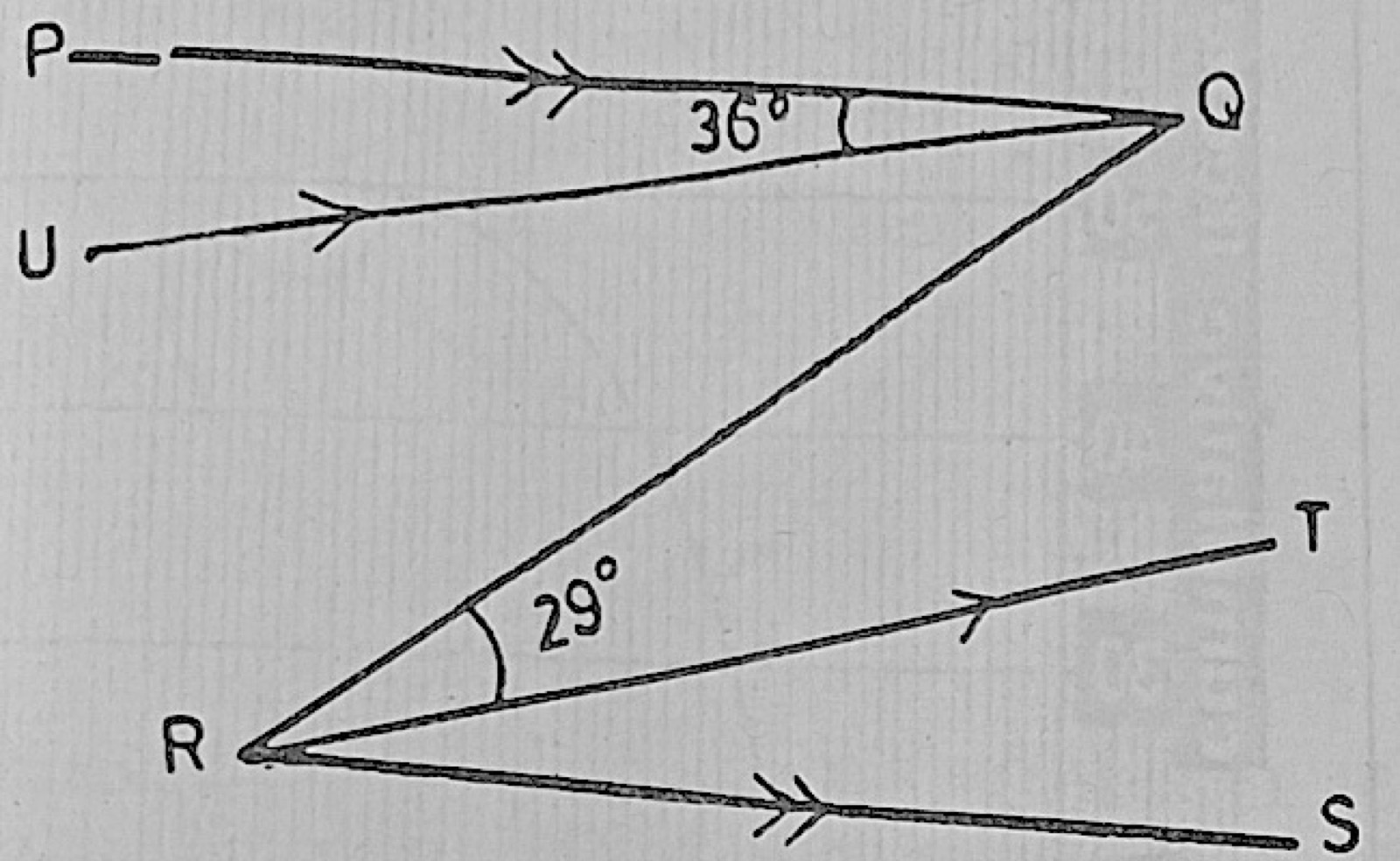
In the diagram, ∠PQU = 36°, ∠QRT = 29°, PQ||RS and UQ||RT. Find ∠PQR.

Diagram for this question
  1. A.94°
  2. B.65°
  3. C.61°
  4. D.54°
Show the answer and explanation

Answer: B (65°)

Explanation

∠PQR = ∠QRS (alternate angles, PQ ∥ RS). ∠TRS = ∠PQU = 36° (the arms are parallel), so ∠QRS = 29° + 36° = 65°.

Open this question

Question 3

Measures of Dispersion

The variance of a given distribution is 25. What is the standard deviation?

  1. A.125
  2. B.75
  3. C.25
  4. D.5
Show the answer and explanation

Answer: D (5)

Explanation

Standard deviation = √variance = √25 = 5.

Open this question

Question 4

Sets

Given that P = {b, d, e, f} and Q = {a, c, f, g} are subsets of the universal set U = {a, b, c, d, e, f, g}. Find P'∩Q.

  1. A.{a, c}
  2. B.{a, c, d, g}
  3. C.{c, d, g}
  4. D.{a, c, g}
Show the answer and explanation

Answer: D ({a, c, g})

Explanation

P' = {a, c, g}. All three are in Q, so P'∩Q = {a, c, g}.

Open this question

Question 5

Linear and Simultaneous Equations

Find the value of x in 0.5x + 2.6 = 5x + 0.35

  1. A.0.5
  2. B.2
  3. C.2.6
  4. D.5
Show the answer and explanation

Answer: A (0.5)

Explanation

2.6 − 0.35 = 5x − 0.5x, so 2.25 = 4.5x and x = 0.5.

Open this question

Question 6

Triangles and Quadrilaterals

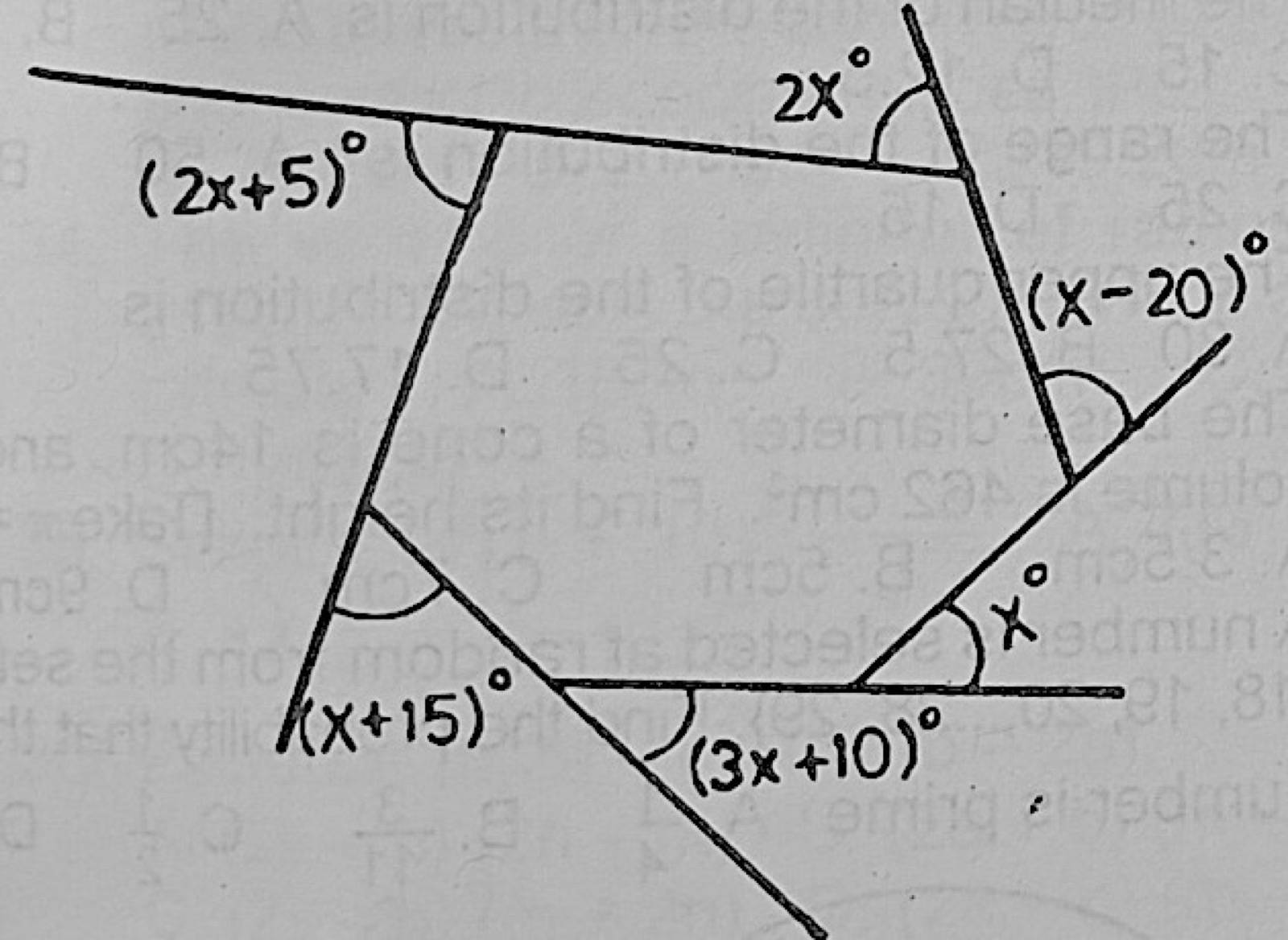
Find the value of x in the diagram

Diagram for this question
  1. A.31°
  2. B.35°
  3. C.37°
  4. D.41°
Show the answer and explanation

Answer: B (35°)

Explanation

The marked angles are the exterior angles of a hexagon, which add to 360°: (2x + 5) + 2x + (x − 20) + x + (3x + 10) + (x + 15) = 10x + 10 = 360, so x = 35°.

Open this question

Question 7

Number Bases

If M5ten = 1001011two, find the value of M.

  1. A.5
  2. B.6
  3. C.7
  4. D.8
Show the answer and explanation

Answer: C (7)

Explanation

1001011two = 64 + 8 + 2 + 1 = 75, so the digit M is 7.

Open this question

Question 8

Graphs of Functions

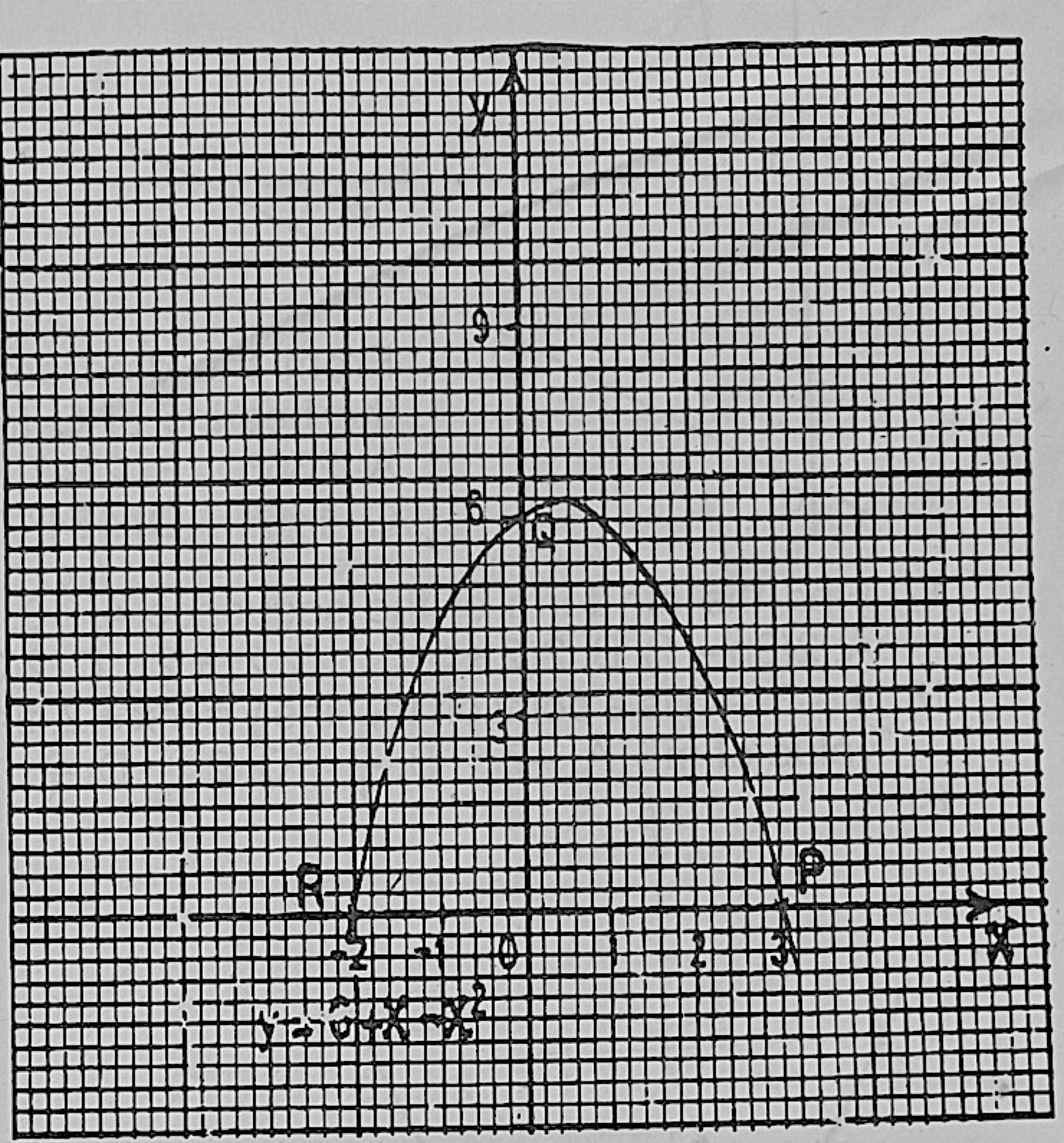
The diagram is the graph of y = 6 + x − x2. The graph intercepts the x-axis at P and R and the y-axis at Q. What is the value of y at Q?

Diagram for this question
  1. A.6 1/3
  2. B.6
  3. C.3
  4. D.0
Show the answer and explanation

Answer: B (6)

Explanation

At the y-axis x = 0, so y = 6 + 0 − 0 = 6.

Open this question

Question 9

Graphs of Functions

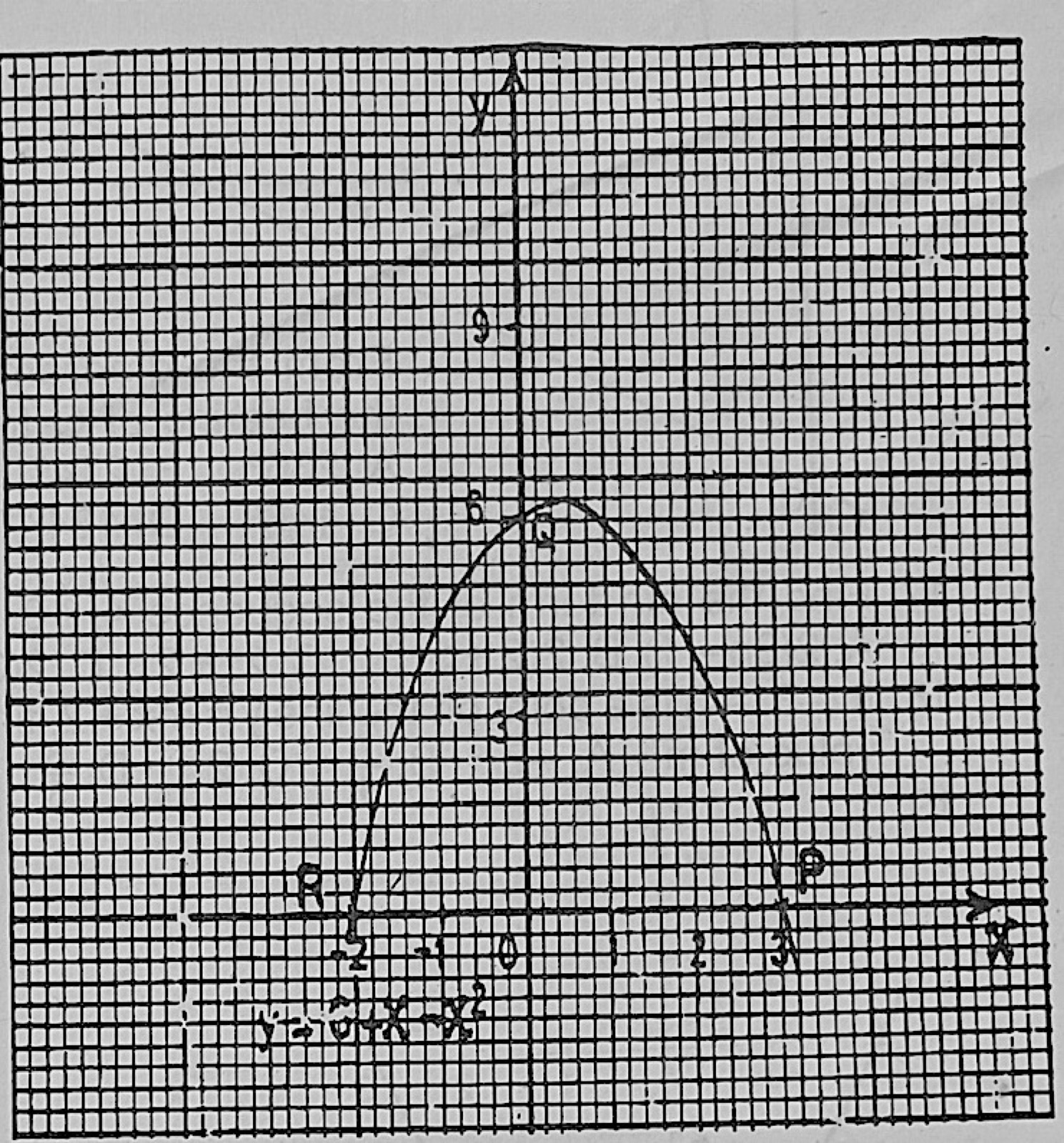
The diagram is the graph of y = 6 + x − x2. The graph intercepts the x-axis at P and R and the y-axis at Q. What is the length of RP?

Diagram for this question
  1. A.6
  2. B.5
  3. C.3
  4. D.2
Show the answer and explanation

Answer: B (5)

Explanation

6 + x − x2 = −(x − 3)(x + 2), so the curve cuts the x-axis at −2 and 3. RP = 3 − (−2) = 5.

Open this question

Question 10

Graphs of Functions

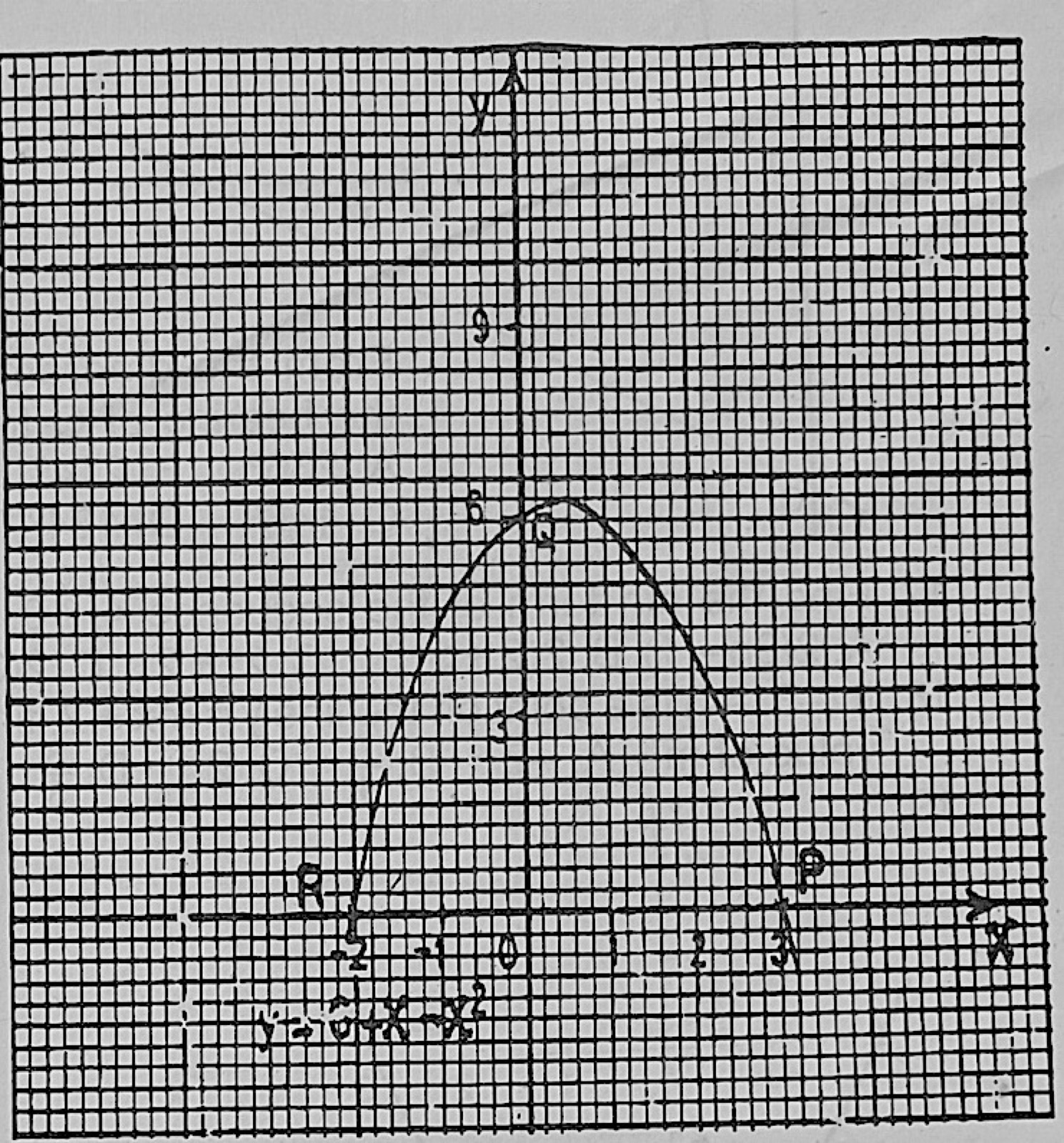
The diagram is the graph of y = 6 + x − x2. When y = 3 1/2, what is the positive value of x?

Diagram for this question
  1. A.2 1/2
  2. B.2 1/5
  3. C.1 1/5
  4. D.0
Show the answer and explanation

Answer: B (2 1/5)

Explanation

Solve 6 + x − x2 = 3.5: x2 − x − 2.5 = 0 gives x ≈ 2.16, which reads as about 2 1/5 on the graph.

Open this question

Question 11

Triangles and Quadrilaterals

The lengths, in cm, of the sides of a right-angled triangle are x, (x + 2) and (x + 1) where x > 0. Find, in cm, the length of its hypotenuse.

  1. A.4
  2. B.5
  3. C.13
  4. D.17
Show the answer and explanation

Answer: B (5)

Explanation

x2 + (x + 1)2 = (x + 2)2 gives x2 − 2x − 3 = 0, so x = 3 and the hypotenuse x + 2 = 5 cm.

Open this question

Question 12

Logarithms

If log 2 = 0.3010 and log 2y = 1.8062, find, correct to the nearest whole number, the value of y.

  1. A.6
  2. B.5
  3. C.4
  4. D.−5
Show the answer and explanation

Answer: A (6)

Explanation

y log 2 = 1.8062, so y = 1.8062 ÷ 0.3010 ≈ 6.

Open this question

Question 13

Bearings

Points X, Y and Z are located in the same horizontal plane such that Y is 12 km north of X and Z is on a bearing of 270° from X. If |XZ| = 6km, calculate, correct to one decimal place, |YZ|

  1. A.18km
  2. B.13.4km
  3. C.13km
  4. D.10.4 km
Show the answer and explanation

Answer: B (13.4km)

Explanation

Z is due west of X and Y due north, so the angle at X is 90°: YZ = √(122 + 62) = √180 ≈ 13.4 km.

Open this question

Question 14

Ratio, Percentages and Rates

The ratio of the number of men to the number of women in a 20-member committee is 3:1. How many women must be added to the 20-member committee so as to make the ratio of men to women 3:2?

  1. A.2
  2. B.5
  3. C.7
  4. D.9
Show the answer and explanation

Answer: B (5)

Explanation

There are 15 men and 5 women. For 15 : w = 3 : 2 we need w = 10, so 5 women must be added.

Open this question

Question 15

Variation

If (x + 3) varies directly as y and x = 3 when y = 12, what is the value of x when y = 8?

  1. A.1
  2. B.1/2
  3. C.−1/2
  4. D.−1
Show the answer and explanation

Answer: A (1)

Explanation

x + 3 = ky: 6 = 12k, so k = 1/2. When y = 8, x + 3 = 4 and x = 1.

Open this question

Question 16

Bearings

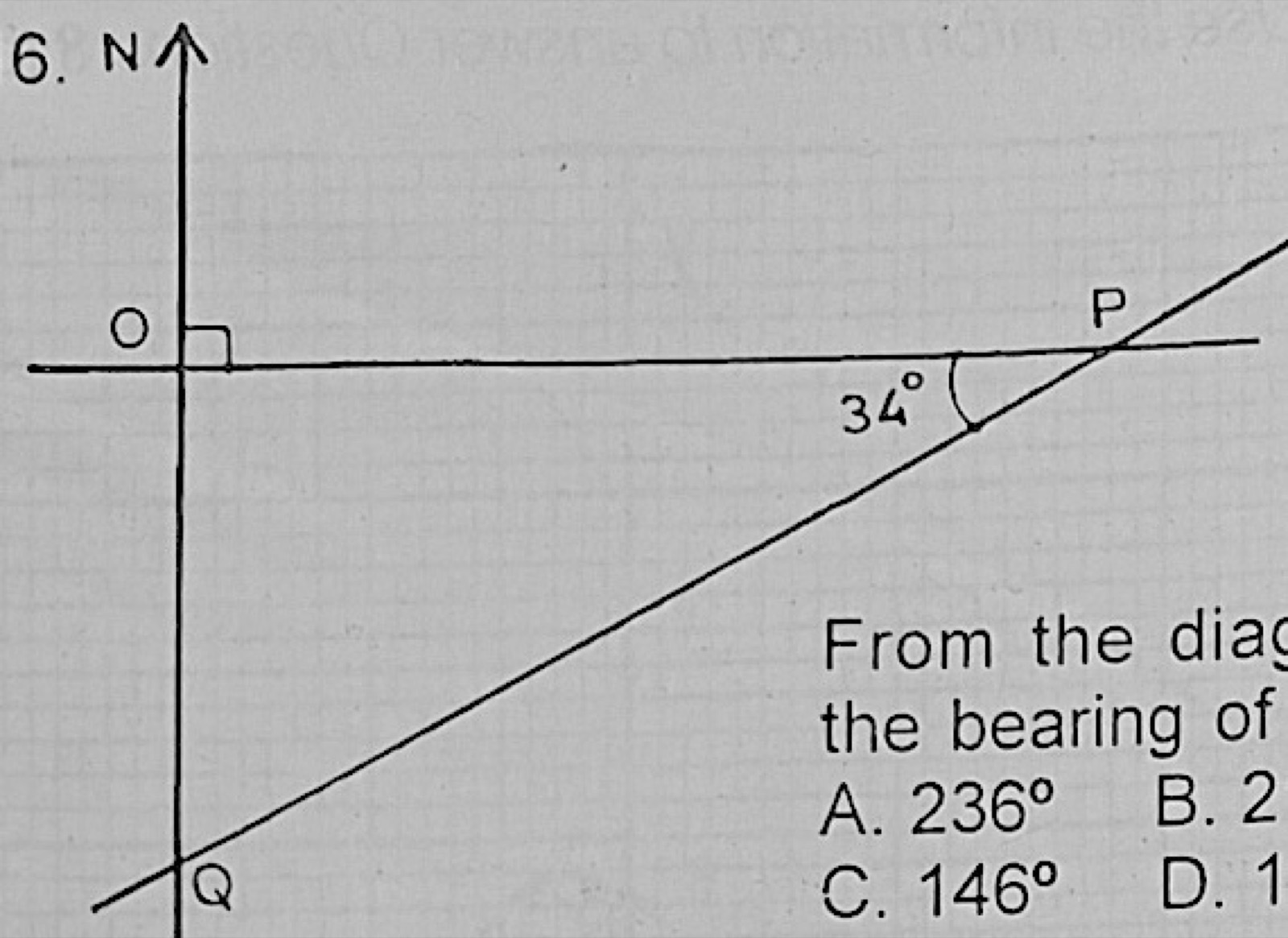
From the diagram, find the bearing of Q from P.

Diagram for this question
  1. A.236°
  2. B.214°
  3. C.146°
  4. D.124°
Show the answer and explanation

Answer: A (236°)

Explanation

From P, the line PO points due west (270°) and Q lies 34° below it, towards the south: 270° − 34° = 236°.

Open this question

Question 17

Progressions

Find the nth term of the sequence 4, 10, 16,...

  1. A.2(3n − 1)
  2. B.2(2 + 3n−1)
  3. C.2n + 2
  4. D.2(3n + 2)
Show the answer and explanation

Answer: A (2(3n − 1))

Explanation

It is an A.P. with a = 4 and d = 6: Tn = 4 + 6(n − 1) = 6n − 2 = 2(3n − 1).

Open this question

Question 18

Coordinate Geometry

If (−3, −4) is a point on the line y = mx + 2, find the value of m.

  1. A.−2
  2. B.7/4
  3. C.2
  4. D.8/3
Show the answer and explanation

Answer: C (2)

Explanation

−4 = −3m + 2, so 3m = 6 and m = 2.

Open this question

Question 19

Graphs of Functions

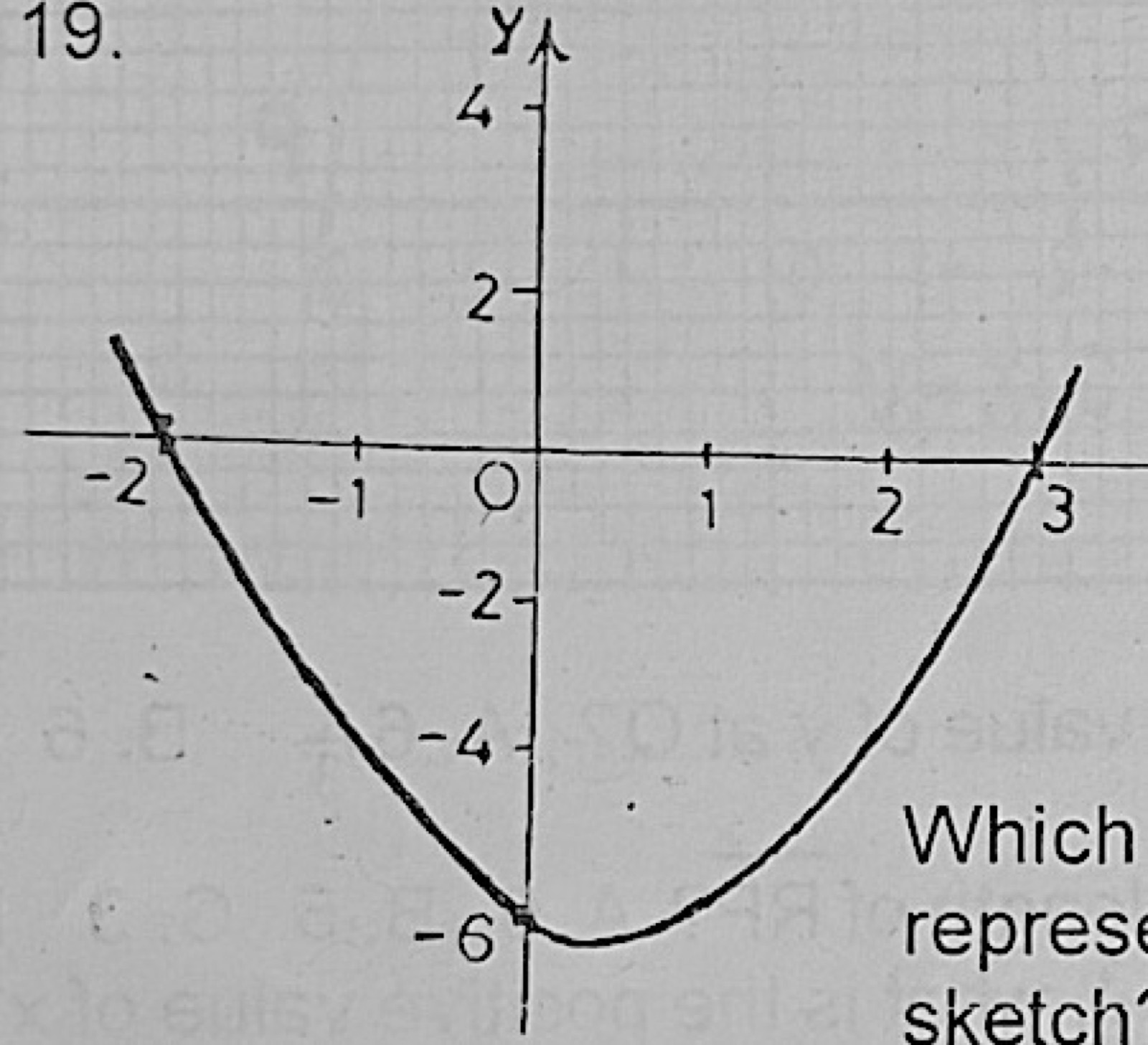
Which of the following is represented by the above sketch?

Diagram for this question
  1. A.y = x2 + x − 6
  2. B.y = x2 − x − 6
  3. C.y = x2 − x + 6
  4. D.y = x2 + x + 6
Show the answer and explanation

Answer: B (y = x2 − x − 6)

Explanation

The curve cuts the x-axis at −2 and 3: y = (x + 2)(x − 3) = x2 − x − 6 (and y = −6 at x = 0).

Open this question

Question 20

Circle Theorems

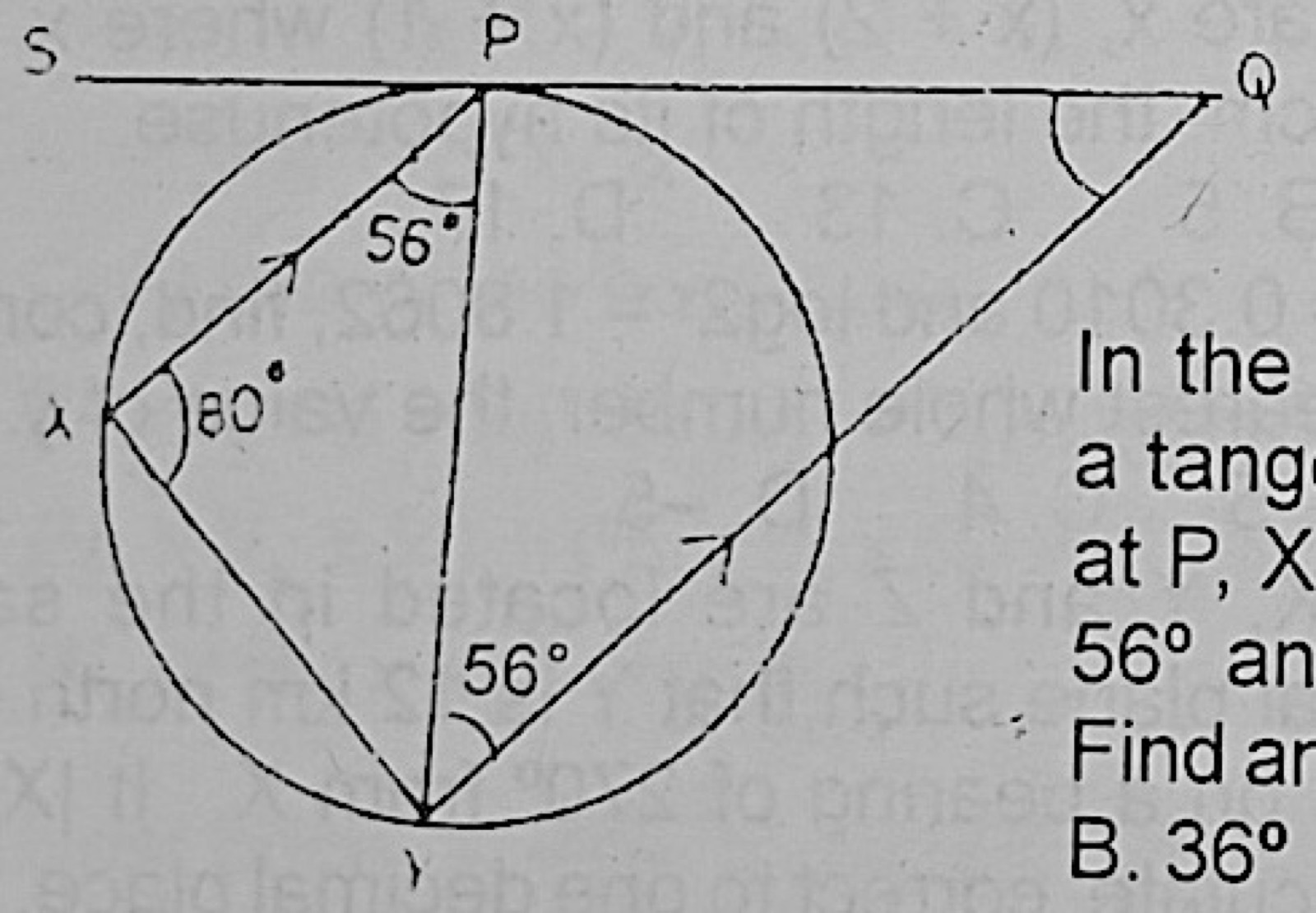
In the diagram, SQ is a tangent to the circle at P, XP||YQ, ∠XPY = 56° and ∠PXY = 80°. Find angle PQY.

Diagram for this question
  1. A.24°
  2. B.36°
  3. C.44°
  4. D.46°
Show the answer and explanation

Answer: C (44°)

Explanation

In triangle PXY, ∠PYX = 180 − 56 − 80 = 44°. The tangent–chord angle ∠SPX equals ∠PYX = 44°, and XP ∥ YQ makes ∠PQY = ∠SPX = 44° (corresponding angles).

Open this question

Question 21

Algebraic Expressions

For what values of x is the expression (3x − 2)/(4x2 + 9x − 9) undefined?

  1. A.−3/4 or 3
  2. B.−2/3 or −3
  3. C.2/3 or 3
  4. D.3/4 or −3
Show the answer and explanation

Answer: D (3/4 or −3)

Explanation

The denominator 4x2 + 9x − 9 = (4x − 3)(x + 3) is zero when x = 3/4 or x = −3.

Open this question

Question 27

Mensuration of Solids

The base diameter of a cone is 14cm, and its volume is 462 cm3. Find its height. [Take π = 22/7]

  1. A.3.5cm
  2. B.5cm
  3. C.7cm
  4. D.9cm
Show the answer and explanation

Answer: D (9cm)

Explanation

r = 7 cm. 462 = ⅓ × 22/7 × 49 × h = 154h/3, so h = 9 cm.

Open this question

Question 28

Probability

A number is selected at random from the set Y = {18, 19, 20,...28, 29}. Find the probability that the number is prime

  1. A.1/4
  2. B.3/11
  3. C.1/2
  4. D.3/4
Show the answer and explanation

Answer: A (1/4)

Explanation

The set has 12 numbers; the primes are 19, 23 and 29. Probability = 3/12 = 1/4.

Open this question

Question 29

Circle Theorems

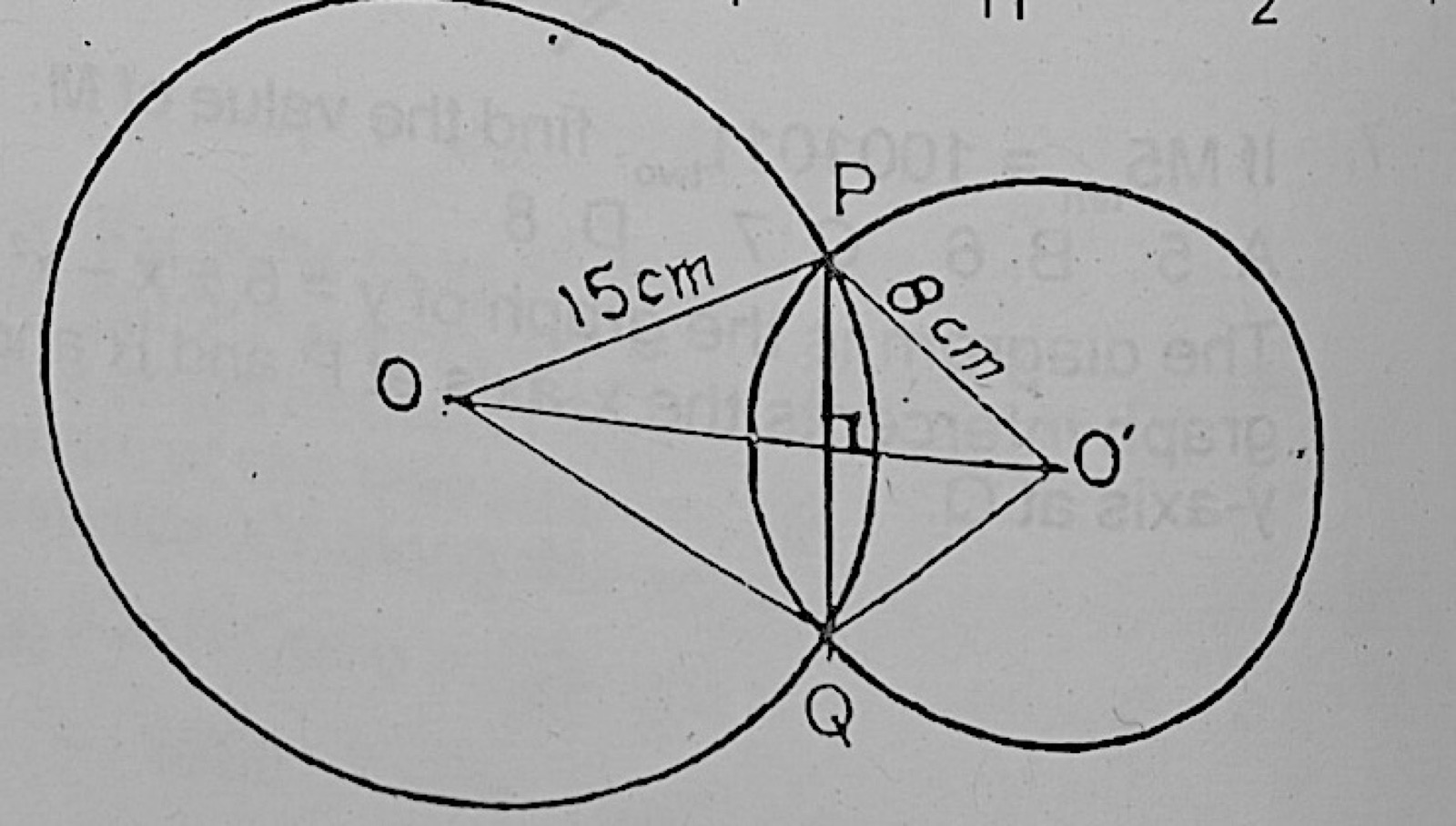
In the diagram O and O' are the centres of the circles radii 15cm and 8cm respectively. If PQ = 12cm, find |OO'|.

Diagram for this question
  1. A.8.46cm
  2. B.19.04cm
  3. C.20.81cm
  4. D.26.16cm
Show the answer and explanation

Answer: B (19.04cm)

Explanation

OO' cuts PQ at right angles at its midpoint, 6 cm from P. OO' = √(152 − 62) + √(82 − 62) = 13.75 + 5.29 ≈ 19.04 cm.

Open this question

Question 30

Circle Theorems

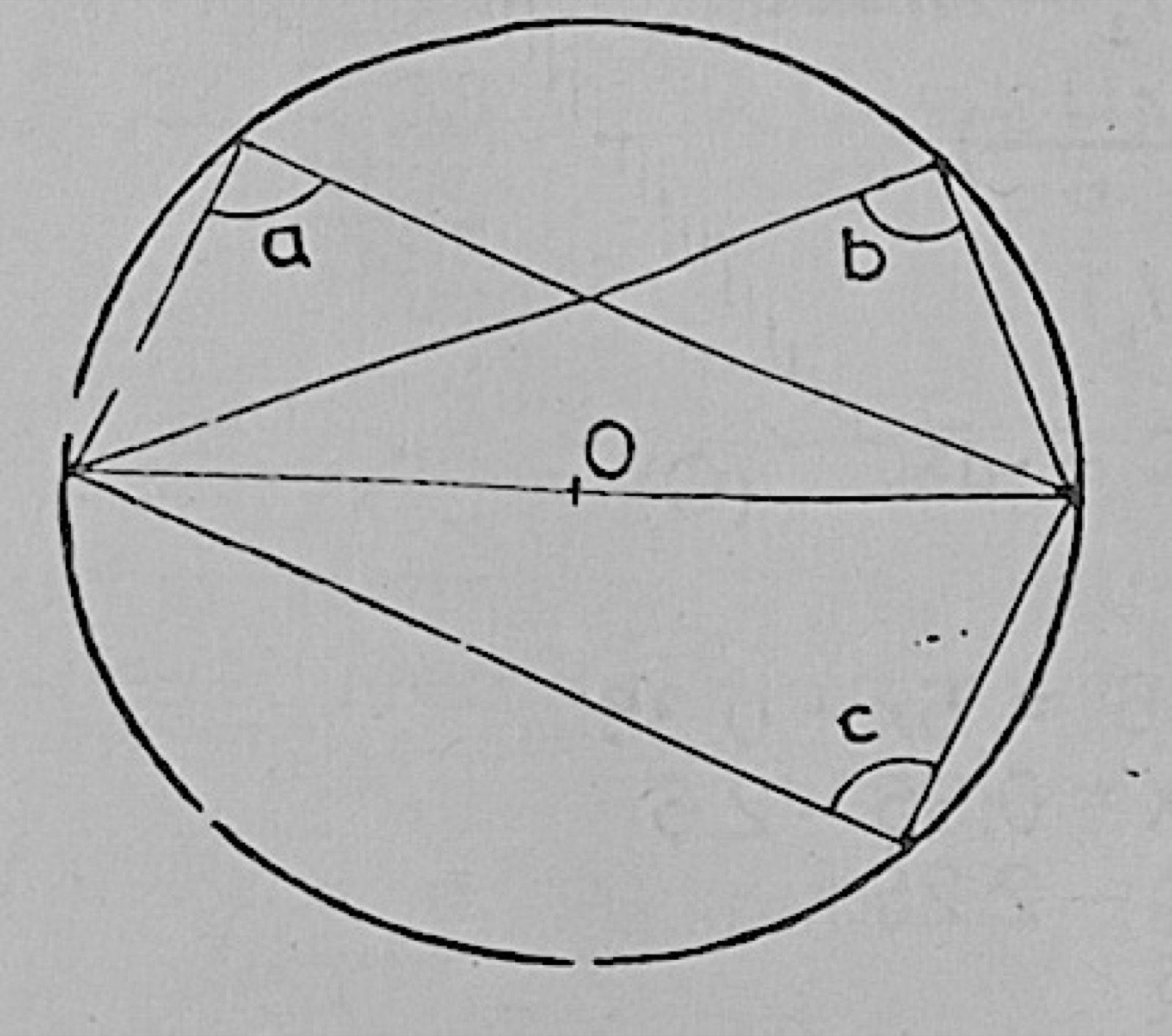
In the diagram. O is the centre of the circle. Which of the following is/are not true? I. a = b II. b + c = 180° III. a + b = c

Diagram for this question
  1. A.I and II only
  2. B.II and III only
  3. C.II only
  4. D.III only
Show the answer and explanation

Answer: D (III only)

Explanation

An angle in a semicircle is 90°, so a = b = c = 90°. Then a = b and b + c = 180° are true, but a + b = 180° ≠ c, so only III is not true.

Open this question

Question 31

Indices

Simplify (21/2 × 81/2)/4

  1. A.1
  2. B.2
  3. C.4
  4. D.16
Show the answer and explanation

Answer: A (1)

Explanation

21/2 × 81/2 = √16 = 4, and 4 ÷ 4 = 1.

Open this question

Question 32

Angles and Polygons

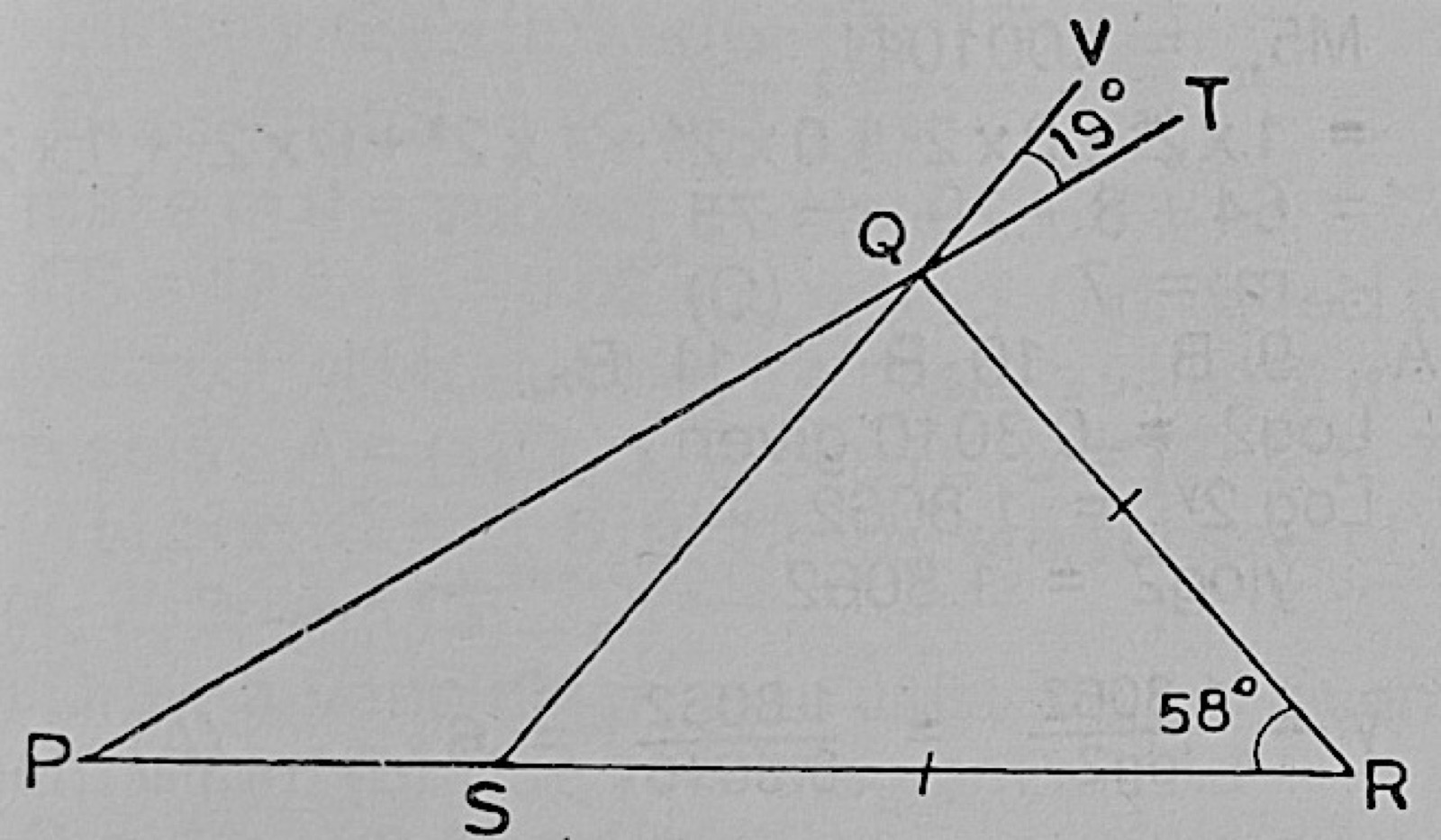
In the diagram, |SR| = |RQ| and ∠PRQ = 58°, ∠VQT = 19°. PQT, SQV and PSR are straight lines. Find ∠QPS.

Diagram for this question
  1. A.42°
  2. B.39°
  3. C.36°
  4. D.30°
Show the answer and explanation

Answer: A (42°)

Explanation

SR = RQ, so ∠RSQ = (180 − 58)/2 = 61°. ∠PQS = ∠VQT = 19° (vertically opposite). ∠RSQ is an exterior angle of triangle PQS, so ∠QPS = 61 − 19 = 42°.

Open this question

Question 33

Trigonometry

The angle of depression of a point Q from a vertical tower PR, 30m high, is 40°. If the foot P of the tower is on the same horizontal level as Q, find, correct to 2 decimal places, |PQ|.

  1. A.35.75m
  2. B.25.00m
  3. C.22.98m
  4. D.19.28m
Show the answer and explanation

Answer: A (35.75m)

Explanation

tan 40° = 30/PQ, so PQ = 30 ÷ 0.8391 ≈ 35.75 m.

Open this question

Question 34

Mensuration of Solids

The volume of a cylinder of radius 14cm is 210cm3. What is the curved surface area of the cylinder?

  1. A.15cm2
  2. B.30cm2
  3. C.616cm2
  4. D.1262cm2
Show the answer and explanation

Answer: B (30cm2)

Explanation

Curved surface 2πrh = 2 × (πr2h)/r = 2 × 210/14 = 30 cm2.

Open this question

Question 35

Surds

Simplify 3√12 + 10√3 − 6/√3

  1. A.7√3
  2. B.10√3
  3. C.14√3
  4. D.18√3
Show the answer and explanation

Answer: C (14√3)

Explanation

3√12 = 6√3 and 6/√3 = 2√3, so 6√3 + 10√3 − 2√3 = 14√3.

Open this question

Question 36

Algebraic Expressions

Factorize m(2a − b) − 2n(b − 2a).

  1. A.(2a − b)(2n − m)
  2. B.(2a + b)(m − 2n)
  3. C.(2a − b)(m + 2n)
  4. D.(2a − b)(m − 2n)
Show the answer and explanation

Answer: C ((2a − b)(m + 2n))

Explanation

−2n(b − 2a) = +2n(2a − b), so the expression is (2a − b)(m + 2n).

Open this question

Question 37

Commercial Arithmetic

If q oranges are sold for t Naira, how many oranges can be bought for p Naira?

  1. A.pt/2
  2. B.qt/p
  3. C.q/pt
  4. D.pq/t
Show the answer and explanation

Answer: D (pq/t)

Explanation

q oranges cost t naira, so 1 naira buys q/t oranges and p naira buy pq/t oranges.

Open this question

Question 38

Trigonometry

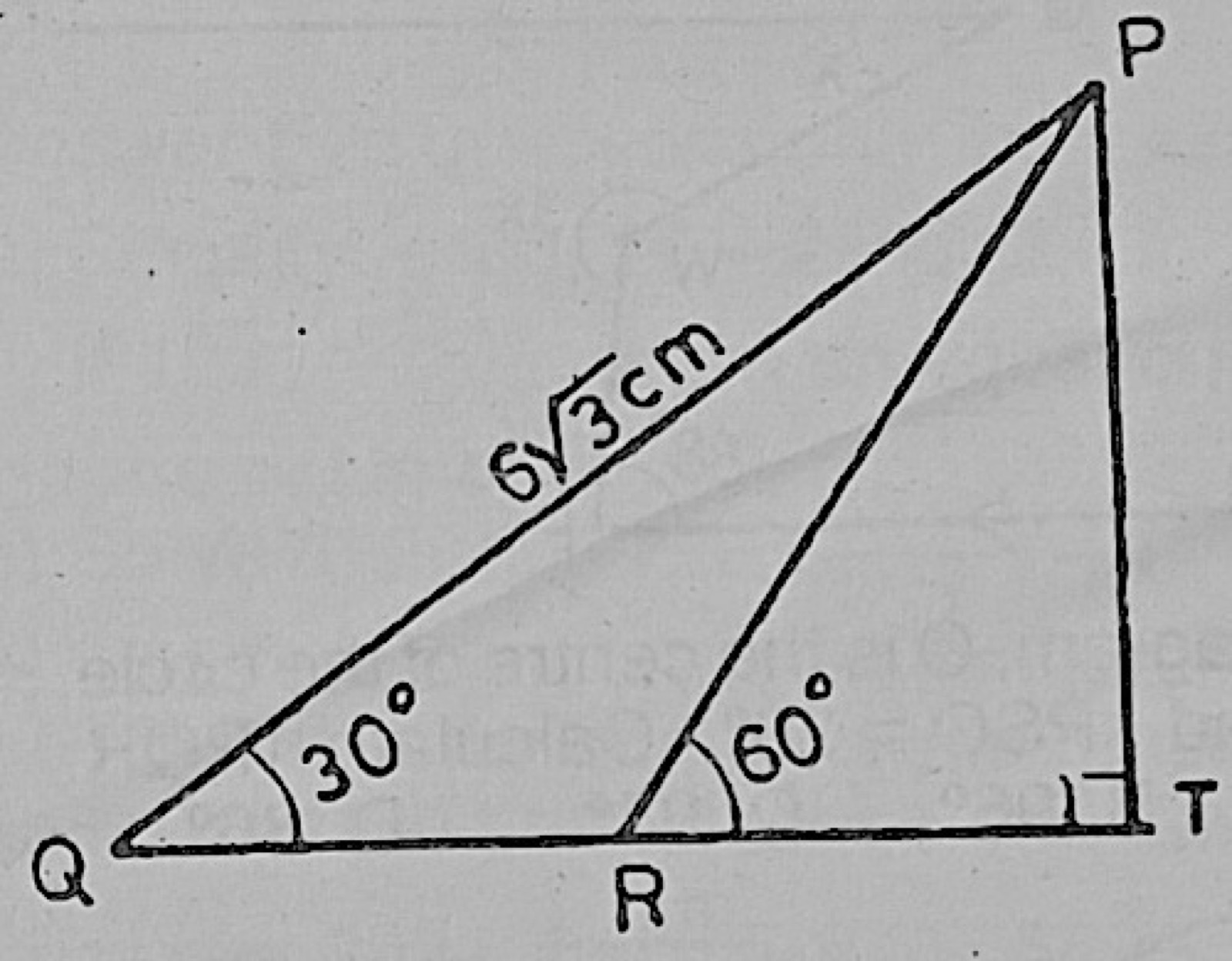
In the diagram, QRT is a straight line. If angle PTR = 90°, angle PRT = 60°, angle PQR = 30° and |PQ| = 6√3 cm, calculate |RT|.

Diagram for this question
  1. A.0.3cm
  2. B.√3/2 cm
  3. C.3cm
  4. D.3√3 cm
Show the answer and explanation

Answer: C (3cm)

Explanation

PT = 6√3 sin 30° = 3√3 cm. In triangle PRT, tan 60° = PT/RT, so RT = 3√3/√3 = 3 cm.

Open this question

Question 39

Triangles and Quadrilaterals

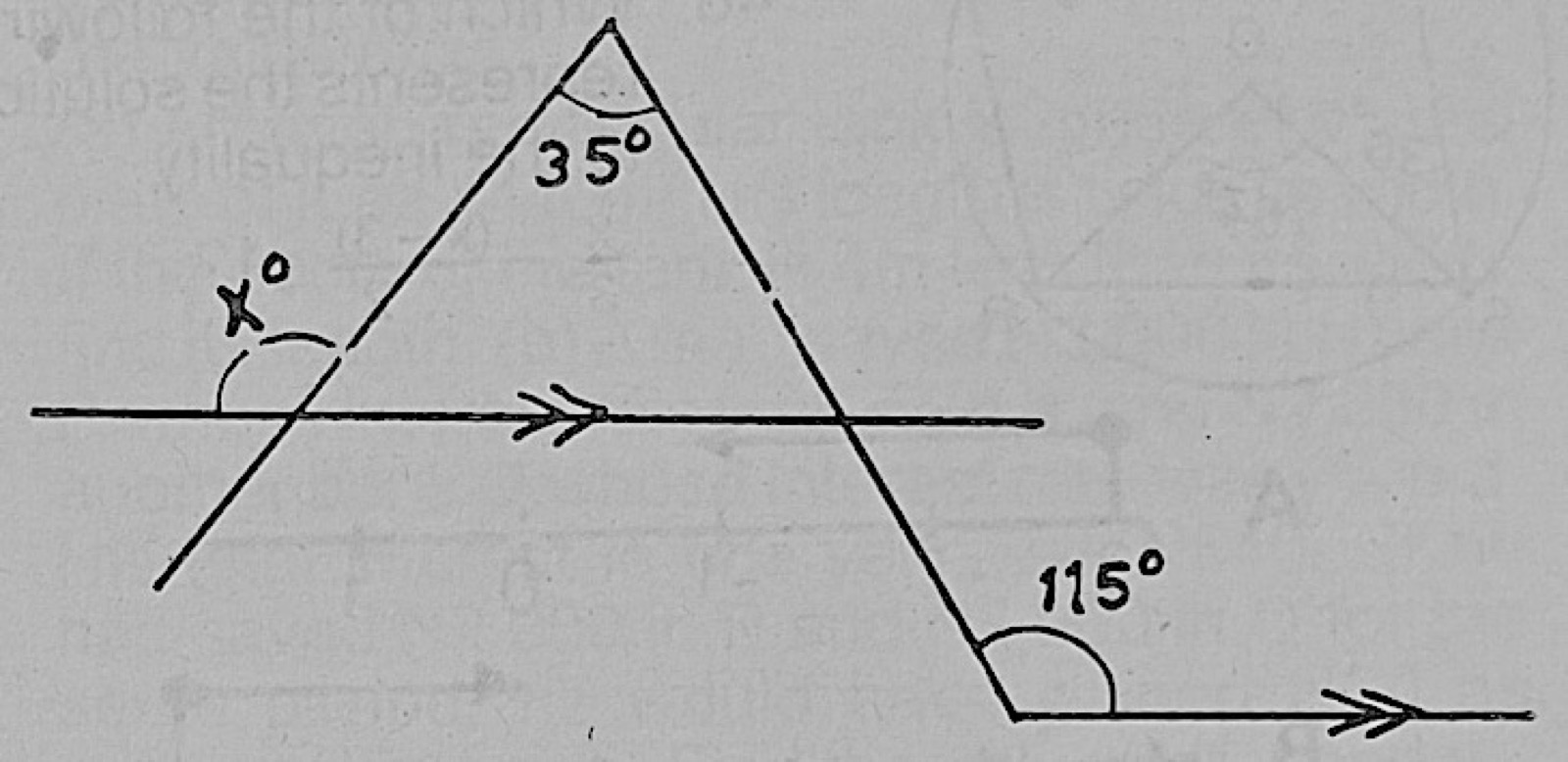
In the diagram, calculate the value of x.

Diagram for this question
  1. A.35°
  2. B.80°
  3. C.100°
  4. D.115°
Show the answer and explanation

Answer: C (100°)

Explanation

The right side meets the parallel lines at 180 − 115 = 65° inside the small triangle at the top, so the third angle there is 180 − 35 − 65 = 80°. x is on a straight line with it: x = 100°.

Open this question

Question 40

Triangles and Quadrilaterals

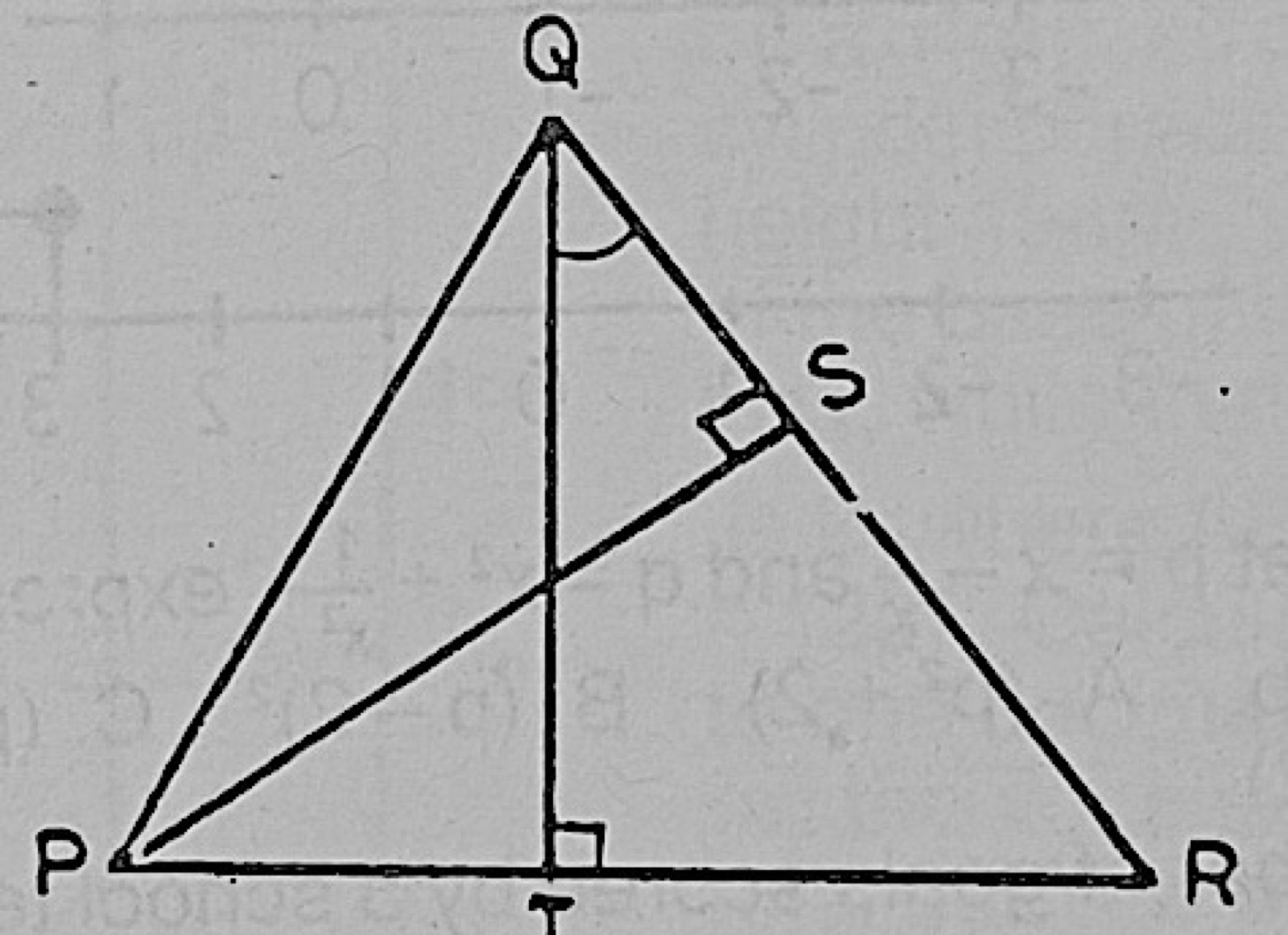
In the diagram, PS and QT are two altitudes of ΔPQR. Which of the following is equal to ∠RQT?

Diagram for this question
  1. A.∠PQT
  2. B.∠SRP
  3. C.∠PQR
  4. D.∠SPR
Show the answer and explanation

Answer: D (∠SPR)

Explanation

In right-angled triangles QTR and PSR, ∠RQT = 90° − ∠R and ∠SPR = 90° − ∠R, so they are equal.

Open this question

Question 41

Trigonometry

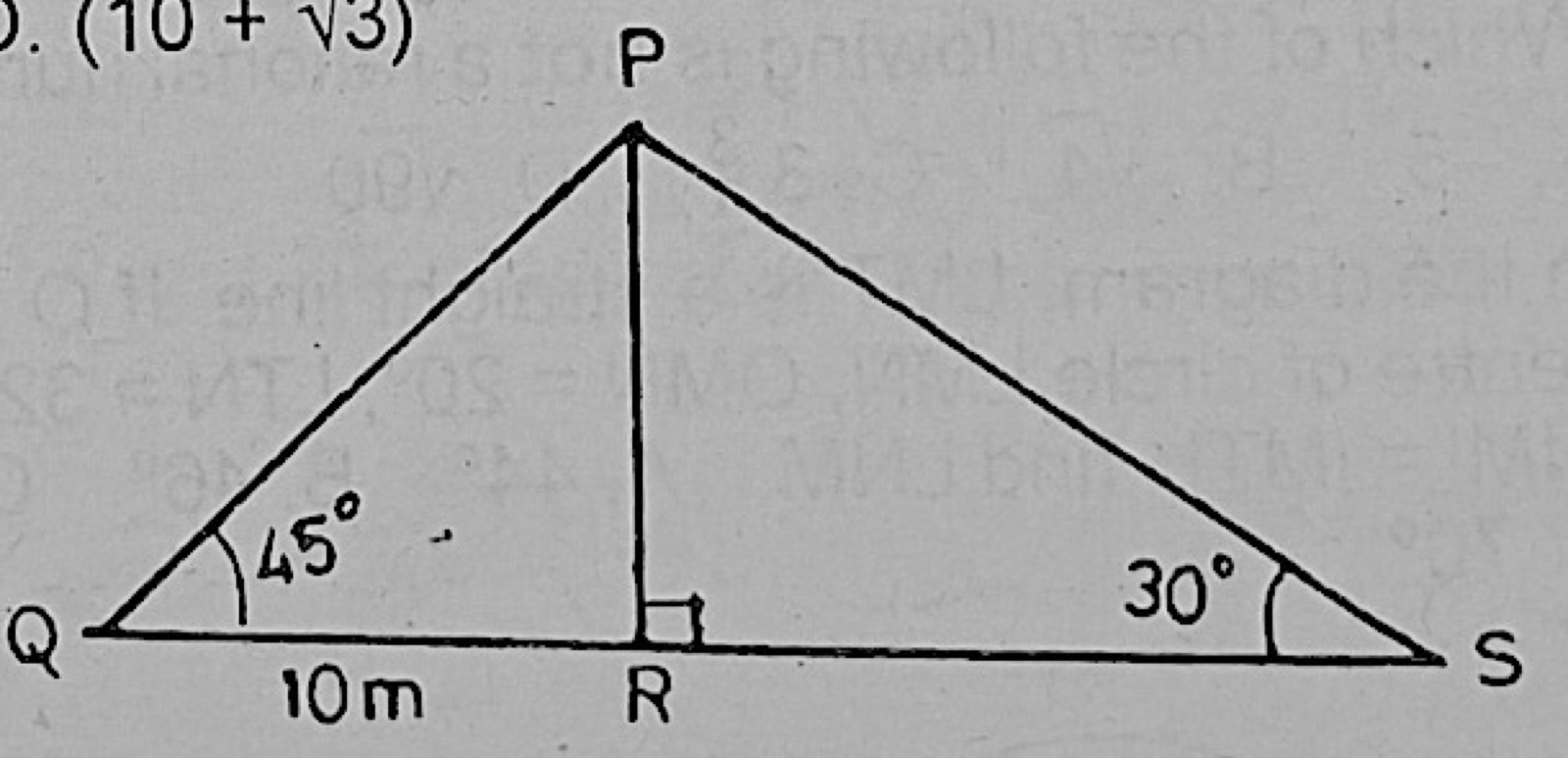
In the diagram, |QR| = 10cm, PR ⊥ QS, angle PSR = 30° and angle PQR = 45°. Calculate in metres, |QS|.

Diagram for this question
  1. A.10(1 + √3)
  2. B.20√3
  3. C.10√3
  4. D.(10 + √3)
Show the answer and explanation

Answer: A (10(1 + √3))

Explanation

Angle Q = 45°, so PR = QR = 10. In triangle PRS, RS = PR/tan 30° = 10√3. QS = 10 + 10√3 = 10(1 + √3).

Open this question

Question 42

Ratio, Percentages and Rates

Calculate, correct to two significant figures, the percentage error in approximating 0.375 to 0.4.

  1. A.2.0
  2. B.2.5
  3. C.6.6
  4. D.6.7.
Show the answer and explanation

Answer: D (6.7.)

Explanation

Error = 0.025. 0.025/0.375 × 100% = 6.67% ≈ 6.7%.

Open this question

Question 43

Ratio, Percentages and Rates

To arrive on schedule, a train is to cover a distance of 60km at 72km/hr. If it starts 10 minutes late, at what speed must it move to arrive on schedule?

  1. A.60km/hr
  2. B.80 km/hr
  3. C.90km/hr
  4. D.108km/hr
Show the answer and explanation

Answer: C (90km/hr)

Explanation

Scheduled time = 60/72 h = 50 min. Starting 10 min late leaves 40 min = 2/3 h, so speed = 60 ÷ 2/3 = 90 km/h.

Open this question

Question 44

Triangles and Quadrilaterals

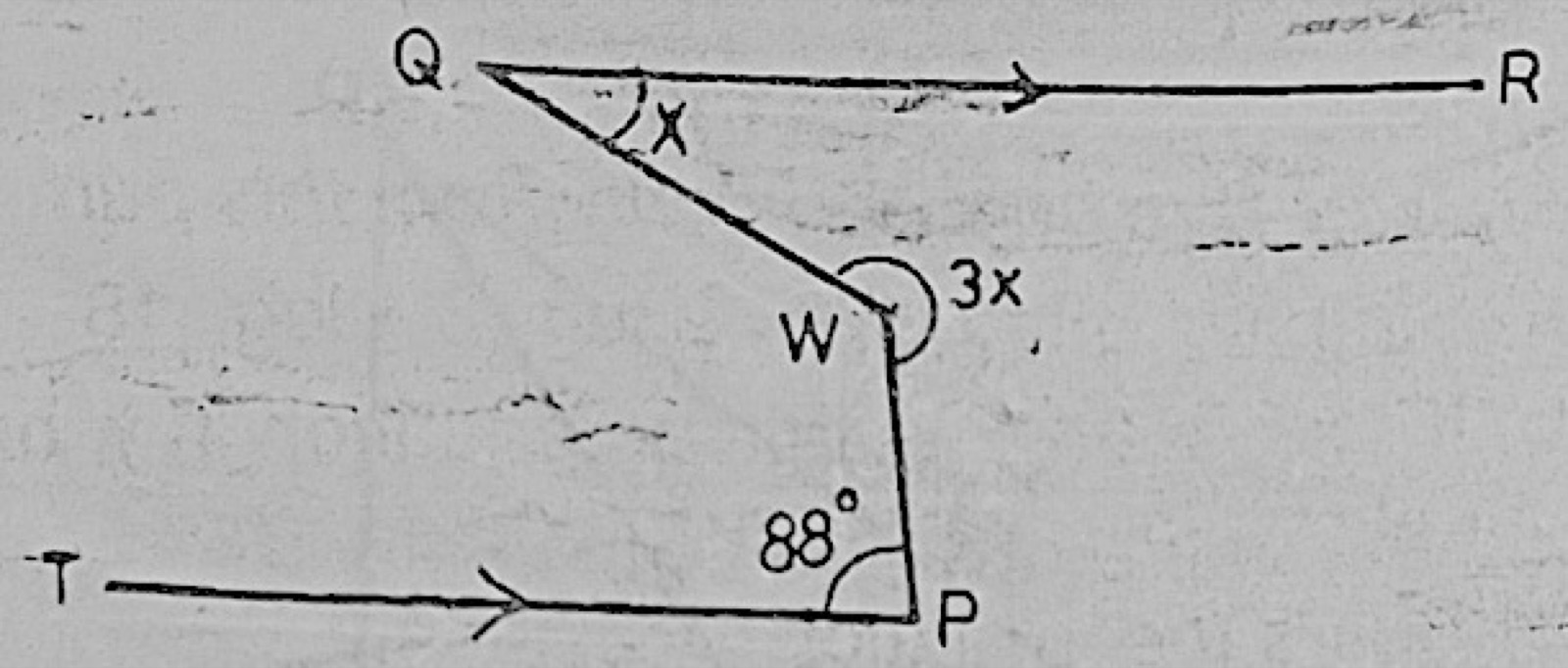
In the diagram, QR||TP and ∠WPT = 88°. Find the value of x.

Diagram for this question
  1. A.92°
  2. B.68°
  3. C.67°
  4. D.23°
Show the answer and explanation

Answer: C (67°)

Explanation

Through W draw a line parallel to QR. The angle QWP on the left is x + (180 − 88) = x + 92, and the marked reflex angle 3x completes it to 360°: 3x + x + 92 = 360, so x = 67°.

Open this question

Question 45

Circle Theorems

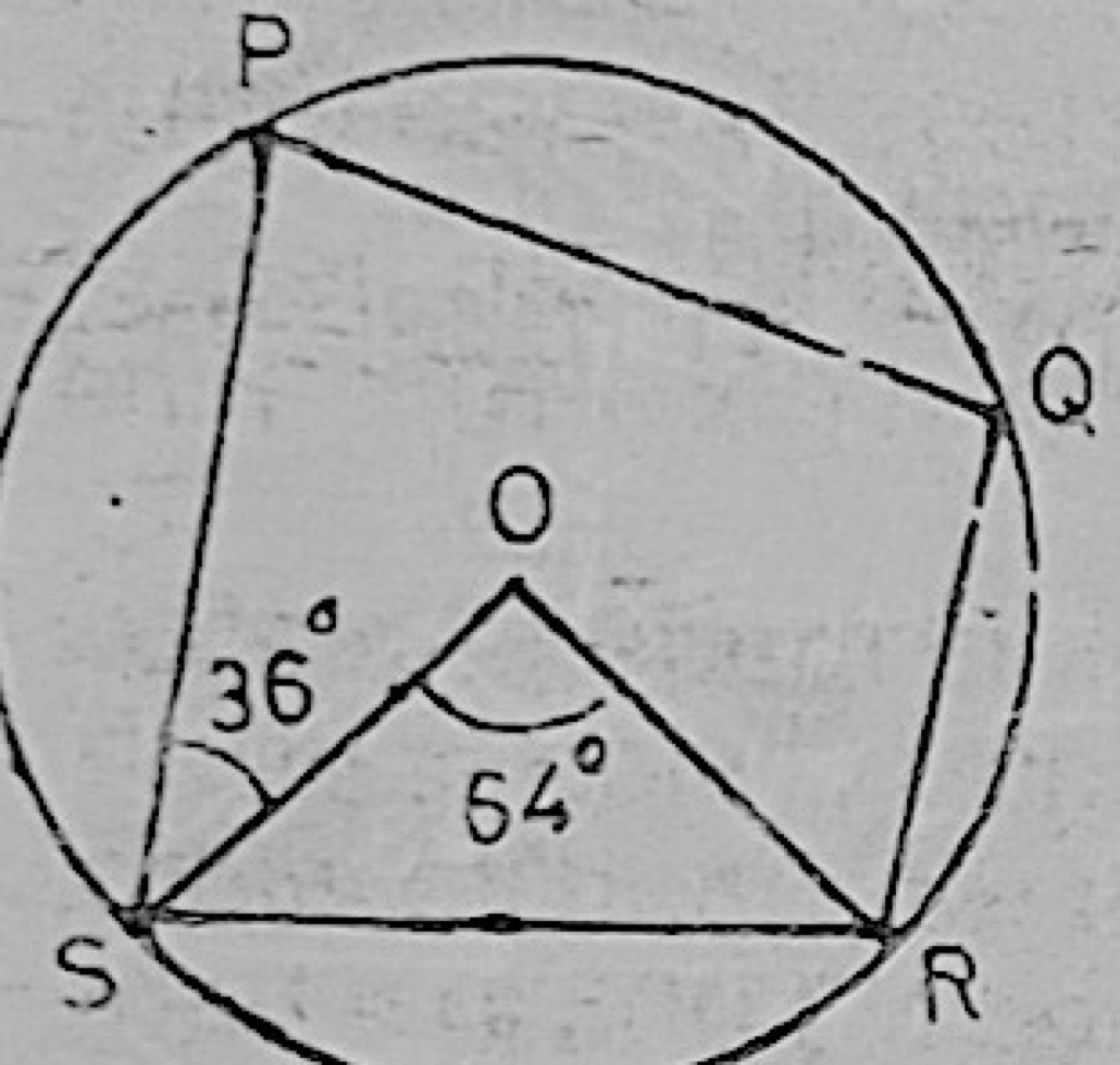
In the diagram, O is the centre of the circle, ∠SOR = 64° and ∠PSO = 36°. Calculate ∠PQR.

Diagram for this question
  1. A.100°
  2. B.96°
  3. C.94°
  4. D.86°
Show the answer and explanation

Answer: D (86°)

Explanation

OS = OR, so ∠OSR = (180 − 64)/2 = 58° and ∠PSR = 36 + 58 = 94°. Opposite angles of cyclic quadrilateral PQRS add to 180°, so ∠PQR = 86°.

Open this question

Question 46

Inequalities

Which of the following represents the solution to the inequality x/3 − (x − 3)/2 ≤ 1?

Diagram for this question
  1. A.Number line A
  2. B.Number line B
  3. C.Number line C
  4. D.Number line D
Show the answer and explanation

Answer: D (Number line D)

Explanation

Multiply by 6: 2x − 3x + 9 ≤ 6, so −x ≤ −3 and x ≥ 3. Line D starts at a shaded dot on 3 and goes right.

Open this question

Question 47

Algebraic Expressions

Given that p = x − 1/x and q = x2 + 1/x2, express q in terms of p.

  1. A.(p2 + 2)
  2. B.(p − 2)2
  3. C.(p + 2)2
  4. D.(p2 − 2).
Show the answer and explanation

Answer: A ((p2 + 2))

Explanation

p2 = x2 − 2 + 1/x2 = q − 2, so q = p2 + 2.

Open this question

Question 49

Fractions, Decimals and Approximation

Which of the following is not a rational number?

  1. A.−5
  2. B.√4
  3. C.3 3/4
  4. D.√90
Show the answer and explanation

Answer: D (√90)

Explanation

90 is not a perfect square, so √90 cannot be written as a fraction. √4 = 2 is rational.

Open this question

Question 50

Circle Theorems

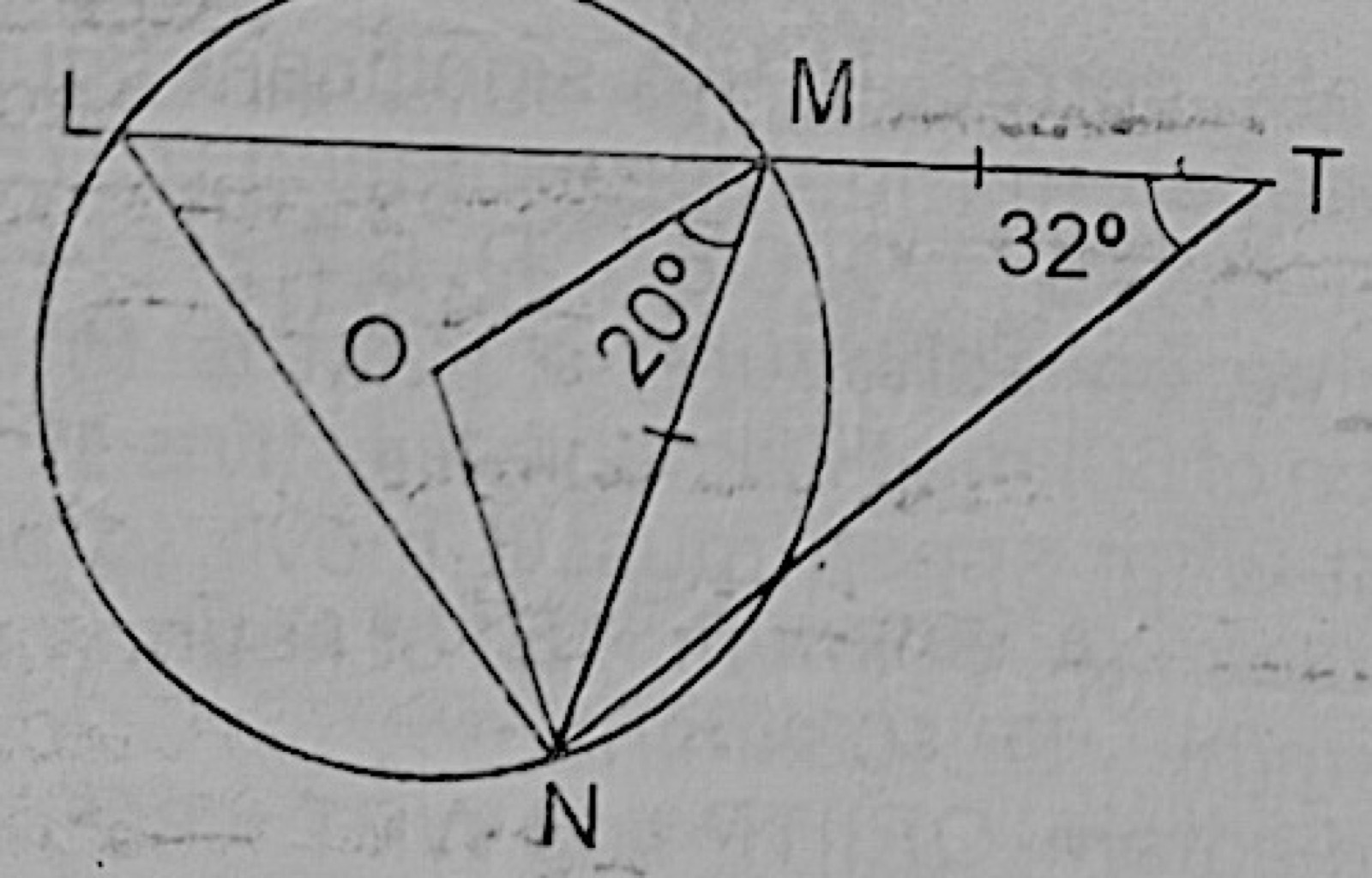
In the diagram, LMT is a straight line. If O is the centre of circle LMN, ∠OMN = 20°, ∠LTN = 32° and |NM| = |MT|, find ∠LNM.

Diagram for this question
  1. A.44°
  2. B.46°
  3. C.52°
  4. D.70°
Show the answer and explanation

Answer: B (46°)

Explanation

NM = MT gives ∠MNT = 32°, so ∠NMT = 116° and ∠LMN = 64°. OM = ON gives ∠MON = 140°, so ∠MLN = 70°. Then ∠LNM = 180 − 64 − 70 = 46°.

Open this question

Theory question 101

Algebraic Expressions

(a) Simplify (2a + b)2 − (b − 2a)2
(b) Given that S = K√(m2 + n2); (i) make m the subject of the relation; (ii) if S = 12.2, K = 0.02 and n = 1.1, find, correct to the nearest whole number, the positive value of m.

Show the model answer
Model answer

(a) Difference of two squares: [(2a + b) − (b − 2a)][(2a + b) + (b − 2a)] = 4a × 2b = 8ab.
(b)(i) S/K = √(m2 + n2), so m2 = S2/K2 − n2 and m = √(S2/K2 − n2).
(ii) S/K = 12.2/0.02 = 610. m = √(372100 − 1.21) ≈ 610.

Explanation

Square both sides to remove the root, then isolate m².

Open this question

Theory question 102

Sets

The sets A = {1, 3, 5, 7, 9, 11}, B = {2, 3, 5, 7, 11, 15} and C = {3, 6, 9, 12, 15} are subsets of ε = {1, 2, 3, ...., 15}
(a) Draw a Venn diagram to illustrate the given information. (b) Use your diagram to find: (i) C∩A' (ii) A'∩(B∪C).

Show the model answer
Model answer

(a) Regions: A∩B∩C = {3}; A∩B only = {5, 7, 11}; A∩C only = {9}; B∩C only = {15}; A only = {1}; B only = {2}; C only = {6, 12}; outside all = {4, 8, 10, 13, 14}.
(b)(i) C∩A' = {6, 12, 15}.
(ii) A'∩(B∪C) = {2, 6, 12, 15}.

Explanation

Place the element common to all three sets first, then work outwards.

Open this question

Theory question 103

Commercial Arithmetic

(a) A manufacturer offers distributors a discount of 20% on any article bought and a further discount of 2½% for prompt payment. (i) If the marked price of an article is N25,000 find the total amount saved by a distributor for paying promptly. (ii) If a distributor pays N11,700 promptly for an article marked Nx, find the value of x.
(b) Factorize 6y2 − 149y − 102, hence solve the equation 6y2 − 149y − 102 = 0

Show the model answer
Model answer

(a)(i) After 20% off: 0.8 × 25,000 = N20,000. A further 2½% off: 0.025 × 20,000 = N500. Total saved = 5,000 + 500 = N5,500.
(ii) He pays 0.8 × 0.975x = 0.78x = 11,700, so x = N15,000.
(b) 6y2 − 153y + 4y − 102 = 3y(2y − 51) + 2(2y − 51) = (3y + 2)(2y − 51).
y = 25½ or y = −2/3.

Explanation

The second discount is taken off the already-reduced price.

Open this question

Theory question 104

Surds

(a) Without using calculator or mathematical tables evaluate: (3/√3)(2/√3 − √12/6)
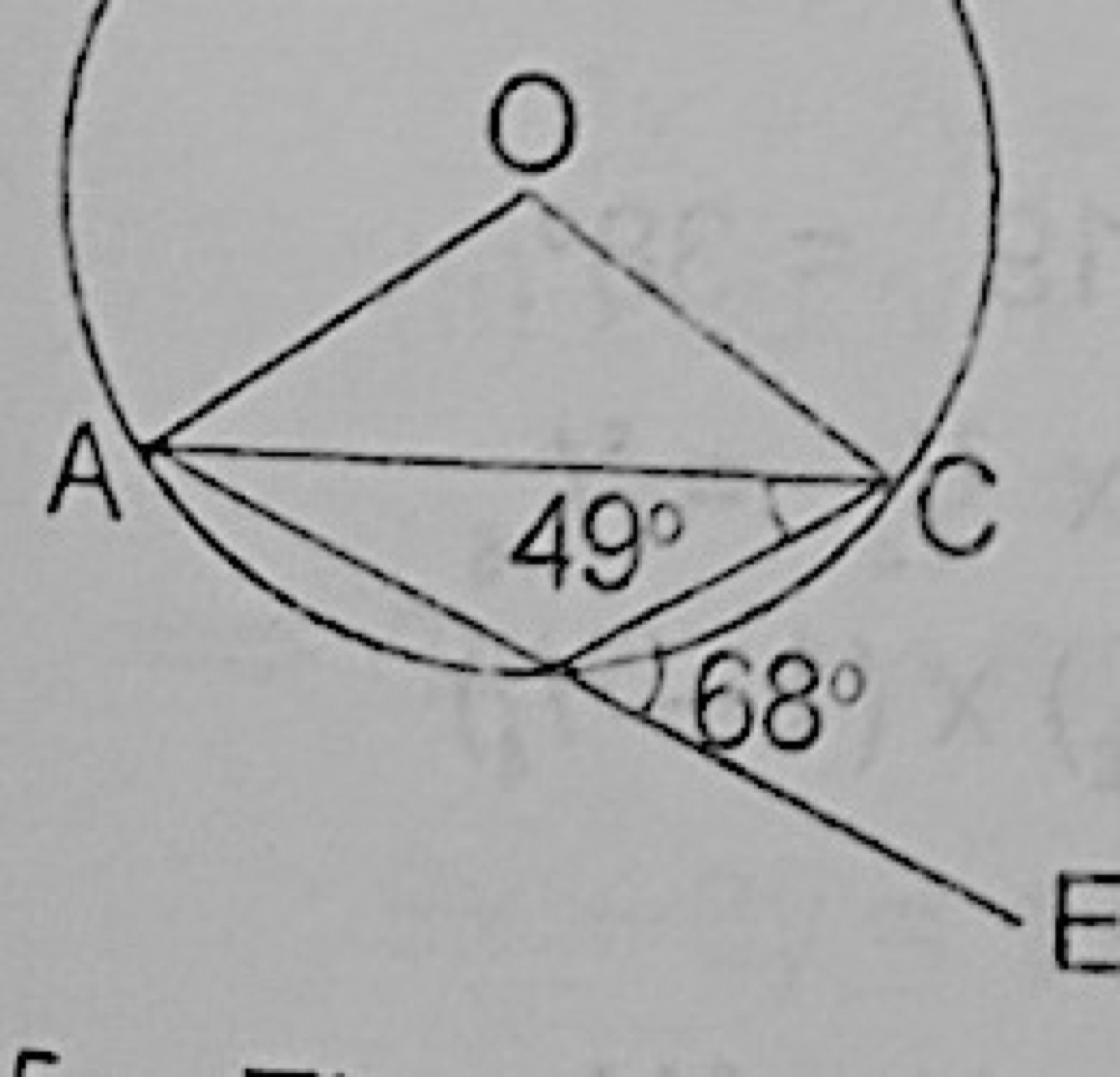
(b) In the diagram, O is the centre of the circle. The side AB is produced to E, ∠ACB = 49° and ∠CBE = 68°. Calculate: (i) the interior angle AOC; (ii) angle BOC

Diagram for this question
Show the model answer
Model answer

(a) 3/√3 = √3 and √12/6 = √3/3. √3 × 2/√3 − √3 × √3/3 = 2 − 1 = 1.
(b)(i) ∠ABC = 180 − 68 = 112°. The reflex angle AOC = 2 × 112° = 224°, so the interior angle AOC = 360 − 224 = 136°.
(ii) ∠BAC = ∠CBE − ∠ACB = 68 − 49 = 19° (exterior angle of triangle ABC). ∠BOC = 2 × 19° = 38°.

Explanation

The angle at the centre is twice the angle at the circumference on the same arc.

Open this question

Theory question 105

Probability

The probabilities that Ade, Kujo and Fati will pass an examination are 2/3, 5/8 and 3/4 respectively. Find the probability that: (a) the three (b) none of them; (c) Ade and Kujo only; will pass the examination.

Show the model answer
Model answer

(a) 2/3 × 5/8 × 3/4 = 5/16.
(b) 1/3 × 3/8 × 1/4 = 1/32.
(c) Ade and Kujo pass, Fati fails: 2/3 × 5/8 × 1/4 = 5/48.

Explanation

'Only' means the third person must fail, so use 1 − 3/4 for Fati.

Open this question

Theory question 106

Logarithms

(a) Simplify ½ log1025 − 2 log103 + log1018
(b) If 123y = 8310, obtain an equation in y, hence find the value of y.
(c) Solve the equation 92x−3/3x+3 = 1

Show the model answer
Model answer

(a) log 5 − log 9 + log 18 = log(5 × 18/9) = log 10 = 1.
(b) y2 + 2y + 3 = 83, so y2 + 2y − 80 = 0, (y + 10)(y − 8) = 0. y = 8 (a base must be positive and bigger than 3).
(c) 34x−6 = 3x+3, so 4x − 6 = x + 3 and x = 3.

Explanation

Write 9 as 3² so both sides have the same base.

Open this question

Theory question 107

Progressions

(a) The first term of an Arithmetic Progression (AP) is 3 and the common difference is 4. Find the sum of the first 28 terms.
(b) Given that x = 2m/(1 − m2) and y = 2m/(1 + m), express 2x − y in terms of m in the simplest form.
(c) The angles of pentagon are x°, 2x°, 3x°, 2x° and (3x − 10)°. Find the value of x.

Show the model answer
Model answer

(a) S28 = 28/2 [2(3) + 27(4)] = 14 × 114 = 1596.
(b) 2x − y = 4m/(1 − m2) − 2m(1 − m)/(1 − m2) = (2m + 2m2)/(1 − m2) = 2m(1 + m)/[(1 − m)(1 + m)] = 2m/(1 − m).
(c) Angles of a pentagon add to 540°: 11x − 10 = 540, so x = 50.

Explanation

Use 1 − m² = (1 − m)(1 + m) as the common denominator.

Open this question

Theory question 108

Mensuration of Solids

(a) An open rectangular tank is made of a steel plate of area 1440m2. Its length is twice its width. If the depth of the tank is 4m less than its width, find its length.
(b) A man saved N3,000 in a bank P, whose interest rate was x% p.a. and N2,000 in another bank Q whose interest rate was y% p.a. His total interest in one year was N640. If he had saved N2,000 in P and N3,000 in Q for the same period, he would have gained N20 as additional interest. Find the values of x and y.

Show the model answer
Model answer

(a) Width b, length 2b, depth b − 4. Open top: base + four sides = 2b2 + 2(2b)(b − 4) + 2b(b − 4) = 8b2 − 24b = 1440.
b2 − 3b − 180 = 0, (b − 15)(b + 12) = 0, b = 15. Length = 30 m.
(b) 30x + 20y = 640 and 20x + 30y = 660, i.e. 3x + 2y = 64 and 2x + 3y = 66.
Solving: x = 12, y = 14.

Explanation

An open tank has no top, so count the base and four sides only.

Open this question

Theory question 109

Mensuration of Solids

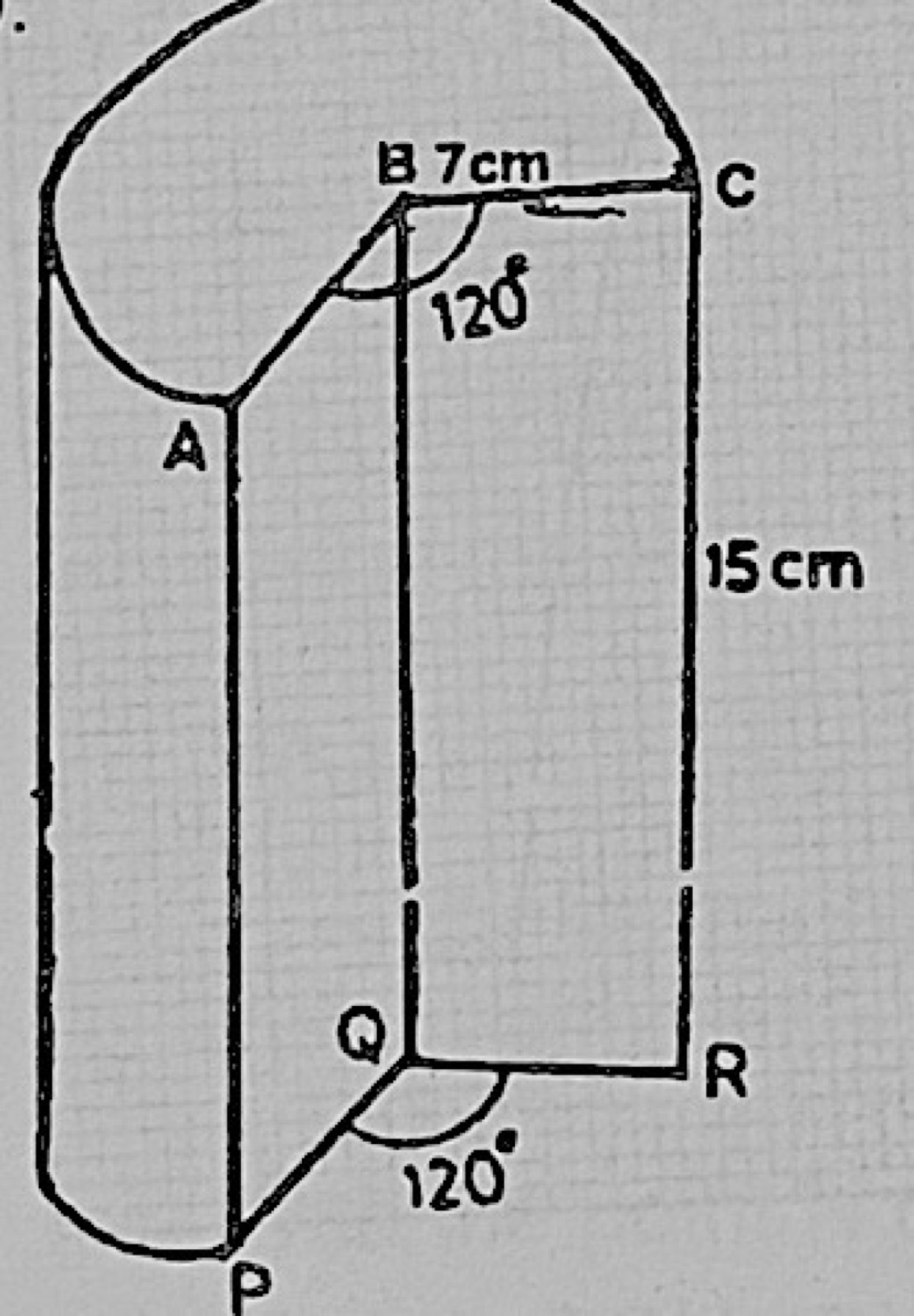
The diagram is a portion of a right circular solid cylinder of radius 7cm and height 15cm. The centre of the base of the cylinder is Q, while that of the top is B, where ∠ABC = ∠PQR = 120°. Calculate, correct to one decimal place; (a) the volume (b) the total surface area of the solid. [Take π = 22/7]

Diagram for this question
Show the model answer
Model answer

A 120° wedge has been removed, so the solid is 240/360 = 2/3 of the cylinder.
(a) V = 2/3 × 22/7 × 72 × 15 = 1540.0 cm3.
(b) Curved surface = 2/3 × 2 × 22/7 × 7 × 15 = 440 cm2.
Two flat rectangles = 2 × 7 × 15 = 210 cm2.
Top and bottom = 2 × 2/3 × 22/7 × 49 = 205.3 cm2.
Total = 440 + 210 + 205.3 = 855.3 cm2.

Explanation

Remember the two flat rectangular faces left by the cut.

Open this question

Theory question 110

Constructions

Using ruler and a pair of compasses only, (a) construct: (i) triangle XYZ with |XY| = 8cm, ∠YXZ = 60° and ∠XYZ = 30°; (ii) the perpendicular ZT to meet XY in T; (iii) the locus l1 of points equidistant from ZY and XY. (b) If l1 and ZT intersect at S, measure |ST|.

Show the model answer
Model answer

(a)(i) Draw XY = 8 cm. Construct 60° at X and 30° at Y (bisect a 60° angle); the arms meet at Z (∠Z = 90°).
(ii) From Z drop the perpendicular to XY, meeting it at T.
(iii) Bisect ∠XYZ; this bisector is l1.
(b) ST ≈ 1.6 cm (by calculation: XZ = 4, XT = 2, TY = 6, ST = 6 tan 15° ≈ 1.61 cm).

Explanation

Points equidistant from two lines lie on the bisector of the angle between them.

Open this question

Theory question 111

Bearings

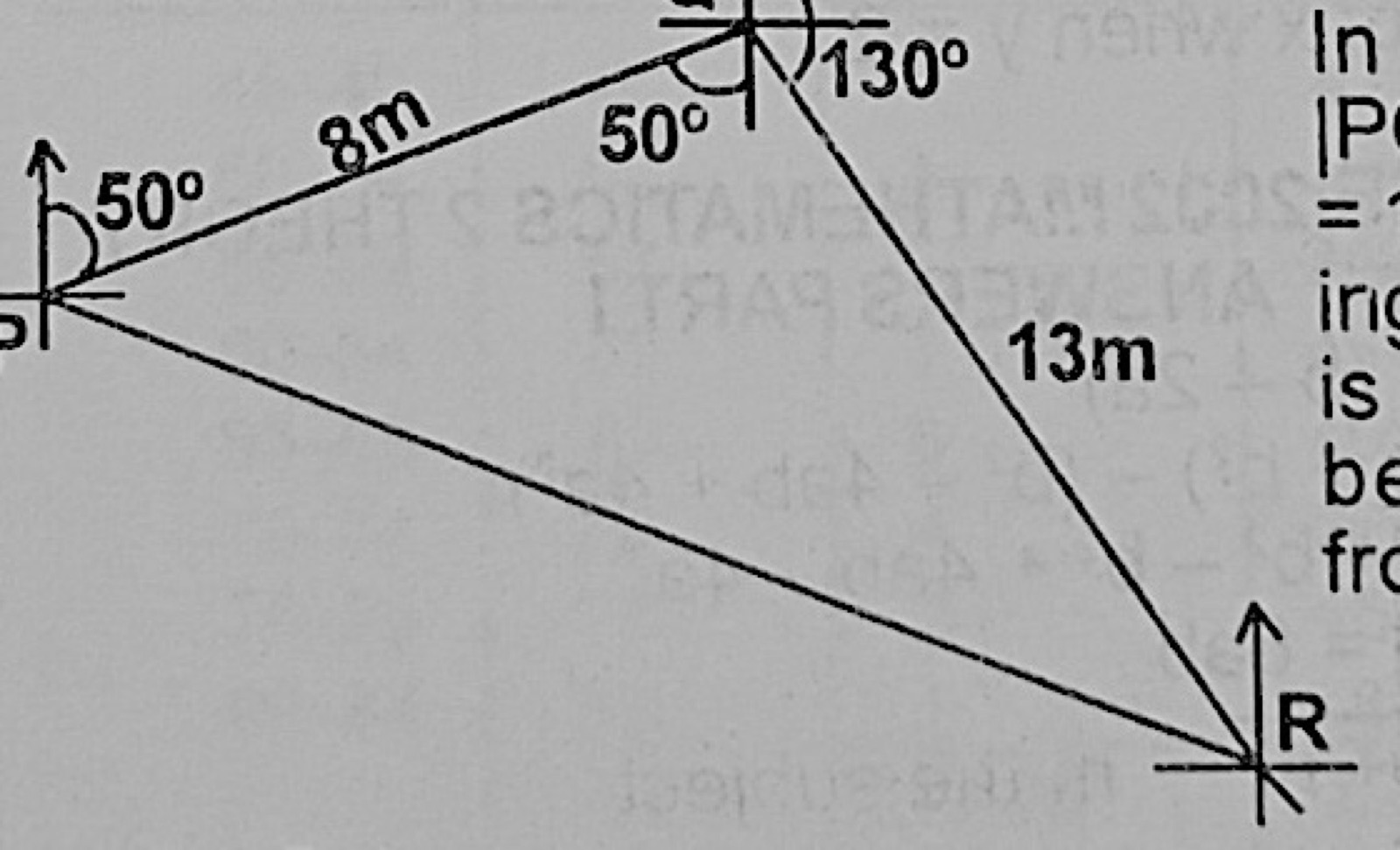
In the diagram, |PQ| = 8m, |QR| = 13m, the bearing of Q from P is 050° and the bearing of R from Q is 130°. (a) Calculate, correct to 3 significant figures, (i) |PR| (ii) the bearing of R from P. (b) Calculate the shortest distance between point Q and PR, hence the area of triangle PQR.

Diagram for this question
Show the model answer
Model answer

(a)(i) ∠PQR = 50° + (180° − 130°) = 100°.
PR2 = 82 + 132 − 2(8)(13) cos 100° = 233 + 36.1 = 269.1, so PR ≈ 16.4 m.
(ii) sin ∠QPR = 13 sin 100°/16.40 = 0.7805, so ∠QPR ≈ 51.3°. Bearing of R from P = 50 + 51.3 ≈ 101°.
(b) Shortest distance = perpendicular from Q to PR = 8 sin 51.3° ≈ 6.24 m.
Area = ½ × 16.4 × 6.24 ≈ 51.2 m2 (check: ½ × 8 × 13 × sin 100° = 51.2).

Explanation

Use the north lines at P and Q to find the angle at Q first.

Open this question

Theory question 113

Graphs of Functions

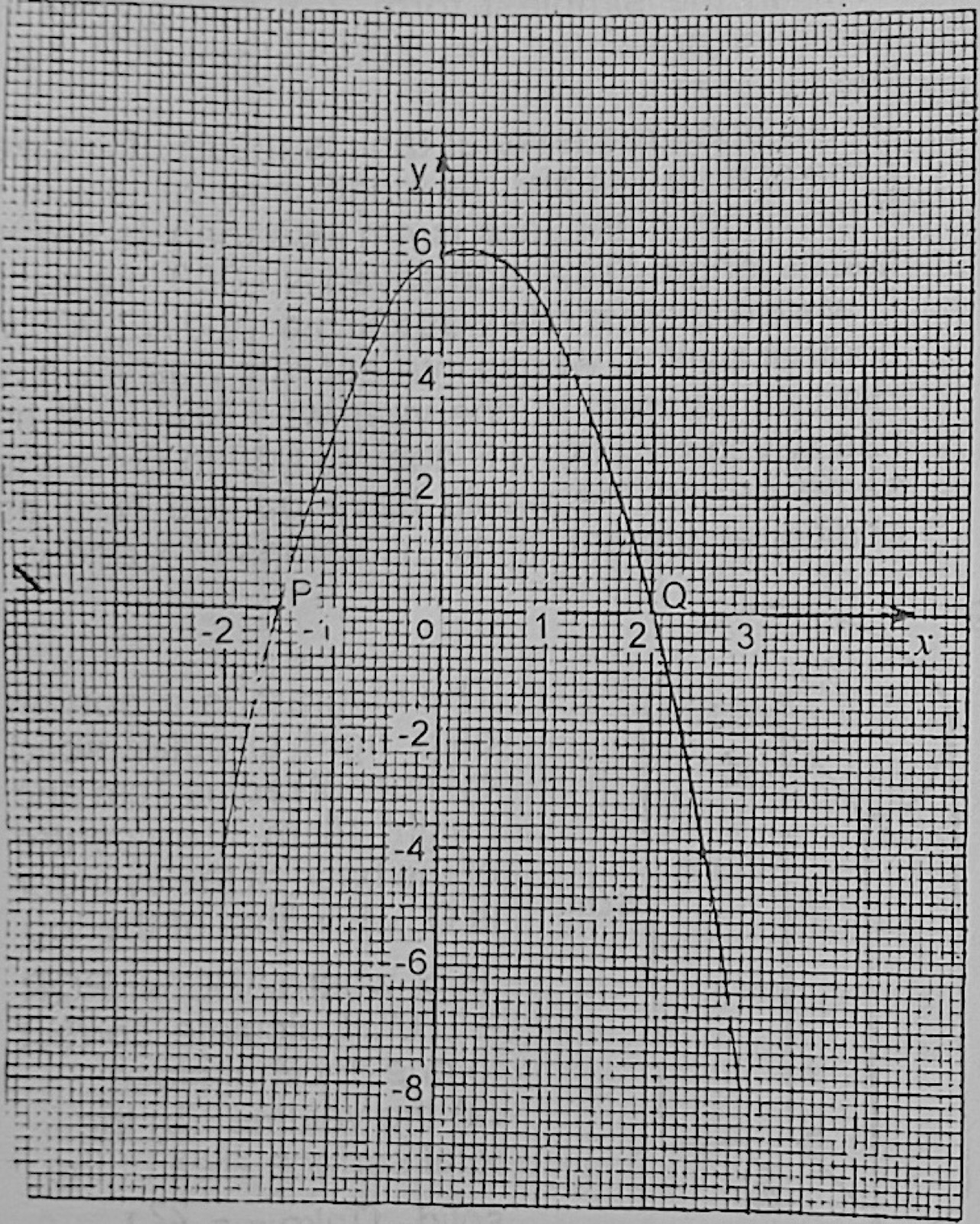
Below is the graph of the relation y = ax2 + bx + c, where a, b, c, are constants. Use the graph to: (a) Find the roots of the quadratic equation ax2 + bx + c = 0; (b) Determine the values of constants a, b, and c in the relation using the values of the coordinates P, Q and hence write down the relation illustrated in the graph; (c) Find the maximum value of y and the corresponding value of x at this point (d) Find the values of x when y = 2.

Diagram for this question
Show the model answer
Model answer

(a) The curve cuts the x-axis at P(−1.5, 0) and Q(2, 0): roots x = −1.5 and x = 2.
(b) y = a(x + 1.5)(x − 2). The curve meets the y-axis at (0, 6), so 6 = a(1.5)(−2) and a = −2.
y = −2(x + 1.5)(x − 2) = −2x2 + x + 6: a = −2, b = 1, c = 6.
(c) Maximum at x = −b/2a = 0.25: y = 6.125 (about 6.1 from the graph).
(d) −2x2 + x + 6 = 2 gives 2x2 − x − 4 = 0, x ≈ 1.7 or x ≈ −1.2.

Explanation

Known roots let you write y = a(x − r₁)(x − r₂); one more point gives a.
Open this question