Question 1
SurdsEvaluate √20 × (√5)3
- A.10
- B.20
- C.25
- D.50
Show the answer and explanation
Answer: D (50)
Explanation
√20 = 2√5 and (√5)3 = 5√5, so the product is 2 × 5 × √5 × √5 = 10 × 5 = 50.
59 questions. Try each one, then open the answer to check yourself and read the explanation.
Evaluate √20 × (√5)3
Answer: D (50)
√20 = 2√5 and (√5)3 = 5√5, so the product is 2 × 5 × √5 × √5 = 10 × 5 = 50.
If P = {3, 7, 11, 13} and Q = {2, 4, 8, 16}, which of the following is correct?
Answer: D (P∩Q = ϕ)
P and Q have no element in common, so P∩Q is the empty set.
It is observed that 1 + 3 = 22, 1 + 3 + 5 = 32, 1 + 3 + 5 + 7 = 42. If 1 + 3 + 5 + 7 + 9 + 11 + 13 + 15 = p2, find P.
Answer: C (8)
The sum of the first n odd numbers is n2. There are 8 odd numbers here, so p = 8.
Evaluate 3.0 × 101 − 2.8 × 10⁻¹ leaving the answer in standard form.
Answer: C (2.972 × 101)
30 − 0.28 = 29.72 = 2.972 × 101.
A trader makes a loss of 15% when selling an article. Find the ratio, Selling Price: Cost Price.
Answer: C (17:20)
With a 15% loss the selling price is 85% of the cost price: 85 : 100 = 17 : 20.
The side of a square is increased from 20cm to 21cm. Calculate the percentage increase in its area
Answer: D (10.25%.)
Area goes from 400 to 441 cm2, an increase of 41. 41/400 × 100% = 10.25%.
Arrange in ascending order of magnitude: 268, 367 and 259.
Answer: B (268, 259, 367)
In base ten: 268 = 22, 259 = 23, 367 = 27, so the order is 268, 259, 367.
The side of a rhombus is 10cm long, correct to the nearest whole number. Between what limits should the perimeter P lie?
Answer: B (38cm ≤ P < 42cm)
The side lies from 9.5 cm up to (but not including) 10.5 cm. Multiplying by 4: 38 ≤ P < 42.
Simplify log78 − log72 + log74
Answer: D (4 log72.)
log7(8 ÷ 2 × 4) = log716 = log724 = 4 log72.
If K√28 + √63 − √7 = 0, find K.
Answer: B (−1)
√28 = 2√7 and √63 = 3√7, so 2K√7 + 3√7 − √7 = 0, giving 2K = −2 and K = −1.
From the set A = {3, √2, 2√3, √9, √7}, a number is selected at random. Find the probability that it is a rational number.
Answer: B (2/5)
Only 3 and √9 = 3 are rational; the other three are irrational. Probability = 2/5.
The pie chart illustrates the amount of private time a student spends in a week studying various subjects. If he spends 2½ hours a week on Science, find the total number of hours he studies in a week.

Answer: D (12 hours.)
Science has 75° of the 360°. Total = 2½ × 360/75 = 12 hours.
A group of eleven people can speak either English or French or both. Seven can speak English and six can speak French. What is the probability that a person chosen at random can speak both English and French?
Answer: A (2/11)
Number who speak both = 7 + 6 − 11 = 2, so the probability is 2/11.
The interior angle of a regular polygon is twice the exterior angle. How many sides has the polygon?
Answer: B (6)
Interior + exterior = 180° and interior = 2 × exterior, so the exterior angle is 60°. Sides = 360 ÷ 60 = 6.
Which of the following figures have one line of symmetry only? I. Isosceles Triangle II. Rhombus III. Kite
Answer: C (I and III only)
An isosceles triangle and a kite each have one line of symmetry; a rhombus has two (its diagonals).
In the diagram below, |XR| = |RY| = |YZ| and ∠XRY = ∠YRZ = 62°. Calculate ∠XYZ.
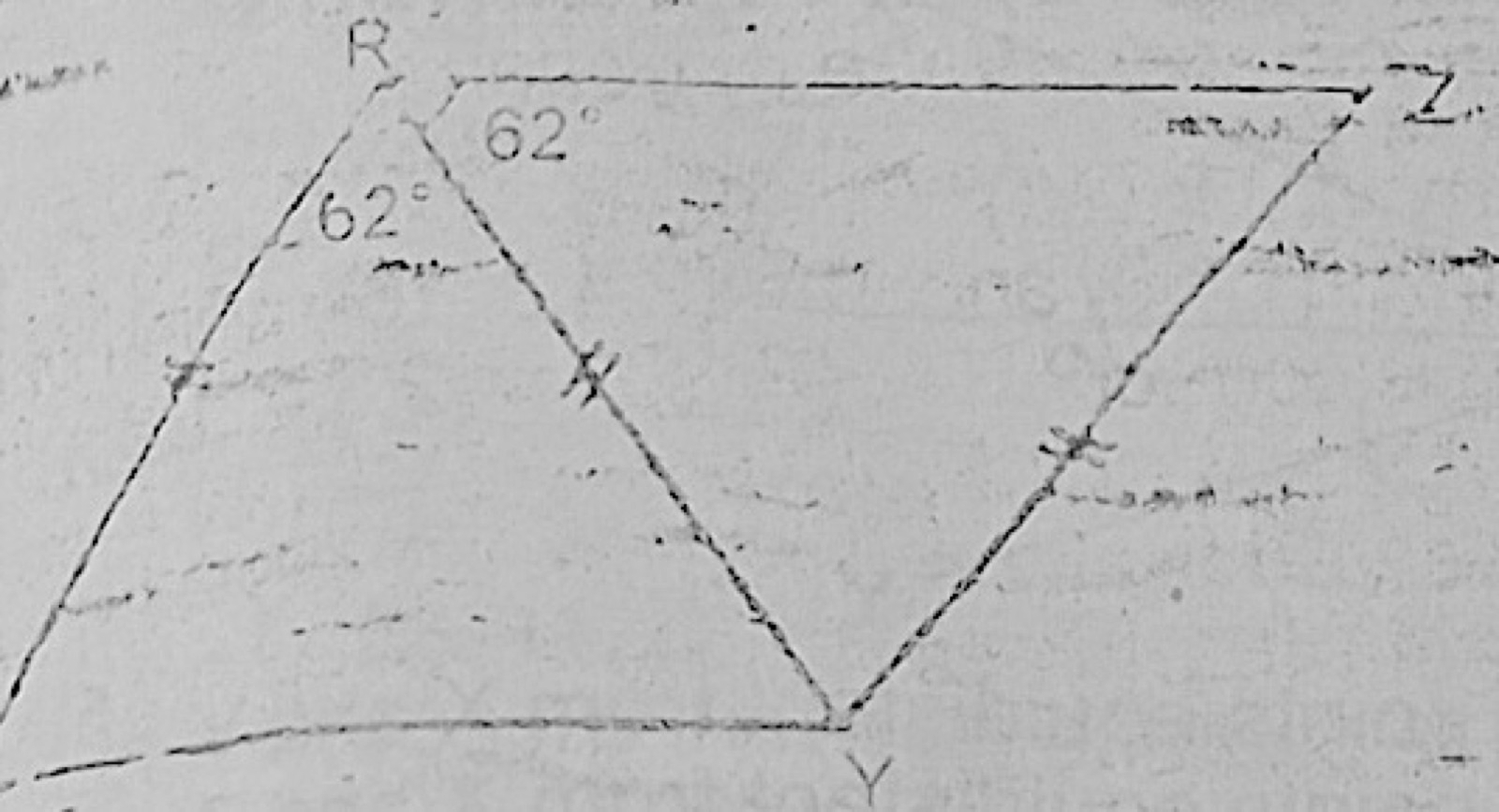
Answer: D (115°)
Triangle XRY is isosceles with apex 62°, so ∠RYX = 59°. Triangle RYZ has RY = YZ, so ∠YZR = 62° and ∠RYZ = 56°. ∠XYZ = 59 + 56 = 115°.
In the diagram, RST is a tangent to circle VSU centre O. ∠SVU = 50° and UV is a diameter. Calculate ∠RSV
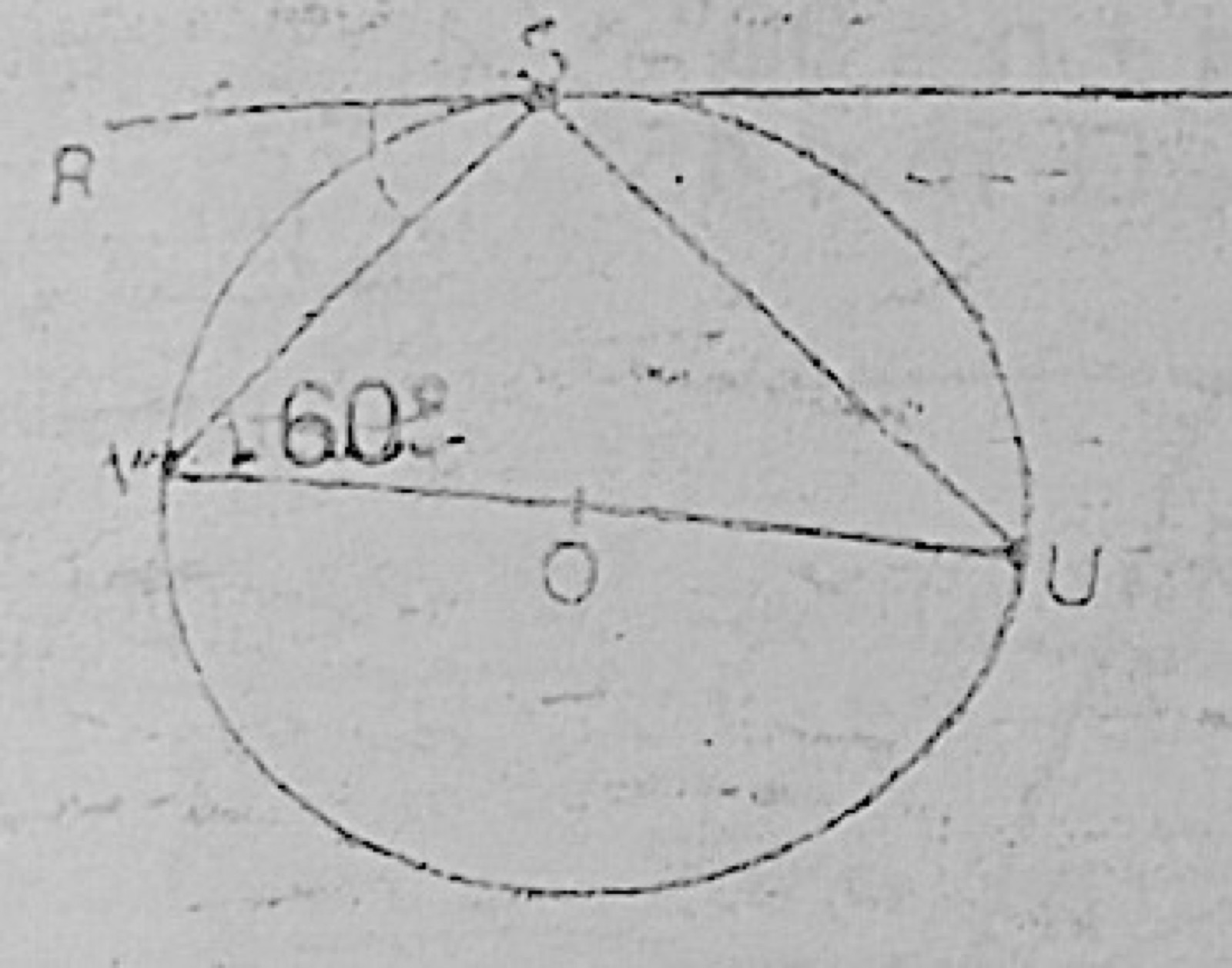
Answer: D (40°.)
∠VSU = 90° (angle in a semicircle), so ∠SUV = 40°. The angle between tangent and chord, ∠RSV, equals ∠SUV in the alternate segment: 40°.
Calculate the value of y from the diagram

Answer: C (48°)
Through the vertex of y draw a line parallel to the two given lines. One arm of y makes 180 − 105 = 75° with it and the other makes 180 − 123 = 57° with it on the other side, so y = 180 − 75 − 57 = 48°.
In the diagram, PQR is a circle with centre O. ∠QPR = 50°, ∠PQO = 30° and ∠ORP = m. Find m.
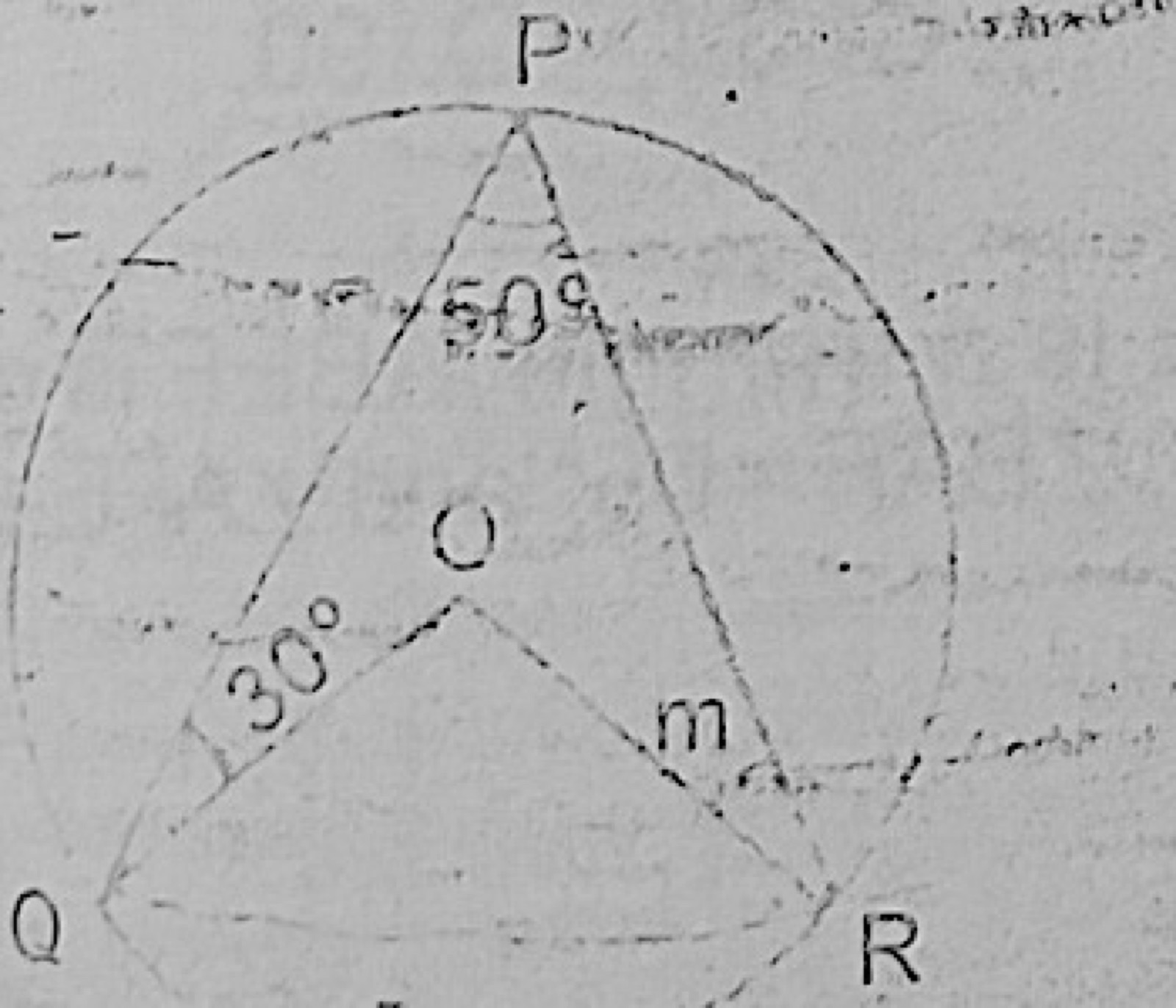
Answer: A (20°)
OP = OQ, so ∠OPQ = 30° and ∠OPR = 50 − 30 = 20°. OP = OR, so ∠ORP = 20°.
Given that m = −3 and n = 2, find the value of (3n2 − 2m3)/m
Answer: A (−22)
3n2 = 12 and 2m3 = −54, so the numerator is 12 + 54 = 66. 66 ÷ (−3) = −22.
Simplify (2 − 18m2)/(1 + 3m)
Answer: C (2(1 − 3m))
2 − 18m2 = 2(1 − 9m2) = 2(1 − 3m)(1 + 3m); cancel (1 + 3m) to get 2(1 − 3m).
If y = √(ax − b) express x in terms of y, a and b.
Answer: D (x = (y2 + b)/a)
Square both sides: y2 = ax − b, so ax = y2 + b and x = (y2 + b)/a.
Simplify 4/(x + 1) − 3/(x − 1)
Answer: C ((x − 7)/(x2 − 1))
Common denominator (x + 1)(x − 1) = x2 − 1. Numerator: 4(x − 1) − 3(x + 1) = x − 7.
If y varies inversely as x2, how does x vary with y?
Answer: B (x varies inversely as √y)
y = k/x2 gives x2 = k/y, so x = √k/√y: x varies inversely as √y.
If tan x = 1/√3, find cos x − sin x such that 0° ≤ x ≤ 90°
Answer: C ((√3 − 1)/2)
tan x = 1/√3 means x = 30°. cos 30° − sin 30° = √3/2 − 1/2 = (√3 − 1)/2.
From the top of a cliff 20m high, a boat can be sighted at sea 75m from the foot of the cliff. Calculate the angle of depression of the boat from the top of the cliff.
Answer: A (14.9°)
tan θ = 20/75 ≈ 0.2667, so θ ≈ 14.9°.
From the diagram below. ABC is a triangle inscribed in a circle centre O. ∠ACB = 40° and |AB| = x cm. Calculate the radius of the circle.
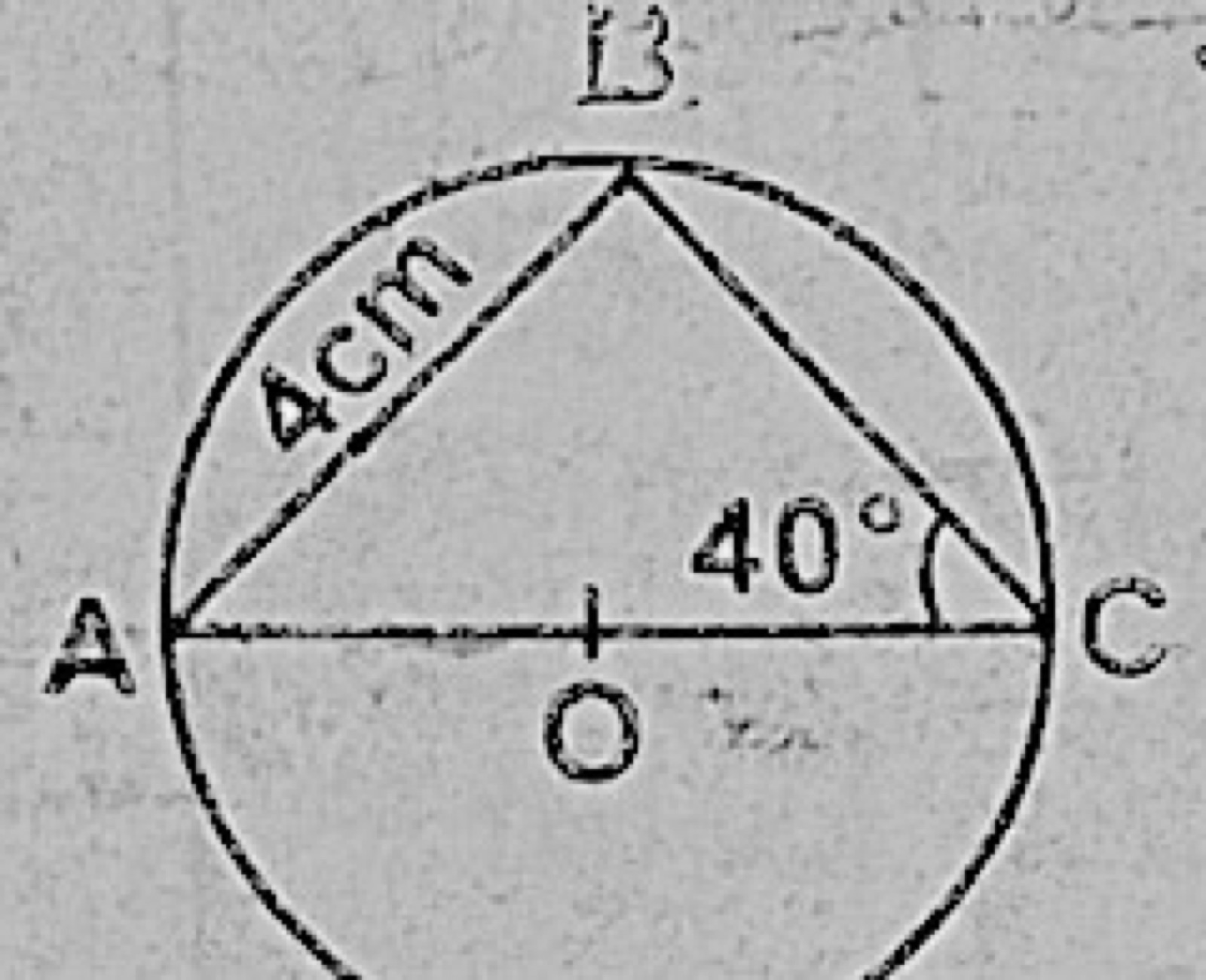
Answer: C (x/(2 sin 40°))
By the sine rule, AB/sin C = 2R (the diameter). So 2R = x/sin 40° and R = x/(2 sin 40°).
The diagram shows the position of three ships A, B and C at sea. B is due north of C such that |AB| = |BC| and the bearing of B from A = 040°. What is the bearing of A from C?
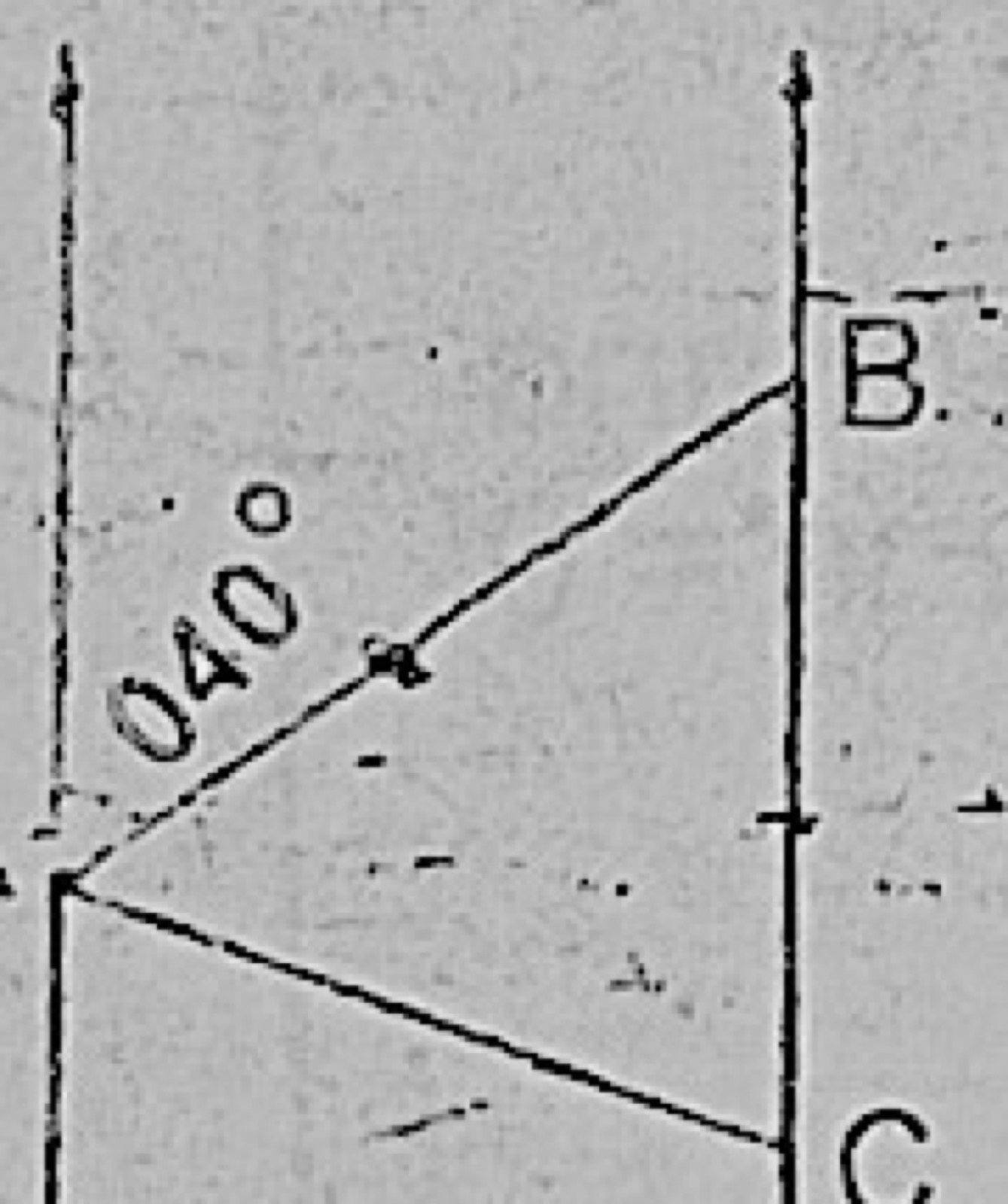
Answer: D (290°)
∠ABC = 40° (from the north–south line at B), so the equal base angles are 70°. A is 70° west of north from C: bearing 360 − 70 = 290°.
In the diagram, PQST and QRST are parallelograms. Calculate the area of the trapezium PRST.
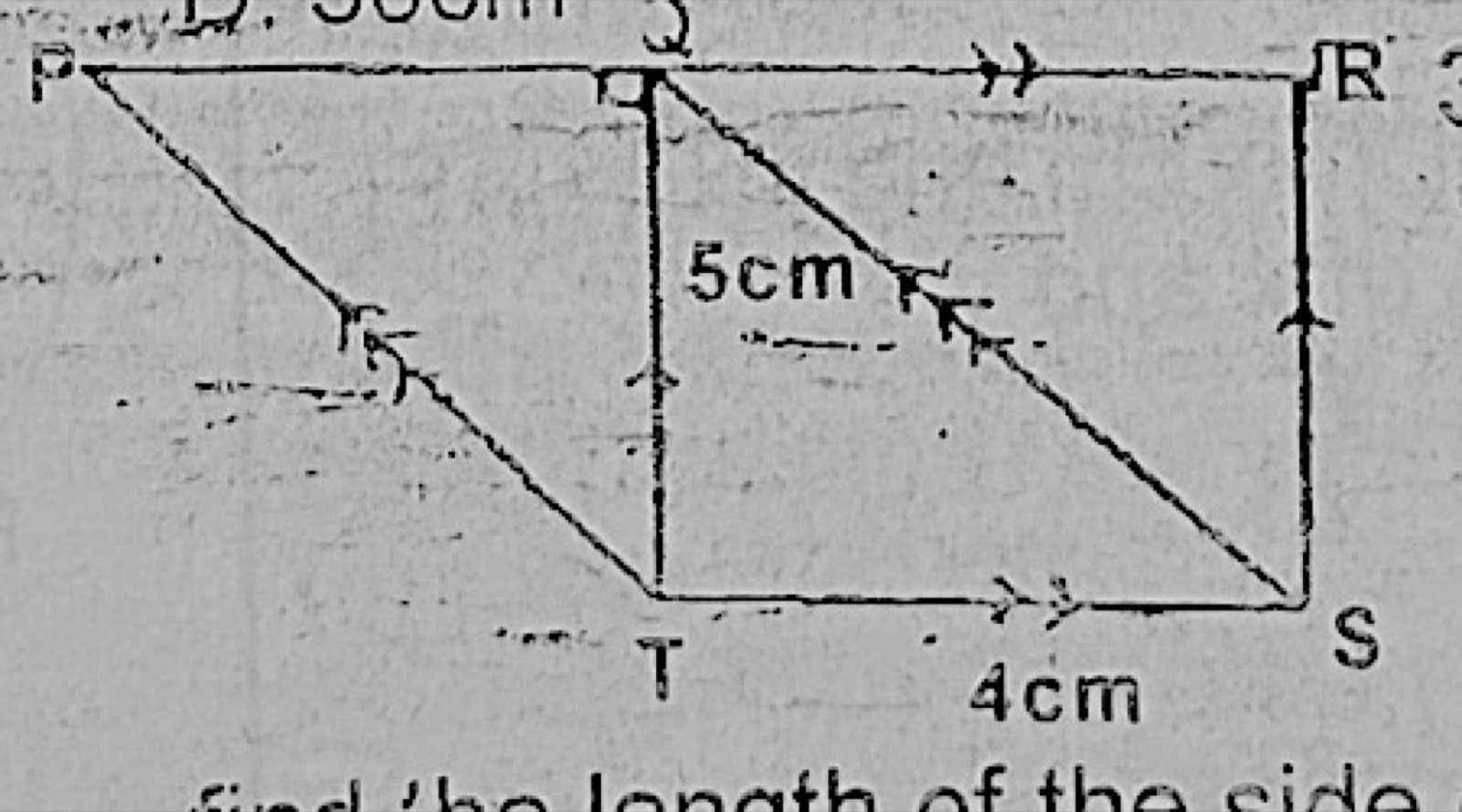
Answer: D (30cm2)
PQ = QR = TS = 4 cm, so PR = 8 cm; the height QT is 5 cm. Area = ½(8 + 4) × 5 = 30 cm2.
The height of a pyramid on a square base is 15cm. If the volume is 80cm3, find the length of the side of the base
Answer: C (4.0cm)
V = ⅓ × s2 × 15 = 5s2 = 80, so s2 = 16 and s = 4 cm.
Simplify 3.72 × 0.025 and express your answer in the standard form.
Answer: C (9.3 × 10⁻²)
3.72 × 0.025 = 0.093 = 9.3 × 10⁻².
Two numbers 24 and 31 are equal in value when converted to base ten. Find the equation connecting x and y.
Answer: A (2x = 3(y − 1))
24x = 2x + 4 and 31y = 3y + 1. Setting them equal: 2x = 3y − 3 = 3(y − 1).
A car travels at x km per hour for 1 hour and at y km per hour for 2 hours. Find its average speed.
Answer: C ((x + 2y)/3 km h−1)
Total distance = x + 2y km in 3 hours, so average speed = (x + 2y)/3 km/h.
The height and base of a triangle are in ratio 1 : 3 respectively. If the area of the triangle is 216cm2, find the length of the base.
Answer: B (36cm)
Let height = h, base = 3h. ½ × 3h × h = 216, so h2 = 144, h = 12 and the base is 36 cm.
Water flows from a tap into a cylindrical container at the rate of 5π cm3 per second. If the radius of the container is 3cm, calculate the level of water in the container at the end of 9 seconds.
Answer: B (5cm)
Volume after 9 s = 45π cm3 = π × 32 × h, so h = 45/9 = 5 cm.
Amina had m mangoes. She ate 3 and shared the remainder equally with her brother Uche. Each had at least 10. Which of the following inequalities represents the statements above.
Answer: C ((m − 3)/2 ≥ 10)
After eating 3 she has m − 3, and each share is (m − 3)/2. 'At least 10' means ≥ 10.
Which of the following pairs of inequalities is represented on the number line?
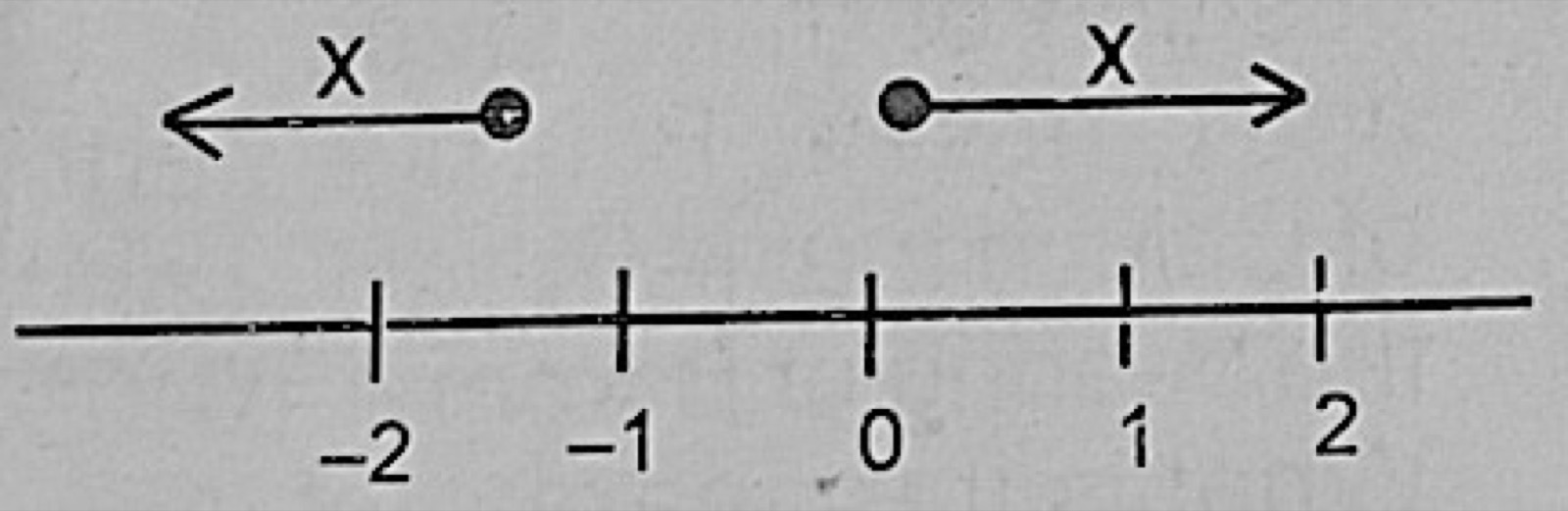
Answer: C (x ≤ −2 and x ≥ 1)
Both end points are shaded dots, so −2 and 1 are included: x ≤ −2 and x ≥ 1.
If x2 + 15x + 50 = ax2 + bx + c = 0, which of the following statements is not true?
Answer: B (x = 10)
x2 + 15x + 50 = (x + 5)(x + 10), so the roots are −5 and −10, not 10. Also b = 15 and c = 50, so bc = 750.
The roots of a quadratic equation in x, are −m and 2n. Find the equation.
Answer: A (x2 + x(m − 2n) − 2mn = 0)
(x + m)(x − 2n) = x2 + (m − 2n)x − 2mn = 0.
A survey shows that 28% of all the men in a village wear size 9 shoes. What is the probability that a man selected at random in the village wears size 9 shoes?
Answer: A (7/25)
28% = 28/100 = 7/25.
Solve the inequality 2x + 3 < 5x.
Answer: A (x > 1)
Subtract 2x: 3 < 3x, so x > 1.
In the diagram, DE||BC, |AD| = x cm and |DB| = |AE| = y cm. Find |CE| in terms of x and y.
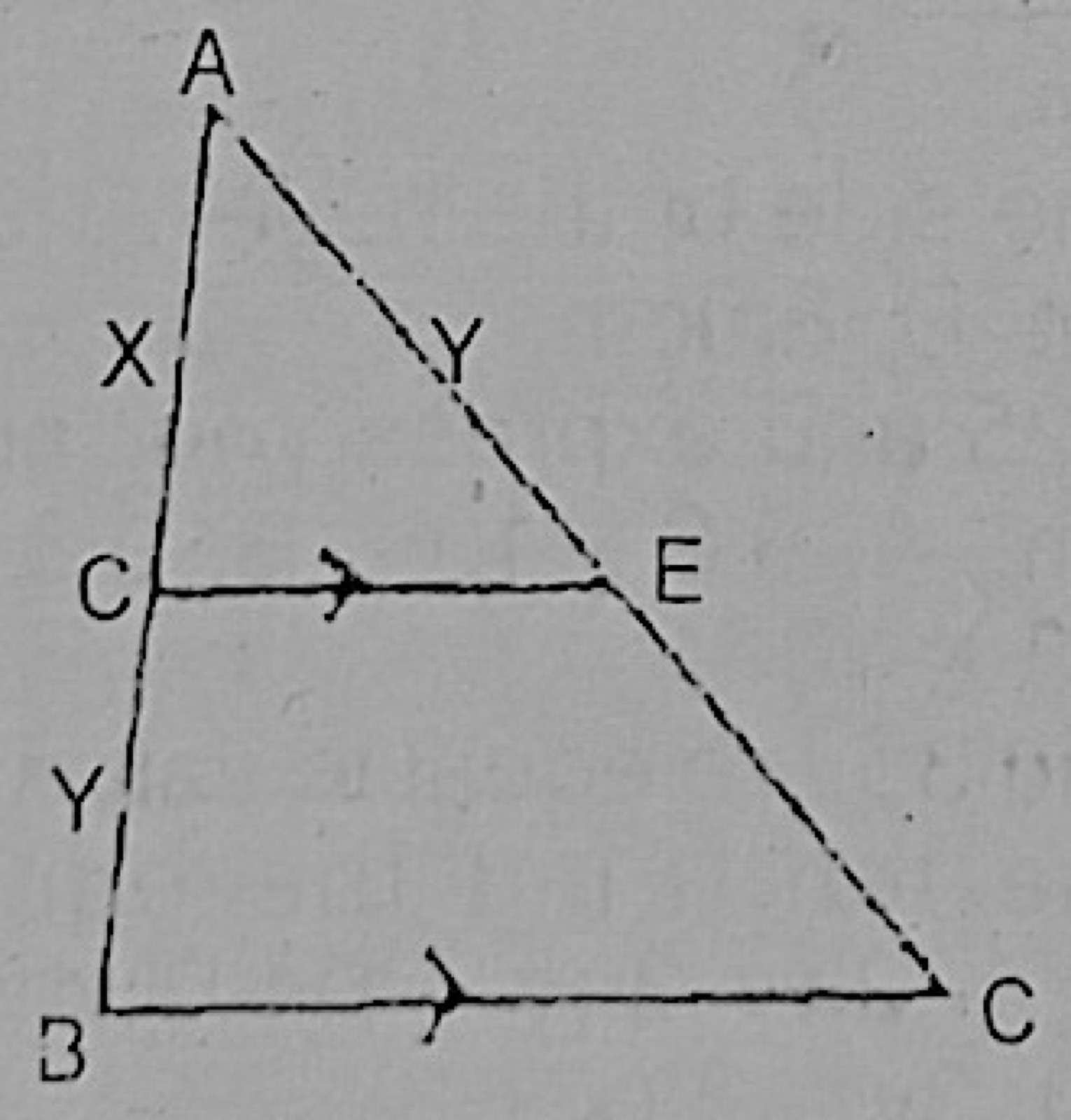
Answer: D (y2/x)
A line parallel to BC divides the sides in the same ratio: AD/DB = AE/EC, so x/y = y/CE and CE = y2/x.
Describe the locus L shown in the diagram below.
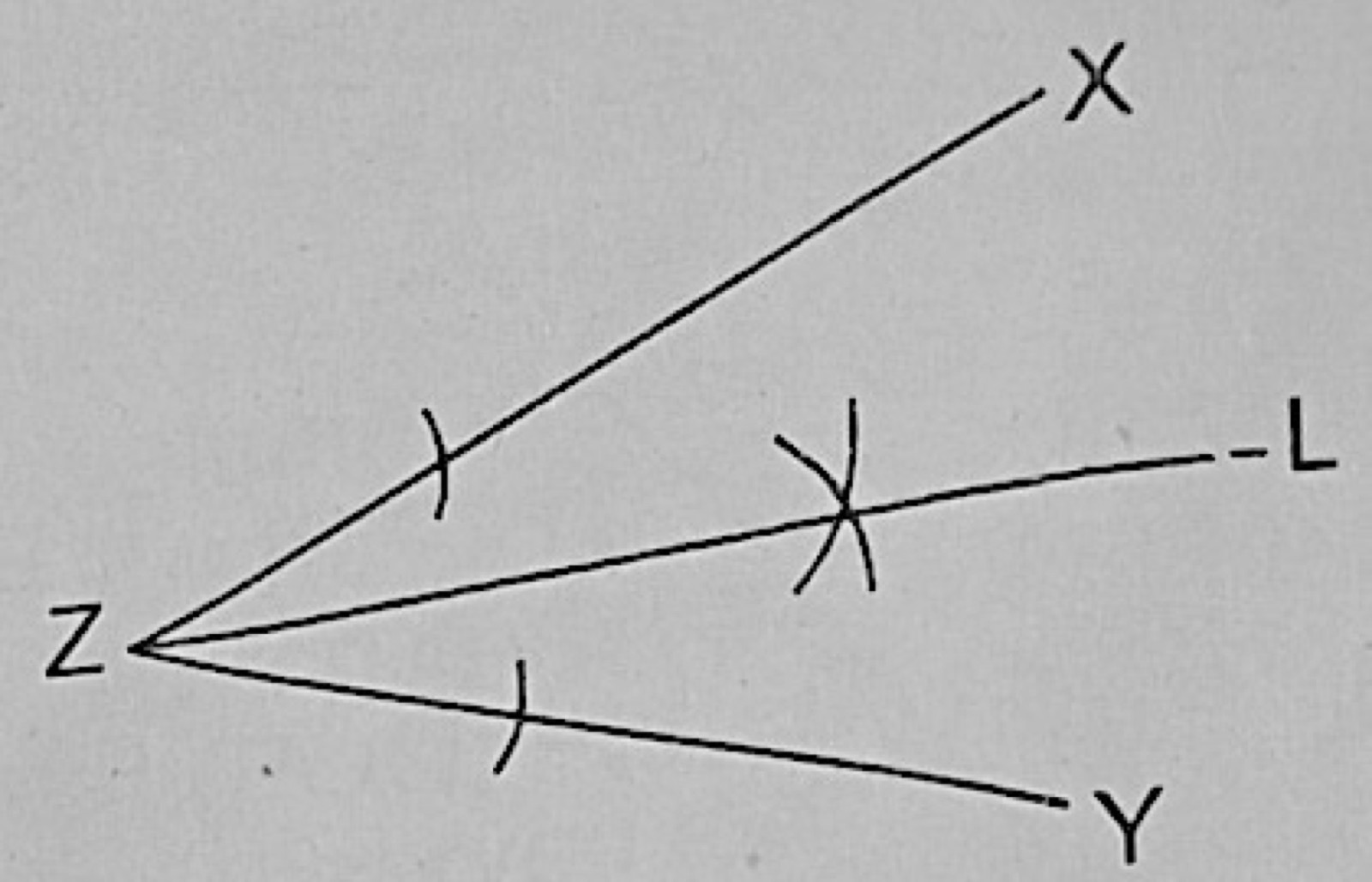
Answer: C (Locus of points equidistant from ZX and ZY)
L is the bisector of angle XZY, and every point on an angle bisector is the same distance from the two arms ZX and ZY.
Which of the following statements is true from the diagram below?
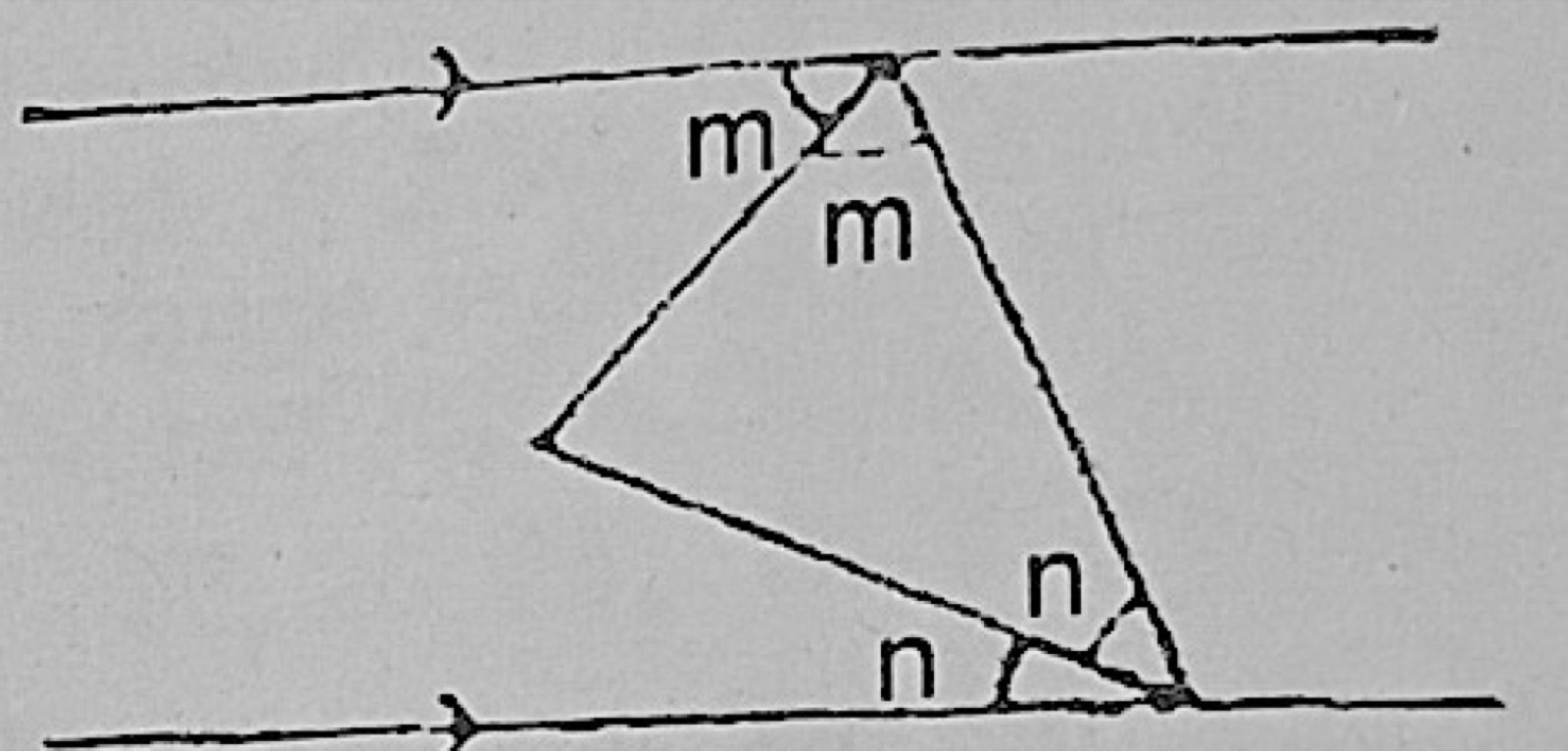
Answer: A (m + n = 90°)
The co-interior angles between the parallel lines add to 180°: 2m + 2n = 180°, so m + n = 90°.
In the diagram, O is the centre of the circle. ∠PQR = 75°, ∠OPS = y° and OR is parallel to PS. Find y.
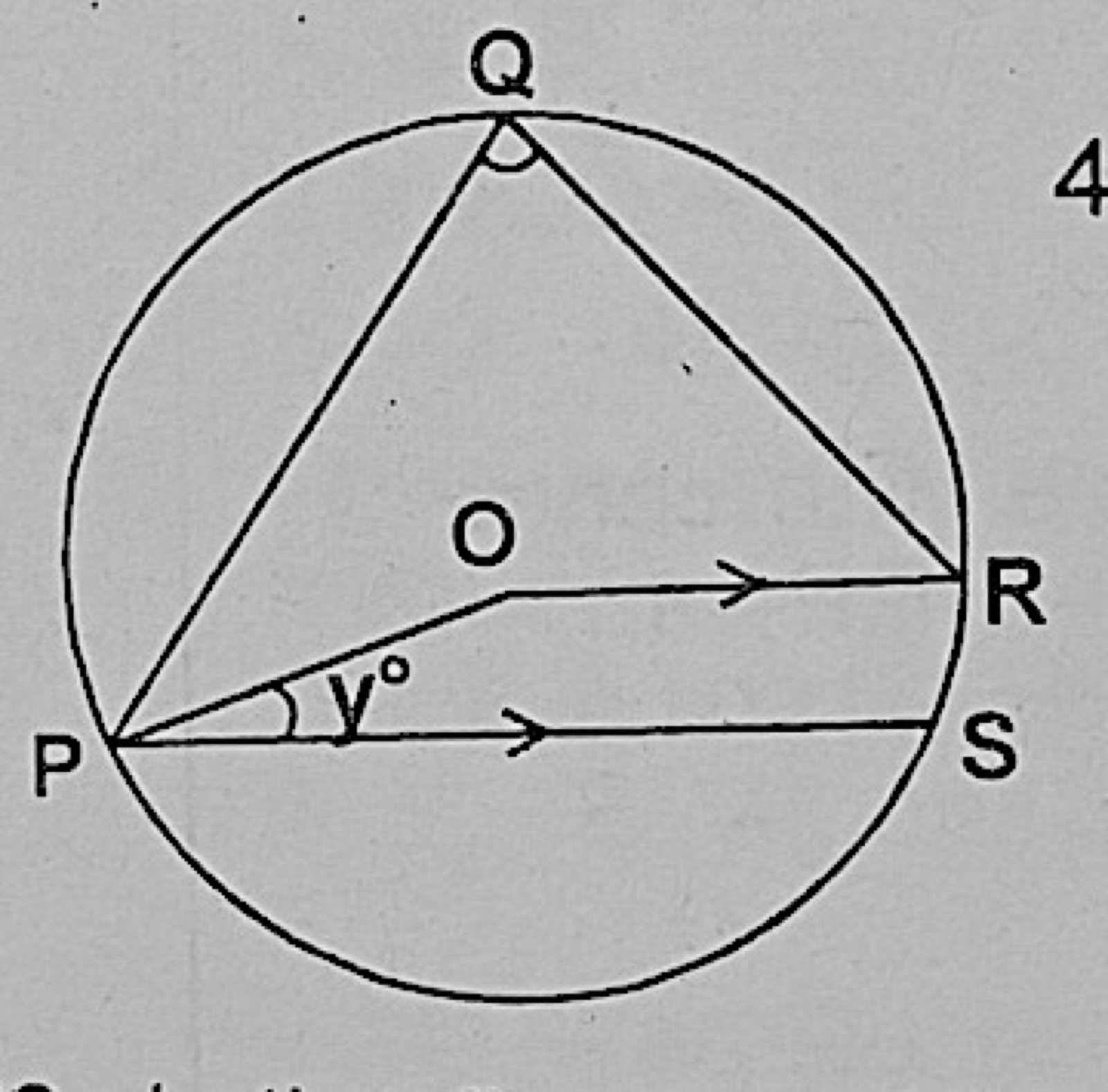
Answer: B (30)
∠POR = 2 × 75° = 150° (angle at centre). OR ∥ PS, so ∠OPS and ∠POR are co-interior: y = 180 − 150 = 30.
The sides of a right-angle triangle, in ascending order of magnitude are 8cm, (x − 2) cm and x cm. Find x.
Answer: B (17)
By Pythagoras, 82 + (x − 2)2 = x2: 64 + x2 − 4x + 4 = x2, so 4x = 68 and x = 17.
In the diagram, CDE is a triangle, ABEF is cyclic quadrilateral, AB || CD, ∠BAF = 65° and ∠AFE = 85°. Calculate ∠CDE
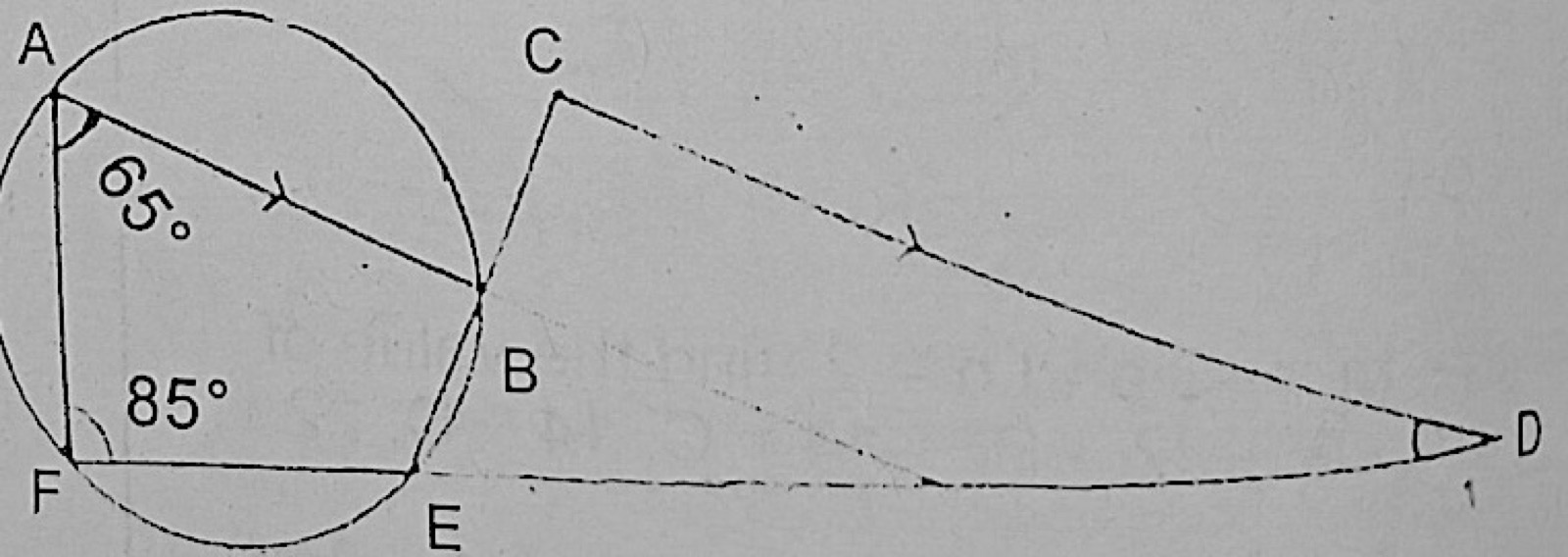
Answer: B (30°)
Opposite angles of ABEF: ∠ABE = 95° and ∠BEF = 115°, so ∠CED = 65° and ∠ABC = 85°. AB ∥ CD gives ∠BCD = 85°, so ∠CDE = 180 − 85 − 65 = 30°.
(b) Evaluate log5(3/5) + 3log5(15/2) − log5(81/8)
Combine: log5[3/5 × (15/2)3 ÷ 81/8] = log5[3/5 × 3375/8 × 8/81].
3 × 3375/(5 × 81) = 10125/405 = 25.
log525 = log552 = 2.
Turn the coefficient 3 into a power first, then combine into a single log.
(a) If a is the set {1, 2, 3, ……, 19, 20} and A, B and C are subsets of a such that A = {multiples of five}, B = {multiples of four}, C = {multiples of three}, list the elements of (i) A (ii) B (iii) C
(b) Find; (i) A∩B (ii) A∩C (iii) B∪C
(c) Using your results in (b) show that (A∩B) ∪ (A∩C) = A∩(B∪C).
(a)(i) A = {5, 10, 15, 20} (ii) B = {4, 8, 12, 16, 20} (iii) C = {3, 6, 9, 12, 15, 18}.
(b)(i) A∩B = {20} (ii) A∩C = {15} (iii) B∪C = {3, 4, 6, 8, 9, 12, 15, 16, 18, 20}.
(c) (A∩B) ∪ (A∩C) = {20} ∪ {15} = {15, 20}.
A∩(B∪C): the elements of A that are in B∪C are 15 and 20, so A∩(B∪C) = {15, 20}. The two sets are equal.
Work out both sides separately and show they contain the same elements.
ABC is a triangle right-angled at C. P is the mid-point of AC, ∠PBC = 37° and |BC| = 5cm. Calculate: (a) |AC| correct to 3 significant figures (b) ∠PBA.
(a) In triangle PBC: PC = 5 tan 37° = 5 × 0.7536 = 3.768 cm.
AC = 2 × PC = 7.536 ≈ 7.54 cm.
(b) tan ∠ABC = AC/BC = 7.536/5 = 1.507, so ∠ABC ≈ 56.4°.
∠PBA = ∠ABC − ∠PBC = 56.4 − 37 = 19.4°.
∠PBA is the part of angle B between BA and BP, so subtract 37° from the whole angle at B.
In the diagram, ABCD is a trapezium in which AD//BC and ∠ABC is a right angle. If |AD| = 15cm, |BD| = 17cm and |BC| = 9cm, calculate (a) |AB|. (b) the area of the triangle BCD. (c) |CD|. (d) the perimeter of the trapezium.
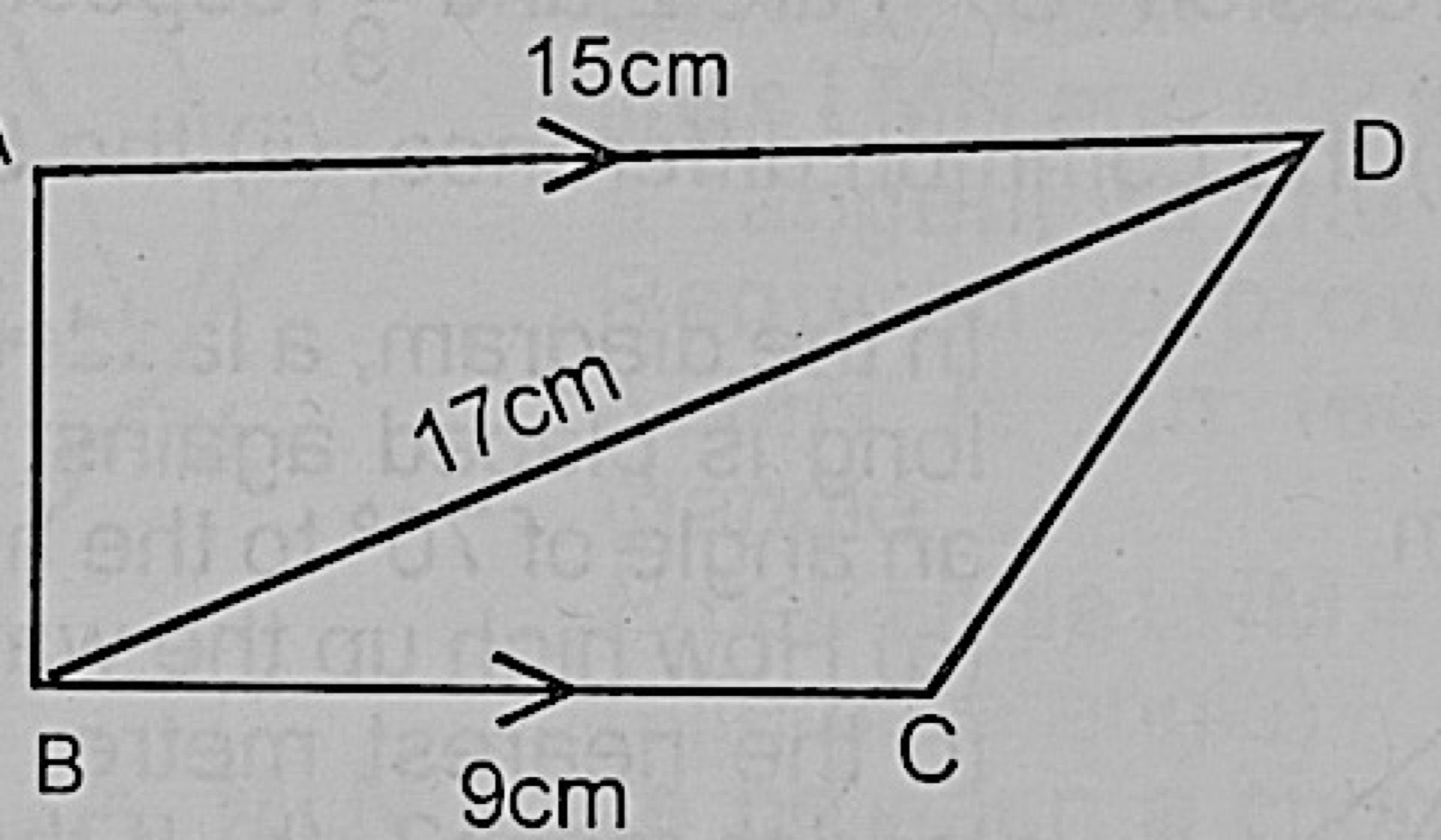
(a) ∠BAD = 90° (AD ∥ BC), so AB = √(172 − 152) = √64 = 8 cm.
(b) Area BCD = ½ × BC × AB = ½ × 9 × 8 = 36 cm2.
(c) Drop a perpendicular from C to AD: horizontal gap = 15 − 9 = 6 cm, height 8 cm, so CD = √(62 + 82) = 10 cm.
(d) Perimeter = 15 + 8 + 9 + 10 = 42 cm.
The height of triangle BCD on base BC is the trapezium's height AB.
(a) Solve the simultaneous equations 3y − 2x = 21; 4y + 5x = 5.
(b) Six identical cards numbered 1–6 are placed face down. A card is to be picked at random. A person wins $60.00 if he picks the card numbered 6. If he picks any of the other cards, he loses $10.00 times the number on the card. Calculate the probability that he: (i) loses (ii) loses $20.00.
(a) Multiply the first by 5 and the second by 2: 15y − 10x = 105 and 8y + 10x = 10. Add: 23y = 115, y = 5.
Then 2x = 3(5) − 21 = −6, x = −3.
(b)(i) He loses with any card from 1 to 5: P = 5/6.
(ii) He loses $20 only with card 2: P = 1/6.
Make the x coefficients equal and opposite, then add.
The table gives the frequency distribution of marks obtained by a group of students in a test.
Marks: 3, 4, 5, 6, 7, 8
Frequency: 5, x−1, x, 9, 4, 1
If the mean mark is 5, (a) Calculate the value of x. (b) find the: (i) mode: (ii) median of the distribution (c) If one of the students is selected at random, find the probability that he scored at least 7 marks
(a) Σf = 2x + 18; Σfx = 15 + 4(x − 1) + 5x + 54 + 28 + 8 = 9x + 101.
(9x + 101)/(2x + 18) = 5 gives 9x + 101 = 10x + 90, so x = 11.
(b) Frequencies are 5, 10, 11, 9, 4, 1 (total 40).
(i) Mode = 5 (highest frequency, 11).
(ii) The 20th and 21st marks are both 5 (cumulative 5, 15, 26…), so median = 5.
(c) At least 7 marks: 4 + 1 = 5 students. P = 5/40 = 1/8.
Set up mean = Σfx ÷ Σf with x still unknown, then solve.
(a) A cylindrical pipe is 28 metres long. Its internal radius is 3.5cm and external radius 5cm, calculate: (i) the volume, in cm3, of metal used in making the pipe; (ii) the volume of water in litres that the pipe can hold when full, correct to 1 decimal place. [Take π = 22/7].
(b) In the diagram, MP is a tangent to the circle LMN at M. If the chord LN is parallel to MP, show that the triangle LMN is isosceles.
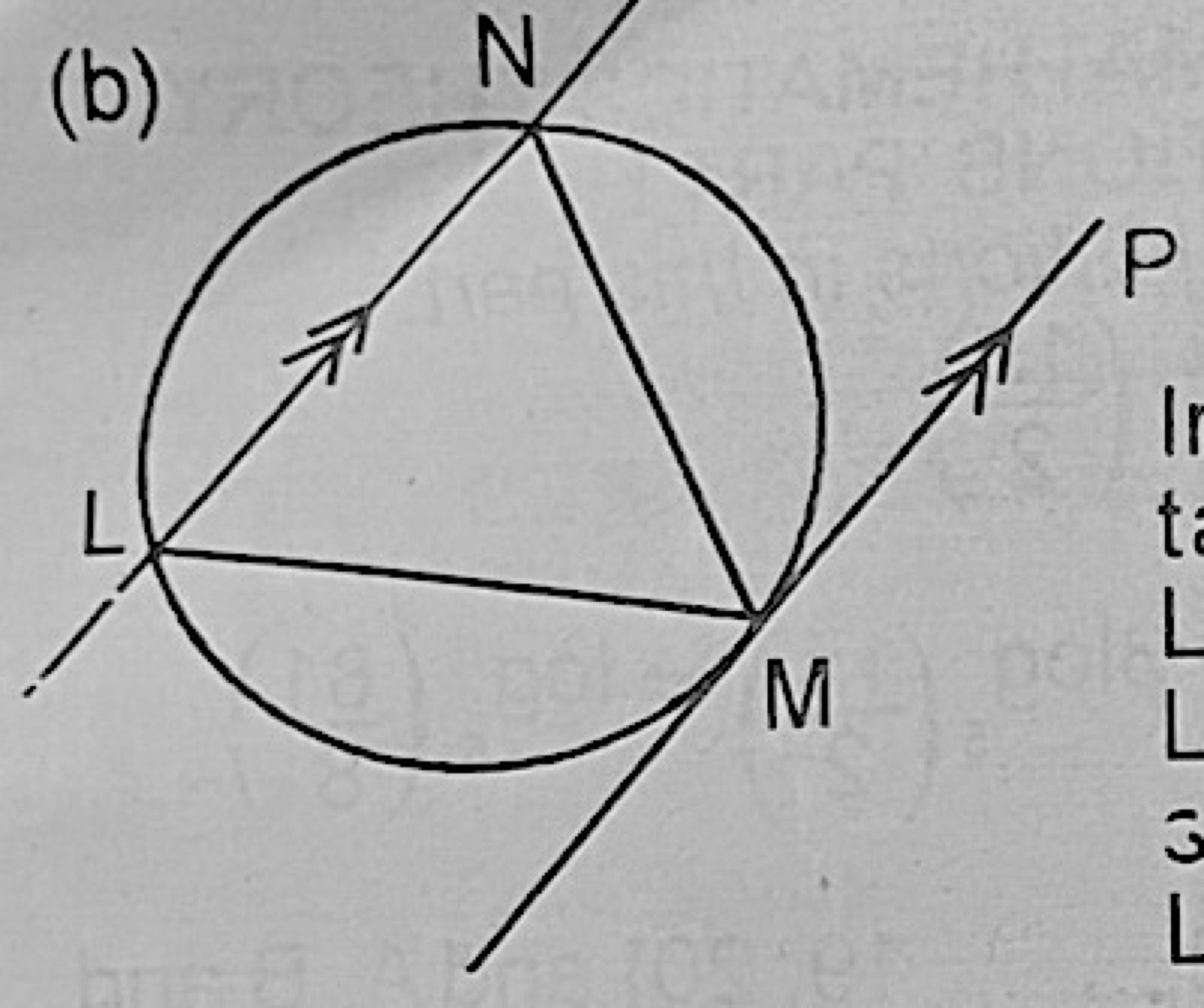
(a) Length = 28 m = 2800 cm.
(i) Metal = π(R2 − r2)h = 22/7 × (25 − 12.25) × 2800 = 112,200 cm3.
(ii) Water = πr2h = 22/7 × 12.25 × 2800 = 107,800 cm3 = 107.8 litres.
(b) ∠PMN = ∠MLN (angle between tangent and chord equals the angle in the alternate segment).
LN ∥ MP, so ∠PMN = ∠MNL (alternate angles).
Hence ∠MLN = ∠MNL, so ML = MN and triangle LMN is isosceles.
Convert the length to centimetres before multiplying; 1000 cm³ = 1 litre.
(a) Given that sin (A + B) = sin A cos B + cos A sin B, without using mathematical tables or calculator, evaluate sin 105°, leaving your answer in the surd form. (You may use 105° = 60° + 45°).
(b) The houses on the side of a particular street are assigned odd numbers, starting from 11. If the sum of the numbers is 551, how many houses are there?
(c) The 1st and 3rd term of a Geometric Progression (G.P.) are 2 and 2/9 respectively. Find: (i) the common difference, (ii) the 5th term
(a) sin 105° = sin 60° cos 45° + cos 60° sin 45° = (√3/2)(√2/2) + (1/2)(√2/2) = (√6 + √2)/4.
(b) An A.P. with a = 11, d = 2: Sn = n/2[22 + 2(n − 1)] = n(n + 10) = 551.
n2 + 10n − 551 = 0, (n + 29)(n − 19) = 0, so n = 19 houses.
(c)(i) ar2 = 2/9 with a = 2, so r2 = 1/9 and the common ratio r = ±1/3.
(ii) T5 = ar4 = 2 × 1/81 = 2/81.
In a G.P. you look for a common ratio, not a common difference.
In the diagram, a ladder TF, 10m long is placed against a wall at an angle of 70° to the horizontal. (a) How high up the wall, correct to the nearest metre, does the ladder reach? (b) If the foot (F) of the ladder is pulled from the wall to F1 by 1 metre. (i) how far, correct to 2 significant figures, does the top T, slide down the wall to T1 (ii) Calculate, correct to the nearest degree, ∠QF1T1.
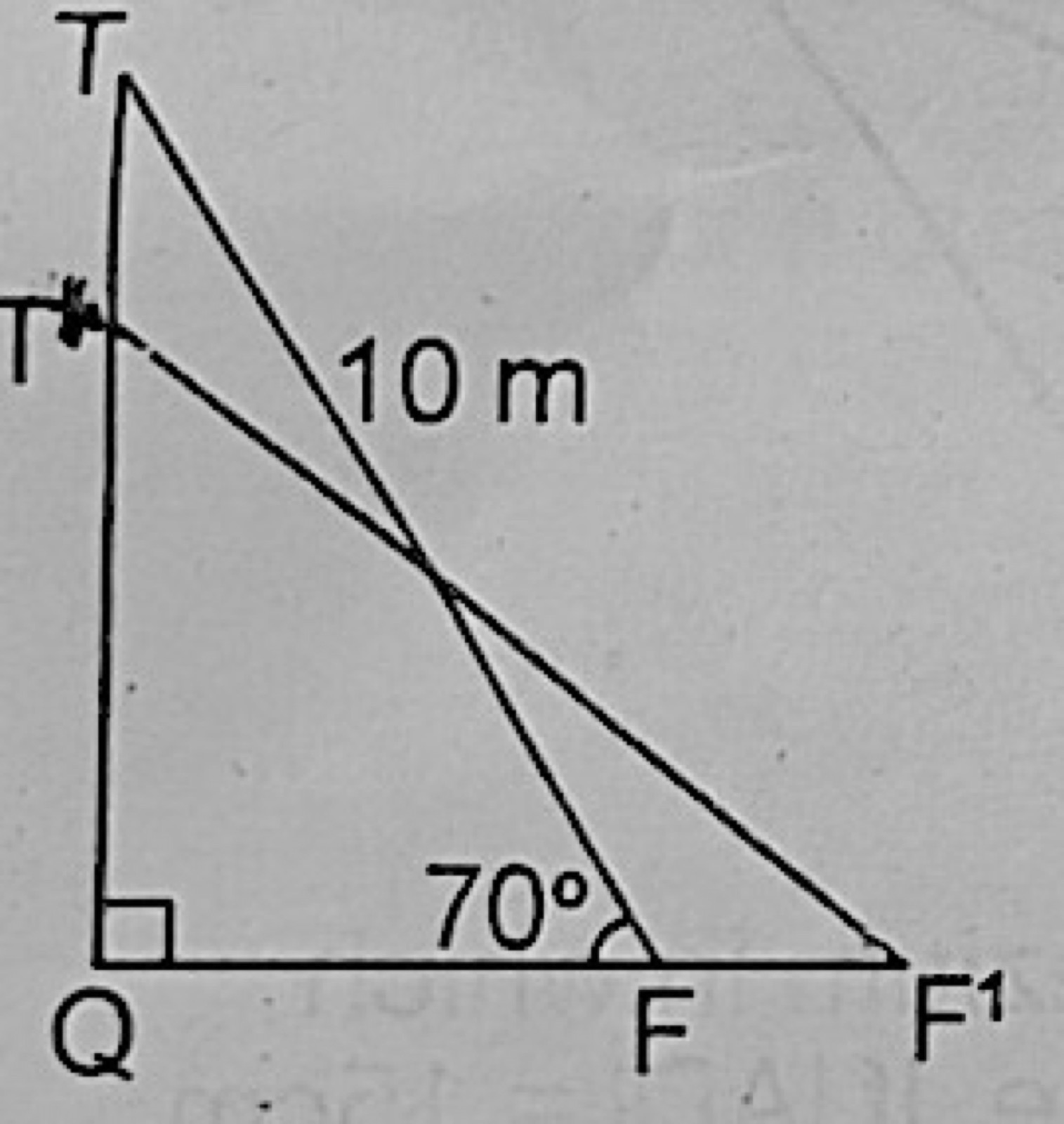
(a) QT = 10 sin 70° = 9.397 ≈ 9 m.
(b) QF = 10 cos 70° = 3.420 m, so QF1 = 4.420 m.
(i) QT1 = √(102 − 4.4202) = √80.46 = 8.970 m. Slide = 9.397 − 8.970 = 0.427 ≈ 0.43 m.
(ii) cos ∠QF1T1 = 4.420/10 = 0.442, so the angle ≈ 64°.
The ladder's length stays 10 m, so use Pythagoras for the new height.
The cost of maintaining a school is partly constant and partly varies as the number of pupils. With 50 pupils, the cost is $15,705.00 and with 40 pupils, it is $13,305.00. (a) Find the cost when there are 44 pupils. (b) If the fee per pupil is $360.00, what is the least number of pupils for which the school can be run without loss?
Let C = a + kn.
a + 50k = 15705 and a + 40k = 13305. Subtract: 10k = 2400, k = 240; a = 15705 − 12000 = 3705.
(a) C = 3705 + 240 × 44 = $14,265.00.
(b) Need 360n ≥ 3705 + 240n, so 120n ≥ 3705 and n ≥ 30.9. Least number = 31 pupils.
'Partly constant and partly varies' means C = a + kn.
On a graph sheet, using a scale of 2cm to 2 units on both axes. (a) draw the straight line joining points P (−5,3) and Q (2,3); (b) construct the locus L of points equidistant from P and Q; (c) by construction, locate points R and S on L, such that PRQS form a rhombus of sides 5cm; (d) find; (i) coordinates of R and S; (ii) area of the rhombus in cm2.
(a) PQ is horizontal, length 7 units.
(b) L is the perpendicular bisector of PQ: the line x = −1.5.
(c) With centres P and Q and radius 5 units, draw arcs cutting L at R (above) and S (below).
(d)(i) Vertical distance = √(52 − 3.52) = √12.75 ≈ 3.57, so R ≈ (−1.5, 6.6) and S ≈ (−1.5, −0.6).
(ii) Area = ½ × PQ × RS = ½ × 7 × 7.14 ≈ 25.0 cm2 (1 unit = 1 cm on this scale).
Every point of a rhombus diagonal's perpendicular bisector is equidistant from its ends, so R and S lie on L.
(a) A shop-owner marked a shirt at a price to enable him make a gain of 20%. During a special sales period, the shirt was sold at 10% reduction to a customer for N864.00. What was the original cost to the shop-owner?
(b) A rectangular lawn of length (x + 5) metres is (x − 2) metres wide. If the diagonal is (x + 6) metres, find; (i) the value of x (ii) the area of the lawn.
(a) Marked price = 1.2C; sale price = 0.9 × 1.2C = 1.08C = 864, so C = N800.00.
(b)(i) (x + 5)2 + (x − 2)2 = (x + 6)2 gives x2 − 6x − 7 = 0, (x − 7)(x + 1) = 0, so x = 7 (x = −1 makes the width negative).
(ii) Length 12 m, width 5 m: area = 60 m2.
Work back from the sale price: each percentage change multiplies the price.