Theory question 107
Mensuration of Solids(a) A cylindrical pipe is 28 metres long. Its internal radius is 3.5cm and external radius 5cm, calculate: (i) the volume, in cm3, of metal used in making the pipe; (ii) the volume of water in litres that the pipe can hold when full, correct to 1 decimal place. [Take π = 22/7].
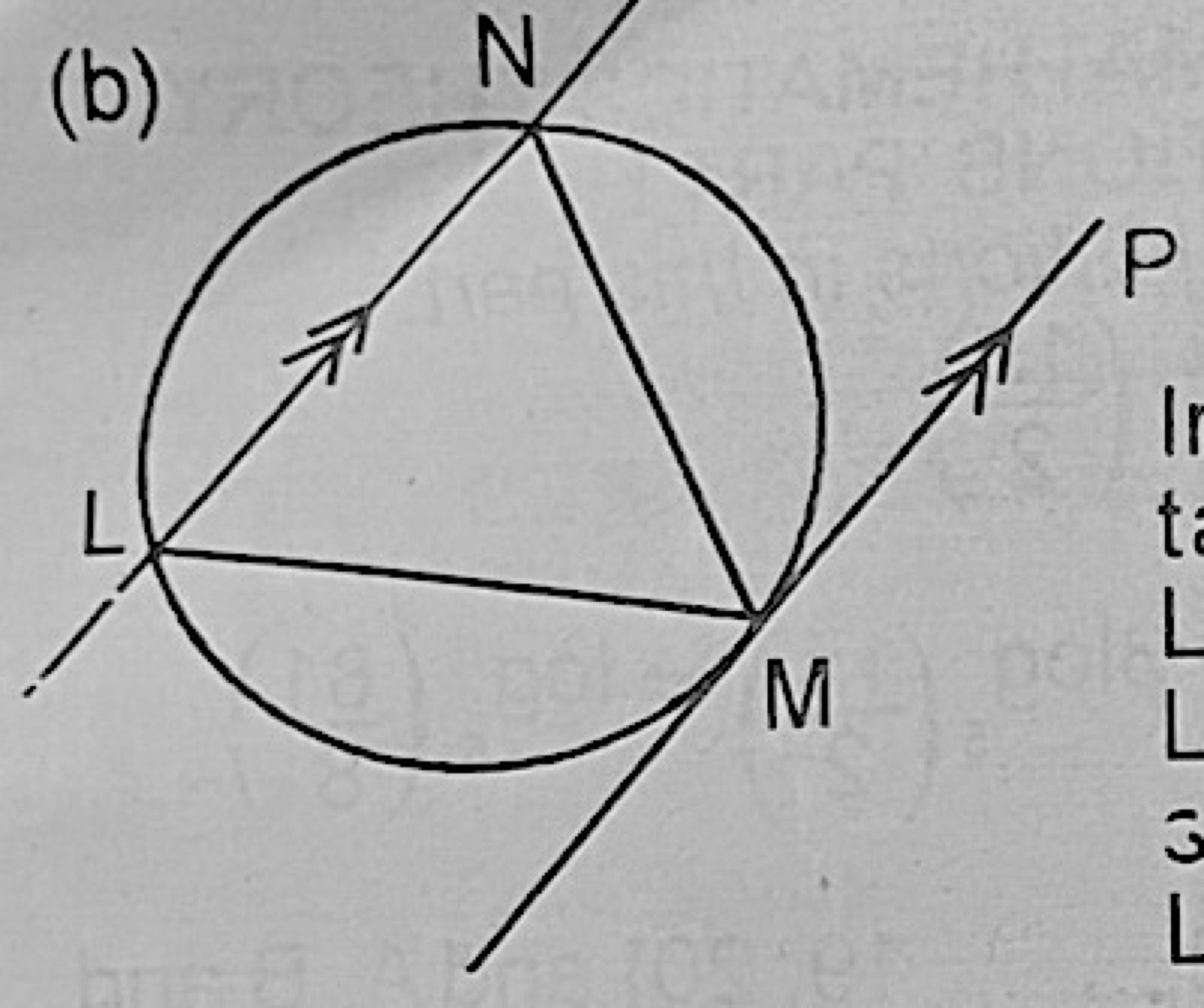
(b) In the diagram, MP is a tangent to the circle LMN at M. If the chord LN is parallel to MP, show that the triangle LMN is isosceles.
Show the model answer
(a) Length = 28 m = 2800 cm.
(i) Metal = π(R2 − r2)h = 22/7 × (25 − 12.25) × 2800 = 112,200 cm3.
(ii) Water = πr2h = 22/7 × 12.25 × 2800 = 107,800 cm3 = 107.8 litres.
(b) ∠PMN = ∠MLN (angle between tangent and chord equals the angle in the alternate segment).
LN ∥ MP, so ∠PMN = ∠MNL (alternate angles).
Hence ∠MLN = ∠MNL, so ML = MN and triangle LMN is isosceles.
Convert the length to centimetres before multiplying; 1000 cm³ = 1 litre.